
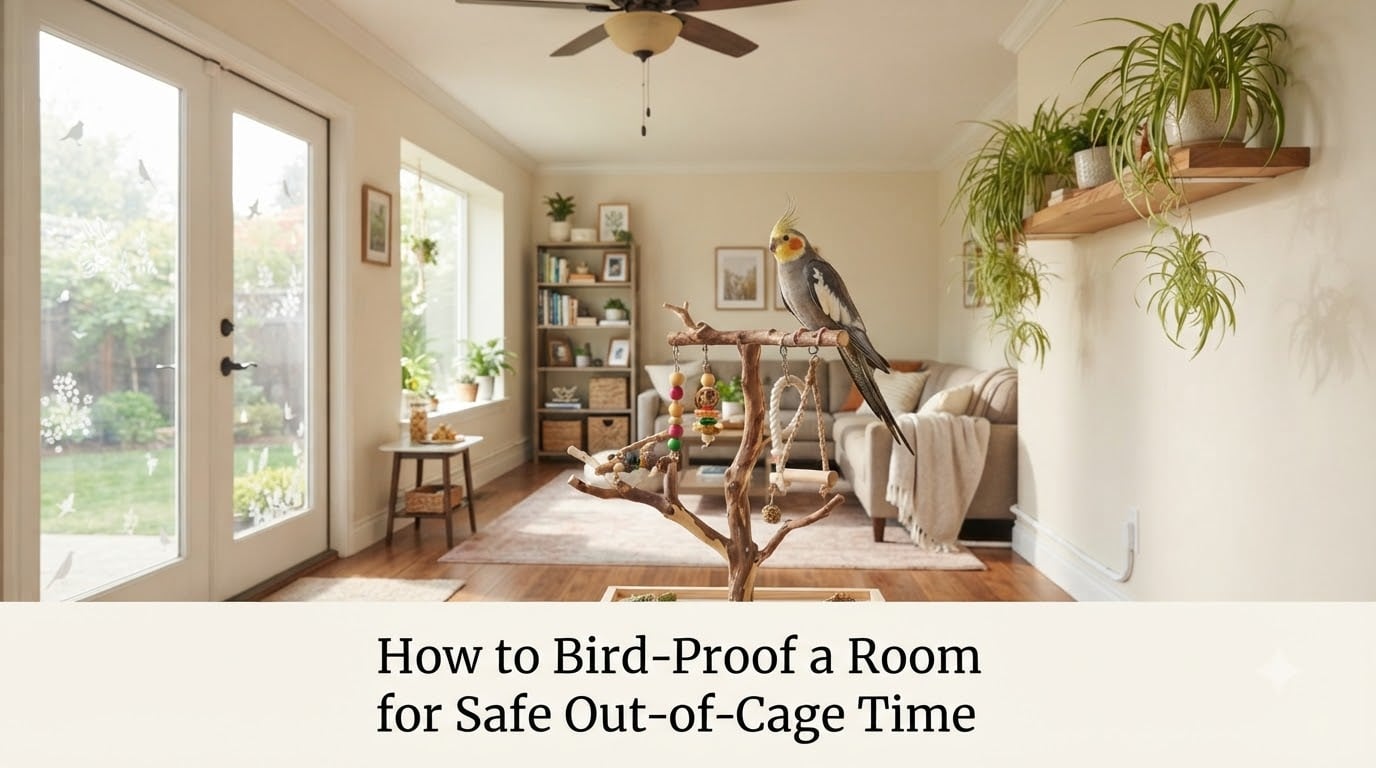
Out-of-cage time is essential for any pet bird. Flying, climbing, and exploring keep your bird physically active and mentally sharp, reducing stress and feather-plucking behavior.
But the moment your bird leaves the cage, danger appears everywhere. Open toilets, ceiling fans, toxic fumes, and electrical cords can injure or kill a bird in seconds.
Learning how to bird-proof a room for safe out-of-cage time takes planning. I have spent years bird-proofing rooms for cockatiels, budgies, and larger parrots, and I want to share what actually works in 2026.
This guide walks through every major hazard, gives you a step-by-step checklist, and includes species-specific tips for small birds. By the end, you will know exactly how to create a safe environment for birds in any room.
Table of Contents
What Is the 3-3-3 Rule for Birds?
The 3-3-3 rule for birds is a decompression timeline that helps your new pet adjust after coming home. It breaks down into three days, three weeks, and three months of gradual adjustment.
First 3 days — Your bird is overwhelmed. Keep the environment quiet, dim, and predictable. Avoid long out-of-cage sessions during this window.
Next 3 weeks — Your bird starts learning the routine. Begin short, supervised out-of-cage sessions in a fully bird-proofed room. Watch how your bird explores so you can spot hazards you missed.
Next 3 months — Trust builds. Your bird becomes comfortable with the space, your family, and other pets. Out-of-cage time can expand to longer periods.
This rule matters for bird-proofing because each phase changes what your bird will attempt. A terrified bird stays still. A confident bird climbs everything, chews everything, and finds the gaps you missed.
Use the 3-3-3 timeline as your bird-proofing roadmap. Bird-proof harder at the start, then refine as your bird reveals its habits.
Why Out-of-Cage Time Matters for Pet Birds?
Birds in the wild fly miles each day. A cage, no matter how large, cannot match that. Out-of-cage time gives your bird the exercise and mental stimulation it needs to stay healthy.
Vets and avian behaviorists generally recommend at least 2 to 3 hours of supervised out-of-cage time daily for most pet birds. Larger parrots benefit from even more.
Without it, birds develop problems. Boredom leads to screaming, biting, and feather destruction. Lack of exercise weakens muscles and the cardiovascular system.
The catch is simple: out-of-cage time is only safe in a bird-proof room. If your bird can reach a toxic plant, a hot stove, or a ceiling fan, the risk outweighs the benefit.
That is why bird-proofing is not optional. It is the foundation that makes free flight time possible.
Step 1: Assess the Room From a Bird’s Perspective
Before changing anything, get down to bird level. Literally sit on the floor and look around the room from your bird’s height and angle.
Birds are natural explorers. Anything at eye level, floor level, or within wingspan becomes a potential landing spot or chew target. What you ignore, your bird investigates.
Think like a toddler combined with a flying squirrel. Birds use their beaks the way toddlers use their hands — to grab, taste, and test everything.
Grab a notebook and walk the room. Note every cord, every gap, every shiny object, every open container of water. Photograph the room from multiple angles so you can review hazards later.
I always recommend doing this assessment twice. The first time you will catch the obvious hazards. The second time, looking more carefully, you will spot the sneaky ones.
Commonly missed hazards include: loose screws behind furniture, curtain pull-cords, the gap behind the refrigerator, standing water in plant saucers, and warm light bulbs your bird might land on.
Step 2: Window and Mirror Safety
Windows and mirrors are the number one cause of injury during out-of-cage time. Birds do not understand glass. A startled bird flying at full speed into a window can break its neck.
The fix is to make glass visible. Birds need visual cues that something solid is there.
Window decals — Apply opaque decals, stickers, or shapes to the outside of windows. Space them no more than 4 inches apart vertically and 2 inches apart horizontally, following the same guidelines used for wild bird window collision prevention.
Vertical blinds or sheer curtains — Keep blinds partially closed or curtains drawn during flight time. This breaks up the reflection and signals that the window is a barrier.
Mirror covers — Drape a towel or sheet over large mirrors during out-of-cage sessions. Some birds also attack their reflection, which causes stress.
Window screens — Check that all screens are secure. A loose screen is an escape route. Birds can squeeze through surprisingly small gaps.
One personal lesson: I once had a cockatiel hit a sliding glass door hard enough to stun himself for ten minutes. Decals fixed it permanently. Do not skip this step.
Step 3: Ceiling Fan and Air System Hazards
Turn off and disable ceiling fans before any out-of-cage session. A ceiling fan blade spinning at normal speed can kill a bird instantly.
Disabling means more than just flipping the switch. Some fans have remote controls that can be triggered accidentally. Pull the chain to the off position and tape the switch as a visual reminder.
If you cannot fully disable the fan, choose a different room for out-of-cage time.
Air vents and ducts — Cover floor-level heating vents with secured grates. Birds can climb into some duct systems and become trapped.
Space heaters — Remove all portable heaters from the room. Birds can land on hot surfaces, and many space heaters contain PTFE coatings that release toxic fumes when heated.
Air fresheners and diffusers — Remove plug-in air fresheners, essential oil diffusers, and scented candles from the bird room entirely. Bird respiratory systems are far more sensitive than ours.
Step 4: Electrical Cord and Outlet Protection
Birds chew. Electrical cords feel interesting under a beak and taste faintly salty from skin oils. A single bite through insulation can electrocute your bird or start a fire.
This is one of the most preventable causes of pet bird death in homes, and it deserves serious attention.
Cord covers — Run all visible cords through split-loom tubing, PVC pipe, or commercial cord management channels. The goal is a hard surface your bird cannot chew through.
Hang cords high — Use cable clips to route cords along the ceiling or high on walls, well above any perch or flight path. Birds explore at perch height, not ceiling height.
Unplug everything not in use — A cord that is not plugged in cannot electrocute. Unplug lamps, chargers, and appliances before out-of-cage time.
Block outlet access — Use outlet covers, the same plastic plugs used for toddler-proofing. Move furniture in front of outlets your bird might investigate.
Power strips — Hide power strips behind or under furniture. The blinking lights attract curious birds, and the switches are easy to flip with a beak.
Step 5: Eliminate Toxic Fumes and Chemicals
Birds have incredibly efficient respiratory systems. This is what allows them to fly at altitude, but it also means they absorb toxins faster than mammals. What is a mild irritant to you can be lethal to a bird in minutes.
PTFE and Teflon — This is the biggest airborne killer of pet birds. Non-stick cookware, self-cleaning ovens, and some heat lamps release polytetrafluoroethylene fumes when overheated. These fumes kill birds within minutes, often before owners notice anything wrong.
Remove all non-stick cookware from the home, or at minimum never use it in any room that shares air with your bird. Replace it with stainless steel, cast iron, or ceramic alternatives.
Aerosol sprays — Hair spray, cooking spray, spray deodorant, and spray paint are all dangerous. Even a quick spray in another room can drift through the HVAC system.
Cleaning products — Bleach, ammonia, oven cleaners, and many scented cleaners release fumes that damage bird lungs. Switch to bird-safe alternatives like vinegar and water, or plain soap and hot water.
Candles and incense — Scented candles, plug-in fragrances, and incense all release particles into the air. Even unscented candles produce soot. Remove all of them from the bird room.
Cigarette and marijuana smoke — Secondhand smoke damages bird lungs severely. Never smoke in the same room or near an open window that feeds into the bird room.
Carbon monoxide — Install a carbon monoxide detector near the bird room. Faulty furnaces and gas appliances produce CO that kills birds before it affects humans.
Step 6: Remove or Relocate Toxic Plants
Many common houseplants are toxic to birds. A single chewed leaf can cause vomiting, seizures, or death depending on the species.
Highly toxic plants to remove entirely:
Avocado (all parts, especially the pit and skin)
Lily (all varieties — extremely dangerous)
Philodendron
Pothos
Dieffenbachia (dumb cane)
Oleander
Sago palm
Holly and mistletoe
Amaryllis
Daffodil and tulip bulbs
Bird-safe plants you can keep:
Spider plant
Bamboo palm
African violet
Boston fern
Areca palm
Christmas cactus
Calathea
Herbs like basil, rosemary, and cilantro
Even with safe plants, check the soil. Some potting mixes contain fertilizer pellets or perlite that birds will eat. Cover soil with river rocks too large to swallow.
One caution: just because a plant is on a safe list does not mean your bird should eat unlimited amounts. Offer bird-safe plants as enrichment, not as a food source.
Step 7: Seal Small Spaces and Gaps
Birds are escape artists. A gap as narrow as an inch can swallow a budgie. Behind furniture, under appliances, and inside wall cavities are all places birds get stuck.
Behind and under appliances — Block the gap behind refrigerators, stoves, and washers with cut foam board or rolled towels. Birds that slip behind these cannot always find their way out.
Under doors — Install door sweeps or draft blockers. A frightened bird will flatten itself and slide under a door faster than you expect.
Open drawers and cabinets — Birds climb into open drawers and get trapped when someone closes them. Keep all drawers and cabinets fully closed during out-of-cage time.
Furniture gaps — Block the space between a couch and the wall, or between a bookshelf and the floor. Birds love these dark hiding spots and can be crushed when furniture shifts.
Fireplaces — Keep fireplace dampers closed and use a fireplace screen. Even cold fireplaces have chimneys birds can fly up and become trapped in.
Toilet lids — Always keep toilet lids down. An open toilet is a drowning hazard, and birds have been known to land in the bowl.
Room-by-Room Bird-Proofing Checklist
Every room has different hazards. Here is a quick-reference guide for the four most common rooms used for out-of-cage time.
Living Room
The living room is usually the most popular choice for out-of-cage time. It is also full of hazards.
Remove or cover all electrical cords
Apply window decals to all glass
Turn off ceiling fans and disable them
Move toxic plants out of reach
Block gaps behind and under furniture
Remove scented candles and air fresheners
Check that curtain pull-cords are out of reach
Kitchen
The kitchen is the most dangerous room in the home for birds. Most avian vets recommend making the kitchen a permanent bird-free zone.
If you must use the kitchen, address every hazard:
Remove all non-stick cookware
Never run the self-cleaning oven cycle
Keep the stove off and cool during out-of-cage time
Store all cleaning products in closed cabinets
Block access behind and under appliances
Keep all food stored — many human foods are toxic
Remove Teflon-coated appliances like air fryers and rice cookers
Bathroom
The bathroom has unique hazards that are easy to overlook.
Always close the toilet lid
Store all medications, cosmetics, and hair products in closed cabinets
Unplug and store hair dryers, curling irons, and straighteners
Remove air fresheners and plug-in fragrances
Keep the exhaust fan off — some birds try to perch on the grille
Check that medicine cabinets close securely
Bedroom
Bedrooms can work well for out-of-cage time if you address the specific risks.
Close closet doors — birds fly in and hide
Block gaps under the bed and dresser
Remove or cover jewelry, which often contains toxic metals
Unplug phone chargers and lamp cords
Keep laundry hampers closed — birds burrow into clothes
Check that window screens are secure
Species-Specific Tips: Cockatiels and Budgies
Different birds have different habits. Small birds face hazards that larger parrots do not, and vice versa. Here is what to focus on for the two most popular pet bird species.
Cockatiel-Proofing a Room
Cockatiels are curious, ground-foraging birds that love to walk and climb as much as they fly. They also produce a fine feather dust that requires good ventilation.
Floor hazards — Cockatiels spend significant time on the floor. Remove all small objects, rubber bands, paper clips, and loose threads. A cockatiel will pick up and swallow almost anything.
Night frights — Cockatiels are prone to night frights, sudden panicked flight episodes in the dark. Use a small night light so your bird can see during these episodes and avoid crashing into walls.
Mirror fixation — Male cockatiels in particular become obsessed with mirrors. Cover all mirrors to prevent territorial aggression and self-injury.
Feather dust — Run an air purifier with a HEPA filter in the cockatiel room. The dust can build up on surfaces and affect both bird and human respiratory health.
Budgie-Proofing a Room
Budgies are tiny, fast, and relentless explorers. They can fit through gaps you would not believe and chew on items you would never expect.
Gap size — A budgie can squeeze through a gap of about half an inch. Seal any crack wider than your fingernail. Check around baseboards, vents, and cabinet edges.
Speed and flight — Budgies fly fast and erratically. They need more decals on windows and mirrors than larger birds because they build speed quickly in a small room.
Chewing — Budgies chew constantly. Remove all painted surfaces within reach, as old paint contains lead. Cover or remove books, picture frames, and anything with glue.
Toe traps — Budgies get their toes caught in fabric, especially loose carpet threads and towel loops. Trim loose threads and avoid terrycloth in the bird room.
Other pets — Even a friendly cat or dog can kill a budgie in seconds. Never allow other pets in the room during budgie out-of-cage time, no matter how well they usually get along.
Bird-Proofing Checklist: Print and Use
Here is a fast checklist you can run through before every out-of-cage session. Once it becomes habit, it takes under five minutes.
Ceiling fan turned off and disabled
All windows closed and decals visible
Mirrors covered or removed
All electrical cords unplugged and covered
Toxic plants removed from the room
Toilet lid closed (if bathroom is connected)
All drawers and cabinets closed
Other pets removed from the room
No cooking or appliance use in adjacent kitchen
Non-stick cookware not in use anywhere in the home
No candles, incense, or air fresheners active
Gaps behind and under furniture blocked
Small objects picked up off the floor
Air purifier running (if you use one)
Carbon monoxide detector installed and working
Phone nearby in case of emergency
Avian vet phone number saved in your contacts
Frequently Asked Questions
What is the 3-3-3 rule for birds?
The 3-3-3 rule is a decompression timeline for newly adopted birds. The first 3 days are for quiet adjustment, the next 3 weeks are for building routine and trust, and the following 3 months are for full settling in. Bird-proofing should be most intense during the first 3 days and refined as your bird reveals its habits.
How do you bird-proof a room?
To bird-proof a room, turn off ceiling fans, apply window decals, cover mirrors, unplug and hide electrical cords, remove toxic plants and chemicals, close toilet lids, block gaps behind furniture, and remove other pets. Run through a checklist before every out-of-cage session.
Do birds need out-of-cage time every day?
Yes. Most pet birds need at least 2 to 3 hours of supervised out-of-cage time daily for exercise and mental stimulation. Without it, birds can develop behavioral problems like screaming, biting, and feather plucking, along with health issues from lack of activity.
How do you cockatiel-proof a room?
To cockatiel-proof a room, focus on floor hazards since cockatiels forage on the ground. Remove small objects, use a night light to prevent night frights, cover all mirrors to avoid fixation, run a HEPA air purifier for feather dust, and seal gaps wider than an inch.
What household items are toxic to birds?
Common toxic household items include non-stick cookware with PTFE coatings, aerosol sprays, scented candles, bleach and ammonia cleaners, essential oil diffusers, avocado, chocolate, onion, garlic, and many houseplants like lilies, philodendron, and pothos. Even small exposure can be fatal.
How long should a bird be out of its cage?
Most pet birds should have 2 to 3 hours of supervised out-of-cage time daily. Larger parrots like macaws and cockatoos benefit from 4 to 6 hours. Start with short sessions of 15 to 30 minutes for new birds and increase gradually as trust builds.
Final Thoughts on Bird-Proofing
Bird-proofing a room for safe out-of-cage time is the most important thing you can do for your pet bird beyond feeding it. Every hazard you eliminate is a potential emergency prevented.
The process feels overwhelming at first, but it gets faster. After a few weeks, your pre-flight checklist becomes a 5-minute habit. The peace of mind is worth every minute.
Start with the biggest killers: ceiling fans, non-stick cookware, and uncovered windows. Then work through the smaller hazards one by one. Your bird gets a richer life, and you get to watch them fly, climb, and explore without constant fear.
When you know how to bird-proof a room for safe out-of-cage time, you give your bird the freedom to be a bird. That is the whole point of sharing your home with one.