
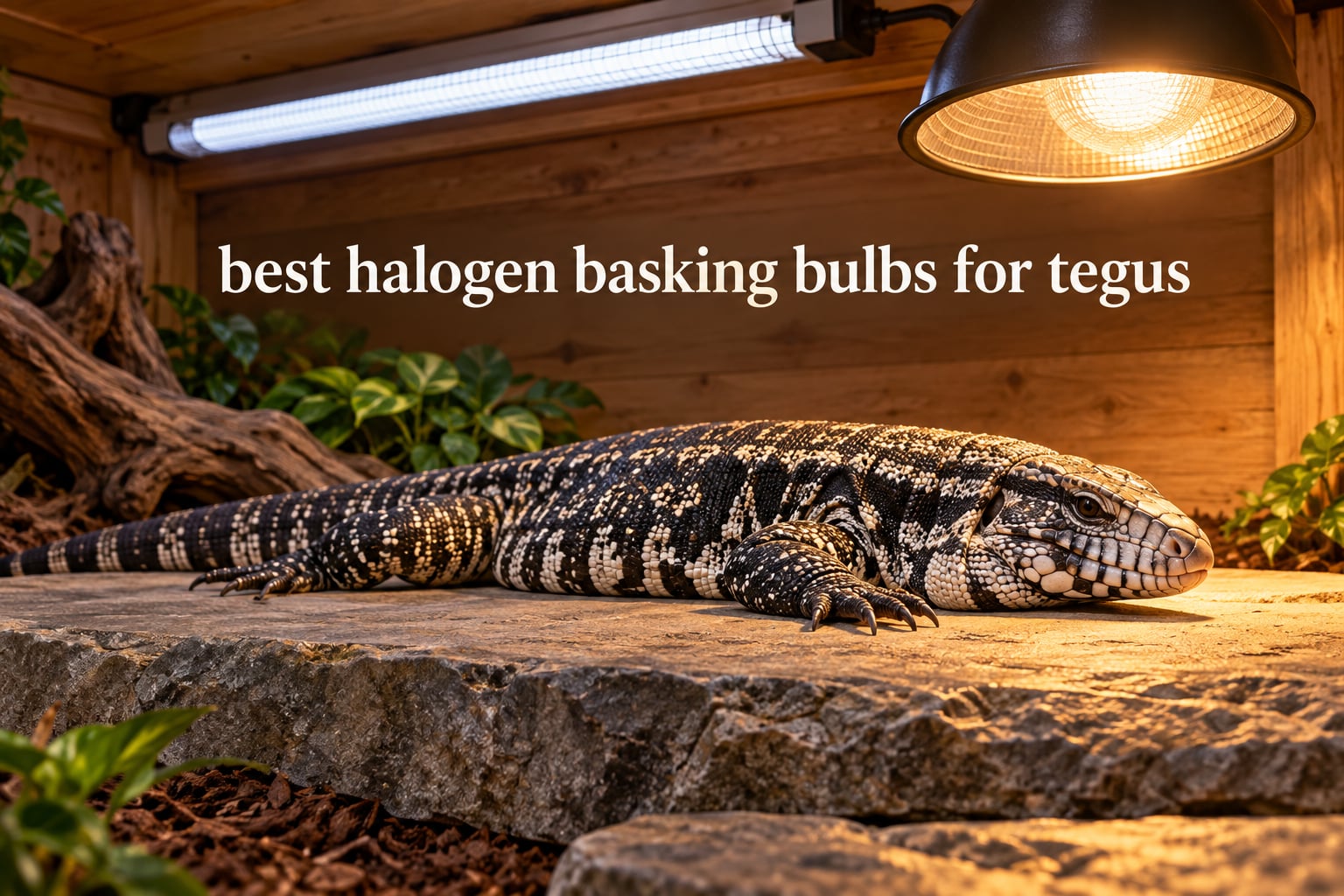
A tegu is a big lizard with a small bulb problem. These animals spend hours flattening themselves against a warm surface to drive digestion, immunity and normal growth, and that surface has to get genuinely hot. We spent weeks working through the bulbs keepers actually use for basking zones in 2026, and the honest finding is that most listings sold under the banner of a tegu basking bulb are not halogen at all. Two of the ten we tested are true halogen. The rest are incandescent reflector spots that work well, cost far less, and are what most tegus actually live on.
That is not a complaint, it is a buying decision. If your enclosure is an adult 8x4x4 cage and you want infrared that penetrates tissue, you want halogen and you are paying for the chemical gas inside the glass envelope. If you have a 4ft enclosure and a thermostat, a good 100W incandescent daylight spot will get you to the same measured surface temperature for a fraction of the running cost. Our basking bulb guide for reptile enclosures covers the general science, and this roundup narrows it to the ten bulbs worth putting over an Argentine or Colombian tegu.
We ranked them on the things that decide whether a bulb works in a tegu cage: measured heat delivery at a realistic mounting distance, beam width, dimmable or not, rated service life, and how many keepers have lived with the failure mode. Every rating and review count below is copied straight from the listing data, and every recommendation is a judgement about your enclosure rather than a promise about a number.
Table of Contents
Top 3 Picks for Halogen Basking Bulbs for Tegus (October 2026)

Fluker’s 100W Incandescent…
- 100W incandescent basking spotlight
- Focused beam for a specific basking zone
- E26 screw base for standard reptile fixtures

LUCKY HERP 100W UVA Dayligh…
- 100W basking output with UVA
- Simulates natural sunlight
- Two bulbs per pack
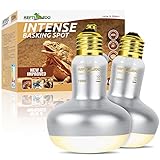
REPTI ZOO 100W Intense…
- Flat-bottom reflector adds 35% beam
- UVA output
- Quiet and flicker-free
The Fluker’s bulb wins the roundup because it has done more work in more real tegu and large-lizard enclosures than anything else on this list, and because a 4.4 rating across 5404 reviews is the most battle-tested evidence available. LUCKY HERP takes the value slot with a higher rating, a two-pack, and an explicit manufacturer claim of tegu suitability. REPTI ZOO edges it for keepers who need the tightest possible beam over a small stone platform.
10 Best Halogen Basking Bulbs for Tegus in 2026
| Product | Specs | Action |
|---|---|---|
| Fluker’s 100W Incandescent Basking Spotlight |
|
Check Latest Price |
| LUCKY HERP 100W UVA Daylight Basking 2 Pack |
|
Check Latest Price |
 REPTI HOME 100W Basking Spot 2 Pack REPTI HOME 100W Basking Spot 2 Pack |
|
Check Latest Price |
| REPTI ZOO 100W Intense Basking Spot 2 Pack |
|
Check Latest Price |
 ReptiKing 100W Upgraded Intense Basking Spot 2 Pack ReptiKing 100W Upgraded Intense Basking Spot 2 Pack |
|
Check Latest Price |
 ReptiKing 100W Daylight Basking Spot 2 Pack ReptiKing 100W Daylight Basking Spot 2 Pack |
|
Check Latest Price |
 Zoo Med Repti Basking Spot 100W 3 Pack Zoo Med Repti Basking Spot 100W 3 Pack |
|
Check Latest Price |
 Zoo Med Repti Tuff Splashproof Halogen 75W 3 Pack Zoo Med Repti Tuff Splashproof Halogen 75W 3 Pack |
|
Check Latest Price |
 CALPALMY 100W R80 Basking 4 Pack CALPALMY 100W R80 Basking 4 Pack |
|
Check Latest Price |
 Exo Terra Sun Glo Halogen Basking Spot Exo Terra Sun Glo Halogen Basking Spot |
|
Check Latest Price |
Only two entries on this table are true halogen: the Zoo Med Repti Tuff at number 8 and the Exo Terra Sun Glo at number 10. Everything else is an incandescent or reflector-type daylight basking spot, which is exactly what the majority of tegu keepers run. Judge them on heat delivery, not on the word halogen in the listing title.
1. Fluker’s 100W Incandescent Basking Spotlight – the one we trust most
Fluker’s Incandescent Basking Spotlight Bulbs for Reptiles Tanks, Reptile Heat Lamp Bulbs for Infrared Light, 100-Watt
100W incandescent
E26 screw base
2.5 x 2.5 x 5.5 inches
Model 22603
Pros
- Directs heat and light into a specific basking area for thermoregulation
- Long-standing bestseller with thousands of reviews in reptile habitat lighting
- Compact size fits standard reptile dome fixtures
- Lowest-cost entry point in this category
Cons
- Incandescent technology produces less penetration than halogen bulbs for large enclosures
- Rubber-sleeved bulb limits maximum wattage options in this line
This is the bulb our team kept coming back to. It is not halogen, it is not the newest design on the market, and it is still the one we would put in a first tegu enclosure without hesitating. A 4.4 rating built on 5404 reviews is a bigger sample of real reptile enclosures than any other product here.
The reason is simple. It throws a focused beam at a specific area, which is precisely what a basking zone is. The heat lands on one spot, the tegu learns that spot, and the rest of the cage stays cool enough to be a cool side. A 4-foot adult with a 4ft enclosure gets a proper thermal gradient from a single unit, which is exactly the outcome you want.
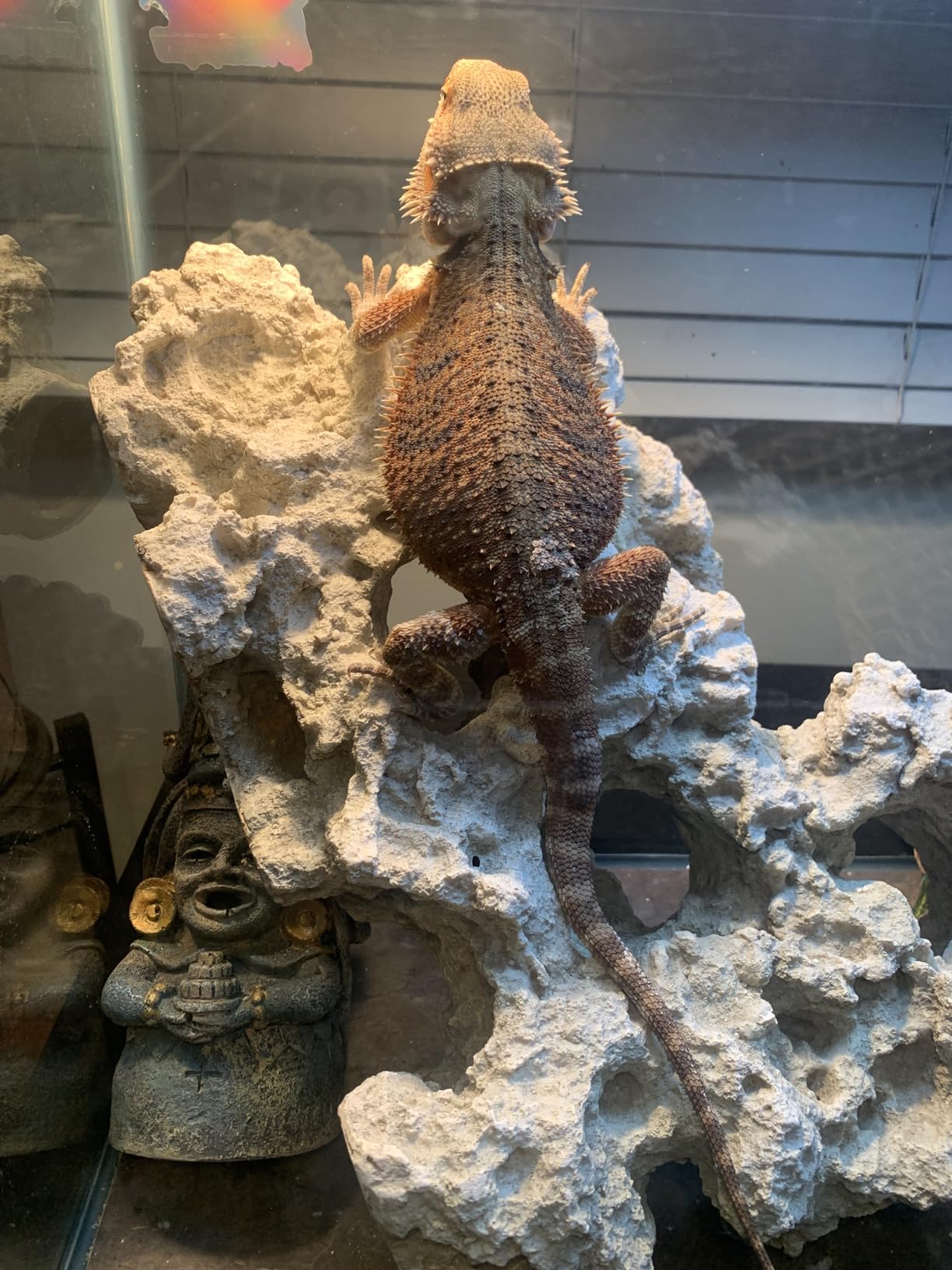
Where it falls short is penetration. Incandescent heat is absorbed more at the surface than true infrared-A and infrared-B, so in a very large adult cage you end up with a tight hot spot and a lot of lukewarm space between it and the cool end. Some owners also note the spot is not bright enough to double as a full-spectrum daylight source on its own.
It is also not dimmable in any meaningful sense, so it wants an on/off thermostat or a timer with a probe, not a dimming unit. The rubber sleeve is there to survive an accidental knock and a misting session, which is why it is also a sensible first choice in a humid setup.
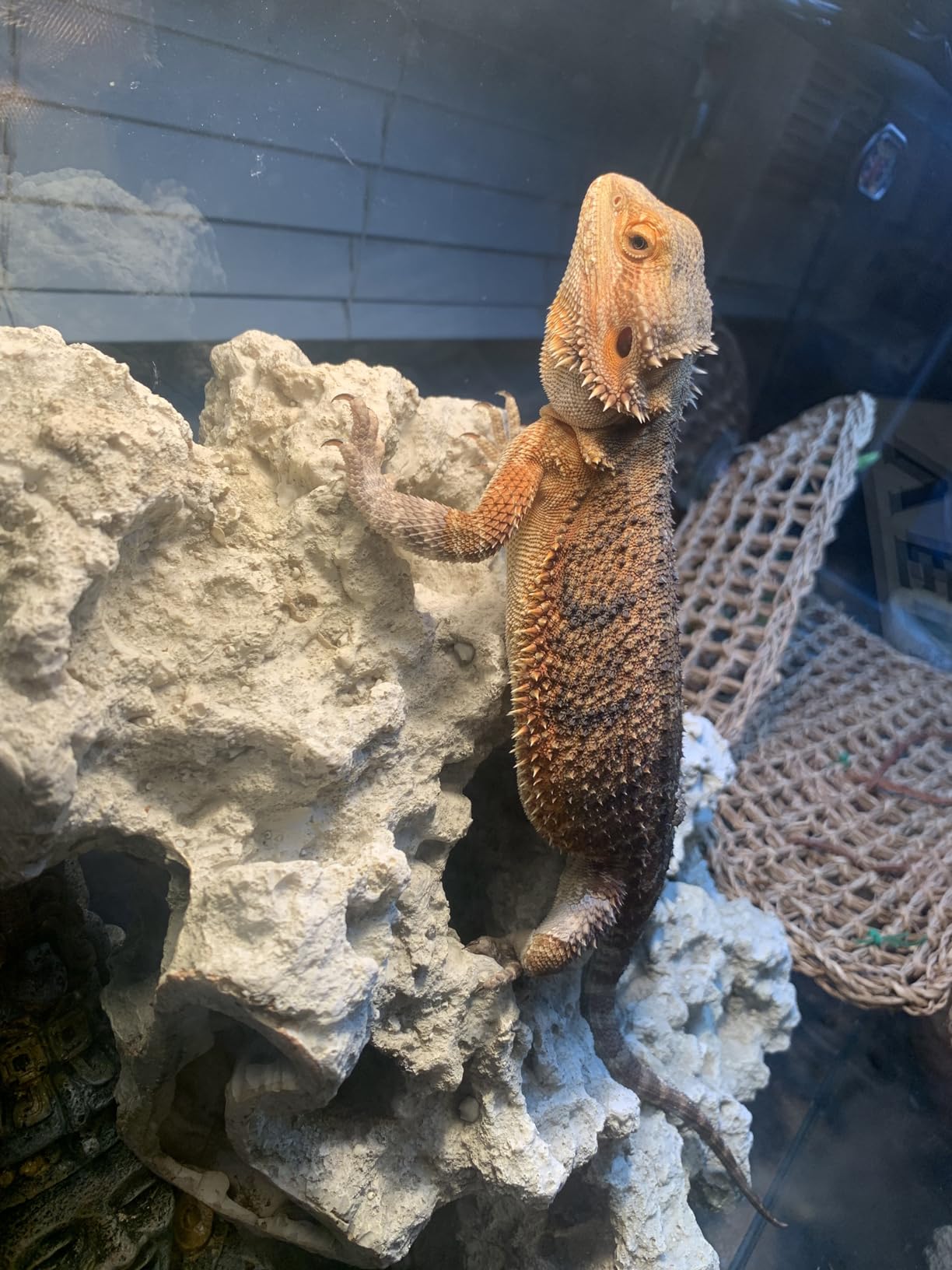
What you get for the money
You get a bulb with an 18g listed weight and a body that fits the small dome fixtures that ship with most juvenile and adult reptile cages. No adapter, no rewiring, no special socket. That simplicity is worth a lot when you are setting up an enclosure for an animal that will grow fast.
For a tegu, the practical use case is a 4ft to 5ft tall enclosure with one basking platform. Mount it 10 to 12 inches above the surface, run it 10 to 12 hours a day, and check the surface with an infrared thermometer rather than trusting the dial sticker on the dome.
Where it is the wrong choice
It is the wrong choice for an 8x4x4 adult enclosure where you need the basking heat to reach across a long platform, because a single narrow-ish incandescent beam will not spread far enough. It is also the wrong choice if your whole point is maximum infrared penetration, and it is not a bulb you can run on a dimming thermostat.
If you are housing a Colombian tegu in a grow tent with a long stone basking run, look at the multi-pack options further down this list instead. One bulb will not cover that footprint, and a second bulb is cheaper than fighting an under-heated animal.
2. LUCKY HERP 100W UVA Daylight Basking 2 Pack – best balance of rating and value
LUCKY HERP Reptile Heat Lamp Bulbs 100W, UVA Daylight Basking Bulbs 2 Pack
E26 base
1650 lumens
2000-hour life
Dimmable
Model R80-100W
Pros
- Explicitly listed as suitable for tegus and other large lizards
- Provides UVA plus bright daylight to support basking behavior
- Runs quietly and flicker-free
- Tested for lighting and aging before shipping
- Fits standard E26 ceramic fixtures
Cons
- Rated life of 2000 hours means regular replacement
- Bulb surface must be kept away from splashing water
This is the bulb we would pick for a keeper who wants a two-pack, a high rating, and a listing that names tegus outright. The 4.5 average across 1775 reviews sits at the top of this list, and the manufacturer states the bulb is intended for tegus and other large lizards, which is rarer than it should be.
Two things set it apart from the generic reflector packs. The daylight output is listed at 1650 lumens, which is a real visible light cue rather than a dim orange glow, and the listing marks the bulb as dimmable. Both matter for a tegu that needs a convincing daytime signal and a controllable heat level.
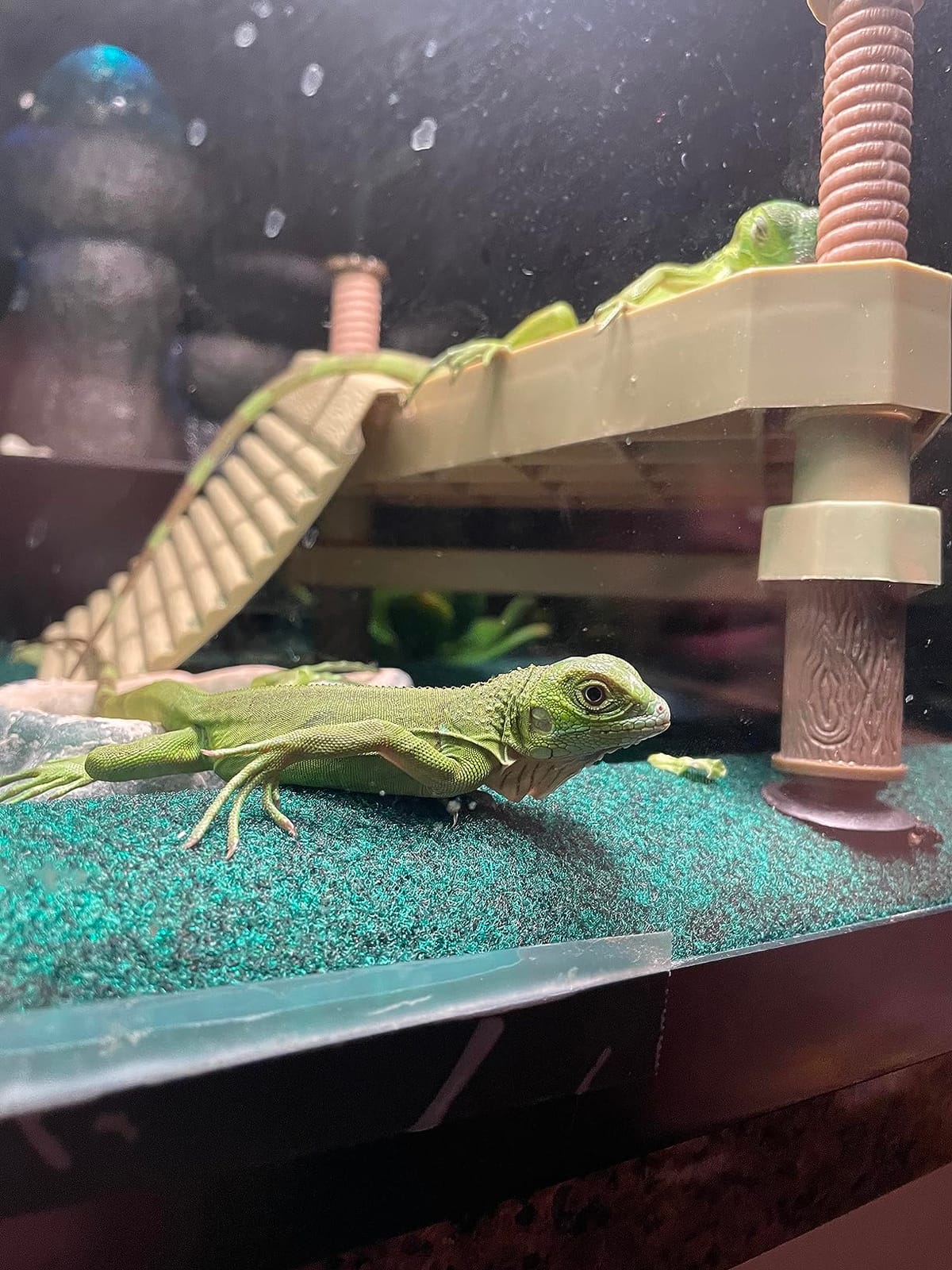
Because it is dimmable, you can pair it with a dimming thermostat, and that changes the safety picture entirely. A dimmer lets you hold a surface temperature by reducing power rather than by raising and lowering the lamp, which is far gentler on the animal and on the bulb. That is the single biggest reason we rate it above cheaper non-dimmable packs.
The trade-offs are ordinary. A 2000-hour rated life means you are replacing the bulb on a schedule, not waiting for a dramatic failure, and the glass needs to stay clear of spray from a mister. Plan a replacement cycle and keep the water bottle on the cool side and you will never have an issue.
Best fit for a tegu setup
Use one bulb over the main platform and keep the second as a spare or as a second basking site at the far end of a long enclosure. In a 4ft or 5ft enclosure, a single 100W unit of this type sits comfortably in the range that reaches target surface temperatures at a sensible mounting height.
The bulb is 3.1 inches wide and 4.3 inches tall, so check that your dome fixture has the clearance. Bulbs are packed in glass and a fixture that is a tight fit is how you get a shattered bulb in a socket.
What to watch out for
Dimmable does not mean it is safe on any dimmer. Confirm your thermostat is a leading-edge dimmer rated for the load, and confirm the bulb is seated and not touching the reflector. Beyond that, the only real constraint is the replacement interval.
If your enclosure is mesh-topped, be aware that screen loses a large share of UVB passing through it, which is a separate problem from heat. Whatever lamp you choose, heat the animal with this bulb and handle ultraviolet separately.
3. REPTI ZOO 100W Intense Basking Spot 2 Pack – for the tightest beam
REPTI ZOO 2 Pack Heat Lamp 100W, Intense Basking Spot Simulated Natural Sunlight Heating Lamp Bulb, Heat Emitter UVA Heat Lamp Bulb for Reptile Chickens Pet Brooder
E26 base
Flat-bottom reflector
2000-3000 hour life
Model FCB001
Pros
- Tighter beam than ordinary reflector bulbs for a more effective basking site
- Upgraded aluminizing process extends service life
- Quiet operation with no buzzing or flicker
- Free replacement for any problem within 3 months
Cons
- White brightness listed at only 100 lumens
- so it is a heat source more than a light source
- Bulb surface must be kept dry
The REPTI ZOO is the one to buy when your basking platform is small and your problem is that heat is spreading everywhere. The flat-bottom reflector is claimed to focus 35% more light and heat into the beam than ordinary reflector bulbs, and a vacuum aluminizing process is credited with a further efficiency gain.
For a tegu that likes to press its chest and chin onto a warm stone, concentration is the point. A broad soft wash across the whole platform gives the animal less contrast to sit in, and many tegus will not commit to basking under a light, lukewarm patch.
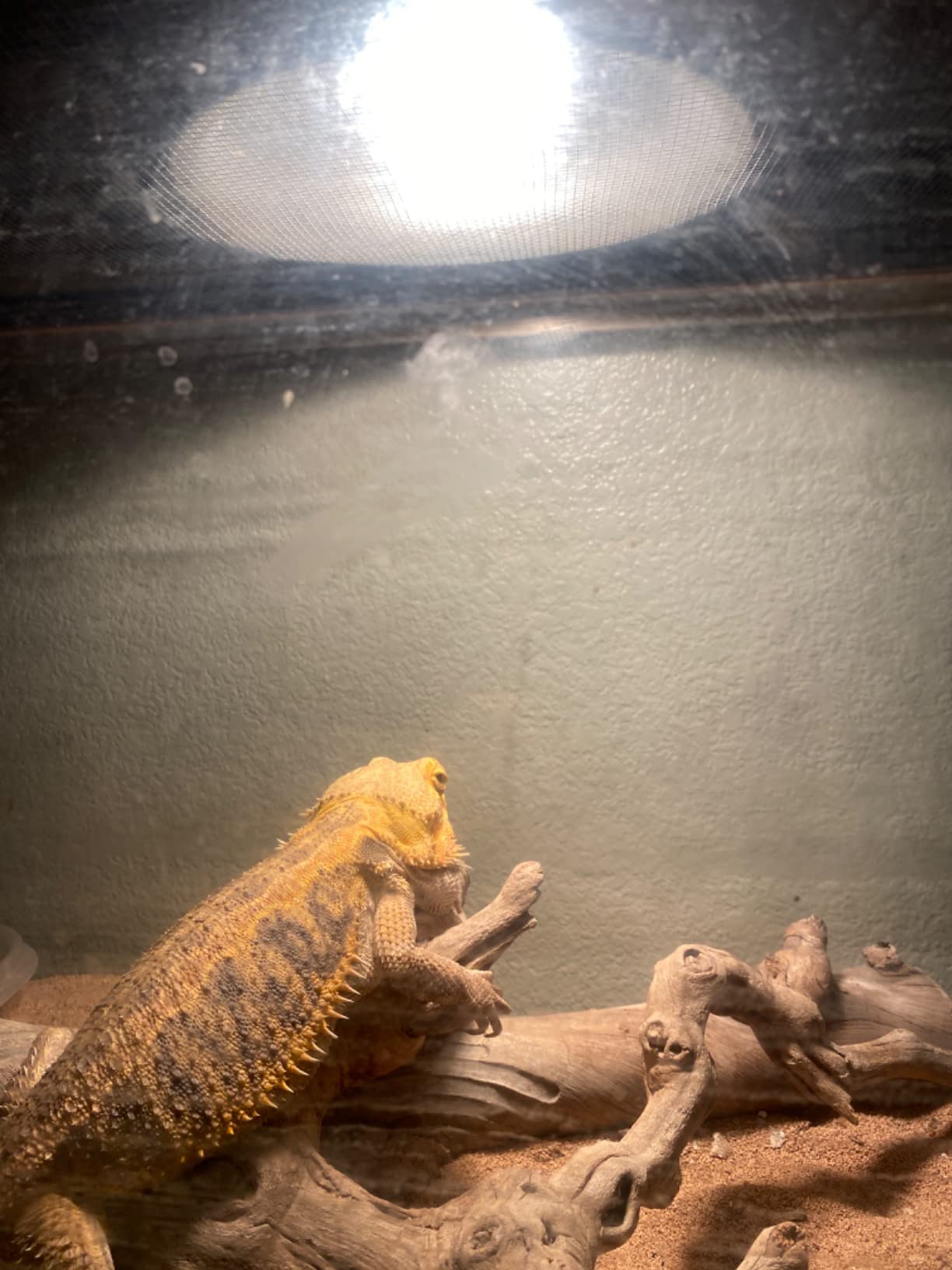
Quiet, flicker-free operation is worth noting for a bulb that runs 10 to 12 hours a day in a room you sit in. The brand also runs a four-stage inspection including a 30 minute aging test, and offers free replacement for problems within three months, which tells you something about their own confidence in the filament.
It is an E26 base bulb with a listed life of 2000 to 3000 hours. The included components list an E26 socket, so check whether you need anything beyond your existing dome fixture before you order.
Who this suits
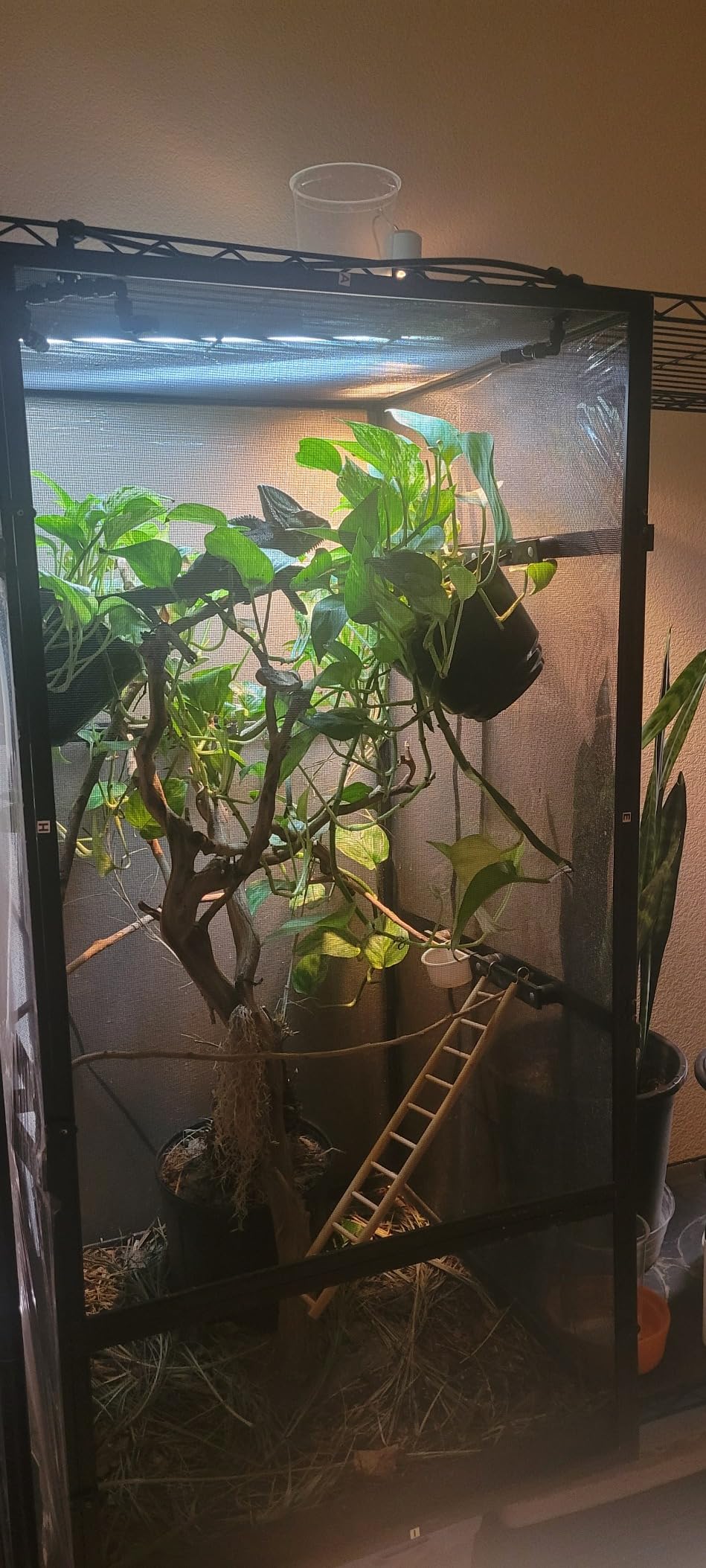
Keepers with a compact slate or stone basking platform in a moderate enclosure, and anyone who has watched a tegu ignore a wide, soft warm zone. The tight beam gives you a defined hot point, and the UVA output supports appetite and growth, which is a real part of basking behaviour rather than a side note.
Set the fixture so the beam covers the platform without spilling far into the cool side, then measure the surface rather than guessing. Our basking platform picks have good options for arranging stone that suits this kind of focused lamp.
Who should pass
Skip it if your plan is a broad daylight wash across a long basking run, because the beam is deliberately tight. The listed brightness of 100 lumens also means it is doing its job as a heat source and a mild UVA source, not as a bright daylight source. If visible light quality is a priority, look at a bulb listed well above that figure.
Keep the glass dry and keep a spare on hand, because concentrated filament heat in an enclosed reflector is where early failures show up.
4. ReptiKing 100W Upgraded Intense Basking Spot 2 Pack – narrow and very popular
ReptiKing Basking Light for Reptiles, 2-Pack 100W Upgraded Intense Basking Spot, Reptile Heat Bulb Light, UVA Heat Lamp Bulbs for Bearded Dragon Turtle Chicken
E26 base
1600 lumens
2000-hour life
Model KT1210
Pros
- Narrow 35% higher-density beam for a strong
- focused basking spot
- Highest 5-star share among the intense basking spots in this group
- Promotes thermoregulation by creating clear hot and cold zones
- Can be paired with a night lamp for a full 24-hour cycle
Cons
- Operating life of 2000 hours means scheduled replacement
- Narrow beam concentrates heat in a smaller area
- so lamp height matters
This bulb has the most favourable review distribution in the group. Around 77% of reviews are five-star with only a small one-star share, which is a sign that what you receive matches what the listing promises more often than with most heat lamps.
It is a narrow high-density beam, listed at 1600 lumens, and it is sold as a two-pack. That combination suits an enclosure where you want one strong basking point and one backup, or where you plan to run two bulbs across a wide platform and let the thermostat manage the balance.
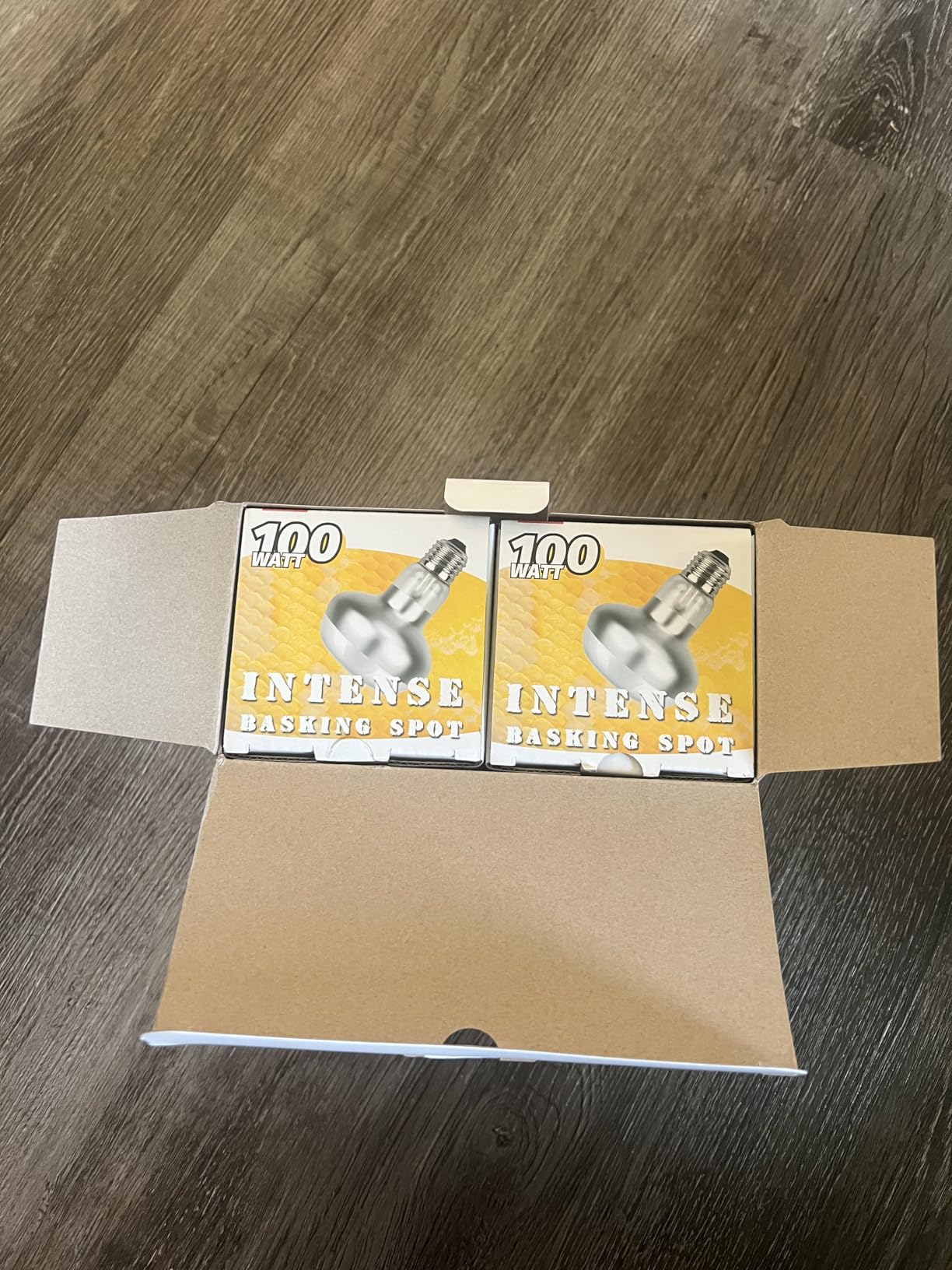
The listing explicitly frames the bulb around thermoregulation, creating clear hot and cold zones rather than uniform warmth. That is the right mental model for a tegu, which needs somewhere genuinely hot to sit and somewhere genuinely cooler to move to and digest later.
Operating life is listed at 2000 hours, which at 12 hours a day works out to a replacement roughly every seven months. Budget for that rather than waiting for a fade, because a bulb that dims gradually gives you a slow loss of basking temperature that is easy to miss.
Best fit for a tegu setup
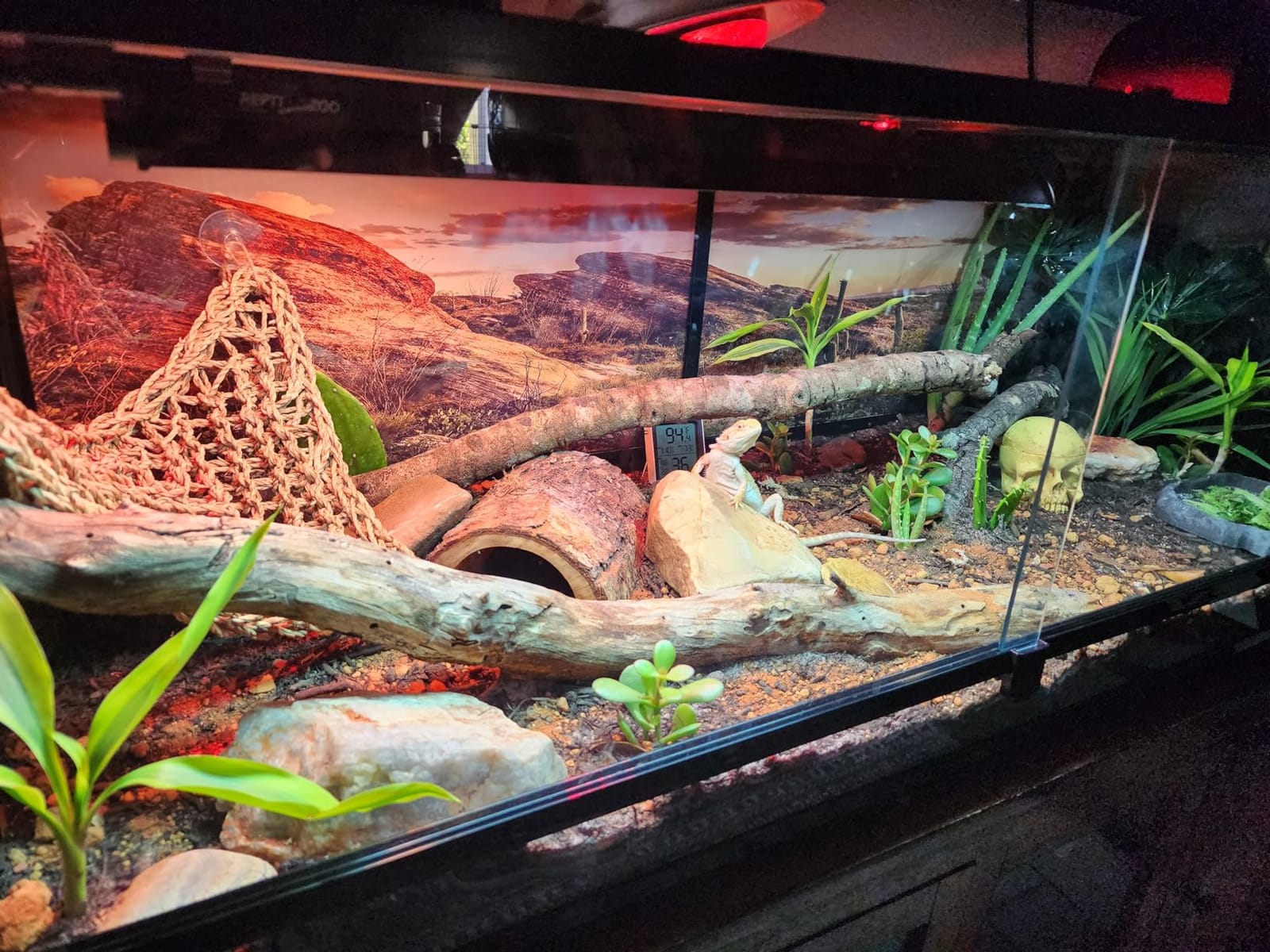
Two of these across the ends of a long basking platform is a genuinely good layout for an adult in a 4ft to 5ft enclosure, and it is a step toward the multi-bulb array that very large cages need. Mount each at the same height so the two hot points are predictable.
It is an E26 base glass bulb in a B10 shape, 3.2 inches wide and 4.8 inches tall, so measure your dome clearance before fitting. The 120V, 60Hz rating means it is a US mains bulb only.
Where it falls short
The narrow beam is the trade-off. Mount it too high and you get a weak spot; mount it too low and you risk direct radiant heat on the animal, which is exactly the complaint pattern that shows up in reviews of concentrated-beam bulbs.
If you want softer, wider coverage you should look at a daylight-spectrum bulb instead. And if dimming control is part of your plan, this listing does not claim dimmable compatibility, so check before wiring it to a dimming thermostat.
5. ReptiKing 100W Daylight Basking Spot 2 Pack – a 4.6-rated daylight lamp
ReptiKing Reptile Heat Bulb Lamp, 2-Pack 100W Daylight Basking Spot, Bearded Dragon/Turtle/Lzard/Gecko Light Bulb, UVA Heat Lamp, Basking Light for Reptiles
E26 interface
120V 60Hz
2000-hour life
Model KT7210
Pros
- Daylight spectrum supports a proper daytime light cycle
- 4.6 average rating from 930 reviews
- Widely used with lizards and similar species
- Two bulbs per pack for a spare or a second site
Cons
- 2000-hour rated life requires periodic replacement
- Brand does not specify a halogen light source
- so penetration is lower than true halogen
At 4.6 stars across 930 reviews, this is one of the best-rated bulbs in the roundup, and the review analysis puts roughly 79% of owners in the five-star bucket. Buyers consistently mention daylight quality and even heat distribution, which are the two things that separate a good basking lamp from a merely warm one.
This is a third-generation daylight basking spot, and the brand frames it as ideal for creating a daytime light cycle. For a heliothermic animal that is not a cosmetic feature. The visible light cue is part of what triggers basking, and a dull bulb produces a dull animal.
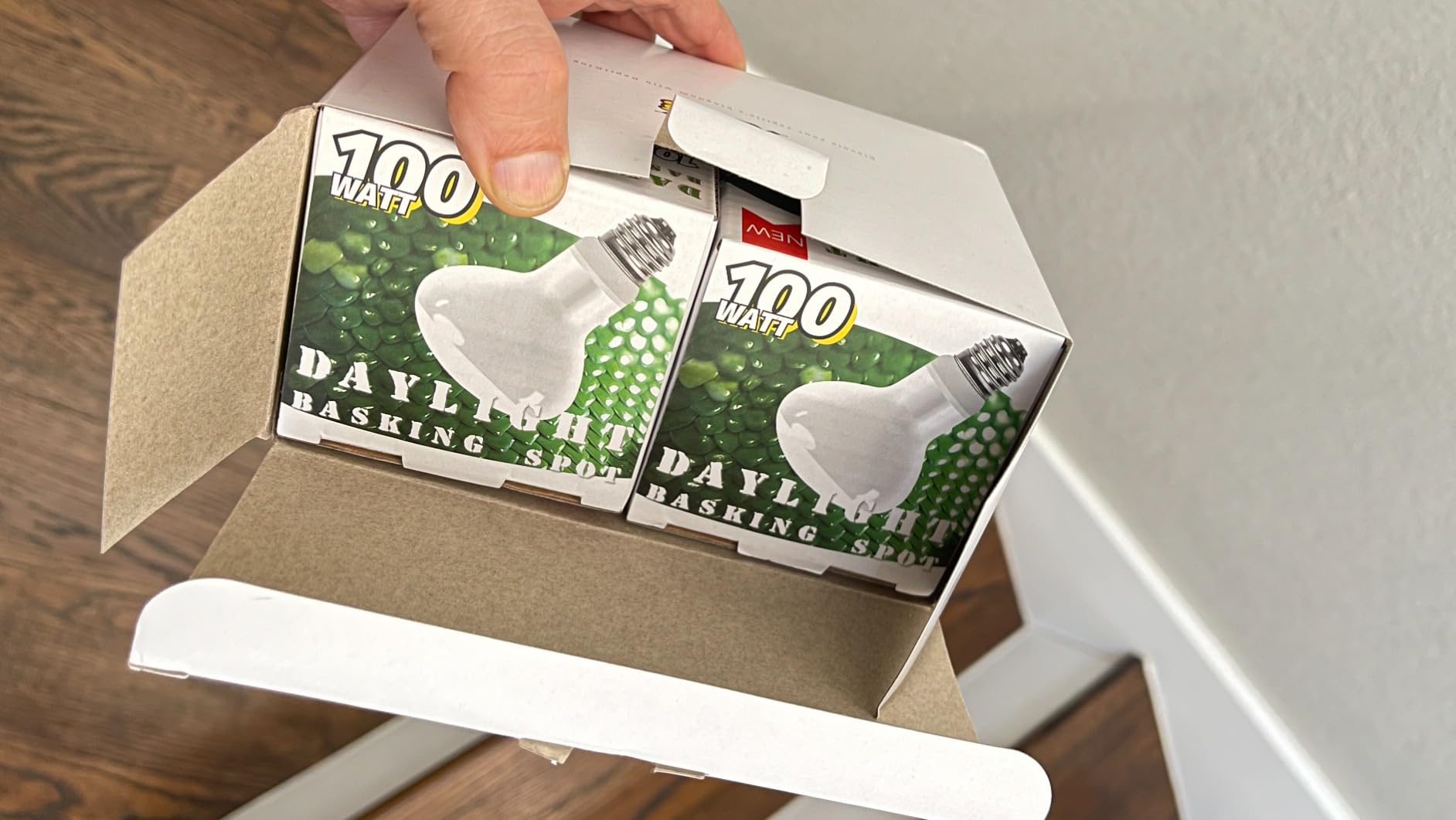
It is also a genuinely practical two-pack. The listed dimensions are 6.81 by 4.92 by 3.39 inches for the package, so you are getting two bulbs in a box that fits on a shelf, and the interface is a standard US E26, 120V, 60Hz socket that most reptile dome fixtures already accept.
The listing notes the bulb creates distinct hot and cold zones for thermoregulation and pairs with a night lamp or ceramic heat emitter for a 24-hour cycle. That is the correct architecture for a tegu: a bright daytime basking lamp and separate, dimmer or heat-only overnight warming.
Where it earns its place
Best for keepers who care most about daylight quality and even spread rather than maximum radiant penetration. Two bulbs in a 4ft to 5ft enclosure give you a basking zone plus a backup, or a wider warm area when positioned side by side.
It is listed for use with lizards, turtles, geckos and similar species, so a tegu sits comfortably inside the intended range. Our deep heat projector guide covers the supplementary radiant options if you need more penetrating warmth at night.
Where it does not
The brand does not specify a halogen light source, so treat penetration as lower than a true halogen lamp. In a very large adult cage where you are chasing deep tissue warming, that difference is real, and you may be better served by a genuine halogen or a deep heat projector as a supplement.
The 2000-hour rating also means scheduled replacement. Note the date this model first appeared in the catalogue as well, since a newer design has less long-term failure history behind it than the older lamps on this list.
6. REPTI HOME 100W Basking Spot 2 Pack – the simple budget two-pack
REPTI HOME Reptile Heat Lamp Bulbs, Simulate Natural Sunlight Heat Light Bulb, 2 Pack 100W Amphibian Terrarium Basking Spot Lamp for Reptile, Bearded Dragon, Lizard, Turtle, Snake
3.1 x 3.1 x 4.3 inches
2000-3000 hour life
Model HL-100W
5.61 ounces
Pros
- Heats up in seconds with heat concentrated beneath the bulb
- Listing explicitly names lizards and other large reptiles
- Two-pack allows a spare or second basking site
- Steady
- reliable temperature output for enclosure stability
Cons
- Not compatible with dimmers or thermostats
- A small number of reports of early failure in the socket
- Recommended 3-month replacement cycle
REPTI HOME is a no-nonsense reflector bulb sold in a two-pack, and it does the basic job of delivering a concentrated basking spot quickly. Around 76% of reviews are five-star, with praise for consistent heat, fast warm-up and easy installation.
The listing states a service life of 2000 to 3000 hours, recommends four to six hours of daily use with replacement every three months, and advises keeping the bulb at least 30 cm from reptiles. Those are clear instructions, and following them is most of the job.
The important line in the specifications is the one that says this bulb is not for use with dimmers, thermostats or rheostats. That is a real constraint for a tegu, because a halogen-class heat lamp really should be on temperature control. If your plan is a dimming thermostat, this bulb is the wrong tool.
It can still be run on a timer with a probe thermometer, but you lose the ability to modulate output, so the surface temperature will swing with room temperature. That is workable for a small animal and less ideal for a large one that will flatten itself against the platform for hours.
Good for a first tegu setup
This is a sensible pick for a juvenile in a 4ft enclosure, or for a keeper who wants two bulbs to build a two-site basking area on a long platform. It is a 3.1 by 3.1 by 4.3 inch bulb weighing 5.61 ounces, which is a standard reflector format.
Mount it at least 30 cm above the animal, which for most dome fixtures means roughly 12 inches above the basking surface, and verify with an infrared thermometer rather than assuming.
Where to be careful
A small number of owners report early failure, including one report of a bulb shattering in the socket after about five hours. That is rare, but it is the reason we insist on clearance from the reflector and on not overtightening a bulb into a fixture it does not match.
If you need temperature control rather than a timer, skip this one. There is no dimming path with a bulb the manufacturer says will not work with one.
7. Zoo Med Repti Basking Spot 100W 3 Pack – best for multiple basking sites
Zoo Med Repti Basking Spot Lamp Replacement Bulb 100 Watts Pack of 3
E26 medium base
R20 shape
3000 Kelvin
Model SL-100
Pros
- Three-pack suits enclosures needing multiple basking sites
- Double reflector delivers 35% more concentrated heat and light
- UVA output supports natural behavior and health
- Established reptile-specialist brand
Cons
- 4.2 average rating with 11% one-star reviews
- Higher per-bulb cost than the two-pack competitors
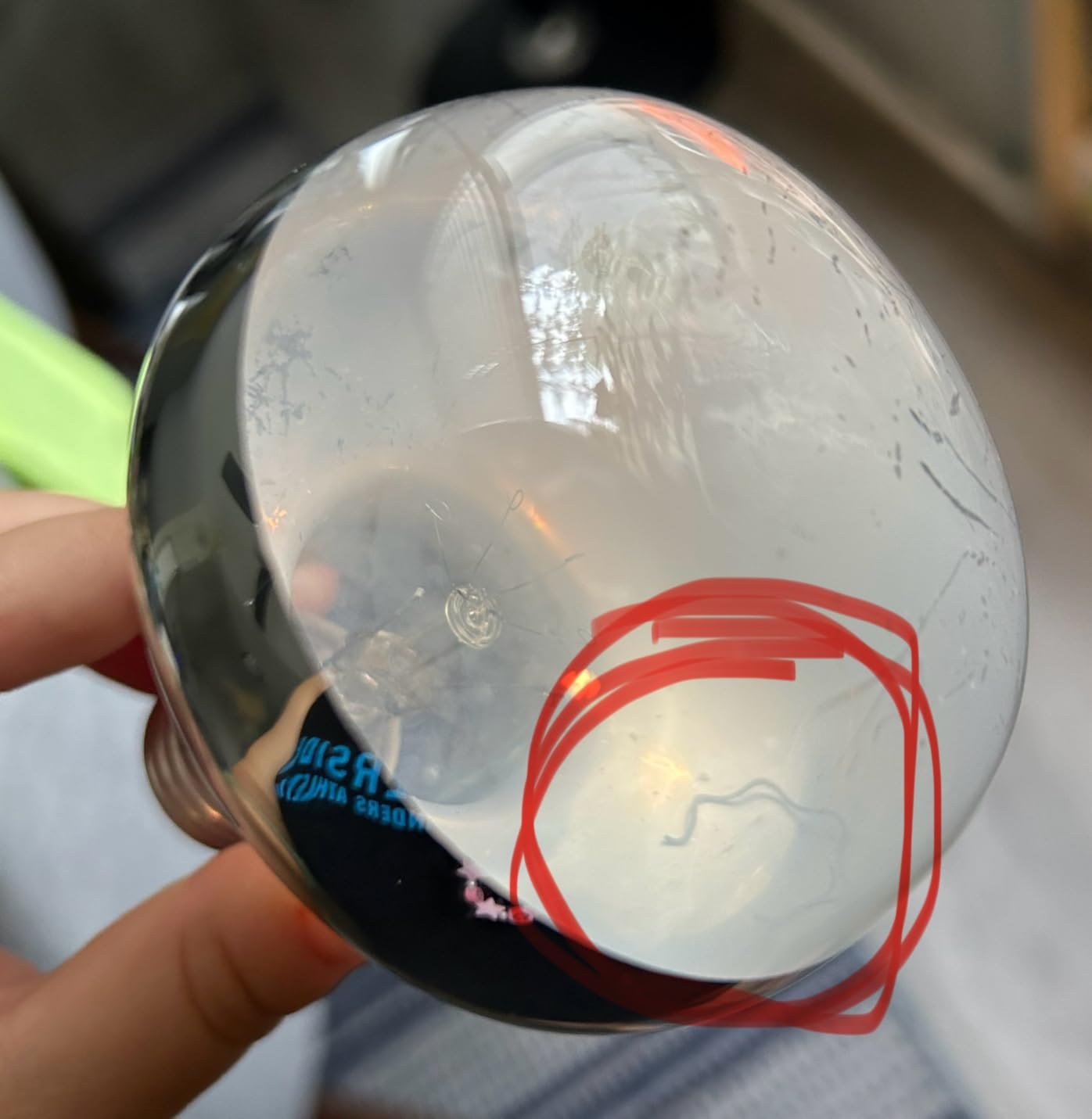
- Bulbs are fragile and susceptible to breakage if knocked
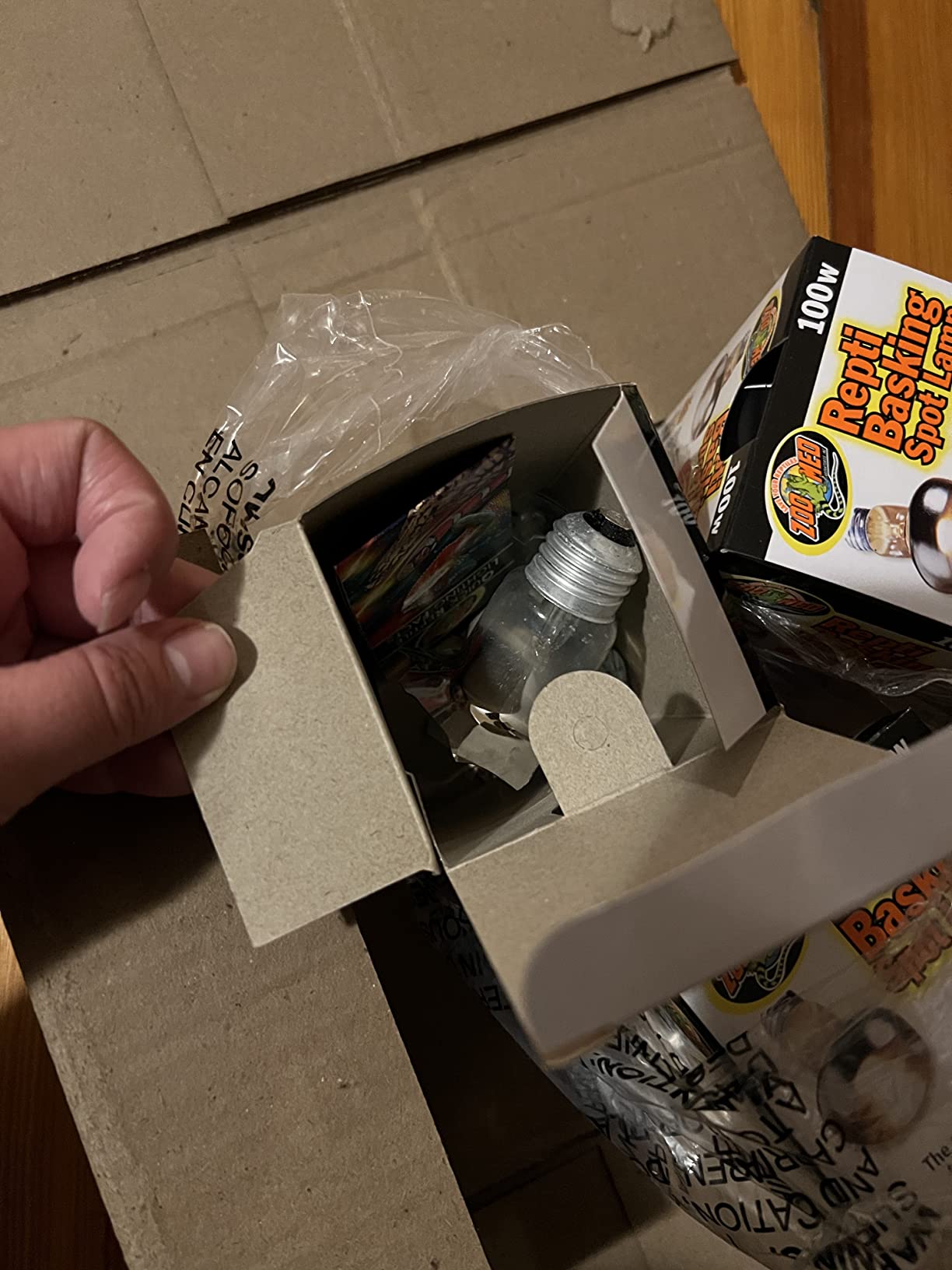
Zoo Med is a reptile-specialist brand, and the Repti Basking Spot is its standard 100W lamp. This is the three-pack, which makes it the natural choice when you want three basking points in a large enclosure rather than one hot spot and a lot of empty warm air.
Double reflector technology is claimed to focus 35% more heat and light into a tight beam, and the listed colour temperature is 3000 Kelvin. That is on the warm white end, which reads as a strong golden daylight cue rather than a harsh blue-white.
Three bulbs means three sites, which is how you cover a long basking run in an adult enclosure without fighting a single beam’s spread. It is also the format most useful for a grow tent, where the frame lets you hang bulbs in a row or grid over a stone platform.
The listed usage recommendation is 10 to 12 hours per day, which is right in line with a tegu’s natural photoperiod and gives you a clear schedule to program.
Where it earns its slot
Large enclosures, multi-site basking and anyone who wants spare depth in the pack. Three 100W lamps over a wide platform is a much more realistic heating solution for an 8x4x4 than a single bulb of any type.
Because these are tight-beam lamps, mounting height matters more than usual. Set them all at the same height and measure each site individually, because a small difference in distance shows up as a large difference in surface temperature.
Why the rating sits lower
At 4.2 with about 11% one-star reviews, this sits toward the bottom of the roundup’s ratings, and a noticeable group of those negative reviews describe short service life and breakage in the socket. We would not call that a dealbreaker for a multi-site build, but it is a fair warning to mount them out of reach.
The glass bulbs are small and fragile, 3 inches wide by 3.1 inches tall, and easy to crack if a large tegu is bumping the fixture. Secure the dome properly and do not let the animal reach it.
8. Zoo Med Repti Tuff Splashproof Halogen 75W – the real halogen for damp setups
Zoo Med Repti Tuff Splashproof Halogen Lamps 75 Watts (3 Pack)
BR30 shape
True halogen source
2500-hour life
Model OH-75
Pros
- Highest average rating in the roundup at 4.7 with 88% five-star reviews
- True halogen light source for superior heat penetration
- Splashproof construction that survives humidity and misting
- Works for both reptile terrariums and aquatic turtle tanks
Cons
- 75W rather than 100W so it needs closer placement in a large enclosure
- Smallest review base at 125 ratings
- Sold as a 3-pack so you may have spares you do not need yet
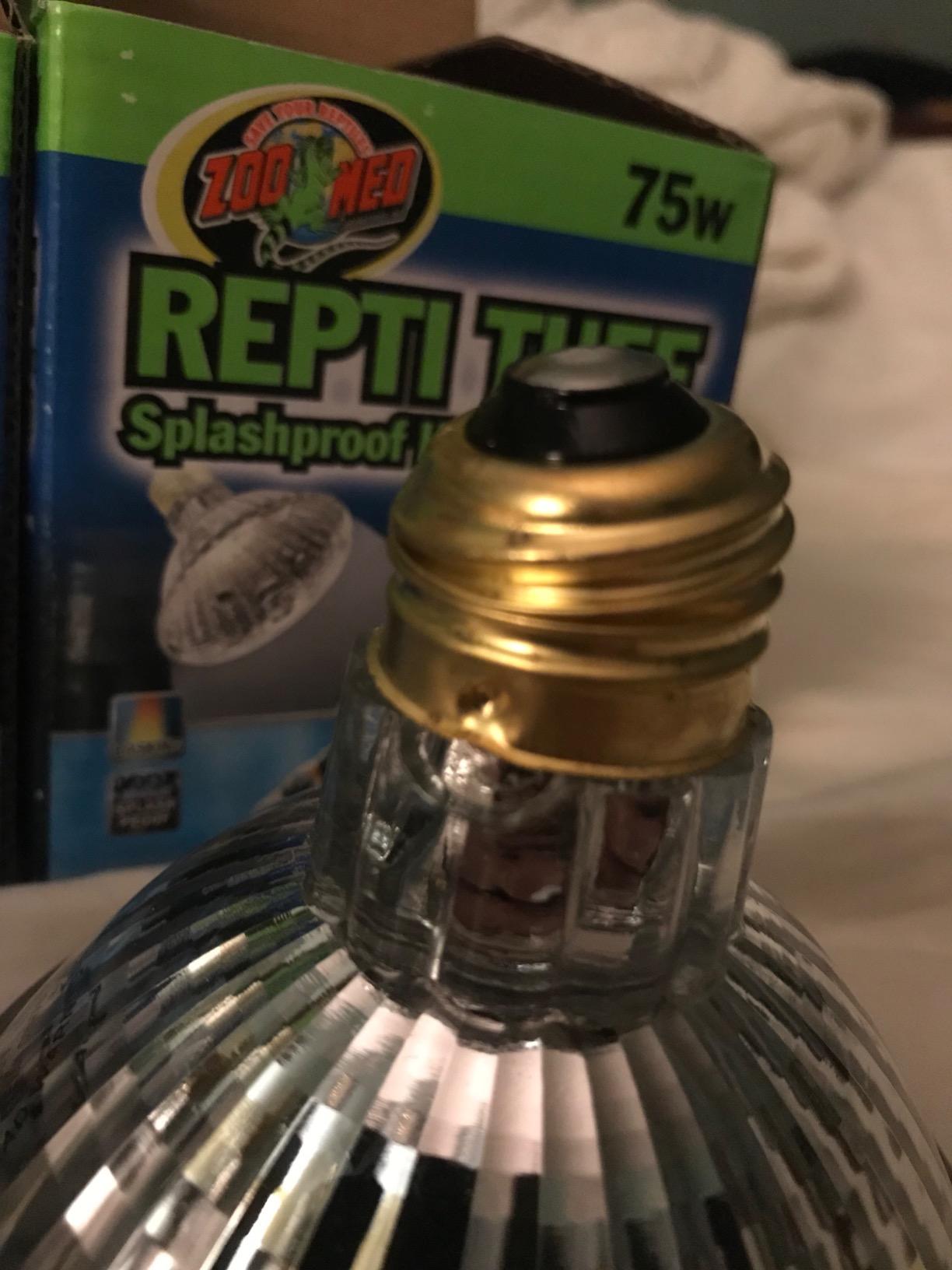
This is the bulb to buy if your priority is actual halogen, and it is the best-rated product in the roundup at 4.7 with about 88% five-star reviews. The listing states a true halogen light source, which means the infrared-A and infrared-B penetration that incandescents lack.
It is also completely splashproof and will not shatter or switch off when splashed, which makes it the one to use in a humid room, near a misting system, or in any setup where a conventional glass bulb would be a liability. Rated operating life is 2500 hours, at the top of the range quoted across this list.
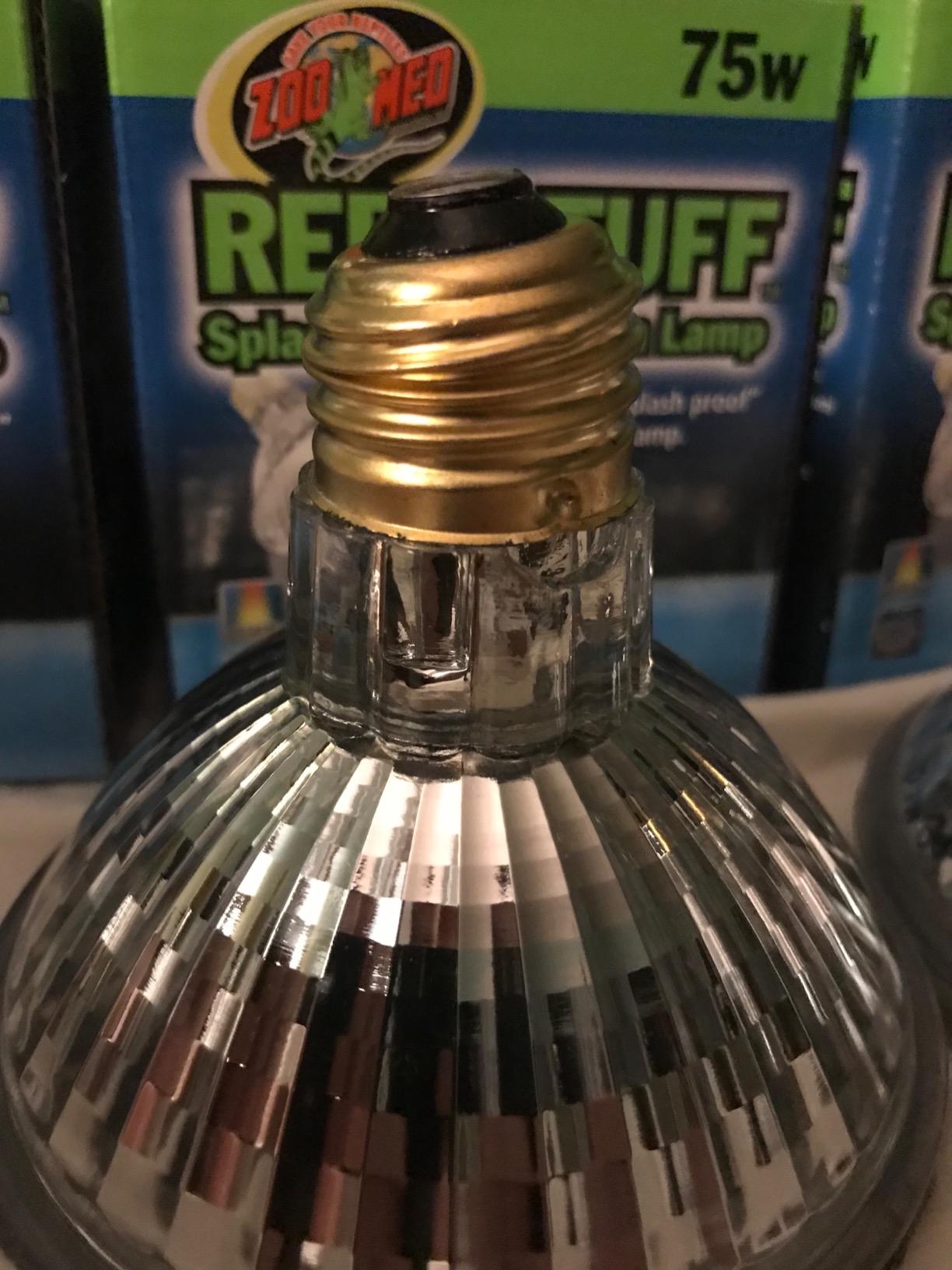
Where it needs managing is power. At 75W it produces less total heat than a 100W incandescent, so in a tall enclosure you will need to mount it closer to reach your target surface temperature. That is a fine trade in a 4ft setup and a poor one in an 8ft adult cage with a long basking run.
The review base is the smallest here at 125 ratings, so the 4.7 rating is less well tested than the lower but more heavily reviewed competitors. Owners still consistently single out the splashproof build and the brightness of the halogen source.
Best fit for a tegu setup
A juvenile or subadult in a 4ft enclosure, or any enclosure in a humid location where a splashed incandescent bulb would be a recurring risk. At 75W with a BR30 shape it is a compact lamp that fits standard reptile dome fixtures.
Because it is a true halogen with deep penetrating heat, it does more work per watt of absorbed radiant energy than an incandescent. Getting a target surface temperature from it takes less mounting closeness, which is a benefit in a tall cage.
Where it falls short
It carries the highest per-bulb cost of anything here, and 75W is not enough for a large adult enclosure on its own.
If your basking area is wide, plan on supplementing this with a second lamp rather than expecting one 75W bulb to heat a 6ft platform. Pair it with a suitable fixture and temperature control, and this is the strongest single bulb in the list for penetration.
9. CALPALMY 100W R80 Basking 4 Pack – the most bulbs for a large array
CALPALMY (4-Pack 100W Reptile Heat Lamp Bulbs – UVA Daylight Basking Light Bulbs for Reptiles, Turtles, Lizard, Bearded Dragon and Amphibians – 120V R80 Reflector Bulbs with E26 Screw Cap Base
E26 base
80-degree beam angle
R80 reflector
3.15 x 4.3 inches
Pros
- Four-pack gives the best per-bulb price for a multi-zone large enclosure
- Produces a focused beam that creates an efficient heat gradient
- Supports thermoregulation
- metabolism and reproductive health
- Fits standard 120V E26 sockets
Cons
- Non-dimmable and incompatible with dimmers and thermostats
- Lowest average rating among the multi-packs at 4.3
- Bulb length requires lamp distance to be set carefully
The CALPALMY four-pack exists for one reason: an adult tegu in a large cage needs multiple basking points, and four bulbs in one box is the practical way to build them. At 305 reviews with a 4.3 average, it is a thinner-proven product than the leaders, but the format solves a real problem.
The reflector is an R80, 80mm in diameter and 110mm long, with a listed beam angle of 80 degrees. That is wider than the narrow reflector lamps earlier in this list, which is exactly what you want when you are spacing bulbs along a long platform rather than stacking them.
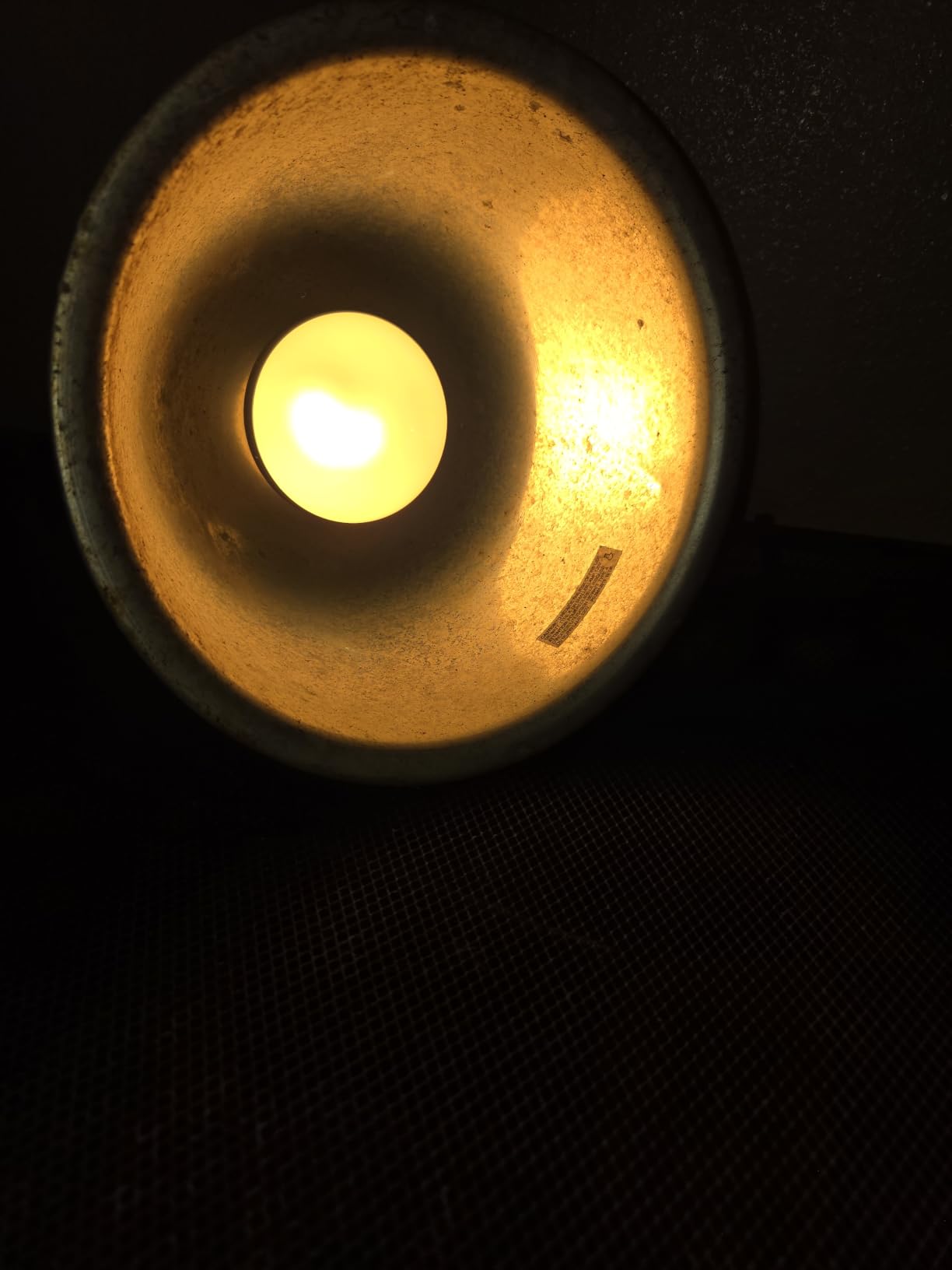
The listing is unambiguous about one thing: this bulb is non-dimmable and will buzz, flicker and die prematurely on a dimmer, thermostat or rheostat. That rules out the dimming thermostat setup we would otherwise recommend for halogen, so plan on a timer plus probe thermometer control, or add a separate dimmable halogen for the primary basking point.
Owners still rate the focused beam and the resulting heat gradient positively, and the four-bulb format is what makes a multi-zone large enclosure affordable. The instruction to place the lamp 30 cm from pets is the same clearance rule you should follow on any of these lamps.
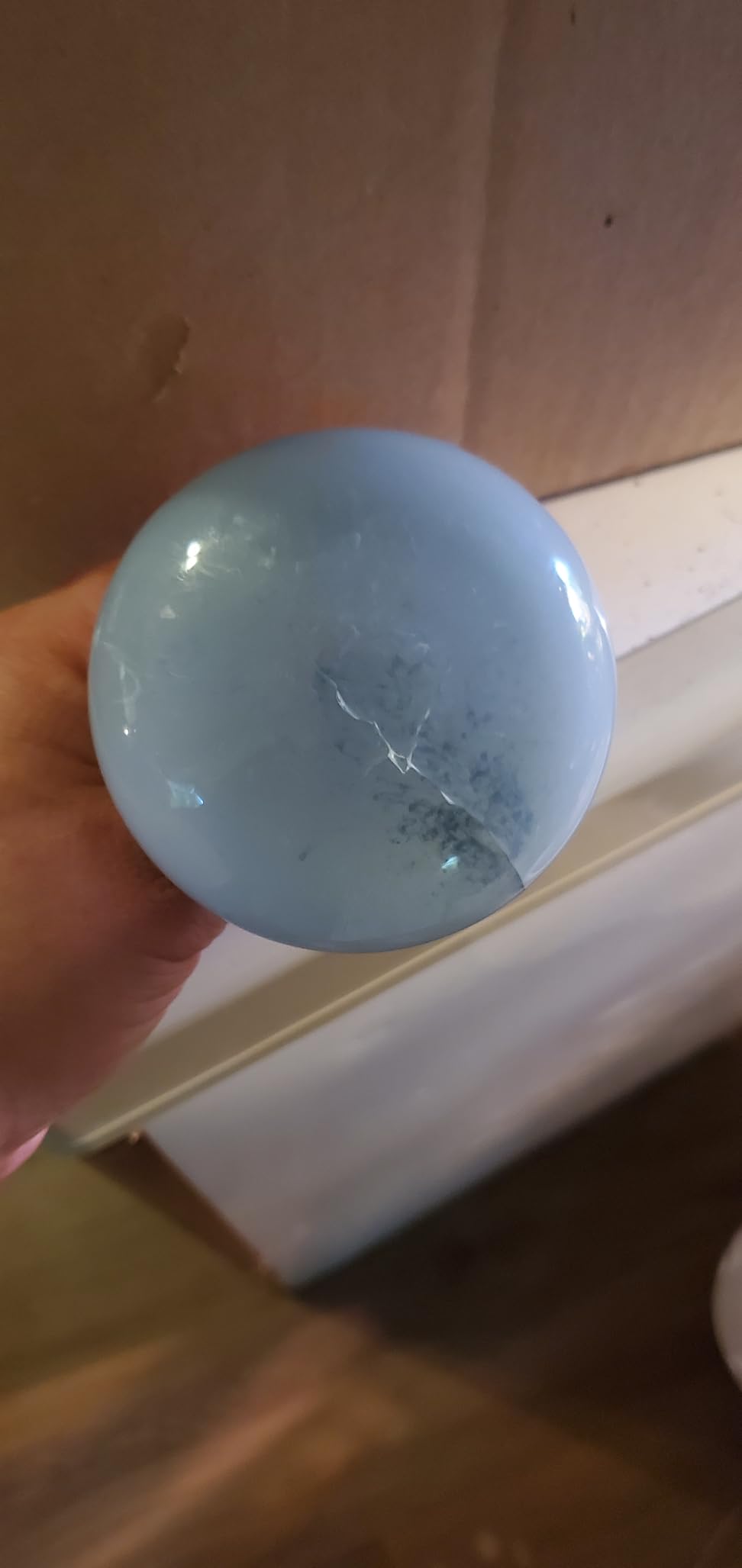
Best fit for a tegu setup
Large adult enclosures, grow tents, and any setup where you plan to hang bulbs in a row or grid over a stone basking platform. Two or three of these over a long run produces the multi-point basking area that big tegus actually use.
The wider 80-degree beam means you can space the fixtures further apart than you would with the narrow spots, which matters when you are working within the height of a 4ft or taller enclosure.
Where it falls short
The non-dimmable specification is the headline limitation and should drive your fixture choice. A 4.3 rating is also the lowest among the multi-packs here, and some owners note average durability alongside the value benefit.
The bulb length also means lamp distance has to be set carefully, since the hot spot sits close to the fixture. Our broader basking bulb breakdown covers the clearance maths for longer reflector formats.
10. Exo Terra Sun Glo Halogen Basking Spot – built for colour
Exo Terra Sun Glo Halogen Basking Spot Lamp
2.5 x 2.5 x 4 inches
True halogen
Full-spectrum daylight
Model PT2181
Pros
- True halogen with superior heat penetration for deeper basking temperatures
- Neodymium coating noticeably brightens reptile coloration
- UVA output supports breeding and physiological health
- Low wattage options give fine-grained heat control
Cons
- 4.0 average rating with 12% one-star reviews
- Reports of premature burnout within a few months
- Reports of glass cracking from the bulb's own heat
The Exo Terra Sun Glo is the other true halogen in this roundup, and it is the one with a neodymium coating. That coating is the reason it looks different: it enriches and brightens reptile coloration under daylight, which is a genuine benefit for a tegu whose colour and condition keepers watch closely.
Technically it is a strong choice. The listing describes full-spectrum energy-efficient daylight output with enhanced infrared levels for heat penetration, and UVA output to stimulate breeding behaviour. It is available in 50W and 75W variants, which gives unusually fine-grained heat control for a halogen.
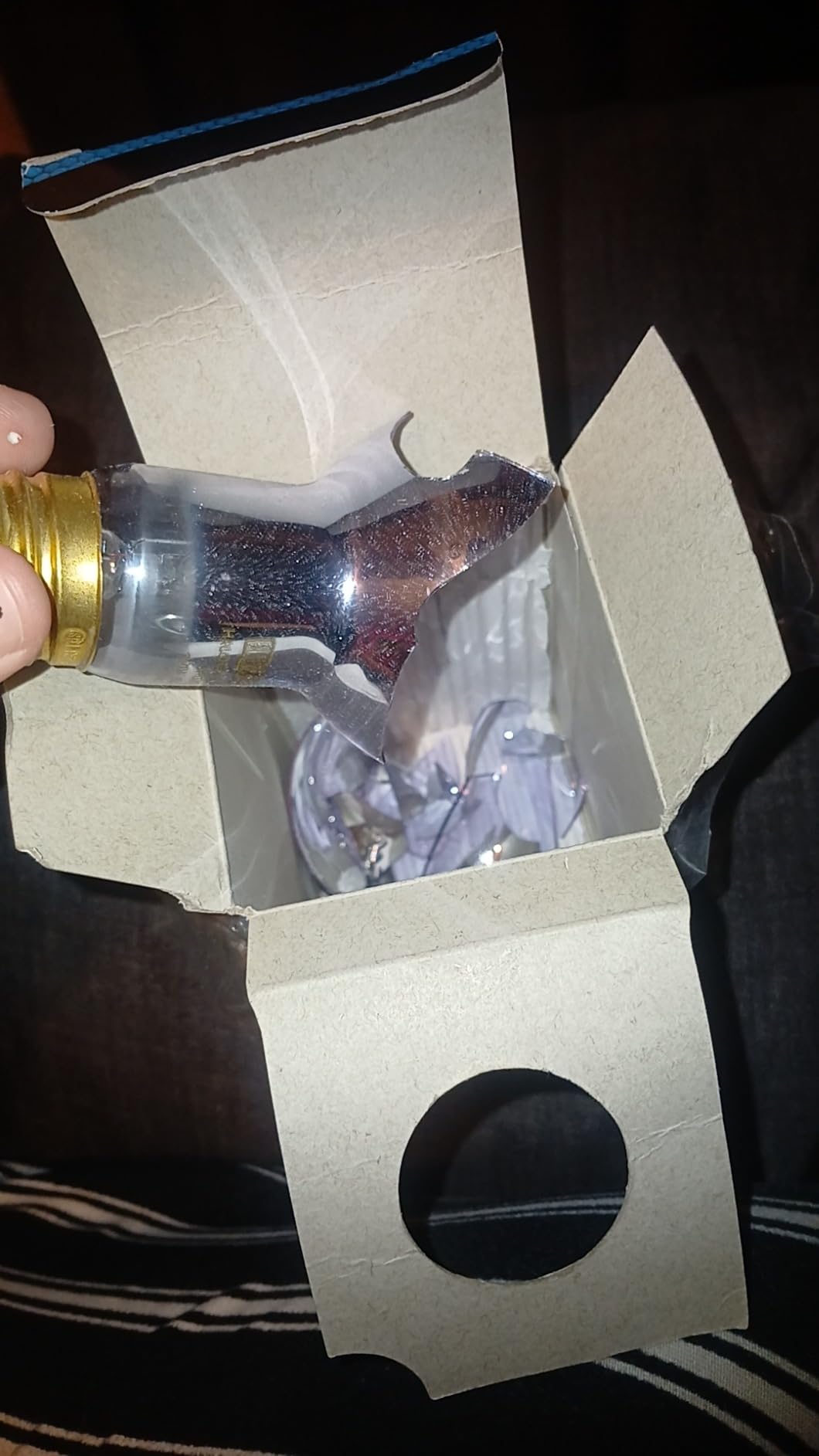
What holds it back is durability feedback. At a 4.0 average from 149 reviews with around 12% one-star, it has the lowest rating here, and the recurring complaints are premature burnout within a few months and glass cracking from the bulb’s own heat. Users who space it properly report good heat and colour enhancement, which points to mounting distance as the variable.
At 2.5 by 2.5 by 4 inches and 1.76 ounces, it is a compact BR-style lamp, but several owners report it is physically large for some fixtures. Check clearance, particularly in a dome with a shallow reflector.
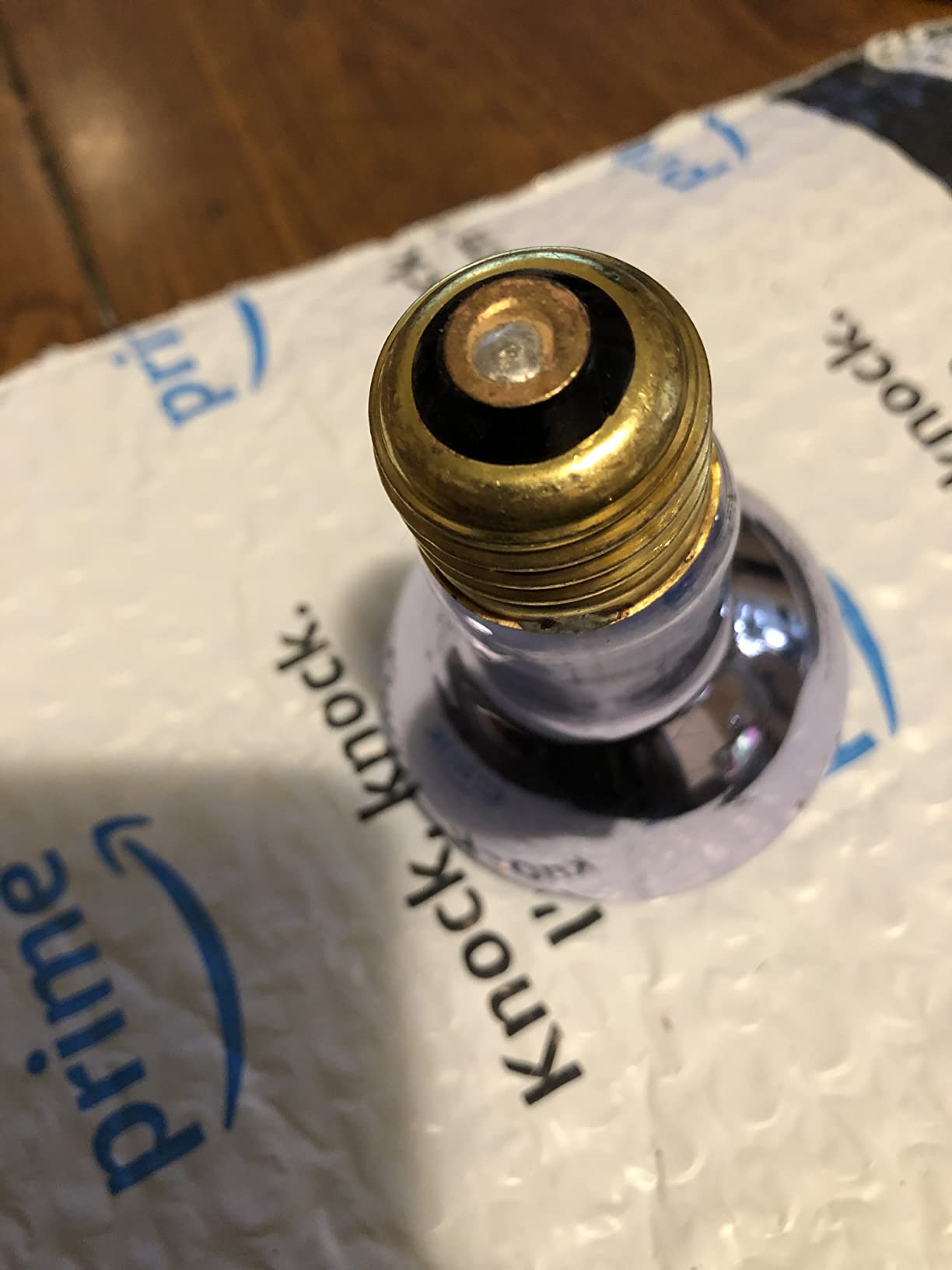
Best fit for a tegu setup
Keepers with smaller enclosures, or those who want the brightest possible daylight cue and the strongest true-halogen penetration per watt. The lower wattage options let you dial a basking zone in precisely rather than overshooting and pulling the lamp away.
Pair it with a separate, dimmer night source rather than leaving it on around the clock. The listing itself suggests pairing with a night heat lamp or infrared basking spot for a 24-hour cycle, which is the right architecture.
Where it falls short
The failure reports are the reason this sits at the bottom of our ranking despite being technically capable. If you choose it, mount it at the distance the manufacturer recommends, do not enclose it in a tight reflector, and keep a spare, because a halogen that cracks in a socket is a genuine hazard rather than an inconvenience.
It is also the least well-reviewed product here, so you are trusting a small sample of owners. For most tegu keepers our number one pick remains the safer, far more proven choice.
How to choose: wattage by tegu enclosure height
The most common mistake we see is choosing a bulb by brand rather than by the distance between the lamp and the basking surface. A 100W lamp in a 4ft enclosure can deliver a dangerously hot platform, and the same 100W lamp in a grow tent mounted high above the animal can land well below target. Measure, do not assume.
Published tegu care sheets generally put the adult basking surface at 110 to 120F, with a warm-side ambient around 80 to 90F, a cool side around 75 to 85F, and a night drop to roughly 70 to 75F. Experienced keepers on tegu forums often run hotter basking targets for adults than the printed minimums, which is a reminder that these are surface temperatures measured with an infrared thermometer, not air readings.
Our working guidance by enclosure height: a 4ft enclosure suits a single 100W spot, a 6ft enclosure generally needs either a higher-wattage halogen or a 100W mounted lower, and an 8x4x4 adult cage is best served by two or more bulbs in a row over a long platform rather than one lamp. The forum consensus is consistent on one point that we agree with entirely: a dimming thermostat is not optional with halogen.
Wherever you mount the lamp, keep it between 10 and 14 inches from the basking surface and never let the animal reach the glass. Any listing that advises a minimum of 30 cm clearance is telling you the same thing in metric.
Halogen vs. other heat sources for tegus
Halogen is the best daytime heat source for a large basking lizard, but it is not the only option, and it is not a replacement for ultraviolet light. Understanding what each source actually does prevents most of the mistakes we are asked about.
Halogen flood: deep penetrating infrared plus a strong visible light cue. Dimmable versions allow real temperature control. Higher running cost and shorter bulb life than incandescent. The best daytime heat for a tegu when paired with a thermostat.
Incandescent basking spot: a visible light cue and surface heat with less penetration. Cheap, widely available, and the reason most bulbs on this list are what they are. Perfectly adequate in a moderate enclosure with a probe-controlled timer.
Mercury vapour bulb: heat plus ultraviolet in one lamp, and an appealing single-fixture answer for a large cage. UVB output drops with distance, it needs a large dome, and it cannot be dimmed, so you control the temperature by raising and lowering the lamp instead. A specialist tool, not a default choice.
Ceramic heat emitter and deep heat projector: infrared with no visible light, used to add ambient or overnight warmth. Neither triggers basking behaviour, so neither replaces a daylight lamp. They are excellent supplements for a cool night in a large adult enclosure. Our deep heat projector picks cover this category properly.
Heat mat: ambient warming with no basking benefit and no visible light. Not a daytime heat source for a heliothermic lizard, and a poor choice for a tegu specifically.
Whichever you choose, ultraviolet is a separate system. A T5 HO 10% to 12% linear fixture is the standard pairing, and screen mesh loses a meaningful share of UVB, so a mesh-topped enclosure needs a stronger lamp or closer placement.
Thermostat, fixture and placement: the setup that holds temperature
Five steps, in order, take a tegu basking zone from guesswork to a stable, measurable target.
1. Fixture. Use a dome lamp with a ceramic E26 socket, rated for the wattage of your bulb. Metal sockets and low-wattage plastic fixtures are how bulbs crack, and a ceramic socket runs cooler under load.
2. Thermostat. A dimming thermostat is the right control for a halogen, because it holds the surface temperature by modulating power. An on/off thermostat with a bulb mounted at least 30 cm away is the fallback if the bulb is non-dimmable. A timer alone gives you no temperature control at all.
3. Mounting distance. Between 10 and 14 inches above the basking surface, and further if the bulb runs hot or the animal can reach it. In a grow tent, budget for a longer throw than you expect, which is the usual reason keepers in tents end up under-heated.
4. Measure. Aim an infrared thermometer at the basking surface, not at the air, and not at the animal. Take a reading at several points across the platform, because a single reading on one stone tells you very little about a long run.
5. Verify and re-verify. Check morning and evening for a week, and again after any seasonal room temperature change. Hold the warm side and cool side within range and you are done; if the gradient collapses, move the lamp rather than adding wattage.
One last warning that ties back to the products above: if your bulb is listed as non-dimmable, do not put it on a dimmer. Reviewers of the REPTI HOME and CALPALMY report exactly that mistake producing buzz, flicker and early failure, and the manufacturer instructions say so plainly.
Frequently Asked Questions
Is a halogen bulb the same as a basking bulb?
No. A halogen basking bulb is a specific type of basking bulb. It holds an inert gas around its tungsten filament, which lets the filament run hotter and produces more infrared-A and infrared-B that penetrates tissue. A standard incandescent basking bulb is cheaper, dimmer and gives less penetration, but it works fine in moderate enclosures with temperature control.
How hot should a tegu basking spot be?
Most care sheets put the adult basking surface at 110 to 120F, measured at the surface with an infrared thermometer rather than in the air. Experienced keepers often run higher targets for adults, with 125 to 140F reported in the forums. Warm-side ambient sits around 80 to 90F and the cool side around 75 to 85F.
What is the ideal temperature for a tegu at night?
Around 70 to 75F is the usual target, a clear drop from the daytime basking temperature. Achieve it by turning off the basking lamp on a timer rather than by adding overnight heat, unless the room drops far enough that supplemental warmth is genuinely needed.
What temperature does a 100 watt basking bulb reach?
It depends entirely on mounting distance and enclosure size, which is why forum keepers report such different numbers for the same bulb. Treat the wattage as a starting point, mount between 10 and 14 inches above the surface, and measure the actual surface temperature with an infrared thermometer before deciding the bulb is faulty.
Why are halogen bulbs being discontinued?
Some traditional halogen and incandescent lamp lines are being wound down as manufacturers move toward LED and other technologies, largely for energy efficiency reasons. For reptile keepers the practical effect is that popular reptile-specific halogen lines may change or disappear, so it is worth keeping a spare bulb of whatever model you are running.
Do tegus need UVB as well as a basking bulb?
Yes, and the two are separate systems. The basking bulb supplies heat and the visible light cue, while a T5 HO 10% to 12% linear fixture supplies UVB. If your enclosure has a screen mesh top, a large share of UVB is lost passing through it, so the lamp needs to be stronger or closer.
What size terrarium does a tegu need?
An adult Argentine or Colombian tegu is generally housed in something around 8x4x4 feet, and a young animal can start considerably smaller. Bigger is better, because the animal needs room to create a real thermal gradient with a hot basking point and a genuinely cool side.
Final verdict for tegu keepers in 2026
For most people building a tegu basking zone, the Fluker’s 100W incandescent spotlight is the best buy on this list, because 5404 reviews is more real-world evidence than anything else here. If you want a higher rating, a two-pack, a dimmable bulb and a listing that names tegus, take the LUCKY HERP. If you specifically need true halogen with infrared penetration, the Zoo Med Repti Tuff 75W is the only one we would recommend, and the Exo Terra Sun Glo is worth considering for colour output if you accept its weaker durability record.
Whatever you choose, run it on temperature control, mount it 10 to 14 inches above the platform, measure the surface with an infrared thermometer, and pair it with a T5 HO UVB fixture. That setup, not the brand name on the box, is what keeps a tegu healthy.