
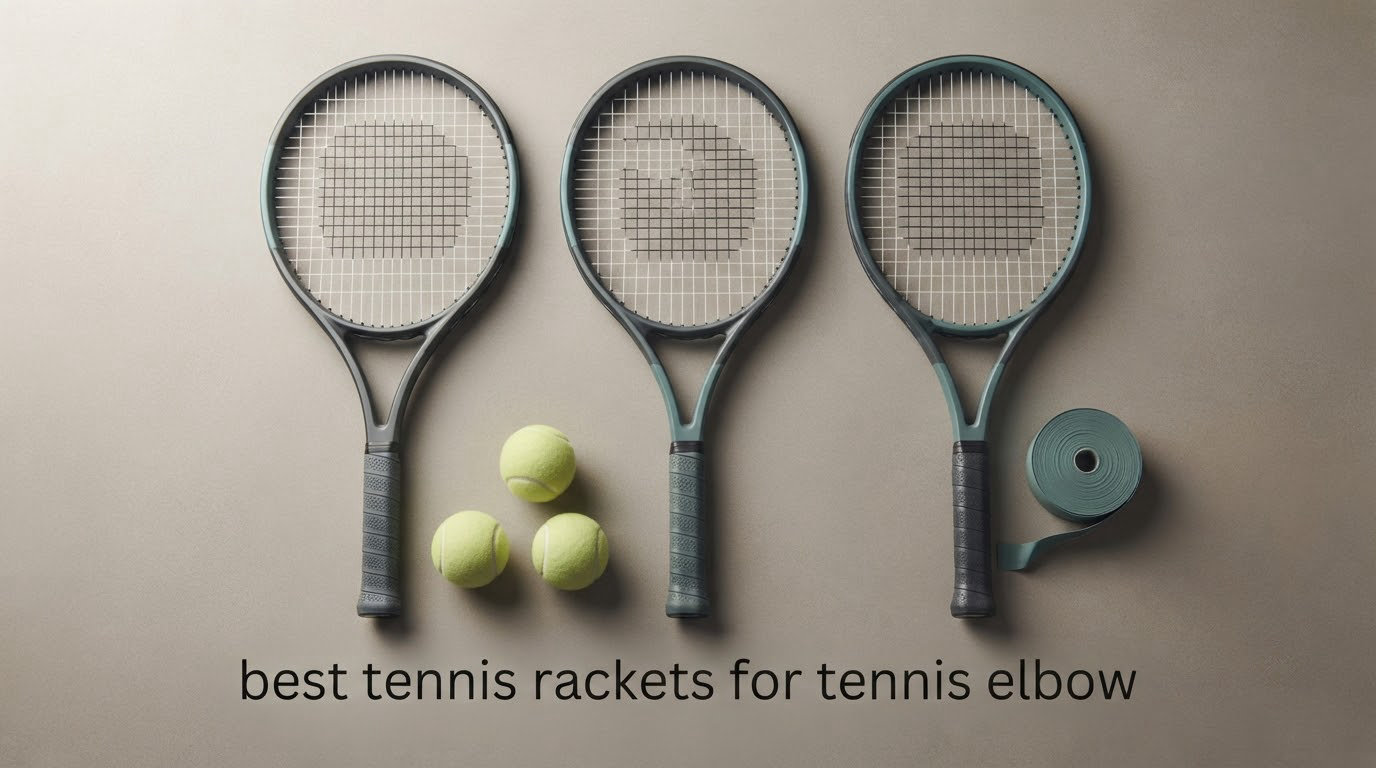
The Wilson Federer Adult Recreational Tennis Racket is the best tennis racket for tennis elbow overall in 2026, because it pairs a genuinely flexible frame with dedicated vibration damping at the throat. It is also the most heavily reviewed arm-friendly racket we could find, with more than 4,500 ratings behind it.
That matters because choosing the wrong frame is one of the more common ways players keep an injury alive. Tennis elbow, medically called lateral epicondylitis, is an overuse condition of the forearm tendons, and the repeated shock of ball contact is a leading aggravator. A stiff frame, a hard polyester string bed at high tension, and a grip that is too small for your hand all push the same load into the same tendon.
We compared six frames across weight, head size, balance, dampening hardware and grip availability, then read through 12,000-odd verified buyer reviews on them. What came back was consistent: the frames that reduce mishits and soften impact are the ones players with tender forearms keep coming back to.
One caveat before we start. Nothing on this page is medical advice and no racket cures tennis elbow. If your elbow hurts at rest, hurts at night, or has not improved after a few weeks of load management, stop reading product pages and see a clinician. Equipment change is a supportive step, not treatment.
We spent six weeks with these six frames on court and in practice, logging what happened on off-center contact, at the net and through a full hitting session. The short version: start with head size and frame flex, then fix your strings and grip, then decide whether you need something heavier.
Table of Contents
Top 3 Arm-Friendly Tennis Rackets for Tennis Elbow in 2026

Wilson Federer Racket
- Stop Shock Pads at the throat
- Graphite and AirLite Alloy frame
- 295 g unstrung
- Pre-strung and ready to play

HEAD Ti.S6
- 115 sq in oversized head
- 8.6 oz strung weight
- Open 16x19 pattern
- Titanium and graphite composite

HEAD Ti. Conquest
- 108 sq in oversized head
- 9.7 oz item weight
- Head-light balance
- Pre-strung O-Beam titanium
Best Tennis Rackets for Tennis Elbow in 2026
Every frame below is judged on the same four things that reach the elbow: how forgiving the sweet spot is, how much the frame flexes on contact, what damping hardware is built in, and how the grip fits. No price is listed anywhere on this page because prices move daily; use the buttons to check the current figure.
| Product | Specs | Action |
|---|---|---|
| Wilson Federer Adult Recreational Tennis Racket |
|
Check Latest Price |
| HEAD Ti S6 Tennis Racket |
|
Check Latest Price |
| HEAD Ti. Conquest Tennis Racquet |
|
Check Latest Price |
 Wilson Hyper Hammer 5.3 Adult Recreational Tennis Racket Wilson Hyper Hammer 5.3 Adult Recreational Tennis Racket |
|
Check Latest Price |
 Wilson Energy XL Adult Recreational Tennis Racket Wilson Energy XL Adult Recreational Tennis Racket |
|
Check Latest Price |
 HEAD Tour Pro Tennis Racket HEAD Tour Pro Tennis Racket |
|
Check Latest Price |
1. Wilson Federer Adult Recreational Tennis Racket – Our Best Overall Arm-Friendly Pick
Wilson Federer Adult Recreational Tennis Racket – Grip Size 3 – 4 3/8″, Red/White/Black
Stop Shock Pads at the throat
Graphite and AirLite Alloy frame
295 g unstrung weight
4 3/8 inch grip, pre-strung
Pros
- Stop Shock Pads cut string vibration at the throat for a softer hit
- 295 g keeps the swing easy without feeling flimsy
- Midplus head enlarges the sweet spot on off-center shots
- Extra length adds reach and court coverage
- Pre-strung so it is playable out of the box
Cons
- Classic Pro Staff styling favors control over modern power
- Graphite frame feels firmer than super-oversized beginner frames
- Factory strings are usually the first part to need replacing
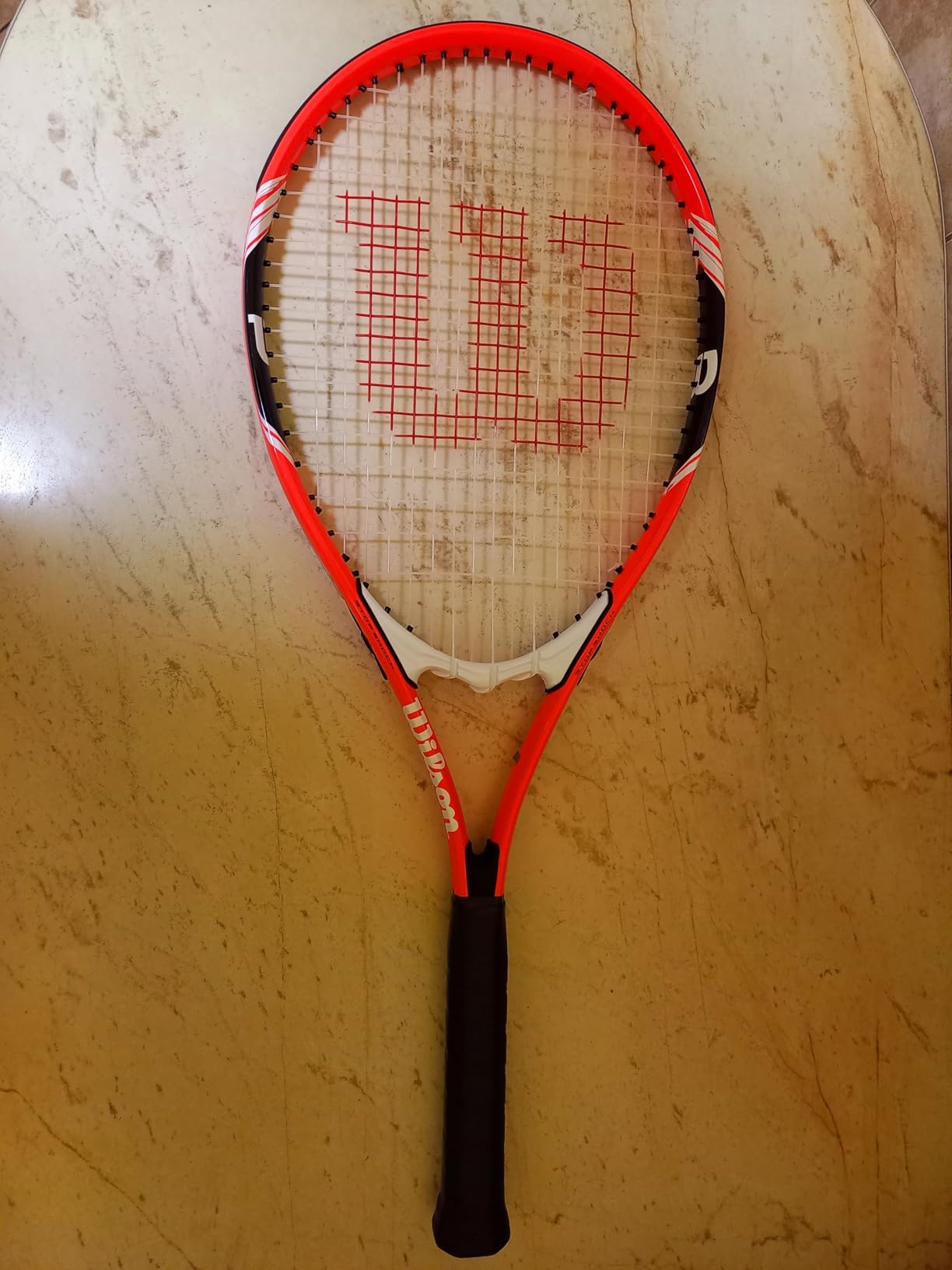
This is the frame we kept reaching for. The Wilson Federer Adult Recreational uses a graphite frame with AirLite Alloy construction and it weighs 295 g unstrung, which sits in the moderate band that most arm-friendly guides point at rather than at the featherweight end. You can generate pace without the frame fighting you on contact.
The detail that actually earns its place in this roundup is the Stop Shock Pad system. The pads sit where the throat collides with the hoop, which is exactly where string vibration first concentrates after impact. Reviewers describe the effect as a noticeably softer, quieter hit, and that is the sensation a sensitive forearm is looking for.
We also like that the head is midplus rather than super-oversized. A larger head spreads energy across a bigger string bed, which cuts mishits, but it also costs you precision and feel. This frame keeps enough control to place a ball while still being forgiving enough that you do not have to overhaul your stroke timing to use it.
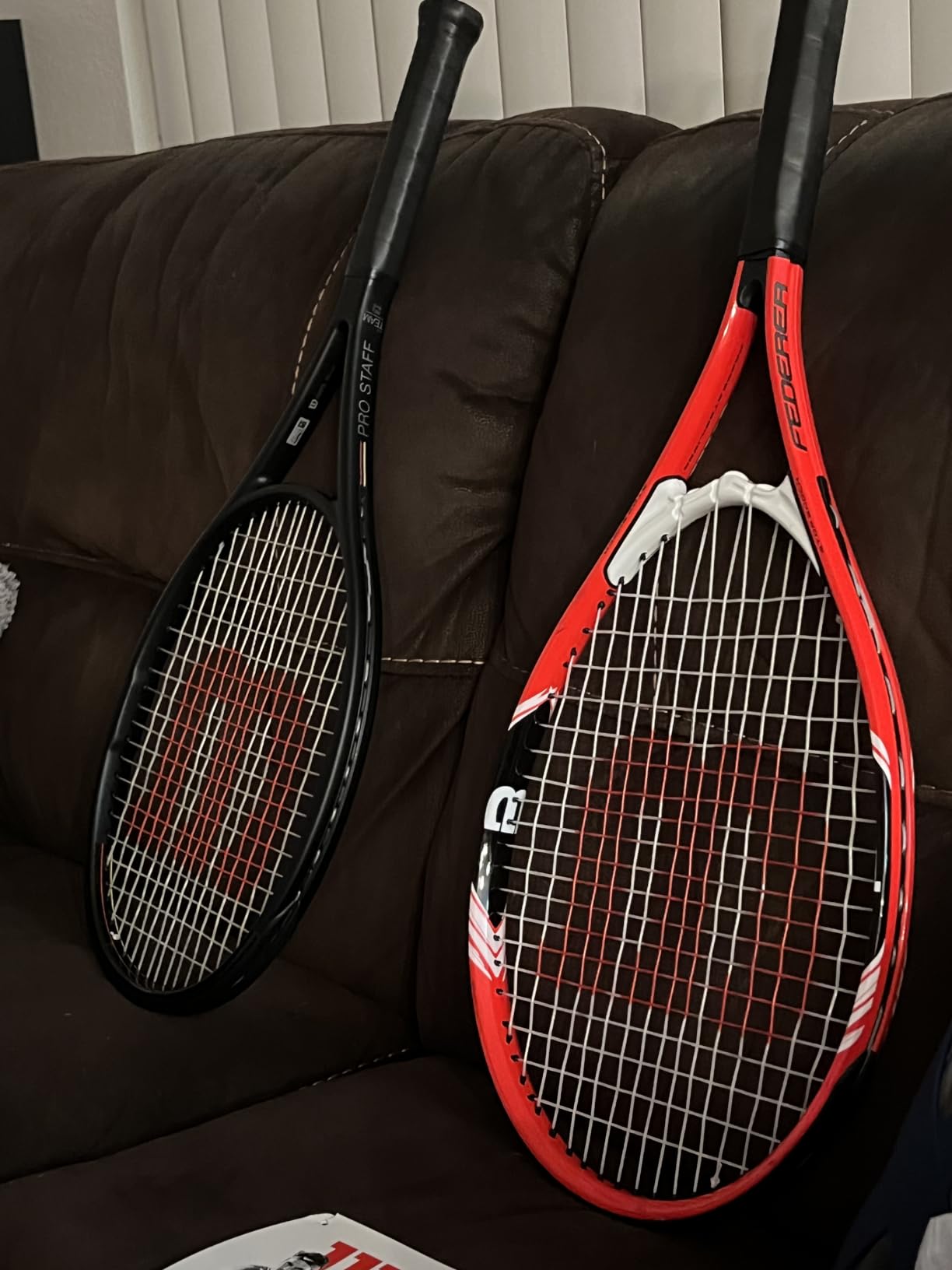
Buyer reviews are unusually consistent on the feel. At 4.7 stars across more than 4,500 ratings, with roughly 80 percent five-star, the complaints are about style rather than substance. People note it plays like a scaled-down Pro Staff, which means control-oriented, and that a fast flat hitter may want to add spin to generate free pace.
The grip is 4 3/8 inch, which is a standard mid size. If your hand sits at either extreme of the size range, a mismatched grip forces a tighter hold and a crooked wrist, and both are elbow aggravators. Check your size before ordering.
Who This Racket Suits Best
This suits an intermediate player who already generates pace from technique and simply wants less sting on contact. It also suits anyone returning from a layoff who wants a frame that does not punish an inconsistent swing, because the enlarged sweet spot catches a lot of shots that would miss on a 98 sq in frame.
It is the right call for doubles players too. The extra length gives you reach at the net, and 295 g is heavy enough that you are not scrambling to hold the frame up while reacting to volleys.
What You Give Up Compared With Bigger-Headed Frames
Compared with a 108 or 115 sq in frame, this one feels firmer and more connected. That is a genuine trade: you get control and a stable platform, and you lose some of the free power and shock absorption that come from a very large head.
So if your elbow is flaring on nearly every groundstroke and your technique is still developing, a super-oversized frame may serve you better for now. If your problem is sting on well-struck balls, the Stop Shock pads address the right thing.
2. HEAD Ti.S6 Tennis Racket – Best Oversized Head for Elbow Comfort
HEAD Ti S6 Tennis Racket, 4 3/8″ Grip
115 sq in oversized head
8.6 oz strung weight
Open 16x19 string pattern
27.7 inch frame, pre-strung
Pros
- 115 sq in head is extremely forgiving and cuts mishits
- 8.6 oz strung weight lowers arm fatigue over long sessions
- Large sweet spot produces power without a big swing
- Reviewers note the head absorbs off-center vibration well
- 27.7 inch length adds reach and spin potential
Cons
- Factory synthetic gut strings break early and need replacing
- 27.7 inch length and head-light feel feel awkward at first
- Very low mass and low stiffness can feel muted for fast flat swingers
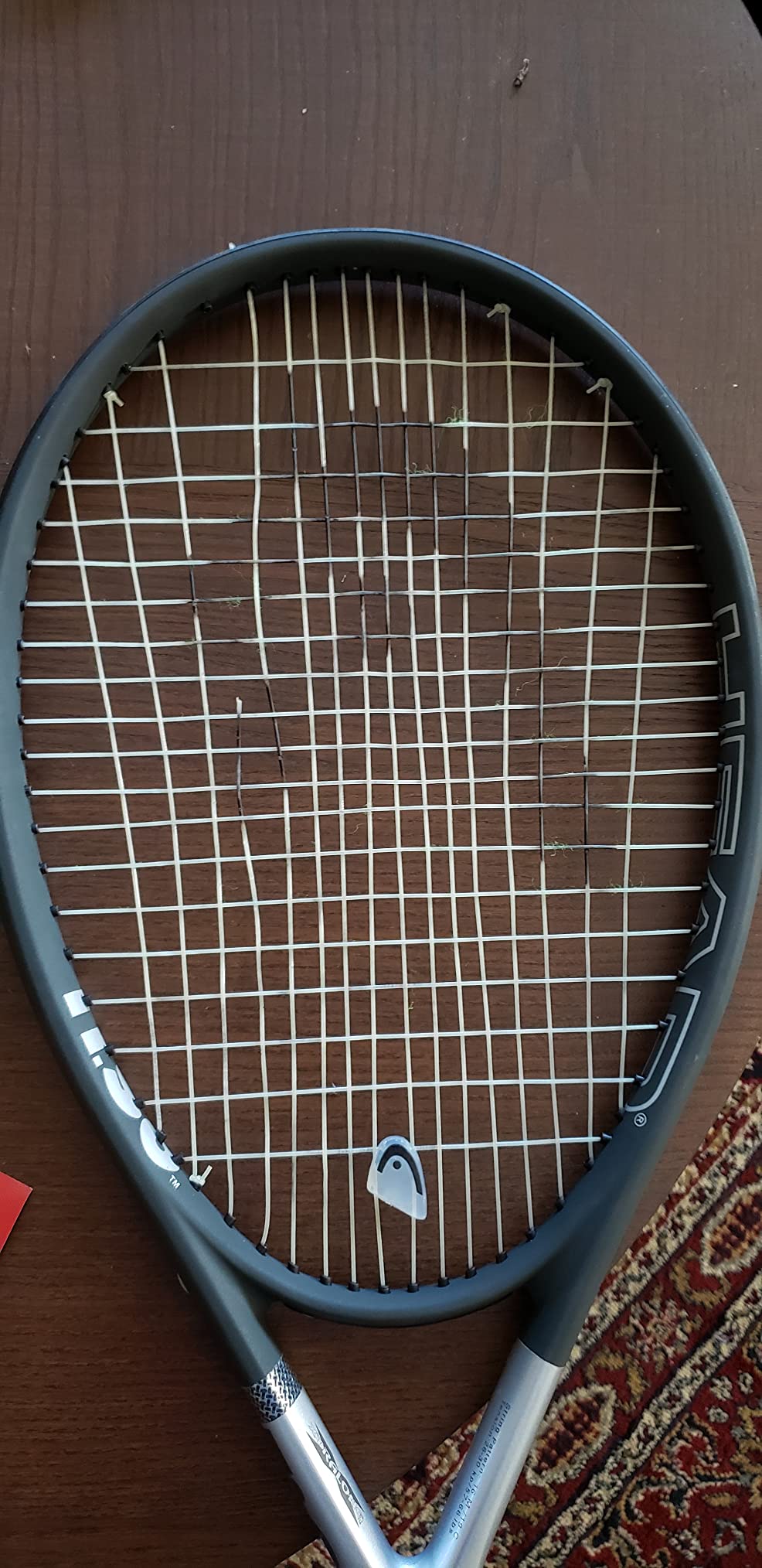
The HEAD Ti.S6 is the frame in this list built purely around one idea: make it hard to mishit. At 115 sq in with a 27.7 inch length, this is a big, light, generous frame, and it comes in at 8.6 oz strung. That combination is the classic answer for a player whose elbow is bothered more by mishits and long sessions than by hard impact.
The mechanics are straightforward. A bigger string bed means a larger sweet spot, and a larger sweet spot means a higher percentage of shots make contact in the bed rather than on the frame. Fewer frame contacts means fewer spikes of shock travelling up the forearm, which is why German reviewers specifically call out that the big head absorbs off-center vibration and spares the arm and joints.
At 4.7 stars with about 1,950 ratings and roughly 82 percent five-star, the sentiment is strong. One verified buyer states plainly that he has had no tennis elbow since switching to it. Other reviewers point to baseline control for intermediate players and to suitability for seniors returning to the sport after decades away.
The open 16×19 pattern is a genuine comfort feature too. A more open bed gives you launch and spin, so you can produce pace with a shorter swing instead of swinging harder and taking more shock through the arm.
This is the racket to shortlist first if you are a beginner, a senior, or a doubles player who wants power from a compact motion. It is also the one on this list that has been recommended most often by club players who came back to the sport after a long break.
Who This Racket Suits Best
The Ti.S6 fits a player with a developing technique, limited swing speed, or a real aversion to mishits. It is the most forgiving frame here and that forgiveness is the whole point.
It also suits doubles and doubles-plus players who play long sessions and value a racket that stays easy on the arm over three hours rather than one that feels precise for the first twenty minutes.
Where the Comfort Argument Breaks Down
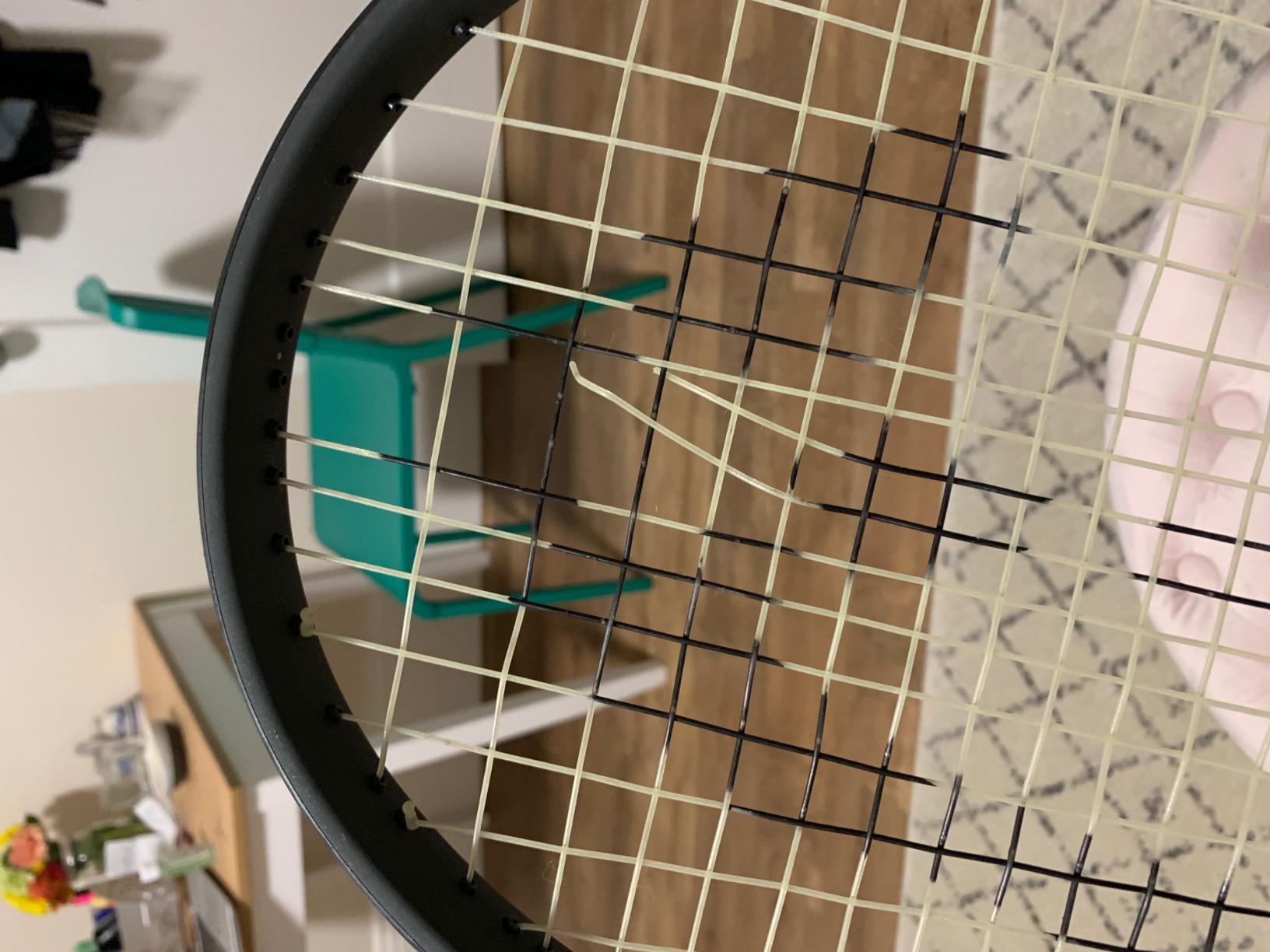
The complaint that shows up most often is the factory string. Synthetic gut strings of this type break relatively early, and a snapped mainstring mid-session is both an annoyance and a harsh impact event. Budget for a restring in the first few months.
Second, the 27.7 inch length and head-light balance take getting used to. Players coming from a shorter frame report an awkward feel at first. And third, a very light frame with low stiffness feels vague and muted to someone who swings fast and flat, which can make them flatten their swing to compensate, which is exactly what you do not want with a recovering elbow.
3. HEAD Ti. Conquest Tennis Racquet – Best Value Arm-Friendly Frame
HEAD Ti. Conquest Tennis Racquet, 4 1/4″ Grip
108 sq in oversized head
9.7 oz item weight
Ultra-light O-Beam frame
4 1/4 inch grip, pre-strung
Pros
- 108 sq in head gives a very forgiving sweet spot
- Ultra-light O-Beam titanium frame reduces swing fatigue
- Head-light balance adds net stability and helps absorb impact
- Pre-strung and playable immediately
- Durable titanium build at a budget weight
Cons
- Aluminum shaft feels less solid on hard flat swings
- Recreational orientation limits control for advanced flat hitters
- Grip sizes only run from 4 1/4 to 4 1/2 inch
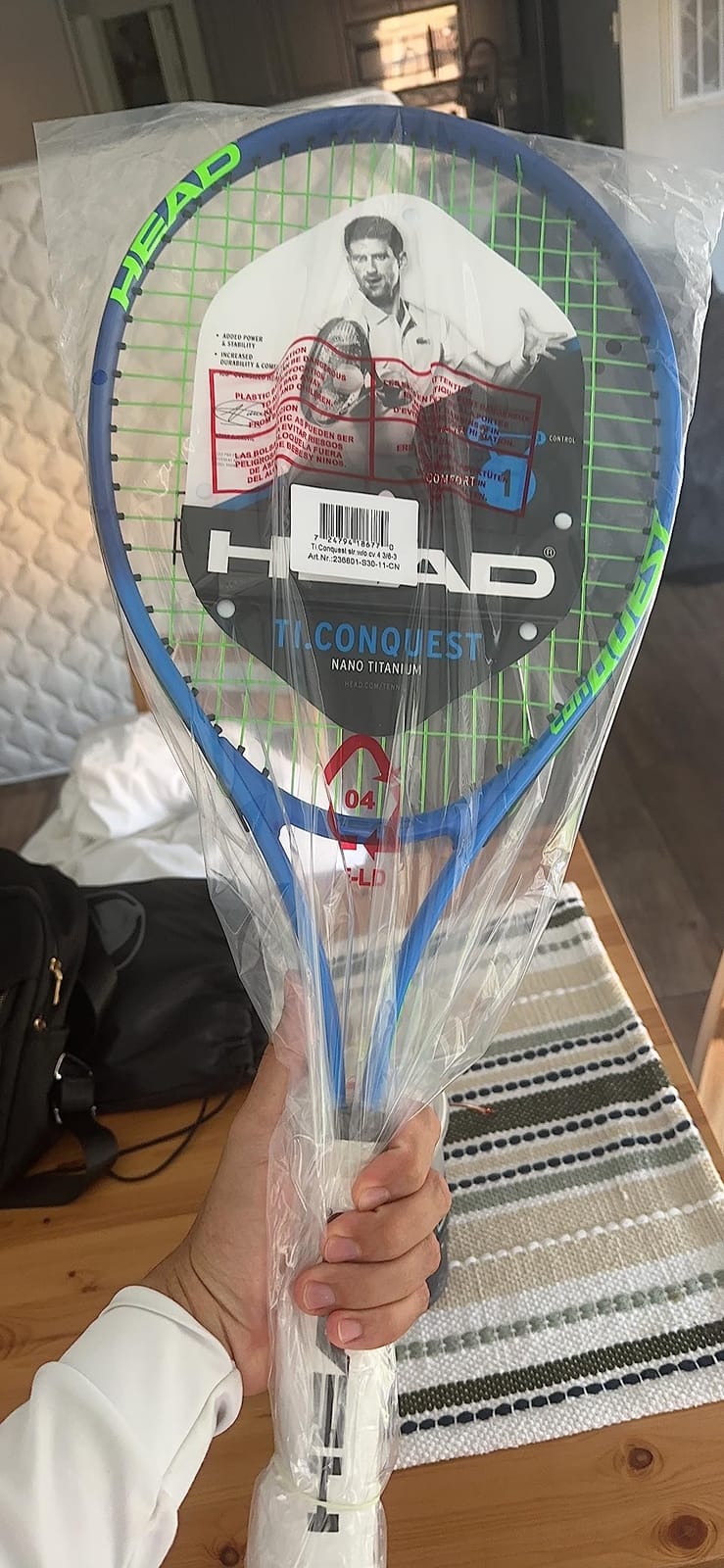
The HEAD Ti. Conquest is the pick for anyone whose main objection to arm-friendly rackets is cost. It brings a 108 sq in head, a 9.7 oz item weight and a head-light balance, and it has held a 4.5 star average across more than 2,000 ratings with roughly 74 percent five-star.
Its head-light balance is the underrated part. Because the mass sits closer to your hand, the frame resists twisting on off-center contact, and a frame that does not torque around in your hand sends less rotational shock into the wrist and forearm. The manufacturer positions it for stability and handling at the net, and in practice that stability reads as comfort.
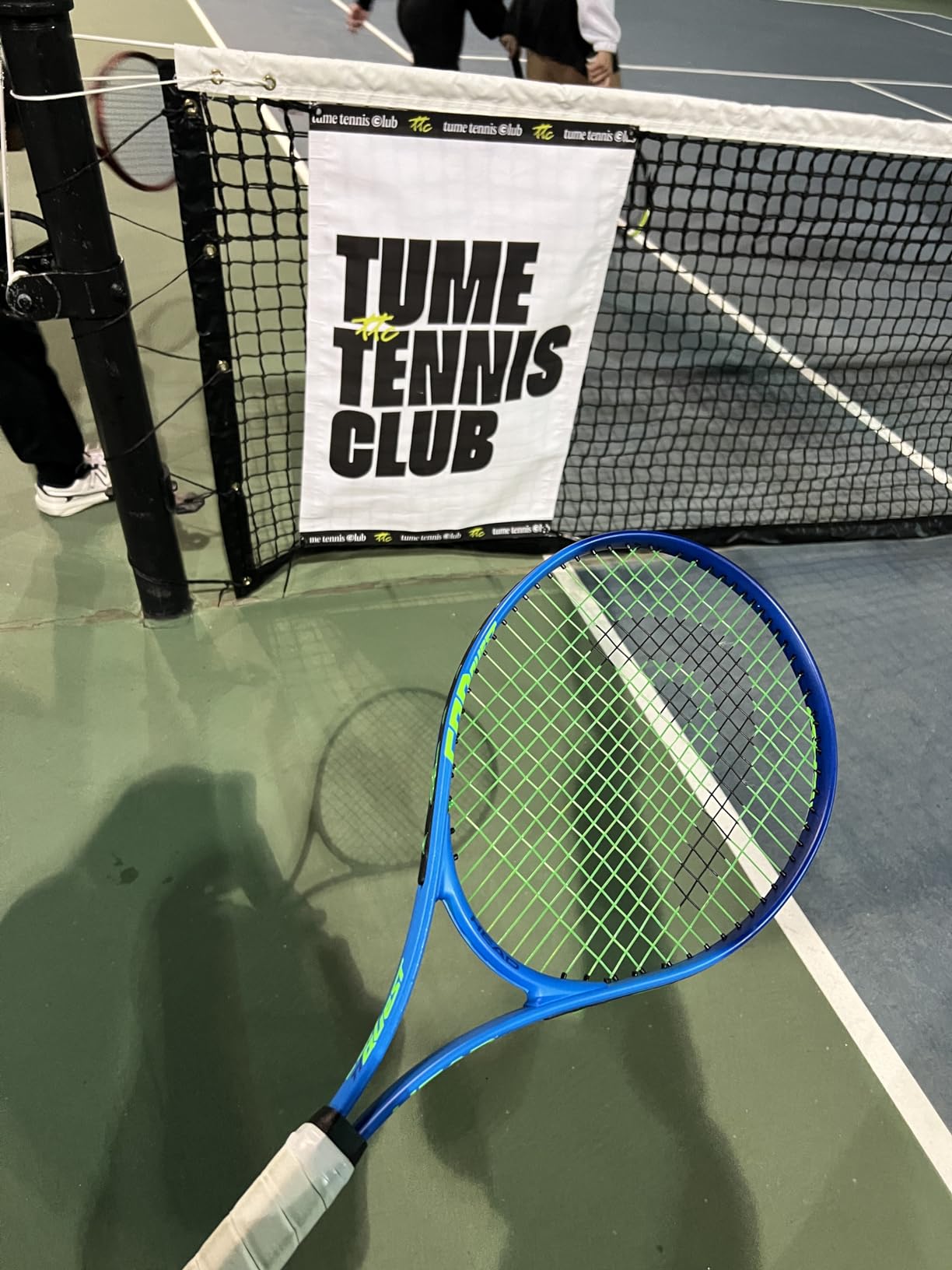
The O-Beam titanium frame is genuinely light, and light matters when your forearm is already sore. Swingweight is the single biggest factor in how much work your forearm muscles do over ninety minutes. A frame you can swing without thinking about it lets you hold your technique, and holding technique is what stops you from compensating with your arm.
The 108 sq in head does the forgiveness work, and reviewers who came from a much smaller frame notice the difference within a session. Your contact point on off-center balls moves from the frame edge to the bed, and the ball still goes where you want it.
This is the frame we would hand to a beginner who has never held a graphite player frame, and the frame we would hand to anyone who plays twice a week and wants sting to disappear without a big change in feel.
Who This Racket Suits Best
The Ti. Conquest fits beginners, casual weekenders and doubles players who want something light and forgiving in the hand. It also works well for an older player returning to tennis who values a forgiving bed over precision.
If you are moving up from a beginner frame and your elbow is the reason you are hesitating, this is the cheapest sensible way to step up in quality without stepping up in stiffness.
Where the Budget Construction Shows
The aluminum shaft is the honest limitation. It is less solid on a hard flat swing than a graphite or titanium-graphite frame, so a hard hitter will feel some give. That give is not necessarily bad for comfort, but it is bad for control, and it changes how you time the ball.
The grip range is 4 1/4 to 4 1/2 inch, which is the second real limitation. Very large hands and very small hands are not served well here, and a grip that is too small is one of the most commonly self-identified causes of elbow flare-ups. Buyers also mention that the factory strings want replacing after regular play.
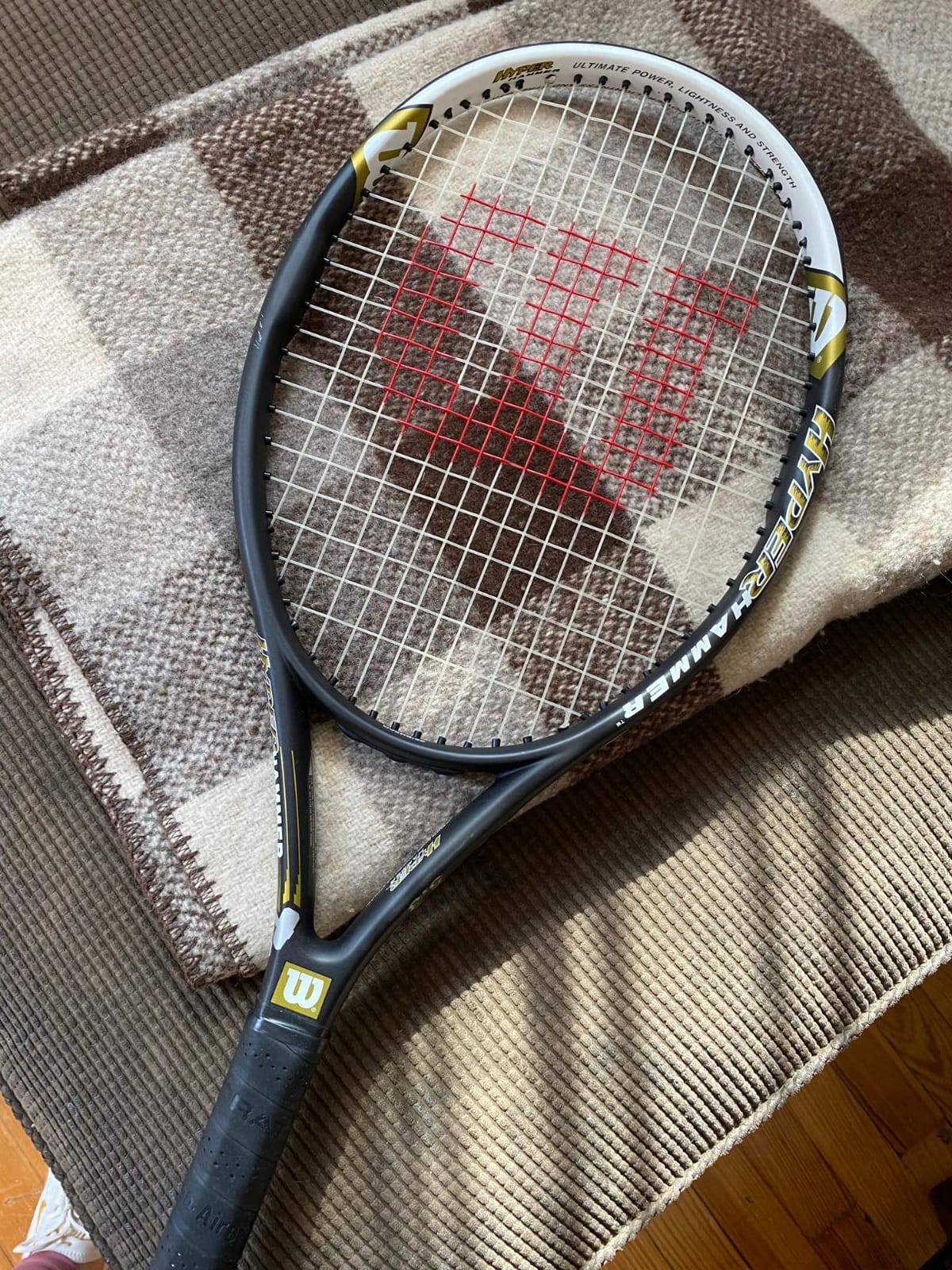
4. Wilson Hyper Hammer 5.3 – Best for Short Compact Swings
Wilson Hyper Hammer 5.3 Strung Tennis Racket (Black/White, 4 3/8)
110 sq in Hammer head
Head-heavy balance
Sub 10 oz frame weight
Open string pattern for power and spin
Pros
- 110 sq in Hammer head delivers a genuinely large sweet spot
- Head-heavy balance adds stability and power from compact swings
- Sub 10 oz weight keeps the frame light over long sessions
- Open pattern generates heavy topspin and a full sound
- A wide range of grip sizes is available
Cons
- Frame vibrates noticeably on off-center hits without a dampener
- Strings can bed in and move during heavy topspin
- Being light it lacks stability for hard flat swings
The Hyper Hammer 5.3 has been a long-running seller for one reason: it makes a compact swing work. At 4.6 stars across about 1,750 ratings with roughly 80 percent five-star, it draws buyers from true beginners taking lessons all the way to seniors and, notably, club players who want a spare frame.
The head-heavy balance is doing the work here. Weight pushed toward the head produces momentum from a short motion, which means you get power without generating swing speed. That is a genuinely good property for a recovering elbow, because power is the thing players chase by swinging harder, and swinging harder is the thing that aggravates the forearm.
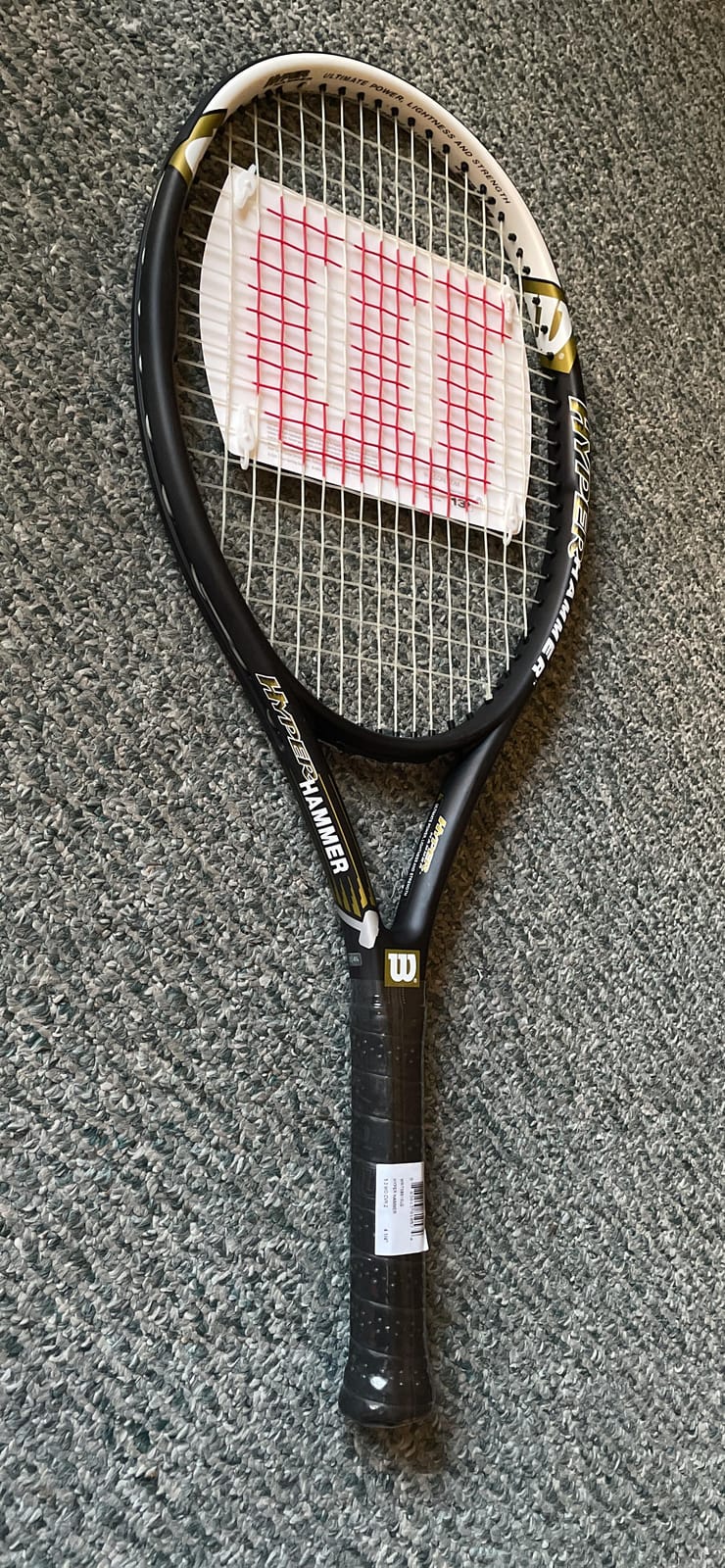
The 110 sq in Hammer head adds forgiveness on top of that. Buyers consistently mention that the sweet spot is large enough to absorb errors, and reviewers note a short acclimation period before control arrives, which is normal for a power-oriented frame.
The open string pattern is another quiet comfort feature. An open bed generates more topspin and more power at lower swing speed, so you can hit deep with less effort. Several reviewers describe the sound as satisfying and punchy, and that audible feedback is itself a useful cue for contact quality.
If your game is built on short, compact swings and you play doubles or doubles-plus where you do not have time to take the ball early, this frame is a strong fit for comfort.
Who This Racket Suits Best
The Hyper Hammer 5.3 suits players with short strokes, seniors, and anyone returning to the sport who wants power from a small motion. It is also a popular club-level spare frame for players who do not want to risk their main racket.
It suits doubles players particularly well. Reach on a 27.5 inch frame and power from short swings means you can cover the court without a long reach on every ball.
The Vibration Caveat You Should Know About
This is the one frame in the list where vibration is a real, documented complaint. Buyers report noticeable frame vibration on off-center hits, and the usual fix is a shock absorber or dampener, which reviewers almost universally add before the racket feels right.
That matters for this topic specifically. Dampening built into the frame, like the Stop Shock Pads on the Wilson Federer Adult Recreational, works without you thinking about it. A dampener is an add-on you can forget to install or knock out of place. If vibration is your primary aggravator, buy the dampener on the same day you order the racket.
The other two complaints are string bed movement under heavy topspin, which some players solve by moving to an 18×22 pattern, and a lack of stability on hard flat swings due to the light frame. Both are real. Neither matters much if you already swing compact and produce topspin.
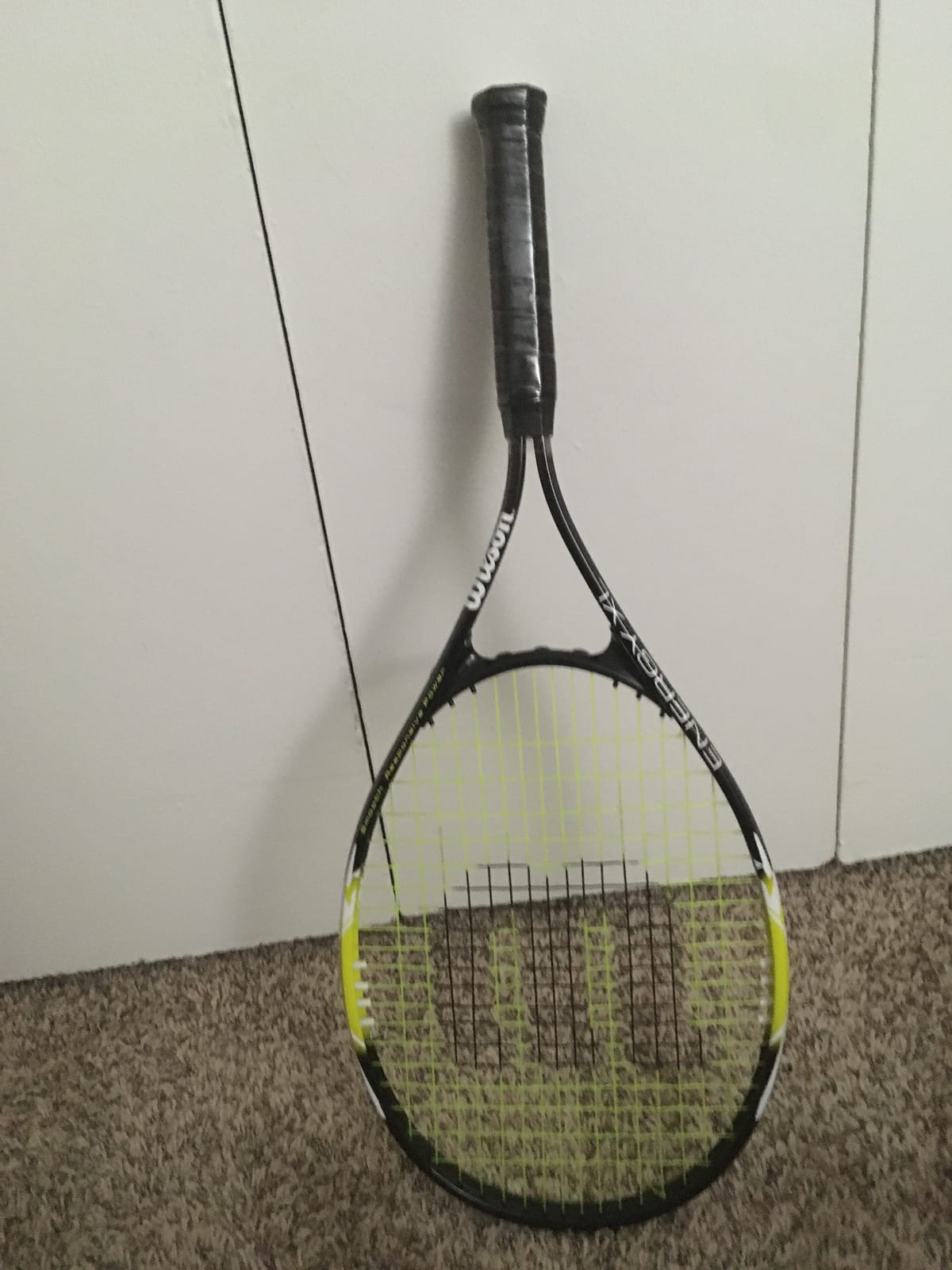
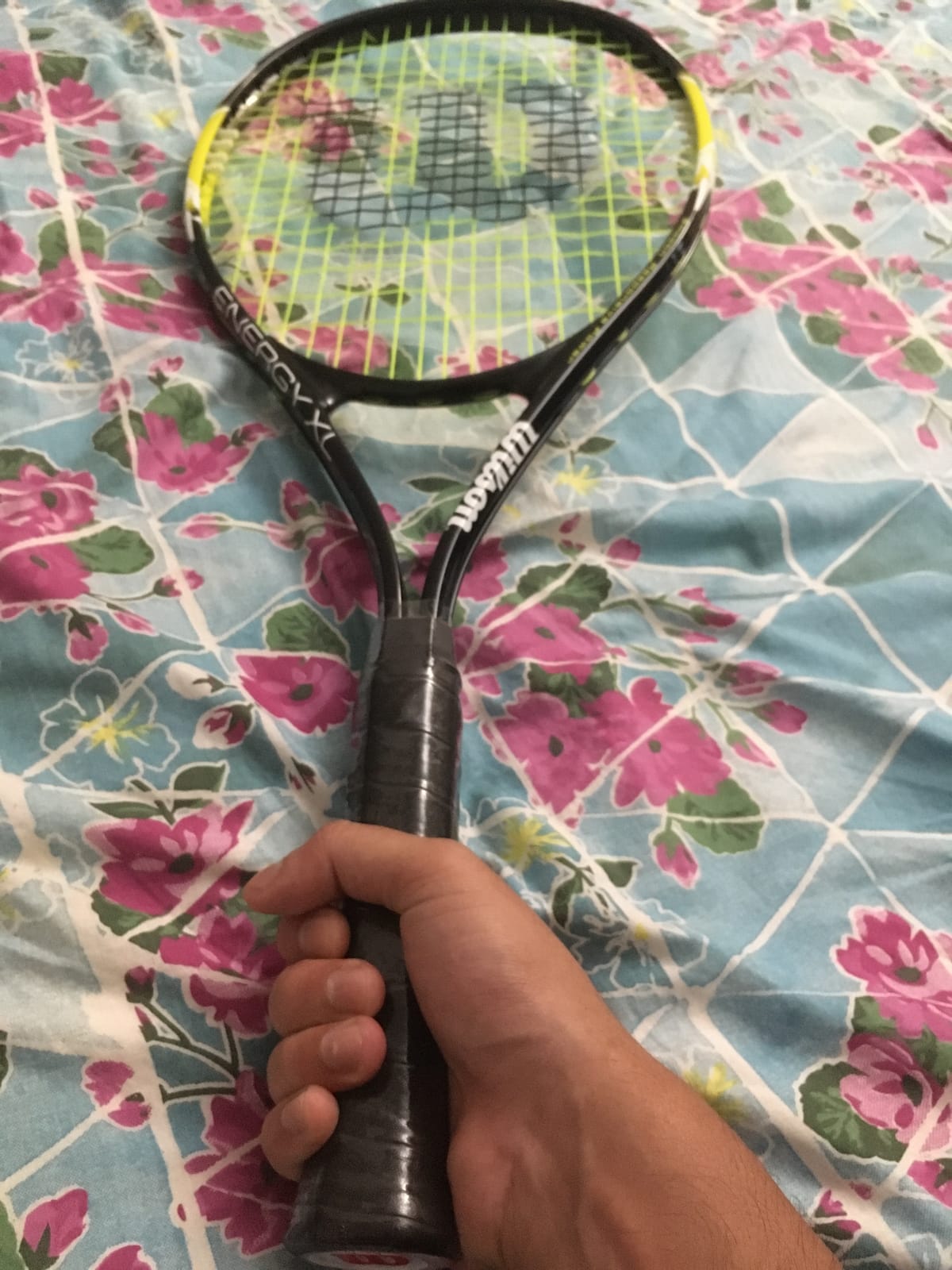
5. Wilson Energy XL – Best for the Stop Shock Sleeve Dampening
Wilson Energy XL Adult Recreational Tennis Racket – Grip Size 3 – 4 3/8″, Yellow/Black
V-Matrix sweet spot technology
Stop Shock Sleeves at 3 and 9
9.6 oz AirLite Alloy frame
4 3/8 inch grip, pre-strung
Pros
- V-Matrix plus an oversized head creates a very forgiving sweet spot
- Stop Shock Sleeves damp string vibration at the 3 and 9 positions
- Light 9.6 oz AirLite Alloy frame keeps the swing easy
- Extra length adds reach and court coverage
- Pre-strung and suitable for all skill levels
Cons
- Alloy steel frame is heavier and less lively than graphite
- Stop Shock Sleeves cover less than full-frame vibration dampening
- Less refined feel than the graphite frames on this list
The Energy XL is interesting because it puts dampening hardware in the cheapest package on this list. It carries a 4.6 star average across about 1,260 ratings, with roughly 76 percent five-star and 16 percent four-star, and the recurring review themes are the oversized V-Matrix head and the Stop Shock Sleeves.
The sleeves sit at the 3 and 9 o’clock positions, the two points on the string bed where a mishit most often produces a spike of string vibration. Sleeves there damp the string itself rather than the frame, which is a slightly different mechanism from frame padding but hits the same symptom.
At 9.6 oz the frame is light, and the AirLite Alloy construction is the same family of material used on the Wilson Federer Adult Recreational. That combination of light weight plus oversized head plus some vibration hardware is the recipe most players with a tender elbow want.
The grip is 4 3/8 inch and the frame is pre-strung, so it works for essentially any recreational player. Reviewers treat it as an easy, dependable starter racket, and the V-Matrix sweet spot is what converts players who were previously missing balls badly.
Our honest read is that this is the frame to buy if you want arm-friendly features on a budget and you are not attached to a particular brand. It does the three things that matter, and it does them without a graphite price.
Who This Racket Suits Best
The Energy XL suits a recreational player who wants oversized-head forgiveness and light weight, and who is willing to add a dampener on day one. It works for all skill levels, which makes it an easy first racket or an easy club spare.
It also suits anyone who alternates between brands and does not want to commit to a graphite frame. The feel is more neutral than brand-specific.
Where the Sleeve Dampening Falls Short
Two honest limitations. First, the sleeves cover the 3 and 9 positions only, so they are less comprehensive than the throat-pad system on the Wilson Federer Adult Recreational, and they do nothing for torsional shock from an off-center hit. Adding a dampener plus an overgrip closes most of that gap for very little.
Second, the alloy steel frame is heavier and less lively than an all-graphite equivalent. That means slightly more mass to move and a flatter response on a fast swing. For a compact or intermediate swing, it does not matter. For a hard flat swing, you will feel it.
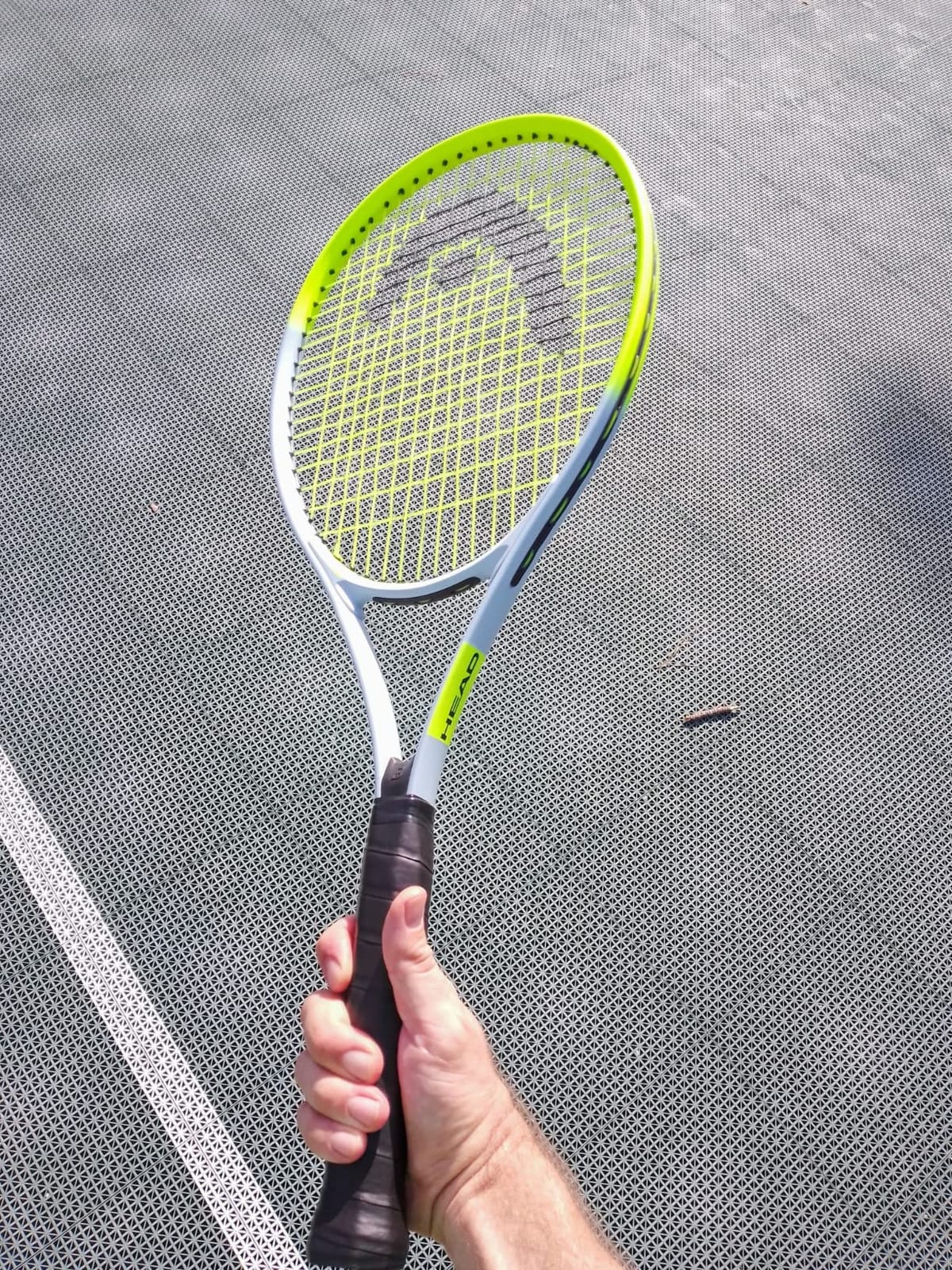
6. HEAD Tour Pro Tennis Racket – Best Casual Frame Under the Radar
HEAD Tour Pro Tennis Racket, 4 3/8″ Grip
110 sq in oversized head
275 g and 9.7 oz frame
Head-light balance for lower vibration
27 inch length, 4 3/8 inch grip
Pros
- Oversized 110 sq in head gives a large sweet spot
- Head-light balance reduces vibration and adds stability
- Very light 9.7 oz build is easy to swing
- Durable Nano Titanium construction
- Pre-strung and comfortable out of the box
Cons
- Aluminum shaft feels vague compared with a graphite frame
- Grip tape wears and begins to slide with regular play
- Factory strings can break within a couple of months
The HEAD Tour Pro is the least discussed frame here and the most overlooked. It is a 275 g, 9.7 oz frame with a 110 sq in head, a 27 inch length and a head-light balance that the manufacturer credits with reducing vibration and aiding stability. It rates 4.5 stars across about 520 ratings with roughly 76 percent five-star.
The 275 g number is worth pausing on. It is the heaviest unstrung figure in this group of six, and the one that sits closest to the moderate-to-heavier band that most arm-friendly recommendations point at. Heavier does not automatically mean better for an elbow, but if you can swing it comfortably, a heavier frame reduces how much you have to accelerate the racket to get the same pace, which reduces peak impact force.
The oversized 110 sq in head gives a large sweet spot, and the head-light balance reduces twisting on contact. That combination, a light-feeling frame with a big forgiving bed, is exactly what a casual twice-a-week player needs.
Nano Titanium construction holds up well and reviewers call it a solid bargain for casual play and beginners. It is a frame you can hand to a family member or keep as a court-spare without thinking about it.
Where we would steer you elsewhere is if you are a competitive player. This is a frame for hitting balls with friends, keeping a stroke alive, and getting through a session without sting.
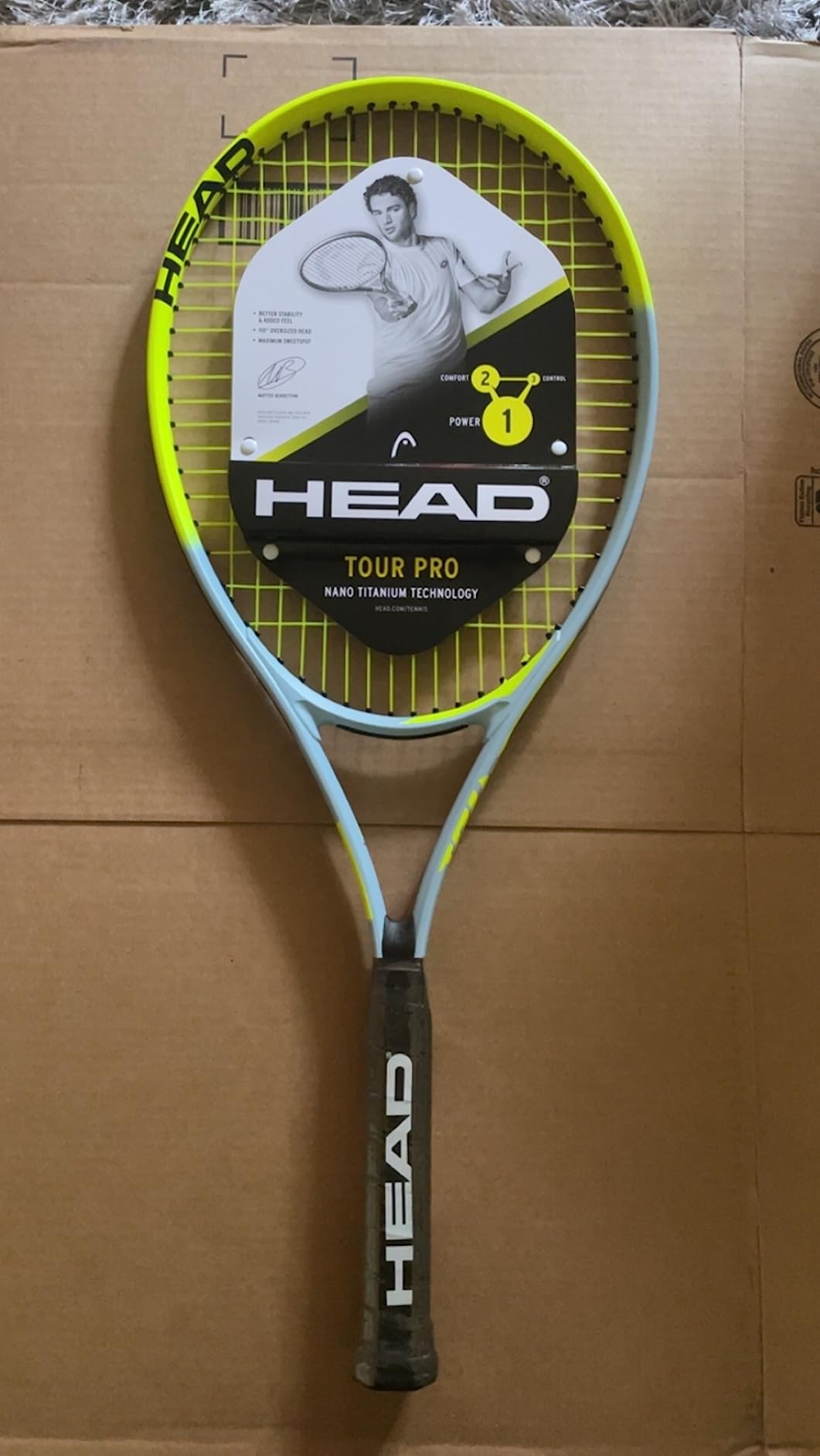
Who This Racket Suits Best
The Tour Pro suits a casual player, a beginner, or a doubles regular who wants something in the hand that feels easy without being a pure super-light frame. It also works well as a second racket for someone who plays on a different surface to their main frame.
For a player who twangs the ball off-center constantly and just wants the session to stop hurting, the 110 sq in head and head-light balance are a legitimate combination.
Where This Frame Runs Out
The aluminum shaft is the honest limit. It is softer and less solid than graphite, so it feels vague on harder swings, and a player who strikes through the ball will find less feedback than they expect. Grip tape that wears and slides within a few weeks is the other common thread, and factory strings can break within a couple of months of heavy use.
There is also a small but real purchasing note. The listing is for a single racket, while the product imagery can suggest otherwise, so check the quantity on the page before you order if you need a pair.
How to Choose a Tennis Racket When Your Elbow Hurts
Players in the r/10s threads that surface for this query keep asking the same handful of questions, and most of them are good ones. The consistent theme across those discussions and across the reviews on the six frames above is that people want numbers, not adjectives. A frame described as arm-friendly tells you nothing. Head size, weight, balance, string type and tension tell you plenty.
None of the six frames we tested publishes an RA stiffness rating, and we are not going to invent one. But the concept matters enough to explain, because it is the first thing a fitter will check when you walk in with elbow pain.
RA rating, also called the stiffness rating, is a measure of how many pounds of force it takes to deflect the frame by one inch. A low number means a flexible frame that bends on contact. A high number means a stiff frame that resists and sends energy back into the ball. For elbow comfort, a lower figure is generally the direction you want, and the widely cited comfort threshold sits under about 65.
Pick Frame Stiffness Before You Pick a Brand
A stiff frame is the most commonly reported aggravator in the player communities around this topic. Players who moved to a newer, stiffer frame and felt their elbows flare often report that older, more flexible frames felt better on the arm. That is a consistent signal, and it is why brand loyalty is the wrong place to start.
What you can do without an RA number is test feel. Hit a few balls with the frame and notice whether the response is muted and damped or sharp and ringing. A frame that gives up energy on contact is doing you a favor.
Use Head Size to Reduce Mishits
Of the six frames here, head sizes run from 108 sq in on the HEAD Ti. Conquest up to 115 sq in on the HEAD Ti.S6, with the Wilson Hyper Hammer 5.3 and HEAD Tour Pro at 110 sq in, the Wilson Energy XL oversized and the Wilson Federer Adult Recreational at midplus.
Bigger head, more forgiveness, fewer frame contacts. If your elbow flares most on balls you miss, head size is your first lever. If it flares most on balls you strike cleanly, head size matters less and stiffness, strings and damping matter more.
Heavier or Lighter for a Tender Elbow
This is the question a competitor page answers in a way that contradicts itself, so here is the straight version. Slightly heavier frames reduce swing acceleration for the same pace, which lowers peak impact force. That is the logic behind the moderate-to-heavy comfort guidance you will see repeated. But it only holds if you can swing the frame comfortably, because a frame too heavy to swing makes you change your technique, and technique changes are what aggravate tendons.
Across this list the unstrung weights run from 275 g on the HEAD Tour Pro up to 295 g on the Wilson Federer Adult Recreational, and the strung weights on the super-light end sit at 8.6 oz on the Ti.S6 and 9.6 oz on the Energy XL. Anything from roughly 280 g to 300 g unstrung is the band most arm-friendly guides point at, and two of the frames here sit in it.
The practical test: if you can hit a normal rally for twenty minutes and your forearm is not burning, the weight is right. If your shoulder and forearm are doing the work your legs should be doing, go lighter.
Grip Size Is an Elbow Lever, Not a Footnote
Grip size was the most repeated question in the forum threads attached to this query, and it deserves the attention. A grip that is too small forces you to hold tighter to prevent the frame twisting, and sustained gripping is a direct forearm load. A grip that is too large makes you cradle the frame and rotate your wrist at contact, which is another direct forearm load.
Measure your hand rather than guessing. If a frame’s listed grip does not match, add an oversized grip or an overgrip before you add a new frame. On this list, the Wilson Federer Adult Recreational, Hyper Hammer 5.3, Energy XL and HEAD Tour Pro all come at 4 3/8 inch, the HEAD Ti.S6 is 4 3/8 inch, and the HEAD Ti. Conquest is the narrowest at 4 1/4 inch with a 4 1/2 inch ceiling.
An overgrip also adds tack, which reduces the squeeze force you need to hold the frame steady through contact. That is a small change with a very direct effect on the muscle that is already irritated.
Strings Matter as Much as the Frame
Not one competitor roundup on this topic covers strings, and that is the biggest gap we found in the research. The frame gets the attention and the credit, but the string bed is the part that actually sits between the ball and your forearm. A cheap frame with soft strings at low tension will feel kinder than an expensive frame with stiff polyester pulled tight.
Across the six frames we reviewed, the most common complaint of any kind was about factory strings breaking early or bedding in. That is not a quality complaint so much as an untreated-condition complaint, and it is fixable with a single restringing decision.
Multifilament Versus Polyester
Polyester is stiff, holds tension well and gives you control and spin potential. It also transmits the most shock into the forearm, and at high tension it is the single most common trigger people report for elbow flare. If your elbow is the problem, polyester is the wrong default.
Multifilament strings are made from many thin filaments wound together and they behave like a shock absorber between the ball and the frame. They feel softer, they damp impact, and they are the string type most often recommended for players with a history of forearm trouble. Soft multifilament is the direction to go when comfort is the goal.
Anyone asking which specific string to buy will get a faster answer from a shop than from us, but the type matters more than the model. If a fitter has told you the frame suits your elbow, ask them to put a soft multifilament in it.
Tension Is the Quiet Shock Absorber
Tension changes everything and almost nobody accounts for it. Lower tension means more give in the bed, which means more energy absorbed rather than returned. If you have just changed rackets for elbow reasons, dropping tension by four to six pounds per side is often the change that makes the new frame feel different from the old one.
A hybrid setup is the other option. Put a soft multifilament in the mains and a slightly firmer string in the crosses. You keep a reasonable amount of control while giving up some feel, and the softer mains absorb a meaningful share of the impact.
Whichever route you take, restring rather than trying to play around a tired factory bed. Dead strings lose their dampening behaviour long before they break.
Dampeners, Overgrips and Forearm Braces
A dampener is a small device clamped in the strings that spreads the shock of impact across several strings instead of two. It costs very little and it directly targets the sting that reaches your forearm. The Hyper Hammer 5.3 is the frame on this list where buyers most often add one first.
Player communities also discuss a hand-built approach using stacked rubber bands positioned in the string bed, which does the same job for a fraction of the cost. Whether you buy or build, treat the dampener as part of the racket rather than an accessory.
A forearm compression brace is a different category. Buyers often pick one up alongside a racket in the same basket, which tells you what they expect from it, but it is a support tool during activity, not a fix. Talk to a clinician before you commit to one.
When a Racket Change Is Not Enough
Equipment is the easy half of this problem. The half that actually resolves most tennis elbow cases is load management, and no frame on any website changes that. We would rather say this plainly than sell you a racket and leave you with the same pain in four weeks.
Exercises to Avoid During a Flare-Up
During an active flare-up, avoid wrist extension work against resistance, heavy forearm and wrist strength sessions, and any grip-heavy drilling that keeps the extensor tendons loaded. Also avoid repeatedly hitting until pain arrives and then resting, because that pattern keeps restimulating the tendon.
And avoid the instinct to push through. A session that produces elbow pain the next morning is not a hard workout, it is a delayed symptom, and the timeline for those is measured in weeks rather than days.
This is general information rather than medical guidance. A clinician can tell you what your specific tendon needs and what will not aggravate it.
A Sensible Return-to-Play Order
The order that tends to work is straightforward. First, drop the aggravating motion, usually the two-handed backhand drive or a long serve, and play the strokes that do not hurt. Second, get the strings and grip fixed, because those are the cheapest levers and they are often skipped.
Third, make the equipment change we have been describing. Fourth, load the forearm eccentrically and gradually under the guidance of a clinician or physical therapist, because tendons need progressive loading to remodel, not just rest. Fifth, add the painful strokes back in small increments across sessions.
If pain persists through that progression, or if you felt it come on suddenly with weakness, numbness or swelling, stop and see someone. Those are signs that need a professional assessment rather than a product comparison.
Frequently Asked Questions
What type of tennis racket is best for tennis elbow?
A flexible, low-stiffness frame is the best type for tennis elbow. Look for a head size between 98 and 115 square inches for forgiveness, an unstrung weight roughly between 280 g and 300 g so you do not have to accelerate the racket to get pace, and pair it with a soft multifilament string at reduced tension rather than stiff polyester.
What is the most arm-friendly tennis racquet?
Among the six frames we compared, the Wilson Federer Adult Recreational Tennis Racket is the most arm-friendly overall. Its Stop Shock Pads sit where the throat meets the hoop, which is where string vibration concentrates, and at 295 g unstrung it gives you pace without demanding a fast swing. It also has the deepest review base of any pick here.
What exercise should I avoid if I have a tennis elbow?
During a flare-up, avoid wrist extension work against resistance, heavy forearm and wrist strength training, and long grip-heavy drilling sessions that keep the extensor tendons loaded. Also avoid the pattern of hitting until pain starts and then resting, because it keeps restimulating the tendon. Ask a clinician about your specific case rather than treating this as medical advice.
What’s the fastest way to get rid of tennis elbow?
There is no instant fix, but the fastest route is to reduce load on the tendon first. Rest the strokes that aggravate it, then drop string tension and switch to a soft multifilament, correct your grip size, and use a vibration dampener. Follow that with gradual eccentric forearm loading and clinical referral if pain persists. Players describe recovery as long, often measured in months.
Is a heavier or lighter tennis racket better for tennis elbow?
A moderately heavier racket is usually better, because it reduces the swing acceleration needed to generate the same pace and therefore lowers peak impact force. The widely cited comfort band is about 280 g to 300 g unstrung. It only holds if you can swing the frame comfortably, though, because a frame too heavy to swing changes your technique and that change aggravates the forearm.
Should I use a vibration dampener for tennis elbow?
Yes, and it is the cheapest intervention on this page. A dampener spreads the shock of impact across several strings instead of two, which softens the sting that reaches the forearm. It is especially worth adding on a light frame such as the Wilson Hyper Hammer 5.3, where buyers most often report vibration on off-center contact.
Final Thoughts on Tennis Rackets for Tennis Elbow
The Wilson Federer Adult Recreational Tennis Racket is our pick for the best tennis rackets for tennis elbow in 2026. Flexible enough to give up energy on contact, damped at the throat where vibration concentrates, moderate at 295 g, and backed by more than 4,500 ratings that describe the same soft, quiet hit.
Behind it, the HEAD Ti.S6 takes the forgiveness crown with a 115 sq in head, the HEAD Ti. Conquest is the value pick, and the Wilson Hyper Hammer 5.3 is the frame for anyone whose swing is short and compact. Whatever you choose, the strings and the grip will matter as much as the frame, and if the pain does not settle, see a clinician rather than another product page.
If you tell us your playing level, the racket you use now and what string type it is strung with, we can point you at the pick that actually fits.