
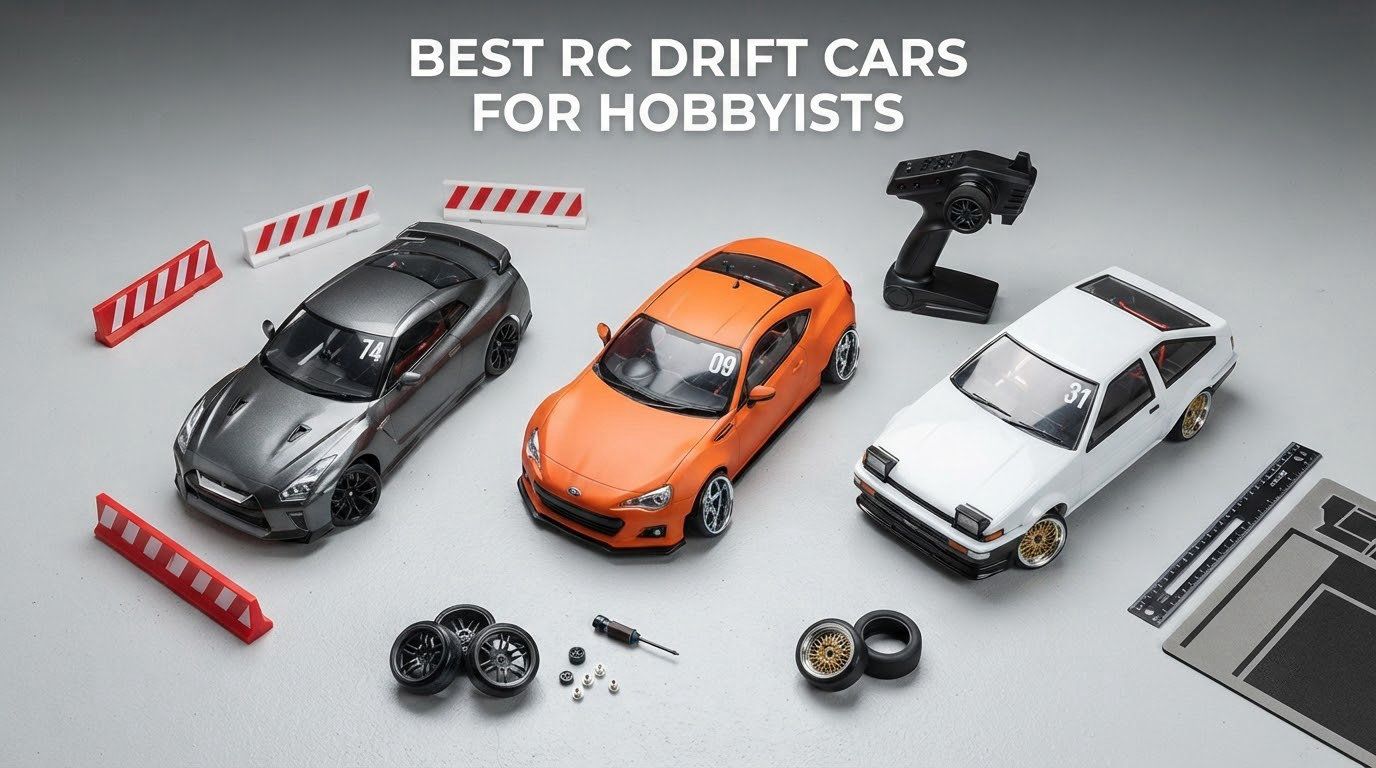
An RC drift car is a remote-controlled model built to slide sideways through corners instead of gripping and pulling out of them. It does this with hard plastic tyres, tuned suspension and a gear ratio that breaks rear traction on entry, and many of the better examples add an on-board gyroscope that reads the yaw angle and applies small steering corrections so the slide stays smooth rather than spinning into the wall. That makes these the cheapest and most forgiving way to practise real car control on a living-room floor, a driveway or a purpose-built track.
Choosing between the best RC drift cars for hobbyists is harder than it looks, because the market splits into two very different worlds. One side is toy-grade 1/24 and 1/43 ready-to-run cars with sealed plastic gearboxes and little that can be adjusted. The other is 1/10 and 1/12 hobby platforms with metal differentials, brushless motors, real shock oil and parts you can order when something snaps.
Our team spent weeks running every car in this list on smooth tile, sealed concrete and pavement, watching how each one behaves when the throttle goes down mid-corner. Nothing below is a spec sheet read aloud. Where a car disappointed, we say so, and where a car is clearly not hobby-grade we label it. We also kept a close eye on the two details that decide whether a drift car is fun or frustrating: whether the controls are proportional, and whether it holds a slide or simply spins.
One thing worth saying early. Drift cars need smooth, hard surfaces. Tile, sealed concrete, laminate flooring and smooth pavement work. Carpet, gravel, grass and anything dusty do not, because the tyres hook instead of sliding. If the only flat surface you have is a lawn, spend your first session with one of the small scale cars indoors before committing to anything larger.
Table of Contents
Top 3 Best RC Drift Cars for Hobbyists in 2026
Our top three cover the three most common situations: a first car that is genuinely fun out of the box, the best value option for learning, and the most capable platform for hobbyists who want to modify and tune.

ACAMMZAR 1:24 4WD Drift Car
- Full proportional throttle
- Two battery packs
- Drift and racing tyres


All 12 RC Drift Cars Side by Side in 2026
Every car below appears in the same order throughout the article. The table is the fastest way to match scale and format to the surface you actually have.
| Product | Specs | Action |
|---|---|---|
| ACAMMZAR 1:24 4WD Drift Car |
|
Check Latest Price |
| Desdoni 1:24 4WD Drift Car |
|
Check Latest Price |
 Sakeye 1:16 4WD Drift Car Sakeye 1:16 4WD Drift Car |
|
Check Latest Price |
 KAIMIO 1:24 4WD Drift Car KAIMIO 1:24 4WD Drift Car |
|
Check Latest Price |
 wheelfun 1:43 Mini Drift Car wheelfun 1:43 Mini Drift Car |
|
Check Latest Price |
 FLYCOLOR Turbo C64 1:76 FLYCOLOR Turbo C64 1:76 |
|
Check Latest Price |
 VoleRusher RC 1:43 Gyro Drifter VoleRusher RC 1:43 Gyro Drifter |
|
Check Latest Price |
 Dingdongwu 1:43 Gyro Drifter Dingdongwu 1:43 Gyro Drifter |
|
Check Latest Price |
 DIKAVEY RX12 1/12 Rally Car DIKAVEY RX12 1/12 Rally Car |
|
Check Latest Price |
| CROBOLL 1/10 Carbon Rally Car |
|
Check Latest Price |
 Tamiya TT-02D 1:10 Chassis Kit Tamiya TT-02D 1:10 Chassis Kit |
|
Check Latest Price |
 Cayrzeth 1:24 4WD Drift Car Cayrzeth 1:24 4WD Drift Car |
|
Check Latest Price |
1. ACAMMZAR 1:24 4WD — Best All-Round First Drift Car
ACAMMZAR RC Drift Car, 1:24 Remote Control Car for Kids, 20KM/H 4WD High Speed RC Cars with LED Lights, Two Batteries, Extra Drifting Tires, Vehicle for Adults Boys Girls
1:24 scale
4WD
20 km/h
Two 3.7V 500mAh batteries
Drift and racing tyres
Pros
- Full proportional throttle makes slides easy to modulate
- 4WD layout feels smooth rather than chaotic
- Two batteries give about 50 minutes of combined use
- High and low speed modes on the remote
- Working headlights and taillights
Cons
- Analog throttle and steering feel low-sensitivity
- Indoor range closer to 10-15 m than claimed
- Hair and dust can jam the drivetrain
If you want one recommendation to start with, this is the one. The ACAMMZAR 1:24 is the rare toy-grade drift car with full proportional throttle, which means you can feather the trigger into a corner and hold the slide instead of snapping into it. For a first car that is the difference between learning in an afternoon and giving up in an afternoon.
It ships with two 3.7V 500mAh lithium-ion batteries, a charger, a screwdriver, four spare wheels and a barricade accessory. Two packs means roughly 50 minutes of combined running time, and the remote switches between high and low speed so you can drop the pace without changing anything else.
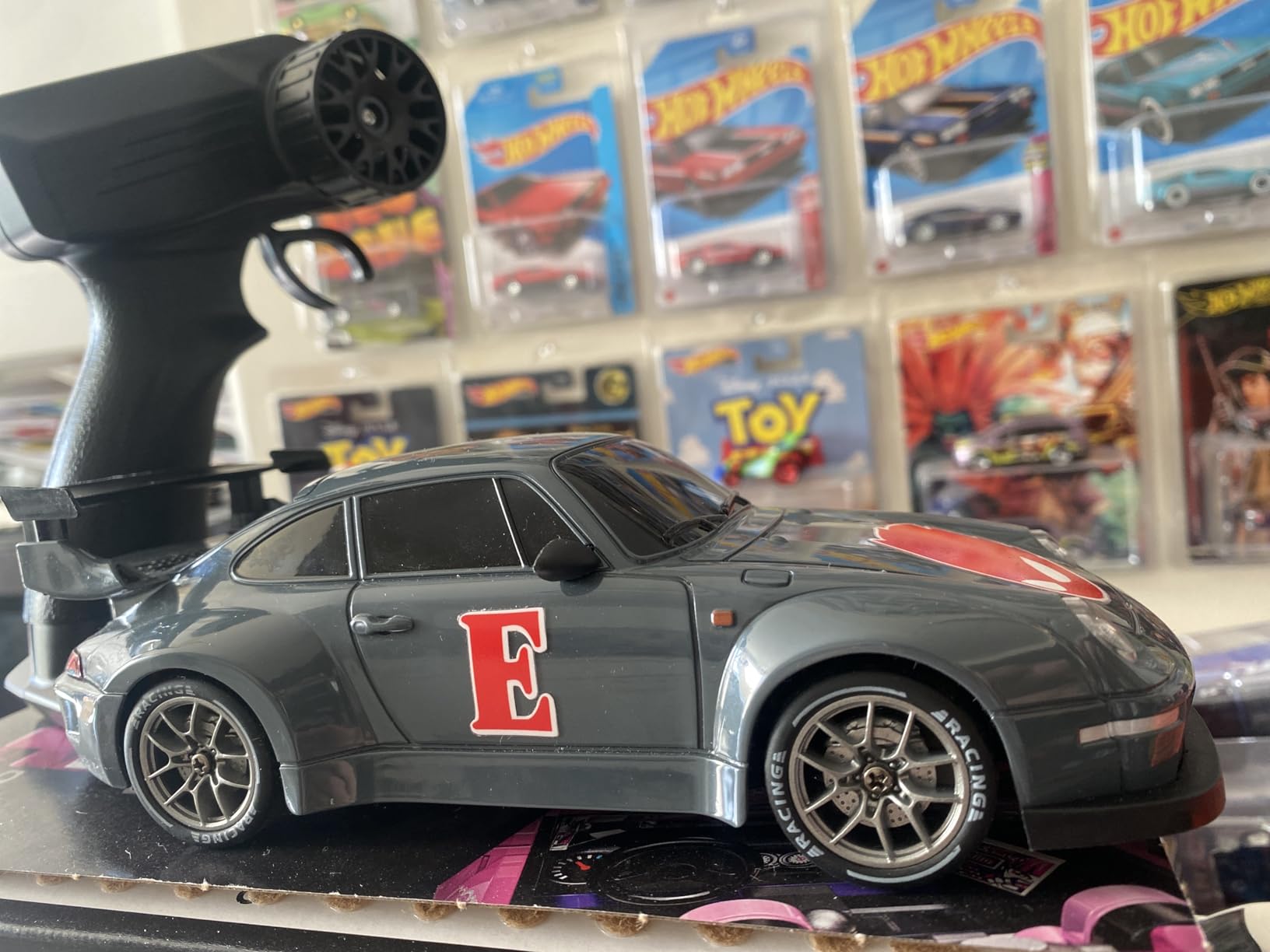
The 4WD drivetrain is what makes this forgiving. Rather than snapping sideways on throttle alone, the car carries momentum and settles into a slide, and the included hard drift tyres plus a set of racing tyres let you change compound for tile or outdoor pavement. Buyers consistently describe the learning curve as short, and the lighting is a genuinely nice touch in a dim room.
What you give up is sharpness. The analog throttle and steering feel low-sensitivity, so fine corrections are harder than on a car with a digital gimbal, and the effective indoor range is closer to 10-15 metres rather than the advertised figure. The most common complaint is dust and hair finding their way into the gearbox.
Check the proportions before you buy
Ask yourself whether your driving will be gentle or aggressive. Proportional throttle rewards a slow right hand, and this car is set up for a driver who eases on and off rather than stabbing the trigger.
If you mostly plan short bursts on a small area of floor, the two speed modes and the barricade accessory give you a complete practice setup in the box.
Check what you will be doing with it
This suits indoor use and smooth sealed concrete. Carpet kills the slide, and the light plastic body is not built for kerb-height drops.
Keep a small brush and some air nearby, or a pair of [handheld vacuums for pet hair in cars](https://www.hdkkk.net/best-handheld-vacuums-for-pet-hair-in-cars/), because hair in a small gearbox is the fastest way to shorten its life.
2. Desdoni 1:24 4WD — Cheapest Way to Learn a Slide
Desdoni Remote Control Car RC Drift Car 2.4GHz 1:24 Scale 4WD 20KM/H High Speed Model Vehicle with LED Lights Drifting Tire Racing Sport Toy Car for Adults Boys Girls Kids Gift
1:24 scale
4WD
20 km/h
Two lithium packs
Drift and racing tyres
Pros
- Cheapest genuine drift car in this list
- Picks up a slide within minutes
- Two batteries mean only one needs charging
- Quick tyre swap between setups
- Light enough to survive bumps and minor crashes
Cons
- On/off controls rather than proportional
- Power can be too high for smooth control
- Headlights and wheels can break on impact
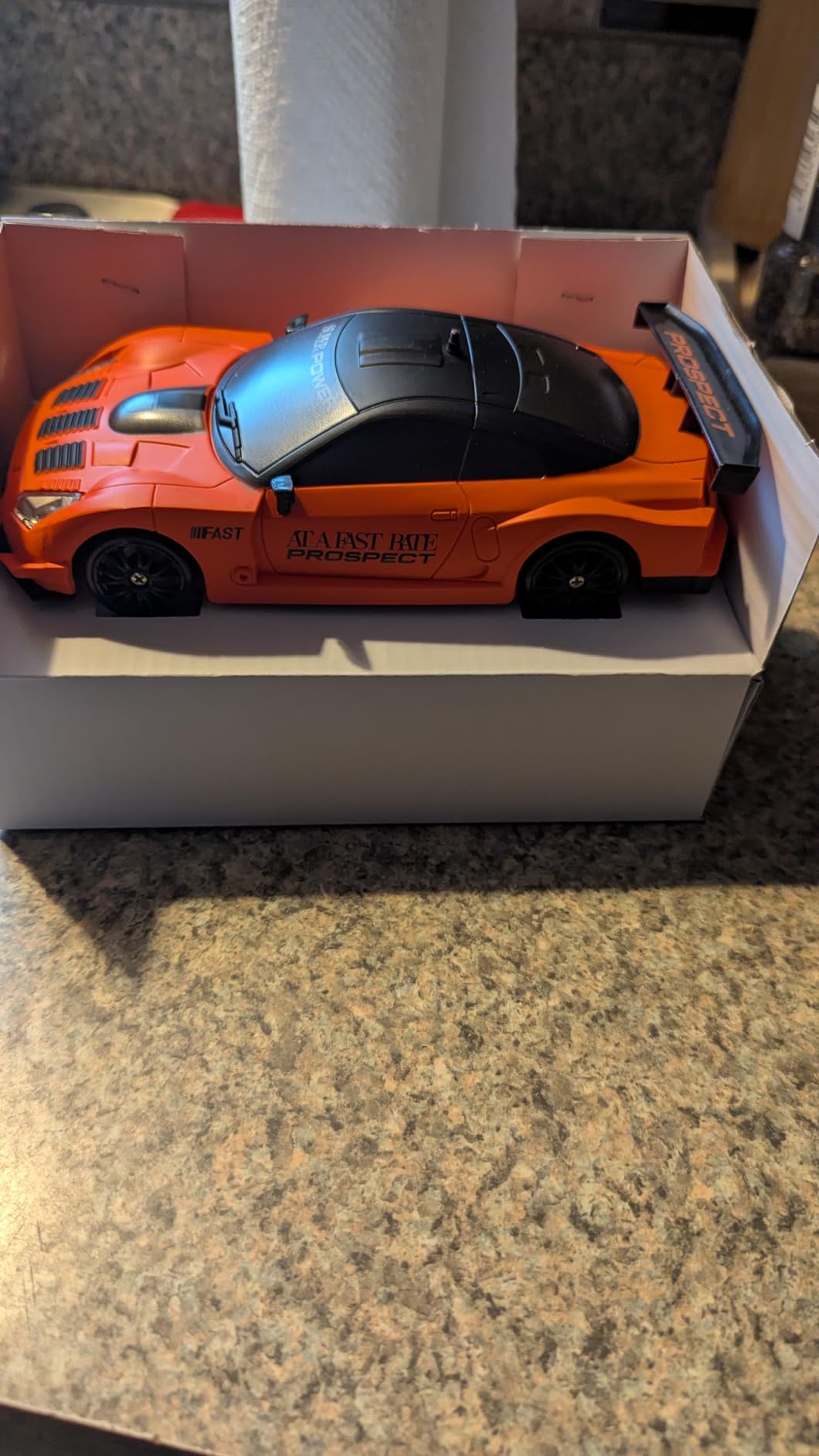
The Desdoni 1:24 is the most-reviewed car here, and the reason is simple: it is the least expensive way to find out whether drifting appeals to you. The chassis is a 2.4GHz 4WD with automatic pairing and a stated 50 metre range, and the box contains four drift tyres, four racing tyres and six traffic cones.
It is also the least refined. The steering and throttle are binary rather than proportional, so input is on or off, and the power delivery is punchy enough that a new driver can spin it in the first three attempts. Once you learn to work in bursts rather than holds, it drifts easily and rewards patience.
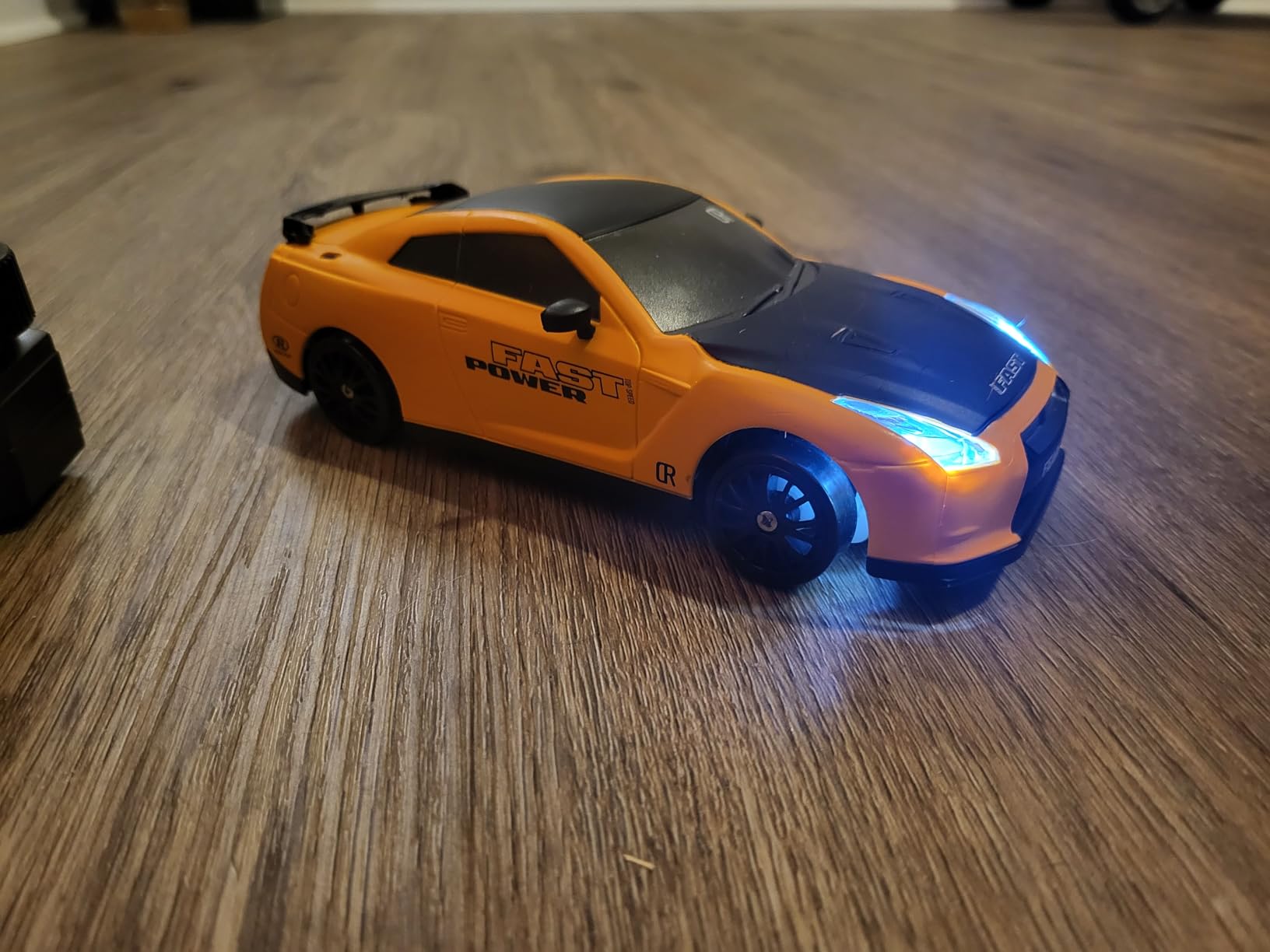
Roughly 20-30 minutes of running time comes from each of the two included lithium packs, and a full charge takes around two hours. The ABS shell is light enough that bumps and minor collisions rarely end the session, which is exactly what you want from a car you are going to hit while learning.
There is no suspension, so small obstacles will stop it dead, and reviewers do report breakage to headlights and wheels after rough play. The battery compartment also uses tiny screws that are awkward to open when you want to swap packs.
Check the controls match your patience
Switch controls are fine for a child learning to hold a line, and they are frustrating for an adult with a car-control background. Know which one you are.
Two people can run these side by side on separate channels without interference, which makes it a good second car for a household.
Check what you will be doing with it
It handles tile, laminate and smooth concrete well and comes with enough cones to build your own small circuit.
It is a toy, not a platform. If you expect to change motors or shocks, look at the 1/10 options further down instead.
3. Sakeye 1:16 4WD — Best for Outdoor Pavement
Sakeye RC Drift Car 2.4GHz 1:16 Scale 4WD High Speed Remote Control Cars Vehicle with LED Lights Two Batteries and Drifting Tires Racing Sport Toy Cars for Adults Boys Girls Kids
1:16 scale
4WD
18 km/h
Two 7.4V 500mAh packs
Mist sprayer
Pros
- Proportional acceleration is easier to control than switch input
- Dual battery packs roughly double continuous play
- Drift and racing tyre sets both included
- LED lighting and a remote mist effect
- Replaceable wheels on a shock-absorbing shell
Cons
- Two-player radio set suits casual runs rather than serious driving
- Toy-grade scale rather than hobby-grade hardware
The Sakeye 1:16 is the largest of the small four-wheel-drive drifters here and the one to take outside. At 1:16 scale it is noticeably bigger than a 1:24, and with two 7.4V 500mAh rechargeable packs giving 20-plus minutes each, it can handle a longer run on a driveway without a mid-session charge.
Control is the selling point. Proportional acceleration gives you a much wider range of control than a switch-trigger car, and reviewers single that out as the reason drifting feels manageable rather than chaotic. Maximum speed is 18 km/h, which is plenty for a sealed driveway and fast enough to feel like a real car.
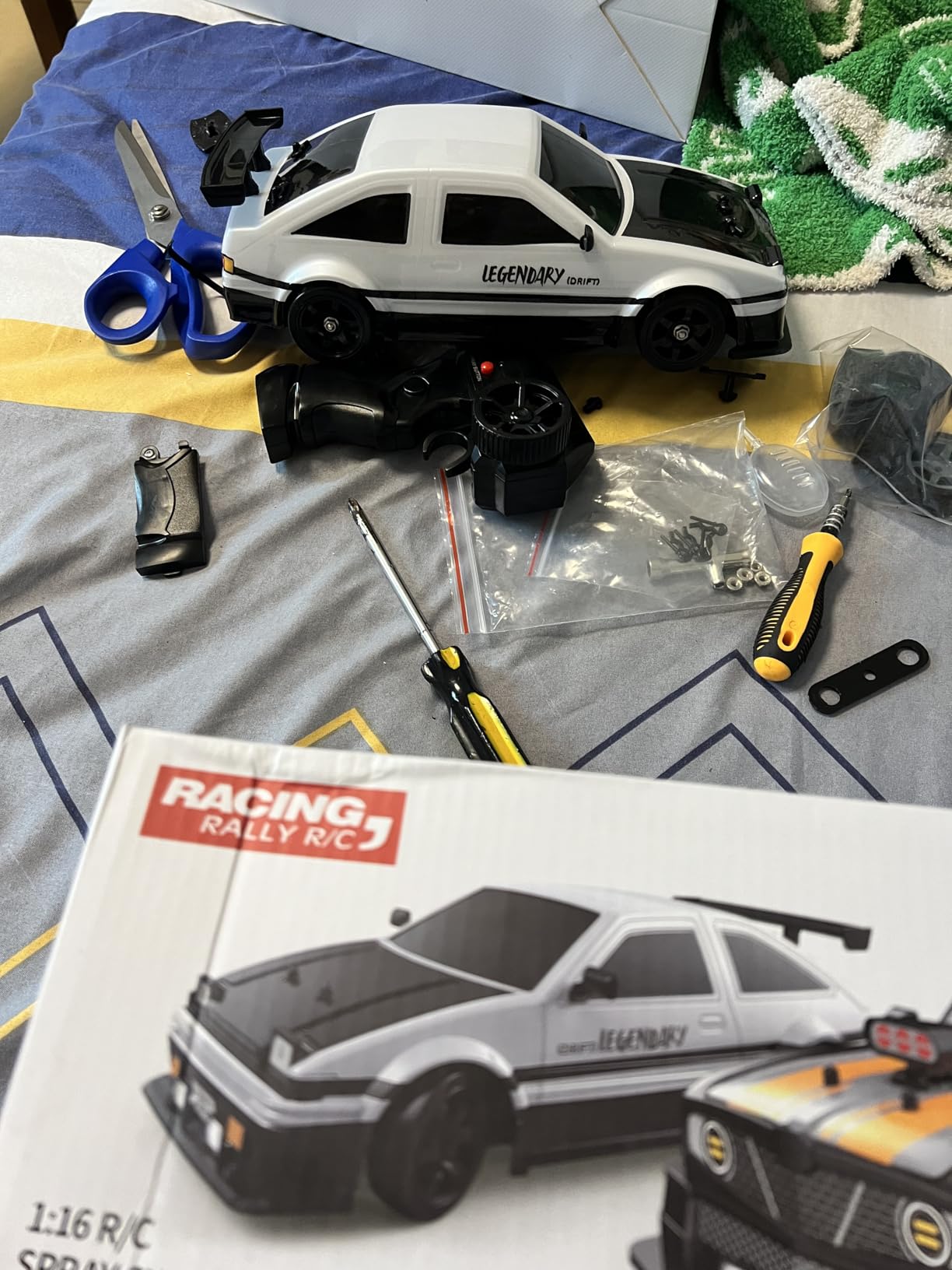
The extras are where it earns its place. There is a full LED lighting package, a remote-activated water mist sprayer at the back, and a two-player 2.4GHz setup rated to about 145 inches, so two cars can run together. Removable and replaceable wheels with thickened tyres mean a damaged wheel is a quick swap rather than a write-off.
What it is not is hobby-grade. The 2.4GHz multi-car arrangement is convenient for casual side-by-side play, and the size and detailing are not intended for competition or for modification.
Check the drive surface first
Sealed concrete, asphalt and smooth paving are ideal. Anything loose or uneven will unsettle a car with this little ground clearance.
If your outdoor space is rough, this is not the car. The 1/12 and 1/10 platforms handle broken surfaces far better.
Check the runtime maths
Two packs at 20-plus minutes each means an hour of driving before charging, and both charge from the same lead.
Buy a second set of batteries before you need them, because waiting on a charge is how hobby sessions end early.
4. KAIMIO 1:24 4WD — Fastest Small Drift Car Here
KAIMIO 1:24 Scale RC Drift Car 4WD 2.4GHz 30KM/H High Speed Racing Sport Toy Car with LED Lights, Racing and Drift Wheels(02-Blue)
1:24 scale
4WD
Up to 30 km/h
2.4GHz auto-pair
Drift wheels
Pros
- Quickest of the small toy drifters on smooth tile
- Slides smoothly once you find the pace
- Light body survives bumps and collisions
- Multiple body styles on the same pre-bound chassis
- Cone set and extra tyre set included
Cons
- Steering is a switch rather than a proportional wheel
- Non-standard included battery type is short-lived
- Motors can be noisy
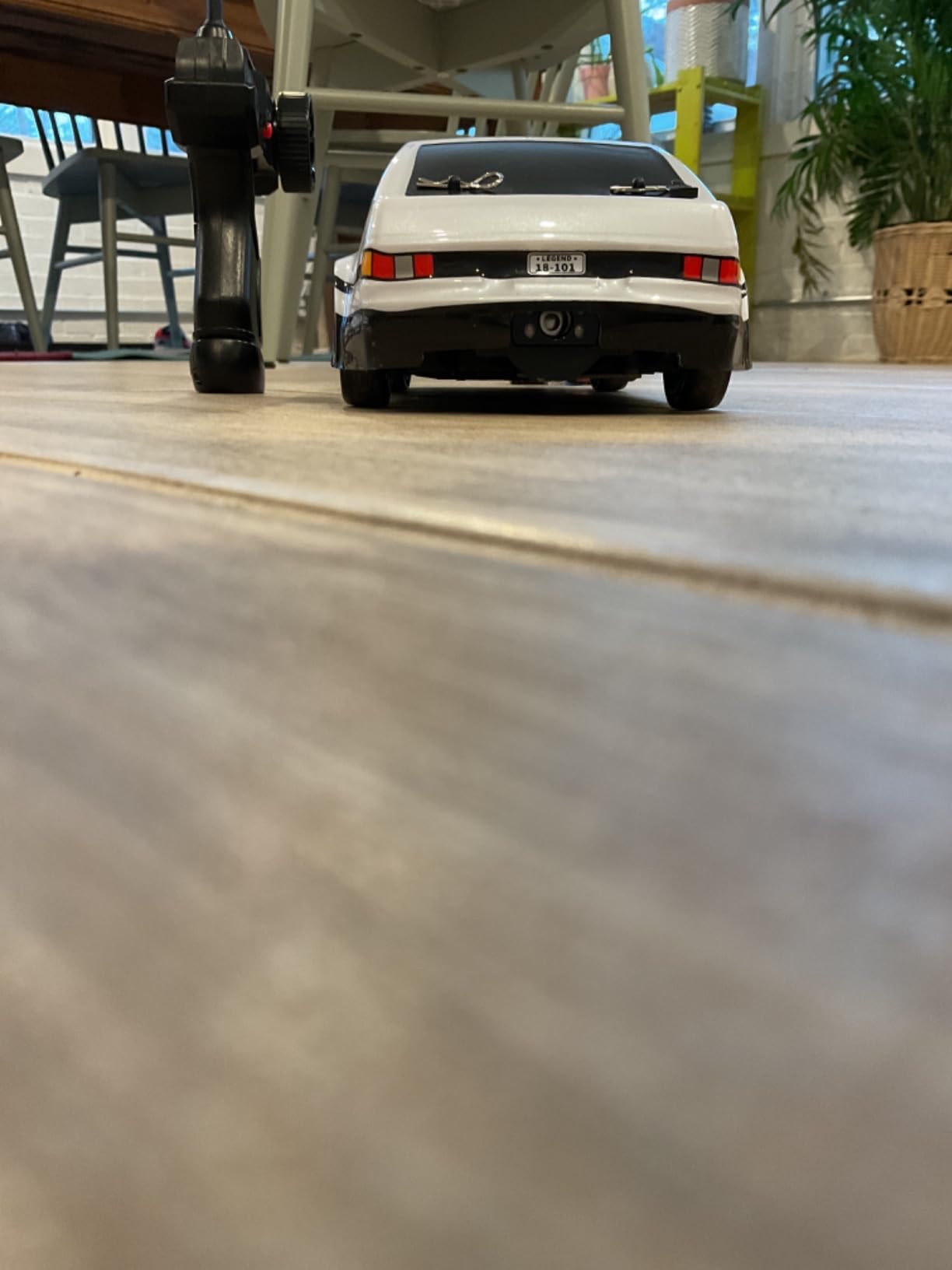
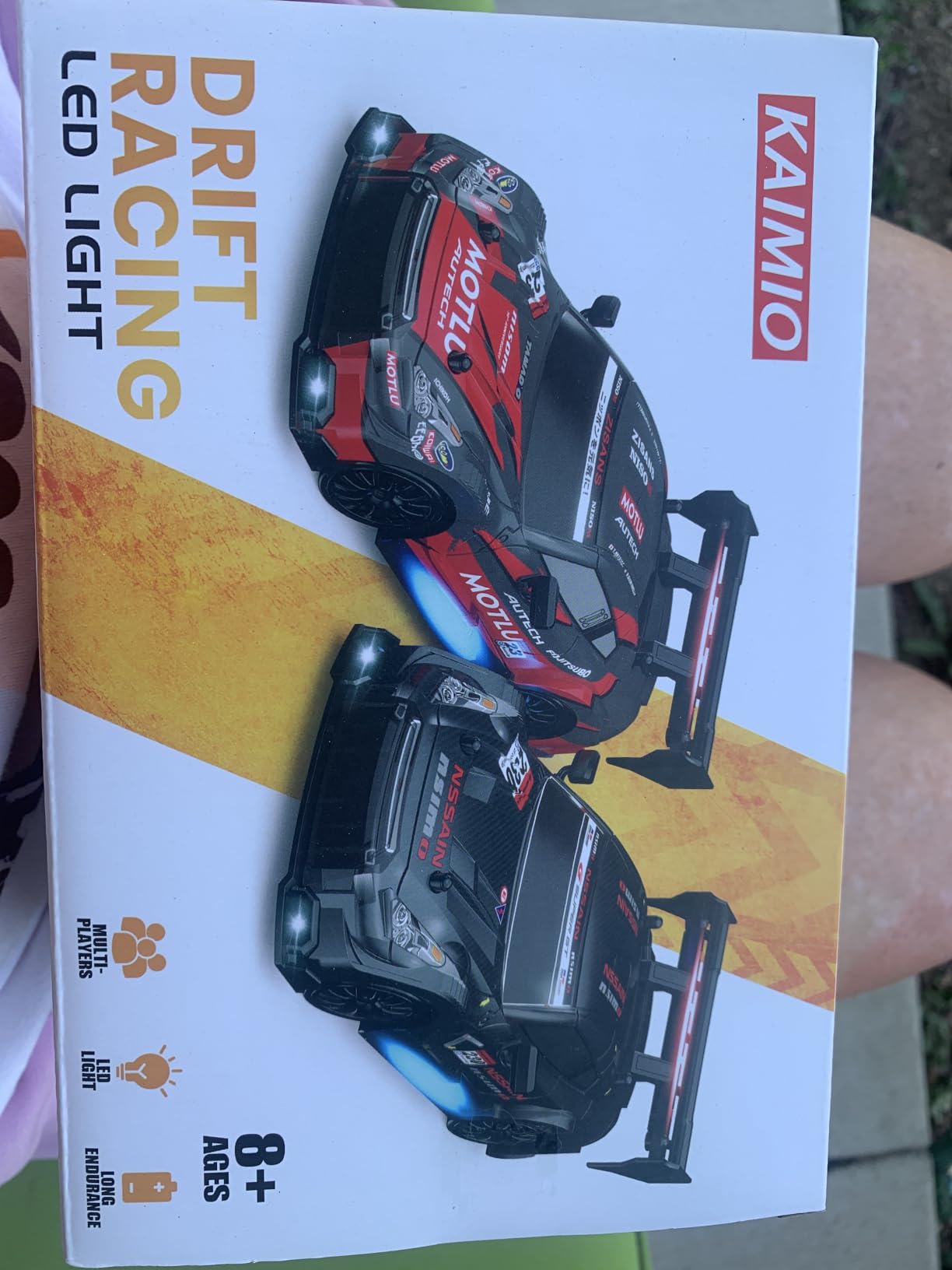
The KAIMIO 1:24 lists 30 km/h as its top speed, and on smooth tile owners typically see it hit around 20 km/h in practice. That makes it the quickest of the small four-wheel-drive cars in this roundup, and the speed is what makes the slides look and feel like drifting rather than slow sliding.
Mechanically it is a straightforward 2.4GHz 4WD with automatic pairing and multi-car support, a high-toughness PVC shell over an ABS body, rounded edges and replaceable racing and drift wheels. The lightweight body shrugs off bumps and minor collisions, which matters when you are running at pace across a floor rather than creeping.
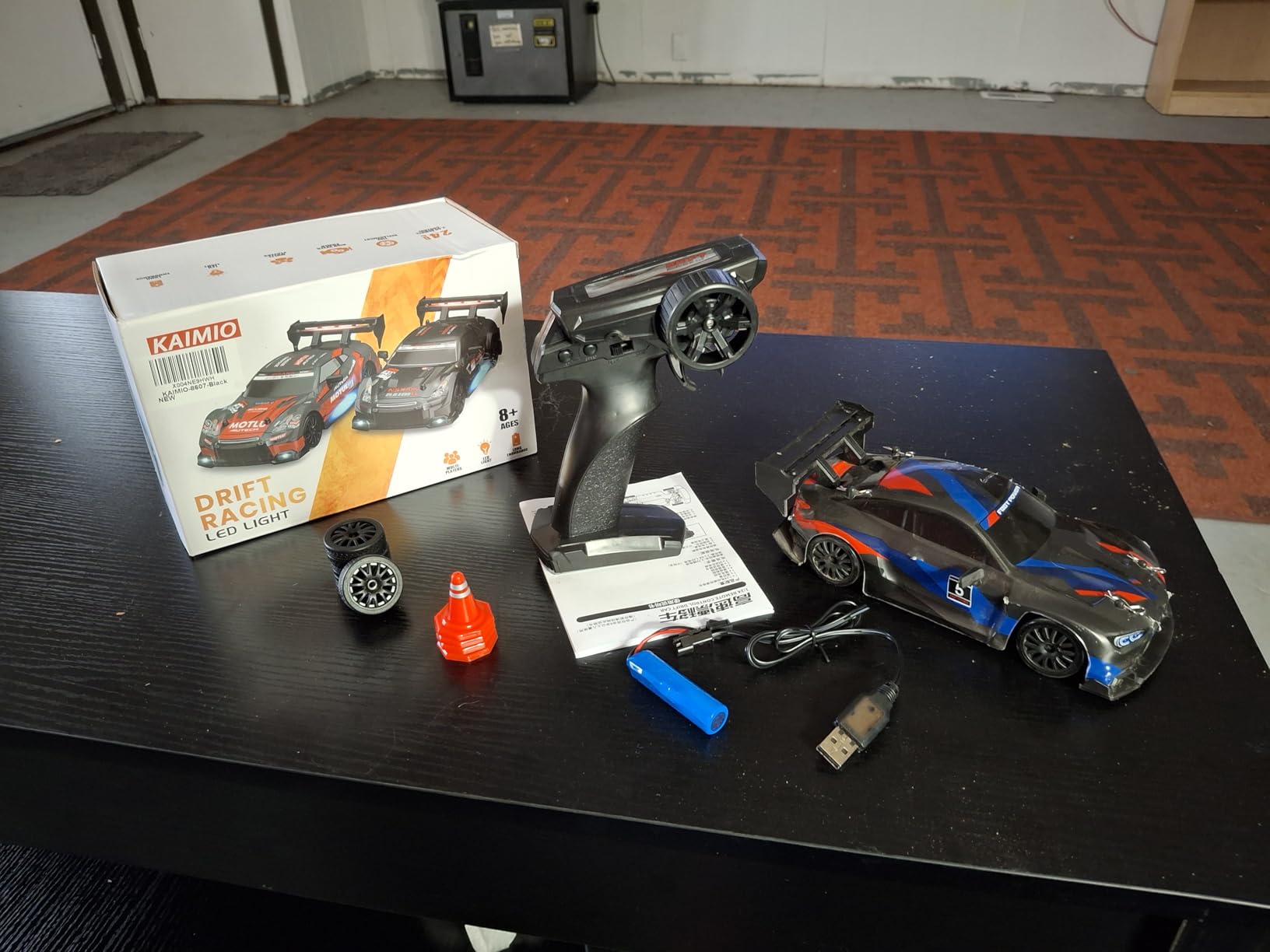
Many buyers pick up two or three of these so they can race against each other, and the remotes come pre-bound, so there is no pairing ritual. Cones and an extra tyre set are included, which is more than most rivals give you.
The compromise is control. Steering is a switch rather than a proportional wheel, so inputs are abrupt at speed, and the included non-standard battery pack is short-lived. The motors are also noticeably noisy compared with the smaller, slower cars.
Check the room you have
This is a car for a garage floor, a long hallway or a decent driveway. It needs length to straighten out after a spin.
Switch steering means you will be correcting in stages rather than continuously, so give it space.
Check what you will be doing with it
It is a good first car for a teenager with a clear indoor or smooth outdoor area and a tolerance for noise.
It is not a car for anyone planning to tune it, because there is nothing meaningful to adjust.
5. wheelfun 1:43 — Best for Desktop Practice
wheelfun 1/43 RC Scale Ready to Go Race Car Remote Control Drift 4WD Mini Lights System 4WD Racing Car RC Full Proportional 2.4g Mini Race Gift Radio Control High Speed Model Without Gyro,
1:43 scale
4WD
15 km/h
Three power levels
Full proportional
Pros
- Full proportional steering throttle and TRIM adjustment
- Three selectable power levels suit skill progression
- Small enough to drift on a desktop
- Front shock-absorbing springs take the edge off bumps
Cons
- No gyro so slide stability depends on driver input
- Modest 15 km/h top speed
- 1/43 size needs practice to control
The wheelfun 1:43 is the smallest car here and the only one in this roundup with a proper TRIM adjustment on the transmitter. Full proportional steering and throttle on a car this size is unusual, and it is the reason reviewers describe it as genuinely precise rather than merely fun.
Under the shell is a 615 coreless motor at 3.7V and 1500 RPM, a 2A integrated ESC and a 2G three-wire digital steering servo. Maximum speed is 15 km/h, and three selectable power levels at 20, 50 and 100 percent let you start slow and open it up as your hands get quicker.
It is small enough at 4.13 by 1.57 by 0.91 inches to run on a desk, and the front shock-absorbing springs take the sting out of slightly rough surfaces. Drift tyres and racing tyres both come in the box, along with two remotes and a charger, so two people can drive at once.
Two honest limitations. There is no gyro fitted, so everything depends on your throttle and steering, and 15 km/h is slow next to faster 1/43 and 1/24 rivals. The 1/43 size also takes real practice before it stops feeling twitchy.
Check your available surface
A desk, a coffee table or a section of hallway is genuinely enough. This is the car to buy if you have no floor space at all.
Smooth laminate and sealed concrete both work, and the small size makes long practice sessions realistic.
Check the parts situation
At 1:43, replacement shells and specialist tyres are limited, so treat the supplied parts carefully.
The lack of a gyro means you should pick the low power mode until you can hold a slide, rather than fighting the car at full pace.
6. FLYCOLOR Turbo C64 1:76 — Best for Shell Collectors
FLYCOLOR Turbo Racing C64 1:76 RC Drift Car, Full Proportional RTR (Blue)
1:76 scale
Full proportional
55mAh battery
Two shells included
Pros
- True full proportional control at this tiny scale
- Two extra shells that can be painted and swapped
- Solid build that holds up with repeated play
- Working headlights brake lights and chassis LED
- Type-C charging
Cons
- Very small and light so needs patience to master
- Gyro setting is finicky to dial in
- Accessories and spare parts are limited at this scale
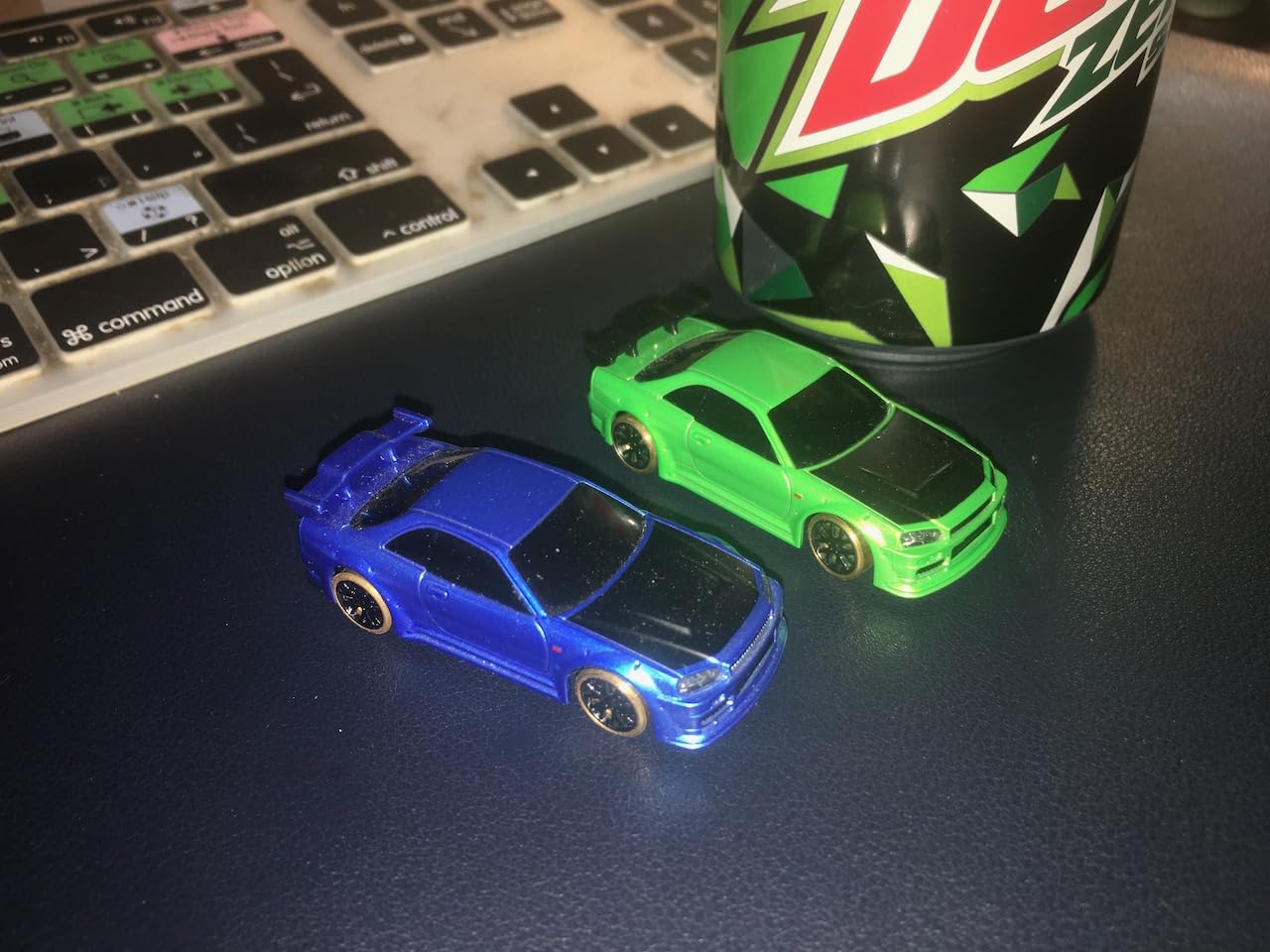
The FLYCOLOR Turbo Racing C64 is a 1:76 scale car at roughly 1.57 inches long, which is Hot Wheels size, and it is the only car here sold on the basis of the shell as much as the driving. Two removable car shells are included and they are paintable, so this is as much a little custom project as a drift car.
Driving hardware is better than the scale suggests. It has full proportional throttle and steering on a four-channel remote, and the throttle curve is tuned so the first 50 percent of the trigger ramps linearly before the upper half adds power. That ramp is what lets a beginner modulate a slide at this size.
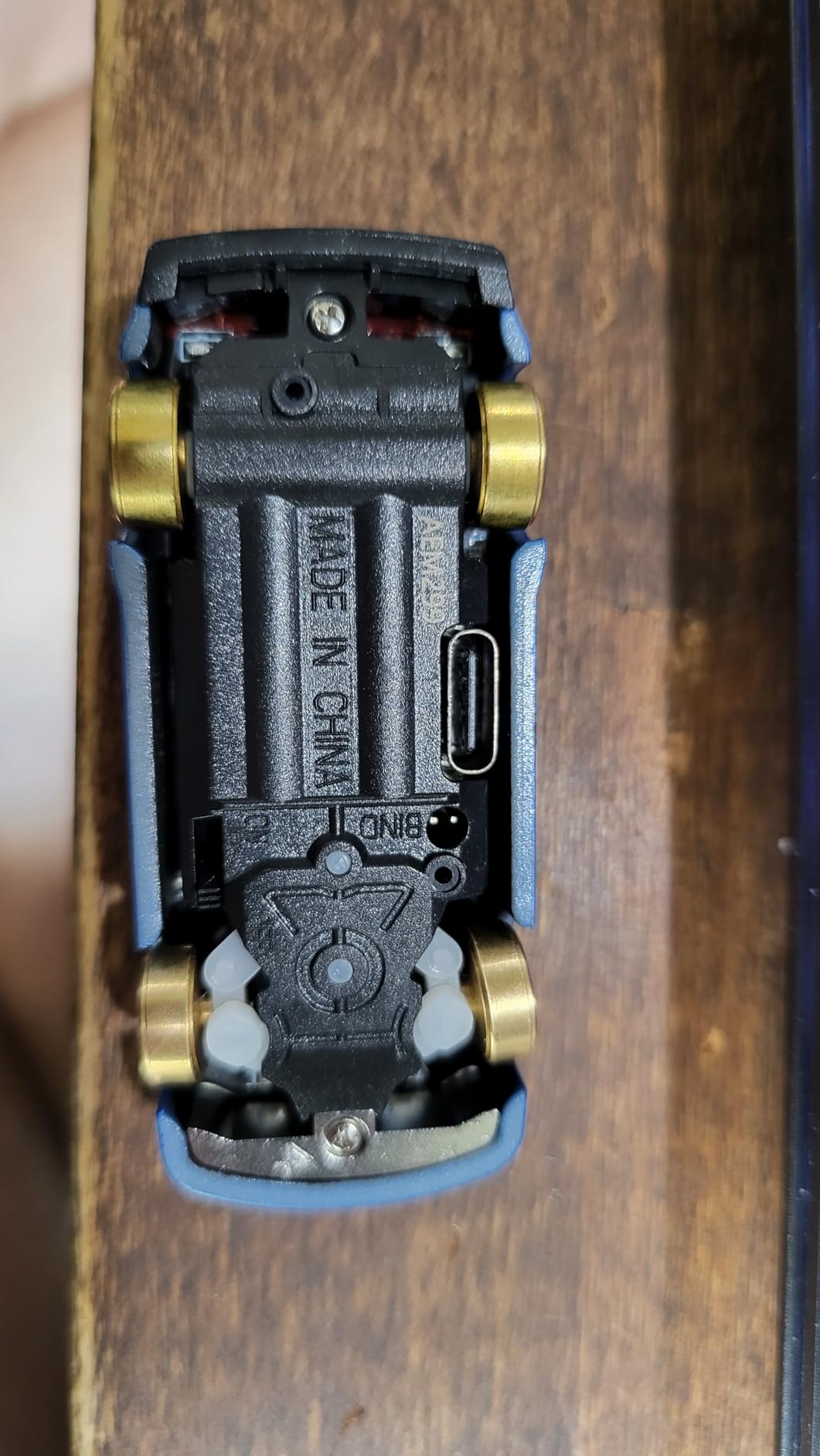
Lighting is a genuine feature here: spotlight-effect headlights with a double flash, brake-activated taillights, and a chassis LED on channel three. The 55mAh battery runs for up to 30 minutes and charges in about 40 minutes over Type-C.
The size is the real difficulty. It is so small and light that it demands patience, and the gyro setting is described as finicky, with small adjustments swinging the turning dramatically. One owner also reported a leaking battery, which is worth considering if you run it near anything you care about.
Check what you are buying it for
If the appeal is driving technique, a 1/43 car will teach you more for less effort. If the appeal is a small collectible you can paint and run on a shelf track, this is the one.
The paintable shells are the reason to choose it, and there is no equivalent at this scale.
Check the long-term spares
Spare parts and accessories at 1:76 are limited, so replacement shells are worth ordering early if you care about keeping it running.
Set the gyro in small increments and test on a soft surface, because the tuning window is narrow.
7. VoleRusher RC 1/43 — Best Gyro-Assisted Micro Drifter
VoleRusher RC [2026 Upgrade 1/43 Mini RC Drift Car with Gyroscope, 4WD RTR
1/43 scale
4WD
Integrated gyro
Brushless motor
15 km/h
Pros
- Gyro is well tuned and makes textbook drifts much easier to hold
- Very fast for a 1/43 size
- Full-size remote feels adult and well weighted
- Lightweight ABS body takes a beating
- Plug-and-play grip and drift tyre swap
Cons
- All-plastic chassis with no rear suspension
- Non-removable rear tyres limit your options
- Controller knob is fragile
This is the micro car to buy if you want a genuine gyroscope. The integrated gyro stabilises beginners while deliberately leaving 30 percent of the correction to your own input, so it assists you rather than driving the car for you. That balance is why reviewers describe it as producing textbook drifts instead of constant spinning.
Everything else is sized for a 1:43 chassis but built with more care than usual. There is a brushless motor with three speed settings up to 15 km/h, plus-minus 60 degree front-wheel steering, linear throttle on a full-size 2.4GHz remote, and a Type-C fast charge that fills the battery in 30 minutes for 30-plus minutes of drifting.
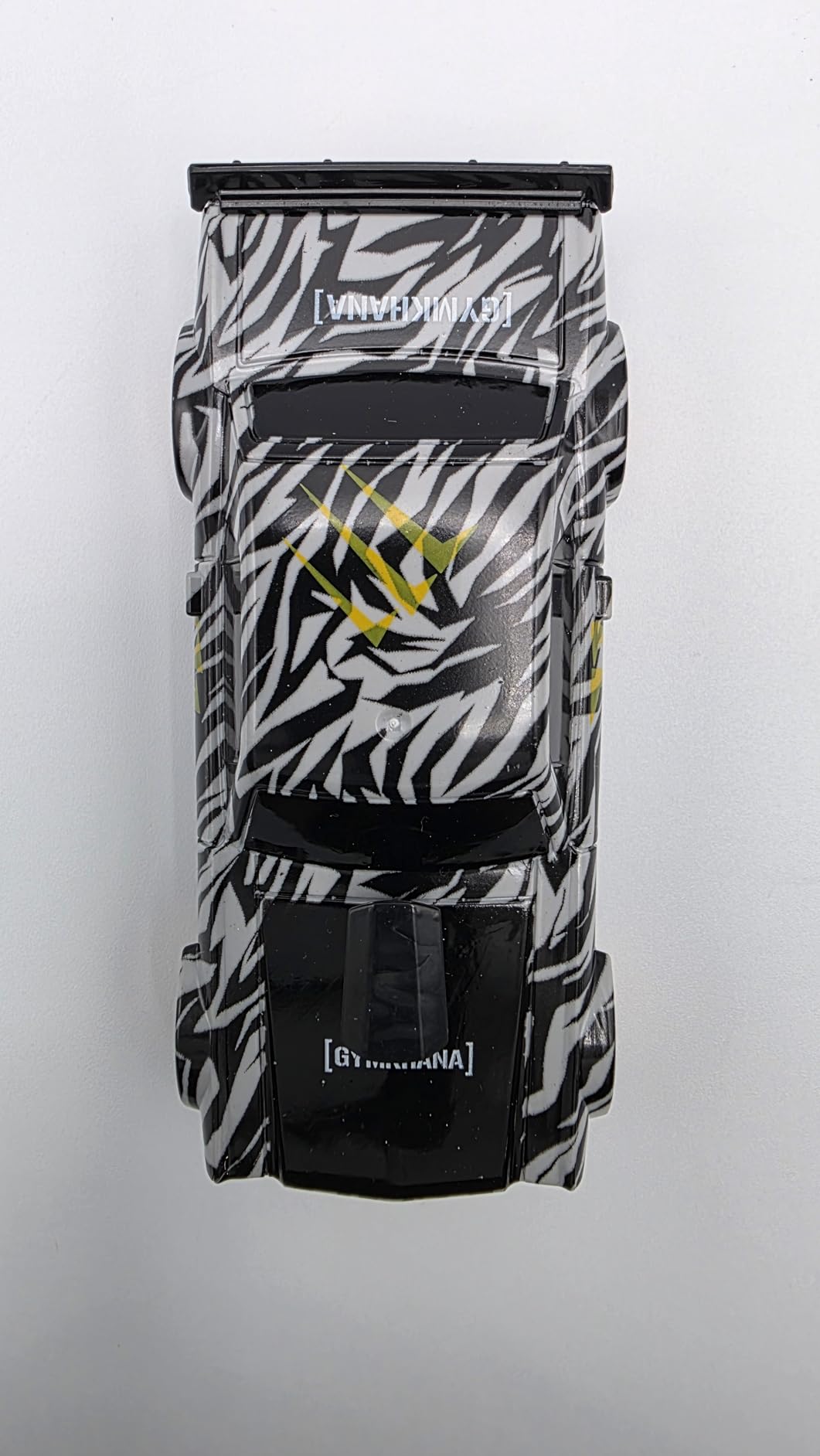
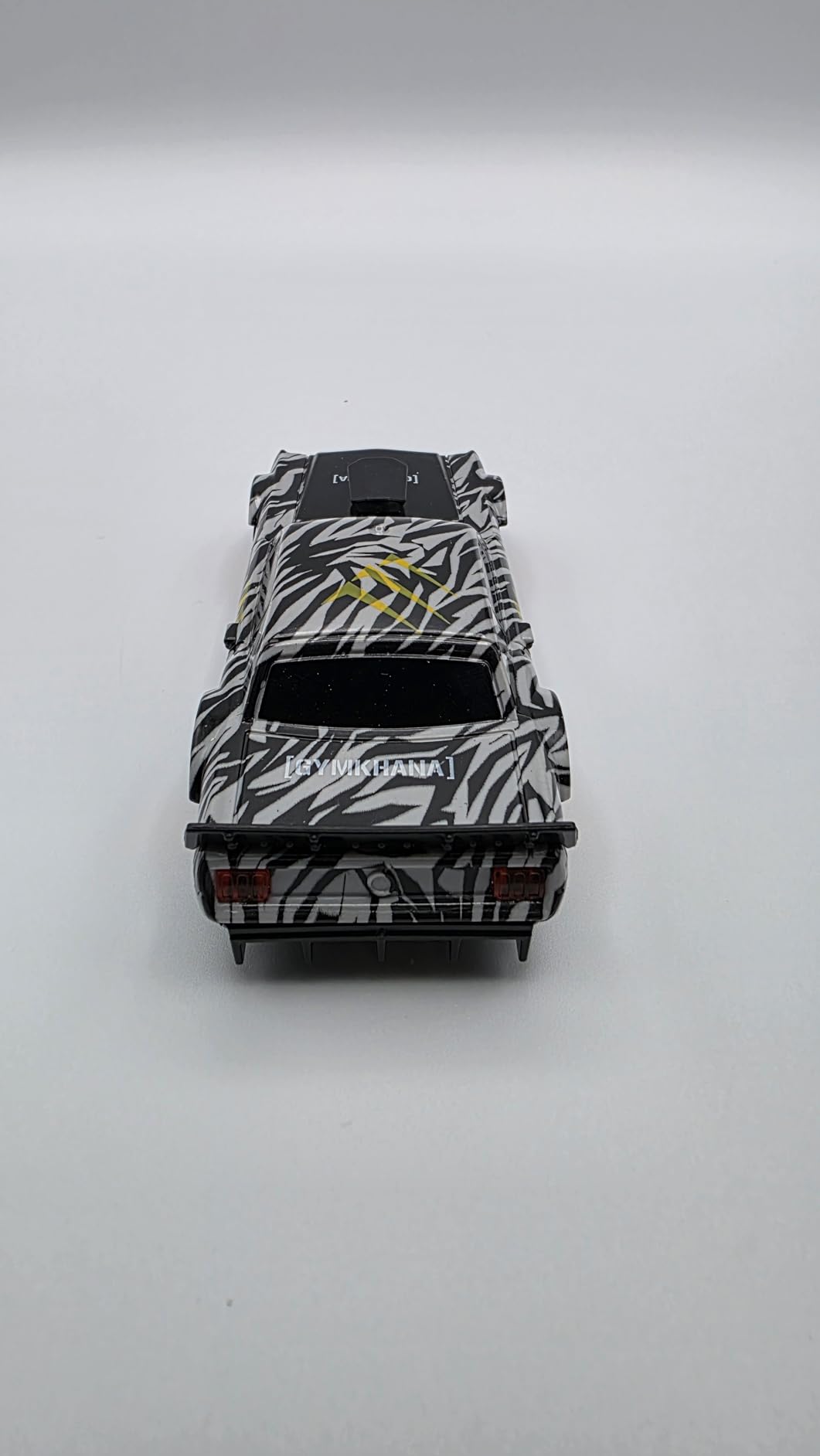
The frame is described as racing-grade ABS tested to 8 foot drops, and 53 degree grip tyres and 72D drift tyres plus eight cones are included. A full-size pistol-grip remote is a genuine upgrade over the thumb-stick controllers used on most cars this small, and many owners buy it as a collectible alongside larger models.
The weaknesses are structural. The chassis is all plastic, there is no rear suspension and the stiff rear end struggles on anything but smooth surfaces, and the rear tyres are fixed in place rather than removable, which limits what you can experiment with. The controller knob can also crack if you twist it hard.
Check the surface before anything else
No rear suspension means smooth tile, sealed concrete and laminate only. Small carpet ridges will unsettle it.
Hair in the gearbox is a recurring complaint, so clear the floor before you drive rather than after.
Check the gyro setting
The gyro is the reason to buy it, so spend time on the gain rather than skipping setup.
If you buy one hair vacuum for the workshop, a dedicated [pet hair vacuum for cars](https://www.hdkkk.net/best-pet-hair-vacuums-for-cars/) will keep a small gearbox alive longer than any amount of careful driving.
8. Dingdongwu 1/43 — Best Budget Gyro Setup
Dingdongwu 1/43 Mini RC Drift Car with Gyroscope, 4WD Full Proportional RC Car, 2.4GHZ Hobby Grade Remote Control Cars, RTR Model Vehicle, 20+KM/H High Speed for Hobbyists Kids Adults (Sliver)
1/43 scale
4WD
20+ km/h
Gyro stabilisation
Type-C charging
Pros
- Full proportional control plus gyro in an entry-level bracket
- Good top speed for a 1/43 car
- Tool-free shell swap makes changes fast
- Adjustable multi-colour lighting and turn signals
- Ready to run with no assembly
Cons
- Light plastic construction limits it to indoor surfaces
- Smaller review base means thin long-term durability feedback
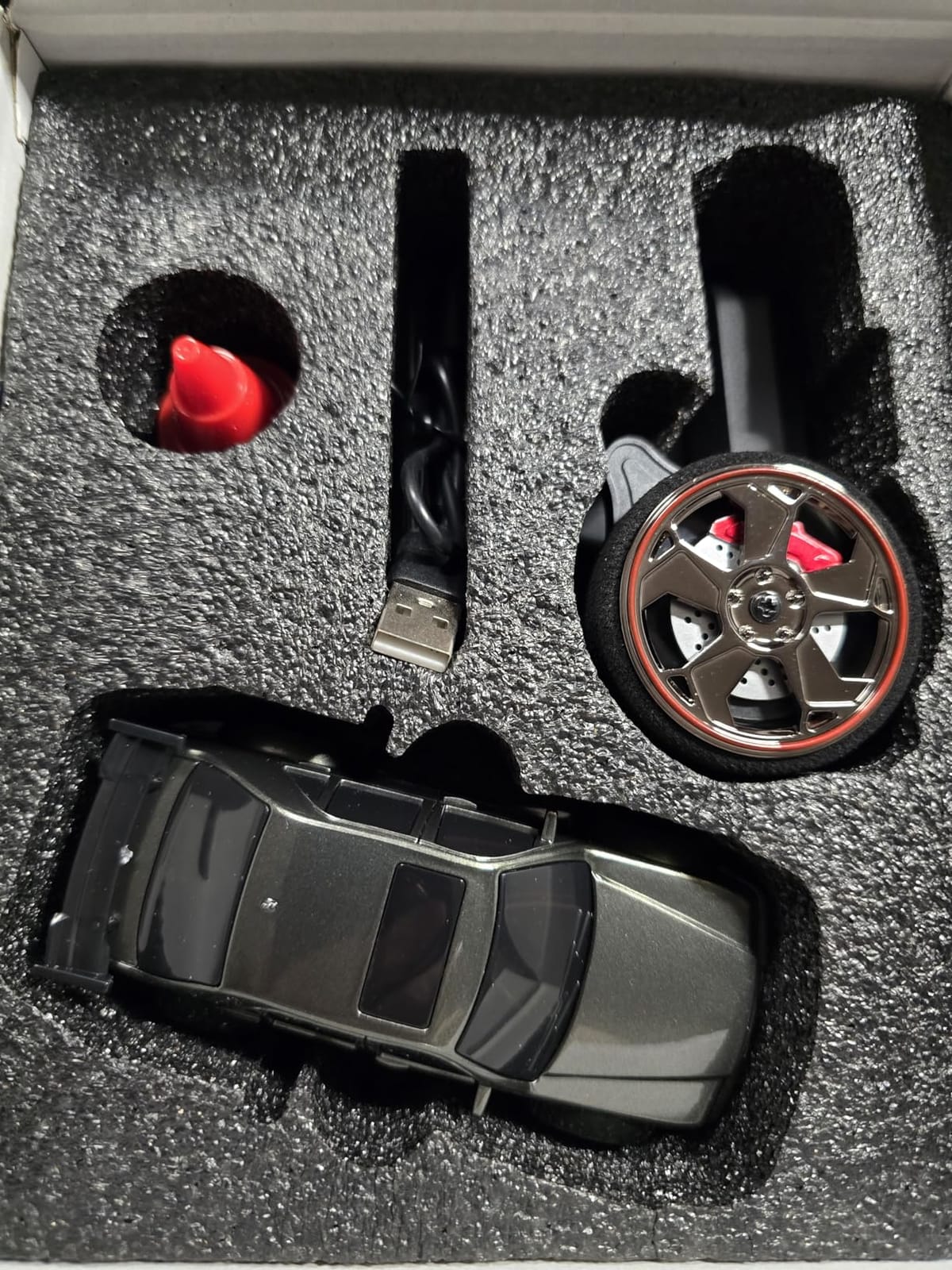
The Dingdongwu 1/43 does something unusual for the money: it puts full proportional control and a gyroscope into the cheapest bracket of any gyro-assisted car we looked at. For a beginner who has given up on sliding because the car keeps spinning, that combination is more useful than extra speed.
It runs at 20 km/h or better, which makes it quicker than most 1/43 rivals including the wheelfun, and it is supplied ready to run with a 2.4GHz remote, both tyre sets, cones and a charging cable. Both racing tyres for asphalt and drift tyres for tile and wood floors are included.
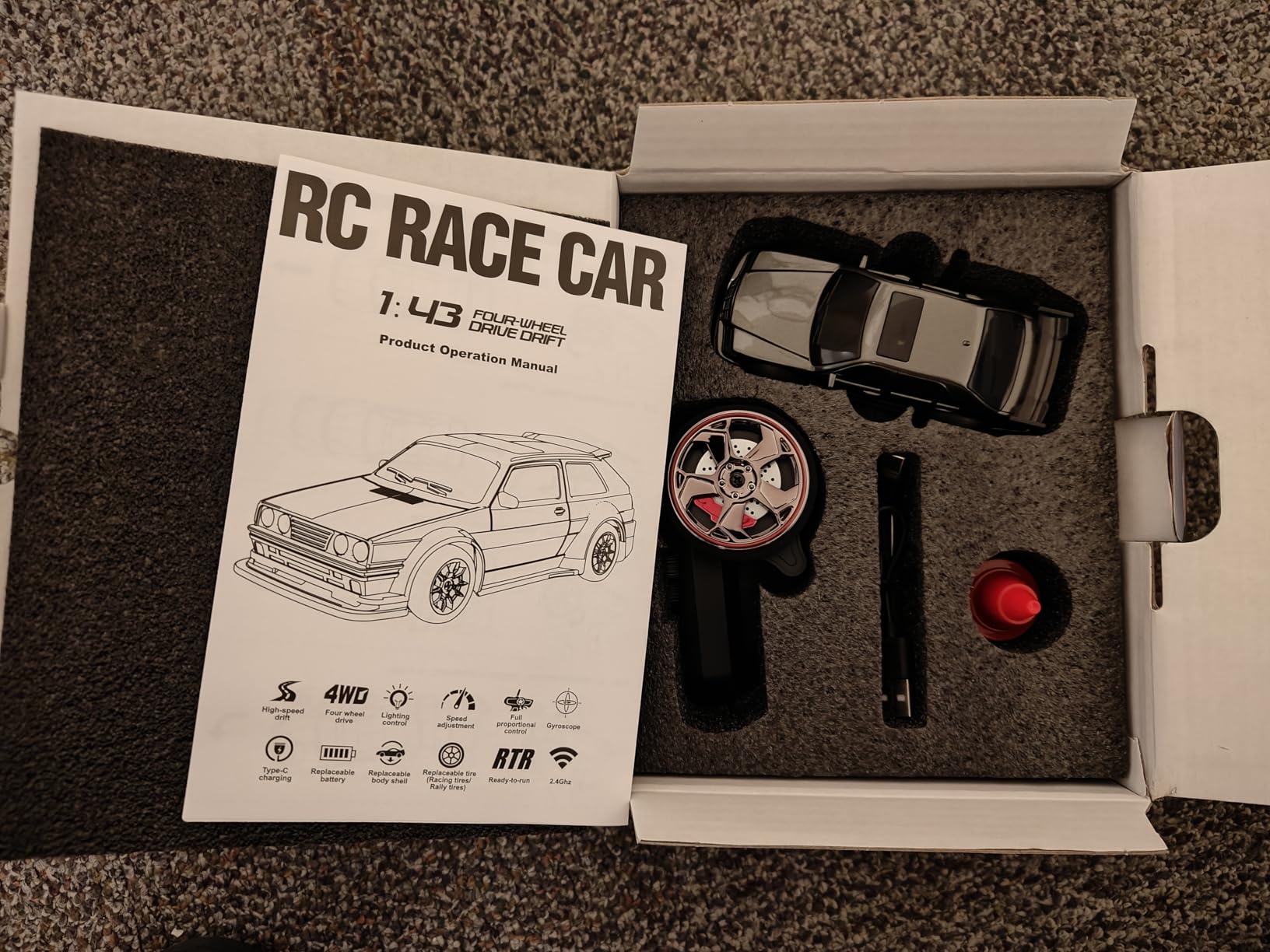
The tool-free quick-change body shell is a practical touch. You can swap shells or tyres in seconds rather than unscrewing fasteners, and the removable battery charges in 30 to 35 minutes over Type-C. Lighting is unusually detailed for the scale, with four-colour adjustable headlights, red taillights and turn signals.
Be realistic about the build. It is light plastic, which limits it to indoor surfaces, and the review base is small enough that long-term durability feedback is thinner than for the established platforms. It is a car to learn on, not one to build a hobby around.
Check where you will drive it
Tile, laminate and sealed wood floors are the intended surfaces and it handles them well.
Anything outdoors with texture or loose material will expose the light chassis quickly.
Check how long you will keep it
Plenty of hobbyists buy this, learn the throttle and countersteer, then move to a larger car within a few months.
If you already have an RC of your own, buy a bigger car. If you are starting from nothing, this is a sensible and cheap first step.
9. DIKAVEY RX12 1/12 — Most Versatile for Hobby-Grade Hardware
DIKAVEY 1:12 RC Rally Car Fast Max 50 MPH,Drift Adults RC Car
1/12 4X4 brushless
35A ESC
6061 aluminium
3S LiPo
Gyro radio
Pros
- Genuine hobby-grade metal drivetrain and aluminium chassis
- Very fast yet easy to control thanks to the gyro
- Front and rear sway bars give balanced handling
- Survives rollovers and hard impacts
- Plenty of spare parts available
Cons
- Supplied tyres wear quickly on hard surfaces
- Grippy rubber can flip the car for newcomers
- Body clips are small and fiddly
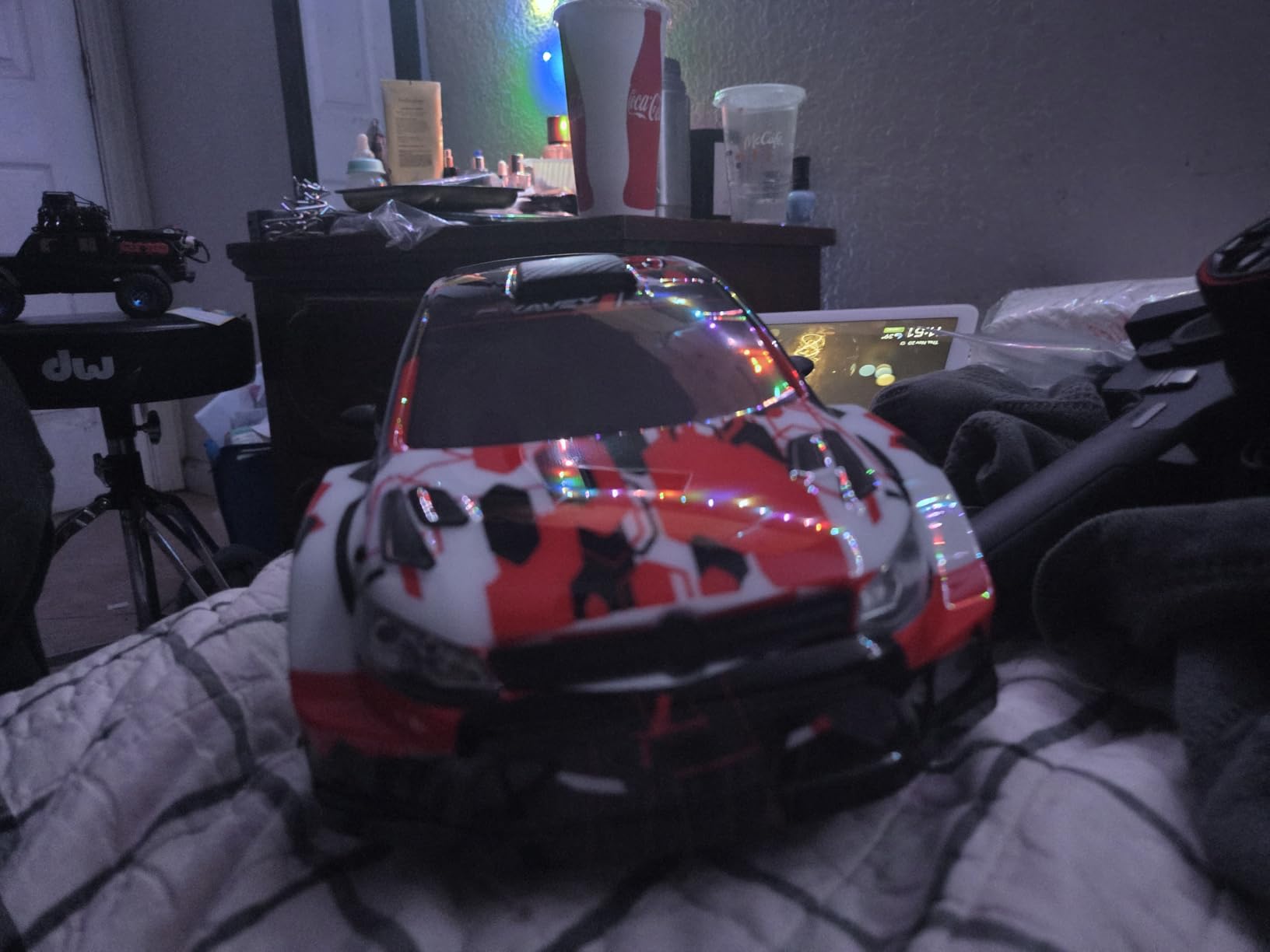
The DIKAVEY RX12 is the first car in this list where the drivetrain is built like a real hobby platform. You get a 35A brushless ESC with a cooling fan and metal heatsinks driving a Rocket 2845 3600KV brushless motor, a CNC 59TC steel differential, oil-damped suspension and steel CVDs, all mounted on a 6061 aluminium chassis with powder-metallurgy gears.
It ships with a 3S 2200mAh LiPo and charger, and reaches up to 80 km/h, roughly 50 mph. The 2.4GHz transmitter has a stated 350 metre range, a gyro, three speed modes and light control, and the electronics include overheating warning, low-voltage cutoff and over-current protection.
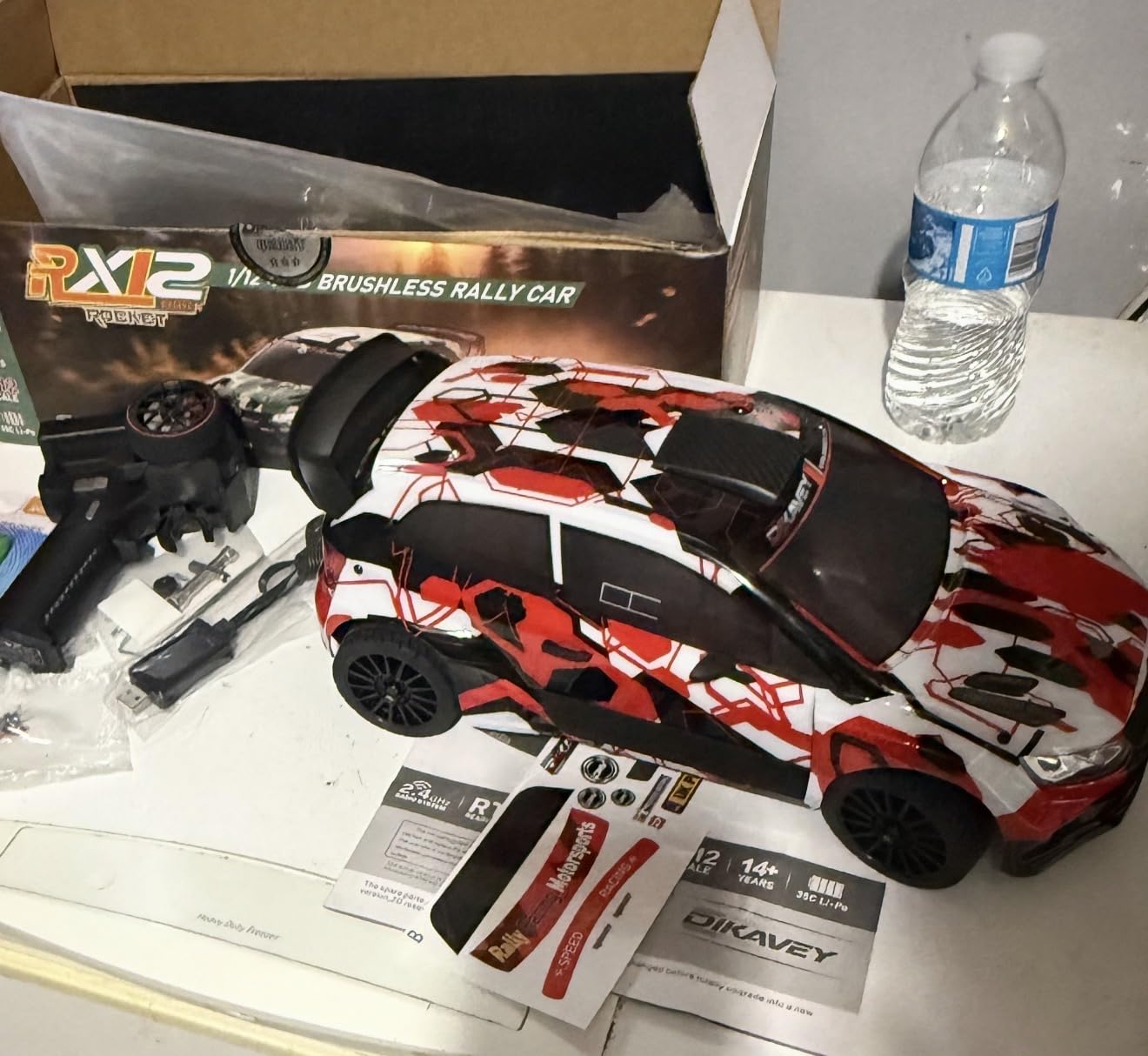
Handling hardware is properly thought out. Front and rear sway bars give it a balanced feel, the differential is sealed, and the 2mm reinforced PC shell has a front anti-collision bumper. Reviewers note it survives rollovers and hard impacts, and that spare parts for this platform are easy to find, which is the single most underrated buying criterion in this hobby.
The near-universal caveat is the supplied tyres. They wear quickly on hard surfaces, and because they are grippy rather than hard, they can flip the car until you learn to modulate the throttle. Charging takes roughly three to four hours with the supplied charger, and run time is around 20 minutes on high.
Check whether you can use the speed
At 1/12 with 50 mph potential, this needs a large smooth area. A short track or a small room will not do it justice.
If you can only drive indoors on a floor of a few metres, drop to a 1/16 or 1/24 car and save the power for later.
Check whether you want to modify it
The metal drivetrain, sealed diffs and wide parts availability mean upgrades are realistic rather than theoretical.
Budget for a hard compound tyre set early, because the supplied rubber is the limiting factor on hard floors.
10. CROBOLL 1/10 Carbon — Top Rated and Most Modifiable
CROBOLL 1/10 Brushless Carbon Fiber RC Rally Cars with Gyro, Max 50 mph,RTR
1/10 4X4 brushless
60A ESC
Carbon chassis
11KG servo
Gyro radio
Pros
- Holds up to serious high-speed abuse
- Highly tunable with 4S packs and the supplied speed pinion
- Excellent gyro that adds real stability while drifting
- Detailed functional lighting with high beams and reverse light
- Metal chassis with CNC shock towers
Cons
- Rubber tyres wear quickly when drifting on concrete
- Poor in tall grass which jams the drivetrain
- Supplied 3S pack limits runtime and top speed
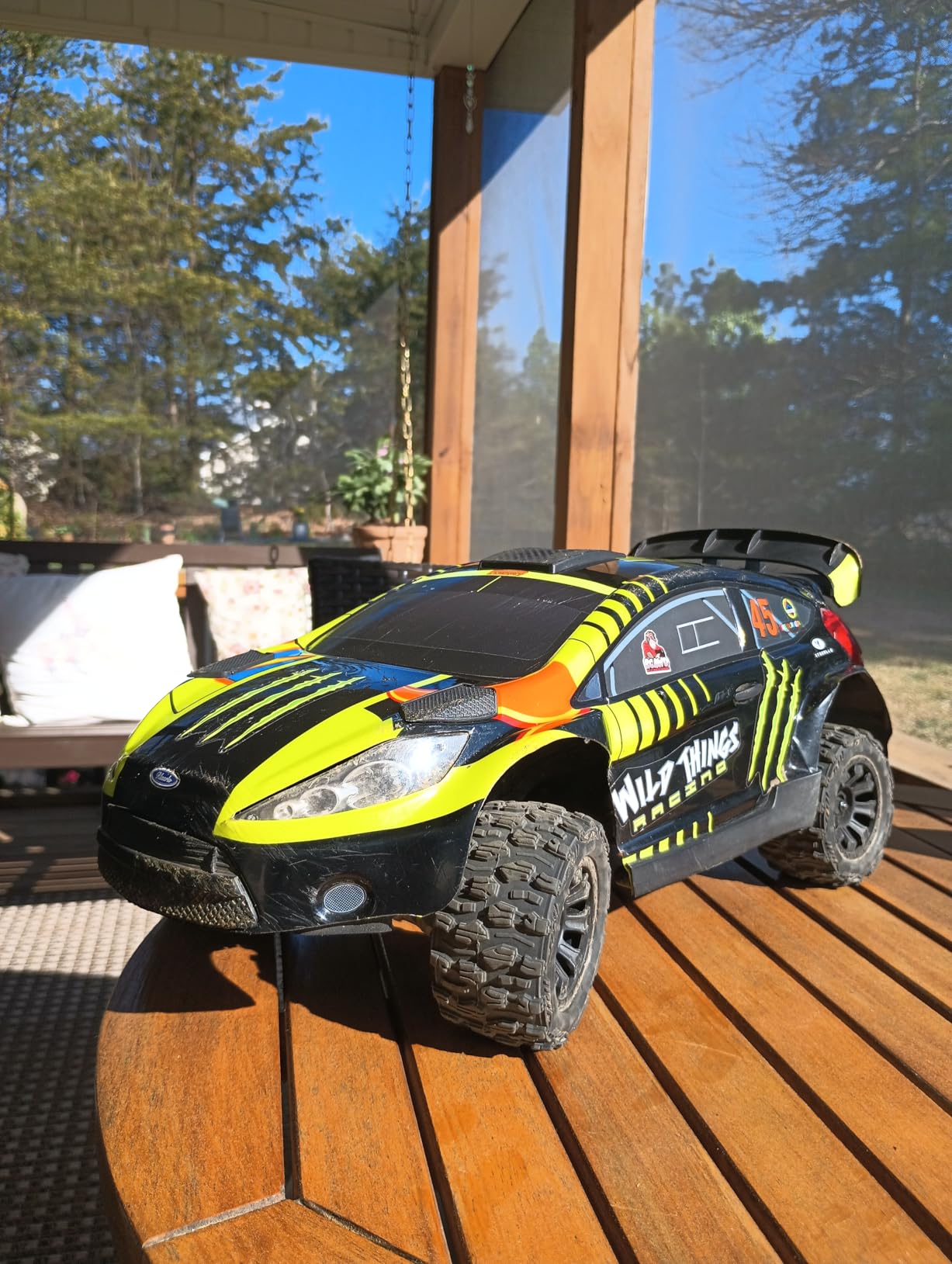
The CROBOLL 1/10 is the highest-rated car in this roundup at 4.6 across 249 reviews, and experienced hobbyists treat it as a modding platform rather than a finished product. The spec sheet reads like a premium 1/10 rally kit: a 60A ESC, a 3650-3300KV brushless motor with cooling fans and a metal heatsink, chrome steel helical gears, metal chassis and CNC shock towers.
Two details make it genuinely hobby-grade. The dual ESC tray and dual receiver box accept standard-size servos, and the supplied 11KG metal gear steering servo is already at the top of the normal range. The 5-channel transmitter has roughly 350 metre range with gyro assist, and the lighting is functional rather than decorative, with high beams, turn signals, a reverse light and an exhaust backfire effect.
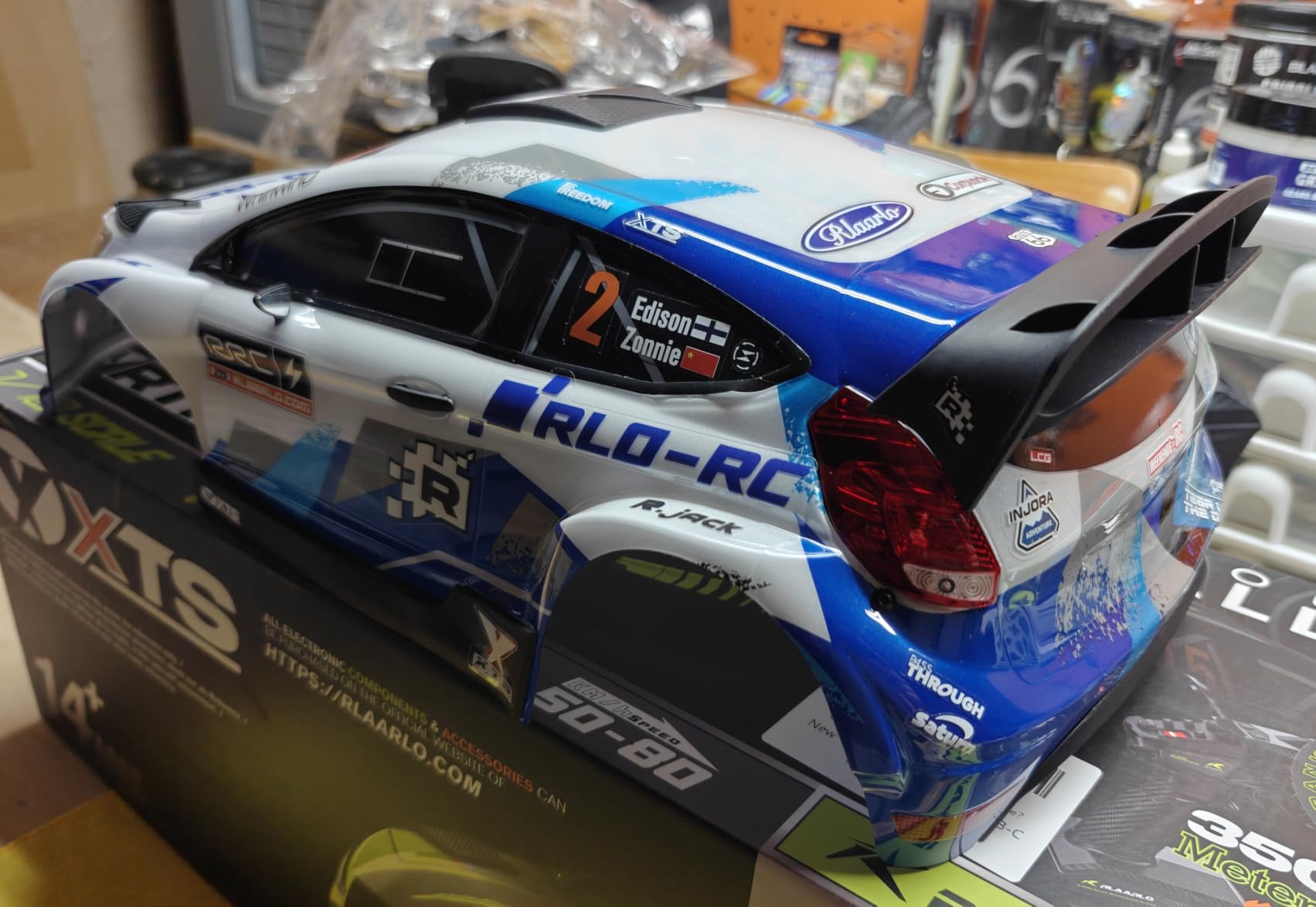
It drifts on dirt, sand, asphalt, cement and light snow, and it is built to be pushed. Owners run 4S packs, larger batteries and the supplied speed pinion to exceed 60 mph. Sealed differentials and dampening rubber rings on the centre drive couplings are the parts that keep it alive when you do that.
Wear points are predictable. Rubber tyres go quickly on concrete and asphalt when drifting, the drivetrain jams in tall grass, the supplied 3S 2200mAh pack is the limiting factor for both runtime and top speed, and the 1.2mm clip-less body shell cracked for one owner on a first hard sideways impact. At 43 cm long it is also large and heavy to carry around.
Check that you have a surface worth using it on
At 1/10 scale with 60 mph potential, this car needs a proper paved run or a purpose-built track. A hallway is wasted on it.
Sealed concrete and asphalt are ideal. Grass, weeds and anything loose will jam the drivetrain rather than slow it down.
Check that you want a project
The servo tray, receiver box and gearset are set up for standard parts, so upgrades drop in rather than requiring soldering or adapters.
Buy hard compound drift tyres early, because the supplied rubber is what limits it on concrete.
11. Tamiya TT-02D 1:10 — Best for Building a Kit Yourself
Tamiya 300058584 58584 TT-02D Drift Spec Chassis Brushed 1:10 RC Car Electric Road Model 4W, Blue
1:10 TT-02D chassis kit
540 sport motor
24mm drift tyres
CVA shocks
Pros
- Very modifiable and accepts brushless conversions and hop-up parts
- Included front upper control arms outclass many aftermarket upgrades
- Chassis holds up well through hard crashes
- Drifts convincingly on concrete with the sport tuned motor
- A real entry point into the Tamiya on-road platform
Cons
- Kit only so electronics battery and transmitter may need sourcing separately
- Loose and slow with the supplied touring tyres until shimmed
- Takes time and patience to assemble
The Tamiya TT-02D is the oldest platform here and the only bare chassis kit, and that is exactly why it is on the list. This is the drift car to buy if you already own a transmitter, a battery and a charger, or if you intend to build a proper hobby platform instead of running a sealed toy.
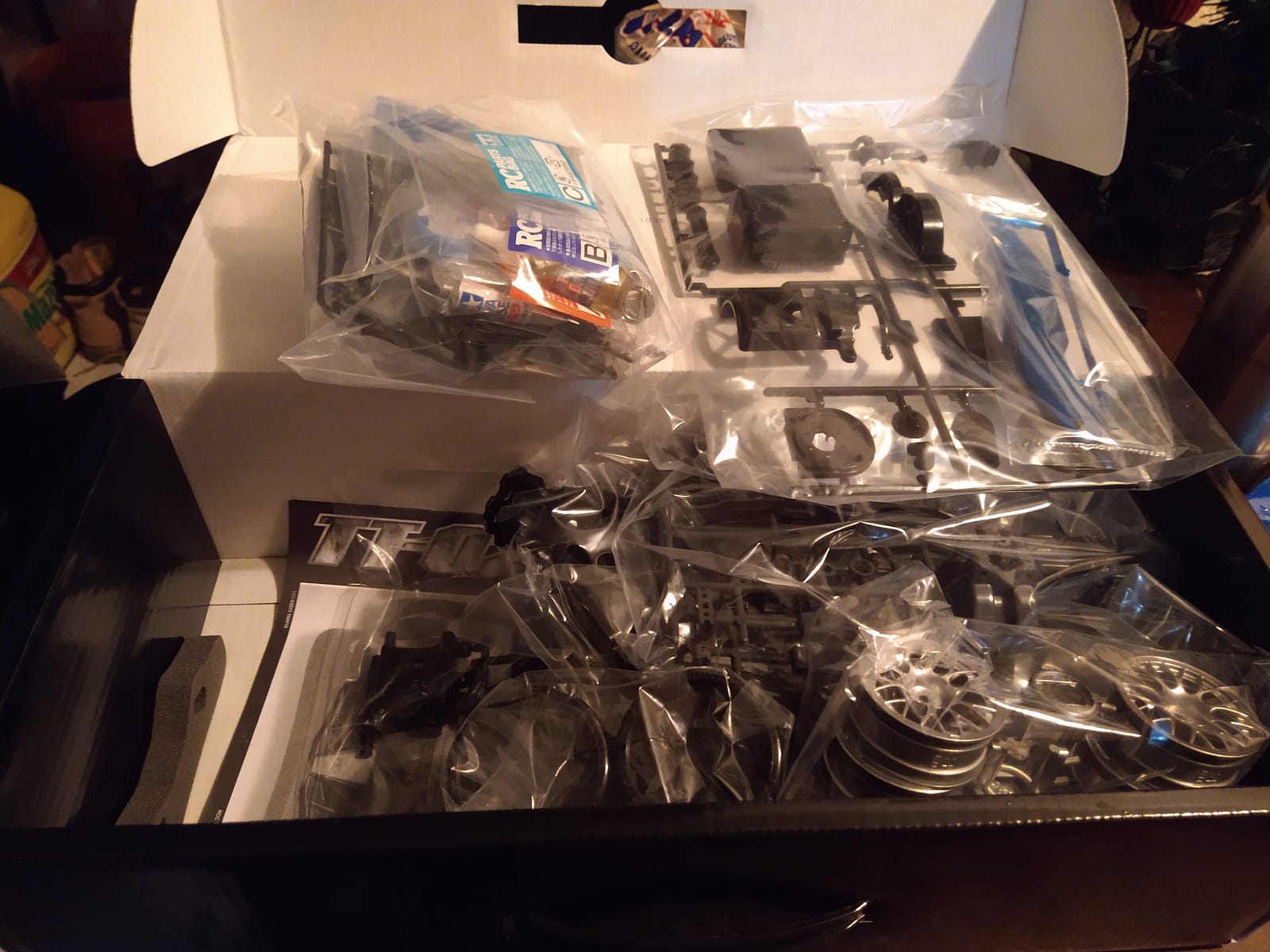
The box is genuinely well equipped for a kit. You get the liner frame chassis, an RS-Sport 540 sport tuned brushed motor with an aluminium heat sink and radiator, an aluminium central drive shaft, CVA Mini oil-filled shock absorbers, 24mm width drift tyres on matte-finish metal-plated wheels, full ball bearings and reinforced resin uprights.
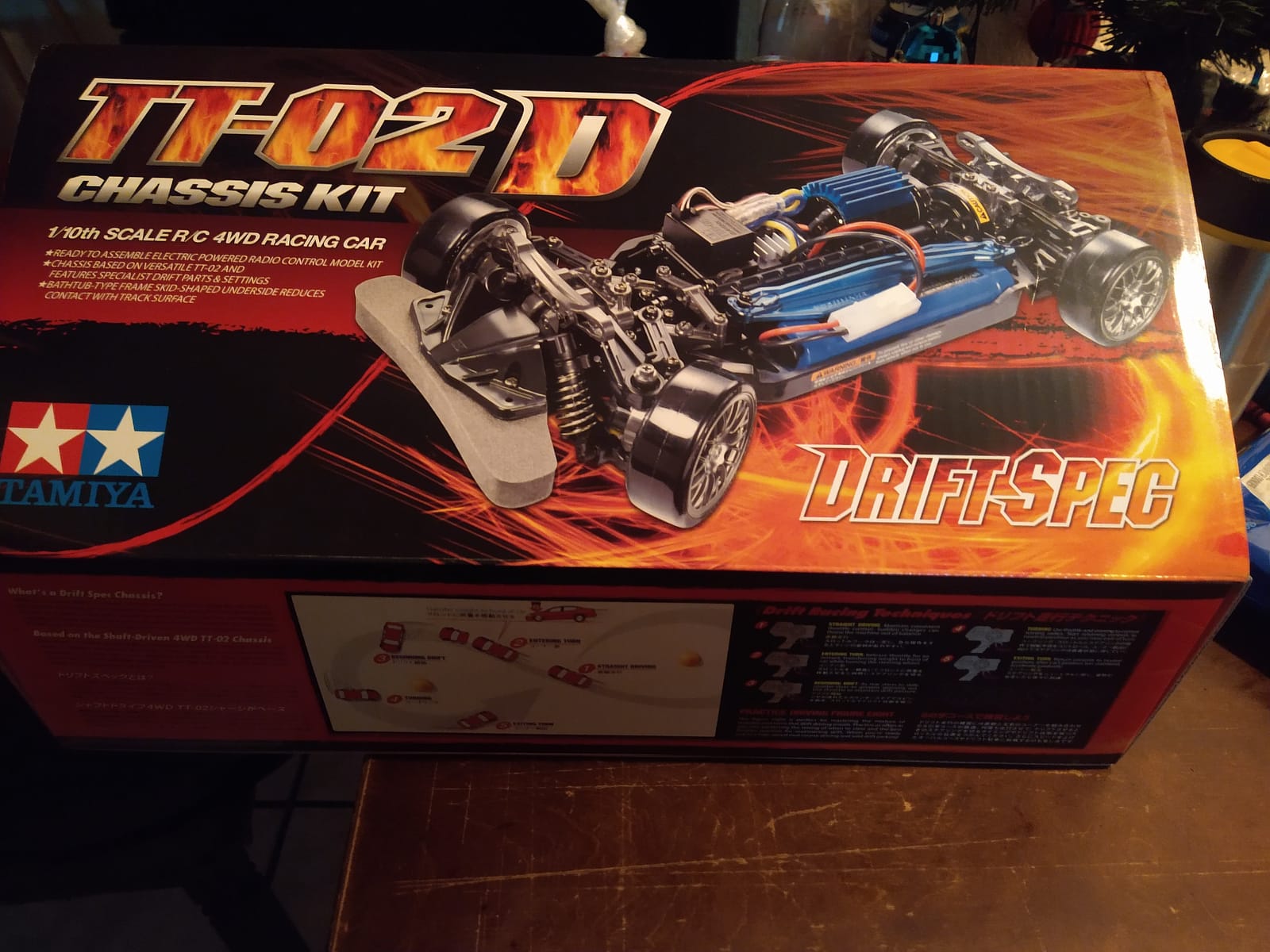
Long-term Tamiya owners rate it as a solid, highly tunable starter chassis, and they single out the included front upper control arms as stronger than many aftermarket hop-up parts. The chassis survives hard crashes, shimming improves the handling noticeably, and it accepts brushless conversions without drama.
The catch list is real. It is a kit, so assembly time and patience are required and electronics, battery, transmitter and wheels may need sourcing separately. Out of the box it feels loose and slow with the supplied touring tyres, and there is suspension slop that needs shimming out. Owners also report units arriving with missing or mismatched parts, so check bearings and hardware before you build.
Check what you already own
If you have no radio gear at all, this is the wrong starting point. A kit needs a transmitter, a receiver, a battery and a charger before it moves.
If you already run Tamiya or any 1/10 on-road kit, this is a cheap way into drifting on an existing platform.
Check how long you want to spend building
Assembly is the first hour, and the shimming and gearing work is where the real character comes out.
The wide turning radius and non-adjustable steering linkages are the limitations you will notice first, and both are addressed later with parts.
12. Cayrzeth 1:24 — Best for Night Drift Runs
Cayrzeth 1/24 4WD RC Drift Car, 2.4GHz 20KM/H High Speed Remote Control Racing Car with Drifting Tires, Gift for Kids Adults
1:24 scale
4WD
Linear throttle to 20 km/h
Dual tyre sets
Underbody LEDs
Pros
- Linear throttle and adjustable sensitivity beat switch-based rivals
- Two batteries give about 50 minutes of combined play
- Quick-release tyre swap between drift and racing setups
- Headlights taillights and underbody LEDs
- Shock-absorbing chassis with a protected battery housing
Cons
- Toy-grade specification rather than hobby components
- 20 km/h top speed is modest among 1/24 cars
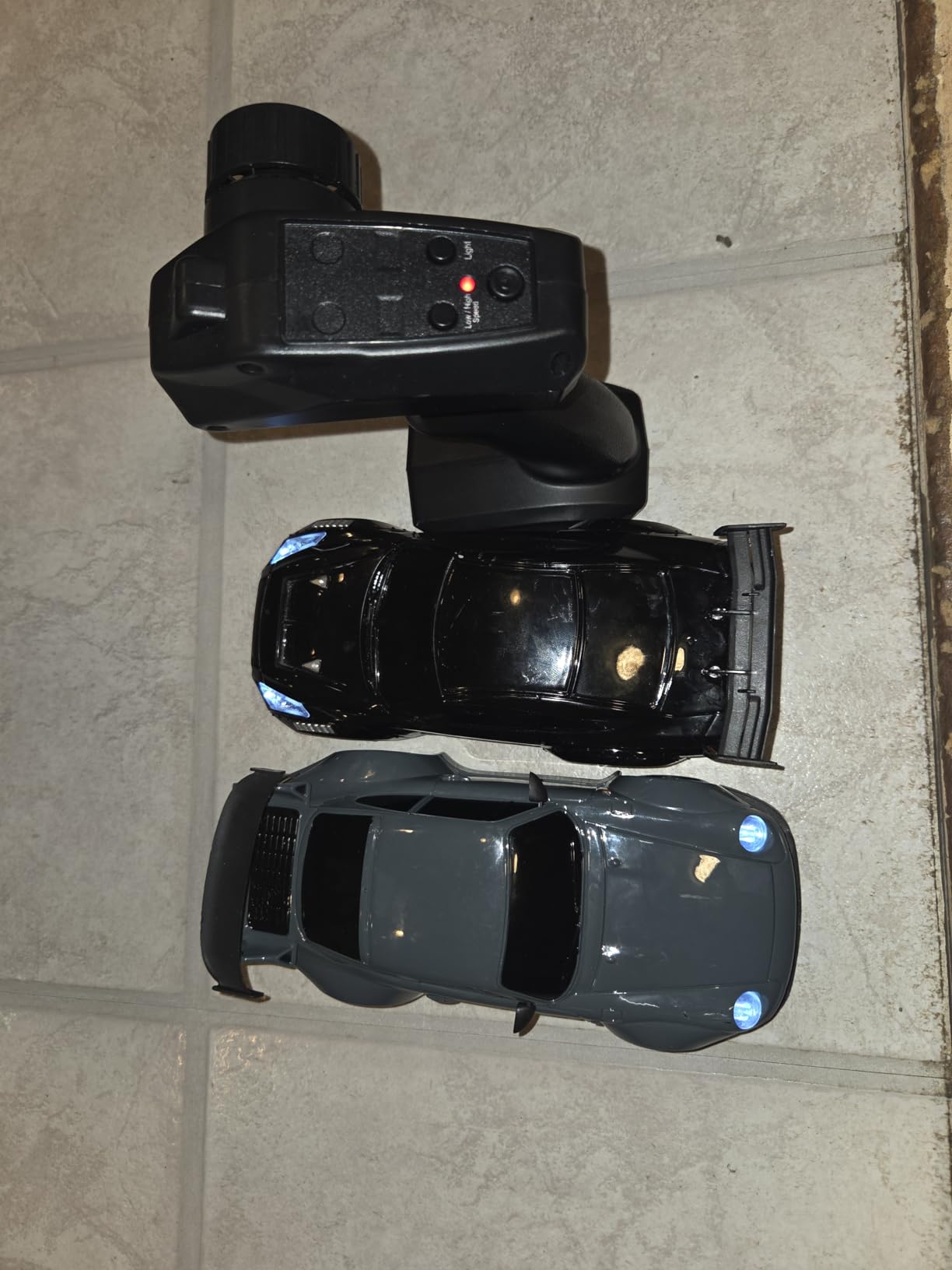
The Cayrzeth 1:24 is the pick if your drifting happens after dark. Alongside working headlights and taillights it has underbody LEDs that light the ground under the car, which is what makes it stand out from every other small drifter in this roundup when a room is dim.
It is also one of the better-controlled cars at this scale despite the low cost. The throttle is full-range linear to 20 km/h rather than a switch, the 2.4GHz remote has adjustable sensitivity and anti-interference, and there are two speed modes so you can pick a level that matches your hands.
Two 3.7V 500mAh batteries give roughly 50 minutes of combined play time, and the quick-release wheel swap lets you move between four drift tyres for smooth surfaces and four racing tyres for outdoor terrain in seconds. The shock-absorbing chassis and impact-resistant battery housing are sensible choices on a car people will drop.
Be clear about what it is. The specification is toy-grade rather than hobby-grade, and 20 km/h is modest next to the faster 1/24 models. It is a car for indoor evening fun, not for building a platform.
Check the lighting against your floor
Underbody LEDs only look good on a light, smooth surface. On dark carpet they wash out and the car will not drift anyway.
The adjustable steering sensitivity is worth setting low before you run it fast indoors.
Check what you will be doing with it
Short evening runs on tile or sealed concrete, with the speed mode dialled back while you learn.
If you want to progress to a real platform, plan to move up to a 1/12 or 1/10 car within a few months.
How to Choose an RC Drift Car Without Wasting Money?
RTR, kit or bare chassis
A ready-to-run car arrives with everything you need to drive. That is the right choice for most people, and every car in the first ten positions here is ready to run. The trade is that sealed toy gearboxes cannot be repaired or tuned, so a broken car is often a broken car.
A kit gives you a chassis and suspension to build on, and you supply the electronics, battery and transmitter. The Tamiya TT-02D is the only kit here, and it is worth considering precisely because you can shim it, replace parts and convert it to brushless. Community discussion on r/rcdrift consistently frames kits as the cheaper route compared with buying the equivalent ready-to-run finished, and for a hobbyist who will crash a lot, that repairability is the real argument.
For most buyers the practical sequence is simple: start ready-to-run to learn throttle and countersteer, then move to a 1/12 or 1/10 platform once you have a surface you trust.
RWD or 4WD for drifting
RWD is better for competitive drifting because it lets a driver hold a bigger slip angle and use throttle to steer, which is why the serious 1/10 platforms that dominate the community conversation are rear-wheel drive. Every car in this roundup except the two 1/10 hobby platforms is four-wheel drive, which is easier to control, less sideways and better suited to beginners or anyone without a dedicated track.
So if your question is which is better, the answer is that RWD is better for learning real drifting technique and AWD is better for a first car or for driving on pavement away from a track. Nobody who asks this in the 1/10 drift groups gets a single answer, because the honest answer depends on whether you have a track.
Whether you need a gyro
A gyroscope reads yaw and mixes in small steering corrections so a slide stays smooth instead of spinning. It is the single most useful electronic feature for a beginner, and it is no longer a premium item. Budget six-channel radios with a built-in gyro are available for a modest sum according to rctalk discussion, and two of the cars in this roundup, the VoleRusher 1/43 and the Dingdongwu 1/43, ship with one fitted.
There is one caveat that catches people out. Community build lists repeatedly advise keeping the servo and the gyro from the same brand, because certain servos do not play well with gyros from another manufacturer. Mixing brands is the most common cause of tuning frustration, so if you plan to fit a gyro yourself, match the brands.
Surfaces, tyres and slip angle
Drifting needs a smooth, hard surface. Tile, sealed concrete, laminate, smooth asphalt and a polished tabletop all work. Carpet, gravel, grass, dust and anything textured will not slide, and no amount of throttle will fix it. That is why so many of the cars here specify a hard plastic drift tyre set alongside a grippier racing set.
The terms are worth learning. Slip angle is the angle between the car’s heading and the direction it is actually travelling, and it is the number that defines a drift. Hard plastic tyres are what let you hold a high slip angle; soft rubber grips and accelerates out of the corner instead, which is rally behaviour, not drifting.
Batteries, chargers and real running cost
Few roundups tell you what a drift car actually costs once it is running, and that is where the frustration shows up. A ready-to-run car with a small battery is a purchase, while a platform that needs a charger, packs and a radio is an ongoing one. Every car above either includes batteries and a charger, or is a kit where you supply them.
Plan the charging before you plan the driving. The 1/12 and 1/10 platforms use LiPo packs that need a balance-capable charger and sensible storage practice, and a three to four hour charge cycle changes how often you can realistically drive. That is the number that decides how quickly you get good.
Parts availability is a buying criterion
Ask what breaks, and whether you can replace it. A car with a published spare-parts ecosystem will survive your learning curve; a car with a sealed one-piece chassis will not. This is the single biggest difference between the toy-grade cars at the top of the list and the hobby platforms near the bottom, and it is the reason we rated the parts availability of the 1/12 and 1/10 cars so highly.
Frequently Asked Questions
What is the best RC drift car for a beginner?
The ACAMMZAR 1:24 is the best starting point for most beginners because it has full proportional throttle, which lets you feather into a corner and hold a slide instead of snapping into it. It also ships with two batteries, two tyre sets and a high and low speed mode. If your floor space is limited, the VoleRusher 1/43 adds a gyroscope that catches slides for you.
Is AWD or RWD better for RC drifting?
RWD is better for competitive drifting because throttle controls the slide angle, while AWD is easier to control and better for beginners or anyone driving away from a track. Nearly every car in this roundup is four-wheel drive, and the two 1/10 hobby platforms are the closest to rear-wheel drive behaviour you can buy here.
Do you need a gyro for RC drifting?
A gyro is not essential, but it makes learning considerably easier by reading yaw and applying small steering corrections so the car holds a slide rather than spinning. Gyro-equipped radios are no longer a premium feature, and if you fit one yourself, keep the servo and the gyro from the same brand, because mixed brands are the most common cause of tuning problems.
What surface is best for RC drifting?
Smooth hard surfaces work: tile, sealed concrete, laminate flooring, smooth asphalt and polished tabletops. Carpet, gravel, grass, dust and any textured surface will not let the car slide at all. Hard plastic drift tyres are what let a car hold a high slip angle, and a grippy rubber set will simply accelerate out of the corner instead.
Are kits better than ready-to-run cars for drifting?
For a beginner, ready-to-run is better because you can drive it within minutes of opening the box. For a hobbyist who will crash a lot, a kit is often the smarter long-term choice because you can repair, shim and upgrade the chassis, and because the running cost works out lower over time. The Tamiya TT-02D is the kit worth knowing about, though you supply the radio, battery and charger.
The Best RC Drift Cars for Hobbyists in 2026: Final Word
After weeks of running every car in this roundup, the honest picture is that there are three good ways in. The ACAMMZAR 1:24 is the best RC drift car for a beginner who wants proportional control and a complete practice setup in the box. The VoleRusher 1/43 is the best choice for anyone short on space, because its integrated gyro catches the slides you cannot yet catch yourself.
For hobbyists who already own RC gear, the DIKAVEY RX12 1/12 and the CROBOLL 1/10 are the two platforms worth building around, and the Tamiya TT-02D is the kit if you want to do the work yourself. Whichever you pick, get a smooth floor sorted before you buy, because a dedicated practice surface will teach you more in a week than a faster car will in a month.
Start on low power, hold the throttle, let it slide, and come back tomorrow. That loop is the whole hobby, and every car above will teach it to you if you give it a smooth surface and a little patience.