
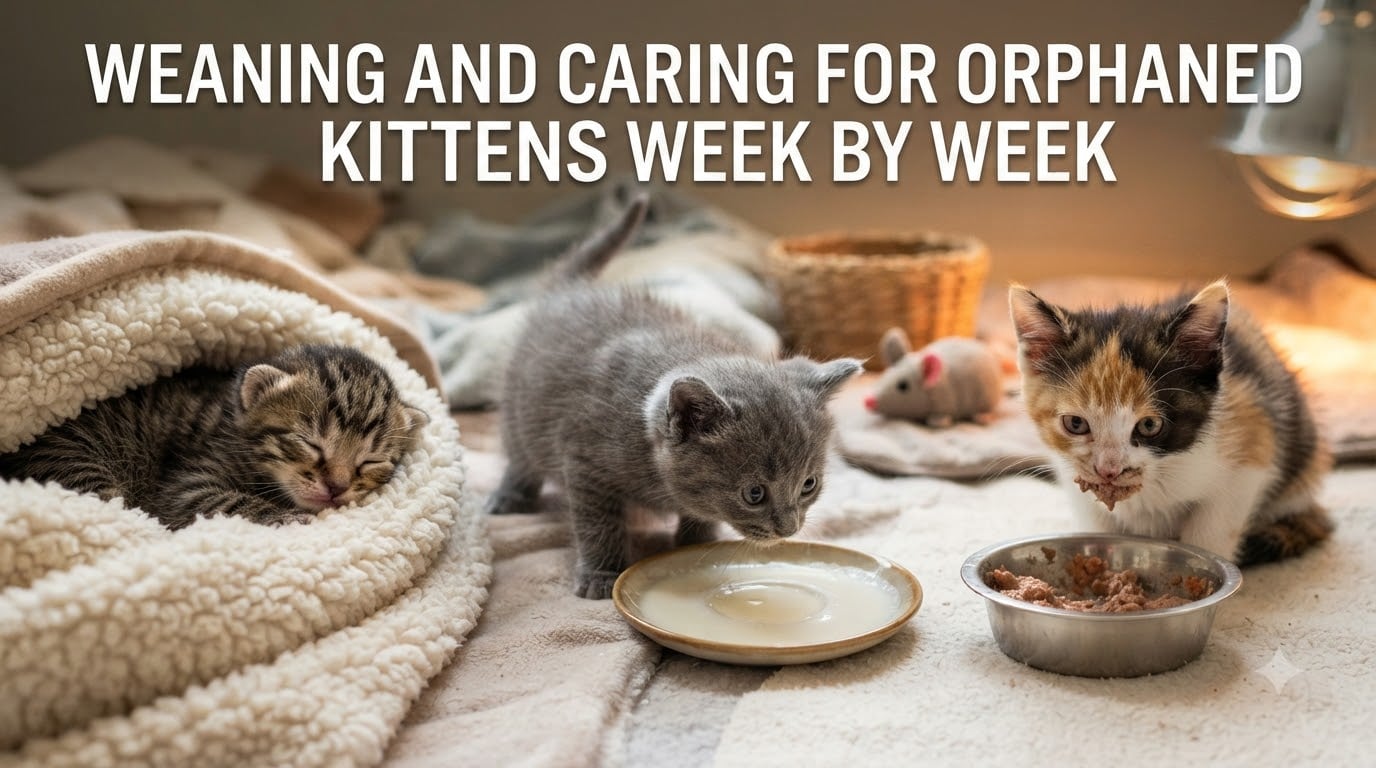
I still remember the night a neighbor knocked on our door with a shoebox holding three tiny kittens. Their eyes were sealed shut, and the box was cold. That moment kicked off a steep learning curve in weaning orphaned kittens, and it turned me into someone who now fosters litters every spring.
If you are holding a kitten right now and wondering what on earth to do, this guide walks you through every week of their development. We will cover feeding amounts, temperature control, the weaning process, troubleshooting, and the warning signs that mean a trip to the vet. By the end, you will know exactly what each week of orphan kitten care looks like, from day one to adoption day.
Table of Contents
How to Tell If a Kitten Is Truly Orphaned?
Before you scoop up a kitten, take ten minutes to watch and wait. Mother cats leave the nest to hunt and can be gone for hours, especially with older kittens. A truly orphaned kitten is usually cold, dirty, crying continuously, or visibly weak.
Here are signs that kittens may have a mom nearby and should be left alone:
The nest is clean and the kittens are warm and quiet.
A mother cat is seen in the area, even from a distance.
The kittens have full, rounded bellies.
Their fur is clean, with no fly eggs or dried stool.
Truly orphaned kittens are cold to the touch, limp, or crying nonstop. Their umbilical cords may still be wet, meaning they are only hours old. If you find them, get them warm first and fed second. Cold kittens cannot digest milk, and bottle feeding a chilled kitten can kill them.
How to Estimate a Kitten’s Age
Age guides every decision in newborn kitten care, so a quick estimate helps. These markers are reliable in the first eight weeks of life.
0 to 1 week: Eyes closed, ears flat against the head, umbilical cord still attached.
1 to 2 weeks: Eyes open around day 7 to 14, but they remain blue.
2 to 3 weeks: Ears start to unfold, baby teeth begin to come in.
3 to 4 weeks: Kittens can walk wobbly, ears point upward.
4 to 5 weeks: Running and playing, starting to use the litter box on their own.
6 to 8 weeks: Adult eye color appears, confident play, ready for adoption.
What You Need Before Bringing Orphaned Kittens Home?
Preparation before the kittens arrive makes the next eight weeks much easier. Here is what I keep in our foster kit at all times.
A small box or pet carrier lined with a towel and a microwavable heating pad set on low.
KMR (Kitten Milk Replacer) powder or premixed liquid.
Small nursing bottles and extra nipples in the correct size.
A kitchen scale that measures in grams.
Unscented baby wipes for cleanup.
A shallow litter box and non-clumping litter once kittens hit 3 to 4 weeks.
If you cannot reach a store tonight, an emergency homemade kitten formula can bridge the gap. Mix one can of evaporated milk, one egg yolk, two tablespoons of plain whole yogurt, and a quarter teaspoon of corn syrup. Warm only what you need for one feeding and discard the rest. This is a stopgap, not a long term solution.
Week 1: Newborn Kittens Need Around-the-Clock Care
Week one kittens are completely dependent. They cannot see, hear, walk, or pee on their own. Every few hours, you will feed them, help them eliminate, and check that they are warm enough.
Temperature and Warmth
Newborn kittens cannot shiver to warm themselves. Keep their environment between 85 and 90 degrees Fahrenheit for the first week, dropping to around 80 degrees by week two. A heating pad under half the box lets kittens crawl to a cooler spot if they get too warm.
Feeding Schedule
Bottle feed every 2 hours around the clock, including overnight. Yes, that means setting alarms. A one week old kitten takes about 2 to 4 milliliters of formula per feeding. Mix KMR with warm water according to the package, and test it on your wrist the way you would test a baby’s bottle.
Feeding Position
Never feed a kitten on its back like a human baby. Hold them belly down, with the head tilted slightly up, so the nipple is at a natural angle. Let the kitten suck at its own pace. If formula bubbles from the nose, slow down or reposition the nipple.
Stimulation for Elimination
After every feeding, gently rub the kitten’s lower belly and rectal area with a warm, damp cotton ball or soft cloth. This mimics the mother’s tongue and triggers peeing and pooping. Most kittens need this help for the first three weeks.
Weight Tracking
Weigh every kitten at the same time each day. Newborns weigh roughly 85 to 100 grams. Healthy kittens gain 7 to 10 grams per day. A flat or dropping weight curve is the earliest warning sign of trouble.
Week 2: Eyes Open and Steady Growth
Eyes usually open between days 7 and 14. Do not force them open. Kittens born with their eyes sealed risk infection if you pry the lids apart.
By week two, the feeding window stretches slightly to every 3 to 4 hours. Each feeding increases to 5 to 10 milliliters. Kittens start to crawl more purposefully, and you may notice the beginnings of teeth pushing through the gums.
Socialization Begins
From the moment eyes open, gentle handling matters. Hold each kitten for a few minutes during feedings, talk softly, and stroke their heads. Our team has seen kittens who got daily handling become noticeably more confident than those who only got fed.
Week 3: Standing and the First Steps Toward Weaning
Week three is when orphaned kittens transform from tiny potatoes to mobile, curious creatures. They start to stand and take wobbly steps. Their baby teeth are mostly in by the end of the week.
Feed every 4 to 6 hours, with 10 to 14 milliliters per meal. Kittens still rely on you for elimination, so keep up the cotton ball routine after each feeding.
Introducing the Litter Box
Place a low sided box with non-clumping litter in the corner of their enclosure. After meals and naps, set each kitten in the box. Most will start to figure it out within days. Clumping litter is unsafe for kittens under 4 months because they may ingest it during grooming.
Week 4: The Weaning Window Opens
Week four is the heart of the weaning orphaned kittens process. Most kittens are ready to sample solid food around day 21 to 28, though stubborn kittens may wait until week five or six.
Signs a Kitten Is Ready to Wean
Watch for these readiness cues before you introduce gruel:
Chewing on the bottle nipple or your fingers during feeding.
Sniffing and investigating what the older cat or you are eating.
Standing steadily and pouncing on litter or toys.
Baby teeth fully in, making chewing possible without pain.
How to Mix Gruel
Gruel is the bridge between milk and solid food. Here is the recipe I use for each kitten at this stage:
One tablespoon of high quality wet kitten food (pate style works best).
Two tablespoons of warmed KMR formula.
A small splash of warm water to reach a smooth, milkshake consistency.
Offer gruel on a shallow plate or in a syringe. Many kittens walk right into the dish. That is fine. Wipe them down with a warm cloth after each meal.
Feeding Schedule at Week Four
Offer gruel three to four times a day and continue bottle feeding every 6 hours. The bottle is still the main source of nutrition. Gruel at this stage is about curiosity and learning, not full meals.
Week 5: Building Confidence With Food
By week five, kittens are mobile, starting to play, and beginning to rely less on the bottle. Continue gruel but make it thicker. Reduce the formula and water until the texture resembles thick oatmeal.
Bottle feed every 6 to 8 hours, with 14 to 18 milliliters per feeding. Kittens should be peeing and pooping on their own in the litter box by now. If they are still struggling, gently place them in the box after meals.
Letting Kittens Wean at Their Own Pace
Our team has fostered kittens who took to gruel on day 22 and others who refused until day 40. Both outcomes ended in healthy, adopted cats. Push too hard and you risk food aversion. Offer gruel at every meal, leave a small dish available between feedings, and let appetite catch up eventually.
Week 6: Most Kittens Are Nearly Weaned
Week six usually marks the end of the bottle for most kittens in a litter. If a kitten is consistently refusing the bottle in favor of gruel, drop the daytime bottles and offer one last bottle at night for comfort.
Transitioning to Wet Food
By the end of week six, kittens should eat wet food on its own. Offer small meals four times per day. Always provide fresh water in a shallow, stable bowl. Keep dry kitten kibble available as well so kittens learn to crunch.
Vet Check and First Vaccines
Week six is the right window for a first vet visit. Kittens get a wellness check, deworming, and their first FVRCP vaccine at this age. FeLV and FIV testing is also standard for orphaned kittens whose mother is unknown.
Weeks 7 and 8: Preparing for Adoption and Independence
By week seven, kittens eat wet and dry food confidently and use the litter box without help. Weaning orphaned kittens is essentially complete, with most kittens fully on solid food by week eight.
Feeding at Weeks 7 and 8
Feed wet food three to four times per day, leaving dry kibble out between meals. The second round of FVRCP vaccines happens around week nine, so schedule the appointment now.
Spay and Neuter Timing
Most shelters and rescues spay or neuter kittens at 8 weeks if they weigh at least 2 pounds. Early age spay and neuter is safe and helps prevent the cycle of unwanted litters. Talk with your vet about the right timing for your kittens.
Socialization Window
Kittens between weeks 2 and 8 are in their primary socialization window. Daily handling, exposure to gentle people, and play with siblings build the confidence that turns a foster kitten into a happy family pet.
Troubleshooting Common Weaning Problems
Even with the best setup, weaning does not always go smoothly. These are the issues I see most often in our foster program, and how I handle them.
The Kitten Refuses Gruel Entirely
Try warming the gruel to body temperature. Add a tiny bit of the KMR they already love to boost the smell. Some kittens accept gruel from a finger or syringe before they trust the dish. Be patient. Forcing the issue creates a food aversion that is much harder to fix.
Weight Loss or Slowed Growth
If a kitten stops gaining weight during weaning, keep bottle feeding in the mix. A drop of more than 10 grams in a single day, or no gain for 48 hours, deserves a vet visit. Slow growth is often the first sign of illness.
Diarrhea
Sudden food changes commonly cause loose stool. Mix old and new foods gradually, and make sure the gruel is not too rich. Persistent diarrhea, especially with lethargy, is a vet emergency for kittens this young. They dehydrate fast.
Sole Kitten Struggles More Than a Litter
Solo kittens wean slower than kittens with siblings. Without littermates to copy, they rely entirely on you. Some single fosters benefit from a stuffed animal to cuddle and a mirror placed outside the box so they can see a “friend.”
Warning Signs That Require a Veterinarian
Trust your gut. If something feels wrong, call your vet or an emergency clinic. These signs are non-negotiable.
Limpness, unresponsiveness, or constant crying.
Refusing food for more than 6 hours in a kitten under 4 weeks.
Vomiting or green, bloody, or watery diarrhea.
Difficulty breathing, blue gums, or a temperature over 103.5 degrees Fahrenheit.
Weight loss for two days in a row.
Frequently Asked Questions
How do I know if kittens are truly orphaned?
If the nest is clean, the kittens are warm and quiet, and the mother is seen nearby, the mother is likely out hunting. Truly orphaned kittens are cold, dirty, crying nonstop, or visibly weak. Watch from a distance for two to three hours before intervening.
What can I feed a newborn kitten in an emergency?
Mix one can of evaporated milk, one egg yolk, two tablespoons of plain whole yogurt, and a quarter teaspoon of corn syrup. Warm only what you need for one feeding. This is a stopgap until you can buy KMR kitten formula.
When should I start weaning orphaned kittens?
Most kittens are ready to try gruel at 3 to 4 weeks of age. Look for chewing on the bottle, sniffing human food, and steady walking. Stubborn kittens may wait until 5 or 6 weeks, and that is usually fine.
How often do newborn kittens need to be fed?
Newborns need bottle feeding every 2 hours, including overnight. By week two, stretch to every 3 to 4 hours. By week four, every 6 hours. Weaning reduces bottle sessions until they stop around week six.
What is gruel for kittens?
Gruel is a soft mixture of wet kitten food, KMR formula, and warm water blended to a milkshake consistency. It is the bridge between bottle feeding and solid food during weaning.
Can a kitten survive without a mother?
Yes, kittens can survive without a mother when you provide warmth, regular bottle feeding, help with elimination, and a clean environment. Success rates are highest for kittens over 2 weeks old with no underlying health issues.
Final Thoughts on Weaning Orphaned Kittens
Weaning orphaned kittens is one of the most rewarding things you can do for animals. The eight weeks go fast, even when you are exhausted. Keep a clean setup, weigh daily, follow the feeding schedules above, and trust your instincts when something is off.
Reach out to a local rescue or vet clinic at the first sign of trouble. They would rather help you early than see you lose a kitten. Take it week by week, and you will watch those tiny fighters grow into healthy, adoptable cats. Updated for 2026, this guide reflects current best practices for foster parents and rescuers caring for kittens without a mother.