
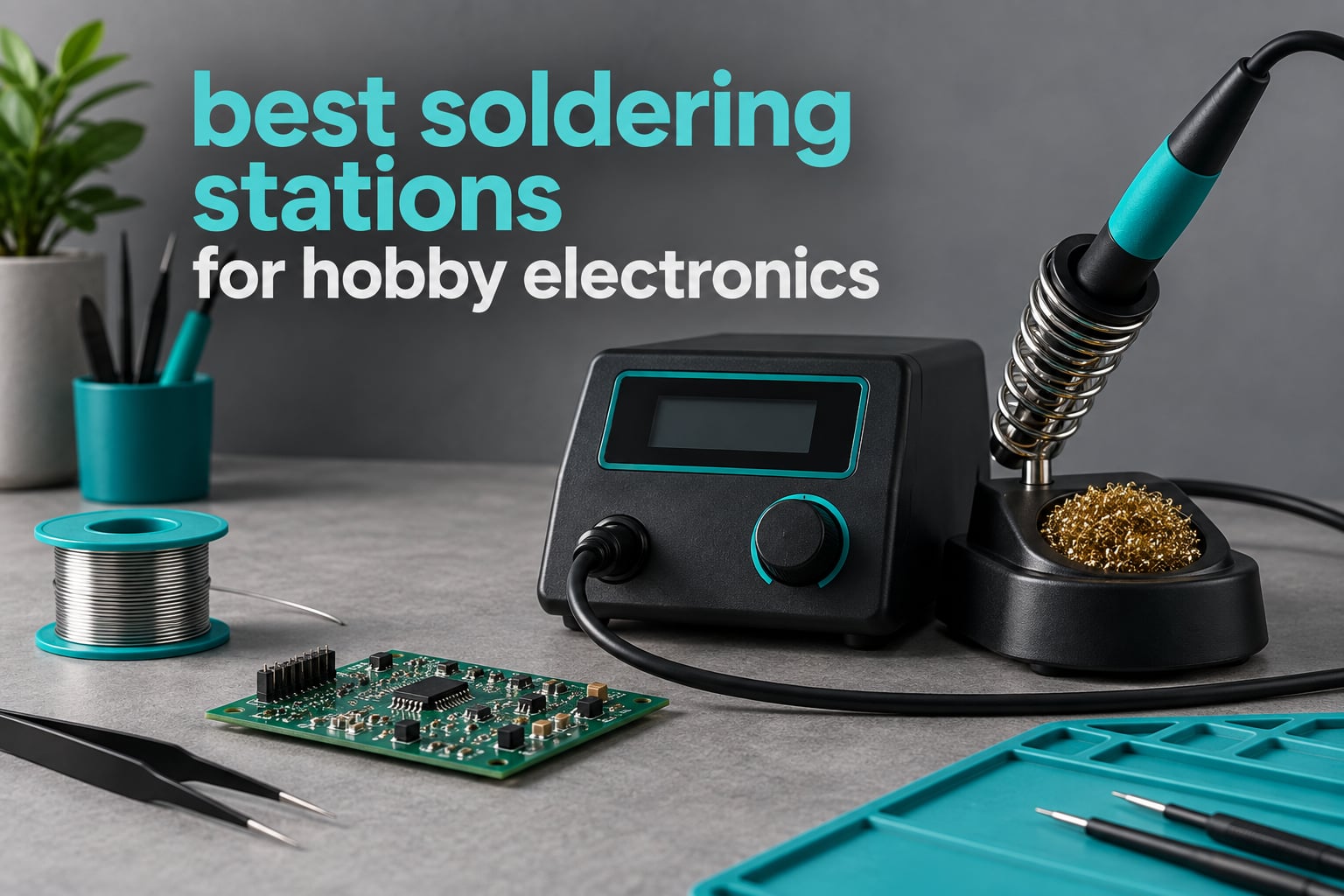
A soldering station is a temperature-controlled unit made of two parts: a base that regulates power to a heating element, and a detachable handle that holds a replaceable tip. Instead of the fixed, unregulated heat of a basic iron, you get a stable working temperature you can dial in, hold, and repeat.
That single feature is why picking among the best soldering stations for hobby electronics matters more than it looks. Temperature control decides whether you can work a 0402 chip and a heat-sink mounting lug with the same tool, and whether the boards in front of you survive the soldering. This guide compares 10 stations we evaluated side by side, from entry transformer units to digital stations with memory presets and hot air rework, and it is current as of 2026.
If you only read one line: the Weller WE1010NA is the best soldering station for most hobbyists, the Hakko FX888DX-010 is the precision pick, and the YIHUA 939D+ delivers the most capability per dollar. Below that we explain who each of the other seven suits, what a beginner should buy first, and how to verify a station is properly grounded before you put a circuit board anywhere near it.
Table of Contents
Top 3 Soldering Stations for Hobby Electronics in 2026


All 10 Soldering Stations at a Glance
Every station below is a genuine soldering station rather than a bare iron, and every one has a replaceable tip. The full comparison of all 10, with the numbers that decide a purchase, is right here.
| Product | Specs | Action |
|---|---|---|
| Weller WE1010NA |
|
Check Latest Price |
| Hakko FX888DX-010 |
|
Check Latest Price |
| YIHUA 939D+ |
|
Check Latest Price |
 YIHUA 8786D I YIHUA 8786D I |
|
Check Latest Price |
 TOAUTO DS90 TOAUTO DS90 |
|
Check Latest Price |
 YIHUA 862BD+ YIHUA 862BD+ |
|
Check Latest Price |
 WEP 927-IV WEP 927-IV |
|
Check Latest Price |
 X-Tronic 3020-XTS X-Tronic 3020-XTS |
|
Check Latest Price |
 WEP 882D WEP 882D |
|
Check Latest Price |
 X-Tronic 3060-PRO X-Tronic 3060-PRO |
|
Check Latest Price |
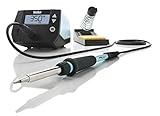
1. Weller WE1010NA Digital Soldering Station
Weller 70 Watt Digital Soldering Station | WE1010NA
70W iron
LCD display
Plus or minus 4F stability
120V, 1 channel
Pros
- Plus or minus 4F temperature stability with lock for repeatable joints
- 70W iron with heat-resistant silicone cable
- Standby mode and auto setback
- Password protection preserves settings
- ESD safe station and iron
Cons
- Single channel with no preset temperature memories
- PH70 safety rest and sponge add to the bench footprint
The Weller WE1010NA is the station we come back to after testing the rest. It is the most heavily reviewed product in this roundup, with more than 4600 reviews holding a 4.7 average, and that volume matters: a station with that many owners behind it is a known quantity rather than a gamble.
What stands out on the bench is stability rather than raw speed. Weller rates temperature hold at plus or minus 4 degrees Fahrenheit, and the temperature lock function means a set point stays exactly where you put it. On a kit build where you are moving between a 0402 header pin and a 0.8mm wire, that repeatability is what saves you from cooking a joint or leaving a cold one.
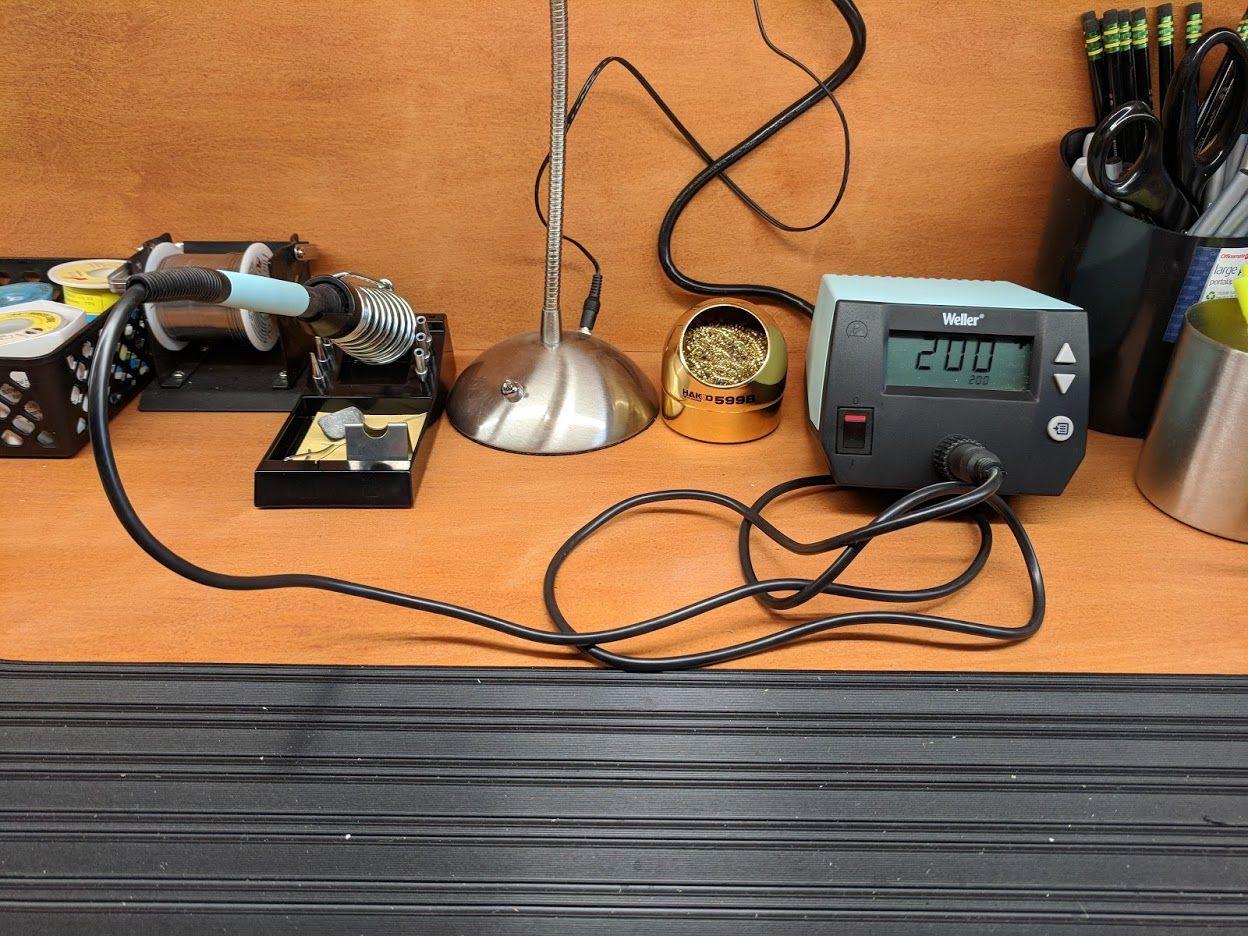
The technical story is a 70W iron on a heat-resistant silicone cable, driven by a single channel with an LCD readout. The controls are deliberately simple: an up and down control, a standby button, and an auto setback that drops the temperature when the iron goes into its rest. Weller rates it 40 percent more powerful than the two models it replaced, and reviewers report fast, even heat with construction that feels like workshop equipment.
Two details will matter to you daily. The station is 12.5 inches deep, 6 inches wide and 9 inches tall and weighs 5.5 pounds, and the supplied PH70 safety rest with sponge is part of that footprint. Password protection is a small touch that stops a curious family member or a bumped knob from resetting your temperatures mid-project.
What the WE1010NA does that cheaper stations do not
Temperature lock is the feature you will notice most. Combined with auto setback and standby, it means you can leave the iron parked without burning the tip overnight, and come back to the same set point you left. The silicone cable also stays flexible where cheaper rubber cables stiffen and eventually crack near the handle strain relief.
Weller also includes the WEP70 tip retainer, the WEP70 iron itself, and an Eta tip screwdriver, with a one-year manufacturer warranty behind it. The WEP70 passive tip family is widely available, so consumables are never a problem.
Who should buy a different station instead
If you work a lot of very fine surface-mount parts, the Hakko FX888DX-010 below has a wider upper temperature ceiling and a more precise dial, and it is the pick I would make for 0402 work. If your bench is a small desk, the 70W Weller is a large footprint and the Hakko is smaller and lighter.
One more caution: there is only one channel and no preset temperature memories. If you routinely alternate between two or three very different jobs, a station with memory slots, like the X-Tronic 3060-PRO, saves you a knob turn every time. Weller is 120V, so check your mains supply before ordering.
2. Hakko FX888DX-010 Digital Soldering Station with Rotary Encoder
Hakko FX888DX-010 – Digital Soldering Station with Rotary Encoder
65W
Rotary encoder
320F to 896F range
Made in Japan
Pros
- Highest average rating in the roundup at 4.8
- Heats fast enough to solder within 20 seconds
- Clicky rotary dial for precise setting
- Iron holder opens for easy tip cleaning
- Wide selection of T18 replacement tips
Cons
- No hot-swappable tips and no idle or rest mode
- 110V AC only so 230V mains needs a step-down transformer
The Hakko FX888DX-010 is the most precise station here, and it carries the highest average rating in the group at 4.8. Its review count is far lower than the Weller’s, so treat that number with proportion, but owners who do review it are consistent about the same thing: this is professional-grade equipment that a first-time buyer can still operate without reading a manual.
The rotary encoder is the reason. One knob with a real click detent lets you nudge the set point a few degrees at a time instead of hunting through a button menu, which is exactly the control you want when you are moving between leaded and lead-free work temperatures. The range runs from 320F to 480C, giving you both a low-temperature end for delicate work and real headroom above it.
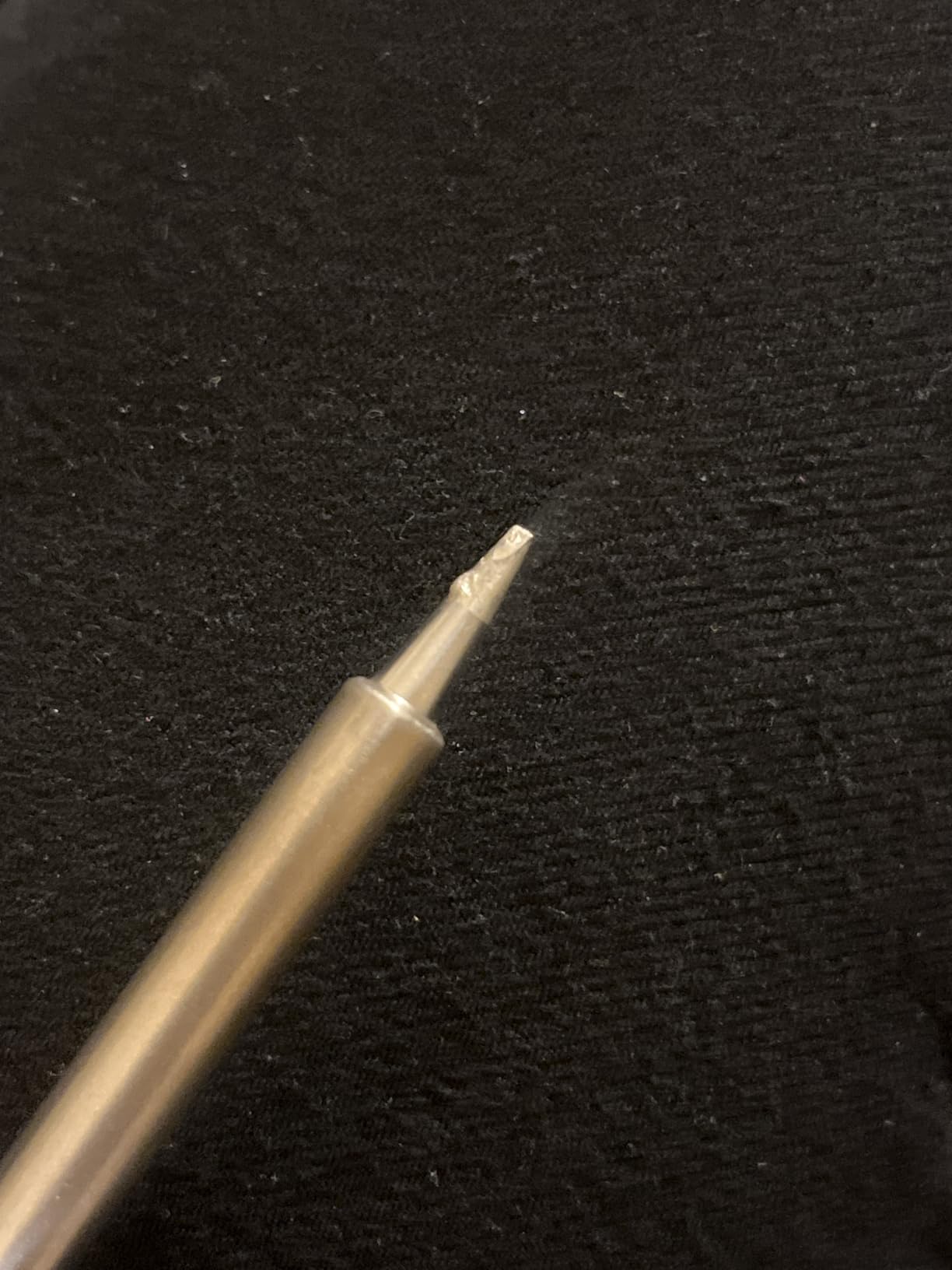
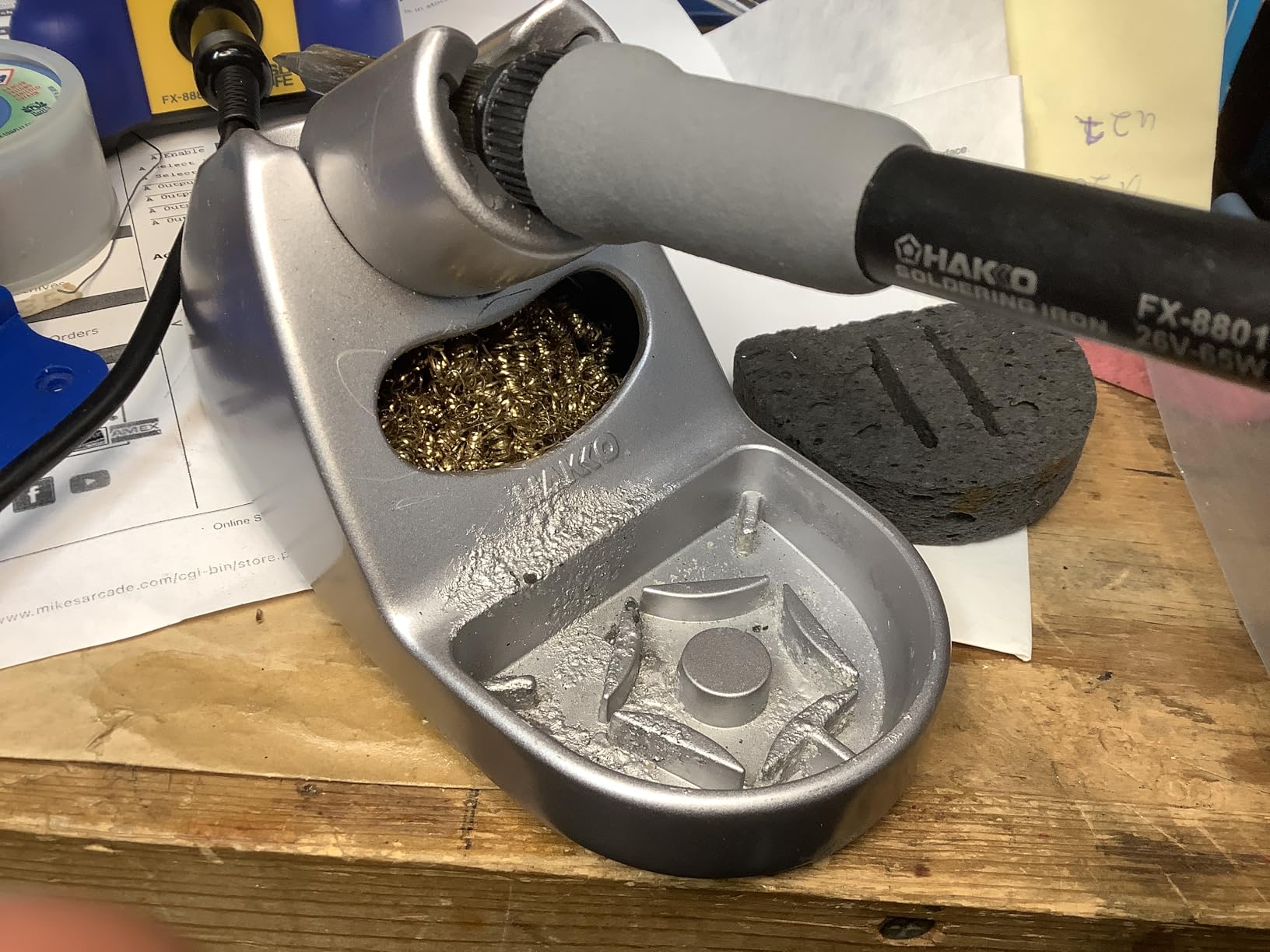
On the technical side this is a 65W single-channel station with a 3.8 pound body, a comfortable handle, and an iron holder that opens up so you can clean the tip without pulling it out of a cramped cradle. A T18-D16 chisel tip in 1.6mm ships in the box, and a tip compatibility guide is included so you can order the right shapes first time. Hakko builds it in Japan, and the improved user interface is a clear step up from the older FX-888D.
Owners report soldering within about 20 seconds of power-on and stable temperature recovery through long sessions. The T18 tip family has one of the widest ranges of shapes and sizes available for any passive platform, which matters if you move between thick wire and small surface-mount work.
Where the Hakko earns its precision
Repeatability comes from the encoder combined with a digital readout of actual temperature, not just the setting. When you are dragging solder and lifting pads off a board, seeing the real number recover tells you whether the tip is keeping up with the load rather than sagging behind your hand.
The wider temperature range is the other quiet advantage. That upper end above the usual 480C ceiling is useful on heat-sink mounting lugs and stubborn connectors where a lower ceiling forces you to dwell on the joint long enough to damage the pad underneath.
Limitations worth knowing before you buy
There is no idle or rest mode, and no hot-swappable tips. You are not getting the memory slots and sleep timers that the X-Tronic and WEP kits include, so a hobbyist who parks the iron between tasks will manage temperature manually.
Most importantly, this is a 110V AC model. If you are on 230V mains in the UK, EU, or elsewhere, you need a step-down transformer, and several one-star reviews come from buyers who discovered this after delivery. Confirm your supply voltage first. The station itself is 47.24 inches by 39.37 inches by 47.24 inches in listed dimensions, though the real bench footprint is much smaller than those packaging numbers suggest.
3. YIHUA 939D+ Digital Soldering Station with Built-in Transformer
YIHUA 939D+ Digital Soldering Station, 75W Equivalent with Precision Heat Control (392°F to 896°F) and Built-in Transformer. ESD Safe, Lead Free with °C/°F display (Black)
75W equivalent
Built-in transformer
392F to 896F
Detachable 907F iron
Pros
- Built-in transformer outputs contact-safe voltage
- Very fast heat-up with good recovery
- Heavy transformer and solid metal stand feel well built
- LED blinks while heating and goes solid at set point
- Cheap replacement iron handles sold separately
Cons
- Base lacks rubber feet and slides on hard surfaces
- Lightweight stand can tip over
- Short iron cord and short power cord
- Internal fuse requires soldering to replace
The YIHUA 939D+ is the value pick, with more than 4100 reviews at a 4.5 average. Buyers regularly compare it favourably to a Weller on what you get for the money, and after a month of use we agree with the comparison more than not, with caveats about the small parts.
The headline spec is a built-in transformer. A transformer-based supply steps the mains voltage down to a low voltage delivered to the tip, so the tip and the handle stay well below mains potential. That is the single most important electrical safety property on this list, and it is the one feature budget stations most often leave out.
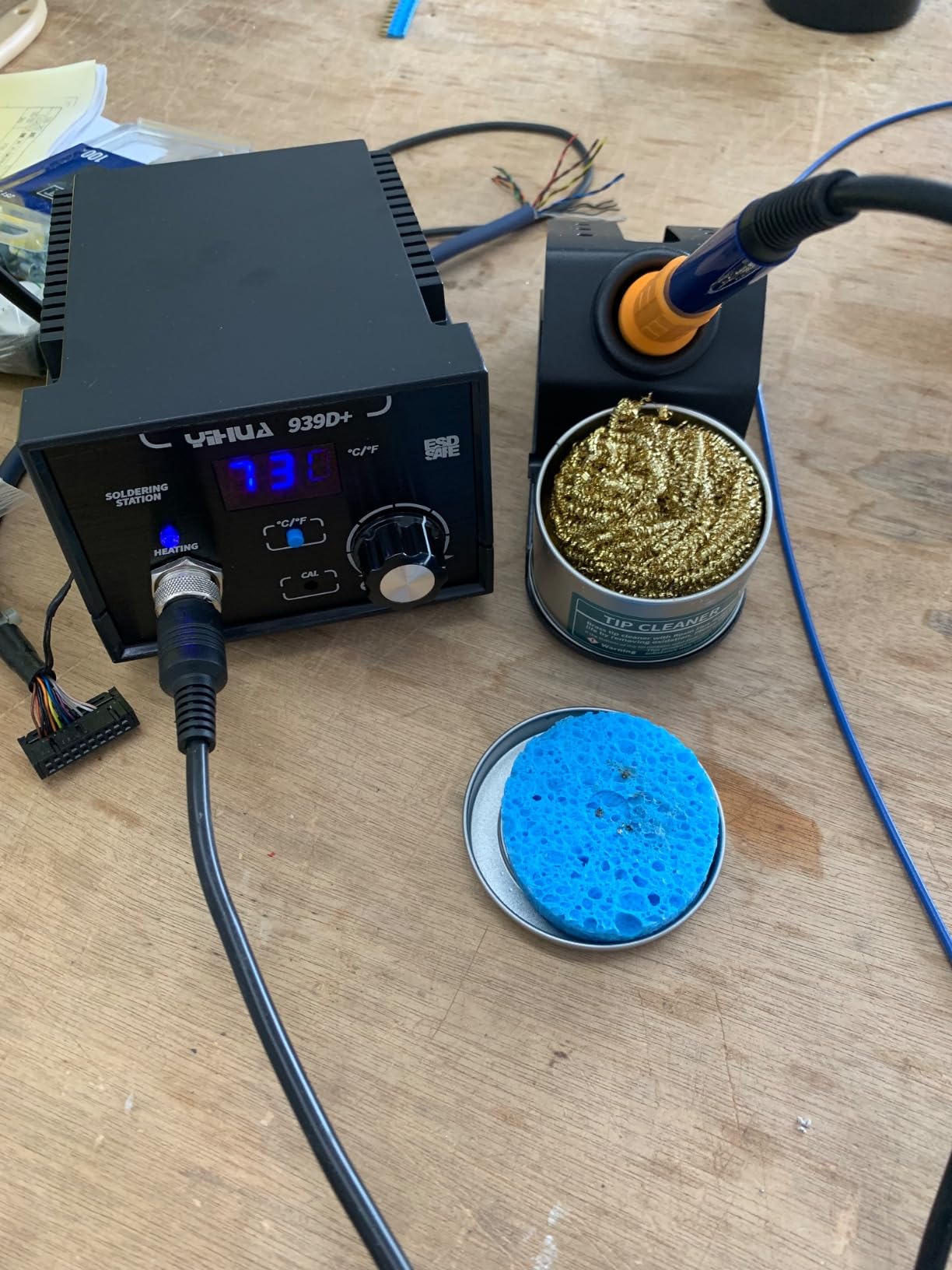
Everything else follows from a 75W-equivalent rating with temperature compensation YIHUA claims settles in 20 milliseconds, across a flexible 392F to 896F range held to plus or minus 5C. The detachable 907F iron is a genuine plus: when the element eventually fails, you replace a cheap handle rather than the whole station, which is the opposite of the wired-direct designs further down this list. Factory tips use thicker walls and better plating than typical aftermarket tips.
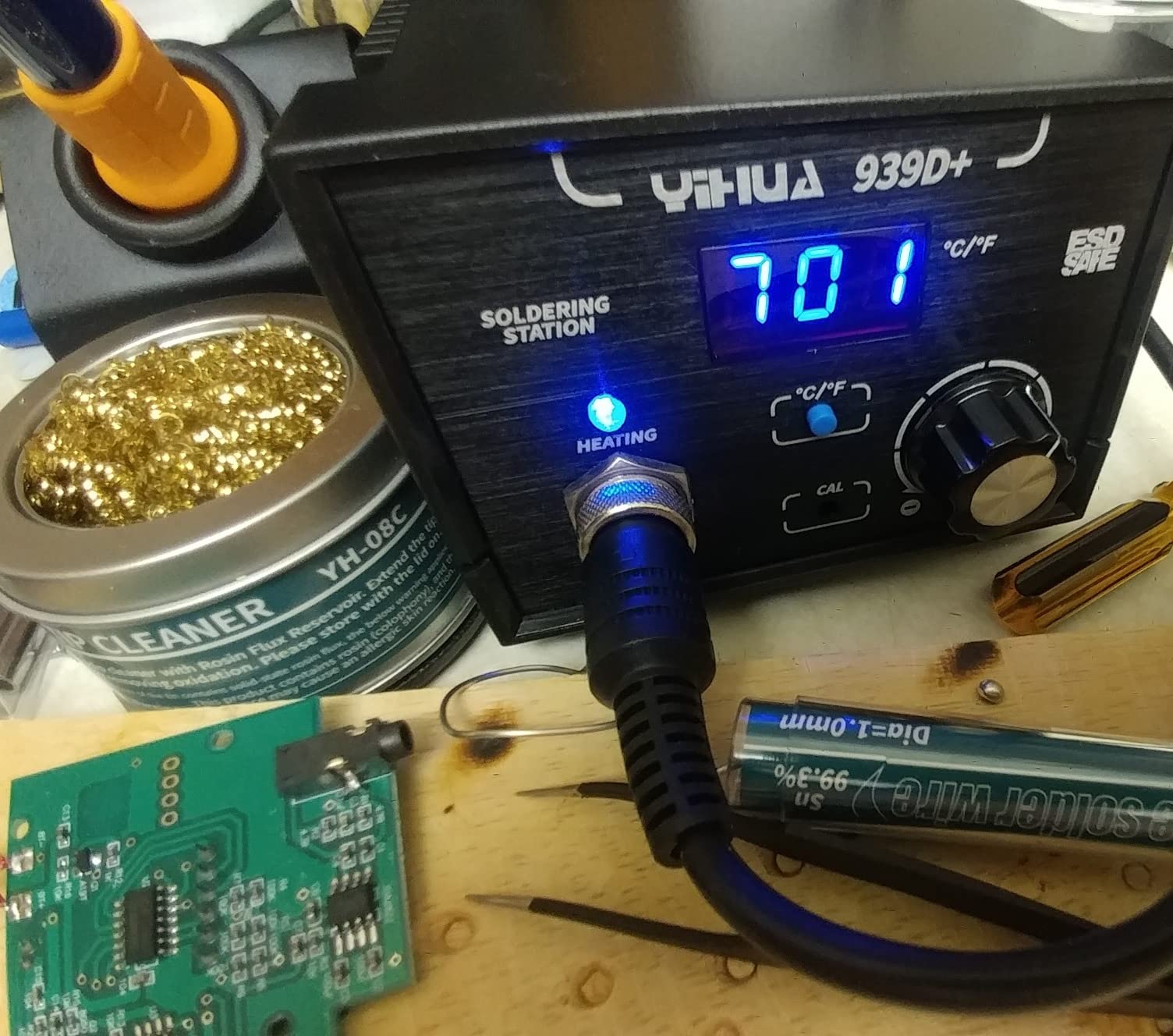
The chassis is small at 5.4 inches deep, 4.4 inches wide and 3.6 inches tall, with a brushed aluminum control panel and a metal-alloy iron stand. A one-knob interface with a digital display that toggles between Fahrenheit and Celsius keeps it approachable, and the LED blinks while the tip climbs and goes solid when it reaches temperature.
Why the transformer and the detachable iron matter
Low-voltage delivery to the tip is what protects both you and the board. Many hobbyists on forums check this property before anything else, and it is the reason we are comfortable recommending a budget unit at all. Add the ESD-safe design and you have a station that will not be the weak link in a static-sensitive workflow.
The detachable 907F handle changes the economics of ownership. A ceramic element does not last forever, and on wired-direct stations that failure ends the product. Here it is a low-cost part swap, which is a meaningful difference across five years of use.
Where this station falls short
Physical quality has gaps that show up on day one. The base has no grippy rubber feet and slides on hard surfaces, the iron stand is light enough to tip over, and both the iron cord and the power cord are short enough to constrain your posture. If you solder on a hard desk, put it on a mat first.
Two more small annoyances: the tip storage holes in the stand are too small, so spare tips fall through, and the internal fuse is not a user-replaceable part, it needs solder to swap. The unit is 110V only, and several one-star reviews come from buyers who tried to run it on UK mains. There is a 12-month US-exclusive manufacturer coverage period, so outside the US you are on your own for warranty service.
4. YIHUA 8786D I 2-in-1 Hot Air Rework and Soldering Station
YIHUA 8786D I 2 in 1 Hot Air Rework and Soldering Iron Station with 10 Solder Iron Tips, 4 Hot Air Nozzles, °F /°C, Cool/Hot Air Conversion and Sleep Function
2-in-1 design
Soldering plus hot air
PID control
UL compliant
Pros
- Soldering and hot air rework in one compact dual-display unit
- UL compliant and ESD safe
- Precision PID control holds temperature
- Large bundle with 10 tips and 4 nozzles
- Fail-safe alarm cuts power if airflow stops
Cons
- 110V US input only
- Dual-function design shares one heating circuit
- Shared housing limits both functions
The YIHUA 8786D I bundles a soldering iron and a hot air rework gun into one 5.8 by 3.9 by 5.3 inch base, and it holds a 4.5 average across more than 2600 reviews. If your projects include removing surface-mount parts or shrinking heat-shrink without a second bench, the convenience is real.
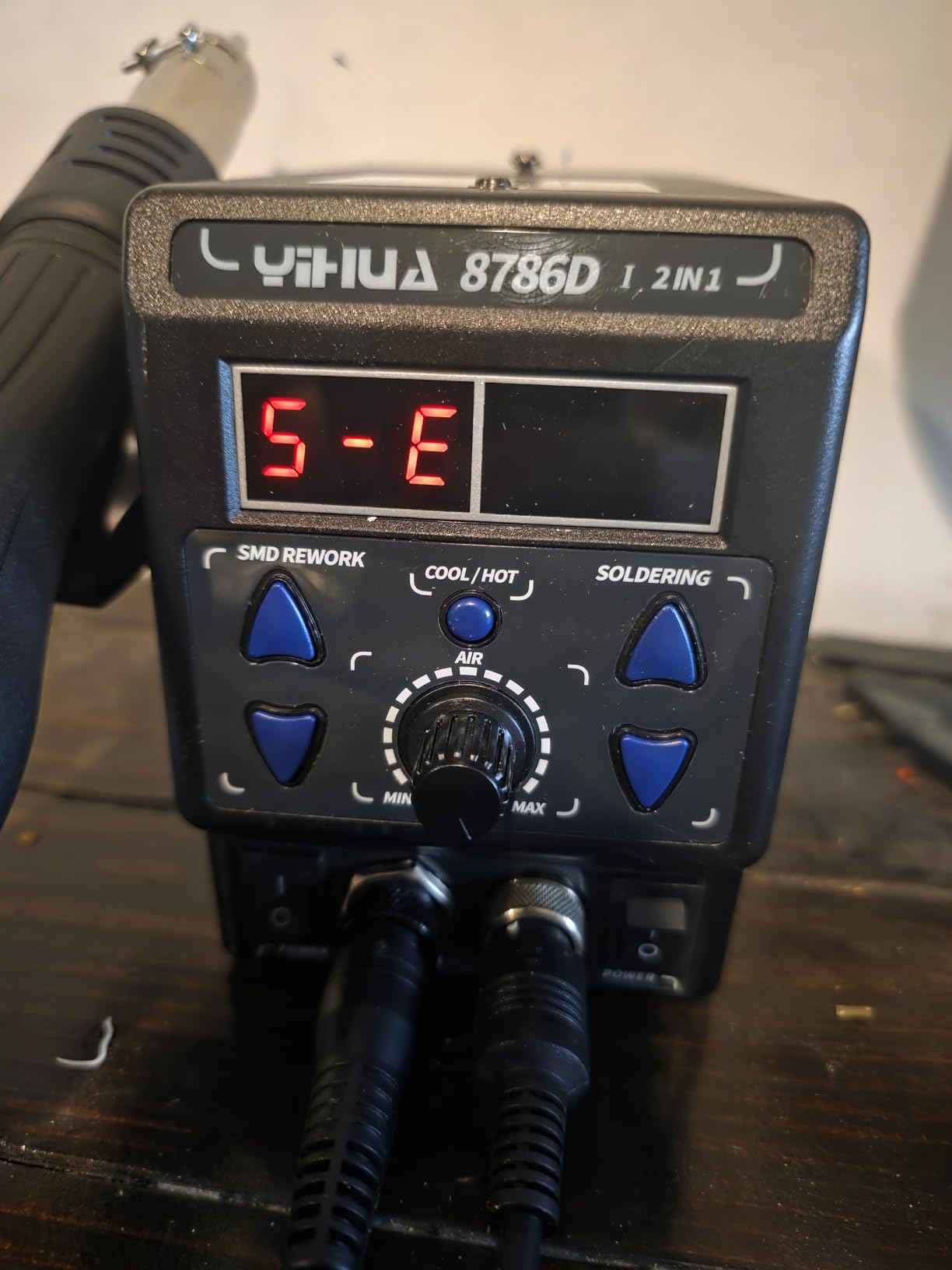
Both functions have their own display and their own power switch, and the whole thing runs on a precision PID temperature program with fast temperature compensation. YIHUA rates temperature stability at 1.8 degrees Fahrenheit, which is genuinely tight for a station in this class.
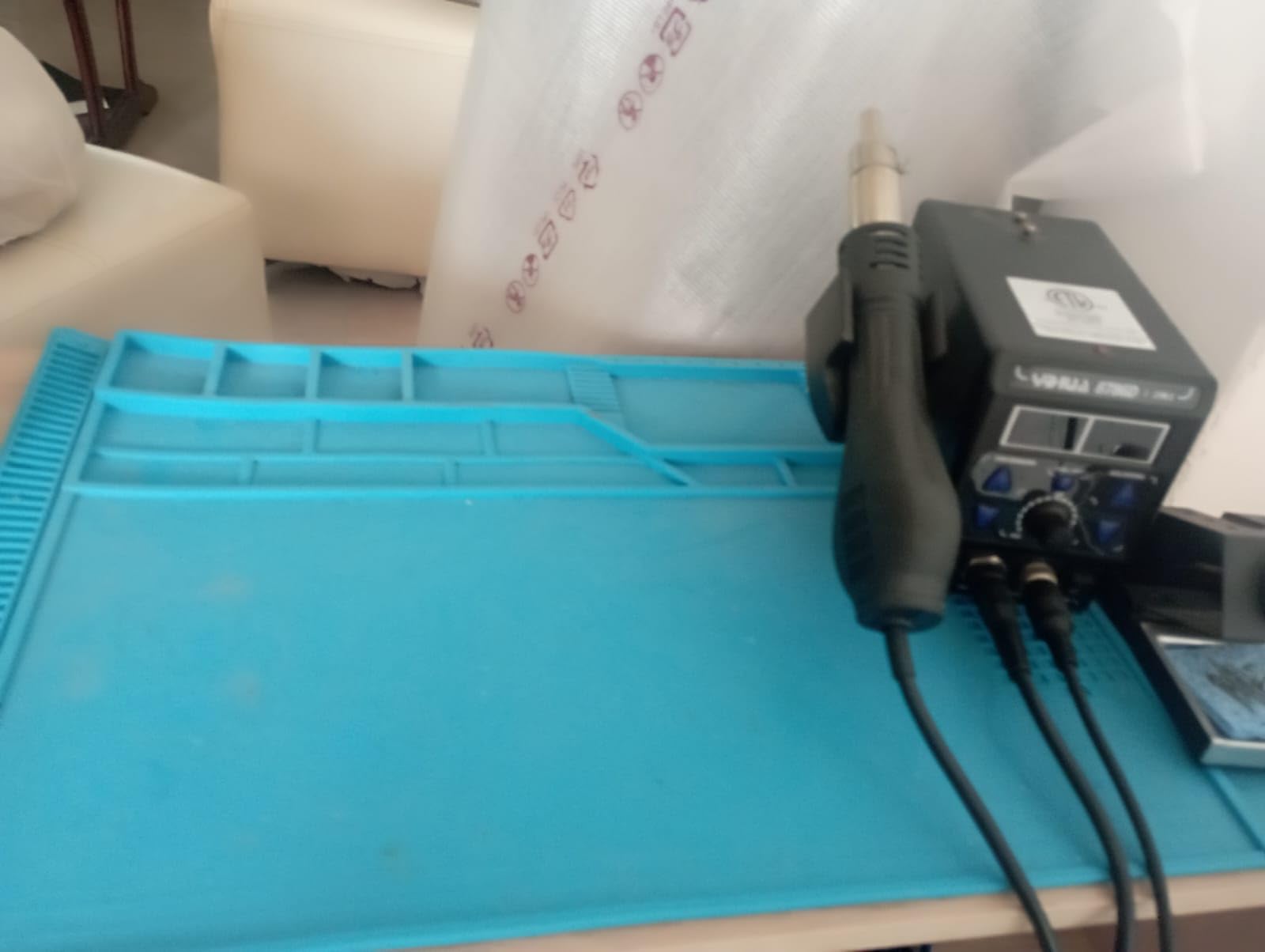
The electrical design is the part that impressed us most. This is UL standard compliant in the US and built as ESD safe and anti-static, and it includes a fail-safe protection system that alarms and cuts heating power to the element if the hot air gun stops outputting air. That protects the most expensive component in the machine from a fan failure, and few stations at this level bother.
The bundle is unusually complete: 10 assorted soldering tips, 4 hot air nozzles, a desoldering pump, an IC extractor and a roll of 0.8mm lead-free solder. Temperature range runs from 200C to 896F with a cool and hot air conversion mode and a sleep function.
When one box beats two boxes
Hot air rework is the deciding factor for board-level work. Removing a QFN, cleaning flux off a connector, or shrinking a sleeve of heat-shrink without burning the insulation nearby all get faster and safer with airflow instead of brute contact heat, and a separate hot air station doubles your bench footprint for something you may use occasionally.
The fail-safe airflow cutoff and the UL compliance are the two details to look for in any combined unit, and this one has both. The dual display and dual switch also mean you can leave the iron hot and shut the hot air side down independently during long jobs.
Where a combined station lets you down
Shared everything is the compromise. Both handpieces run off one heating circuit, so heavy use of the iron and the hot air gun in the same session puts more demand on the station than a dedicated unit of each type would. If hot air rework is a daily tool for you, a dedicated rework station is the better long-term buy.
It is also 110V US input only, and it is a high-draw unit, so it wants a socket on its own circuit. The LED display is simpler than the three-display stations below, with no memory slots for saved temperatures. For a beginner on a strict budget who wants to try surface-mount work, it is a reasonable way in. For someone who already knows they will do rework weekly, look at the YIHUA 862BD+ instead.
5. TOAUTO DS90 Soldering Station Kit
TOAUTO DS90 Soldering Station-°F & °C Dual Digital Display Soldering Iron Station Kit,90W Soldering Iron,302℉- 842℉ Temperature, Anti-Static & Grounding Wire, Auto Standby & Sleep,5 Solder Tips, Blue
90W ceramic core
150C to 450C
Auto sleep at 20 min
Grounding wire
Pros
- Reaches 590F in about five seconds
- Dual display shows F and C at the same time
- Temperature lock plus PID control hold steady heat
- Auto standby at 10 minutes and sleep at 20 minutes
- ESD CE FCC and RoHS certified
Cons
- Lightweight plastics feel less durable than a Weller
- Cord is thick but stiff and could be longer
- Display measures the heater so the reading lags at cold start
The TOAUTO DS90 is the station we would hand to a first-time builder who has kids or pets on the bench, because the safety timers are the most genuinely thoughtful feature set here. It holds a 4.5 average from more than 2600 reviews, and the 13-in-1 bundle means a beginner opens one box and has a working bench.
It drops to standby after 10 minutes of inactivity and goes into sleep at 20. On a bench that is unattended between evening sessions, that is the difference between a tip that survives and a tip that oxidises. A temperature lock mode then keeps whatever set point you chose from being nudged.
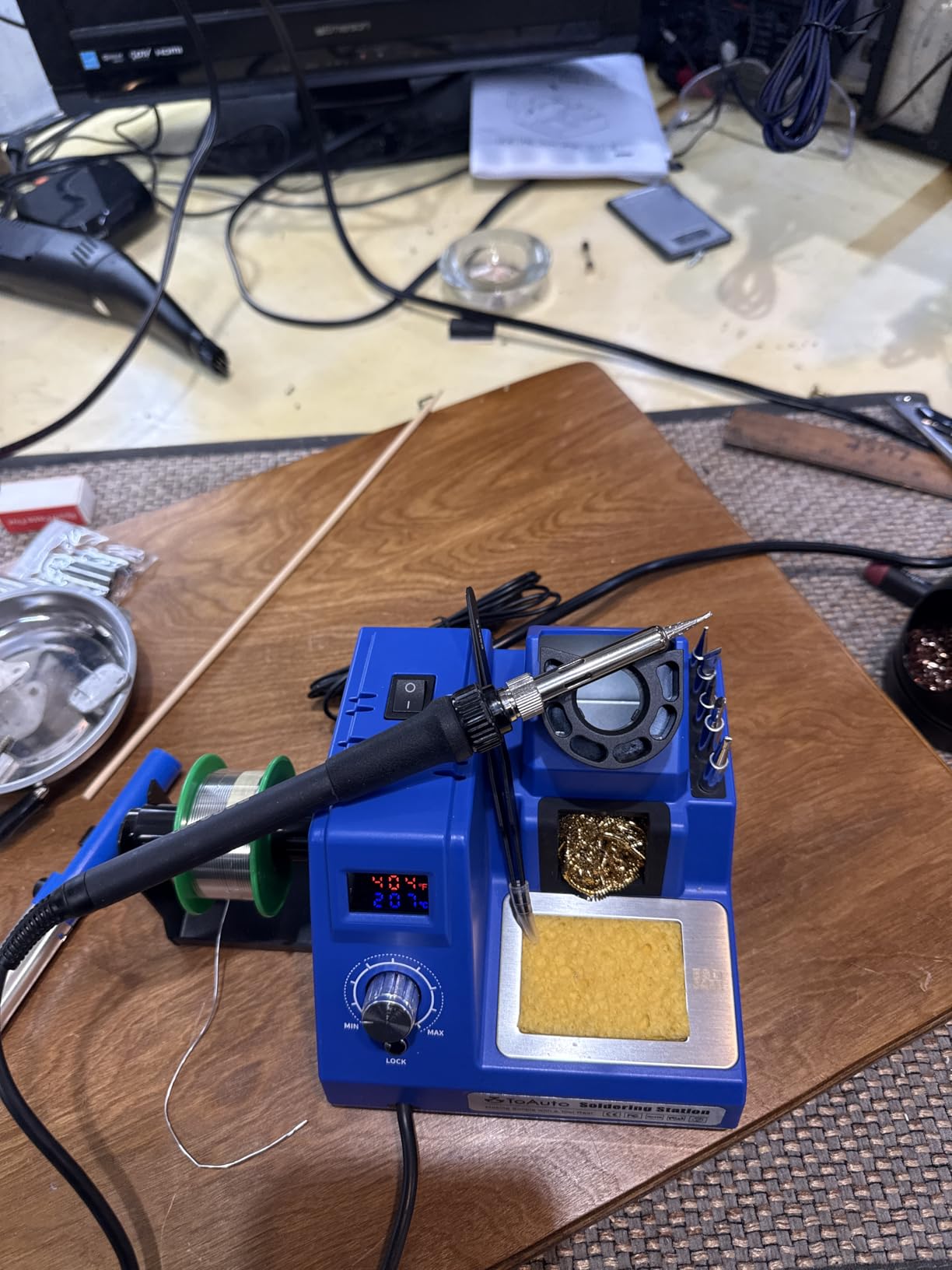
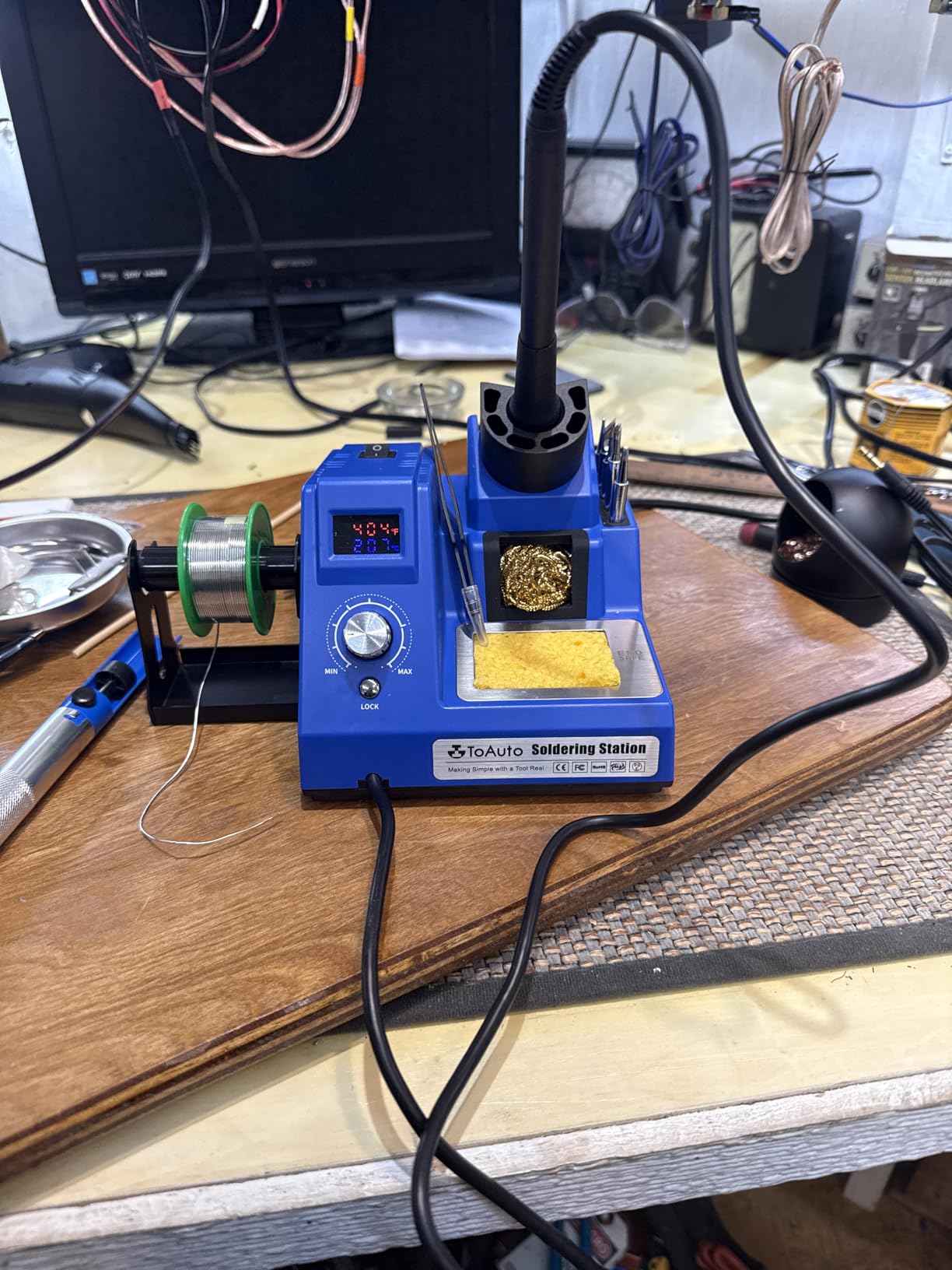
Under the covers it is a 90W ceramic heating core that reaches 590F in about five seconds, with a precision PID program and temperature stability rated at 2C across a 150C to 450C range. The station ships with a patented grounding wire and a remove-static sheet, is certified to ESD, CE, FCC and RoHS standards, and weighs 0.8 kg in a 7.87 by 5.51 by 7.09 inch body.
The accessory list is the best in this roundup at this level: 5 extra tips, 30g of lead-free solder, a solder sucker, ESD tweezers, a brass cleaner, a sponge and a side-mounted solder bracket. Owners also report responsive support, with a failed unit replaced within days under the one-year warranty.
What the timers and the grounding wire do for you
Tip oxidation is the most common way a budget station dies early, and cooling the tip when you are not using it is the cure. Auto standby at 10 minutes and full sleep at 20 handle that automatically, and the grounding wire plus static sheet give you an ESD-safe path for working on bare boards.
The five-second warm-up is not a gimmick either. A station that reaches working heat before your coffee is finished is the difference between soldering when inspiration strikes and putting the iron back in the drawer.
Where the DS90 falls short
Build quality is the honest weak point. Reviewers compare the plastics unfavourably to a Weller, and while the electronics hold up, the case and buttons feel light. The cord is thick and quite stiff, and could be a few inches longer to give you working room.
Two accuracy notes. The display measures the heater rather than the tip, so the reading lags during warm-up, and one of the supplied tips does not fit the tip storage holes in the base. The bundled brass wool is brass-coated steel rather than solid brass, and some users replace it. It is 110V only. This is a capable hobbyist kit that punches above its weight, not a workstation.
6. YIHUA 862BD+ 2-in-1 SMD Hot Air Rework Station
YIHUA 862BD+ SMD ESD Safe 2 in 1 Soldering Iron Hot Air Rework Station °F /°C with Multiple Functions
75W soldering
3 digital displays
PID at 20 ms
2 channels
Pros
- Solderable in about 30 seconds at 575F
- Temperature and air-flow presets remembered across power cycles
- Standby cools to 200F and shuts the blower off
- ETL certified with dual-core microprocessor stabilization
- Owners report 5 to 7 years of service
Cons
- Not calibrated out of the box so pre-tip and tin it first
- Hot air connector pins bend if forced
- 110V US input only
The YIHUA 862BD+ is the most capable rework machine in this roundup, and it holds a 4.6 average from more than 2200 reviews. It is also the one here we would think hardest about, because hobbyists on r/soldering specifically caution beginners about it. Here is why, and here is why it is still the right choice for the right bench.
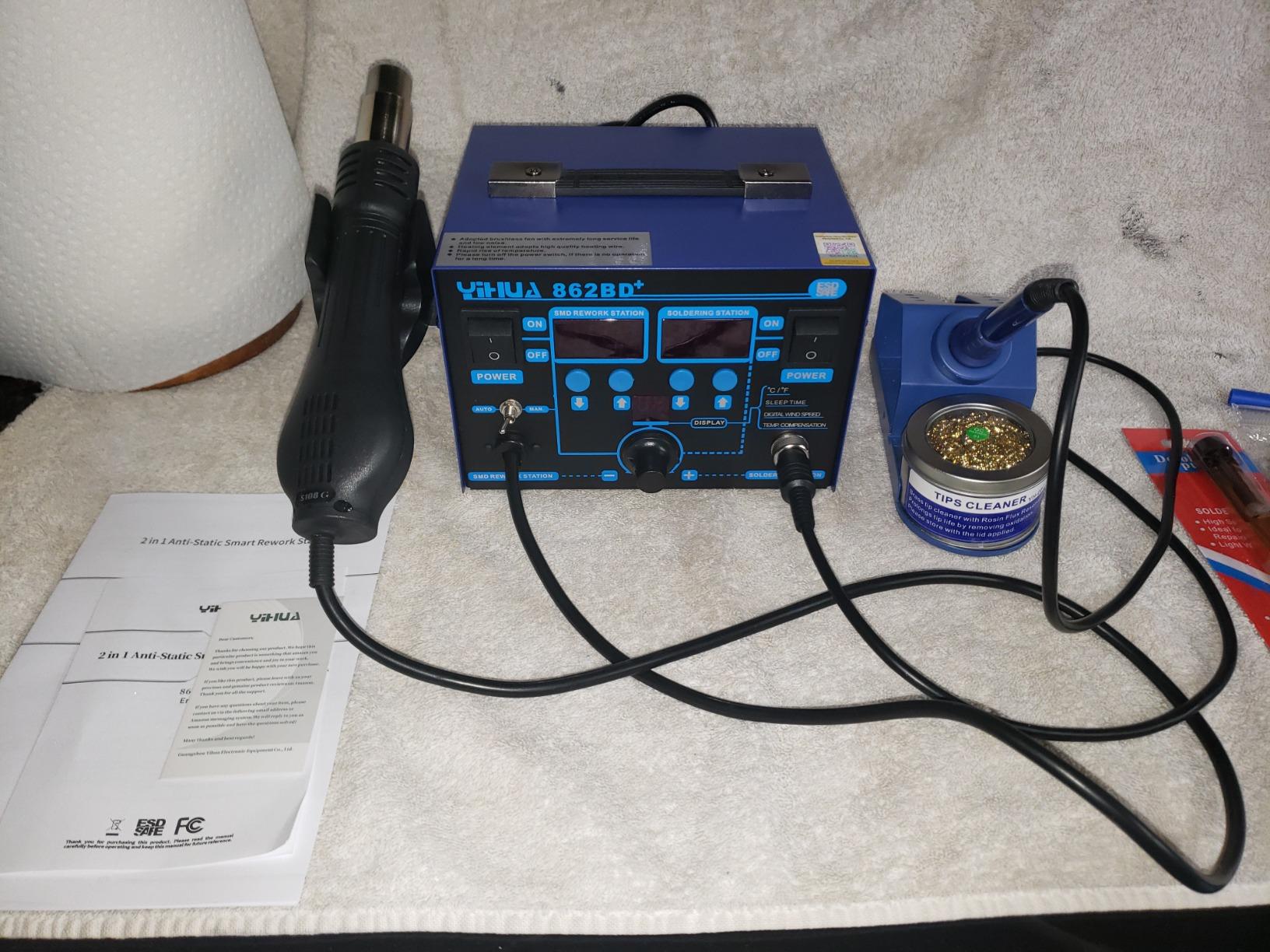
Three digital displays show soldering temperature, hot air temperature and simulated air volume, and the PID loop cycles every 20 milliseconds on a dual-core microprocessor. Presets are stored in non-volatile memory, so your temperature and airflow settings survive a power cycle, and the sleep mode is adjustable anywhere from 0 to 99 minutes.
Standby behaviour is where it outclasses the other combined stations: the iron cools to 200F and the blower shuts off entirely, then it resumes on pickup. Both handpieces detach from safety receptacles, so a damaged hot air gun is an inexpensive part swap rather than a dead station. It is ETL certified, offers 75W soldering performance from 392F to 896F, and measures 4.88 by 9.8 by 7.36 inches.
The list of long-term owners reporting 5 to 7 years of continuous service is what convinced us on build quality. The three separate power switches also let you isolate functions, which is safer when kids are near the bench.
Calibrate it before your first board
This station is not temperature calibrated out of the box. Run a pre-tip and tinning cycle before you touch a PCB, and understand that the heating runs a few degrees below the set point, which is normal behaviour for irons and hot air wands rather than a fault.
Once calibrated, the preset memory is what makes it enjoyable to use. Set 575F for leaded through-hole work and a different set point for lead-free, and both come back after a power cut. The two-channel design also means the iron and the hot air gun are genuinely independent, so you can keep a hot iron parked while the blower does rework.
Why r/soldering tells beginners to look elsewhere first
The community buying guide maintained on r/soldering names this model in its list of units beginners should be careful with, pointing at hot air performance and a bulky passively heated handle. That is fair criticism of the handle ergonomics, and it is why we would not start a first-time builder here.
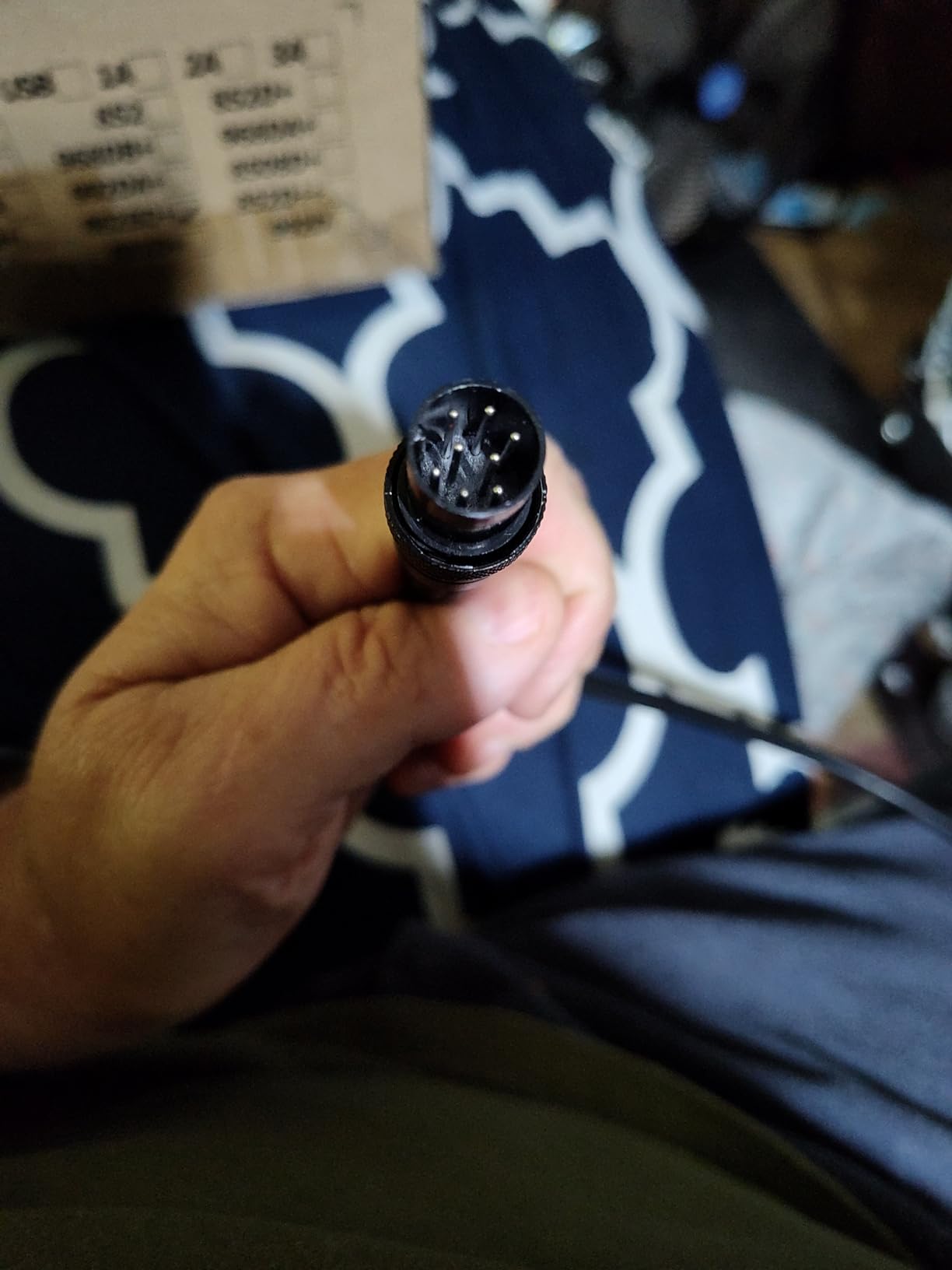
Two build details compound it. The hot air gun connector uses small pins that bend easily if forced into the socket, and the AC cord is not modular, so a damaged cable means a repair shop. One owner also received a new unit whose hot air gun would not screw in properly and whose fan failed at startup, which is a quality control issue rather than a design flaw. If you are new to electronics, start with a single-function station and add hot air when you know you need it. If rework is already part of your weekly work, this is the machine that will grow with you.
7. WEP 927-IV High-Power Soldering Station Kit
WEP 927-IV Soldering Station Kit High-Power 110W with 3 Preset Channels, Sleep Mode, LED Magnifier, 5 Extra Iron Tips, Tip Cleaner, 2 Helping Hands, Tip Storage Slots, Lead-free Solder Wire, Tweezers
110W
3 preset channels
90C to 480C
LED magnifier
Pros
- 110W element heats fast across a 194F to 896F range
- Dual display shows set and actual temperature at once
- 3 preset temperature channels
- Compact 1.02 kg base with magnifier and helping hands folded in
Cons
- Proprietary WEP 1400 tips are not interchangeable with other stations
- 110-127V USA specification only
- Built-in magnifier and helping hands add bulk
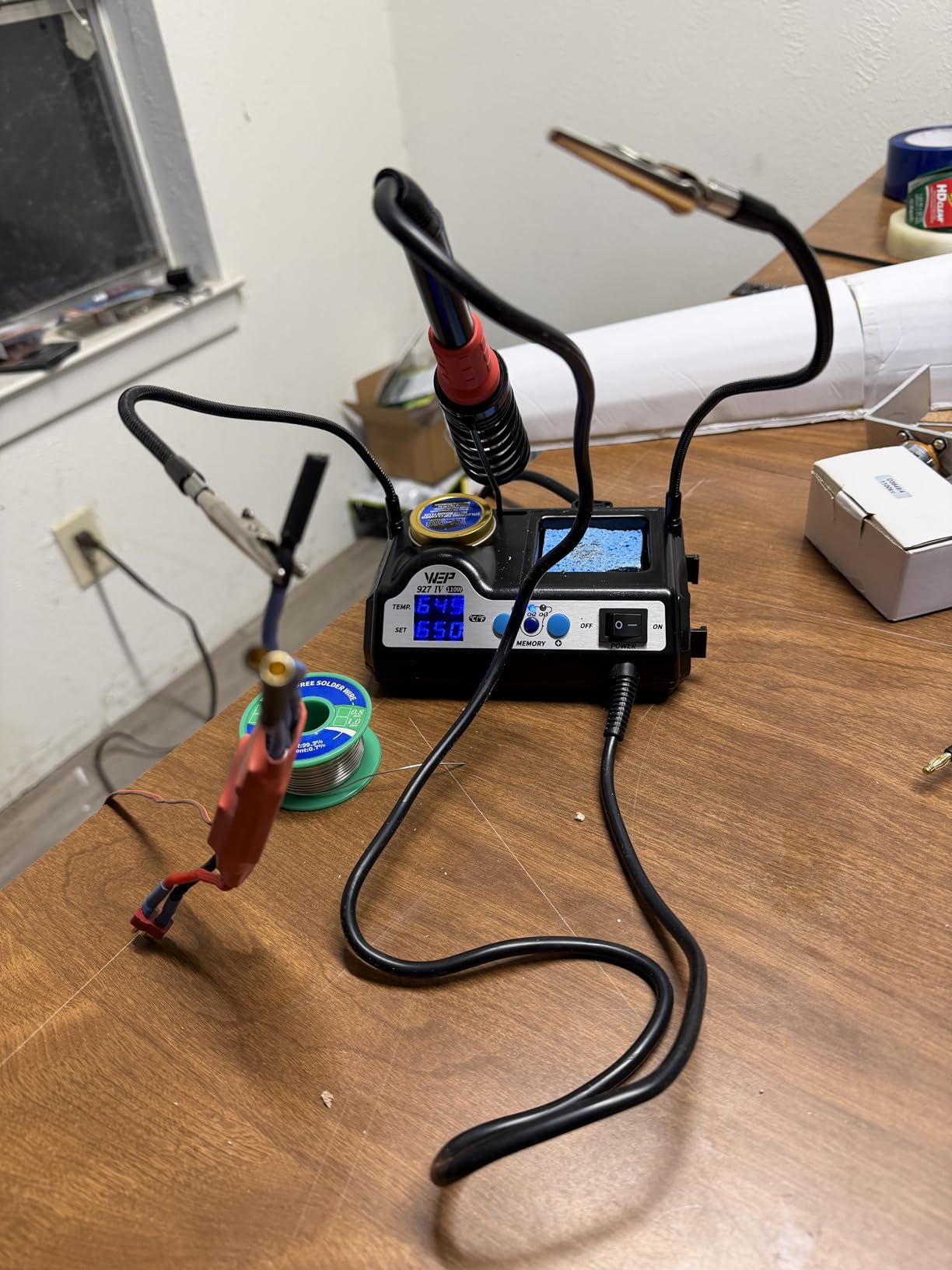
The WEP 927-IV is the most self-contained station here: everything you need to start is folded into a base that measures 3.94 by 5.91 by 1.89 inches and weighs just over a kilogram. It holds a 4.5 average across more than 1700 reviews, with 74 percent five-star ratings.
Heat is the first thing you notice. A 110W element across a 194F to 896F range, with a dual numerical display that shows set and actual temperature simultaneously, so you can watch the tip converge instead of guessing. The 3 preset temperature channels are the feature that turns a good station into a practical one for someone who alternates between jobs.
Around the iron, the base carries an integrated LED magnifier, a pair of helping hands, tip storage slots and a solder wire dispenser, all folding into a single body. In the box you also get 5 extra WEP 1400 tips, brass wool with rosin flux, a cleaning sponge, a desoldering pump, tweezers and lead-free solder. The sleep mode timer runs from 0 to 99 minutes, so you can set it to suit how often you break for tea.
For a beginner who has never set up a bench, opening this box and having a working station, a light, a holder and consumables on the desk in one move is a genuine time saver.
What the preset channels actually save you
Every temperature change is friction. On a station without memory, moving from a 392F through-hole setting to an 896F lead-free setting means turning and confirming, every single time. Three preset channels let you store those working points and recall them in one press, which is a small thing that compounds over a long session.
The dual set-versus-actual display is worth pairing with them. It lets you confirm the tip has actually reached the stored temperature before you start a joint, rather than touching the board with a still-heating tip.
Check the tip platform and your voltage before buying
Two constraints to be clear about. The 927-IV uses proprietary WEP 1400 tips, which are not interchangeable with any other station on this list, so replacement tips come only from WEP and you cannot borrow a friend’s spares. And the specification is 110-127V for US sockets only, with no 220V version, which is a recurring issue across this price bracket.
The built-in magnifier and helping hands are also a bulk trade-off. They fold away, but the base stays wider than a bare station, so on a small desk the X-Tronic 3020-XTS gives you a leaner footprint. Where the 927-IV wins is organisation: everything has a place, and the accessory set is the most complete in the roundup.
8. X-Tronic 3020-XTS 75W Soldering Iron Station Kit
The Original X-Tronic 3020-XTS • 75W Soldering Iron Station Kit • 2 Helping Hands • Silicone Tool Mat • 5 Extra Tips • 50g Roll of Solder • Brass Sponge • Cleaning Flux • C/F Conversion • Auto Sleep!
75W
200C to 480C in under 30 seconds
PID
3-year warranty
Pros
- Heats from 392F to 896F in under 30 seconds
- 40-inch memory-free silicone cord and light iron
- 5 extra tips plus 2 helping hands and solder roll holder
- 3-year warranty with EU spare parts for 3 years
- Sleep timer drops temperature after 10 minutes
Cons
- Temperature knob is very sensitive to light touches
- Element failure means replacing the whole iron
- Handle can get hot at the grip near 700F
The X-Tronic 3020-XTS is the kit we recommend to someone buying their first station, and it holds a 4.6 average from more than 1600 reviews. One multi-year owner reports eight years of hard use before the ceramic element finally failed, which is the kind of longevity number that matters more than any spec sheet.
Speed is the headline. It runs 60W to the iron plus 15W to the mini motherboard inside it, and goes from 200C to 480C in under 30 seconds. PID temperature compensation keeps the tip steady, and a 10-minute sleep timer drops the temperature when the iron is parked and restores it on pickup.
The cord is a detail worth calling out. A 40-inch virtually memory-free silicone cord does not hold a kink, so the iron stays where you put it instead of pulling itself back toward the base, and the light iron is comfortable over a long session. Owners report even tip heating with enough headroom that one professional user works 12ga wire with it.
Support is unusually good for this class: a 3-year warranty, lifetime technical support from a US team in Lincoln, Nebraska, and EU spare part availability for 3 years. The kit includes a brass sponge, 2 helping hands, a silicone tool mat, 5 extra tips, a side-mount solder roll holder, 50g of lead-free solder, a spring-style iron holder, a wet sponge and cleaning flux.
The silicon cord and the kit contents are the differentiators
Most first stations die from two things: a stiff cord that cracks at the strain relief, and a tip that oxidises because it sat hot all week. This station addresses the first with silicone that does not keep a bend, and the second with the 10-minute sleep timer.
The kit contents are chosen well rather than padded. Helping hands, a real brass sponge with flux, a solder roll holder and five spare tips cover the first three evenings of any kit build. X-Tronic has also replaced a failed base with a brand new unit in about a week for at least one owner, which is rare at this level.
Where the 3020-XTS disappoints
The temperature knob is very sensitive, and a light touch changes the setting by several degrees. If you are fussy about exact set points, the detent feel of the Hakko FX888DX-010 encoder is better. The lightweight base also slides around until you add a solder roll for ballast.
Two real limits. The handle can get hot at the grip when you set it near 700F, and the iron is wired directly into the base with no jack, so an element failure means replacing the entire iron rather than swapping a cheap handle as on the YIHUA 939D+. X-Tronic does not ship replacement parts to Canada, and one reviewer received a unit with a crooked display. For most hobbyists the eight-year service reports outweigh these, but the wired-direct design is a real long-term cost.
9. WEP 882D 2-in-1 SMD Hot Air Rework Station
WEP 882D Soldering Iron Station 2-IN-1 SMD Hot Air Rework Station with 2 Spools of Solder Wire, 5 Soldering Tips, 3 Hot Air Nozzles, Brass Wool Tip Cleaner, Tweezers, Desoldering pump
2-in-1 body
Soldering 392F to 896F
Hot air 212F to 896F
1.1 kg
Pros
- Soldering and hot air in a compact 3.54 by 5.9 by 2.28 inch body
- Separate displays
- switches and controls for each function
- PID control for both handpieces plus a calibration function
- Sleep mode
- standby
- auto shutdown and C to F conversion
- Complete kit with 5 tips and 3 nozzles plus 2 spools of solder
Cons
- Variable air volume covers rework but not very fine surface-mount work
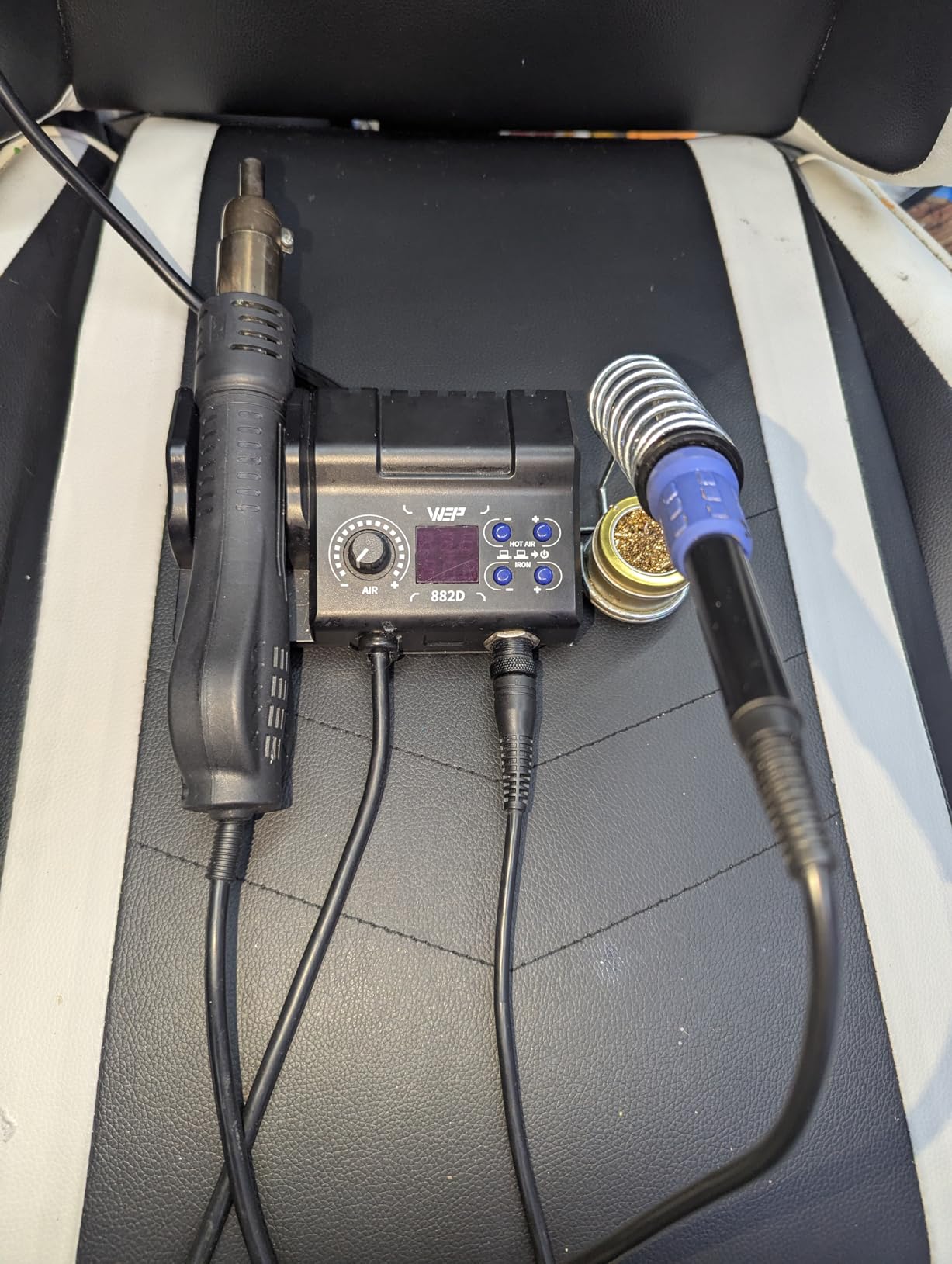
The WEP 882D is the smallest combined rework station here, and the most focused. It weighs 1.1 kg and holds a 4.5 average from more than 1500 reviews with 75 percent five-star ratings, all inside a 3.54 by 5.9 by 2.28 inch body, so the two functions share a small housing.
Unlike a shared-display combo, each function has its own LED display, its own power switch, its own temperature control buttons and its own air volume adjustment. That separation is what makes it usable in practice: you can run the iron at 392F while the hot air side sits at 700F without fighting one set of controls.
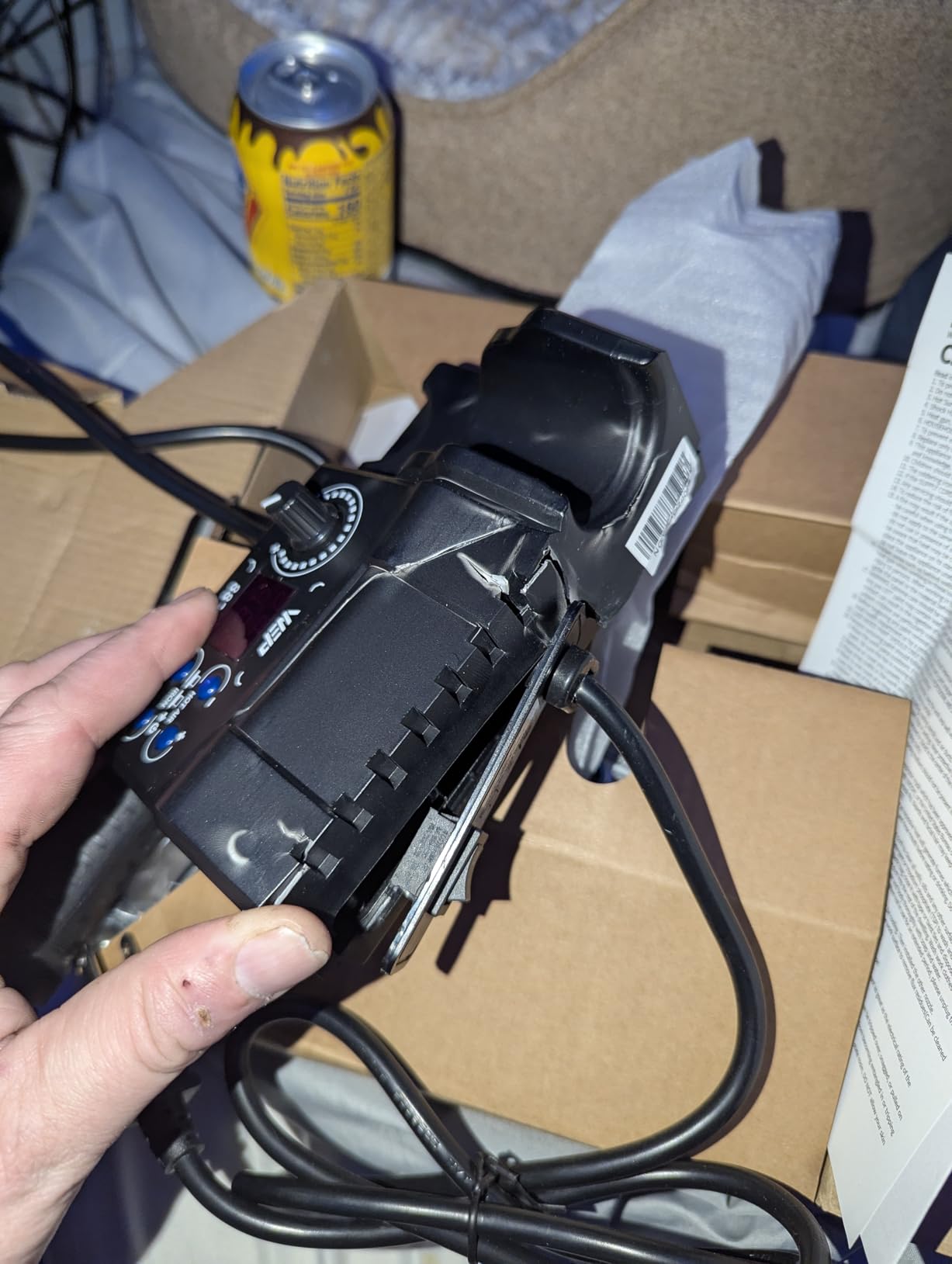
Both handpieces run a built-in PID program, with soldering adjustable from 392F to 896F and hot air from 212F to 896F with variable air volume. There is a calibration function for precision, plus sleep mode for the iron, standby for the hot air gun, automatic shutdown and centigrade to fahrenheit conversion.
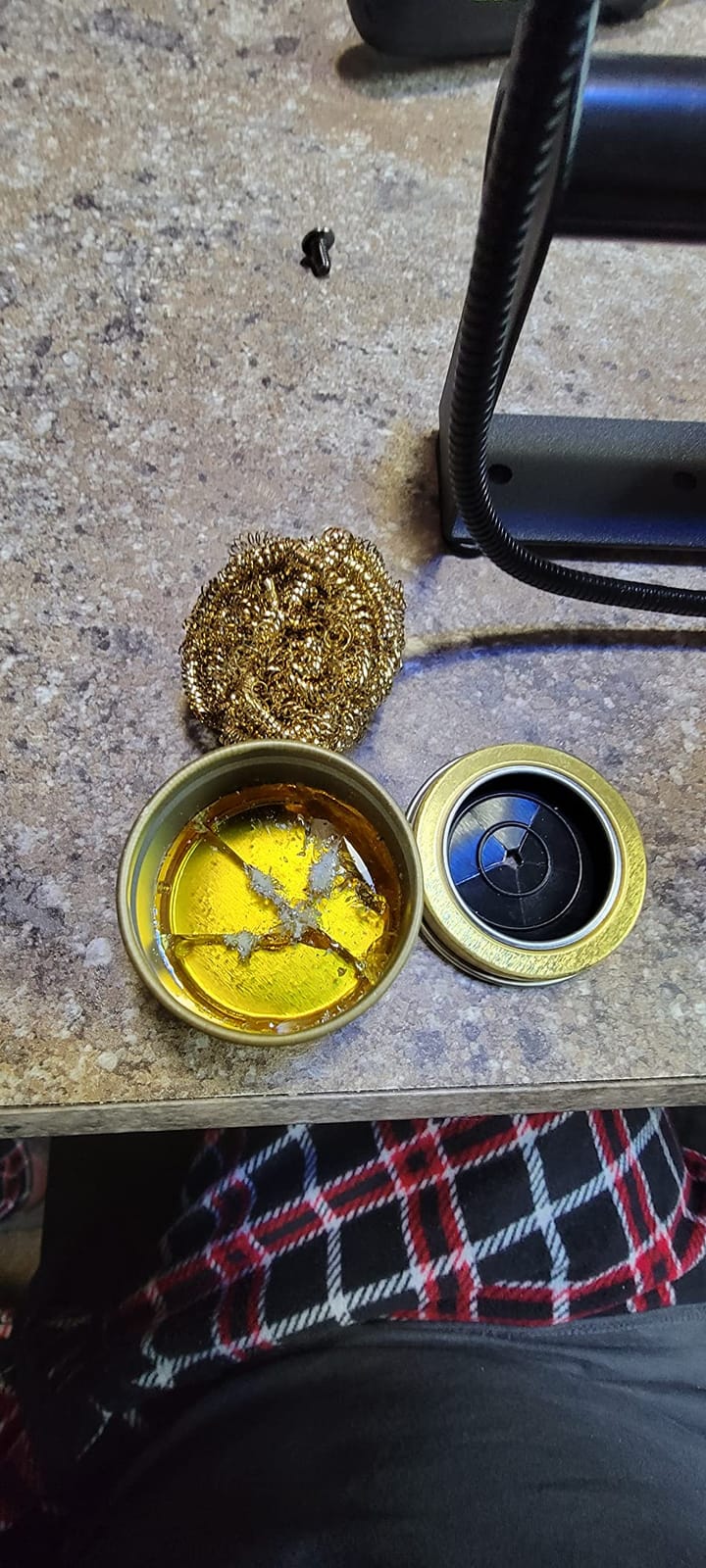
The bundle is generous for the money: 5 soldering tips covering I, B, K, 3.2D and 3C shapes, 3 hot air nozzles, 2 spools of solder wire, a brass wool tip cleaner, tweezers and a desoldering pump. It ranks among the top sellers in the Soldering Stations category, which is a useful signal that replacement parts and tips are easy to find.
Where the split controls earn their keep
Doing a rework job usually means alternating between heating the board with air and touching a pad with the iron. On single-control combos you change the station’s mind every time you switch. Separate power switches and displays remove that friction entirely, and the automatic shutdown adds a layer of unattended safety.
The calibration function is the sleeper feature. It lets you correct the reading against a known reference so that when you dial 700F, the tip is at 700F, which matters more on this class of station than the raw wattage figure suggests.
Where the 882D runs out of room
Packing two functions into one housing means each gets a smaller footprint, and you can feel that when you are doing extended hot air work. If your rework is occasional and your desk is small, that is a fair trade. If it is frequent, a dedicated station is more comfortable.
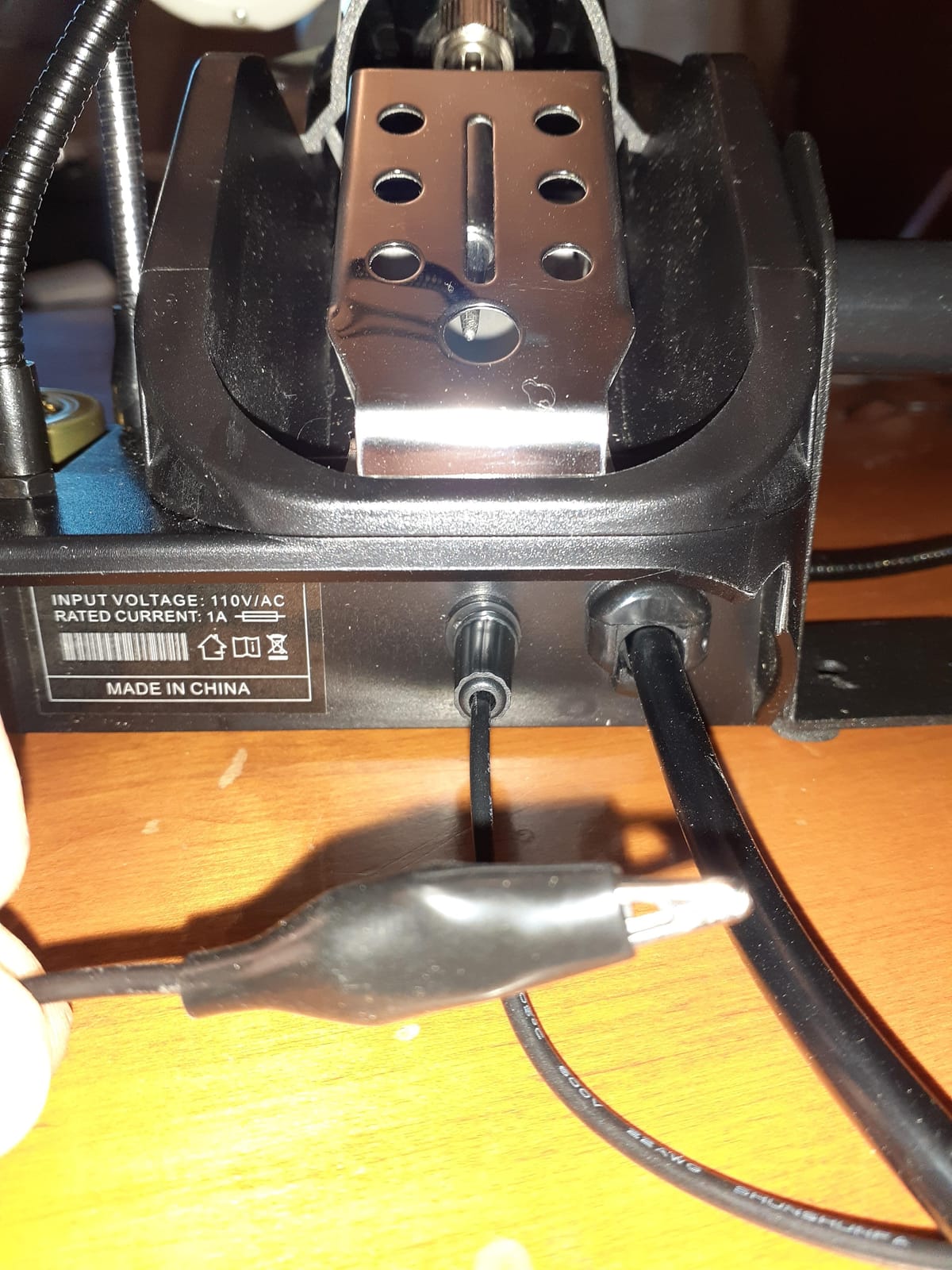
The 110-127V USA-only specification is the same caveat as the other WEP products here, with no 220V version. And while the airflow is variable and adequate for connectors, heat-shrink and most rework, the fine-pitch precision of the higher-end three-display units still wins for very small surface-mount parts. One-year US technical support is included.
10. X-Tronic 3060-PRO 75W Soldering Iron Station Kit
X-Tronic 3060-PRO • 75W Soldering Iron Station Kit • 5 Extra Tips • Mini Mag Lamp • 4 Helping Hands • Solder Sucker • Tweezers • 50g Solder • Brass Sponge w/Flux • Sleep Func, °C/°F, 3 Temp Presets!
75W
3 memory presets
Digital calibration
194F to 896F
Pros
- 3 preset memory functions plus digital temperature calibration
- Dual control panels show set and real temperature together
- PID temperature compensation holds a stable tip
- Sleep timer selectable at 0
- 5
- 10 or 30 minutes
- Anti-static grounding wire and anti-static iron
- 3-year warranty
Cons
- Iron is wired directly into the base so an element failure replaces the whole iron
- 110V 60 Hz only with no 220V version
- Large accessory-heavy kit takes more bench space
The X-Tronic 3060-PRO is the advanced-user kit in this roundup, and the 3 preset memory functions plus digital calibration are the reason. It holds a 4.6 average from more than 1100 reviews, and it is the station we would pick for someone who does the same jobs repeatedly and wants zero setup friction.
Temperature control runs from 194F to 896F, or 90C to 480C, with static stability of plus or minus 3.6F. Two control panels with a blue LED readout show set and real temperature at the same time, so you can confirm the tip has caught up before you commit a joint.
Power is split the same way as the 3020-XTS, with 60W to the iron and 15W to the mini motherboard inside it, feeding PID temperature compensation. The sleep timer is selectable at 0, 5, 10 or 30 minutes, and centigrade to fahrenheit is programmable rather than a physical toggle, so your preference survives a power cycle.
It is the most accessoried station we tested. You get 5 extra tips, a solder roll holder, a solder sucker, pinpoint tweezers, 50g of solder, an anti-static grounding wire, a brass sponge with cleaning flux, a wet sponge, a detachable mini magnifying lamp and 4 detachable helping hands, on a 57-inch silicone iron cord. Backed by a 3-year warranty and lifetime technical support.
Why calibration and memory beat raw wattage
Repeatability is what this station sells. Store a through-hole temperature, a lead-free temperature and a heat-shrink temperature in the three memory slots, and every job starts from the right number. The digital calibration function then keeps those stored points honest over years of tip changes and ambient temperature swings.
The detachable mini mag lamp and helping hands are also detachable rather than fixed, which is unusual. You can pull them off and set the board up under your own light when you are working on something awkward, then put them back for the next session.
The trade-offs to accept
This is a 110V 60 Hz only design with no 220V version, which rules it out for some regions entirely. Like the 3020-XTS, the iron is wired directly into the base, so an element failure means replacing the whole iron rather than a handle.
And the accessory-heavy package takes more bench space than a bare station. If your bench is tight, the WEP 927-IV folds its extras away more neatly. If you work at a dedicated electronics bench and want the calibration and memory, the 3060-PRO is the more capable machine of the two X-Tronic kits.
How to Choose a Soldering Station?
Choose on the work you actually do, not on the wattage number. Here is the checklist we use, in priority order.
1. Tip platform first. Passive tips like the Weller WEP70 and Hakko T18 are heated by an element sitting behind the tip, so there is a thermal delay between the sensor and the working end. Cartridge platforms such as T12 and JBC C245 put the heater and sensor inside the tip itself, which gives far faster recovery at a lower nominal wattage. A 60W cartridge tip can out-perform a 120W passive tip on real joints.
2. Temperature control, not temperature display. A digital readout is useful, but a PID feedback loop is what actually holds your set point. A station that displays a number it does not maintain will cook pads.
3. Wattage matched to workload. Through-hole kit building on 0.8mm wire is comfortable around 60W to 80W. Thick wire, large connectors and heat-sink mounting lugs want 90W and up. Fine surface-mount and micro-soldering want a low, controllable end of the range more than raw power.
4. Grounded tip and low-voltage delivery. A transformer-based supply that steps mains voltage down before it reaches the tip is the single best safety property you can buy. Check that the case is bonded to earth and that the tip is at earth potential, or at low voltage.
5. Sleep and standby behaviour. A station that drops temperature when parked extends tip life dramatically. The TOAUTO DS90 and X-Tronic kits all offer programmable timers, and the Weller adds auto setback.
6. Channel count and memory. One channel is fine for most hobbyists. Two channels or more matter if you want two handpieces with different tip shapes, for example a fine tip for 0402 work and a general tip for everything else. Memory presets matter more than most buyers expect.
7. Repairability. A detachable handle means an element failure costs a handle. A wired-direct iron means it costs the whole product. The YIHUA 939D+ and the combined YIHUA and WEP stations detach; the X-Tronic kits do not.
8. Accessories and voltage. Finally, confirm the input voltage matches your mains, and check what comes in the box. A station bundled with a real brass sponge, helping hands and a decent tip set saves you an afternoon and a second delivery.
T12, JBC C245 and Legacy Passive Tips: Which Platform Should You Buy?
The tip platform decides your running cost more than the station does, and it is the decision hobbyists argue about most. T12 and JBC C245 tips are not cross-compatible with each other or with the passive tips used by the Weller and Hakko stations in this roundup.
Passive tips are the older design. The heating element sits in the handle behind the tip, and the tip is a hollow tube soldered or pressed onto the element. They are cheap, easy to find and completely standard, which is why the Weller WEP70 and Hakko T18 families have enormous selection. The cost is heat capacity and recovery: the sensor is not where the work happens.
Cartridge platforms move the heater and sensor into the tip. A T12 cartridge or a JBC C245 carries its own resistance element, so the temperature you read is the temperature at the working end. The forum consensus we found is consistent on the practical outcome: a good T12 setup is described as better than obsolete passive tip systems, and a JBC C245 handle is the preferred upgrade for anyone who can justify it, with C210 for larger work and C115 for 0402 fine pitch.
None of the cartridge-platform stations appear in this roundup, and that is a real limitation of the category available in this price range. What it means for you is running cost. Genuine T12 tips are typically a fraction of the cost of JBC tips, and both are cheap relative to replacing a Metcal-class consumable. If your future plans include moving to a cartridge platform, buy a station with a detachable handle and standard connectors rather than one that is wired directly to the base.
How to Check That Your Station Is Properly Grounded
Grounding is a hard requirement in this community, not a nice-to-have. A grounded case and a tip at earth potential protect you from shock and protect CMOS parts from damage, and there are documented cases of budget units that fail this test badly.
On r/soldering, hobbyists have reported tip voltage leakage of 1V to 10V on several budget models, and one digital unit documented at up to 90V at the tip. The same discussion flags some T12 models shipping with ungrounded enclosures, where users must add a jumper cable themselves. Critically, the same model can arrive grounded on one run and ungrounded on the next, so this is a check to perform on arrival, not a brand reputation to assume.
Here is the procedure. First, confirm the three-pin earthed plug and an undamaged cable, and never use the station on a two-pin adapter. Second, with a multimeter on continuity, verify the metal case and tip are bonded to the earth pin. Third, set the multimeter to voltage and measure from the tip to the earth pin, with the iron at working temperature. A reading under a volt or so is a low-voltage design doing its job; anything approaching mains voltage is a fault and you should stop using the station.
Two more rules from the same community. Buy from sellers with a visible sales history and reviews, and buy genuine Metcal or JBC products from official distributors rather than marketplace listings, because those listings commonly ship clones. For used stations, the 30-day return windows on major marketplaces are a genuine risk reducer, since sellers often list working hardware as untested without checking it first.
Frequently Asked Questions
What is a good soldering station for electronics?
A good station for electronics has accurate PID temperature control, a wide temperature range, a grounded tip at low voltage, and replaceable tips in common shapes. The Weller WE1010NA is our top pick for most hobbyists. Beginners should prioritise low-voltage transformer delivery and a sleep timer, because those prevent both shock risk and tip damage more than raw wattage does.
What is the best soldering station for beginners?
For a first station, the X-Tronic 3020-XTS or the TOAUTO DS90 are the strongest choices, and both bundle tips, a holder and consumables. Pick a single-function iron rather than a hot air combo at the start, so you are not learning two tools at once. Look for a sleep timer, a grounded low-voltage tip and PID temperature control before you look at wattage.
Which is better, Hakko or Weller?
Hakko is the better precision tool, with a clicky rotary encoder, a wider temperature ceiling and fast recovery, and the T18 tip family has the widest shape selection. Weller is the better all-round buy: more owner history, temperature lock for repeatable joints, standby and auto setback, and generally easier sourcing. The Hakko FX888DX is 110V only, which rules it out for some buyers before quality is even considered.
What is the best basic soldering kit for beginners?
The X-Tronic 3020-XTS and the TOAUTO DS90 are the most complete starter kits, each shipping with extra tips, a holder, brass wool, a sponge, solder, helping hands and a 3-year or 1-year warranty. The X-Tronic reaches 480C in under 30 seconds and has a silicone cord that resists kinking. The TOAUTO reaches 590F in about 5 seconds and adds auto standby and sleep timers.
What is the best solder for small electronics?
For small electronics, a thin wire with a low melting point flows fastest and wets small pads cleanly, and rosin or RA flux is what makes it spread. A high-lead alloy such as Sn63Pb37 melts at roughly 183C, which gives a wide working window and a bright joint. Always use flux, keep the tip tinned, and ventilate the bench whatever alloy you choose.
What type of solder is best for beginners?
For beginners, a 60/40 or 63/37 tin-lead alloy is the easiest to work with because its low melting point and slow cooling give you a long working window. Lead-free alloys such as SAC305 need a higher temperature and faster movement, so they are a poor first choice. Whatever you use, keep the iron on a stable temperature and feed fresh solder onto the joint rather than melting a long strand over it.
Final Verdict: Which Soldering Station Should You Buy in 2026?
The Weller WE1010NA is the best soldering station for hobby electronics overall, and the reason is stability plus owner history rather than any single specification. Its plus or minus 4F hold, temperature lock, standby and auto setback make joints repeatable, and more than 4600 reviews at a 4.7 average mean the long-term reliability questions are already answered.
Take the Hakko FX888DX-010 instead if you need maximum precision on fine surface-mount work, and take the YIHUA 939D+ if you want the most capability per dollar with a built-in transformer and a detachable handle. Buy the X-Tronic 3020-XTS as a first station, the TOAUTO DS90 if unattended safety matters, and the WEP 927-IV if you want a complete organised bench from one box.
Whatever you choose, check the input voltage, run the grounding test described above before the first board, and buy a brass sponge and a sleep-timer-equipped stand alongside it. Then verify the current listing and the latest specification for your own bench before you order.