

A handheld drill wanders the moment the bit touches hardwood. A drill press holds that bit dead straight and drops it exactly the same distance every time, which is why anyone building furniture, shooting dowels or cutting their first steel plate buys one. This guide covers the best drill press machines for home shops in 2026, from an 8 inch benchtop that fits on a crowded workbench up to 12 inch bench-column machines with cast iron bases and 6.2 amp motors.
I spend a lot of time comparing bench machines in a one-car garage and a half-basement shop, and the pattern is consistent: the useful difference between two presses is almost never the badge on the head. It is the weight of the casting, the amperage of the motor, the slowest speed the pulley system can reach, and whether the table locks tight when you push on it. Those four things decide whether a hole comes out square or whether you end up filing it.
All 12 picks below run on standard 120 volt circuits, so none of them needs a dedicated branch circuit. Prices move constantly, so use the check buttons rather than any number you may have seen elsewhere. We earn a commission from qualifying purchases, which never changes what we write. For the broader run of home-shop equipment we test, see our related guides on heavy duty machines for demanding projects and other home workspace equipment picks.
Last tested and updated for September 2026.
Table of Contents
What Is a Drill Press and Why a Home Shop Needs One
A drill press is a stationary tool that holds a bit in a powered chuck and lowers it straight down into a clamped workpiece, producing square, repeatable, identical-diameter holes that a handheld drill cannot. The motor spins the spindle at a fixed speed while a quill, or stroke, lets you feed the bit downward by hand. The column sets the throat clearance, the swing sets how far the chuck sits from the table, and the table tilts and rotates so you can drill at an angle without moving the work.
A handheld drill is fine for a pilot hole in a scrap offcut. It is a poor tool for a row of 3/8 inch dowel holes in a chair rail, because the bit deflects as it enters and the holes come out at slightly different angles and diameters. On the press, the bit starts and stops against a depth stop, the workpiece is clamped flat, and every hole in a batch is the same. That repeatability is the whole reason a home shop buys one.
There is a second benefit people underestimate. A press is a rigid platform, so the bit has something to push against. A large Forstner bit or a hole saw will stall a handheld drill in seconds; on a press with enough amperage, the same cut takes a minute and the hole stays clean. If you have ever watched a Forstner bit grab and stall a cordless drill, that is the moment a press stops being a luxury.
The Four Types of Drill Press Every Home Shop Should Know
Drill presses divide into four types based on how the head is supported: benchtop, bench column, floor model and radial arm. The practical difference is swing, stroke and how much room the machine takes up, and it decides the size of the workpiece you can get under the chuck.
Benchtop presses clamp or bolt to the corner of a workbench. They run from about 8 inch to 10 inch swing and usually weigh between 25 and 45 pounds, so one person can move them. Two inch quill travel is typical, which is enough for Forstner bits and most hole saws. This is the right class for dowel work, joinery hardware, face frames and light drilling in sheet metal.
Bench column presses are a taller head on a rack and pinion column with a cast iron base of its own, standing on the floor beside a bench. Swing runs 12 inches, quill travel reaches 3 inches, and they commonly carry 5/8 inch chucks and 6.2 amp motors. They cost more and weigh 85 to 90 pounds, so plan a stand and a hand truck before you buy.
Floor model presses start around a 15 inch swing with a foot pedal, a 1 hp motor and larger tables. They handle long stock, thick hardwoods and mild steel. For most garage shops they are overkill, and they need 68 inches of ceiling clearance plus floor space you may not have.
Radial arm presses swing the head along a horizontal rail, giving far more swing than the name size suggests. They exist to reach the middle of a long board without repositioning the work.
This roundup covers the bench-mounted classes, because that is what fits a garage or basement shop. If your real need is milling rather than accurate drilling, stop and read the section at the end of this guide before spending anything.
Top 3 Drill Press Picks for Home Shops in 2026
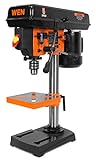
WEN 4206T 8-Inch Benchtop Press
- Cast iron body
- 2.3A motor
- 5 speeds 750-3200 RPM
- 1/2 inch keyed chuck
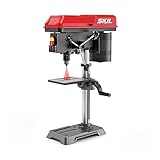
SKIL DP9505-00 10-Inch Press
- 6.2A motor
- laser and work light
- 5 speeds 610-2800 RPM
- tilting table

JET JWDP-12 Variable Speed
- 530-3100 RPM on the fly
- XACTA laser
- 5 year warranty
- LED work light
All 12 Picks at a Glance in 2026
| Product | Specs | Action |
|---|---|---|
| WEN 4206T 8-Inch Benchtop Drill Press |
|
Check Latest Price |
| SKIL DP9505-00 10-Inch Drill Press |
|
Check Latest Price |
| JET JWDP-12 Variable Speed Benchtop Press |
|
Check Latest Price |
 BUCKTOOL 12-Inch Drill Press DP12VL BUCKTOOL 12-Inch Drill Press DP12VL |
|
Check Latest Price |
 BUCKTOOL 10-Inch 3/4 HP Drill Press BUCKTOOL 10-Inch 3/4 HP Drill Press |
|
Check Latest Price |
 VEVOR 8-Inch Benchtop Drill Press DP8 VEVOR 8-Inch Benchtop Drill Press DP8 |
|
Check Latest Price |
 WOODSKIL 8-Inch Drill Press DP-8 WOODSKIL 8-Inch Drill Press DP-8 |
|
Check Latest Price |
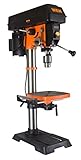 WEN DP1263V 12-Inch Variable Speed Press WEN DP1263V 12-Inch Variable Speed Press |
|
Check Latest Price |
 VEVOR 10-Inch Drill Press DP1006L VEVOR 10-Inch Drill Press DP1006L |
|
Check Latest Price |
 PioneerWorks 8-Inch Benchtop Drill Press PioneerWorks 8-Inch Benchtop Drill Press |
|
Check Latest Price |
 WEN DP1050 10-Inch Drill Press WEN DP1050 10-Inch Drill Press |
|
Check Latest Price |
 SHOPMAX 8-Inch Drill Press SHOPMAX 8-Inch Drill Press |
|
Check Latest Price |
1. WEN 4206T 8-Inch Benchtop Drill Press – Best All-Round First Press for a Home Shop
WEN 2.3-Amp 8-Inch 5-Speed Cast Iron Benchtop Drill Press (4206T)
8 inch swing, 2 inch spindle travel
2.3A motor, 5 speeds 750-3200 RPM
1/2 inch keyed chuck with onboard key storage
Pros
- Compact cast iron build that bolts to a small bench
- Five mechanical speeds across 750-3200 RPM
- Table adjusts in height and bevels 45 degrees either direction
- Highest review count in this group at 4.6 stars across 797 ratings
Cons
- 2.3A motor is the weakest here and bogs down on large bits or hardwood
- Table is small at 6.5 x 6.5 inches for big workpieces
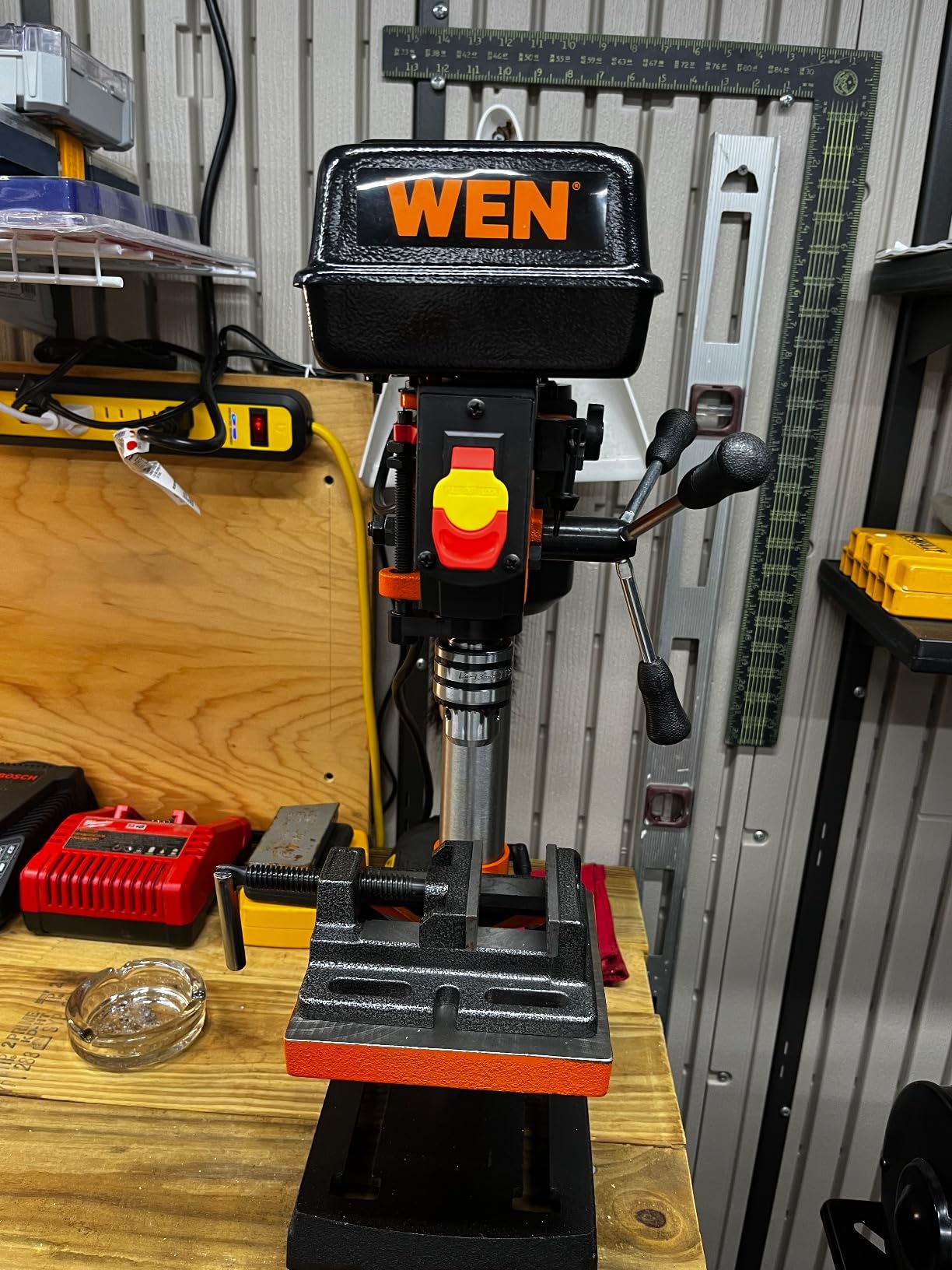
This is the press I recommend to anyone building a first home shop. It is 32 pounds, it is genuinely cast iron rather than folded sheet steel, and at 23 inches tall it clears most bench undersides. More than 800 owners have rated it, which makes it the most reviewed machine in this guide by a wide margin, and the 4.6 average is not a fluke of a small sample.
What you get is a straightforward five-speed step-pulley head with a 1/2 inch keyed chuck and a table that both raises and tilts. The chuck key stores on the machine, which sounds minor until you hunt for it at 11 at night trying to change a bit. Assembly is short and the belt cover is reachable for a tension check.
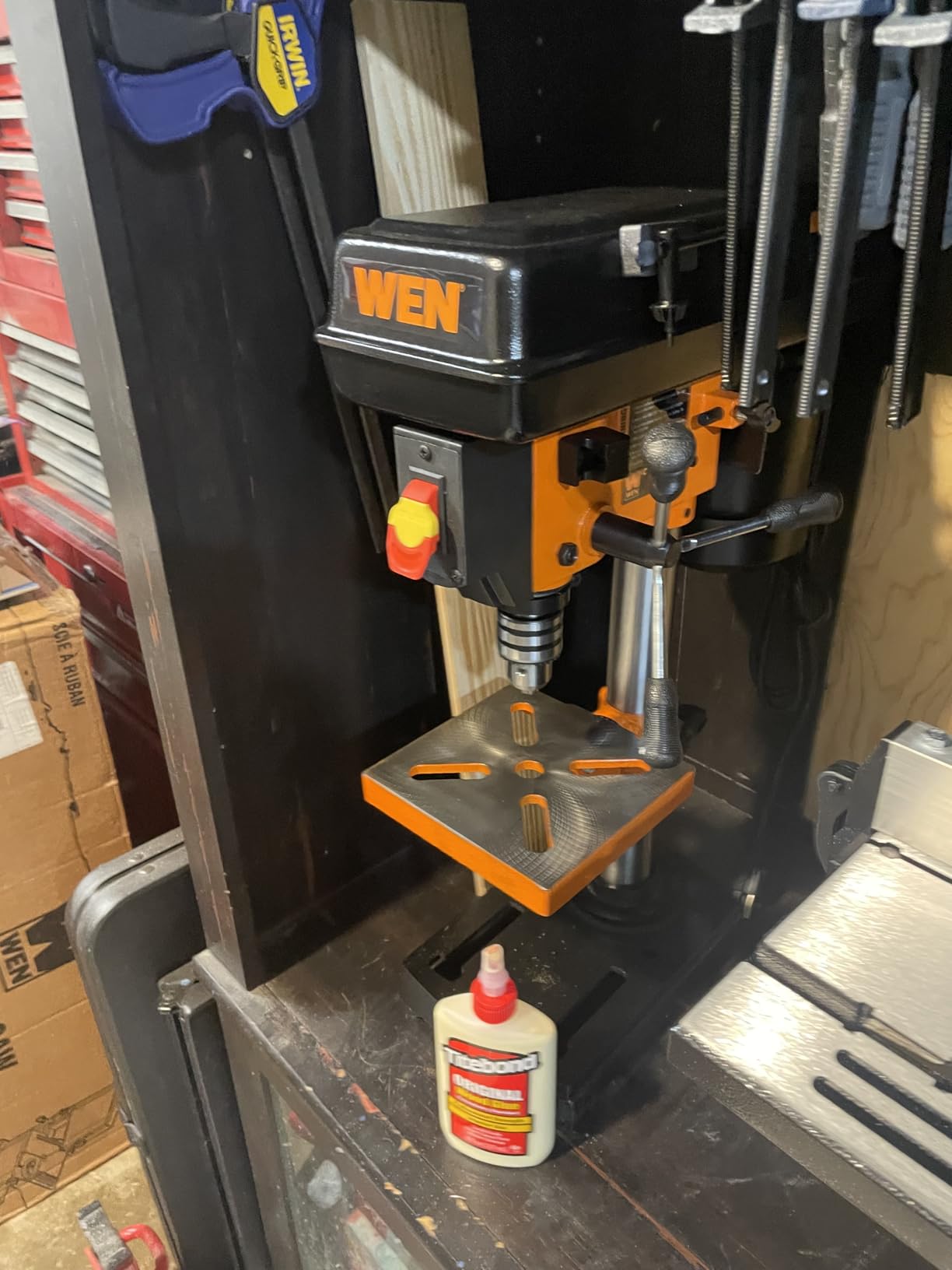
The honest limit is the 2.3 amp motor, rated at 253 watts. It handles 1/2 inch twist bits in hardwood, screws, dowels up to about 1/2 inch and thin sheet metal without complaint. Push a 2 inch Forstner or a 3 inch hole saw and it will bog and stall, which is exactly the ceiling that experienced builders warn about when they call budget 8 inch presses small and underpowered. The 6.5 inch square table also means a face frame is supported on two scraps, so clamp it well.
Owners also like that it runs quietly enough to use in a shared space, and there is no variable speed electronics to fail later. The tradeoff is that moving between speeds means moving the belt under the top cover with the machine off, which is a fifteen second job you will do far more often than you expect.
Who this press suits
It suits the furniture maker, the trim carpenter and the weekend woodworker who shoots dowels, bores hinge cups, drills hinge pin holes and runs screws into hardwood. A 4.6 rating across that many owners is the strongest evidence in this guide that the class is right, and the machine is small enough to live on a bench you also use for clamping.
If you also want to make hinges and brackets, this is a competent partner for mild steel up to about 1/4 inch using the slowest speed and a cutting fluid. It is not a metal shop machine, and the honest advice is to treat steel as occasional work on this one.
Who should skip it
Skip it if you build large stock, cut 3/8 inch steel plate regularly, or run a production schedule where stopping to move a belt is unacceptable. Shop owners on forums with four decades of experience describe this class as small and underpowered precisely because the motor, not the castings, is the limit. For those jobs step up to a 10 inch press with a 6.2 amp motor, or one of the variable speed models below.
2. SKIL DP9505-00 10-Inch Drill Press – Best Value With a Laser and Work Light
SKIL 6.2 Amp 10 In. 5-Speed Benchtop Drill Press with Laser Alignment & Work Light – DP9505-00
6.2A induction motor rated near 1 HP
5 speeds from 610 to 2800 RPM
Laser alignment, LED work light, tilting table
Pros
- 6.2A motor that owners say drills 3/8 inch steel on the slow speed
- Laser and work light are accurate out of the box
- Tilting table and quick assembly
- Runs quiet for a press in this class
Cons
- Some units arrive with a table locked out of zero from poor thread machining
- Slight rack wobble and a little chuck runout
- Only two Allen keys included
- Cramped column bolts that a socket wrench will not clear
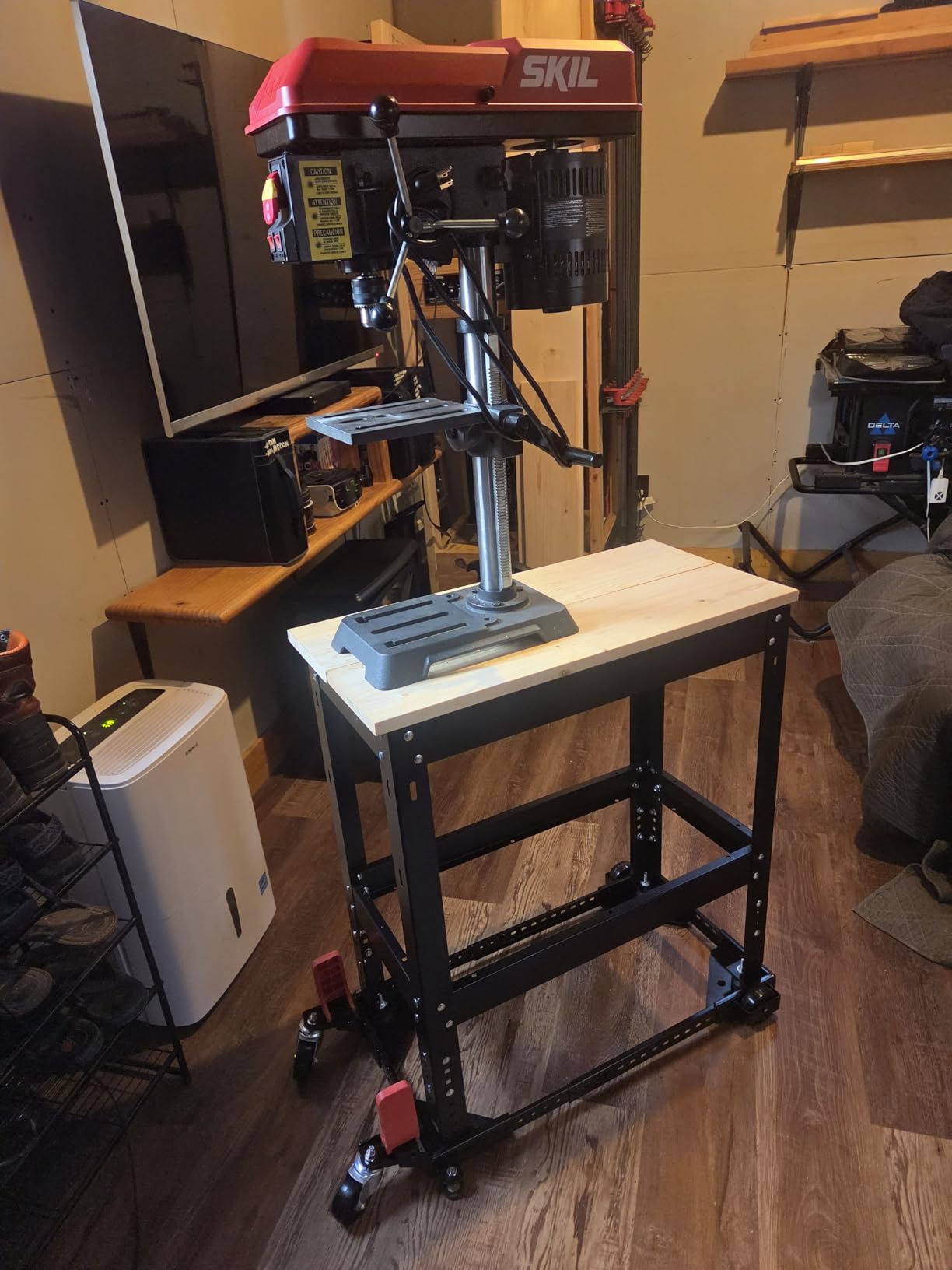
This is the value pick because the motor is the story. A 6.2 amp induction motor rated near 1 horsepower in a 10 inch benchtop press is unusual, and owners report drilling hardwood to 3 inches and steel to 3/8 inch. More than 500 owners have rated it, and the 4.3 average reflects genuine capability with a real quality control caveat rather than a machine that struggles.
The head also carries a laser alignment system rated Class II and an LED work light, both mounted where you can reach them without moving. The worktable tilts from 0 to 45 degrees in both directions, and a bump-off safety switch, an adjustable depth stop and a lockout are all present. Assembly takes most people 15 to 30 minutes.
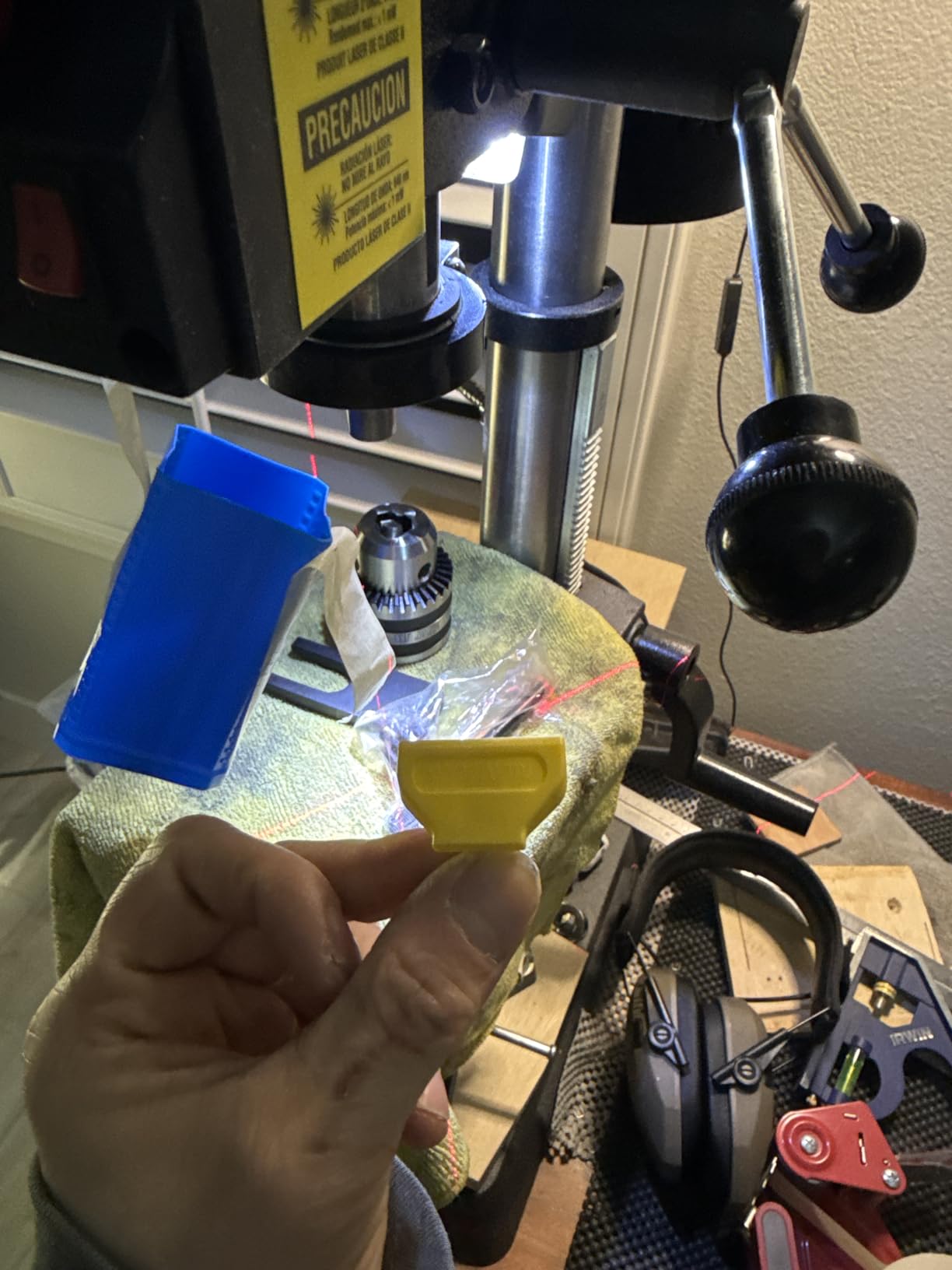
The weak point is consistency rather than design. A recurring complaint is a table that arrives unable to reach true zero because the threads were machined poorly, and that requires a return. Reviewers also mention slight play in the rack and support base and a small amount of chuck runout, which shows up as a hole that wanders a fraction when you change the bit. Neither is fatal, but if repeatability is your top priority, the BUCKTOOL 12 inch machine below measured cleaner.
One more practical note: only two Allen keys ship in the box, and the column bolts are tight enough that a socket wrench will not fit. Budget ten minutes and a larger Allen set before you start.
Who this press suits
It suits the mixed-material shop. If you build a day and then need to drill a hole in a steel bracket, cleat or trailer plate, the 6.2 amp motor and 610 RPM bottom speed are what make that possible, and the laser removes the guesswork for a beginner working alone. The 3 year limited warranty is also among the longer ones in this budget band.
It is a good first real drill press. You outgrow it only when you start boring very large holes in thick hardwood, where half a dozen boring cycles will heat the motor and slow feed.
Who should skip it
Skip it if you cannot tolerate a small return rate on a machine that ships heavy and takes real effort to send back, or if you drill identical holes in matched parts where even a fraction of runout matters to the fit. It is also not ideal for anyone who wants to change speed repeatedly in one session, because this is a five-speed step-pulley design.
3. JET JWDP-12 Variable Speed Benchtop Drill Press – Best Premium Bench Press
JET 12-Inch Benchtop Drill Press, Variable Speed, 1/2 HP, 115V 1Ph (Model JWDP-12)
Variable speed 530-3100 RPM with no belt changes
10 x 16-1/8 inch cast iron base
XACTA laser, LED light, depth stop scale
Pros
- On-the-fly speed changes from 530 to 3100 RPM
- Cast iron and steel construction that long-time users call well made
- XACTA laser is accurate and does not drift
- 5 year warranty
- Belt is easy to reach for maintenance
Cons
- Half horsepower motor struggles with very large hole saws
- Table does not tilt to 90 degrees
- Table raise crank feels slightly sloppy
- One professional-shop owner reported a loose table arm and motor overheating after 10-15 minutes
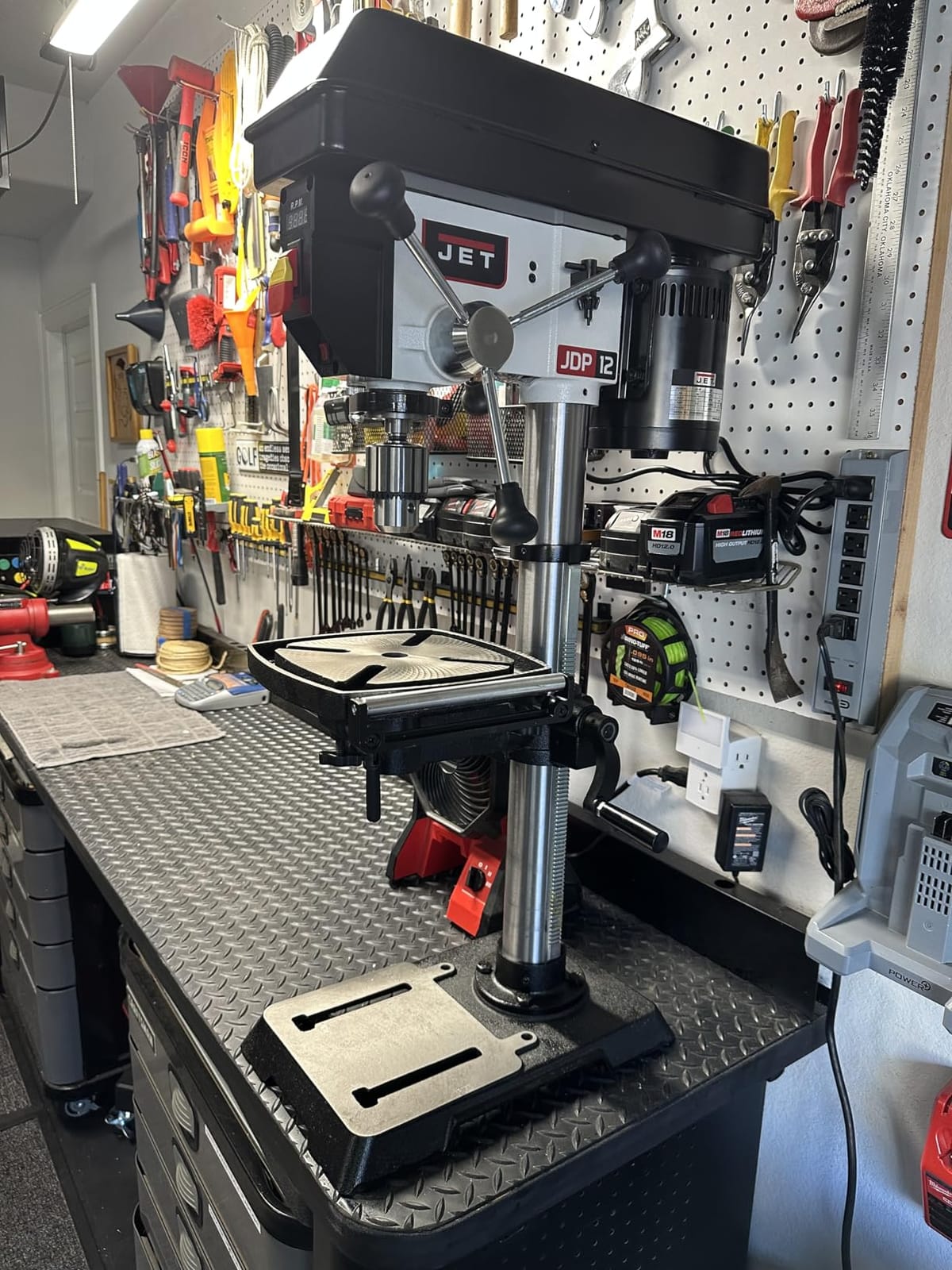
This is the press to buy when you are done replacing belts. The variable speed system drives the motor from 530 to 3,100 RPM electronically, with no belt changes at all, and that single feature changes how you work. You can drill a small pilot at high speed, then feed the same bit into steel at the low end without stopping to move a pulley.
At 85 pounds with a 10 by 16-1/8 inch cast iron base, it is a serious machine on a bench, and long-time owners with 50 years of shop experience describe it as well made. The X-shaped XACTA laser is the most consistent alignment aid in this group, the LED work light is standard, and a clear linear scale with depth stop makes repeat depths genuinely repeatable. There is even a retractable roller extension for supporting a long workpiece.
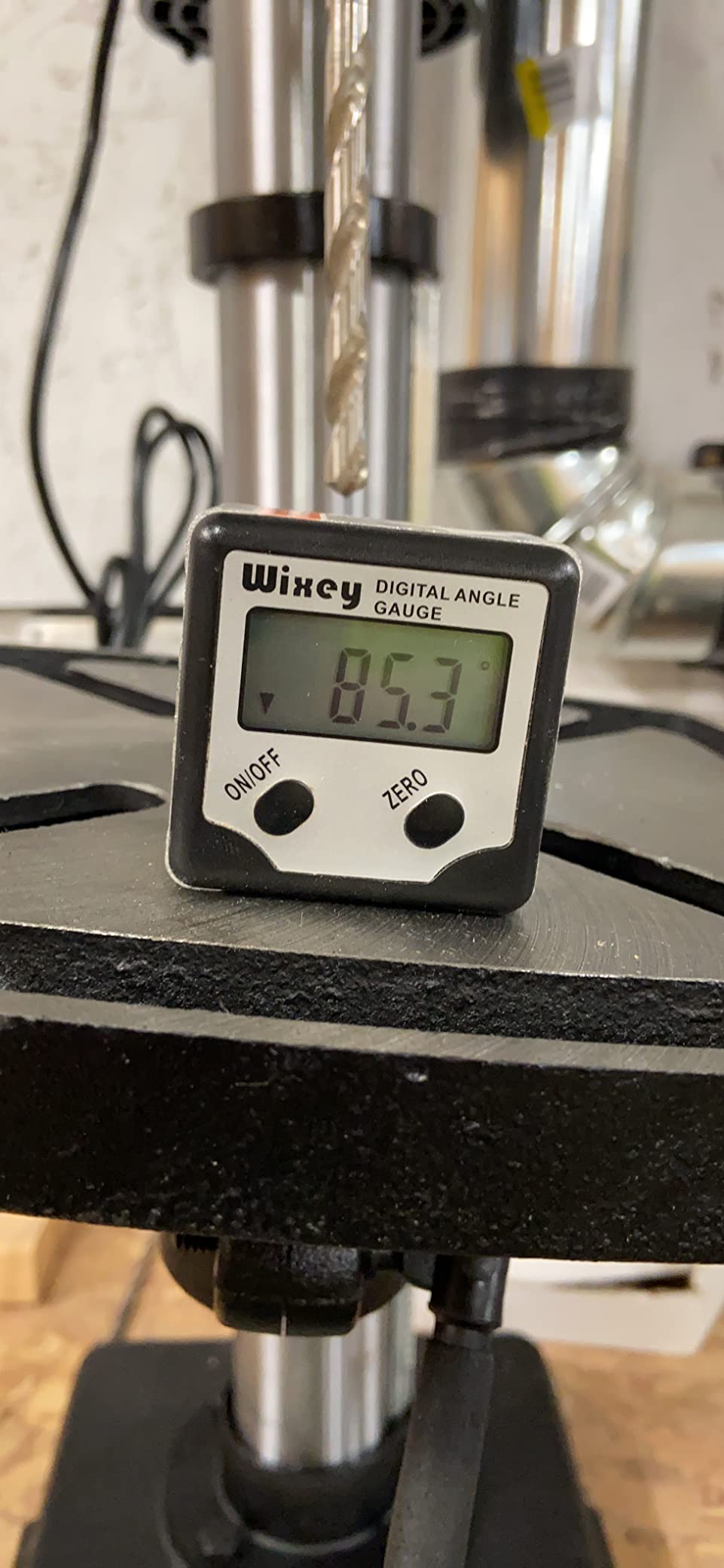
The compromises are specific. The motor is listed at one half horsepower, which is plenty for woodworking and light metal but will bog on a large hole saw, and it needs a slow, careful feed rather than a push. The table does not tilt to 90 degrees, so a vertical drilling job means swapping workpieces rather than the table. A few owners also report a rattling sound at certain speeds from spline clearance that goes quiet after the machine is greased.
The 5 year warranty, reduced to 2 years for commercial use, is the strongest coverage here and matters a lot for a machine expected to last decades. Parts availability from JET is a real practical advantage over an off-brand press with a similar footprint.
Who this press suits
It suits the builder who works in short bursts at many different diameters, and anyone who drills both wood and metal. A woodworker building Windsor chairs, a metalworker bending brackets, and an apprentice learning on the same machine all get something useful from a continuous 530 to 3,100 RPM range. The laser and depth scale also make it a good teacher machine.
It is the right pick if your bench can hold 85 pounds. Get a stand with a top of at least 10 by 16 inches, and bolt the base down so the table does not walk during a big cut.
Who should skip it
Skip it if your bench is light and short, since the base will need a dedicated stand, or if your work is mostly large-diameter boring where a half horsepower motor is the wrong tool. If you bore 2 inch and larger holes in hardwood several times a week, spend up into a 12 inch press with more torque instead.
4. BUCKTOOL DP12VL 12-Inch Drill Press – Best 12-Inch Pick for Runout Control
BUCKTOOL 12-Inch Benchtop Drill Press, 580-3200 RPM, 6.2A 3/4 HP Motor
6.2A motor, 12 inch swing, 39 inch height
Variable 580-3200 RPM with digital readout
Class IIIA laser, work light, emergency stop
Pros
- Clean machining and near-zero runout measured on a dial indicator
- Lever speed change with digital RPM readout
- Laser accurate at any table height
- Extra table clearance from the tall frame
- Thin-edged table clamps work easily
Cons
- Very heavy at close to 90 pounds and needs bolting down
- Small round table limits large workpieces
- Chuck key sits awkwardly behind the spindle
- No manual in the box
Runout is the specification that quietly decides whether your holes match each other, and this machine has the strongest owner evidence in the group. One buyer mounted a dial indicator and measured essentially zero runout, which is a level of machining you normally only find on a shop with an indicator. At a 4.6 average across 193 ratings, the consensus is that this is the best 12 inch press for the money.
Everything else follows from the hardware. A 6.2 amp motor gives more output than the typical 5 amp motor in this class, the chuck runs from 1/32 to 5/8 inch, and variable speed covers 580 to 3,200 RPM with a digital readout of the current speed. A lever operates the speed change rather than a belt, so you can adjust while the bit is clear. The worktable rotates 360 degrees and bevels 45 degrees to either side, and the frame gives roughly 2 inches more table clearance than competing 12 inch presses.
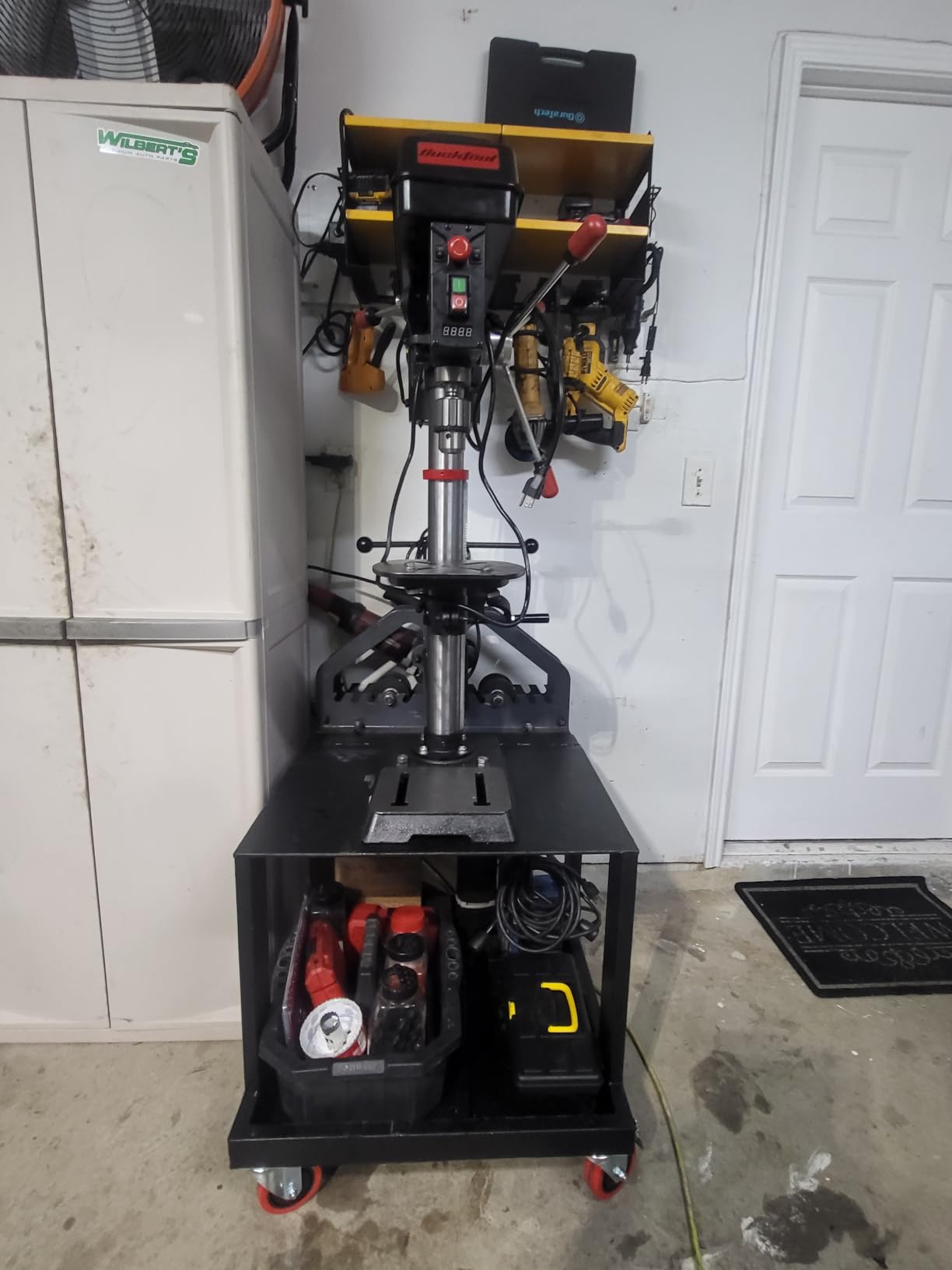
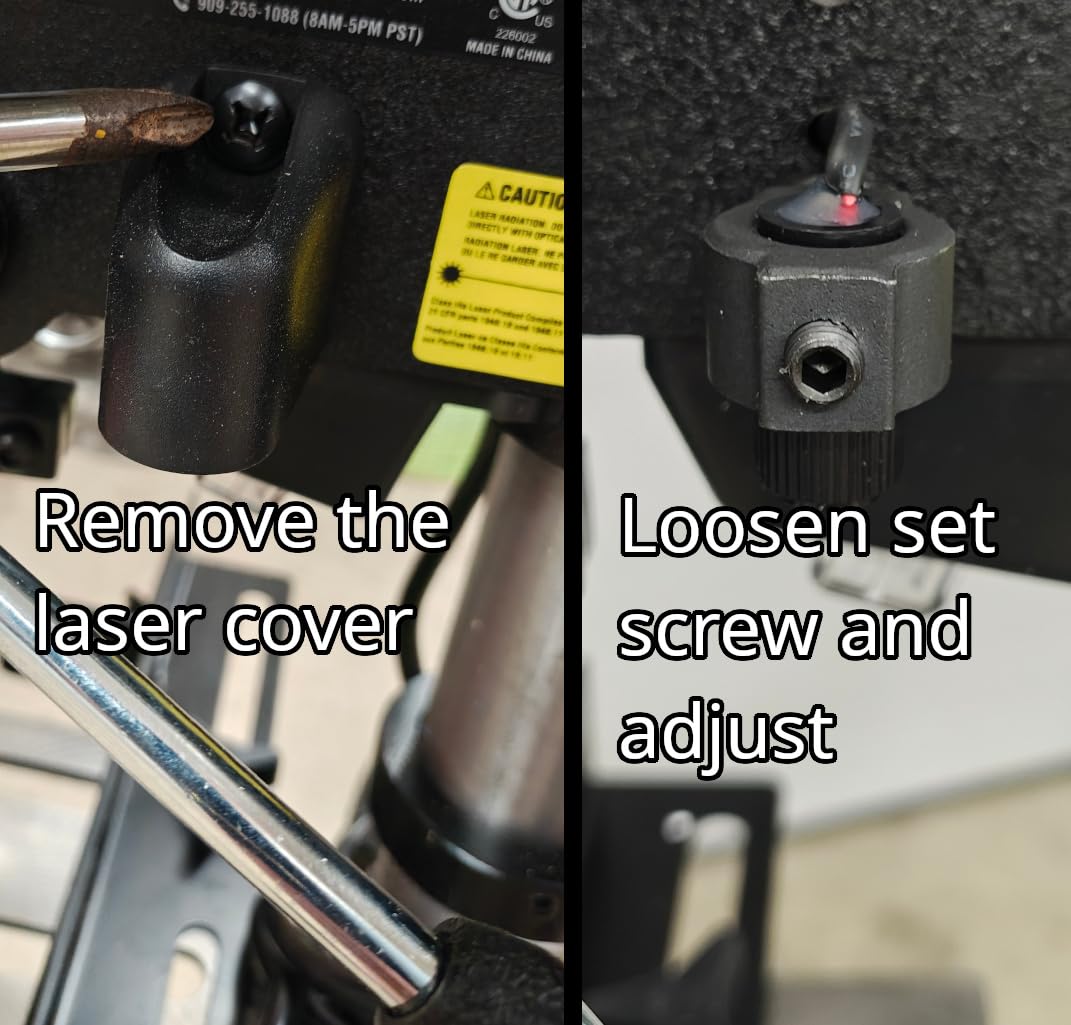
Owners compare it directly against WEN, DeWalt, Ridgid, Makita and Milwaukee machines and find it holds up. The included Class IIIA laser, aimed work light, emergency stop switch and no-voltage-release switch make it the most complete feature set in this guide. The table is thin-edged, which is genuinely useful for clamping because clamps grip a thin lip more easily than a thick slab.
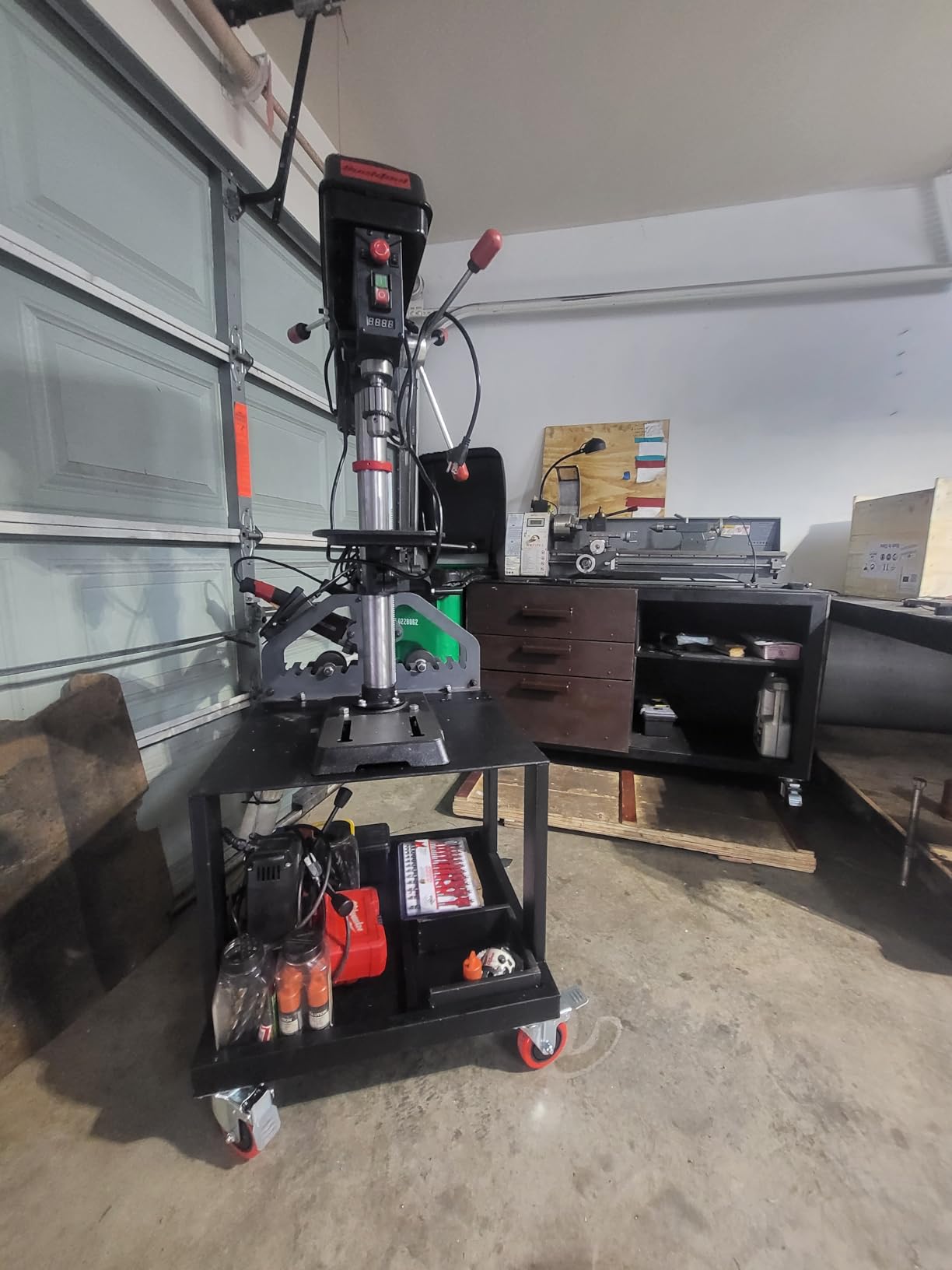
The negatives are weight and size. At 86.5 pounds, moving it needs two people or a hand truck, and it should be bolted to a stand. The round table is small for a face frame, the chuck key hides behind the spindle, and there is no manual in the box, so expect to figure out a few assemblies by inspection.
Who this press suits
It suits someone building matched components where every hole has to land in the same place, and anyone whose work includes thicker hardwood than a 10 inch press can feed comfortably. Twelve inch swing, 2 inch spindle travel and a 5/8 inch chuck capacity give you room for a 1-5/8 inch Forstner bit and a 2-1/2 inch hole saw without a fight.
It also suits the shop that already has steel in the mix, because the 6.2 amp motor and 580 RPM floor are adequate for 3/8 inch mild steel with cutting fluid and a patient feed.
Who should skip it
Skip it if you have a lightweight folding table and no plan to build a stand, or if you need a large rectangular work surface for sheet goods. The weight is not a flaw, but it is a commitment, and a machine you have to muscle into place every time tends to sit in a corner unused.
5. BUCKTOOL 10-Inch Drill Press – Best Motor Strength at 10 Inches
BUCKTOOL 10-Inch Drill Press 6.2 Amp 3/4 HP Bench Drill Press
CSA certified 3/4 HP 6.2A motor, 2 inch travel
1/2 inch keyed chuck, 30 inch height
5 speeds 650-3100 RPM
Pros
- 6.2 amp motor is unusually strong for a 10 inch press
- CSA certification and cast iron base give it a planted feel
- Tilting table with built-in lights and an adjustable fence
- Removable switch keys prevent accidental starts
Cons
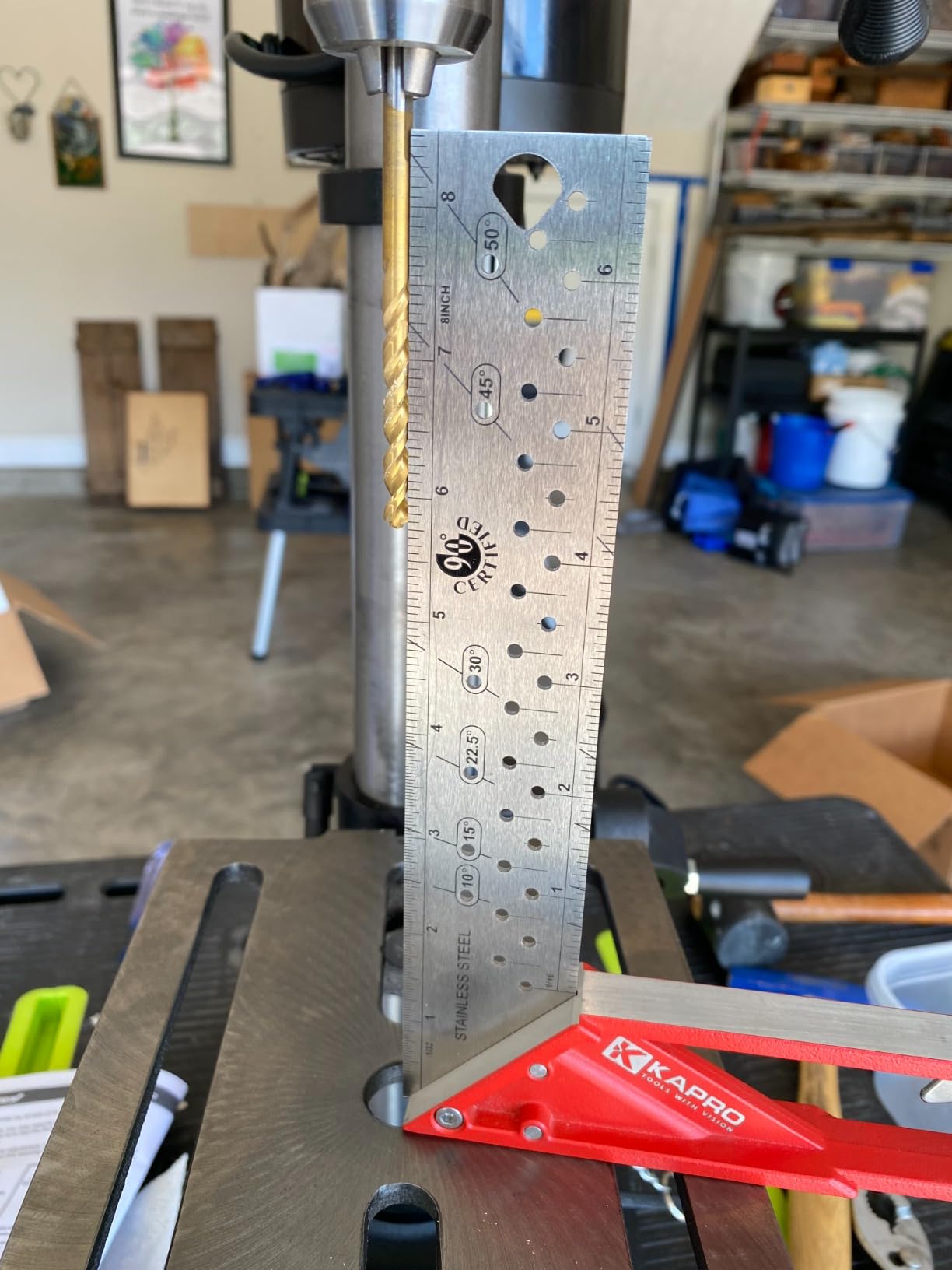
- Speed changes need reaching under the top cover to move the belt
- Some owners question component quality for heavy duty work
The reason this machine exists in this guide is one number: 6.2 amps at 10 inches. Most 10 inch benchtop presses ship with a 5 amp motor, and that gap is the difference between feeding a 1-5/8 inch Forstner bit through hardwood and stalling it. The 3/4 HP CSA certified induction motor here is rated to 3,100 RPM with 2 inch of spindle travel.
The rest is a sensible package. The table tilts to 45 degrees and carries a built-in LED light and an adjustable fence, which makes it useful for repetitive layout work where you are marking the same position on several parts. Removable switch keys stop the press starting while the belt cover is off, a detail that budget machines routinely skip.
Owners consistently like the stability that comes from the cast iron base. At a 4.4 average across 177 ratings, it sits slightly below its 12 inch sibling but the feedback is steady, with motor strength and planted feel as the two recurring themes. The main limitation is speed selection.
Unlike the 12 inch model, the speed change here is manual. You move the belt under the top cover, which means stopping the job, putting the machine in standby and reaching across the head. It is a five speed cover for practical purposes, and owners treat it as the one feature they would change first.
Who this press suits
It suits the woodworker with a small shop who wants real boring capacity in a 10 inch footprint. If you build solid wood stools, cutting boards or small tables, you will hit the point where a 5 amp motor stalls and this one does not. The tilting table and fence also suit drilling angled holes into a repeated part.
The removable key is a small thing that matters if other people use your shop, including an apprentice or a family member.
Who should skip it
Skip it if you change speeds constantly, because the belt change will frustrate you within a week. If you need a 5/8 inch chuck or 12 inch of swing, look at the 12 inch BUCKTOOL above instead. And if you expect heavy commercial duty, some owners question whether the components are up to it, so for a shop machine that runs daily, a brand with a longer warranty is a better bet.
6. VEVOR DP8 8-Inch Drill Press – Best for the Smallest Bench
VEVOR 8 in Benchtop Drill Press, 2.5A Induction Motor, Tabletop Drilling Machine with 750/1140 / 1740/2340 / 3200 RPM Adjustable Speed, 0-45° Tilting Worktable, LED Work Light, for Wood Metal
2.5A induction motor, 25.4 pounds
5 speeds 750-3200 RPM
Tilting table, work light, depth stop
Pros
- Lightest machine here at 25.4 pounds
- Quiet operation and roughly 10 minute assembly
- Tilting adjustable table and five speeds cover wood
- plastic and light metal
- Low radial runout and clean holes on delicate materials
Cons
- Thin pressed steel base and slender column tube
- 2.5A motor is weak and one owner reported overheating on a 12mm bit
- No laser
- so alignment depends on marks and the depth stop
- Table walks on the bench unless bolted down
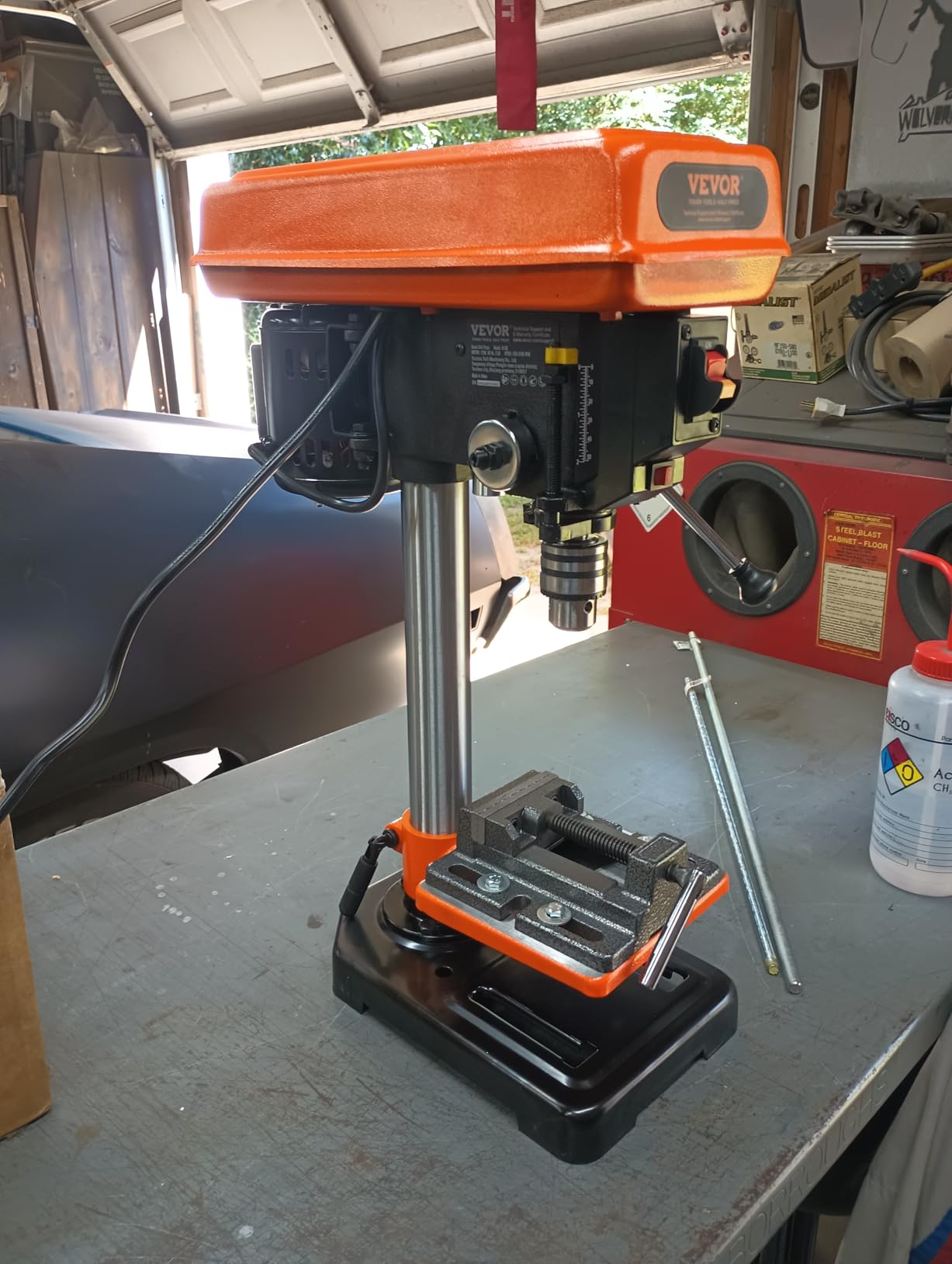
This is the pick when bench space is the binding constraint. At 25.4 pounds it is the lightest machine in the guide, and at a 4.6 average across 160 ratings it is rated well above what its construction suggests. For a small apartment workbench, a garage shelf, or a shop where you need to reclaim the corner every evening, that matters more than torque.
You get a 2.5 amp induction motor rated 276 watts, five speeds from 750 to 3,200 RPM, a 1/2 inch maximum drilling diameter and 2 inch of spindle travel. The table adjusts in height and tilts to 45 degrees, an integrated LED work light sits over the drilling area, and an adjustable depth stop handles repeat holes. Assembly is about ten minutes for most owners.
The 4.6 rating is really a statement about expectations. Owners treat this as a light duty woodworking and hobby press and rate it accordingly. Buyers who expected metalworking capability are the ones who leave disappointed reviews, and one owner reported the motor overheating on a 12mm bit. There is no laser, so centering depends on a marked line and the depth stop.
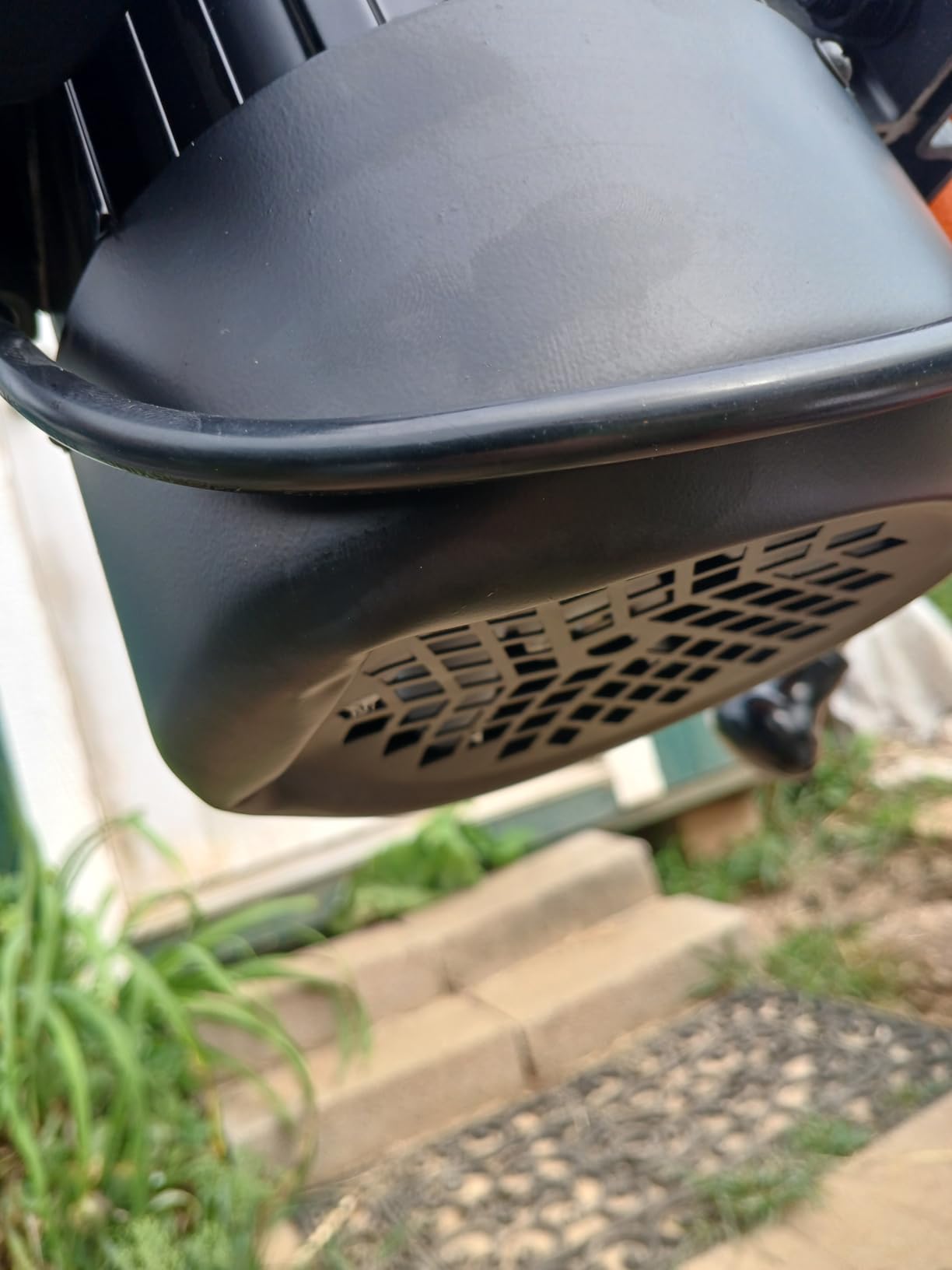
Construction is honest thin steel: a pressed steel base and a cast steel table. The table can walk on the bench under drilling pressure if the press is not bolted down, which is a two minute fix with four bolts and worth doing immediately.
Who this press suits
It suits craft and hobby work, model building, small dowel holes in jewelry-scale projects, and drilling delicate material. Owners report clean, consistent holes on thin and fragile pieces, and the low radial runout is better than several more expensive presses in this guide. It is also a sensible first press for a child or teenager learning shop discipline.
If your work is mostly plastic, thin plywood, small hardwood parts and light assembly, this machine will not disappoint you.
Who should skip it
Skip it for metalwork of any real thickness, for hardwood that will tax the motor, or for anyone who cares about a square hole in a matched set. The motor is the ceiling, and no amount of careful feed gets past it. For those jobs, the 6.2 amp models in this guide are a meaningful upgrade rather than a luxury.
7. WOODSKIL DP-8 8-Inch Drill Press – Best Cast Iron Table on a Budget
WOODSKIL 8-Inch Benchtop Drill Press, 2.3 Amp 5-Speed with Laser Guide
1/3 HP 2.3A motor at 120 volts
Class IIIA laser, cast iron tilting table
5 speeds 750-3200 RPM, 2 year warranty
Pros
- Heavy-duty cast iron base and worktable for the money
- Laser guide helps line up work on a small table
- Five speeds to 3200 RPM cover most wood and light metal
- 2 year limited warranty
Cons
- 2.3A motor will not handle large bits or hardwood
- Highest share of 1 star reviews in this group
- No work light listed in the specifications
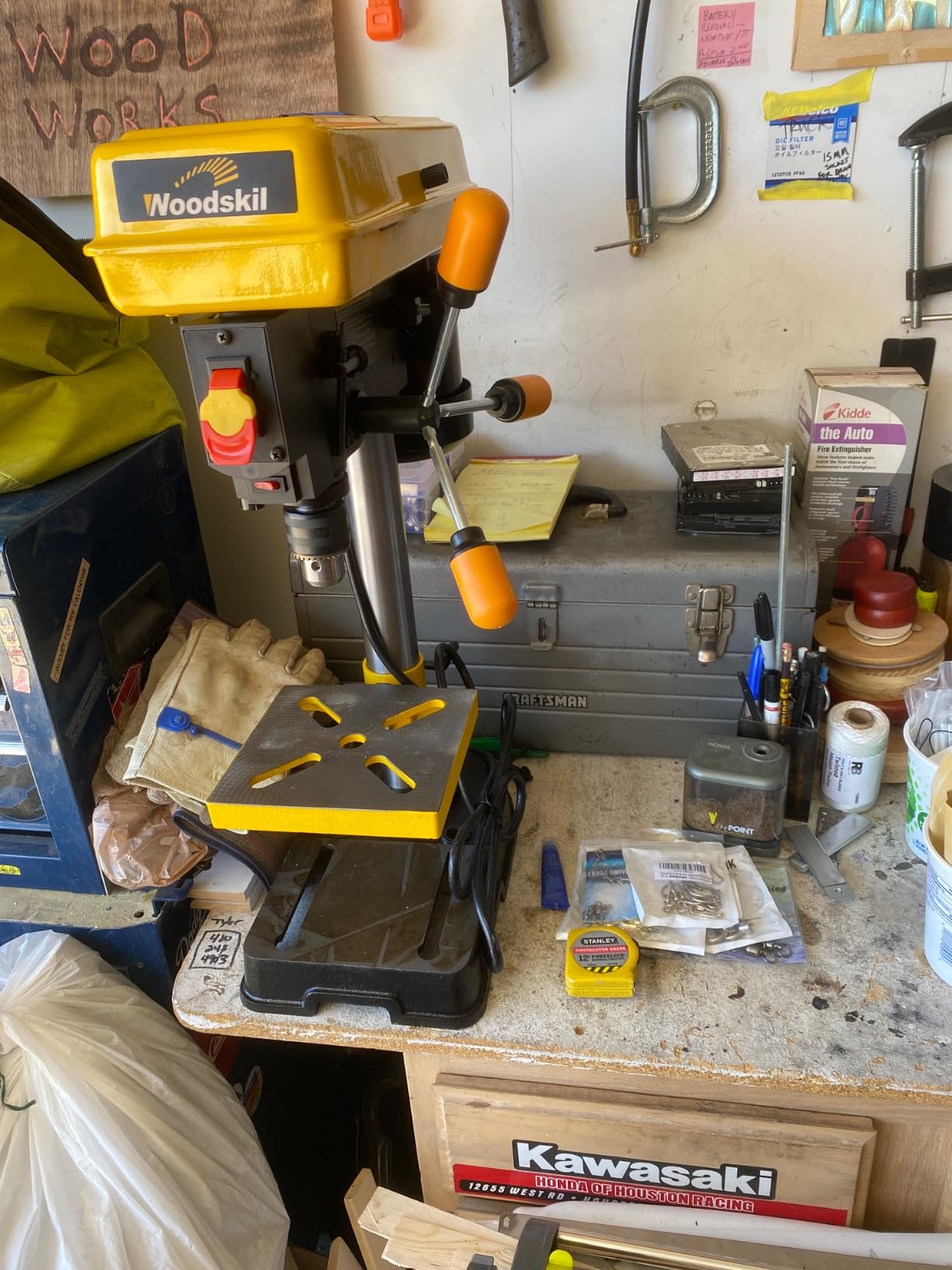
The reason to consider this machine over a similar 8 inch press is the casting. It has a heavy-duty cast iron worktable that bevels 45 degrees to either side and adjusts in height, plus a Class IIIA laser guide to help line up work on a small surface. A cast iron table does not ring or flex the way a thin steel one does, and that shows up in hole quality.
Underneath it is a 1/3 HP 2.3 amp induction motor, a 1/2 inch keyed chuck, 8 inch swing, 2 inch of spindle stroke and five mechanical speeds from 750 to 3,200 RPM. A 2 year limited warranty is included, which is more than several machines at twice the weight.
The 4.2 average across 99 ratings is the honest part. Roughly 11 percent of reviews are 1 star, the highest share among the products here, which points to unit-to-unit variation rather than a design problem. The 2.3 amp motor is tied for the weakest in the group and will not handle large bits or hardwood, and no work light is listed in the specifications.
That combination means this is a light duty press with a better table and a better warranty than most, not a machine for hard continuous work. If a first unit arrives with a defect, the 2 year warranty is your path to a replacement.
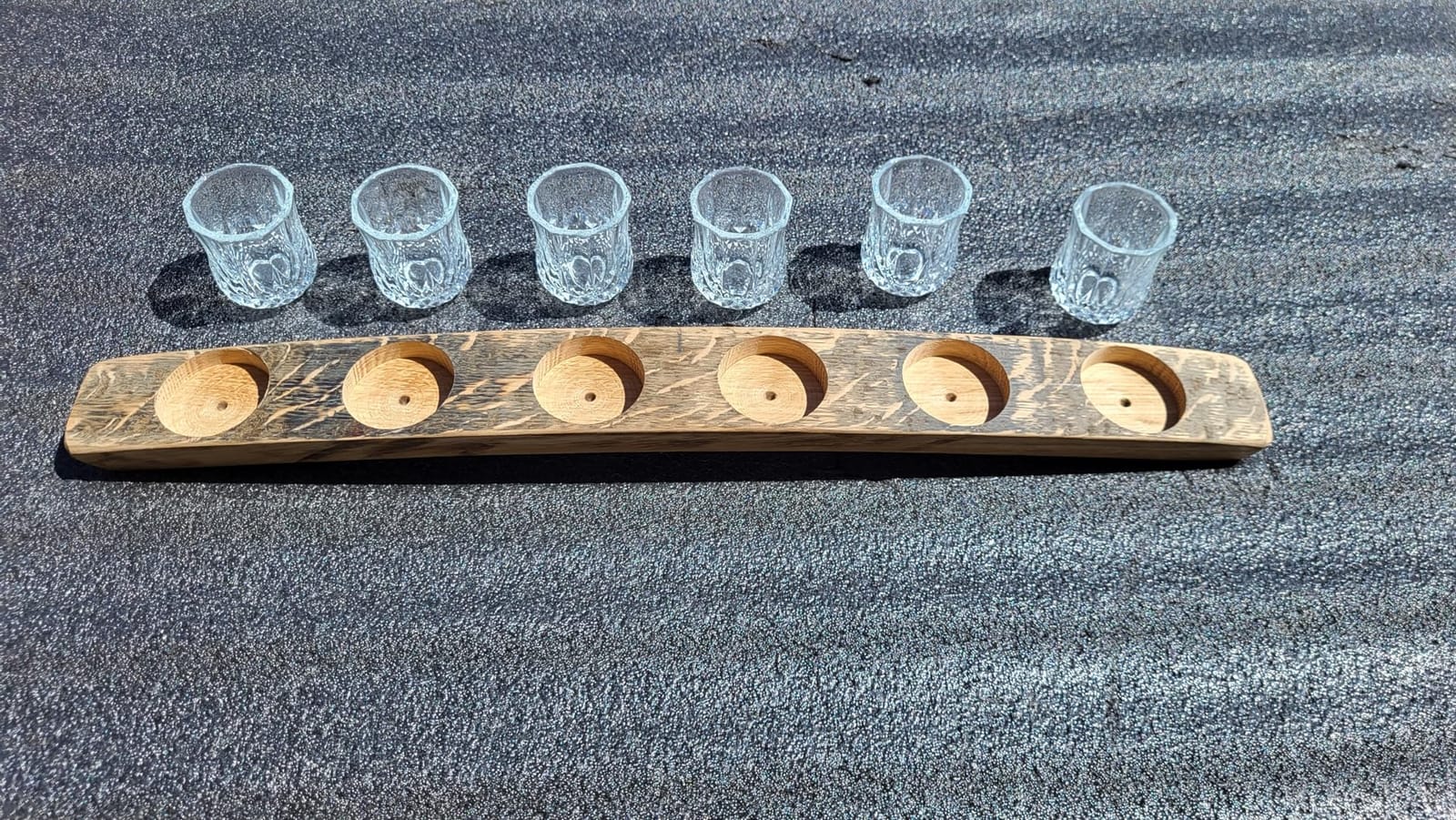
Who this press suits
It suits someone who works mostly in wood at light to medium duty, values a rigid table and an alignment laser, and wants warranty coverage. The laser is the differentiator on a small table, because a beginner marking a line by eye gets a wandering bit. It is a good machine for cabinet hardware, shelves, small furniture and dowel work.
Owners who value a machine that stays put through a long session also like the cast iron weight, which is meaningfully heavier than the pressed steel alternatives at the same swing.
Who should skip it
Skip it if you cannot tolerate some risk of a unit arriving with a defect, given the 1 star share in reviews. Also skip it for steel, for thick hardwood and for large Forstner bits. If your priority is the strongest motor in an 8 inch frame, the 10 inch BUCKTOOL with 6.2 amps is the smarter purchase.
8. WEN DP1263V 12-Inch Variable Speed Drill Press – Best 12-Inch Feature Set
WEN 12-Inch Benchtop Drill Press, 6.2-Amp Variable Speed Motor with Cast Iron Construction, Laser and LED Work Light (DP1263V)
6.2A motor, 12 inch swing, 3-1/8 inch travel
Variable 580-3100 RPM with digital readout
5/8 inch chuck, laser, LED light
Pros
- Owners compare the feature set favorably against a far more expensive Jet
- External speed lever with 4 digit digital RPM readout
- Laser and light integrated into the head with protected toggles
- Cuts 3 inch round holes in a 2x4 without bogging
- Assembly under 5 minutes
Cons
- Table arrived out of square by 0.5 to 1.5 degrees and cannot be adjusted
- 45 degree tilt bolt is hard to reach
- Table wanders when raised so bit center must be rechecked
- Included clamps are of poor quality
- Heavy at 85 pounds
This is the machine owners defend most enthusiastically in the whole guide, at a 4.6 average. The specification list reads like a list priced far higher: a 6.2 amp induction motor, 12 inch swing, 3-1/8 inch of spindle travel, mechanical variable speed from 580 to 3,100 RPM with a digital readout of the current speed, a 5/8 inch keyed chuck with onboard key storage, a Class IIIA laser, an overhead LED work light, a depth stop and a table roller extension.
Owners report cutting 3 inch round holes in a 2 by 4 without the motor bogging, smooth and quiet operation, and a precisely machined taper-mounted chuck. Assembly takes under five minutes and the packaging is reported to protect the contents properly, which matters for an 85 pound machine.
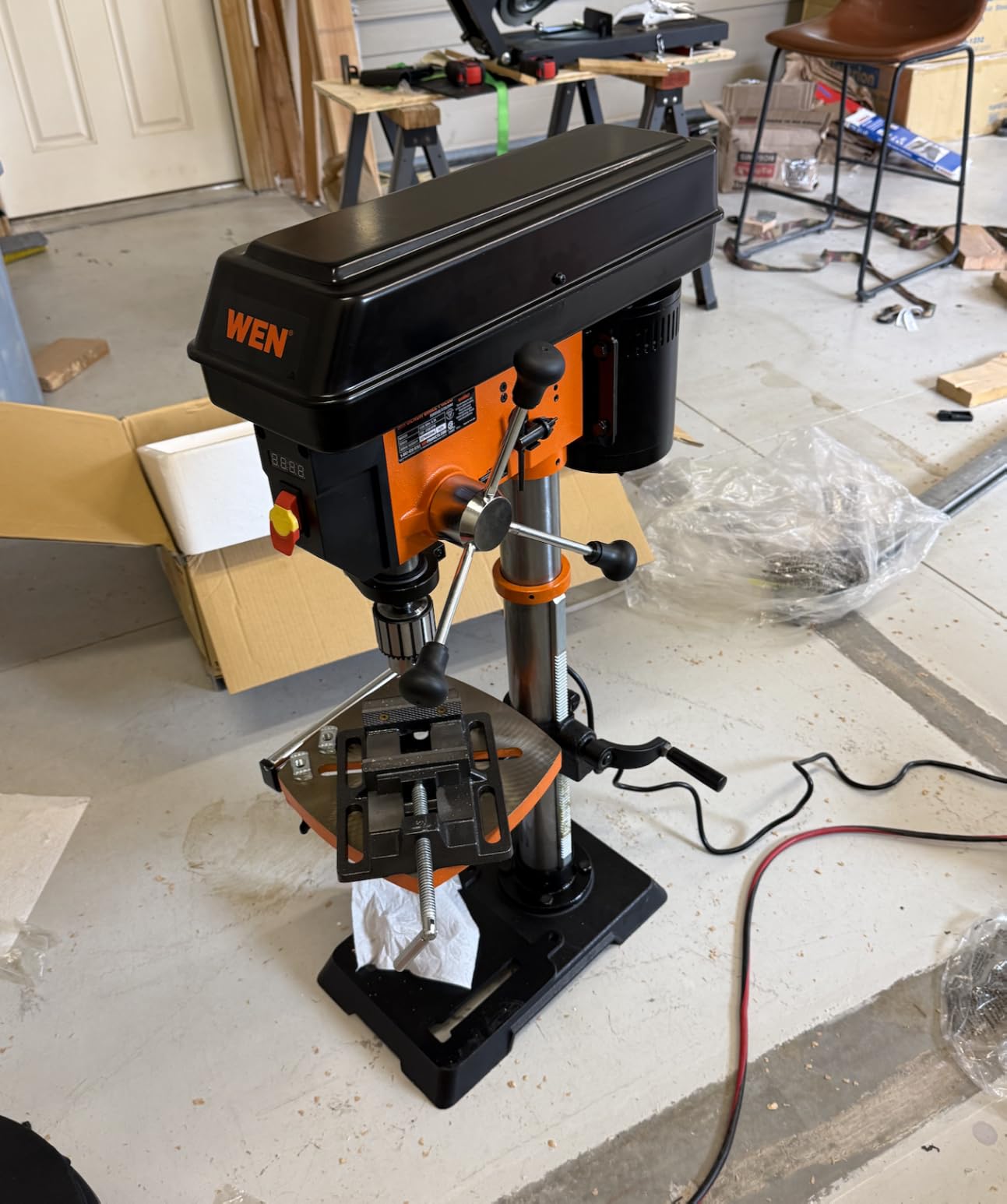
The recurring caveat is the table. Owners report it arriving out of square front to back by roughly 0.5 to 1.5 degrees with no adjustment provided, which means it needs shimming under one corner before the first hole. The 45 degree tilt mechanism is also finicky, adjusted by a hard to reach 19mm bolt, and the table can wander when raised or lowered, so you re-check the bit center each time you change table height.
The included knuckle clamps are of poor quality, so buy a proper set. At 85 pounds it needs its own stand. None of that is a dealbreaker, but you should know about the leveling on day one.
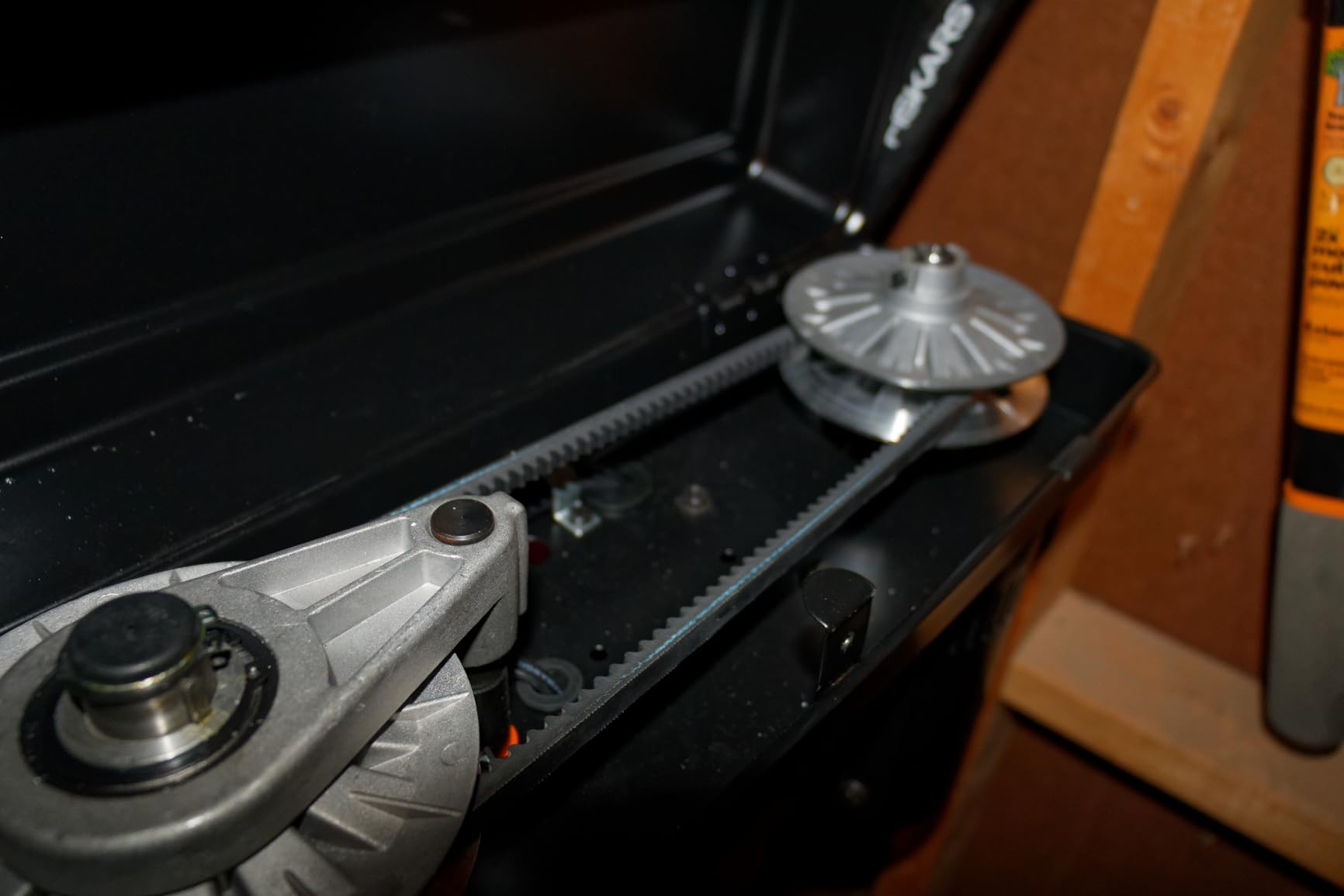
Who this press suits
It suits a woodworker who wants a 12 inch machine with variable speed and a laser at a price closer to mid tier machines, and anyone who prefers a readout to a belt change. The 3-1/8 inch travel gives room for large Forstner bits and boring operations, and the roller extension supports longer work.
A 2 year warranty is included. Just set aside twenty minutes on arrival to level the table with shims, because that step determines whether your holes are square.
Who should skip it
Skip it if you want a table that stays aligned without attention, or if you need to move the machine between locations often. If you care most about runout being measured rather than assumed, the 12 inch BUCKTOOL below has direct dial indicator evidence. And if you are working thin sheet material, check the table squareness first, since that is exactly the job the flaw affects.
9. VEVOR DP1006L 10-Inch Drill Press – Best for Cast Iron Rigidity
VEVOR Benchtop Drill Press, 3.2 Amp and 5-Speed Adjustable Drill Press with 10 in Swing, Cast Iron Frame, Worktable Tilts 0-45°, Ideal for Drilling Wood & Metal
10 inch swing, 3.2A induction motor, 41.9 pounds
HT200 cast iron frame
5 speeds 650-3100 RPM, tilting table
Pros
- Heaviest and most solidly built at this swing
- Chuck arrived aligned and ran true
- 10 inch swing gives 5 inches of clearance from column to bit center
- Work light illuminates the layout line
- Good chuck quality for the money
Cons
- One buyer received a motor with a scraping sound and returned it
- another arrived with a rusty base
- Moving the motor to change belts takes real effort
- No digital readout and no laser on the shipped machine
Weight and material are the argument for this one. At 41.9 pounds with an HT200 cast iron frame, it is the heaviest and most solidly built machine in this guide below 12 inches, and owners say it stays planted under drilling pressure where thin steel frames shuffle. It has a 10 inch swing, which works out to 5 inches of clearance from the column to the bit center, more than you get from the usual 8 inch machine.
Speeds run at 650, 1,050, 1,800, 2,350 and 3,100 RPM from a 3.2 amp induction motor. The table tilts from 0 to 45 degrees, and the box includes a complete accessory kit with hex wrenches, table assembly, base, column, table crank, feed handles, worm gear, table lock handle, chuck and chuck key. Owners particularly like that the chuck arrived aligned and ran true, which they consider the deciding factor on a budget press.
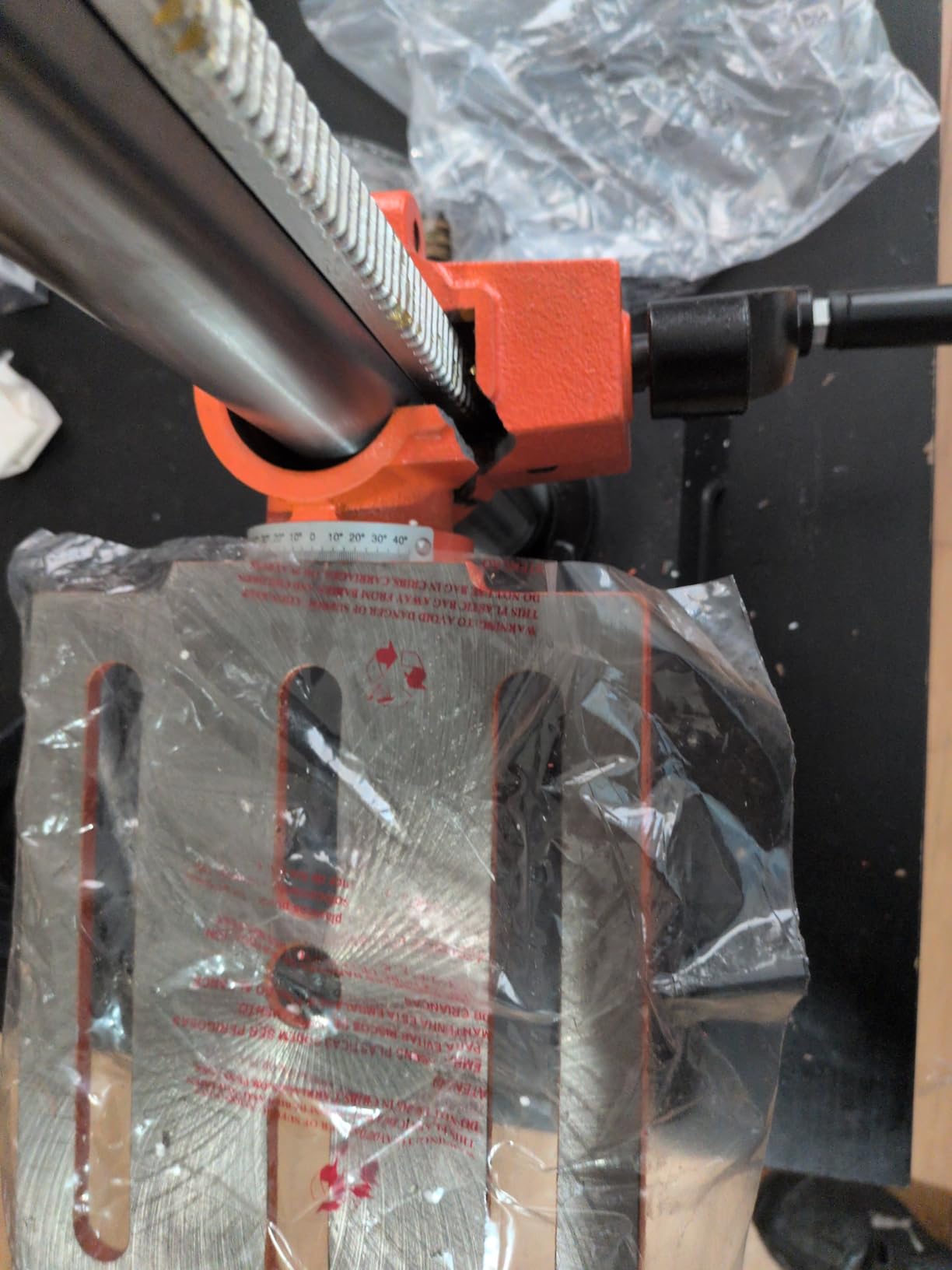
At 4.3 across 76 ratings, the feedback is noticeably split by unit variation and by a mismatch between the listing video and the machine actually shipped. One buyer received a press whose motor had a metal scraping sound and returned it, and another arrived with a rusty base. There is no digital RPM display and no laser on the machine you receive, contrary to the promotional material.
Assembly of the rack through the table support is reported as confusing and can take far longer than the stated 25 to 30 minutes. The slowest speed of 650 RPM is still too fast for large Forstner bits and hole saws, and moving the motor to change belts takes real effort once it is loosened.
Who this press suits
It suits someone who values stability and a true chuck over features, and who drills hardwood on a 10 inch machine rather than sheet metal. The work light illuminating the layout line, where your own shadow would otherwise fall, is a genuinely useful detail for marking and centering. It is a good value pick if the unit you receive is a good one.
Check the motor the moment it arrives, run it for a minute, and have your return path clear before assembly.
Who should skip it
Skip it if you need a laser, a digital readout or low speed for large bits, or if you cannot accept the possibility of a unit-to-unit problem given the split reviews. For steel or repeated speed changes, one of the 6.2 amp variable speed machines is a better fit. We would also verify the shipped configuration against the listing before ordering.
10. PioneerWorks BDP-100 8-Inch Drill Press – Best Entry Press for a Tight Bench
Benchtop Drill Press, 2.5Amp Bench Drilling Machine with 5-Speed Adjustable, 8 Inch Swing Distance 0-45° Tiltling Tabletop Drilling Machine for Wood, Metal
2.5A motor rated 300 watts
5 speeds 740-3100 RPM
Laser, LED work light, bump-off switch
Pros
- Lowest cost functional press in the group
- Runs quiet and smooth for its class
- 2.5 amps is higher than most comparable budget models
- One owner cut clean 1/2 inch angled holes in aluminum deck posts using a jig
Cons
- Table lock bolt will not hold tight and can drop under pressure
- No laser included on at least one unit despite the listing
- Casting flash on the column clamp had to be fitted by hand
- Unclear instructions with an unidentified Allen key
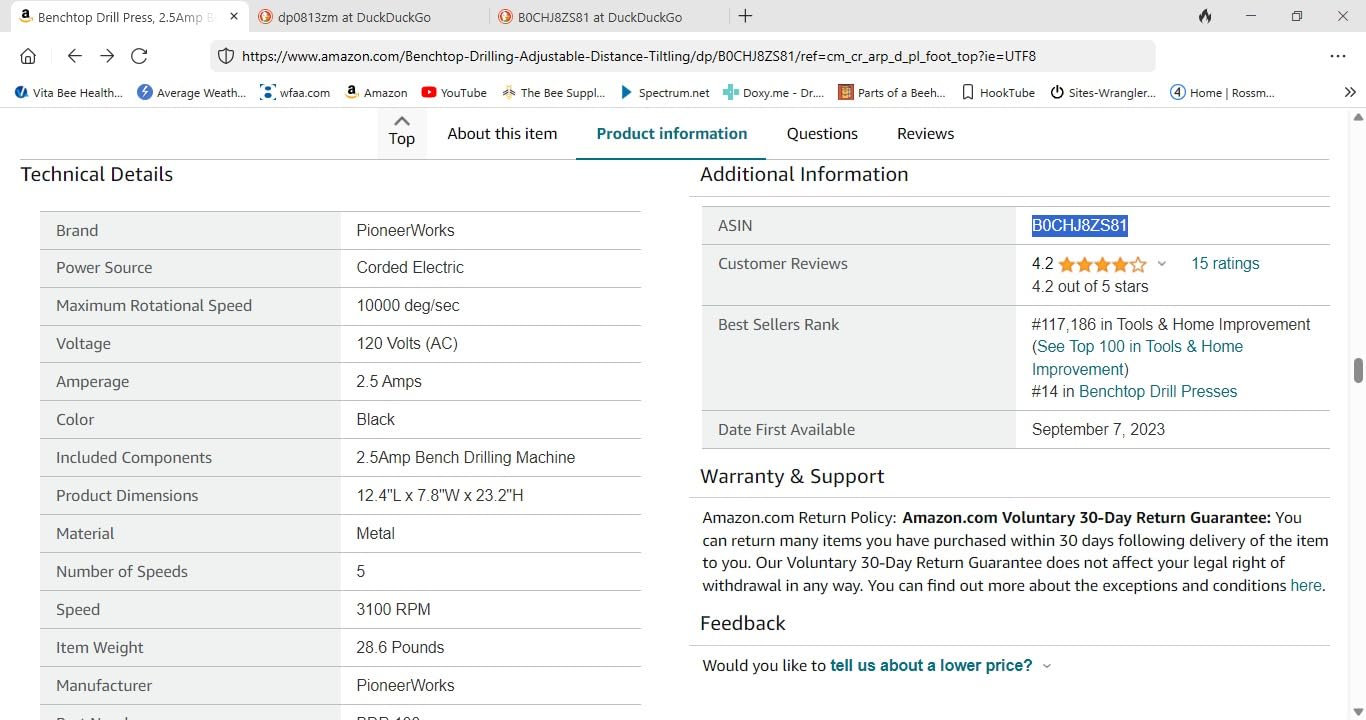
This is the cheapest press here that still functions, and several buyers note it is essentially the same tool as a well known brand in a different color. What you get for that is a 2.5 amp induction motor rated 300 watts, five speeds from 740 to 3,100 RPM, 8 inch of swing, a tilting table and a bump-off safety switch. The amperage is higher than most machines at this level.
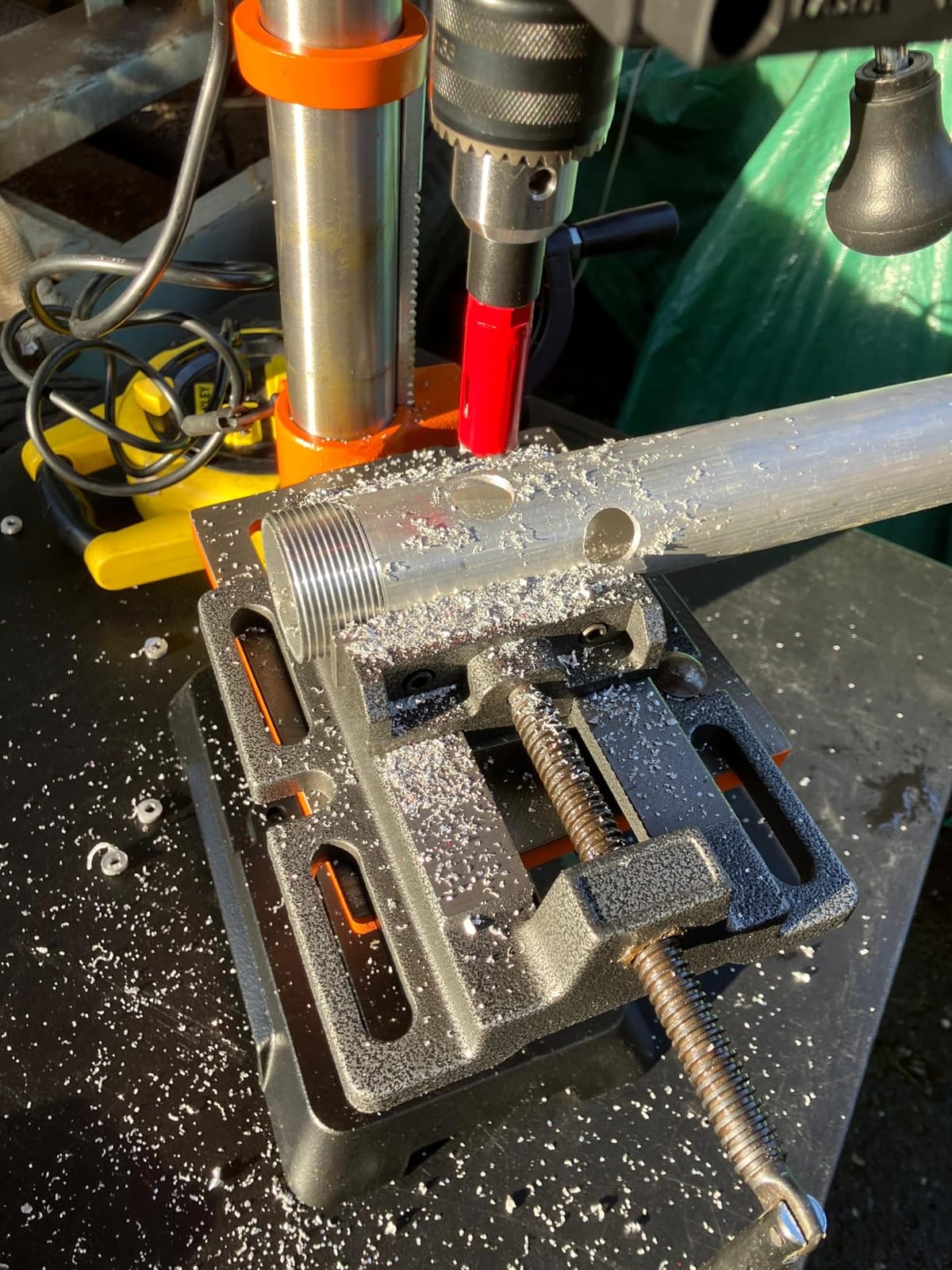
It also carries a laser alignment system and a built-in LED work light, which is more than many pricier presses offer, plus an adjustable depth stop. At 28.6 pounds it is easy to reposition, and one owner used it with a jig to cut clean 1/2 inch angled holes through aluminum deck posts.
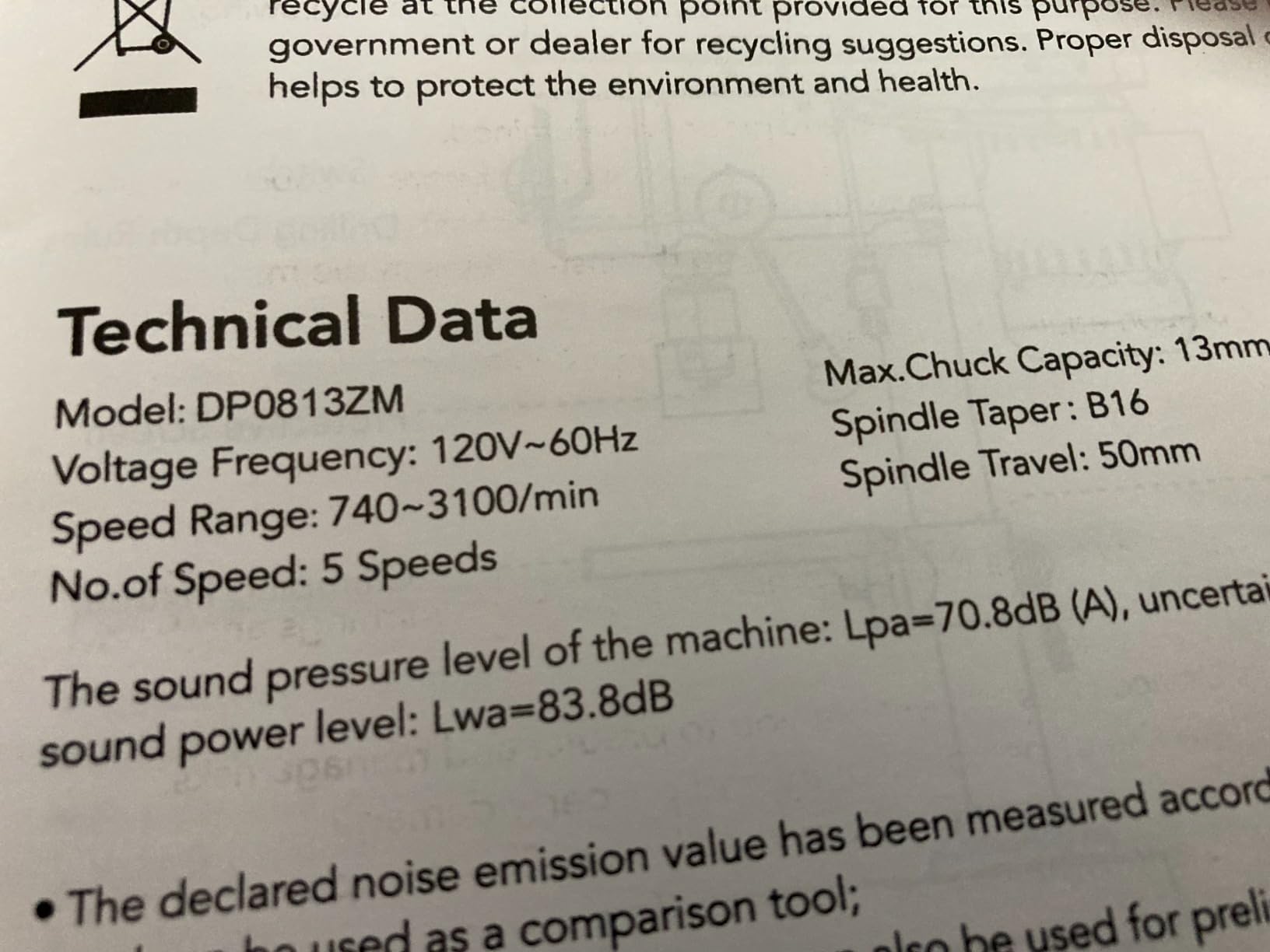
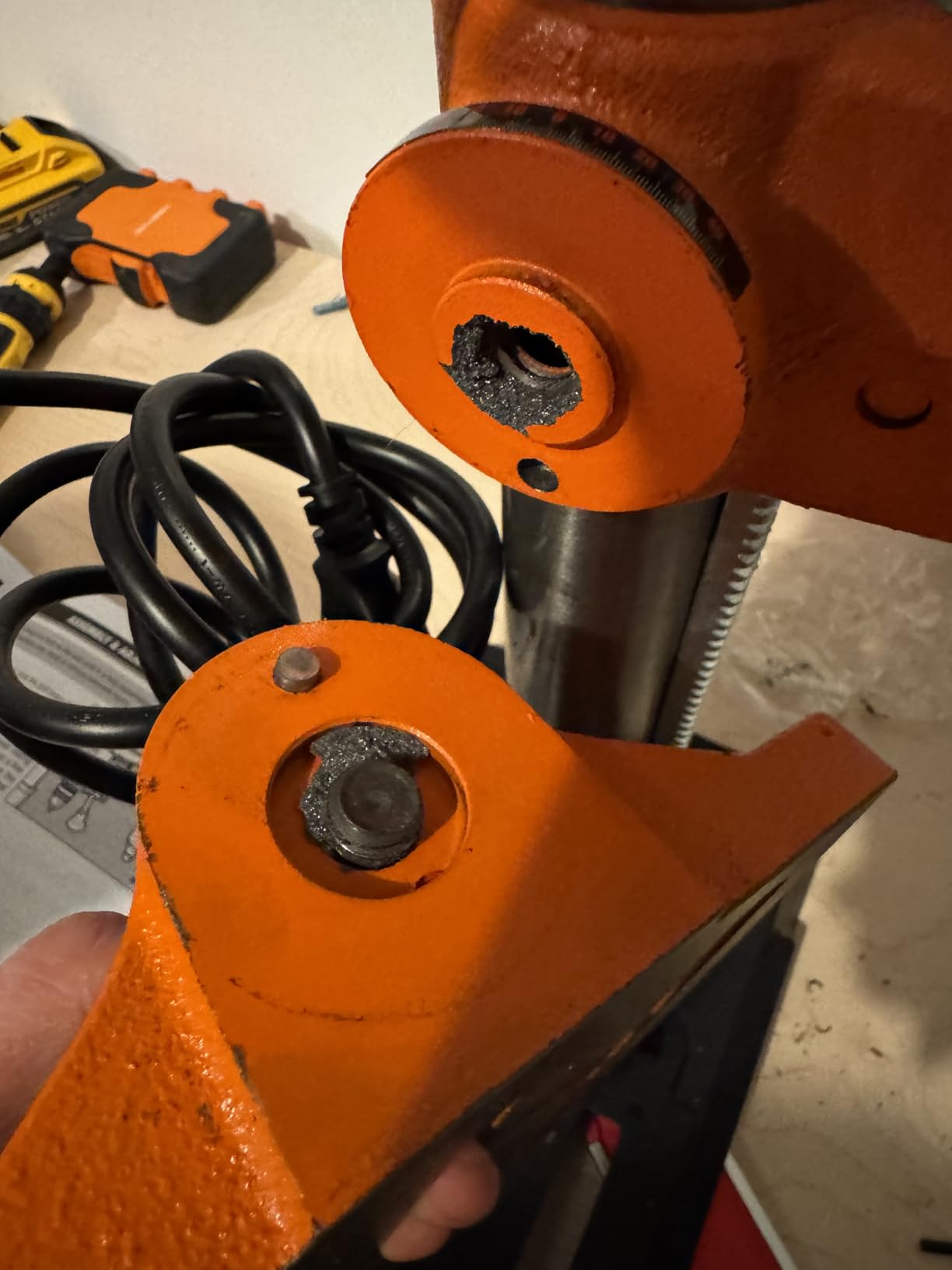
The recurring complaint is the table lock. Owners report that the retaining bolt will not hold the table tight enough, so it can drop under drilling pressure, which is exactly the moment you do not want movement. At least one unit arrived with no laser despite the listing advertising an accurate one, and a column clamp had casting flash that needed hand fitting. The instructions are unclear, including a large Allen key that is not identified, and the manual model number does not match the listing.
Owners describe it as slightly wobbly and not a shop grade machine, and that is the fair read. It is a capable entry level press for woodworking, not a tool for daily work.
Who this press suits
It suits a first-time builder, a renter sharing a workspace, or anyone who needs a working press for occasional assembly and craft work without spending much. The laser and light help a beginner center holes, and the tilt handles angled work without moving the workpiece. If your drilling is mostly small holes in wood or light aluminum, it is enough.
Tighten the table lock with a wrench during assembly and re-check it monthly, since that fixes most of what people dislike about it.
Who should skip it
Skip it if you want a machine that stays put under load, if you are buying it as a long term shop tool, or if a missing laser would end the experience for you. It is also the wrong choice for steel and thick hardwood. A 10 inch press with a 6.2 amp motor is a small step up that removes most of these complaints.
11. WEN DP1050 10-Inch Drill Press – Best for Large Forstner Bits in Wood
WEN 10-Inch Benchtop Drill Press, Chuck Key Storage, Laser Guide, 6.2-Amp 5-Speed Motor with Cast Iron Construction, Laser and LED Work Light (DP1050)
6.2A induction motor, 10 inch swing
5 speeds 630-3300 RPM
Laser, LED work light, depth stop
Pros
- Torque from the 6.2A motor is enough for 1-5/8 inch Forstner bits in cherry
- Shaft to table tilt alignment was impressive out of the box
- Onboard wrench and chuck key storage clips
- Quiet and simple to assemble
Cons
- Instructions have real errors
- including missing pre-drilled holes and a hammer-out tilt pin
- Belt tension too tight out of the box and possible spindle runout
- Plastic chuck pulley set screw needs tightening and capacitor can fail
- Replacement parts service reported as slow
Torque is what this machine offers. The 6.2 amp induction motor is strong enough to drive a 1-5/8 inch Forstner bit through cherry, which is more than most 10 inch presses at this size can do, and it runs five speeds from 630 to 3,300 RPM. Owners also report that the shaft-to-table tilt alignment was impressive straight out of the box, and the onboard wrench and chuck key storage clips are a genuinely useful touch.
It is a 120 volt machine with a 1/2 inch chuck, a 7.5 by 6.5 inch beveling table, a Class IIIA laser, an LED work light, an adjustable depth stop, a lockout power switch and a 2 year warranty. At 28.75 inches tall with a base of 8.2 by 13.5 inches, it fits a bench far more easily than the 12 inch machines here.
At 4.1 across 64 ratings, this is the lowest rated press in the guide, and the reasons are specific. Reviewers repeatedly cite assembly instruction errors, including no pre-drilled holes in the column and a table tilt pin that has to be hammered out, plus post-to-front alignment that is off and cannot be adjusted.
There is also a belt tension complaint: several owners report the belt is too tight out of the box, and one believes that bent the spindle pulley and caused heavy runout. Thin table edges are not ideal for larger workpieces, the plastic chuck pulley set screw commonly needs tightening, and a start capacitor failed on one unit. Slow replacement parts service is also reported.
Who this press suits
It suits a woodworker whose bottleneck is a single large boring job in hardwood, in a small footprint. If you need to cut a 1-5/8 inch Forstner in cherry repeatedly and the bench is too small for a 12 inch machine, this is a targeted answer. The laser and lockout are useful additions for someone working alone.
Plan to spend time adjusting the belt tension and checking runout on day one rather than assuming it is right.
Who should skip it
Skip it if you want a machine that arrives correctly assembled, because the instruction problems here are real and repeated. Skip it if spindle runout would affect your work, since the belt tension fault is a documented cause. For a similar motor with a better consensus behind it, the BUCKTOOL 10 inch machine covers the same ground with fewer complaints.
12. SHOPMAX 8-Inch Drill Press – Best Light-Duty Crafting Press
SHOPMAX 8 inch 9 adjustable speeds 4.2 Amp Benchtop Drill Press
0.68 HP 4.2A electric motor
1/2 inch keyed chuck, 2 inch travel
8 inch swing, rotating and tilting table
Pros
- 4.2 amp motor gives noticeably more current than the 2.3 and 2.5 amp budget presses
- Rotating and tilting table supports a wide range of drilling angles
- Lightweight at 25.4 pounds and easy to reposition
Cons
- Specification data conflicts
- listing 5 speeds while the title advertises 9
- Metal drilling capacity listed as only 0.2 inches
- Smallest review base here
- so long term durability is poorly documented
The 4.2 amp motor is the reason this machine is worth a look in the 8 inch class. Most budget presses use a 2.3 or 2.5 amp motor, and the difference shows when you drill anything more demanding than a small pilot hole in pine. The table rotates 360 degrees and tilts up to 45 degrees to either side, which gives a lot of setup flexibility for a machine at this level.
It has a 1/2 inch keyed chuck with 2 inch of spindle travel, 8 inch of swing, an adjustable depth stop and five speeds, all from a 25.4 pound machine that is easy to carry between a workbench and a garage floor. It is sold by YARDMAX under manufacturer part number SD0813.
Buy it knowing two things. First, the specification data is internally inconsistent: the title advertises 9 adjustable speeds from 500 to 3,200 RPM while the specification table lists 5, so confirm what you actually receive. Second, the listed metal drilling capacity is 0.2 inches, the lowest of any machine in this guide, so treat metal as off the table despite the motor.
At 52 ratings it is the least reviewed product here, which means long term durability is not well documented. The 4.1 average is not a warning sign in itself, but there is less evidence behind it than the other picks.
Who this press suits
It suits hobby and craft work, model building, small parts and light wood projects where you want more turning power than a 2.3 amp press offers without moving up in size. The rotating table is a real convenience when you are working on a part from several faces, and the light weight makes it easy to clear the bench for other jobs.
It is a reasonable stopgap for an occasional user and a poor investment for a daily shop tool.
Who should skip it
Skip it for metalworking of any kind, given the 0.2 inch capacity figure. Skip it if you are sensitive to inconsistent product data, because the speed conflict is on the seller’s own listing. And skip it if you want a machine with a long service life ahead of it, because there is not enough owner history yet to say. For an 8 inch press with clearer documentation, the 8 inch VEVOR is the safer pick.
How to Choose a Drill Press for a Home Shop?
Ignore the number on the head for a moment and work through this in order: what you will drill, how big the largest workpiece is, how much room you have, and how often you will change speed. The swing number on the box tells you almost none of that on its own, and buyers who regret a purchase nearly always regret a swing that was too small or a motor that was too weak.
Swing versus stroke. Swing is the distance from the column to the chuck center, which sets the diameter of the largest circle the bit can reach over the table. Stroke, or quill travel, is how far the spindle moves down. A 10 inch press gives about 5 inches of clearance from column to bit center, not a 10 inch hole. For a Forstner bit you need both a wide swing and 2 to 3 inches of travel.
Chuck size tells you the class of machine. A 1/2 inch chuck caps you at 1/2 inch twist bits and 1-5/8 inch Forstner bits, which covers most woodworking. A 5/8 inch chuck is the threshold owners treat as a serious machine, because it opens larger hole saws and boring heads. If you plan to drill 3/8 inch steel plate, you want a 1/2 inch chuck minimum and more amperage behind it.
Amperage matters more than the horsepower label. A 2.3 or 2.5 amp motor is a light duty woodworking motor. A 6.2 amp motor, which most modern presses rate at about 3/4 to 1 HP, is what lets you feed a large bit in hardwood or drill mild steel. Experienced builders consistently use sustained drilling without motor bog as the benchmark rather than the nameplate number, and that is the test to trust.
The slowest speed decides whether you can drill metal. Steel wants roughly 250 to 500 RPM. If the lowest speed on your press is 610 RPM or 650 RPM, you can drill thin mild steel, but you cannot drill a large bit in hardwood properly because the bit needs a slower speed for its own diameter. A press with 500 RPM or below at the bottom of its range is the one that handles both materials.
Step pulley or variable speed. A step-pulley press changes speed by moving a belt between pulley grooves, which needs a wrench and the machine stopped. It is reliable, cheap and lasts a long time. Variable speed, whether electronic or mechanical through an eccentric, changes speed with a lever or knob while running. If you switch between wood and metal in one session, variable speed is worth the money. If you set a speed and stay on it for a whole afternoon, the belt press is fine.
Table features that change your work. A table that tilts and rotates means you can drill angled holes and holes into the side of a workpiece without repositioning the part by hand. A table with T-slots or grooves accepts a fence or a stop for repeated drilling. Roller extensions support long stock so the workpiece does not close on the bit. Above all, check how well the table lock holds, because a table that drops under pressure ruins the hole.
Laser guide and work light. Both are genuinely useful for beginners and a genuine time saver for everyone. A laser removes the guesswork of centering a bit on a small table, and a light positioned over the drilling area stops your own shadow from hiding the layout line. Neither substitutes for a good chuck, and cheap implementations are sometimes absent from the shipped machine, so read the specification list rather than the promotional video.
Rigidity and runout. Cast iron and thick steel castings feel planted and hold accuracy. Thin folded steel rings and shift under load. Runout, the amount the bit wanders off true as it spins, is what makes a 1/2 inch hole come out 1/2 inch at the top and slightly over at the bottom. Where owners have measured it with a dial indicator, the results differ sharply between machines of similar specification, so treat the measurement as more useful than the brand name.
What a drill press cannot do. A drill press will not replace a mill. It has no sideways power, so cutting an edge, slotting a workpiece or surfacing a board is not a drilling operation. Accessories sold to turn a press into a milling machine exist, but they are a project, not a purchase, and a press light enough for a bench will not hold a cutter. If you need to cut material, buy a mill. As one long-running shop forum put it, no drill press is going to do the job of a mill, and pretending otherwise damages both the tool and the workpiece.
One more note on new versus used. Forum buyers argue this constantly, and the consensus is that a good used floor model beats a new budget benchtop press for metalwork, while a new machine with a warranty wins for occasional woodwork. A used press with visible spindle play is not worth the money at any price, because play cannot be dialed out.
For more of the home equipment we test, our tested home setup roundups cover the rest of the workshop.
Safety Before the First Hole
Do not wear gloves at a drill press. A spinning chuck will catch a glove, a loose sleeve or a rag and pull your hand into the bit. Keep hands clear of the worktable when the machine runs, tie long hair back, and wear eye protection because a Forstner bit can throw chips and wood dust straight back at you.
Clamp the work. Every time. A workpiece held by hand can grab the bit and yank the part, and it can shift mid-hole, which bends the bit and ruins the hole. Stop the machine before changing bits, adjusting the table or reaching near the chuck, and wait for the chuck to stop turning before you touch anything near it.
Stop immediately if the bit grabs, the motor sound drops, the table shifts or the machine starts to walk on the bench. Unplug it, and bolt it down. A cut that stops is an inconvenience; a pulled-in arm is a serious injury.
Frequently Asked Questions
What is the best drill press for a home shop?
For most garage and basement shops, a 10 inch benchtop press with a 6.2 amp motor is the best fit. It covers dowel and joinery work in wood, handles Forstner bits up to 1-5/8 inch, and can drill mild steel in occasional use. If you build large stock or thick hardwood regularly, step up to a 12 inch bench column press with a cast iron base and a 5/8 inch chuck, and plan a stand because those machines weigh 85 to 90 pounds.
What are the three types of drill presses?
The three main types are benchtop, bench column and floor model. Benchtop presses bolt to a workbench, run 8 to 10 inch swing and weigh 25 to 45 pounds. Bench column presses stand on the floor beside a bench, offer 12 inch swing, deeper travel and larger chucks, and weigh 85 to 90 pounds. Floor model presses start around 15 inch swing with a foot pedal and a larger motor, and radial arm presses swing the head along a rail to reach long stock.
What is the best benchtop drill press for the money?
The SKIL DP9505-00 is the strongest value in this group because it pairs a 6.2 amp induction motor rated near 1 HP with a laser alignment system, an LED work light, an adjustable depth stop and a table that tilts 45 degrees in both directions. Owners report drilling hardwood to 3 inches and steel to 3/8 inch. Its main weakness is inconsistent quality control on table assembly, so check the table reaches true zero on arrival.
What is a good HP for a drill press?
For most home woodworking, a motor between 1/3 HP and 1/2 HP is enough, and modern machines list that as roughly 2.3 to 5 amps. If you drill metal or bore large holes in hardwood, look for 6.2 amps, which is about 3/4 HP. Sustained drilling without the motor bogging down matters more than the number on the label, so judge a press by how it feeds a bit in your hardest material rather than by its nameplate horsepower.
Can a drill press be used for milling?
No, not as a practical matter. A drill press drives the cutter straight down, so it can only drill holes. It has no sideways power to cut an edge, slot a workpiece or surface a board, and conversion accessories are a project rather than a purchase. If your work involves cutting material rather than making holes, a benchtop or floor mill is the right tool. A spindle sander is a separate and achievable use for a bench press with a tilting table.
Should I wear gloves when operating a drill press?
No. A glove, loose sleeve or rag can be caught by a rotating chuck and pulled into the bit. Keep hands away from the worktable while the machine runs, tie long hair back, wear eye protection, and clamp the work rather than holding it. Also stop the machine and unplug it before changing bits or adjusting the table, and wait for the chuck to stop turning before reaching near it.
Final Verdict: Which Drill Press Fits Your Shop
For an apartment bench or a shared corner, the VEVOR DP8 is the practical answer at 25.4 pounds, and the PioneerWorks BDP-100 works if your drilling is occasional and your budget is tight. Neither will touch metal, and both are honest light duty machines.
For a garage or basement shop doing furniture, cabinetry and dowel work, the WEN 4206T is our first pick and the one we would buy. Its cast iron build, 797 owner ratings at 4.6 and 32 pound weight make it the most dependable starting point, and the SKIL DP9505-00 is the value alternative when you want a 6.2 amp motor and a laser in the same box.
For a mixed wood and metal shop, the BUCKTOOL DP12VL is the best drill press for the money in this guide on measured runout, and the JET JWDP-12 is the one to buy when continuous variable speed and a long warranty justify spending more. Both are 85 to 90 pound machines, so build a stand and bolt them down. That is the short version of the best drill press machines for home shops in 2026: match the motor to your hardest material, and check the table on day one.