
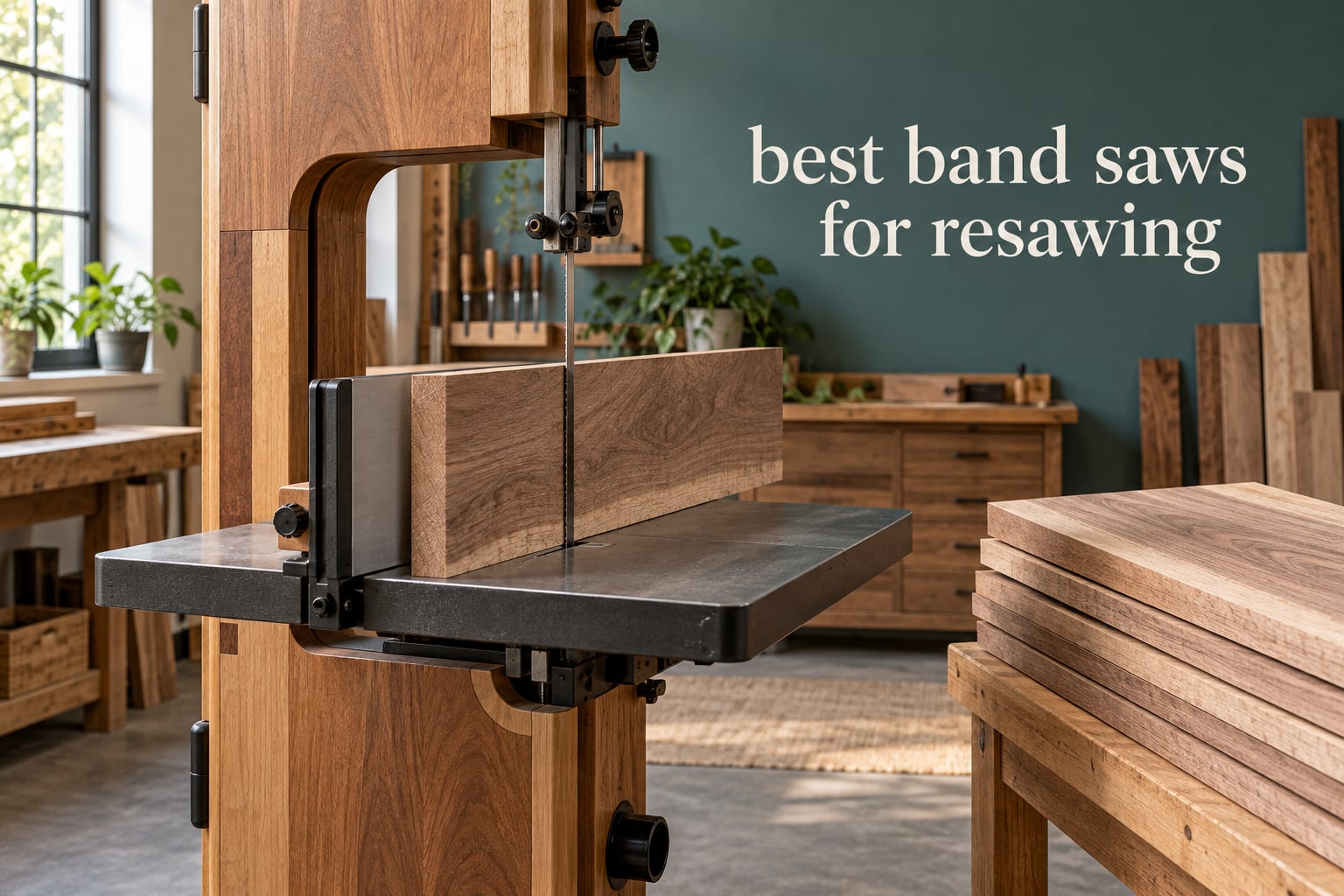
The best band saws for resawing are the machines that keep a wide blade straight and cool while it works down through a flat-lying board. Our pick for most shops is the JET 14-Inch 1.75 HP Band Saw, which pairs 13 inches of advertised resaw capacity with a cast-iron table, independently adjustable ball-bearing guides and a machined-aluminum resaw fence in the box. If your shop runs on 240V and you want ceramic guides instead, the Laguna MBAND1412-175 is the alternative we would own.
Resawing is the least forgiving thing you can ask a band saw to do. On a curved cut the blade spends a second or two in the wood; on a resaw it stays buried the entire length of the board, and any wobble in the blade, the guides or the fence prints itself across the face of every leaf you cut. That is why the machines that shine at scroll work and slicing small parts often disappoint people whose real goal is book-matched panels and hardwood veneer.
We compared ten band saws that span roughly 5 inches to 13 inches of advertised resaw capacity, from 1/2 HP benchtop machines to a 3/4-inch-blade-capable 14-inch saw with two speeds. Every machine here was assessed on the four things that decide resaw quality: advertised versus usable capacity, motor headroom, blade guide construction, fence rigidity. We also read long-term owner reports, because the saw you keep for fifteen years is not always the saw that looks best on day one.
Updated for 2026. We earn a commission when you buy through links on this page, at no additional cost to you.
Table of Contents
Key Features to Look For in a Resaw Band Saw
Four criteria separate a resaw-capable saw from a general-purpose band saw. Everything else on the spec sheet is secondary to these.
Motor headroom: 1.75 HP to 2.5 HP covers standard 12-inch to 14-inch resaw work. Below 1 HP the motor bogs down in wide, dense hardwood like walnut or white oak, and the cut wanders and burns.
Resaw capacity: Look for at least 12 inches of vertical cutting capacity if you handle thick material. Remember that advertised capacity is measured with the blade perfectly centered, so real usable capacity is smaller.
Blade guides: Ceramic or heavy-duty ball-bearing guides hold a wide blade stable and reduce the friction and heat that spoil a resaw face.
Fence rigidity: A tall, stiff resaw fence at least 6 inches high keeps a wide board from tipping into the blade. Many machines include a thin extruded aluminum fence that needs an auxiliary face.
Dust collection matters more than buyers expect. Resawing produces a surprising amount of fine sawdust, and dust packed into the lower cabinet and wheel rim is one of the most common reasons tracking goes off. Look for a 4-inch port on a 14-inch saw and a 3-inch port minimum on a 10-inch.
Top 3 Band Saws for Resawing in 2026

JET 14 in 1.75 HP Band Saw
- 13 in resaw capacity
- 1.75 HP motor
- Ball-bearing guides
- Resaw fence included
Laguna MBAND1412-175 14 x 12
- 13 in resaw capacity
- Ceramic guides
- Dual voltage 115/230V
- Quick-release tension

WOODSKIL 10 in Benchtop
- 5-1/8 in cutting height
- Dual speed 2360/3000 FPM
- 6 ball bearing guides
- Tool-free doors
All 10 Band Saws Compared for Resawing
| Product | Specs | Action |
|---|---|---|
| JET 14 in 1.75 HP Band Saw |
|
Check Latest Price |
| Laguna MBAND1412-175 14 x 12 |
|
Check Latest Price |
 JET JWBS-14CS 14 in Closed Stand JET JWBS-14CS 14 in Closed Stand |
|
Check Latest Price |
 WEN BA1487 14 in Two-Speed WEN BA1487 14 in Two-Speed |
|
Check Latest Price |
 JET JWB-10 10 in Benchtop JET JWB-10 10 in Benchtop |
|
Check Latest Price |
 WEN BA3962 10 in Two-Speed WEN BA3962 10 in Two-Speed |
|
Check Latest Price |
| WOODSKIL 10 in Benchtop |
|
Check Latest Price |
 Grizzly G0555XH 14 in Extreme Series Grizzly G0555XH 14 in Extreme Series |
|
Check Latest Price |
 WEN BA1411 14 in Dual-Voltage WEN BA1411 14 in Dual-Voltage |
|
Check Latest Price |
 Rikon 10-310 10 in with Stand Rikon 10-310 10 in with Stand |
|
Check Latest Price |
Four of the ten machines here top out at 6 inches of resaw capacity or less, which is fine for cutting parts and thin material and genuinely unsuited to wide resaw work. If veneer and book-matched panels are on your list, focus on the six machines that clear 8 inches.
1. JET 14-Inch 1.75 HP Band Saw – Best Overall Resaw Saw
JET 14″ Woodworking Band Saw, 1.75 HP, 13″ Deep-Cut Resaw Capacity
13 in resaw capacity
1.75 HP capacitor-run motor
1/8-3/4 in blade range
14 in wheels
Pros
- 13 inch resaw capacity handles thick boards
- Ball-bearing guides adjust independently
- Includes a machined-aluminum resaw fence
- 360 square inch cast iron table
- 5-year warranty
Cons
- Blade sold separately
- Heavy saw needs two people to place
- Rewiring to 230V is awkward
- Included fence could slide more smoothly
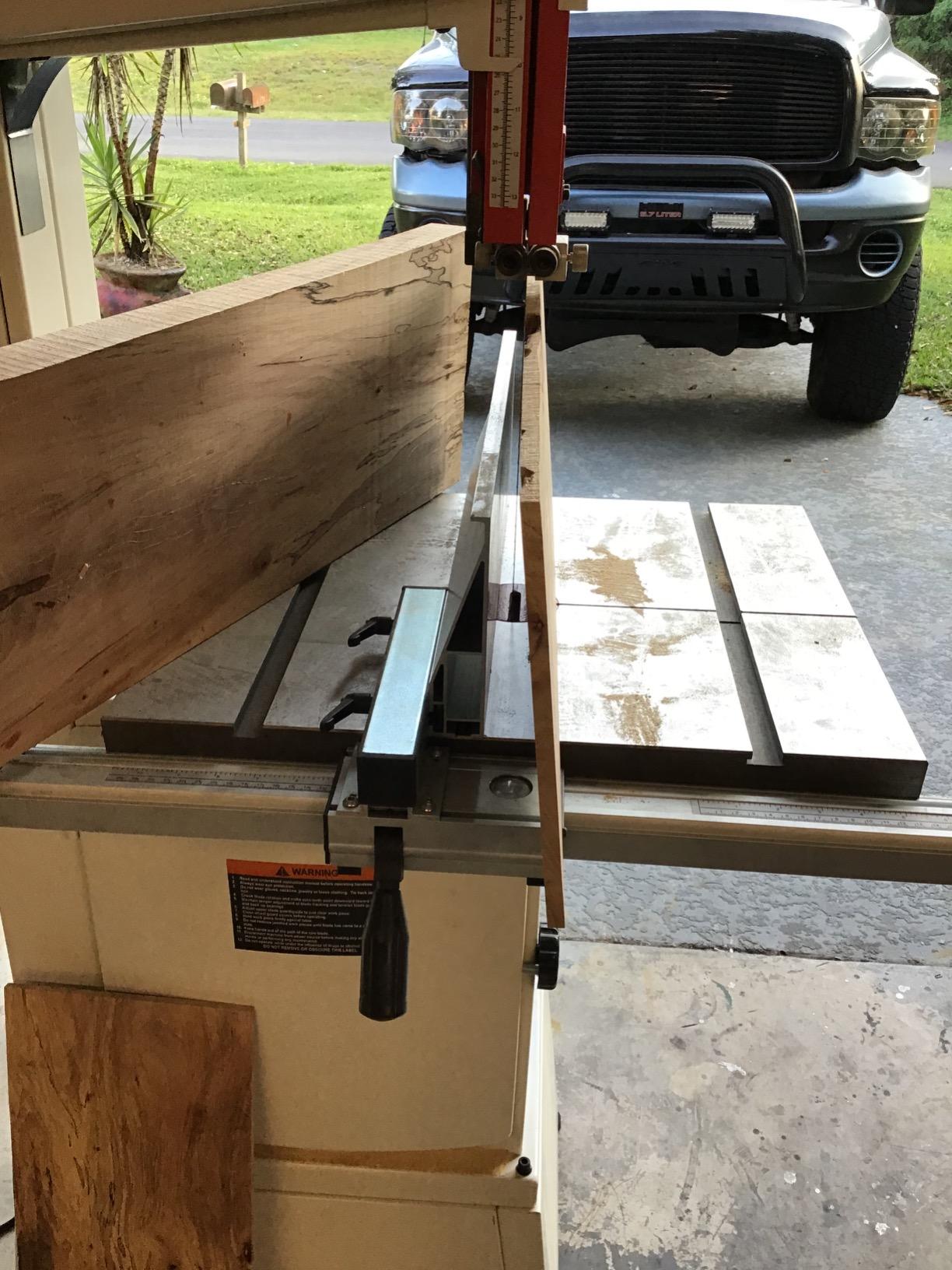
This is the machine I recommend to someone building a first serious resaw setup. The 1.75 HP capacitor-run motor has real headroom for a 1-inch walnut board lying flat, and 13 inches of advertised resaw capacity puts it at the top of this group alongside the Laguna, with the two of them tied for the most capacity in our test pool.
The 360 square inch cast-iron table tilts through 45 degrees, which matters more than it sounds: a resaw needs a dead flat, rigid surface, and a cast-iron table that weighs a couple hundred pounds simply does not dance. The 14-inch wheels and the 1/8-inch to 3/4-inch blade range give you room to move from a 1/4-inch blade for thin parts up to a proper 3/4-inch resaw blade.
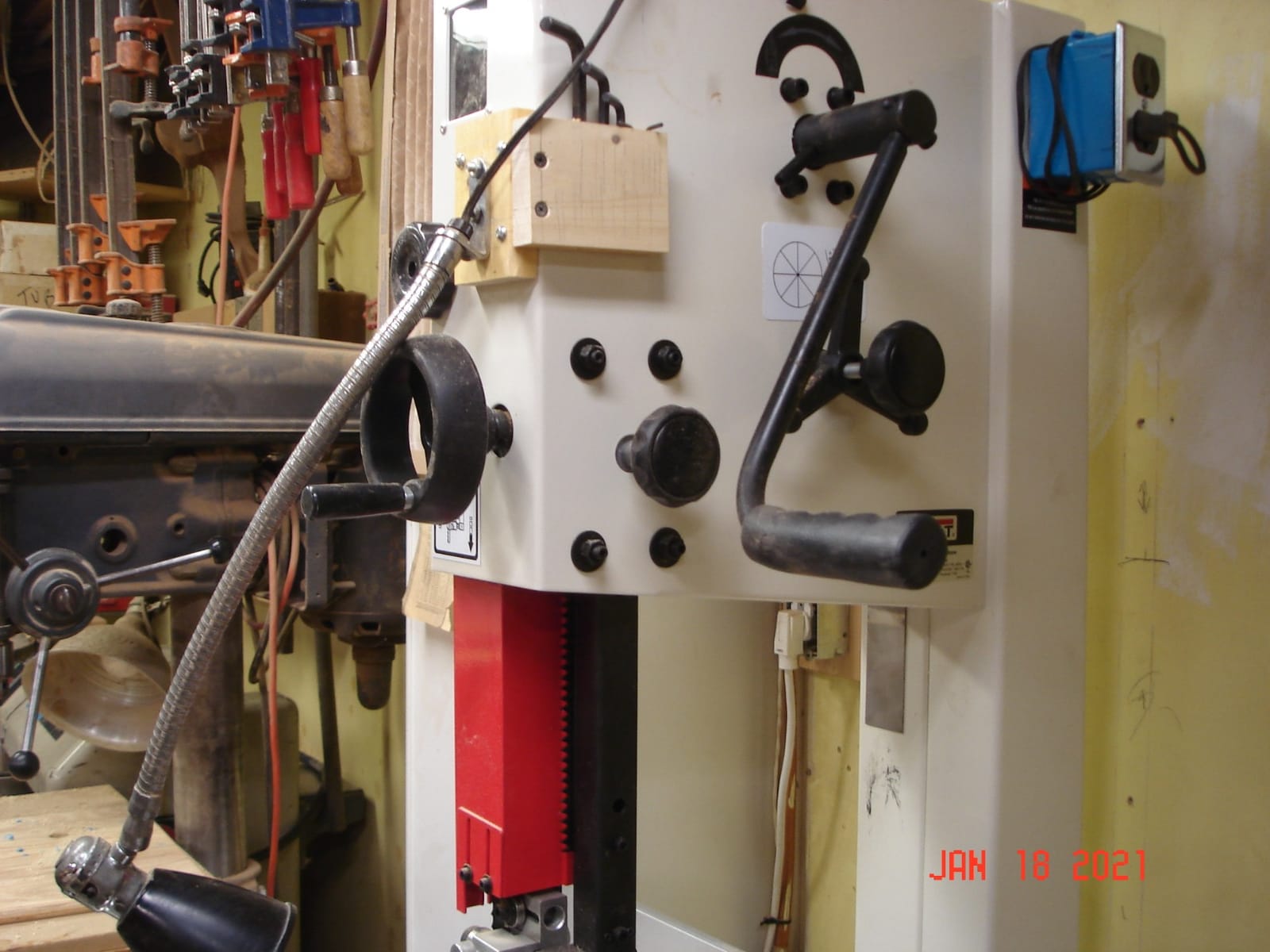
Blade guides are independently adjustable ball-bearing units with tool-less adjusters, which is exactly what you want when you are dialing in a new resaw blade and changing setups often. The included resaw fence is machined aluminum rather than a thin extrusion, and it has an easy-read scale, so the fence that arrives can stay in place for a while.
Owners consistently describe it as heavy and vibration-free, and the 5-year warranty is longer than most machines in this price bracket offer. The JET runs 115/230V single phase and JET recommends a 20-amp circuit, so wiring is straightforward for a shop with a 240V subpanel.
Who this saw suits
This is the right pick if your widest regular material runs about 9 to 10 inches and you want consistent 1/4-inch and 3/8-inch leaves from walnut, maple or white oak. The 1.75 HP motor does not strain on dense hardwood, and the cast-iron table plus included fence mean you are not building a support jig the week the saw arrives.
It also works well as a second saw in a shop that already owns a benchtop machine for curves. Resawing and scrolling pull the saw in opposite directions, and separating them keeps the blade changes and fence setup from interrupting each other.
Who should skip it
If you regularly resaw boards wider than 11 inches, 13 inches of capacity is a ceiling rather than a comfort zone, and you should look at a larger machine or a horizontal resaw saw. Buyers on a tight budget should also factor in that no blade is included, and a resaw-specific blade is a required purchase before the first cut.
Owners also flag the weight as the single biggest install-day issue. This saw is not a one-person move, and if your shop is upstairs or down a set of steps, plan the delivery path before it arrives.
2. Laguna MBAND1412-175 14 x 12 – Best Premium Ceramic-Guided Resaw Saw
Laguna Tools MBAND1412-175 14 x 12 Bandsaw, Black/Grey
13 in resaw capacity
1-3/4 HP dual voltage TEFC
Ceramic guides
1/8-3/4 in blade range
Pros
- Ceramic guides cut friction and heat in deep cuts
- Dual voltage 115/230V TEFC motor
- Quick-release tension with indicator
- Dual viewing windows for tracking
- Large tilting table
Cons
- 258 lb machine is awkward to move
- Lower guide adjustment is hard to reach
- Fence angle needed shims to correct
- Blade not included
The Laguna is the machine to buy if guide quality is the deciding factor for you. The precision ceramic guides do not smear wood the way a steel or ball-bearing guide can when a wide resaw blade is running hot, and that difference shows up directly in face quality on walnut and cherry.
Underneath the hood it is a serious machine: a 1-3/4 HP dual-voltage TEFC motor, dynamically balanced cast-iron wheels with polyurethane tires, and a rack-and-pinion upper guide system that makes fine guide positioning easy to repeat. The 21-1/2-inch by 16-inch micro-polished table tilts 45 degrees in one direction and 7 in the other, so a resaw sits flat and a tilted cut is still available.
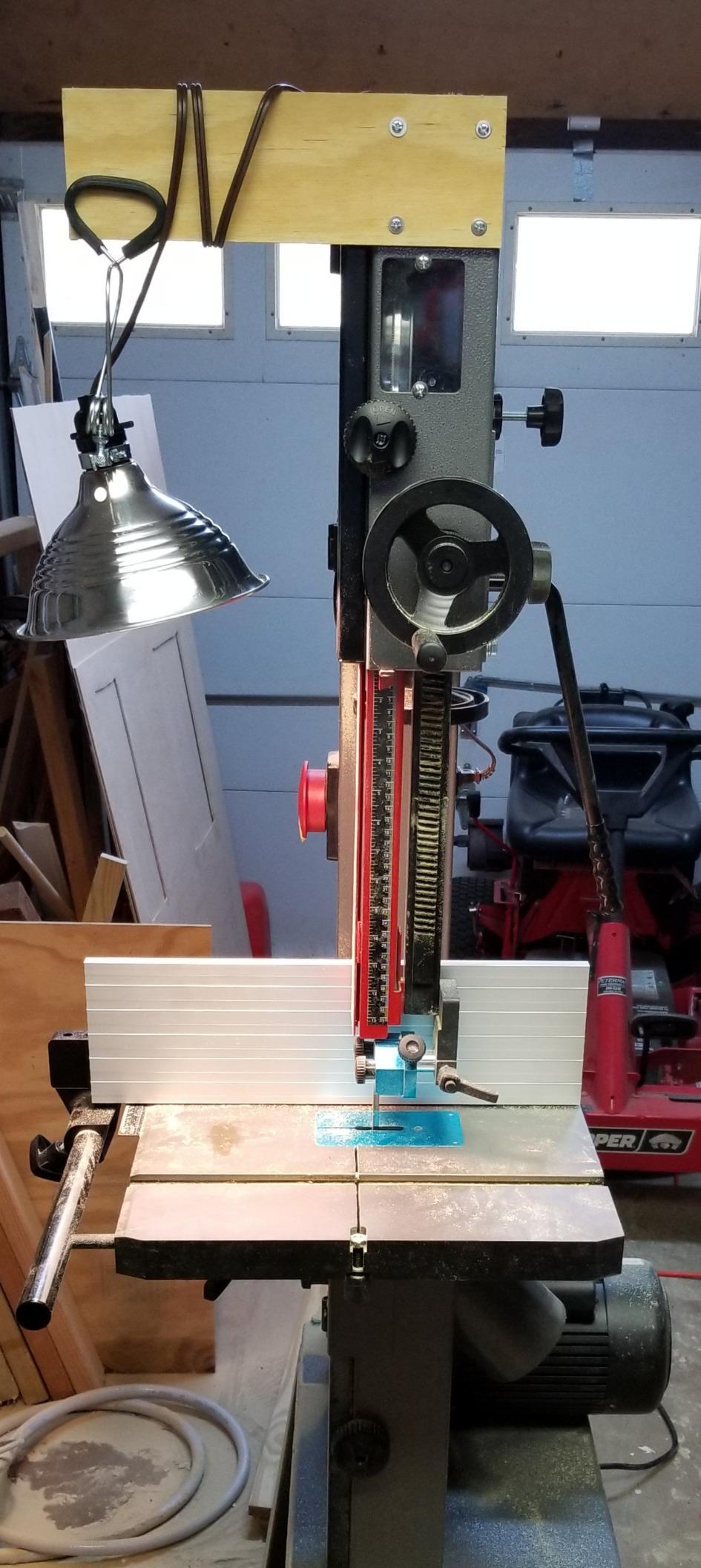
Quick-release blade tension with a tension indicator and dual viewing windows is a real convenience here. On a resaw you change blade width often, and a tension system you can release and re-set without hunting for a reference mark saves time on every setup. Blade range runs from 1/8 inch to 3/4 inch wide, with a 115-inch loop.
The dual voltage motor means one machine covers both a 115V circuit and a 230V branch, and the Laguna is one of the few designs here that runs efficiently on 120V without feeling underpowered. Just plan your floor space: the machine weighs 258 pounds and stands 70 inches tall.
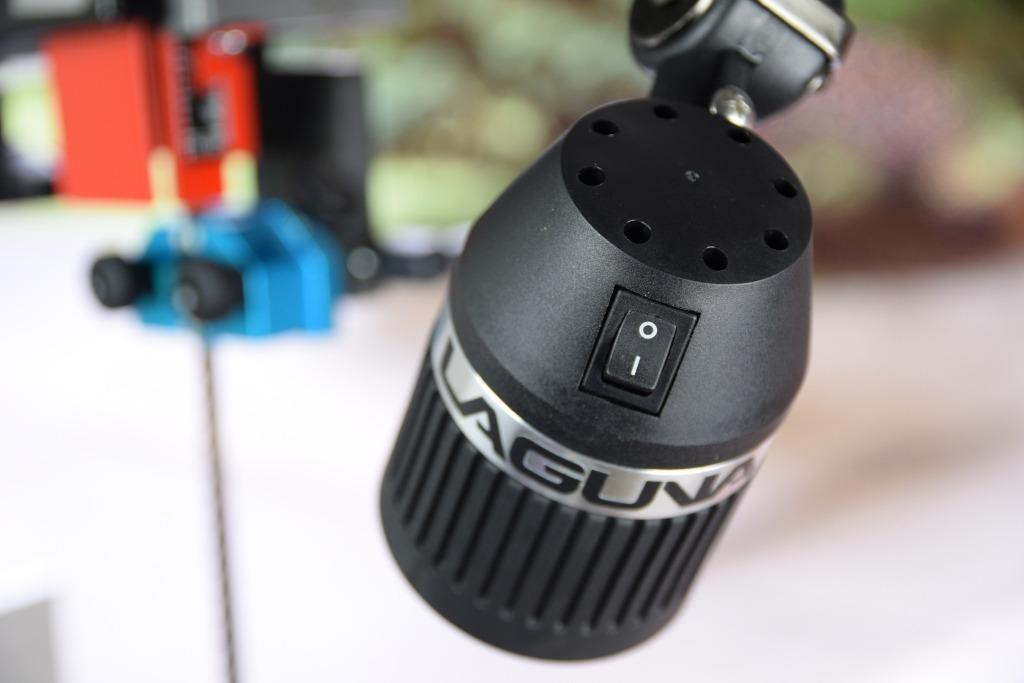
Who this saw suits
Pick this if you cut expensive hardwood often enough that blade temperature and face quality are worth paying for. It suits a shop that resaws figured maple, walnut and cherry for cabinetry, where a burn mark or a fuzzy face is an expensive defect.
It also suits anyone who will run a 3/4-inch resaw blade, because the guide system is designed to hold a wide blade steady at working tension. If your plan involves two-saw shops, this is the natural resaw half paired with a benchtop machine for curves.
Who should skip it
Do not buy this if floor space or moving it around is a concern. At 258 pounds it is the heaviest machine here, and owners consistently mention the difficulty of delivery and setup, plus reports of freight damage on arrival.
Owners also flag that the lower guide is awkward to reach, and several had to shim the fence to correct its angle. Both are minor once addressed, but budget an afternoon of setup and a set of feeler gauges before the first resaw.
3. JET JWBS-14CS 14-Inch Closed Stand – Best Saw That Disappears Into a Cabinet
JET 14-Inch Woodworking Band Saw, 1 HP, 115/230V 1Ph (JWBS-14CS)
6 in resaw capacity
1 HP 115/230V single phase
Cast iron frames
Includes 3/8 in 6 TPI blade
Pros
- Closed cabinet stand keeps the floor clear
- Includes a 3/8 in 6 TPI blade
- Computer-balanced wheels run smooth
- Micro-adjustable lower guide
- 5-year warranty
Cons
- Only 6 in resaw capacity
- Single speed only
- Rack and pinion post can be stiff
- Table tilts one direction only
The JWBS-14CS is the option for a garage or basement shop where the saw has to live inside a cabinet. The closed stand encloses the motor and collects chips, so the machine disappears when you are done and the floor stays clear.
It is a well-built 14-inch saw underneath: upper and lower cast-iron frames, computer-balanced six-spoke wheels, a rack-and-pinion blade guide post, upper and lower ball-bearing guides, a single-knob tracking adjustment and a micro-adjustable lower guide. It runs 115/230V single phase at 1 HP, and a 3/8-inch 6 TPI blade comes in the box.
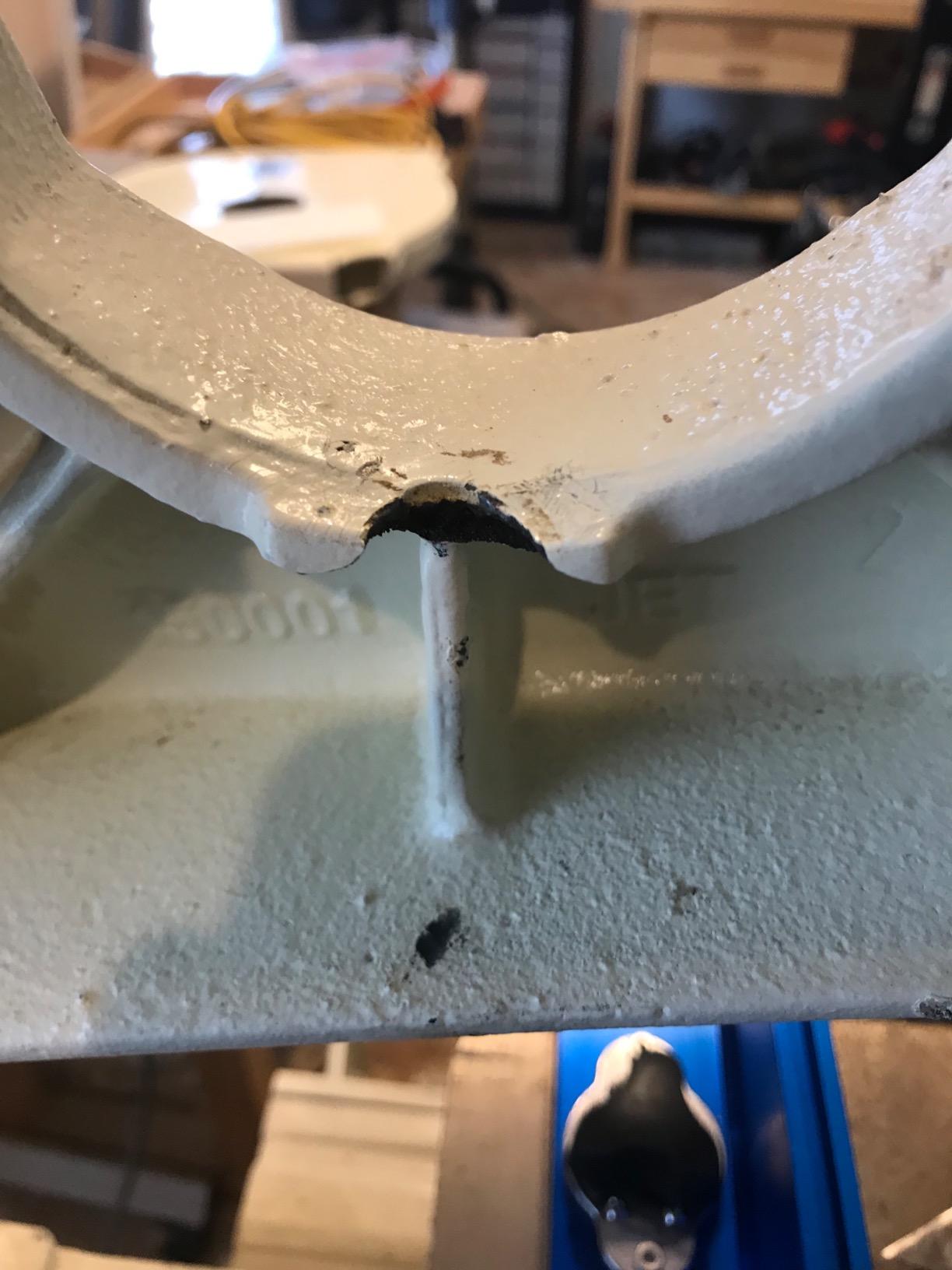
For curve work, freehand scroll sawing and cutting furniture parts, this is a genuinely capable machine. The balanced wheels and cast-iron frame give it a smooth, quiet feel that a lighter stamped-steel saw in the same class cannot match.
What limits it is the 6-inch resaw capacity. That figure is measured to the blade center, so usable capacity on real material is closer to 4 to 5 inches, which suits resawing thin material only.
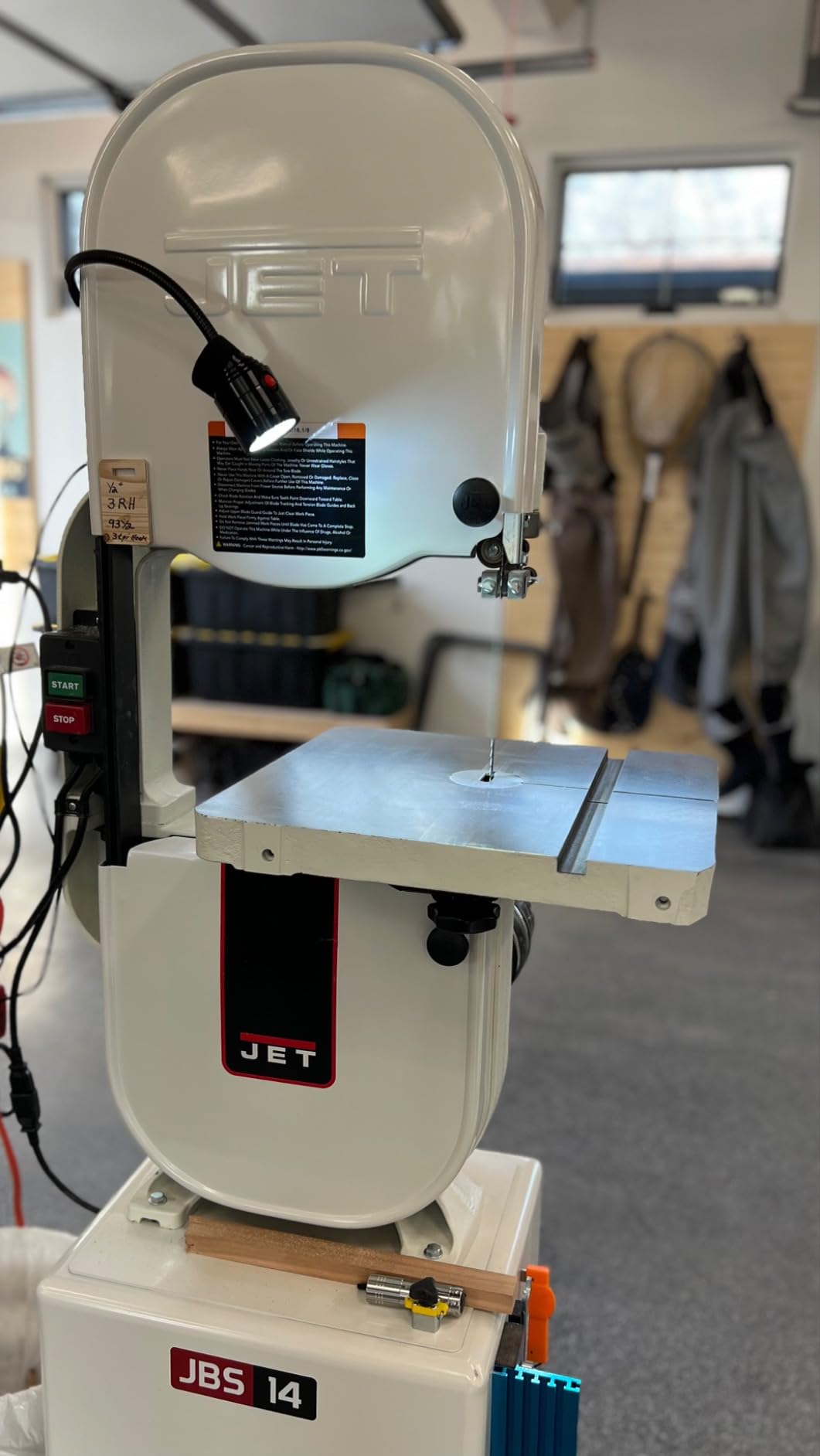
Who this saw suits
This is the right saw if you cut parts, blanks and curves most of the week and only occasionally resaw a thin board. It is also a strong choice for a garage shop with tight floor space and no room for an open stand.
The included blade means it is cutting wood the day it is assembled, and the 5-year warranty is a good sign for a machine that will live in a damp garage. A dust port connection is straightforward once the saw is in the cabinet.
Who should skip it
Skip it if veneer, book-matched panels or thick slabs are the point. A 1 HP motor with 6 inches of capacity is the wrong tool for a wide walnut board, and no amount of blade tuning changes the geometry.
It is also a single-speed machine, so you cannot slow the blade down for a wide cut, and the table tilts in one direction only. Owners who resaw regularly at any width tend to move up to a 14-inch saw with more capacity and more power.
4. WEN BA1487 14-Inch Two-Speed – Best 14-Inch Saw With Two Speeds and a Wide Blade Range
WEN (BA1487) Band Saw with Stand,Two-Speed,Black,14-Inch
8.85 in cutting depth
13-3/8 in throat
Two speeds 1480/3280 FPM
1/8-1 in blade range
Pros
- Two speeds let you match the blade to the cut
- Accepts blades up to 1 in wide
- Largest throat in this group at 13-3/8 in
- Includes work light and circle guide
- Good power for resawing hardwoods
Cons
- Included blade quality is weak
- Fence can be out of square
- Guide bearings are fiddly to dial in
- Base can arrive bent
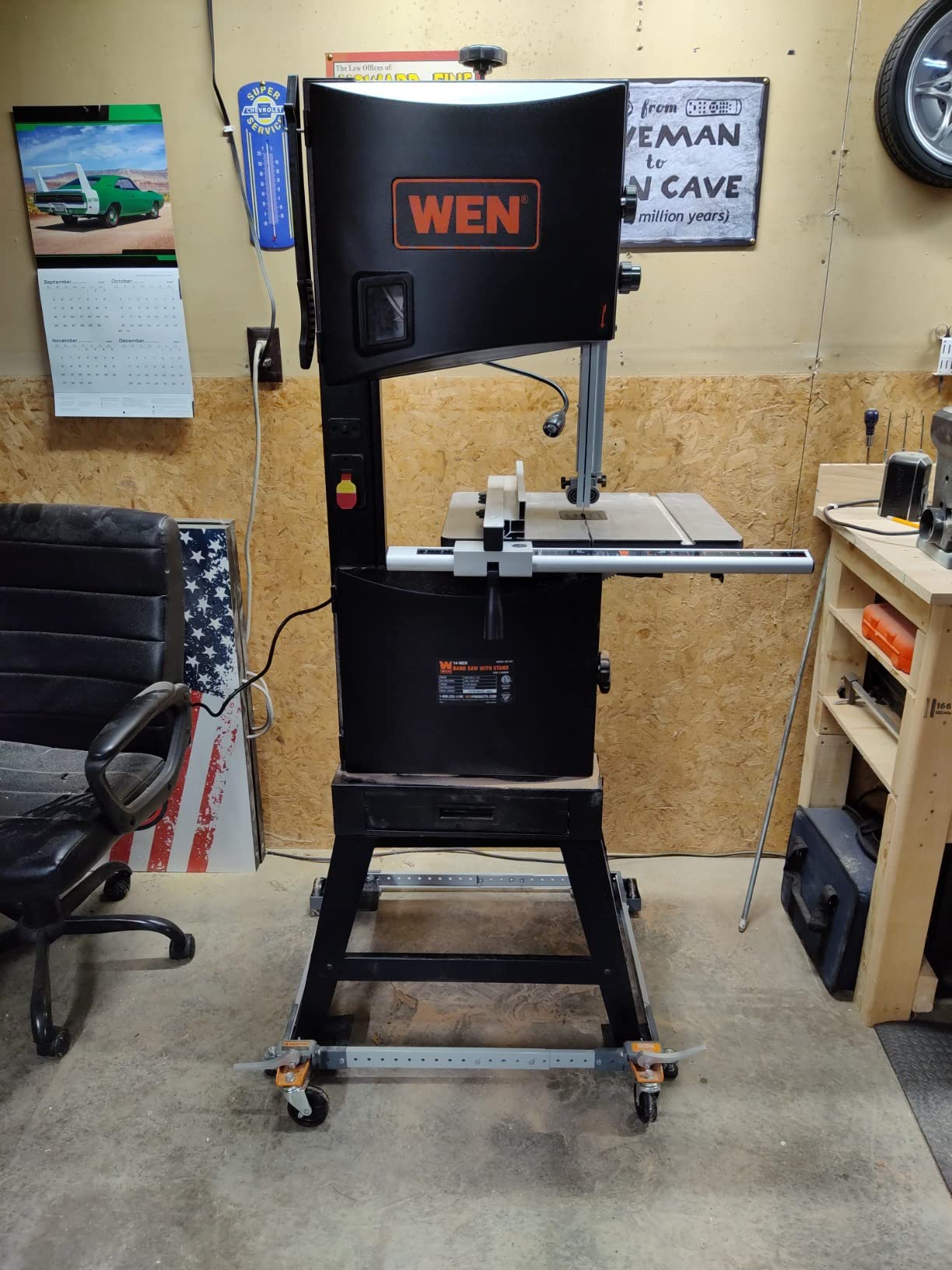
The BA1487 is the most flexible 14-inch saw in this group, and flexibility is what it buys you. Two speeds at 1480 or 3280 feet per minute mean you can drop to the slow speed for a wide, dense resaw and run fast for curve work on thinner material, which is a genuine advantage over every single-speed machine here.
It also accepts blades from 1/8 inch all the way to 1 inch wide on a 100-3/4-inch loop. That upper end of the range is unusual at this size and matters for resaw, because a wider blade is stiffer and deflects less. The 9.5-amp motor cuts up to 8.85 inches deep with a 13-3/8-inch throat, which is more depth than any other 14-inch machine in this list.
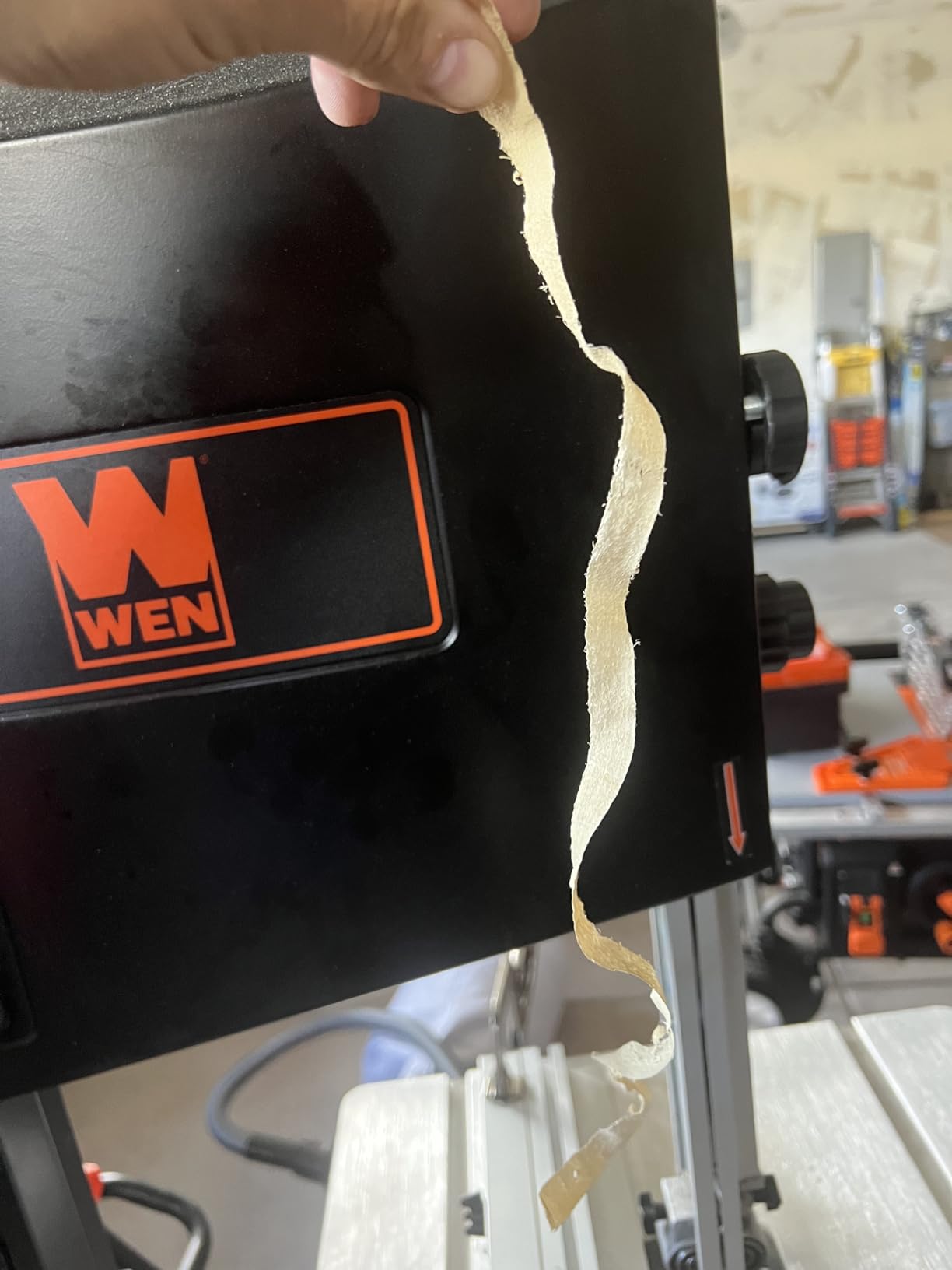
Accessories are unusually complete for the money: a flexible work light, a circle-cutting guide, a 3-in-1 dust port, a blade tension gauge, a miter gauge, a fence and a 1/2-inch blade. The 21-1/2-inch by 15-3/4-inch table bevels to 45 degrees, and a cast aluminum table variant is offered.
Owners praise the value and the power for resawing hardwoods, and WEN’s customer service draws repeated mentions in reviews. The common pattern is that you buy this saw, then immediately replace the blade and the fence.
Who this saw suits
Choose the BA1487 if you want one 14-inch machine that handles parts, curves and medium resaw work with room to grow. The two-speed setup makes it a good companion to resaw-focused work, because the same machine handles the small stuff without slowing the blade to a crawl.
It suits a shop where a dealer or distributor will handle freight, since it is 138.9 pounds with the stand rather than the 200-plus pounds of the heavy cast-iron machines. That is a real advantage if you are moving it into position yourself.
Who should skip it
Do not buy it for book-matched panels on thick material. 8.85 inches of depth with a 1-inch blade is capable, but the fence is the weak point, and a fence that is not square will give you wavy faces no matter how good the blade is.
Owners also report a base or stand that arrives bent in transit, which is worth checking the moment the crate is opened. Plan on a resaw blade and a squarer fence as part of the first-week budget.
5. JET JWB-10 10-Inch Benchtop – Best 10-Inch Saw for a Tight Shop Corner
JET 10-Inch Woodworking Band Saw with Stand, 1/2 HP, 115V 1Ph (JWB-10)
1/2 HP induction motor
67.5 in high carbon steel blade
Poly-V drive
Quick-release tension
Pros
- Compact footprint for small shops
- Poly-V drive runs quiet and smooth
- Includes blade stand fence and miter gauge
- 5-year warranty
- Ball bearing guides
Cons
- 1/2 HP struggles with dense hardwood
- Actual cutting height under 9 in
- Plastic handles feel cheap
- Some motor pulley alignment issues
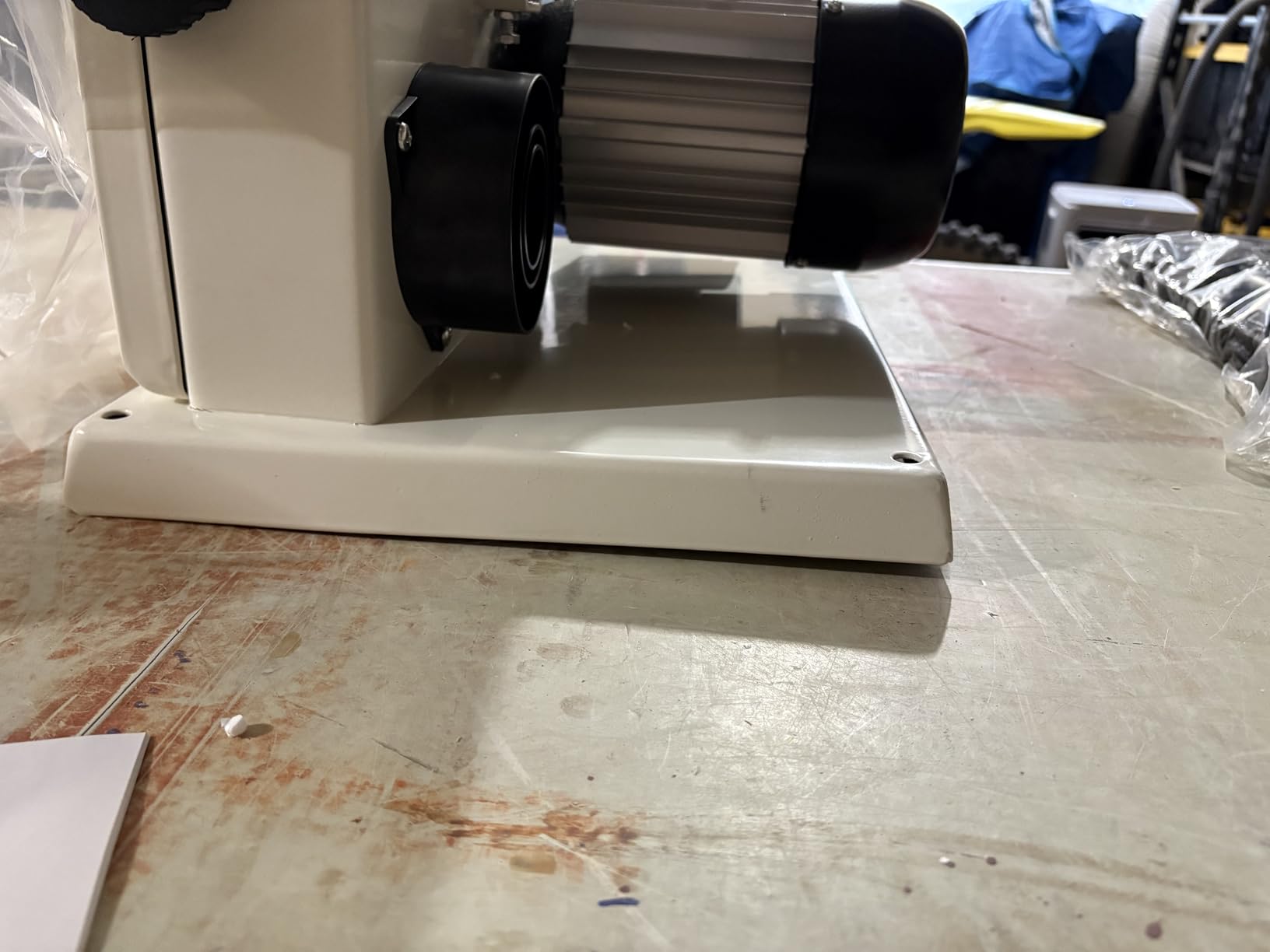
The JWB-10 is the smallest complete package here, and for a shop that resaws a few boards a month and mostly cuts small parts, it is enough. At 83 pounds with the stand and 34.6 inches long, it fits where most 14-inch machines cannot.
Build quality is better than the size suggests. The poly-V drive system transfers power smoothly and cuts vibration, the upper and lower guides are ball bearing, the tension is quick-release, and the extruded aluminum fence is simple but positive. A 67.5-inch high carbon steel 6 TPI blade comes with it, along with the stand, fence and miter gauge.
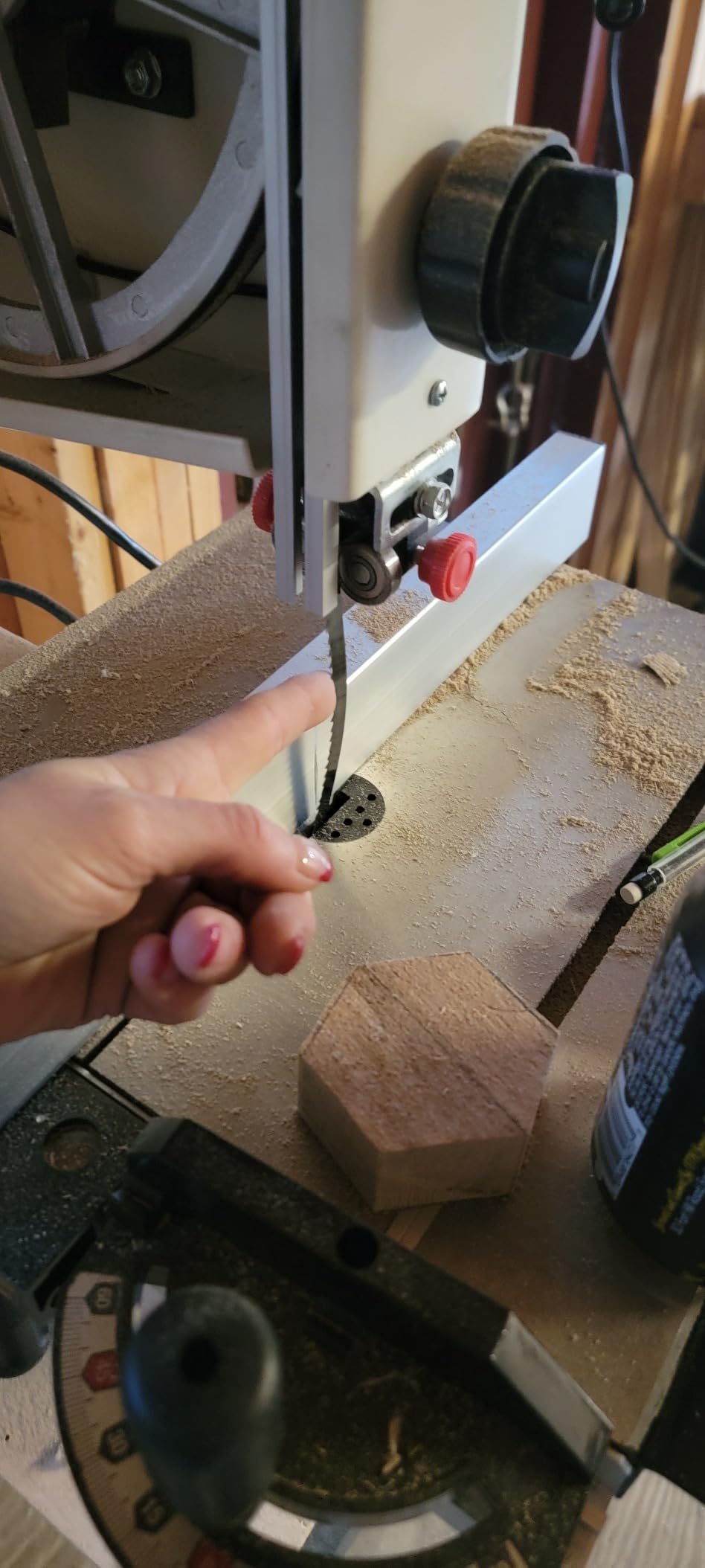
The 1/2 HP induction motor is the limiting factor, not the frame. In softwood and in thinner hardwood, it works fine. On a wide board of walnut or white oak it bogs, and the blade slows, the cut wanders and the surface burns.
Owners also note that actual cutting height is a little under the nominal 9 inches, and that some examples had motor pulley alignment issues out of the box. Checking the pulley alignment during assembly is a five-minute job that pays back immediately.
Who this saw suits
This saw suits a first shop, a garage or a classroom where the work is bowl blanks, small parts, and the occasional resaw of a board a few inches wide. The included blade and accessories mean it is usable immediately after assembly.
It also works as a companion machine in a two-saw shop. A 10-inch saw like this handles every curved cut and small job, which frees your 14-inch resaw saw from being moved out of position and re-tensioned constantly.
Who should skip it
Skip it if wide hardwood resawing is anywhere in your plans. The 1/2 HP motor does not have the headroom, and owners consistently describe blade drift on thicker cuts as a symptom of the motor being pushed past its limit.
Be aware of the small-handle and quality-control complaints as well. If your shop has room and you resaw more than a few boards a month, the money is better spent one size up.
6. WEN BA3962 10-Inch Two-Speed – Best First Band Saw With Two Speeds
WEN Band Saw with Stand, 10-Inch, 3.5-Amp, Two-Speed (BA3962),Black
6 in cutting depth
9-3/4 in throat
Two speeds 1520/2620 FPM
72 in blade range 1/8-1/2 in
Pros
- Two speeds on an entry-level saw
- UL certified
- Includes work light dust port and fence
- Cast aluminum table bevels to 45 degrees
- Large owner base for support
Cons
- 3.5 amp motor is underpowered for hardwood resaw
- 6 in cutting depth only
- Guide adjustments are fiddly
- Stand could be sturdier
The BA3962 is the strongest-rated machine in this group, and with 356 owner reviews behind that rating it is also the best-tested. For a first band saw that will mostly do curve work, small part cutting and the occasional light resaw, it is hard to argue with the package.
Two speeds at 1520 or 2620 feet per minute is unusual at this level, and the 3.5-amp motor cuts up to 6 inches deep with a 9-3/4-inch throat. Blades run from 1/8 inch to 1/2 inch wide on a 72-inch loop, and the 14-1/8-inch by 12-1/2-inch cast aluminum table bevels to 45 degrees.
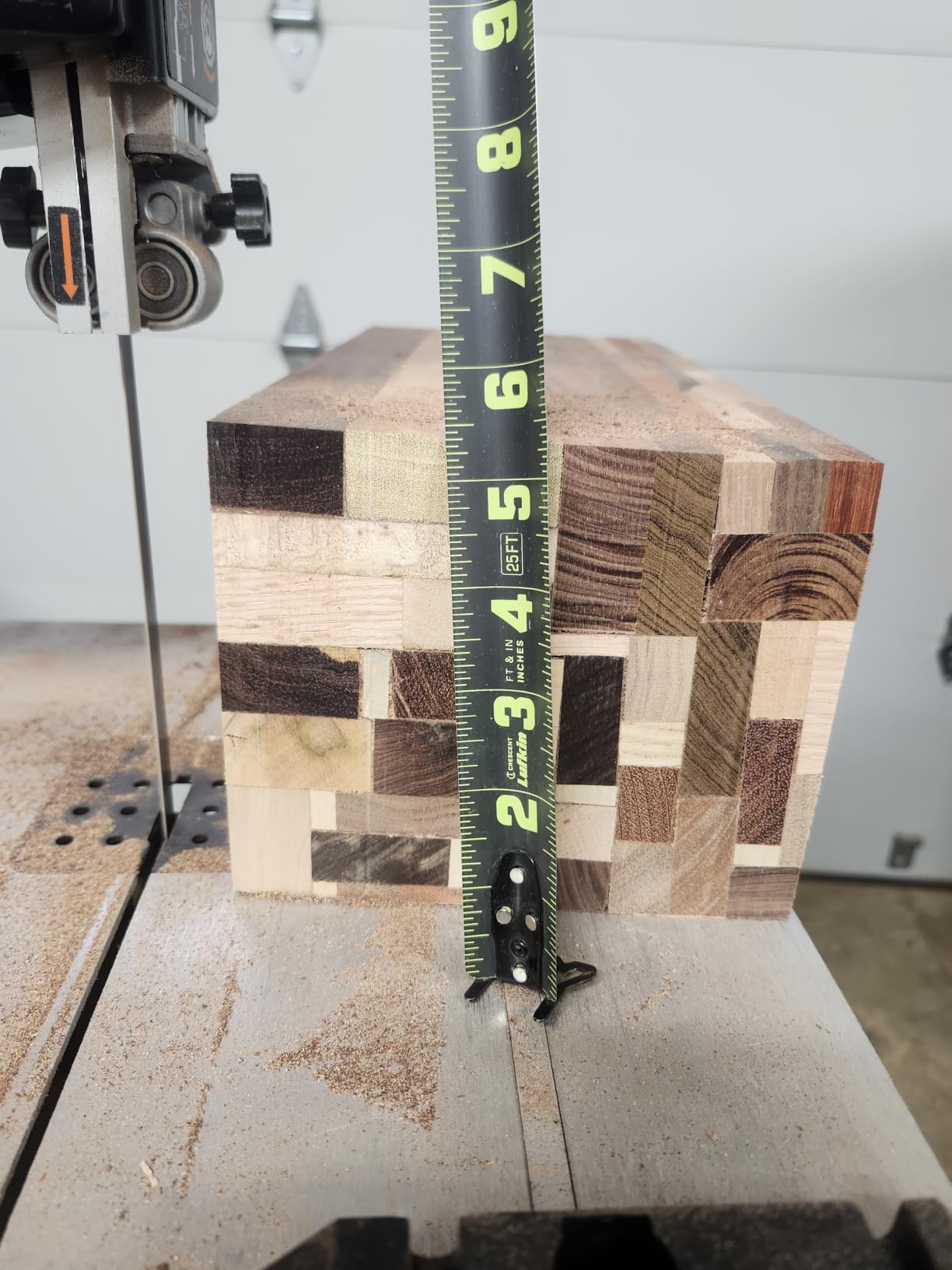
The accessory list is generous: a flexible work light, a 3-in-1 dust port, a fence, a miter gauge and a 3/8-inch 6 TPI blade. It is UL certified and carries a 2-year warranty.
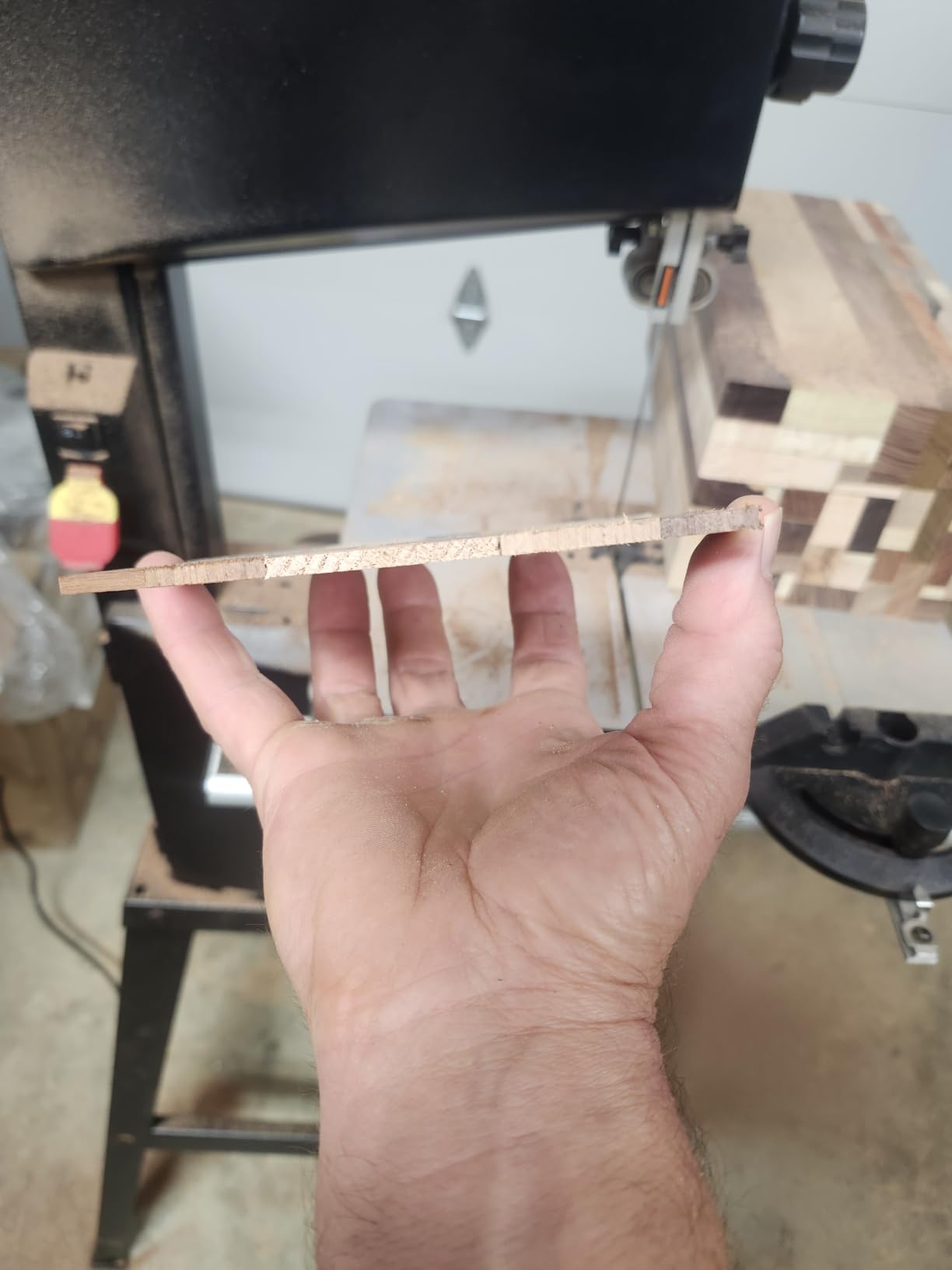
Owners rate it highly for a first machine, and many note that the first purchase they make is an upgrade blade. That is the right instinct, because the stock blade is a basic 6 TPI pattern not built for resaw duty.
Who this saw suits
Choose this if your largest practical cut is a few inches wide and you are buying your first band saw. It handles scroll work, cutting material to length, small furniture parts and light resawing, and the two speeds let you slow down when the material is wider.
It also suits a shop with a strict footprint limit. At 26.5 inches by 21 inches it tucks into a bench area easily, and the dust port keeps cleanup manageable.
Who should skip it
Do not buy it to resaw hardwood boards. Six inches of cutting depth and a 3.5-amp motor mean wide, dense material will stall it, and the resulting burn marks and tapered leaves are what drive people to sell a 10-inch saw and buy up.
If you know you will be resawing walnut, white oak or thick hardwood regularly, start one size up. The resale lesson here is straightforward: an entry-level 10-inch saw is a good curve-cutting machine, not a resaw machine.
7. WOODSKIL 10-Inch Benchtop – Best Value Benchtop Saw
WOODSKIL 10-Inch Benchtop Bandsaw with Stand, 3.4A Dual-Speed Band Saw
5-1/8 in cutting height
10 in throat
3.4A dual speed 2360/3000 FPM
6 ball bearing guides
Pros
- Most owner reviews of any saw here at 515
- Dual speed for hardwood and softwood
- Tool-free side doors for blade changes
- Quick tension via one lift handle
- Metal stand and fence included
Cons
- 5-1/8 in cutting height limits resaw work
- 3.4A motor underpowered for thick hardwood
- Fence and miter gauge are basic
- Build quality matches the tier
The WOODSKIL is the most popular saw on this list, with 515 owner reviews, and the reason is straightforward: the tool-free side doors and quick tension system make blade changes genuinely fast in a way most machines in this class do not.
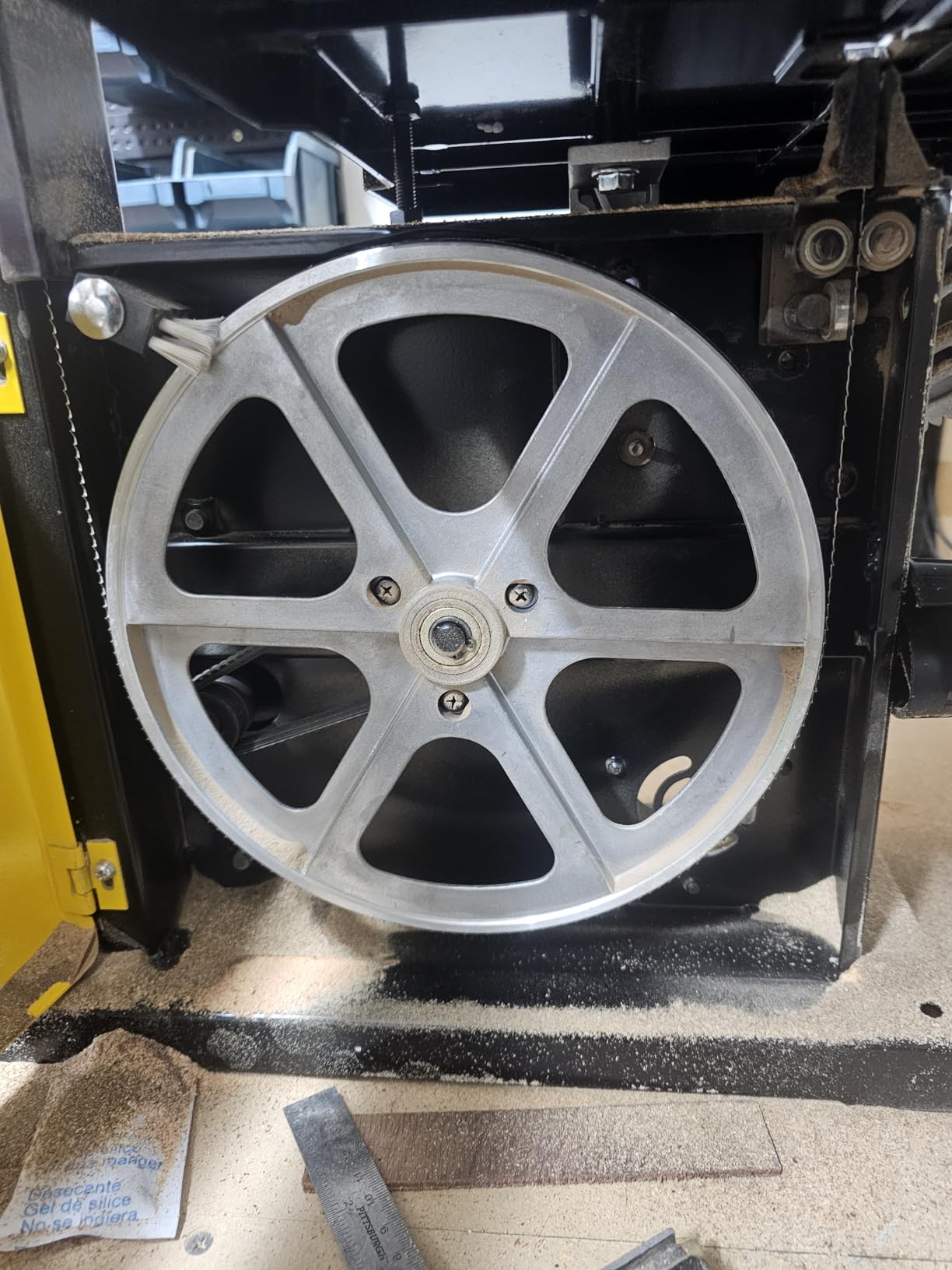
Lifting a single handle releases the blade tension, and the side doors open without tools, so a resaw blade swap takes a couple of minutes instead of a half hour. Six ball bearing guides are specified to hold the blade steady, and the 3.4-amp motor offers two speeds at 2360 and 3000 feet per minute, with the slower setting intended for hardwood.
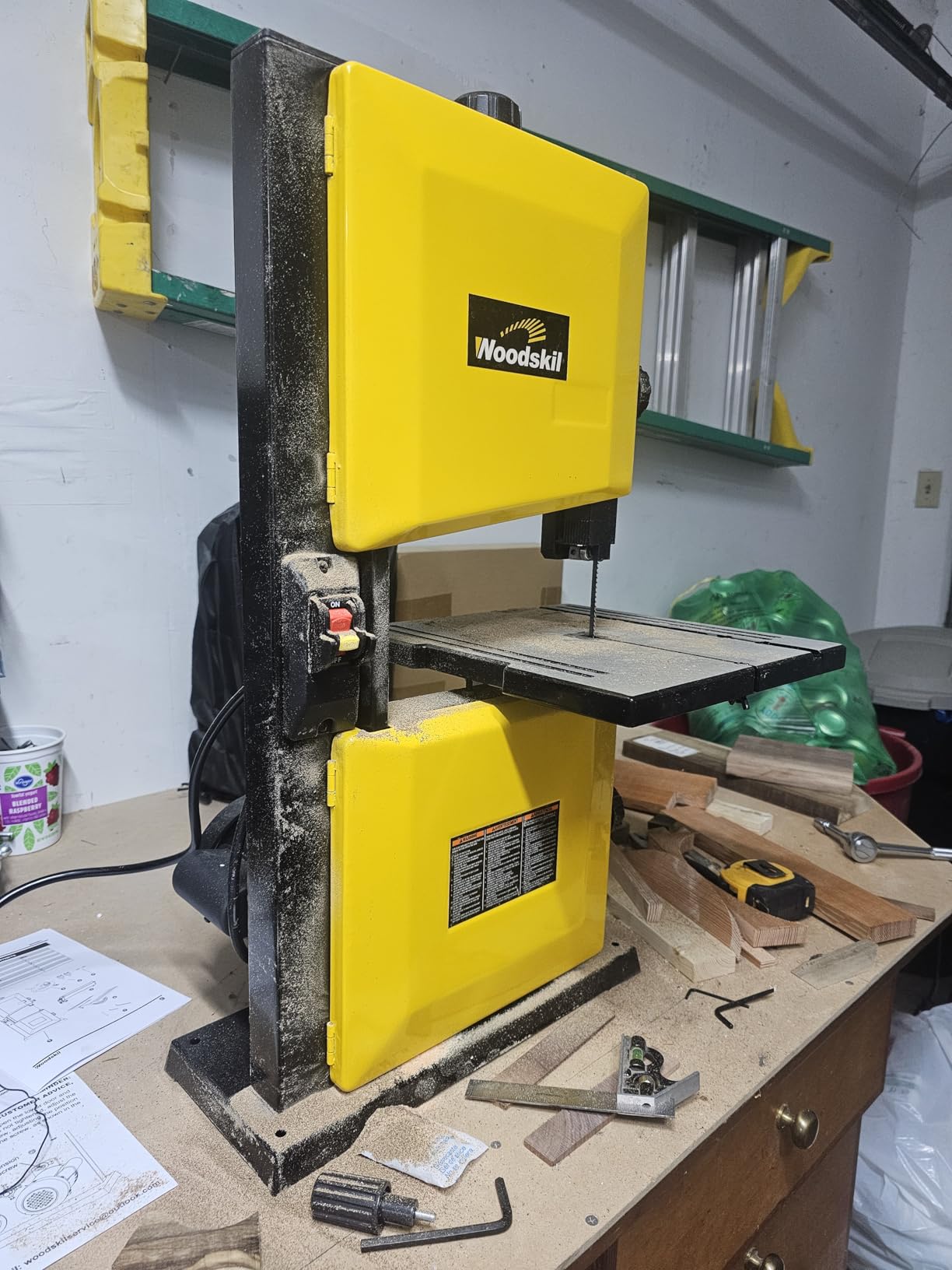
The 10-inch throat depth is deeper than most benchtop saws at this price, and the 0 to 45 degree tilting cast aluminum table is a genuine advantage for angled work. A rip fence, miter gauge and metal stand are included, and a 1-7/8-inch dust port handles cleanup. The warranty is two years.
Owners consistently call it a good entry-level machine for hobby work, scroll cutting and lighter material, and the review volume suggests people are comfortable recommending it to beginners.
Who this saw suits
This suits a hobbyist or a small shop that resaws occasionally and changes blades often. The tool-free access makes it a pleasant machine to own, and the metal stand and included accessories remove the usual first-purchase list.
It is also a good travelling companion for work away from a shop, since the design is compact and self-contained. Nothing in the design assumes a permanent bench position.
Who should skip it
Skip it for wide hardwood resawing. A 5-1/8-inch cutting height is one of the smallest capacities here, and a 3.4-amp motor will not drive a wide blade through dense hardwood without slowing down.
The fence and miter gauge are also basic parts, and reviews note the build quality reflects the tier. If resaw capacity is not a side activity but the main reason you are buying a band saw, this is not the machine.
8. Grizzly G0555XH 14-Inch Extreme Series – Best Dedicated 12-Inch Resaw Machine
Grizzly Industrial G0555XH – 14″ 1-3/4 HP Extreme Series Resaw Bandsaw
12 in resaw capacity
1.75 HP motor
Cast iron frame
110V/220V prewired 120V
Pros
- Built specifically around a 12 in resaw capacity
- 1.75 HP motor for dense hardwood
- Cast iron frame resists flex
- Extruded aluminum resaw fence included
- Prewired for 120V but ready for 220V
Cons
- Only 16 owner reviews to judge by
- Freight damage to the crate and motor housing reported
- Included blade needs replacing
- Utilitarian no-frills design
The G0555XH is the only machine here designed from the start as a resaw saw rather than a general-purpose band saw with a resaw fence added on. Twelve inches of resaw capacity, a 1.75 HP motor and a cast-iron frame is a coherent package, and it is the pick for someone whose resaw work is the primary purpose of the machine.
The frame is cast iron on a heavy-duty stand, which is exactly what resists the flex that turns a straight resaw into a wavy one. The extruded aluminum resaw fence and miter gauge are included, and the machine is CSA certified and built in an ISO 9001 factory.
It is prewired for 120V but rated for 110V/220V, so you can start on a standard circuit and convert to 240V later without replacing the saw. That flexibility is genuinely useful in a shop that is still working out its electrical plan.
The honest caveat on this machine is the size of its owner base. With 16 reviews, it has the thinnest feedback of any saw here, and owners who receive an undamaged machine are very satisfied, while the most common complaint by far is freight damage to the crate and motor housing.
Owners also say the blades it comes with are not the blades you want for resaw, so budget for a proper resaw blade before the first real cut. The utilitarian design is a feature for a shop tool, not a drawback.
Who this saw suits
This suits a shop where resawing is the primary activity and capacity is the limiting factor in the current setup. If you are regularly working with material 9 to 10 inches wide, the 12-inch figure here is closer to your actual need than the 6-inch class machines.
It also suits buyers who want a cast-iron frame specifically, and shops planning to move to 240V power later without replacing the saw.
Who should skip it
Skip it if you want a machine for general curve work as well as resaw. This is a narrow-purpose design, and it will not replace a benchtop saw for small parts and scroll work.
Be cautious if you are shipping it yourself or cannot inspect the crate on arrival, because freight damage is the single most reported issue. Budget for a resaw blade as well, since the included blades are not the ones you will cut with.
9. WEN BA1411 14-Inch Dual-Voltage – Best Choice for a 240V Shop
WEN Industrial Band Saw, 14-Inch, 1 HP Dual-Voltage 120V/240V, Two-Speed (BA1411)
11 amp 1 HP motor
120V/240V dual voltage
14 x 14 in cast iron table
4 in dust port
Pros
- Dual voltage 120V and 240V from one machine
- Dual speed 1700/3000 FPM
- Spacious 14 x 14 in cast iron table
- 4 inch dust port for real collection
- Quick-release tension and thrust bearings
Cons
- Only 6 in cutting depth for a 14 in saw
- Only 15 owner reviews
- Table bevels 15 degrees one way
- Less established brand in the class
The BA1411 is the one to look at if your shop already has 240V available and you want a full-featured 14-inch saw with a genuinely large cast-iron table. The 14-inch by 14-inch table tilts 15 degrees one way and 45 the other, and that surface area matters for handling long boards and wide material.
It runs 120V or 240V and two speeds at 1700 or 3000 feet per minute, with an 11-amp 1 HP motor. The cast-iron frame, ball-bearing guides with thrust bearings, quick-release blade tension, a 4-inch dust port and a heavy-duty steel stand are a solid feature set for the money.
Accessories are included too: a blade tension gauge, a T-fence, a sliding miter gauge and a 93.5-inch by 3/8-inch blade. The two-year warranty is shorter than JET’s 5-year cover, which is worth factoring in for a machine you plan to keep.
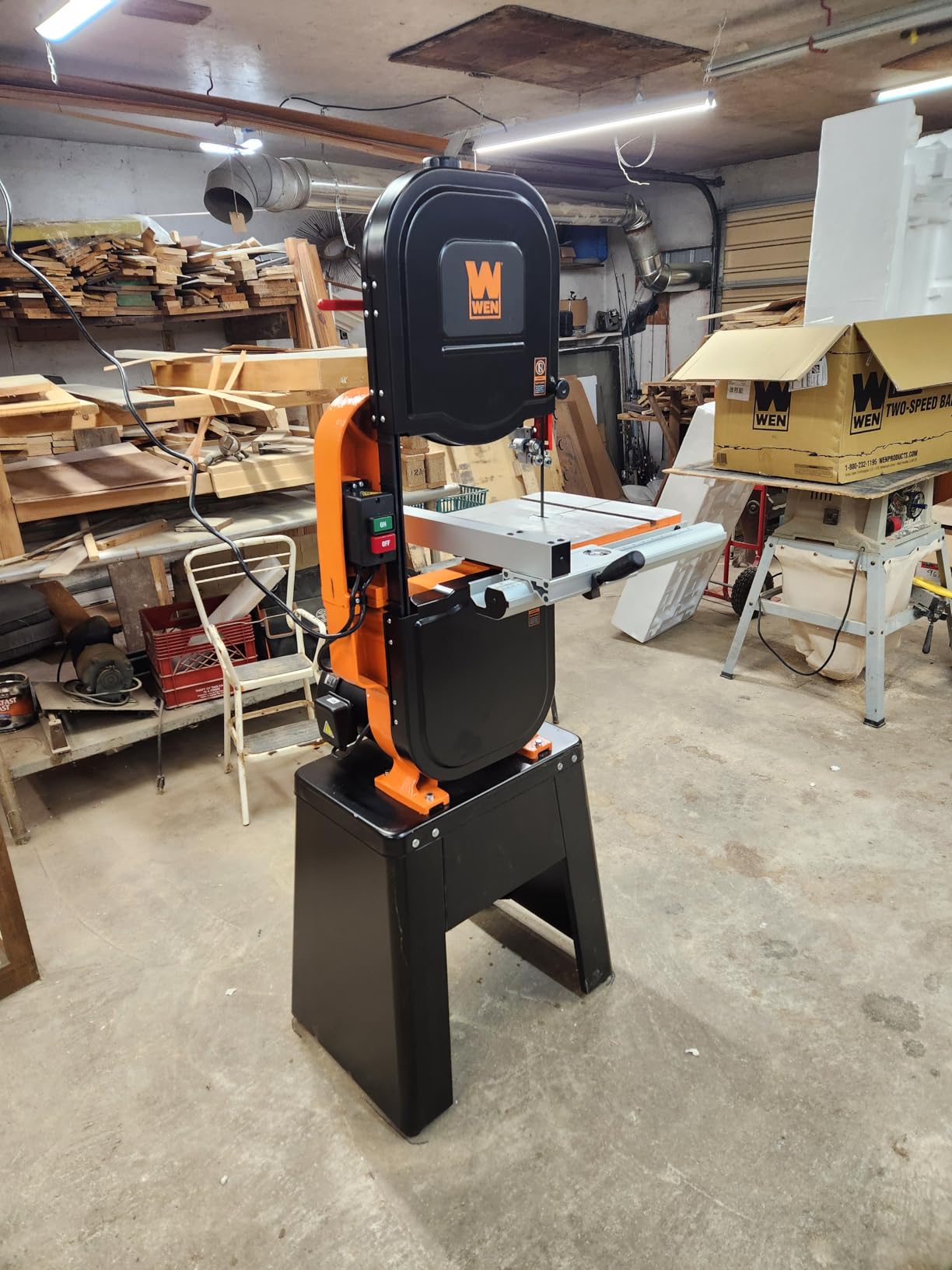
The 4-inch dust port is the standout for a 14-inch saw at this level, and a resaw generates far more dust than curve work, so collection capacity directly affects how long the machine stays in tracking. A 93.5-inch blade loop gives you room for a wider resaw blade than most machines this size.
The limitation is depth. Six inches of cutting depth on a 14-inch saw is shallow, so this is a strong all-around machine that will handle light resaw work but is not the choice for wide boards.
Who this saw suits
This suits a shop that has 240V power and wants one machine for parts, curves and moderate resawing. The large table and 4-inch dust port make it pleasant to work with, especially if you generate meaningful chip volume.
It also suits buyers who want a full accessory package on day one, since the blade, fence, miter gauge and dust port are all included.
Who should skip it
Skip it if wide resaw is the goal. Six inches of cutting depth is the same limitation as the smaller 14-inch class, and no amount of motor capacity changes the geometry of the cut.
Also weigh the thin owner base. With 15 reviews, long-term reliability data is limited, and a 2-year warranty is shorter than some competitors in this list. For a heavy work schedule, the longer warranty on the JET or Laguna is worth comparing directly.
10. Rikon 10-310 10-Inch – Best 10-Inch Saw for Tool-Less Blade Changes
Rikon 10 Inch Bandsaw With Stand
10 in throat
Welded steel frame
Tool-less blade guides
61.8 lb with stand
Pros
- Spring-loaded tool-less upper and lower guides
- Quick-release tension lever with a large hand wheel
- Welded steel column and frame
- Only 61.8 lb so it moves easily
- Machined cast iron table with T-slot
Cons
- Rip fence canter under pressure
- Some owners report 1/2 in blades do not fit
- Limited height for resaw work
- Guide blocks are basic
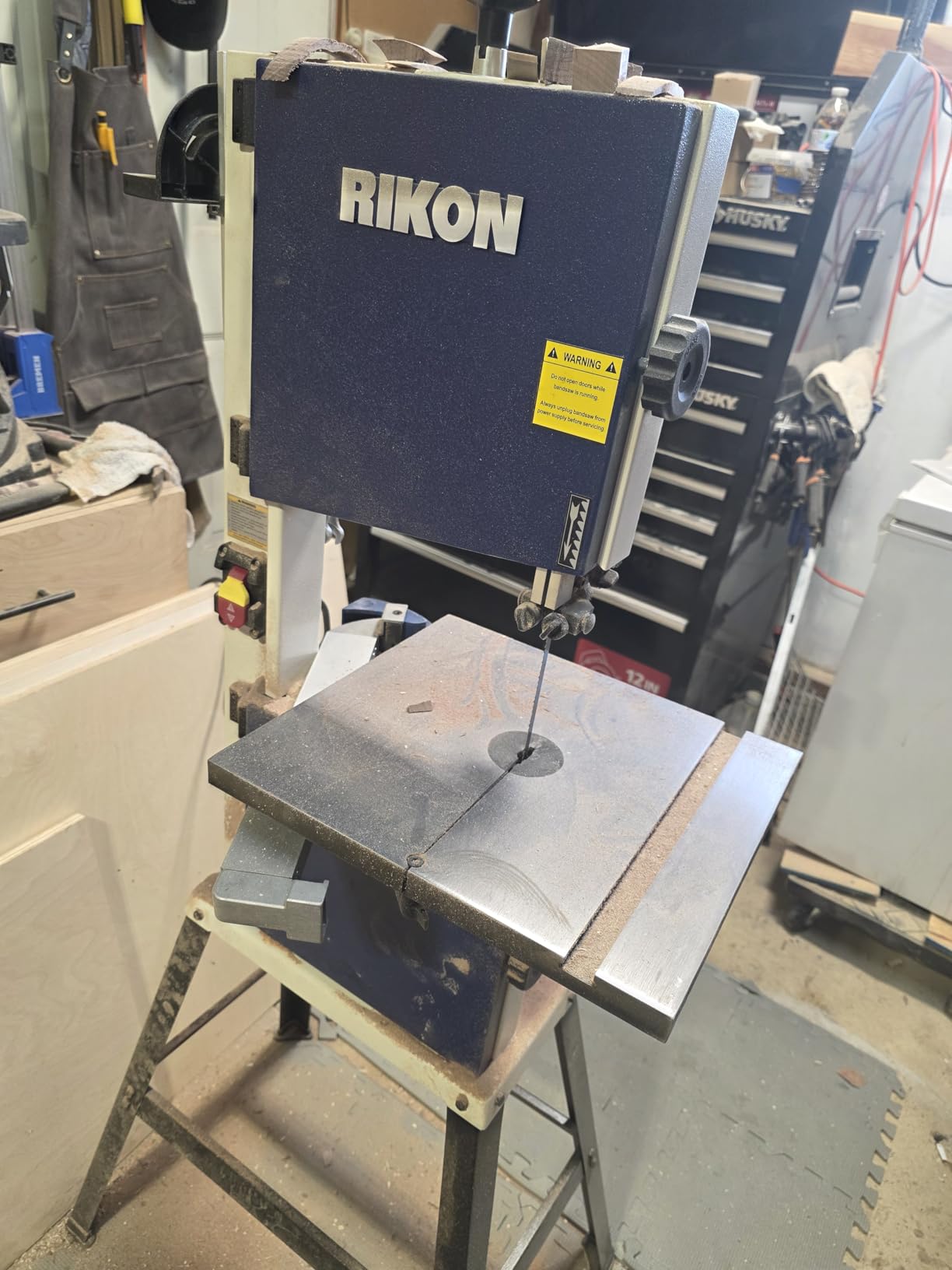
The Rikon 10-310 has the best rating of any 10-inch saw in this group, and the reason is the frame. A rugged welded steel column and frame at 61.8 pounds is a solid platform for a machine you intend to move around, and the machined cast-iron table with a miter gauge T-slot is better than most tables at this size.
Tool-less setup is the headline. Both the upper and lower blade guides are spring-loaded and tool-less, and a quick-release blade tension lever with a large tension hand wheel means you can change blades without hunting for hex keys. That is a real time saver when you move between a scroll blade and a wider resaw blade.
The trade-off is capacity. A 10-inch saw will not handle wide resaw work, and owners note limited cutting height for that purpose. Treat it as a curve-cutting and small-parts machine that can handle light resaw duty on thinner material.
The most common complaint is the rip fence cantering under pressure, which owners generally solve with a small modification. A few owners also report that 1/2-inch blades do not fit, so check the blade range before planning a resaw blade purchase.
Who this saw suits
This suits a small shop that wants a well-built 10-inch saw it can move without help and adjust without tools. The 61.8-pound weight is the lightest complete package here, which is a genuine advantage in a shared shop or a rented space.
It also works as the curve half of a two-saw setup. Owners who resaw on a 14-inch saw often pair it with a 10-inch machine like this for everything that is not a resaw.
Who should skip it
Skip it if you plan to resaw anything wide. The frame is good, but the geometry is not, and no setup change will add capacity the machine does not have.
Buyers planning a resaw blade purchase should confirm blade width fit first, since owners report some issue with 1/2-inch blades. And if fence rigidity is going to be your main concern, test the fence under pressure before committing.
How Resaw Capacity Translates to Real Board Width?
Resaw capacity is the spec buyers misread most often. It is measured to the center of the blade, not to the inside edge of the wheel or the throat plate, so the number on the spec sheet is the best case rather than your working number.
Subtract roughly 1.5 to 2 inches from the advertised figure to estimate usable capacity, then subtract another inch if the board is thicker than an inch or the material is dense hardwood like white oak. A machine advertised at 12 inches typically gives you 9 to 10 inches of working capacity, and a machine advertised at 6 inches gives you closer to 4.
What each size class actually resaws
Here is how the four size classes map to real material, based on the capacities in this roundup.
A 10-inch benchtop saw in this group covers roughly 3 to 5 inches of usable resaw capacity. That handles thin hardwood boards for small panels and blanks, and nothing wider. A 14-inch saw with a 6-inch rating, like the JET JWBS-14CS or the WEN BA1411, gets you to about 4 to 5 usable inches, which covers 1-inch walnut for cabinet parts but not full-width resaw.
A 14-inch saw with 12 to 13 inches of advertised capacity, like the JET 14-Inch 1.75 HP Band Saw, the Laguna MBAND1412-175 or the Grizzly G0555XH, is where serious veneer work starts. Those machines give you 9 to 11 inches of usable capacity, which covers most hardwood boards you will find at a lumber yard.
Beyond that you are into 17-inch and 18-inch machines, or a horizontal resaw saw. None of those appear in this roundup because none of them showed up as a well-supported option in our research, and we would rather tell you where the ceiling is than pad the list.
One practical note on kerf loss. Forum users who have measured this report that two kerfs plus four cleanup passes cost about a quarter inch of total material. On a 1-3/4-inch board that leaves roughly 1-1/2 inches of finished leaves, which is worth remembering before you buy a machine based on the capacity number alone.
Band Saw Blades for Resawing
A 3/4-inch-wide resaw blade with 2 to 3 teeth per inch is the standard starting point on a 14-inch saw. A 1/2-inch blade is easier to tension on smaller machines and works well for boards around 6 inches tall, so match blade width to the capacity you actually need rather than to the largest blade the saw accepts.
Two to 3 TPI is the right tooth count for resaw work. Fewer teeth leave larger gullets, so sawdust clears the cut instead of packing into it, and that is what keeps a wide blade cool and a resaw face clean. A fine-tooth blade will look smoother on paper and perform worse in practice because the gullets fill with dust and the blade heats up.
Skip-tooth is the standard resaw pattern. The wide-set teeth push dust down and away from the blade, which is the second reason resaw blades are built the way they are.
On blade brands, the most common recommendation in woodworking forums for resaw duty is the Highland Woodslicer or a Timberwolf, both of which owners describe as far cheaper than a carbide resaw blade while still doing the job well. The carbide option, sold as the Laguna Resaw King, comes up most often when someone is resawing expensive wood often enough that the cost per cut justifies a premium blade.
The practical rule: if you resaw a few boards a month, a good bimetal blade in the 1/2-inch to 3/4-inch range is plenty. If you are producing veneer weekly out of expensive hardwood, carbide pays for itself in blade life rather than in cut quality.
The 3-tooth rule
The 3-tooth rule states that a band saw blade should have at least three teeth in contact with the workpiece at the cut, so the load is shared across the tooth set rather than concentrated on the leading teeth. This is the single most useful diagnostic idea in band sawing, and it explains why an over-tensioned, over-wide blade wanders: fewer teeth are in contact, each tooth carries more load, and the blade deflects. It is also why a wide resaw blade drifts and why the fence has to be angled slightly off parallel to account for that drift.
How to Set Up a Band Saw for Straight Resaw Cuts
Straight, repeatable resaw cuts come from setup, not from the saw. Seven steps, in order, and the difference in your veneer quality will be obvious on the first board.
Install the blade with the teeth pointing down and toward the front of the machine. Teeth cutting toward the operator is the safe direction, and a reversed blade dulls itself in seconds.
Set tension to the manufacturer’s scale for the blade width you are running. An over-tensioned blade is stiff in theory and wandering in practice. Re-check tension after ten minutes of cutting, because a blade heats up and settles.
Confirm tracking at the wheel crown. Spin the wheel by hand and let the blade sit on the crown of the wheel rather than the flanges. The dual viewing windows on the Laguna make this check easy; on other saws, look through the wheel guard opening.
Set the side guides just behind the gullets. Too far forward and the guides cut the teeth off. Too far back and they do nothing. Use the printed tooth depth on the blade as your reference.
Bring the thrust bearing close without contact while the blade is unloaded. It should be within a few thousandths of an inch. It stops the blade from being pulled backward at the start of the cut, which is the usual cause of wandering.
Level the table and square the fence with a test cut. Cut a scrap board, then flip it and cut the new edge. Hold the two faces together; any gap is your error, and shim the fence by that amount.
Add a tall auxiliary fence face and use a push stick. A tall board is heavy, and a 6-inch-tall auxiliary fence on the stock fence gives it support so the weight does not swing the top of the board into the blade.
If cuts still wander after all seven steps, the blade is almost certainly dull. Owners who blame the saw for wavy, tapered faces are frequently cutting with a blade that has lost its edge, and a fresh resaw blade costs a fraction of what a new saw costs.
Why Resaw Cuts Go Wavy and How to Fix It
Almost every wavy resaw traces back to one of five causes, and three of them are setup issues rather than machine defects.
Wavy or scalloped face: Almost always a dull blade, sometimes a blade that is too fine for the job. Replace it, or step up tooth size so the gullets can clear dust.
Burn marks along the cut: The motor is bogging down, the blade is too fine, or both. Move up a speed if the saw is two-speed, drop to a coarser tooth, or take a lighter pass.
Wander at the bottom of the board: A dull blade, wrong tooth count, or not enough motor. Owners frequently blame the saw when a fresh blade and a coarser tooth fix it outright.
Blade tracking off after a few cuts: Dust packed into the lower cabinet and the wheel rim. A 4-inch dust port on a 14-inch saw or a 3-inch port on a 10-inch keeps this from recurring.
Cut that starts straight then goes off: A tight throat bearing or an over-tensioned blade, which is the 3-tooth rule showing up in practice. Reduce tension to the scale and re-check the thrust bearing gap.
110V vs 220V and Single vs Three Phase Power
Power is the question that stalls otherwise good purchases, so it is worth answering directly. A 14-inch resaw saw with a 1.75 HP motor is the most common configuration here, and most of those machines run on either 115V or 230V single phase. A 20-amp 115V circuit is the minimum for most, and 115V works fine if the motor is properly rated for it.
Moving to 240V is worth it for three reasons: a 240V motor uses roughly half the amperage for the same horsepower, so it can be on a smaller breaker, a 240V circuit frees your 115V branch circuits for lights and other tools, and 240V run on a saw is often quieter and cooler under load.
Three phase is where shops get stuck. Most 14-inch resaw saws are single phase, and a 3 HP three-phase machine will not run on a residential panel without a phase converter, which adds cost and shop complexity. If you do not already have three-phase service and a plan to go there, buy a single-phase machine.
Two of the machines here make the voltage decision simple. The Laguna MBAND1412-175 and the Grizzly G0555XH are dual voltage, so you can start on 120V and convert later without replacing the saw. The WEN BA1411 runs on either 120V or 240V for the same reason.
Measure your actual needs before shopping. If your widest regular material is under 10 inches, single-phase 115V or 230V is entirely adequate and the electrical decision stops being a factor.
Vertical vs Horizontal Resaw Bandsaws
A vertical band saw cuts with the board lying flat and the blade going down through it, which is what every machine in this roundup does. A horizontal resaw saw lays the board on its side between rollers and pulls it through a vertically mounted blade, which removes the need to support the board’s weight at all.
The tradeoff is straightforward. A vertical saw is cheaper, uses less floor space and handles everything else well, but the operator supports the board, so a wide or heavy board needs a tall auxiliary fence and steady feed. A horizontal saw handles wide lumber comfortably, produces a very consistent cut, and costs considerably more and takes considerably more room.
Our reading of the buying pattern in woodworking forums is that horizontal resaw machines only earn their place when the material regularly exceeds what a vertical saw can handle, or when someone is doing production veneer work every day. For almost everyone else, a 14-inch vertical machine with real capacity is the right answer, and it is the reason every saw in this roundup is a vertical saw.
The one case where a horizontal machine clearly wins is a shop resawing boards wider than 12 inches as a routine task, because that is the point at which supporting the board becomes the hardest part of the job.
Frequently Asked Questions
What size bandsaw blade is best for resawing?
A 3/4-inch wide resaw blade with 2 to 3 teeth per inch is the standard starting point on a 14-inch saw. A 1/2-inch blade is easier to tension on smaller machines and works well for boards around 6 inches tall. The widest blade the saw accepts is not automatically the best, so check the manufacturer’s blade width range first.
What TPI is best for resawing wood?
Two to 3 teeth per inch is right for resaw work. Fewer teeth leave larger gullets so sawdust clears the cut instead of packing into it, which keeps a wide blade cool and the resaw face clean. Skip-tooth is the standard resaw pattern because the wide-set teeth push dust away from the blade.
Can you resaw with a 14-inch band saw?
Yes. A 14-inch saw typically gives 10 to 13 inches of advertised resaw capacity, which covers most 1-inch-thick hardwood boards. You cannot resaw a board at the full width of the saw, because advertised capacity is measured to the blade center. Subtract 1.5 to 2 inches for the real working figure.
Which band saw has the best resaw capacity for woodworking?
For most shops, a 14-inch saw with 10 to 13 inches of advertised capacity is the sweet spot. A 10-inch benchtop saw gives 4 to 6 inches, a 14-inch saw in the 6-inch class gives about 4 to 5 usable inches, and a 17 to 18-inch machine is the step up when your material regularly exceeds 12 inches wide.
What is the 3-tooth rule for band saws?
The 3-tooth rule states that a band saw blade should have at least three teeth in contact with the workpiece at the cut, so the load is shared across the tooth set instead of concentrated on the leading teeth. This is why an over-tensioned, over-wide blade wanders, and why wide resaw blades drift slightly.
Should I buy a 10-inch or 14-inch band saw?
Choose a 10-inch saw if your largest practical cut stays under about 4 inches and you resaw only a few boards a month. Choose a 14-inch saw if you want repeatable veneer, book-matched panels, or 8 to 11 inches of usable hardwood capacity. If you can own only one saw, the 14-inch is the more common choice and the more common source of regret.
What horsepower band saw do I need for resawing?
Between 1.75 and 2.5 HP covers standard 12 to 14-inch resaw work without the motor bogging down in wide, dense hardwood. More horsepower does not fix a flexible frame, poor guide setup or a dull blade, so a smaller saw with a rigid frame can beat a bigger saw with a weak one.
How do I set up a band saw for straight resaw cuts?
Teeth down and toward you, tension to the manufacturer scale, tracking checked at the wheel crown, side guides just behind the gullets, thrust bearing close but not touching while unloaded, table level and fence squared with a test cut, then a tall auxiliary fence and a push stick for the feed.
Final Verdict: Which Resaw Saw Fits Your Shop
The JET 14-Inch 1.75 HP Band Saw is the best band saw for resawing in most shops, because 13 inches of advertised capacity, a cast-iron table, a 1.75 HP motor and an included machined-aluminum fence cover the range of material most woodworkers actually bring to the table. If guide quality is your top priority and you will run expensive hardwood, the Laguna MBAND1412-175 earns its place on ceramic guides and dual voltage, at the cost of 258 pounds on the floor.
For wide material as the main event, the Grizzly G0555XH is built for 12-inch resaw capacity and nothing else, which is either exactly what you want or exactly what you do not. For a shop that mostly cuts curves and wants a machine that fits in a cabinet, the JET JWBS-14CS is the sensible one, and a 10-inch machine like the WOODSKIL or the Rikon handles everything else in the corner.
Before you spend more on horsepower, get the fundamentals right: a sharp 1/2-inch or 3/4-inch resaw blade at 2 to 3 TPI, tension set to the scale, guides just behind the gullets, and a fence you have verified is square with a test cut. Those four things produce flat, book-matchable veneer on machines that would otherwise disappoint you. We have seen shops blame a saw for wavy faces when the fence was out by a few thousandths, and no amount of new hardware fixes that. Whichever saw you choose from this guide, those steps matter more than the spec sheet.