

A garage shop rarely has the luxury of a dedicated woodshop. The car still needs to fit sometimes, the ceiling is often eight feet, and the nearest outlet is a 15A 110V circuit on the wall. Dust collection has to work inside those limits. After spending weeks with ten of the most popular cyclone units and separators in real garage layouts, the best cyclone dust collectors for garage shops come down to one question: does the unit keep chips out of the filter without eating your floor space, your suction, or your circuit.
A cyclone dust collector is a two-stage system. Dusty air spins through a cone-shaped chamber, centrifugal force throws heavy chips and sawdust into a bin below, and only the finer residue travels on to the filter. That second stage is why a cyclone keeps a filter or bag alive far longer than a single-stage unit, and why the bin fills while the bag stays nearly empty.
We looked at ten options, from bolt-on bucket lids that cost less than dinner to aluminum units that dock inside a modular storage system. Some are bare separators you bolt to a drum. Some are complete mobile kits with casters, hose and gasket included. A few only make sense if you already own a particular extractor. We ranked all ten on capture, suction retention, install effort, footprint, noise and how much of your garage they eat.
If you are starting from nothing, read the how-it-works section first so the jargon in the reviews makes sense. If you already know how two-stage separation works, jump straight to the ranked reviews and the garage buying guide at the end.
Table of Contents
Top 3 Cyclone Dust Collectors for Garage Shops in 2026
These three are the ones we would put in a garage tomorrow. One is the do-everything pick, one is the cheapest serious separator, and one is the fastest-spinning unit we tested.

Oneida Dust Deputy DIY
- Up to 99.9 percent separation before the filter
- Neutral Vane tech adds 20 percent efficiency
- Tapered 2.0 inch ports fit most wet and dry vacs
- You supply the container and hose
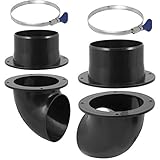
Peachtree 4 Inch Cyclone Kit
- Four 4 inch ports with turn key clamps
- Mounts to a bucket barrel or drum
- Only 1.5 lb and installs in minutes
- Container and hose sold separately

Mullet High-Speed Cyclone
- Parabolic one-piece body spins dust faster
- Pre-separates over 99 percent of debris
- Rigid cut to fit PVC connection
- Adapters fit nearly any shop vac
How Two-Stage Cyclone Separation Actually Works
Every unit in this roundup is a separator. Some pair with a shop vac, some bolt onto the inlet of an existing dust collector, and some include a bucket on casters. The separation principle is identical across all of them.
Stage one: the spin
Dirty air enters tangentially near the top of the cone. As it spirals, the heavier material is flung outward and drops into the bin below. This is where chips, shavings and coarse sawdust land. The faster the air moves, the more of the heavy fraction falls out before the air turns back toward the filter, which is why the parabolic bodies in this roundup outperform straight-wall bucket lids.
Stage two: the filter
What exits the cone is much cleaner air carrying only fine particles. That air goes to a canister, a bag or your shop vac filter. Because the bulk debris never reached it, the filter loads slowly. Reviewers on the Oneida Dust Deputy report the majority of sawdust in the drum with the shop vac filter staying clean, and the same pattern shows up across the category.
What CFM and static pressure mean for a garage
CFM is cubic feet per minute, the volume of air the system moves. Static pressure is how hard it has to push to move that air through filters, hose and ducting. A separator is not a motor, so it never adds airflow. It can only reduce airflow if it is badly sealed or if the bin is full, which is why almost every owner note in this roundup repeats the same rule: empty the container at the halfway mark.
All 10 Cyclone Dust Collectors Compared in 2026
The table below lists every unit we covered with the details that decide a garage purchase. The column that changes most decisions is the last one: how much of the system you have to source yourself.
| Product | Specs | Action |
|---|---|---|
| Oneida Dust Deputy DIY |
|
Check Latest Price |
| Peachtree 4 Inch Cyclone Kit |
|
Check Latest Price |
 POWERTEC Low Profile Separator POWERTEC Low Profile Separator |
|
Check Latest Price |
 Festool CT Cyclone Festool CT Cyclone |
|
Check Latest Price |
 Oneida 2.5 Deluxe 5-Gal Kit Oneida 2.5 Deluxe 5-Gal Kit |
|
Check Latest Price |
 Oneida 4/5 DIY Retrofit Oneida 4/5 DIY Retrofit |
|
Check Latest Price |
| Mullet High-Speed Cyclone |
|
Check Latest Price |
 VEVOR Cyclone with Metal Tank VEVOR Cyclone with Metal Tank |
|
Check Latest Price |
 VEVOR 4 Inch Transparent Cyclone VEVOR 4 Inch Transparent Cyclone |
|
Check Latest Price |
 Cikawit Bucket-Top Separator Cikawit Bucket-Top Separator |
|
Check Latest Price |
1. Oneida Dust Deputy DIY Review: The Most Proven Separator in the Category
Oneida Air Systems Dust Deputy DIY Anti-Static Retrofit Cyclone Separator for Wet/Dry Shop Vacuums (DD DIY)
Up to 99.9 percent separation
20 percent better efficiency
Tapered 2.0 inch ports
Pros
- Cuts filter clogging and cleanup time
- Supply your own container for unlimited capacity
- Fits nearly any wet dry vacuum
- Made in the USA with an anti-static housing
Cons
- You supply the container hose and hardware
- Very fine powdery dust still reaches the filter
- 2.0 inch ports are narrower than the 2.5 and 4 inch options
This is the unit most of the rest of the category is measured against, and for good reason. It has more owner history than anything else we reviewed, and the pattern in those reviews never really changes. The drum fills, the vacuum filter stays clean, and the cleanup bill drops.
Mounting takes about fifteen minutes with a hole saw and the supplied template. Drill the lid, clamp the separator in place, and run a short length of hose from the outlet to your shop vac inlet. The Neutral Vane inlet is the part worth understanding, because it is a shaped vane rather than a plain tangential entry, and Oneida credits it with roughly 20 percent better efficiency than the earlier version of the same design.
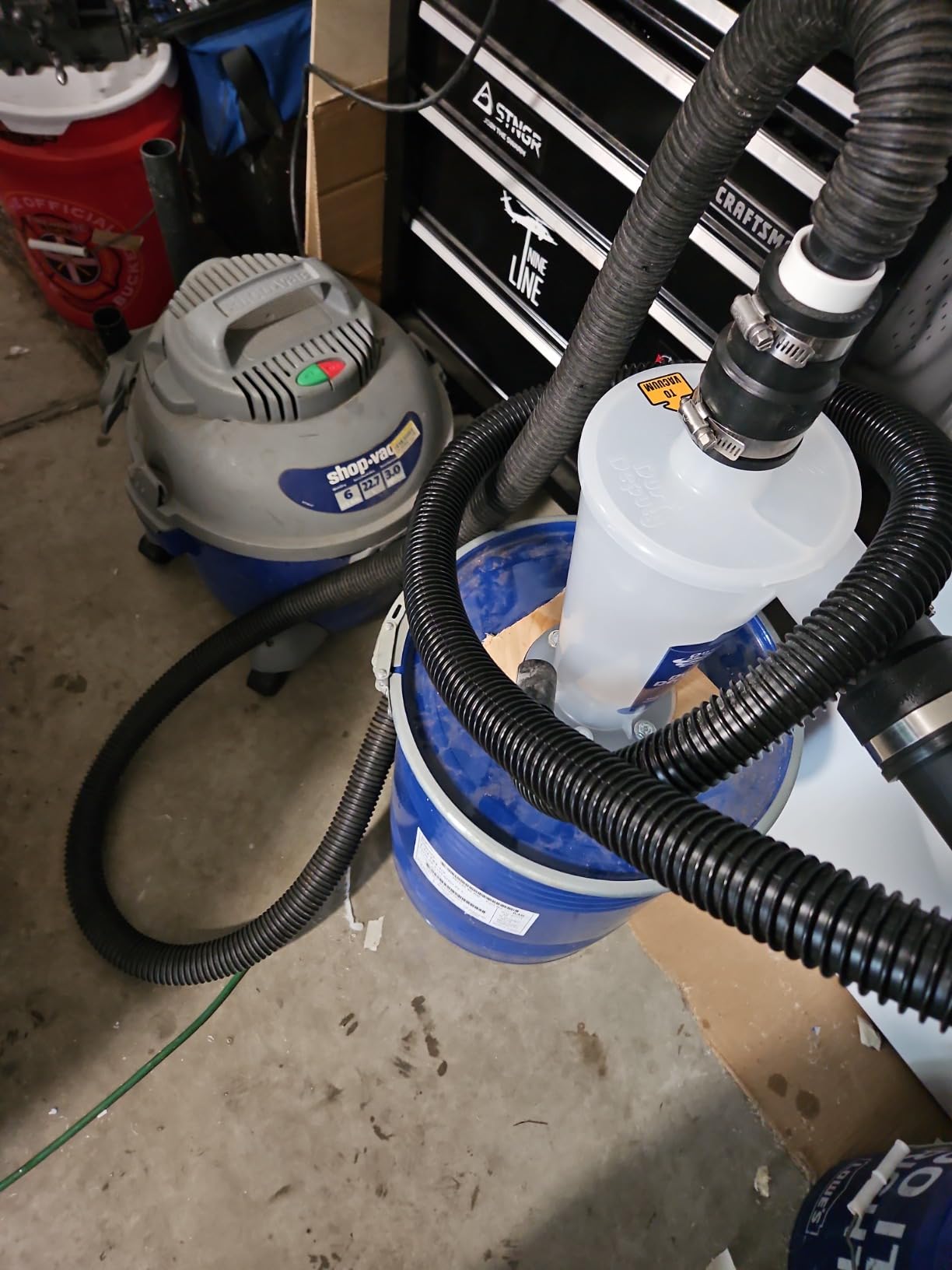
The DIY format is the reason this works so well in a garage. Because you choose the container, a 5-gallon bucket works for a benchtop setup and a 55-gallon drum works when you do a lot of planer and jointer work. Nothing about the cyclone has to change between the two. Oneida also sells static-dissipative versions of this same body for shops with a lot of fine powdery material in the mix.
What it will not do is catch everything. Owners running drywall compound or very fine sanded dust report those particles still make the trip to the filter. That is not a flaw unique to this unit, but at this level of adoption it is the most commonly reported limitation.
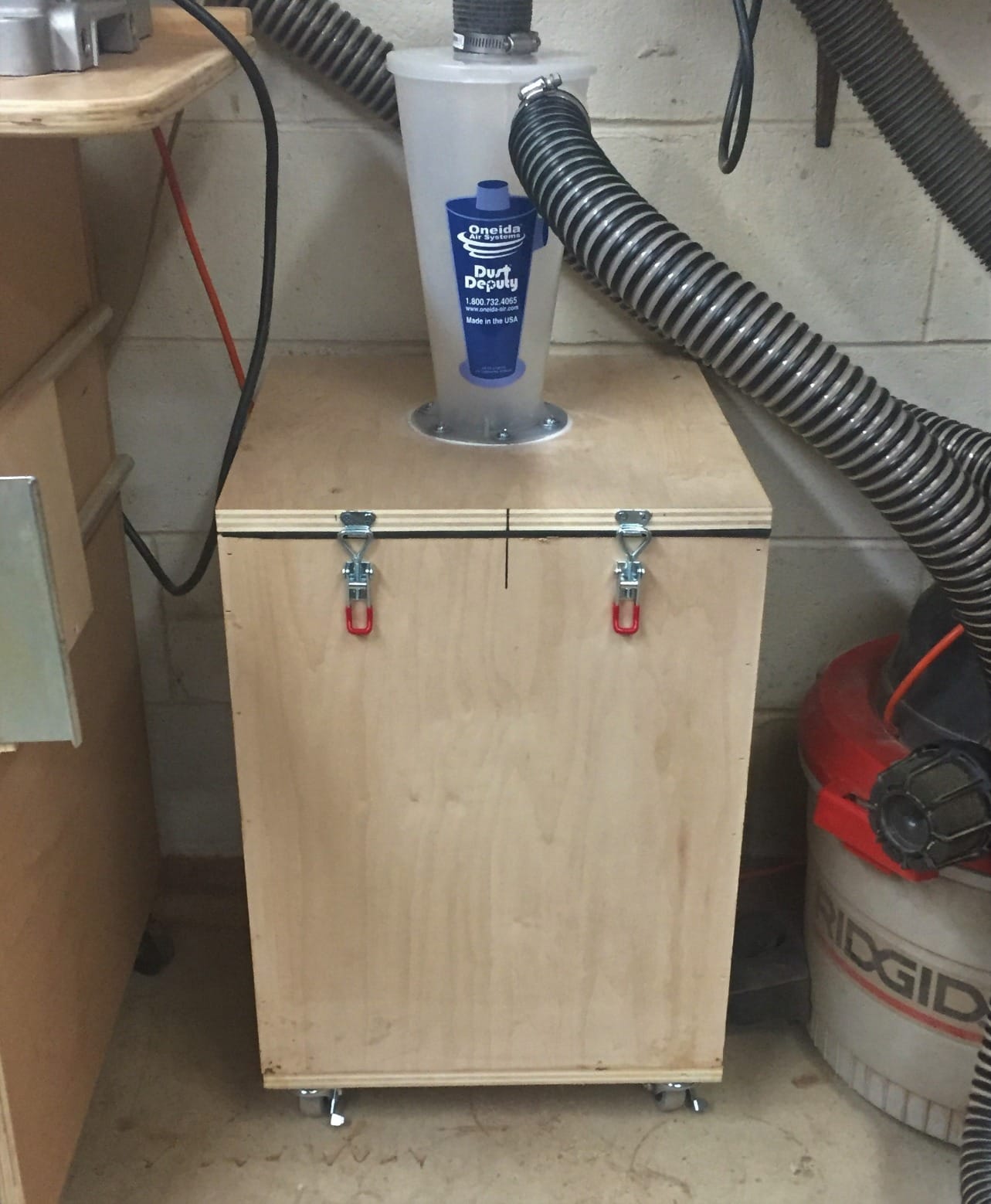
Will it work in a garage that still parks a car?
Yes, and that is exactly the use case it suits. The separator body is small enough to sit on a shop-made stand, a shelf above a bench, or directly on a 5-gallon bucket in the corner. Nothing about the installation requires dedicated floor space, and swapping between a bucket and a drum takes under a minute.
What should you buy alongside it?
A container, a length of hose sized to your vac port, and hose clamps. Grounding is worth a few extra dollars too. A length of copper wire bonded between the plastic cyclone and a ground point removes the small shocks and the sawdust that clings to an ungrounded body.
2. Peachtree 4 Inch Cyclone Kit Review: The Cheapest Genuine Two-Stage Setup
Cyclone Dust Separator Kit for 4
4 inch top and bottom ports
Turn key clamps included
Mounts to a bucket or drum
1.5 lb
Pros
- Lowest cost genuine cyclone in the group
- Catches fine sawdust in the container
- Quick install with the supplied template
- Protects the collector impeller from chips
- Users run it on 30 to 55 gallon drums
Cons
- Suction drops at about half full
- Hose and container are not included
- A pressurized planer can pop the lid without extra spring clamps
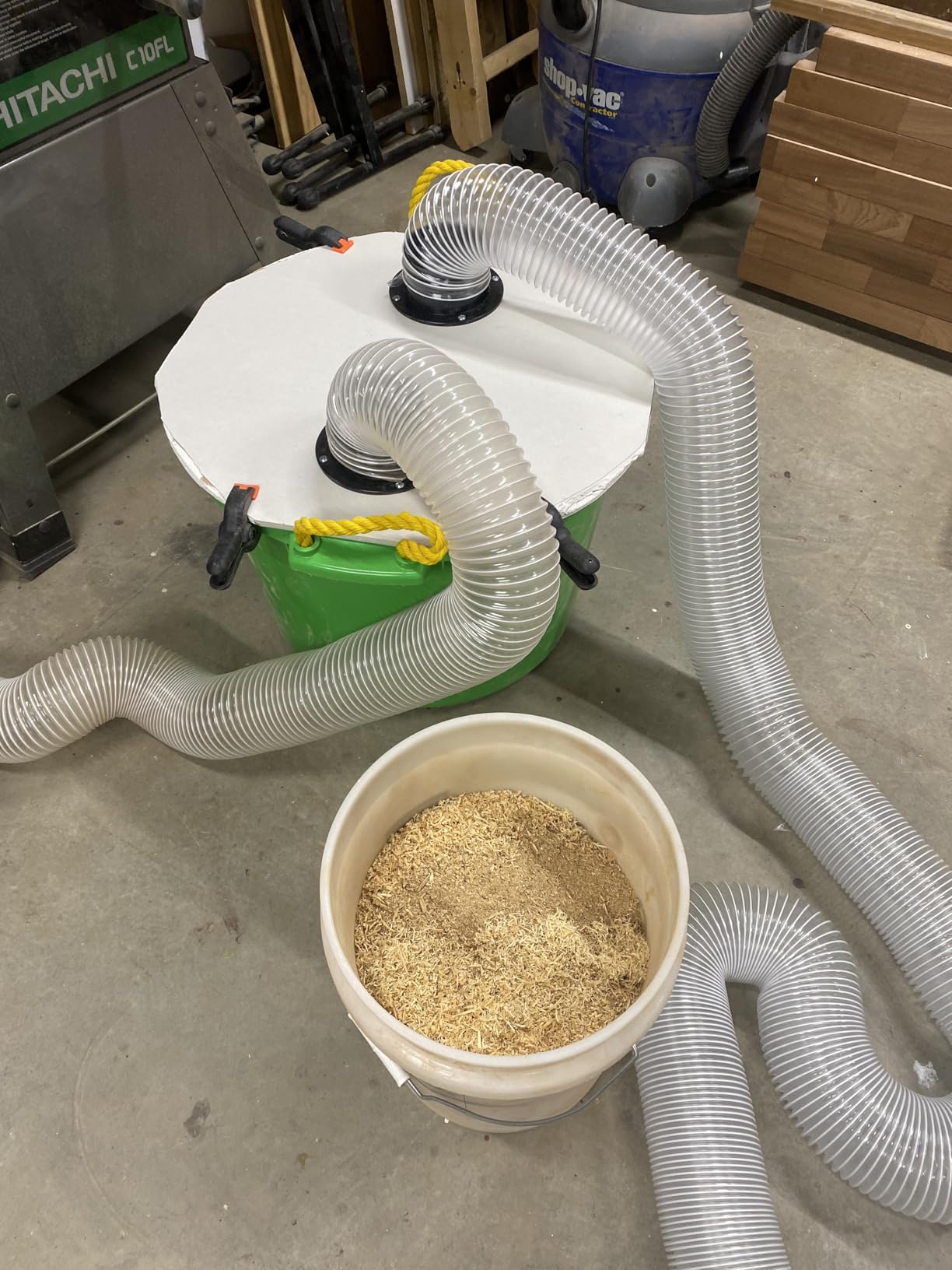
This kit is the value answer, and the rating reflects that. Owners running it on 55-gallon drums with 4-inch collectors report that nearly all chips and shavings land in the container and the collector bag stays close to empty. It is also the lightest unit in this roundup at 1.5 lb, so lifting it onto a high stand is a one-hand job.
The kit includes two top-side 4-inch ports, two bottom-side 4-inch elbow ports, and turn-key hose clamps with hardware. Port orientation is flexible. Owners mount it center-mounted or edge-mounted and report no measurable performance difference between the two, which means you can install around whatever container you already have.
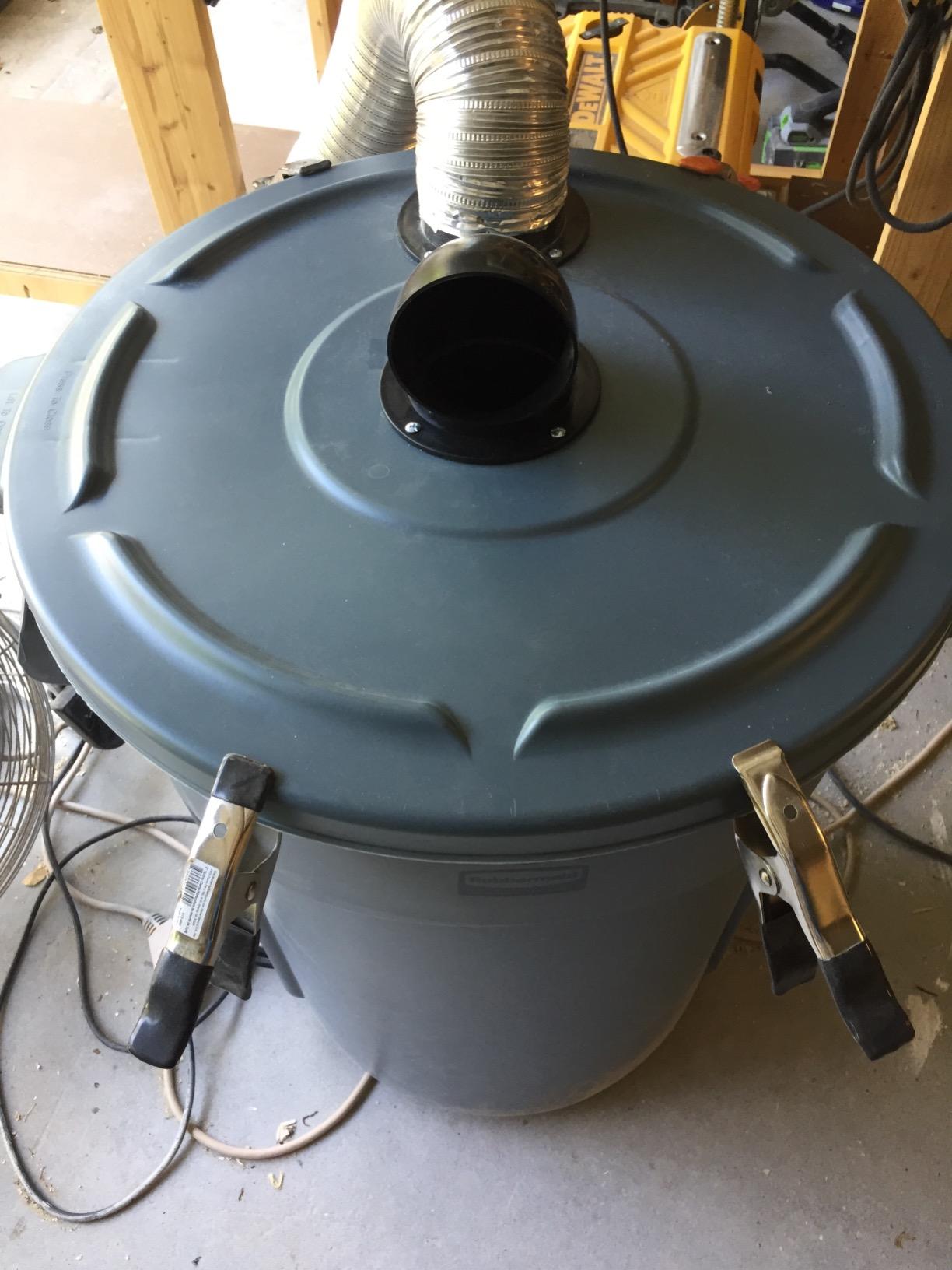
The one behavior you must plan around is the half-full rule. Once the container reaches roughly half capacity the effective separation volume drops and suction falls with it. On a small bucket that means checking during a long cut. On a drum, it means a scheduled empty at the end of every project rather than a surprise mid-cut.
Planers are the other thing to watch. A planer produces a lot of air and a lot of pressure in a short burst, and owners running high-volume planers like the DeWalt DW735 report that the container can pressurize and lift the lid unless you add spring clamps.
Is the low cost worth the extra clamps?
For most garage shops, yes. One set of spring clamps costs less than a single replacement filter, and the alternative is buying a commercial separator at several times the price. The trick is to pick a container with a flat or ribbed rim that the lid can clamp down onto evenly.
Which port size suits a typical garage?
Four inch is the right choice when you already own a 4-inch collector, because you can use one continuous run of rigid ducting from tool to cyclone. If you are running a shop vac with a 2.5-inch hose, a kit built around 2-inch or 2.5-inch ports saves you from adding reducers at every joint.
3. Mullet High-Speed Cyclone Review: Parabolic Shape, Faster Capture
Mullet Cyclone Dust Collector, High-Speed Separator for Shop Vac
Parabolic one-piece body
Pre-separates over 99 percent of debris
Rigid cut-to-fit PVC connection
Pros
- Highest average rating we measured
- Parabolic body spins dust out faster than straight-wall lids
- Rigid PVC connection instead of bolts and bungee cords
- Adapters fit virtually any shop vac or extractor
- Keeps the vacuum filter clean much longer
Cons
- The PVC must be cut to fit and sizing errors are final
- No bucket or container included
- Louder than a passive bucket lid design
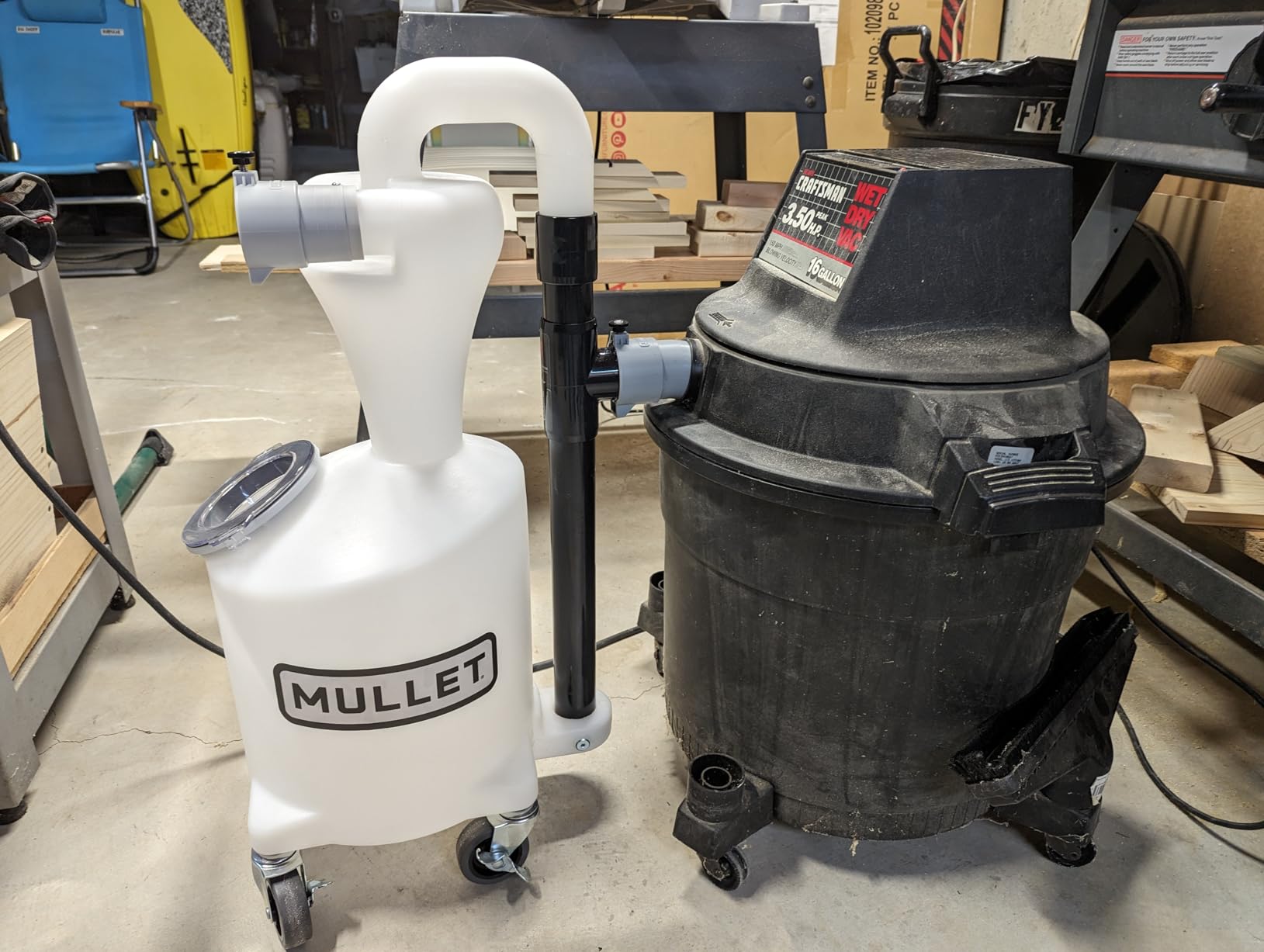
The engineering story here is shape. Most bucket-top cyclones are straight-sided cones, and air exits them as a narrow ring. The Mullet body is a paraboloid, which pulls the spinning air inward and drops more material before it turns back toward the filter. Owners watching through a shop vac window consistently see dust fall out before the air ever leaves the unit.
The second design decision is the connection. Instead of a bolt flange, a bungee cord or a strip of duct tape, this unit uses rigid PVC cut to fit your setup. That makes the seal far more dependable and is the change people notice most after moving away from a homemade version.
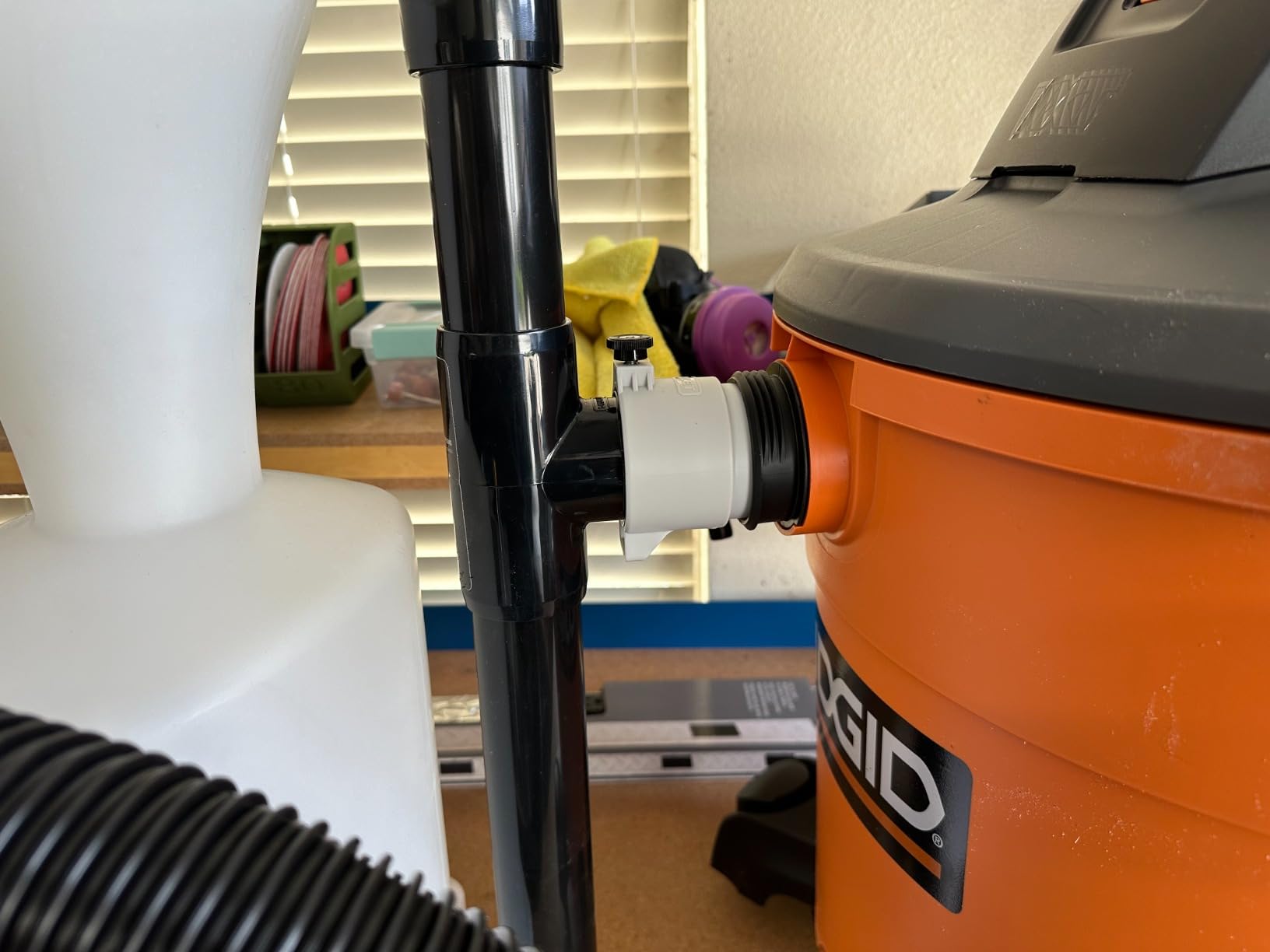
Two practical notes came up repeatedly. The included hose adapters fit nearly any wet and dry vacuum or dust extractor, tall or short, so compatibility is rarely the problem. The cutting is. Because the PVC is rigid and must be trimmed to length, measure the run twice and cut once.
The fast spin has a side effect. When the container is packed, the spinning dust cloud gets re-entrained back into the airflow, so performance drops off sharply near full. Plan to empty at the halfway mark like the rest of the category, and treat the noise as a reminder that this is a louder design than a passive lid.
Does the extra spin matter on a table saw?
It matters most on the tools that move a lot of air in a short burst. Table saws, planers and jointers all benefit, because the extra capture happens before the fine fraction reaches the filter. A track saw or a random orbital sander produces so little debris that the difference barely registers.
Is the extra noise a problem in a residential garage?
It can be. Moving more air through the parabolic body makes this one of the louder options here, and louder than a passive bucket lid. If the garage shares a wall with living space, position the unit away from the shared wall and run it during daytime hours.
4. Oneida 4/5 DIY Retrofit Review: Best Upgrade for an Existing Collector
Oneida Air Systems Cyclone Attachment for Single Stage 0.5-3HP Dust Collector, 4/5 DIY – Portable Attachments and Accessories for Home and Woodworking Space Cleaning
Retrofits 1HP to 3HP single stage units
Captures over 99 percent of fine dust
7.7 lb
Pros
- Fits a wide range of existing collectors
- Included gasket and 4 inch reducer adapters
- Air ramp maintains suction at high separation
- Light enough to reposition in a small shop
- Made in the USA under US patents
Cons
- DIY version means you supply the container and ducting
- 4 inch and 6 inch outlet limits other port sizes
- Polypropylene body is less rigid than metal
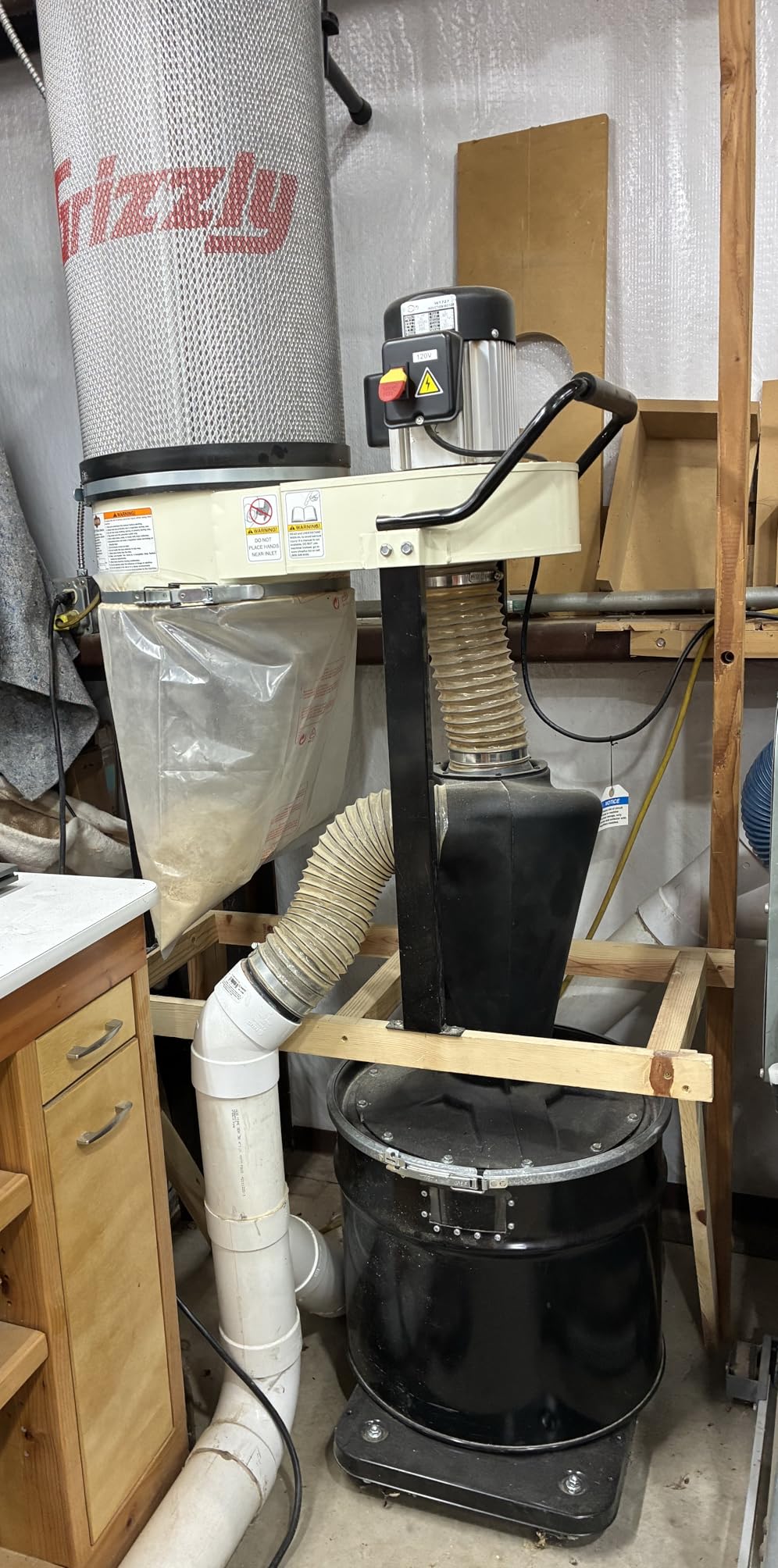
If you already own a 1HP to 3HP single-stage dust collector, this is the cheapest path to two-stage performance. It clamps onto the inlet of the unit you have and intercepts the bulk debris before it reaches the impeller and filter. Owners consistently describe it as the most cost-effective conversion available.
Compatibility is broad but not universal. The body is designed for collectors with a 4-inch or 5-inch inlet and a 4-inch or 6-inch outlet. Two 4-inch reducer adapters and a gasket are included, so the common case is a clean install without a trip to the hardware store.
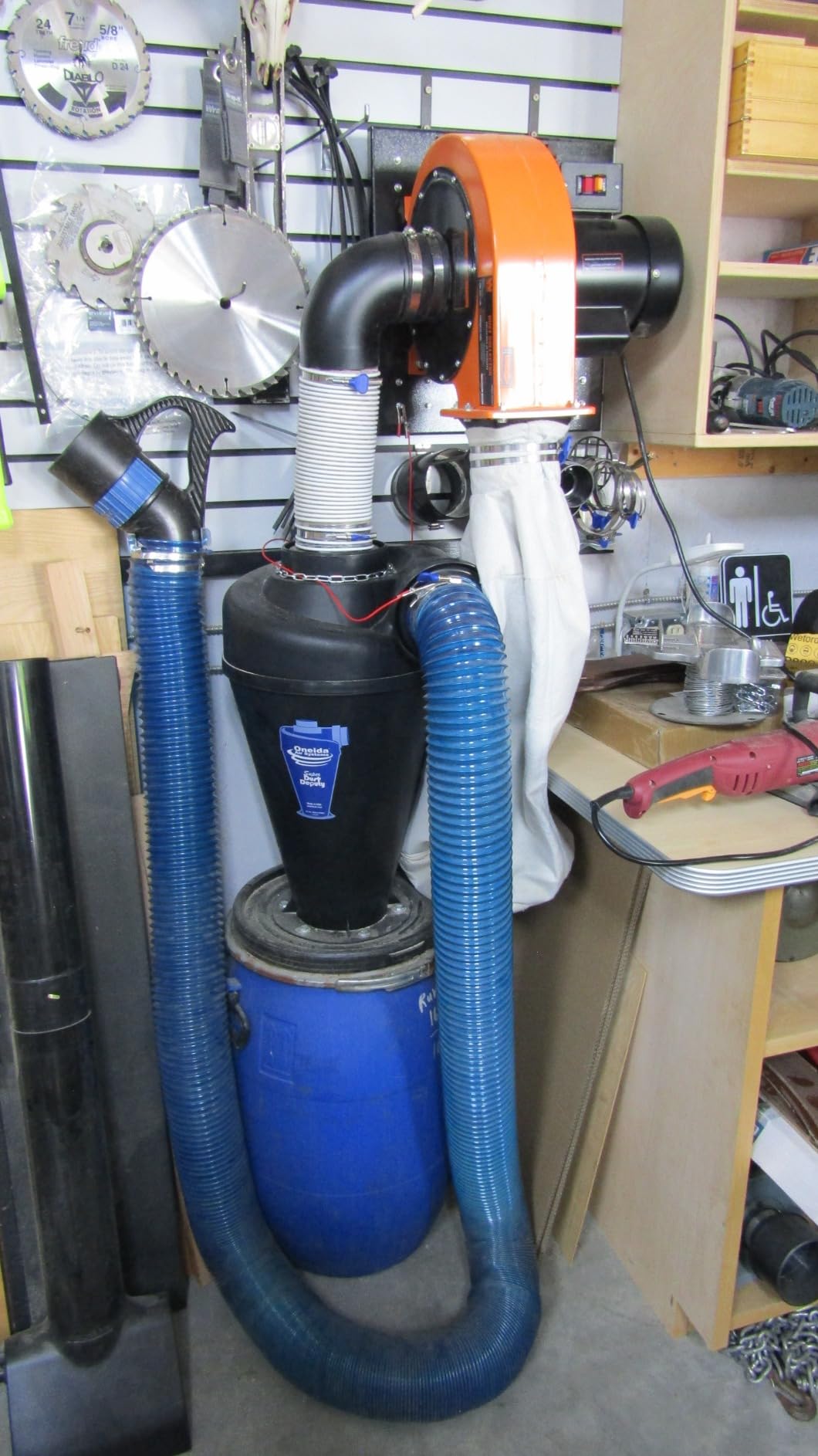
At 7.7 lb it is easy to lift, which matters when the collector lives in a corner you cannot walk behind. The integrated air ramp and neutral vane inlet are the parts doing the real work here, and they are what let the unit hold suction while capturing the large majority of fine dust and debris.
Being the DIY variant, this is the cyclone only. You supply the waste container, the hose and the ducting. That sounds like a drawback, but for anyone with an existing collector it is the point, since the expensive motor and housing are already on hand.
Is retrofitting better than buying a new collector?
For most garage shops it is. You already own the blower, the filter housing and the electrical, and this replaces the part that actually determines how the dust behaves. The only case for a new collector is if your existing unit is undersized for the horsepower your tools demand.
What if your collector ports do not match?
Measure the inlet and outlet before you buy. If your collector uses port diameters outside the 4-inch and 6-inch range covered here, you will need reducers, and a mismatched reducer is where static and leaks start. The included adapters handle the common sizes only.
5. POWERTEC Low Profile Separator Review: Steady on a Five-Gallon Bucket
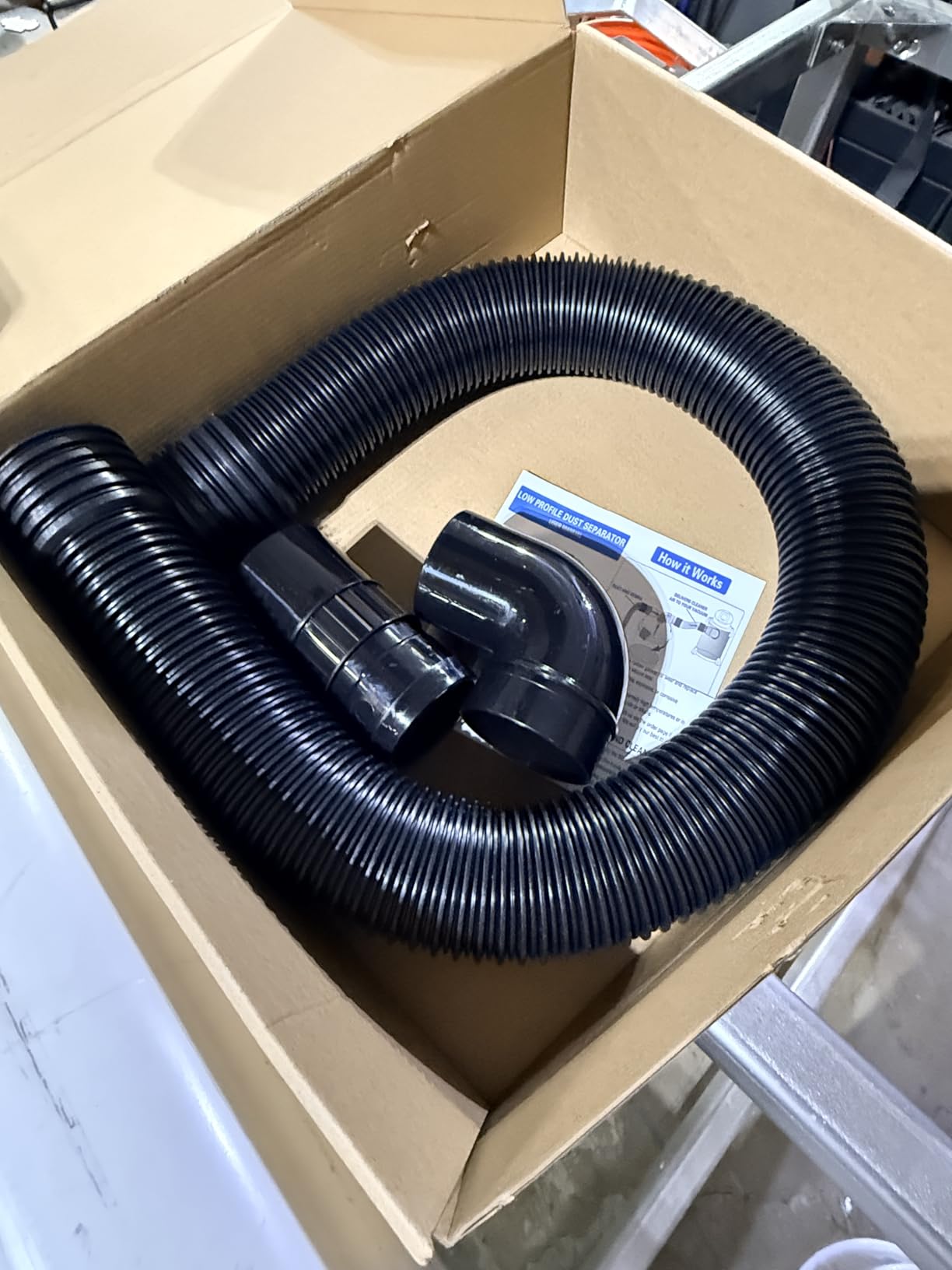
POWERTEC Low Profile Dust Separator for Shop Vac & Dust Collectors, Fits 5 Gallon Buckets, For 2-1/4″ Shop Vacuum Port, 2-1/2″ & 4″ Dust Collection System, Cyclone Dust Collection Kit w/Hose & Elbow
Low profile patented lid
Connects to 2-1/4 inch vac hose
Includes hose elbow and adapters
Pros
- Low profile lid resists tipping on a bucket
- Complete kit with hose elbow latches and gasket
- Works as a floor sweeper for piles of sawdust
- Performs well paired with a 1HP or larger collector
Cons
- Foam gasket can arrive short of full circumference
- Dual latches are flimsy and pins barely engage
- Performs poorly running off a shop vac alone
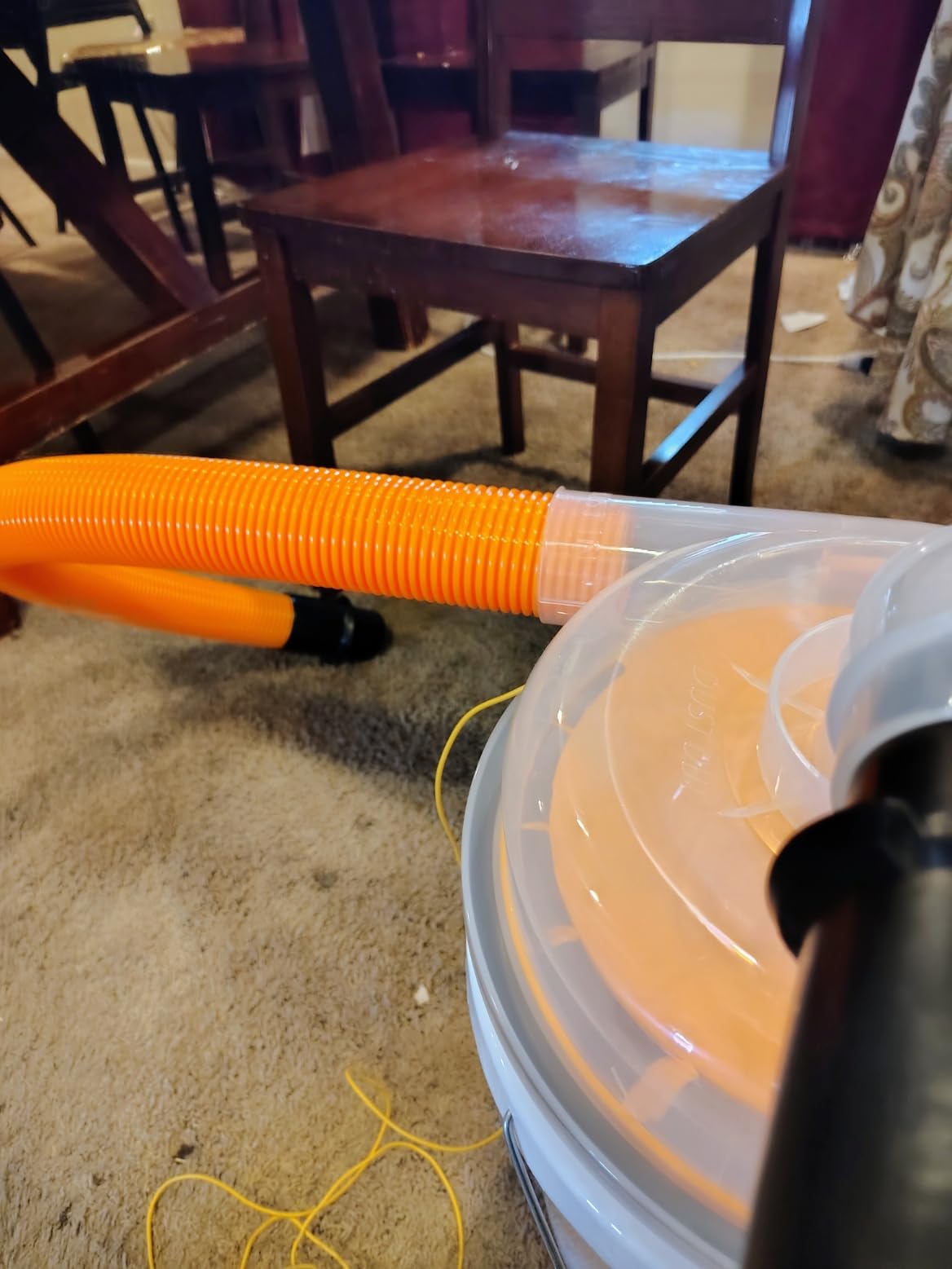
The low profile is the point of this design. A short lid lowers the center of gravity, which matters because a bucket full of chips is a top-heavy object that gets yanked by hose pull the moment you drag the vac across the shop. The impact-resistant plastic and ABS body is also lighter than a full cyclone cone.
The kit is unusually complete for the money. You get the separator lid, foam gasket, dual latches, a 90-degree elbow sized for a 2-1/4-inch shop vac hose, hose adapters, a 3-foot length of hose and the grounding hardware, though not the grounding wire itself. That list covers everything except the bucket.
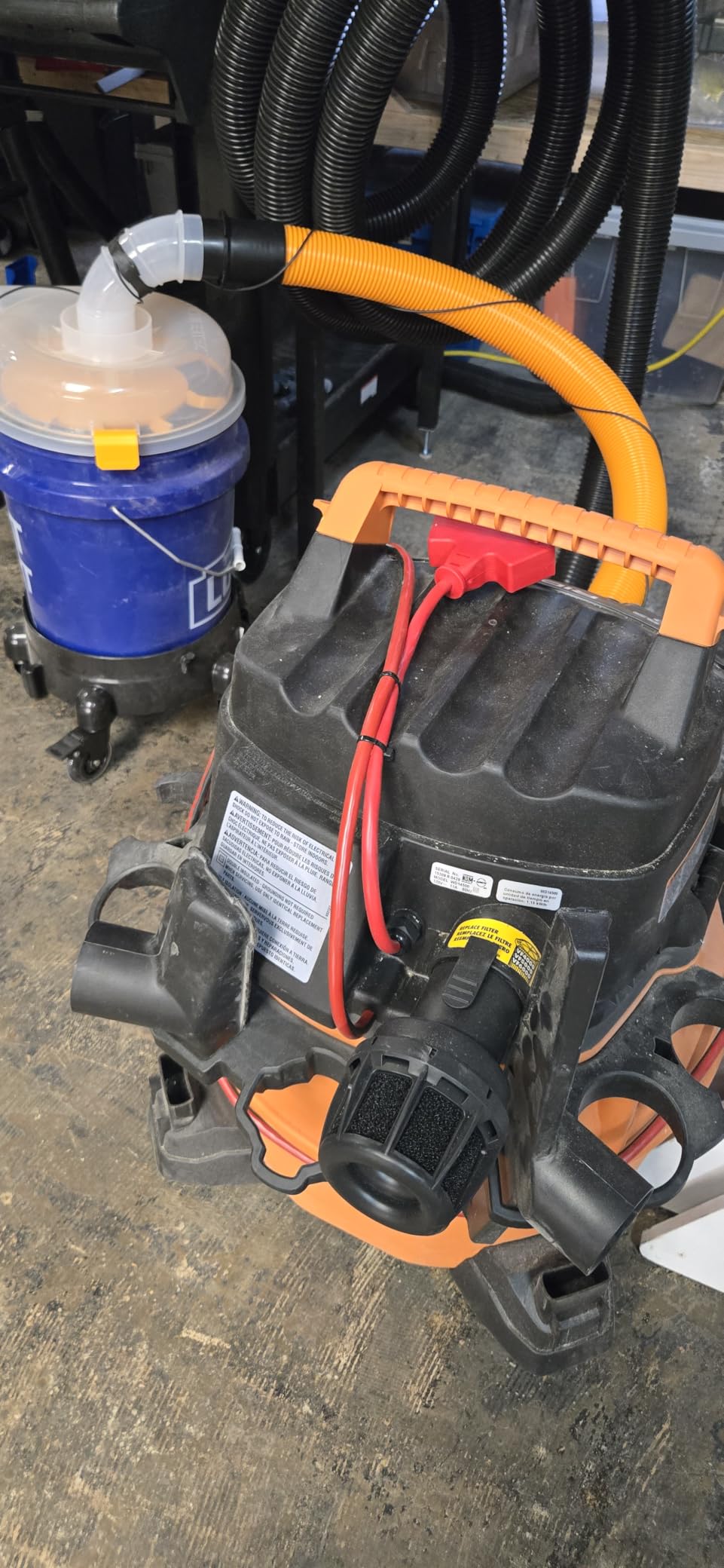
Performance depends heavily on the air source. Owners feeding it from a 1HP or larger dedicated collector report strong separation and little loss of tool suction. Owners trying to run it off a shop vac alone report a drop in effectiveness, which matches the pattern across this whole category. More airflow means more centrifugal force and more material dropping out.
Two hardware details are worth checking at unboxing. Some units arrive with a foam gasket roughly half an inch short of the full bucket circumference, and the dual latches have small pins that barely engage. Neither is a deal breaker, but both are five-minute fixes before you first pull suction.
Is it good enough for a table saw and a track saw?
Yes for chip-heavy work. Reviewers specifically praise it on a table saw and as a floor sweeper, where it pulls in piles of sawdust from a few inches away. It is less useful as a fine-dust solution than a unit with a real baffle, so pair it with a solid shop vac filter if you sand a lot.
What is the internal-arch half-full limit?
The lid contains internal arches that spin the collected dust. Once the bucket passes roughly half full, that spinning pushes material back up into the airflow instead of letting it settle. Treat the halfway line as the working capacity of the bucket and it stays predictable.
6. Festool CT Cyclone Review: Built Around a Modular System
Festool 204083 CT CYCLONE Dust Separator CT-VA-20
Flat body fits inside a Systainer
Works with CT 26 36 and 48 extractors
OSHA Table 1 compliant
Pros
- Stores and moves inside a Systainer
- Owners report about 95 percent of sawdust landing in the bin
- Flat profile saves floor space in small shops
- Reduces bag and filter replacement
- Covers silica work when paired correctly
Cons
- By far the most expensive unit in the group
- Friction fit parts are easy to seat misaligned
- Only pairs with Festool CT extractors
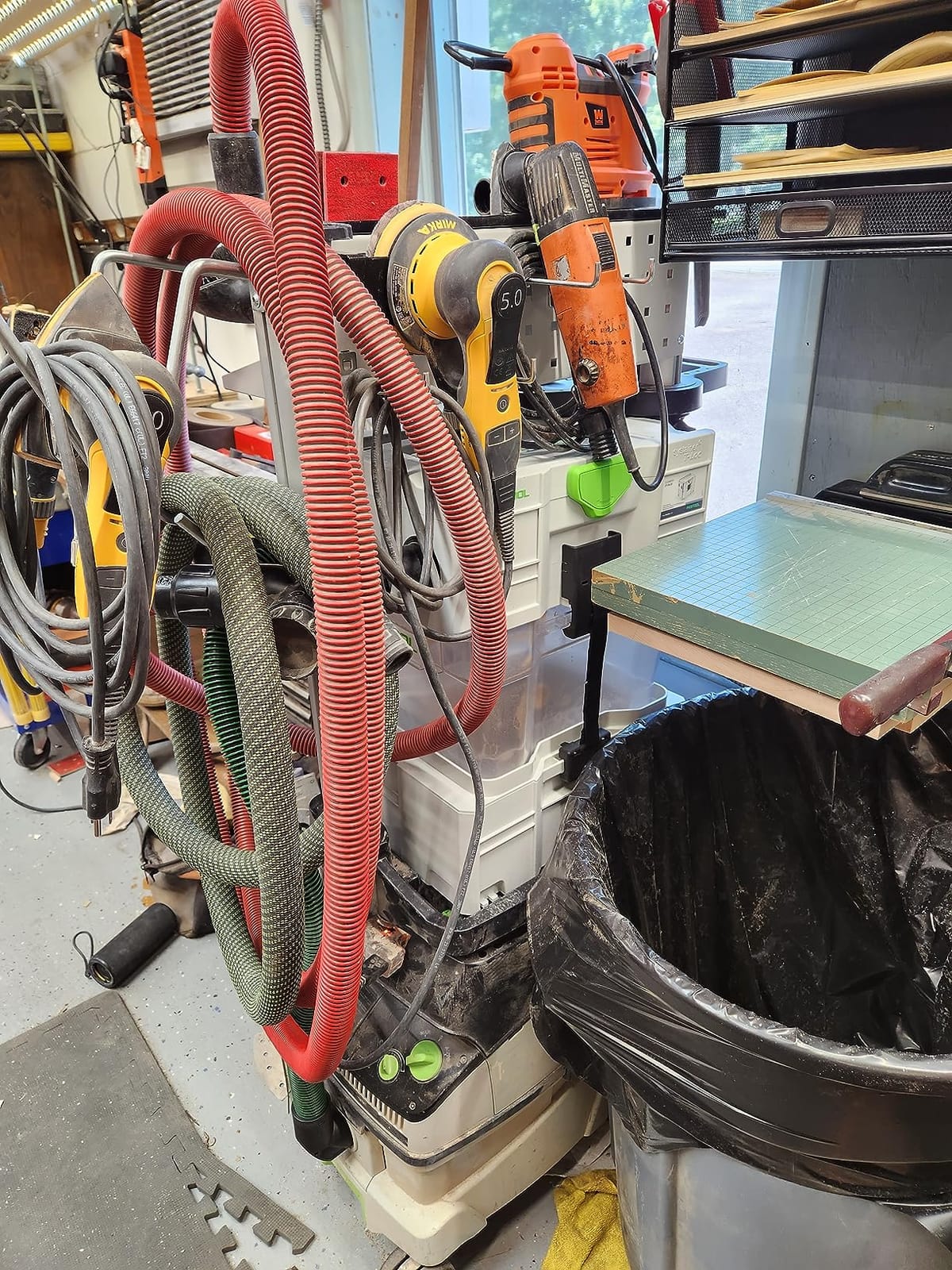
This one is bought as part of a system rather than as a standalone separator. The body is a flat cyclone that drops inside a Festool Systainer, so the whole thing stores on a shelf and moves with the rest of the range. In a garage where floor space is the scarcest resource, that storage behavior is the real feature.
Owners report roughly 95 percent of sawdust ending up in the bin rather than the extractor bag, and the aluminum body gives it a completely different feel from the injection-molded plastic designs above it. It also works with every CT 26, 36 and 48 extractor, with or without the Autoclean function.
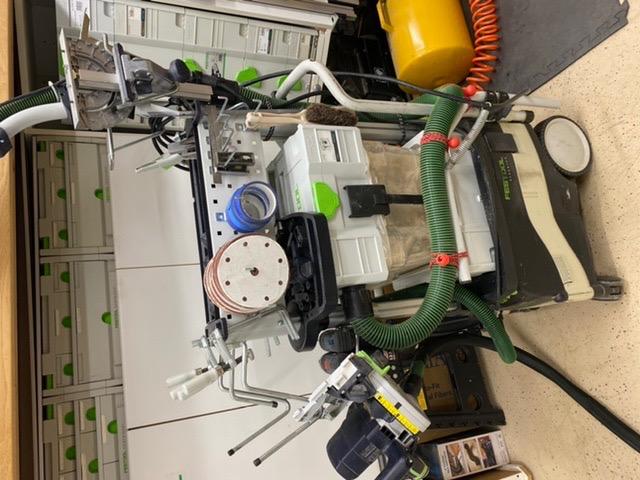
The friction-fit assembly is the part to respect. The cyclone components are located by fit and held by the Systainer lid, and a slightly misaligned seat causes a dramatic loss of suction. It is a design choice that reduces parts and looks clean, but it demands a careful setup.
There is also an inherent suction penalty compared with a straight hose connection, and large chips can pass through the flat geometry rather than being trapped. If you do not already use Festool extractors, this unit does not apply to you.
Is it worth the price difference?
If you run Festool extractors, the case is strong. Owners describe it as a purchase that pays for itself through avoided bags and filters, and several note that they deliberated for years before buying and then regretted the delay. If you do not own Festool gear, no price makes that work.
Does the low profile actually fit a low ceiling garage?
It is one of the few units here that stores flat rather than standing. Most people set it on a shelf or bench, or leave it docked in the extractor between uses. The aluminum body weighs 7 kg, so it is not something you want to lift overhead repeatedly.
7. VEVOR Cyclone with Metal Tank Review: The Steel-Barrel Option
VEVOR Cyclone Dust Separator with Metal Tank, 4″ Retrofit Cyclone Separator for Dust Collectors, ABS Material With 2″ Hole O.D. Connector & Hose for Wet/Dry Shop Vacuums, Fits 13.21 Gallon Tank
13.21 gallon iron barrel
Transparent separator body
Separation up to 99.61 percent
Pros
- Steel can is more rigid and durable than plastic
- Transparent body and sight window show fill level
- Handles high pressure collectors well
- Good on planers jointers CNC and slab work
- 13.21 gallon size is easy to lift when full
Cons
- Only three casters makes the can unstable
- Bundled 2-1/2 inch reducers do not seat properly
- Requires 4 inch hose for collector use
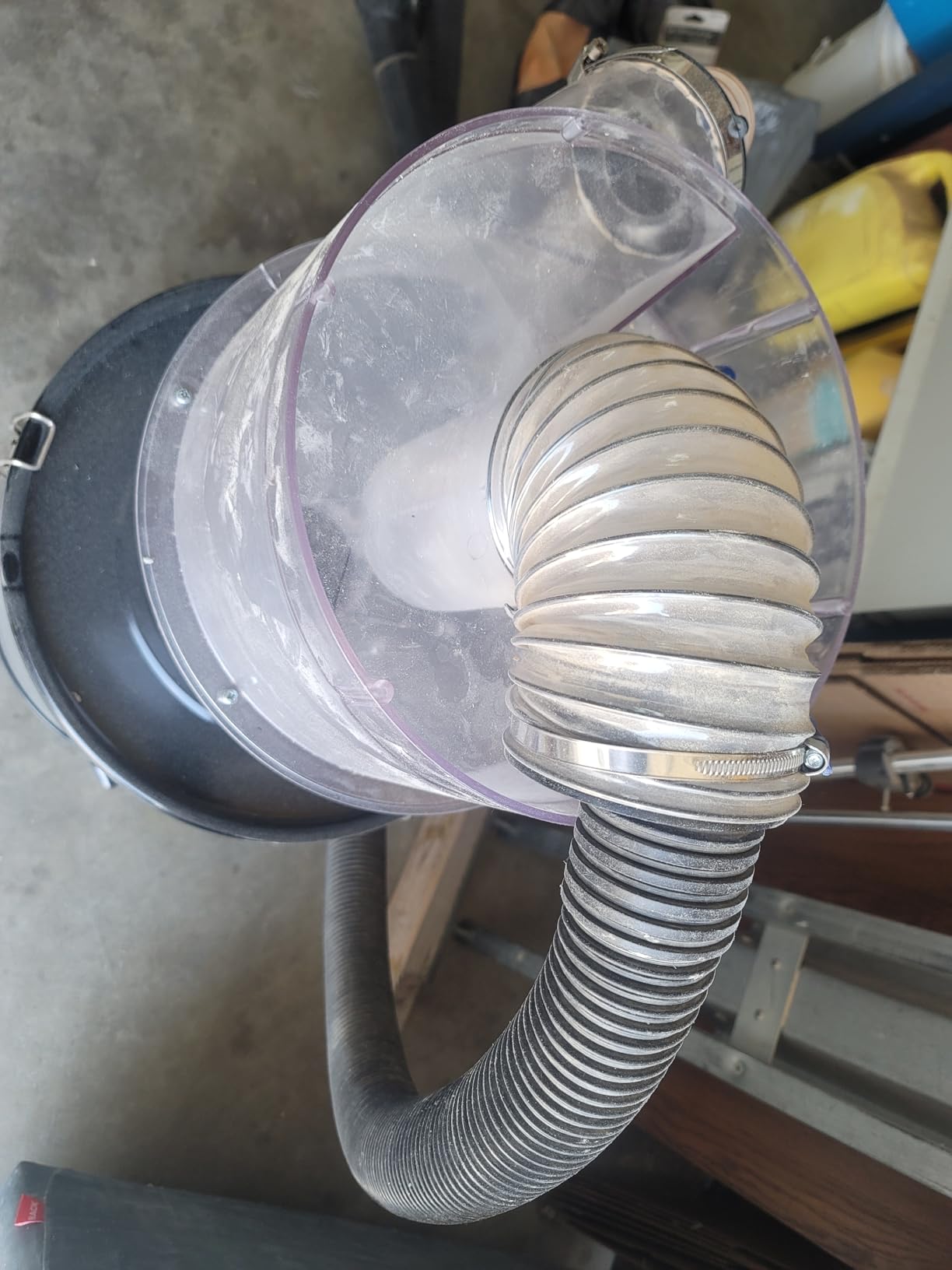
Most separators in this roundup end in a plastic bucket. This one includes a 13.21 gallon iron barrel, and that single difference removes the tipping problem, the lid-lift problem and the bucket-swap problem in one move. The clear sight window on the can and the fully transparent separator body let you watch fill level without opening anything.
Reviewers place it firmly in the heavy-duty end of the range. Owners report running it with high-horsepower collectors, plus effective results on planers, jointers with helical heads, CNC routers and slab milling. In those cases the extractor bag stays close to empty, which is the entire point of adding a separator.
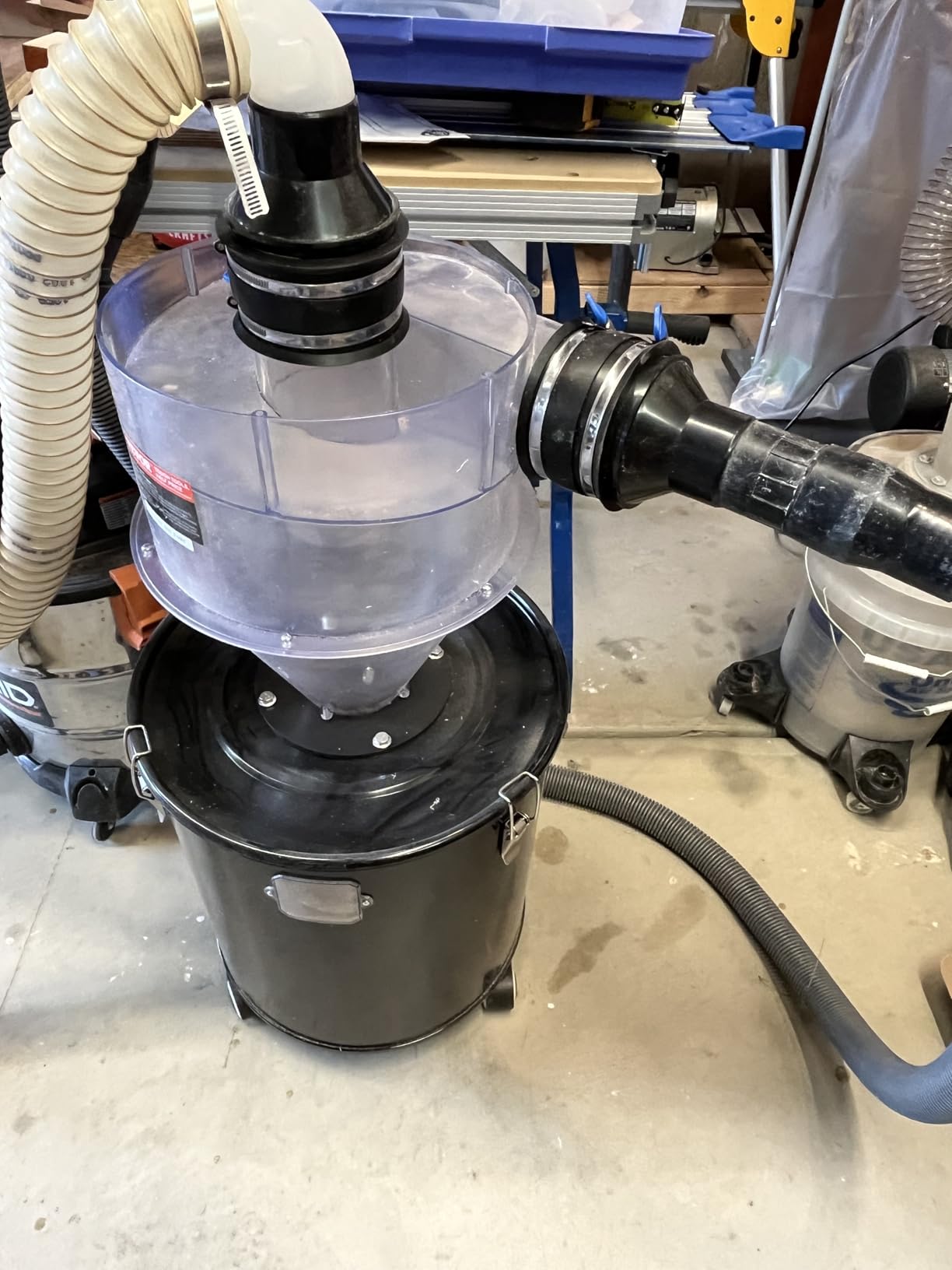
There are real hardware complaints. The barrel arrives on three casters rather than four, which makes it unstable, and several owners simply remove the wheels and park it. The dust ports are short, so a squeeze clamp is needed when you move it between tools. And the supplied 2-1/2-inch reducers do not seat properly without a foam shim or a proper aftermarket reducer.
Also expect some noise. The metal can rings audibly under a high-pressure collector, though owners do not report structural failure. Static will still make chips cling to a plastic separator body, which is another good reason to ground the unit.
Is 13.21 gallons the right capacity for a garage?
For a hobby shop working in short sessions it is a comfortable size. Thirteen gallons is full but still liftable for most people, and the sight window means you check it visually instead of lifting a lid. Production shops move more volume per hour and will empty it more often.
Does it work with a small shop vac?
Not out of the box. The inlet and outlet measure 3.81 inch for 4-inch commercial hose, and 4-inch hose has to be sourced separately. A 1.97 inch adapter covers 2-inch household hose, but that small hose limits how much air the system moves and how much the cyclone actually separates.
8. Oneida 2.5 Deluxe 5-Gallon Kit Review: Turnkey and Mobile
Oneida Air Systems Dust Collector & Cyclone Separator Kit w/ Clear Bucket, 2.5 Deluxe 5-Gal – Portable Cyclone Machine for Wet and Dry Shop Vacuums
Cyclone bucket lid casters and hose included
Translucent 5 gallon bucket
4.5 ft 2.5 inch hose
Pros
- Everything is included from cyclone to casters
- Translucent bucket shows fill level at a glance
- Cleanup times drop dramatically on chip work
- Shop vac pulls stronger with a cleaner filter
- Moves easily on four casters
Cons
- Hose cuffs pull off easily and no band clamps are included
- Caster mounts use tape that can fail
- Suction drops past the half-full mark
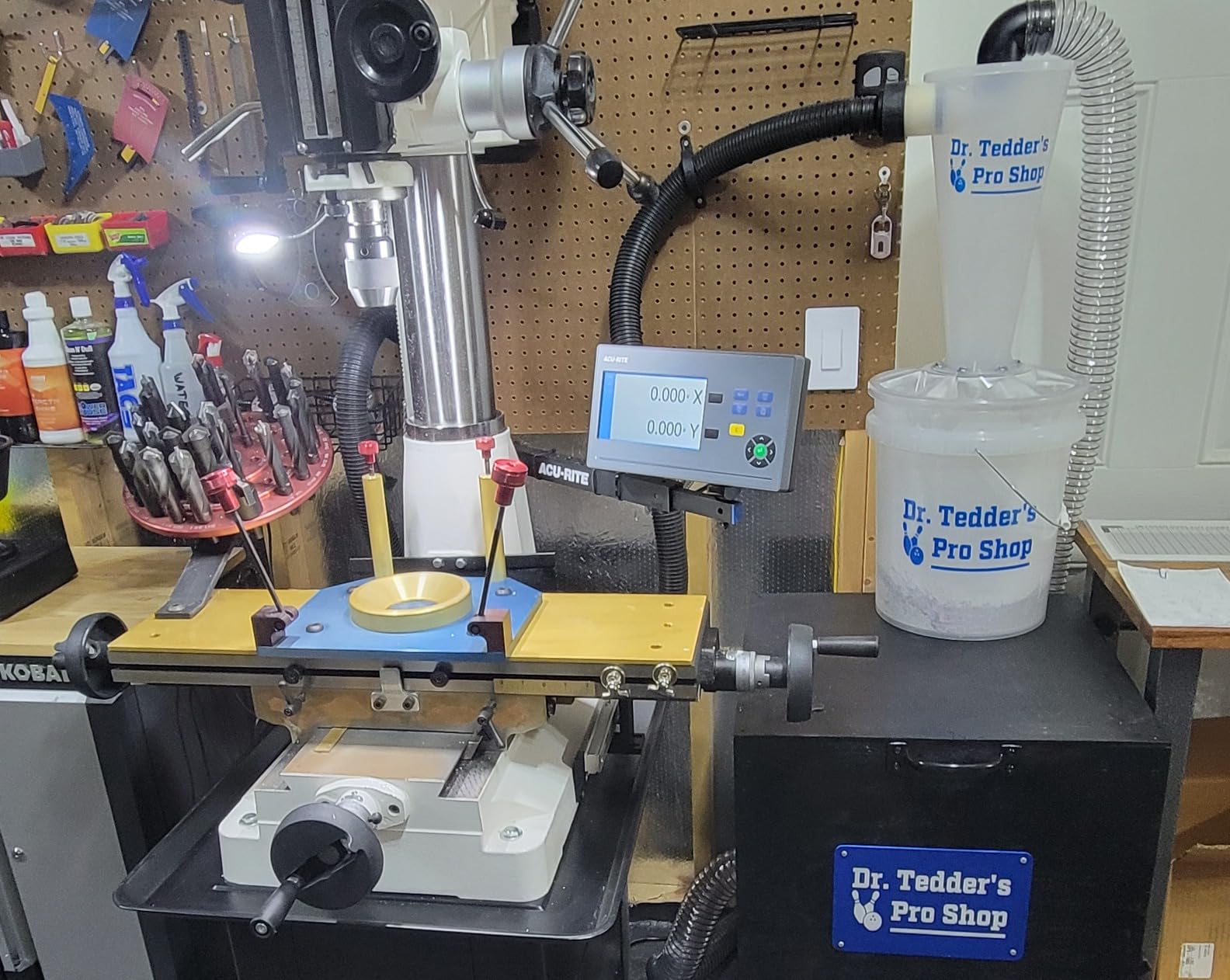
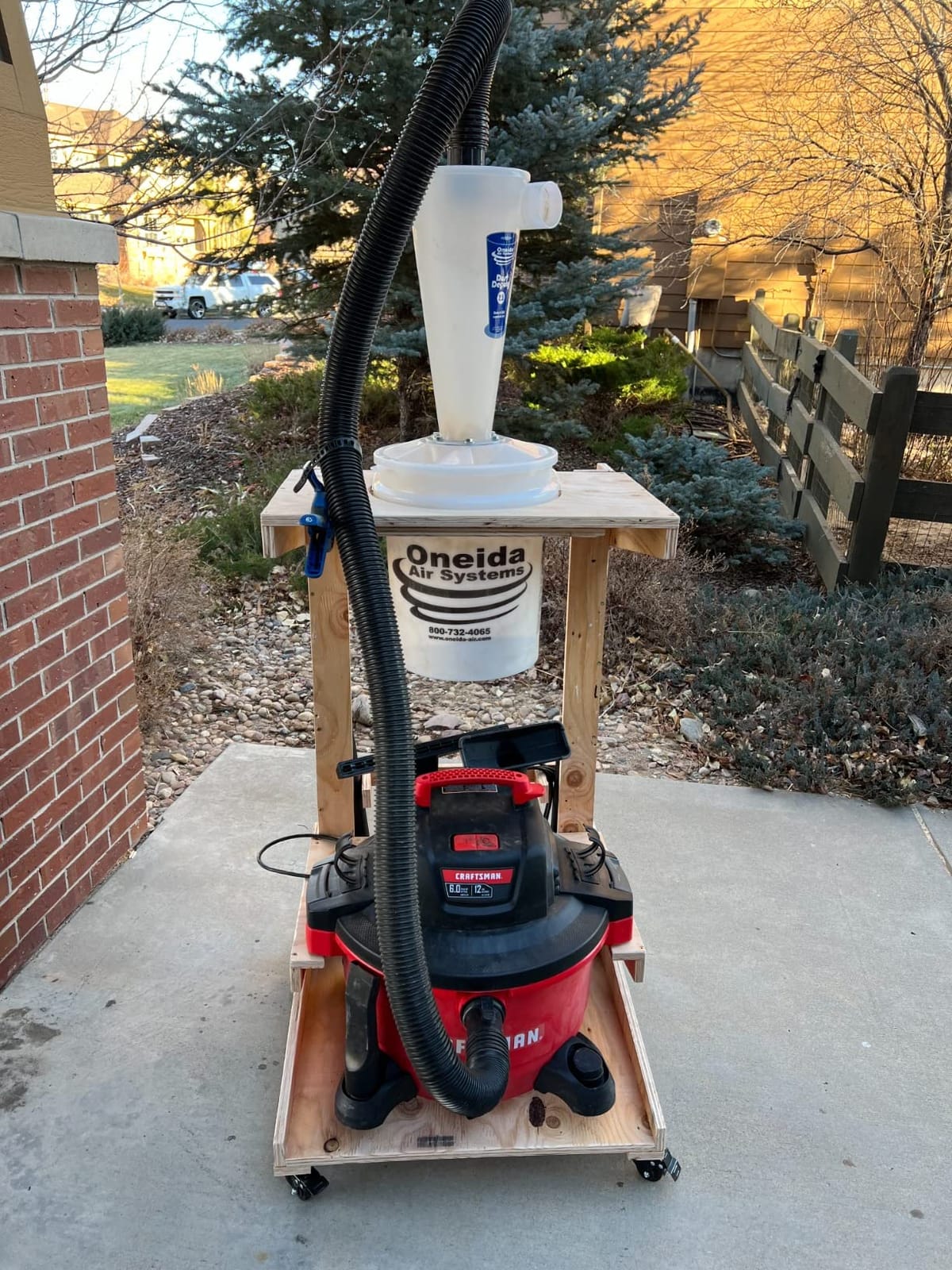
This kit bundles everything in one box: the cyclone, a collapse-proof 5-gallon bucket with translucent walls, a lid, four casters and mounts, a 4.5-foot 2.5-inch hose with swivel cuffs, a tether kit, a pre-cut neoprene gasket and the hardware.
Functionally it works. Owners report cutting 30-plus-minute cleanups down to about a minute, and a shop vac that pulls noticeably better afterward because the filter stayed clean. The translucent bucket is a genuinely useful touch in a garage where you want to know the fill level without crossing the room.
The rating is the lowest of the Oneida units here, and the reviews explain why. The complaints are about assembly hardware rather than separation performance. Caster mounts are secured with double-sided tape that can fail, some kits arrive missing bolts, and the instructions are unhelpful. The sharp 90-degree swivel cuffs pull off easily and no band clamps are included.
Suction also drops noticeably past the half-full mark, and the tight 90-degree bend in the hose restricts airflow. Multiple reviewers call out Oneida’s customer service as fast and inexpensive when parts do fail, which softens the hardware complaints considerably.
Is the 2.5 inch port too small for a garage?
For a shop vac setup it is the correct size, since that is the standard wet and dry vacuum hose. For feeding a dedicated dust collector it is on the small side. Smaller hose means less airflow, which means less centrifugal force and less material dropping out of the air.
Is it better to build your own instead?
If you enjoy a Saturday project, building a bucket-top cyclone is satisfying and cheaper. If you want it working today with no drilling, no template and no hunting for clamps, this kit is the shortcut. The hardware complaints are real, but they are all fixable in an afternoon.
9. VEVOR 4 Inch Transparent Cyclone Review: Light and See-Through
VEVOR Cyclone Dust Separator, 4″ Retrofit Cyclone Separator for Dust Collectors, ABS Material With 2″ Hole O.D. Connector & Hose for Wet/Dry Shop Vacuums, Fits 5-10 Gallon Tank (Tank Exclude)
High transparency ABS body
Inlet and outlet 3.81 inch for 4 inch hose
Fits 5 to 10 gallon tanks
Pros
- Watch separation happen in real time
- Retrofits a drum you already own
- Lightest full size separator we weighed
- 2 inch hose and a 4 to 2 inch adapter included
- About half the cost of the bundled can version
Cons
- Collection tank is not included
- 4 inch hose must be bought separately
- ABS body is less impact resistant than metal
This is the sibling model to the steel-barrel version, and the difference is everything: no tank, a clear ABS body, and about half the cost. At 7.03 lb it is the lightest full-size separator we weighed, which makes it easy to lift onto a shelf or move between two machines.
The transparency is the reason to buy it. Owners who like to understand what their hardware is doing can watch the debris cloud spin and settle instead of guessing. Rated separation here is up to 99.61 percent, the same figure as the metal version.
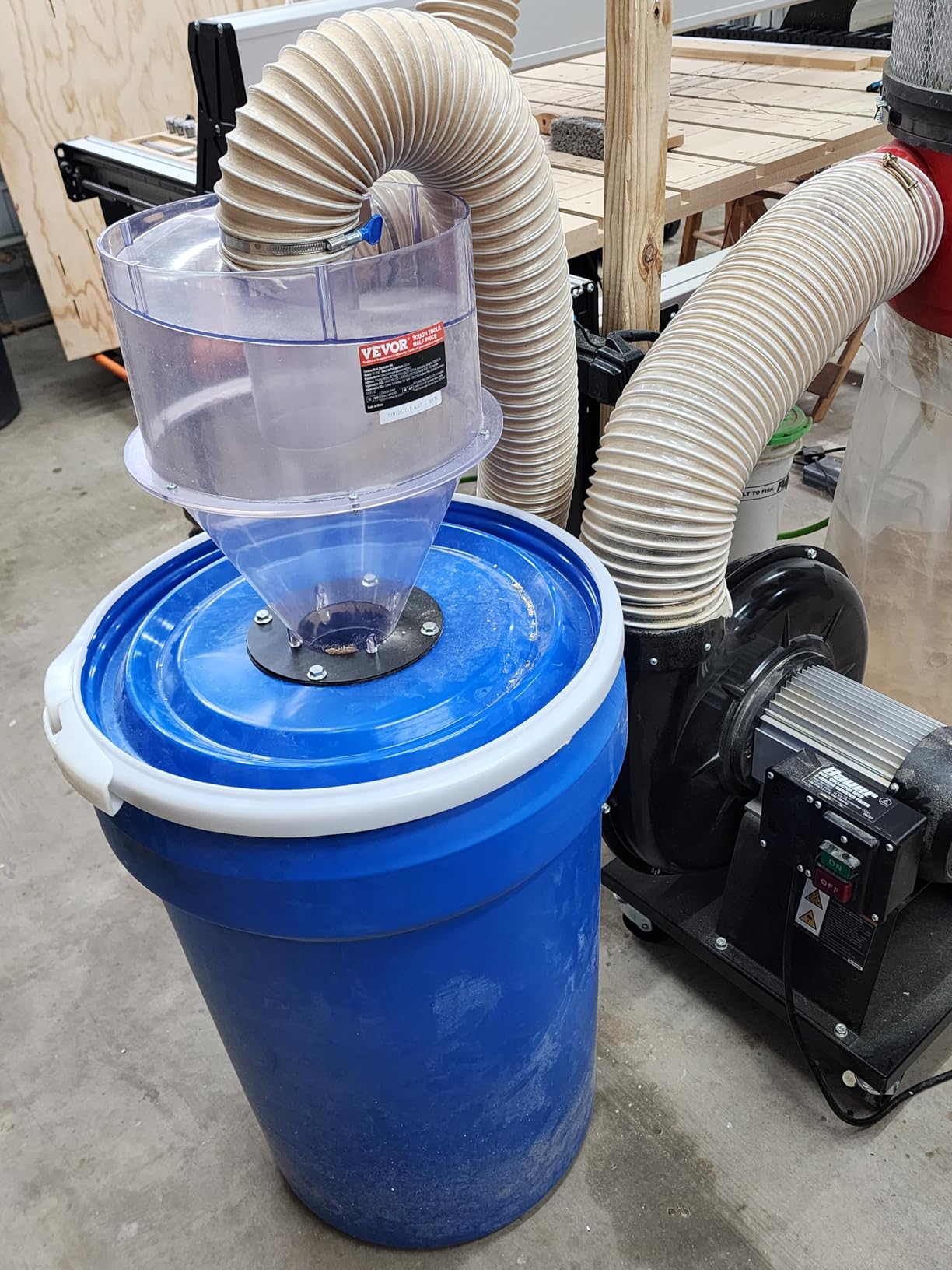
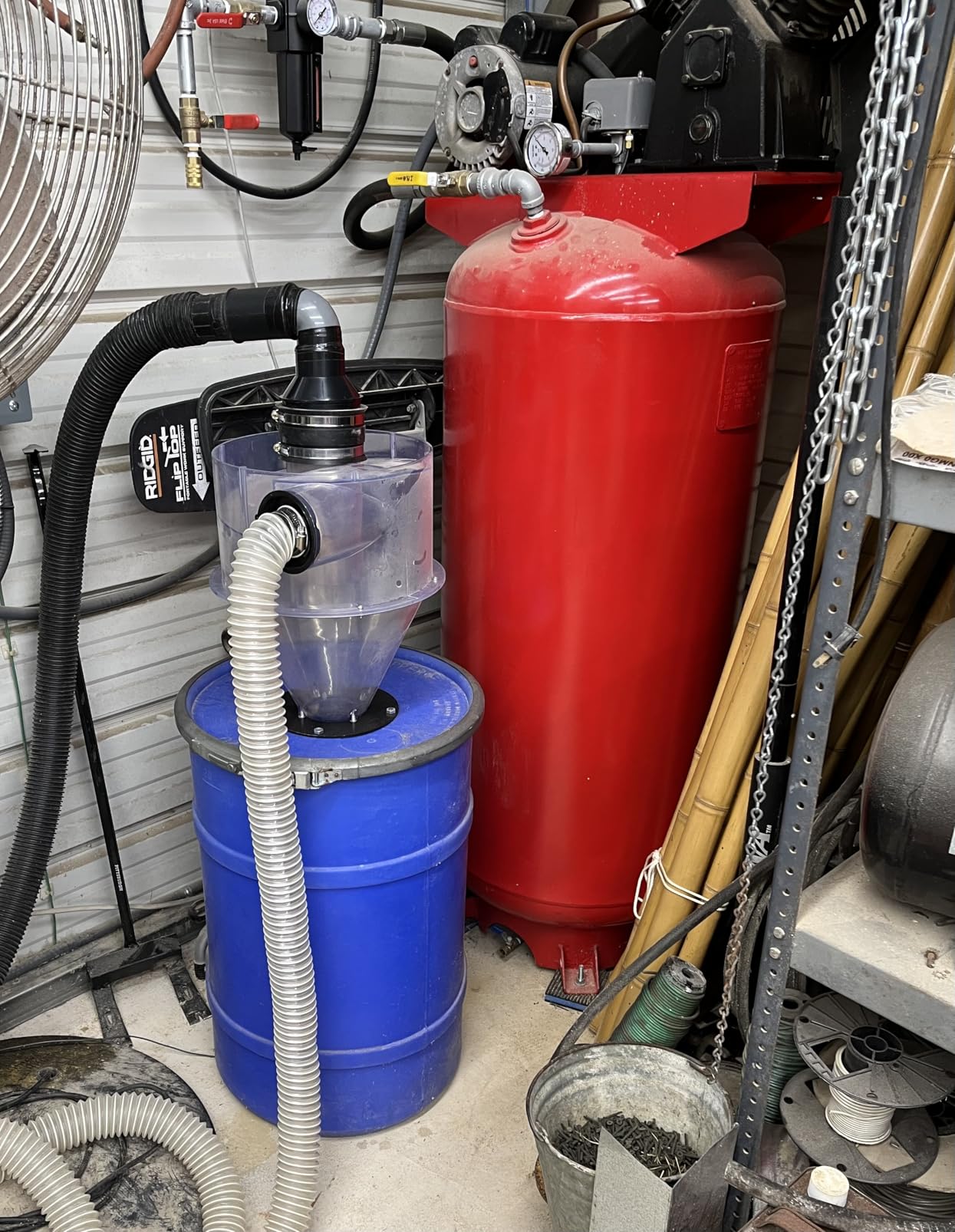
It fits 5 to 10 gallon tanks, so an existing drum works. A 2-inch hose and a 4-to-2-inch adapter are in the box, which means a shop vac can be connected immediately. For a dust collector you will need 4-inch hose separately, since the ports measure 3.81 inch for 4-inch commercial hose.
The evidence base here is thinner than the rest of the group, so treat performance claims as less well corroborated. The lower rating reflects fit and completeness complaints rather than separation failure. The 5-to-10-gallon range also means more frequent emptying than the 13.21-gallon version.
Is a 10 gallon drum a good target size?
It is a good middle ground. A 10-gallon drum is a standard container, empties without much strain, and the low weight makes it easy to swap out. If you run long planer sessions, size up to the largest drum you can comfortably lift when full.
ABS or steel, which lasts longer?
Steel, clearly. The ABS body here is cheaper and lighter and it works well as long as you do not knock it around. If the unit lives in a place where a car door or a mower might hit it, the metal-tank version is the safer purchase.
10. Cikawit Bucket-Top Separator Review: Cheapest Complete Kit
Cikawit Dust Separator – High-Efficiency Cyclone Dust Separator, Dust Separator for Standard 5 Gallon Buckets, Wet & Dry Debris, Includes 90° Elbows & 2-1/2” Hose
Low profile lid for 5 gallon buckets
Pre-installed thickened gasket
Includes 2-1/2 inch hose
Pros
- Lowest cost complete kit in the group
- Everything needed to hook it up is included
- Gasket is pre-installed so setup is one step
- Compact 12.2 inch footprint fits under a bench
- Lightest unit here and easy to move
- Good on chips and coarse debris
Cons
- No baffle so fine dust is agitated and re-enters airflow
- Does not meaningfully extend filter life on fine dust
- Bucket can tip under strong suction
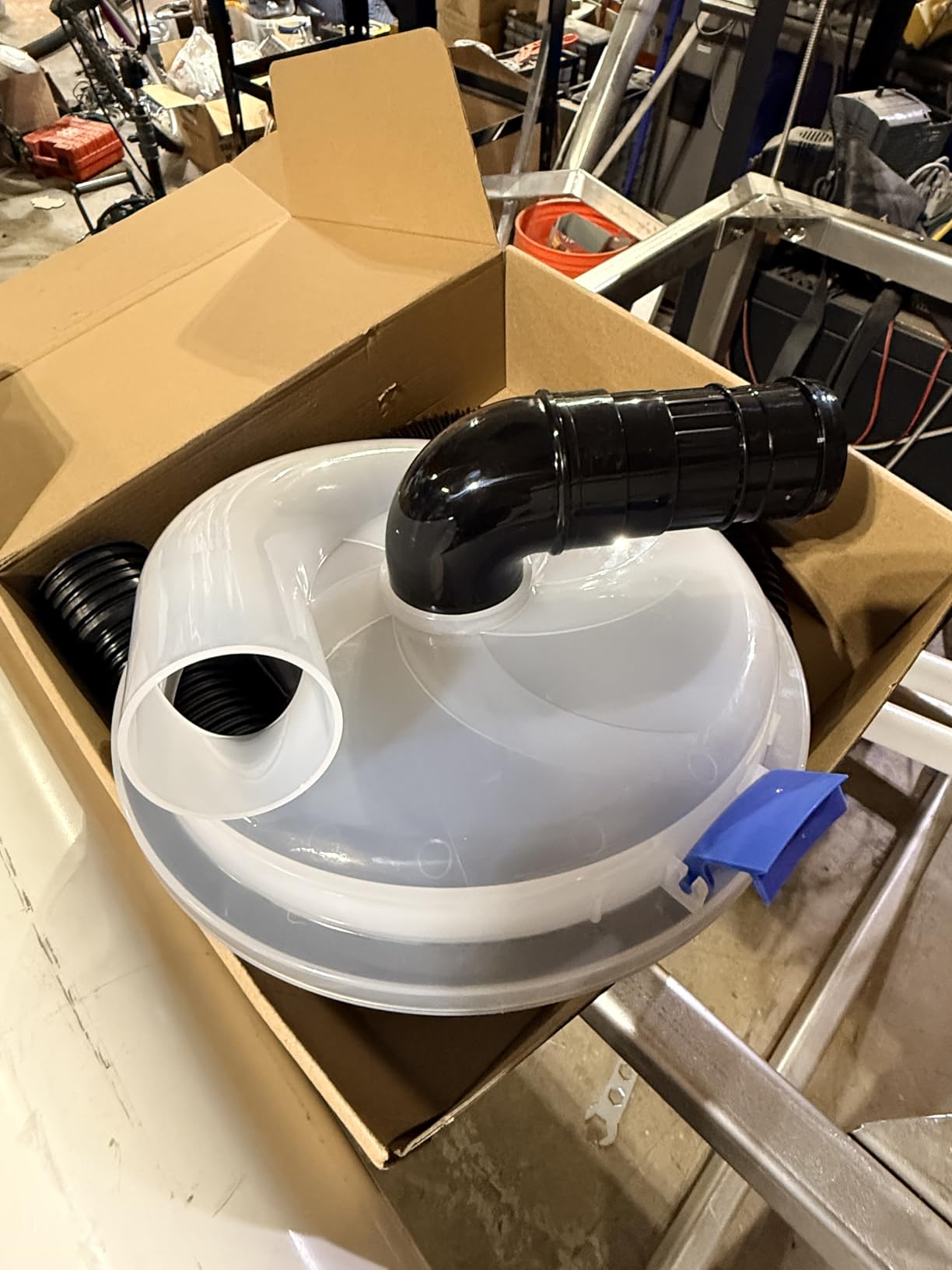
This is the entry point. The kit includes the low-profile lid, a 2-1/2-inch hose, two 90-degree elbows and connectors, and the gasket is already installed, so the whole install is placing the lid on a 5-gallon bucket. At 2.99 lb and 12.2 inches across, it fits under a workbench in a tight garage.
Owner opinion splits cleanly along a line. People focused on chips and coarse sawdust rate it as the best value in the category. People focused on fine dust rate it far lower, and their reasoning is mechanical: without a baffle, the design is essentially a lid with a side intake, so the debris cloud in the bucket spins hard enough that fine particles never settle.
Two more practical notes. Strong vacuum pull can tip the bucket, and owners add a brick or a sandbag to settle that. And the rubber seal can arrive split or detached from its adhesive backing, so check it before the first pull. Lighter construction than the metal or aluminum options is expected at this level.
Where it earns its place is chip volume. If your garage is mostly table saw, track saw and router work, it does that job for very little money. If you sand a lot or work with powdery material, spend up for a unit with a real baffle.
Is it worth buying over building your own?
For a first setup, yes, because the pre-installed gasket and included elbows remove the two steps where DIY builds usually go wrong. For a second setup, most builders switch to rigid PVC instead of the supplied flex hose, which seals better and resists the static that clings sawdust to plastic.
Will it stop my filters from clogging?
On chip-heavy work, partly. On fine dust, not reliably, because the missing baffle lets the cloud re-enter the airflow. If filter life is your main goal rather than bin convenience, choose a unit with a neutral vane inlet or a parabolic body instead.
How to Choose a Cyclone Dust Collector for Your Garage?
Most of the wrong purchases in this category come from matching the unit to the tool instead of matching it to the constraints of the room. These are the ones that actually decide the outcome in a garage.
How much CFM do you actually need?
Match airflow to the biggest chip producer you own. A planer or jointer needs far more airflow than a track saw or a random orbital sander, and a single hose run serves one tool at a time. If your tools share a collector, budget for the largest one rather than the average. Remember that a separator never adds airflow, it only avoids losing it.
Do you need 220V for a cyclone dust collector?
Not from the cyclone itself. Separators like the ones in this roundup are passive bodies with no motor, so they add no electrical load at all. The power question belongs to the dust collector or shop vac feeding them, and many garage shops never get past that. A standard household circuit will happily run a small single-stage collector; the 220V requirement arrives when you step up to multi-horsepower three-phase-capable units.
Ceiling height, car sharing, and footprint
Check the assembled height against your door and your ceiling. Some cyclones stand taller than an eight-foot ceiling once they sit on a drum or a stand. The low-profile lids, such as the POWERTEC and Cikawit designs, exist specifically for this reason, and wall-hung or shelf-mounted options free up floor space entirely.
How to size your ducting
Duct diameter matters more than most buyers expect. Keep the run as short as possible, match the port size of your cyclone, and use rigid ducting with a blast gate at each branch rather than one long flexible hose. Flexible hose is fine for the last few feet to a handheld tool and poor everywhere else. A grounding wire bonded between plastic ducting and the cyclone eliminates the static shocks and the sawdust that clings to an ungrounded body.
Is a cyclone worth it against a shop vac and separator alone?
A shop vac with a bucket-top separator is the budget route and it handles chips well. A cyclone buys you two things beyond that: a higher capture rate on fine dust, and suction that holds steady as material loads the bin. Buy the separator if your work is mostly sawdust and sanding grit. Buy the cyclone if you run a planer, do a lot of sanding, or are tired of replacing filters.
How to pair dust collection with air filtration
A cyclone does nothing for airborne dust that has already escaped into the room, which is the other half of garage air quality. Ceiling-mounted air cleaners are the usual companion, and woodworking forum owners consistently report a noticeable difference in air quality once one is running. The dust collector handles the source, the air cleaner handles what escaped.
Frequently Asked Questions
What is the best cyclone dust collector for a small shop?
For most small shops, the best value is a bolt-on cyclone or separator that mounts to a bucket or drum you already own. The Oneida Dust Deputy DIY leads our list because of its long owner history and universal shop vac fit, while the Peachtree 4 inch kit is the cheapest genuine option. Add a rigid PVC connection and a blast gate at each tool, and remember to empty the container at the halfway mark.
Are cyclone dust collectors worth it for a garage shop?
Yes, when your garage runs a planer, jointer, table saw or sander regularly. A cyclone intercepts chips and coarse sawdust before the filter, so filters and bags last much longer and suction stays steadier as material loads up. If your work is limited to a track saw and hand tools, a shop vac with a simple separator does the same job for far less money.
What are the disadvantages of using a cyclone dust collector?
The main drawbacks are added cost, extra parts to seal, and a hard half-full limit. A cyclone adds another connection that can leak, and many DIY variants require you to source your own drum, hose and clamps. Because the spinning dust cloud gets re-entrained when the container is packed, performance drops sharply past halfway, so it needs more frequent emptying than a plain shop vac.
Can I use a shop vac with a cyclone separator?
Yes, and that is the most common garage setup. Choose a separator with ports that match your vac hose, either 2.25 inch, 2.5 inch or 4 inch. A shop vac airflow of about 100 CFM is enough for a table saw or track saw, while a planer or jointer produces far more debris than a small vac can spin out of the air efficiently. Larger tools deserve a dedicated collector.
Do I need 220V for a cyclone dust collector?
No, because a cyclone separator has no motor. It is a passive body that uses the airflow your dust collector or shop vac already produces, so it adds nothing to your electrical load. The 220V requirement belongs to the collector itself, and it only arrives when you step up to multi-horsepower units. Many garage shops never leave a standard household circuit.
Final Verdict for Garage Shops in 2026
The best cyclone dust collectors for garage shops are not the biggest or the most expensive ones. The Oneida Dust Deputy DIY is our top pick because it has the deepest owner history in the category, fits nearly any wet and dry vacuum, and lets you choose your own container so it works with a bucket today and a drum later. For the smallest budget, the Peachtree 4 inch kit delivers genuine two-stage separation for very little, and for the fastest capture the Mullet parabolic body pulls more debris out of the air before it reaches the filter.
Whatever you pick, respect three rules. Empty the container at the halfway mark, run rigid ducting with a blast gate at each tool, and ground the plastic body so sawdust stops clinging to it. Get those right and any of the ten above will outperform the bag collector it replaces.