
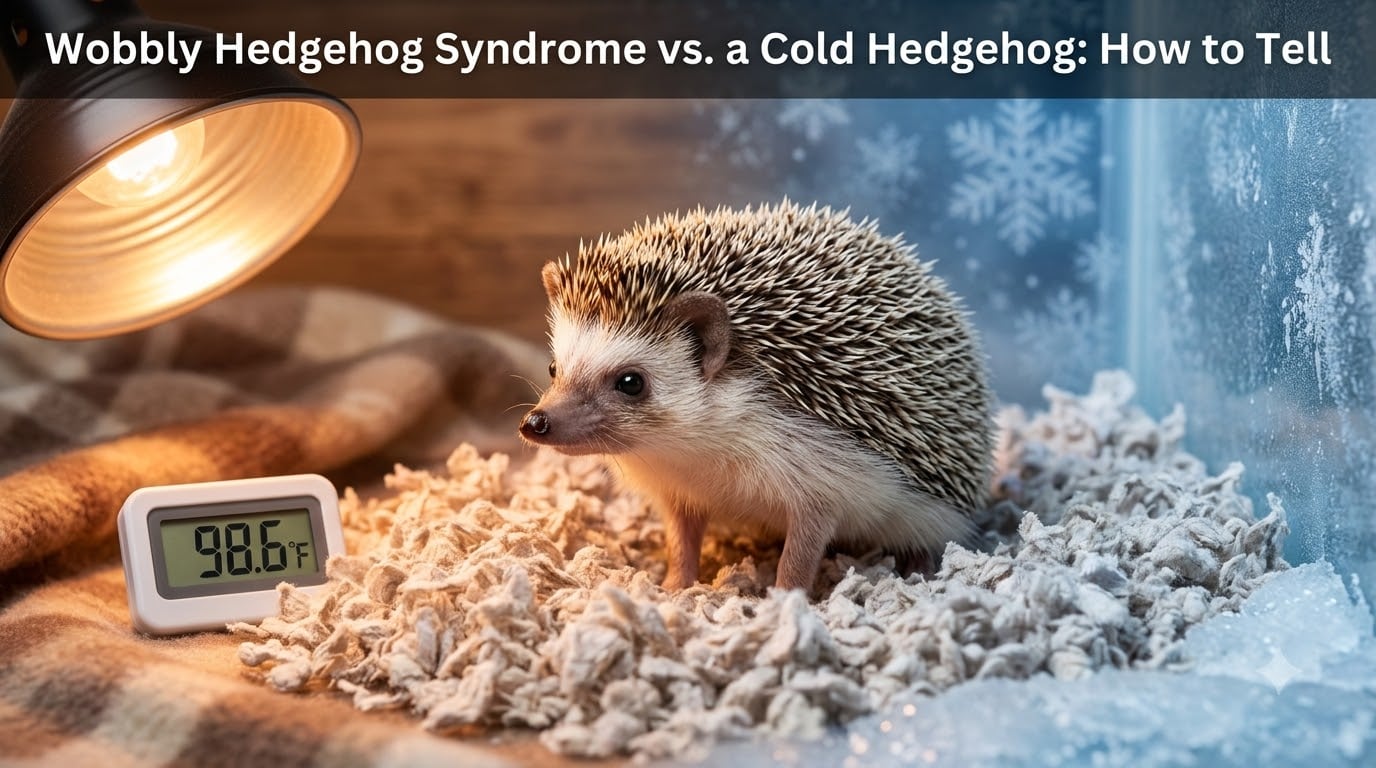
Seeing your hedgehog wobble, stumble, or struggle to stand is one of the scariest moments any hedgehog owner can face. The mind immediately jumps to Wobbly Hedgehog Syndrome (WHS), a fatal neurodegenerative disease, but the cause could be far simpler and fully reversible. Understanding the difference between Wobbly Hedgehog Syndrome vs cold hedgehog symptoms can literally save your pet’s life, because a cold stressed hedgehog often mimics the early signs of WHS but recovers completely with proper warming.
I have talked with dozens of hedgehog owners in online communities who panicked over a wobbly pet, only to discover the enclosure temperature had dropped below the safe range overnight. One Reddit user shared how their hedgehog “improved dramatically after warming” and was later confirmed to have cold stress, not WHS. This guide will walk you through exactly how to tell the two conditions apart, step by step, so you can act quickly and confidently.
The key distinction comes down to reversibility. WHS is a progressive disease with no cure, while cold stress is a temporary metabolic slowdown caused by low temperatures and it reverses when you warm your hedgehog properly. Mix them up and you risk either giving up on a perfectly recoverable pet or delaying care for a serious neurological condition.
Table of Contents
What Is Wobbly Hedgehog Syndrome (WHS)?
Wobbly Hedgehog Syndrome is a progressive, degenerative neurological disease that affects the central nervous system of hedgehogs, primarily African pygmy hedgehogs. It destroys the myelin sheath (the protective coating around nerve fibers) through a process called demyelination, which disrupts communication between the brain and muscles. There is no cure, and the disease eventually leads to full paralysis.
The condition typically begins with ataxia, which means a loss of full control over body movements, or paresis, which is muscular weakness. Both symptoms usually start in the hind legs and slowly spread forward. Over time, the hedgehog loses the ability to walk, stand, and eventually curl into a ball.
WHS is considered a diagnosis of exclusion. Veterinarians rule out other causes of wobbling, including cold stress, vitamin deficiencies, infections, spinal injuries, and intervertebral disc disease (IVDD), before concluding that WHS is the likely culprit. A definitive diagnosis can only be made through histopathology of the brain and spinal cord after the hedgehog has passed away.
The average life expectancy after symptom onset is 6 to 18 months, though some owners report their hedgehogs living longer with attentive care. One owner mentioned their hedgehog lived 6.5 years with WHS, which is well beyond the typical timeline.
What Is a Cold Stressed Hedgehog?
A cold stressed hedgehog is one whose body temperature has dropped too low for normal metabolic function. Hedgehogs, especially African pygmy hedgehogs, are sensitive to cold because they originate from warm climates. Their ideal ambient temperature range is between 75 and 85 degrees Fahrenheit.
When a hedgehog gets too cold, its body attempts to conserve energy by entering a state called torpor, which is a mild form of hibernation. This is dangerous for African pygmy hedgehogs because they are not physiologically built to hibernate safely. Torpor can trigger a cascade of problems including a slowed heart rate, suppressed immune function, and fatty liver disease.
The symptoms of cold stress look alarming and often mirror early WHS signs. A cold hedgehog may wobble, stumble, appear lethargic, refuse to eat, or feel cool to the touch. The critical difference is that these symptoms are reversible. Once you warm the hedgehog gradually back to a healthy temperature, the wobbling should disappear within hours to a day.
Cold stress can happen for many reasons. A drafty room, a malfunctioning heat lamp, a power outage, transport in cold weather, or even a cool floor can drop the enclosure temperature enough to trigger torpor. Checking temperature first before assuming the worst is the single most important step I can recommend.
Wobbly Hedgehog Syndrome vs Cold Hedgehog: Symptom Comparison
Comparing WHS and cold stress side by side is the fastest way to understand what you are dealing with. The conditions share several visible symptoms, but the underlying patterns, onset, and reversibility are completely different.
Here is how the two conditions differ across the most important diagnostic factors:
Onset pattern: WHS develops gradually over weeks or months, while cold stress appears suddenly, often overnight or after a known temperature drop. If your hedgehog was perfectly normal yesterday and wobbly today, cold stress is far more likely.
Temperature relationship: WHS symptoms are not affected by temperature. Cold stress symptoms are directly caused by low temperatures and improve when the hedgehog is warmed. This is the single most reliable distinguishing test.
Reversibility: WHS is progressive and irreversible. Cold stress is fully reversible with gradual warming and improved husbandry.
Symptom symmetry: WHS typically affects both hind legs symmetrically and spreads forward. Cold stress can cause generalized wobbling, lethargy, and whole-body weakness.
Appetite: Both conditions can reduce appetite, but a cold hedgehog often stops eating abruptly, while a WHS hedgehog may struggle to eat progressively due to worsening motor control.
Body feel: A cold stressed hedgehog will feel cool to the touch, especially on the belly and feet. A hedgehog with WHS maintains normal body temperature.
Behavior after warming: A cold hedgehog should show improvement within a few hours of gradual warming. A hedgehog with WHS will show no change, because the neurological damage is not temperature dependent.
Age factor: WHS most commonly appears between 1 and 3 years of age, though it can occur earlier or later. Cold stress can happen at any age and is purely environmental.
How to Tell if Your Hedgehog Has WHS or Is Just Cold
Follow this step-by-step assessment guide to differentiate between the two conditions. I recommend working through these steps in order, because temperature is the most common and easiest to address cause.
Step 1: Check the Enclosure Temperature Immediately
Place a reliable thermometer at hedgehog level inside the enclosure, not just in the room. The temperature should read between 75 and 85 degrees Fahrenheit. If the reading is below 73 degrees, cold stress is a strong possibility. Many owners keep their room warm but underestimate how much cooler the cage floor can get, especially near windows or exterior walls.
Step 2: Feel Your Hedgehog’s Belly and Feet
Gently pick up your hedgehog and feel the belly and foot pads. A healthy hedgehog feels warm to the touch. A cold stressed hedgehog will feel noticeably cool, sometimes even cold. If the belly is cool, proceed to the warming protocol before assuming anything more serious.
Step 3: Warm Your Hedgehog Gradually
Use gradual warming methods (detailed in the next section) to bring your hedgehog’s body temperature back up over 1 to 3 hours. Never use sudden heat like a hot hair dryer, direct heating pad on high, or hot water, because rapid warming can cause shock or burns.
Step 4: Observe for Improvement Within a Few Hours
After warming, watch your hedgehog closely. A cold stressed hedgehog should start moving more normally within 2 to 12 hours. If the wobbling disappears or significantly improves after warming, the cause was almost certainly cold stress.
Step 5: Track Symptoms Over Several Days
If symptoms persist despite proper temperature and a confirmed warm environment, keep a daily log. Note when wobbling happens, which legs are affected, and whether it is getting worse. Gradual worsening over days and weeks, especially starting in the hind legs, points toward WHS or another neurological condition.
Step 6: Schedule an Exotic Vet Visit
If wobbling continues for more than a few days despite ideal temperatures, or if it is progressively worsening, book an appointment with an exotic animal veterinarian. They can rule out other causes like vitamin E deficiency, spinal injury, infection, or IVDD before considering a WHS diagnosis.
How to Safely Warm a Cold Hedgehog
Warming a cold hedgehog must be done gradually to avoid shock. Sudden temperature changes can be fatal, so patience is essential. Here is the safe warming protocol I recommend based on owner experiences and veterinary guidance.
Step 1: Move your hedgehog to a warm room, ideally between 78 and 82 degrees Fahrenheit. Let the ambient warmth start the process naturally.
Step 2: Place your hedgehog on a heating pad set to low, positioned under only half of a carrier or small enclosure. This allows the hedgehog to move away if it gets too warm. Never place the hedgehog directly on the heating pad without a barrier.
Step 3: Offer warm (not hot) water in a shallow dish and soft, easily digestible food. A cold hedgehog may be too weak to eat hard kibble, so wet cat food or baby food works well.
Step 4: Monitor body temperature and behavior every 30 minutes. The warming process typically takes 1 to 3 hours. Once your hedgehog is moving normally and feels warm to the touch, return it to a properly heated enclosure.
Going forward, invest in a thermostat-controlled ceramic heat emitter or a CHE lamp to maintain a consistent 75 to 85 degree temperature range. Use a thermostat, not just a clamp lamp, because uncontrolled heat sources can overheat or underheat the cage unpredictably.
WHS Progression, Prognosis, and Care
If your hedgehog is diagnosed with Wobbly Hedgehog Syndrome, understanding the progression helps you prepare and provide the best possible care. WHS advances through stages that typically unfold over months.
The disease usually starts with mild hind leg weakness. You might notice your hedgehog swaying when standing, stumbling occasionally, or having trouble climbing. Over time, the weakness progresses to visible ataxia, then to paresis, and eventually to full paralysis of the hind legs. In the final stages, the front legs and neck become affected, and the hedgehog loses the ability to walk or curl.
The typical life expectancy after onset is 6 to 18 months. Progression speed varies between individuals. Some hedgehogs decline rapidly within months, while others maintain reasonable mobility for over a year with supportive care.
Age of onset is most commonly between 1 and 3 years, but WHS has been documented in hedgehogs as young as 6 months and as old as 5 years. There is no way to predict or prevent WHS in an individual animal, though responsible breeding practices that avoid breeding from affected lines may reduce incidence over time.
While there is no cure, supportive care can significantly improve quality of life. Owners use several strategies to keep WHS hedgehogs comfortable and mobile for as long as possible.
Keep the enclosure warm and accessible. Remove multi-level platforms and ramps, since a hedgehog with weakening legs cannot climb safely. Provide soft, flat bedding that is easy to walk on. Offer food and water in shallow dishes placed close to where the hedgehog rests.
Adjust the diet to soft foods as motor control declines. Wet cat food, baby food, and soaked kibble are easier for a hedgehog with jaw or tongue weakness to manage. Some owners supplement with vitamin E, which is thought to support nerve health, though evidence is anecdotal.
Keep the hedgehog clean. As mobility decreases, the hedgehog may be unable to self-groom or use a litter area. Gentle warm water baths and spot cleaning prevent skin infections and urine scald.
Assess quality of life regularly. The hardest decision for any WHS owner is knowing when to say goodbye. Most veterinarians recommend euthanasia when the hedgehog can no longer move to food or water, cannot self-clean, shows signs of pain, or has lost the ability to enjoy normal hedgehog behaviors like exploring and foraging. This is a deeply personal decision, and consulting with an exotic vet you trust is invaluable.
Emergency Signs That Need Immediate Veterinary Care
Some symptoms should never wait for a scheduled appointment. If your hedgehog shows any of the following warning signs, contact an exotic veterinarian or emergency animal hospital right away.
1. Wobbling that does not improve after 12 hours of proper warming. If you have confirmed the enclosure is between 75 and 85 degrees and your hedgehog has been warm for half a day with no improvement, something beyond cold stress is happening.
2. Sudden complete inability to use the hind legs. This could indicate WHS, a spinal injury, IVDD, or a stroke. All require professional evaluation.
3. A hedgehog that is cold, limp, and unresponsive. This is a medical emergency. Begin gradual warming immediately and call a vet while you do it.
4. Refusal to eat or drink for more than 24 hours. Hedgehogs can develop fatty liver disease (hepatic lipidosis) rapidly when they stop eating, which can be fatal within days.
5. Difficulty breathing, blue-tinged gums, or seizures. These indicate a critical emergency and require immediate veterinary intervention.
Finding a qualified exotic veterinarian before you need one is one of the best preparations you can make. Not all general practice vets have experience with hedgehogs, so search for an exotic animal specialist in your area now, not when an emergency hits.
Frequently Asked Questions
What are the first signs of wobbly hedgehog syndrome?
The first signs of WHS are usually mild hind leg weakness, swaying while standing, occasional stumbling, and difficulty climbing. These symptoms start gradually and progressively worsen over weeks or months. Unlike cold stress, WHS symptoms do not improve with warming.
How do I tell if my hedgehog is cold?
A cold hedgehog will feel cool to the touch on the belly and feet, appear lethargic, wobble or stumble when walking, eat less, and may ball up and refuse to uncurl. Check your enclosure temperature with a thermometer at hedgehog level. If it reads below 73 degrees Fahrenheit, cold stress is likely.
How long can a hedgehog live with wobbly hedgehog syndrome?
Most hedgehogs with WHS live 6 to 18 months after symptoms begin, though some survive longer with attentive supportive care. Progression speed varies between individuals. The disease eventually leads to full paralysis, at which point quality of life decisions become necessary.
What age does wobbly hedgehog syndrome start?
WHS most commonly appears between 1 and 3 years of age, but it has been documented in hedgehogs as young as 6 months and as old as 5 years. There is no guaranteed way to predict which hedgehogs will develop it.
Why is my hedgehog so cold and wobbly?
A hedgehog that is both cold and wobbly is most likely experiencing cold stress or a hibernation attempt triggered by low environmental temperature. African pygmy hedgehogs need temperatures between 75 and 85 degrees Fahrenheit. Check the enclosure temperature first, warm your hedgehog gradually, and monitor for improvement. If wobbling persists despite proper warming, consult an exotic vet.
Why do hedgehogs wobble?
Hedgehogs wobble for several reasons including cold stress, Wobbly Hedgehog Syndrome, vitamin E deficiency, spinal injuries, infections, or neurological conditions. Cold stress is the most common and most easily reversible cause. Always check temperature first before considering more serious diagnoses.
Conclusion
Telling the difference between Wobbly Hedgehog Syndrome vs cold hedgehog symptoms comes down to three things: check the temperature, warm gradually, and observe whether symptoms improve. Cold stress comes on suddenly, is triggered by low temperatures below 73 degrees Fahrenheit, and reverses with proper warming. WHS develops gradually, is not affected by temperature, and progressively worsens over months.
If your hedgehog is wobbling, do not panic but do act quickly. Confirm the enclosure is between 75 and 85 degrees, warm your hedgehog safely over a few hours, and watch for improvement. If wobbling persists or worsens despite ideal conditions, schedule a visit with an exotic veterinarian to rule out WHS and other serious conditions. Acting fast and methodically gives your hedgehog the best chance at recovery or the best care if something more serious is going on.