
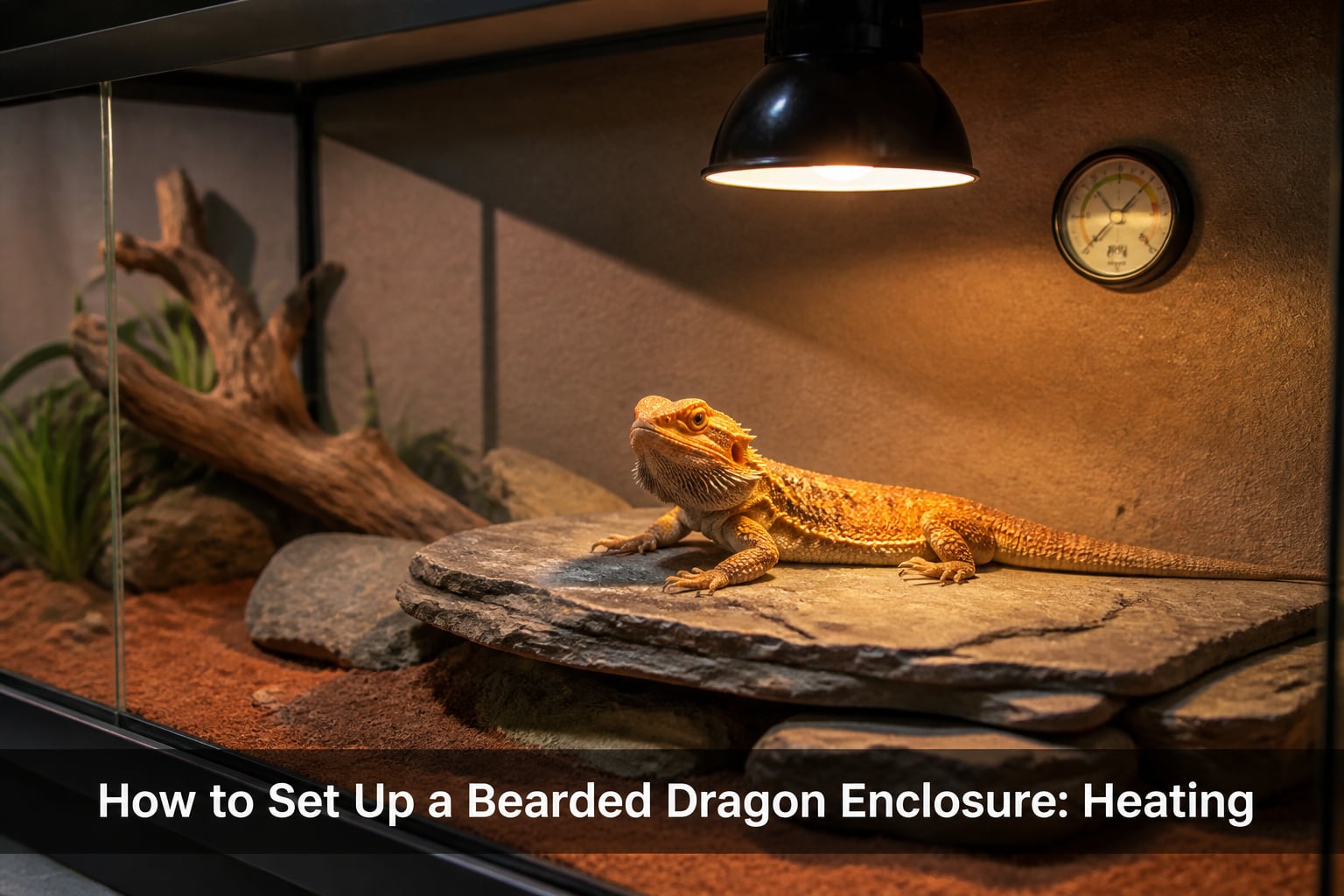
Setting up bearded dragon enclosure heating correctly is the single most important thing you’ll do for your new pet. Get the temperatures wrong, and your dragon won’t digest food, fight off illness, or grow properly. I’ve kept bearded dragons for years and walked dozens of first-time owners through their first enclosure builds. The setup that follows is the exact system I’d use today.
In this guide, I’ll walk you through everything you need to know about how to set up a bearded dragon enclosure for heating. You’ll get exact temperature numbers, a step-by-step installation process, a comparison of every major heat source, thermostat recommendations, troubleshooting tips, and emergency protocols for power outages. If you only read one section, jump to the Step-by-Step part. If something isn’t working right, the Troubleshooting section will probably fix it.
Table of Contents
Understanding Bearded Dragon Heating Needs
Bearded dragons are ectothermic, which means they can’t generate their own body heat the way mammals do. Instead, they depend on external heat sources to raise their core temperature. In the wild, they do this by basking in direct Australian sunlight, then retreating to cooler burrows when they need to cool down.
This behavior is called thermoregulation, and it drives every heating decision you’ll make. Your job is to recreate a similar temperature gradient inside the enclosure. Without a gradient, your dragon has no way to control its body temperature. Digestion slows, immune function drops, and chronic illness follows.
Heat also ties directly to UVB exposure. Bearded dragons synthesize vitamin D3 in their skin using UVB rays, then use that D3 to absorb calcium. Without proper basking temperatures, the entire calcium cycle breaks down. This is why heating and UVB lighting are inseparable in any bearded dragon enclosure setup.
What “diurnal” means for your setup
Bearded dragons are diurnal, meaning they’re active during the day and sleep at night. Their heating schedule must follow a 14-hour day, 10-hour night cycle. Leaving heat on 24/7 will disrupt their sleep and stress their system.
Ideal Temperature Gradient for Bearded Dragons
The temperature gradient inside your enclosure should run from a hot basking spot on one end to a cool zone on the other. Here are the exact target values I use and recommend.
- Basking spot surface: 105 to 115°F (40 to 46°C) for adults. Babies and juveniles do best at 110 to 115°F.
- Warm zone ambient air: 88 to 95°F (31 to 35°C).
- Cool zone: 70 to 85°F (21 to 29°C).
- Nighttime minimum: 65°F (18°C). Most adults can safely drop to 60°F.
- Humidity: 30 to 60%, lower in winter and during shedding.
These numbers come from years of keeper experience and match what the major herpetology sources publish. The basking spot is the single most important measurement. If it’s not reaching 105°F, your dragon is not digesting properly, period.
Always measure basking surface temperature, not air temperature directly under the bulb. Air temperature is misleading because the basking platform itself absorbs and re-radiates heat. Use a temperature gun pointed at the rock or wood where your dragon actually sits.
How to Set Up a Bearded Dragon Enclosure: Heating Step by Step
Follow these steps in order. I’ve tested this sequence with first-time owners and it consistently produces a working setup in under an hour. Skip a step and you’ll likely end up troubleshooting later.
- Choose the right enclosure size. A minimum 4x2x2 ft enclosure is standard for adult bearded dragons. Smaller tanks lose heat too quickly to maintain a proper gradient.
- Place the enclosure in a draft-free room. Avoid windows, AC vents, and exterior doors. Cold drafts will pull heat out and create unstable temperatures.
- Mount a heat lamp fixture on one end of the screen top. Use a ceramic socket fixture rated for the wattage you’ll run. Position it directly above the basking platform, not centered.
- Install a UVB tube light across the length of the enclosure. The UVB tube should sit 10 to 12 inches from the basking spot for a T5 HO bulb.
- Set up a basking platform directly under the heat lamp. Use a flat rock, slate tile, or wooden log. The surface should be 6 to 10 inches below the bulb for adult dragons.
- Plug your heat lamp into a dimming thermostat. Set the probe at the basking surface. This is the most commonly skipped step, and it’s the one that causes most setup failures.
- Place two digital probe thermometers in the enclosure. One on the basking surface, one on the cool side floor. Cheap stick-on thermometers are not accurate enough.
- Run the system for 24 hours before adding your dragon. Check temperatures at morning, midday, and evening to confirm stability across the photoperiod.
- Adjust bulb height and wattage until you hit 105 to 115°F at the basking spot. Raise the bulb to cool it down, lower to increase heat, or swap wattage in 25 to 50W increments.
If you follow this order, you’ll avoid the most common mistakes. The biggest one is plugging a heat lamp directly into a wall outlet without a thermostat. Without a thermostat, the lamp runs at full power constantly, and small enclosure changes cause temperature swings that stress your dragon.
Wattage sizing for a 4x2x2 enclosure
For a standard 4x2x2 ft PVC or glass enclosure, you’ll typically need a 100W halogen flood bulb for ambient room temperatures around 70 to 75°F. In colder rooms below 65°F, jump to 150W. In warm climates above 80°F, a 75W bulb may be enough. These are starting points, not rules. Always verify with a temperature gun.
Choosing the Right Heat Source
Not all heat sources work the same way for bearded dragons. Each option has trade-offs in terms of heat penetration, light emission, energy use, and night-time usability. Here’s how I evaluate them.
Halogen flood bulbs
Halogen flood bulbs are my top recommendation for daytime basking. They produce infrared heat that penetrates deep into the scales and muscle tissue, mimicking natural sunlight. A PAR38 halogen flood in the 75 to 150W range is the gold standard. Look for a color temperature around 5000K to 6000K for visible light that resembles sun.
The downside is they produce light. You can’t run a halogen bulb at night without disrupting your dragon’s sleep cycle. For most keepers, this isn’t an issue because night heat is rarely needed above 65°F.
Ceramic heat emitters
Ceramic heat emitters (CHEs) produce heat without visible light. They screw into a standard E26 socket and last for years. CHEs are the best option for night-time heat if your room drops below 65°F. They don’t disturb sleep because they emit zero light.
The downside is they produce a different wavelength of heat than halogen bulbs. They work fine as supplemental heat, but they’re not ideal as a sole basking source because their heat penetration isn’t as deep.
Mercury vapor bulbs
Mercury vapor bulbs combine heat and UVB in one bulb. On paper, this sounds convenient. In practice, I rarely recommend them because they produce intense, hard-to-regulate heat. A dragon can overheat within inches of these bulbs if the wattage is wrong. They also have a short lifespan and dim significantly after 6 months.
If you do use one, expect to mount it 12 to 18 inches above the basking spot and pair it with a high-range thermostat. They’re better suited to very large enclosures.
Deep heat projectors
Deep heat projectors (DHPs) are a newer option that produce infrared-B and infrared-C wavelengths. They emit no visible light and penetrate tissue well. They work as both a daytime basking source when paired with a separate UVB light, and as a night-time heat source. They’re more expensive than halogen or CHE setups but offer flexibility.
For most keepers, a halogen flood for daytime and a CHE for backup night heat is the simplest, cheapest, and most reliable combination.
Thermostats and Temperature Measurement Tools
A thermostat isn’t optional. Without one, your heat source runs at full power constantly, and any change in room temperature, bulb aging, or ventilation shift will throw your basking temps off. I’ve seen enclosures hit 130°F in summer without a thermostat, which can kill a dragon within hours.
Dimming thermostats
Dimming thermostats pulse power to the bulb, raising and lowering brightness in micro-adjustments to maintain a set temperature. They’re the best choice for halogen flood bulbs because they don’t shorten bulb life the way on/off thermostats do. Brands like Herpstat and Inkbird make reliable dimming models.
Pulse proportional thermostats
Pulse proportional thermostats send rapid on/off pulses to ceramic heat emitters and other non-light-emitting sources. They work great for CHEs and deep heat projectors but cause halogen bulbs to flicker and burn out quickly. Don’t use pulse stats with halogens.
On/off thermostats
On/off thermostats are the cheapest option. They cut power completely when the target temperature is reached and turn back on when it drops. They work adequately for CHEs but cause noticeable temperature swings and shorten halogen bulb life. Skip these if you can afford a dimming stat.
Digital probe thermometers
You’ll need two digital probe thermometers minimum. Place one probe at the basking surface and one on the cool side floor. The Govee and Zoo Med digital probe models are reliable and inexpensive. Replace the batteries every 6 months.
Infrared temperature guns
An infrared temperature gun (also called a temp gun) lets you measure the basking surface temperature directly without waiting for a probe to equilibrate. This is the fastest way to confirm your setup is correct. The Etekcity and Fluke models are popular among keepers. Aim for under $30.
Day and Night Heating Requirements
Bearded dragons need a clear day/night cycle, which means your heating setup must turn off at night. Run your heat lamp and UVB tube on a 14-hour-on, 10-hour-off cycle. Plug both into a simple outlet timer and set it once.
If your room temperature stays above 65°F at night, you don’t need any heat source running. Turn everything off and let the enclosure cool naturally. This temperature drop is healthy and mirrors what happens in the wild.
If your room drops below 65°F at night, you’ll need a CHE or DHP on a separate thermostat to provide supplemental heat without light. Set the night thermostat to 65°F and let it cycle as needed. Most adult bearded dragons can safely handle drops to 60°F without issue, but juveniles benefit from staying closer to 70°F.
What about red or blue night bulbs?
Skip them. Red and blue “night bulbs” were marketed heavily in the 1990s and 2000s, but research has since shown that bearded dragons can see this light and it disrupts their sleep. Use a ceramic heat emitter instead if you need night heat.
Troubleshooting Common Heating Problems
Even well-planned setups fail sometimes. Here are the issues I see most often and how to fix them.
The basking spot won’t reach 105°F
This is the most common complaint on bearded dragon forums. If your basking spot is stuck at 85 to 95°F, work through this list in order:
- Bump the wattage. Move from 75W to 100W or 150W. Many first-time owners undersize their bulb.
- Lower the bulb closer to the basking platform. Halogen heat drops off dramatically with distance. Moving from 12 inches to 8 inches can add 15°F.
- Check for drafts. A nearby window, vent, or door can pull heat out of the enclosure.
- Replace the bulb. Halogen bulbs lose about 10% of their output by month 6.
- Upgrade to a higher-wattage dome fixture. A cheap fixture with thin wiring can choke power delivery.
The cool side is too warm
If your cool side reads above 90°F, your enclosure is too small to maintain a gradient, or your heat lamp wattage is too high. Either reduce wattage, raise the bulb, or move to a larger enclosure.
The dragon is hiding all day
A dragon that avoids the basking spot is usually too hot. Check your basking surface temperature with a temp gun. If it’s reading above 115°F, raise the bulb or drop the wattage.
The dragon is sluggish and not eating
The opposite problem. If your dragon is lethargic, not eating, and not basking voluntarily, your temps are likely too low. Verify your basking spot is reaching 105°F minimum and your cool side isn’t dropping below 70°F.
Emergency Heating: Power Outages and Cold Nights
If the power goes out in winter, your enclosure will start cooling within an hour. For short outages under 4 hours, wrap the enclosure in blankets to insulate it and add a hot water bottle wrapped in towel inside. This buys you time.
For longer outages, a portable car inverter paired with a small heat lamp can run off a car battery. Some keepers keep a 12V deep cycle battery and a small 50W halogen on hand for emergencies.
Body heat works in a pinch. If your dragon is showing signs of severe cold stress (lethargy, slow movement, dark coloration), hold it against your body under a blanket for 20 minutes. This is a temporary measure while you restore power.
Frequently Asked Questions
How do I make my bearded dragon enclosure warmer?
Increase wattage, lower the bulb closer to the basking platform, eliminate drafts, and verify with a temperature gun. Most stuck-at-85°F setups just need a higher-wattage halogen bulb.
How cold is too cold for a bearded dragon at night?
Below 65°F at night for prolonged periods can stress juveniles. Adults handle 60°F overnight safely. If your room drops below 60°F, add a ceramic heat emitter on a thermostat.
How warm does a bearded dragon enclosure need to be?
Basking spot 105-115°F, warm zone 88-95°F, cool zone 70-85°F. Night minimum 65°F for adults.
What is the best heating source for a bearded dragon?
A halogen flood bulb for daytime basking, paired with a ceramic heat emitter for night heat if needed. Mercury vapor bulbs work in large enclosures but are harder to regulate.
Do bearded dragons need heat at night?
Only if the room drops below 65°F. Above that, turn all heat off and let the enclosure cool naturally to support healthy thermoregulation.
Is 90 degrees too hot for a bearded dragon?
90°F is too cool for the basking spot (target 105-115°F) but is acceptable as the warm zone ambient air temperature.
What temperature will kill a bearded dragon overnight?
Sustained temperatures below 50°F can be fatal, especially for juveniles. Adults can survive brief drops into the 40s but will suffer stress and immune suppression.
Final Thoughts on Bearded Dragon Enclosure Heating
Setting up bearded dragon enclosure heating doesn’t need to be complicated. Get the basking spot to 105 to 115°F with a halogen flood bulb on a dimming thermostat, run a 14-hour photoperiod, add a UVB tube, and let the cool side settle naturally between 70 and 85°F. That covers 90% of what your dragon needs.
The remaining 10% comes from observing your individual dragon. Some like slightly warmer basking spots. Some prefer the cool side more than others. Watch where your dragon spends time and adjust accordingly. If they’re always under the bulb, raise the temp a bit. If they avoid it, lower it.
Your next step is to verify your basking temperature with a temp gun today. If you’re already at 105 to 115°F, you’re done. If not, walk through the troubleshooting checklist and adjust one variable at a time. Within a week, your bearded dragon will be basking comfortably, eating well, and showing the active behavior that signals a healthy setup.