
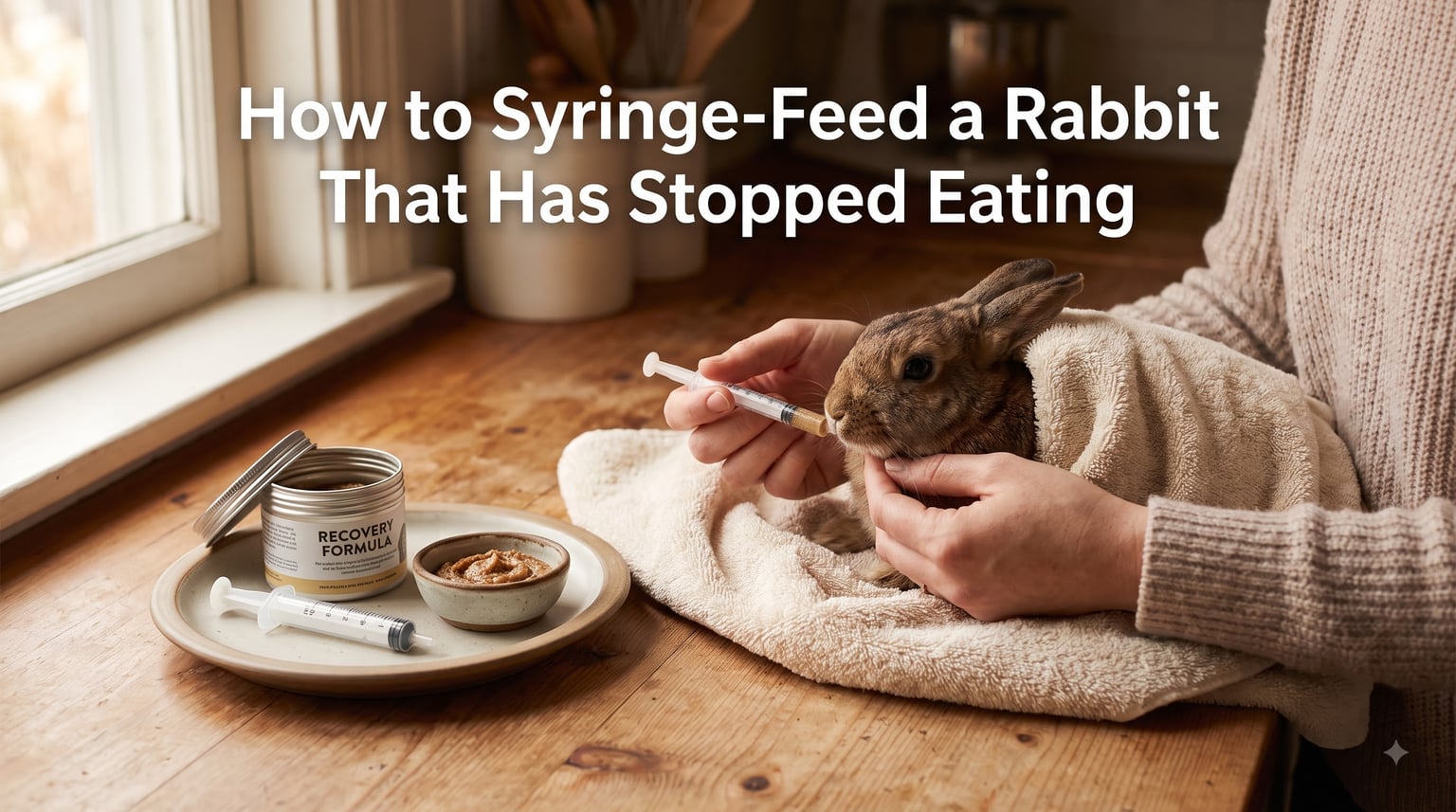
Watching your rabbit refuse food is terrifying. I still remember the night my own bunny, Pepper, turned away from her favorite parsley and just sat hunched in the corner of her pen. Within hours I was desperately searching for how to syringe feed a rabbit that has stopped eating, racing the clock while she grew weaker.
Here’s the truth: a rabbit who stops eating is a true emergency. Their digestive system depends on a constant flow of food, and just 12 to 24 hours without eating can trigger gastrointestinal stasis (GI stasis), a life-threatening condition where the gut essentially shuts down. This guide walks you through exactly how to syringe feed a rabbit safely, the supplies you need, and the warning signs that mean you need a vet right now.
Table of Contents
Warning: See a Vet Before You Syringe Feed
Before we cover the syringe feeding technique, I want to make this completely clear: a rabbit who has stopped eating needs veterinary attention as soon as possible. Syringe feeding buys you time to reach the vet, but it does not replace professional care.
Why the urgency? Rabbits cannot vomit, so any food they take in must pass through the entire digestive tract. When eating stops, gut motility slows, gas builds up, and bacteria can multiply dangerously. This cascade is what vets call GI stasis or ileus. Without intervention, a rabbit can die within 24 to 48 hours of refusing food.
I learned this the hard way when I tried to “wait it out” with Pepper. By the time I called the emergency vet, her gut had already begun shutting down. Don’t repeat my mistake. Call your vet or an out-of-hours exotics clinic the moment your rabbit stops eating normally.
Why Rabbits Stop Eating (Common Causes)
Before you learn how to syringe feed a rabbit that has stopped eating, it helps to understand why it happens. The cause changes the urgency and the treatment.
Gastrointestinal Stasis (GI Stasis or Ileus)
GI stasis is the most common emergency we see. The gut stops its normal peristalsis (the wave-like contractions that push food through). Gas builds up, the rabbit feels nauseous, and they refuse food because eating hurts. Common triggers include stress, dehydration, low-fiber diets, hair ingestion during molting, and underlying pain.
Dental Disease and Malocclusion
Rabbit teeth grow continuously throughout life. If the jaw alignment is off (malocclusion), spurs form on the molars and slice into the cheeks or tongue. Eating becomes painful, so the rabbit stops. Look for drooling, wet fur under the chin, and dropped food.
Stress and Environmental Changes
Rabbits are creatures of habit. A new pet, a move, a predator in the yard, or even a loud thunderstorm can trigger temporary anorexia. Stress-related refusal usually reverses quickly once the rabbit feels safe, but you still need to syringe feed in the meantime.
Pain and Underlying Illness
Anything that hurts a rabbit can stop them from eating. Urinary tract infections, sore hocks, arthritis, abscesses, and the parasite E. cuniculi all cause pain. A rabbit in pain also hunches, grinds its teeth, and moves reluctantly.
Post-Surgery or Post-Illness Recovery
Even after successful veterinary treatment, rabbits often need several days of assisted feeding to rebuild their strength and restart their gut. Syringe feeding during recovery is normal and expected.
Signs Your Rabbit Needs Emergency Vet Care
Not every appetite loss is the same. Some situations require immediate professional intervention, not just home syringe feeding.
- No droppings for more than 12 hours, or droppings noticeably smaller than usual
- Hard, distended, or painful belly (gently palpate; a normal belly should be soft)
- Loud gurgling or, conversely, complete silence from the gut
- Teeth grinding loud enough to hear across the room (a sign of pain)
- Labored breathing, blue or pale gums, or collapse
- Refusal of food lasting more than 12 hours, especially in a rabbit who normally eats well
- Suspected poisoning, trauma, or seizure activity
If you see any of these, skip ahead to the emergency vet and syringe feed only what you can on the way.
What You Need to Syringe Feed a Rabbit
Gather everything before you catch your rabbit. Trust me, scrambling for a towel while a wriggly bunny waits is stressful for both of you.
- Recovery food: Oxbow Critical Care or Emerald Intensive Care Herbivore are the gold standard. Both come as a powder you mix with water into a thick paste.
- Feeding syringes: A 1 ml syringe for precise dosing and a 5 to 10 ml syringe for larger volumes. Use wide-bore tips that don’t clog. Pet stores sell rabbit-specific syringes, but any slip-tip oral syringe from a pharmacy works.
- Clean bowl and spoon: For mixing the recovery food. A fork or small whisk helps break up clumps.
- Warm water: To mix with the powder. Warm helps dissolve the powder and is gentler on the stomach.
- A soft towel: For the “bunny burrito” wrap if your rabbit resists.
- A flat, stable surface: A counter or table at waist height is easier on your back.
- Kitchen scale (optional but helpful): To weigh your rabbit so you can calculate correct feeding amounts.
Mix the recovery food to the consistency of thick pudding or toothpaste. Too runny and it can be inhaled into the lungs. Too thick and it clogs the syringe. Test by drawing some up; it should flow smoothly when you press the plunger.
How to Syringe Feed a Rabbit: Step-by-Step
This is the core technique. Read through all the steps once before you start so you know what comes next.
Step 1: Wrap Your Rabbit (If Needed)
Place a towel flat on the table. Set your rabbit in the middle, then bring the sides up snugly around the body, like swaddling a baby. Tuck the front edges under the chest and belly, leaving the head exposed. This “bunny burrito” keeps the back legs contained and prevents injury if your rabbit kicks or struggles.
Step 2: Position the Head
Hold your rabbit’s head gently from above with your non-dominant hand. Place your thumb behind the skull and your fingers along the jaw. The head should be held straight, not tilted back. Tilting upward increases the risk of food going down the wrong way (aspiration). Many experienced owners cover the rabbit’s eyes with their palm; this often calms a panicking bunny.
Step 3: Insert the Syringe at the Correct Angle
Find the gap between the front incisors and the back molars, on the side of the mouth. Insert the syringe tip into this gap at roughly a 60-degree angle, pointing toward the back of the throat but not directly down it. Never push the syringe straight in from the front; this can damage the teeth or trigger a gag reflex.
Step 4: Deliver Small Amounts
Press the plunger gently, delivering about 0.5 to 1 ml at a time. Pull the syringe out between mouthfuls to give your rabbit a chance to chew and swallow. Watch the throat for a clear swallowing motion. If food is dribbling out the side or your rabbit is making snuffling sounds, slow down or stop.
Step 5: Repeat in Sessions
Most rabbits need 8 to 12 ml per kilogram of body weight per feeding, four times a day. A 2 kg rabbit needs roughly 16 to 24 ml per session, spread across many small mouthfuls. Stop when your rabbit refuses, rests, or has had the target amount. Never force more than your rabbit can comfortably swallow.
Step 6: Clean Up
Wipe your rabbit’s face with a damp cloth to remove any food residue. Leftover paste can dry on the fur and cause skin irritation. Reward your rabbit with calm petting and a quiet space to recover.
How Much to Feed: Amounts by Weight
Getting the dose right is critical. Too little and your rabbit doesn’t get the calories and fiber needed to restart the gut. Too much and you risk aspiration or bloat.
The standard guideline, used by rabbit vets worldwide, is 8 to 12 ml of mixed Critical Care per kilogram of body weight, given four to six times per day. A 1.5 kg Netherland Dwarf needs 12 to 18 ml per session, while a 5 kg Flemish Giant needs 40 to 60 ml per session.
Worked example for a 2 kg rabbit:
- Target per session: 16 to 24 ml
- Frequency: every 4 to 6 hours
- Daily total: roughly 60 to 100 ml of mixed Critical Care
If you don’t have a scale, weigh your rabbit at the vet or use a kitchen scale at home. Weight loss during illness can be dramatic; a rabbit who was 3 kg last week might be 2.4 kg now, and the dose changes accordingly.
Top Tips for Difficult Rabbits
Some rabbits tolerate syringe feeding like champs. Others wage war. Here are the techniques that have worked for me and for the experienced owners on rabbit forums.
The bunny burrito is your friend. A snug towel wrap prevents the sudden back-leg kicks that can throw the syringe across the room and injure the rabbit’s spine. Wrap firmly but never tight enough to compress the chest.
Cover the eyes. Rabbits rely heavily on peripheral vision to detect threats. Gently cupping a hand over the eyes during feeding signals “you are safe” and often stops the struggling within a minute or two.
Use the burrito between mouthfuls, not the whole time. If your rabbit fights less once unwrapped, try feeding with minimal restraint. Position them on a non-slip mat at table height. Some rabbits actually eat better when they can feel their feet on the ground.
Pause and breathe. If both of you are stressed, put the rabbit down for 5 minutes and start again. Forcing the issue creates a stronger aversion every time.
Flavor boost. A tiny amount of unsweetened apple juice, banana, or even a splash of the water from canned pumpkin can make the Critical Care paste more appealing. Don’t add sugar, dairy, or anything acidic.
Try a feeding bowl first. Some rabbits who refuse a syringe will lap recovery paste from a shallow dish or even a spoon. Save the syringe for stubborn cases.
Burp your rabbit. Hold them upright against your chest, belly against your shoulder, and gently pat the back. This mimics what a mother rabbit does and can release trapped gas, making the next feeding go more smoothly.
When to Reduce or Stop Syringe Feeding
Syringe feeding is a bridge, not a destination. The goal is to get your rabbit eating on their own again as quickly as possible. Watch for these signs that the end is near.
Interest in normal food. When your rabbit starts sniffing at hay, picking up pellets, or nibbling greens, you can gradually reduce the syringe sessions. Drop one feeding at a time over several days, not all at once.
Normal droppings return. Round, moist, plentiful fecal pellets are the gold standard sign of a working gut. If droppings are small, dry, or sparse, keep up the syringe feeding.
Hydration and energy. A hydrated, energetic rabbit with bright eyes and normal posture is on the mend. A bunny who still sits hunched and ignores food needs continued assistance and probably a vet recheck.
Self-feeding for 48 hours straight. Once your rabbit has eaten normally on their own for two days, you can stop syringe feeding. Don’t taper faster than that; relapse is common.
Post-Feeding Monitoring and Care
The minutes and hours after each feeding matter just as much as the feeding itself. Here’s what I watch for in my own rabbits.
Dropping count. Aim for at least 50 to 100 droppings per day in a healthy adult rabbit. During recovery, count them. A sudden drop is the first warning sign of stasis returning.
Gut sounds. A healthy rabbit’s belly gurgles softly and continuously. Use a stethoscope or simply press your ear gently against the flank. Silence is bad; loud tinkling or rushing can indicate gas.
Hydration check. Pinch the skin between the shoulder blades gently. It should snap back immediately. If it stays tented, your rabbit is dehydrated and may need subcutaneous fluids from the vet.
Body temperature. Rabbit normal temperature is 38.5 to 40 degrees Celsius. Anything below 38 is hypothermic and requires immediate warming. Use a warm (not hot) water bottle wrapped in a towel.
DIY Recovery Food Alternatives
Sometimes Critical Care isn’t available, especially late at night or in rural areas. A few simple DIY recipes can keep your rabbit going until you can buy the real thing or reach a vet.
Pellet slurry. Soak plain timothy-based rabbit pellets in warm water for 10 to 15 minutes until they break down into a paste. Blend for a smoother consistency. This isn’t as fiber-rich or calorie-dense as Critical Care, but it works in a pinch.
Pumpkin and pellet mix. Mix 2 tablespoons of plain canned pumpkin (not pie filling) with soaked pellets and enough water to make a thick paste. The fiber in pumpkin helps gut motility.
Baby food vegetable option. Plain, unsweetened, single-ingredient baby food like squash or carrot can be syringe fed in an emergency. Avoid anything with onion, garlic, or added sugar.
These alternatives are stopgaps. They lack the precise vitamin, mineral, and fiber balance of commercial recovery formulas. Use them for no more than 24 hours while you obtain Critical Care or get to a vet.
Preventing Future Episodes
Once your rabbit is through the worst, focus on prevention. GI stasis is far easier to avoid than to treat.
Unlimited grass hay. Timothy, orchard, or meadow hay should make up 80% of the diet. Fiber drives gut motility. Hay racks and constant refills keep the gut working.
Fresh water always. A dehydrated rabbit is a stasis candidate. Provide multiple water sources, including a heavy ceramic bowl (most rabbits drink more from bowls than bottles).
Daily leafy greens. Romaine, cilantro, parsley, and basil add moisture and micronutrients. Avoid iceberg lettuce and sugary fruits in large amounts.
Regular exercise. A sedentary rabbit is a stasis-prone rabbit. Several hours of supervised floor time each day keeps the gut moving.
Dental checks. Rabbits should have a dental exam at every vet visit, ideally every 6 months. Early detection of spurs prevents painful anorexia.
Stress reduction. Predictable routines, quiet hiding spaces, and consistent handling reduce stress-related appetite loss. Bonded pairs often eat more reliably than solo rabbits.
Frequently Asked Questions
How to syringe feed a difficult rabbit?
Wrap the rabbit snugly in a towel (the ‘bunny burrito’), cover the eyes with your palm to calm them, and insert the syringe at a 60-degree angle into the gap beside the front teeth. Deliver only 0.5 to 1 ml at a time, removing the syringe between mouthfuls so the rabbit can swallow. Stay patient, pause if either of you gets stressed, and never force food.
How long can a bunny rabbit go without eating?
A rabbit should never go more than 12 hours without eating. Beyond that window, the gut slows dangerously and gastrointestinal stasis can develop. Even a few hours of reduced intake warrants close monitoring. If your rabbit has not eaten at all for 12 hours, contact a vet immediately and begin syringe feeding recovery formula on the way.
How to stimulate a rabbit’s appetite?
Offer fragrant fresh herbs like cilantro, parsley, or mint. Warm the food slightly to release more aroma. Try a small amount of Critical Care on a spoon rather than a syringe. Reduce stress by dimming lights, covering the cage, and minimizing noise. Gentle belly massage and short floor-time sessions can also restart eating behavior.
What is the correct syringe angle for feeding a rabbit?
Insert the syringe into the gap between the incisors and molars at roughly a 60-degree angle, pointing toward the back of the mouth but not straight down the throat. Keep the head level, never tilted upward. This positioning protects the teeth, prevents gagging, and minimizes the risk of food entering the windpipe.
When should I stop syringe feeding my rabbit?
Stop syringe feeding once your rabbit has eaten normal food on their own for 48 consecutive hours, droppings are round and plentiful, and energy levels are back to normal. Taper gradually by removing one feeding per day rather than stopping abruptly. If droppings shrink or appetite drops again, resume assisted feeding and contact your vet.
Final Thoughts on How to Syringe Feed a Rabbit That Has Stopped Eating
Knowing how to syringe feed a rabbit that has stopped eating is one of the most important skills a rabbit owner can have. The technique is simple once you’ve practiced it a few times, and the difference between acting quickly and waiting can be life or death for your bunny.
Stock your rabbit first-aid kit now, before you ever need it. A tin of Oxbow Critical Care, a couple of feeding syringes, and a soft towel take up almost no space and can save hours of panic. Most importantly, find a rabbit-savvy vet in your area before an emergency happens. The combination of professional care and confident home syringe feeding gives your rabbit the best possible chance of a full recovery.
Stay calm, move quickly, and trust your instincts. Your rabbit is lucky to have someone who cares enough to learn this.