
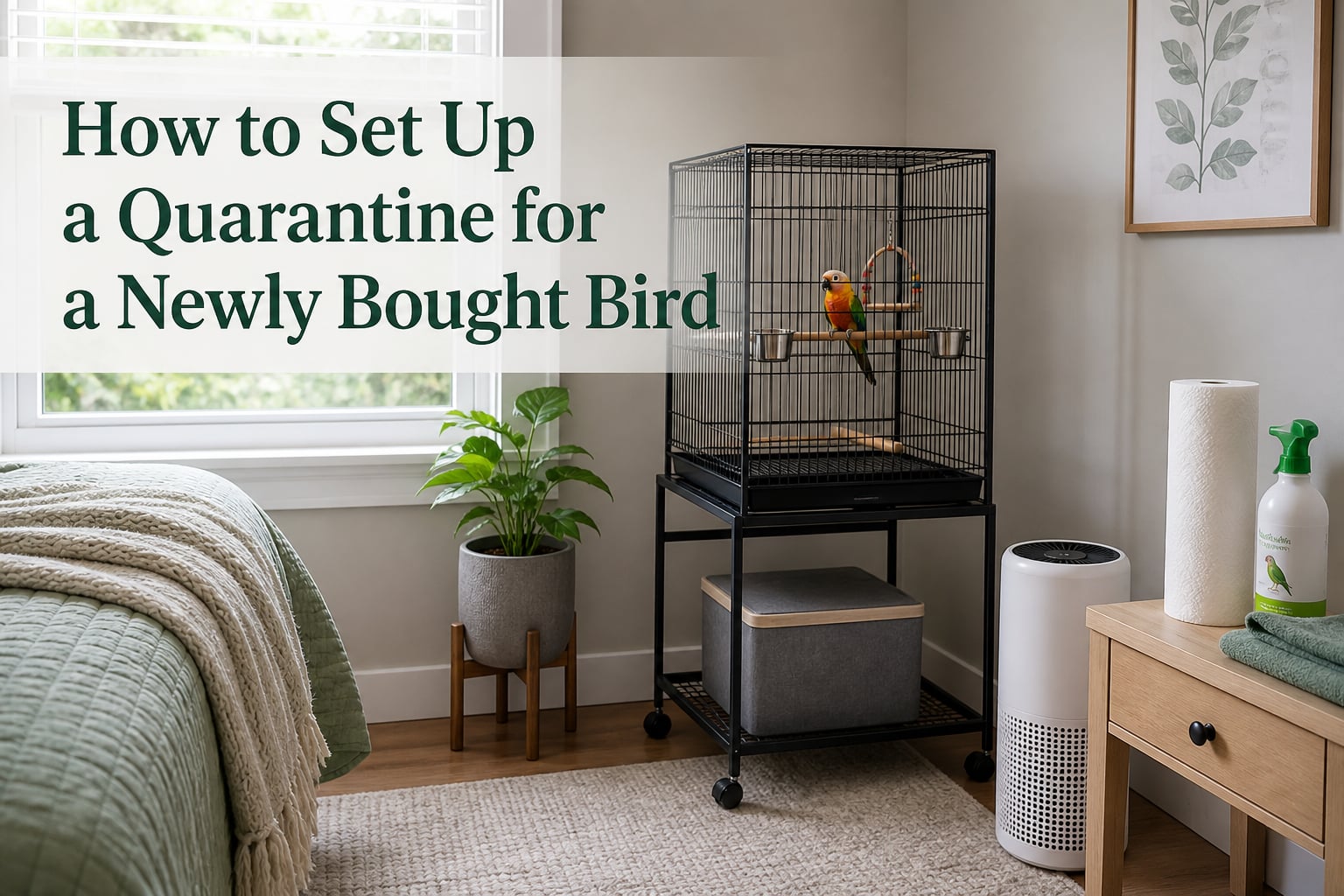
Bringing home a new bird is one of the most exciting moments for any bird owner. But if you already have feathered family members at home, skipping quarantine could put their lives at risk. Knowing how to set up a quarantine for a newly bought bird can mean the difference between a smooth introduction and a heartbreaking disease outbreak.
A proper bird quarantine means keeping your new arrival in a separate room for at least 30 to 45 days, following strict hygiene protocols, and watching closely for signs of illness. Birds are masterful at hiding disease (a survival instinct as prey animals), so a bird that looks perfectly healthy on day one can still carry psittacosis, polyomavirus, or psittacine beak and feather disease without showing any symptoms for weeks.
Our team has worked with multi-bird households, rescues, and avian veterinarians to put together this 2026 guide. We will walk you through everything from choosing the right quarantine room to the specific hygiene practices that prevent airborne and surface disease transmission. Whether you have a spare bedroom or live in a studio apartment, there is a quarantine solution that works for your situation.
By the end of this guide, you will have a complete quarantine plan ready to execute the moment your new bird comes home.
Table of Contents
What Is Bird Quarantine and Why It Matters?
Bird quarantine is the practice of isolating a newly acquired bird from your existing flock for a minimum of 30 to 45 days to prevent potential disease transmission. The word itself comes from the Italian “quaranta giorni,” meaning forty days, which gives you a sense of how long this practice has been used to protect both animals and humans.
During quarantine, the new bird lives in a separate room with its own cage, food and water dishes, and cleaning supplies. You follow strict hygiene protocols every time you interact with the bird, then move on to your other birds. The goal is to give any latent disease time to manifest visibly while keeping your existing flock safely separated.
The Science Behind Prey Animal Behavior
Birds are prey animals, which means they have evolved to hide signs of illness as a survival mechanism. In the wild, a sick bird that looks weak becomes an easy target for predators. This instinct does not disappear in captivity.
Forum users on r/parrots and parrotforums.com repeatedly share the same warning: birds hide illness until it reaches advanced, sometimes untreatable stages. A seemingly healthy budgie from a reputable breeder can carry dormant viruses that only surface under the stress of moving to a new home.
This is why visual inspection alone is never enough. You need time and isolation to let any hidden conditions reveal themselves in a controlled, low-risk environment.
Diseases That Hide During the Incubation Period
Several serious avian diseases can remain asymptomatic for weeks or even months. Here are the ones avian veterinarians worry about most during quarantine:
Psittacosis (Chlamydiosis): A bacterial infection transmissible to humans that causes respiratory symptoms, lethargy, and green droppings in birds. The incubation period can stretch from several days to weeks.
Psittacine Beak and Feather Disease (PBFD): A viral disease affecting parrots that causes abnormal feather growth and beak deformities. It is highly contagious and often fatal, especially in young birds.
Polyomavirus: A virus that primarily affects young birds and can cause sudden death with little warning. Adults can be asymptomatic carriers.
Avian Bornavirus / Proventricular Dilatation Disease (PDD): Causes neurological and digestive issues. Birds can carry the virus for years without symptoms.
External parasites: Mites and lice can hitch a ride on any new bird and quickly spread to your entire flock if given the chance.
Intestinal parasites: Giardia, roundworms, and other parasites may not produce visible symptoms initially but can be detected through fecal testing.
Even a bird purchased from the most reputable breeder or pet store can carry these conditions. No source is guaranteed disease-free, which is why quarantine applies universally regardless of where your bird came from.
Recommended Quarantine Duration for a New Bird
The minimum quarantine period recommended by avian veterinarians is 30 days, with 45 days being the standard recommendation and 60 days considered ideal by experienced breeders. The exact duration depends on the bird’s source, age, and species.
Here is how the recommendations break down across trusted sources:
30 days minimum: This is the absolute floor recommended by VCA Animal Hospitals and most general avian resources. It covers the incubation period of many common bacterial and parasitic infections.
45 days recommended: Most avian veterinarians prefer 45 days because it provides additional buffer time for slower-developing conditions. This is the timeframe we recommend for most situations.
60 days ideal: BirdTricks and experienced breeders recommend 60 days (two months) because it captures the longest known incubation periods for viral diseases like PBFD and polyomavirus. If you have a large, valuable, or elderly flock at home, 60 days is worth the wait.
The bottom line: never quarantine for less than 30 days. If you have the patience for 45 to 60 days, you give yourself the best chance of catching any hidden illness before it reaches your other birds.
How to Set Up a Quarantine Space Step by Step?
Setting up a proper quarantine space is the most practical part of this process. The room you choose and how you prepare it will determine whether your quarantine actually protects your existing flock or just gives you a false sense of security.
Here is the step-by-step process we recommend, along with solutions for owners with limited space.
Step 1: Choosing the Right Room
The ideal quarantine room is a separate bedroom or office with a door that closes completely. It should be as far as possible from where your existing birds live, ideally on a different floor if your home has multiple levels.
Avoid rooms with shared ventilation systems if possible. HVAC ducts can carry airborne pathogens and feather dander between rooms even when doors are closed. If your home uses central air, consider closing the vent in the quarantine room and using a space heater instead.
The room should also have easy-to-clean surfaces. Tile or hardwood floors are better than carpet. Remove fabric items that cannot be easily washed or disinfected.
Step 2: Temperature and Air Quality Control
Birds are sensitive to temperature fluctuations. The quarantine room should maintain a consistent temperature between 65 and 80 degrees Fahrenheit. If your spare room runs cold, a portable ceramic heater with a thermostat can solve this without the fire risk of a space heater with exposed elements.
A standalone HEPA air purifier placed in the quarantine room serves two purposes. It protects the new bird’s respiratory health from dust and dander, and it helps capture any airborne particles that might otherwise travel through your home’s ventilation system.
Never use Teflon or non-stick cookware anywhere near the quarantine room. Overheated PTFE coatings release fumes that are lethal to birds, and this is one of the most common causes of sudden death in new bird situations.
Step 3: Essential Supplies Checklist
Stock the quarantine room with everything the bird needs so you never have to carry items back and forth between rooms. Here is what you will need:
A cage appropriate for the species, separate food and water dishes that stay in the quarantine room, a dedicated supply of food, cleaning supplies (paper towels, bird-safe disinfectant, cage liner), a separate trash bag for waste, and a set of clothes or a cover-up that you wear only in the quarantine room.
Having a dedicated set of supplies prevents cross-contamination. The moment you start sharing a food scoop or carrying a perch from one room to another, you defeat the entire purpose of quarantine.
Step 4: Budget-Friendly Quarantine Solutions
Not everyone has a spare room. Here are budget-conscious alternatives that still provide meaningful isolation:
Plastic sheeting barrier: Hang heavy plastic sheeting over a doorway to create a secondary barrier. This is a technique shared by multiple forum users as a way to reduce airborne transmission when a solid wall is not available.
Bathroom quarantine: An unused or rarely used bathroom can work as a quarantine space. The tile surfaces are easy to disinfect, and bathrooms typically have their own exhaust fan for air circulation.
Walk-in closet conversion: For small birds like budgies or finches, a large walk-in closet can serve as a temporary quarantine area. Ensure there is some air circulation and temperature control.
Plastic tent setup: BirdTricks describes building a temporary quarantine enclosure using PVC pipe and clear plastic sheeting. This creates a sealed environment that can be set up in a corner of any room and dismantled after quarantine ends.
Step 5: Same-Room Quarantine Alternatives
If you have absolutely no option for a separate room, you need to understand the limitations and risks. Forum users on r/budgies and r/parrots are unanimous: same-room quarantine does not provide true protection against airborne diseases or mites.
If same-room is your only option, maximize the distance between cages (at least 6 to 10 feet), place a physical barrier like a tall bookshelf or plastic divider between them, and never let the birds out of their cages at the same time. Change your clothes and wash your hands between handling each bird.
Be aware that this setup does not protect against airborne pathogens. It is better than nothing, but you should have an honest conversation with your avian veterinarian about the risks involved.
Hygiene Protocols and Disease Prevention
Hygiene is the backbone of any effective quarantine. Even the best quarantine room fails if you carry pathogens between birds on your hands, clothes, or shared supplies.
Here are the non-negotiable hygiene rules for the duration of quarantine:
Wash your hands every time. Before entering the quarantine room and immediately after leaving. Use warm water and soap for at least 20 seconds. Hand sanitizer is a backup, not a replacement.
Change your clothes. Keep a dedicated shirt or cover-up in the quarantine room and wear it only when interacting with the new bird. Remove it before leaving the room. This prevents feather dander and fecal dust from traveling on your clothing.
Use separate cleaning supplies. Sponges, scrub brushes, food scoops, and cage liners should all be dedicated to the quarantine room. Color-coding (for example, red items for quarantine, blue for existing flock) helps prevent mix-ups.
Feed the new bird last. Always care for your existing birds first, then tend to the quarantine bird. This way, if you are unknowingly carrying something from the new bird, you are not bringing it to your established flock.
Use bird-safe disinfectants. Products containing accelerated hydrogen peroxide or chlorhexidine are effective against many avian pathogens. Never use bleach at full strength around birds, and always rinse surfaces thoroughly after cleaning.
Dispose of waste carefully. Put cage liner and droppings in a sealed bag before removing them from the quarantine room. Do not compost or reuse materials from the quarantine cage.
The 3-3-3 Rule for New Birds
You may have heard of the 3-3-3 rule in the context of rescue dogs, but bird owners have adapted this framework to understand the adjustment process for new birds. This rule is increasingly referenced in forums and PAA questions, yet no major competitor has explained it in the context of bird quarantine.
Here is how the 3-3-3 rule applies to your new bird during and beyond quarantine:
First 3 days to decompress: Your new bird is overwhelmed. The sights, sounds, and smells are all unfamiliar. During this period, keep interaction minimal. Provide food, water, and a quiet environment. Let the bird observe and settle without pressure.
First 3 weeks to learn the routine: Your bird starts to understand the daily rhythm of your household. You will see the beginning of a personality emerge. This phase overlaps with most of your quarantine period, which works out well because the bird is getting used to you in a controlled, low-stress environment.
First 3 months to feel at home: The bird fully settles in, bonds with family members, and shows its true temperament. This phase extends well beyond the typical 30 to 45 day quarantine, meaning the real bonding happens after quarantine ends and introductions are complete.
Understanding this timeline helps you set realistic expectations. The quarantine period is not just about disease prevention. It is also the decompression and adjustment phase that sets your bird up for long-term success in your home.
Daily Care and Monitoring During Quarantine
Daily observation is where quarantine does its real work. The entire point of isolation is to give you a controlled window to monitor the bird’s health without the distraction of other birds. You need to know exactly what to look for.
Here is your daily monitoring checklist for the full quarantine period:
Droppings: Check the cage floor every morning. Healthy droppings have three parts: a dark solid portion, a white urate portion, and clear liquid. Watch for green droppings (possible psittacosis), all-liquid droppings (diarrhea), or any blood.
Appetite and water intake: Note how much food the bird eats each day. A sudden drop in appetite is one of the earliest warning signs of illness. Track water consumption as well.
Weight: Weigh your bird weekly using a gram scale. Weight loss is often the first measurable sign of illness in birds, sometimes preceding visible symptoms by days or weeks.
Feather condition: Look for fluffed feathers (a sign the bird is cold or ill), missing feathers (could indicate feather plucking or PBFD), or damaged feathers. A bird sitting with feathers fluffed for extended periods during warm weather needs a vet visit.
Behavior and energy: A healthy bird is alert, responsive, and interested in its surroundings. Lethargy, sitting at the bottom of the cage, or unusual aggression can all signal underlying illness.
Breathing: Watch for tail bobbing (the tail moving up and down with each breath), open-mouth breathing, or clicking sounds when the bird breathes. These are emergency symptoms that require immediate veterinary attention.
Keep a simple log or notebook in the quarantine room. Write down one or two observations each day. When patterns emerge or something seems off, you will have documentation to share with your avian veterinarian.
Veterinary Checkup and Disease Testing
A quarantine period without a veterinary checkup is incomplete. Even if your bird looks perfectly healthy, laboratory testing can detect conditions that visual observation cannot.
Schedule the first avian veterinarian visit within the first week of bringing your bird home. This allows the vet to establish a baseline and run initial wellness tests while the bird is still in quarantine.
Here are the tests you should request during this initial visit:
Physical wellness exam: The vet checks body condition, feather quality, eyes, nares, beak, and vent. They listen to the heart and lungs and palpate the abdomen for abnormalities.
Blood panel: A complete blood count and chemistry panel can reveal infections, organ dysfunction, and systemic issues that are not yet producing visible symptoms.
Fecal analysis: Microscopic examination of droppings detects intestinal parasites, bacterial overgrowth, and yeast infections. This is one of the most valuable tests for a new bird.
Chlamydia testing: Since psittacosis is transmissible to humans and can be carried asymptomatically, request a specific test for Chlamydophila psittaci.
PSittacine Beak and Feather Disease test: Especially important for parrot species, this DNA-based test detects a virus that may not show symptoms for months or years.
Bring your daily observation log to the vet appointment. The patterns you have tracked will help the veterinarian interpret test results and identify issues more quickly.
What to Do After Quarantine Ends?
Completing the quarantine period is a milestone, but the transition process matters just as much. Rushing the introduction can undo weeks of careful isolation and cause unnecessary stress for all your birds.
Here is the gradual introduction process we recommend:
Step 1: Final vet clearance. If you have not had a follow-up vet visit, schedule one at the end of quarantine. Get confirmation that the bird is healthy before proceeding with introductions.
Step 2: Cage proximity. Move the new bird’s cage into the same room as your existing birds but keep several feet of distance between cages. Let them see and hear each other for a few days without physical contact.
Step 3: Supervised out-of-cage time. Allow the birds out of their cages at the same time under close supervision. Watch for aggressive behavior, and be ready to separate them immediately.
Step 4: Gradual integration. Over the course of a week or two, increase the amount of shared time. Watch for signs of bonding (preening, chattering, sitting near each other) versus conflict (chasing, biting, screaming).
Step 5: Shared space. Only move toward shared cage space if you have multiple birds of the same species who are showing clear signs of compatibility. Many birds prefer their own cage even in a flock setting.
Be patient. Some birds bond within days, while others take months to accept a new flock member. There is no rush, and forcing the process can create long-term territorial and behavioral problems.
Frequently Asked Questions
Do I have to quarantine my new bird?
Yes, you should quarantine every new bird for at least 30 to 45 days before introducing it to your existing flock. Birds hide illness as a survival instinct, so even a bird that looks perfectly healthy can carry diseases like psittacosis, polyomavirus, or PBFD. Quarantine protects your other birds and gives you time to catch any hidden conditions.
What is the 3-3-3 rule for birds?
The 3-3-3 rule suggests that a new bird needs about 3 days to decompress from the stress of moving, 3 weeks to learn the household routine, and 3 months to fully settle in and feel at home. This timeline overlaps with the quarantine period and helps you set realistic expectations for bonding and adjustment.
Can you leave a bird alone for 2 days?
No, you should not leave a pet bird alone for two full days. Birds need fresh food and water daily, and they are social animals that require interaction and monitoring. If you must be away, arrange for a trusted caregiver to check on the bird at least once a day, ideally twice.
What to do when you bring home a new bird?
When you bring home a new bird, place it directly into your pre-prepared quarantine room, give it fresh food and water, and leave it alone to decompress for the first day. Schedule an avian vet visit within the first week, begin daily health monitoring, and maintain strict hygiene protocols for the full 30 to 45 day quarantine period.
Wrapping Up Your Bird Quarantine Plan
Learning how to set up a quarantine for a newly bought bird is one of the most important skills a multi-bird owner can develop. The 30 to 45 day investment of time and effort protects not just your new arrival, but every bird already in your home.
Remember the fundamentals: choose a separate room, follow strict hygiene protocols, monitor daily for signs of illness, and schedule a veterinary wellness exam with disease testing. The 3-3-3 rule reminds you to be patient with the adjustment process, because the quarantine period is also the foundation of your bond with your new bird.
If you take away one thing from this guide, let it be this: never skip quarantine, and never cut it short. The inconvenience of a separate room and extra cleaning is nothing compared to the heartbreak of losing a beloved bird to a preventable disease. Consult your avian veterinarian with any questions specific to your bird’s species and health history, and give your new arrival the safe, healthy start it deserves.