
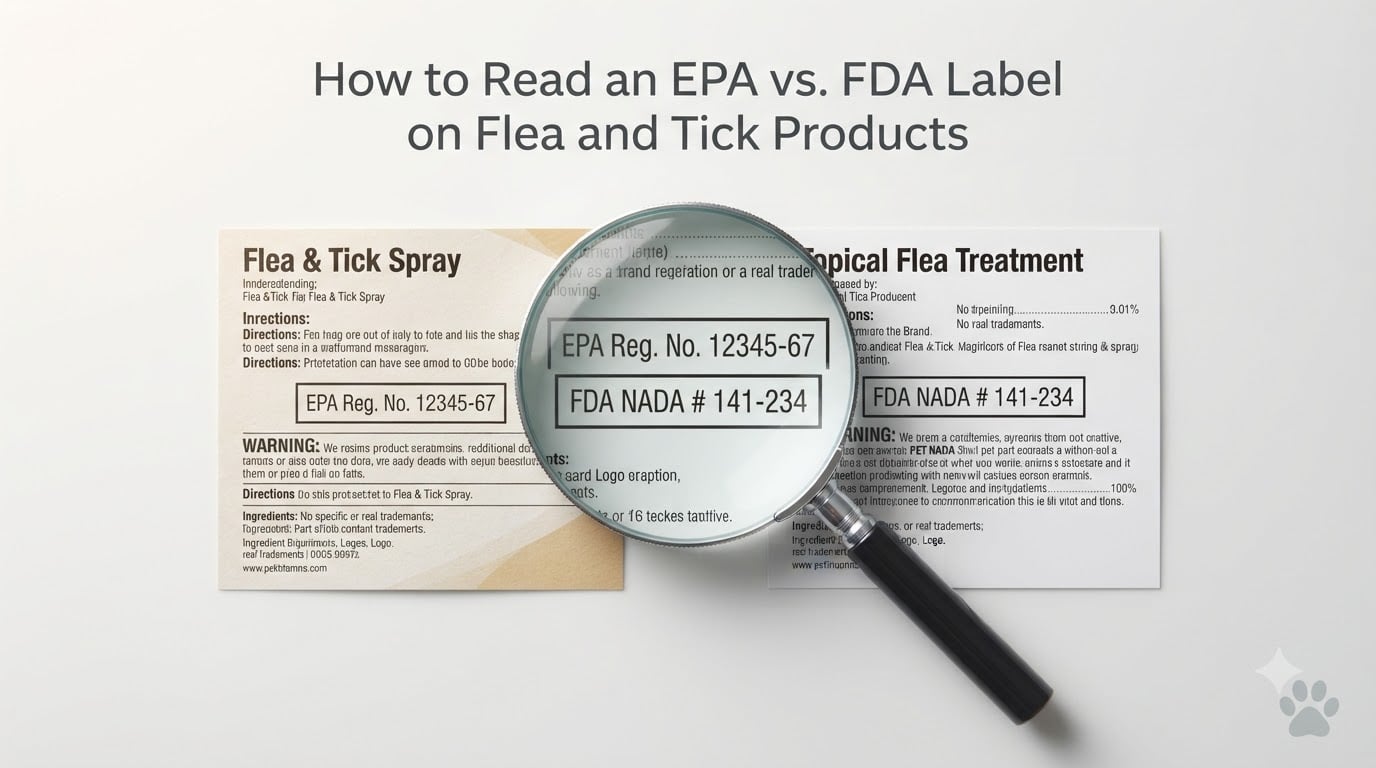
Reading an EPA vs FDA label on flea and tick products takes about 10 seconds once you know what to look for. Flip the box or tube and search for one of three things: an “EPA Reg. No.” (EPA-registered pesticide), or a six-digit “NADA” or “ANADA” number (FDA-approved animal drug). That single number tells you which federal agency reviewed the product, what safety testing it cleared, and who to call if something goes wrong with your pet.
I dug into the FDA and EPA guidance, cross-referenced label databases, and pulled together everything you need to read these labels with confidence. Whether you buy spot-ons, collars, or oral chews, this guide will help you pick legitimate products and report problems to the right agency.
Table of Contents
EPA vs FDA: What’s the Difference?
The split comes down to how the product works inside or on your pet. The EPA regulates flea and tick products that act as pesticides, which generally means they stay on the skin or fur and kill parasites on contact. The FDA regulates animal drugs, which are absorbed into the bloodstream and kill parasites systemically.
Think of it this way: if the active ingredient works from the outside in (topical, collar, spray), EPA registers it. If it works from the inside out (chewable tablet, injectable), FDA approves it. Both agencies require rigorous safety testing, but the data they demand reflects the different exposure routes.
This division has been in place for decades, and it determines what numbers appear on the label, what warnings are required, and which agency tracks adverse events for that product.
Quick Jurisdiction Cheat Sheet
EPA oversees: collars, many spot-on treatments, sprays, powders, and shampoos. FDA oversees: oral tablets (like Bravecto, NexGard, Simparica), some newer spot-ons that act systemically, and injectable preventives.
Frontline Plus is a notable example of a product that sat in the EPA bucket for years. After fipronil’s regulatory review, Frontline Plus transitioned to FDA oversight under NADA 141-202 in recent years, which surprised many longtime users.
How to Read an EPA vs FDA Label: Quick Visual Guide
Spotting the regulating agency on a flea and tick label is a one-step process. Look for any of these three identifiers printed on the outer packaging or the product insert:
EPA Reg. No. (format like 2724-XXX or 11556-XXX) means the EPA registered this product as a pesticide.
NADA # followed by a six-digit number (like 141-202) means FDA approved it as a new animal drug.
ANADA # followed by a six-digit number means FDA approved it as a generic version of an already approved animal drug.
You’ll typically find these numbers on the back or bottom of the box, on the product tube’s crimp, or on the folded leaflet inside the package. If you see none of these identifiers, treat the product as suspect and verify before using.
Label Number Format Examples
Here are real-format examples so you know what to look for. An EPA-registered product: “EPA Reg. No. 2724-497” (the digits represent the company and product code). An FDA-approved new animal drug: “Approved by FDA under NADA # 141-202.” An FDA-approved generic: “Approved by FDA under ANADA # 200-661.”
The string “EPA Reg. No.” is a regulatory requirement for every registered pesticide. The strings “NADA” or “ANADA” are required for every FDA-approved animal drug. Their presence is your proof of legitimacy.
Understanding EPA-Registered Products
When you see an EPA Reg. No. on a flea and tick product, it means the Environmental Protection Agency has reviewed the active ingredients, the inert ingredients, and the product’s intended use. The manufacturer submitted data on toxicity, environmental impact, and effectiveness before the EPA granted the registration.
The EPA Registration Number is typically two or three segments separated by hyphens. The first segment identifies the registrant (the company that holds the registration). The second segment identifies the specific product. The third segment, if present, identifies the distributor or sub-registration.
You can verify any EPA Reg. No. by searching the EPA’s Pesticide Product Label System (PPLS) at epa.gov. If the number doesn’t appear in the database, the product is mislabeled, counterfeit, or both.
What EPA Registration Covers
EPA registration evaluates the product against the Federal Insecticide, Fungicide, and Rodenticide Act (FIFRA). The agency looks at human health risk (especially for people handling the product), ecological risk (what happens if the chemicals enter waterways), and the product’s effectiveness against the target pests.
Every 15 years, the EPA re-reviews each registered pesticide under its Registration Review program. This is why long-standing products sometimes change formulations or labeling over time. The EPA can require new data, additional warnings, or even cancel a registration if new science raises concerns.
Understanding FDA-Approved Products: NADA and ANADA Numbers
FDA-approved flea and tick products display either a NADA number or an ANADA number on the label. These are issued under the Federal Food, Drug, and Cosmetic Act, which treats flea and tick preventives for pets as animal drugs.
Both numbers are six digits, but they signal different approval pathways. Knowing the difference helps you understand whether a product is the original innovator drug or a generic equivalent.
What Is a NADA Number?
NADA stands for New Animal Drug Application. When a company develops a brand-new animal drug, it submits a NADA containing all the safety, effectiveness, and manufacturing data. FDA reviews the data and, if the drug meets the standard, approves it and assigns a NADA number.
For example, Bravecto (fluralaner) is approved under NADA 141-426. NexGard (afoxolaner) is approved under NADA 141-409. These NADA numbers are searchable in the FDA’s Animal Drugs @ FDA database at fda.gov.
What Is an ANADA Number?
ANADA stands for Abbreviated New Animal Drug Application. This pathway allows a company to bring a generic version of an already-approved animal drug to market without repeating all the original safety and effectiveness studies. The generic sponsor must demonstrate bioequivalence and meet manufacturing standards.
Think of ANADA as the animal-drug equivalent of an Abbreviated New Drug Application (ANDA) for human generics. Once the original NADA’s exclusivity period expires, competitors can file ANDAs to market the same active ingredient at lower cost.
Where to Find NADA/ANADA Numbers on Labels
The exact phrase on the label is usually “Approved by FDA under NADA # XXX-XXX” or “Approved by FDA under ANADA # XXX-XXX.” This statement must appear on the label, the package insert, or both. The company name and the established name of the active ingredient also appear nearby.
Why the EPA vs FDA Distinction Matters for Pet Safety?
The agency that regulates a product determines what kind of safety review it received, what warnings appear on the label, and which agency tracks adverse reactions. Knowing the distinction helps you make informed choices and act quickly if something goes wrong.
I’ve seen pet owners waste critical time reporting a reaction to the wrong agency. If your dog has a seizure after a topical treatment, the EPA is the right contact. If the seizure happens after a chewable tablet, the FDA is the right contact. The systems are siloed, so reporting to the wrong one often means the report goes nowhere.
Different Safety Testing Requirements
EPA registration focuses on exposure from external contact (skin, ingestion during grooming, environmental residue). FDA approval focuses on systemic exposure (what happens when the active ingredient circulates in the bloodstream at the dose used).
Both pathways require toxicity studies, target animal safety studies, and environmental or human safety data, but the specifics differ. For pet owners, the practical takeaway is that the FDA approvals for oral flea and tick products have included more rigorous long-term safety monitoring in recent years, partly due to the rise in reported adverse events.
Which Agency to Contact for Problems
For EPA-registered products, contact the National Pesticide Information Center (NPIC) at 1-800-858-7378 or report through the EPA. For FDA-approved animal drugs, report adverse events to the FDA’s Center for Veterinary Medicine using Form 1932a or call your veterinarian to submit a report through the veterinary reporting system.
Your veterinarian should always be your first call if your pet has a serious reaction. They can treat the symptoms and submit the appropriate report to the right agency.
Common EPA-Registered Flea and Tick Products
Most topical spot-on treatments, flea and tick collars, and sprays fall under EPA jurisdiction. These products work by depositing active ingredients on the skin or fur, where they kill parasites on contact or repel them.
Brands you’ve likely seen on store shelves include:
Seresto collars (flumethrin and imidacloprid) – EPA Reg. No. 11556-XXX series
Frontline Spray (fipronil) – EPA-registered before transitioning to FDA for the spot-on version
Adams Plus Flea & Tick Spray – EPA Reg. No. 2724-XXX series
Vet’s Best Flea & Tick Spray – EPA-registered botanical formulation
Many Hartz and Zodiac spot-on products
If you can find the EPA Reg. No. on the label, you can verify the product in the EPA’s PPLS database. The registration tells you the product is legitimate and the formulation matches what EPA reviewed.
Common FDA-Approved Flea and Tick Products
Oral flea and tick medications for dogs and cats are almost exclusively FDA-approved. These products enter the bloodstream and kill parasites that bite the treated pet. Because they distribute systemically, the FDA classifies them as animal drugs rather than pesticides.
Common FDA-approved products include:
Bravecto (fluralaner) – NADA 141-426 for dogs, NADA 141-443 for cats
NexGard (afoxolaner) – NADA 141-409 for dogs
Simparica (sarolaner) – NADA 141-452 for dogs
Credelio (lotilaner) – NADA 141-494 for dogs
Advantage Multi (imidacloprid + moxidectin) – NADA 141-334 for dogs
Revolution (selamectin) – NADA 141-152 for dogs and cats
These are all available by veterinary prescription. The FDA approval means the manufacturer submitted safety and effectiveness data, and the FDA continues to monitor adverse event reports through its pharmacovigilance program.
How to Verify a Product’s Legitimacy and Avoid Counterfeits?
Counterfeit flea and tick products are a real and growing problem, especially for popular brands sold online through third-party sellers. The FDA and EPA have both issued warnings about fake products that contain incorrect doses, wrong ingredients, or no active ingredients at all.
Verification takes a few minutes and can save you from treating your pet with something useless or harmful.
Step 1: Check for the Required Identifier
Every legitimate flea and tick product displays either an EPA Reg. No. or an FDA NADA/ANADA number. If neither appears on the label or packaging, walk away. The product is not legally marketed in the United States.
Step 2: Search the Official Database
For EPA products, enter the EPA Reg. No. into the EPA’s Pesticide Product Label System search at epa.gov/pesticide-labels. For FDA products, search the Animal Drugs @ FDA database at animaldrugsatfda.fda.gov. Both databases are free, no registration required.
If the number doesn’t appear, or the product details don’t match the label in your hand, the product is counterfeit or misbranded.
Step 3: Buy From Authorized Sellers
Purchase directly from your veterinarian, the manufacturer’s website, or a verified retailer. Be cautious with marketplace listings at below-retail prices, especially for prescription products. Counterfeiters often target high-volume oral products like Bravecto and NexGard because they’re expensive and in demand.
Step 4: Inspect the Packaging
Look for misspellings, blurry printing, faded lot numbers, missing expiration dates, or tamper-evident seals that have been broken. Compare the package against the manufacturer’s website images. If anything looks off, contact the manufacturer before using the product.
The 2023 Regulatory Modernization Proposal
In 2023, the FDA and EPA published a joint whitepaper proposing changes to the regulatory framework for animal parasite control products. The proposal acknowledges that the boundary between EPA and FDA jurisdiction has become blurred as new products blur the line between “pesticide” and “drug.”
The current framework relies on a case-by-case determination based on how the product is intended to work. As more products enter the market with both topical and systemic effects, the line gets harder to draw.
What the Proposal Recommends
The joint whitepaper suggests clearer, more predictable criteria for deciding which agency regulates a product. It also proposes enhanced interagency coordination so that safety signals are shared without duplication. The goal is faster review timelines and more consistent consumer protection.
For consumers, the practical takeaway is that some products may shift between agencies over the coming years. If a product you use has always been EPA-registered and suddenly shows a NADA number, that’s the transition in action, not a counterfeit.
Why This Matters to Pet Owners
Modernization could mean stronger post-market surveillance, clearer labeling, and faster response to emerging safety concerns. It also means pet owners should periodically check the regulatory status of long-standing products, especially if their label changes unexpectedly.
As of 2026, the modernization proposal is still under review. The FDA and EPA have not yet finalized implementation timelines.
What to Do If Your Pet Has an Adverse Reaction
Even legitimate products can cause reactions in sensitive pets. Knowing the right steps can speed up treatment and ensure the incident is properly documented.
Step 1: Contact Your Veterinarian Immediately
Call your vet or an emergency animal hospital if your pet shows symptoms like vomiting, lethargy, tremors, seizures, excessive drooling, or skin irritation. Take the product packaging with you so the vet can identify the active ingredients and strength.
Step 2: Report to the Correct Agency
For EPA-registered products, report to the National Pesticide Information Center (NPIC) at 1-800-858-7378. For FDA-approved products, your veterinarian can report through the FDA’s pharmacovigilance program, or you can submit Form 1932a directly to the FDA’s Center for Veterinary Medicine.
Step 3: Document Everything
Record the product name, lot number, expiration date, exact product purchased, where you bought it, when you applied it, and the symptoms your pet showed. Photos and timestamps help. This information goes into the federal adverse event database and can trigger label changes or recalls if patterns emerge.
Step 4: Notify the Manufacturer
Most manufacturers list a consumer phone number on the packaging. They are required to report adverse events to the appropriate agency within 15 days, and they may also offer reimbursement for veterinary costs related to product reactions.
Buying Guide: Choosing and Using Flea and Tick Products Safely
Now that you can read the label, here are practical tips for selecting and using flea and tick products that match your pet’s needs.
Match the Product to Your Pet’s Lifestyle
Dogs that swim daily, for example, may benefit more from oral products than topical treatments that wash off. Cats in multi-pet households need products labeled safe for multi-pet use. Dogs with seizure history should avoid isoxazoline-class drugs (Bravecto, NexGard, Simparica, Credelio) without a vet’s specific guidance.
Read the Entire Label
Even after you’ve verified the EPA Reg. No. or NADA number, read the full label. Application instructions, reapplication intervals, age and weight minimums, and species restrictions all matter. A product that works for a 50-pound dog could be toxic to a 5-pound cat.
Talk to Your Veterinarian
Your vet knows your pet’s health history, including any medications that might interact with flea and tick preventives. Many of the FDA-approved products are prescription-only, which means a vet visit is required. Even OTC EPA-registered products are worth discussing with your vet before first use.
Watch for Recalls and FDA Alerts
Subscribe to FDA and EPA recall alerts for animal health products. The FDA maintains a current list of animal drug recalls on its website, and the EPA posts pesticide product cancellations and label changes through the Federal Register.
Frequently Asked Questions
What is an EPA-approved flea spray?
An EPA-approved flea spray is a flea control product that the Environmental Protection Agency has registered as a pesticide under FIFRA. You can verify its legitimacy by looking for an EPA Reg. No. on the label and searching it in the EPA Pesticide Product Label System database.
What is the difference between FDA and EPA for flea and tick products?
The EPA regulates flea and tick products that work as pesticides, primarily topical treatments, collars, and sprays that kill parasites on the skin or fur. The FDA regulates flea and tick products that act as animal drugs, primarily oral medications that enter the bloodstream and kill parasites systemically. The distinction is based on how the active ingredient works inside or on the pet.
Is Frontline EPA or FDA approved?
Frontline Plus transitioned from EPA registration to FDA approval under NADA 141-202 after fipronil underwent EPA registration review. Older Frontline products may still appear in EPA databases, but the current spot-on formulation is FDA-approved.
What does an EPA label mean on a flea and tick product?
An EPA Reg. No. on a flea and tick product label means the Environmental Protection Agency has reviewed the active ingredients, formulation, and intended use and registered the product as a pesticide under FIFRA. The registration number lets you verify the product in the EPA’s Pesticide Product Label System and confirms it has met federal safety and effectiveness standards.
How do I know if my flea treatment is FDA approved?
Look for the statement Approved by FDA under NADA # XXX-XXX or ANADA # XXX-XXX on the label or product insert. The NADA or ANADA number is a six-digit identifier that proves FDA approval. You can also search the number in the FDA’s Animal Drugs @ FDA database to confirm the product’s approval status.
Why is Frontline no longer effective for some pets?
Flea populations in some regions have developed resistance to fipronil and other older active ingredients over decades of use. The product itself is still approved and effective in many areas, but localized resistance and improper application contribute to perceived failures. If Frontline is not working for your pet, your veterinarian can recommend an alternative from a different drug class.
What is the safest flea and tick treatment for dogs?
No single product is universally safest because reactions depend on the individual dog, other medications, and health conditions like seizure history. FDA-approved products from the isoxazoline class (Bravecto, NexGard, Simparica, Credelio) have been associated with neurological side effects in some dogs. Your veterinarian can recommend the safest option based on your dog’s specific health profile and risk factors.
Conclusion: How to Read an EPA vs FDA Label on Flea and Tick Products
Reading an EPA vs FDA label on flea and tick products comes down to three identifiers. EPA Reg. No. means pesticide, EPA-regulated, external action. NADA or ANADA number means animal drug, FDA-approved, systemic action. Take 10 seconds to check the box before you apply anything to your pet.
This simple habit protects your pet from counterfeits, helps you report problems to the right agency, and gives you confidence in the safety review behind every product you buy. Bookmark the EPA PPLS and FDA Animal Drugs databases so you can verify any product in seconds, and keep your veterinarian in the loop whenever you try a new preventive.
The regulatory landscape is also evolving. The 2023 FDA/EPA joint whitepaper signals potential changes in how these products are reviewed, which means staying informed is part of being a responsible pet owner. Take a few minutes today to check the products currently in your pet care kit. Verify each one, note the lot numbers, and you’ll be prepared if anything goes wrong.