
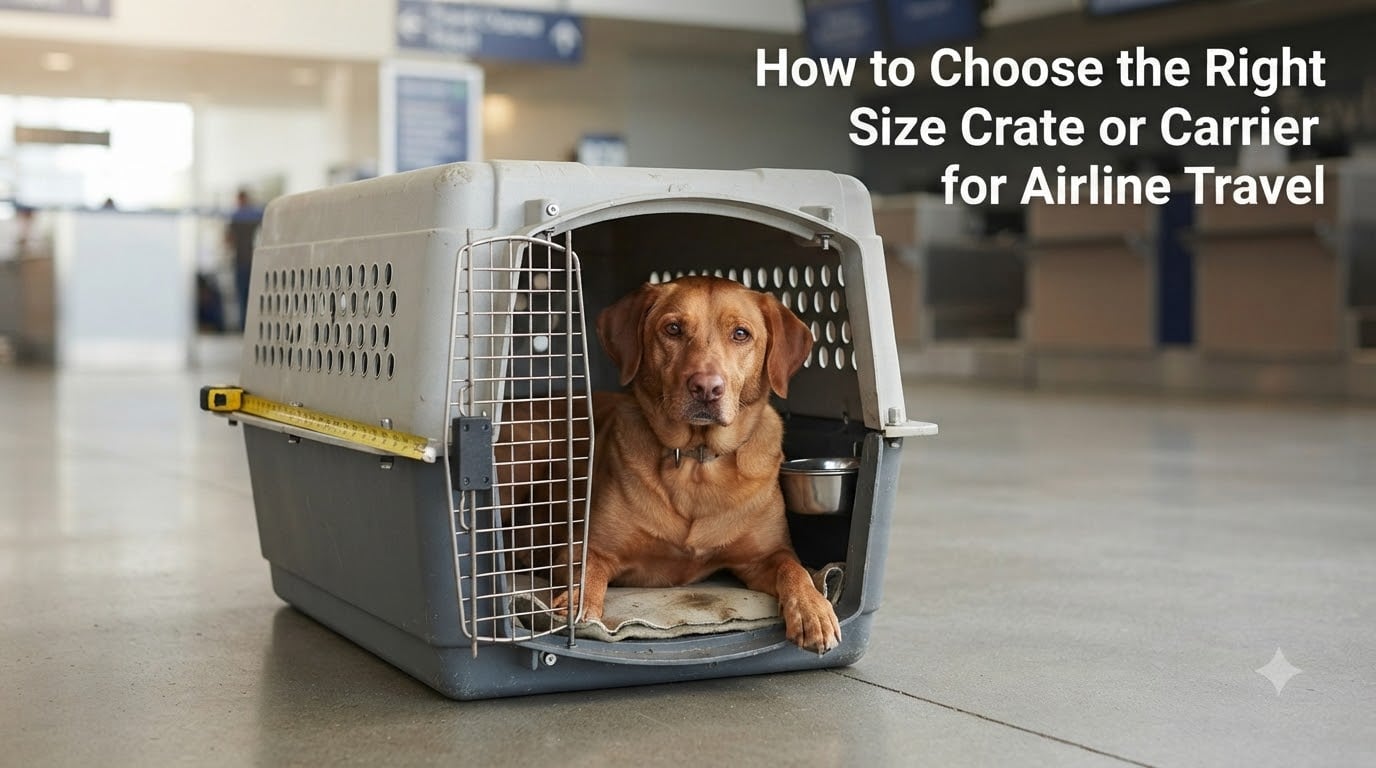
Choosing the right size crate or carrier for airline travel comes down to one simple rule: your pet must be able to stand up, turn around, and lie down comfortably inside the container. After helping dozens of friends prepare their dogs and cats for flights over the past five years, I have seen what works and what gets rejected at the check-in counter. The wrong crate can mean denied boarding, a canceled trip, or a stressed pet in a too-small space.
This guide walks you through the exact steps I use to pick a compliant crate, including the IATA measurement formula, the difference between in-cabin and cargo hold sizing, and the breed-specific rules that catch most travelers off guard. Whether you are moving cross-country with a Labrador or flying your cat to a new home overseas, the steps below will help you avoid the most common mistakes.
Table of Contents
How to Measure Your Pet for an Airline Approved Crate?
Accurate measurements are the foundation of choosing the right size crate or carrier for airline travel. Most denied boardings happen because the carrier is either too small or too large, so spend the time to get this right before you book your ticket.
Step 1: Measure your pet’s length. Have your dog or cat stand on all four legs on a flat surface. Measure from the tip of the nose to the base of the tail (not the tip of the tail). Record this number in inches.
Step 2: Measure your pet’s height. Measure from the floor to the top of the shoulders (withers), not the top of the head. Standing room in the crate is usually measured to the shoulders, not the ears.
Step 3: Measure your pet’s width. Measure across the widest part of the body, usually the shoulders or hips. This is critical for narrow-bodied breeds like whippets.
Step 4: Add clearance space. Add 2 to 3 inches of clearance for domestic flights and 3 to 4 inches for international flights. This extra space lets your pet stand, turn around, and lie down without touching the walls.
Step 5: Apply the formula. Minimum crate length = pet length + clearance. Minimum crate height = pet height + clearance. Minimum crate width = pet width + clearance.
For a 24-inch-long, 18-inch-tall beagle flying domestically, you need a crate at least 26-27 inches long, 20-21 inches tall, and wide enough for the dog to turn around. The “300 series” kennel naming (e.g., 300, 400, 500) refers to these exact dimensions in millimeters, so a 400 series crate is roughly 40 inches long.
Why Clearance Matters More Than You Think
I have watched travelers buy crates that match their pet’s exact measurements, only to have them rejected at the gate. Airlines require that extra clearance because the cargo hold is pressurized and the crate may shift during loading. Without it, your pet cannot reposition for comfort on a long flight.
IATA Compliance Requirements for Airline Pet Crates
The International Air Transport Association (IATA) sets the global standard for shipping live animals. Every airline approved pet crate on the market must meet IATA’s container requirements, which cover everything from ventilation to door construction.
IATA compliant crate: A rigid container that meets IATA Live Animals Regulations (LAR), including a metal grate door, spring-loaded locking system, leak-proof bottom, four-sided ventilation, and enough room for the animal to stand, turn around, and lie down naturally.
Mandatory Features for an IATA-Approved Crate
Metal grate door: The door must be made of welded metal, not plastic, so the animal cannot chew through it. The latch must be a spring-loaded, center-locking system that cannot be pushed open from inside.
Four-sided ventilation: Ventilation openings on at least three sides for domestic flights and four sides for international flights. Total ventilation area must be at least 16% of the total wall area on each ventilated side.
Leak-proof bottom: The floor must be solid and leak-proof, with an absorbent lining (like a towel or puppy pad) on top. Liquids must not escape the crate during transit.
Structural integrity: The crate must be rigid enough to withstand stacking and rough handling. Plastic kennels should have secure fasteners, not just snap-together joints.
Food and water containers: Two bowls must be accessible from outside the crate without opening the door, usually attached to the door grate.
Documentation Stickers Required
Every IATA-compliant crate must display “Live Animal” stickers on top and one side, with directional arrows indicating the upright position. The crate also needs your contact information, the destination contact, and the animal’s feeding schedule attached in a waterproof pouch. Our team has seen travelers forget the “This Way Up” arrows and end up with delayed cargo transfers.
In-Cabin Pet Carrier Size vs Cargo Crate Requirements
The biggest mistake I see is mixing up in-cabin and cargo requirements. In-cabin pet carriers are typically soft-sided and must fit under the seat in front of you, while cargo crates are rigid and must meet strict IATA specifications. Knowing which one applies to your pet is the first step.
In-Cabin Carrier Limits
Most U.S. airlines require the in-cabin carrier to fit under the seat and stay within roughly 18 x 11 x 11 inches. This typically works for pets under 20 pounds, including the carrier weight. Only one pet per carrier is allowed, and the carrier must remain under the seat for the entire flight. The pet must stay inside the carrier at all times, with only the head potentially allowed out if the carrier is open-top.
Snub-nosed breeds like French bulldogs, pugs, and Persian cats are often banned from cargo travel due to breathing risk, but many airlines allow them in-cabin where the air is pressurized and climate-controlled. Check your airline’s specific list before booking.
Cargo Hold Size Requirements
For pets too large for in-cabin travel, the cargo hold requires a rigid plastic or wooden crate that meets IATA standards. The crate dimensions must exceed your pet’s measurements by the clearance space we calculated above. Most airlines cap pet cargo at around 70 to 100 pounds including the crate, with size limits typically maxing out at the 700-series kennel (around 54 inches long).
Airline-Specific Size Limits at a Glance
| Airline | In-Cabin Carrier Max (L x W x H) | Pet + Crate Weight Limit | Snub-Nosed Cargo Allowed |
|---|---|---|---|
| Delta | 18 x 11 x 11 in | No published limit; standard 70 lb | Yes (brachycephalic breeds with restrictions) |
| United | 17.5 x 12 x 7.5 in (soft) or 18 x 11 x 11 in (hard) | Standard 70 lb max | Limited (some breeds banned) |
| American | 19 x 13 x 9 in | 100 lb max with crate | Restricted (seasonal restrictions) |
| Alaska | 17 x 11 x 7.5 in | 150 lb max with crate | Some breeds restricted |
| Southwest | 18.5 x 13.5 x 9.5 in | 150 lb max with crate | Some breeds restricted |
Always call your specific airline before booking. Fleet policies and embargoes change frequently, and even small variations can ground your pet at the gate.
Special Considerations for Snub-Nosed and Large Breeds
Some breeds require extra crate size or cannot fly at all. Snub-nosed (brachycephalic) breeds have shortened airways that make breathing difficult during temperature and pressure changes. Standard airline practice is to add 10% more clearance to crates for snub-nosed dogs, but many airlines still refuse them in cargo during summer or winter extremes.
Common Snub-Nosed Breeds Often Restricted
Dogs: English bulldogs, French bulldogs, pugs, Boston terriers, boxers, shih tzus, Pekingese
Cats: Persian, Himalayan, Burmese, exotic shorthair
Large Breed Sizing Tips
For large breeds like German Shepherds, Standard Poodles, and Golden Retrievers, the 500 and 700 series crates are typical. The Vari Kennel XXXL (48 inches) is a popular choice for these dogs and is widely available. Measure your dog carefully because even a 1-inch error can force you to upgrade to a much pricier crate.
For pets over 70 pounds, including the crate, options shrink dramatically. Some airlines refuse them entirely, while others require special manifest cargo handling. Our team has found that booking early and confirming weight limits with the cargo department is the only way to avoid a denied booking two weeks before departure.
How Strict Are Airlines With Pet Carrier Size at Check-In
Airlines are very strict about pet carrier size consistency. Gate agents will measure soft-sided carriers with a sizer to confirm they fit under the seat. For cargo crates, the check-in counter will weigh the pet plus crate and verify dimensions before accepting it. Crates that look oversized or undersized are flagged immediately.
Real-world consequences I have witnessed include:
Denied boarding at the gate with no refund on the pet ticket
Cargo crate rejected for missing ventilation holes on three sides
Traveler forced to buy a new crate at the airport for triple the online price
Pet sent on later flight when crate was deemed too small
One forum user reported being turned away at the check-in counter for a 1-inch shortfall on crate length, even though the pet was calm and had traveled that route before. The lesson: size compliance is non-negotiable, and airline staff have no discretion to bend the rules.
What to Put Inside the Crate for a Safe Flight?
What goes inside the crate matters as much as the size. Vets and experienced pet shippers recommend a minimal setup to prevent choking or shifting during turbulence.
Absorbent bedding: A towel, pee pad, or vet bed on the bottom. Avoid loose shredded paper or hay.
Frozen water bowl: Attach a water bowl to the door and freeze water inside it. It melts slowly during the flight without spilling.
Familiar scent: A worn t-shirt or small blanket with your scent can reduce anxiety.
No food during travel: Feed your pet 4-6 hours before the flight to prevent nausea. Water can stay in the frozen bowl.
No toys or treats: Loose items can become choking hazards. Calming aids like a ThunderShirt can be worn if the airline allows.
Pre-Flight Crate Checklist
Crate meets IATA size and clearance requirements
All screws and fasteners are tight
Door locks securely and cannot be opened from inside
Ventilation holes are unobstructed on all required sides
“Live Animal” stickers are attached on top and one side
Directional arrows correctly indicate upright position
Food and water bowls attached and accessible from outside
Absorbent bedding in place
Contact information pouch attached
Health certificate and rabies vaccination on hand
Frequently Asked Questions
What size dog crate do I need for air travel?
The right size crate is one where your dog can stand, turn around, and lie down naturally. Measure your dog’s length from nose to tail base, height to the shoulders, and width at the widest point. Add 2-3 inches of clearance for domestic flights and 3-4 inches for international flights. That total becomes your minimum crate dimension.
How strict are airlines with pet carrier size?
Airlines are very strict and consistency is enforced at check-in. Gate agents measure soft-sided carriers with a sizing box, and cargo staff weigh and measure the pet plus crate. If the carrier does not meet the published size limits, the pet will be denied boarding with no exception. There is no discretion to bend the rules once you arrive at the airport.
Can you bring a 70 lb dog on a plane?
Yes, most major airlines allow dogs up to 70 pounds including the crate in cargo, though some cap at 100 pounds. You must use a rigid IATA-compliant crate that meets the 700-series size limit (around 54 inches long). The pet must fly as checked cargo or manifest cargo, not in-cabin. Always confirm with your specific airline before booking, as policies vary by route and season.
Are soft-sided carriers allowed on planes?
Soft-sided carriers are allowed for in-cabin travel only on most airlines, and they must fit under the seat in front of you. They are not permitted for cargo travel because they cannot withstand stacking and rough handling. For cargo, you must use a rigid plastic or wooden crate that meets IATA standards.
What is the best dog crate for air travel?
The best crate is one that is IATA-compliant, the correct size for your dog, and approved by your specific airline. For small pets, the Petmate Top Load or Diggs Revol are popular choices. For medium and large dogs, the Petmate Vari Kennel (300-700 series) is the industry standard and is accepted by nearly every airline. Always confirm the exact model with your airline before purchasing.
Final Verdict on Choosing the Right Size Crate for Airline Travel
Choosing the right size crate or carrier for airline travel does not have to be stressful. Start by measuring your pet carefully, add the clearance required for your route, and confirm the crate meets IATA standards. Call your airline before you book to verify their specific size and breed restrictions, and triple-check the crate at home before you leave.
A correctly sized crate means a calmer pet, a smoother check-in, and peace of mind throughout the flight. Take the time to do the measurement step right now, and you will save yourself the cost of a rejected crate or a denied boarding later. Your pet deserves a comfortable journey, and the airlines will do their part if you do yours.