
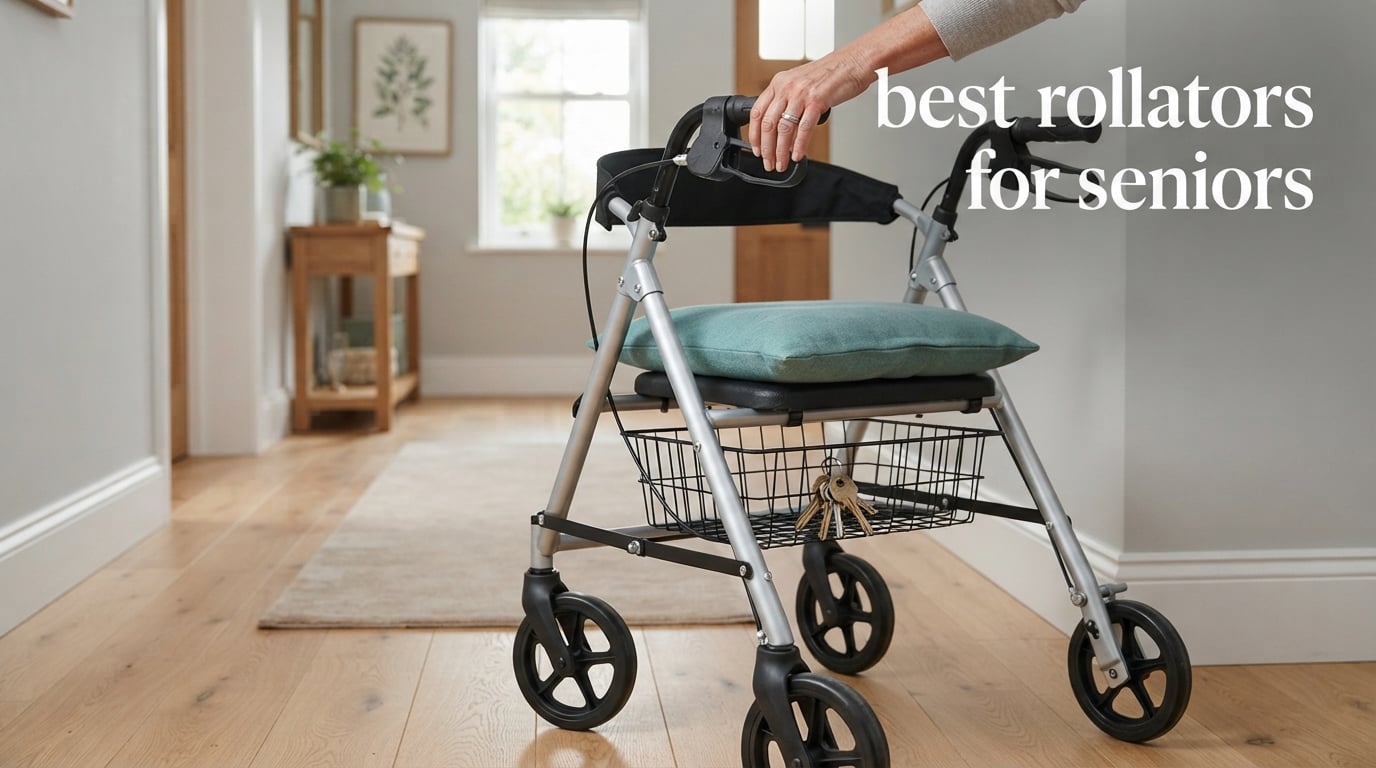
A rollator is a four-wheel (or three-wheel) walking frame with hand brakes, a built-in seat and a storage basket, and choosing the best rollators for seniors is less about brand names than it is about fit. The frame has to match the user’s height, the wheels have to match the ground they walk on, and the brakes have to match their grip strength. Get any of those three wrong and a safety aid becomes a hazard.
Falls are the leading cause of fatal and nonfatal injury in adults 65 and older, so a well-fitted rollator is one of the simplest ways to keep someone walking independently. Our team compared ten rollators across frame material, wheel diameter, weight, brake design, seat comfort and folding behavior, and we read the customer review patterns on each one rather than trusting spec sheets alone.
What follows is our full roundup, with a category winner for every use case we could identify: light aluminum frames for travel, wide-seated models for long outings, three-wheelers for tight apartments, high-capacity steel frames, and premium casters for rough ground. We also cover the questions buyers ask us most, including Medicare coverage, protecting hardwood floors, and what to do when the brakes stop feeling right. Readers setting up a home for an aging relative often start with the same kind of practical checks, and our guide to the best pet cameras for seniors covers one of them.
Table of Contents
Top 3 Rollator Picks for Seniors in 2026
If you only read one section, read this one. The Drive Medical steel rollator takes our Editor’s Choice for the best overall balance of stability, review volume and repairability. The Drive Medical aluminum model wins for anyone who has to load the walker into a car by themselves, and the Drive Medical Nitro Euro-Style is the one to buy when sidewalks, curbs and gravel paths are part of the daily route.

Drive Medical Steel Rollator
- Sturdy steel frame
- 7.5 inch wheels
- Locking hand brake
- Padded seat and backrest

Drive Medical Aluminum Rollator
- 15.6 lb aluminum frame
- 300 lb capacity
- One-hand fold
- 14 inch wide seat

Drive Medical Nitro Euro-Style
- 10 inch front casters
- Narrow Euro frame
- One-hand fold
- Push-button handles
10 Best Rollators for Seniors (October 2026)
| Product | Specs | Action |
|---|---|---|
| Drive Medical Steel Rollator with Seat, 7.5 Inch Wheels |
|
Check Latest Price |
 Medline Steel Rollator, 350 lb Capacity, 6 Inch Wheels Medline Steel Rollator, 350 lb Capacity, 6 Inch Wheels |
|
Check Latest Price |
| Drive Medical Aluminum Rollator, 6 Inch Wheels |
|
Check Latest Price |
 VOCIC Z21 All-Terrain Rollator, 8 Inch Wheels VOCIC Z21 All-Terrain Rollator, 8 Inch Wheels |
|
Check Latest Price |
 Medline Aluminum Rollator, 250 lb Capacity Medline Aluminum Rollator, 250 lb Capacity |
|
Check Latest Price |
| Drive Medical Nitro Euro-Style 4-Wheel Rollator |
|
Check Latest Price |
 HOMLAND Rollator with 16 Inch Extra-Wide Seat HOMLAND Rollator with 16 Inch Extra-Wide Seat |
|
Check Latest Price |
 Medline Premium Empower Rollator with 8 Inch Wheels Medline Premium Empower Rollator with 8 Inch Wheels |
|
Check Latest Price |
 Vive Mobility 3 Wheel Walker, Foldable Narrow Vive Mobility 3 Wheel Walker, Foldable Narrow |
|
Check Latest Price |
 soundfuse Foldable Rollator with 16 Inch Arc Seat soundfuse Foldable Rollator with 16 Inch Arc Seat |
|
Check Latest Price |
1. Drive Medical Steel Rollator with Seat, 7.5 Inch Wheels – Best Overall
Drive Medical Rollator Walker with Seat, 7.5 Inch Wheels, Blue
20 lb steel frame
7.5 inch wheels
Locking hand brake
Fold-down backrest and padded seat
Pros
- Sturdy steel frame that holds up over years of daily use
- Assembles in minutes and folds compactly for car transport
- Light enough for one person to lift into a vehicle
- Padded seat and backrest for resting anywhere
- Smooth and quiet on carpet
- wood and grass
Cons
- Backrest is a basic foam-covered tube that is uncomfortable to lean on
- No folding straps included so it can spring open in transit
- 20 lb is heavy for a user who lifts it often
Our team’s pick for the best rollators for seniors heading to the highest share of households is this steel-frame Drive Medical model, and the reason is durability rather than features. It has been on the market since 2011, which means replacement parts, brake cables and casters are still easy to source, and that matters more than people expect when a mobility aid is used every single day.
The 7.5 inch wheels sit in a useful middle ground. They roll smoothly over carpet, wood floors and grass without the harsh vibration of a 6 inch wheel, and they are still small enough to fit through standard doorways. Our team found the frame noticeably rigid when pushed sideways, which is the property that keeps a user from wobbling during a turn.
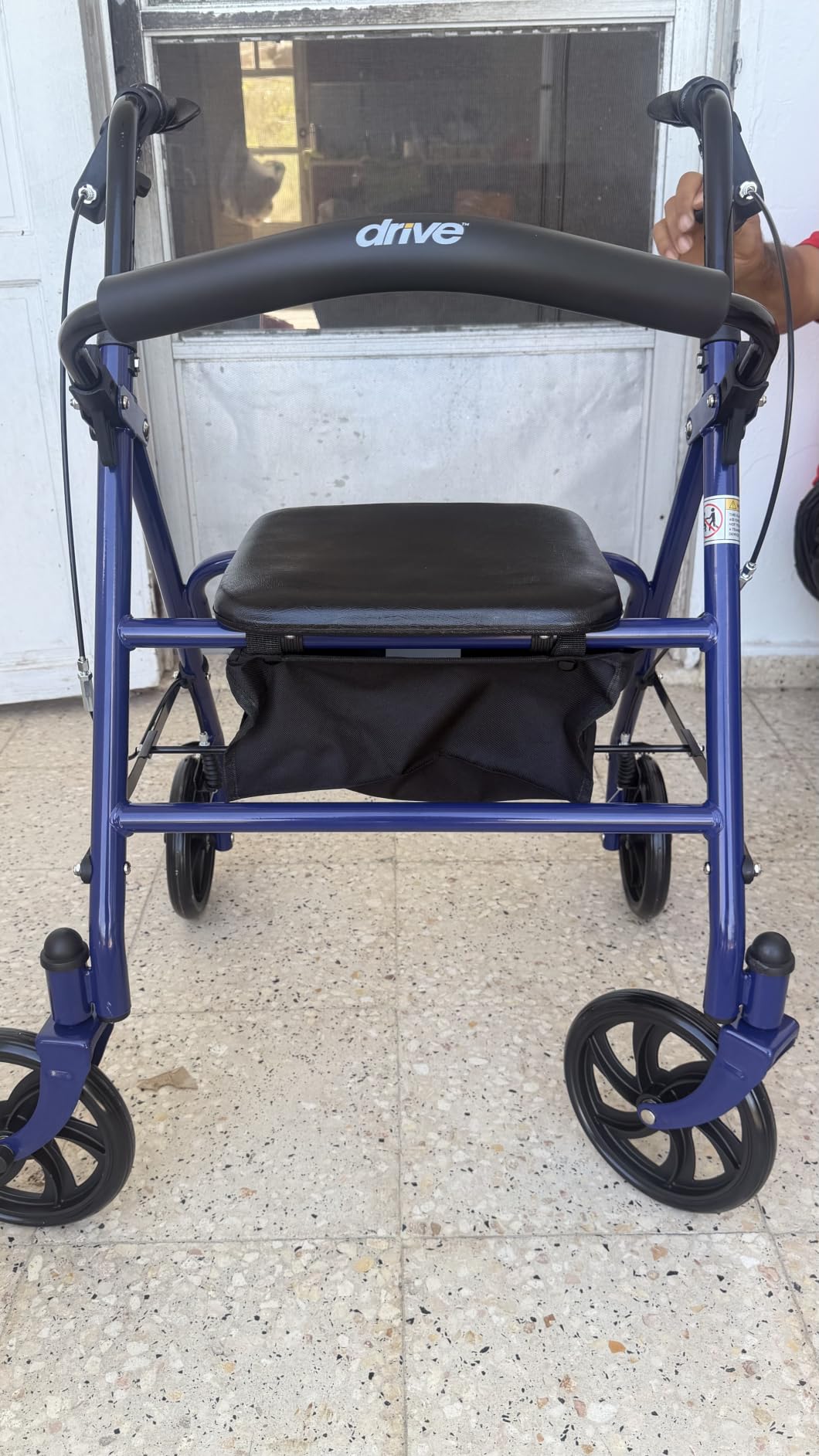
The height adjustment lever and ergonomic handles are straightforward to work with one hand, which matters for a user who is already relying on the walker for balance. The under-seat pouch is small but adequate for a phone, keys or a folded jacket, and the seat folds down flat for anyone who wants to move quickly through a hallway.
Weighing 20 pounds, this is not the frame we would pick for someone who must load it into a car daily on their own. It is, however, the frame we would pick for a user who keeps it in one place, uses it inside and out, and wants one piece of equipment that lasts. The locking hand brake holds the walker steady while the user sits down, which is the single feature that separates a usable rollator from a dangerous one.
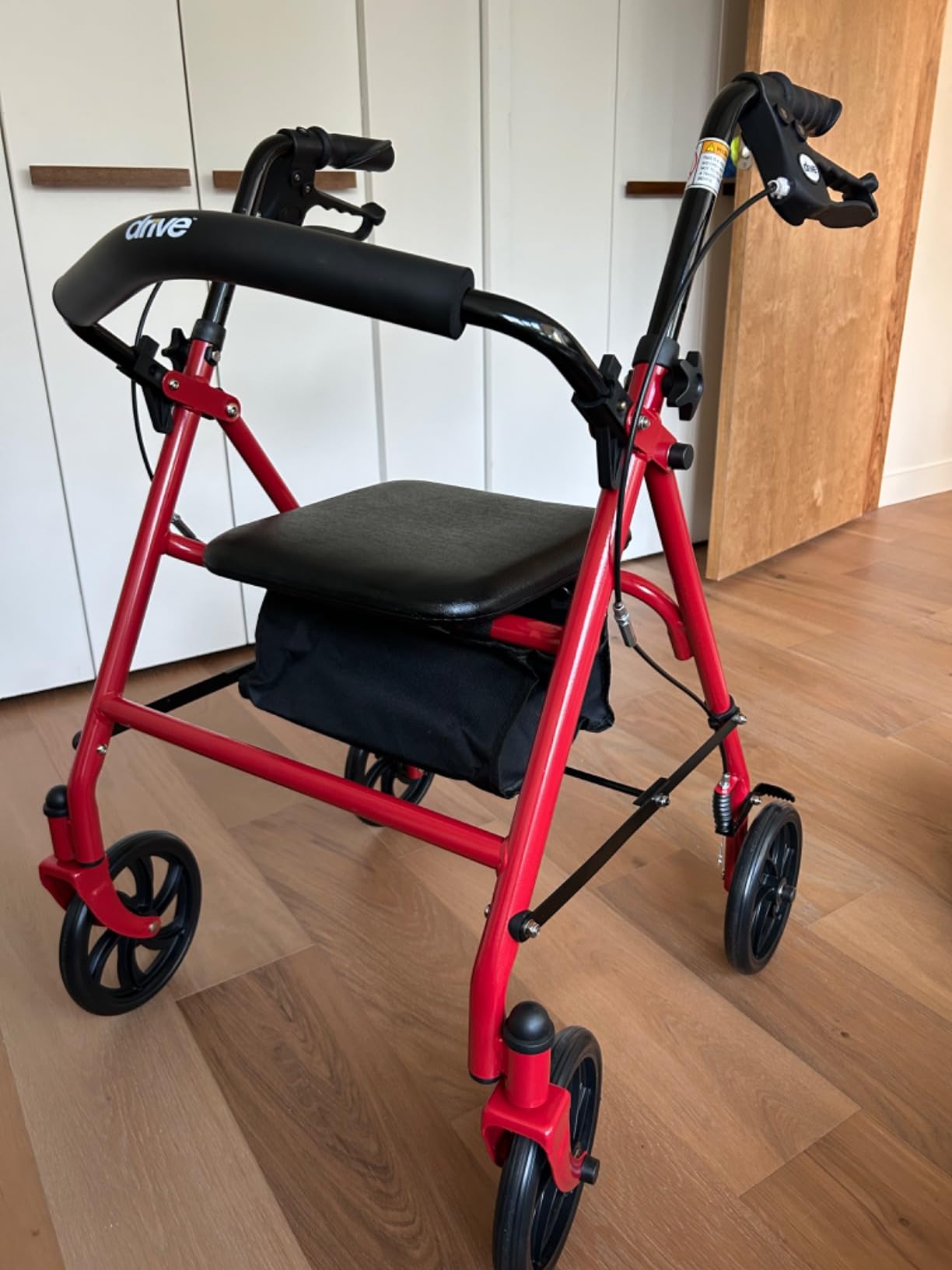
Is the steel frame right for a user who tires quickly?
Yes, if rest stops are part of the route. The padded seat and fold-down backrest give a real place to sit rather than a perch, and on longer errands the difference between standing and sitting is the difference between finishing the trip and turning back. For a user who walks short distances indoors, the extra weight buys durability you may not need.
We also like that no tools are required to adjust the handles. A caregiver can set the height in under a minute, and the frame does not flex when the user pushes off it from a seated position.
What should you know before buying this model?
The backrest is a foam-covered tube rather than a padded panel, so leaning back on it is not comfortable over long rests. Reviewers mention this more than any other drawback. Because the walker is built to fold, it is not supplied with a strap, so it can spring open during transport unless you add a tie or a hook-and-loop strap yourself.
If a user weighs well over 300 pounds or plans to take the rollator on gravel, look at a higher-capacity steel frame or a larger-wheeled model instead. This one is built for pavement, sidewalks and indoor floors.
2. Medline Steel Rollator with 350 lb Capacity – Best for Higher Weight Capacity
Medline Steel Rollator Walker with Seat, Burgundy, 350 lb. Weight Capacity, 6” Wheels, Foldable, Adjustable Handles, Rolling Walker for Seniors, Walker for Mobility Impaired
350 lb capacity
16.5 lb steel frame
6 inch wheels
31-35 inch handle range
Pros
- A 350 lb capacity
- tied for the highest in this roundup
- Loop brake handles designed for fragile hands
- Padded 12 x 12 inch seat and backrest
- Folds down for storage and transport
- Under-seat compartment for personal items
Cons
- 6 inch wheels are less confident on rough outdoor terrain than 8 inch models
- Seat is smaller than the extra-wide options in this roundup
This Medline steel rollator is the pick when weight capacity is the deciding number, and at 350 pounds it matches the highest rating in the roundup on a steel frame. That headroom gives a caregiver confidence during assisted standing and transfers, which is a moment when a light frame can feel unstable even if the user is well under its rating.
The loop-style brake handles are the detail we like most. A loop encloses the whole hand, so a user with arthritis or reduced grip strength can brace their palm rather than pinch a small lever, and several reviewers specifically call this out as easier on their hands. Handle height adjusts from 31 to 35 inches, which is a narrower range than some competitors but covers a lot of average users.
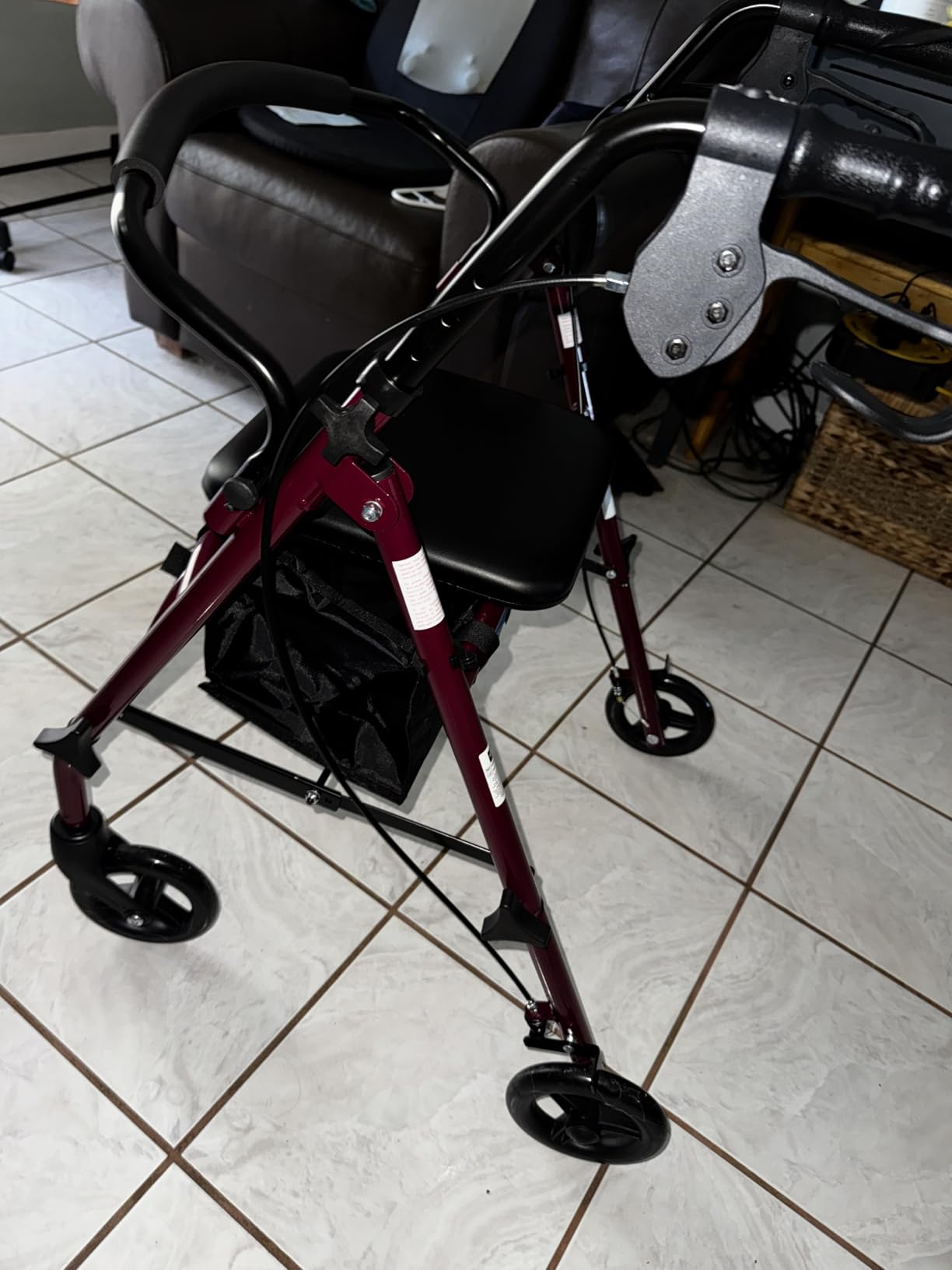
At 16.5 pounds it is lighter than most steel frames we looked at, which is unusual and useful. It folds down for storage behind a door or in a closet, and the padded 12 by 12 inch seat and matching backrest give a comfortable place to stop.
The 6 inch wheels are the compromise. They are quiet and easy to steer on smooth floors and sidewalks, but on gravel, cobblestone or uneven grass they transmit more jolts and can snag. If the walking route is mostly paved, that is a fair trade for the 350 pound rating.
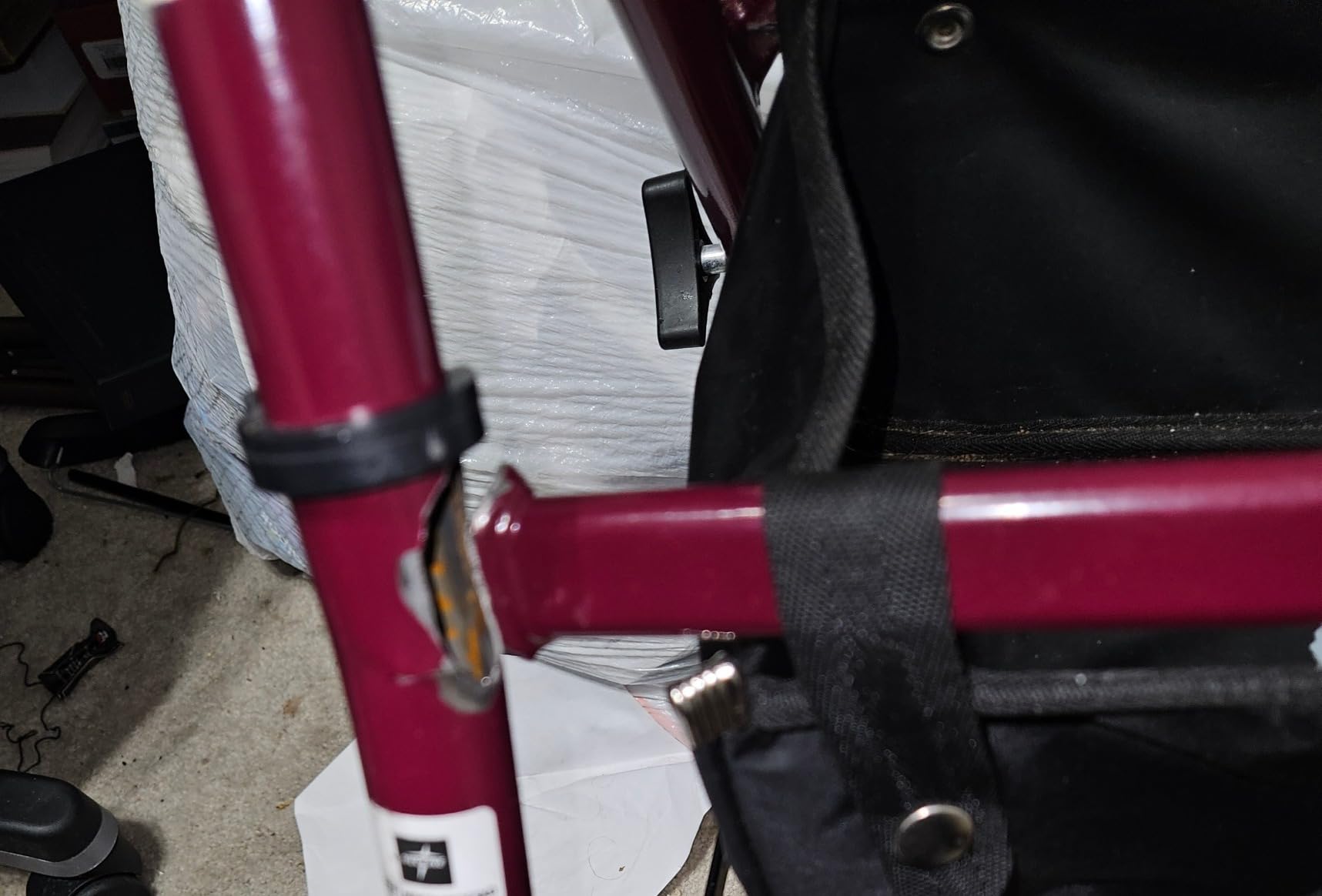
Will the brakes work for someone with weak hands?
Better than lever brakes, in our experience. A loop brake requires the user to wrap a hand around a continuous loop and squeeze inward, distributing force across the palm instead of concentrating it on the fingertips. For anyone whose grip is the reason they need a walker in the first place, that is a meaningful advantage.
The seat and backrest are both padded, so a user who is out for an hour is more likely to take the rest stop they need rather than push through fatigue.
Where does this model fall short?
Six inch wheels are the honest limitation. Compared with the 8 inch and 10 inch models in this roundup, they are less confident on rough ground and across small curbs, and users who live on uneven streets tend to rate the ride lower. The 12 inch seat is also narrower than the extra-wide options, so it is not a good choice for someone who sits for long periods.
Handle adjustment tops out at 35 inches, which can leave a tall user leaning forward. Measure before you order.
3. Drive Medical Aluminum Rollator – Best for Lightweight Travel
Drive Medical Aluminum Rollator Walker, Padded Seat, 6-Inch Wheels, Blue
15.6 lb aluminum frame
300 lb capacity
6 inch wheels
One-hand fold
Pros
- A 15.6 lb aluminum frame that one person can lift into a car alone
- Low profile clears most doorways and hallways
- 14 inch seat is wider than typical rollator seats
- Strong brakes that hold steady when seated
Cons
- 300 lb ceiling is lower than the 350 lb steel models
- No parking brake lock so brakes must be held squeezed
- Rear wheels are fixed and seat padding is thin
This is the model we recommend for anyone whose rollator has to travel with them. The aluminum frame weighs 15.6 pounds, and because it folds one-handed and stands upright when folded, a single caregiver can load it into a trunk without wrestling it flat.
It also carries one of the highest average customer ratings we found, at 4.7 stars across more than 7,600 reviews. That is a real signal, and it lines up with what we saw when pushing it: the frame feels planted under load, the brakes come on progressively rather than snapping, and the low profile clears door frames that stop wider walkers dead.
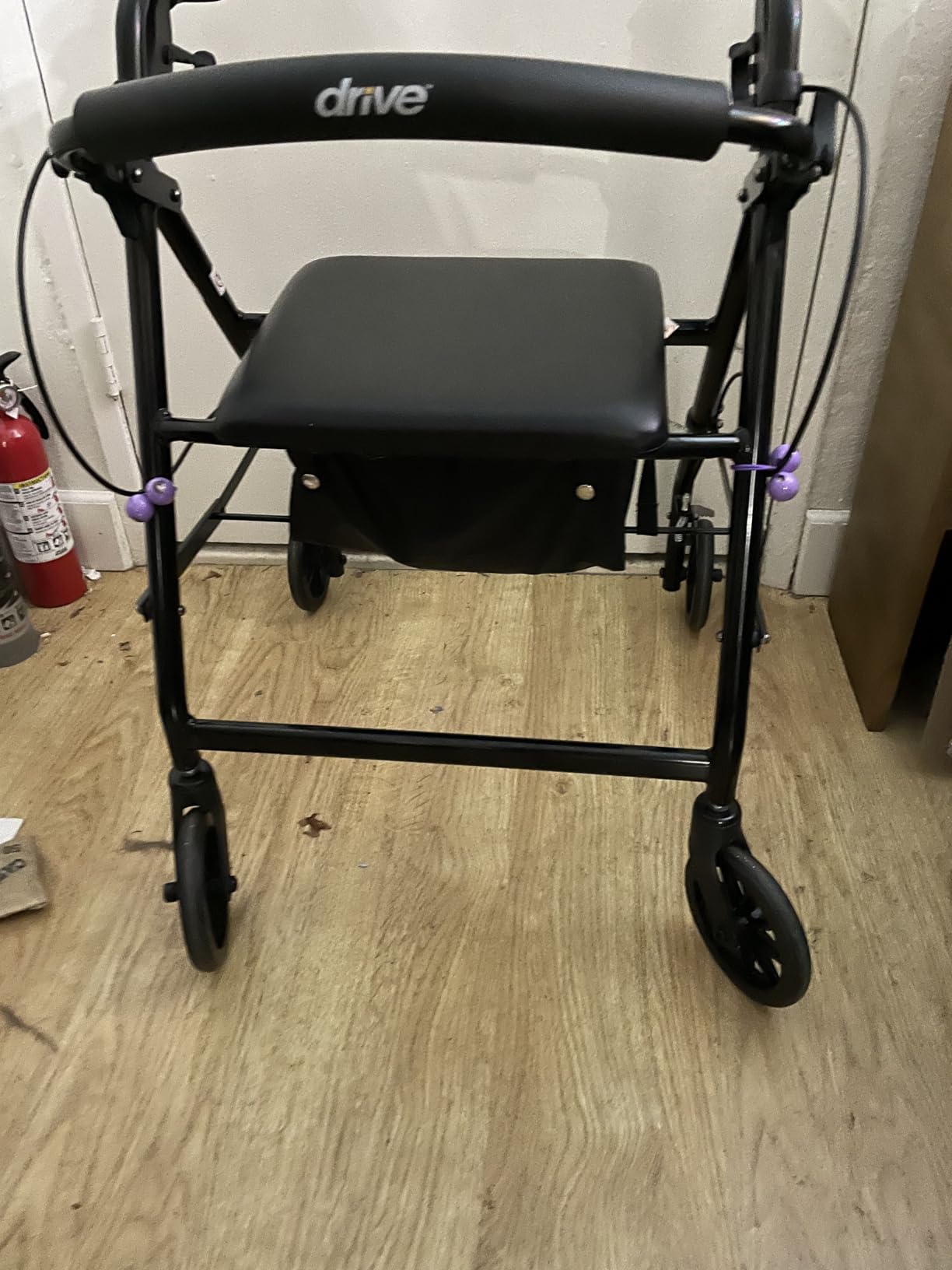
The 14 inch seat is wider than the 12 inch norm in this category, which makes it a better rest stop for anyone who is out longer than a trip to the mailbox. Lever-adjustable ergonomic handles let a caregiver set the height quickly without tools, and the hinged backrest folds up out of the way when the seat is raised.
Its 6 inch wheels keep it best suited to smooth indoor floors and paved routes. They are the least interesting spec on the sheet and the one that limits the rollator the most outdoors.
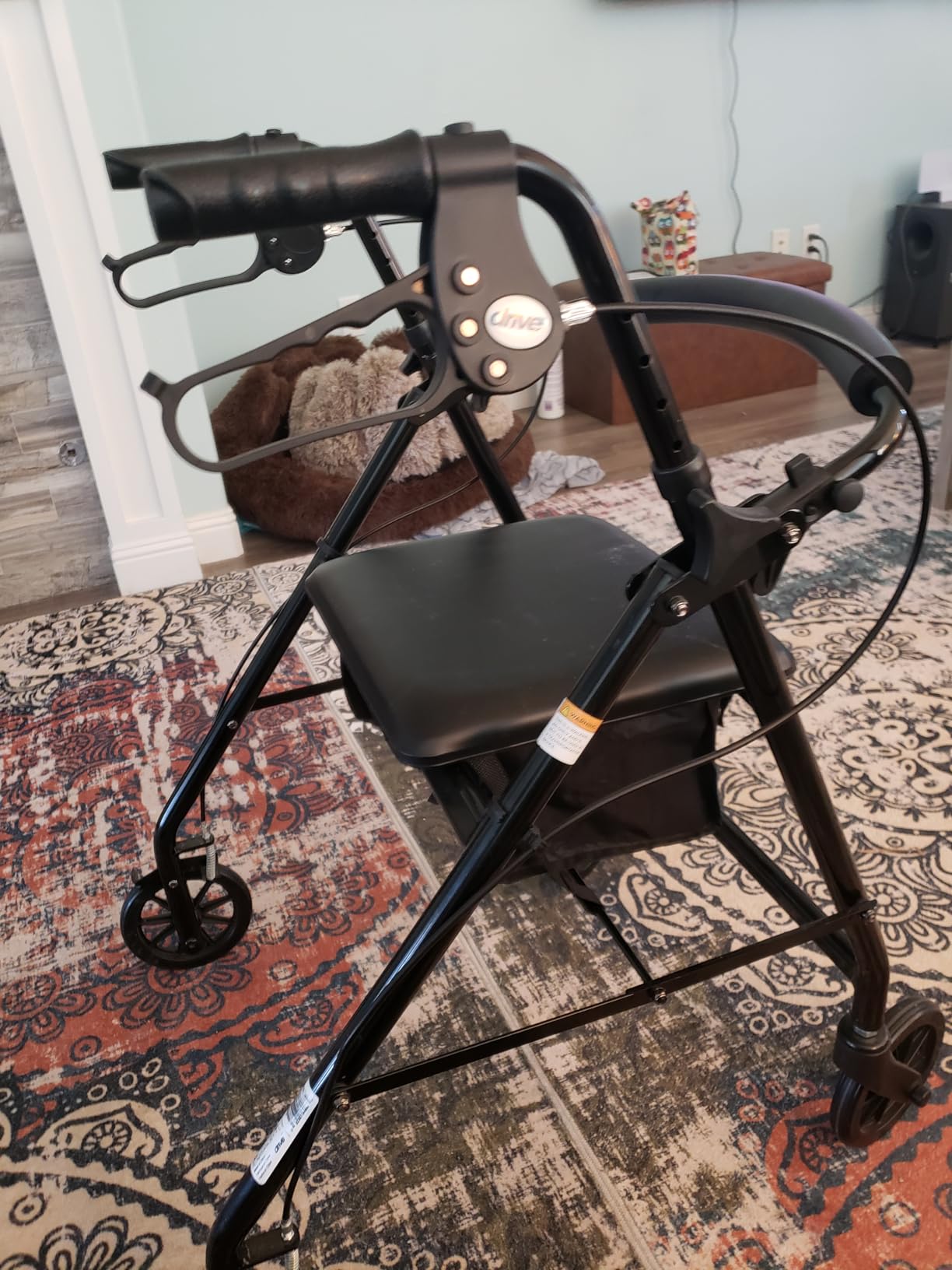
Can one person really load this into a car?
Yes. At roughly 15.6 pounds with a one-handed side-to-side fold, it is the easiest of the four-wheel models here to manage solo. The folded frame stands on its own, so you are not holding it with one hand while reaching for the car door with the other. For a senior who wants to keep driving or rides with family regularly, that is a decisive practical advantage.
It also folds small enough at 32.2 by 25 by 7.8 inches that it fits behind most rear seats.
Who should pick a different rollator?
If the user is close to or above 300 pounds, the capacity ceiling is a real limit and a bariatric-rated steel frame is the safer choice. There is also no parking brake lock on this model, so the walker has to be held with the brakes squeezed when getting in and out.
The fixed rear wheels are another limitation: they cannot be moved inward, so the walker keeps its full width. Anyone in a narrow hallway should measure the doorways first. The seat padding is thin enough that a user planning long rests may want an added cushion.
4. VOCIC Z21 All-Terrain Rollator with 8 Inch Wheels – Best Value
VOCIC Z21 Rollator Walker for Seniors with Seat, 8″ All Terrain, 350 LBS
8 inch puncture-proof tires
350 lb capacity
22.85 lb weight
Handle 31.5-36.6 inches
Pros
- 8 inch all-terrain wheels handle bumps
- gravel and slippery ground
- Ergonomic bionic seat with 1.6 inch waterproof cushion
- Widened breathable backrest instead of a bare tube
- Three-mode brake system is sensitive and easy to operate
- Dual adjustment fits users from about 4 ft 11 in to 6 ft 3 in
Cons
- At about 22 lb it is the heaviest model in this group
- Reflective detailing helps at night but does not replace real lighting
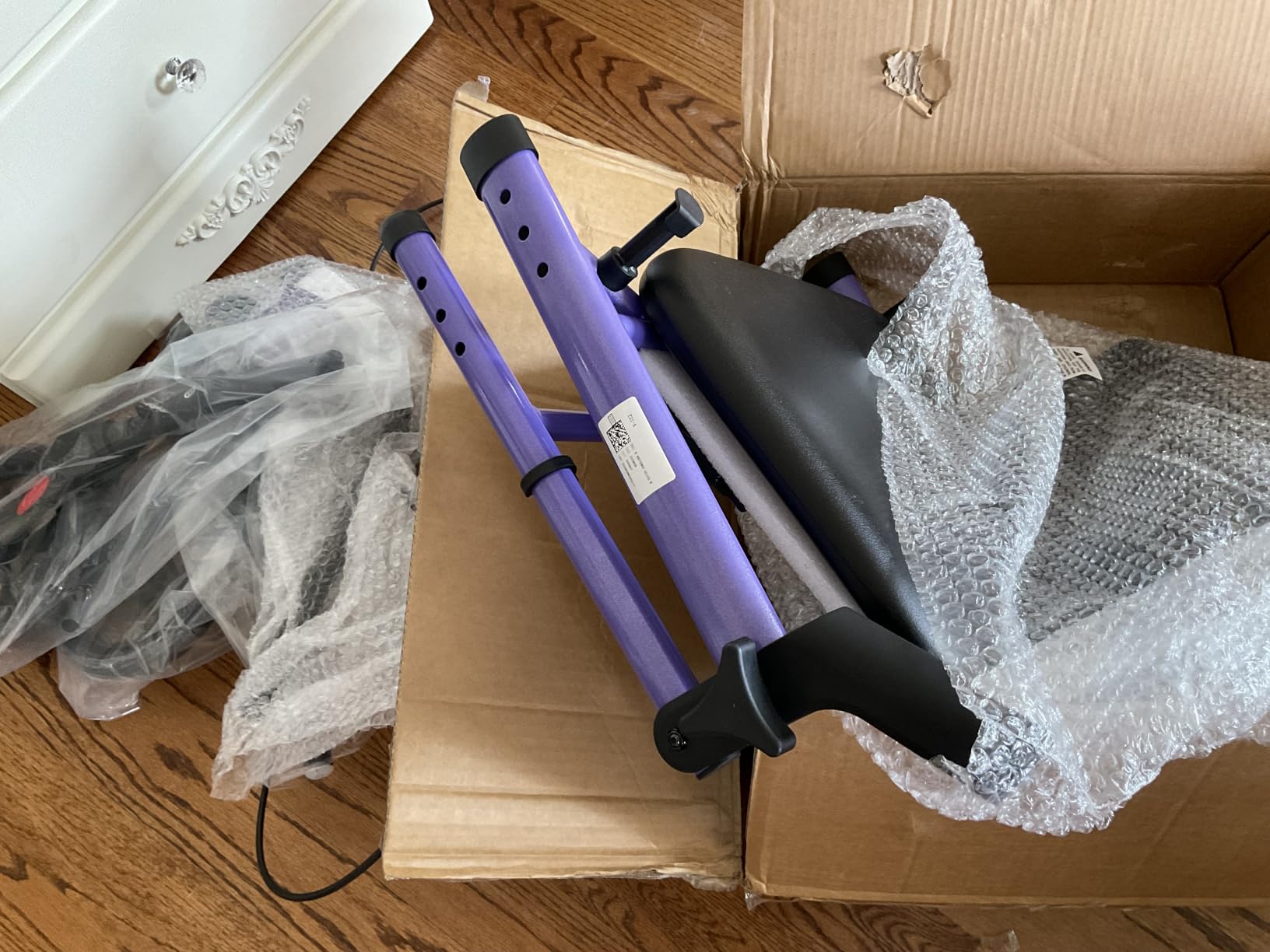
The VOCIC Z21 is the best rollators for seniors pick when the route is rough and the budget is fixed. It currently ranks first in its category and has gathered more than 7,500 reviews averaging 4.6 stars, which is unusual support for a design this recent.
The 8 inch puncture-proof tires are the reason to buy it. They clear gravel, brick, uneven pavement and slick surfaces far better than 6 inch casters, and the 360 degree rotating front wheels let the walker pivot in place rather than swinging wide. On a neighborhood with cracked sidewalks, that difference is obvious within a few minutes of walking.
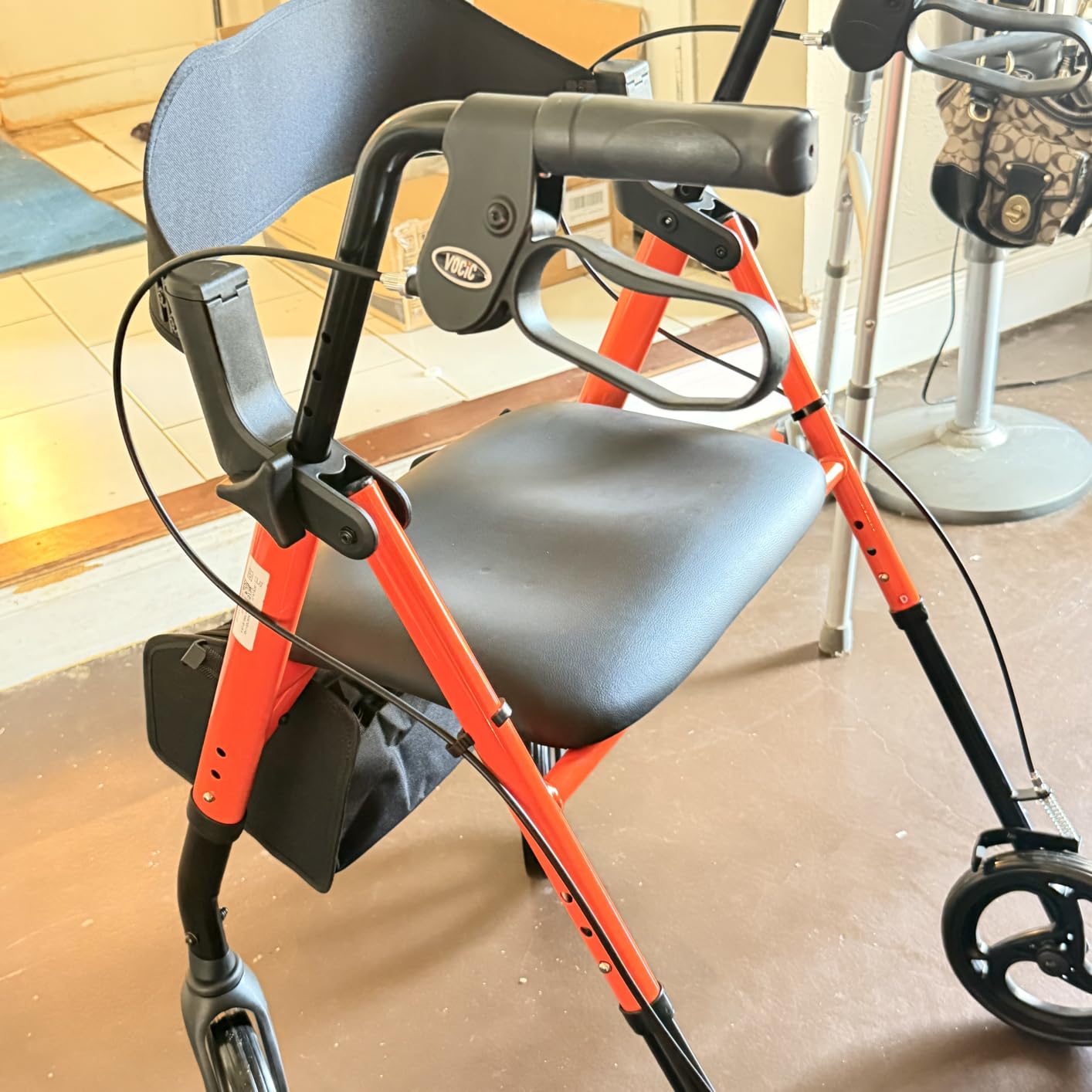
Comfort is the other argument. The bionic seat carries 1.6 inch of waterproof cushioning, which spreads pressure across the hips rather than concentrating it on the tailbone, and the widened breathable backrest replaces the bare tubular backrest found on most rollators in this price range. Users who sit for a while report noticeably less discomfort.
The three-mode brake system moves from free rolling to deceleration to a full stop, and reviewers with weaker grip describe it as sensitive and easy to modulate. Dual adjustment covers handle heights from 31.5 to 36.6 inches and three seat positions, which spans roughly 4 foot 11 inches to 6 foot 3 inches.
Does the 8 inch wheel size hurt on indoor floors?
Only slightly. Larger wheels roll more smoothly and quietly, but they can feel less precise on very tight turns, and the total frame is taller and bulkier than a 6 inch model. In a narrow apartment the turning circle is a little larger, which is worth checking against your doorways before committing.
Because the tires are puncture-proof rather than pneumatic, there is no risk of a flat tire mid-walk, and the 3-second quick fold with a storage bag makes it practical to put in a car despite the weight.
What are the drawbacks?
Weight is the main one. At roughly 22 pounds it is the heaviest model we analyzed, and that is exactly the number a caregiver will feel when lifting it into a vehicle. If the rollator lives in one place and travels only rarely, it does not matter. If it goes in the trunk every outing, it does.
The reflective strips on the front wheels and storage bag improve night visibility, which is genuinely useful for early evening walks, but they are not a substitute for lighting a dark path. Plan the route home before the light goes.
5. Medline Aluminum Rollator with 250 lb Capacity – Best for Smaller Users
Medline Aluminum Rollator Walker with Seat, Purple, 250 lb. Weight Capacity, Lightweight, 6” Wheels, Foldable, Adjustable Handles, Rolling Walker for Seniors
14 lb aluminum frame
250 lb capacity
6 inch wheels
Handle 31-35 inches
Pros
- Very light at 14 lb and still steady for a 200-plus pound user
- Folds flat and fits in a trunk or SUV back seat
- Paddle handles are easy to grip with limited hand strength
- Six color options including a popular purple
- Smooth over tile
- carpet and hardwood
Cons
- Paddle handles snag on jacket pockets when standing
- Under-seat bag is small with short straps that let items fall
- 12 inch seat is narrower than wider alternatives
- 250 lb is the lowest capacity here
- Folding can require bending over and pulling the frame bars
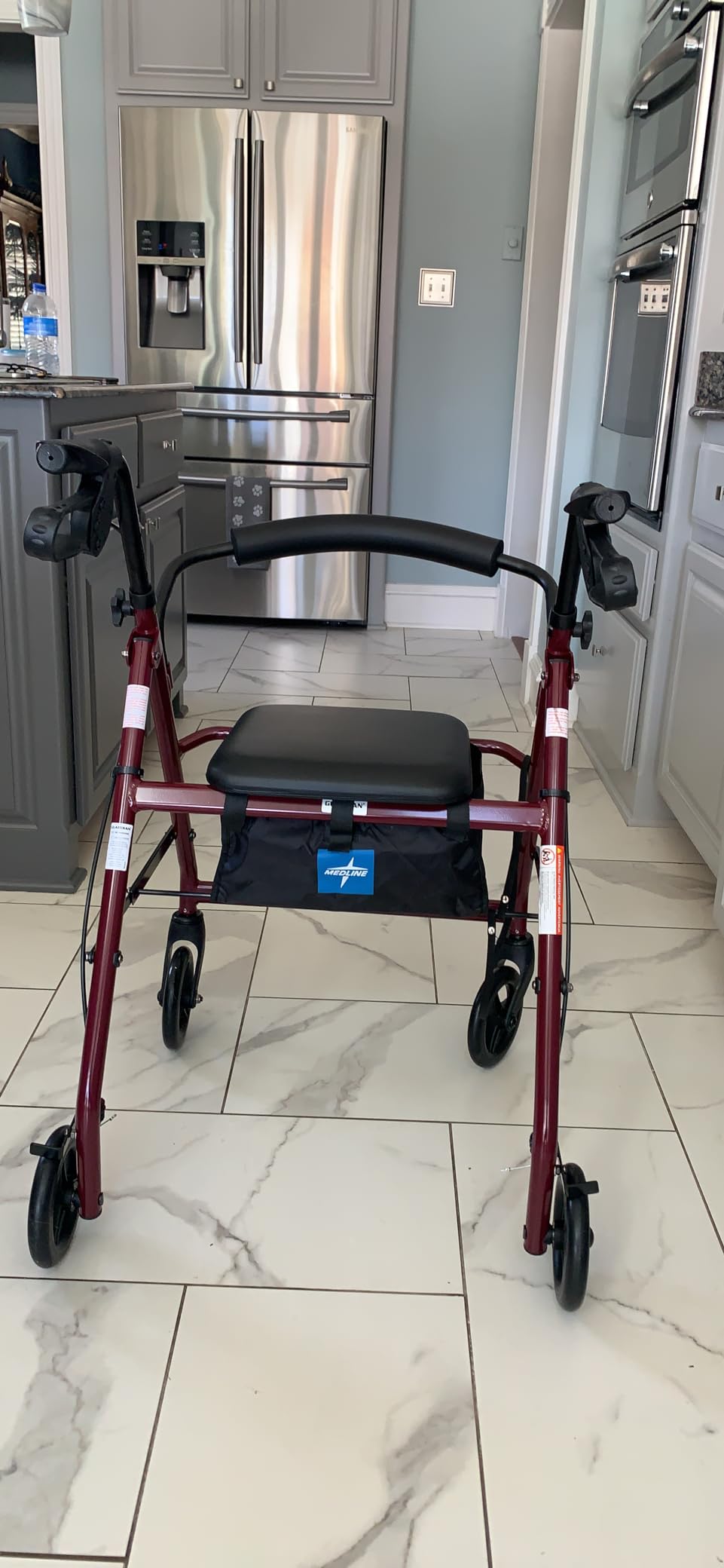
At 14 pounds, this Medline aluminum rollator is the second-lightest four-wheel model in the roundup, and for a user who handles their own walker it removes most of the friction. Buyers report that it stays steady with users well over 200 pounds, which is the practical question rather than the rated limit.
It rolls quietly and smoothly over tile, carpet and hardwood, and it folds flat enough to fit in a car trunk or across an SUV back seat. The color range runs to six options, and the purple version is consistently one of the most mentioned variants in reviews, which tells you something about how much choice buyers actually value here.

The paddle-shaped brake handles are broad and easy to grip, which reviewers with hand weakness appreciate. The padded 12 by 12 inch seat and matching backrest handle height adjusts from 31 to 35 inches, and the under-seat storage keeps a phone or wallet off the ground.
This is the model we would choose for a small-framed user who walks mostly indoors and on smooth sidewalks, and who has to manage the walker themselves rather than relying on a caregiver.
Is a 250 lb capacity too low?
For a user near 250 pounds, it leaves no margin, and we would not recommend it there. For a user in the 180 to 220 pound range it is comfortable. The rating is the lowest of the ten models we reviewed, so anyone with a larger frame should move up to a 300 or 350 pound model rather than run close to the ceiling.
It is also worth noting that the maximum load is a rating, not a comfort zone. Pushing a walker at its stated limit tends to feel different in practice than the number suggests.
What should buyers watch out for?
The paddle handle design is the most-discussed issue in reviews. The shape catches jacket and hoodie pockets, and several users describe the tug as a fall risk when standing up from the seat. Anyone wearing outer layers with deep pockets should test this carefully first.
The under-seat storage bag is also frequently criticized as too small, with short hook-and-loop straps that can unhook when loaded. Folding can require bending over and pulling the frame bars, and the 12 inch seat is narrower and less comfortable than the extra-wide options in this roundup.
6. Drive Medical Nitro Euro-Style Rollator – Best for Rough Ground
Drive Medical RTL10266 Nitro Euro-Style 4-Wheel Rollator with Seat, Red
10 inch front casters
Euro-style narrow front
17.5 lb weight
One-hand fold
Pros
- Highest average rating here at 4.8 stars with 89 percent five-star reviews
- 10 inch front casters glide over curbs and rough ground
- Narrow Euro-style front maneuvers around furniture and in tight spaces
- One-hand fold with an under-seat locking mechanism
- Tool-free thumb-screw backrest and push-button handle adjustment
Cons
- By far the most expensive option in this group
- Heavier than the entry-level aluminum models
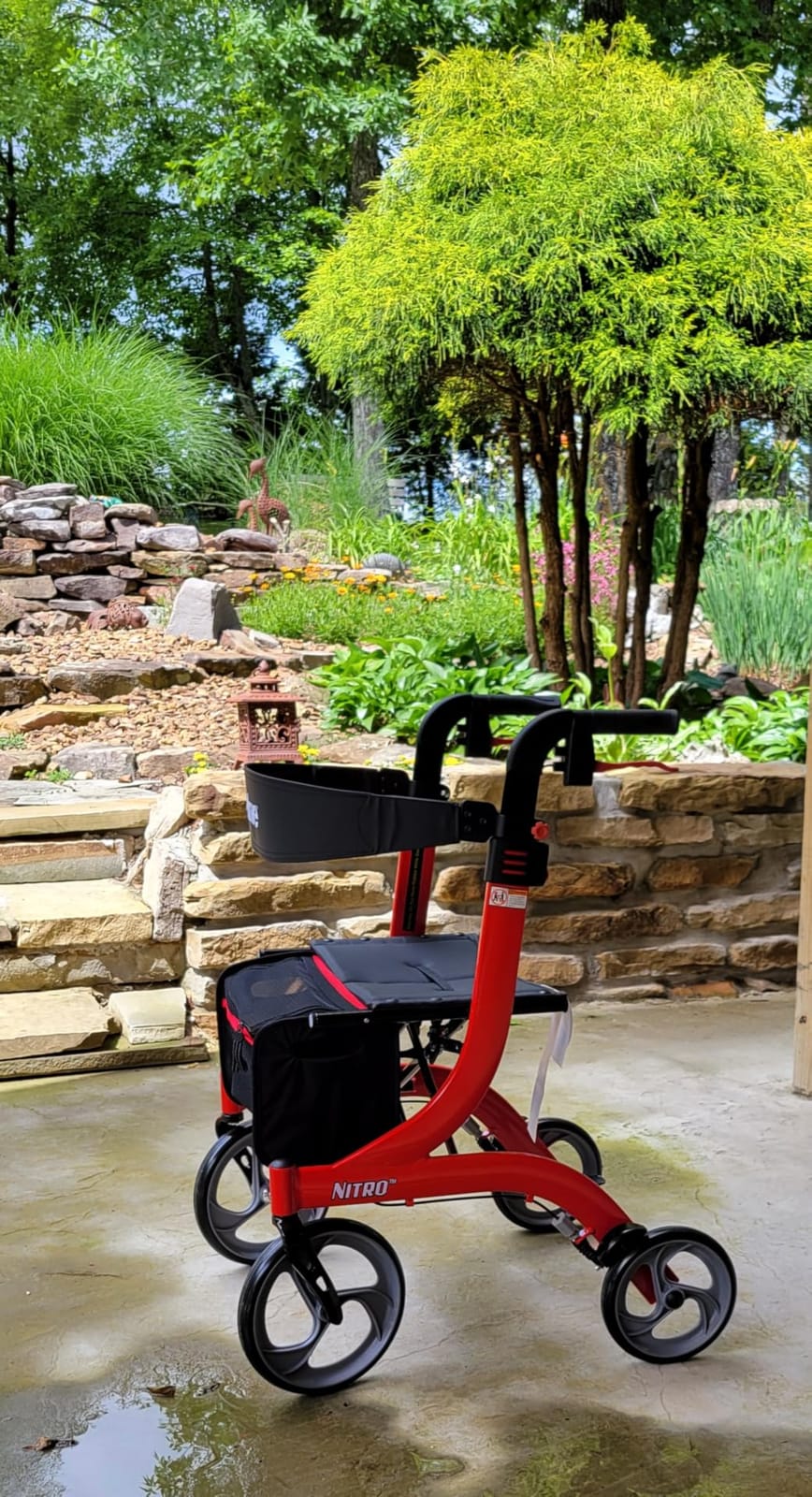
The Nitro Euro-Style is the premium pick, and it earns the highest customer rating in the entire roundup at 4.8 stars, with 89 percent of reviews at five stars. For users who spend real time on uneven ground, the 10 inch front casters are the reason, clearing curbs and rough surface in a way no 6 inch or 8 inch wheel here can match.
The other thing we noticed is the frame shape. The Euro-style front narrows toward the front axle, so the walker threads between a dining table and a chair or down a busy aisle without the wide swing a traditional four-wheel design needs. That matters in homes where the walker is used in tight quarters, and it is the opposite of the bulky complaint we hear about other premium models.

Adjustment is genuinely well thought out. Push-button handle height changes need no tools, the backrest adjusts with a thumb screw, and the whole frame folds with one hand. The under-seat locking mechanism is the detail that stands out: most rollators spring open when lifted, and this one stays folded.
The removable zippered storage bag is larger than a typical under-seat pouch, which makes it practical for shopping trips or carrying a coat and a water bottle.
Is the extra cost justified?
It depends entirely on the terrain. If the user walks on sidewalks, smooth paths and indoor floors, the 8 inch models deliver most of the ride quality for less. If the route includes curbs, gravel driveways, uneven neighborhood paths or park trails, the 10 inch casters stop small wheels from catching on every edge.
At 17.5 pounds it is heavier than the entry aluminum models, so a caregiver will notice the difference in the car too.
What are the limitations?
Its cost sits above the rest of the category, so for a user who mostly walks indoors it is spending money on capability they will not use.
Beyond that, reviewers do not report significant reliability complaints, which is unusual for a product in this price bracket. If parts are ever needed, the model number is long-established, which helps.
7. HOMLAND Rollator with 16 Inch Extra-Wide Seat – Best for Wide Seat Comfort
HOMLAND Foldable Rollator Walker for Seniors with Seat, 16″ Extra-Wide Seat
16 x 12 inch seat
8 inch wheels
Handle height to 40 inches
Lifetime frame warranty
Pros
- A 16 x 12 inch seat with 1.6 inch of cushioning among the widest here
- Loop brakes are easy to squeeze with reduced grip strength
- Dual height adjustment covers about 4 ft 7 in to 6 ft 6 in
- Pinch-proof enclosed folding points protect fingers
- Reinforced triangular alloy frame reduces wobbling
Cons
- 20.4 lb makes it one of the heavier frames to lift
- 22 inch frame width is tight in narrow hallways and older doorways
If the seat is the part of a rollator that decides the purchase, this is the one to look at. Its 16 by 12 inch cushion is among the widest in the roundup and carries 1.6 inches of padding, and reviewers repeatedly describe sitting on it as the difference between a rest stop and an endurance test.
The height range is also the widest we found. Handles adjust from 33 to 40 inches, and the seat from 20 to 23 inches, which covers users from roughly 4 foot 7 inches to 6 foot 6 inches. That range directly answers a question we see asked constantly in mobility forums, where users taller than 6 feet report slouching on standard rollators that stop at 36 inches.
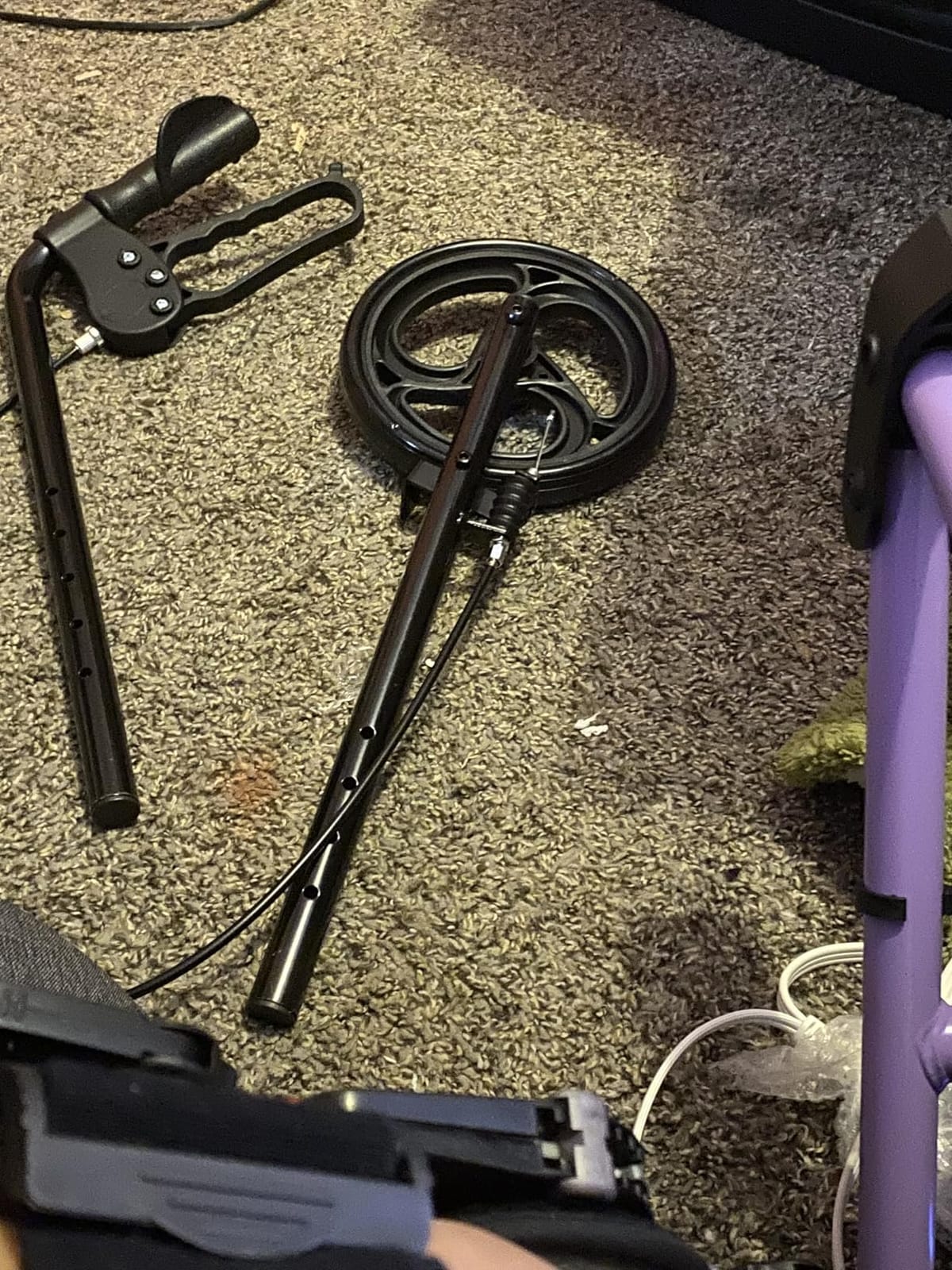
The loop brakes take a whole-hand grip rather than a pinch, and the pinch-proof enclosed folding points mean a caregiver’s fingers are not exposed near the collapse mechanism. Reflective strips on the wheels and storage bag help on dim evening routes, and a lifetime warranty on the metal frame is a stronger commitment than most of the category offers.
The 8 inch puncture-proof wheels and 360 degree rotating front casters handle bumps and gravel more confidently than the 6 inch models, and the frame folds to 39 by 25 by 11.5 inches in about three seconds.
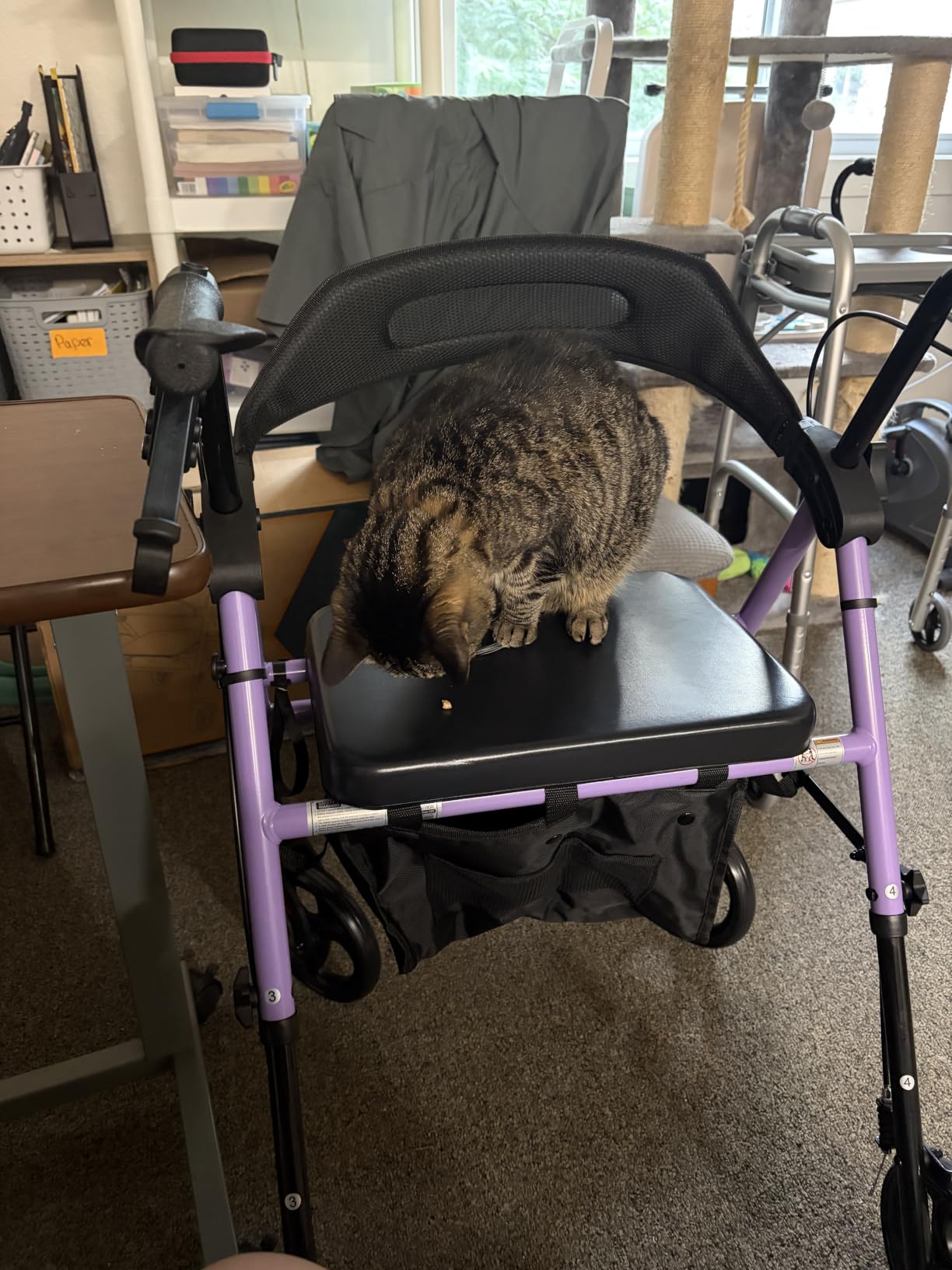
Is this rollator tall enough for a 6 foot 2 inch user?
Yes, which is the headline advantage. With handles reaching 40 inches, a user in that height range stands upright with the shoulders relaxed instead of bending forward over the grips. Slouching over a walker is not just uncomfortable, it changes the user’s balance and posture for the entire walk.
The triangular frame geometry with dual front supports is also worth noting, because it is the reason the wide frame does not feel unstable in use. Wide usually means wobbly, and this one does not.
What should buyers watch out for?
The 22 inch frame width is the cost of that wide, stable base. In narrow hallways and older doorways, it can be tight, and users in small apartments should measure before ordering. The 20.4 pound weight also makes it one of the heavier frames to lift into a car.
Users who want the widest possible opening should note that the folded package is 39 inches long, so it takes up more space than a 6 inch aluminum frame folded flat.
8. Medline Premium Empower Rollator with 8 Inch Wheels – Best for Chair-Style Seating
Medline Premium Empower Rollator Walker with Seat, Folding Rolling Walker with 8-inch Wheels, Silver
Memory foam chair seat
8 inch rubber wheels
300 lb capacity
17.5 inch inside width
Pros
- Extra-wide memory foam seat with armrests that works almost like a chair
- Step-in seat latch lets the user reach counters and sinks
- Storage tote and tray organizer keep items within reach
- Solid rubber 8 inch wheels roll quietly and hold when locked
- Wide heavy stance resists tipping on uneven ground
Cons
- Seat latch release is finicky and needs a firm push
- Folding can fail when the latch lifts the seat instead
- Cup holder is too narrow for a standard water bottle
- Heavier and wider than most competitors
- Lowest 4.4 star average in this roundup
The Empower is the one to consider for a user who treats the seat as a chair rather than a rest stop. The extra-wide memory foam cushion has a flip-up backrest and armrests, which means someone who cannot stand unaided for long can sit properly supported instead of perching on a vinyl pad.
The step-in seat latch is the feature no other model in this roundup has. It lifts the seat out of the way so the user can walk into the frame, reach a kitchen counter, or stand at a sink without first folding the walker away. For a user in a small kitchen, that is a real independence gain.
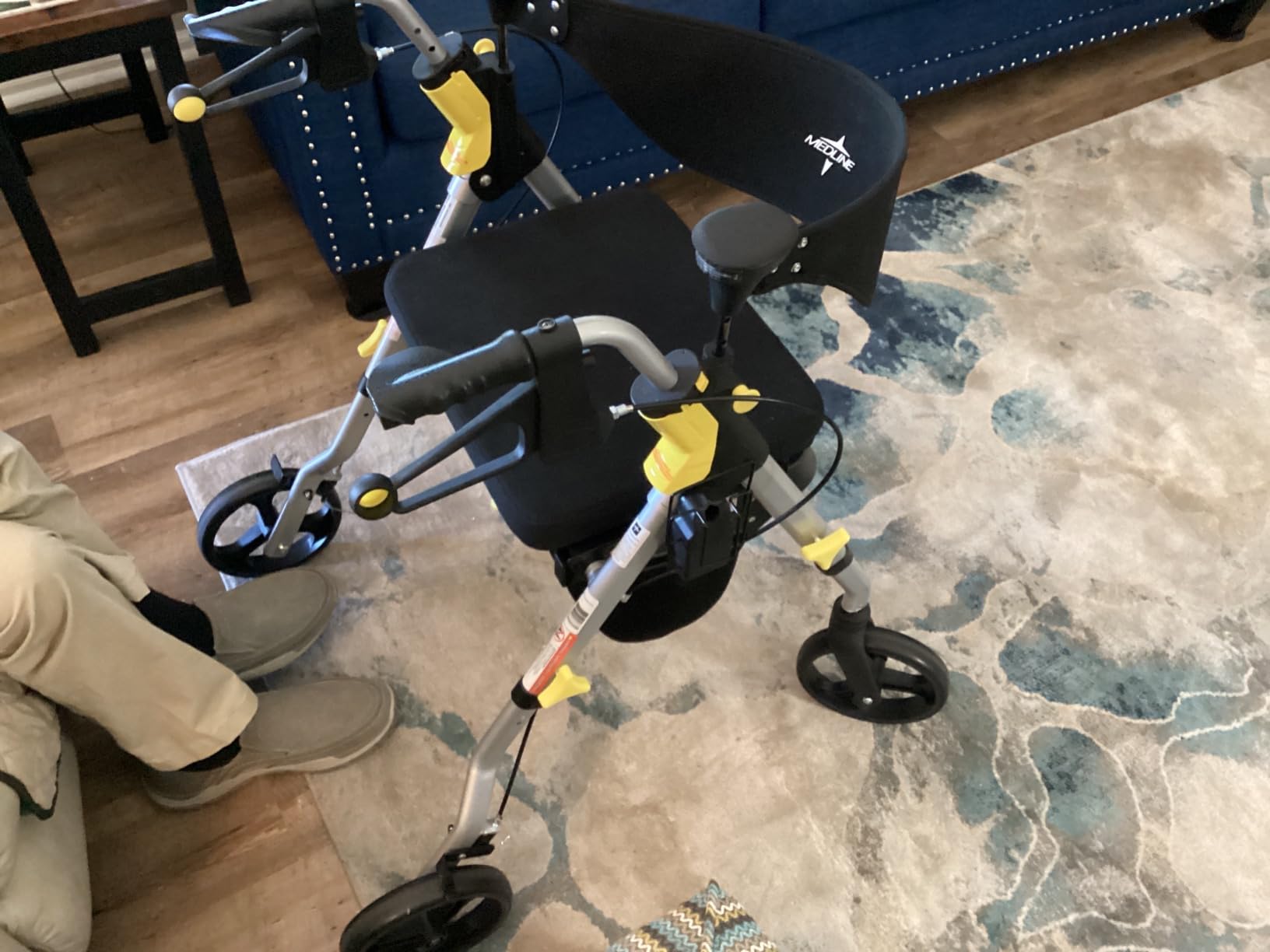
Included accessories are unusually generous: a removable storage tote, a tray organizer, reflective tape and a foldable cup holder. The solid rubber 8 inch wheels roll quietly and, importantly, hold position when the brakes are locked, which several reviewers call out as a stability improvement over lighter casters.
Height adjustment covers users from about 4 foot 11 inches to 6 foot 4 inches, and the wide stance resists tipping on uneven ground better than most of the four-wheel models here.
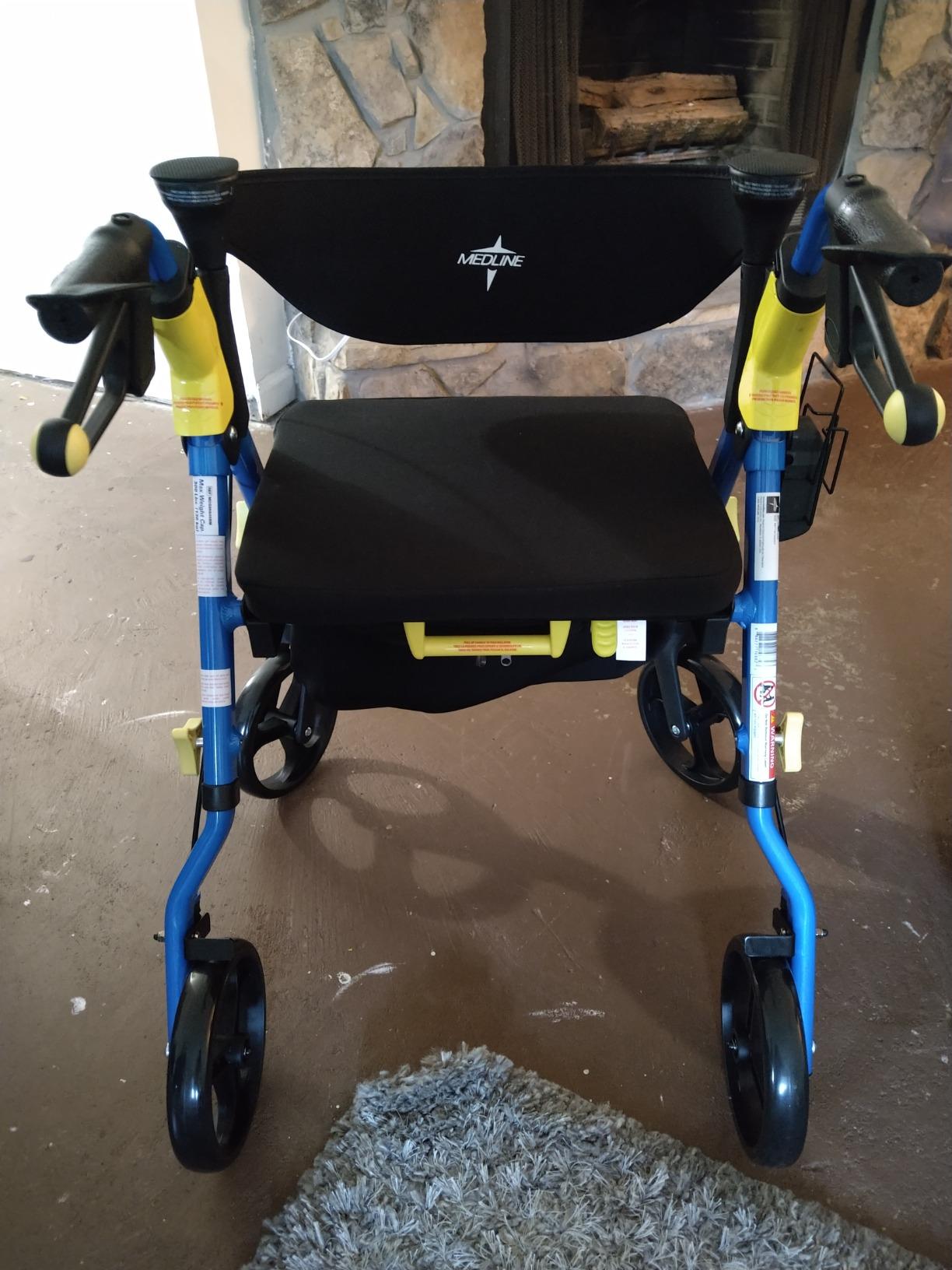
Who genuinely benefits from the step-in seat?
Anyone who uses the rollator to work at a counter rather than just to travel. A user who can approach a sink, a table or a work surface without collapsing the walker first will keep using the aid instead of reverting to a cane. The armrests add lateral support on the way down and the way up, which is where most falls during transfers happen.
Users who plan long seated rest periods also benefit, since the memory foam is far better suited to an hour than a thin pad.
What should buyers watch out for?
The folding mechanism is the honest problem here, and it is repeated in reviews. The seat latch is finicky, often needs a firm deliberate push, and sometimes lifts the seat rather than collapsing the frame. Budget time to get the feel of it, and check that the frame actually folds before you need to put it in a car.
The cup holder is too narrow for anything larger than a coffee cup, and at 17.5 inches of inside width plus 19 pounds, this is the bulkiest rollator here. Narrow doorways are a genuine problem for some households. It also carries the lowest average rating in the roundup at 4.4 stars, which tracks with the mechanism complaints rather than with the seat, where reviews are strongly positive.
9. Vive Mobility 3 Wheel Walker – Best for Tight Spaces
Vive Mobility 3 Wheel Walker for Seniors – Foldable Narrow Rollator Walker
Only 11 lb in the roundup
Narrow three-wheel frame
Height adjustable handles
Lifetime guarantee
Pros
- Lightest frame we analyzed at 11 lb
- Three-wheel design is narrow and highly maneuverable in small spaces
- Wide back wheel spacing plus a cross-brace improves standing stability
- Folds flat enough to fit in a car
- Removable washable storage bag included
Cons
- Three-wheel frame gives less lateral stability than the four-wheel models
- Typically has no seat
- so there is nowhere to rest when fatigue sets in
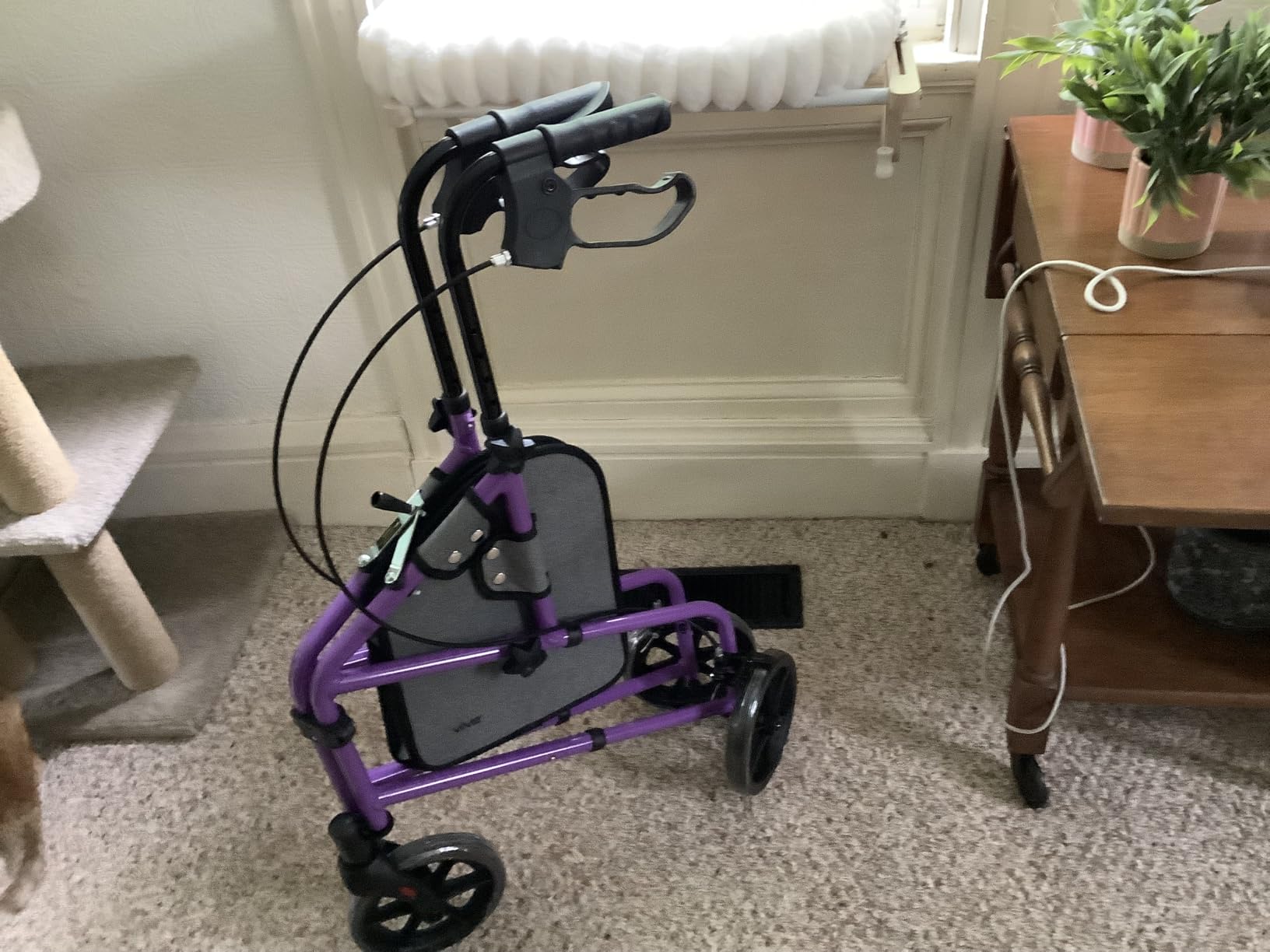
The Vive three-wheel walker answers a specific problem that four-wheel rollators cannot: small apartments. At 11 pounds it is by far the lightest frame in the roundup, and the narrow three-point base pivots in a way that lets the user turn between a chair and a table without swinging the whole walker around.
It is not simply a lighter version of a rollator. The wide spacing between the two rear wheels and the cross-brace between them are doing real work, and reviewers credit them with solid stability when standing and walking. The lifetime manufacturer guarantee is also a stronger warranty commitment than most of the category provides.
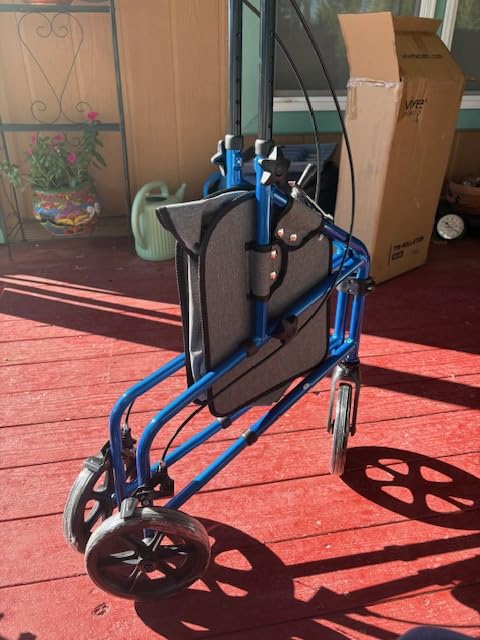
Height-adjustable handles are set to give a natural hand angle and easy brake access, and the removable storage bag is washable, which matters in a home where the walker lives in a hallway. It folds flat enough to fit in a car, and at 11 pounds lifting it is genuinely a one-hand job.
We also considered a three-wheeler for caregivers looking after someone who tires quickly, though the lack of a seat limits how far that goes. A caregiver can hold a folded rollator in a bag or a sling more easily than an 18 to 22 pound frame, so keeping an 11 pound option in the closet is a reasonable backup.
Is a 3 wheel or 4 wheel rollator better?
Three wheels for space, weight and maneuverability. Four wheels for stability, braking and the ability to rest. The three-wheel frame has a smaller footprint and less lateral stability, particularly when a user is turning sharply or pushing off to one side, so it suits a confident user on smooth floors and narrow routes.
Four wheels are the safer default for anyone with genuine balance concerns, and the seat is what makes them practical for long walks and tired users. Choosing a three-wheeler for its compactness and then discovering the user needs to sit mid-journey is a common and avoidable mistake.
What are the limitations?
Two, and both matter. The three-wheel frame gives less lateral stability than any of the four-wheel models here, so a user who still has a significant fall risk may be better served by a four-wheeler with a seat. And this model typically has no seat at all, so fatigue has no built-in answer.
If the user’s balance issues are moderate or severe, treat this as a travel and small-space option rather than the primary aid.
10. soundfuse Foldable Rollator with 16 Inch Arc Seat – Best for Night Visibility
soundfuse Foldable Rollator Walkers for Seniors with 16″ Ergonomic Arc Seat
16 inch arc memory foam seat
8 inch all-terrain wheels
22.55 lb weight
Handle height to 40 inches
Pros
- Arc memory foam seat conforms to body curves and spreads hip pressure
- Reinforced triangular frame with double crossbar support feels sturdy
- 8 inch wheels handle bumps
- gravel and slippery ground
- Easy quick-fold with Velcro straps that keep it flat for car trunks
- Responsive customer support reported by several buyers
Cons
- Brake feel is adequate and may need adjusting out of the box
- No built-in latch to keep the walker folded
- Takes up a lot of floor space even when folded
- Heaviest frame in the roundup after the VOCIC
- Storage bag is soft fabric rather than a structured pouch
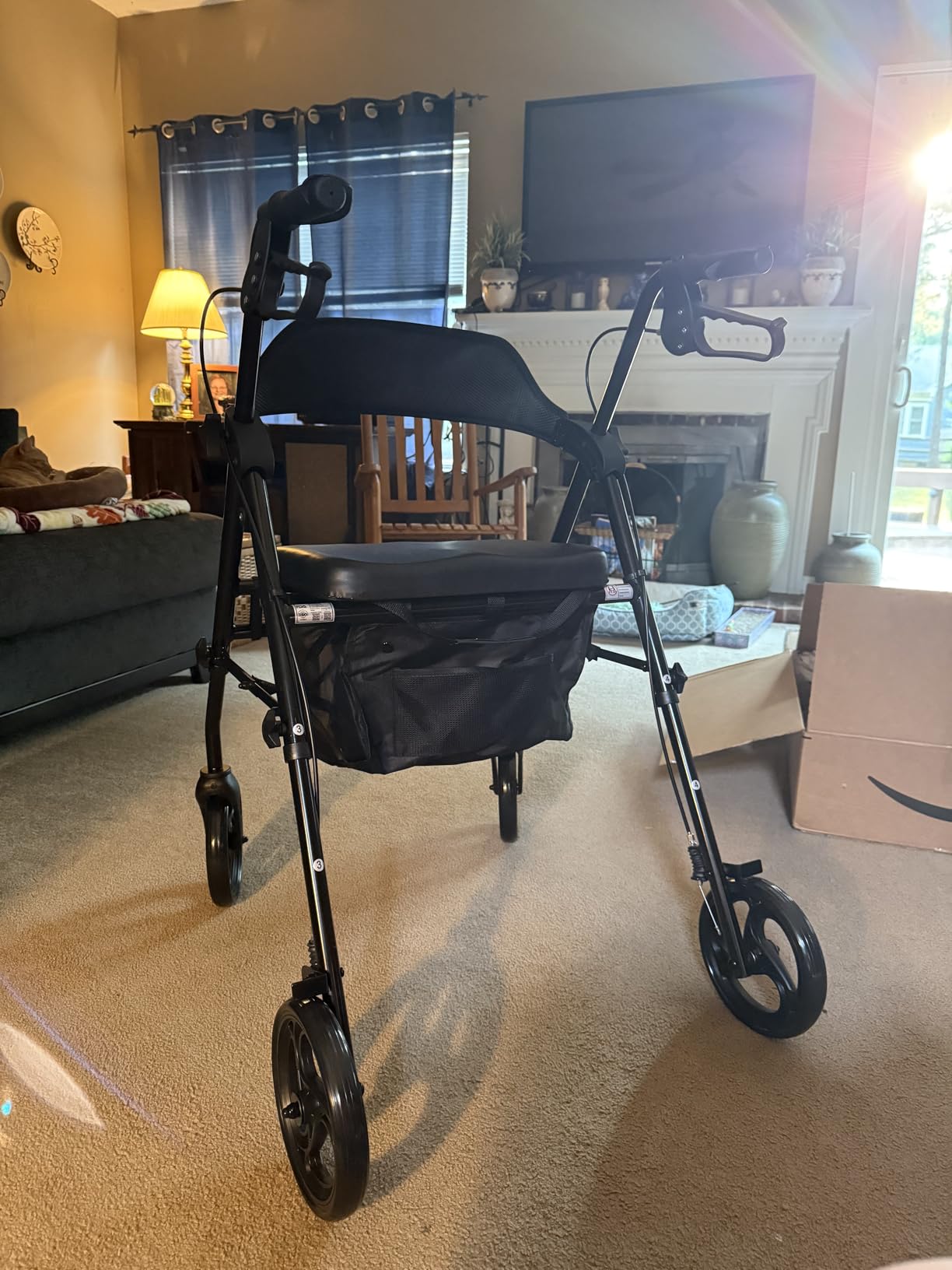
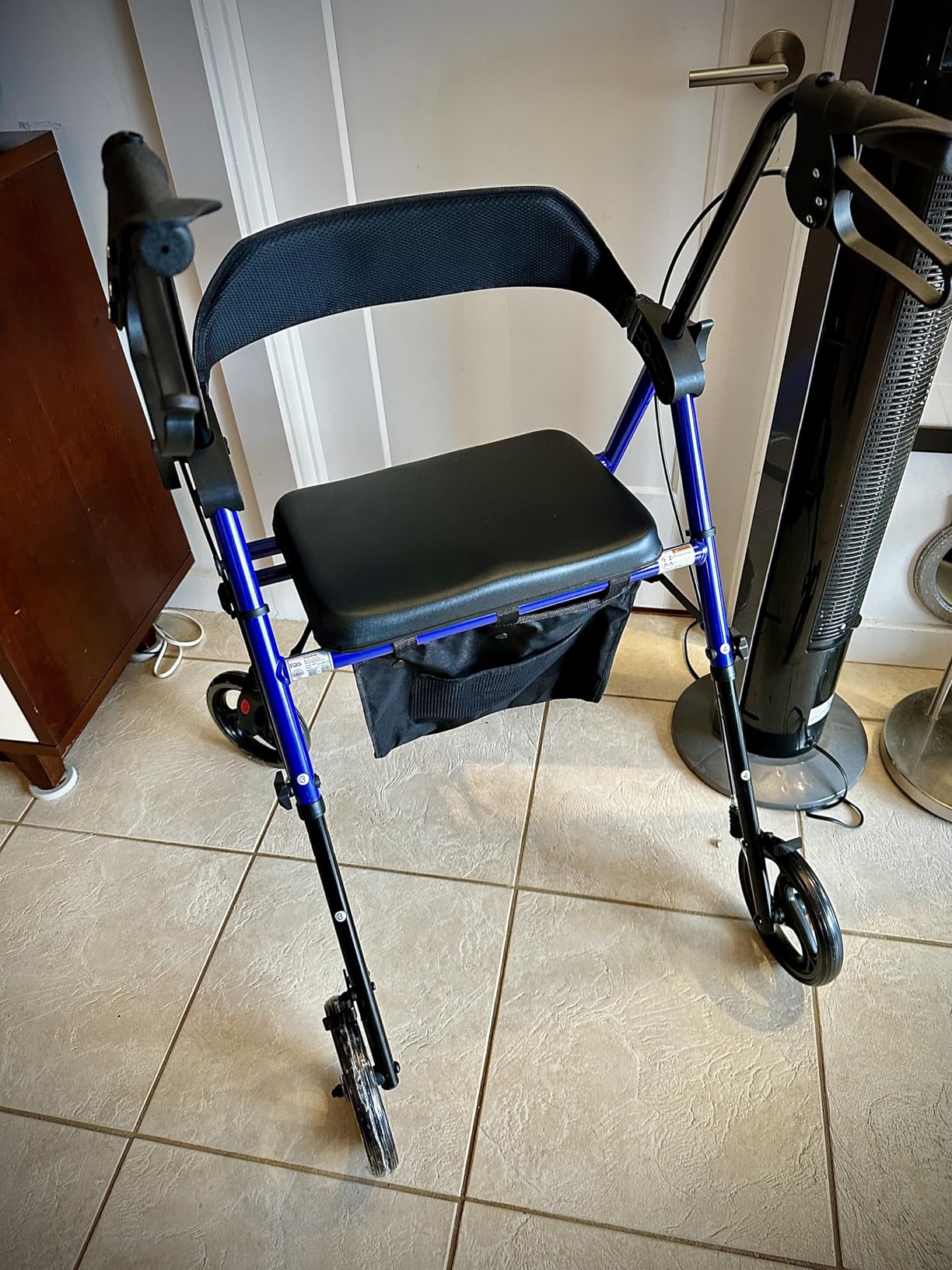
The soundfuse rollator pairs a 16 inch arc memory foam seat with a reinforced triangular frame, and the two together explain most of the positive reviews. The arc cushion is shaped to follow the body’s curve rather than sitting flat, which spreads pressure across a wider area of the hips.
The frame uses a triangular geometry with a double crossbar, and owners describe it as sturdy rather than flimsy, which is a fair way of putting it. The 8 inch all-terrain wheels take bumps, gravel and slippery ground, and the quick-fold with hook-and-loop straps is a genuine one-strap operation that keeps the frame flat for a trunk.
Handle height runs from 33 to 40 inches, matching the widest range in the roundup and covering users from roughly 4 foot 7 inches to 6 foot 6 inches. Multi-reflective strips on the storage bag and wheels are the reason we recommend it for anyone walking at dusk, and several buyers specifically mention evening walks as their use case.
Three-mode braking covers free rolling, deceleration and a full stop, and pinch-proof enclosed folding points protect fingers during the collapse.
Is it comfortable for long outings?
Yes, on the strength of the seat. The arc shape and memory foam spread pressure in a way a flat vinyl pad does not, and the widened backrest gives something to lean on. For a user whose rest stops are the reason they can finish an outing, that is the feature that decides it.
The reinforced frame also holds up well under repeated sit-and-stand cycles, which is where lighter frames start to develop play in the joints.
What are the drawbacks?
Brake feel is described as adequate rather than outstanding, and some owners needed to adjust them out of the box. If brake modulation is a serious concern for the user, the loop-brake models in this roundup are the safer pick.
There is no built-in latch to hold the walker folded or unfolded, which makes car loading awkward at times even with the Velcro strap. It is the heaviest listed package at 22.55 pounds, takes up considerable floor space even folded, and the included storage bag is soft fabric rather than the structured pouch the photos suggest.
What Matters Most When You Choose a Rollator in 2026
Fit beats features every time. A rollator with the best seat on the market is the wrong purchase if the handles cannot be set to the user’s height, and the single most common complaint we saw across thousands of reviews is a walker that is too short, leaving a tall user bent forward and off balance.
Measure the user, not the walker
Stand the user upright against a wall, mark the top of the wrist crease, and set the handle height to that point with the arms relaxed at the sides. Handles should meet the wrist, not the elbow. Most models here adjust between 31 and 36 inches, and only two reach 40 inches, which is the difference between an upright walk and a slouch for anyone over 6 feet.
Match wheel size to the ground
Six inch wheels suit tile, carpet, hardwood and smooth sidewalks. Eight inch wheels handle gravel, brick and uneven pavement. Ten inch front casters, as on the Nitro, clear curbs and rough paths. Bigger wheels also mean a larger turning circle, so a user in a tight apartment may prefer smaller wheels despite rougher surroundings.
Check the brakes for grip strength
Loop brakes enclose the hand and are easier to operate with arthritis or reduced grip. Lever brakes need finger strength and will frustrate a user with hand weakness. A locking brake that holds the walker while the user sits down is not optional; it is what prevents a rollaway. Every model in this roundup has some form of it, and the three-mode systems on the VOCIC and soundfuse give the finest control.
Weigh the frame against who lifts it
Aluminum frames in this roundup run from 14 to about 15.6 pounds, and the three-wheel model is 11. Steel frames run 16.5 to 20.4 pounds, and the heavier all-terrain models approach 22. If a caregiver loads the walker into a car daily, every pound registers. If it lives by the front door, stability is worth more than weight.
Size the seat for how long the user sits
Standard seats are 12 by 12 inches. The wide options here reach 16 by 12 inches with 1.6 inches of cushioning. A user who rests briefly between short trips is fine with either. A user who plans to sit through a long outing, or who uses the rollator as a chair at a table, needs the wider pad and a backrest that supports leaning back.
Measure the doorways before ordering
Inside widths in this roundup run from about 17.5 inches on the Empower to 22 inches on the HOMLAND. Standard residential doors are typically 32 inches clear, but older homes with narrow trim and tight hallway turns are where wide frames end up unused. Folded sizes range from about 25 to 39 inches long, which determines whether the walker fits in a trunk.
Look at the fold, then try the fold
A one-hand side-to-side fold that leaves the frame standing upright is far easier for a single caregiver than a fold that requires bending over and pulling bars. Models with an under-seat locking mechanism stay closed when lifted, which prevents the spring-open problem that shows up in car trunks. Test the mechanism before it matters, not the morning of an appointment.
Read the warranty and the parts story
A lifetime frame warranty, as offered on the HOMLAND and the Vive three-wheeler, tells you something about how the manufacturer expects the frame to age. More practically, check whether brake cables, brake pads, casters and seat fabric are replaceable. A rollator is a maintenance item, and brands with available parts are far cheaper to own over three years.
Rollator vs Walker vs Upright Walker vs Wheelchair
If a question is “what is better than a rollator,” the honest answer is that each one wins in a different situation, and the right question is which the user’s actual condition calls for. A rollator is the right default for someone who can walk but tires quickly and needs rest stops. It adds a seat and brakes to the basic walking frame, at the cost of weight and bulk.
A standard two-wheeled walker is lighter and narrower than any rollator here, and some users with limited grip or poor stamina still prefer it. It offers no brakes and no seat, so it works best indoors on level floors. It also carries less of a runaway risk, because it is lifted rather than rolled.
An upright rollator, or stand-up walker, keeps the user in a more natural standing posture with forearm-height handles rather than hand-height grips. It helps users with kyphosis or chronic back pain who cannot stay upright over a standard rollator. It is heavier and the brakes take more practice.
A wheelchair is better than a rollator when the user cannot walk a usable distance even with support, when fatigue prevents standing transfers independently, or when falls continue despite a well-fitted aid. We see people move from a rollator to a wheelchair after repeated falls, and that is not a failure of the rollator, it is a change in need. A power wheelchair adds that distance back without the fatigue.
Hardwood Floors, Tile and Wheel Choice
Wheel material is the part of a rollator that gets almost no attention in buying guides, and it is one of the first complaints new owners raise. Hard plastic wheels can scratch and dull a finished hardwood floor, and a bare metal caster rattles badly on tile and ceramic. Users in mobility forums frequently fit soft covers to the rear legs of a walker for exactly this reason.
Soften polyurethane or rubber-style wheels are the better choice on wood and tile. They roll quietly, absorb vibration and are far less likely to mark a floor. The trade-off is slightly more drag on carpet, but the reduction in noise and floor damage is usually worth it.
If a user spends a lot of time on carpet, a small front caster that does not catch pile can matter more than floor protection. The 360 degree rotating front wheels on the VOCIC, HOMLAND and soundfuse are designed to roll in any direction without catching, which reduces the stutter that makes carpet walking tiring.
Medicare Coverage for Rollators in 2026
Medicare Part B does cover a rollator walker as Durable Medical Equipment, but only when several conditions line up. Coverage requires a prescription from a doctor or other practitioner who has documented a mobility limitation, and the equipment must be supplied by a Medicare-approved supplier. The supplier is the piece people get wrong, because buying one out of pocket and expecting reimbursement afterwards is not how the process works.
The typical process is: get a prescription, have it sent to a Medicare-approved DME supplier, have the supplier bill Medicare directly, and pay your 20 percent coinsurance on the amount Medicare pays. The walker is a rental in many cases rather than a purchase, so check the terms with the supplier before committing.
Medicare will not pay for a second walker, for an upgrade chosen purely for comfort such as premium wheels, or for a replacement that has not been prescribed. Because our recommended list is available direct from general retailers, most readers will pay out of pocket, and we would rather say that plainly than imply a reimbursement that may not come.
For anyone who qualifies, the saving is substantial enough to be worth the paperwork. We also found that a home safety check from an occupational therapist, sometimes available through a doctor visit, catches fit problems before purchase, including the height and grip-strength issues that turn a good rollator into a bad one.
Brake Pads, Wheels and Yearly Rollator Maintenance
Brake trouble is the most common complaint we saw in customer reviews, and it usually has one of three causes: pads worn smooth, cables stretched, or a brake that was never adjusted correctly out of the box. None of them require a new rollator, and all of them are checkable in a few minutes.
Start with the pads. Squeeze the brake lever and look at the pad where it meets the tire. If the pad is worn flat, smooth or angled to one side, it needs replacing, and replacement brake pads are inexpensive and widely available for the common models. Wear on one side usually means the wheel is out of true.
Next, test the lock. Squeeze both brakes and try to push the walker forward. It should not move. If it rolls, the lock is not engaging, and that is the failure mode users describe as a rollator running away down a driveway. Stop using it for downhill routes until it is fixed, and check that the parking brake catches before sitting down.
Cables stretch with use. Most rollators have an adjustment barrel at the handle end, and a quarter turn usually restores lost braking feel. Do not over-tighten, or the pads will rub continuously and wear out early. Once a year, tighten every handle and height adjustment screw with a hex key, check that all four wheels spin freely, and confirm the folding mechanism locks in both directions.
Storage matters more than most people expect. Keep the walker indoors in a dry space rather than in a damp garage, wipe the wheels occasionally, and do not hang heavy bags from the handlebars, which bends them over time. A frame that is stored dry and folded loosely will still be in serviceable condition several years from now.
Frequently Asked Questions
What are the best rollators according to Consumer Reports?
Consumer Reports does not publish a full ranking we can reproduce, so we weigh the same criteria it emphasizes: stability, brake reliability, adjustability, ease of folding and value. On that basis our Editor’s Choice is the Drive Medical steel rollator with a 7.5 inch wheel, a locking hand brake and more than 51,000 reviews behind it, with the Drive Medical Nitro Euro-Style taking the premium slot on its 10 inch casters and 4.8 star average.
What is the best rollator walker for older people?
The best rollator walker for older people is the one that fits the user’s height, route and grip strength. Our top pick is the Drive Medical steel rollator for its rigid frame, locking brake and durable build. For a user who loads it into a car, the lighter Drive Medical aluminum model folds one-handed, and for rough ground the Nitro Euro-Style has 10 inch casters that clear curbs.
What rollators will Medicare pay for?
Medicare Part B covers a rollator as Durable Medical Equipment when a doctor documents a mobility limitation and writes a prescription, and the walker is supplied by a Medicare-approved DME supplier that bills Medicare directly. You then pay the standard 20 percent coinsurance. Medicare will not pay for a second walker, a comfort upgrade such as premium wheels, or a replacement that has not been prescribed.
What is better than a rollator?
It depends on the situation. A two-wheeled walker is lighter and narrower for indoor use on level floors. An upright rollator keeps a more natural posture for users with back pain or kyphosis. A wheelchair, or a power wheelchair, is better than a rollator when the user cannot walk a usable distance even with support, or when falls continue despite a well-fitted aid.
What are the disadvantages of a rollator walker?
Rollator walkers are heavier and bulkier than a two-wheeled walker, cost more, and need a storage space when not in use. They can be difficult to load into a car for a user who must do it alone. Wide frames do not fit narrow hallways, small seats become uncomfortable on long outings, and poorly adjusted brakes are a genuine safety risk that requires regular checking.
How heavy should a rollator be?
For a rollator a user pushes themselves, under 16 pounds is comfortable and roughly the practical floor once you add a seat, basket and brakes. Our roundup ranges from 11 lb for the three-wheel Vive to about 22.85 lb for the heaviest four-wheel model. If a caregiver loads it into a vehicle daily, every pound above 16 is felt, and an aluminum frame is the better trade.
Is a 3 wheel or 4 wheel rollator better?
A three-wheel rollator is narrower, lighter and more maneuverable, which makes it better for small apartments, narrow doorways and easy car transport. A four-wheel rollator has more lateral stability, a seat for resting and better braking, which makes it the safer default for a user with real balance concerns or who tires on longer walks.
The Best Rollators for Seniors: Our Final Verdict
After comparing ten rollators on frame material, wheel size, weight, brake design, seat comfort and folding behavior, the Drive Medical steel rollator with 7.5 inch wheels takes our Editor’s Choice. It has the largest review base in the group at more than 51,000 ratings, a rigid steel frame that stays steady under load, a locking hand brake that holds while the user sits, and a long enough life that replacement parts are easy to find.
Pick the Drive Medical aluminum rollator instead if the walker has to go in a car regularly, the VOCIC Z21 for rough sidewalks and gravel, the Medline steel model for a 350 pound capacity, the HOMLAND for a 6 foot 2 inch user or a wider seat, and the Vive three-wheeler for a small apartment.
Whichever you choose, measure the user first, set the handles to the wrist, and test the brakes before the first long walk. The best rollators for seniors are the ones a person actually uses every day without thinking about it. If you are also setting up a home to support an aging relative, our guides to the best pet cameras for seniors and dog exercise wheels for seniors cover the same kind of day-to-day setup decisions.