
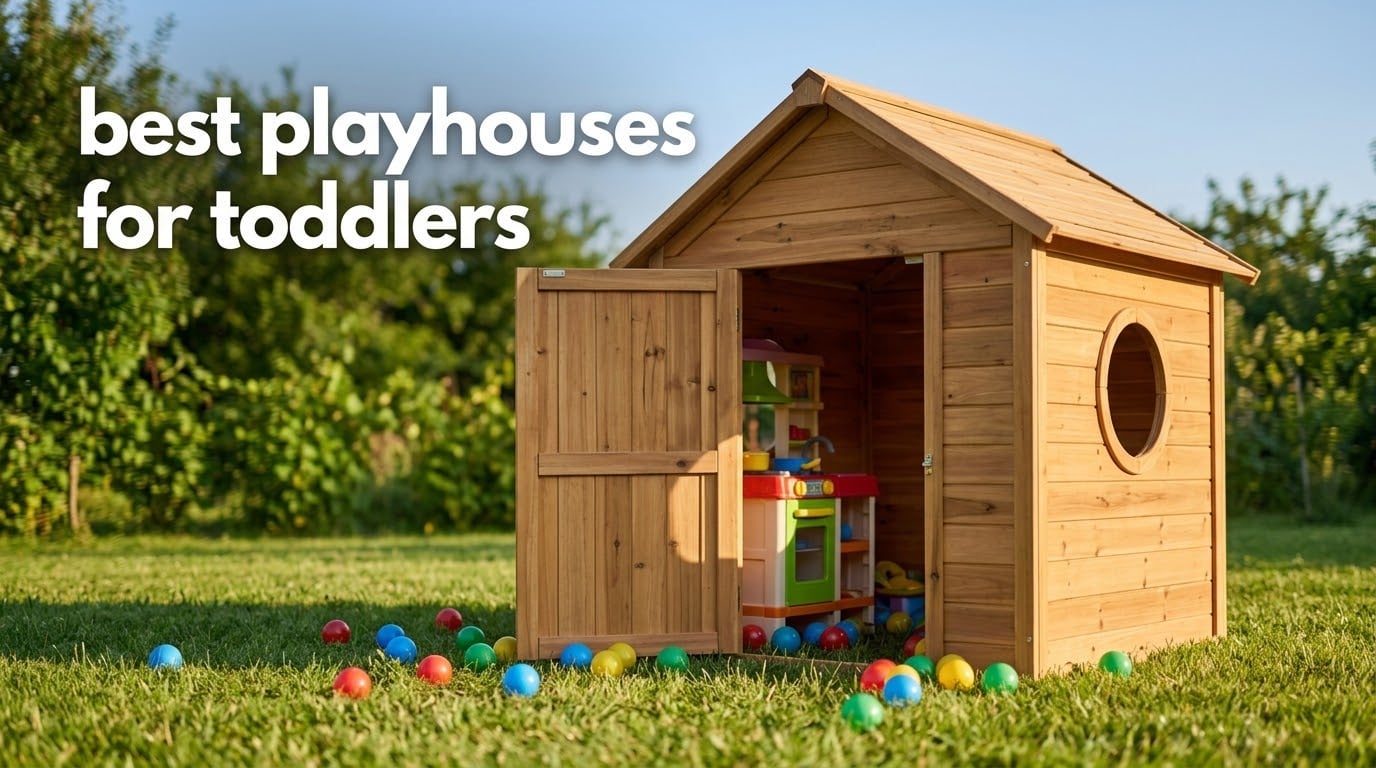
Last updated: October 2026. We earn a commission when you buy through links on this page, at no extra cost to you.
A playhouse is one of the few toys that turns an empty patch of grass or a bare playroom floor into a named place a toddler can claim. Ours is the Monobeach Princess Castle Tent: at 55 inches across it fits up to three children at once, packs into a carry bag, and works just as well in a living room as on a patio. For families who want a sturdier structure, the Step2 All Around Playtime Patio adds shade and a sand-and-water table.
This roundup covers the best playhouses for toddlers across plastic, cedar and fabric, indoor and outdoor, from compact table-top houses to full-size cottages. Every pick is listed with the manufacturer’s own age recommendation, the dimensions that actually matter for a two-year-old, and the complaints reviewers raise most often.
One note on method: this is a research-based roundup. We compared specifications, dimensions, age ranges and review patterns across twelve products, and we did not hands-on assemble them. Where a reviewer consistently reports a problem, we name it, because that is where the useful information lives.
Table of Contents
Top 3 Playhouses for Toddlers (October 2026)

Monobeach Princess Castle Tent
- Fits 3 children
- Star lights included
- Packs into a carry bag
Step2 All Around Playtime…
- Removable canopy
- Pretend grill and sand table
- Double-walled plastic
Those three cover the three most common situations: a family that needs space for more than one child, a family with a sunny patio, and a family that wants a simple cottage at the lower end of the range.
All 12 Picks at a Glance (October 2026)
| Product | Specs | Action |
|---|---|---|
| Monobeach Princess Castle Tent |
|
Check Latest Price |
| Step2 All Around Playtime Patio |
|
Check Latest Price |
 Little Tikes Cape Cottage Little Tikes Cape Cottage |
|
Check Latest Price |
 Backyard Discovery Sweetwater Cedar Playhouse Backyard Discovery Sweetwater Cedar Playhouse |
|
Check Latest Price |
 Step2 Neat and Tidy Cottage Step2 Neat and Tidy Cottage |
|
Check Latest Price |
 Fisher-Price Little People Friends Together Play House Fisher-Price Little People Friends Together Play House |
|
Check Latest Price |
 Fisher-Price Surprise and Sounds Home Fisher-Price Surprise and Sounds Home |
|
Check Latest Price |
 UTEX 3 in 1 Pop Up Play Tent UTEX 3 in 1 Pop Up Play Tent |
|
Check Latest Price |
 SweHouse Play Tent Clubhouse SweHouse Play Tent Clubhouse |
|
Check Latest Price |
 KidKraft Modern Outdoor Wooden Playhouse KidKraft Modern Outdoor Wooden Playhouse |
|
Check Latest Price |
 Step2 Crazy Maze Ball Pit Playhouse Step2 Crazy Maze Ball Pit Playhouse |
|
Check Latest Price |
 BTMWAY Cedar Playhouse with Play Kitchen BTMWAY Cedar Playhouse with Play Kitchen |
|
Check Latest Price |
1. Monobeach Princess Castle Tent – the Roomiest Pick for Toddlers Who Play Together
Monobeach Princess Tent Girls Large Playhouse Kids Castle Play Tent with Star Lights Toy for Children Indoor and Outdoor Games, 55” x 53” (DxH)
Fabric castle playhouse
Fits up to 3 children
55 x 53 inch footprint
Star lights included
Pros
- Roomy 55 inch footprint that fits three children
- Star lights included in the box
- Packs into a carry bag for moving rooms
- Polyester taffeta wipes clean easily
- Works indoors and outdoors
Cons
- Thin fabric and plastic poles are less durable than wood
- Pink castle theme is not for every child
With more than 34,000 ratings behind it, this is the most thoroughly reviewed playhouse in the roundup, and the volume explains a lot. A 55 by 53 inch footprint is genuinely large for the category, which is why it holds three children rather than one. The star lights that come in the box add atmosphere for a reading nook or a birthday party without any extra buying.
The whole thing sets up from plastic poles and a carry bag, so moving it from a playroom to a patio takes a couple of minutes. That portability matters more than it sounds for toddlers, because the same structure serves nap-time quiet play indoors and burn-off energy outside.
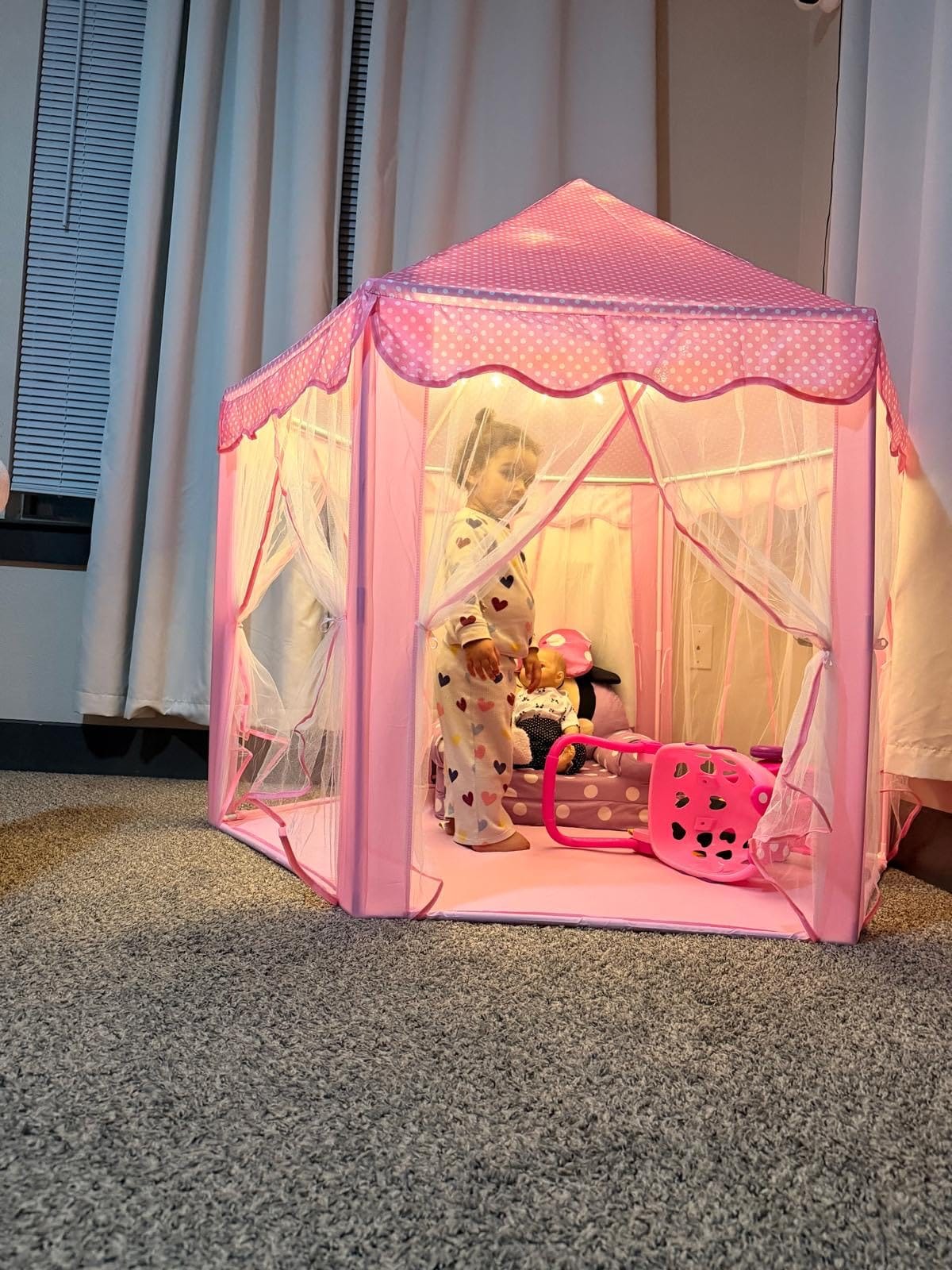
It is rated for ages 36 months to 9 years, which is a wider range than most child-sized playhouses carry. In practice a two-year-old fits comfortably; a three-year-old and a friend can sit inside at the same time. Polyester taffeta wipes down with a damp cloth, so spilled juice is not a lasting problem.
Reviewers are clear that this is a good-value fabric option rather than a heavy-duty structure. Thin fabric and light plastic poles will not survive rough play the way cedar panels do, and the castle styling in pink is aimed at a specific taste.
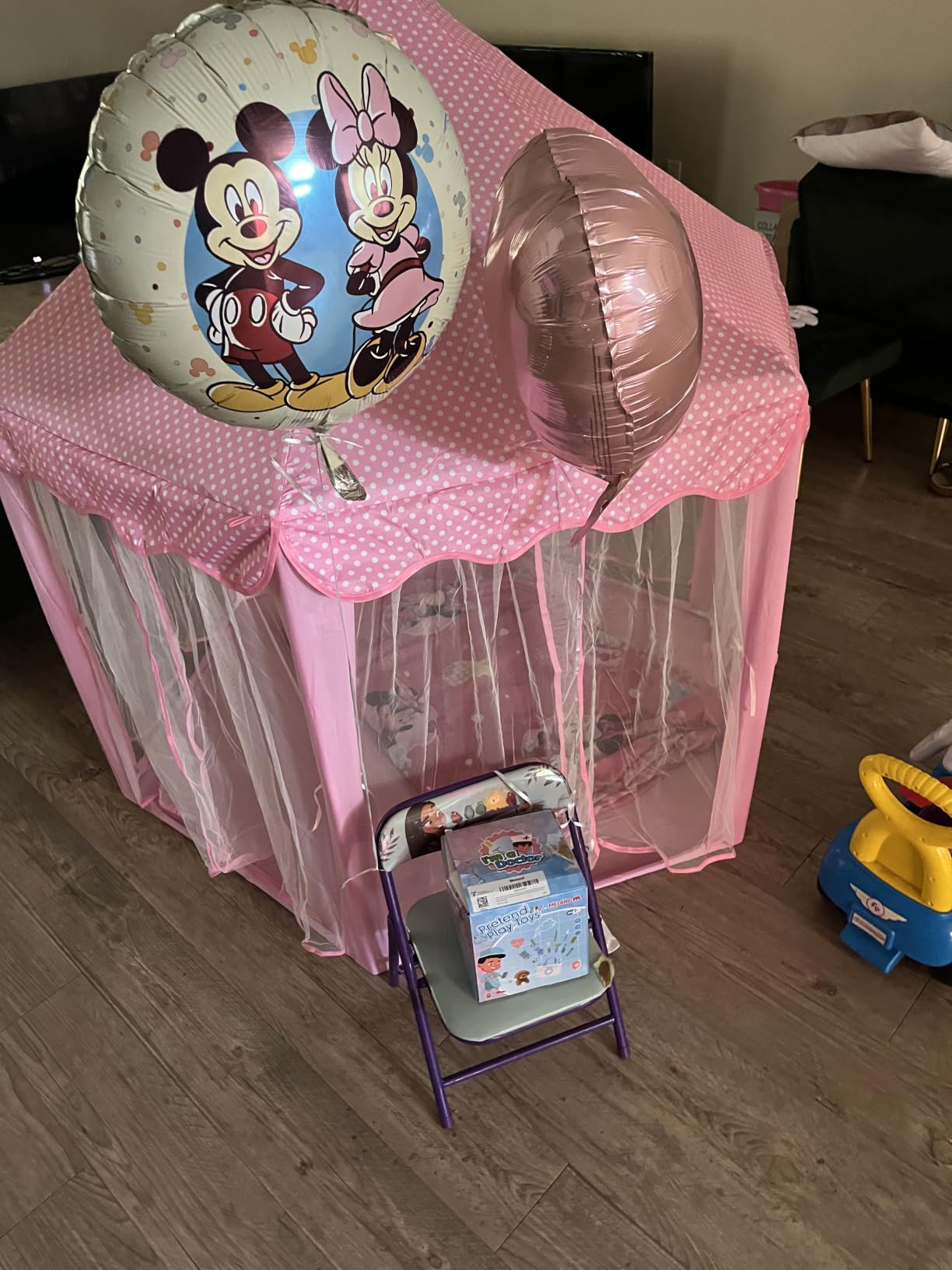
Who this playhouse suits best
It suits families in small apartments, anyone without a yard, and any household where a playdate regularly means three children needing somewhere to be at once. The carry bag also makes it a practical travel toy for grandparents’ houses or hotel rooms.
If your child is at the stage of feeding and nurturing role play, a castle theme works just as well as a cottage theme. The open-sided design means you can supervise from a sofa in the same room without peering through a window.
Where it falls short
It is not a structure a child can climb on or sit inside for a nap. For a child who wants a door that closes and a roof overhead, one of the rigid plastic or cedar cottages further down the list fits better.
Long-term outdoor use in full sun will fade polyester faster than it fades molded plastic. Treat it as an indoor-first toy that tolerates a patio, not as a permanent garden fixture.
2. Step2 All Around Playtime Patio – Best for Siblings and Shady Yard Play
Step2 All Around Playtime Patio with Canopy Playset – Shaded Outdoor Playhouse for Kids with Realistic, Interactive Features, Room for Multiple Toddlers to Play – Dimensions: 60″ H x 47.5″ W x 47.5″ D
Plastic patio playhouse
Removable canopy
Pretend grill and sand table
16 piece accessory set
Pros
- Removable canopy gives shade and works indoors too
- Double-walled plastic resists fading and cracking
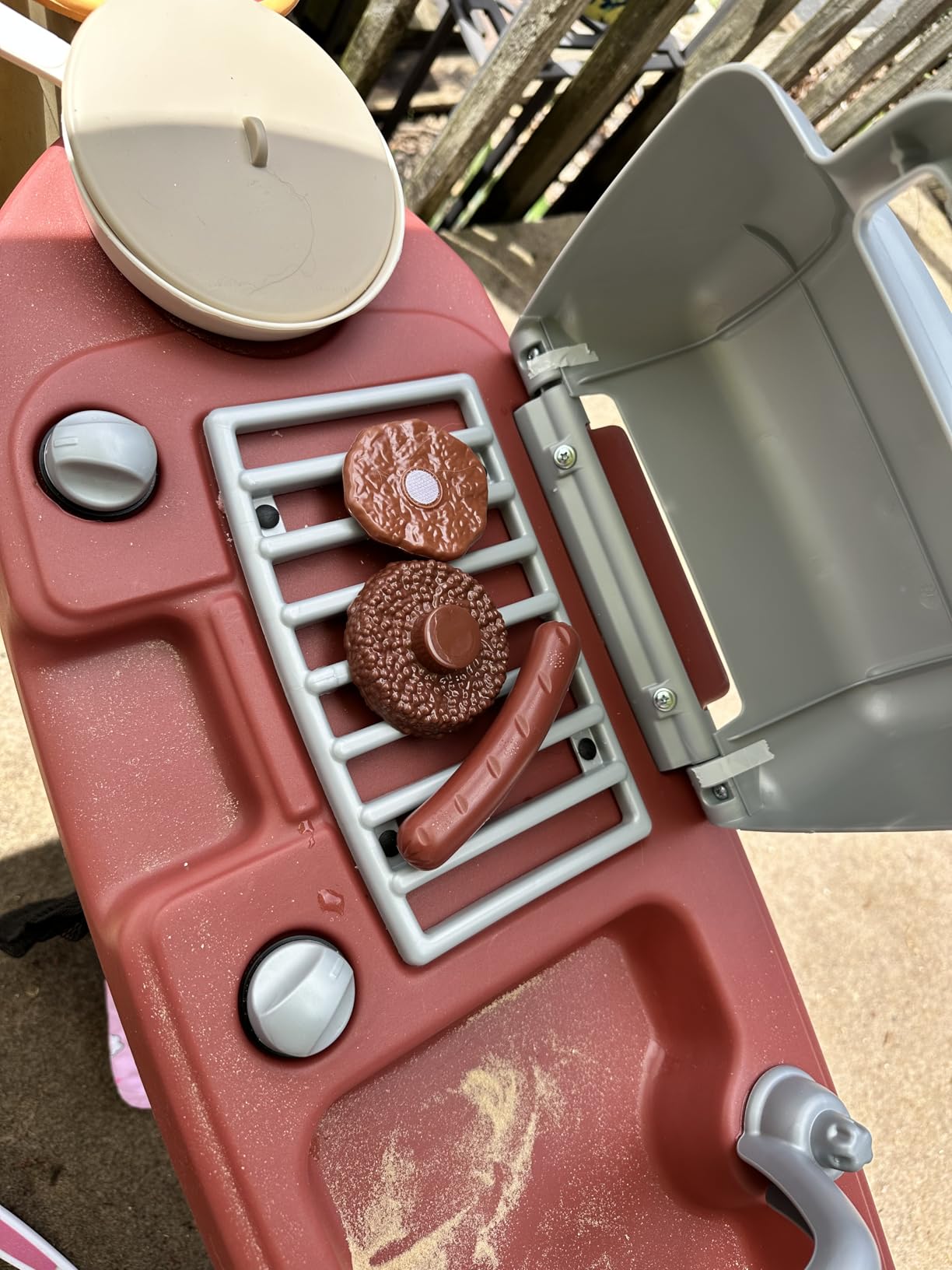
- Pretend grill countertop water and sand table
- Comfortable for several toddlers at once
- Wipes clean after outdoor messes
Cons
- Assembly instructions are unclear at several steps
- Bottom screws are hard to reach and fit
- Sand and water zones spill outside the unit
The Step2 All Around Playtime Patio is the pick for a family with two or more toddlers and a backyard that gets direct sun. The removable canopy is the feature that changes the equation: it shades the interior in summer and comes off entirely when you want to move it indoors for the winter.
Inside, the pretend grill, large countertop and built-in water and sand table give a two-year-old something to do with their hands that pure role play does not. A 16-piece toy accessory set is included, so the kitchen is usable on day one. Double-walled plastic resists chipping, fading and cracking, which reviewers consistently confirm after a season of use.
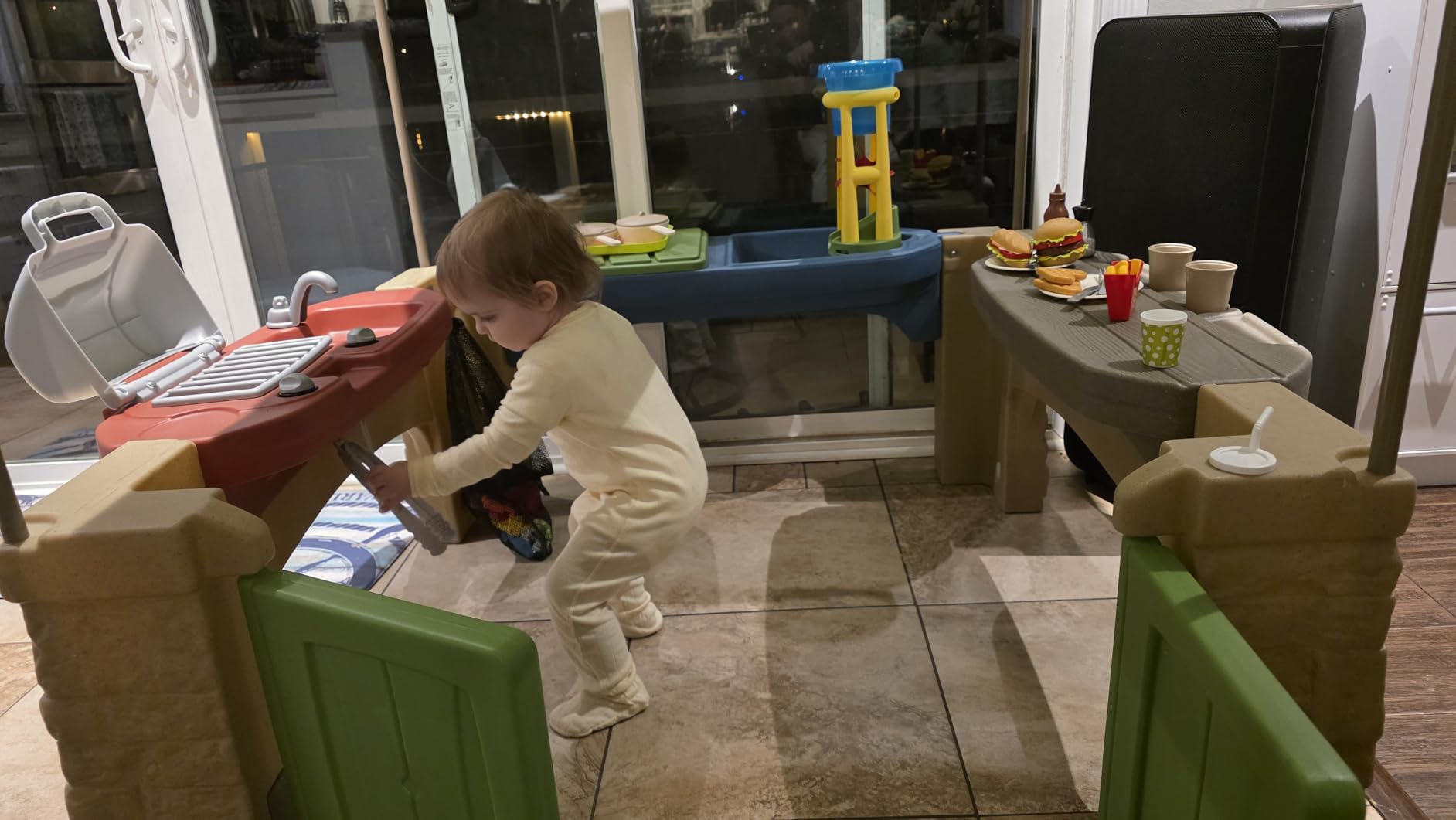
At 47.5 inches deep, 54 wide and 60 tall, this is one of the larger plastic playhouses in the roundup and it needs a real footprint. The manufacturer recommends ages 24 months to 8 years, and reviewers describe children from roughly two to six playing in it together comfortably.
Wiping it down after a messy water-and-sand session is straightforward, and the structure itself survives weather well. Many owners add a weather cover as an extra, since the roof panels collect water in heavy rain.
Who this playhouse suits best
It suits a two-child household, or a firstborn who is at the age where a visiting friend needs to fit inside too. The sand and water table also makes it a natural match for a family already buying a sand pit or water table separately.
If you rent and need the play value indoors for half the year, the removable canopy is the deciding factor. Nothing else in this price range offers that flexibility with a rigid structure.
Where it falls short
Assembly is the weak point. Reviewers repeatedly describe unclear instructions, and the screws on the underside are genuinely hard to reach and align. Budget a second adult and a free afternoon.
The sand and water zones spill. On a lawn this is a minor annoyance; on a patio or in a playroom you will want a towel or mat under the unit. The included accessory set is also small enough that most families add play food later.
3. Little Tikes Cape Cottage – Best Value Entry-Level Plastic Playhouse
Little Tikes Cape Cottage Playhouse with Working Door, Windows, and Shutters – Tan, Toddlers Ages 2+ Years
Plastic cottage
Working door shutters and mail slot
32 lb lightweight build
Pros
- Assembles and disassembles with minimal tools
- Light enough to move between yard and playroom
- Mail slot and shutters drive role play
- Well suited to toddlers and preschoolers
Cons
- Plastic panels feel flimsier than older models
- Some doors do not latch shut
- Decals fade with direct sun
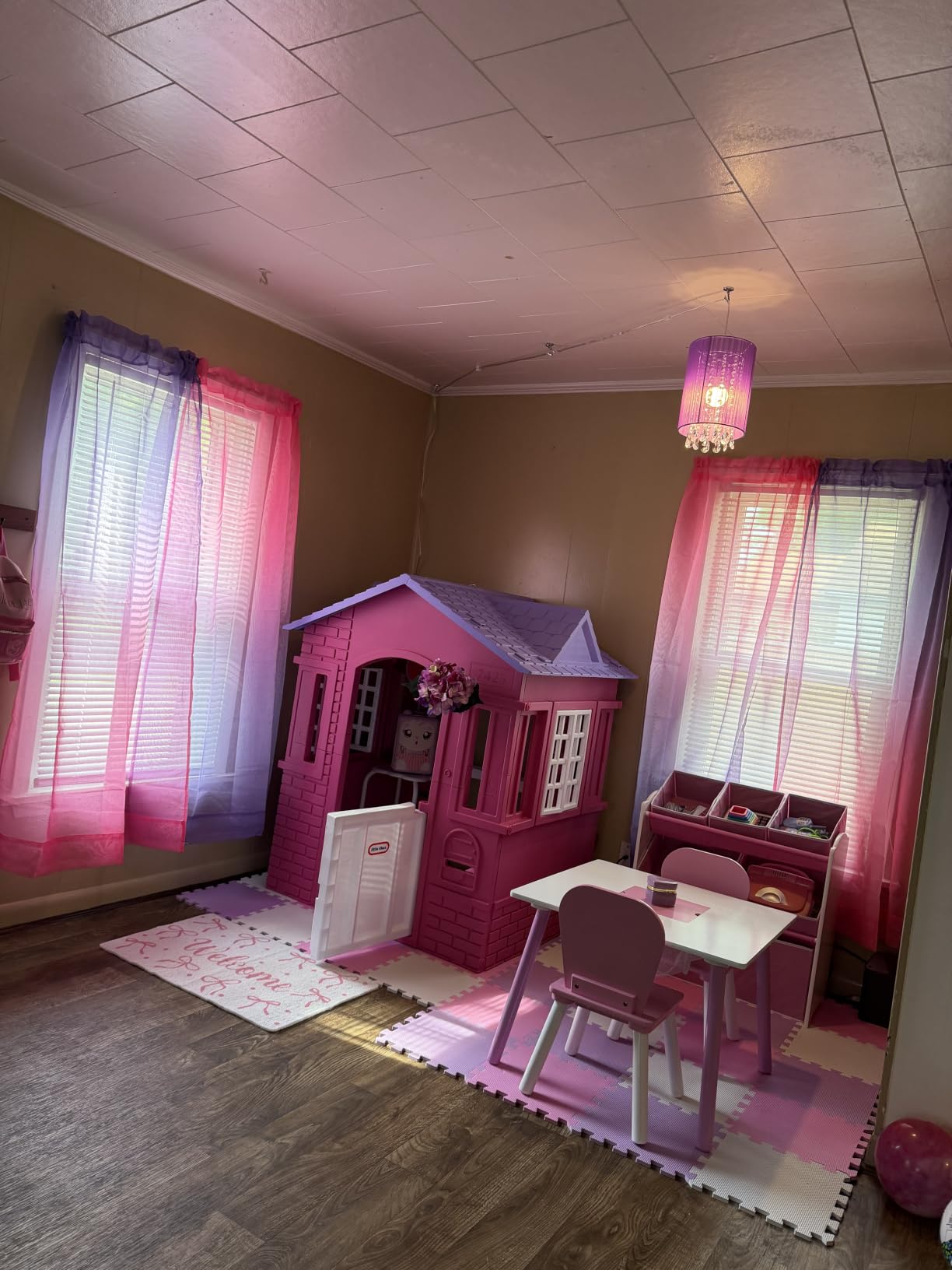
The Cape Cottage is the classic American preschool playhouse, and the reason it appears on so many shortlists is that it does three things well: it has a door that opens, a mail slot that works, and a weight of 32 pounds that one adult can lift.
At 42.8 inches deep, 35 wide and 49 tall, it sits at the smaller end of the rigid-playhouse range, which is exactly the right scale for a two-year-old. The manufacturer recommends ages 24 months to 6 years, so it covers the toddler years and then some.
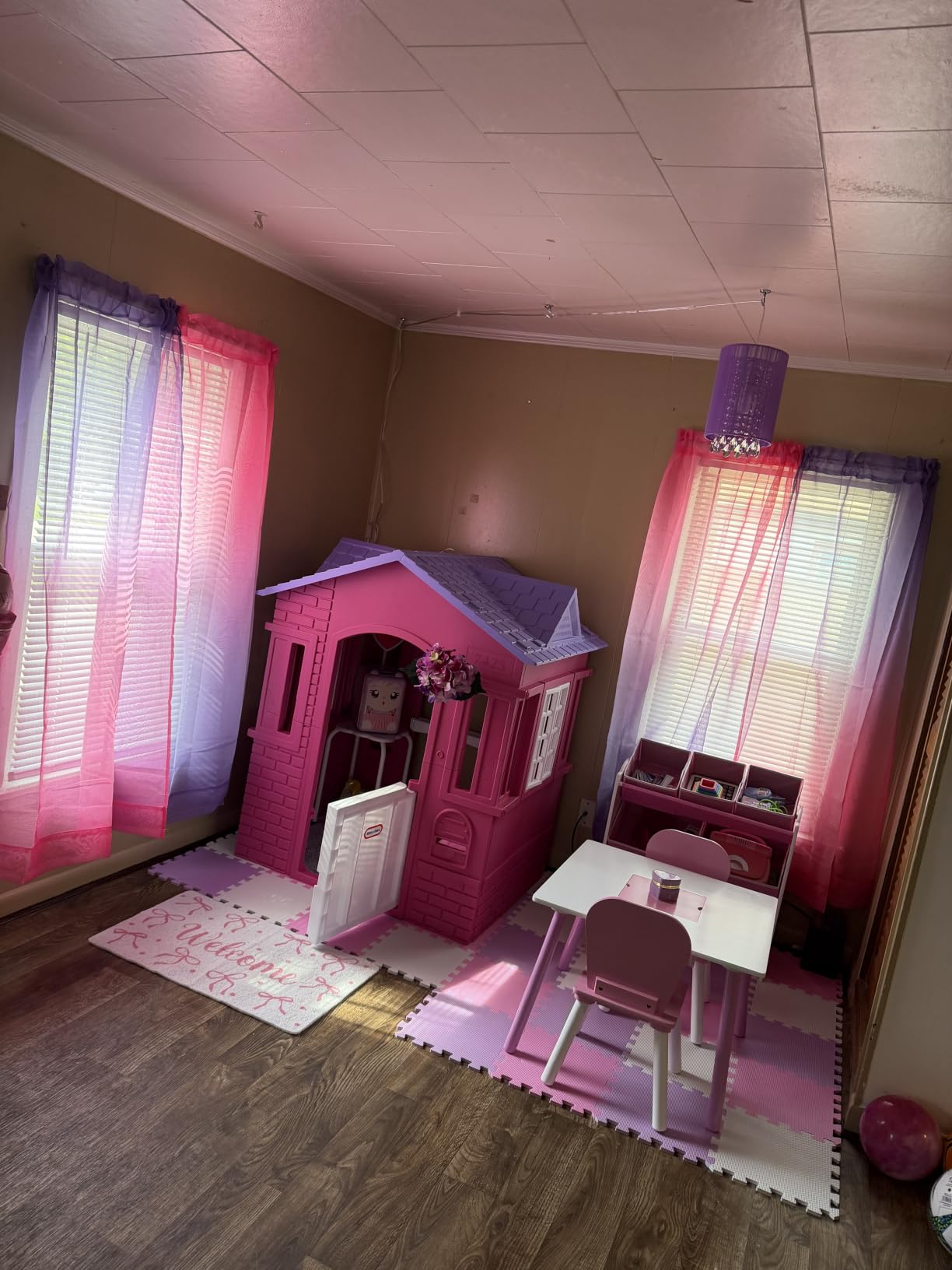
Nearly 14,800 ratings at a 4.5 average makes this one of the most proven designs still in production. Reviewers praise quick assembly, the cheerful cottage styling, and the fact that it works in a playroom or on a lawn without modification.
It also disassembles. For a family in a rental, or one using a garage as a playroom, the ability to take it apart and move it is worth more than most buyers expect at purchase time.
Who this playhouse suits best
It suits a firstborn who plays solo or one at a time, in a small yard or a small playroom, on a budget that will not stretch to cedar. The mail slot gives a toddler who is drawn to delivery and mail play a specific reason to go inside.
For a child who is still unsteady on a step or a small slope, a flat-floor playhouse like this is a safer first step than anything with a deck or a climbing wall.
Where it falls short
The most common criticism is that the plastic panels feel lighter and flimsier than older versions of the same product. It is thinner-walled than the double-walled units further down this list.
Some owners report a door that will not latch, and decal stickers that fade with direct sun. Neither is a safety problem, but both wear on the appearance after a summer or two outdoors.
4. Backyard Discovery Sweetwater Cedar Playhouse – Best Wooden Outdoor Cottage
Backyard Discovery Sweetwater Cedar Wooden Kids Playhouse Cottage with Play Kitchen, Snack Bar, Half Door, Toy Phone, Windows, Flowerpot Holders, and Working Doorbell for Outdoor Imaginative Play
100 percent cedar cottage
Play kitchen snack bar and doorbell
46 x 42 x 55 inches
5 year warranty
Pros
- Solid cedar that resists decay naturally
- Pre-cut pre-drilled and pre-stained panels
- Doorbell toy phone sink and snack window
- Wide windows give light and parent visibility
- Backed by a 5 year warranty
Cons
- Heavy once assembled and hard to reposition
- Larger footprint and higher cost than plastic models
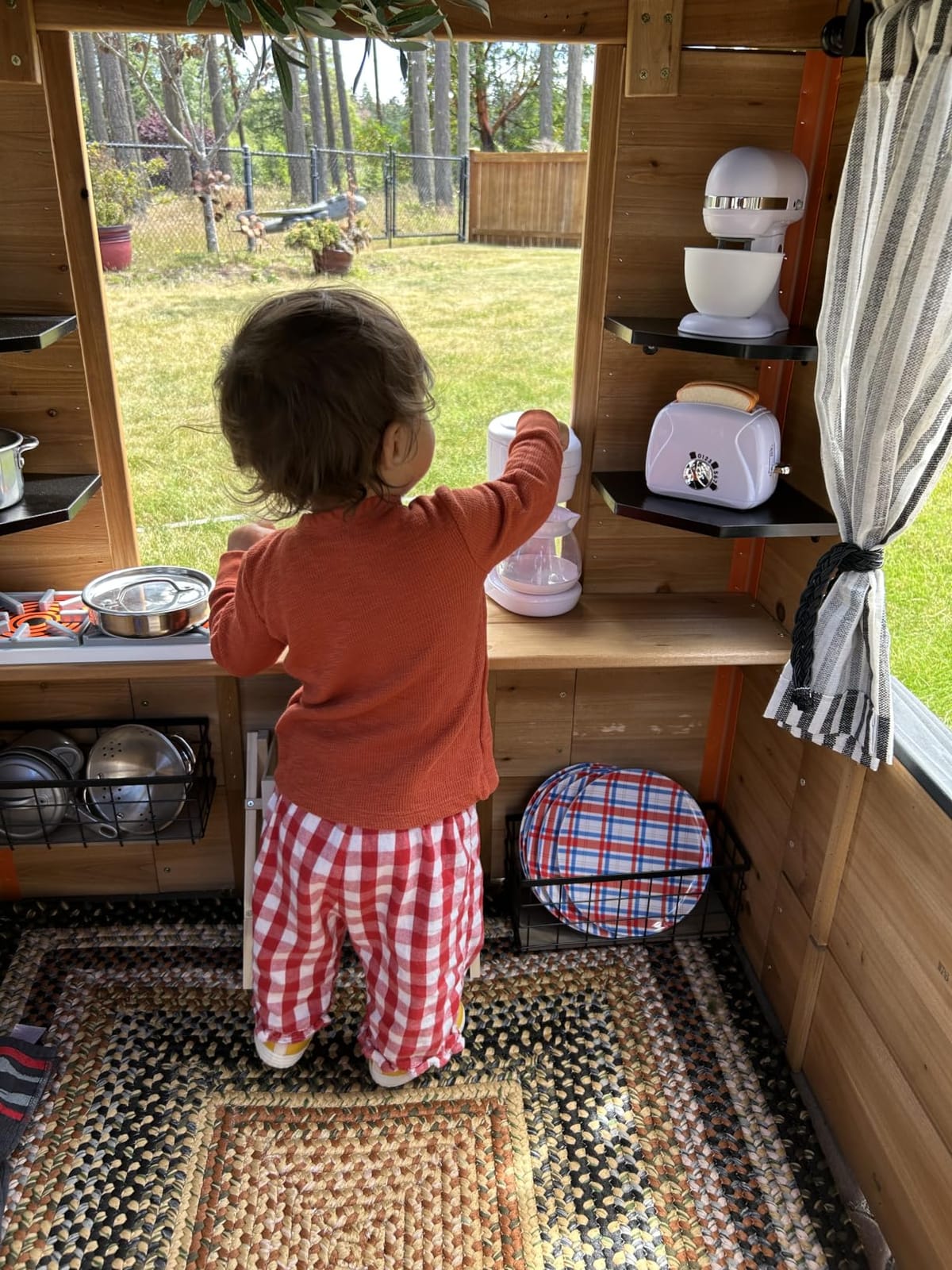
Cedar is the material to look for if you want a playhouse that stays in the yard. It resists decay and insects on its own, which means it does not depend on a paint job every spring to stay sound. The Sweetwater is 100 percent cedar throughout the structure, with plastic hardware at the moving parts.
The pretend-play inventory is the richest in the wooden category. You get a play kitchen with a toy sink, stove, cookware and utensils, a cordless phone, a working doorbell, a hinged half door, a snack bar window and flowerpot holders. A two-year-old will find a reason to open that doorbell at least once an hour.
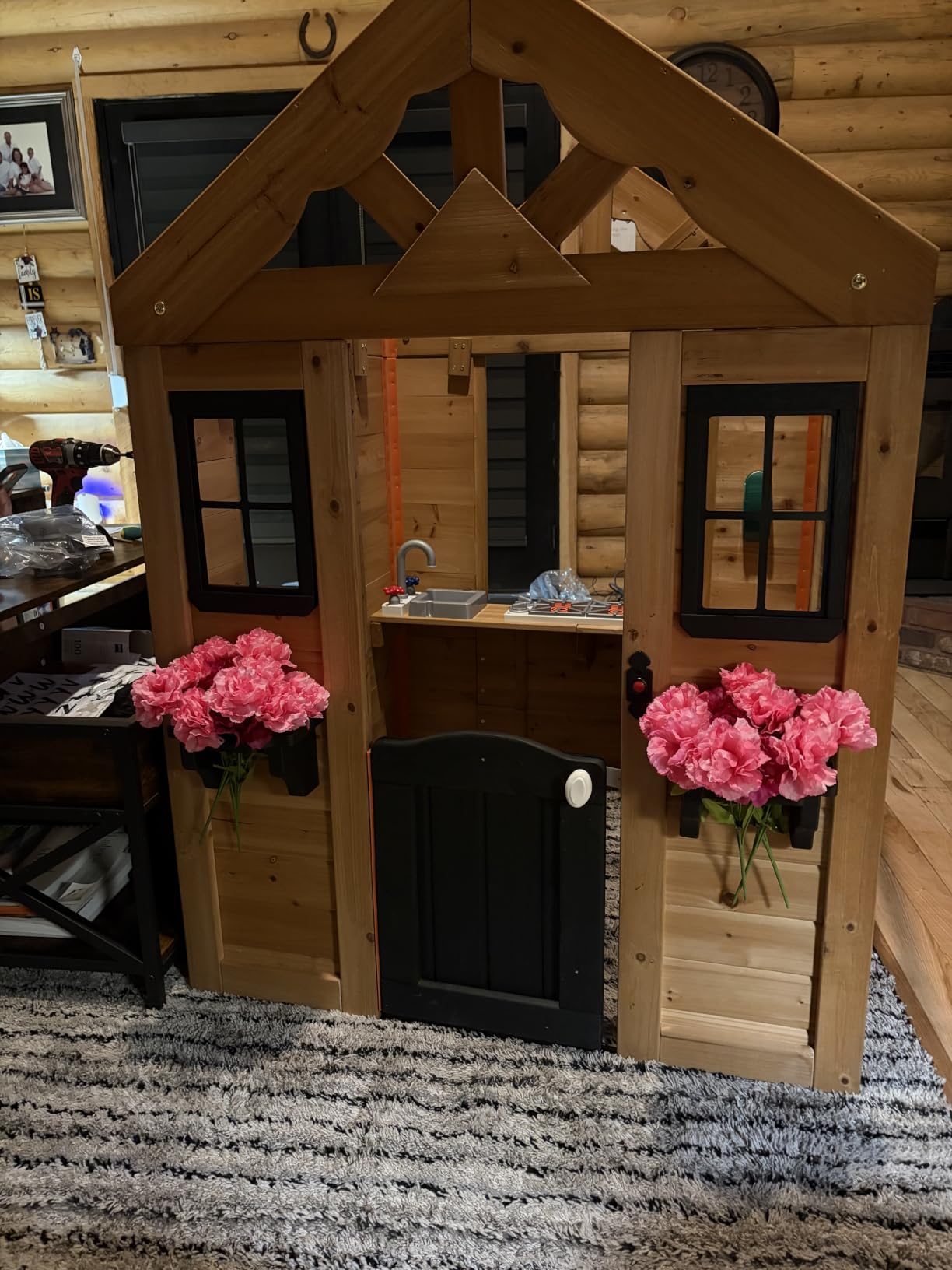
At 46 inches deep, 42 wide and 55 tall, it is wide enough for two children to sit inside and wide-windowed enough that a parent can see the whole interior from the kitchen window. The manufacturer recommends ages 24 months to 6 years and backs the structure with a 5-year warranty.
Assembly is the reason cedar playhouses get a bad reputation, and this one is the counter-example. The panels arrive pre-cut, pre-drilled and pre-stained, with all wood and hardware in the box. That cuts hours off the build compared with a flat-pack kit that needs sanding and finishing.
Who this playhouse suits best
It suits families who plan to keep a playhouse for years rather than seasons, and anyone who wants a real door with a real latch, real windows and a real kitchen rather than molded imitations.
It also suits a household where a child is already showing sustained interest in feeding and caring for a pet or a baby. The kitchen and doorbell give that interest somewhere to land.
Where it falls short
It is heavy. Cedar panels at 34.74 kg mean you will build it where you want it, because repositioning it later takes two people and some effort.
It costs more than a plastic playhouse and takes more of your yard. In a small backyard, a structure this size can crowd out the open lawn space a toddler also needs.
5. Step2 Neat and Tidy Cottage – Best for Indoor Playrooms
Step2 Neat & Tidy Cottage Kids Playhouse, Indoor and Outdoor Playset, Interactive Sounds, Toddlers 1.5+ Years Old, Easy to Assemble, Grey
Indoor and outdoor plastic cottage
Doorbell play phone sink and fireplace
From 18 months to 10 years
Pros
- Doorbell play phone fireplace and skylight in one unit
- Rated from 18 months through 10 years
- Double-walled plastic resists chipping and fading
- Works in a playroom or outdoors year round
Cons
- Bulkier footprint than small plastic cottages
- Costs more than a basic play tent
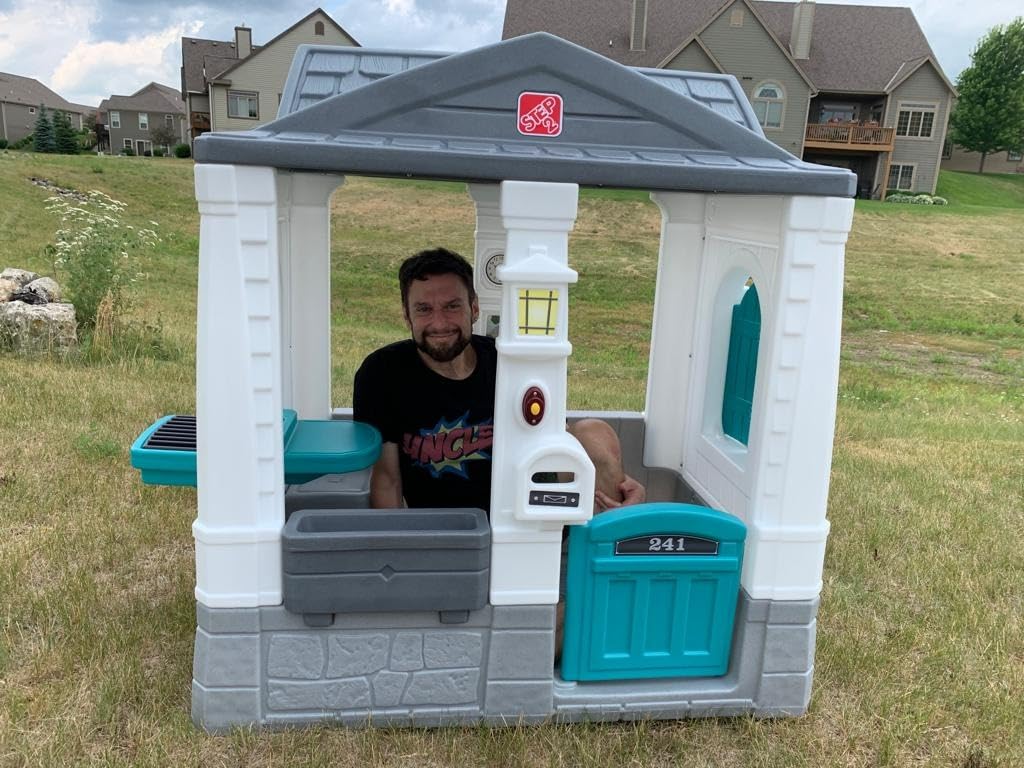
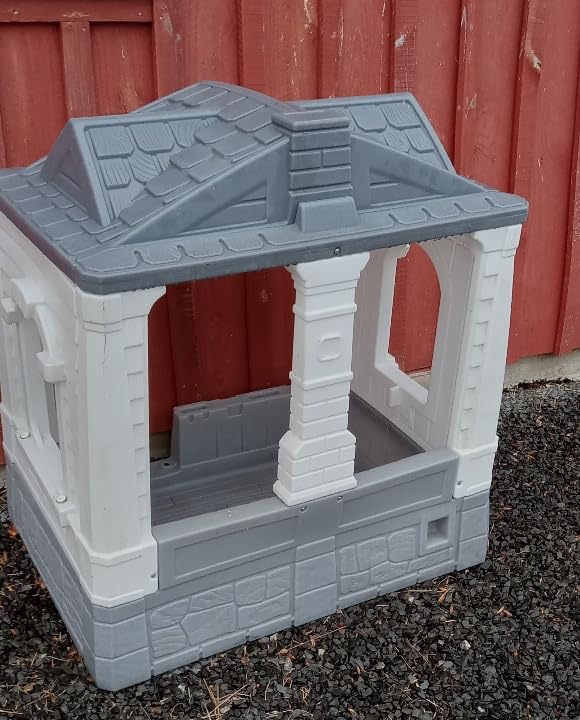
The Neat and Tidy is the pick if your child is under two, because the manufacturer recommends ages 18 months and up. That is the earliest age rating of any child-sized playhouse in this roundup, and it makes the unit genuinely usable for a child who is not yet confident on a step.
Feature density is the selling point. It has a functional doorbell, Dutch-style doors with working shutters, a play phone, a tabletop, a fireplace, a skylight, a molded-in sink, a backyard barbecue area and a drive-thru window. For a toddler who cannot yet run to a real kitchen, that is a lot of surfaces to touch.
Double-walled plastic is the construction detail to look for across this roundup. It resists chipping, fading and cracking, which is why reviewers report it still looking intact after a year outdoors.
It is also the one structure here rated all the way to 10 years, so it does not need replacing when your child moves past the toddler stage. Assembly is described as straightforward.
Who this playhouse suits best
It suits a playroom, a finished basement, or a family that wants one structure working indoors in winter and outdoors in summer. The widest age range here means a single purchase can follow a child from 18 months to school age.
It also suits a child who is drawn to sounds and cause-and-effect. A working doorbell and a play phone reward pressing, which is exactly the behaviour a two-year-old repeats.
Where it falls short
The footprint is bulkier than the smaller plastic cottages. At 33.75 inches deep, 53.25 wide and 49.75 tall, it needs floor or lawn space in a corner rather than tucked against a wall.
It costs more than a basic play tent, and the number of molded features means more places a sticky hand can end up. Wiping it down is a chore but not a difficult one.
6. Fisher-Price Little People Friends Together Play House – Best for Figure-Scale Play
Fisher-Price Little People Friends Together Play House
Figure scale folding house
3 Smart Stages levels
Six activation points
3 figures included
Pros
- Three Smart Stages levels cover letters numbers and opposites
- Six activation points including lights and a flushing toilet
- Four rooms plus patio pool and tree swing
- Folds flat with a carrying handle
- Includes three figures and seven more pieces
Cons
- Built for figures rather than for a child to sit inside
- Electronic features need batteries
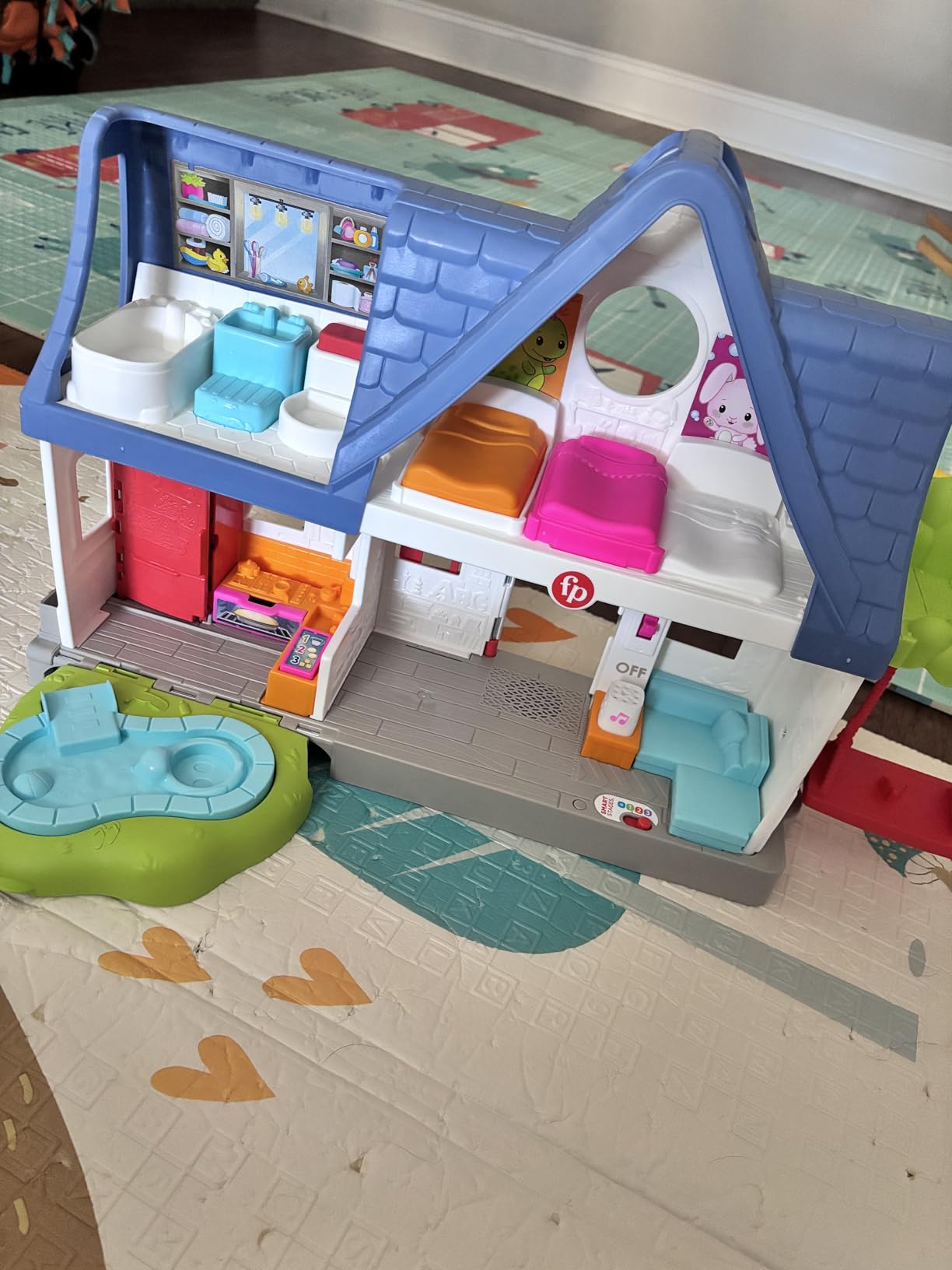
This is a different category of toy and it deserves to be judged on different terms. It is a tabletop-scale house for Little People figures, not a structure a toddler climbs into. For a child at the stage of sorting, feeding and putting figures to bed, that is exactly the right form factor.
Smart Stages content runs across three levels and covers alphabet, counting, opposites and greetings, which makes this closer to an educational playset than a pretend-play structure. Six activation points include a light-up radio, a light switch, a door, a tablet, a refrigerator, an oven and a flushing toilet.
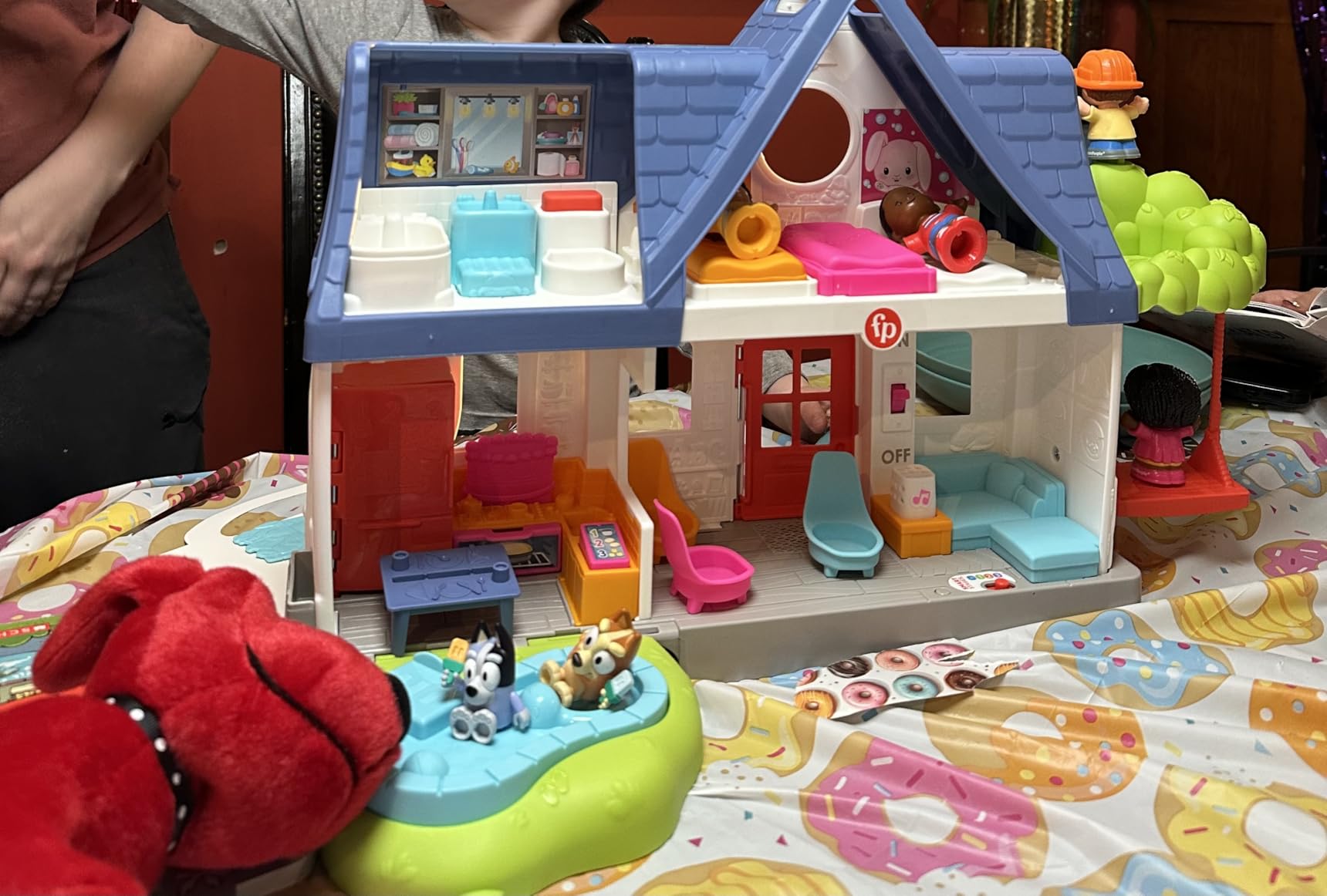
It holds four rooms plus an outdoor patio with a swimming pool and a working tree swing, and it ships with three figures plus seven additional pieces including a table, chairs, a recycling piece and a cake piece. That is a complete little world rather than an empty shell.
The manufacturer recommends ages 12 months to 5 years, making it the earliest-rated product in the roundup. Reviewers rate it 4.8 stars across roughly 2,700 ratings, and the folding design with a carrying handle is the feature most often mentioned as the reason it stays out rather than pushed under a bed.
Who this playhouse suits best
It suits a toddler who has just graduated from a baby activity toy and is now interested in figures and small-world narratives. It also suits a family looking for a birthday or holiday gift that travels.
It is a genuinely good option for an apartment or a shared flat where floor space is precious. At 10 by 21.59 by 13.39 inches, it needs a shelf, not a yard.
Where it falls short
A child cannot sit inside it, so it will not satisfy a toddler who wants to be in the house rather than arranging it. If your child is climbing out of the highchair stage, this is probably a bridge toy rather than a destination.
The electronics need batteries, which means occasional dead buttons and a screwdriver moment. Two pounds of weight also makes it easy to carry off to a grandparent’s house, whether you planned to or not.
7. Fisher-Price Little People Surprise and Sounds Home – Best for Compact Indoor Spaces
Fisher-Price Little People Surprise & Sounds Home, Musical Playhouse
Two piece musical play house
50 sounds songs and phrases
Closes flat for storage
Indoor use
Pros
- Fifty sounds songs and phrases across many points
- Two halves connect in about two minutes
- Closes fully with a carry handle for storage
- No small parts for toddlers to swallow
- Mom Dad and Emma figures plus table and chairs
Cons
- Color is brighter and pinker than the photos suggest
- Some light and sound features do not work on every unit
- Most buttons sit on one side of the house
This musical home scores 4.8 stars across more than 4,000 ratings, and the sound count explains why. Fifty sounds, songs and phrases fire from activation points including an alarm clock, oven and refrigerator doors, a toilet seat and a radio.
The build is the part worth knowing about: it arrives as two halves that connect in about two minutes with no tools. When play is over it closes completely and folds down with a carry handle, which means it lives on a shelf or in a closet instead of taking up floor space permanently.
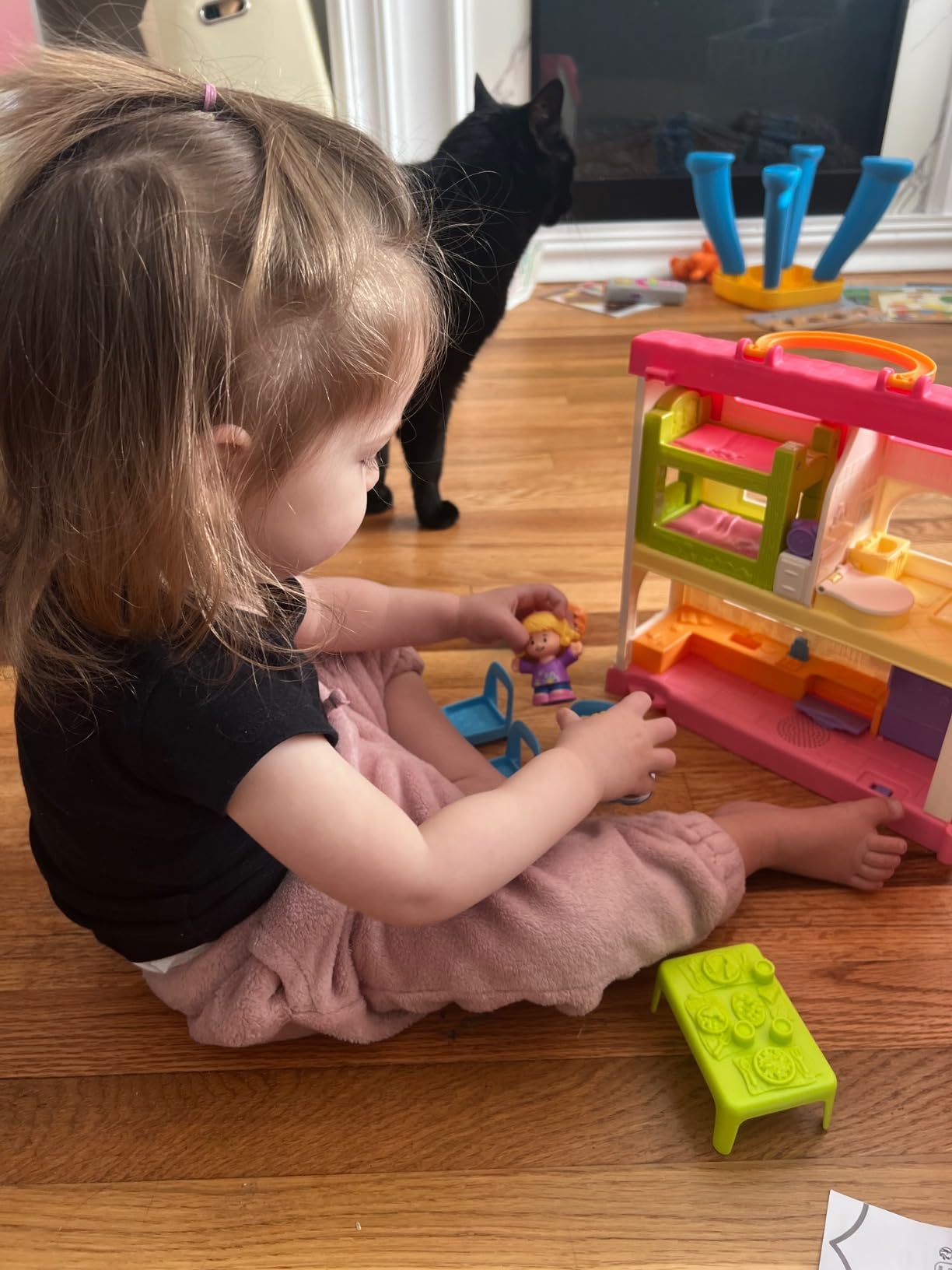
It opens for full 360-degree hands-on play, with a sliding bird and a peek-a-boo kitten for fine-motor practice. All pieces store inside the shell, including the Mom, Dad and Emma figures, a table and three chairs, so there is no loose-part problem and nothing migrates under the sofa.
At 4.98 by 23.39 by 11.81 inches and 4.3 pounds, it is designed for indoor use. The manufacturer recommends ages 12 months to 5 years, and the listed educational focus covers fine motor skills, language development and social-emotional learning.
Who this playhouse suits best
It suits a child between 12 months and 3 years, who is drawn to sounds, singing and pressing buttons rather than to large-scale physical play. Parents who want a toy that genuinely stows away will find very few better options.
It is specified for indoor use, which makes it a natural pick for a family in a flat, or for anyone looking for a second play structure to complement an outdoor one.
Where it falls short
The most repeated note across reviews is color. Owners consistently report a much brighter, pinker plastic than the listing photographs suggest, which matters if you are matching it to a room.
A few buyers report that light or sound features, such as the oven and fridge lights, did not work on their model. Most interactive buttons are also concentrated on one side, which limits two children playing at once.
8. UTEX 3 in 1 Pop Up Play Tent – Best Portable Set for Ages 1 to 3
UTEX 3 in 1 Pop Up Play Tent with Tunnel, Indoor/Outdoor Playhouse
Tent teepee and tunnel set
Pop-up with no tools
Folds flat
Built for ages 1 to 3
Pros
- Three connected play spaces in one box
- Tool-free pop-up setup in seconds
- Folds flat for closet or garage storage
- Mesh windows give ventilation and peek-a-boo play
- Light enough for one adult to carry
Cons
- Ball pit section arrives empty with no balls included
- Spring steel takes practice to fold back into shape
- Fabric is not meant for long outdoor exposure
The UTEX set answers a question most roundups skip: what do you do with a playhouse when the child is between 18 months and 2 years and still wants to be inside something? The answer here is a three-piece set: a square tent, a teepee house, and a long tunnel that connects them.
Assembly is genuinely instant. The spring-steel frame pops into shape by itself, so there is no build and no tools, and it folds flat for storage between uses. At 3 pounds, one adult can carry the whole thing.
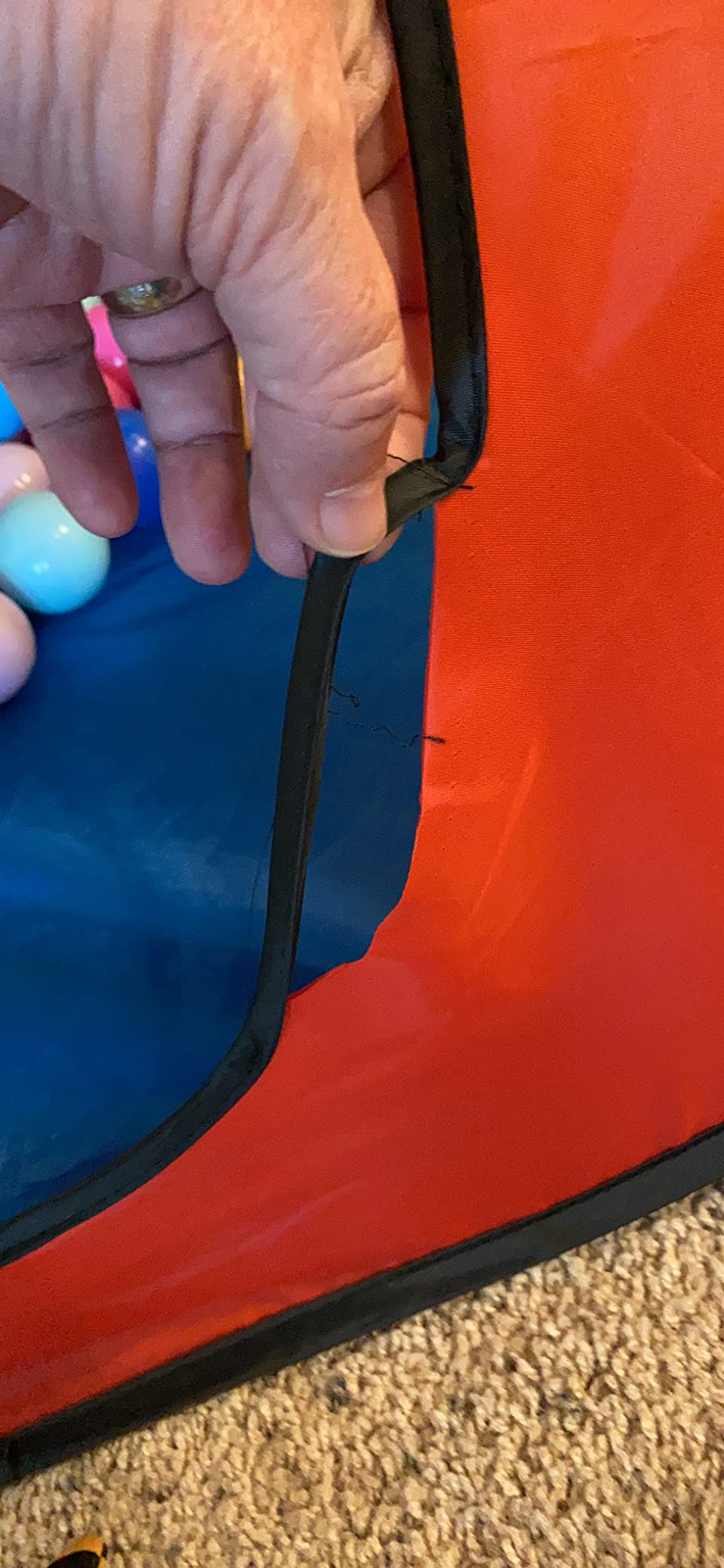
It is suited to toddlers from 18 months to 3 years, which is the most toddler-specific fit in the roundup. The 190T polyester taffeta fabric resists wear and tearing, and the mesh windows provide both ventilation and peek-a-boo play, which is a toddler’s favourite kind of window.
More than 11,000 ratings at 4.6 stars make it one of the most proven choices in the budget tier. Owners consistently mention getting three play spaces in one box and the fact that the whole thing disappears into a closet when the floor is needed again.
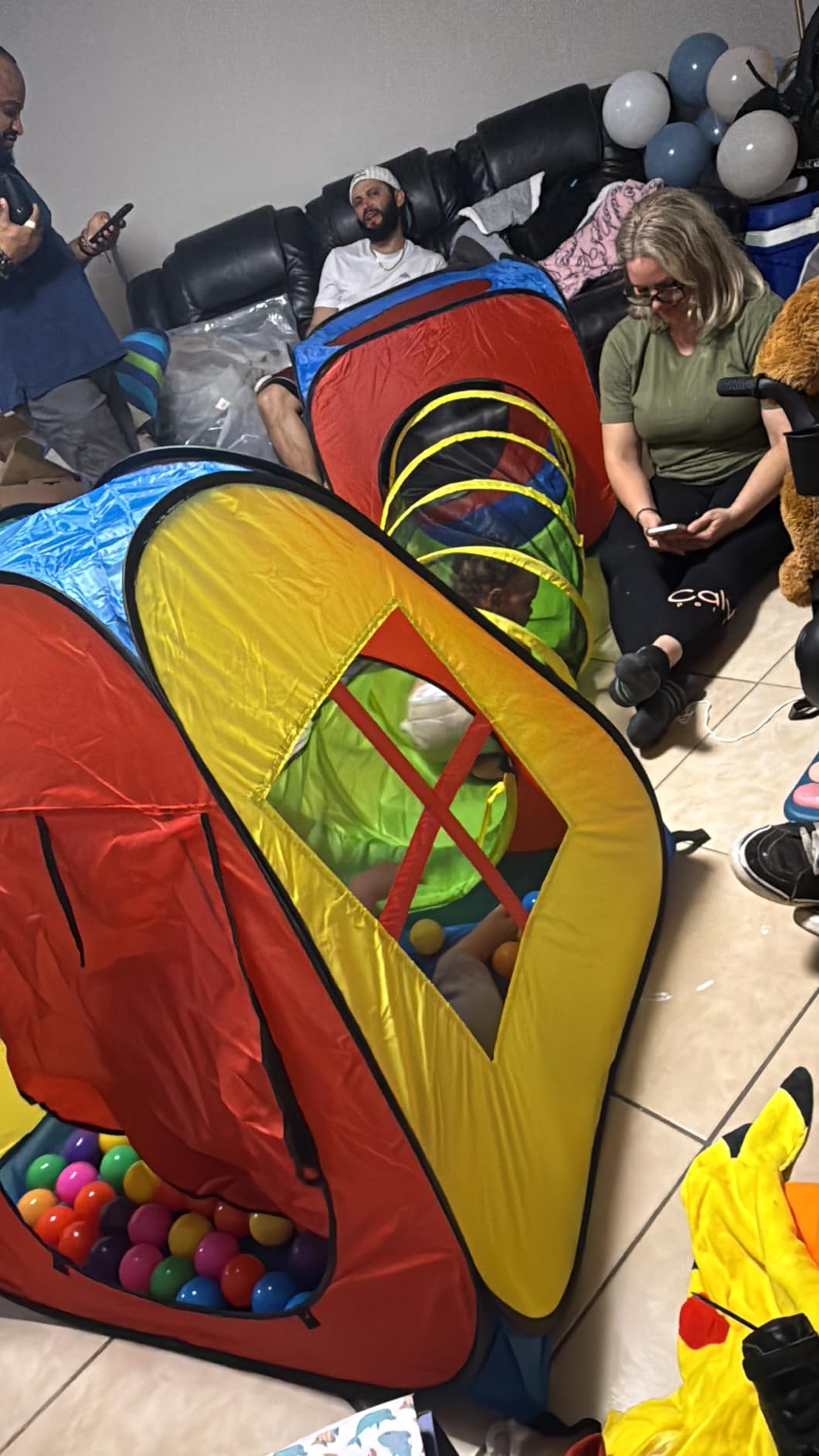
Who this playhouse suits best
It suits a child aged 1 to 3 who is not ready for a rigid structure with a door that latches, and any family in temporary accommodation who needs a play space that packs into a car boot.
It also suits a household with a playroom and a garden, because the same three pieces can be split up and arranged differently in each location. The tunnel works as a quiet-time den on its own.
Where it falls short
The ball pit section arrives with no balls. This is the single most common complaint in more than 11,000 reviews, so plan on buying a bag of soft balls separately.
Folding the spring-steel pieces back into shape takes practice, and the fabric is not built for extended outdoor exposure in wet weather. Keep it for dry play.
9. SweHouse Play Tent Clubhouse – Budget Pick for Lightweight Indoor-Outdoor Play
SweHouse Play Tent Indoor Clubhouse Boy Girl Playhouse, Green
Fabric clubhouse tent
Waterproof roof
2.3 lb portable build
38.6 x 27.6 x 42.5 inches
Pros
- Weighs only 2.3 pounds so one adult can move it
- Waterproof roof works indoors and outdoors
- Roll-up door and several entry points
- Packs down small and sets up quickly
- Non-toxic paint with no strong smell
Cons
- Light frame can tip in wind without anchoring
- Rated for ages 3 and up
At 2.3 pounds, the SweHouse clubhouse is the lightest play structure in the roundup, and that is the whole argument for it. You can move it between rooms, carry it to a grandparent’s house, or store it in a car. For a family that moves, or a playroom that doubles as a guest room, that flexibility is worth more than durability.
The waterproof roof is what separates it from a typical indoor play tent. It tolerates damp grass and light rain, so it works in a backyard as well as a living room, and the roll-up door plus windows give a toddler several ways in and out.
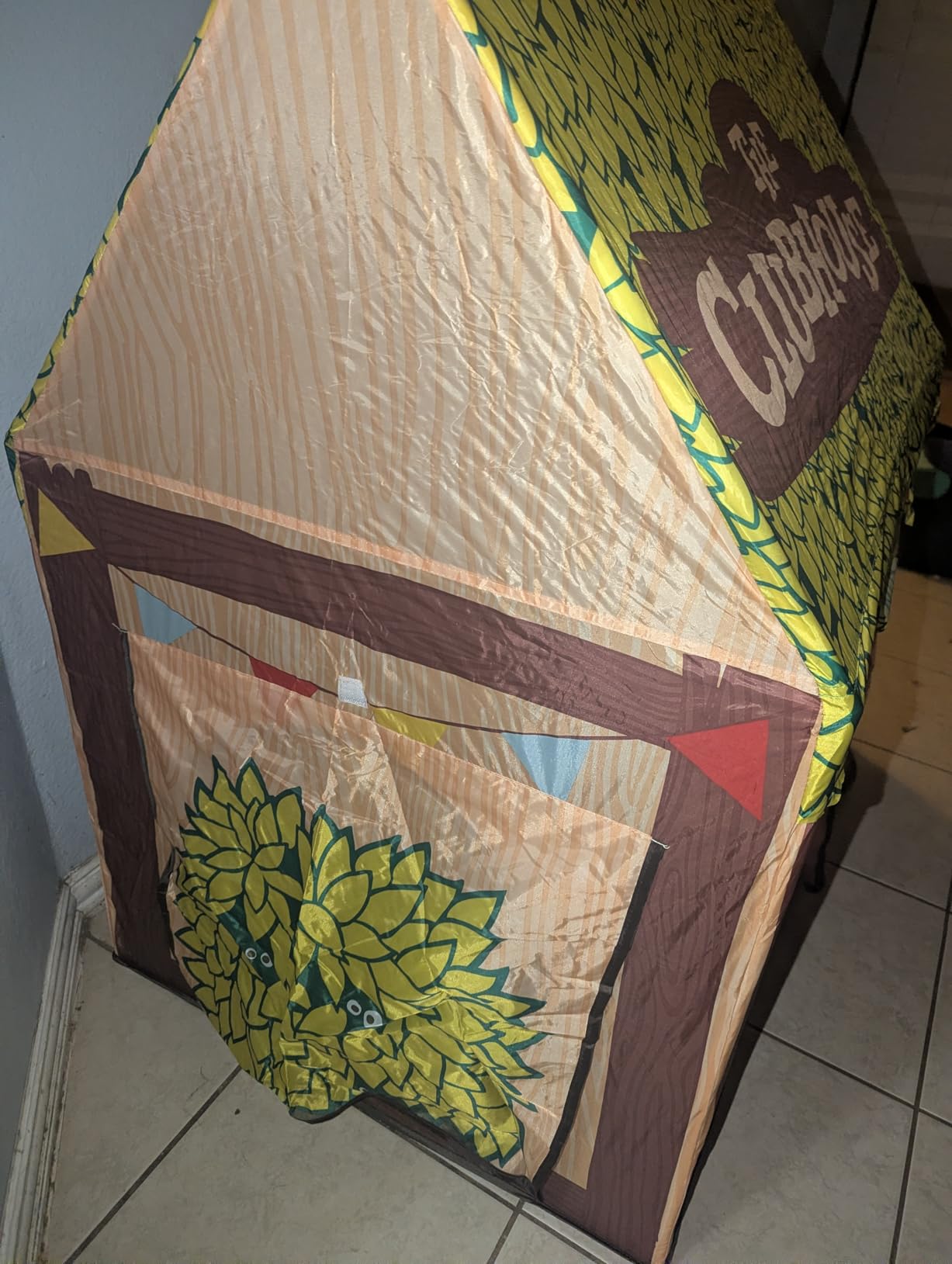
At 38.6 inches long, 27.6 wide and 42.5 tall, it is a compact clubhouse rather than a cottage. The green color is neutral and suits a wide range of children, and the non-toxic paint has no strong odor, which matters in a nursery.
More than 5,600 ratings at 4.4 stars make it one of the most heavily reviewed options at the budget end. Owners like the weight, the waterproof roof, and how easily it sets up and packs down.
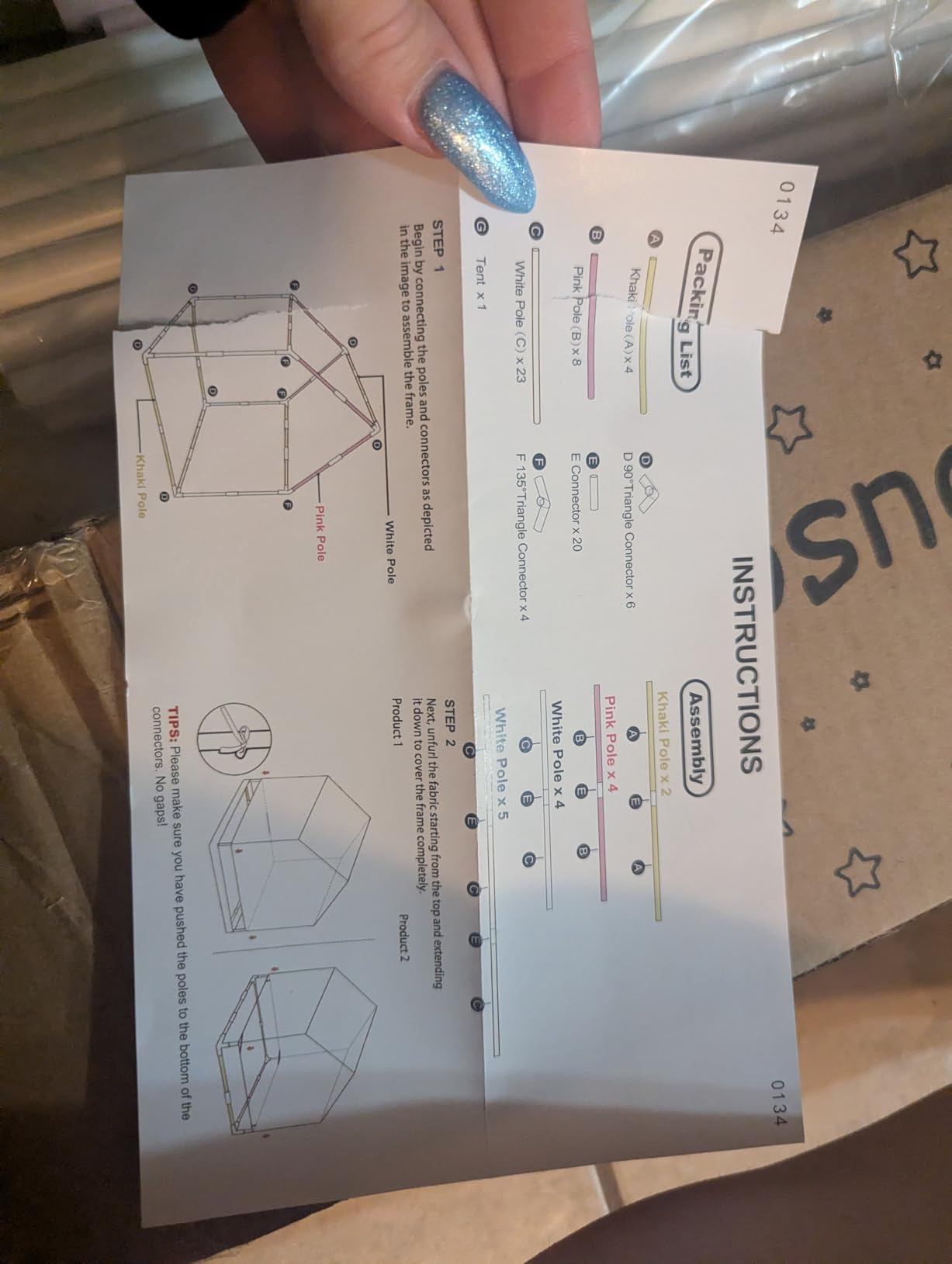
Who this playhouse suits best
It suits a child around 3 and up who wants a defined space with a door, and any family in a rental where permanent structures are not an option. The small pack size is the deciding factor for tight indoor spaces.
It also works as a supplemental space: a reading den alongside a wooden cottage, or a covered corner for a three-year-old who likes watching while playing alone.
Where it falls short
The light frame is the trade-off. It can tip or collapse in wind unless you anchor it, so outdoor use on a breezy day needs a stake or a weight.
It is rated for ages 3 and up, which puts it outside the toddler window this roundup is built around. If your child is under 3, the UTEX set earlier in this list is a closer match.
10. KidKraft Modern Outdoor Wooden Playhouse – Best for Picnic-Style Play
KidKraft Modern Outdoor Wooden Playhouse with Picnic Table, Mailbox and Outdoor Grill ,Gift for Ages 3+
Wood and plastic playhouse
Attached picnic table and benches
Grill and working sink
Ages 3 to 8
Pros
- Attached picnic table lets kids serve pretend meals
- Grill sink and fabric curtains add realism
- Pre-treated wood resists UV and mold
- Chalkboard and mailbox extend the play
- Fits ages 3 through 8 as children grow
Cons
- Assembly often takes 4 to 6 hours for two adults
- Diagram-only instructions leave parts unlabeled
- Roof and door can warp or split outdoors
The KidKraft Modern is the only playhouse in this roundup with an attached picnic table and benches, which makes it a genuinely different proposition. Instead of a child pretending to cook alone inside, they can cook, serve and sit down to eat with a friend.
The accessory set is unusually complete for a wooden model: a barbecue grill with a click-and-turn knob and removable lid, a working sink with a moving lever, fabric curtains, a mailbox and a chalkboard. The wood arrives pre-treated with a water-based stain that offers UV and mold protection.
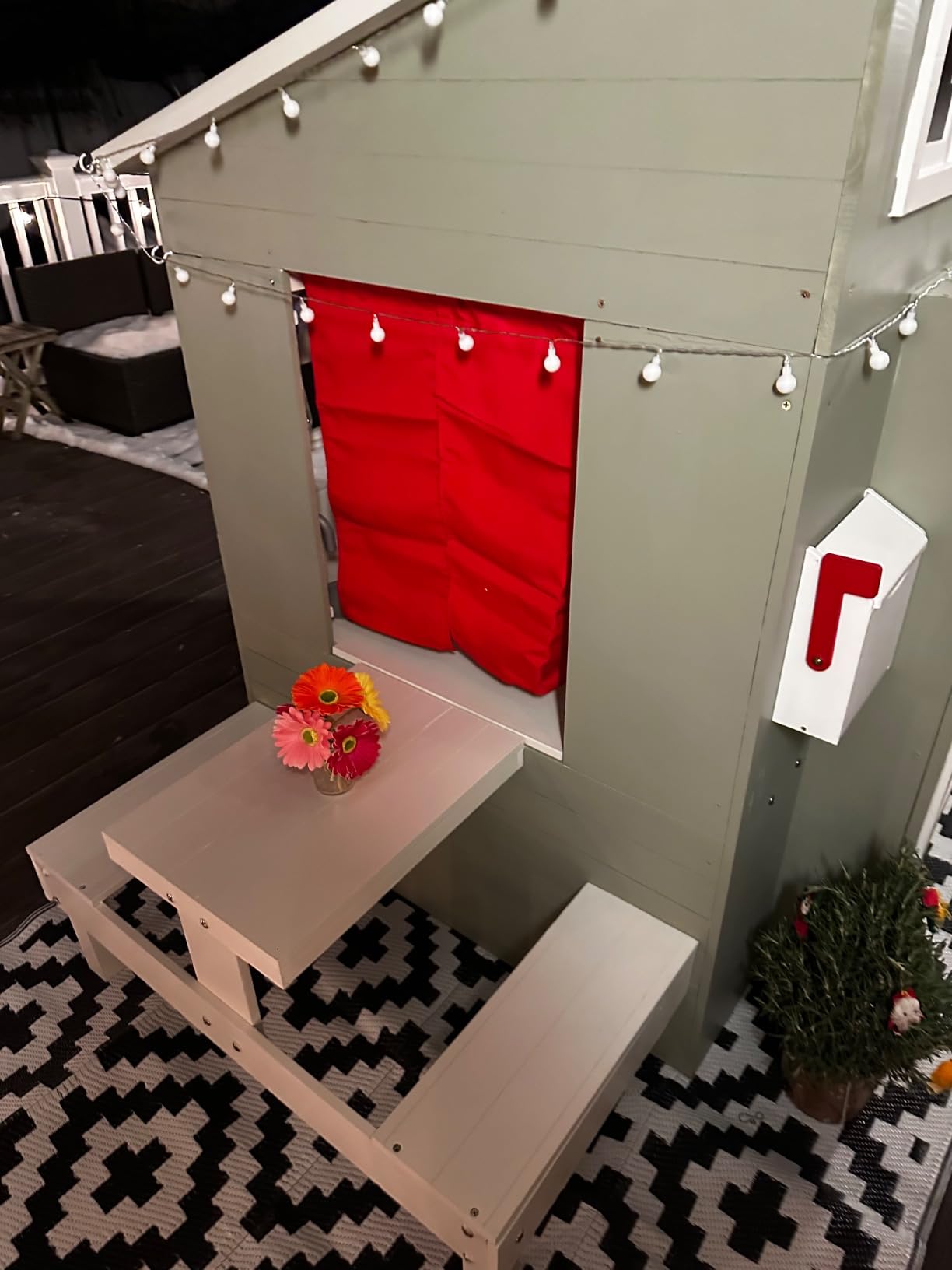
At 70.9 inches wide, 48.9 deep and 62.25 tall, it is the largest footprint in the roundup, and 53 kg of weight means you build it where it lives. The manufacturer recommends ages 36 months to 8 years, so it is built for a longer runway than most toddler playhouses.
The warranty is 90 days against manufacturer defects, which is the shortest in this roundup. That is a real difference when you are comparing a cedar structure designed to last a decade.
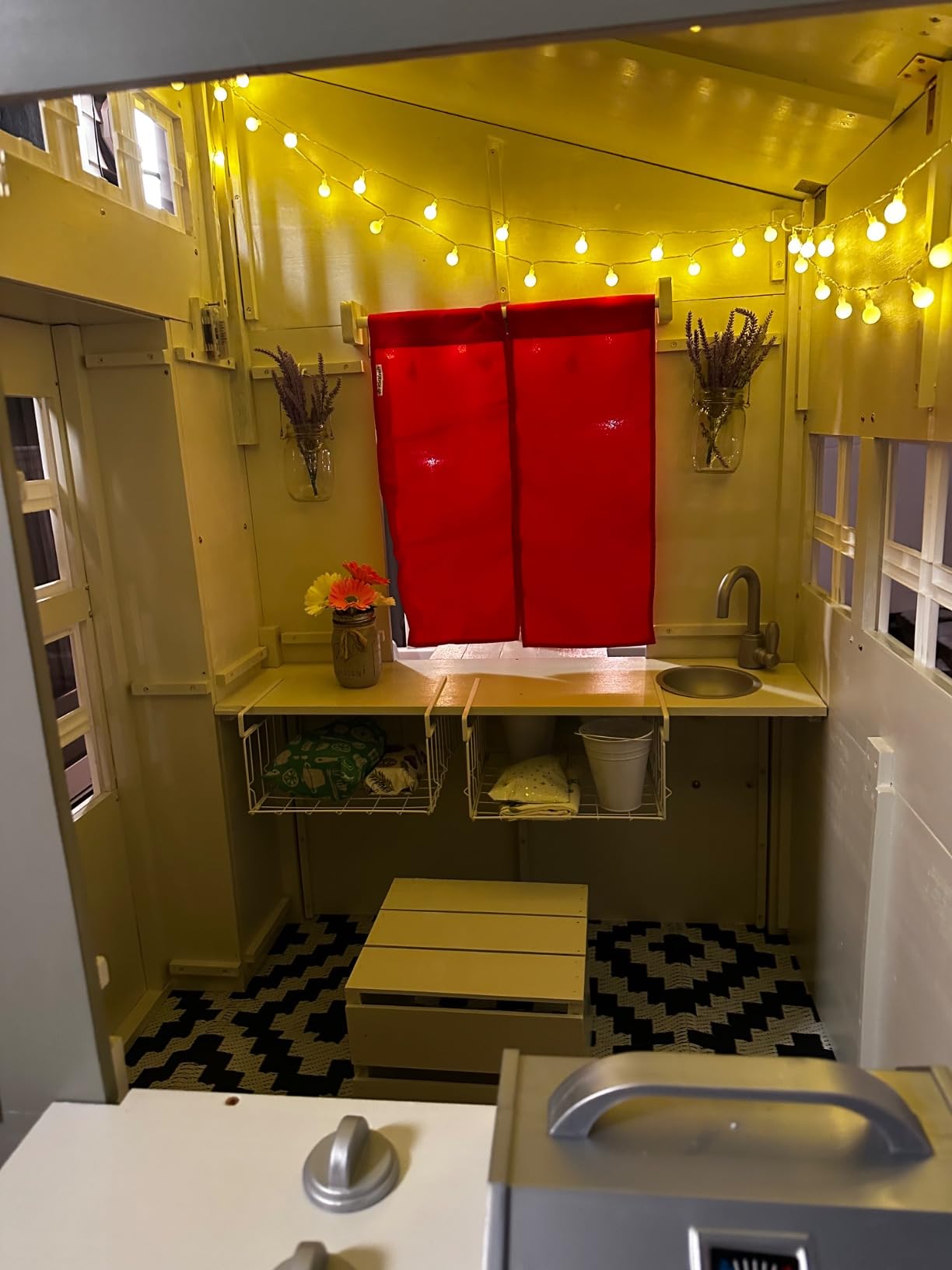
Who this playhouse suits best
It suits a family with a generous yard and a child who is already at the picnic-table stage, meaning a three-year-old rather than a two-year-old. The serving and eating play is a step up in complexity from feeding dolls.
It also suits a family that wants one structure to cover several years. The 3-to-8 range is the widest of the wooden options here and buys real longevity.
Where it falls short
Assembly is the central complaint. Reviewers report 4 to 6 hours for two adults, with diagram-only instructions that have no written text, and parts that are unlabeled or mismatched.
Durability feedback is genuinely mixed. Several owners report the roof and door warping or splitting within months outdoors, while some multi-year owners report it holding up fine, so climate and sealant maintenance matter a great deal here. No floor is included either.
11. Step2 Crazy Maze Toddler Ball Pit – Best for Active Toddlers
Step2 Crazy Maze Toddler Ball Pit, Kids Playhouse, Indoor/Outdoor Playset, Interactive Play with Sounds, Includes 20 Colorful Balls, Made of Durable Plastic, For Toddlers 1.5+ Years Old
Ball pit playhouse with roof maze
20 balls included
Storage basin
From 18 months to 10 years
Pros
- Twenty balls are actually included with the set
- Roof maze adds active play beyond the pit
- Bottom basin doubles as toy storage
- Double-walled plastic resists cracking
- Rated from 18 months to 10 years
Cons
- At 36 pounds it is awkward to reposition
- Balls scatter across the yard and need regular clean-up
- Fewer pretend play features than cottage models
Not every toddler wants to stand in a house pretending. Some want to climb, throw and crash, and for that child the Step2 Crazy Maze is the right shape of toy. The roof maze sends balls zigzagging down through the top, which turns a ball pit into something a toddler actively operates rather than falls into.
Twenty colorful balls are included, along with a pouring pitcher and a boiling pot. That matters more than it sounds, because ball-pit playhouses almost never ship with balls and reviewers are tired of buying them separately.
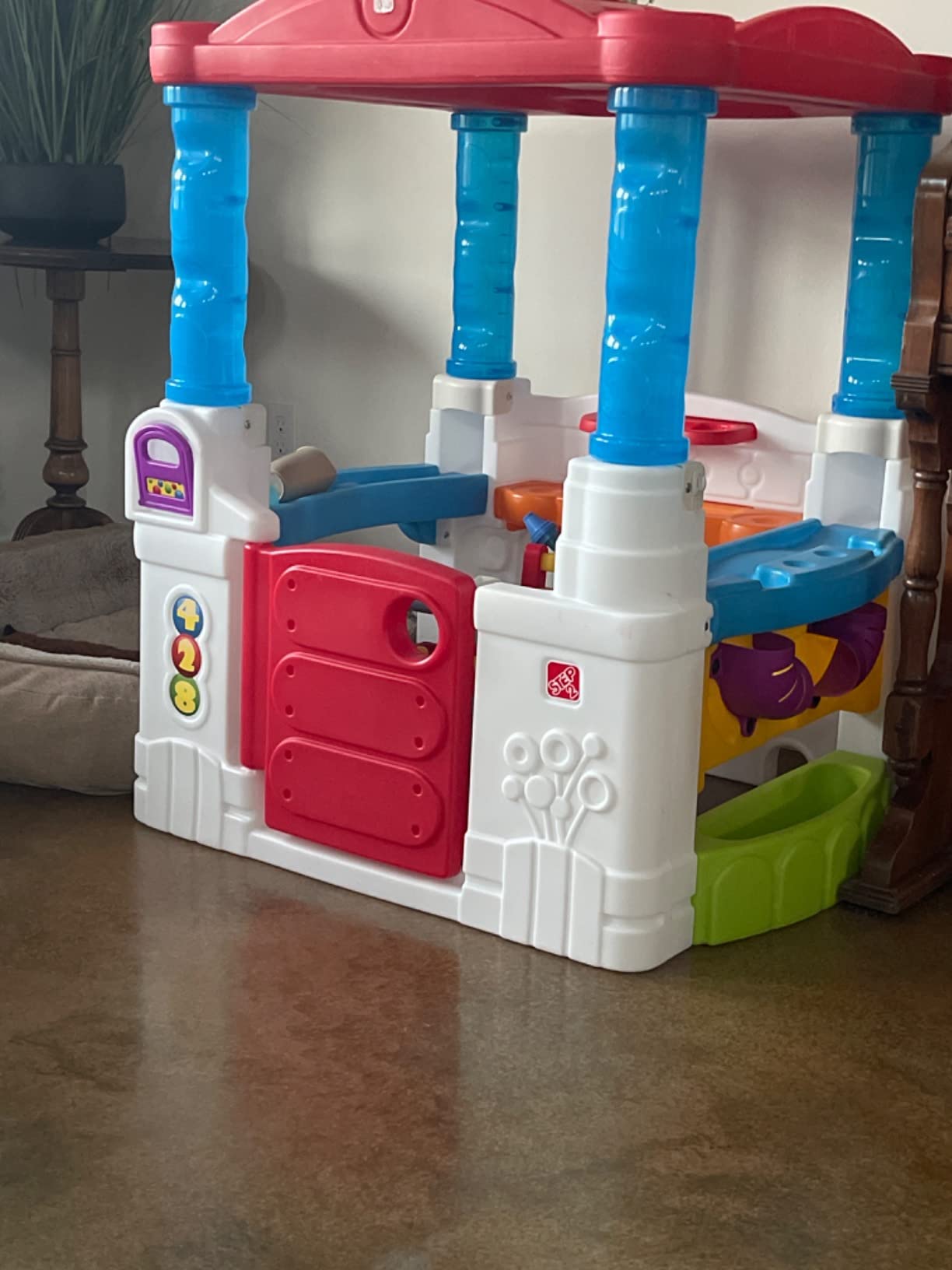
The bottom basin doubles as toy storage, so clean-up is a matter of tipping the balls in rather than chasing them. Double-walled plastic gives the same chipping and fade resistance as the larger Step2 cottages.
At 42 inches tall, 36 wide and 33 deep, it is compact by playhouse standards, and the manufacturer recommends ages 18 months to 10 years. Reviewers rate it 4.6 stars across roughly 1,380 ratings.
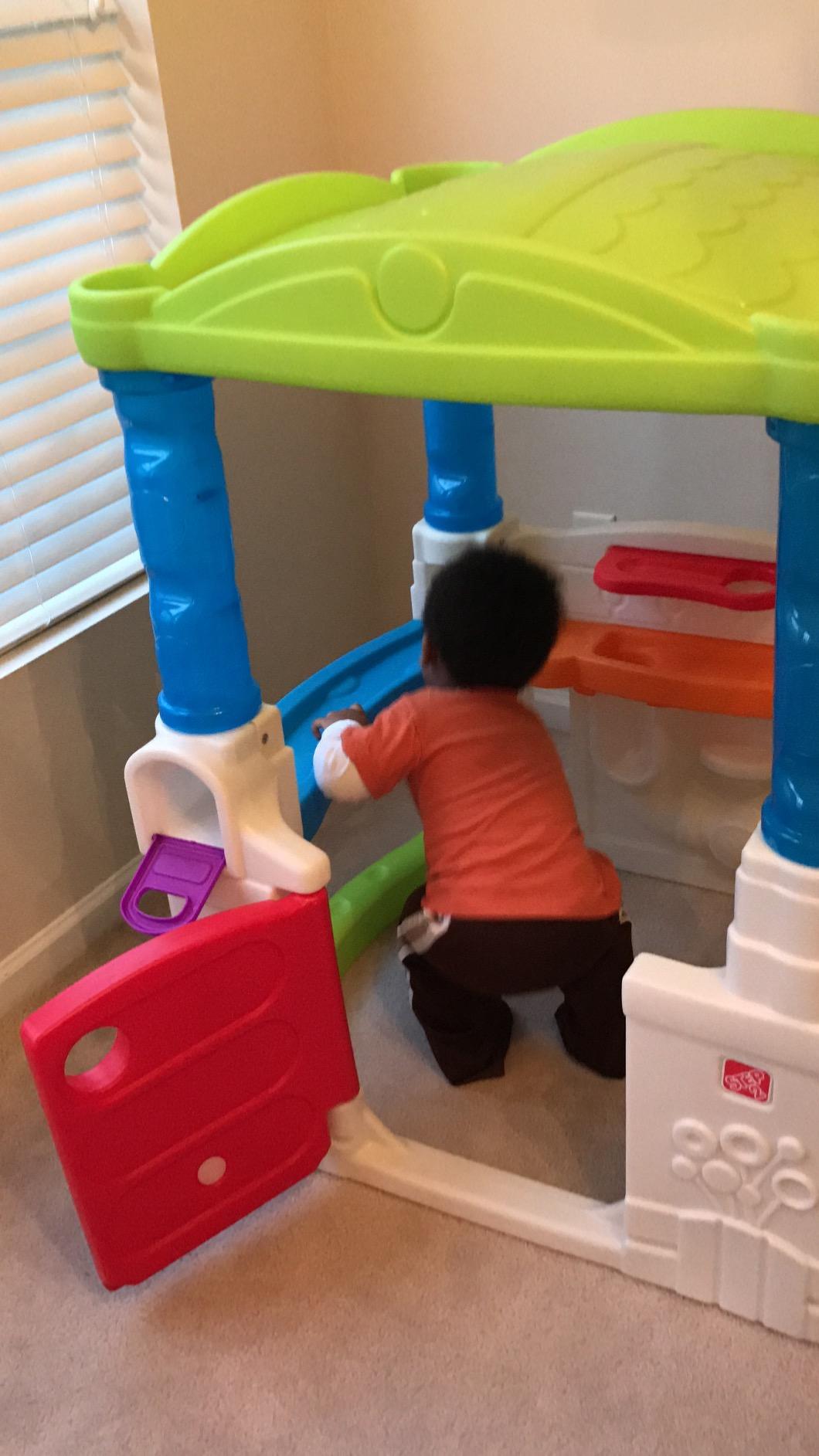
Who this playhouse suits best
It suits a toddler who is 18 months old and already climbing rather than role playing, and any parent whose child treats every toy as a soft-play course. The 18-month rating makes it one of the earliest-usable options in a rigid format.
It also works as a sensory and motor play station indoors, since it needs no lawn. For a playroom in cooler months, that is a solid use.
Where it falls short
At 36 pounds it is heavy for a plastic playhouse, and moving it around a yard or patio takes two people.
The pretend-play inventory is thin compared with the cottage models. A child who wants a doorbell, a kitchen and a mailbox will be disappointed. And the balls will find every corner of the garden.
12. BTMWAY Cedar Playhouse with Play Kitchen – Best for Playdates and Round Two
BTMWAY Kids Outdoor Playhouse with Play Kitchen, Ages 3-8, Fits 2-4 Kids
Cedar house with play kitchen
Fits 2 to 4 children
66.3 inches tall
Pre-cut panels
Pros
- Weather resistant cedar with a water-based finish
- Panels sanded smooth with rounded edges
- Interior fits two to four children
- Doorbell toy phone sink and flowerpots included
- Hardware sorted and labeled before the build
Cons
- No floor is included so a base must be built
- Build runs 3 to 5 hours with two adults
- A few pieces arrive missing or with paint gaps
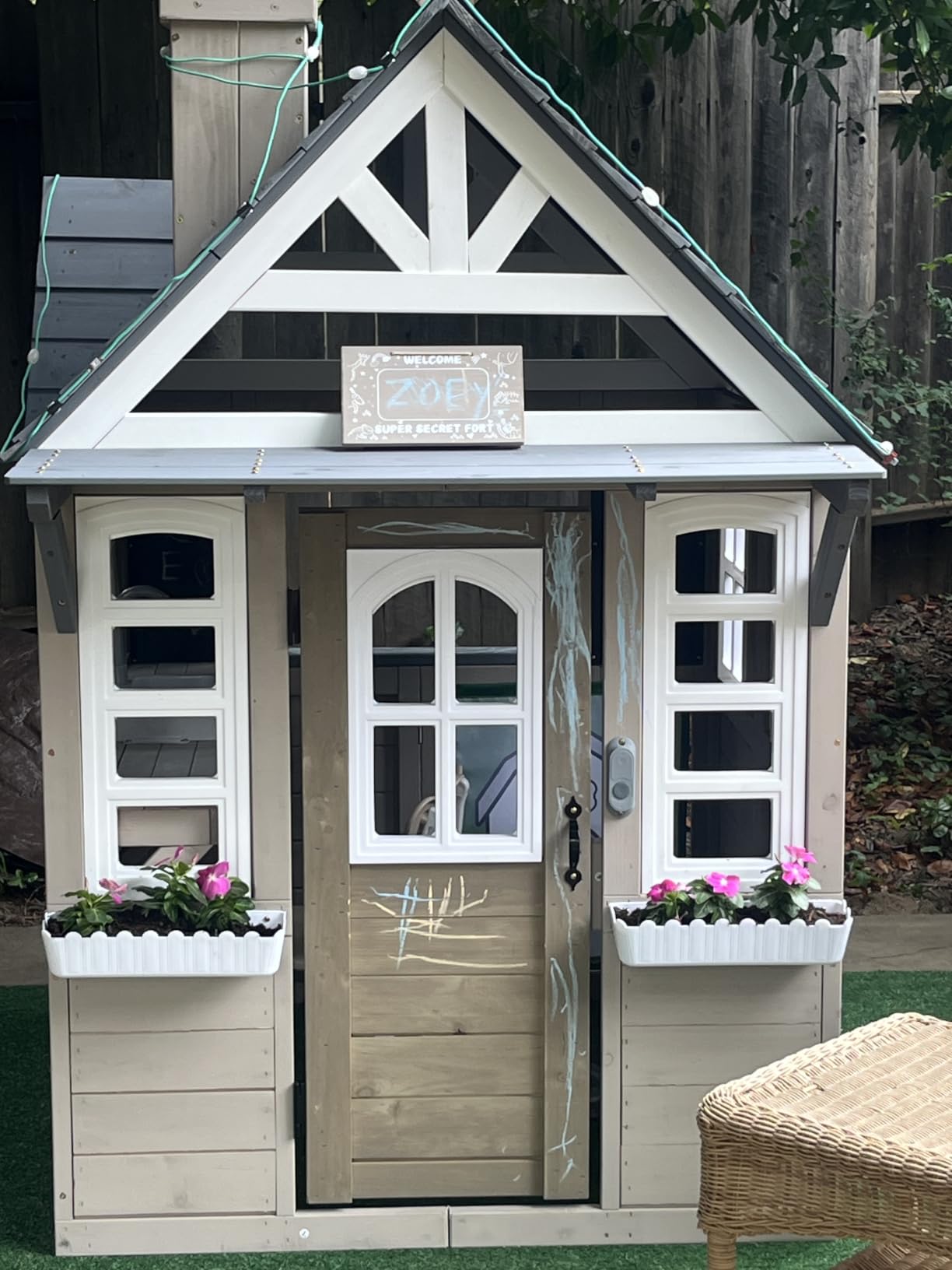
The BTMWAY cedar house is the pick when playdates are the main use case. The interior is specified to fit two to four children, which is the largest play capacity claimed by any wooden model in this roundup and the reason it earns its place here.
Construction details are thoughtful for toddler safety. Panels arrive sanded smooth with rounded edges to reduce splinter risk, the accessories are made without ABS plastics, and the cedar carries a water-based finish intended for year-round outdoor use.
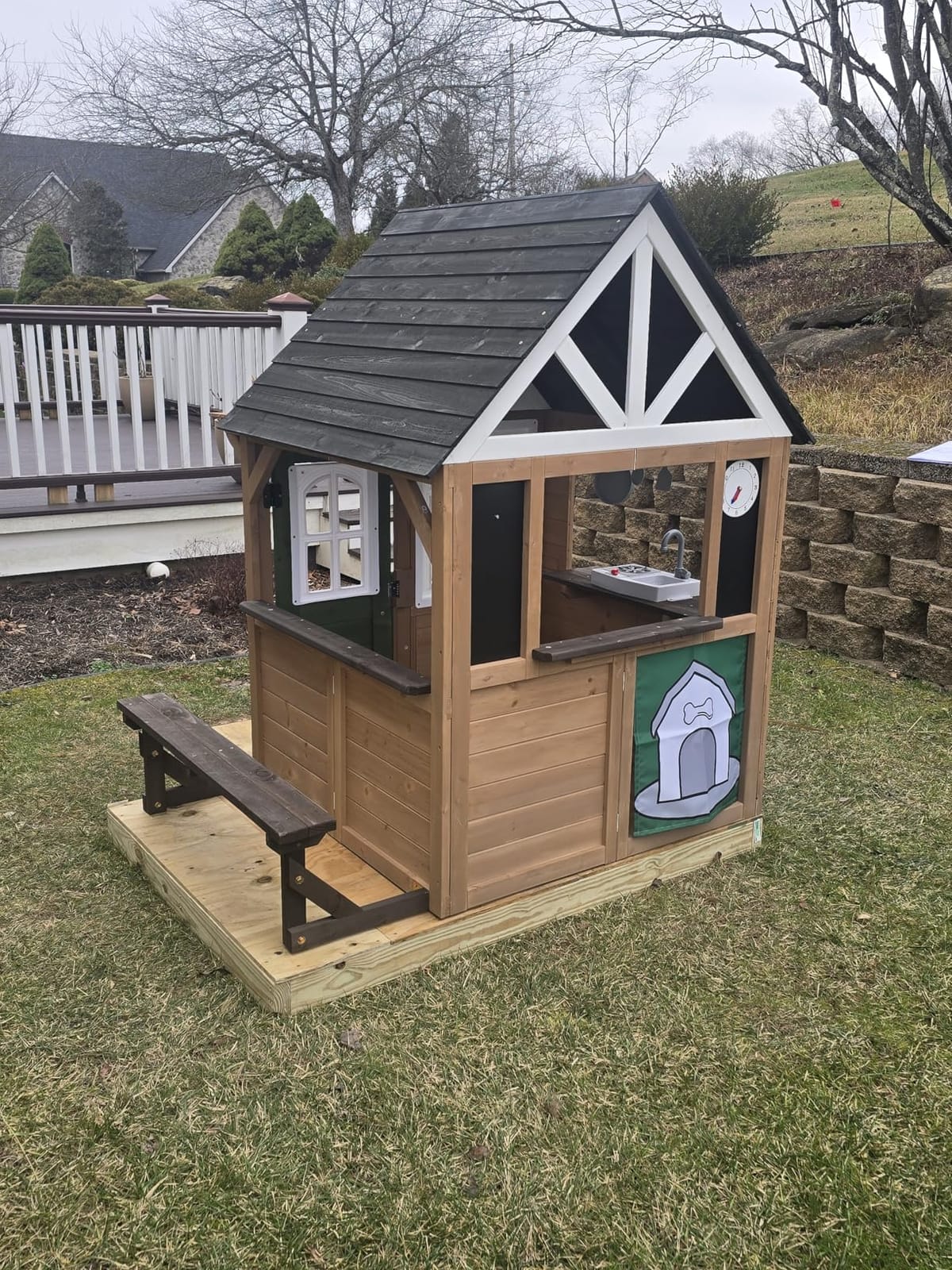
The role-play kit includes a play kitchen with a sink, stove and kitchenware, a working doorbell, a toy phone and window flowerpots. The panels are pre-cut and pre-drilled with hardware sorted and labeled, which is the single biggest predictor of an easy cedar build.
At 43.3 inches deep, 41.3 wide and 66.3 tall, it is one of the taller structures here, and taller means younger children duck through the doorway. The manufacturer recommends ages 3 to 8.
Who this playhouse suits best
It suits a family with a three-year-old or older who regularly hosts friends, and anyone who wants a cedar structure that keeps working through primary school rather than being outgrown at four.
It also suits a household that wants to bring a playhouse inside for winter. Owners report using it in a playroom or basement when the weather turns, which is a good argument for buying a structure this solid in the first place.
Where it falls short
No floor is included, so you need to build a deck or a ground-level base separately. That is extra weekend work and extra material cost that the listing does not reflect.
Build time runs 3 to 5 hours with two adults, and the instructions use millimeters, which some buyers find awkward. A few pieces can also arrive missing or with small paint gaps, and the review base at 140 ratings is much thinner than every other pick here.
How to Choose a Playhouse for Toddlers?
Start with the age rating, then work outward. Everything else in this guide is secondary to matching the structure to a child who can actually use it safely, because a playhouse built for a five-year-old will frustrate a two-year-old who cannot reach the doorbell.
What age is appropriate for a playhouse?
Most playhouses for toddlers start at 18 or 24 months, and that rating is more meaningful than it looks. “Ages 18 months and up” describes a child who can pull to stand, hold a play phone and press a doorbell. “Ages 3 and up” describes a child who can step through a doorway without ducking and negotiate a table with chairs.
Under 18 months, a fabric pop-up or a folding musical house is the right form factor, because rigid playhouses with a latching door are not built to be climbed on. Between 18 months and 3 years, look for a working door, shutters, a mail slot and a low countertop, since those are the features a toddler actually reaches.
A useful toddler-specific fact: interior ceilings in this category run about 5 feet, which feels tall to an adult and right to a child under three. A structure listed at 62 or 66 inches tall will feel roomy, and one at 42 inches will feel snug.
Wood or plastic for an outdoor playhouse?
Wood wins on longevity, plastic wins on price and portability, and fabric wins on indoor flexibility. Here is how the three compare across the factors that decide it.
Wood. Cedar resists decay and insects without a paint job, so panels last far longer than plastic in full sun and rain. Wood needs sealing or staining on a schedule, and it is heavy enough that repositioning is a two-adult job. The tradeoff is a structure that can stay in the yard for years.
Plastic. Double-walled molded plastic resists chipping, fading and cracking, wipes clean, and weighs a fraction of what cedar does. It can get hot in direct sun, and lighter panels feel flimsier to adults than cedar does. It is the easier choice for a first playhouse.
Fabric. Fabric play tents and castles fold flat, weigh under 4 pounds, and move between rooms or travel well. They will not survive a hard winter outdoors and they cannot support climbing. For indoor play or temporary spaces they are the strongest value in the roundup.
Indoor or outdoor?
If you rent, or your outdoor space is a balcony rather than a garden, start from the indoor shortlist: the Fisher-Price musical home, the UTEX pop-up set, the Monobeach castle, or the Step2 Neat and Tidy, which is rated for both indoor and outdoor use from 18 months up.
The Step2 All Around Playtime Patio is the only structure here with a removable canopy, which makes it the most useful buy for a family that wants real outdoor play in summer and floor space back in winter.
How much space do you need?
Measure the footprint before you buy, not after. The largest model in this roundup is 70.9 inches wide, and the compact options are under 40 inches across. Toddlers need lawn space to run as well as house space to hide in, so a playhouse that takes a quarter of a small yard changes how the whole space works.
A useful rule from our own space planning: leave at least 6 feet of clear run space around any playhouse that has a step or a slide. If you cannot, choose a flat-floor model like the Cape Cottage or the Crazy Maze instead.
Should you build one instead?
Building a playhouse is often cheaper in materials, and almost never cheaper in time. Raw lumber plus hardware covers the parts, but your time does not appear on any invoice, and the finished result usually lacks the doorbell, sink and phone accessories that make a toddler play in it rather than sit in it.
Buying wins on time to first play, on accessories, and on the warranty. Building wins if you want a specific size, a specific look, or a house that fits an awkward corner. If you have a drill and a free weekend, build. If you have a toddler, buy.
How do you treat a wooden playhouse?
Cedar arrives pre-stained on the good models, which buys you a first season. After that, a simple annual routine keeps it sound for a decade or more.
First, check the roof, door and any water traps each spring, because rot starts where water sits. Second, clean the panels with mild soapy water and let them dry fully. Third, apply a water-based exterior wood sealer or stain every one to two years, working on the sheltered sides first. Fourth, tighten any loose hardware and sand any raised grain before coating it.
Avoid oil-based stains and paint on play surfaces. Toddlers put hands and mouths on everything, and a low-VOC water-based product is the safer choice on a structure a two-year-old climbs into.
Playhouse Safety and Supervision for Toddlers
Playhouses are among the safer outdoor toys, but they introduce specific risks worth knowing about. Most are behavioural rather than structural, which means the fix is a habit rather than a purchase.
Check the accessories for choking hazards. Play food, small figure sets and loose kitchen utensils are the real risk in any toddler playhouse. Anything a child under 3 could fit through a toilet paper roll should stay out of reach until they turn 3.
Check the door and hinges for pinch points. A latching door with a soft or rounded edge matters for a child who is still learning to control a swinging panel. This is one reason the roundup favors models with rounded, sanded cedar edges.
Supervise the climb, not just the play. Any playhouse with a step, a deck or a slide needs an adult within arm’s reach for children under 3. A toddler can go from fine motor control on a ramp to a fall in about two seconds.
Watch the floor. A foam mat underneath an indoor playhouse stops the knees, and a layer of mulch or grass under an outdoor one softens falls. None of the wooden models in this roundup includes a floor, so this is a required extra rather than an optional one.
Mind the temperature. Plastic playhouses get hot in direct sun. Position a plastic unit in partial shade, or add the canopy, and check the surface before a toddler climbs in at midday.
Keep the doorway visible. Wide windows and open-sided fabric structures are not just nice for light. They let you supervise without opening a door, which is a meaningful safety feature in a structure a toddler will disappear inside.
For families setting up a contained play area alongside a playhouse, our guide to playpens for toddlers covers the same supervision thinking for indoor play.
How long do toddlers stay interested in a playhouse?
Longer than most parents expect, and the deciding factor is what the house offers rather than how big it is. A plain structure with a door is interesting for about a week. A structure with a doorbell, a kitchen, a mailbox, a snack window and a table is interesting for months, because it supports a new scenario each time.
The second factor is access to roles and props. Play food, a phone, a notepad, a set of figure people and a chalkboard on an interior wall all extend the life of a playhouse without buying anything. Families on a small play budget for toddler accessories get the most mileage this way.
The third factor is whether the child can play with someone. A playhouse that only works solo will be outgrown socially long before it is outgrown physically. The models rated for two to four children tend to hold interest longest.
Frequently Asked Questions
What is a good playhouse for a 2-year-old?
A good playhouse for a 2-year-old should have a working door, shutters or a mail slot, and a low countertop or table the child can reach. Look for an age rating of 18 months and up rather than 3 and up, a footprint under about 50 inches, and an interior that does not require ducking. The Monobeach Princess Castle Tent and the Step2 Neat and Tidy Cottage both fit that brief.
Are playhouses good for toddlers?
Yes. A playhouse gives a toddler a defined, named space for open-ended pretend play at an age when physical play alone does not fill the need. Working features like a doorbell, a play phone, a sink and shutters build language and fine motor skills, and they let your child rehearse feeding, caring and helping roles. Outdoor models also convert screen time into active, self-directed play.
Are playhouses safe for toddlers?
They are generally safe, with four real checks. Remove play food, figures and small utensils that fit through a toilet paper roll, since choking is the most common genuine hazard. Check the door and hinges for pinch points. Keep an adult within arm’s reach of any step, deck or slide. And remember that most wooden playhouses come without a floor, so add mulch outdoors or a foam mat indoors.
Which is better for an outdoor playhouse, plastic or wood?
Wood is better if you want longevity, because cedar resists decay and insects and can stay outdoors for years. Plastic is better if you want a lower cost, an easy wipe-down and a structure light enough to move, and double-walled plastic resists fading and cracking. Plastic can get hot in direct sun, while wood needs sealing or staining every one to two years to stay in condition.
What is the best material for a playhouse?
Cedar is the best material for a long-term outdoor playhouse because its natural oils resist rot and insects without a yearly paint job. Double-walled molded plastic is the best all-round material for a first playhouse, since it is light, cheap to maintain and easy to clean. Polyester fabric is the best choice for indoor or temporary play, because it folds flat and moves between rooms.
Is it cheaper to build a kids playhouse or buy one?
Building is cheaper in materials, because raw lumber and hardware cost less than a finished structure, but your time is not free and the result usually lacks the doorbell, sink, phone and accessories that make a toddler play inside it. Buying costs more and gives you a warranty, pre-cut and pre-drilled panels, and play on day one. Build if you need a custom size, buy if you have a young child and a short weekend.
What is the best treatment for a wooden playhouse?
Start by checking the roof, door and any place water collects each spring, since rot begins where water sits. Clean the panels with mild soapy water and let them dry fully. Then apply a water-based exterior wood sealer or stain every one to two years, sanding any raised grain first. Avoid oil-based stains and paint, because toddlers put their hands and mouths on every surface.
Conclusion
The best playhouses for toddlers are not the biggest or the priciest. The Monobeach Princess Castle Tent wins here because it does three things most rivals cannot: it fits three children, it packs into a bag, and it works in a living room as well as a garden. For a sturdier structure built to last, the Backyard Discovery Sweetwater cedar cottage is the one to buy and keep.
Match the age rating first, then the footprint, then the material. A playhouse your child can enter, reach into and open the door of will hold their interest far longer than a bigger one they struggle to get into, and that is what makes it worth the money in 2026.