
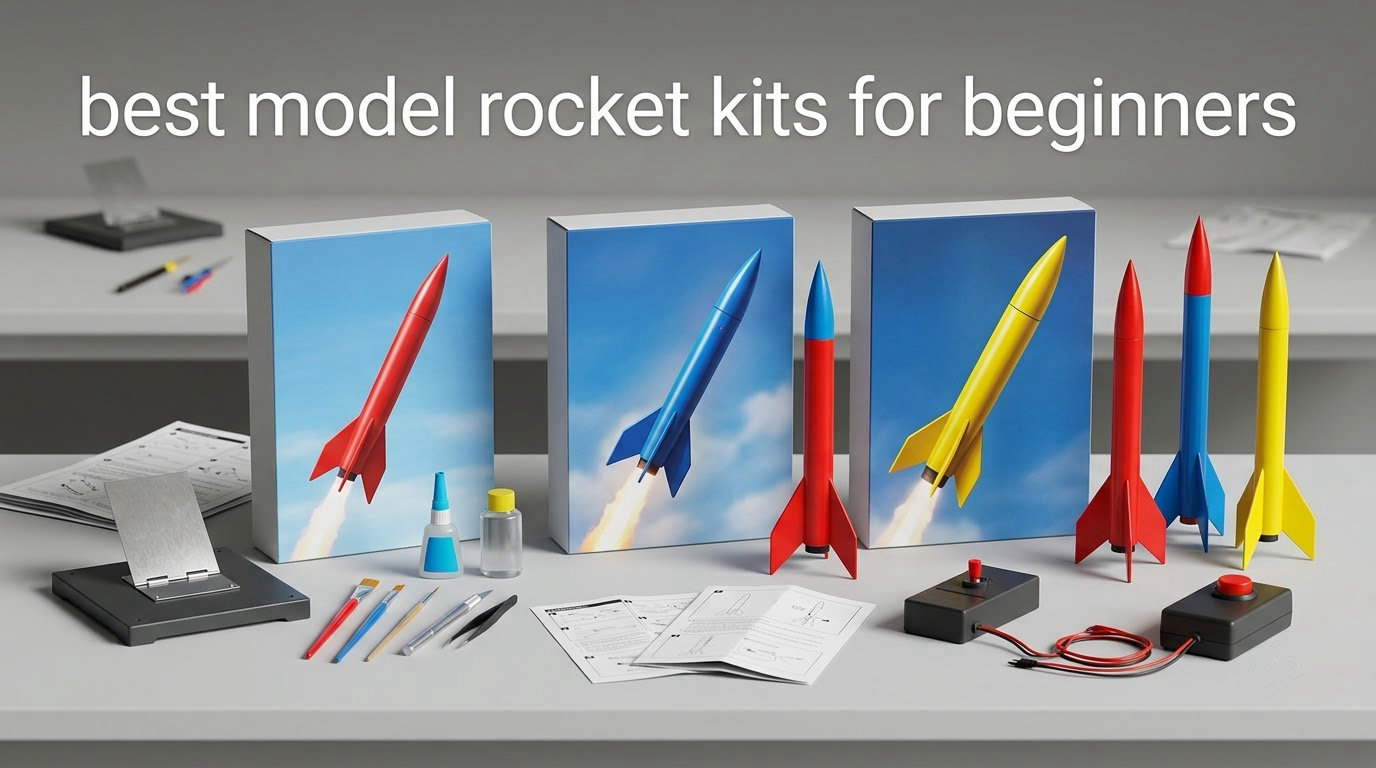
The best model rocket kit for a beginner is the Estes 1469 Tandem-X Launch Set. It builds two different rockets, includes the launch pad and handheld controller in the same box, and is rated for ages 10 and up, which means one purchase covers your first build, your first launch and your second build.
That last part is where most first-time buyers go wrong. A model rocket kit is often just the airframe, a parachute and some glue, while a launch set adds the pad, the controller and the batteries you need to actually fly it. The difference in what you end up holding matters more than any spec on the box, and it is the reason we rank launch sets above bare kits throughout this guide.
Model rocketry is also one of the cheapest hands-on ways to learn real STEM ideas, from propulsion and drag to how centre of gravity and centre of pressure decide whether a rocket flies straight. We have covered other beginner kit categories in the same style, including our picks for aquarium maintenance kits and all-in-one pond kits, because in every hobby the pattern is the same: buy the bundle that removes the second shopping trip.
Everything below is a low-power kit, meaning motors under 4 ounces of total propellant weight, which stay inside the federal rules for unlicensed flying in all 50 states. We looked at build difficulty, what the box actually contains, how hard the rocket is to build for the first time, projected altitude, recovery system and the honest drawbacks that show up in owner reviews.
Table of Contents
Top 3 Picks for Beginner Model Rocket Kits for 2026

Estes 1469 Tandem-X
- Builds two rockets
- Pad and controller included
- 600 ft and 1150 ft altitudes
8 Best Model Rocket Kits for Beginners (October 2026)
| Product | Specs | Action |
|---|---|---|
| Estes 1469 Tandem-X Launch Set |
|
Check Latest Price |
 Estes 1491 Taser Launch Set Estes 1491 Taser Launch Set |
|
Check Latest Price |
 Estes 2452 Athena Estes 2452 Athena |
|
Check Latest Price |
 Space Corps Centurion Starter Set Space Corps Centurion Starter Set |
|
Check Latest Price |
 Mars Colonizer Starter Set Mars Colonizer Starter Set |
|
Check Latest Price |
 Quest Aerospace Gamma Ray Quest Aerospace Gamma Ray |
|
Check Latest Price |
 Quest Aerospace Astra III Quick Kit Quest Aerospace Astra III Quick Kit |
|
Check Latest Price |
 Quest Aerospace Novia Quest Aerospace Novia |
|
Check Latest Price |
1. Estes 1469 Tandem-X Launch Set — Best Overall for a First Buy
Estes 1469 Tandem X Rocket-Building Kit, Beginner Flying-Rocket Model Kit for Ages 10+, Includes Launch Pad and Controller
30 in and 15.6 in rockets
Pad II and controller included
600 ft and 1,150 ft altitudes
Ages 10 and up
Pros
- Builds two different rockets in one purchase
- One rocket is precolored with plastic fins and self-stick graphics
- Complete starter package with pad and controller
- Crossfire ISX reaches 1150 ft projected altitude
- Huge base of owner feedback
Cons
- Engines starters wadding and AA batteries not in the box
- Two rockets means more glue and more build time
- Laser-cut wood fins need careful alignment
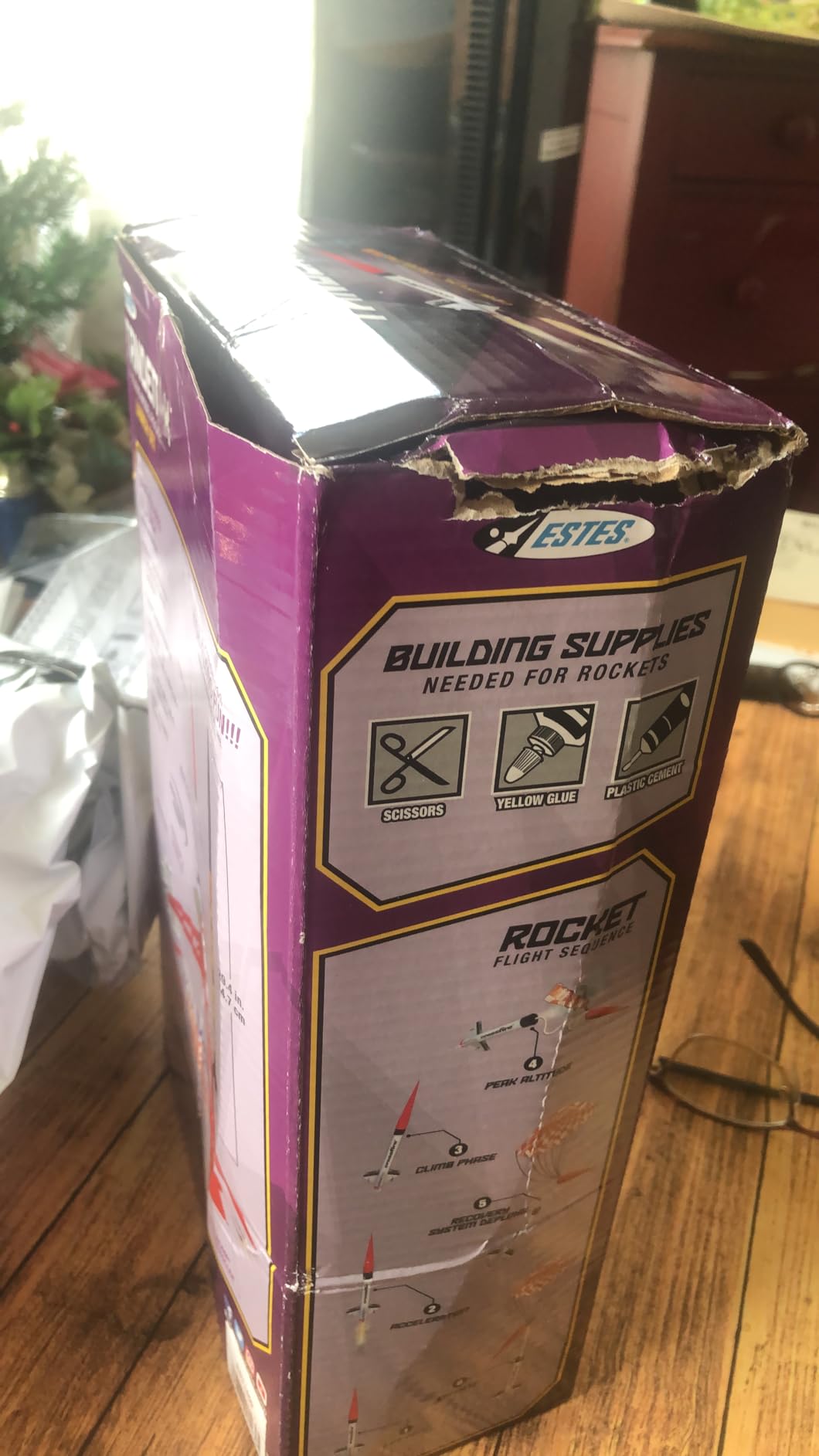
I keep coming back to the Tandem-X because it removes the single most common beginner mistake: buying once and discovering halfway through that you also need a launch system. The Porta Pad II pad and the Electron Beam handheld controller are both in the box, so the moment you finish gluing you can arm the pad and fly.
You build two rockets, not one. The Amazon is 30 inches tall with a projected altitude of 600 feet on a C6-5, and the Crossfire ISX is 15.6 inches tall with a projected altitude of 1,150 feet on a C6-7. The Amazon comes precolored with molded plastic fins and self-stick graphics, which is a genuinely kind choice for a first build.
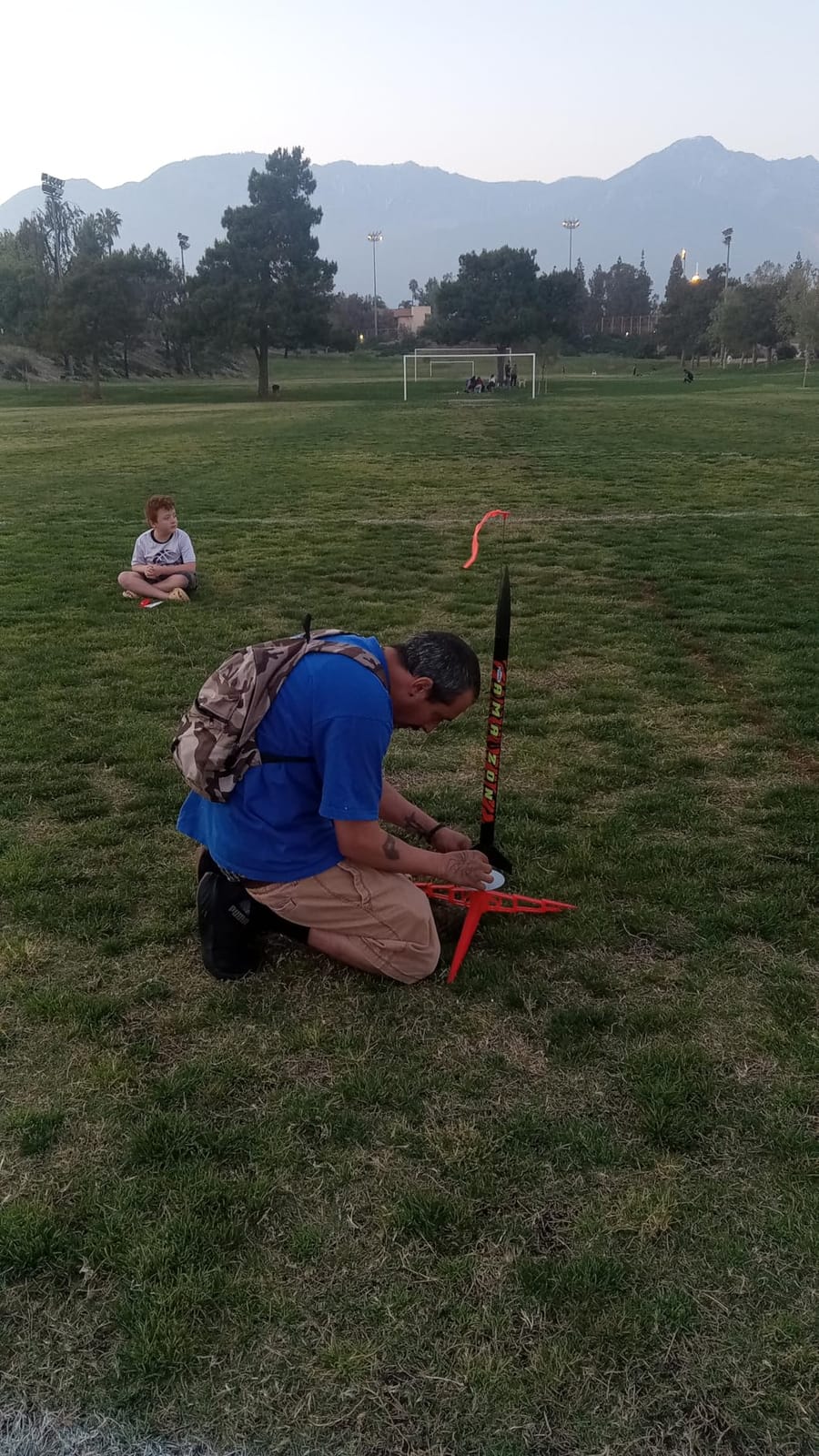
The Crossfire ISX is the more involved of the two. It uses laser-cut wood fins, and fin alignment is the step that decides whether a first rocket flies straight or weathercocks badly. Glue a fin unit square, let it cure fully, and the flight rewards the patience.
What you still have to buy is the same for nearly every kit on this list: engines, starters, recovery wadding and four AA batteries for the controller. Think of that as part of the hobby cost rather than a surprise, because you will use those consumables on every flight you ever make.
Who this kit suits
This is the pick for a parent buying a birthday present and hoping the child will still be interested three launches later. Two rockets means two builds and two flights, and the taller Crossfire ISX gives a visible altitude difference that makes the aerodynamic lesson land.
Forum regulars on r/rocketry repeatedly name this set as the best value entry point, and for once that consensus matches the spec sheet. The one reviewer detail worth planning for is that the second rocket takes longer, so budget a second evening.
Where it falls short
The honest drawback is consumables. Nothing in the box lets you launch, so a first-time buyer who does not read the fine print ends up with a beautiful pair of rockets and nothing to light them with.
The laser-cut wood fins on the Crossfire ISX are also the most alignment-sensitive parts in this roundup. If you are building with a child who wants instant results, the Taser below is an easier first evening.
2. Estes 1491 Taser Launch Set — Best Value Short Build
Estes 1491 Taser Rocket Launch Set, Beginner Flying-Rocket-Model Building Kit for Ages 10+, Includes Launch Pad System
17 inch rocket, E2X skill level
Pad and controller included
Up to 1,100 ft with C6-7
About 10 minutes assembly
Pros
- Precolored body tube and molded fins cut the finishing work
- Short build suits a first kit
- Pad and controller in the box
- About 1100 ft gives a satisfying first flight
- High-visibility parachute simplifies recovery
Cons
- Engines starters wadding and AA batteries not included
- Only one rocket in the set
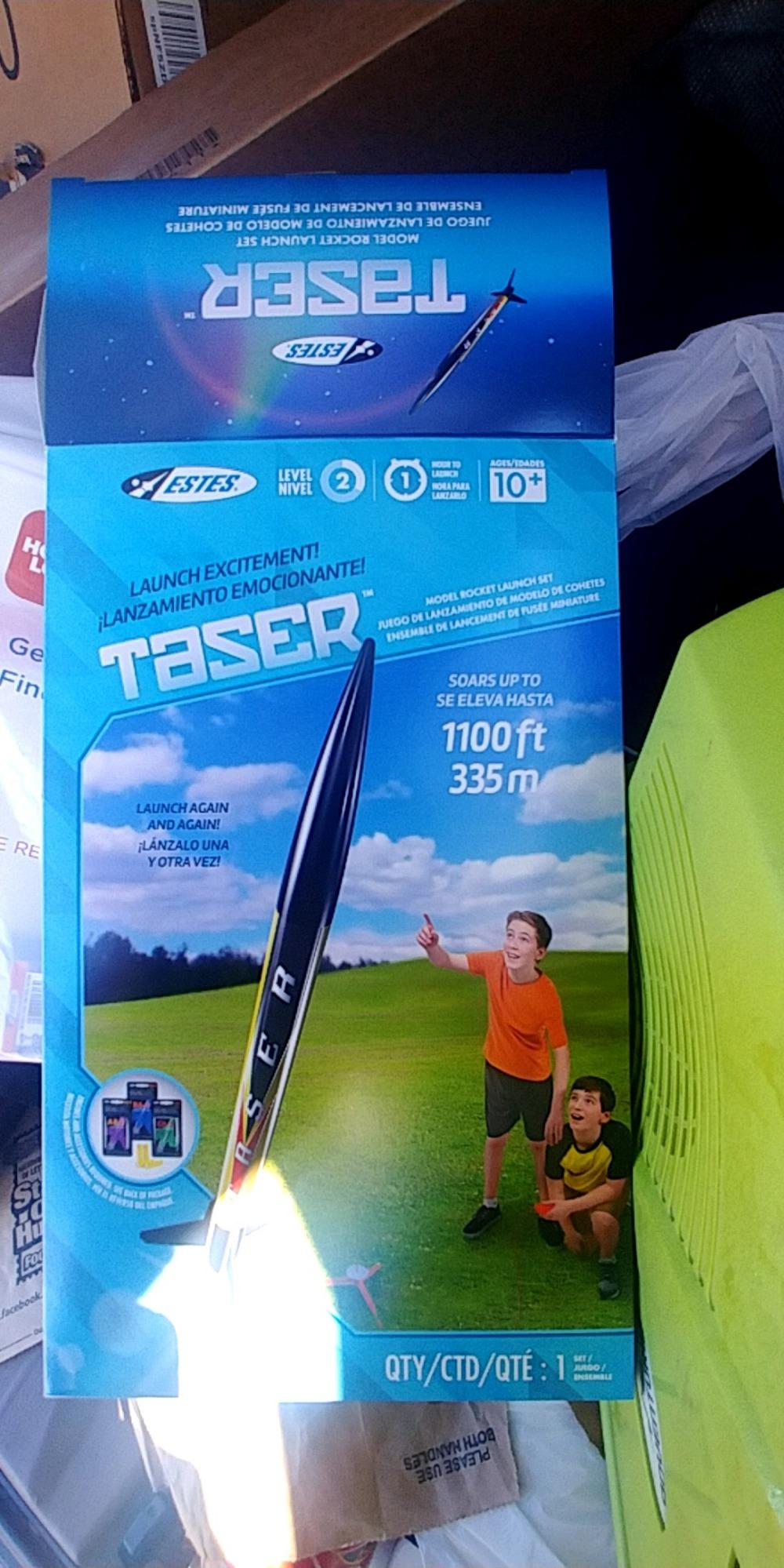
The Taser is the kit I recommend when a build session has to fit inside a single sitting. Assembly is roughly 10 minutes, which sounds almost too fast until you remember that a first-timer is reading every step, cutting every line and waiting for glue to set.
The airframe is 17 inches tall with a custom three-fin aerodynamic design, and it reaches up to 1,100 feet on a C6-5. Engine compatibility covers the whole beginner ladder, including A8-3, B4-4, B6-4, B6-6 and C6-5, so you can start gentle and step up without changing rockets.
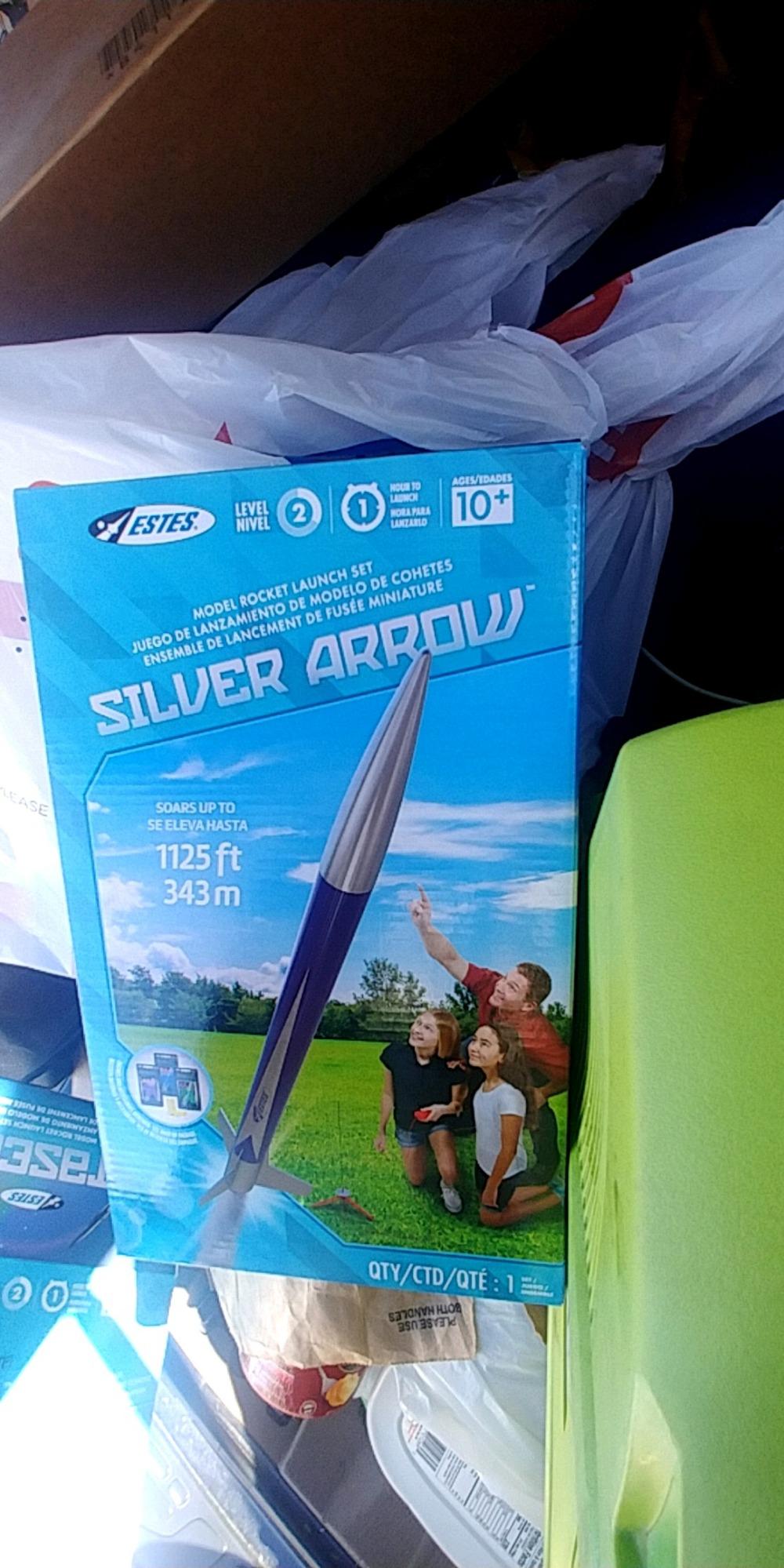
Like the Tandem-X, this is a full launch set. The Porta Pad II pad and the Electron Beam controller are included, and the rocket arrives with a precolored body tube, molded fins, self-stick decals and a high-visibility parachute already in the parts bag.
That combination is why it works so well for a child aged 10 to 12. There is no painting, no sanding and no fin squaring, so the adult supervision question is about launch safety rather than about holding a glue bottle steady.
Who this kit suits
Choose the Taser if you want a guaranteed first flight with the least room for error. A high-visibility parachute and a stable three-fin layout are both forgiving choices when you do not yet know how a rocket behaves off the pad.
It is also the natural second purchase after a Tandem-X owner outgrows the beginner stage, because the engine range reaches further up the impulse ladder than most entry kits.
Where it falls short
You get one rocket, so the replay value drops once the first launch is behind you. If your goal is to keep a child engaged across several weekends, the two-rocket bundle is a better fit.
Consumables are still absent. Budget for engines, igniters, wadding and controller batteries before the first launch day, not after.
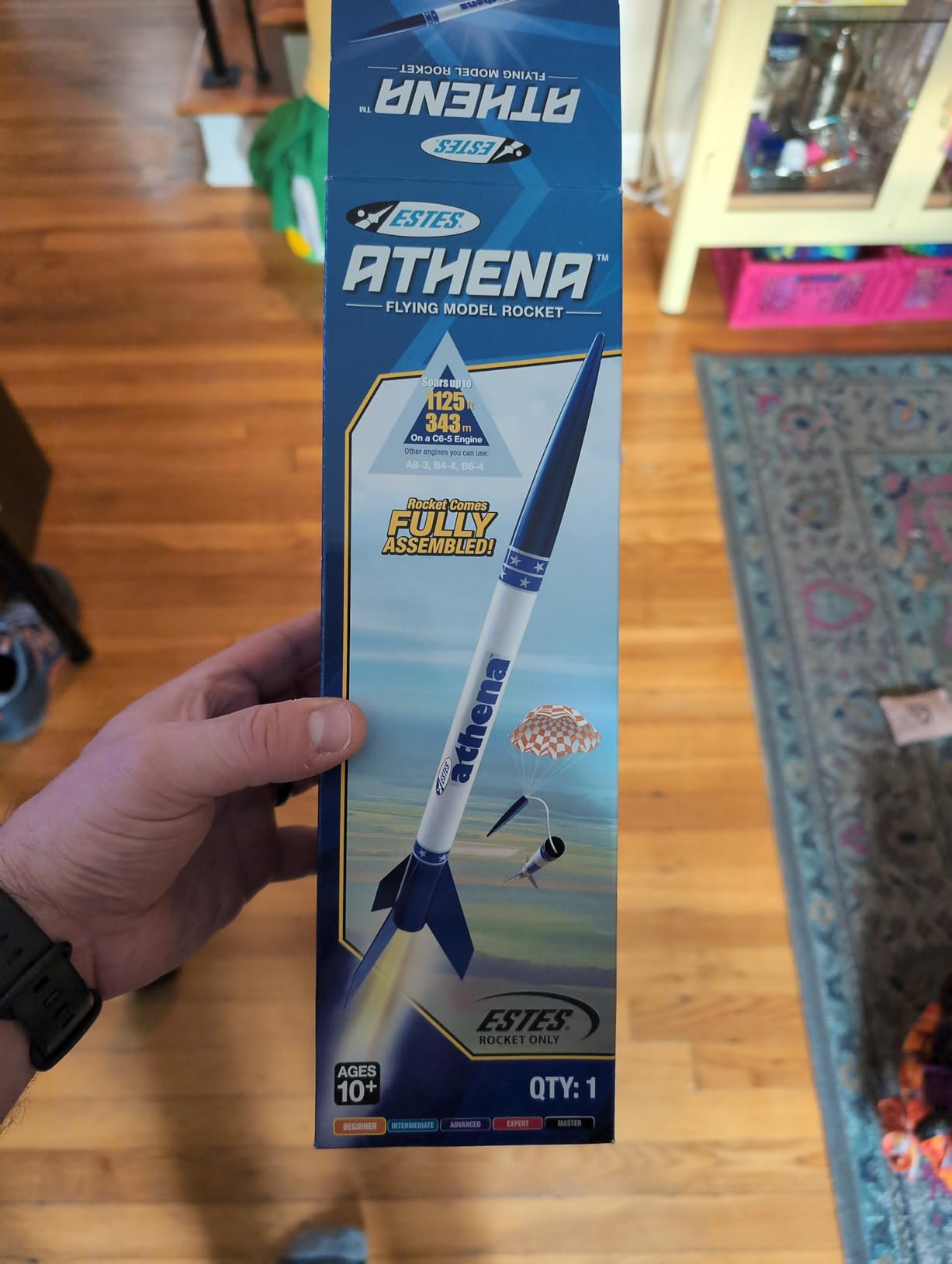
3. Estes 2452 Athena — Best for Kids Who Want to Skip the Build
Estes 2452 Athena Rocket-Building Kit, Prebuilt Beginner Flying-Rocket Model Kit for Ages 10+, Blue
Fully assembled ready-to-fly
Up to 1,125 ft with C6-7
12 inch parachute
About 15 minutes prep
Pros
- Arrives fully assembled for a first-timer
- Only about 15 minutes of prep before launch
- 1125 ft is one of the higher entry-level altitudes
- 12 inch parachute gives reliable recovery
Cons
- No building
- so it teaches less about construction
- Pad controller engines and batteries all separate
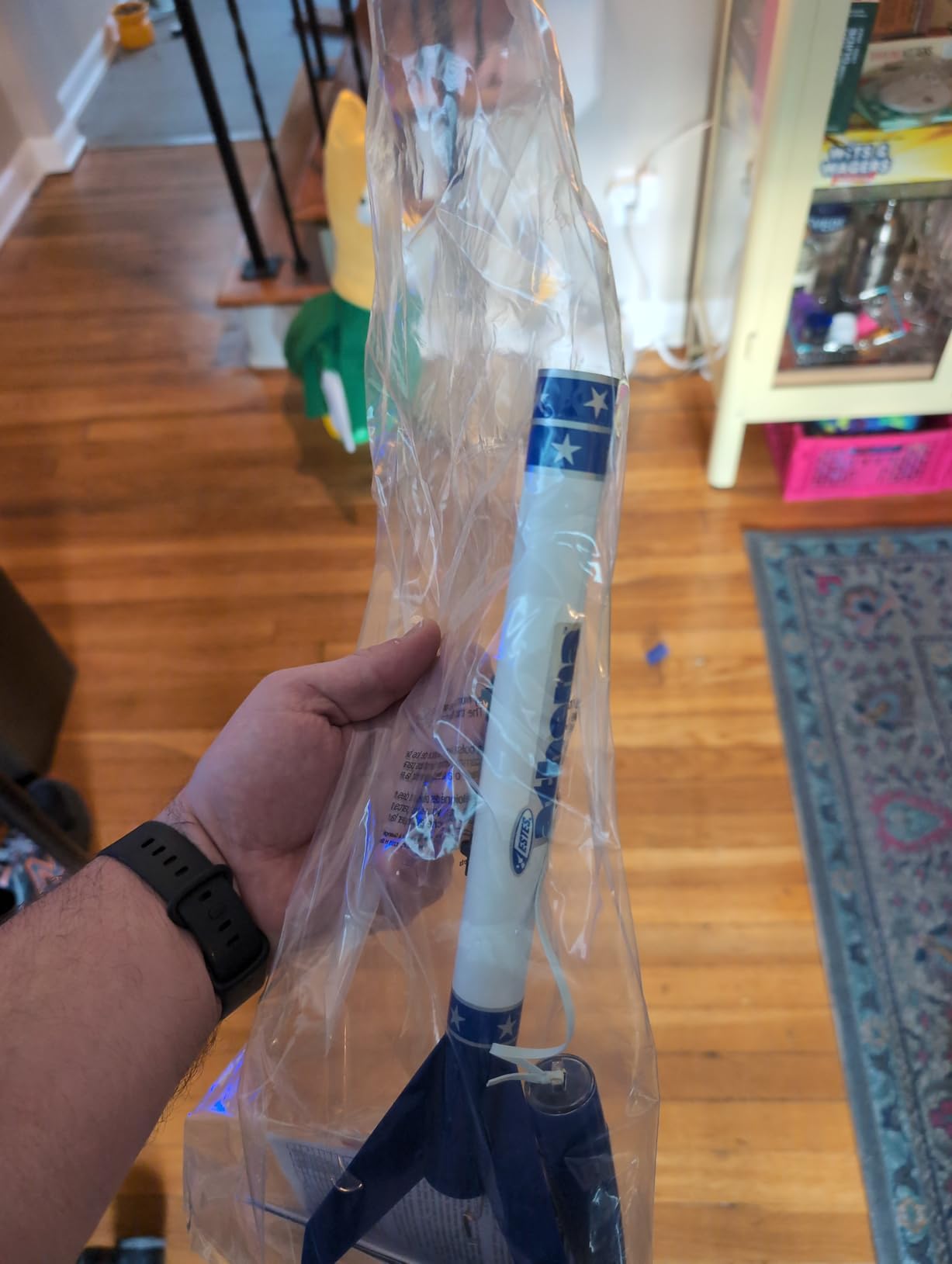
The Athena arrives fully assembled and ready to fly, and roughly 15 minutes of preparation is all it takes before the first launch. That makes it the honest answer for a child whose excitement will not survive a two-hour glue session.
Flight performance is the surprise. Despite needing no build work, it reaches up to 1,125 feet on a C6-5, and it is compatible with A8-3, B4-4, B6-4 and C6-5 engines. The 12-inch high-visibility parachute is a solid recovery choice for a first flight.
What you give up is the STEM part of the equation. Gluing a body tube, squaring a fin unit and watching a rocket stand up on the pad is most of what makes this hobby educational, and the Athena skips all of it.
It is also the least complete purchase here, because the launch pad, controller, engines and batteries are all outside the box. For a child, that means the most exciting part of the gift arrives a few days late.
Who this kit suits
The Athena fits a birthday scenario where the launch has to happen the same day, or an impatient sibling who wants to fly first and build later. Buying it alongside a buildable kit works well: fly the Athena while the other rocket cures.
It also works as a second rocket, since the 1,125-foot ceiling matches the Taser and the Tandem-X Crossfire ISX on motor choice.
Where it falls short
You learn nothing about construction from it. If the goal is a parent-child STEM project rather than a quick thrill, the Tandem-X or a Quest kit is a much better use of the same weekend.
Every accessory is extra, so budget for a pad, a controller, engines and four AA batteries before the first launch.
4. Space Corps Centurion Starter Set — Best All-in-One Box
Estes Space Corps Centurion Model Rocket Starter Set – Includes Rocket Kit (Quick and Easy Assembly), Launch Pad, Four AA Batteries, and Three Motors
Preassembled rocket with three motors
Pad controller and batteries included
Up to 700 ft
9 inch parachute
Pros
- Motors batteries pad and controller all in the box
- Almost fully preassembled so assembly is just the parachute and shock cord
- Three C6-5 motors give several flights immediately
- Distinctive space fighter styling
Cons
- Almost no assembly means little build experience
- Only 42 ratings behind a 4.4 average
This is the only kit in the group that removes the consumables problem entirely. Three C6-5 motors, four AA batteries, the launch pad and the controller all come in the same box, so you can launch the day it arrives.
Assembly is almost nothing. You attach the parachute and the shock cord, and the rocket is ready. It launches to up to 700 feet with the included motors, and it stays compatible with A8-3, B4-4 and B6-4 engines if you want to fly it gentler later.
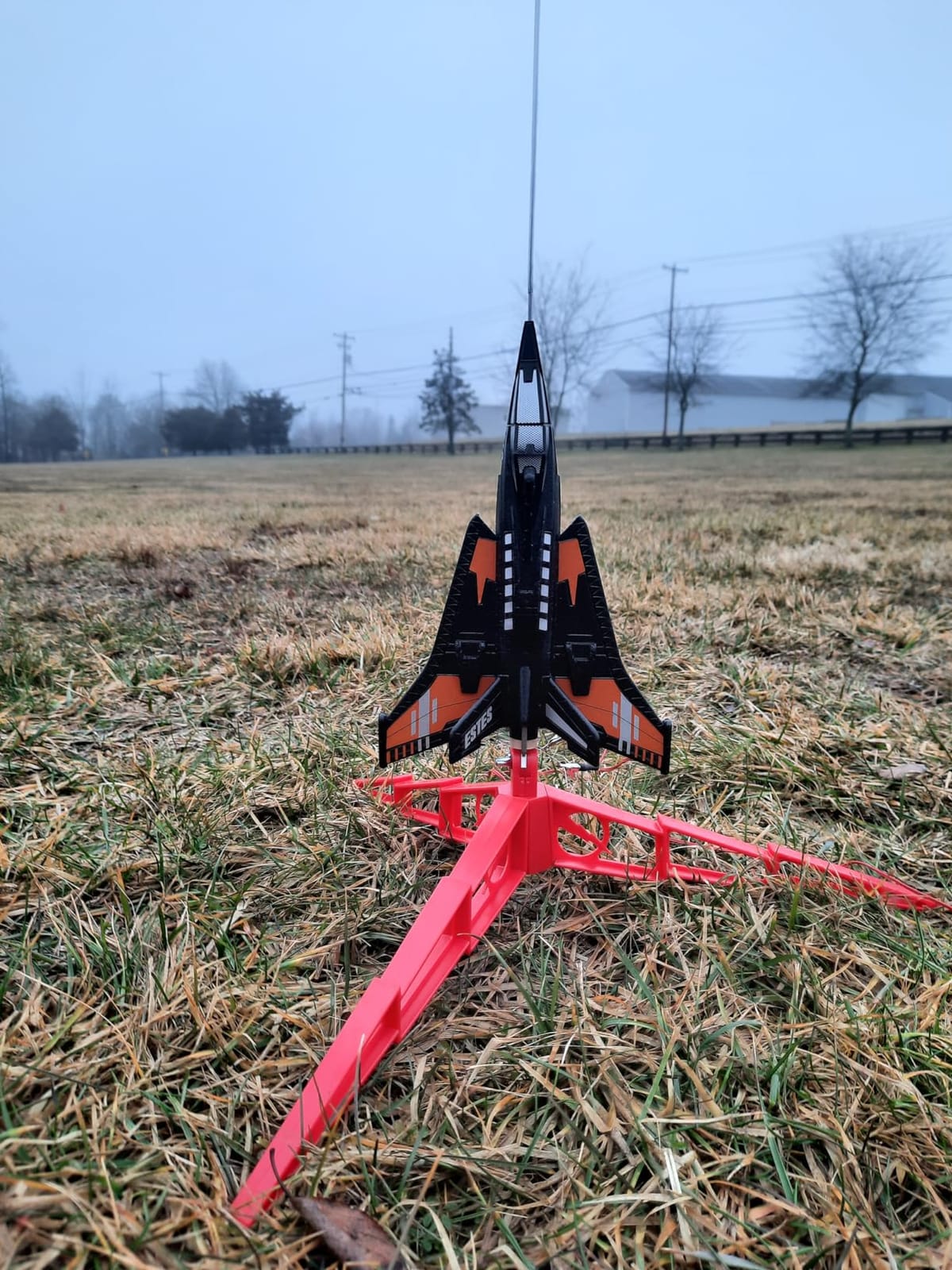
The tradeoff for that convenience is educational. There is no fin unit to square, no body tube to sand and no decals to align, so almost none of the physics is in the build.
Worth knowing before you buy: the rating base is small. Forty-two ratings averaging 4.4 is a positive signal, but it is far thinner than the Estes sets above, so judge it on the one-year warranty and the included hardware rather than on reviews.
Who this kit suits
This is the pick for a gift where the giver cannot be sure the recipient will spend money on accessories, or for a Scout leader running a session with limited preparation time. Everything needed for several flights is already accounted for.
It is also a good second-rocket purchase for anyone whose main complaint about a first kit was running out of engines.
Where it falls short
You get very little hands-on work, which defeats the purpose for anyone who chose this hobby to build things. Expect a quick launch rather than an afternoon project.
At up to 700 feet it flies lower than the Estes launch sets, and the styling is deliberately sci-fi rather than traditional, so it may not appeal to an adult returning to the hobby.
5. Mars Colonizer Starter Set — Best Pre-Finished Build
EX ELECTRONIX EXPRESS Mars Colonizer Model Rocket Starter Set, Beginner Level, Pre-Finished Parts, Includes Launch Pad, Controller, 18-inch Parachute and Everthing Need to Launch.
Pre-finished parts, no painting
18 inch parachute included
Pad and controller included
Up to 250 ft with C6-5
Pros
- Everything to build and launch in one box
- Pre-finished parts remove cutting sanding and painting
- Pre-wrapped body tube with full-color graphics
- Landing struts and molded nosecone
Cons
- Modest 250 ft ceiling for a launch set
- Only 2 ratings behind the 4.6 average
The Mars Colonizer is a build with none of the finishing work. No cutting, no sanding and no painting, just assembly with the included glue, and the body tube arrives pre-wrapped with full-color graphics.
It is a genuine starter set, with the Porta-Pad II pad, the Electron Beam controller and an 18-inch parachute recovery system included. Rated for ages 8 and up, it is the earliest age recommendation on this list.
One specification stands out against the others: up to 250 feet with a C6-3 or C6-5. That is a fraction of what the Estes kits reach, and it is the honest cost of the pre-finished approach on a kit this size.
Who this kit suits
Pick this for a younger child who is not ready for scissors and glue, and for anyone who wants a Mars-themed rocket with landing struts rather than a plain airframe. The included pad and controller remove the second shopping trip entirely.
It is also a good match for a classroom or youth group where the goal is a shared launch rather than an individual build.
Where it falls short
The 250-foot ceiling is modest. Your child will see a launch, but not a dramatic climb, and the flight will not compete visually with an Estes kit on a C6-7.
With only two ratings behind the 4.6 average, there is very little owner feedback to judge build quality by. Treat the stated specification set as the more reliable basis for your decision.
6. Quest Aerospace Gamma Ray — Best for Payload Experiments
Quest Aerospace Gamma Ray Model Rocket Kit
Color coded laser-cut balsa
Payload compartment
Parachute recovery
Balsa fins hold alignment
Pros
- Payload compartment for experimenting with weight and altitude
- Color coded parts and picture-based instructions
- Precision laser-cut balsa fins hold alignment
- Kevlar shock cord system
- Used for a Cub Scout space merit badge
Cons
- Payload bay is smaller than some buyers expect
- Balsa fins are stiffer and need care when gluing
- Engines and launch system not included
The Gamma Ray is the only kit here with a payload compartment, and that changes what a first rocket can teach. You can add a small mass, launch, then remove it and compare how altitude and stability respond.
Build quality is the strongest argument. Color-coded parts, a blowmolded plastic nose cone, precision laser-cut balsa fins and a Kevlar shock cord system make this a kit that rewards careful work, and owners report successful flights on B-class engines.
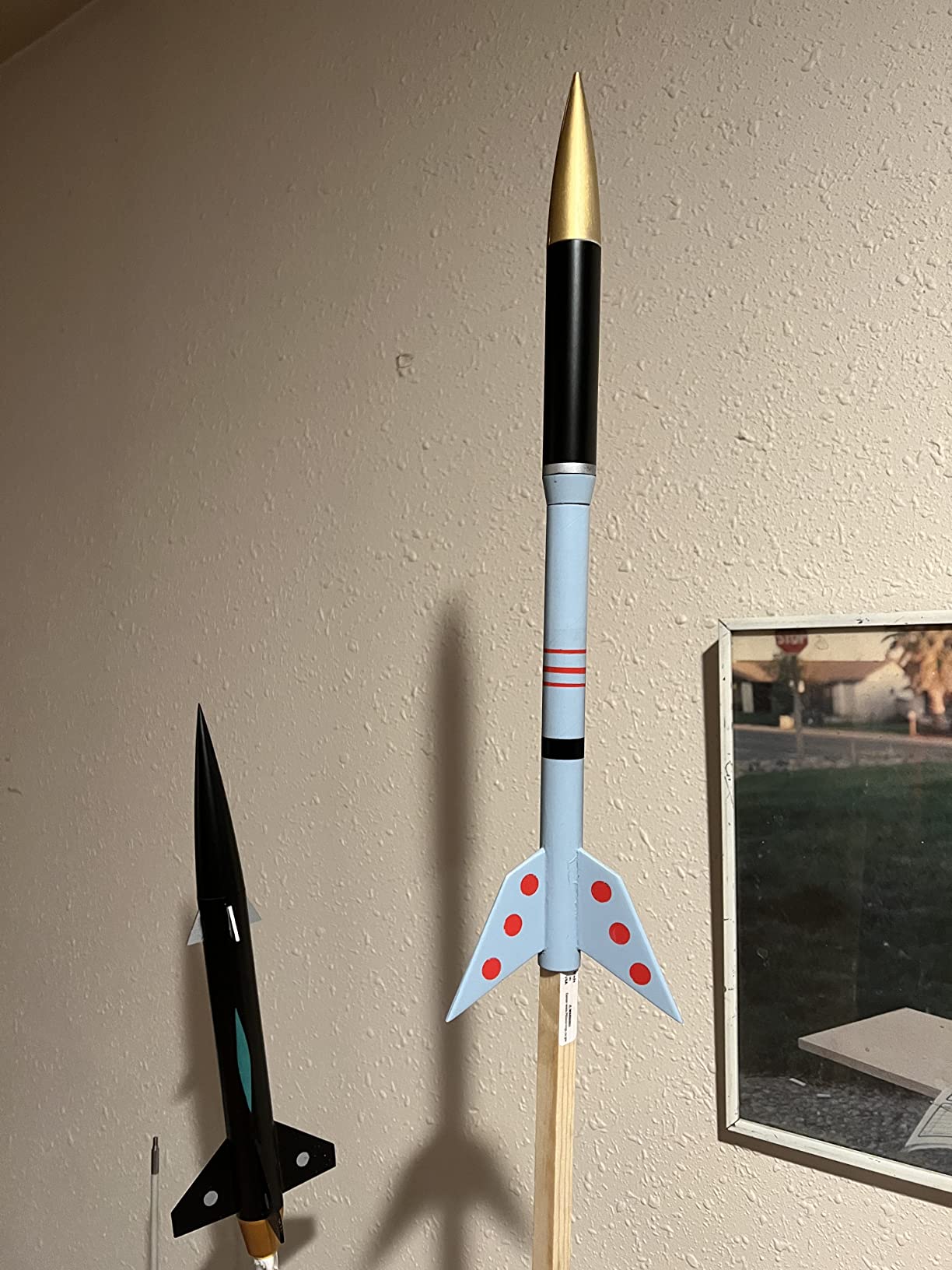
One practical warning: the balsa on this kit is noticeably stiffer than older, thinner fin stock. That is good for holding alignment, but it means the glue joint needs more pressure and more curing time than a beginner expects.
Also note that engines and a launch system are outside the box. If you already own a pad and controller, that makes this an excellent value upgrade. If not, budget for the hardware first.
Who this kit suits
This suits an older child or adult who wants to understand why a payload affects altitude, rather than simply watch a rocket go up. A Scout leader running a space exploration merit badge activity gets a kit that supports the actual experiment.
Anyone with a launch system already on hand should look here first, because the quality of the airframe is a step above the plastic kits.
Where it falls short
The payload bay is smaller than buyers tend to imagine, so plan a simple experiment with a few ounces rather than a substantial payload.
Five ratings is a very small base, and one reviewer notes the name is easy to confuse with the Estes X-Ray, which is worth knowing when you search for replacement parts.
7. Quest Aerospace Astra III Quick Kit — Easiest Build, Fewest Complaints
Quest Aerospace Astra III Model Rocket Quick Kit
Molded fins, no cutting needed
Color coded parts
Parachute recovery
Kevlar shock cord
Pros
- Molded fins remove the cutting and sanding step
- Parachute recovery is more visible than a streamer
- Color-coded parts keep assembly straightforward
- Highest average rating in the group
Cons
- Molded fins cannot be trimmed if a fit is off
- Only 6 ratings behind the 5.0 average
- Launch system and motors not included
The Astra III is the fastest route to a finished rocket. Molded fins mean there is no balsa to cut, sand or square, so the whole build reduces to joining a few color-coded parts around a blowmolded nose cone.
Recovery is handled by a parachute rather than a streamer, and for a first flight that is the better choice. A parachute is slower and far easier to spot in a field, where a streamer can land before you have picked a landing spot.
It also carries a Kevlar shock cord system, which is a durability detail you would not expect at this level. The airframe weighs 4.8 ounces and its package measures a mid-sized 5 by 5 by 15 inches.
Who this kit suits
This is the pick for a builder who wants a real assembly experience with no fiddly steps. It suits a child moving up from a pre-finished rocket and an adult who wants a relaxing evening project rather than a test of fin alignment.
Anyone who already owns a pad and controller gets a complete first rocket from this one purchase.
Where it falls short
Molded fins cannot be trimmed or adjusted, so a fit that is slightly off cannot be corrected. That flexibility is exactly what a laser-cut kit gives you, so the two approaches suit different builders.
Six ratings, all five stars, is too small a sample to treat as a track record. There is no negative signal, but there is not much of a signal either.
8. Quest Aerospace Novia — Simplest Kit to Get Started
Quest Aerospace Novia Model Rocket Kit
Color coded laser-cut balsa
Blowmolded nose cone
Streamer recovery
Compact airframe
Pros
- Lowest cost kit in the roundup
- Simplest Quest package for a first build
- Color-coded parts and laser-cut balsa fins aid assembly
- Kevlar shock cord at this level
Cons
- Streamer recovery is slower and less visible than a parachute
- Smallest airframe of the Quest kits listed
- Launch system and motors not included
The Novia is the smallest and simplest airframe in the group, and it is a genuine first build rather than a shortcut. Color-coded parts, precision laser-cut balsa fins and a blowmolded plastic nose cone make assembly easy to follow, and the Kevlar shock cord is a good detail at this level.
The difference that matters is recovery. This kit uses a streamer, not a parachute, so the rocket descends more slowly and with far less visual tracking. Expect to spend more time walking toward the landing spot.
It weighs 18 grams and measures 7 by 7 by 11.5 inches, and there is a small cluster of two-star ratings in the twelve reviews, so expectations should be set around a simple first rocket rather than a high-flying model.
Who this kit suits
The Novia fits a first build on a tight budget, or a second rocket for a builder who already has hardware. The streamer is also a useful teaching contrast if a child flies this and a parachute kit side by side.
It is a reasonable choice for an indoor-friendly small field, where a slow streamer descent is easier to follow than a fast parachute.
Where it falls short
Streamer recovery is the main compromise. A streamer is less visible on the way down and less forgiving when the wind picks up between launch and apogee.
Engines and a launch system are outside the box, so on its own this is a rocket you cannot fly yet.
How to Choose Your First Model Rocket Kit
The first decision is simple: buy a launch set rather than a bare kit unless you already own the hardware. A launch set bundles the pad, the controller and usually the batteries, and it removes the most common first-weekend problem of having nothing to launch with.
Second, understand what E2X means. It is Estes labelling for a kit that requires assembly but no painting or advanced finishing, and it maps closely to NAR Level 1 requirements, which are the entry point for new fliers. A pre-finished kit like the Athena skips the build but does not change the safety class.
Third, pick an engine you can grow out of. The code reads thrust class first, then average thrust duration, then delay. An A8-3 is gentle and ideal for a first flight, B4-4 and B6-4 are the everyday workhorses, and a C6-5 or C6-7 gives the higher apogee the Estes kits are rated for.
Fourth, think about who is flying. Ages 10 and up is the standard recommendation across these kits, and any child under that should have an adult handling the launch controller. A pre-finished kit with no scissors suits younger children better than a laser-cut balsa kit.
Fifth, on fins and recovery: three fins are more forgiving on a beginner build because there is less surface to align, and a parachute is easier to track on descent than a streamer. Neither choice is wrong, but they change how forgiving your first launch is.
Setting up the launch pad itself is the part beginners overcomplicate. Small, portable pads like the compact kit approach we use for other beginner hobbies applies here: keep the hardware minimal, lay it out before the first launch, and learn the four safety checks before you ever arm a motor.
If a rocket will not launch, work through this in order. Check that the igniter is pressed firmly into the motor, confirm the motor casing is seated to the stop in the motor mount, verify the launch rod is clear and the blast deflector is aimed away from people, and finish with fresh batteries in the controller. A loose igniter causes most first-launch failures.
Finding a Legal Launch Site in 2026
Low-power model rockets are legal to fly anywhere in the United States under 14 CFR Part 1015, as long as you stay under the weight and altitude limits and follow the safety code. Permission is the part people forget, and it comes from people rather than from regulations.
You need the landowner’s permission in writing where possible, and for a large open field you may also need approval from the local fire marshal. Clubs such as the National Association of Rocketry and the Tripoli Rocketry Association run regular launches where a beginner can simply show up and join, which is the easiest route for a first flight.
Before you arm the pad, check clearance, wind speed and the position of spectators. Stand well back from the pad, keep everyone behind the launcher’s shoulder, and pick a landing area you can reach on foot. Weather matters more than beginners expect, and a windy day is the most common reason a first flight ends in a tree.
A useful habit is to simulate before you fly. Free design software lets you check stability and predicted altitude for a motor choice, which is exactly how experienced fliers decide whether a C6-7 is a sensible first flight.
Frequently Asked Questions
What is the best model rocket kit for a beginner?
The Estes 1469 Tandem-X Launch Set is the best model rocket kit for a beginner because it builds two different rockets, includes the Porta Pad II launch pad and the Electron Beam launch controller, and is rated for ages 10 and up. One purchase covers a first build, a first launch and a second build.
What is the best model rocket kit for kids?
For kids, the best choice depends on age and patience. The Estes 2452 Athena arrives fully assembled and needs about 15 minutes of preparation, which suits an impatient child. The Estes 1491 Taser takes roughly 10 minutes to assemble and includes the pad and controller, so it suits a child who wants a real build with the same-day payoff.
What age to start model rockets?
Most of these kits carry a manufacturer recommended age of 10 years and up, with pre-finished sets listed as low as 8 years. Under age 10, an adult should handle the launch controller and the recovery device. Above 10, a child can usually do the build and loading with supervision at the pad.
Are Estes rockets legal to fly?
Yes. Estes beginner kits use low-power motors that fall under 14 CFR Part 1015, so no license is needed and flying is legal in all 50 states. You do need the landowner’s permission, and for a large open field that may also mean fire marshal approval. Following the NAR safety code is what makes the permission straightforward.
What are the requirements for a Level 1 rocket?
A Level 1 rocket is a single motor stage, weighs no more than 4 ounces ready to fly, uses a motor with no more than 4 ounces of total propellant weight, flies to a projected altitude of 1,200 feet or less, and uses a recovery device that brings it down with no parachute failures, no fire hazards and no injury risk. Most Estes E2X beginner kits are designed around these limits.
My model rocket is not launching, what should I check?
Check four things in order: the igniter pressed firmly into the motor, the motor casing seated against the stop in the motor mount, the launch rod clear with the blast deflector aimed away from people, and fresh batteries in the launch controller. A loose or mis-seated igniter causes most first-launch failures. Also confirm the pad safety switch is set to safe before you approach the pad.
Which Beginner Model Rocket Kit Should You Buy in 2026?
For most first-time buyers, the Estes 1469 Tandem-X is the pick, because it combines two builds with a complete launch system in one box. Choose the Estes 1491 Taser if you want the shortest build, the Estes 2452 Athena if a child needs to fly the same day, and the Space Corps Centurion Starter Set if you would rather not make a second purchase for engines and batteries.
Add a pack of A8-3, B6-4 and C6-5 engines, some starters, recovery wadding and a set of spare AA batteries to the box. Then take it to a club launch, keep everyone well back from the pad, and enjoy the 2026 version of a hobby that gets better every time you add a new motor.