
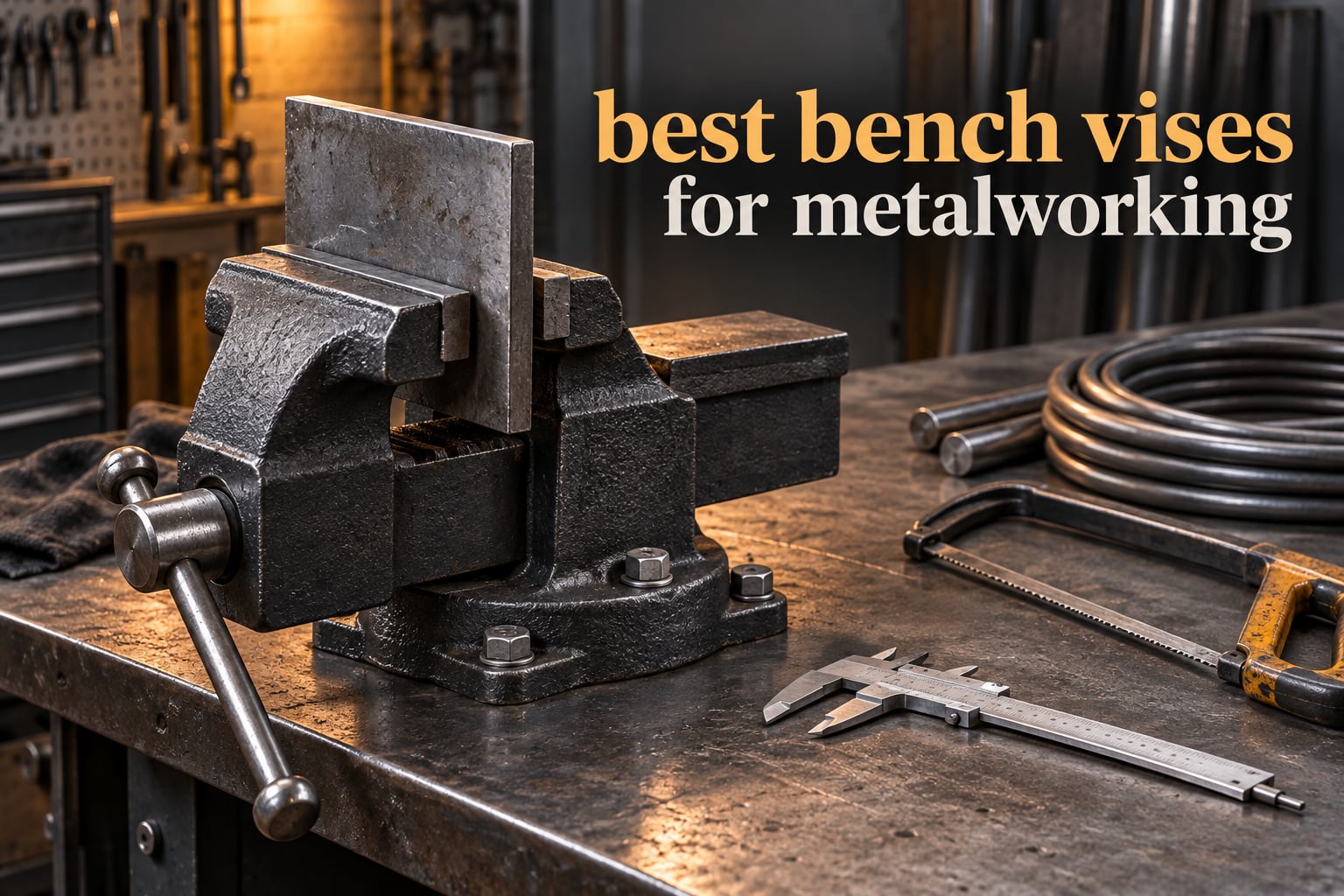
A bench vise is a clamp bolted to a workbench that grips a workpiece so it cannot move while you saw, drill, file, tap, or hammer it. Metalworking models use hard serrated steel jaws and a screw or lever handle to generate thousands of pounds of clamping force.
That distinction matters more than most roundups admit. A woodworking vise has wide, shallow, textured jaws meant to grip a board without crushing it. A metalworking vise has narrow, hard, replaceable jaws designed to bite into steel, plus an anvil, a throat deep enough to clear the workpiece, and a base heavy enough that it does not walk across the bench when you lean on the handle.
This roundup covers the best bench vises for metalworking only. We left the woodworking vises out entirely, and every model below is rated on the four things that actually decide whether a vise works on metal: clamping force, throat depth, jaw opening, and how well it stays put under load. We also weighed replaceable jaw caps, since forum complaints consistently trace back to a screw or jaw set that cannot be swapped when it wears.
Our team worked through ten of the highest-rated bench vises for metalworking on the market, comparing published spec sheets against what buyers report after months of daily use. We read the small print on mounting hardware more carefully than any competitor does, because a vise that creeps under a hammer is not a vise you can use for metalwork, no matter what its listing claims.
Two measurements decide most purchases, and buyers mix them up constantly. Jaw width is how tall the jaws are, measured across the clamping face, and jaw opening is how far they separate.
Throat depth is the third, and it is the number that tells you whether your largest workpiece will actually fit in front of the vise rather than overhanging the base. Every review below lists all three.
Table of Contents
Top 3 Picks: Best Bench Vises for Metalworking 2026

VEVOR 6-Inch Bench Vise
- 6-inch jaw
- 4496 lbs clamp force
- 360-degree swivel
- magnetic soft jaw pads

Yost 460 Combination Vise
- 6-inch jaw
- 4.375 inch throat
- permanent pipe jaw
- dual lockdown swivel
All three of the top picks carry a 4.7 rating from more than 1,500 buyers each, and they fail in completely different ways. The VEVOR leads on raw clamping force for its class. The Wilton 11106 is the most reviewed and the only one carrying a lifetime warranty against manufacturing defects. The Yost 460 wins on throat depth, which is the spec that matters most when you are clamping something taller than the jaw opening.
All 10 Bench Vises Compared in 2026
| Product | Specs | Action |
|---|---|---|
| VEVOR 6-Inch Bench Vise |
|
Check Latest Price |
| Yost 460 Combination Vise |
|
Check Latest Price |
 Wilton 11106 General Purpose Vise Wilton 11106 General Purpose Vise |
|
Check Latest Price |
 Forward CR50A 5.5-Inch Vise Forward CR50A 5.5-Inch Vise |
|
Check Latest Price |
 Yost 760-DI Multi-Jaw Rotating Vise Yost 760-DI Multi-Jaw Rotating Vise |
|
Check Latest Price |
 Forward 30404 4-Inch Vise Forward 30404 4-Inch Vise |
|
Check Latest Price |
 Yost ADI-6 Austempered Ductile Iron Vise Yost ADI-6 Austempered Ductile Iron Vise |
|
Check Latest Price |
 Wilton 746 Mechanics Vise Wilton 746 Mechanics Vise |
|
Check Latest Price |
 Forward 0806 6-Inch Cast Iron Vise Forward 0806 6-Inch Cast Iron Vise |
|
Check Latest Price |
 IRWIN 4935506 Multi-Use Vise IRWIN 4935506 Multi-Use Vise |
|
Check Latest Price |
Read that table as a set of trade-offs rather than a ranking. Seven of these rotate a full 360 degrees, two stop at 120 degrees, one stops at 210 degrees, and only one rotates the head as well as the body. Among the models that publish a figure, clamping force ranges from just over 3,000 pounds to 7,700 pounds, and throat depth ranges from 2-3/8 inches to 4.375 inches.
1. VEVOR 6-Inch Bench Vise – Best Overall Clamping Strength
VEVOR Bench Vise, 6-inch Jaw Width 5.9-inch Jaw Opening, 360-Degree Swivel Locking Base Multipurpose Vise w/Anvil, Heavy Duty Ductile Iron Workbench Vise w/Bolts & Nuts, for Drilling, Pipe Cutting
6-inch jaw, 5.9-inch opening, 3.5-inch throat, 4496 lbs clamp force
Pros
- High published clamping force for the class
- Smooth lead screw and swivel with minimal lash
- Magnetic nylon soft jaw pads protect finished work
- Dual swivel locking screws
- Heavy 25 lb base resists shifting
Cons
- Supplied bolts too short for most bench tops
- Jaw edges slightly misaligned when fully closed
- Compact base limits under-bench clearance
This is the vise I keep coming back to when someone asks what a first serious metalworking vise should be. The spec that stands out is clamping force: 4,496 pounds from a 25-pound ductile iron casting, which is unusually high for the class and is the reason it stays put when you are drilling a big hole in steel with a hand drill.
The screw action is the part I pay attention to first, because a stripped acme screw ends a vise’s working life. Reviewers describe it as smooth and buttery with minimal lash, and the 360-degree base uses two locking screws rather than one, which adds real rigidity at the joint.
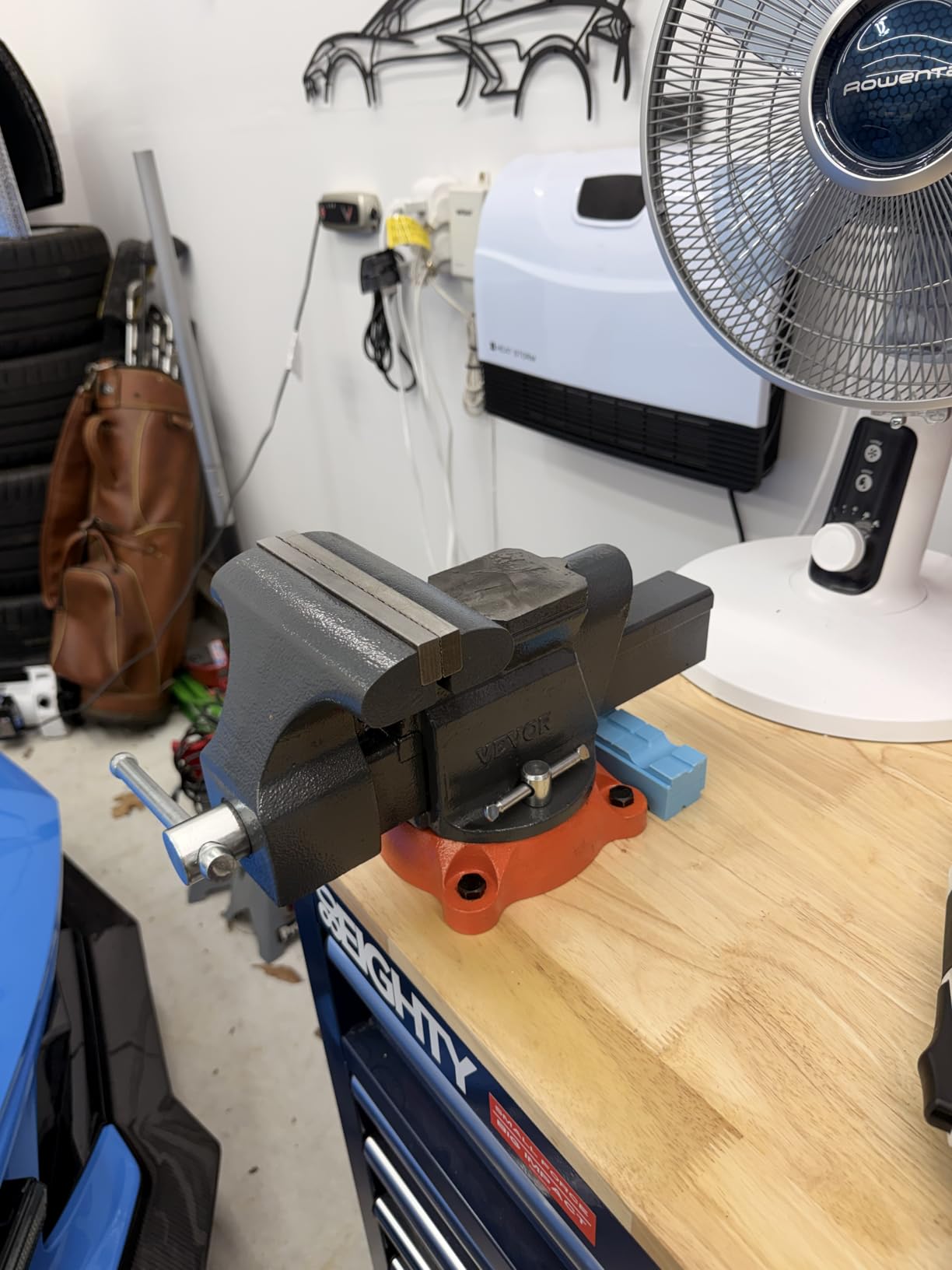
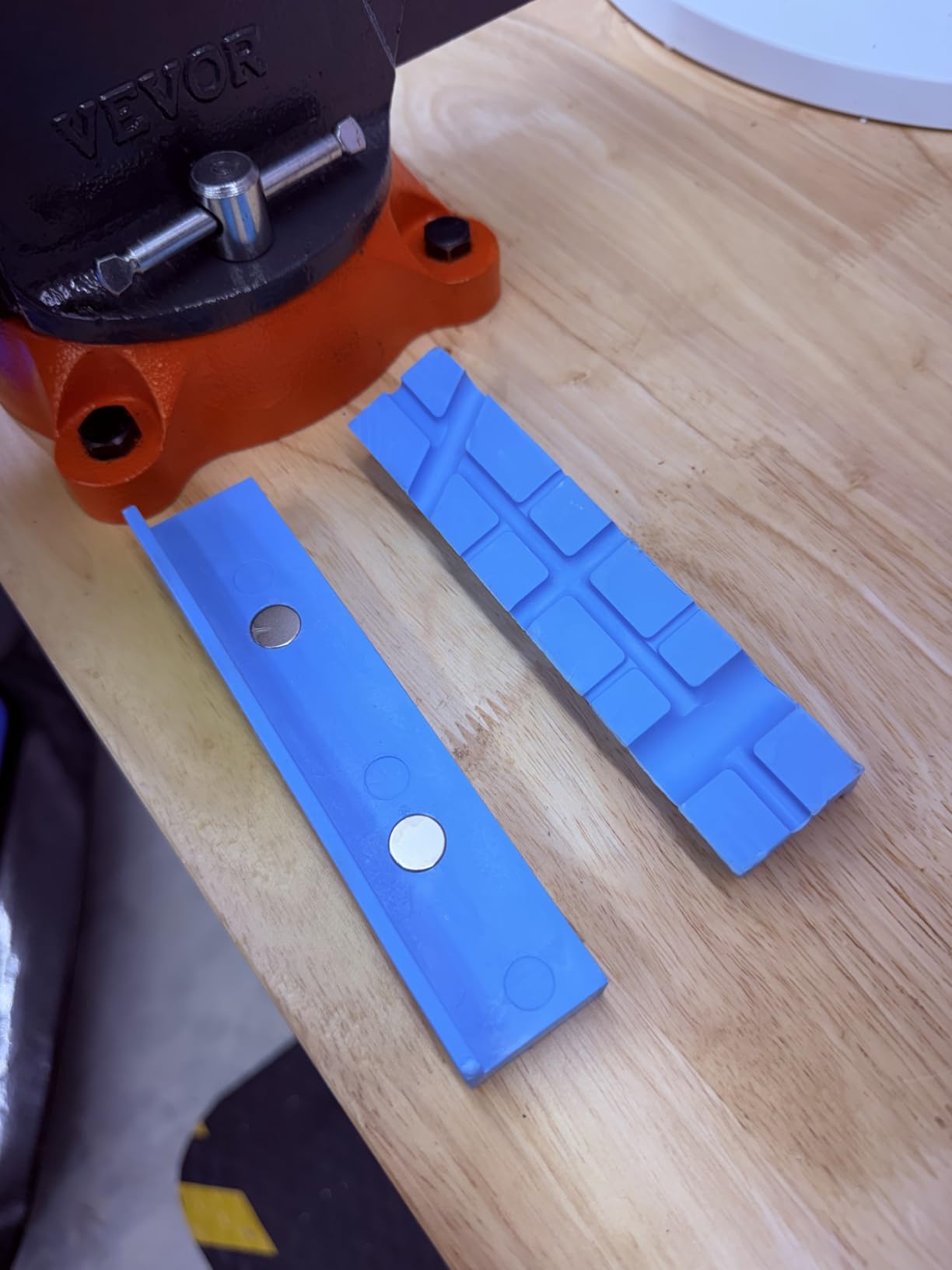
The magnetic nylon jaw pads stick to the steel plates with a magnet, so you can clamp a finished face without marring it and pull them off for rough work. The multi-jaw design also holds flat bar and round tube from 0.6 to 2.9 inches, and a 2.9 by 3 inch anvil sits behind the jaws.
The complaints are fixable. The four included M10 bolts are too short for a typical bench top, The jaw edges sit slightly out of line when fully closed, and some examples arrive with chipped powder coat.
Is the VEVOR strong enough for drilling and tapping flat metal?
For drilling, filing, deburring, tapping, and general assembly, yes. The 4,496 pound clamping force and the 3.5 inch throat give you room to work on flat bar and plate that a 4-inch vise cannot accept.
For sustained hammering or blacksmith-style work, this is ductile iron rather than an austempered casting, and I would not call it a striking vise. Use the included nylon pads for anything you care about finishing.
Where does the VEVOR fall short?
The base is smaller than most buyers expect for a nominal 6-inch vise, so there is limited clearance underneath when you want to work on a tall piece from below. The short supplied bolts are the single most common installation complaint, and you will need to source your own.
Slight jaw misalignment when fully closed does not affect clamping force on real work, but it does mean a soft pad will not sit perfectly flat at the tips.
2. Yost 460 Combination Vise – Best Throat Depth and Pipe Grip
Yost Vises 460 Combination Vise | 6 Inch Jaw Width Heavy-Duty Utility Pipe and Bench Vise |Secure Grip with Swivel Base| Made with Cast Iron and Steel U Channel Bar | Blue
6-inch jaw, 6-inch opening, 4.375 inch throat, 30,000 PSI cast iron
Pros
- Full 6-inch opening on a 6-inch jaw
- 4.375 inch throat clears tall work
- Permanent serrated pipe jaw
- Swivel locks genuinely hold
- Handle grommets stop slipping
Cons
- No mounting hardware included
- Printed hole template does not match the base
- 30000 PSI iron is not a striking vise
The Yost 460 is the one I recommend when throat depth is the deciding factor. At 4.375 inches it is the deepest throat in this roundup, and it also opens to a full 6 inches, which is wider than the jaw is tall. That combination lets you clamp a tall angle iron or a length of channel without it tipping out.
It is a combination pipe and bench vise, and the permanent serrated pipe jaw is not an accessory bolted on later. It is machined into the body, so it is there from day one and holds round bar from 0.125 to 3 inches without any jaw change. Reviewers single this out as the most useful feature after the throat depth itself.
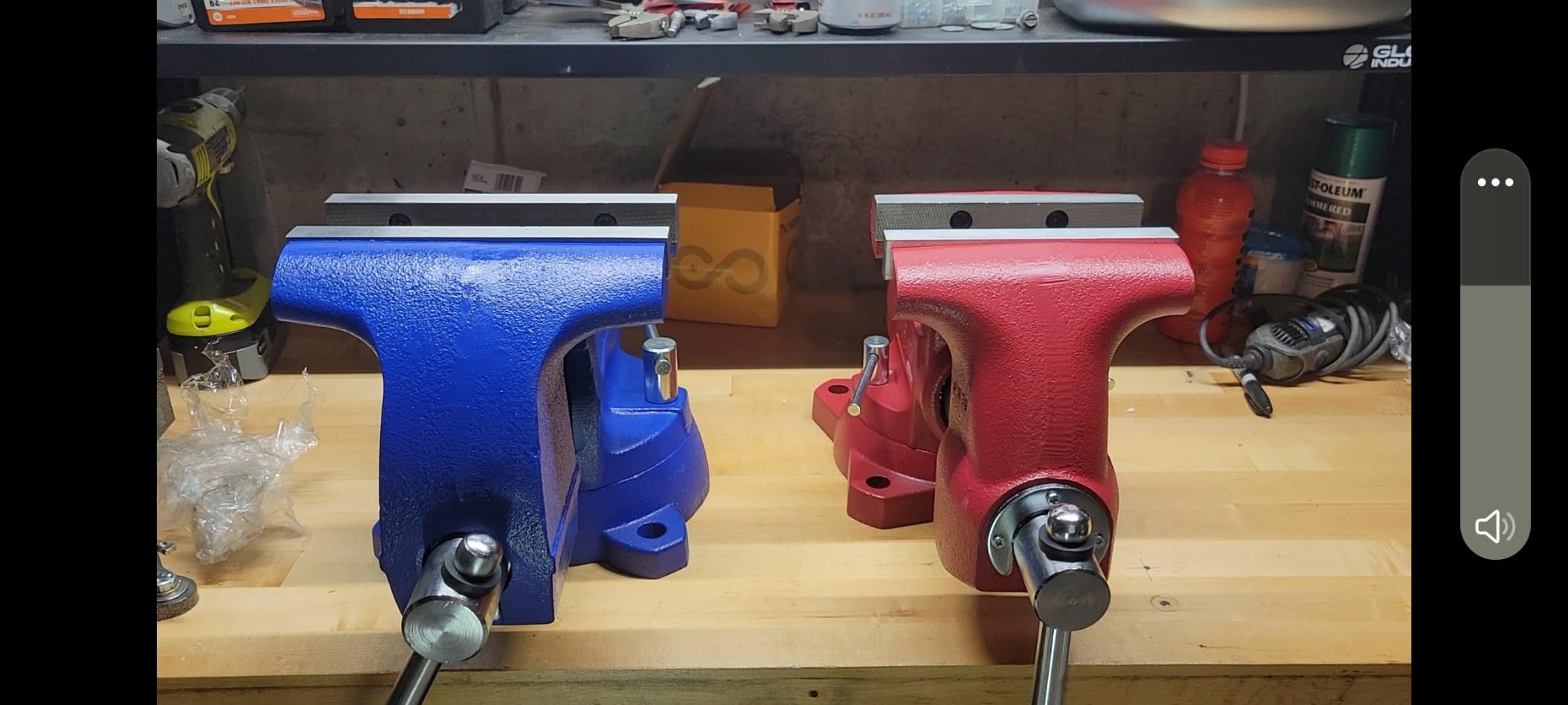
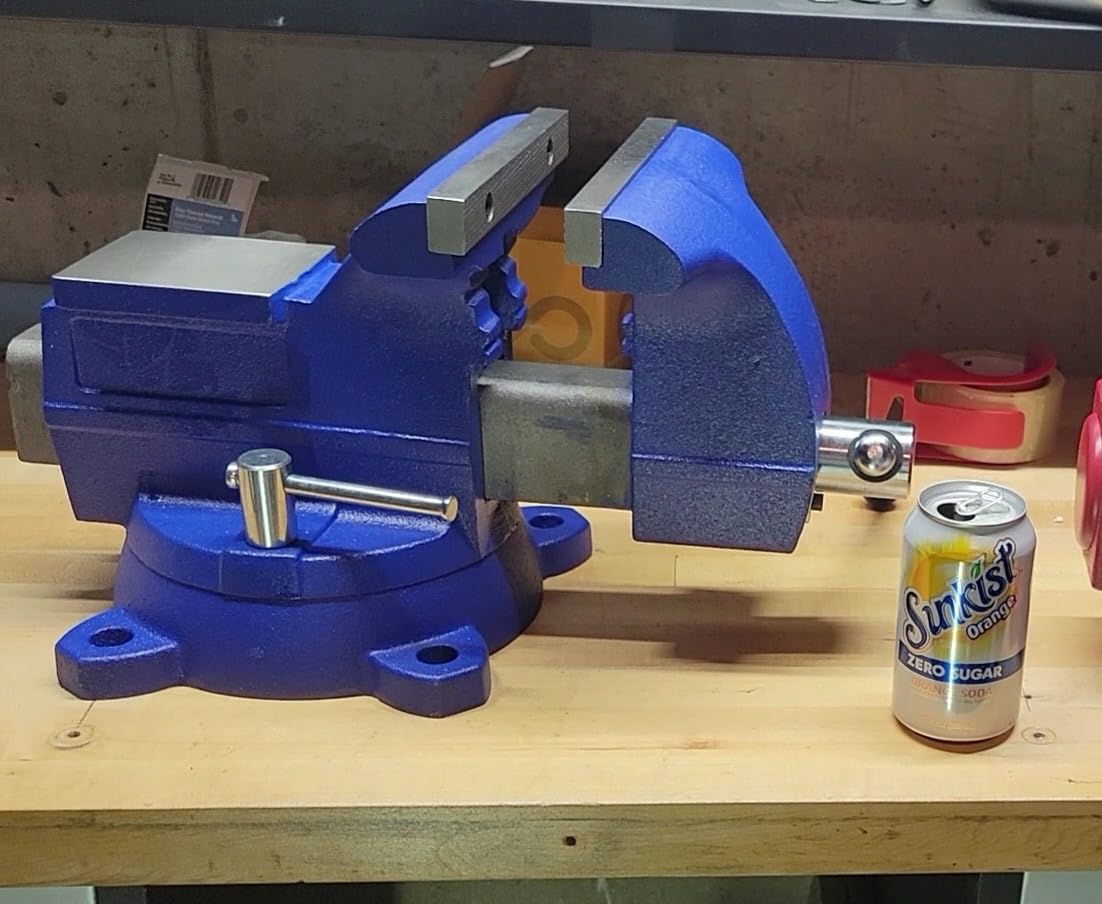
The body is 30,000 PSI grey cast iron with a steel U-channel bar, mounted on a 360-degree swivel base with two lockdowns. Buyers confirm the locks hold position under load rather than creeping, which is the most common swivel complaint in this roundup. Rubber grommets on the sliding handle damp the noise and stop the handle slipping in oily conditions.
Jaw alignment is another repeated positive. Owners report the jaws lining up accurately, and the replaceable hardened steel serrated top jaws mean you can restore grip later instead of buying a new vise.
What to plan for: no bolts, washers, or nuts are included, and the downloaded hole template does not match the actual base spacing. Measure and mark your own holes. At 16 pounds this is also a lighter vise than the 6-inch cast iron models, so it feels less planted under heavy load, and 30,000 PSI grey iron is not intended for blacksmithing or sustained striking.
Is the Yost 460 a good all-round metalworking vise?
Yes, if your work includes round bar, tube, or tall sections. The integrated pipe jaw and the deep throat handle more workpiece shapes than any other 6-inch vise here without any jaw swap.
For light to medium duty work, filing, tapping, drilling, and general holding, the swivel locks hold and the jaws stay aligned. It carries a large anvil work surface as standard, not as an add-on.
What should you know before buying the Yost 460?
Budget time and hardware for mounting. You will need your own bolts, and the supplied template is unreliable, so lay the base out on the bench and mark the holes yourself before you drill anything.
Some users perceive slight play in the moving parts once assembled. If you need a vise that absorbs heavy impact, look at an austempered ductile iron model instead of this grey cast iron body.
3. Wilton 11106 General Purpose Vise – Most Reviewed and Lifetime Warrantied
Wilton General Purpose Bench Vise, 6″ Jaw Width, 5″ Max Jaw Opening, 3″ Throat (11106)
6-inch jaw, 5-inch opening, 3-inch throat, 30,000 PSI grey cast iron
Pros
- Lifetime warranty against manufacturing defects
- Heavy 38 lb body clamps without wobble
- Double lockdown swivel holds firmly
- Large anvil for light striking
- Replaceable hardened jaw inserts
Cons
- 120-degree swivel is among the narrowest here
- Not for heavy forging or production work
- Some examples need lubrication out of the box
With more than 1,500 ratings at 4.7, the Wilton 11106 has the largest owner base of any vise here, and that matters for a tool you might own for twenty years. Wilton backs it with a lifetime warranty against manufacturing defects, which is the strongest long-term commitment in this roundup alongside the lifetime casting warranty on the Yost ADI-6.
At 38 pounds, this is a planted vise. The cast iron body does not flex when you clamp a plate and lean hard on a file or a tap wrench, which is the behaviour that makes thin vises feel vague. The double-lockdown swivel base holds its angle, and the large anvil surface is useful for light striking and flattening.
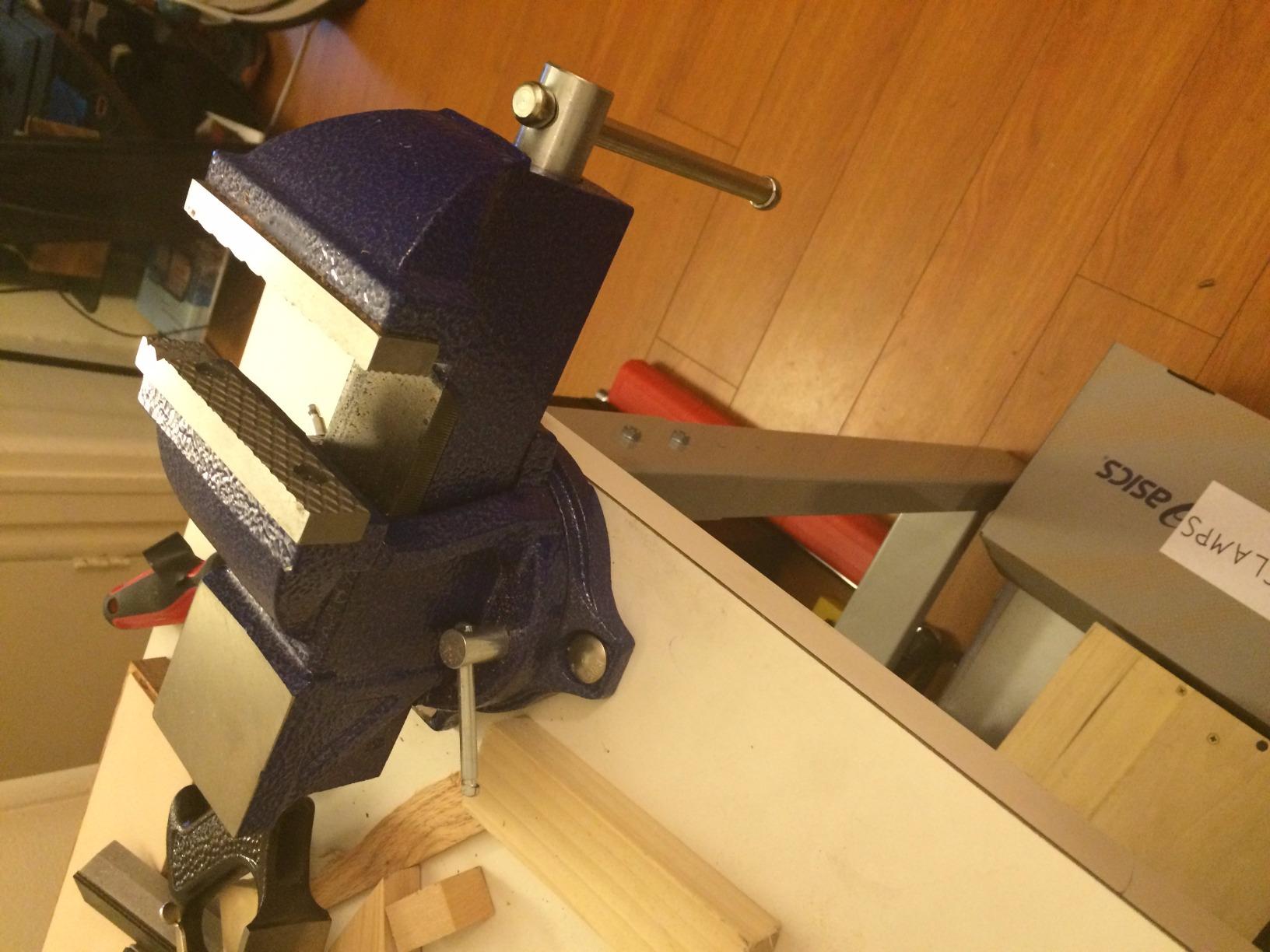
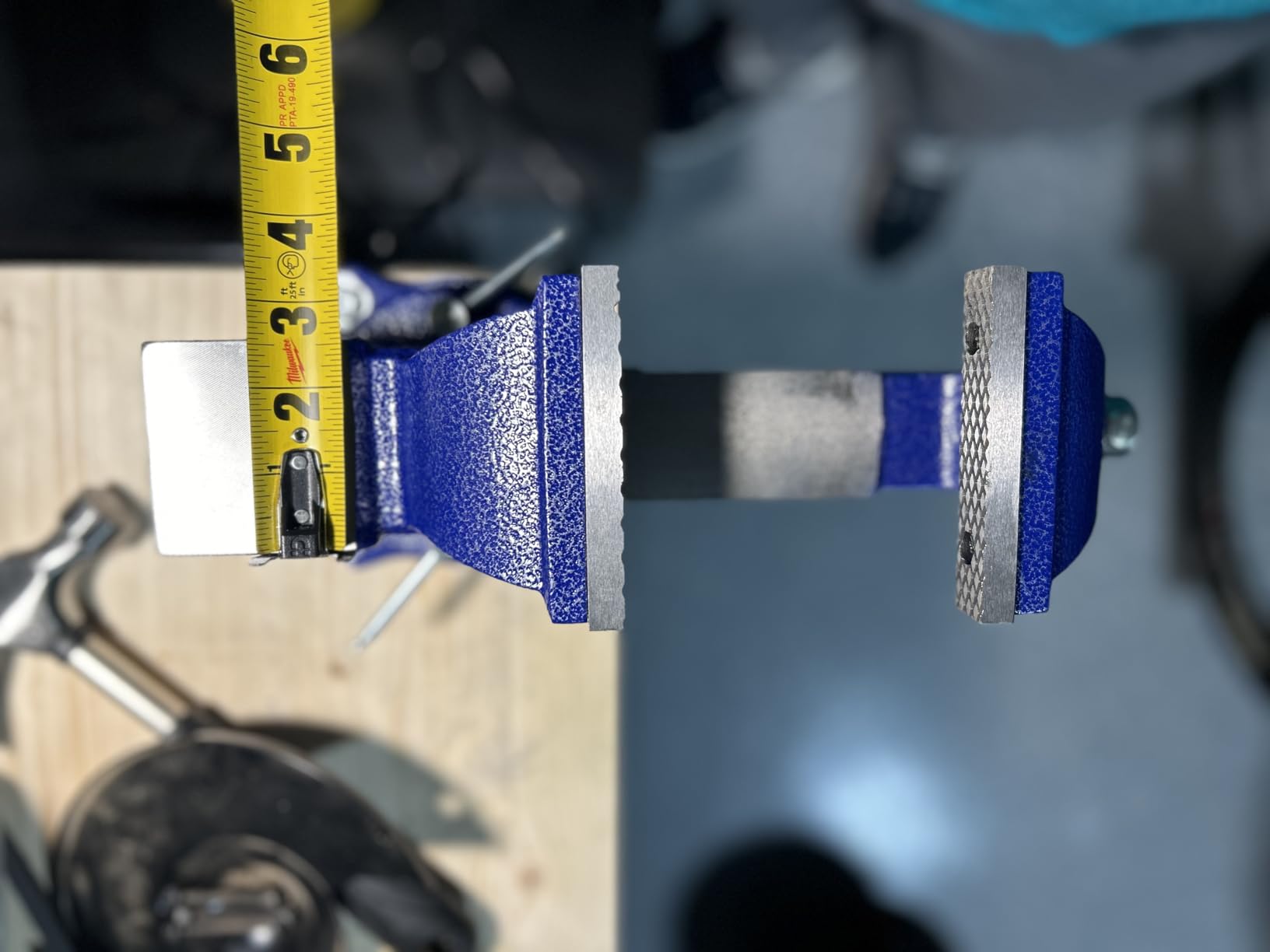
The hardened steel jaw inserts are machine serrated for grip under maximum torque and are replaceable, so when the teeth wear you swap a part rather than a vise. That is the maintenance detail that separates a general-purpose vise from a disposable one, and it is the reason this model has held its rating for so long.
The honest limitation is rotation. The base swivels 120 degrees, not a full turn, so you cannot swing the handle to reach work on all four sides of the bench. Buyers coming from a 360-degree vise notice this immediately. Some examples also arrive needing lubrication before the screw runs freely.
Wilton is consistently cited in machinist communities as one of the best-made vises, and that reputation tracks with the lifetime warranty. This is not a forging or production-shop vise, and reviewers are clear about that.
Is the Wilton 11106 the best bench vise for metalworking for most shops?
For a home garage or small fabrication shop doing general metalwork, yes. The combination of a heavy planted body, a lifetime warranty, and replaceable hardened jaw inserts covers the three failure modes that end most vises.
It is the safest choice if your bench is a normal wooden workbench. A 38 pound vise bolted properly through a substantial top is well within what a good bench is designed to carry.
What is wrong with the Wilton 11106?
The 120-degree swivel arc is the main complaint, and it is a real restriction when you are working a part from more than one side. If you need to reach any angle, a full-rotation model is a better fit.
At 3 inches, the throat is shallower than the Yost 460 or the Wilton 746, so tall sections sit closer to the base. And it is explicitly not a heavy forging or production metalworking tool.
4. Forward CR50A 5.5-Inch Vise – Best Multi-Jaw Versatility per Dollar
Forward CR50A 5.5 Inch Bench Vise Heavy Duty with Anvil and 210°Swivel Base
5.5-inch jaw, 6-inch opening, 3.1 inch throat, 7700 lbs clamp force
Pros
- Highest published clamping force in this group
- Ductile iron resists cracking under impact
- Two jaw sets plus integrated pipe jaws
- Reinforced anvil for grinding and tapping
Cons
- 210-degree swivel cannot reach vertical clamping of tall work
- Ductile iron dents and wears readily
- 3.1 inch throat limits clamping height
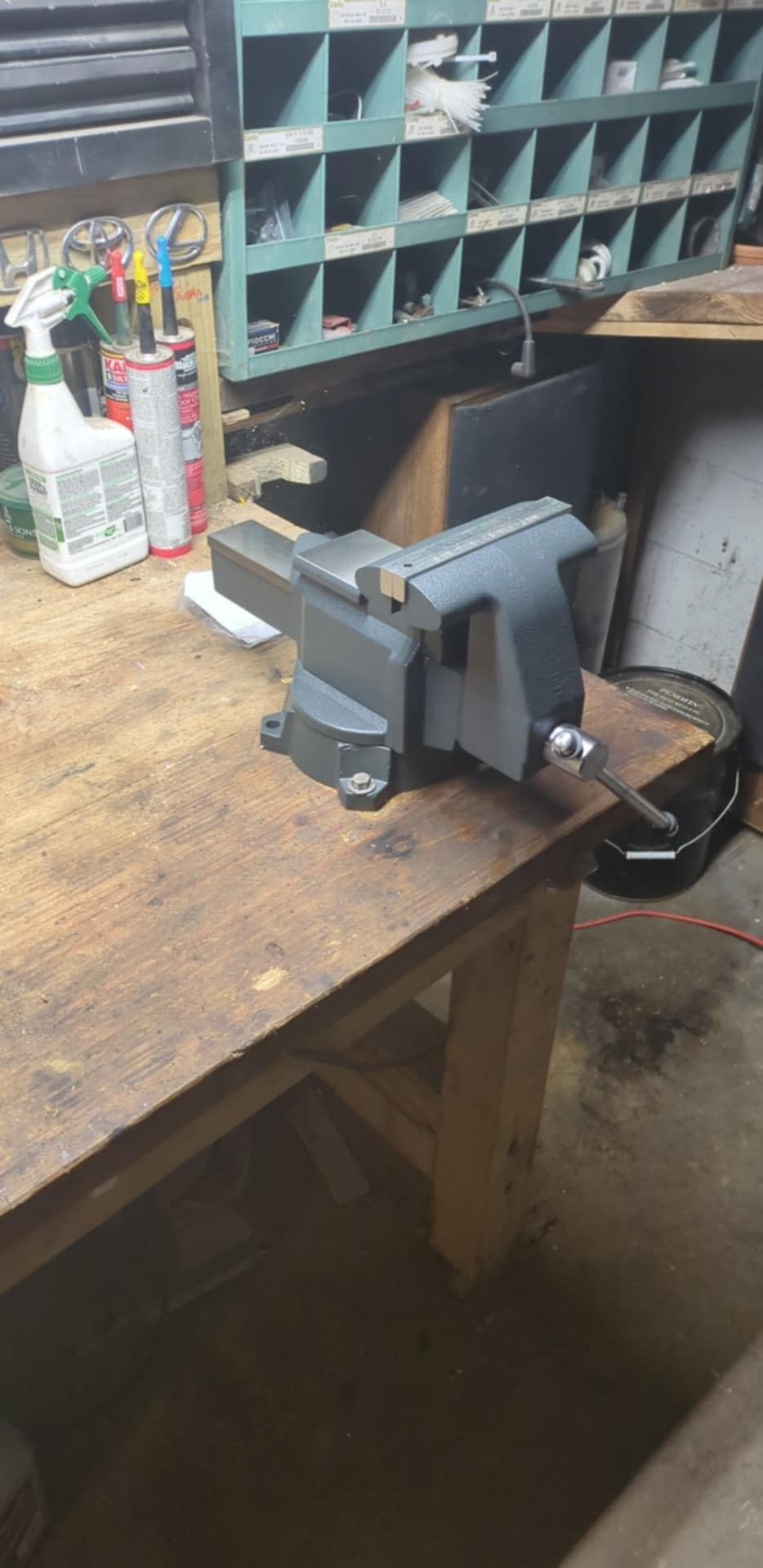
On clamping force alone, the Forward CR50A leads this entire group. It puts out 7,700 pounds, the highest published figure in this roundup, and the 6-inch jaw opening on a 5.5-inch jaw means you can open it wider than the jaw is tall.
It ships with two sets of machined jaws. One set is the replaceable flat and slotted machinist jaws, the other a built-in pipe jaw handling round bar from 0.5 to 3.5 inches. Having both means you are not unbolting anything to switch from flat bar to tube.
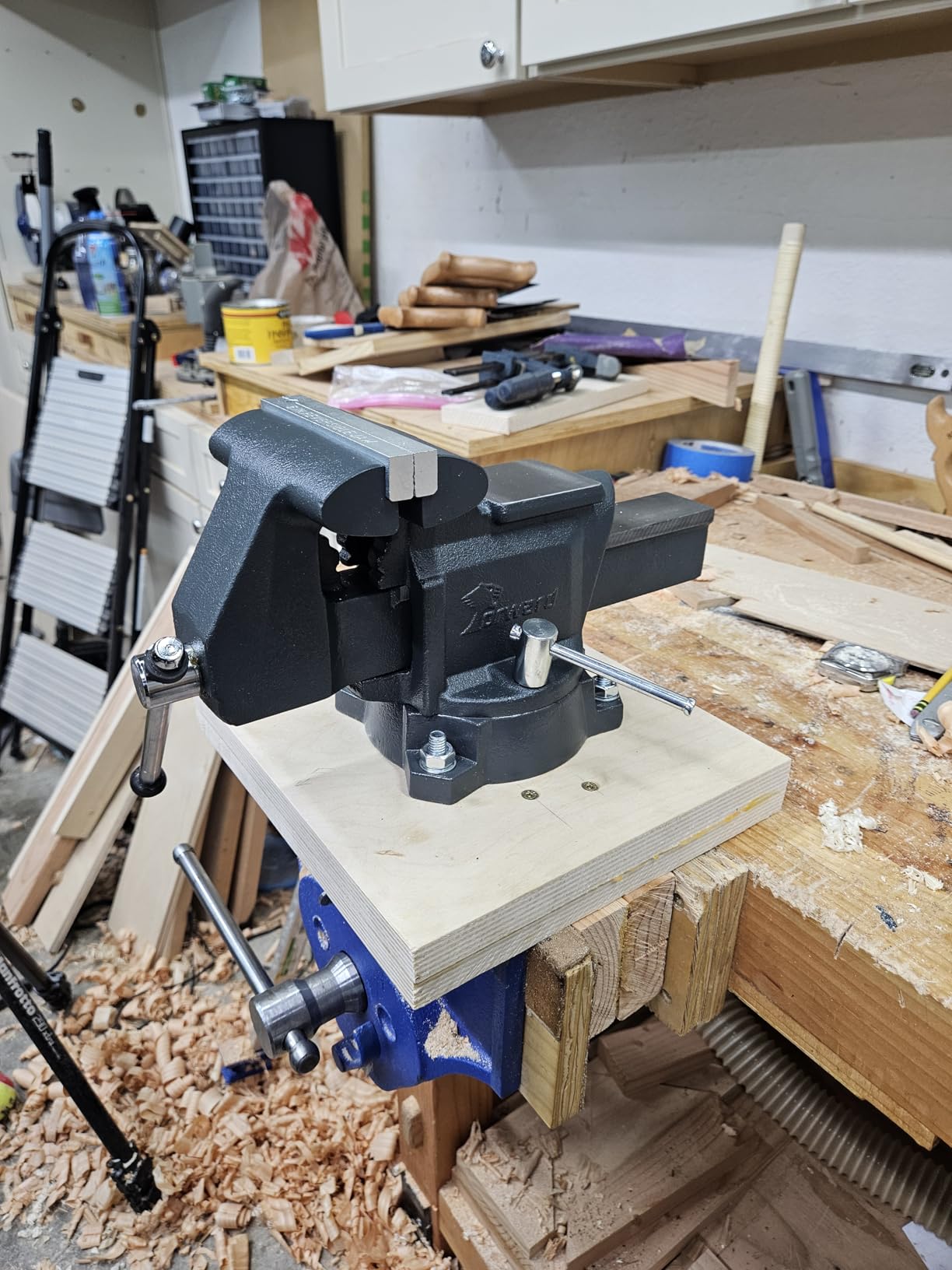
The 60,000 PSI ductile iron body is the key material choice. Grey cast iron resists abrasion better but will crack if you shock it, whereas ductile iron takes the hit and dents instead. Multi-year owners specifically push back on reviews that call it soft.
The reinforced anvil is a real working surface for grinding, cutting, and light tapping. The 210-degree swivel covers most working angles, and the 3.1 inch throat is adequate for flat bar, plate, and short sections.
The trade-offs are honest ones. The 210-degree rotation is the single most-cited complaint, because it makes the vise unsuitable for clamping tall or heavy material vertically. Ductile iron also shows wear readily on the anvil and body, and the 3.1 inch throat is shallower than the deeper models here.
Is 7,700 pounds of clamping force worth having?
For drilling into thick plate, tapping, and holding work while you apply real torque, yes. It is the difference between a vise that feels solid under a drill press handle and one that lets the work move.
The 5.5-inch jaw is a slightly unusual size, so check that your typical workpiece fits before committing. It is narrower than the 6-inch models but wider than the compact 4-inch option.
Where does the CR50A let you down?
Vertical clamping of long material. With only 210 degrees of swivel, you cannot get the handle out of the way to hold tall work upright, and that is a real limit for pipe fitting or long tube work.
The body dents under hard impact, which is the trade-off that makes it crack-resistant. If you want a surface that stays visually clean, cast iron suits that better.
5. Yost 760-DI Multi-Jaw Rotating Vise – Best Positioning Control
Yost Vises 760-DI Multi-Jaw Rotating Vise 6 Inch Jaw Width | 2 in 1 Multipurpose Bench and Pipe Vise | Secure Grip with Swivel Base | Made with a Combination of Ductile Iron & Hardened Steel
6-inch jaw, 5.90-inch opening, 4.31-inch throat, 75.8 lb casting
Pros
- Body and head both rotate 360 degrees
- Head locks every 30 degrees in 12 positions
- Three replaceable jaw sets including pipe and V-jaws
- Heavy 75.8 lb body resists flex
Cons
- Head cannot rotate while the workpiece is clamped
- Slight play in head lock pin when jaws are open
- Handle sits close to the head
Almost every bench vise rotates at the base. This one also rotates the head, which separates it from everything else here. The body turns a full 360 degrees on an interlocking V-grooved swivel base with two lockdowns, and the head turns another 360 degrees, locking every 30 degrees across 12 positions.
In practice that means you can bring the handle around to any side while the fixed jaw stays anchored to the bench, so you can work a long part from whichever angle is comfortable. For someone who moves around a bench constantly, that is worth more than raw force numbers.
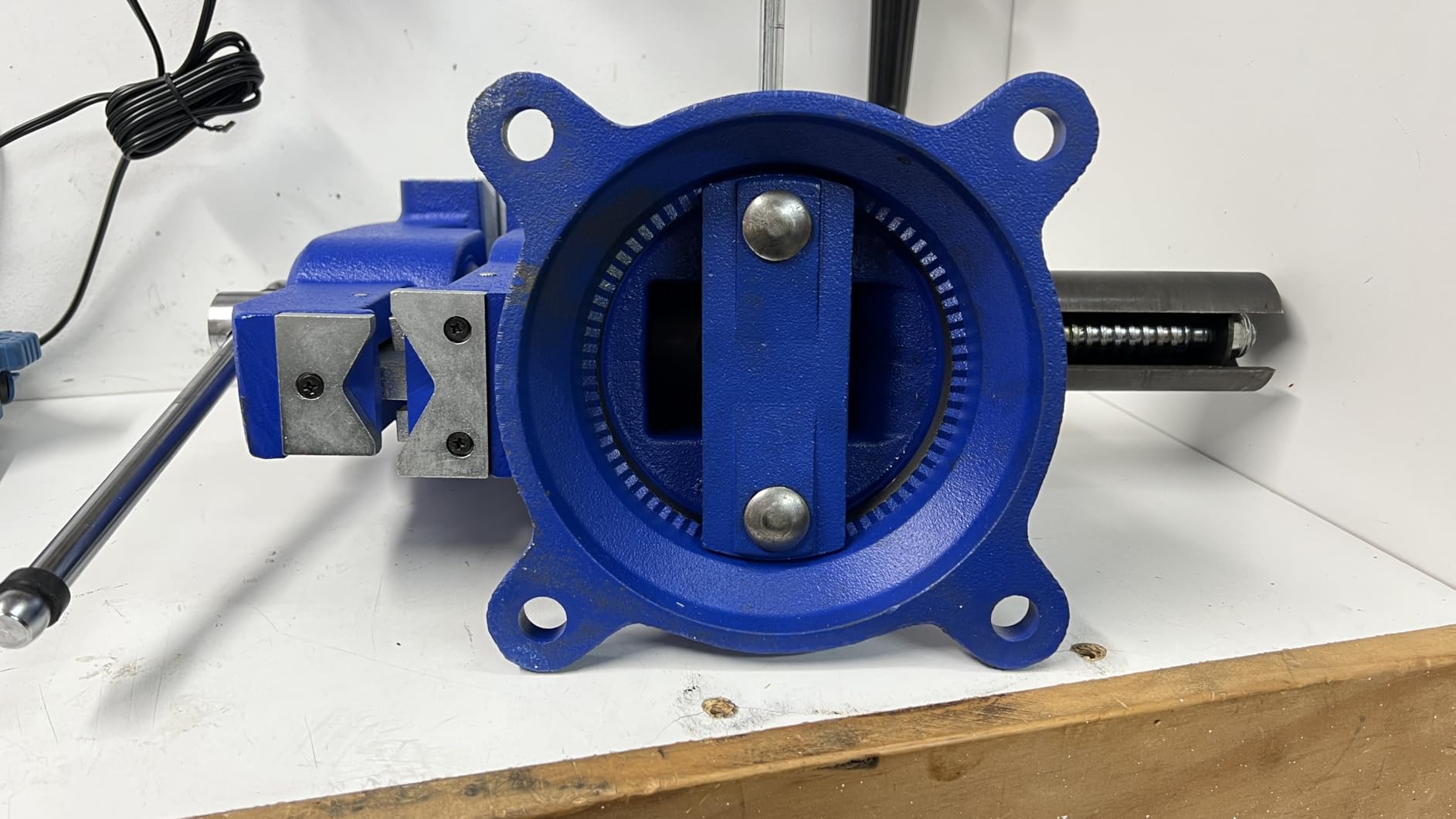
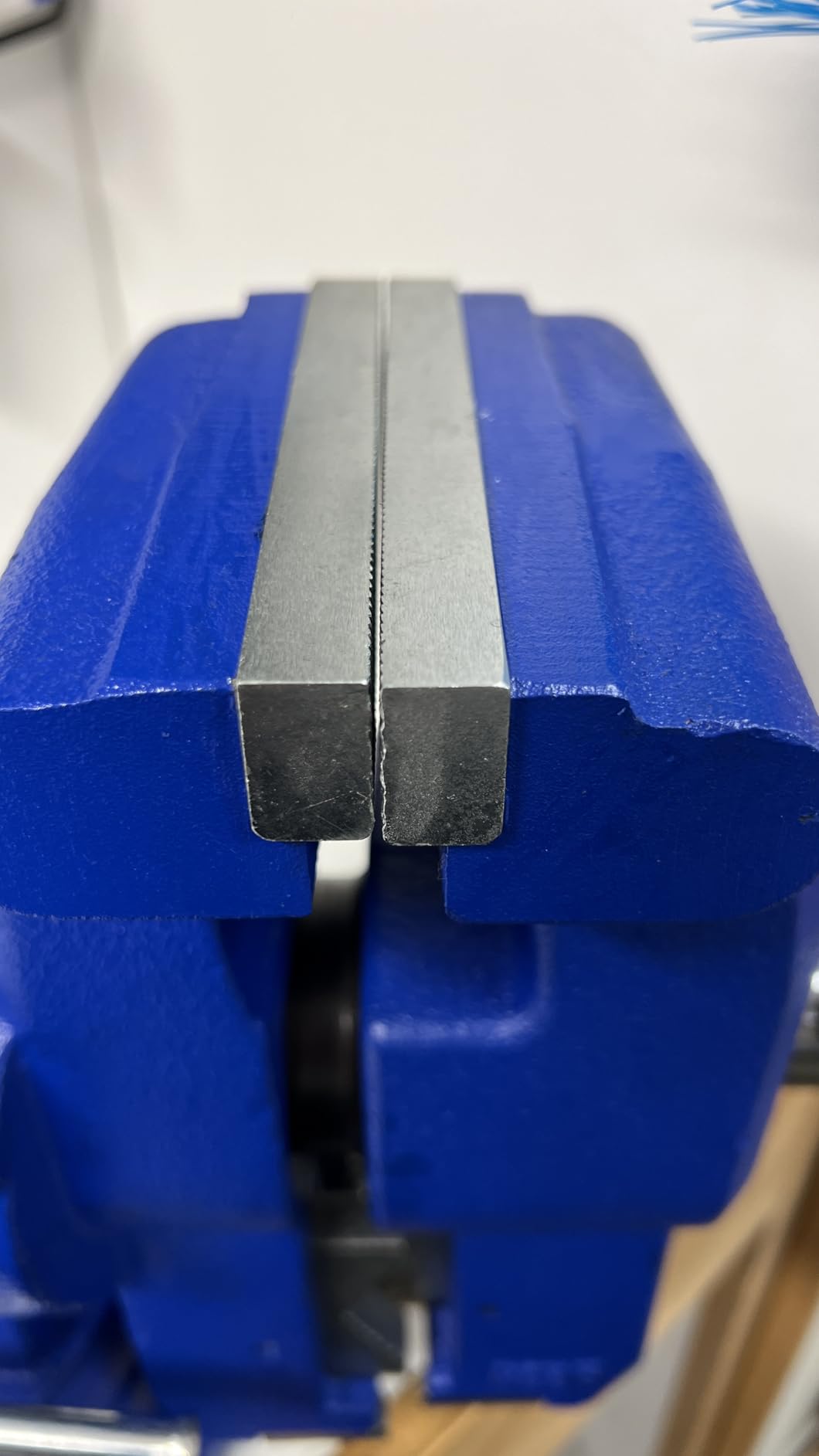
Three sets of replaceable hardened steel jaws ship with it: bench jaws, serrated pipe jaws, and V-jaws for tapered or conical material. Pipe capacity runs from 0.63 to 4.33 inches, which covers small tube up to most conduit and pipe you will meet. The 4.31 inch throat is the second deepest of the 6-inch vises here.
At 75.8 pounds this is the second heaviest vise in this roundup after the Wilton 746, and owners report it resists flex and stays planted. The lead screw and slide are well machined with no burrs, and long-term owners say it became their primary vise.
The ergonomics are the trade. The head cannot be rotated while the workpiece is clamped, so you set the angle before you tighten. The lock pin shows slight play when the jaws are open, the handle sits close to the head so hands can catch between them, and a raised collar on the dynamic jaw complicates clamping small parts. The handle is also shorter than ideal, and at this weight it needs a properly reinforced bench.
When does a rotating head actually matter?
When you are working around a part rather than at it. A rotating head lets you drill, file, or fit from the top, the side, or underneath without unbolting anything or re-clamping a part you have already squared.
Set the angle first, then clamp. Once the jaws are closed, the head lock is reported to become rock solid, so the play you feel with the jaws open is not a working defect.
What are the drawbacks of the 760-DI?
Weight, mostly. At 75.8 pounds this vise needs a bench built to take it, and it is the heaviest model in this roundup after the Wilton 746. Check your bench’s load rating before drilling into it.
The close handle position is a genuine pinch-point risk worth thinking about before you work with gloves on. Small parts are also fiddlier than the shape suggests because of the raised collar.
6. Forward 30404 4-Inch Vise – Best for Compact Benches and Small Workpieces
Forward 30404 4 Inch Bench Vise Heavy Duty with Anvil and 360° Swivel Base
4-inch jaw, 4-inch opening, 2-3/8 inch throat, 4400 lbs clamp force
Pros
- Survives heavy abuse with no cracking
- Minimal lash at the screw after years of use
- 360-degree swivel with secure locks
- Mounting bolts and nuts included
Cons
- Swivel needs locking bolts backed out almost fully
- Stationary jaw close to base suits short parts
- 4-inch jaw limits larger work
Not everyone has room for a 6-inch vise, and forcing one onto a small bench top is how benches get damaged. The Forward 30404 is the compact answer at 4-inch jaw width and 15.5 pounds, and it still delivers 4,400 pounds of force with a full 360-degree swivel base.
The 60,000 PSI ductile iron body is the same material family as the larger Forward vises, and multi-year owners report it has survived heavy abuse with no cracks and minimal lash at the screw. Screw durability is the point of this pick: a vise that still runs smoothly after years is worth more than a heavier one that binds.
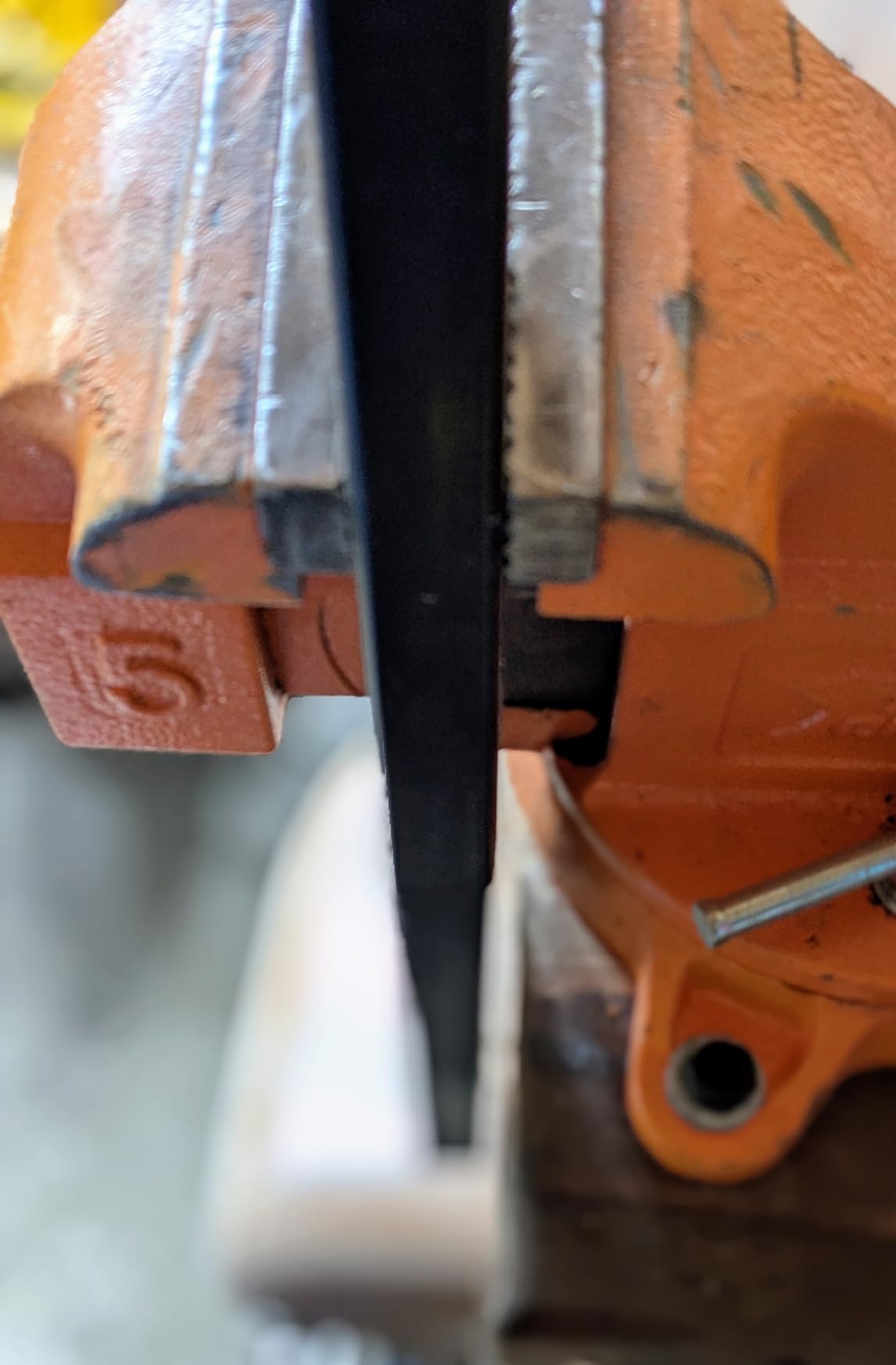
You get replaceable machinist top jaws plus built-in grooved pipe jaws holding 0.5 to 1.5 inch diameter material, and a large anvil for tapping work. Rubber washers on the handle prevent sliding and cut the noise, and mounting bolts and nuts are included in the box so you are not sourcing hardware on mounting day.
Two things to know. The swivel requires backing the locking bolts out almost completely before it will rotate, which is a design choice that keeps the lock solid but makes repositioning slower. And the stock jaws have an aggressive knurl that will mark workpieces, so keep soft jaw covers on hand if you are clamping finished parts.
The jaw sits close to the base, which makes it better suited to compact work than long vertical material. Owners who moved up to a 5-inch or 6-inch vise generally did so because they needed capacity, not because the 4-inch stopped working.
Is a 4-inch bench vise too small for metalworking?
Not for a lot of metalwork. It handles drilling, tapping, filing, deburring, and assembly on small brackets, hardware, gun parts, and electrical fittings, and the 4,400 pound force is more than most of that work needs.
It becomes the wrong tool when your largest workpiece exceeds the jaw width or the 2-3/8 inch throat. Measure your three biggest typical jobs before deciding.
What do owners dislike about the 30404?
The swivel procedure. Having to loosen the lock bolts almost fully to turn the base is the top complaint, and it is a deliberate trade for a lock that will not rotate by accident.
The knurled jaw faces mark soft and finished metal, and 4-inch capacity is simply the ceiling on what you can clamp. Both are reasons people size up later.
7. Yost ADI-6 Austempered Ductile Iron Vise – Best for Heavy Striking Work
Yost Vises ADI-6 Heavy Duty Vise | 130,000 PSI Tensile Strength Austempered Ductile Iron Bench Vise | 6 Inch Jaw Width with a 360 Degrees Interlocking Swivel Base and 2 Lockdowns | Red
6-inch jaw, 7.875-inch opening, 3.7 inch throat, 130,000 PSI casting
Pros
- 130000 PSI austempered ductile iron is the strongest casting here
- Geared interlocking swivel indexes and holds firmly
- 7.875 inch opening is unusually wide for a 6-inch jaw
- Limited lifetime warranty on castings
Cons
- 42 lbs demands a substantial bench to mount
- Commands a premium over basic 6-inch models
- Fewer owner reviews than the brand's cheaper models
If you hammer on your vise, material strength is the whole argument. The ADI-6 is cast from austempered ductile iron rated at 130,000 PSI tensile, which is the highest stated casting strength anywhere in this roundup. Austempered treatment gives you the toughness of ductile iron with far better wear resistance than ordinary cast iron.
The jaw opening is the other headline. At 7.875 inches on a 6-inch jaw, it opens wider than any other 6-inch vise here, which means you can clamp a wide plate or a length of channel without the jaw running out of travel first.
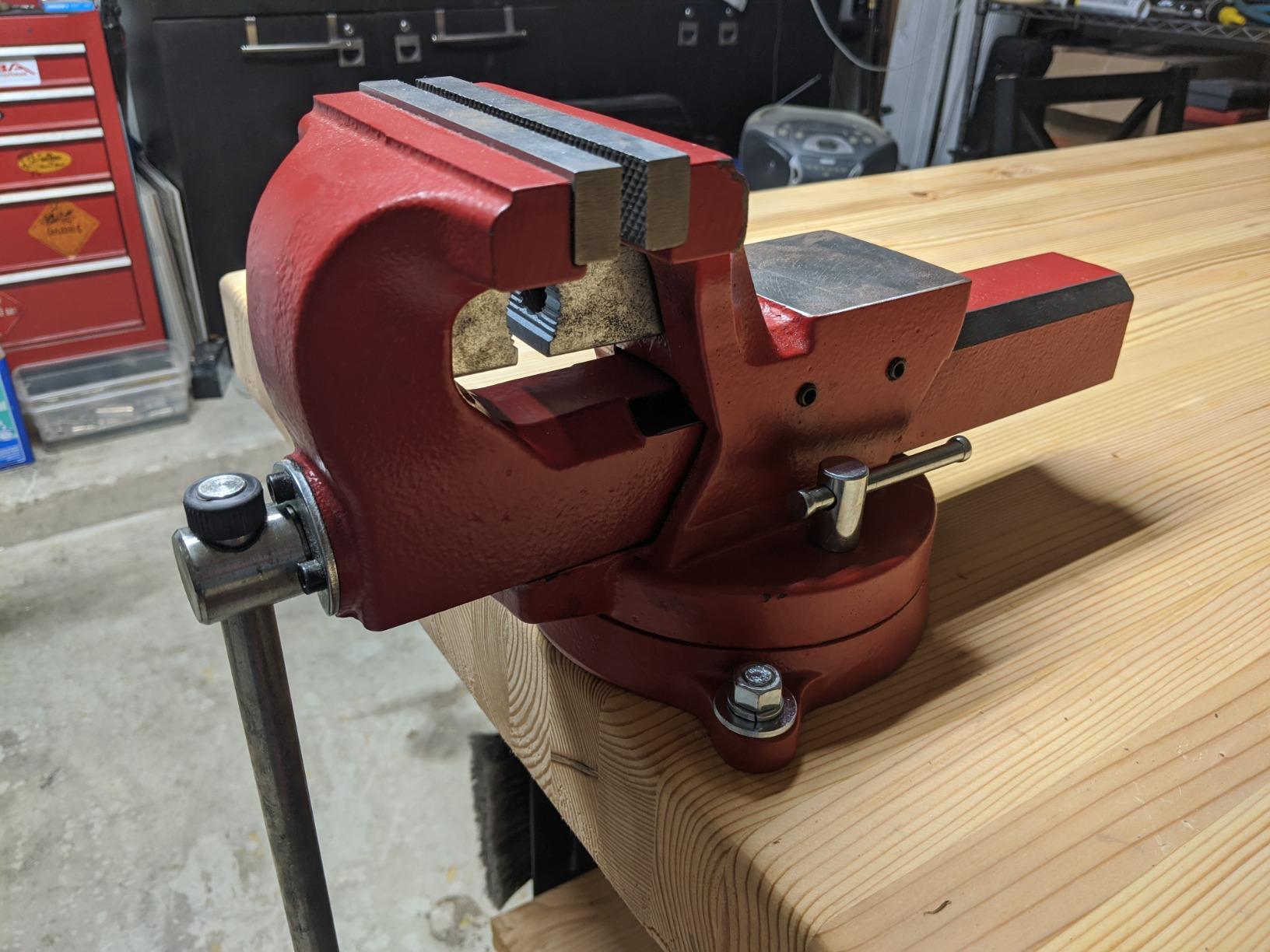
The swivel base is interlocking and geared, so it indexes into position and holds it rather than relying on friction alone. Two lockdowns and three mounting holes give you options when laying it out. Replaceable hardened steel serrated machinist and pipe jaws cover flat work and 0.75 to 3.5 inch pipe.
It carries a limited lifetime warranty on the castings, and the handle, lockdowns, and jaws are all zinc-plated to resist corrosion. At 42 pounds it demands a substantial bench, costs meaningfully more than a general-purpose 6-inch model, and carries fewer customer reviews than the brand’s cheaper vises.
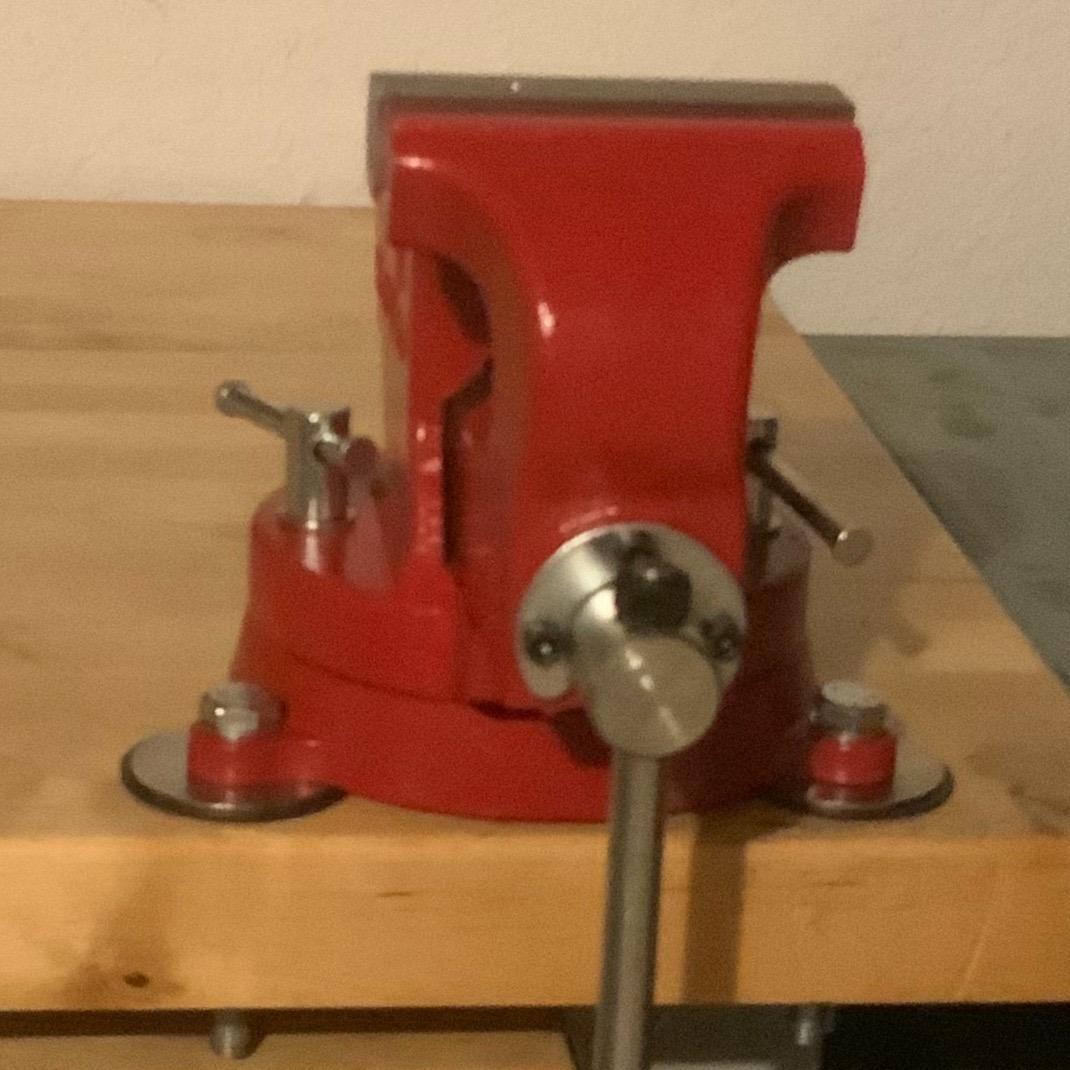
Do you need austempered ductile iron for metalworking?
If you strike, form, or peen metal on the vise, yes. The combination of high tensile strength and toughness means the casting absorbs a blow instead of cracking, and the wide anvil is sized to take that.
If you only hold work steady for drilling, tapping, and assembly, a ductile iron model at 60,000 PSI gives you most of the benefit for a good deal less.
What are the compromises with the ADI-6?
Weight and mounting. At 42 pounds the bench has to be solid, and you are drilling into a top that now carries that load for years.
It is also a pricier 6-inch vise than the general-purpose models here, and the smaller review base means less long-term feedback than the Wilton 11106 or the Yost 460 have accumulated.
8. Wilton 746 Mechanics Vise – Best Rigid Shop Vise for Machinists
Wilton Mechanics Bench Vise, 6″ Jaw Width, 5-3/4″ Jaw Opening, 4-1/8″ Throat (Model 746)
6-inch jaw, 5-3/4 inch opening, 4-1/8 inch throat, 64 lb body
Pros
- Rock solid 64 lb body stays rigid under torque
- 360-degree swivel with tight lockdowns
- Fully enclosed spindle and nut keeps grease in
- Lifetime warranty
Cons
- Some examples arrive with debris in threads
- Phillips rather than hex jaw retaining screws
- Hole diameters can differ from drawings
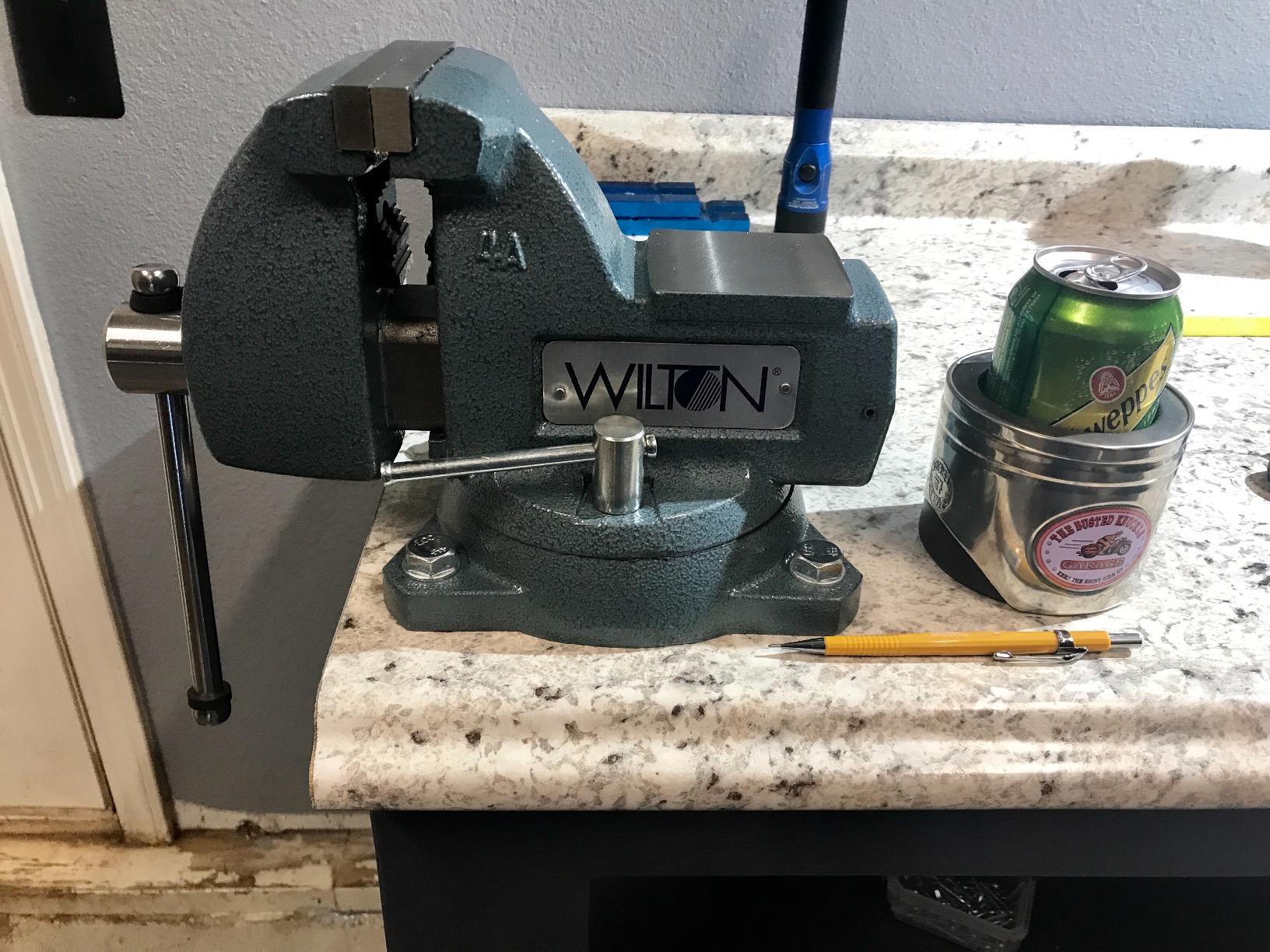
The 746 is the mechanics vise rather than the general-purpose one, and the difference shows in the numbers. At 64 pounds with a 4-1/8 inch throat, it is heavy and deep, and owners describe it as staying rigid under torque rather than flexing, which is the property you want when you are chasing a torque wrench or a heavy file stroke.
It also has a 360-degree swivel base with double lockdowns, so unlike the Wilton 11106 you can reach any working angle. The fully enclosed spindle and nut is the detail that matters most for longevity: it keeps grease in and dirt out, and long-term owners report the vise needs only a light dressing and stays true for years.
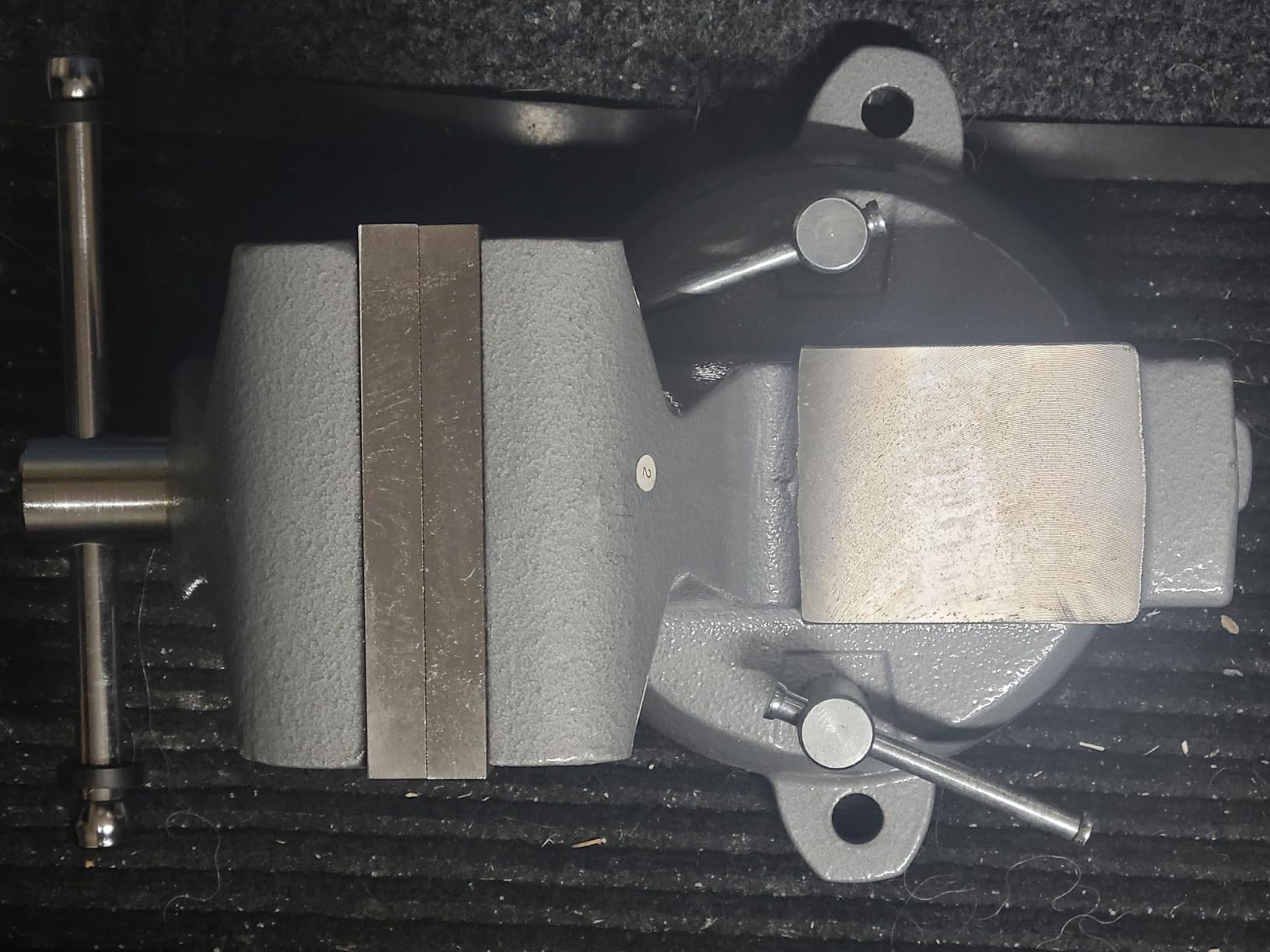
Jaw caps are replaceable hardened steel, and there are separate pipe jaws. The powder coat finish resists scratches, and the lifetime warranty is one of the strongest commitments in the industry. Machinist forums regularly name Wilton as a brand that holds up over a working lifetime.
The complaints are about quality control rather than durability. Some examples arrive heavily greased with debris in the joints, and some do not have jaws meeting perfectly parallel. Jaw retaining screws are Phillips rather than hex, and mounting hole diameters can differ from the published drawings, so measure before you drill.
Is a machinist vise worth the extra specification?
If you clamp work for torque, chase threads, or work on a machine tool where a flexing jaw ruins accuracy, yes. The 4-1/8 inch throat and 64-pound rigidity are what separate it from a general-purpose bench vise.
If you hold plate steady for drilling and filing, a 30,000 PSI cast iron model does the same job at a fraction of the mounting burden.
What should I check when the Wilton 746 arrives?
Clean the threads and joints thoroughly before first use, because some examples arrive with debris in them. Then check jaw parallelism and measure your mounting holes rather than trusting the drawing.
Most importantly, confirm your bench can take 64 pounds at the front edge for years. A reinforced steel frame is the realistic answer; a light duty MDF workbench is not.
9. Forward 0806 6-Inch Vise – Best Budget Six-Inch Cast Iron Option
Forward 0806 6 Inch Bench Vise Workbench Vise with Anvil and Swivel Base
6-inch jaw, 5-inch opening, 2.7 inch throat, 30,000 PSI cast iron
Pros
- Substantial 29.7 lb cast iron body
- Replaceable microgroove steel jaws grip without slipping
- Dual lock-down swivel holds the chosen angle
- 3.5 by 3.5 inch polished steel anvil
Cons
- Only 120 degrees of swivel rotation
- Shallow 2.7 inch throat limits clamping height
- Grey cast iron more crack-prone under heavy impact
This is the straightforward 6-inch cast iron vise, and at this specification there is not much to argue with. A 29.7 pound 30,000 PSI cast iron body with a blue powder coat gives you a planted vise with real jaw opening at the entry end of this roundup.
The replaceable microgroove tooth steel jaws are the feature that keeps it relevant. Microgrooves grip flat material well without the aggressive marking a coarse knurl leaves, and because they are replaceable you can restore the bite when they wear.
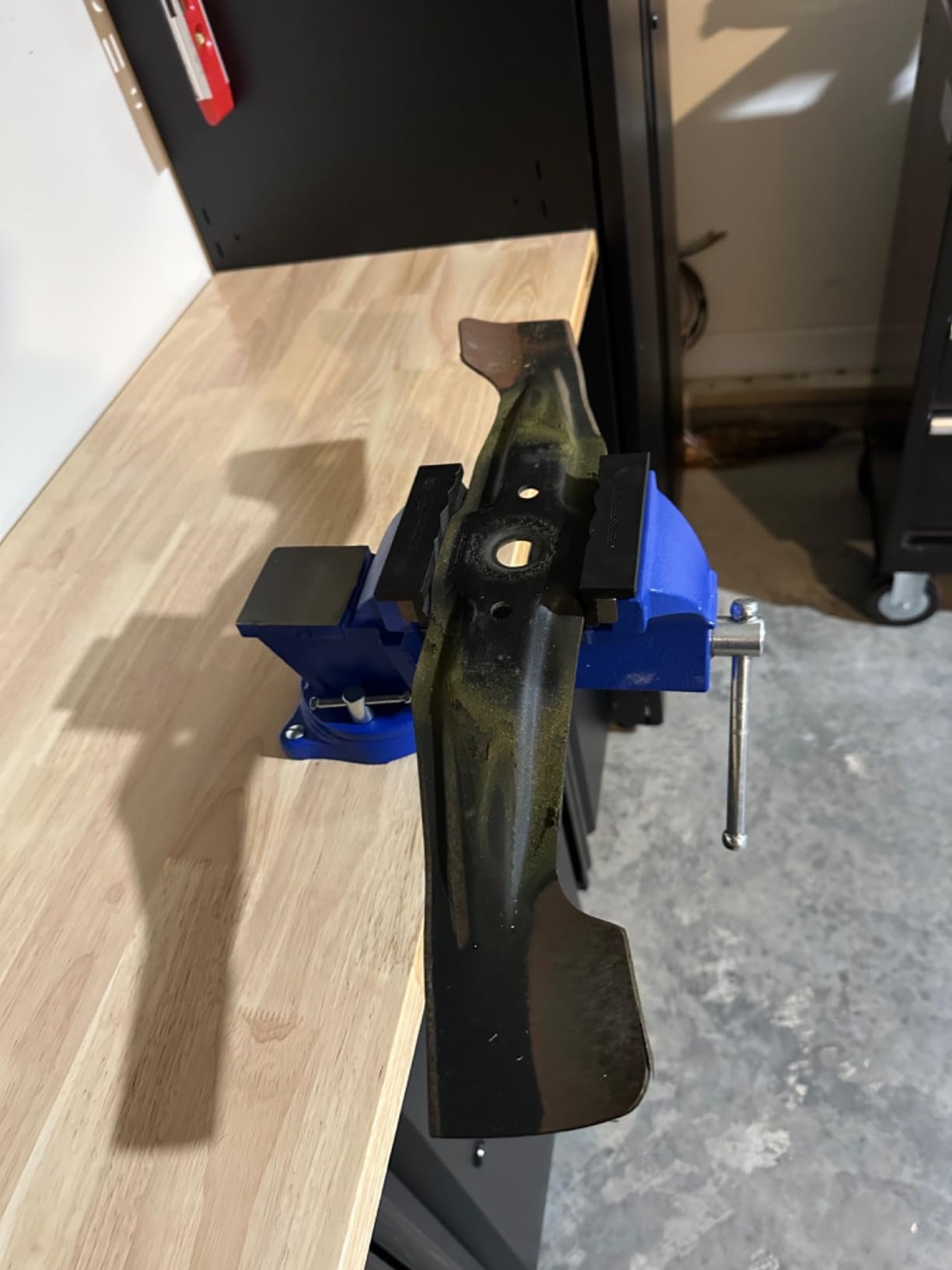
The 3.5 by 3.5 inch polished steel anvil is properly finished, not just a flat casting, so it is usable for forming and shaping light material. Three mounting holes give you flexibility in where you set it on the bench, and the dual lock-down swivel nuts hold whatever angle you choose.
The limitations are the 120-degree swivel, one of the narrowest rotation ranges here, and the 2.7 inch throat, the shallowest of any 6-inch vise in this roundup apart from the 4.25 inch clamping capacity of the IRWIN. Both matter if you clamp tall sections. And because the body is grey cast iron rather than ductile iron, it is more prone to cracking under heavy impact, so this is not a forging or sustained striking vise.
Reviewers treat it as a dependable all-purpose home and garage vise rather than a machinist tool, and that is exactly what it is. For assembly, drilling, tapping, filing, and general holding it does the job without drama.
Is a 6-inch cast iron vise good enough for a home shop?
For most home metalwork, yes. Six inches of jaw with a 5-inch opening and 29.7 pounds of casting covers plate, flat bar, angle, and hardware comfortably.
It becomes a limitation when you work on tall sections that need depth to clear the jaws, or when you need to reach work from a different side. Both are solved by a deeper throat or a full swivel.
What is wrong with the Forward 0806?
The 2.7 inch throat is the number to check against your work. Among the 6-inch vises here only the IRWIN, with 4.25 inches of clamping capacity, is tighter, and tall material sits high and less stable in any of them.
With 120 degrees of swivel you cannot reposition the handle to the far side, and only the Wilton 11106 shares that narrow an arc. And grey cast iron will crack rather than dent if you treat it like a forging vise.
10. IRWIN 4935506 Multi-Use Vise – Best Traditional Hold-It-Steady Design
IRWIN Multi-Use Bench Vise, Heavy-Duty, 6-Inch (4935506)
6-inch jaw, 4-1/4 inch capacity, 2-1/2 inch throat, over 3000 lbs pressure
Pros
- Close-tolerance grey iron casting resists distortion
- Long-barreled dovetailed nut gives smooth action and low wear
- Opens wide and holds tight
- Fully rotatable base with a useful anvil
Cons
- Smallest review base in this roundup at 160 ratings
- Lighter than expected for a heavy-duty 6-inch vise
- Not built for hammering or forging
The IRWIN 4935506 is the old-school mechanics vise, and its argument is mechanical rather than marketing. The grey iron casting is machined to close tolerances and is claimed to withstand distortion under high pressure, which is exactly the property you want in a vise you are going to clamp hard and hit with a wrench.
The nut is the piece worth knowing about. It is a long-barreled, unbreakable design dovetailed into the body and aligned with the main screw to reduce wear. That is why owners report smooth, dependable action over years.
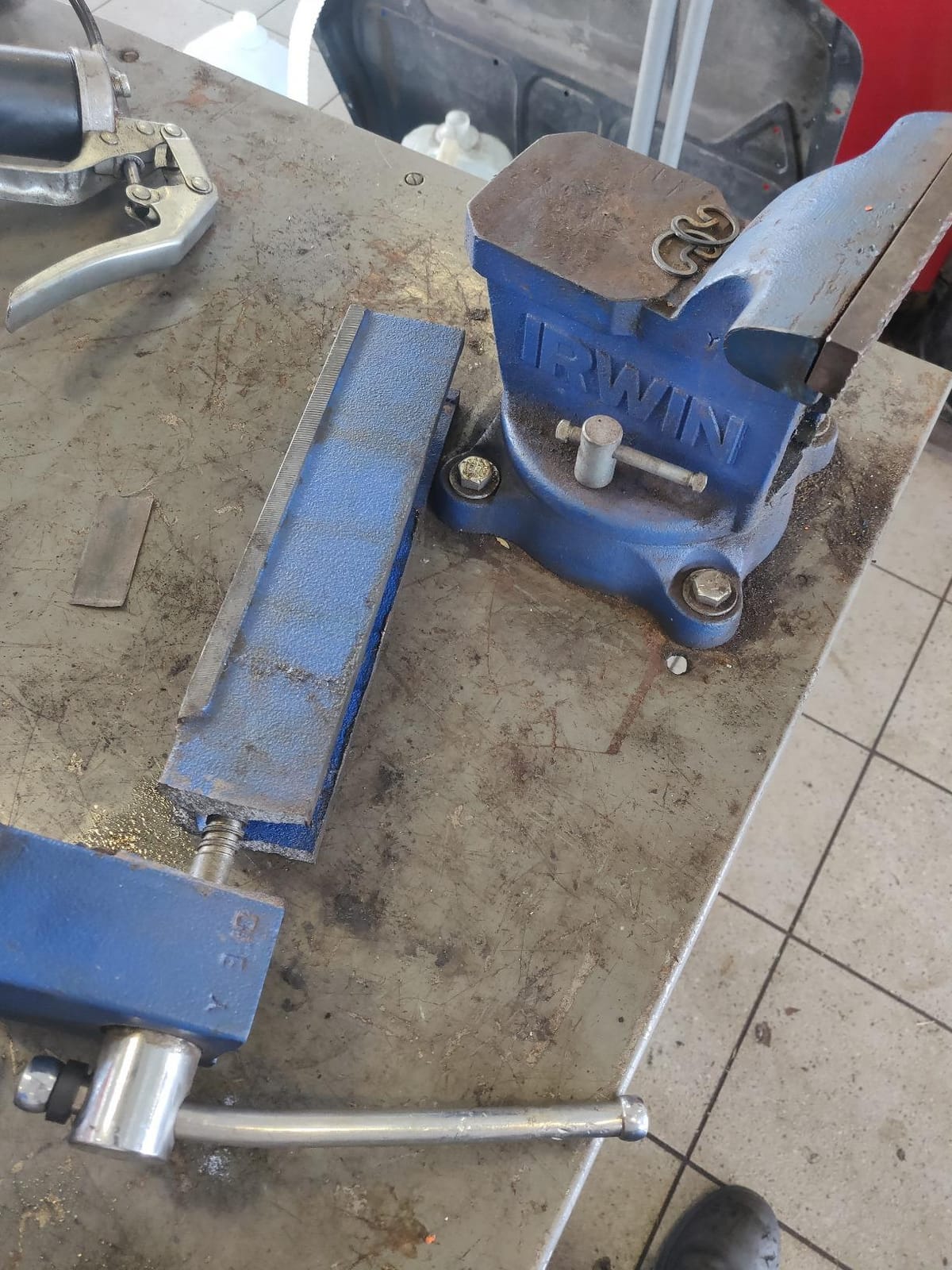
It opens wide and holds with more than 3,000 pounds of clamping pressure, the base rotates fully in either direction, and there is an incorporated anvil. A safety stop prevents the slide from separating from the body, which is a cheap feature that prevents an expensive failure.
The honest read from owners is that this is a hold-it-steady vise rather than a striking vise. At 30.9 pounds it is lighter than the heavy-duty label implies, and the swivel lock threads can wear over years. With the smallest review base here at 160 ratings, you have less community evidence to draw on than with the other nine. Several owners note Taiwanese manufacture.
Is the IRWIN 4935506 a good everyday bench vise?
Yes, for holding parts steady while you apply torque, and for general repair shop work. The dovetailed nut and close-tolerance casting mean it keeps its accuracy instead of developing lash.
The 4-1/4 inch clamping capacity and full rotation base make it easy to work with, and the incorporated anvil is a bonus for light shaping.
Where does the IRWIN fall short?
Weight. Owners consistently say it is lighter than expected for a heavy-duty 6-inch vise, and that means it is not the right tool for hammering, forming, or forging.
The swivel lock threads can wear out over a long life, and the smallest review base here means you have less long-term feedback to rely on. Parts are easy to source, which partly offsets it.
How to Choose a Bench Vise for Metalworking?
The single most useful thing you can do before buying is measure your three largest typical workpieces. Jaw width should be equal to or greater than the widest dimension of the part, jaw opening should comfortably exceed its thickness, and throat depth should be deep enough that the part sits in front of the jaws rather than overhanging the base. Everything else is preference.
Bench vise vs machinist vise vs milling vise
A bench vise is a general-purpose clamp for hand work: filing, deburring, drilling, tapping, and assembly. A machinist vise is a heavier, more rigid version with a deeper throat, full rotation, and replaceable hardened jaws, built so that clamping force does not change accuracy as the jaw loads up. A milling vise is a precision indexing vise that clamps between two parallel faces and locks rigidly for machining operations on a mill or drill press. A pipe vise is built around V-shaped jaws for round material.
For metalworking at a bench, you want an engineering or machinist vise. You need a milling vise only if you are holding work on a machine tool where the workpiece must not move in any axis.
Jaw width vs jaw opening vs throat depth
Jaw width is the height of the clamping face and it determines clamping force, because a wider face spreads the same load over more area. Jaw opening is how far the jaws separate, and it determines the thickest material you can clamp. Throat depth is the clearance between the front of the fixed jaw and the slide, and it determines the height of workpiece you can hold in front of the vise rather than overhanging it.
For metalworking, a 4-inch vise handles small brackets and hardware. A 5-inch or 5.5-inch covers general flat bar and plate. A 6-inch covers most production work, and it is the size most mechanics settle on. Below about 2-3/8 inches of throat, tall sections start to become awkward to clamp.
How much clamping force do you actually need?
More than most people expect, and you will know you are short when a spinning drill walks the workpiece or a wrench slips the corners off a bolt. Among the vises here that publish a figure, clamping force runs from just over 3,000 pounds to 7,700 pounds. Drilling and tapping thin plate needs very little. Drilling into thick steel, tapping large threads, and holding work under a heavy wrench stroke all benefit from a vise well above 4,000 pounds.
Grease the acme screw and it will hold its force far longer. Dry screws wear faster, develop lash, and are the first thing to fail in an inexpensive vise.
Mounting: why most vises creep and how to stop it
Nearly every complaint about vise movement traces back to mounting, not to the vise. A 38-pound vise on four short bolts into a particle board top will move the first time you hit it, and no amount of clamping force fixes that.
Use bolts that pass completely through the bench top and into the frame or a solid hardwood substrate, not short lag screws into a hollow top. Mark your own holes from the actual base rather than trusting a printed template, since hole spacing on several of these models does not match the drawing. Torque the bolts evenly in a cross pattern so the base seats flat.
On a wood top, a reinforcement plate or a hardwood bench is worth fitting. On a steel bench, weld nuts or use through-bolts. A 64-pound mechanics vise needs a bench frame designed for that load, not a light duty shop bench. Once mounted, test the vise with a dead-blow hammer before you trust it with a part you care about.
Maintenance: keeping clamping force for a decade
Clean and lubricate the acme screw on a schedule. A thin film of suitable grease every few months keeps the thread from wearing and stops the slide from developing lash, which is the difference between a vise that feels precise and one that feels vague.
Keep the slide and nut clear of metal swarf. Chips that build up in the joint will chew the screw and the nut, and they are the reason the enclosed spindle on the Wilton 746 is worth paying for on a working shop vise. Check jaw caps periodically and replace them when the teeth round off rather than waiting until they stop gripping. Wipe cast iron bodies when the powder coat is unfinished or scratched, and touch up any chips to keep corrosion off the casting.
Which vises accept soft material without marking it?
All of them, if you add soft jaw caps or sacrificial jaw material. The VEVOR in this roundup is the only one that ships with magnetic nylon pads, which is convenient for finished work out of the box. The other nine have replaceable hardened steel jaws that are designed to bite hard into metal, so expect marking on anything you care about finishing.
USA-made vises versus imported vises
Machinist communities consistently single out Wilton as one of the best-made vises, often alongside the small 4-inch bullet vises, and that reputation tracks with the lifetime warranty and the depth of the 746. The Yost lines here carry the same long-term commitment, with lifetime casting coverage on the ADI-6. The VEVOR, Forward, and IRWIN models in this roundup sit in the imported value tier, where the practical difference is warranty length and how long replacement parts will be available.
Buying from a maker with a long service life costs more up front and buys you a warranty that still means something in ten years. Buying imported buys you more clamping force and more jaw per pound spent today. Both are defensible choices; they just fail differently.
Frequently Asked Questions
What is the best brand of bench vise for mechanics?
For most mechanics, Wilton and Yost are the two names that come up most. Wilton offers general-purpose and machinist vises with lifetime warranties and deep throats, while Yost covers entry cast iron through 130,000 PSI austempered ductile iron with a lifetime casting warranty. Imported brands such as VEVOR, Forward, and IRWIN deliver more clamping force and jaw size for less money, which many shops prefer.
Who makes the best bench vices?
It depends entirely on the work. The Yost 760-DI is the most adjustable, with a 360-degree body and a rotating head that locks in 12 positions. The Yost 460 has the deepest throat among the 6-inch vises here at 4.375 inches plus a permanent pipe jaw. The Wilton 746 trades the most weight for rigidity, at 64 pounds, with a fully enclosed spindle. The Forward CR50A produces the highest published clamping force, 7,700 pounds, in this roundup.
What is the best bench vise made in the USA?
Wilton and Yost are the two makers most often named for US-built vises in this roundup. The Wilton 746 mechanics vise carries a lifetime warranty with a 64-pound body and a 4-1/8 inch throat, and the Yost ADI-6 has a limited lifetime warranty on castings built from 130,000 PSI austempered ductile iron.
What vise do gunsmiths use?
Most gunsmiths use a 6-inch engineering vise, and for parts that matter, one that accepts soft jaw material. The VEVOR 6-inch suits that work because the magnetic nylon pads protect blued and finished surfaces without any jaw change. The Wilton 11106 is the alternative for shops that want a lifetime warranty. Avoid a vise whose jaw faces will mark a hardened receiver.
Which 6-inch bench vise is the best?
Among the 6-inch vises here, the VEVOR leads on published clamping force at 4,496 pounds and includes magnetic soft jaw pads, the Wilton 11106 has the most owner feedback and a lifetime warranty, and the Yost 460 has the deepest throat at 4.375 inches plus a permanent pipe jaw. For striking work the Yost ADI-6 has the stronger casting, and for pure rigidity the Wilton 746 is heavier at 64 pounds.
What are the key differences between a bench vise and a machinist vise?
A bench vise is a general-purpose clamp for hand work such as filing, deburring, and drilling. A machinist vise is heavier and more rigid, with a deeper throat, a full 360-degree swivel, replaceable hardened jaws, and a fully enclosed screw and nut so clamping force stays consistent under load. If your accuracy depends on the work not shifting, the machinist vise is the upgrade that matters.
How much clamping force does a bench vise need for metalworking?
For drilling, tapping, and assembly on plate and flat bar, anything above 3,000 pounds is workable. For drilling thick steel, tapping large threads, and holding work while you apply heavy torque, look for 4,000 pounds or more. The vises in this roundup that publish a figure range from just over 3,000 pounds to 7,700 pounds, and heavier vises gain force mainly from jaw width and screw design.
Should I buy a 4-inch, 5-inch, or 6-inch bench vise?
Buy a 4-inch vise for a small bench, small brackets, gun parts, and electrical fittings. A 5-inch or 5.5-inch covers general flat bar and plate. A 6-inch handles most production metalwork and is the size most mechanics settle on. The simplest rule is to match jaw width to the widest workpiece you regularly clamp, then check that throat depth clears its height.
The Verdict: Which Bench Vise Should You Buy
The VEVOR 6-inch is our pick as the best bench vise for metalworking overall. It pairs 4,496 pounds of clamping force with a 3.5 inch throat, a full 360-degree swivel, and magnetic soft jaw pads, all on a 25-pound ductile iron casting. Buy your own mounting bolts and it is ready for a workbench.
Buy the Yost 460 instead if throat depth is what you are short on, or if you handle round bar and pipe and want a permanent pipe jaw. Buy the Wilton 11106 if a lifetime warranty and the largest owner base matter more to you than swivel range. For a rotating head, the Yost 760-DI is the only one here that does it. For striking, forming, and rigidity, the Yost ADI-6 and the Wilton 746 are the two to look at.
Whatever you choose, measure your largest workpiece, bolt it through the bench top with hardware that reaches the frame, and grease the acme screw every few months. Those three habits matter more to how a vise feels in ten years than any spec on the box. Check current pricing and availability for each model with the button below its review, and pick the size that matches your bench before you pick the brand.