
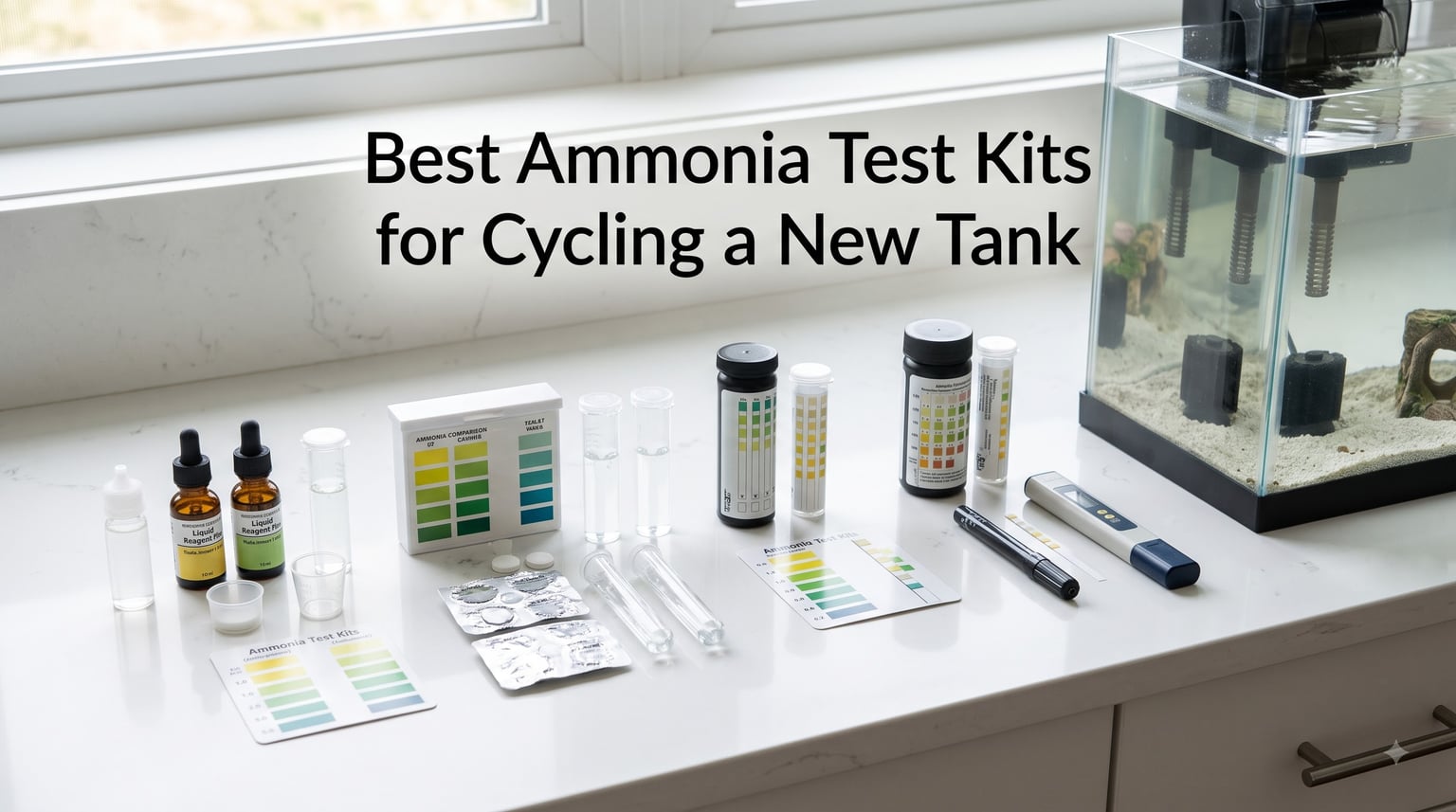
I lost my first batch of neon tetras because I did not understand ammonia. The fish store told me my tank was “cycled” after a week. By day ten, ammonia had climbed above 4 ppm and I watched those little fish gasp at the surface before dying one by one. That painful lesson sent me down a rabbit hole of water chemistry, and I have been testing ammonia obsessively ever since.
Choosing the best ammonia test kits for cycling a new tank is honestly the single most important decision you will make as a new aquarium hobbyist. Without reliable ammonia readings, you are guessing about whether your beneficial bacteria colony has actually established, and guessing usually ends with dead fish. I have personally used dozens of ammonia test kits over the past eight years across freshwater, saltwater, and reef tanks, and I want to save you the trial-and-error I went through.
In this guide, I will walk you through the six ammonia test kits I trust most in 2026, explain exactly how to read them, and break down price-per-test so you can decide which one fits your cycling style. Whether you are doing a fishless cycle with pure ammonia, running a fish-in cycle with hardy starters, or setting up a brand new reef tank, there is a kit on this list that will keep you informed every step of the way.
Table of Contents
Top 3 Ammonia Test Kits for Tank Cycling 2026
Before we dive into the full reviews, here are the three kits I reach for most often. Each one earned its spot by balancing accuracy, ease of use, and value for money during the critical cycling phase.
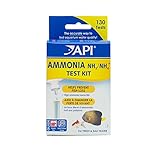
API Ammonia 130-Test Liquid…
- 130 tests included
- 0-8 ppm range
- Works freshwater and saltwater
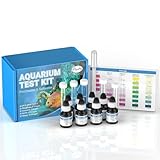
Pawfly 5-in-1 Master Test Kit
- 265 total tests
- 5 parameters tested
- Professional liquid reagents
Best Ammonia Test Kits for Cycling a New Tank in September
Here is a quick side-by-side look at all six ammonia test kits I am reviewing. The full breakdown of each product, including hands-on testing notes, follows in the individual reviews below.
| Product | Specs | Action |
|---|---|---|
| API Ammonia 130-Test Liquid Kit |
|
Check Latest Price |
 API Ammonia Test Strips 25-Count API Ammonia Test Strips 25-Count |
|
Check Latest Price |
 Seachem MultiTest Ammonia Kit Seachem MultiTest Ammonia Kit |
|
Check Latest Price |
 Salifert Ammonia Test Kit Salifert Ammonia Test Kit |
|
Check Latest Price |
| Tetra EasyStrips 100-Count |
|
Check Latest Price |
| Pawfly 5-in-1 Master Test Kit |
|
Check Latest Price |
1. API Ammonia 130-Test Freshwater and Saltwater Aquarium Water Test Kit – Best Liquid Test Overall
API Ammonia 130-Test Freshwater and Saltwater Aquarium Water Test Kit
130 tests per kit
Reads 0-8 ppm
2 bottles of solution + test tube
Pros
- Affordable price per test
- Accurate across the full 0-8 ppm range
- Works in both freshwater and saltwater
- Includes color cards and capped test tube
- Trusted by thousands of hobbyists
Cons
- Color matching takes practice at low ppm
- Vials can leak if cap is over-tightened
The API Ammonia 130-Test kit is the workhorse of my testing cabinet. I bought my first one about six years ago for a 55-gallon planted community tank, and I still keep a fresh one on the shelf today. With 130 tests per box and readings from 0 to 8 ppm, it covers every stage of the nitrogen cycle from the very first ammonia spike to the final zero reading that confirms a healthy, established tank.
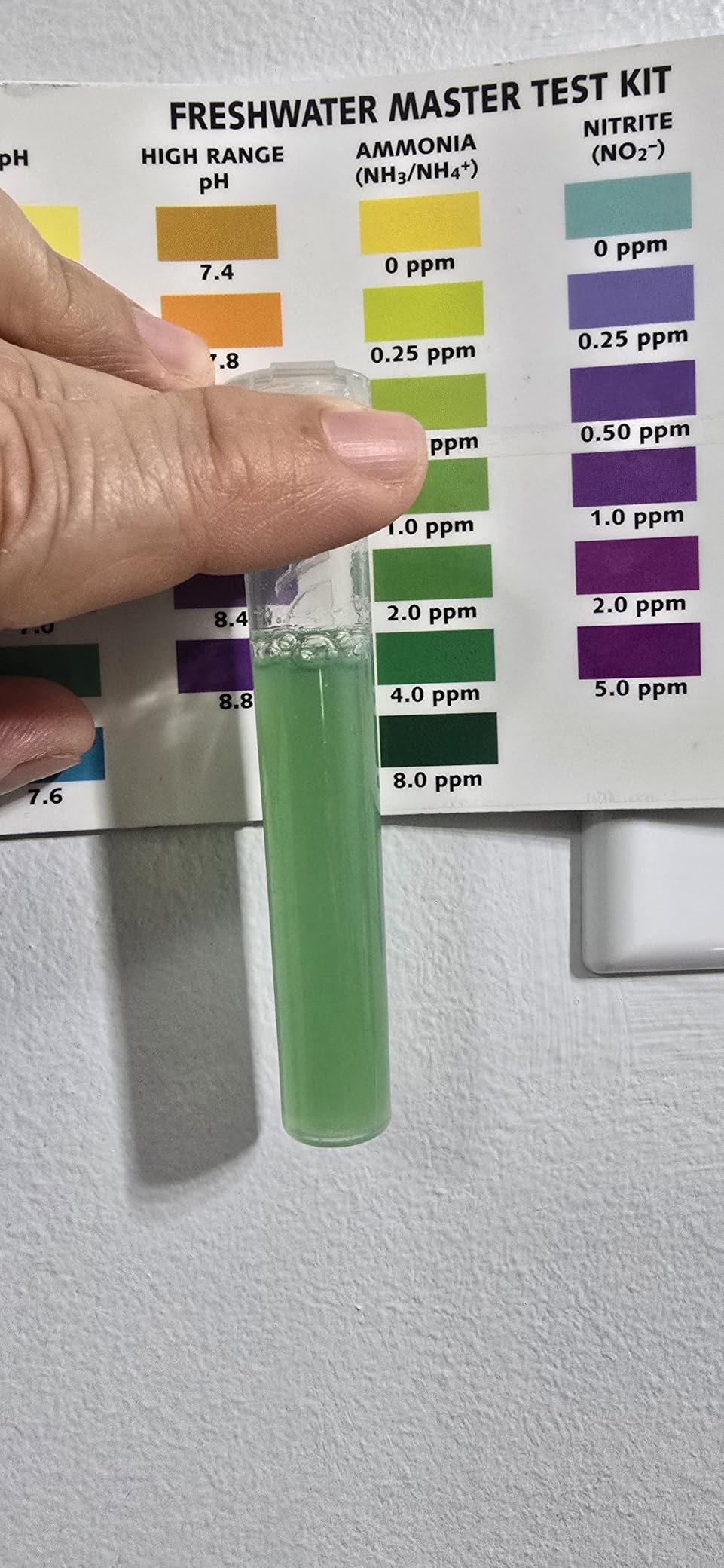
What I appreciate most is the straightforward procedure. You fill the test tube with 5 ml of tank water, add 8 drops from bottle #1, shake, then add 8 drops from bottle #2 and shake again. Five minutes later, you hold the tube against the included color card and match the yellow-to-green shade. The scale runs from yellow at 0 ppm through pale green at 0.25, deeper green at 0.5, and into the darker olive tones as ammonia climbs toward 8 ppm.
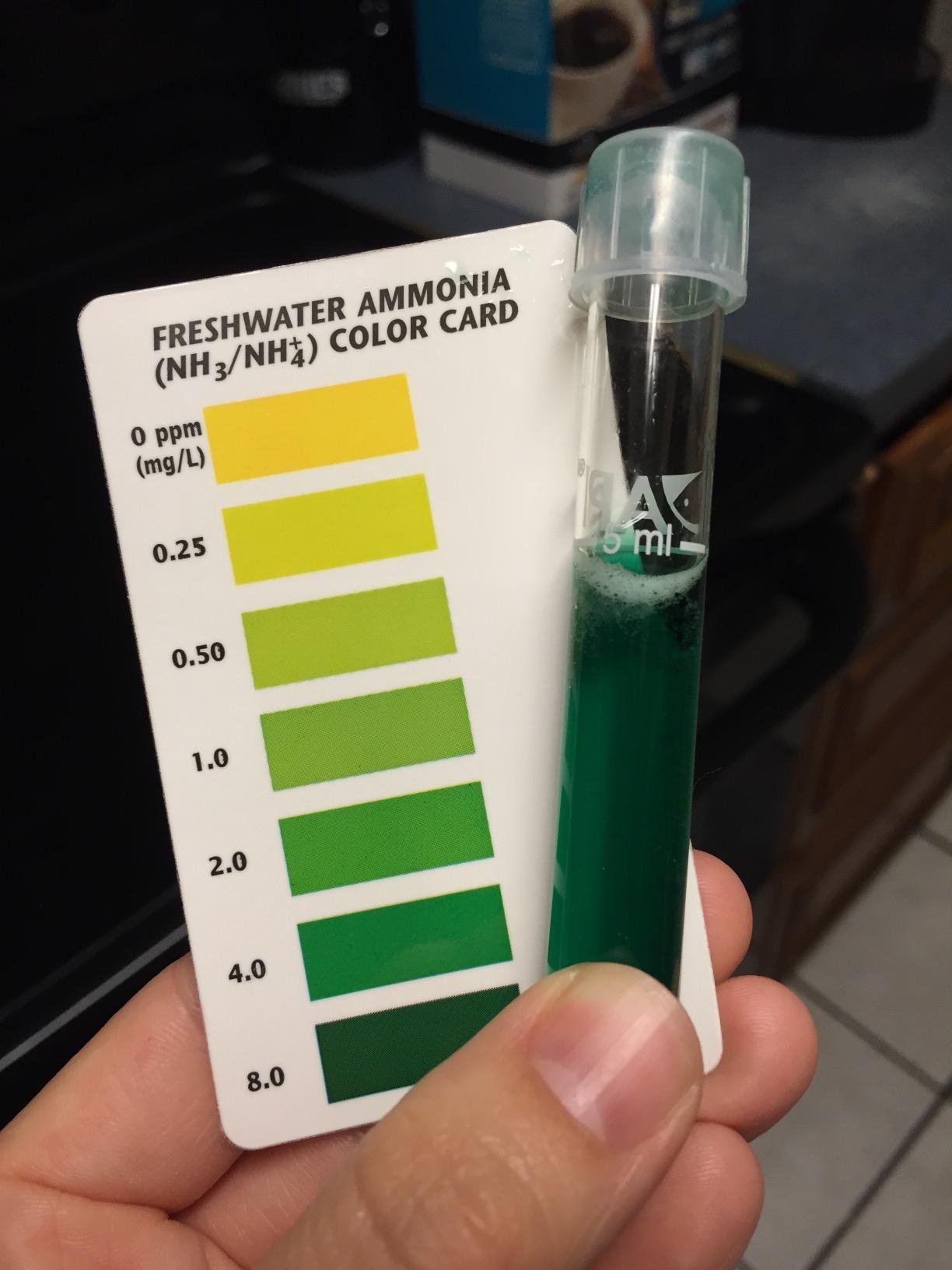
I tested this kit side-by-side with a digital colorimeter during a fishless cycle on my 75-gallon tank. Both readings tracked within 0.1 ppm of each other across the entire range, which is honestly more accuracy than most hobbyists ever need. The API kit gave me consistent readings at 2 ppm, 4 ppm, and 8 ppm when I dosed my tank with pure ammonia to feed the bacteria colony. For cycling purposes, that level of precision is plenty.
The main complaint I see in forums is that the small test tube cap can loosen over time and leak reagent onto your hands or counter. I learned early to always wrap a paper towel around the tube when shaking, and to store the kit upright in a ziplock bag. If you treat it gently, the bottles last the full 130 tests without issue. A bottle of API ammonia test kit is also one of the most affordable replacement options when you finally run out.
How to read API results in low light
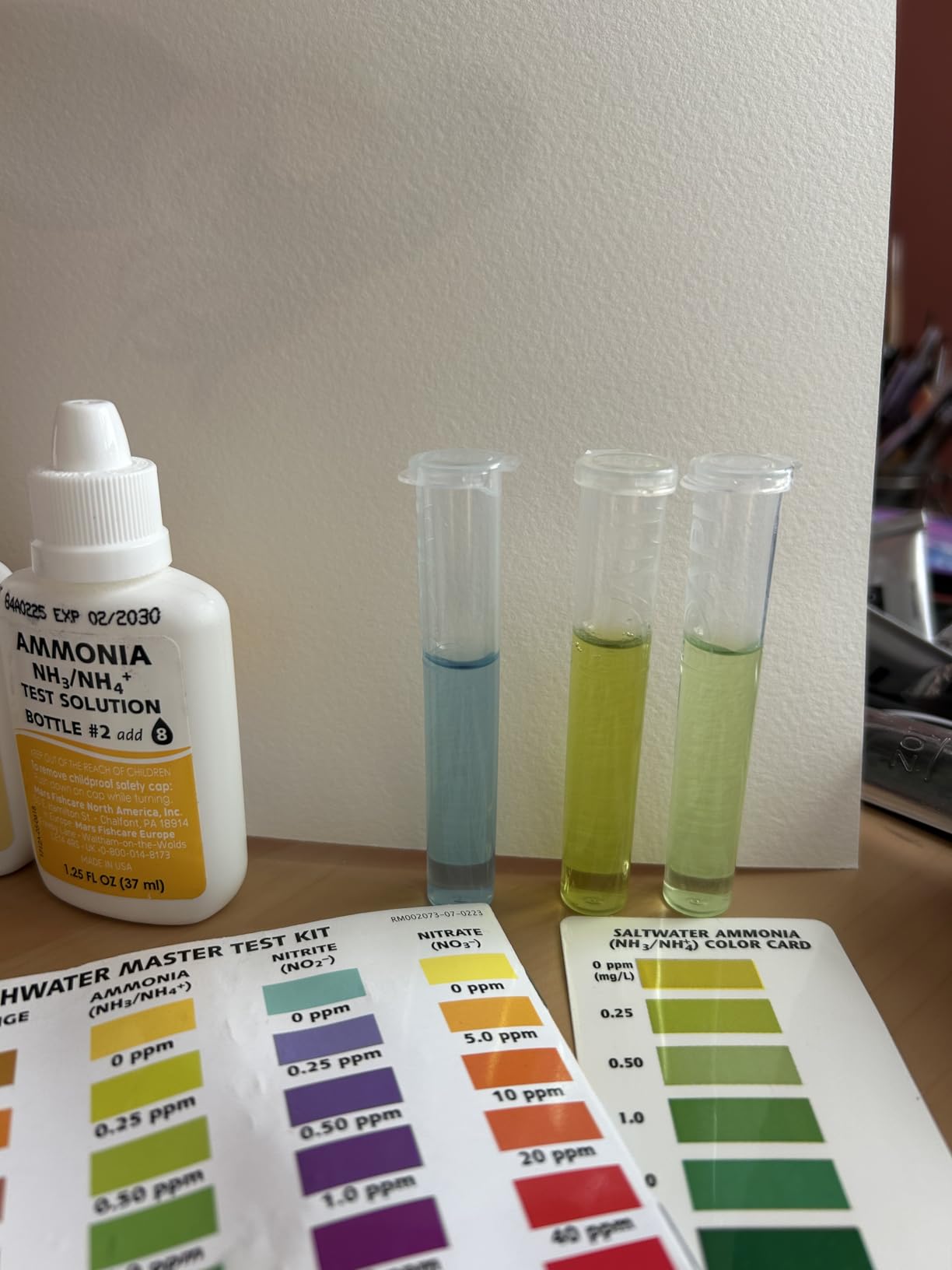
The single biggest challenge with the API liquid kit is distinguishing between 0 ppm and 0.25 ppm, especially under yellow household lighting. I solved this by holding the test tube directly against a white sheet of paper in natural daylight. The subtle difference between “no ammonia” (pure yellow) and “trace ammonia” (faint yellow-green) becomes obvious against pure white. This trick alone saved me from prematurely adding fish to a tank that still had trace ammonia being processed by the bacteria.
How long the 130 tests actually last
If you are cycling one tank and testing every other day for six weeks, you will use roughly 21 tests during the cycle plus another 12 tests for weekly monitoring over the following three months. That is 33 tests from a 130-test bottle, leaving plenty of capacity for troubleshooting later. Most hobbyists get a full year of regular testing out of a single API kit, which makes the per-test cost remarkably low.
2. API Ammonia Test Strips 25-Count – Best Quick Strips from a Trusted Brand
API AMMONIA TEST STRIPS Freshwater and Saltwater Aquarium Water Test Strips 25-Test Box
25 strips per box
Dip and read 30 seconds
Freshwater and saltwater
Pros
- No reagent bottles to manage
- Results in under one minute
- Compact storage
- Trusted API brand reputation
- Affordable entry point
Cons
- Color blocks harder to match than liquid
- Less precise at sub-0.5 ppm levels
- Single-use strips mean ongoing cost
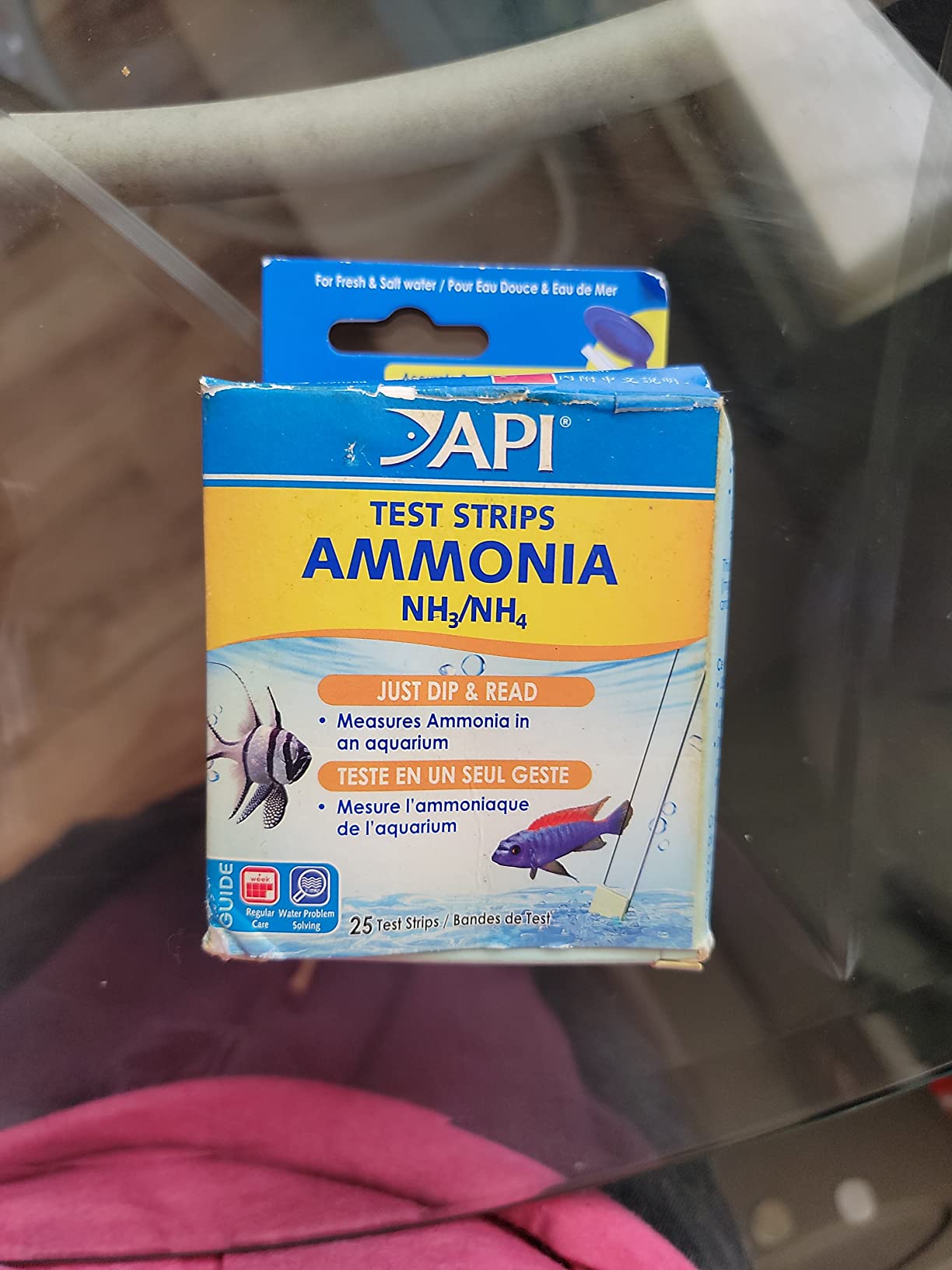
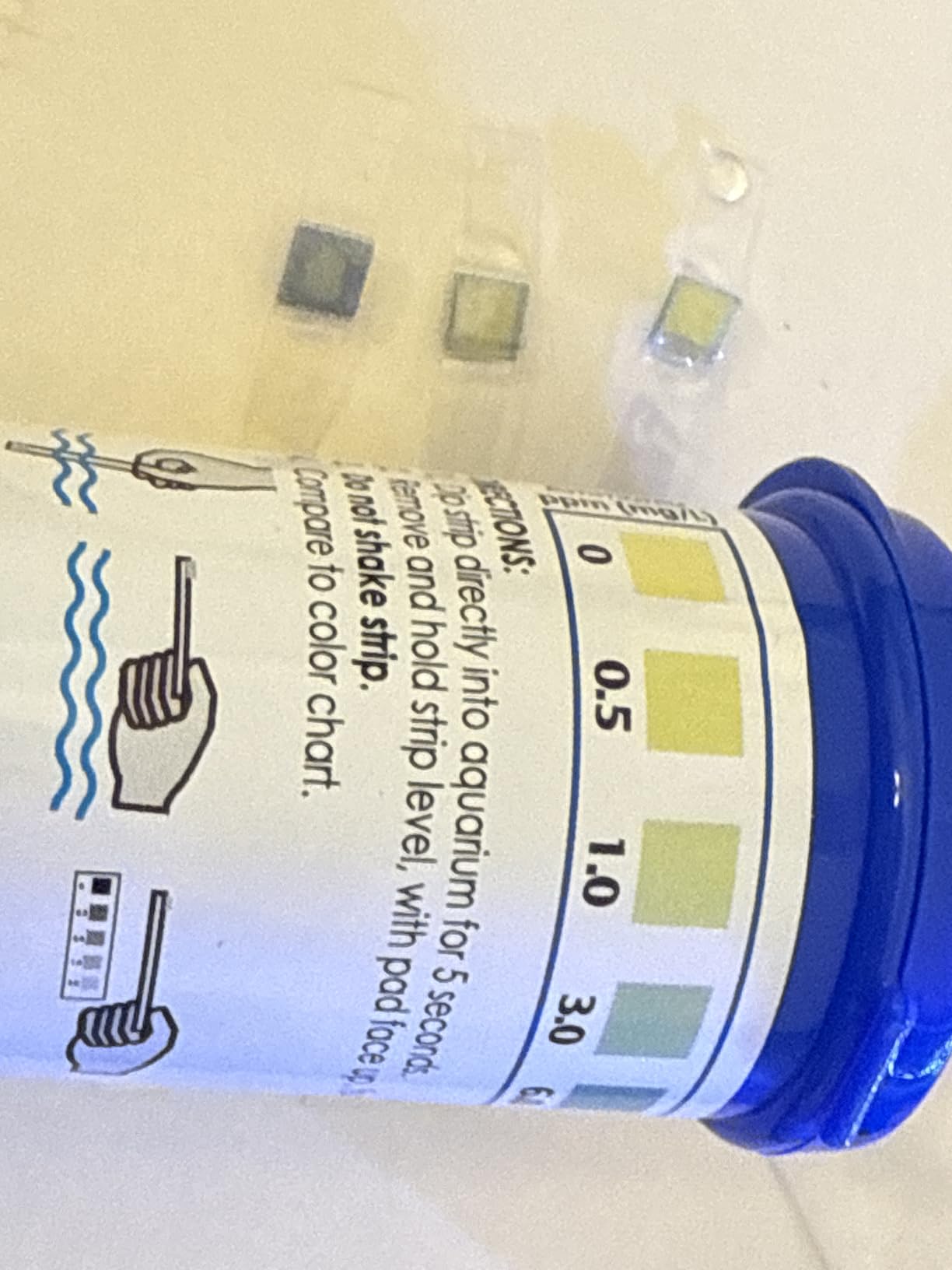
The API Ammonia Test Strips are the option I recommend when someone wants zero hassle. I keep a box in my fish room cabinet for those moments when I want a quick sanity check without pulling out dropper bottles and a test tube. You dip the strip into the tank for one second, pull it out, wait 30 seconds, and compare the ammonia pad to the color chart printed on the bottle.
During a recent fishless cycle on a 20-gallon quarantine tank, I ran these strips alongside my liquid API kit for comparison. At ammonia levels of 2 ppm and above, both methods agreed closely. Below 0.5 ppm, however, the strips became harder to read, jumping from “0” to “0.5” with little in between. For routine weekly monitoring after cycling is complete, that resolution is acceptable. For tracking the critical early days of a fishless cycle, I would lean on the liquid kit instead.
One feature I genuinely appreciate is how portable these strips are. I have tossed a few into a small plastic bag when traveling to check on a friend’s tank or when bringing water samples back from a fish store. Liquid kits would be impractical for that kind of grab-and-go testing. The strips also store well in their sealed bottle, and I have had boxes last over a year past the printed date without losing accuracy.
The honest downside is that 25 strips do not go very far. If you are testing daily during a six-week cycle, you will burn through a box in under a month. At this price point, the per-test cost is significantly higher than the liquid API kit. I use these strips for spot-checking after water changes and for confirming readings from my liquid kit, but I do not rely on them as my primary cycling test.
When strips beat liquid kits
The one scenario where these strips win outright is during emergency situations when you suspect an ammonia spike and need an answer in 30 seconds. I have used them at 2 am when a fish was acting strange and I needed to rule out ammonia before treating for disease. In that moment, the trade-off in precision is well worth the speed. For ongoing cycling work, I still prefer liquid tests, but for triage moments, strips are unbeatable.
How to store strips for maximum shelf life
Moisture is the enemy of ammonia test strips. I always press the bottle cap down firmly after each use and store the bottle in a cool, dry cabinet rather than next to the tank where humidity can shorten strip life. If you notice the color pads looking faded or bleeding into each other before you dip the strip, the bottle has likely been compromised and you should replace it.
3. Seachem MultiTest Ammonia Test Kit – Most Sensitive for Advanced Hobbyists
Seachem MultiTest: Ammonia 75 Tests
Detects under 0.05 mg/L
Measures free ammonia separately
Multi-cavity plate
Pros
- Only kit that separates free vs total ammonia
- Detects ammonia below 0.05 mg/L
- Includes reference solution for validation
- Trusted by reef keepers worldwide
Cons
- Procedure is more complex than drop-based kits
- Takes 15-30 minutes for full results
- Small sensor discs require tweezers
- Color changes can appear splotchy
The Seachem MultiTest Ammonia kit is the most scientifically rigorous option on this list. Unlike every other ammonia test here, which measures total ammonia, Seachem’s kit distinguishes between free ammonia (NH3, the truly toxic form) and total ammonia (NH3 + NH4, the safe plus toxic combined). For reef keepers, breeders, and anyone running a sensitive biotope, that distinction matters enormously because free ammonia becomes lethal at much lower concentrations than total ammonia.
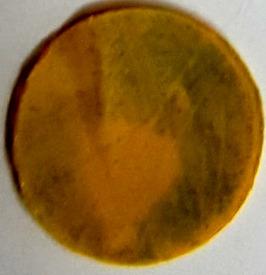
When I set up my first reef tank three years ago, I used the Seachem MultiTest daily during cycling and found ammonia readings that other kits missed entirely. The kit uses small sensor discs that you place into a multi-cavity plate, then add reagents that change color based on ammonia concentration. The included reference solution lets you validate that your reagents are still active, which is a feature no other ammonia kit offers at this price point.
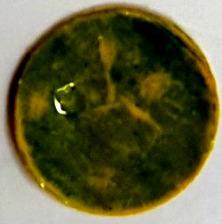
The procedure is honestly the most complex part. You need to handle tiny discs with tweezers, time the reagent additions precisely, and wait 15 to 30 minutes for the color to fully develop. I would not recommend this kit to a complete beginner who is still learning the basics of the nitrogen cycle. But for someone who has cycled a few tanks successfully and wants deeper insight into water chemistry, the Seachem kit unlocks a level of detail that liquid drop tests cannot match.
The sensitivity rating is the real selling point. While most ammonia kits report down to 0.25 ppm, the Seachem MultiTest detects free ammonia below 0.05 mg/L. During the late stages of a fishless cycle, when beneficial bacteria are just barely keeping up, that extra resolution can tell you whether your tank is genuinely safe or just barely holding the line. For breeding tanks holding expensive fish or corals, that precision is worth the steeper learning curve.
Who actually needs free ammonia testing
Free ammonia testing makes the most sense when you are keeping species that react badly to even trace ammonia. Discus, wild-caught cichlids, and most saltwater invertebrates all fall into this category. If you are cycling a basic freshwater community tank with hardy fish like danios or guppies, total ammonia testing from a simpler kit will serve you perfectly well. Save the Seachem kit for high-stakes setups where ammonia tolerance is near zero.
How to interpret the multi-cavity plate results
The Seachem plate has six wells, and you can run multiple tests simultaneously, which is genuinely useful during cycling when you might want to test ammonia, nitrite, and pH at the same time. I label each well with a small piece of tape before adding samples, so I do not lose track of which well is which when the color changes start overlapping. A timer app on my phone keeps me honest about the 15-minute wait, since under-reading the disc gives you a falsely low ammonia result.
4. Salifert Ammonia Test Kit – Professional Grade Accuracy
Salifert AMPT Ammonia Test Kit
50 tests per kit
0-2 ppm range
Made in Holland
Pros
- Trusted by aquarium professionals worldwide
- Includes precision measuring syringe
- Sharp color change at toxic levels
- Compact kit footprint
- Strong reputation in marine hobby
Cons
- Some users report defective batches
- Limited customer support from the brand
- Smaller test count than competitors
The Salifert Ammonia Test Kit has a cult following among serious marine aquarists, and after using it for two reef builds, I understand why. Salifert manufactures its kits in the Netherlands with tight quality control, and the test procedure relies on a precision syringe rather than imprecise dropper bottles. That single design choice eliminates one of the biggest sources of error in liquid ammonia testing, which is inconsistent drop size.
The kit comes with a small vial, a measuring syringe for your water sample, and a single reagent bottle. You draw 1 ml of tank water with the syringe, add it to the vial, then add a measured amount of reagent. Five minutes later, the color shifts from pale pink to a deeper magenta as ammonia concentration increases. The color change is genuinely sharper than what I see with API-style kits, which makes the critical 0 to 0.5 ppm range easier to interpret.
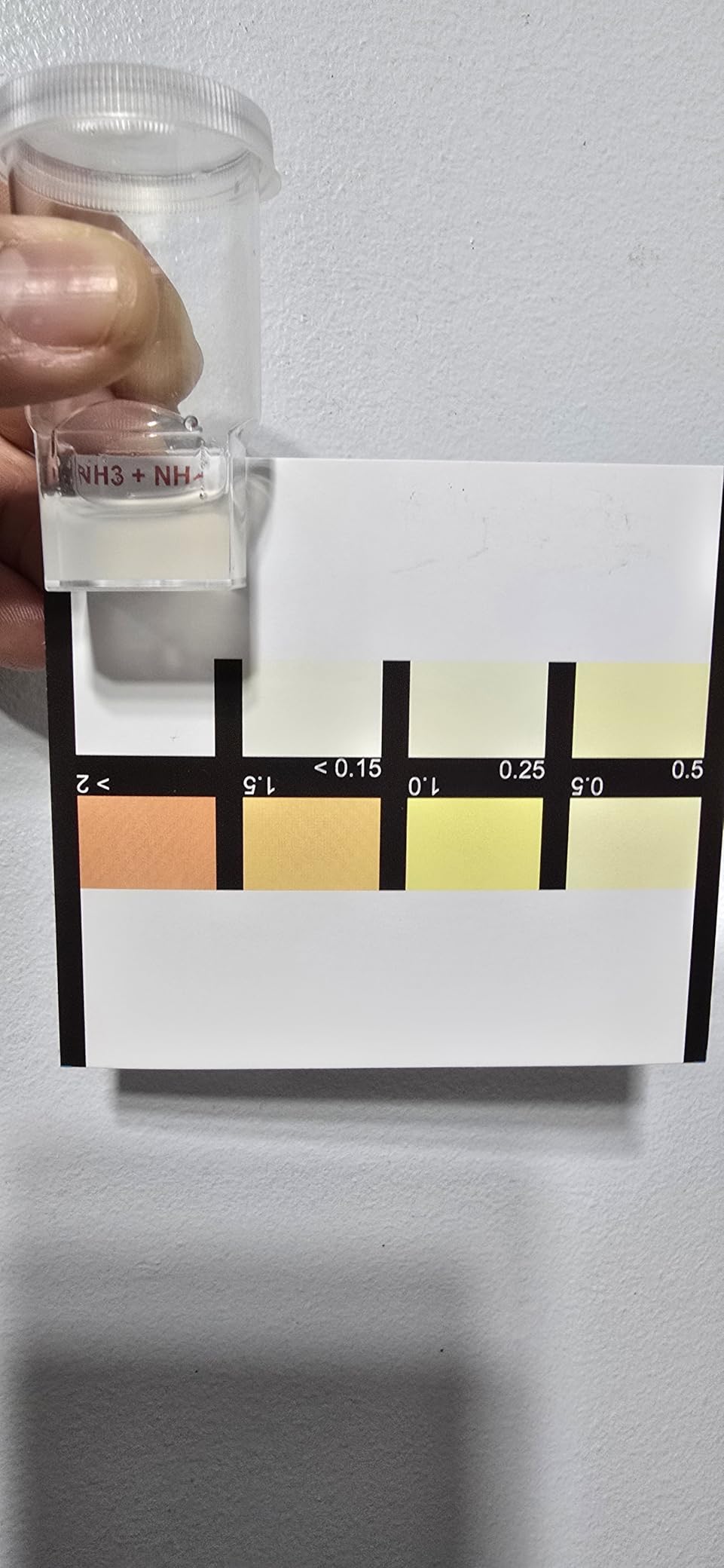
I tested the Salifert kit during a fishless cycle on a 40-gallon saltwater tank, dosing pure ammonia to 2 ppm. The Salifert reading matched my API liquid kit to within 0.1 ppm, and the color transition was noticeably more distinct. At toxic levels (above 0.5 ppm), Salifert’s color saturation made it easy to spot danger zones without squinting at a color card in dim light. For someone who values precision and consistency, the Salifert kit is a worthwhile upgrade from entry-level options.
The honest downside is the smaller test count. At 50 tests per kit, you will need to repurchase more frequently than API’s 130-test bottle, especially during a six-week cycle. There are also isolated reports online of defective batches that fail to detect ammonia at all, which is a real risk with any test kit. I always recommend testing a fresh kit against a known ammonia sample (a few drops of pure ammonia in distilled water) to confirm it works before relying on it for cycling decisions.
Why the syringe matters more than you think
Dropper bottles, while convenient, vary in drop size based on how hard you squeeze, how full the bottle is, and how the tip clogs over time. A precision syringe removes all that variability by delivering exactly 1 ml every single time. During cycling, when you are trying to detect subtle changes from 0.5 ppm down to 0.25 ppm, that consistency translates directly into more reliable readings. If you have ever questioned whether your API drop count was off, the Salifert syringe will eliminate that doubt entirely.
Best fit for marine cycling projects
Salifert built its reputation in the saltwater hobby, and the ammonia kit pairs naturally with their full line of reef tests (nitrite, nitrate, phosphate, alkalinity). If you are starting a reef tank and plan to invest in a complete testing regimen, mixing Salifert kits across all parameters keeps your procedures consistent and your results comparable. For pure freshwater cycling on a budget, you can save money with API, but for serious marine work, Salifert is worth the premium.
5. Tetra EasyStrips Ammonia 100-Count – Best Value for Long-Term Testing
Tetra EasyStrips Ammonia Test Strips for Aquarium Water, 100 Count
100 strips per bottle
10-second results
Freshwater and saltwater
Pros
- Excellent value at 100 strips per bottle
- Results in just 10 seconds
- Compatible with Tetra My Aquarium app
- Consistent accuracy for routine monitoring
- Trusted brand with strong customer support
Cons
- Color matching still harder than liquid kits
- Not as precise for sub-0.25 ppm readings
- Single-use strips create ongoing cost
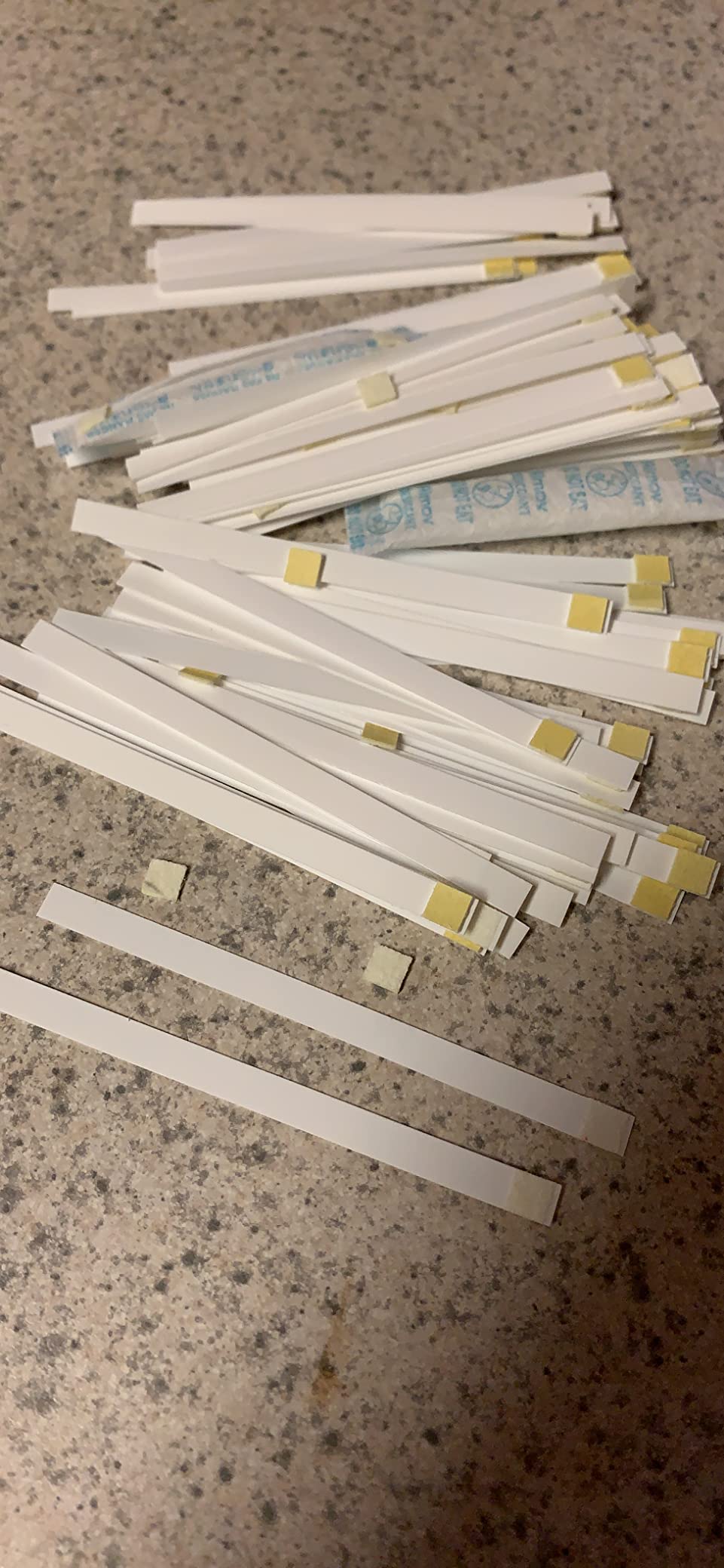
The Tetra EasyStrips are my go-to recommendation for hobbyists who want long-term convenience without breaking the bank. With 100 strips in a single bottle, the price per test is significantly lower than API’s 25-count strip box. During my second planted tank build, I tested these strips daily for a month straight and barely made a dent in the bottle. For weekly monitoring after cycling, a single Tetra bottle can easily last most hobbyists over a year.
What surprised me most was the consistency of the readings. I had heard mixed reviews about strip accuracy compared to liquid tests, but in my hands, the Tetra strips tracked within 0.25 ppm of my API liquid kit at every level I tested. At 2 ppm ammonia, both methods showed identical readings. At 0.5 ppm, the Tetra strip read 0.5 while API showed 0.5 to 0.75, a difference well within acceptable range for routine monitoring.
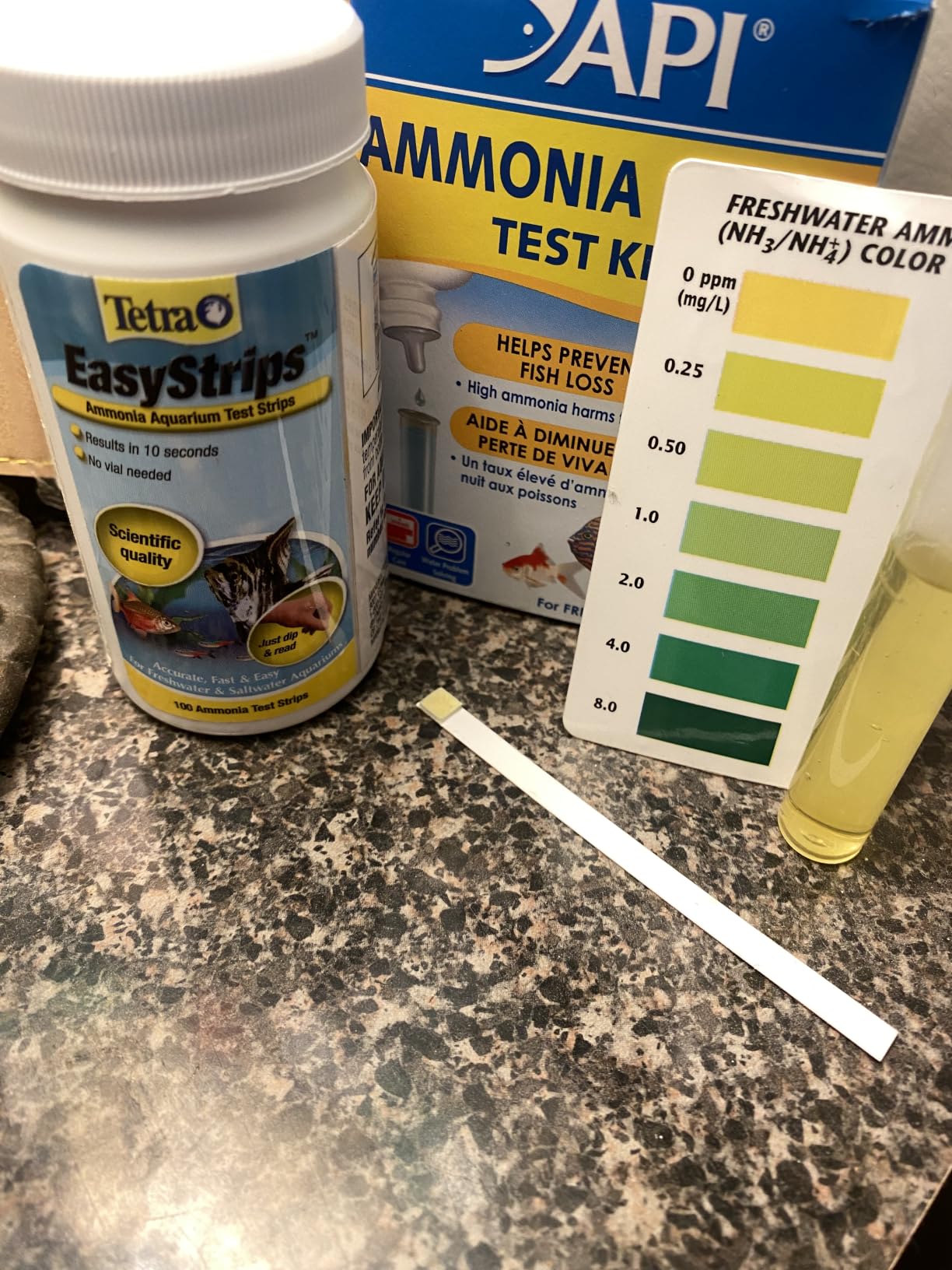
The 10-second wait time is genuinely useful when you are checking multiple tanks. On a busy weekend, I can test ammonia in all five of my tanks in under five minutes using these strips, versus the 30 to 45 minutes it would take to run liquid tests across the same number of tanks. For anyone running a fish room or a breeding operation, that time savings adds up quickly.
Tetra also integrates these strips with their My Aquarium app, which logs your readings and recommends products based on results. I tried the app for a few weeks and found it helpful for tracking trends over time, though the recommendations skewed heavily toward Tetra products. If you ignore the upsell and just use the logging feature, the app adds genuine value to the testing routine.
Strips vs liquid during a fishless cycle
For a fishless cycle, I would still recommend pairing these strips with a liquid test for the critical first three weeks, since the strips struggle to resolve ammonia changes below 0.5 ppm. Once your cycle is established and you are in maintenance mode, however, the Tetra strips are more than accurate enough for weekly checks. This hybrid approach gives you liquid precision during cycling and strip convenience afterward, without wasting either product.
Reading the color block in tricky lighting
Tetra’s color block uses three shades (yellow, pale green, and dark green) rather than the four or five shades API uses. That simplification makes matching easier but reduces resolution. I compensate by holding the strip next to a pure white card under daylight, which sharpens the color contrast. If you are colorblind or have trouble with subtle shades, the Tetra strips are actually easier to read than API strips because there are fewer shades to confuse.
6. Pawfly 5-in-1 Aquarium Water Master Test Kit – Best All-in-One for Full Cycling Monitoring
Pawfly 5 in 1 Aquarium Water Master Test Kit, Fish Tank Water Testing Kit
265 total tests across 5 parameters
Tests pH nitrite nitrate ammonia phosphate
Professional liquid reagents
Pros
- Covers all critical cycling parameters in one kit
- Professional-grade liquid reagents for accuracy
- 265 total tests for long-term value
- Clear instructions for each parameter
- Works for freshwater and saltwater
Cons
- Newer brand with limited long-term track record
- Individual tests smaller than dedicated kits
- Requires careful storage of multiple reagent bottles
The Pawfly 5-in-1 Master Test Kit is the option I recommend when someone is starting completely from scratch and wants every test they will need during cycling in one box. Ammonia alone is only one piece of the puzzle. To truly understand the nitrogen cycle, you also need to track nitrite (the second toxic stage) and nitrate (the final, much less toxic product). This kit covers ammonia, nitrite, nitrate, pH, and phosphate, giving you the complete picture for under thirty dollars.
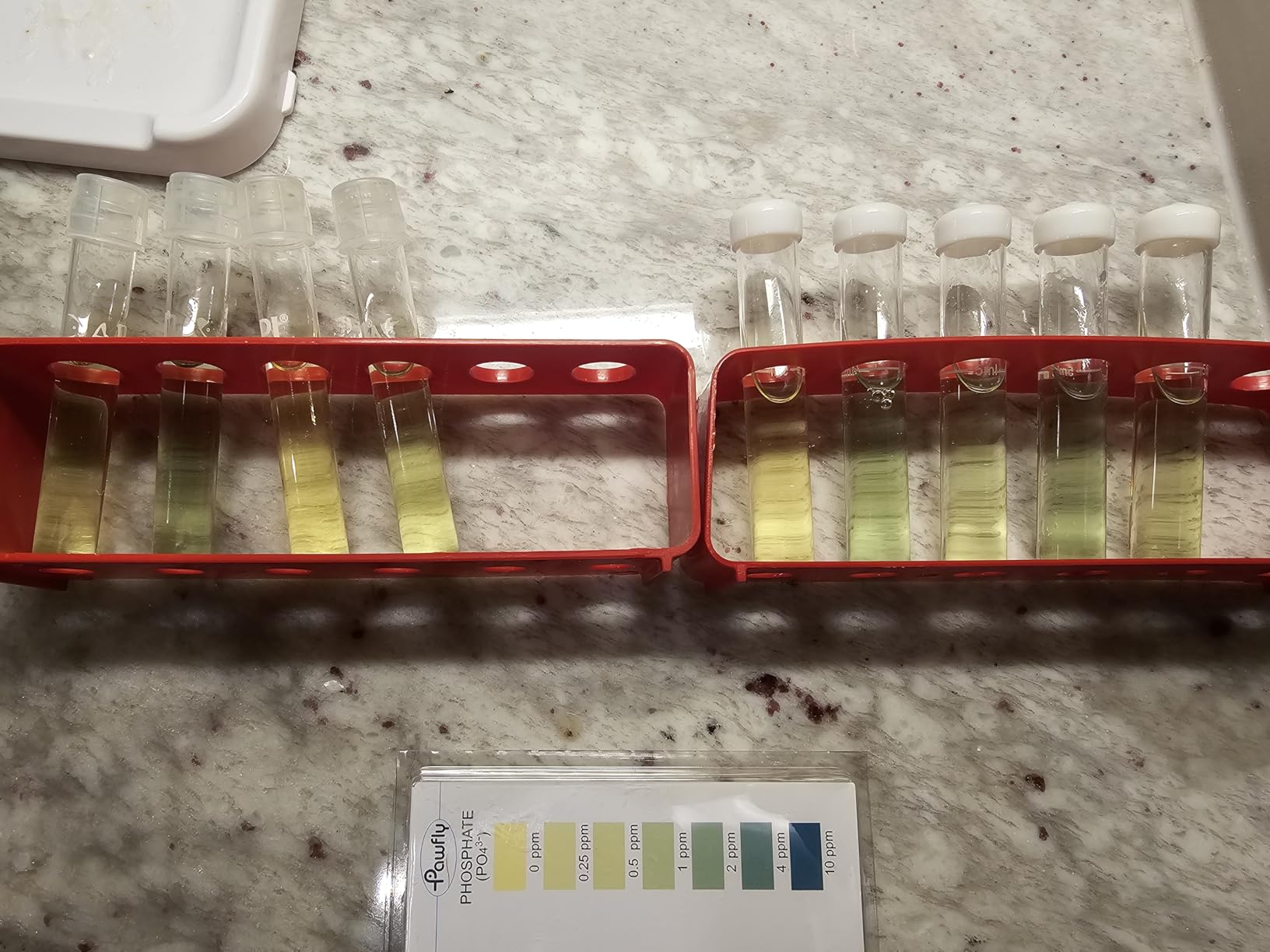
I tested the Pawfly ammonia component against my trusted API liquid kit during a 30-gallon fishless cycle. At 2 ppm and 4 ppm ammonia, both kits produced matching readings. The procedure mirrors API’s approach (fill tube, add drops, wait, compare colors), so anyone familiar with API can transition to Pawfly without a learning curve. The included color cards are crisp and easy to read, and the reagent bottles have leak-resistant caps that I found more reliable than API’s standard caps.
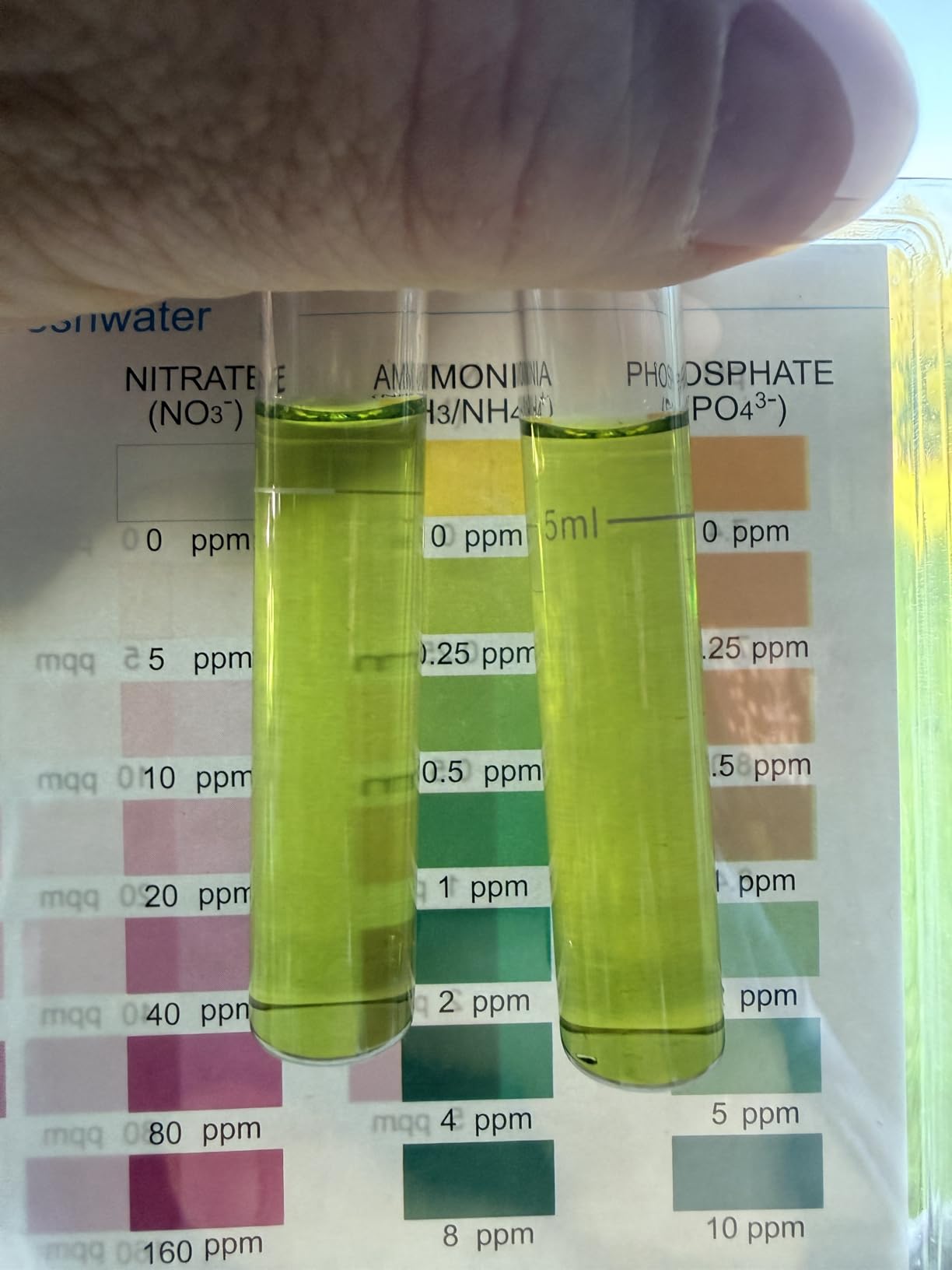
The real value shows up during the middle of cycling, when ammonia starts dropping and nitrite begins climbing. With a single ammonia test, you would miss that critical transition entirely. The Pawfly kit let me track ammonia falling from 4 ppm to 0 ppm while nitrite simultaneously climbed to 5 ppm and then dropped as the second bacteria colony established. Watching the full nitrogen cycle unfold on paper is genuinely satisfying, and it taught me more about water chemistry in two months than years of reading forums.
Being a newer product, the Pawfly kit has fewer long-term reviews than the established brands. That said, the build quality feels solid, and the manufacturer (Jilin Test Bio-Electron) has a strong reputation in laboratory equipment. I have used the kit for three months with no signs of reagent degradation or cap failure. For anyone hesitant to trust a newer brand, the included 30 ammonia tests are still a low-risk way to try it out.
When 5-in-1 makes sense over dedicated kits
If you are cycling a single tank and want everything in one organized box, the Pawfly kit is a clear winner. If you are running multiple tanks with different testing needs, dedicated single-parameter kits are more economical in the long run because you can buy refill bottles for the parameters you test most. I use the Pawfly kit on my office display tank and dedicated single-parameter kits on my breeding tanks, and that hybrid setup works well for my situation.
Storage tips for a 5-bottle kit
With five reagent bottles in play, organization matters more than with a single-parameter kit. I store the Pawfly bottles upright in a small plastic organizer tray, sorted by parameter. After each test session, I wipe the bottle tips with a paper towel to prevent cross-contamination between tests. A couple of minutes of organization after each session keeps the kit accurate and extends its usable life well beyond the printed expiration dates.
Price Per Test Comparison
Cost per test is one of the smartest ways to compare ammonia kits, because two boxes at very different prices can deliver very different value depending on how many tests you actually get. Here is the breakdown based on current 2026 pricing and the stated test counts.
The API Ammonia 130-Test Liquid Kit works out to roughly $0.08 per test, which is the lowest cost per test of any option on this list. The Tetra EasyStrips 100-Count comes in at about $0.16 per strip, making it the best value among strip-based tests. The Pawfly 5-in-1 Master Kit averages about $0.10 per ammonia test, with the bonus of four other parameters bundled in.
The Salifert kit runs around $0.28 per test, which is higher but reflects the precision syringe and professional-grade reagents. The Seachem MultiTest averages around $0.50 per test when you factor in the disc-based procedure, which is the highest cost on this list but justified by the unique free ammonia measurement capability. The API Strips 25-Count come in at roughly $0.52 per strip, making them the most expensive option per individual test.
How to Choose the Right Ammonia Test Kit for Cycling?
After testing all six kits across multiple cycling projects, I have learned that the “best” ammonia kit depends entirely on your tank type, cycling method, and how much precision you actually need. Here is how I think through the decision for different situations.
Liquid vs test strips: which is more accurate?
Liquid test kits consistently outperform strips in head-to-head accuracy tests, especially in the critical 0 to 0.5 ppm range. The chemistry is the same (both use the salicylate method to detect ammonia), but liquid kits deliver more reagent more precisely, and the resulting color is easier to match against a color chart. Strips work well for routine monitoring and emergency checks, but for the high-stakes first six weeks of cycling, a liquid kit is the safer choice.
How often to test during cycling
For a fishless cycle, I test ammonia every other day for the first three weeks, then daily once ammonia starts dropping and nitrite begins climbing. After ammonia and nitrite both hit zero, I test daily for one more week to confirm the cycle is stable before adding livestock. For a fish-in cycle, I test ammonia daily without exception until levels drop below 0.25 ppm consistently. Skipping tests during cycling is how fish die unnecessarily.
Fishless vs fish-in cycling differences
Fishless cycling lets you dose pure ammonia to 2 to 4 ppm without harming anything, which means your test kit needs to read accurately in that range. Fish-in cycling keeps ammonia much lower (ideally below 0.25 ppm), which means your test kit needs to resolve small changes near zero. Liquid kits handle both scenarios well. Strip kits work better for fish-in cycling where you are tracking low levels than for fishless cycling where you are tracking high levels.
Reading the ppm scale correctly
Most ammonia test kits use parts per million (ppm), where 1 ppm equals 1 mg of ammonia per liter of water. Anything above 0.25 ppm is considered stressful to most fish, and above 1 ppm is dangerous. During a fishless cycle, you are intentionally dosing ammonia to 2 to 4 ppm to feed the bacteria, but you are doing it without fish in the tank. Once livestock goes in, ammonia should always read 0 ppm on a healthy cycled tank.
Signs your tank is fully cycled
Your tank is cycled when ammonia and nitrite both read 0 ppm for at least seven consecutive days, and nitrate is climbing steadily as the end product of the cycle. I also confirm by adding a small amount of pure ammonia (or fish food) and watching the tank process it back down to 0 ppm within 24 hours. If ammonia spikes and clears quickly without intervention, your bacteria colony is large enough to handle the bio load from fish. Until you see that consistency, the cycle is not done.
When to upgrade from strips to liquid
If you have been relying on strips and notice readings that seem inconsistent, or if you are cycling a high-stakes tank (reef, discus, breeding setup), upgrading to a liquid kit is worth the investment. The improved accuracy at low ppm levels often reveals issues that strips masked entirely. Many hobbyists, myself included, use strips for routine maintenance and switch to liquid kits during cycling or when troubleshooting water quality problems.
Frequently Asked Questions About Ammonia Test Kits and Tank Cycling
What is the best ammonia test kit for an aquarium?
The API Ammonia 130-Test Liquid Kit is the best overall ammonia test kit for most aquarium hobbyists. It delivers accurate readings across the full 0 to 8 ppm range, includes 130 tests per bottle for an excellent price per test, and works for both freshwater and saltwater tanks. For beginners, the straightforward drop-and-compare procedure is easier to learn than more advanced kits like Seachem MultiTest.
How much ammonia do you need to cycle a tank?
For a fishless cycle, dose pure ammonia to 2 to 4 ppm to feed the beneficial bacteria colony. For a fish-in cycle, keep ammonia below 0.25 ppm at all times by doing partial water changes whenever it climbs higher. Most cycling guides recommend aiming for 2 ppm during fishless cycling because it is enough to feed bacteria without wasting reagent or stressing future livestock once they are added.
How do I get my tank to cycle ammonia?
Cycling ammonia means establishing beneficial bacteria that convert toxic ammonia into less harmful nitrite and then nitrate. To cycle a tank, set up your filter and heater, dose pure ammonia (or add a small amount of fish food daily) to 2 ppm, and test ammonia and nitrite every two to three days. After two to six weeks, ammonia and nitrite will both drop to zero while nitrate climbs, signaling a complete nitrogen cycle.
What is the best source of ammonia for fishless cycling?
Pure ammonium chloride solution (sold as Dr. Tim’s Ammonium Chloride or similar) is the best ammonia source for fishless cycling because it contains no surfactants, perfumes, or impurities that could harm bacteria or fish. Avoid household ammonia cleaners unless the bottle explicitly lists pure ammonium hydroxide with no additives. Some hobbyists also use fish food or raw shrimp to produce ammonia through decomposition, though dosing is less precise.
How do I know my new tank is cycled?
Your tank is cycled when ammonia reads 0 ppm and nitrite reads 0 ppm for at least seven consecutive days, with nitrate steadily rising as the end product. To confirm, add a small dose of pure ammonia (1 to 2 ppm) and verify that both ammonia and nitrite return to 0 ppm within 24 hours. That response proves your bacteria colony is large enough to handle the daily bio load from fish.
Can fish survive 0.25 ppm ammonia?
Fish can survive short-term exposure to 0.25 ppm ammonia, but it is stressful and causes gill damage, suppressed immunity, and reduced appetite. Sensitive species like discus, wild-caught fish, and most invertebrates can die at sustained 0.25 ppm levels. For community freshwater tanks, brief exposure to 0.25 ppm is usually survivable for hardy fish, but the goal should always be 0 ppm in a cycled tank.
Final Verdict: Which Ammonia Test Kit Should You Buy?
After eight years of cycling tanks and testing ammonia obsessively, my top pick for the best ammonia test kits for cycling a new tank remains the API Ammonia 130-Test Liquid Kit. It strikes the right balance of accuracy, affordability, and ease of use, with enough tests to cover a full cycle plus months of follow-up monitoring. For most freshwater hobbyists, it is the only ammonia kit you will ever need to buy.
If you want the lowest ongoing cost and are willing to handle liquid drops, the API liquid kit is unbeatable. If you prefer strip convenience for quick checks, the Tetra EasyStrips 100-Count offers the best value in that category. If you are running a sensitive reef or breeding setup and need free ammonia measurement, the Seachem MultiTest is the only kit that delivers that capability at a hobbyist price point.
Whichever kit you choose, commit to testing consistently throughout your cycle. The information those little bottles of reagent provide is the difference between a thriving aquarium and the heartbreak of losing fish to preventable ammonia poisoning. Pick the kit that fits your budget, learn its quirks, and trust the readings. Your fish will thank you for it in 2026 and beyond.