
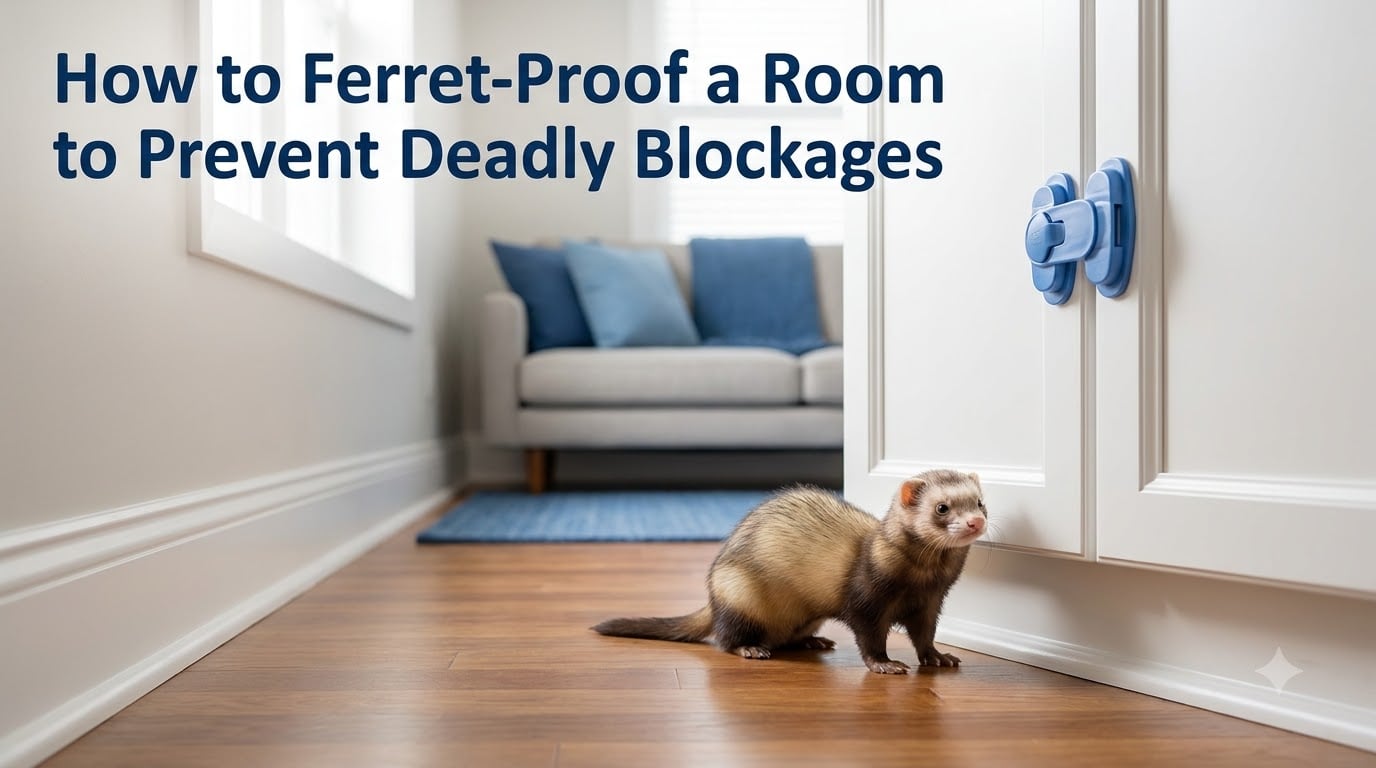
A ferret named Moose was four years old when he wandered behind a recliner while his owner was at work. He climbed into the lever mechanism and was crushed when someone sat down that evening. A ferret named Pepper swallowed a single piece of foam from a dog bed cushion. She survived two weeks before her owners noticed she had stopped eating.
Both deaths were preventable. That is the core of this guide. When you learn how to ferret-proof a room to prevent deadly blockages, you are not just baby-proofing for a curious pet. You are eliminating two of the leading causes of preventable ferret death: crushing injuries from furniture mechanisms and intestinal blockages from swallowed soft materials.
I have worked with ferret owners for years, and I have read the rescue forums where the same heartbreaking stories repeat. A ferret gets into the recliner. A ferret swallows a rubber duck. A ferret hides in the washing machine. Every single case traces back to an unsealed gap or an unsealed material. In this guide, I will walk you through the exact steps to seal every one of those gaps in your home.
You will learn the 1-inch rule for ferret-proofing gaps, why foam is the most dangerous material in your house, how to do a proper ferret-eye-level room sweep, and a room-by-room checklist for living rooms, kitchens, bedrooms, bathrooms, and laundry rooms. You will also learn the signs of intestinal blockage in ferrets, because early detection can mean the difference between life and death.
Table of Contents
What Is Ferret-Proofing and Why Deadly Blockages Matter?
Ferret-proofing is the process of removing every physical hazard in a room that could kill, injure, or trap a ferret. It is more intensive than baby-proofing because ferrets are smaller, more flexible, and more determined to get into dark, enclosed spaces.
A ferret has a floating collarbone and a spine that flexes enough to squeeze through a hole roughly the size of their skull. An adult ferret head is about one inch across. That means any gap wider than one inch is a potential entry point.
Ferrets also stash. They pick up small soft items, drag them into hiding spots, and either shred them or eat them. Soft materials like foam, rubber, sponge, and erasers do not break down in the digestive tract. They cause intestinal blockages, which are surgical emergencies.
The two main home killers for ferrets are:
Crushing injuries from recliners, sofa beds, and rocking chairs. Ferrets climb inside the mechanism. When the lever is pulled, they are crushed instantly.
Intestinal blockages from swallowed foam, rubber, sponge, erasers, and similar materials. The ferret may survive for days or weeks, but the blockage will eventually prove fatal without emergency surgery.
Both are 100 percent preventable with proper ferret-proofing. That is what this guide is for.
The 1-Inch Rule: If Their Head Fits, They Squeeze Through
The single most important measurement in ferret-proofing is the 1-inch rule. If a ferret’s head fits through a gap, their entire body will follow. This is because of their unique anatomy.
A ferret’s skull is about one inch wide in adults, and slightly narrower in younger ferrets. Their collarbones are not fused to their shoulders. Their spines can flex sideways and vertically. The result is a body that flows through any opening wider than one inch.
You will see some sources cite a 2-inch rule. That is wrong for ferret-proofing. A 2-inch hole is large enough for an adult ferret head to pass through with room to spare. Stick with 1 inch as your safety threshold.
Common gaps that exceed the 1-inch rule:
Under-door gaps (usually 1.5 to 2 inches)
Toe kicks under kitchen cabinets (1.5 inches)
Behind-appliance gaps around fridge water lines
Baseboard cracks near old plaster
Vent openings without covers
Around plumbing penetrations under sinks
Use a ruler or measuring tape and physically check every gap in your ferret-proofed room. If a gap is wider than 1 inch, block it.
Get Down on the Floor: The Ferret-Eye-Level Test
The most common mistake new ferret owners make is proofing from standing height. You cannot see what a ferret sees unless you physically get to ferret-eye level.
Kneel on the floor, then lower yourself to your stomach. Look around the room from 6 to 12 inches off the ground. This is the perspective your ferret has when they explore. You will immediately see hazards you missed.
What you find at ferret-eye level that you missed at standing height:
Small holes in baseboards
Gaps under radiator covers
Openings around electrical outlet plates
Low gaps behind furniture
Drawer ventilation slots
Cable management holes in desks and entertainment centers
Walk the perimeter of the room slowly. Ferrets are burrowers. They run along walls and edges first. Any gap along a wall baseboard or junction is a priority target.
Then walk the interior of the room. Look at the undersides of furniture, the backs of appliances, and any dark corner. Ferrets seek out dark enclosed spaces. If it looks like a burrow to you, it looks like home to them.
Deadly Hazard #1: Recliners and Sofa Beds
Recliners are the leading cause of preventable ferret death in the home. Every ferret owner I have spoken with who lost a ferret to furniture had the same reaction: I never thought it could happen to me.
How it happens:
The ferret climbs up the back or side of the recliner.
They crawl down into the mechanism between the seat and the footrest.
They hide in the dark enclosed space, which feels like a perfect den.
Someone sits down and pulls the lever.
The mechanism closes on the ferret.
The crushing force is enough to kill instantly. There is no warning. The ferret cannot escape because the mechanism locks.
Sofa beds are equally dangerous. The internal metal frame has springs, hinges, and folded mattress supports. A ferret who crawls inside cannot get out, and when the sofa bed is opened or closed, they are crushed or pinched.
The fix is simple but inconvenient. Remove the recliner or sofa bed from the ferret-proofed room entirely. Do not try to block access. Ferrets will find their way in. The only safe option is to remove the furniture from the room or keep the door closed with a ferret-proof latch.
If removing the recliner is not possible, do not let your ferret free-roam in that room. Choose a different safe room instead.
Deadly Hazard #2: Intestinal Blockages From Foam, Rubber, and Sponge
This is the differentiating danger that most ferret-proofing guides treat casually. They mention “remove soft items” in a single sentence. The reality is far more urgent.
Foam is the number one killer of pet ferrets in the home. This includes:
Memory foam mattress toppers
Foam dog beds and cat beds
Foam furniture cushions (even inside non-recliner sofas)
Sponge bath mats with foam backing
Foam kids’ toys and puzzles
Erasers and foam craft supplies
Rubber dog toys (especially ones that shred)
Latex rubber bands and balloons
When a ferret chews or tears off a small piece of foam, they often swallow it. Foam does not dissolve in stomach acid. It does not pass through the digestive tract. It lodges in the small intestine or stomach and causes a complete blockage.
Signs of intestinal blockage in ferrets include:
Loss of appetite over 12 to 24 hours
Lethargy and hiding
Pawing at the mouth (a sign of nausea)
Straining to defecate with no output
Hard, distended abdomen
Vomiting or dry heaving
Drooling
Intestinal blockage is a surgical emergency. If you suspect your ferret has swallowed foam, rubber, or any foreign object, contact an emergency veterinarian immediately. Do not wait. Do not try home remedies. The window for successful surgery is often less than 48 hours from the time eating stops.
To prevent blockages, remove every foam and rubber item from your ferret-proofed room. Replace memory foam mattress toppers with solid cotton or wool bedding. Replace foam dog beds with woven fabric or canvas beds. Remove foam bath mats and use cotton rugs instead.
If your ferret has a stash, check it daily. We will cover stashing behavior in detail below.
Room-by-Room Ferret-Proofing Guide
The most practical approach is to proof one room at a time, thoroughly. Trying to ferret-proof an entire house at once leads to missed hazards and burnout. Focus on getting one room completely safe, then expand if you want.
Ferret-Proofing the Living Room
The living room is usually the hardest room to proof because it has the most furniture, electronics, and decor.
Living room checklist:
Remove recliners and sofa beds. Non-negotiable if ferrets free-roam here.
Block couch undersides. Use plexiglass or plywood panels to seal the gap under non-recliner sofas. Ferrets climb inside couch frames and can get trapped.
Replace foam cushions. If you have a sofa with foam-filled cushions your ferret can access, replace the foam with fiberfill or remove access.
Cover all electrical cords. Use cord protectors, cable management boxes, or split loom tubing. Ferrets chew cords and can be electrocuted.
Secure bookshelves. Anchor tall bookshelves to walls. Ferrets climb and can pull shelves down.
Cover fireplaces. Install a baby gate or fireplace screen. Ferrets climb into chimneys.
Remove toxic plants. Many common houseplants are toxic to ferrets. We will cover this in detail later.
Ferret-Proofing the Kitchen
The kitchen contains the densest concentration of hazards. Most ferret owners do not let ferrets free-roam in kitchens, but if you do, or if your ferret can access the kitchen when you are not looking, every item below must be addressed.
Kitchen checklist:
Lock all cabinets. Use child-proof cabinet locks. Ferrets open cabinet doors with their paws and noses.
Seal toe kicks. The recessed panel under base cabinets is the perfect ferret burrow. Block it with plywood.
Check behind the fridge. The gap between the fridge and the wall is a favorite hiding spot. Use fridge guards or seal the gap.
Always check the dishwasher. Before running a cycle, physically check the dishwasher. Ferrets climb into the lower rack.
Lock the oven. Use the control lock feature. Ferrets climb into ovens.
Clean up dropped food immediately. Ferrets eat anything they find. Onions, garlic, chocolate, grapes, and raisins are all toxic.
Ferret-Proofing the Bedroom
The bedroom is where many ferret owners let their ferret free-roam, because it is a quiet enclosed space. But it has unique hazards.
Bedroom checklist:
Block under-bed access. Use bed skirts, plywood panels, or store items in bins under the bed. Ferrets love hiding under beds.
Block under-dresser drawers. The space under a dresser is dark and enclosed.
Remove foam mattress toppers. This is the most common bedroom foam killer. Replace with solid mattresses.
Secure closet doors. Use child-proof door handles or keep the closet closed. Ferrets climb into shoes and chew rubber soles.
Cover electrical cords. Bedside lamps, alarm clocks, phone chargers.
Remove small items from nightstands. Jewelry, hair ties, rubber bands, earbuds. All can be swallowed.
Ferret-Proofing the Bathroom
The bathroom is small but packed with hazards. Many owners skip bathroom proofing because they assume ferrets will not go in there, but ferrets follow you everywhere.
Bathroom checklist:
Keep the toilet lid closed. Ferrets can fall in and drown. They also drink the water, which has chemical residues.
Block drains. Use drain covers. Ferrets explore drains and can get stuck.
Remove foam bath mats. Replace with cotton or rubber-free mats.
Lock the medicine cabinet. Human medications are toxic. Even small doses can kill a ferret.
Store cleaning supplies high or locked. Bleach, drain cleaners, and toilet bowl cleaners are all fatal.
Block the gap under the door. Bathroom doors usually have the largest under-door gaps in the house.
Ferret-Proofing the Laundry Room
The laundry room is the most dangerous room for ferrets because of the appliances. A ferret who climbs into an empty washing machine or dryer and is later turned on will die.
Laundry room checklist:
Always check the washing machine drum before running. This is the rule you can never break. Always check.
Always check the dryer drum. Same rule.
Keep the dryer door closed. Use the door as a barrier. Ferrets climb into dryers for the warm lint smell.
Store detergent pods high. Detergent is toxic and the soft pods look like toys.
Seal vents and gaps around pipes. Laundry rooms often have plumbing penetrations through walls.
Block access to the laundry room entirely if possible. Use a baby gate or keep the door latched.
The One-Safe-Room Approach: Why You Shouldn’t Try to Proof the Whole House
Most ferret-proofing guides try to cover every room in your home. That is overwhelming and unrealistic. A better approach is to focus on one fully-proofed room, then expand over time.
The one-safe-room approach works because:
You can be confident the room is truly safe, not just mostly safe.
You can supervise your ferret more easily in a smaller area.
You can close the door and know your ferret is contained.
You can find new hazards faster when the search space is smaller.
How to choose the safe room:
Pick a room you can close off with a door.
Avoid rooms with recliners, sofa beds, or major foam furniture.
Avoid rooms with major appliances (kitchens, laundry rooms).
A bedroom or small den is often ideal.
Once your safe room is fully proofed, your ferret can free-roam there with minimal supervision. Free-roam time in your safe room is essential for ferret health and happiness. Caged ferrets without daily free-roam develop behavioral problems and depression.
When you want to expand, do it one room at a time. Spend a week proofing the new room before letting your ferret into it.
Ferret Stashing Behavior and Why You Must Check Stashes
Ferrets stash. They take small items and hide them in dark corners, under furniture, and inside bedding. This is normal behavior. The problem is that stashed items often end up swallowed.
What ferrets typically stash:
Socks and small cloth items
Rubber bands and hair ties
Small foam pieces
Food crumbs and treats
Small plastic items
Paper and cardboard bits
The danger is that ferrets chew stashed items while hiding, and they often swallow pieces. A rubber band or a foam fragment swallowed during stashing becomes an intestinal blockage risk.
Common stash locations:
Under couch cushions
Inside shoes left on the floor
Behind furniture in corners
Inside hammocks and bedding folds
Under rugs and mats
Check stashes daily. Pick up every ferret-accessible item that could be chewed or swallowed. Sweep under furniture weekly. Check inside shoes and slippers before wearing them. I have heard multiple stories of ferrets hiding in shoes and being stepped on.
Cord, Plant, and Appliance Hazards
Beyond foam and recliners, three more hazard categories deserve specific attention.
Electrical cords. Ferrets chew cords. They are attracted to the rubbery texture. A chewed cord can deliver a lethal shock. Use split loom tubing, cord protectors, or cable management boxes on every cord your ferret can access. Pay special attention to TV cables behind entertainment centers, computer cords, and phone chargers.
Toxic plants. Common houseplants that are toxic to ferrets include lilies, philodendrons, pothos, dieffenbachia, peace lilies, and most bulb plants. If your ferret free-roams, either remove toxic plants or place them in a sealed terrarium the ferret cannot access. Better yet, only keep ferret-safe plants like spider plants and Boston ferns.
Appliances. Beyond washers and dryers, dishwashers, ovens, refrigerators, and freezers all create ferret hazards. Always check before running. Always keep doors closed. Ferrets can climb into refrigerator coils through the back and become trapped.
Supervision: Proofing Doesn’t Replace Watching
Even in a fully-proofed room, supervision matters. Proofing reduces risk. Supervision eliminates the surprises you did not anticipate.
Ferrets are fast, curious, and persistent. They will find hazards you missed. They will chew items you forgot to put away. They will climb into spaces you thought were sealed. Direct supervision during free-roam time is the only way to catch these moments.
For new ferrets, follow the 3-3-3 rule. Give them 3 days to decompress, 3 weeks to settle in, and 3 months to feel at home. During the first 3 weeks especially, supervise every moment of free-roam time. New ferrets are more anxious and more likely to bolt into hazards.
For multi-ferret households, headcount every 15 minutes during free-roam. Ferrets nap in obscure places. I have heard stories of ferrets sleeping inside dresser drawers and being closed inside. Always count heads before leaving the room.
Daily and Weekly Ferret-Proofing Safety Checklist
Print this checklist and post it near your ferret-proofed room. It is what I use with my own ferrets.
Daily checks (before free-roam):
Check washer, dryer, and dishwasher drums
Check oven and refrigerator interior
Look for new gaps or chewed items
Sweep under furniture for dropped items
Verify door is closed
Weekly sweep:
Walk the room perimeter at ferret-eye level
Check every cord protector is intact
Check every cabinet lock is engaged
Inspect foam items for chew marks
Look for new stash spots
After-guest reset:
Guests leave doors and cabinets open. Always reset the room after visitors.
Check for dropped items guests may have left behind.
Frequently Asked Questions
How to ferret-proof a bedroom?
To ferret-proof a bedroom, block under-bed access with plywood or bed skirts, replace foam mattress toppers with solid mattresses, secure all electrical cords with cord protectors, lock closet doors with child-proof handles, and remove small items like jewelry and hair ties from nightstands. Then get down to ferret-eye level and seal every gap wider than 1 inch along baseboards and around plumbing.
What is the 3-3-3 rule for ferrets?
The 3-3-3 rule describes how long it takes a new ferret to decompress, settle in, and feel at home. Give them 3 days to decompress from the stress of rehoming, 3 weeks to learn their new environment and routines, and 3 months to fully bond and feel secure. During the first 3 weeks, supervise every moment of free-roam time closely.
How to ferret-proof an area?
To ferret-proof an area, follow these steps: 1) Get down to ferret-eye level and walk the perimeter. 2) Seal every gap wider than 1 inch using plywood, caulk, or foam sealant. 3) Remove recliners and sofa beds, or block access. 4) Remove all foam, rubber, and sponge items. 5) Cover all electrical cords. 6) Lock all cabinets and drawers. 7) Remove toxic plants. 8) Block access to all appliances or always check them before running.
Is it okay to keep a ferret in the air conditioning room?
It is okay to keep a ferret in an air-conditioned room as long as the temperature stays between 60 and 75 degrees Fahrenheit. Ferrets tolerate cool temperatures better than heat, but direct cold drafts can cause respiratory issues. Make sure the room is also fully ferret-proofed, since AC rooms often have vents and gaps around ductwork that ferrets can enter.
What are the signs of intestinal blockage in ferrets?
Signs of intestinal blockage in ferrets include loss of appetite for 12 to 24 hours, lethargy and unusual hiding, pawing at the mouth, straining to defecate with no output, hard or distended abdomen, drooling, and dry heaving or vomiting. Intestinal blockage is a surgical emergency. If you suspect your ferret has swallowed foam, rubber, or any foreign object, contact an emergency veterinarian immediately. The window for successful surgery is often less than 48 hours from the time eating stops.
Do ferrets really get crushed in recliners?
Yes. Recliners are the leading cause of preventable ferret death in the home. Ferrets climb inside the dark mechanism between the seat and footrest, and when someone pulls the lever to recline, the mechanism closes on them with crushing force. There is no warning and no escape. The only safe option is to remove the recliner from any room where ferrets free-roam, or keep the room door closed with a ferret-proof latch.
Final Thoughts on Preventing Deadly Blockages in Your Ferret
Every ferret death from a recliner crushing or an intestinal blockage traces back to an unsealed gap or an unsealed material. That means every one of these deaths was preventable. When you learn how to ferret-proof a room to prevent deadly blockages, you take responsibility for the two leading home killers of ferrets.
Start with one room. Get to ferret-eye level. Block every gap wider than 1 inch. Remove every foam and rubber item. Move the recliner out. Then check your work daily. Your ferret will thank you with years of healthy, curious exploration.