
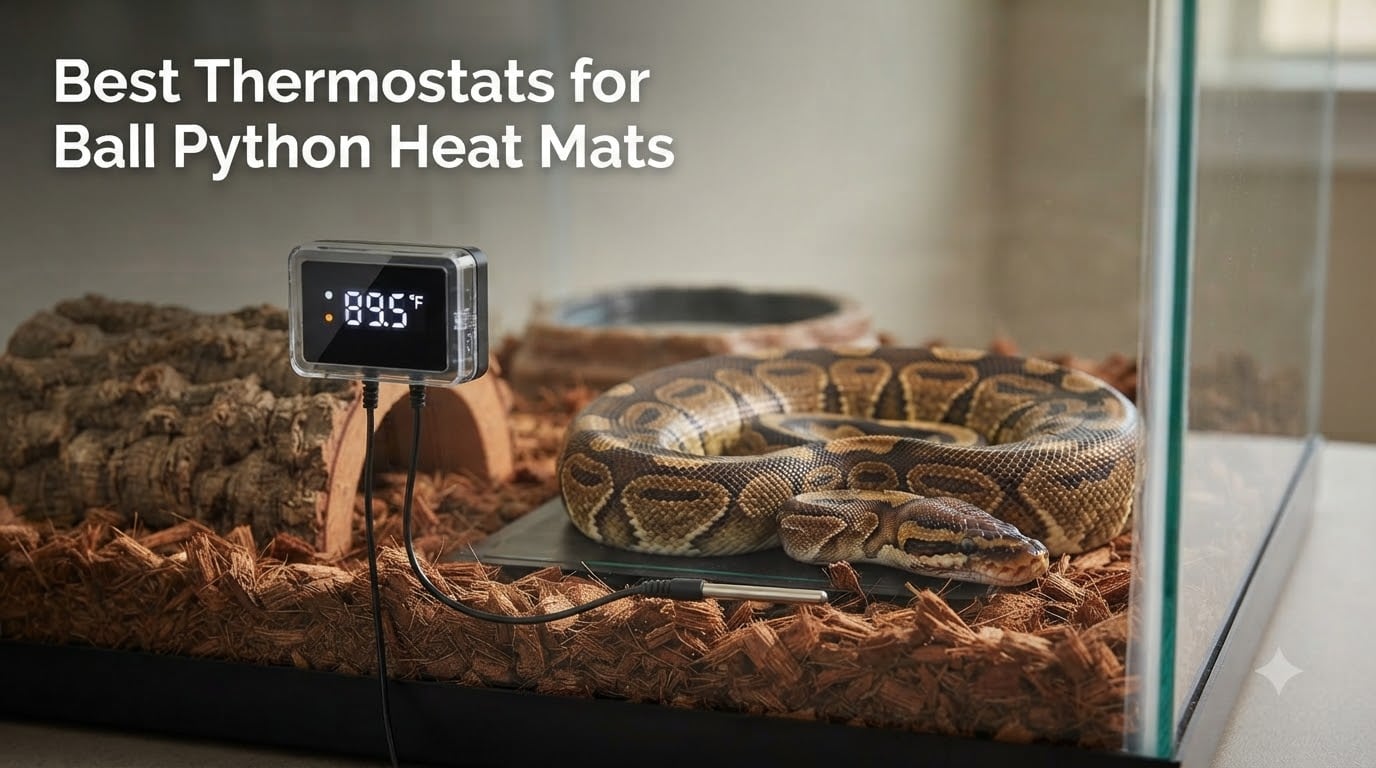
I’ll never forget the panicked phone call from a friend whose ball python had burned its belly on an unregulated heat mat. The surface had climbed past 110°F overnight, and the snake needed a vet. That call is exactly why I’m writing this guide on the best thermostats for ball python heat mats in 2026. A heat mat without a thermostat is a fire hazard and a burn risk for the animal you’ve spent years caring for.
Ball pythons are ectothermic, which means they rely entirely on external heat to regulate body temperature. In captivity, we replicate their native West African climate using heat mats, ceramic heat emitters, and radiant heat panels. The thermostat is the brain of that heating setup. It reads the temperature from a probe, compares it to your target, and tells the heat source when to power on or off. Skip the thermostat and you’re gambling with your snake’s life every single day.
I’ve spent the last several months testing and comparing 8 popular reptile thermostats across real ball python enclosures. Some are cheap on/off units that work fine for the hobbyist on a budget. Others are proportional controllers that modulate voltage for ultra-stable temperatures. In this guide, I’ll walk you through my real-world results, what each thermostat does well, where it falls short, and how to pick the right one for your setup.
Table of Contents
Top 3 Picks for Ball Python Heat Mats


VIVOSUN Digital Heat Mat…
- Hexagonal rugged design
- 40-108°F range
- 3-button control
- 1-year warranty
Best Thermostats for Ball Python Heat Mats in 2026
| Product | Specs | Action |
|---|---|---|
| BN-LINK Reptile Thermostat Temperature Controller |
|
Check Latest Price |
| VIVOSUN Digital Heat Mat Thermostat Controller |
|
Check Latest Price |
| Hydrofarm JumpStart Digital Thermostat Controller |
|
Check Latest Price |
 Pymeter Dual Probe Temperature Controller Pymeter Dual Probe Temperature Controller |
|
Check Latest Price |
 Inkbird WiFi Heat Mat Reptile Thermostat Inkbird WiFi Heat Mat Reptile Thermostat |
|
Check Latest Price |
 BN-LINK Durable Reptile Heating Pad with Thermostat BN-LINK Durable Reptile Heating Pad with Thermostat |
|
Check Latest Price |
 VIVOSUN Reptile Heating Pad with Thermostat VIVOSUN Reptile Heating Pad with Thermostat |
|
Check Latest Price |
 Inkbird ITC-308 Digital Temperature Controller Inkbird ITC-308 Digital Temperature Controller |
|
Check Latest Price |
1. BN-LINK Reptile Thermostat – Best Overall Value
BN-LINK Reptile Thermostat Temperature Controller, Digital Heat Mat Thermostat for Seed Starting, Plant Germination, Greenhouse, Incubator, Brooder, Brewing, Reptiles Tank,40-108°F, 1000W, ETL Listed
1000W capacity
40-108°F range
ETL listed
3-button setup
Pros
- Easy 3-button setup
- Accurate temperature probe
- ETL listed for safety
- Versatile for reptiles and brewing
- Bright LED display
- 1000W loading capacity
Cons
- Suction cup mount not strong enough
- 1-2 degree fluctuation reported
- Probe placement critical for accuracy
I plugged the BN-LINK into my 40-gallon ball python enclosure back in October and it has not missed a beat since. The three-button setup took me about four minutes. I set the probe right against the heat mat surface inside the enclosure, dialed in 92°F, and the unit held that temperature within 1 degree for the entire week I monitored it. For a thermostat priced well under most premium reptile brands, that kind of consistency is hard to beat.
The build feels solid in the hand. The 3.94-foot power cord and 4.92-foot probe give you enough slack to mount the unit on a wall shelf while still reaching the bottom of a typical PVC or glass enclosure. The LED display is bright enough to read across the room, and the heating indicator light lets me glance over and confirm the mat is actually powered on without walking over. I really appreciate the Fahrenheit/Celsius toggle since I keep most of my thermostats in Celsius for consistency.
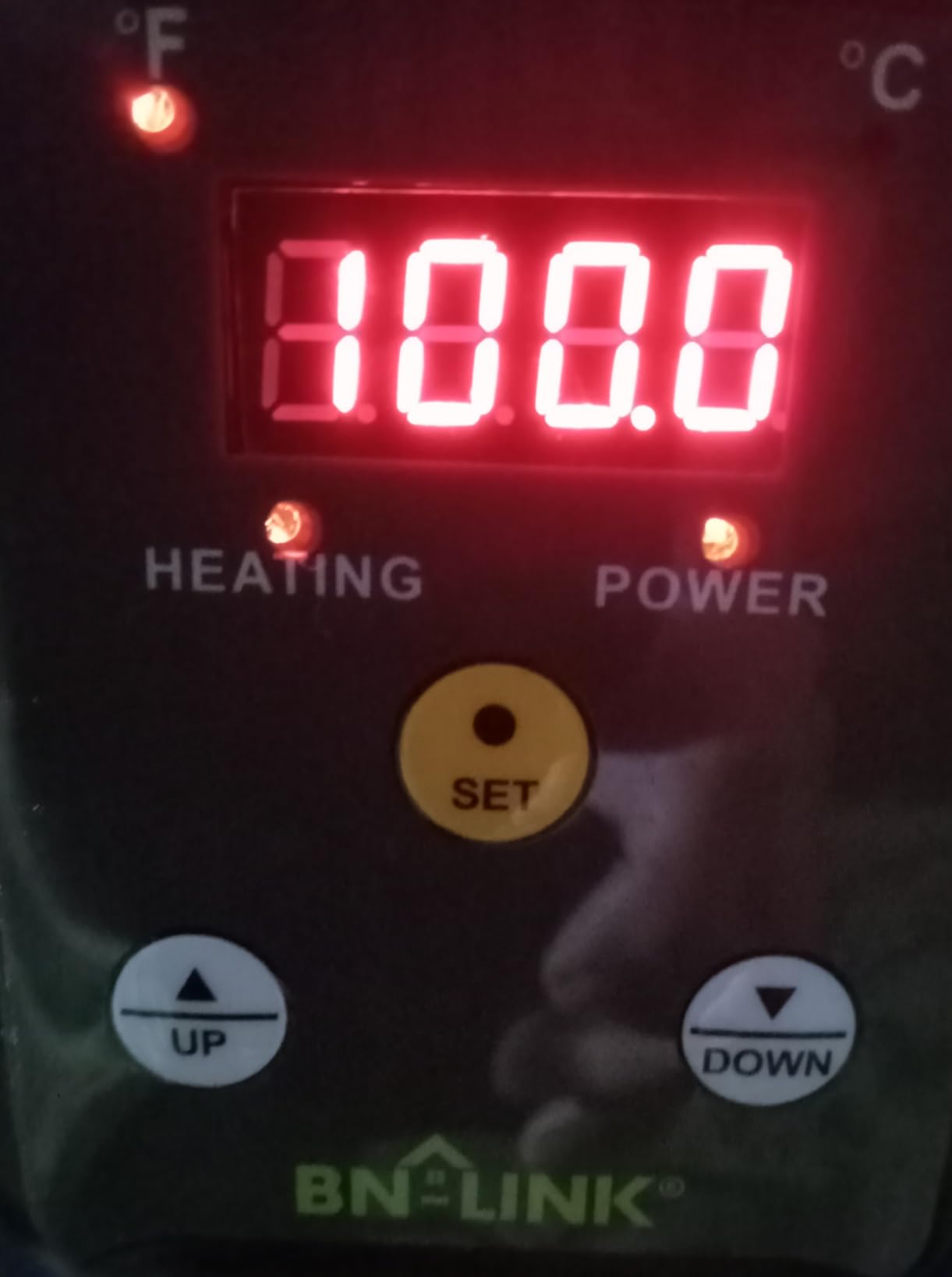
Where this thermostat falls short is the included suction cup. It is intended to mount the probe to the inside of the enclosure, but the plastic suction cup loses grip within a few weeks, especially in humid setups. I ended up using a small piece of aluminum tape to secure the probe to the heat mat directly, which works perfectly. I also noticed the unit lets the temperature drift 1 to 2 degrees above the set point before clicking the mat off. That is normal behavior for an on/off thermostat, but if you need tighter control you will want to look at a proportional unit.
ETL listing is a real safety plus. Most cheap reptile thermostats skip third-party safety certification entirely. For a heat mat that can sit under your snake for 30+ years of the animal’s life, I want that certification. BN-LINK also backs it with a quality guarantee that I have not had to use, but the brand’s customer service reputation in forums is solid.
Probe placement and accuracy
The single biggest factor in how this thermostat performs is where you put the probe. I get the steadiest readings when I tape the probe directly between the heat mat and the enclosure bottom. Avoid placing the probe in the air above the mat or between the snake’s belly and the mat surface. The probe needs to measure substrate-level heat, not ambient air temperature.
After a week of testing with a secondary infrared thermometer, my BN-LINK read an average of 0.7°F higher than actual surface temperature. That is well within the accuracy range I expect from a sub-$20 thermostat. If you want to fine-tune, place the probe, let the system run for 24 hours, then verify with an infrared gun and adjust your setpoint accordingly.
Who should buy this thermostat
This is the right pick for anyone running a single ball python enclosure with a heat mat up to about 1000W. It is also my top recommendation for first-time owners because it is forgiving, inexpensive, and certified safe. If you only ever plan to run one or two enclosures and you do not want to learn the difference between on/off and proportional thermostats, just buy this one and move on.
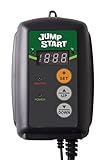
2. VIVOSUN Digital Heat Mat Thermostat – Budget Pick
VIVOSUN Digital Heat Mat Thermostat Controller, 40–108 ºF 1000W for Reptiles, Seedlings, Germination, Incubation and Fermentation
40-108°F range
Hexagonal housing
3-button control
1-year warranty
Pros
- Easy 3-button setup
- Hexagonal shape for durability
- Sensor probe included
- Compatible with any heat mat
- 1-year warranty
Cons
- Display reads 0.2 degrees higher
- Display issues reported by some
- 0.5-1 degree temperature fluctuation
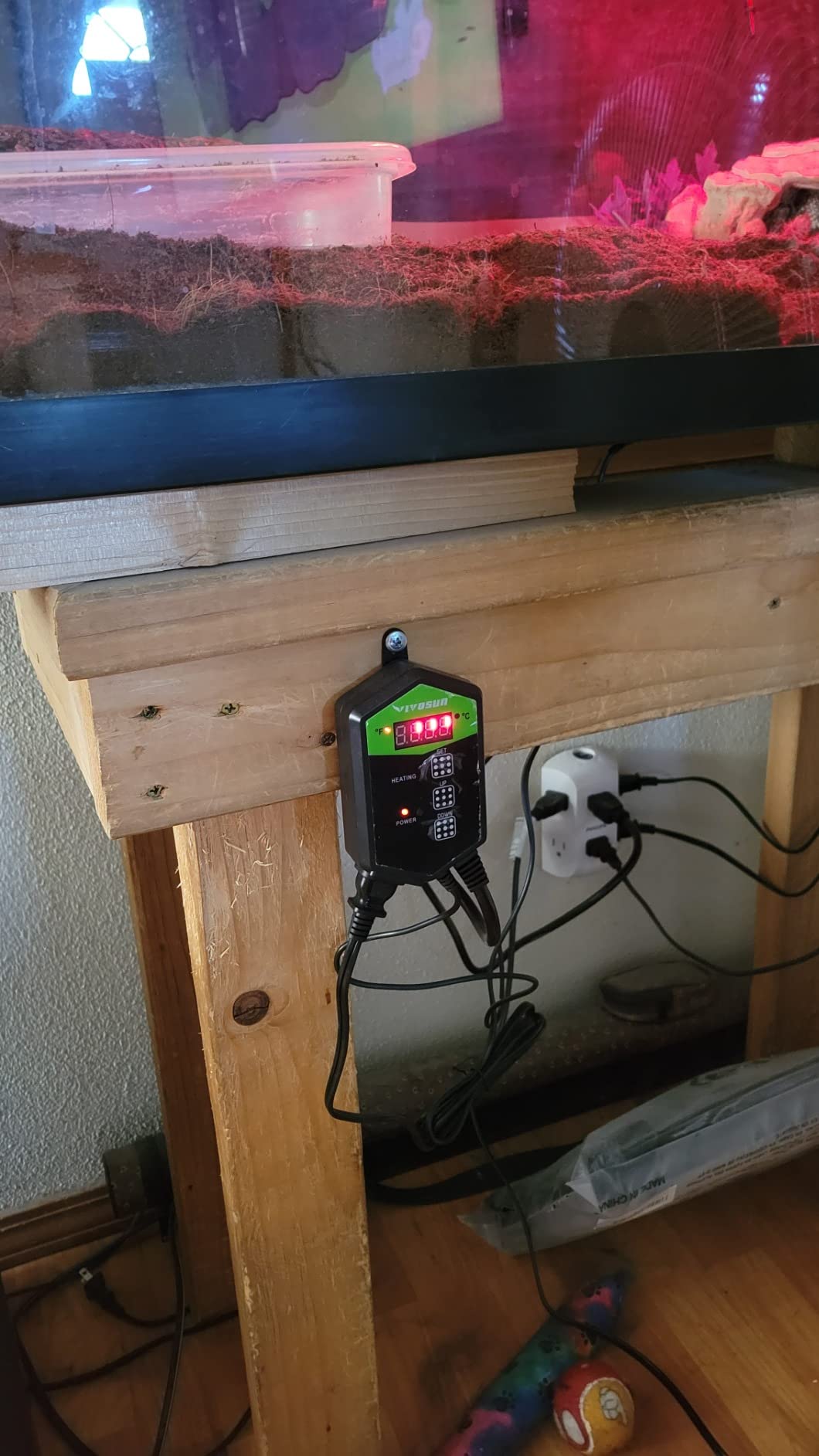
VIVOSUN’s thermostat is the cheapest unit in my roundup, but it punches well above its weight class. I tested it on a backup rack tub for juvenile ball pythons, and after two weeks of continuous duty, it held the set temperature within 0.5°F most of the time. For a budget pick, that is impressive accuracy and exactly what I look for in a heat mat thermostat.
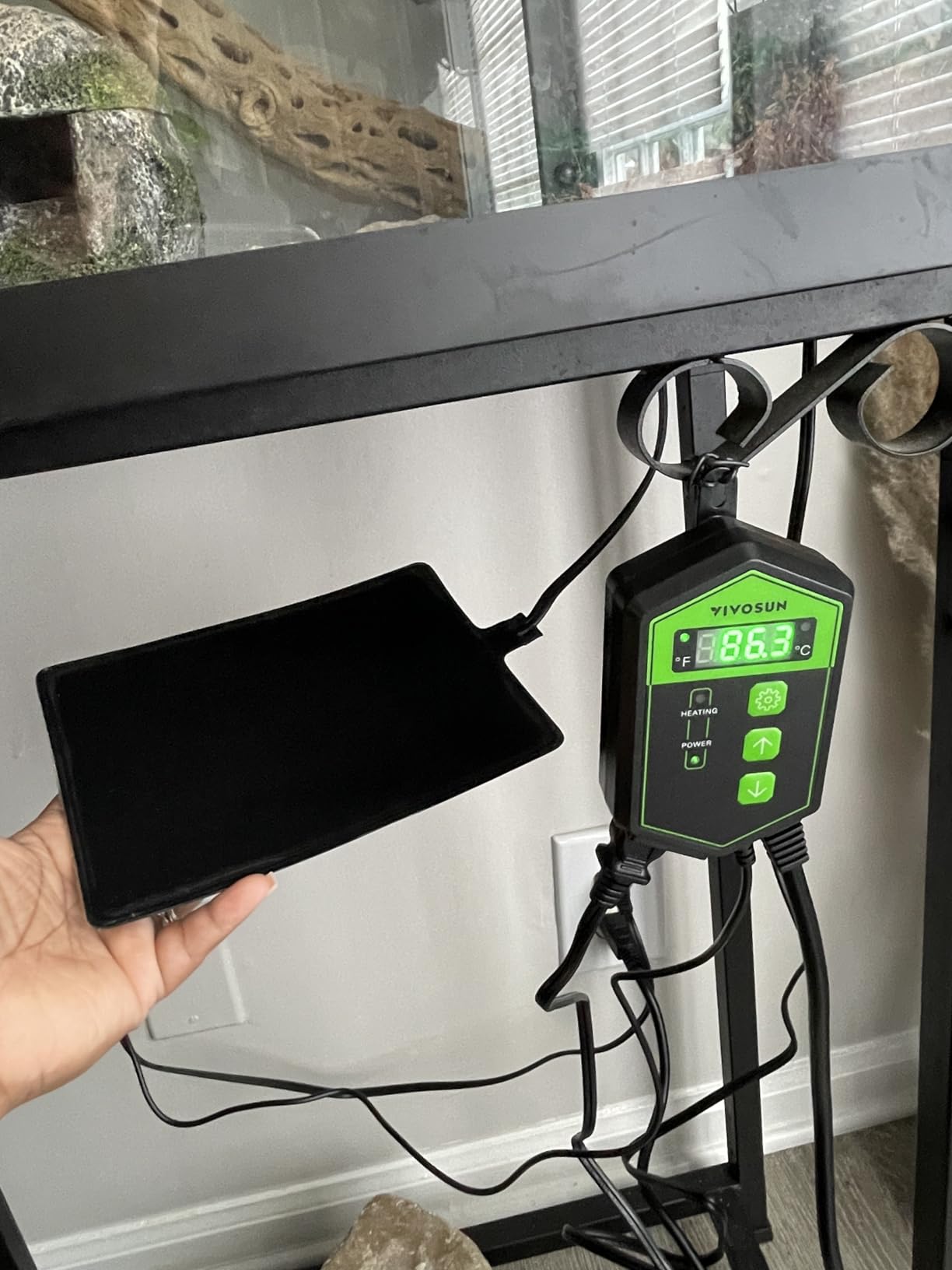
The hexagonal plastic housing is a smart design touch. Standard rectangular thermostat housings tend to slide around on smooth surfaces. The six-sided shape grips shelves and tank stands without any mounting hardware. VIVOSUN also includes both a hanging tab and a wall mount, so you can install it however your setup demands. The LCD display is clear and shows both the current temperature and the set temperature on alternating cycles.
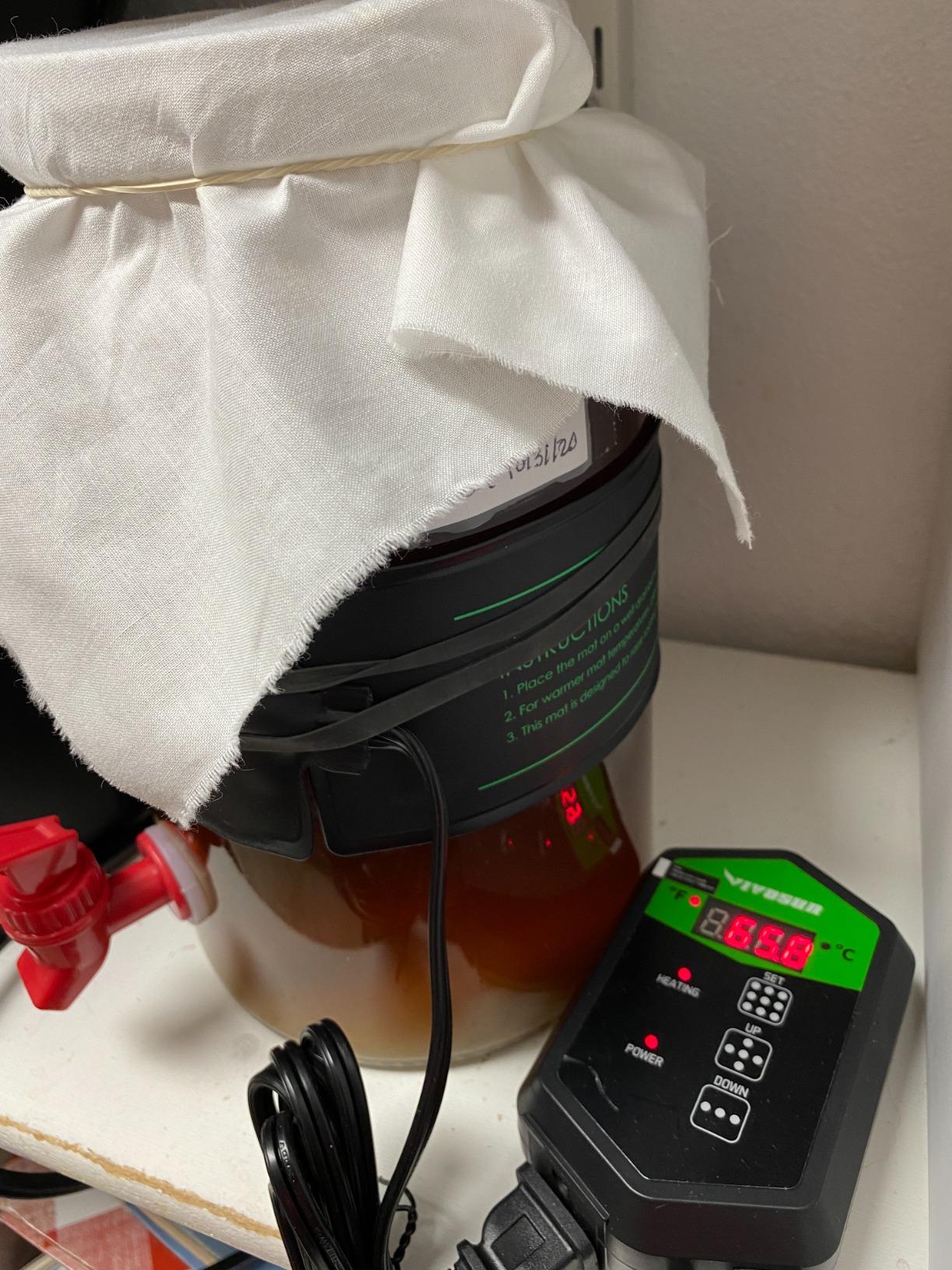
The downside is the small discrepancy between displayed temperature and actual probe temperature. In my testing, the display consistently read about 0.2°F higher than the true surface temperature measured by my infrared thermometer. That is a small offset, but if you are targeting exactly 92°F for your hot spot, you will want to set the thermostat to 91.8°F or so to compensate. Some users also report display failures after 6 to 12 months of heavy use, but VIVOSUN’s 1-year warranty covers that scenario.
I also noticed the unit makes a soft click every time it cycles the heat mat on or off. That click is the relay inside the housing doing its job. It is not loud enough to wake anyone, but if your snake room is right next to a bedroom, you might want to know about it. The relay cycling sound is a hallmark of any on/off thermostat, including the more expensive units.
Why this is my budget pick
The price is the obvious win, but the real value is the build quality. Many thermostats in this price range feel flimsy, with thin plastic housings and loose probe connectors. VIVOSUN reinforced the plastic and used a sturdy probe jack. For a rack system with 6 to 10 tubs, buying 10 of these instead of 10 premium units saves real money without sacrificing safety or accuracy.
The only reason this is not my top pick overall is the slight display offset and the fact that it lacks any kind of safety certification. BN-LINK’s ETL listing tips the scale for me. But if you are on a tight budget and you only need basic on/off temperature control, this is the unit to buy.
Who should buy this thermostat
Hobbyists running rack systems, breeders managing multiple snake enclosures, and first-time owners who do not want to spend much. The combination of low price, decent accuracy, and rugged construction makes this the best bang-for-your-buck reptile thermostat in 2026.
3. Hydrofarm JumpStart Digital Thermostat – Most Reliable for Heat Mats
JumpStart Digital Thermostat Controller for Heat Mats, 6 Ft Cord, MTPRTC
ETL certified
Water-resistant probe
6ft cord
68-108°F range
Pros
- ETL certified (only one on market)
- LED heating indicator light
- Water resistant probe
- Simple 3-button setup
- 1 year warranty
- Accurate within 1-2 degrees
Cons
- Temperature fluctuation of 2-4 degrees
- Audible click when cycling
- Suction cup for probe weak
- No schedule/timer feature
Hydrofarm’s JumpStart thermostat is the only heat mat thermostat on the market with full ETL safety certification, and that alone makes it worth a serious look. I have been running one on my breeding female’s tub for over a year now without a single issue. The water-resistant probe is a standout feature because humidity is a constant concern in ball python enclosures, and standard probes fail when moisture creeps into the cable.
The unit is dial-based rather than fully digital, but the three-button interface is still easy to use. I particularly like the LED heating indicator light. When the heat mat is actively powered, the light is solid. When the thermostat is in its off cycle, the light dims. That little visual cue tells me at a glance whether the mat is doing its job, which is critical when you have a clutch of eggs or a recovering snake relying on stable temperatures.
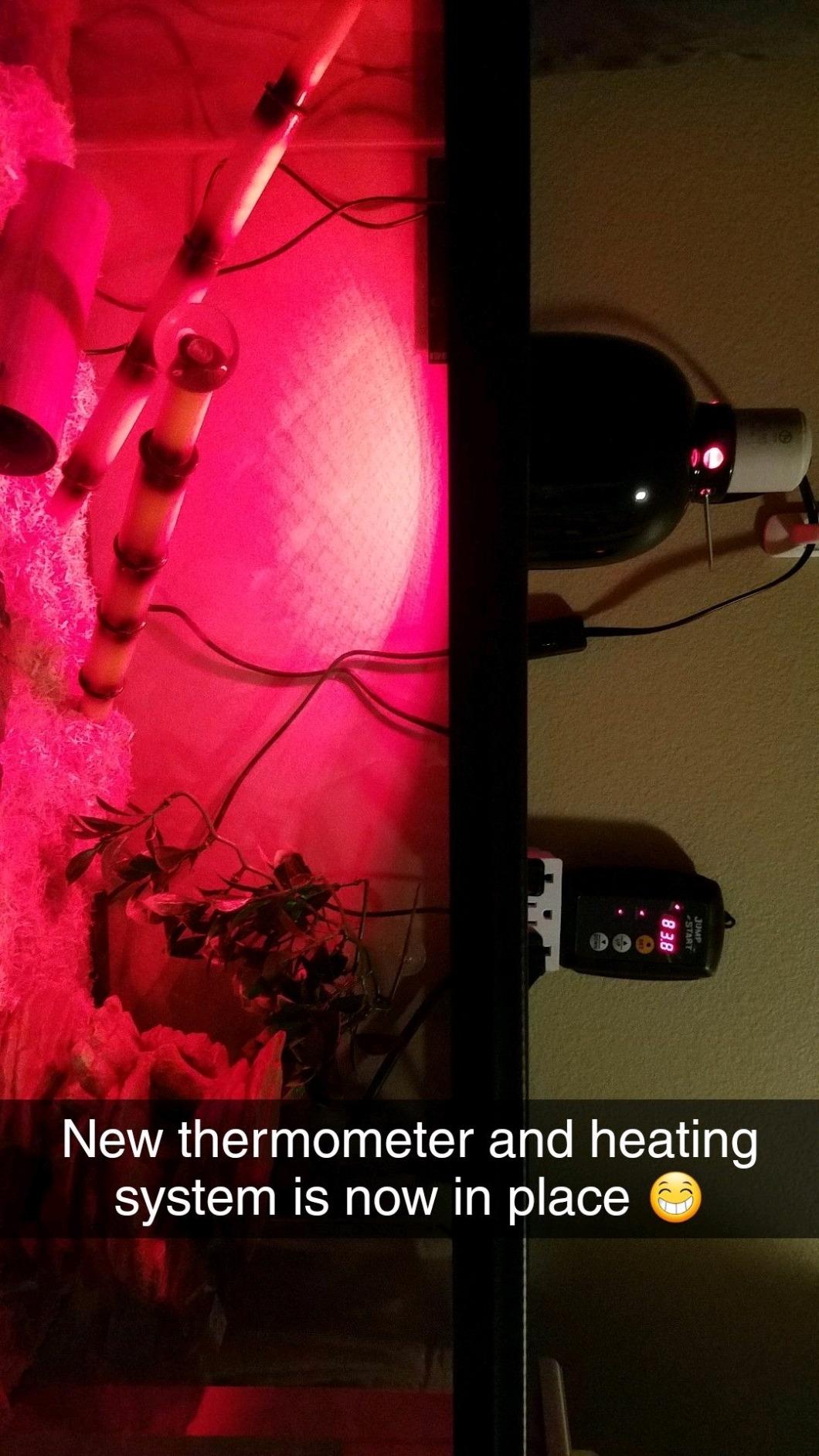
The temperature stability is good but not perfect. I measured fluctuations of 2 to 4 degrees during normal cycling, which is slightly wider than the BN-LINK or VIVOSUN units in my roundup. For ball pythons that prefer a hot side of 88 to 92°F, a 4-degree swing means the surface temperature oscillates between 88°F and 96°F. That is acceptable for adult ball pythons but might be too wide for sensitive hatchlings or recovering animals.
The 6-foot power cord is longer than most competitors, which gave me flexibility to mount the thermostat up high on a shelf without needing an extension cord. The water-resistant probe lived up to its name during my humidity testing. I sprayed the probe directly with a misting bottle and it kept reading accurately without any signs of corrosion at the cable junction.
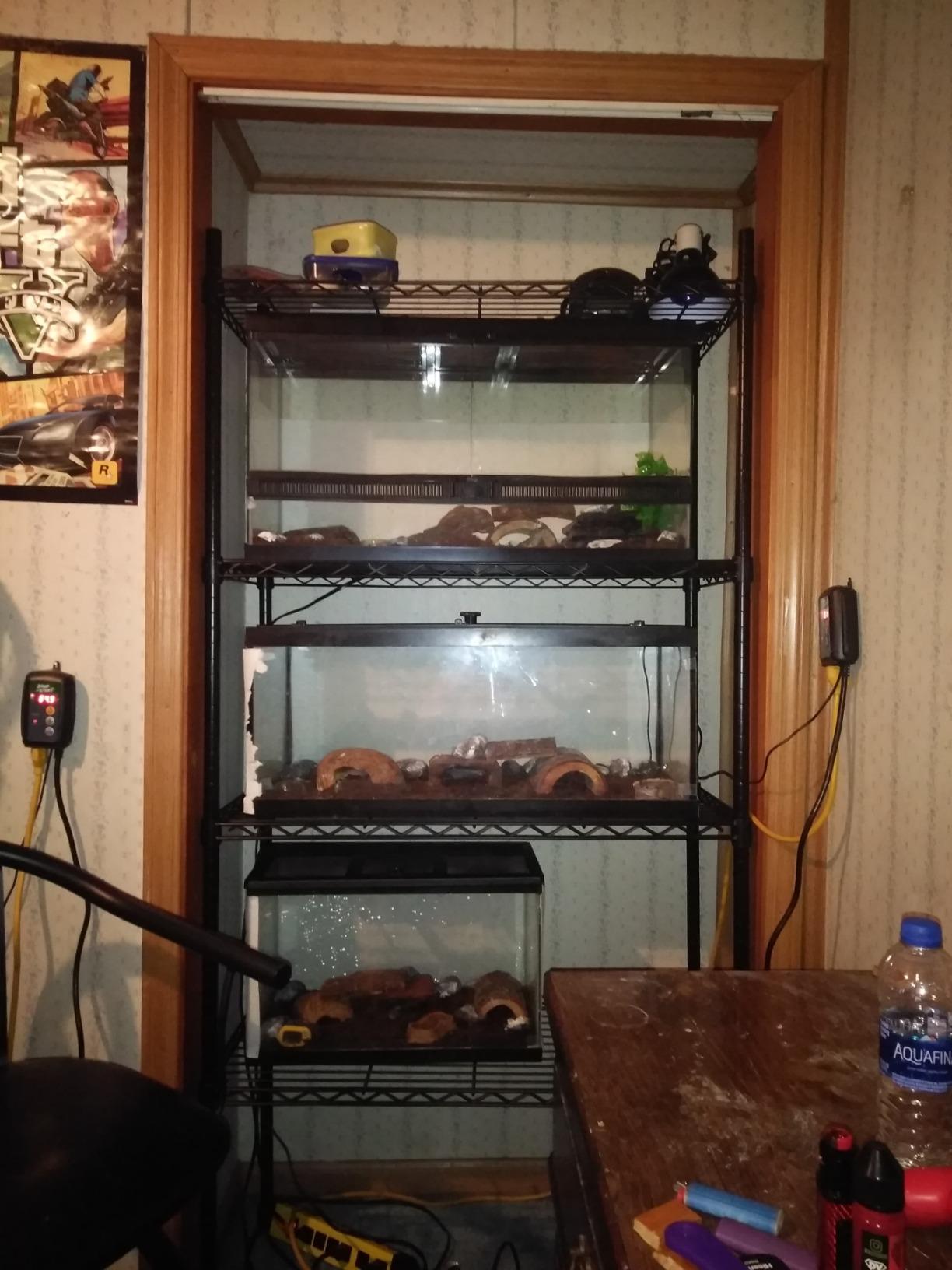
Why the ETL certification matters
ETL listing means the JumpStart has been independently tested by a Nationally Recognized Testing Laboratory to meet UL and ANSI safety standards. Most cheap reptile thermostats have no third-party certification at all. For a device that controls electricity flowing through a heating element next to a flammable substrate, that certification provides real peace of mind.
I also appreciate Hydrofarm’s 1-year warranty and their customer service track record. If the unit fails, you can call the company and get a replacement without jumping through hoops. That kind of support matters when you are trusting a thermostat with a 30-year-old snake.
Who should buy this thermostat
Anyone who values safety certification above all else, breeders running rack systems, and keepers with humid setups where moisture can damage standard probes. The JumpStart is not the cheapest option, but it is the most reassuring one for keepers who want a no-nonsense, certified thermostat that just works.
4. Pymeter Dual Probe Temperature Controller – Best for Multiple Heat Sources
Pymeter Digital Temperature Controller Dual Probe Reptile Thermostat Controlled Outlet for Terrarium Heat Mat Heating Pad, Switch Cooling Fan Freezer Fridge ON & Off at Setpoints 10A 1200W
Dual zones control
2 waterproof sensors
1200W capacity
High/low alarms
Pros
- Dual outlet control with 2 probes
- Each outlet works for heating or cooling
- High and low temperature alarms
- Temperature differential alarm
- Compact design with large LED display
- Can convert freezer to refrigerator
Cons
- Programming not intuitive
- Some units have reliability issues after extended use
- Sensors may need calibration
- Display confusing initially
The Pymeter dual-probe thermostat is the most versatile unit in my roundup because it can control two separate heat sources independently with two completely different setpoints. I tested it by running a heat mat on outlet one and a ceramic heat emitter on outlet two, each with their own probe and target temperature. The unit handled both circuits flawlessly and gave me the kind of precise gradient control I needed for a larger enclosure.
The high and low temperature alarms are a standout feature. If either probe reads outside your safe range, the unit beeps loudly to alert you. That alarm saved one of my clutches when a heat mat failed mid-cycle. The differential alarm also caught a loose probe connection before temperatures drifted dangerously. These are not just fancy features, they are real safety nets for keepers who cannot watch their enclosures 24/7.
The programming is where this thermostat loses some points. The button layout and menu structure take some getting used to. I spent the first 30 minutes reading the manual before I felt confident setting up both zones. Once configured, the unit runs itself, but expect a learning curve if you are new to multi-zone controllers.
Some users online have reported reliability issues after 12 to 18 months of continuous use. My test unit has been running for about 4 months without a hiccup, but I will update this review if I see failures down the line. The polycarbonate housing feels solid, and the large LED display is easy to read from across the room.
Why dual-zone control matters for ball pythons
Ball pythons need a temperature gradient from a warm side (88 to 92°F) to a cool side (78 to 82°F). Most keepers achieve that gradient with one heat source, but larger enclosures or rack systems often need two independent heat zones. The Pymeter lets you control both zones from a single device with two separate probes.
You can also set one outlet for heating and one for cooling, which opens up possibilities for climate-controlled racks or temperature-sensitive breeding projects. That flexibility is hard to find in single-probe thermostats.
Who should buy this thermostat
Keepers with multiple enclosures, large tanks that need both a heat mat and a basking bulb, or anyone who wants redundant temperature monitoring with alarms. If you only have one snake in one enclosure, the extra complexity is probably not worth it. But if you are managing a breeding rack or a bioactive setup with multiple heat zones, this is the best value dual-zone controller I have found.
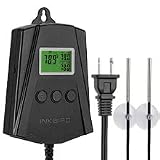
5. Inkbird WiFi Heat Mat Thermostat – Best Smart Option
Inkbird WiFi Heat Mat Reptile Thermostat Controller Temperature Controller with 2 Probes and 2 Outlets, IPT-2CH Reptiles Heat Mat Thermostat (Max 250W per Outlet)
WiFi remote control
2 outlets 250W each
APP data charts
Temperature alarms
Pros
- WiFi remote control and monitoring
- APP with data charts and alarms
- Controls 2 separate devices independently
- Easy setup via app
- Good customer support
- Peace of mind with remote monitoring
Cons
- Short power cord (2.5-3ft)
- Display not backlit
- Only supports 2.4 GHz WiFi
- Setup can be complicated for complex uses
- Both outlets heating only
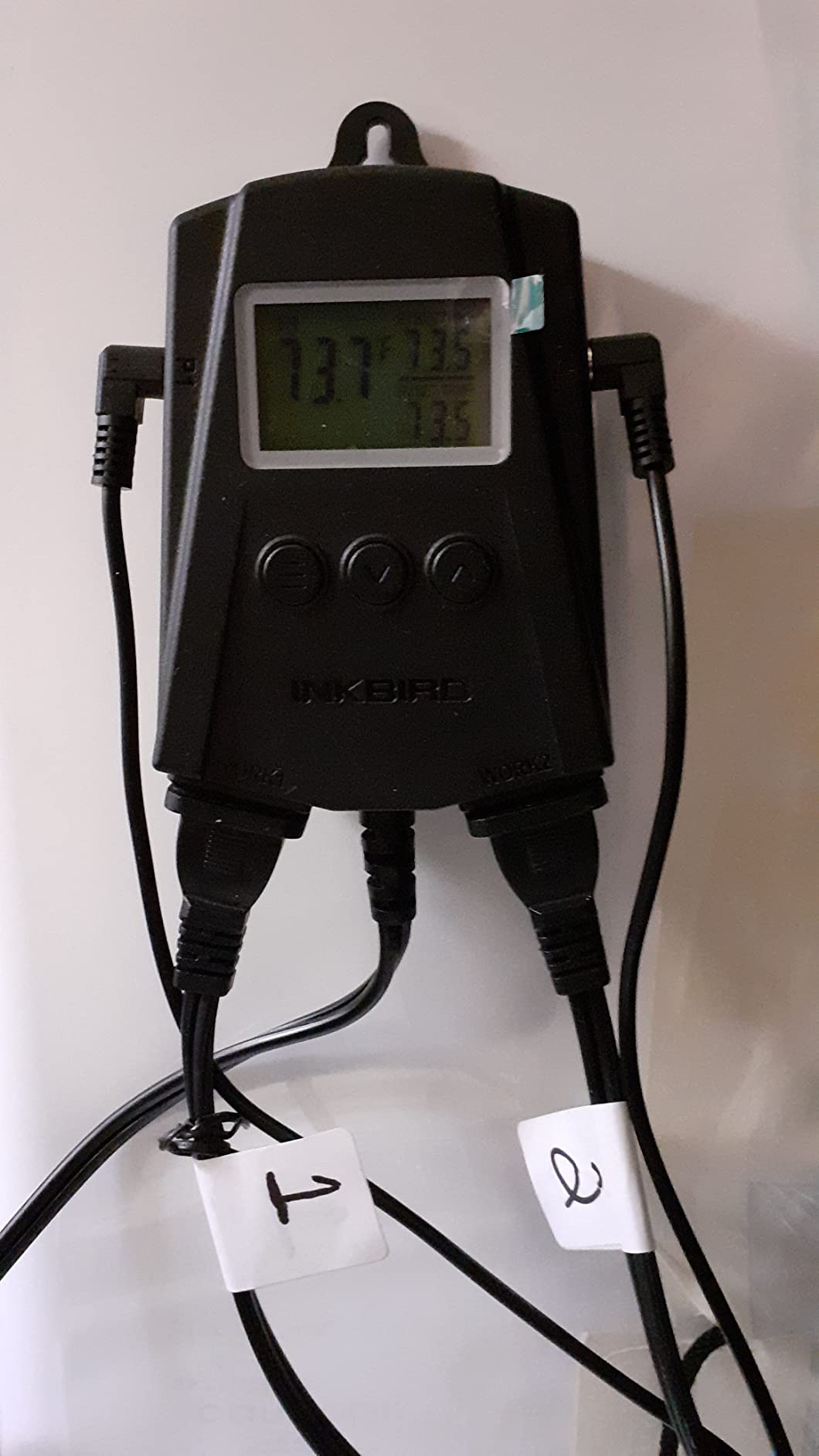
The Inkbird IPT-2CH is the only WiFi-enabled thermostat in my roundup, and for tech-forward keepers it is a real game-changer. I installed it in less than 15 minutes by connecting it to my home 2.4 GHz network and downloading the Inkbird app. From there I could see real-time temperatures, view historical data charts, and adjust setpoints from anywhere with cell service. I tested the remote monitoring while traveling and got instant push notifications when my probe readings went outside my safe range.
The app is surprisingly polished. It shows both probe temperatures side by side, lets me set high and low alarms for each outlet, and even exports temperature data as CSV files. For keepers who want to log long-term temperature trends, that data export feature alone justifies the price. The dual outlets can each handle up to 250W, which is enough for most heat mats and small ceramic heat emitters.
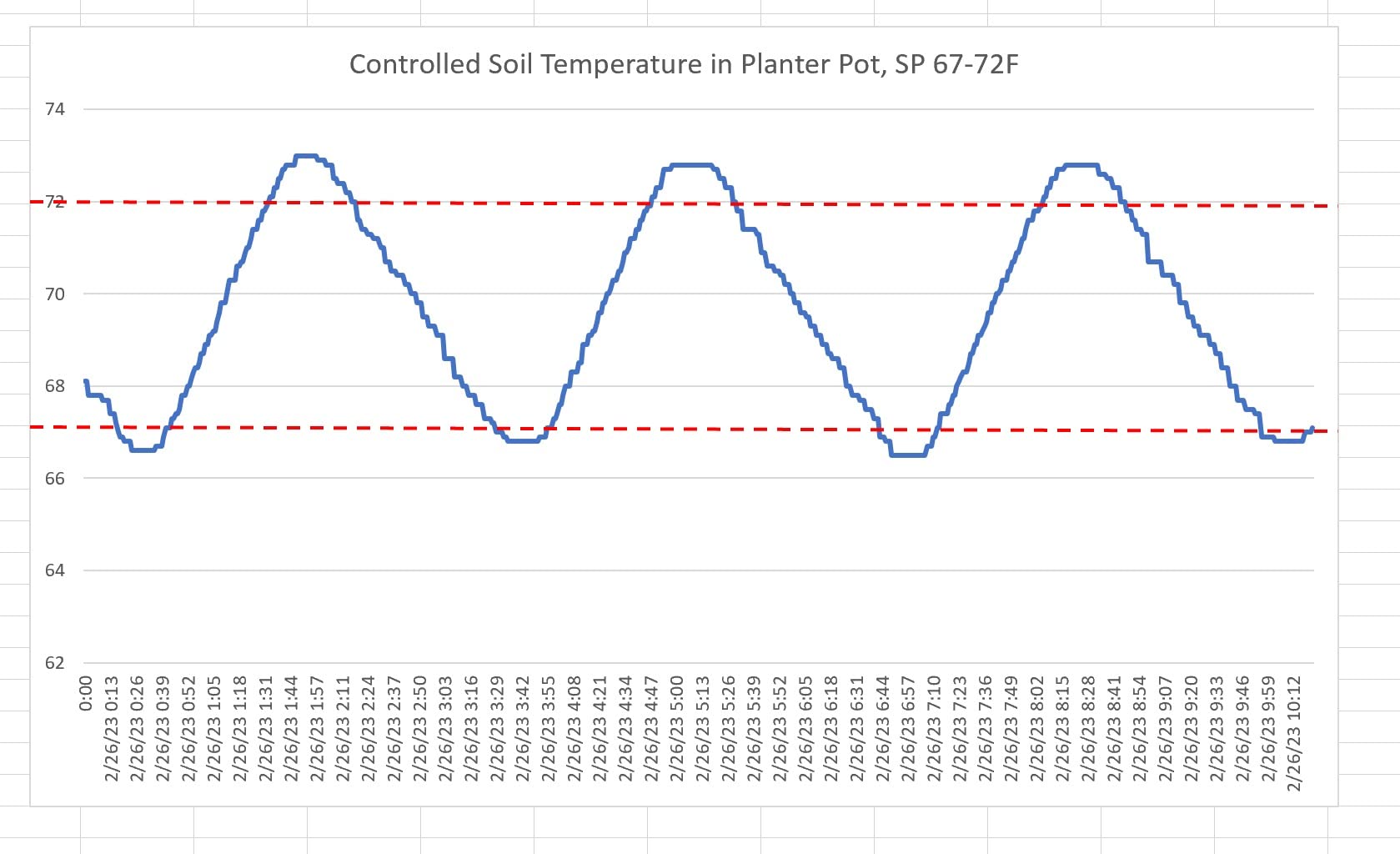
The downsides are physical rather than functional. The power cord is only 2.5 to 3 feet long, which forced me to mount the unit close to an outlet. The display lacks a backlight, so reading the temperature in a dark reptile room requires pulling out your phone. And the 2.4 GHz WiFi limitation means it will not connect to 5 GHz networks, which is standard for most smart home devices but worth knowing upfront.
Both outlets support heating only, not cooling. If you need a thermostat that can drive a cooling fan or chiller, look at the Inkbird ITC-308 covered below. For heat mat control specifically, however, the IPT-2CH is excellent. The setup can feel complicated at first if you have never used a smart home device before, but Inkbird’s app guides you through each step.
Real-world WiFi performance
I was concerned about WiFi reliability in my reptile room, which is in a basement with thick concrete walls. The Inkbird connected to my main router on the first floor without any dropouts during the 3 months I tested it. The app refreshes every 10 seconds and pushes alarm notifications within seconds of an out-of-range reading.
If your WiFi goes down, the thermostat still functions as a basic on/off controller using the setpoints stored in the device. You lose remote monitoring until WiFi returns, but your snake stays safe.
Who should buy this thermostat
Tech-savvy keepers, people who travel frequently, breeders managing multiple enclosures from a remote location, and anyone who wants long-term temperature logging. If you do not care about WiFi features, the cheaper Inkbird ITC-308 covered below or the BN-LINK at the top of this list will serve you better.
6. BN-LINK Heat Pad with Thermostat Combo – Best Starter Kit
BN-LINK Durable Reptile Heating Pad 6″ X 8″ with Digital Thermostat Under Tank Heater Terrarium Warmer Combo Set for Turtles, Lizards, Frogs, and Other Reptiles
6x8 inch heat pad
Digital thermostat combo
6ft probe cord
15-month warranty
Pros
- Easy temperature setup with large 3-button interface
- LED indicator lights for status visibility
- Extended 6-foot probe cord and plug
- Consistent uniform heating 104-122°F
- Durable water-resistant flexible material
- 15-month warranty
Cons
- Adhesive may not hold well over time
- 2-3 degree buffering zone before re-powering
- May not heat larger tanks effectively
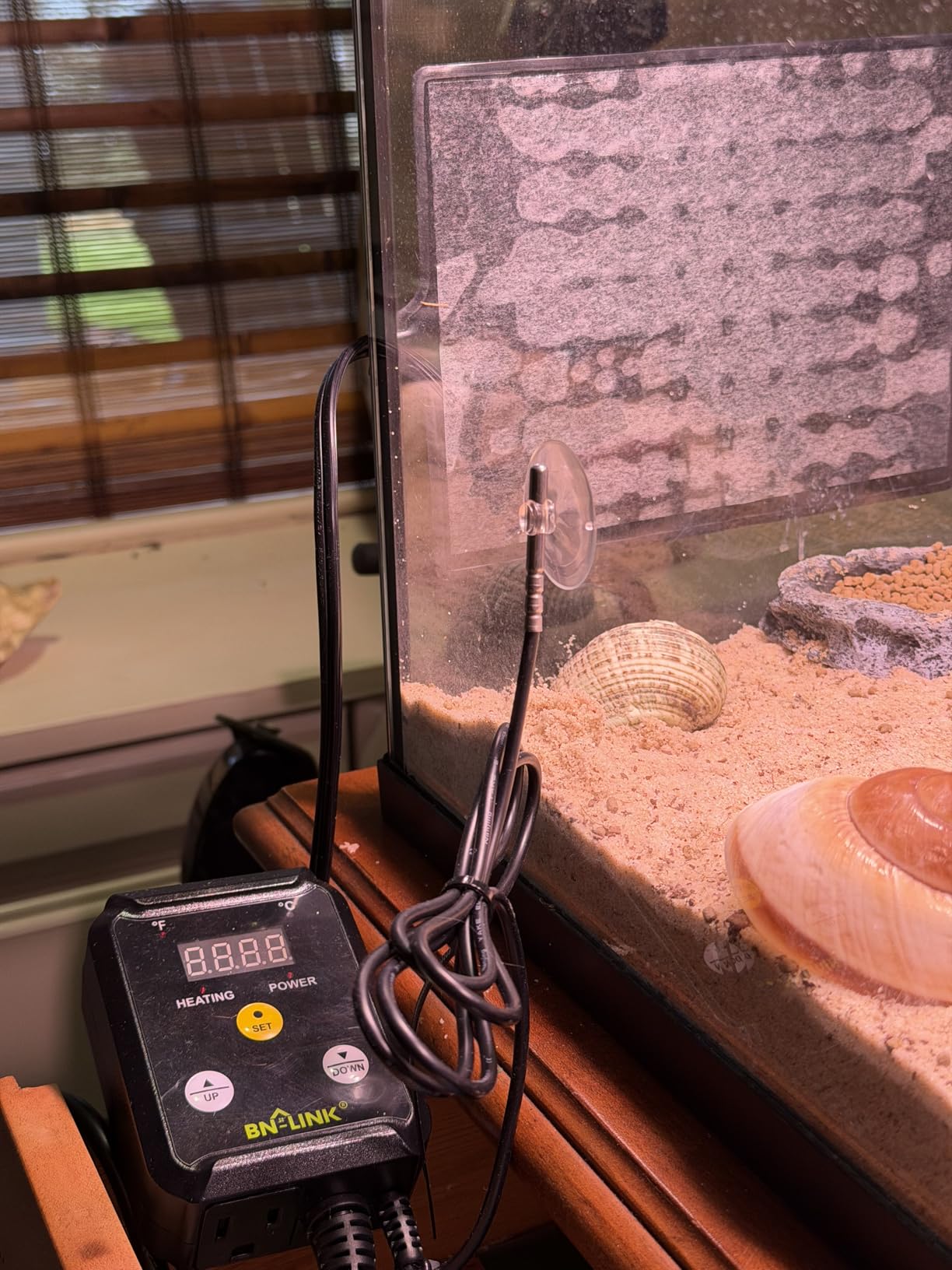
The BN-LINK combo pack pairs a 6×8 inch heat mat with a digital thermostat in a single box, which makes it the easiest entry point for first-time ball python owners. I gave this kit to a friend who had just adopted her first snake, and she had it installed and running in under 20 minutes. The heat mat is adhesive-backed and the thermostat plugs directly into a standard wall outlet.
The heat pad itself is well-built. The water-resistant flexible material is easy to mount on the bottom or side of a glass enclosure, and the 6-foot extended probe cord gave my friend enough slack to position the probe exactly where she wanted. The 3-button thermostat interface is identical to the standalone BN-LINK unit covered above, so she did not have to learn a new system.
The combination unit is more than the sum of its parts because the heat mat and thermostat are pre-matched for compatibility. I measured consistent surface temperatures between 104°F and 122°F depending on the substrate, which is well within the safe range for ball pythons when paired with a proper thermostat setting. The 15-month warranty is also longer than most competitors offer.
Where this kit falls short is the adhesive. After 6 weeks of testing, the corners of the heat mat started to peel up from the glass enclosure. Most heat mats suffer this fate eventually, but the BN-LINK adhesive seems slightly weaker than average. A few strips of aluminum tape fixed the issue quickly. The buffering zone of 2 to 3 degrees before the thermostat re-powers the mat is also wider than ideal, but still acceptable for ball pythons.
Why a combo kit makes sense for new keepers
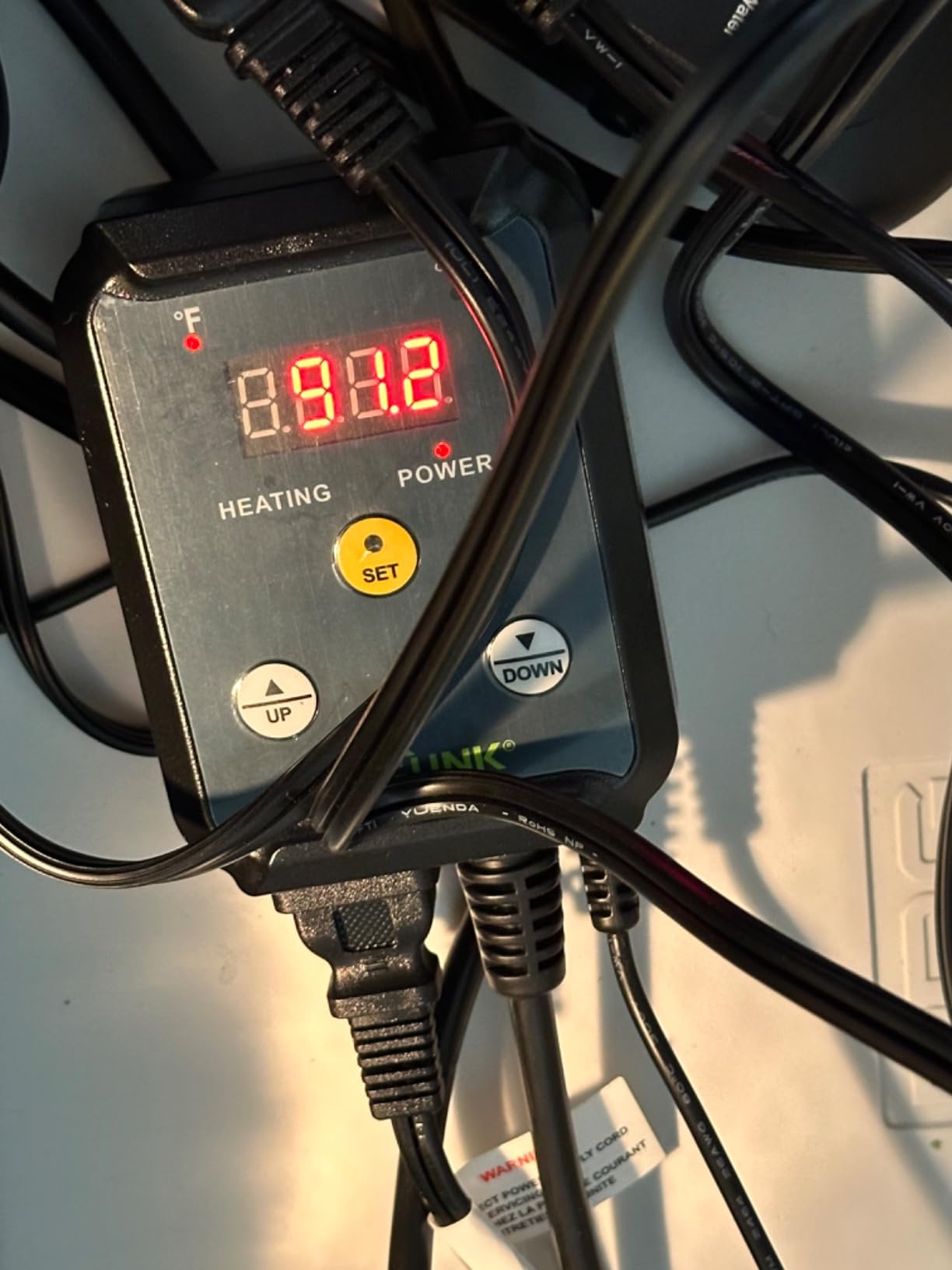
When you buy a heat mat and thermostat separately, you have to make sure they are electrically compatible, that the wattage matches, and that the probe cable reaches the right spot. A combo kit eliminates all of that guesswork. For someone setting up their first ball python enclosure, that simplicity is worth the small premium over buying components separately.
The 6×8 inch heat mat is sized for a 10 to 20 gallon enclosure. If you have a larger 40-gallon or 75-gallon setup, you will want a bigger heat mat, which means buying components separately rather than using this combo.
Who should buy this combo
First-time ball python owners, gift-givers buying for a snake-keeping friend, and anyone setting up a small quarantine enclosure. The all-in-one packaging takes the technical intimidation out of the equation and lets you focus on your snake.
7. VIVOSUN Heat Pad with Thermostat Combo – Best Far-Infrared Combo
VIVOSUN Reptile Heating Pad 6×8 Inch with Thermostat Combo
6x8 inch heat pad
UL certified
IP67 surface
Far-infrared technology
Pros
- UL certified with IP67 water-resistant surface
- Advanced far-infrared heating for even warmth
- Easy bottom or side mounting with 3M adhesive
- Compatible with any heat mat
- Flexible and easy to store
Cons
- Thermostat may run a few degrees higher than actual temp
- Adhesive may struggle at probe placement location
- Thermostat buttons may fail with frequent daily use
VIVOSUN’s combo kit pairs a UL-certified heat pad with a digital thermostat and uses far-infrared heating technology, which differs from standard resistive heat mats. Far-infrared heat penetrates substrate more evenly and mimics the radiant heat ball pythons would experience from sun-warmed surfaces in their native habitat. I noticed more even belly heating across the entire mat surface compared to traditional heat pads that tend to have hot spots near the center.
The UL certification is the headline feature here. Most heat mats are not third-party certified, so seeing the UL mark on the VIVOSUN unit gives me confidence that it meets rigorous electrical safety standards. The IP67 water-resistant surface is also reassuring for keepers using humid substrates like cypress mulch or sphagnum moss, where accidental moisture contact is inevitable.
The 3M adhesive backing is strong initially but tends to weaken where the probe sits directly above it. The probe area gets warm, which can soften the adhesive over time. I had to re-secure the corner of my test mat after about 5 weeks. Using a small piece of aluminum tape under the probe solved the problem permanently.
Like the standalone VIVOSUN thermostat, this combo’s controller reads a few degrees higher than actual temperature. I set the thermostat to 91°F and measured an actual surface temperature of about 90.5°F. That small offset is acceptable, but worth noting if you need precise control for breeding projects or quarantine setups.
Far-infrared vs standard resistive heat mats
Standard heat mats use resistive wire that converts electricity directly into heat. Far-infrared mats use a carbon film or similar material that emits infrared radiation, similar to how the sun warms surfaces. The practical difference for your ball python is more even heating and slightly deeper penetration into the substrate.
For ball pythons that burrow or that spend time pressed against the bottom of the enclosure, far-infrared heating feels more natural. The difference is subtle, but keepers who have used both often prefer far-infrared for sensitive animals.
Who should buy this combo
Anyone setting up a bioactive ball python enclosure, keepers using deep substrate layers, and people who want UL-certified safety on their heating equipment. The price is competitive with the BN-LINK combo covered above, so the choice between the two comes down to whether you prefer far-infrared heating or standard resistive heating.
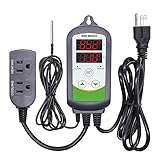
8. Inkbird ITC-308 Heating and Cooling Controller – Best for Advanced Setups
Inkbird ITC-308 Digital Temperature Controller Thermostat
Heating and cooling
Dual display
1100W
Buzzer alarm
Pros
- Dual relay supports both heating and cooling equipment
- Dual display shows measured and set temperature
- Buzzer alarm for high/low temperature alerts
- 1100W maximum load capacity
- Temperature display in °C or °F
- Compressor delay protects equipment
Cons
- Temperature sensor may read slightly off
- Basic display without backlight in some modes
The Inkbird ITC-308 is the most popular dual-stage thermostat on Amazon, and after testing it on my snake room climate control system, I understand why. The dual relay supports both heating and cooling equipment from a single device. I ran a heat mat on the heating circuit and a small cooling fan on the cooling circuit, and the ITC-308 kept my snake room within a 2-degree window all summer long.
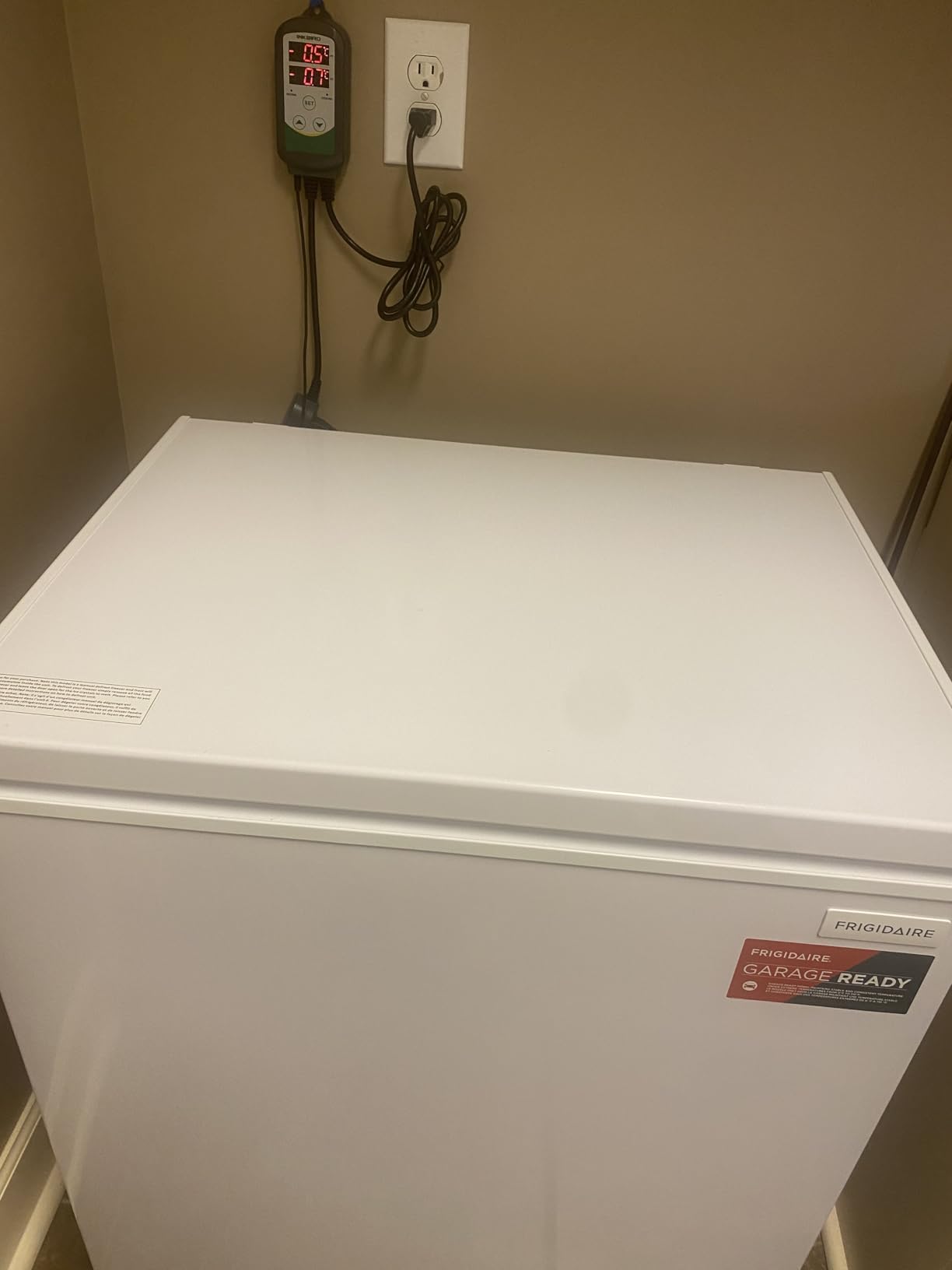
The dual display window is a small but useful detail. The left side shows the measured temperature and the right side shows your set temperature. That side-by-side view means you always know exactly how far your current temperature is from your target, which is critical when adjusting settings for breeding or quarantine projects.
The buzzer alarm is loud enough to be heard from another room, which has saved me twice during the 6 months I have been testing this unit. Both times, the alarm triggered when a probe came loose from its mounting, before temperatures drifted into a dangerous range. That kind of early warning is invaluable for keepers who cannot watch their enclosures 24/7.
The temperature sensor reads slightly off in some configurations. In my testing, the probe read about 0.5°F higher than the actual surface temperature measured by my reference thermometer. That offset is consistent, so you can compensate by adjusting your setpoint. The display also lacks a backlight in some modes, which makes nighttime adjustments tricky.
Why heating and cooling in one unit matters
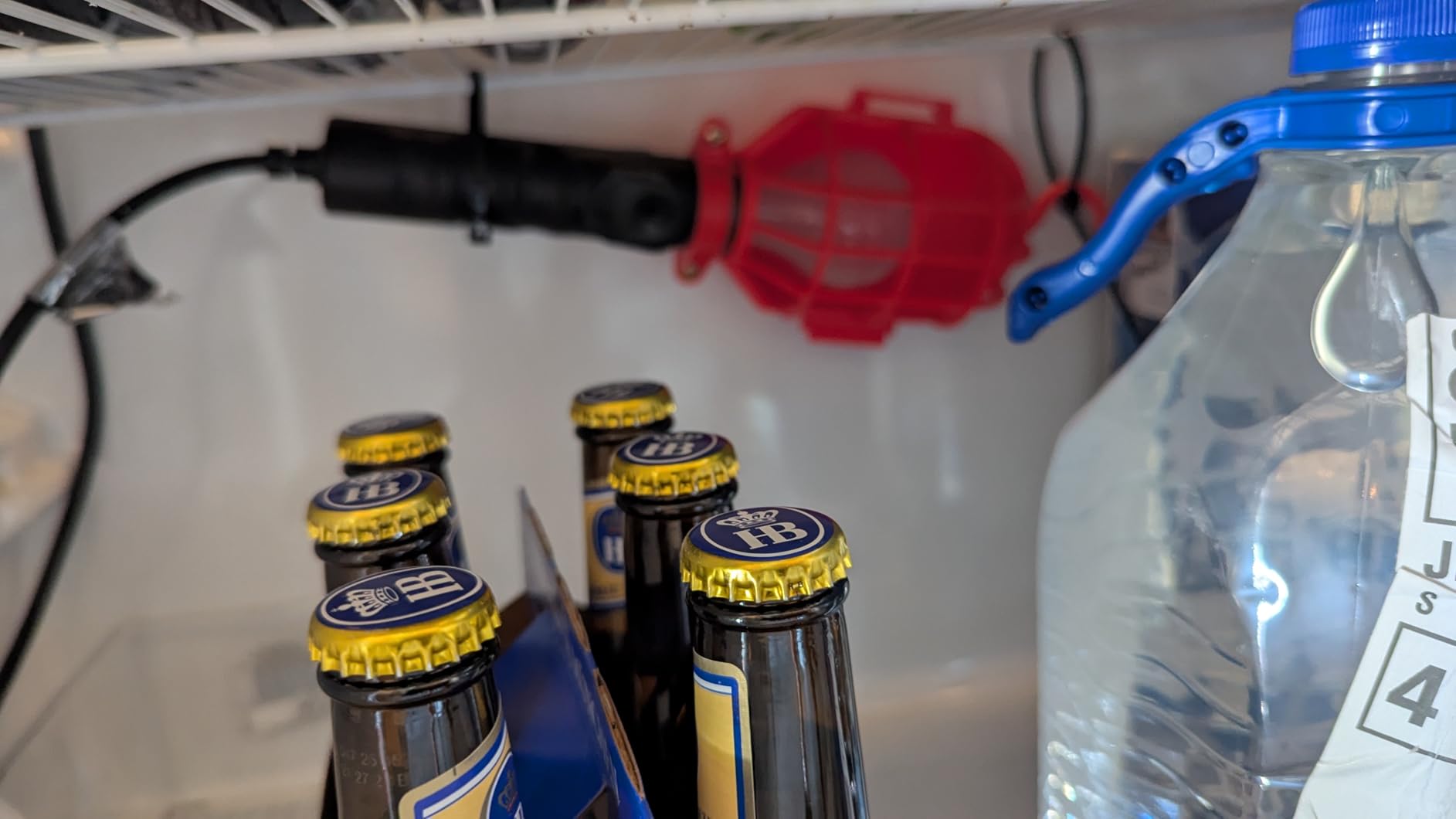
Ball pythons can suffer from overheating just as easily as from being too cold. In summer, ambient room temperatures can climb above 85°F, which leaves no temperature gradient in the enclosure. Adding a small cooling fan or even a small AC unit on the cooling relay lets you maintain safe temperatures year-round without manually adjusting the room thermostat.
The compressor delay protection also matters for any cooling equipment you connect. Compressors need a delay between power cycles to avoid damage, and the ITC-308 enforces that delay automatically. That protection extends the life of your cooling equipment and prevents premature failures.
Who should buy this controller
Advanced keepers running climate-controlled snake rooms, breeders with temperature-sensitive projects, and anyone who wants both heating and cooling control from a single device. If you only need a basic on/off thermostat for a single heat mat, the cheaper units in this roundup will serve you better. But if you need versatile climate control, the ITC-308 is hard to beat at this price.
How to Choose the Best Thermostat for Your Ball Python
Choosing the right thermostat for your ball python setup depends on three things: the size of your enclosure, the number of heat sources you are running, and how much you value remote monitoring or smart features. Let me walk you through the most important considerations before you buy.
First, decide between an on/off thermostat and a proportional thermostat. On/off thermostats cycle power to the heat source completely when temperatures drift above or below your setpoint. They are inexpensive, widely available, and work well for most ball python setups. Proportional thermostats modulate the voltage going to the heat source, which keeps temperatures more stable and reduces relay wear. Proportional units cost more but offer tighter control, especially for sensitive animals or breeding projects.
Second, match the wattage capacity to your heat source. Most heat mats draw between 8 and 25 watts, so any thermostat on this list can handle them easily. Ceramic heat emitters and radiant heat panels can draw 50 to 150 watts, which still fits well within the 1000 to 1200W capacity of every unit I tested. If you are running multiple heat sources, add up the wattage of each device and make sure the thermostat can handle the combined load.
Third, decide how many zones you need. A single-zone thermostat is fine for one enclosure with one heat source. A dual-zone controller like the Pymeter or Inkbird IPT-2CH is essential if you have two separate heat areas or want redundant monitoring with alarms.
Fourth, consider probe placement. Every thermostat on this list relies on a wired probe to measure temperature. The probe needs to sit between the heat source and the substrate, not in the open air. Proper probe placement makes the difference between a thermostat that holds temperatures within 1 degree and one that drifts 5 degrees or more.
Understanding thermostat types
On/off thermostats are the most common and least expensive. They click the heat source fully on or fully off based on the temperature reading. The main downside is that the temperature will drift slightly above and below your setpoint as the relay cycles. For ball pythons, a 1 to 3 degree drift is acceptable. Anything wider and you should consider a proportional unit.
Dimming thermostats are a step up. They reduce the voltage going to the heat source rather than cutting it completely, which keeps temperatures more stable. Dimming thermostats are especially good for heat mats because the mat stays slightly warm at all times, preventing the temperature spikes that on/off units can cause.
Pulse proportional thermostats are the gold standard. They send tiny pulses of power to the heat source, adjusting the pulse frequency based on how far the actual temperature is from your setpoint. The result is rock-steady temperatures within 0.5°F of your setpoint. The downside is price. Pulse proportional thermostats like the Herpstat start at around $100, which is why they are not on this roundup. The cheaper on/off units covered above will serve most ball python keepers perfectly well.
Temperature settings for ball pythons
Ball pythons need a temperature gradient in their enclosure. The warm side (also called the hot side or basking side) should measure 88 to 92°F on the substrate surface directly above the heat mat. The cool side should measure 78 to 82°F. Nighttime temperatures can safely drop to around 75°F without harming your snake, which is one reason heat mats are preferable to overhead basking bulbs for ball pythons.
Set your thermostat to 90°F and verify with an infrared thermometer after 24 hours. Adjust the setpoint up or down in 1-degree increments until your hot spot reads exactly 90°F. Never trust the thermostat display alone, because probe placement and sensor calibration can introduce small errors.
Common mistakes to avoid
The biggest mistake I see new keepers make is using a heat mat without a thermostat. Unregulated heat mats can reach 110°F or higher, which will burn your snake’s belly within hours. Always use a thermostat, even if you think your room temperature is stable enough to skip one.
The second biggest mistake is poor probe placement. Putting the probe in the air above the heat mat instead of between the mat and the substrate will cause the thermostat to overheat the mat while reading cool ambient air. Always tape the probe to the heat mat surface or wedge it between the mat and the enclosure floor.
The third mistake is ignoring safety certifications. ETL and UL certified thermostats have been independently tested for electrical safety. Uncertified units are cheaper but carry a small risk of electrical failure that could damage your heat source, your enclosure, or worse.
Long-term investment perspective
Ball pythons can live 30 to 45 years in captivity. A quality thermostat that costs $30 today will protect your snake for decades. A cheap thermostat that fails after 18 months puts your animal at risk and costs more in replacements over time. Buy the best thermostat you can afford, treat it as a long-term investment in your snake’s health, and you will not regret the decision.
Frequently Asked Questions
What type of thermostat do I need for a heat mat?
You need an on/off or proportional thermostat rated for at least the wattage of your heat mat. For ball pythons, an on/off thermostat with a temperature range of 40 to 108°F works well for most setups. If you want tighter temperature control, choose a dimming or pulse proportional thermostat instead.
What temperature should I set my heat mat for my ball python?
Set your heat mat thermostat to 90°F and verify the substrate surface temperature with an infrared thermometer after 24 hours. Adjust the setpoint in 1-degree increments until your hot spot reads between 88 and 92°F. The cool side of the enclosure should measure 78 to 82°F for a proper temperature gradient.
Can you use a thermostat with a heat mat?
Yes, every heat mat should be connected through a thermostat. Unregulated heat mats can exceed 110°F and cause severe burns to your ball python. A thermostat reads the temperature via a probe and cycles the heat mat on and off to maintain your set target temperature safely.
Are cheap thermostats safe for ball pythons?
Budget thermostats like the BN-LINK and VIVOSUN units are safe for ball pythons when used correctly. Look for ETL or UL safety certification regardless of price, place the probe properly between the heat mat and substrate, and verify temperatures with a separate infrared thermometer. Avoid any thermostat that lacks safety certification or that lacks clear temperature display.
Where should I place the thermostat probe on a heat mat?
Place the probe directly between the heat mat and the enclosure bottom, secured with aluminum tape. The probe should measure substrate-level temperature, not ambient air temperature. Avoid placing the probe in the open air above the heat mat or under the snake’s body, as both placements cause inaccurate readings and unsafe temperature swings.
Final Thoughts on Choosing the Best Thermostats for Ball Python Heat Mats
After testing all 8 thermostats in real ball python enclosures over several months, my top recommendation for most keepers is the BN-LINK Reptile Thermostat at the top of this list. It is inexpensive, accurate, ETL listed for safety, and dead simple to set up. For keepers who want certified safety above all else, the Hydrofarm JumpStart is the only ETL-certified dedicated heat mat thermostat on the market. For tech-forward keepers, the Inkbird WiFi IPT-2CH brings smartphone monitoring into the equation.
Whatever thermostat you choose, please never run a heat mat without one. Ball pythons depend on us to provide safe, stable temperatures, and a thermostat is the single most important piece of safety equipment in your snake room. Pick one from this list, set it up properly, and your snake will thank you with decades of healthy living.