
Finding an injured wild or stray bird feels overwhelming. Your heart races, you wonder if the bird is in pain, and you have no idea what to do next. I have been in that exact spot more times than I can count, and I can tell you this: the steps you take in the next ten minutes matter more than anything else you will do for that bird.
This guide will walk you through exactly how to care for an injured wild or stray bird you found, starting from the moment you see it on the ground until you hand it over to a licensed wildlife rehabilitator. You will learn how to assess the situation, catch the bird safely, build a transport box, and find the right professional help. By the end, you will have a clear action plan for any bird emergency you encounter.
Before we go further, here is the single most important point: do not feed the bird, do not give it water, and contact a licensed wildlife rehabilitator as soon as possible. That trio of actions gives the bird the best chance of survival.
Table of Contents
First, Decide Whether the Bird Actually Needs Your Help
Yes, in many cases the kindest thing you can do is leave an injured bird alone – but only after you have confirmed it actually needs help. Many seemingly hurt birds turn out to be perfectly healthy fledglings learning to fly. Stepping in too quickly can actually hurt them by separating them from parents.
Here is how to tell if a bird needs your intervention. Look for these clear signs of distress or injury:
Visible bleeding, open wounds, or blood on nearby surfaces
A wing that hangs at an odd angle or appears broken
Shivering, lethargy, or eyes that stay shut
Inability to stand, perch, or move away from you
A bird that lets you approach without flying away, or that flies into windows repeatedly
Evidence of a predator attack (damp or ruffled feathers from a cat, for example)
Being caught by a pet, hit by a car, or sprayed by a cat or dog
If the bird is hopping on the ground, has full fluffy plumage, and darts away when you get close, it is almost certainly a healthy fledgling. Watch from a distance of at least 30 feet for an hour or two. A parent bird is usually nearby, watching and feeding, even when you cannot see it.
If the bird is featherless or sparsely downy, has closed eyes, and cannot grip your finger, it is a nestling that likely fell from a nest. In that case, swift action is critical because nestlings cannot survive long outside the nest.
How to Safely Catch an Injured Bird?
Catching an injured bird without making things worse is the step most people fear the most. The good news is that most injured birds move slowly, which gives you time. Approach calmly and methodically, and you will almost always succeed.
Before you move in, gather a towel, a T-shirt, or a thin cloth you can drape over the bird. Light fabric prevents flapping and protects both you and the bird. Wear gloves if you have them, especially around hawks, owls, or large seabirds, whose talons can puncture skin.
Scenario 1: The Bird Is on the Ground and Cannot Fly
Move slowly and quietly toward the bird from behind if possible.
Stop a few feet away and very gently toss the cloth or towel over the bird’s body, including the head and wings.
Bring your hands together with the bird inside the bundle, leaving room for air and supporting the body.
Place the bird directly into the prepared container.
Scenario 2: The Bird Can Fly Weakly or Hop a Short Distance
Block access to bushes, fences, or structures it might escape into.
Two people work better than one here – one to herd, one to catch.
Corner the bird gently against a wall or shrub.
Drape the cloth quickly but without throwing it hard.
Scenario 3: A Bird in Your Pet’s Mouth or Near a Cat
If your cat or dog has the bird, get your pet inside immediately and away from the bird. Pick up the bird with a cloth only if you can do it safely. Even if you do not see obvious injury, any bird caught by a cat needs professional help because cat saliva contains bacteria fatal to birds within hours.
Scenario 4: A Raptor or Large Bird
Hawks, owls, and herons need different handling. Use thick gloves, hold the bird with wings folded gently against its body, and keep the talons pointed away from you. If you do not have experience, call a rehabber for phone guidance before approaching.
Handling the Bird Without Adding Stress or Injury
An injured bird in human hands is under enormous stress. Stressed birds can die from heart failure or shock, so every second of unnecessary handling matters. The goal is calm, confident, minimal contact.
Hold the bird with the wings folded gently against its body. A firm hold around the shoulders – where the wings meet the back – prevents flapping and self-injury. Do not squeeze the chest, because birds have hollow bones and powerful flight muscles that are easy to damage. Do not pull feathers, which can break or uproot them.
Keep the bird away from your face and never bring it near children or pets. Move the bird directly from the catching spot into the container. If the bird’s head is free, that is fine, but cover the box quickly so darkness can begin lowering its stress level.
How to Make a Temporary Container for the Bird
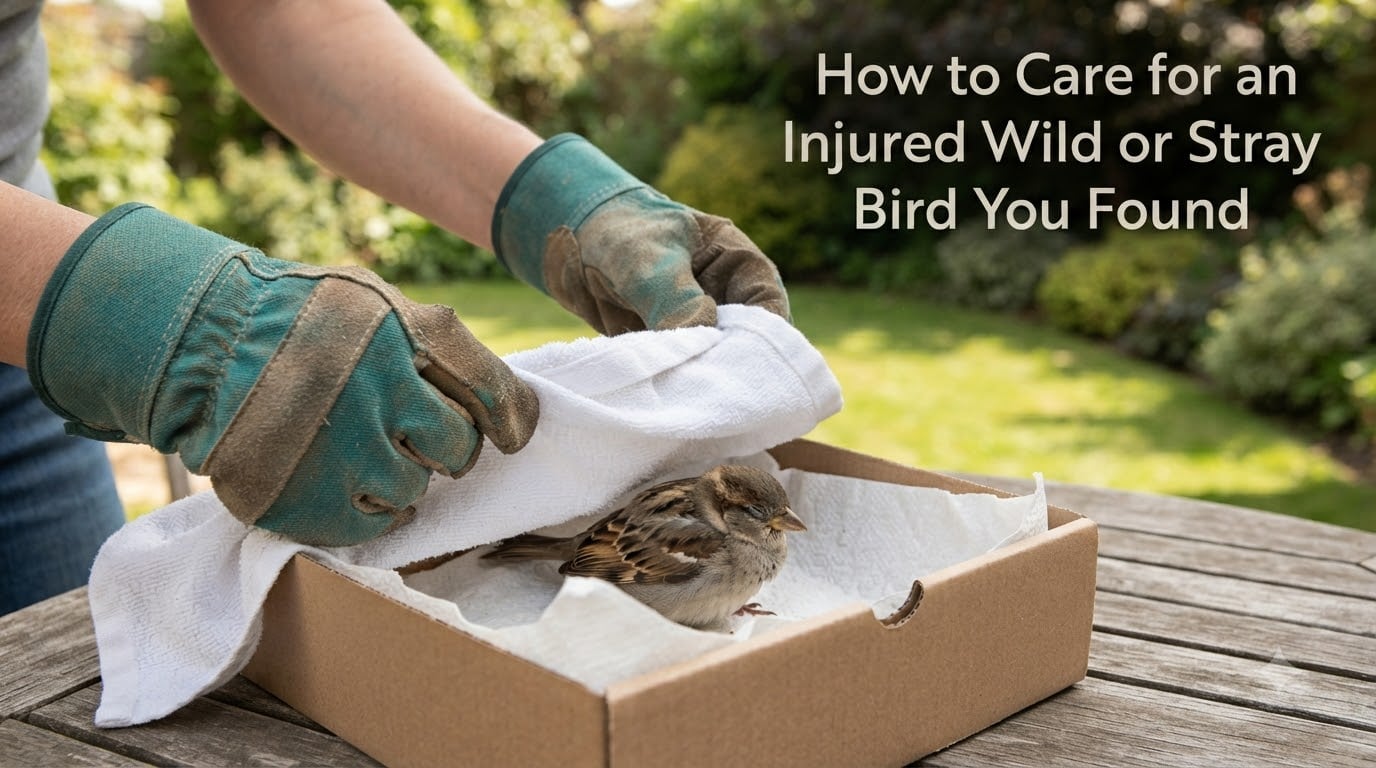
The right container can save a bird’s life. The wrong one can kill it. You want something small, dark, secure, warm, and ventilated. A regular cardboard shoebox checks every box.
Step-by-Step Container Setup
Choose a small box – a shoebox is ideal for songbirds.
Poke small air holes in the lid and sides using a pencil or pen. Holes the diameter of a pencil are perfect.
Line the bottom with a soft, unscented paper towel or a clean T-shirt. Do not use fluffy fibers, terry cloth, or anything with loops that can tangle toes and beaks.
Place a low heat source near or under one side of the box: a heating pad set to low, a hot water bottle wrapped in a towel, or a rice sock warmed in the microwave for 60 seconds works well.
The target temperature is around 85 degrees Fahrenheit inside the box. If the bird is panting or holding its wings away from its body, the box is too warm.
Close the lid partway to create a dim environment. Total darkness is best for stress reduction.
Why darkness matters: bright light worsens shock in birds. A dark, quiet space lowers heart rate and respiration within minutes. Think of the box as a recovery room, not a regular pet carrier.
Why heating matters: injured birds lose body heat rapidly, and hypothermia kills more birds than the original injury. Warmth buys time while you arrange transport.
Temporary Care Before Getting the Bird to a Rehabilitator
If rehab centers are open, head there immediately. If it is after hours, you may need to care for the bird overnight. Here is how to keep it stable until morning.
The only care you should ever provide at home is warmth, darkness, and quiet. No food. No water. No medicine. Even well-meaning owners cause harm by feeding birds bread, milk, or seed meant for adult pet birds – all of these can kill a wild songbird.
Overnight Care Checklist
Keep the box in a quiet room away from TVs, kids, and pets.
Do not open the lid except to gently refresh heat every few hours.
Maintain 85 degrees Fahrenheit. Replace hot water bottles or reheated rice socks as they cool.
Do not handle the bird. Touching it raises heart rate and burns energy reserves.
Call the rehabber first thing in the morning. Many have voicemail boxes that respond overnight.
If the bird is bleeding, you can apply gentle pressure with a clean paper towel for up to one minute. Beyond that, leave treatment to professionals. Do not apply ointments, hydrogen peroxide, or styptic powder.
Understanding Baby Birds: Nestlings, Fledglings, and the 3-3-3 Rule
The 3-3-3 rule is something every wildlife rehabber swears by, and once you understand it, you will know exactly when to step in. It describes how long young birds can survive on their own at three different life stages.
Here is the 3-3-3 rule for birds, simplified:
3 hours: A nestling (featherless or partially featherless) can survive about 3 hours without being fed before it needs warming and nutrition.
3 days: A fledgling (fully feathered, hopping on the ground) can go 3 days without intervention because parents are usually still feeding it nearby.
3 weeks: An adult bird, when sick or stunned, can sometimes pull through on its own if left undisturbed for around 3 weeks while it recovers.
The nestling vs. fledgling distinction is critical for this rule.
Nestlings: These are babies that should still be in the nest. They have bare pink skin or sparse down, sometimes pinfeathers just emerging. Eyes may be closed. They cannot grip, perch, or hop. If you find one, look for the nest within a small radius. Most songbird nests are in low branches, shrubs, or under eaves. If you can reach the nest safely and it is intact, place the nestling back and watch from a distance for an hour.
Fledglings: These are young birds that have left the nest but are still learning to fly. They are fully feathered, slightly smaller than adults, and have a short tail. They hop on the ground. They squeak loudly. The parents are almost certainly nearby, feeding and watching. The biggest mistake people make is kidnapping healthy fledglings. Leave them alone unless they are in immediate danger from cats, cars, or foot traffic.
Finding a Licensed Wildlife Rehabilitator Near You
Once the bird is safe in its box, your next call is to a licensed wildlife rehabilitator. These professionals have the training, permits, and equipment to give wild birds the best chance at recovery and release. They are also the only people legally allowed to provide extended care to most wild bird species.
Where to Search for a Rehabber
Call your state’s Department of Natural Resources or Fish and Wildlife agency.
Search the National Wildlife Rehabilitators Association directory at
nwrawildlife.org.Call local veterinarians; many keep lists of nearby rehabbers for injured wildlife.
Reach out to animal shelters, Audubon Society chapters, and nature centers.
What to Tell the Rehabilitator
The species, if you can identify it, plus size, color, and markings.
Where you found the bird, including street or landmark.
The time of day and what you witnessed – hit by a car, attacked by a pet, fell from a nest.
Any visible injuries or behavior you observed.
Your contact information in case they need follow-up questions.
Most rehabbers are happy to walk a finder through next steps by phone if they cannot accept the bird themselves. Some will pick up from your location. Others will ask you to drop the bird at their facility.
What NOT to Do When You Find an Injured Bird?
Helping is good, but helping wrong is worse. These are the most common mistakes people make when they find an injured bird, and what to do instead.
Do not feed the bird. Many wild birds cannot digest bread, milk, or seed. Even water given incorrectly can drown a bird whose beak is held the wrong way. You can starve a bird more slowly than you can drown it in a single spoonful.
Do not give water. Birds aspirate easily. Leave hydration to the professionals.
Do not try to treat injuries yourself. No antibiotics, no ointments, no splints. Improper treatment often makes injuries worse.
Do not keep the bird as a pet. It is illegal for most species, and pet life is not what wild birds need.
Do not release a “recovered” bird prematurely. Birds that appear fine after a few hours can have internal injuries. Only a rehabber should clear a bird for release.
Do not leave the bird with your pets or children. Stress and handling can be lethal, and pets may try again to catch it.
Do not post on social media asking for advice before contacting a rehabber. Time matters. Make the call first.
Legal Considerations for Helping Wild Birds
In the United States, nearly all native songbirds, raptors, and migratory species are protected by the Migratory Bird Treaty Act of 1918. This federal law makes it illegal to possess, treat, or kill most wild birds without a permit. State laws add additional layers of protection.
That is why every credible wildlife guide points you to a licensed wildlife rehabilitator. They hold the federal and state permits required to provide care. Your role as a finder is limited to short-term rescue and transport. Once a bird reaches a permitted facility, all legal responsibility shifts to them.
Penalties for unauthorized possession can range from fines to felony charges depending on species and circumstances. Even keeping a healthy fledgling overnight “just to keep it safe” can violate the law in many states. The exception varies by state, but most allow short-term emergency rescue of clearly injured birds while transferring them to professionals.
Keep records of where and when you found the bird. Rehabbers and wildlife officers sometimes need this information for disease tracking and population studies.
Frequently Asked Questions
Should you leave an injured bird alone?
In many cases, yes. If the bird is a fully feathered fledgling hopping on the ground, leave it alone because the parents are almost certainly still feeding it. If the bird has visible bleeding, broken limbs, shivering, or cannot move away from you, it needs help. Assess whether the bird can fly away on its own before intervening.
What is the 3 3 3 rule for birds?
The 3-3-3 rule describes how long young birds can survive at three life stages. A nestling (featherless baby) can go about 3 hours without feeding. A fledgling (fully feathered, learning to fly) can stay on its own for around 3 days with parents feeding nearby. An adult bird stunned or sick may take up to 3 weeks to recover on its own if left undisturbed.
What do I do with an injured bird I found?
Catch the bird gently using a towel, place it in a small cardboard box with air holes and a soft liner, keep the box around 85 degrees Fahrenheit in a dark quiet room, do not feed or give water, and contact a licensed wildlife rehabilitator immediately. Transport the bird to the rehabber as soon as possible.
Can an injured bird heal on its own?
Some injuries heal without intervention, but you cannot tell from the outside which ones. Stunning from window strikes often resolves with rest. Broken wings, internal injuries, and cat-caught birds do not heal without care. Always have a wildlife rehabilitator assess the bird rather than waiting to see.
What do you feed an injured wild bird?
Nothing. Do not feed an injured wild bird at home. The wrong food can cause fatal digestive problems, and giving water can drown the bird. Only a licensed wildlife rehabilitator knows the correct diet and method for feeding each species.
How do you catch an injured bird?
Approach slowly from behind. Drape a thin towel or cloth over the bird, including its wings. Pick the bird up gently with wings folded against its body, supporting the head and chest without squeezing. Place it directly into a prepared container. Always wear gloves when catching raptors or large birds.
Final Thoughts on Caring for an Injured Bird You Found
Knowing how to care for an injured wild or stray bird you found turns a panic moment into a calm, purposeful response. The sequence is simple: assess, catch, contain, warm, and call. Five steps that take less than thirty minutes and save lives.
Most of the birds you find will do well if you resist the urge to feed, drink, or treat them. Keeping the bird calm, dark, and warm until a licensed wildlife rehabilitator takes over is the single most effective thing you can do. Save the rehabber’s number in your phone now, before you need it, so the next time you find a hurt bird, you can move quickly without skipping steps.