
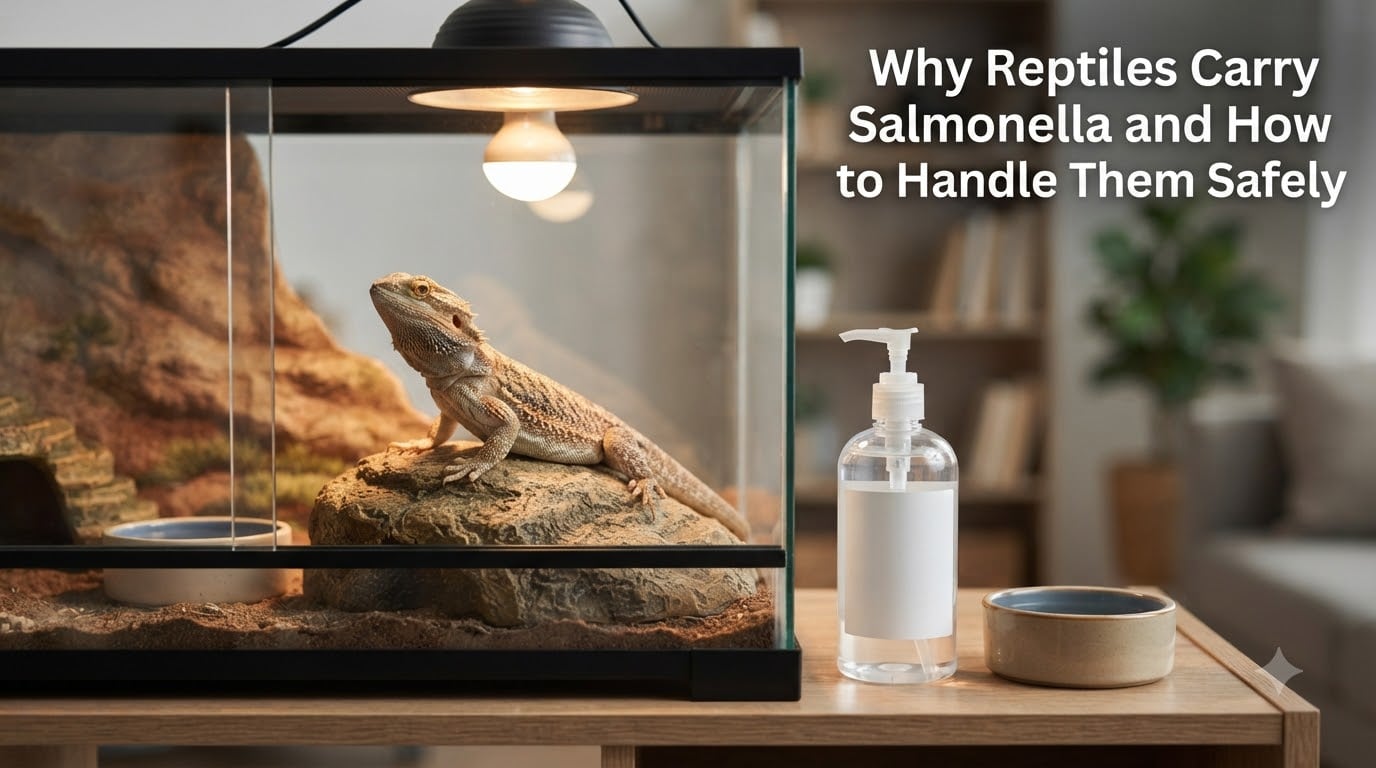
If you have ever wondered why reptiles carry Salmonella even when they look perfectly healthy, you are not alone. I have kept bearded dragons for years, and this question came up the very first week I brought one home.
Reptiles carry Salmonella bacteria naturally in their digestive tracts as part of their normal gut microbiota. They shed these bacteria in their feces, and the germs spread to their skin, the tank water, the substrate, and anything they touch. Even a reptile that eats well, basks correctly, and shows no signs of illness can be a Salmonella carrier.
In this guide, I will walk you through the science behind reptile Salmonella, who is most vulnerable, and the exact handling and cleaning habits our team uses to keep the risk low. The goal is not to scare you away from reptile ownership. The goal is to help you enjoy your pet with confidence.
Table of Contents
Why Do Reptiles Carry Salmonella Bacteria?
Reptiles carry Salmonella because the bacteria are a normal part of their intestinal microbiome. A 2023 review published in PMC found that Salmonella organisms are considered part of the standard reptile gut microbiota and have lived alongside reptiles for millions of years.
Here is the short version of the science. Salmonella is a gram-negative bacterium that colonizes the reptile intestinal tract shortly after hatching. It does not make reptiles sick the way it makes humans sick, because their immune systems evolved alongside the bacteria.
The bacteria reproduce inside the gut and are shed continuously through feces. This process is called fecal shedding, and it is the main reason reptiles carry Salmonella. Even a reptile that tests negative one week can test positive the next, which is why no test can clear a reptile of Salmonella permanently.
Three things make this fact important for owners. First, the bacteria are not a sign of a sick animal. Second, shedding is intermittent, so a single negative test means nothing. Third, because reptiles evolved with Salmonella, antibiotics cannot eliminate it without harming the reptile’s gut and risking antibiotic resistance.
The same PMC review noted that Salmonella organisms are often host-adapted in reptiles, meaning the strains reptiles carry frequently differ from the strains that cause human food poisoning. That detail is important, and I will come back to it later when we talk about actual infection risk.
How Salmonella Spreads From Reptiles to Humans?
Salmonella spreads through direct and indirect contact with reptiles, their droppings, their habitat, and anything that touches them. You do not have to be bitten or scratched to get infected.
The CDC lists the most common transmission routes. Touching a reptile and then touching your mouth or food without washing your hands is the leading route. Cleaning a tank in a kitchen sink or bathroom spreads germs to surfaces where food is prepared. Handling feeder rodents, insects, or frozen prey with bare hands is another common route.
Tank water is a particularly sneaky source. A bearded dragon that climbs into its water bowl can splash droplets that carry Salmonella across nearby counters. I learned this the hard way when I moved my dragon’s enclosure two feet closer to the kitchen prep area and saw water spots on a cutting board the next morning.
Survival time on surfaces matters too. Salmonella can live on hard, non-porous surfaces for days. It survives on clothing, reptile decor, and feeding tongs. Any object that enters the enclosure can come out contaminated.
Children are especially exposed because they tend to put their hands in their mouths, kiss reptiles, and help clean tanks without gloves. The Public Health Ontario 2025 report on reptile-linked Salmonella cases highlighted that children under 10 made up the largest share of recent cases linked to amphibians and reptiles.
Who Is at Highest Risk of Reptile Salmonella?
Healthy adults can usually handle a Salmonella exposure without falling seriously ill. The people who need to be most cautious are those whose immune systems are still developing, aging, or already weakened.
The CDC lists five groups that should think twice about reptile ownership or be extra careful with hygiene. Children under 5 years old have immune systems that are not fully developed. Adults over 65 have immune systems that respond more slowly. Pregnant women face risks because Salmonella can cross the placenta. Anyone with a weakened immune system, whether from HIV, cancer treatment, or organ transplant, is at serious risk. People without a functioning spleen are also more vulnerable.
Within households with these groups, reptiles should never roam freely and tanks should never be cleaned in kitchen or bathroom sinks. If someone in your home falls into one of these categories, that does not mean you have to give up your reptile, but it does mean your hygiene routine needs to be airtight.
Ontario’s 2025 outbreak data showed that reptile-linked Salmonella cases were spread across all age groups, but children under 10 had the highest proportion of amphibian-linked cases. The takeaway is that species matters as much as the reptile itself. Turtles, lizards, and frogs tend to shed more bacteria than snakes, which is why small turtles under 4 inches are actually banned for sale in the United States.
If you are immunocompromised or live with someone who is, talk to a reptile-savvy veterinarian before bringing a reptile home. A good vet will walk through your specific situation and help you decide.
Safe Handling Practices for Pet Reptiles
Handling reptiles safely comes down to three habits: wash your hands, supervise children, and keep reptiles out of food prep areas. These three rules cover most real-world exposure.
Hand washing is the single most effective action you can take. The CDC recommends washing with soap and warm water for at least 20 seconds after any contact with a reptile, its habitat, its food, or its droppings. If soap and water are not available, a hand sanitizer with at least 60 percent alcohol works in a pinch.
I keep a bottle of hand sanitizer next to my dragon’s enclosure for exactly this reason. The moment I close the lid or finish a feeding, my hands get sanitized before I touch anything else. It takes five seconds and removes 99 percent of the bacteria that matter.
For households with children, direct supervision during handling is non-negotiable. Children should not kiss reptiles, put them near their faces, or clean tanks without an adult present. Teach kids the same hand washing rule from the first day, and make it visible. Wash together so they see you do it too.
Bite and scratch prevention also matters. A stressed reptile is more likely to defend itself, and any bite or scratch creates an open wound where bacteria can enter. Approach reptiles slowly, support their body fully, and avoid handling during shedding or right after feeding.
Free-roaming reptiles in the living room or kitchen is a common habit in our community. I understand why owners do it. The reality is that a free-roaming reptile will eventually walk across a counter, a cutting board, or a child’s toy. Keep reptiles in their enclosure or in a dedicated, easy-to-clean space like a bathtub that you disinfect afterward.
Cleaning the Reptile Habitat Without Getting Sick
Cleaning the enclosure is where most Salmonella exposure actually happens, because you are dealing directly with waste and contaminated surfaces. The good news is that a consistent routine makes this safe and quick.
Never clean a reptile tank in a kitchen sink, bathroom sink, or bathtub used by people. Use a dedicated tub, a large plastic bin, or clean the enclosure outside with a hose. If you must use an indoor sink, disinfect it thoroughly afterward with a dilute bleach solution.
The CDC recommends a three-step cleaning process. First, remove the reptile and place it in a secure temporary container. Second, wear disposable gloves and scoop out solid waste and soiled substrate. Third, scrub all surfaces with hot soapy water, then apply a disinfectant.
Effective disinfectants include a dilute bleach solution of about 1 tablespoon of bleach per gallon of water, or a commercial reptile-safe disinfectant like chlorhexidine or F10. Bleach kills Salmonella within minutes on hard surfaces. Allow the disinfectant to sit for at least 10 minutes, then rinse thoroughly and let dry before returning the reptile.
Dedicated equipment is a small investment that pays off. Use a separate set of sponges, scrub brushes, buckets, and gloves that never touch your kitchen or bathroom. Label them if you have to. I keep mine in a plastic crate under the dragon’s stand.
Substrate changes, water bowl scrubs, and decor disinfection should happen on a consistent schedule. Spot-clean droppings daily, change water daily, do a full substrate change every 4 to 6 weeks depending on species, and disinfect decor monthly. The exact timing depends on the reptile, but the principle is the same. Clean often enough that bacteria do not build up.
Feeding Safety and Habitat Best Practices
Feeding is a sneaky exposure route because you handle raw prey items, sometimes frozen rodents or live insects, and these can carry Salmonella too. The 2025 Public Health Ontario report highlighted that feeder rodents and feeder insects are themselves a documented source of Salmonella outbreaks.
Treat feeder prey like raw chicken. Wear gloves or use feeding tongs. Keep frozen rodents and insects in a sealed container in a separate part of the fridge or freezer, away from human food. Thaw them in a dedicated container, not on the kitchen counter. Disinfect all surfaces afterward.
Use separate dishes and utensils for reptile food. The reptile’s food bowl should never enter a dishwasher that also handles human dishes, and ideally it should be washed in the same dedicated space where you clean the tank.
Routine veterinary care is part of safety too. A reptile-savvy vet can spot early signs of illness, check weight and body condition, and advise on species-specific risks. If your reptile stops eating, has runny droppings for more than a few days, or behaves unusually, schedule a vet visit.
If you or someone in your home develops Salmonella symptoms after handling a reptile, see a doctor. Symptoms include diarrhea, stomach cramps, fever, and nausea, usually starting 6 to 72 hours after exposure. Most healthy adults recover in a week, but severe cases need antibiotics. Children, elderly adults, and immunocompromised individuals should see a doctor sooner rather than later.
For households with high-risk members, additional steps are worth it. Consider keeping the enclosure in a room that young children or elderly relatives do not use for eating or sleeping. Install a hand-washing station or sanitizer near the enclosure. Some owners with immunocompromised family members keep reptiles in a separate room altogether, and that is a reasonable choice.
One last perspective I want to share. The Georgia Reptile Society points out that dogs, cats, hamsters, and horses can all carry Salmonella too. Reptiles are not uniquely dangerous. What they require is the same level of hygiene you would apply after handling any animal. With the right habits, the risk of reptile Salmonella is genuinely low, and the rewards of reptile ownership are real.
Frequently Asked Questions
How likely is it to get Salmonella from reptiles?
The actual risk of getting Salmonella from a pet reptile is low with good hygiene. Reptiles account for roughly 2 to 5 percent of all Salmonella cases in the United States each year, and most of those cases involve direct handling without hand washing or tank cleaning in kitchen sinks. With consistent hand washing and dedicated cleaning equipment, the risk drops further.
Are there any reptiles that do not carry Salmonella?
There are no reptiles that can be guaranteed Salmonella-free. Salmonella is part of the normal gut microbiota in reptiles, and even animals that test negative can shed the bacteria weeks later. Snakes tend to shed Salmonella at lower rates than lizards and turtles, but no species is risk-free.
Can you treat a lizard for Salmonella?
Treating a lizard for Salmonella is not recommended. Antibiotics cannot fully eliminate Salmonella from the reptile gut, and they risk creating antibiotic-resistant strains that are harder to treat in humans. Focus instead on hygiene, hand washing, and keeping the enclosure clean to manage the risk at the human side.
What kills Salmonella on surfaces naturally?
Heat above 150 degrees Fahrenheit kills Salmonella on surfaces and in food, and a dilute bleach solution of about 1 tablespoon per gallon of water disinfects hard non-porous surfaces within 10 minutes. White vinegar alone is not strong enough, but commercial reptile disinfectants containing chlorhexidine or quaternary ammonium compounds work well.
How common is it for bearded dragons to carry Salmonella?
Studies show that more than half of healthy bearded dragons shed Salmonella at any given time, which is one of the highest rates among commonly kept pet reptiles. This does not mean the dragon is sick. It reflects the normal gut microbiota of bearded dragons. Hand washing after every handling session is essential.
Balancing the Joy of Reptile Ownership With Smart Hygiene
Reptiles carry Salmonella because the bacteria are a normal part of their gut, not because they are dirty or sick. The bacteria spread through feces, tank water, and contaminated surfaces, which is why reptiles carry Salmonella even when they look perfectly healthy.
The good news is that the risk is manageable. Hand washing, dedicated cleaning equipment, never cleaning tanks in kitchen sinks, and keeping reptiles away from food prep areas handle the vast majority of real-world exposure. The 2025 Public Health Ontario study and the CDC guidance both point to the same conclusion. The risk is low, but it is not zero, and a few consistent habits make the difference.
If you are a current or prospective reptile owner, focus on these four actions this week. Wash your hands for 20 seconds with soap and water after every interaction. Move your cleaning supplies into a dedicated bin and stop using kitchen sinks. Use gloves or tongs when handling feeder rodents or insects. Talk to a reptile-savvy vet about your specific species and household.
Reptiles make extraordinary pets. They are quiet, low-allergen, and fascinating to watch. With the right hygiene habits, you can enjoy everything they offer while keeping your family safe in 2026 and beyond.