
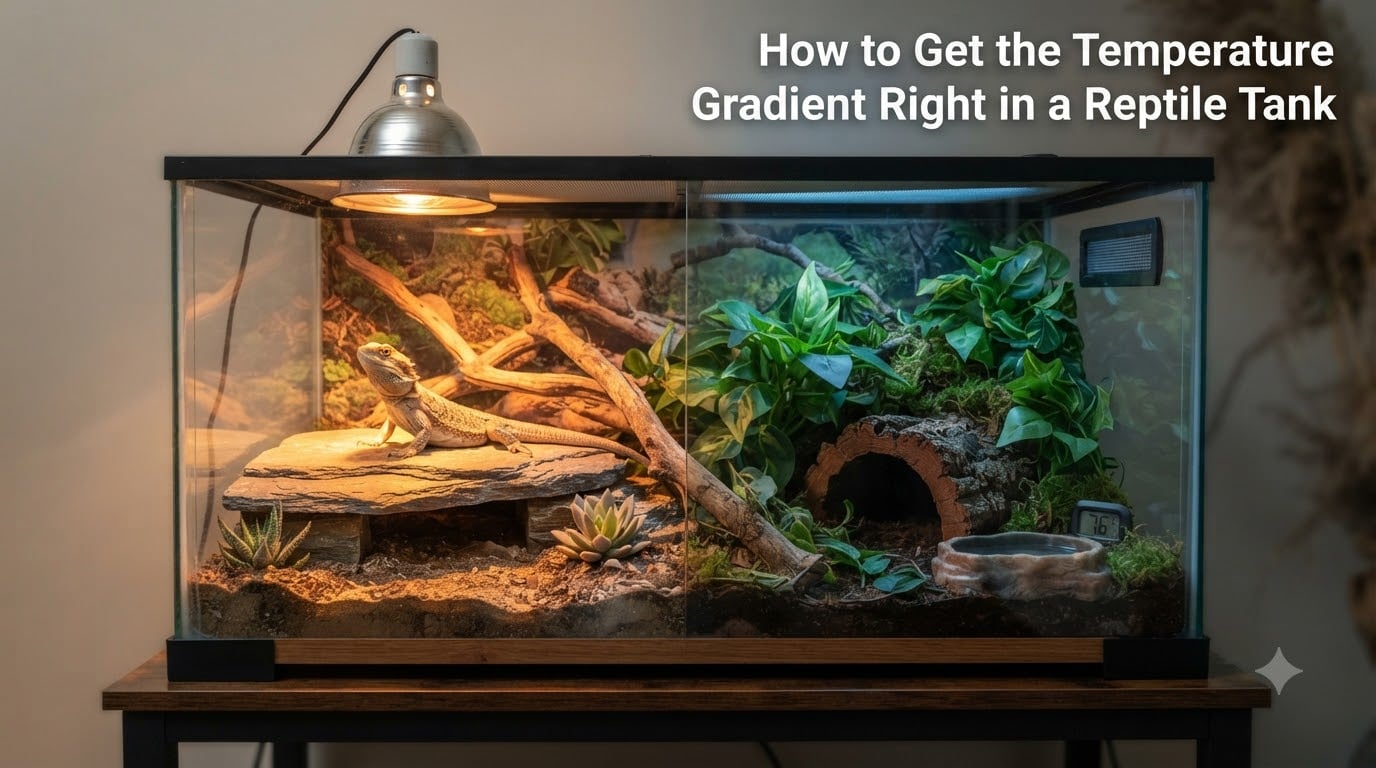
When I set up my first bearded dragon enclosure, I made the mistake of centering the heat lamp right above the middle of the tank. Within a week, my dragon spent all his time pressed against the front glass and refused to eat. The fix was simple: move the lamp to one end, leave the other end unheated, and let him choose where he wanted to be. That single change is the entire principle behind a temperature gradient in a reptile tank.
A proper temperature gradient lets your reptile move between warmer and cooler zones, copying the choice it would make in the wild between sun and shade. In this guide, I’ll walk you through what a temperature gradient actually is, why it matters for your animal’s health, the exact temperatures you should aim for, and the step-by-step process for building one that works in 2026.
Table of Contents
What Is a Temperature Gradient in a Reptile Tank?
A temperature gradient in a reptile tank is a range of temperatures within the enclosure, with a warmer area (hot side) at one end and a cooler area (cool side) at the other, allowing reptiles to regulate their body temperature by moving between zones. Instead of one uniform temperature across the whole tank, you create a spectrum from hottest to coolest.
Think of it like a thermostat you control with your feet. Your reptile walks to the hot side when it needs to warm up and digests food, then walks to the cool side when it needs to cool down and rest. Without that choice, your animal has no way to thermoregulate properly.
Why Reptiles Need a Temperature Gradient
Reptiles are ectothermic, which means they cannot generate their own body heat internally the way mammals do. They depend entirely on outside temperatures to power digestion, immune response, muscle function, and even basic movement. A gradient gives them the choices they need to keep those systems running.
When I asked a herpetology friend why so many sick reptiles come through rescue, she told me the same thing every vet will tell you: chronic low temperatures suppress the immune system, slow digestion to a crawl, and turn minor infections into fatal ones. A gradient isn’t a luxury. It is the foundation of reptile husbandry.
Why Temperature Gradients Matter for Reptile Health?
Temperature gradients affect nearly every biological process in your reptile. Digestion is the most obvious one: enzymes that break down food work best at a specific temperature range. If the enclosure is too cool, food sits in the gut and starts to rot, which leads to impaction and serious illness.
Immune function depends on heat too. White blood cells move faster and replicate more effectively at higher temperatures. A reptile kept at a uniform cool temperature cannot fight off infections the same way one with access to a hot basking zone can.
Behavior is another factor keepers sometimes miss. Reptiles that cannot reach their preferred body temperature become lethargic, stop eating, hide constantly, and may develop repetitive stress behaviors. I have personally seen a ball python that refused to eat for six weeks recover its appetite the day after I added a proper basking lamp to one end of its enclosure.
The short version: a working temperature gradient is the difference between a reptile that thrives and one that merely survives.
Hot Side vs Cool Side: Target Temperature Ranges
The two main zones of a temperature gradient are the hot side (also called the basking side or warm end) and the cool side (cool end). Each species has its own preferred range, but the general structure is the same: hot side air around 80 to 95°F, basking surface around 95 to 110°F, and cool side around 70 to 80°F.
Hot Side (Basking Zone) Temperatures
The hot side is where your heat source sits, and it should include a focused basking spot directly under the lamp. Air temperature on the hot side typically ranges from 80 to 95°F, while the basking surface itself is hotter, often 95 to 110°F depending on species.
Use a digital probe thermometer or infrared temperature gun to measure the basking surface, not the air just above it. Many beginners set up what they think is a 100°F basking spot and end up with one that is actually 85°F, which is far too cool for most species.
Cool Side (Cool Zone) Temperatures
The cool side should sit between 70 and 80°F for most common pet reptiles. This zone gives your animal a place to escape the heat and cool down. Without a true cool zone, your reptile has nowhere to go when it overheats, which can lead to heat stress and death.
The cool side does not usually need an extra heat source. As long as the room temperature stays above the species minimum, ambient heat is enough. If your room drops below 65°F at night, you may need supplemental heating (more on that in the nighttime section).
Surface Temperature vs Air Temperature
This is the distinction that trips up most new keepers. The basking surface temperature is what your reptile actually feels against its belly, and it is always higher than the air temperature around it. When you read that a bearded dragon needs a 105°F basking spot, that means the rock or branch under the lamp, not the air two inches above.
Air temperature tells you the overall climate of the enclosure. Surface temperature tells you whether your reptile can actually warm itself to the level it needs. Measure both, and make sure each one falls within the species range.
How to Create a Temperature Gradient (Step-by-Step)?
Here is the exact process I use every time I set up a new enclosure. It works for bearded dragons, ball pythons, leopard geckos, and most other common pet reptiles.
Step 1: Choose the Right Heat Source
For most reptiles, the best heat source is overhead lighting or a ceramic heat emitter. Halogen flood bulbs are my top pick because they produce infrared-A and infrared-B wavelengths, which penetrate skin and warm reptiles the same way the sun does. Ceramic heat emitters work well as a 24-hour option, since they produce heat without visible light.
Heat mats are useful for belly heat in leopard geckos and some snakes, but they cannot create a strong gradient on their own. Use them as a supplement, not as the primary heat source.
Step 2: Place the Heat Source at One End
Position the heat lamp, ceramic emitter, or radiant heat panel at one end of the enclosure. The far end stays unheated. That single decision is what creates your gradient. If your heat source sits in the middle, you get two lukewarm zones and no real hot or cool side.
Mount the fixture securely so it cannot fall into the tank. A reflector dome or arcadia-style fixture works well. The basking surface should sit about 8 to 12 inches below the bulb for a halogen, depending on wattage.
Step 3: Add Thermometers and a Thermostat
Place a digital probe thermometer on the cool side and another on the hot side, both at the level your reptile lives at (ground level for terrestrial species, branch level for arboreals). Add an infrared temperature gun to your toolkit for surface readings.
A thermostat is not optional. Plug your heat source into a dimming or pulse-proportional thermostat, and clip the probe directly to the basking surface. Set the thermostat to the species target temperature, and it will regulate the bulb automatically to prevent overheating.
Step 4: Run a 24-Hour Test Cycle
Before putting your reptile in the enclosure, run the setup for a full 24 hours. Check temperatures every few hours. Make sure the basking spot hits target, the cool side stays in range, and night drop happens naturally if you do not run heat overnight.
If the basking spot is too hot, raise the lamp or drop the wattage. If the cool side is too warm, the enclosure may be too small or the room may be too hot. I usually spend a day tweaking before I ever introduce the animal.
Species-Specific Temperature Requirements
Every species has its own preferred range. The numbers below are solid starting points based on current herpetology references in 2026.
Bearded Dragon Temperature Gradient
Bearded dragons come from the hot Australian outback and need high basking temperatures. Aim for a basking surface of 100 to 110°F, hot side air around 90 to 95°F, and a cool side of 75 to 80°F. Nighttime drops to 65°F are safe.
Ball Python Temperature Gradient
Ball pythons prefer slightly cooler basking spots than bearded dragons. Aim for a basking surface of 88 to 92°F, hot side air around 80 to 85°F, and a cool side of 75 to 80°F. Nighttime can safely drop to 72 to 78°F.
Leopard Gecko Temperature Gradient
Leopard geckos are ground dwellers that thrive with a warm side ambient of 80 to 85°F and a basking surface around 90 to 95°F. The cool side should sit around 70 to 75°F. Nighttime drops into the high 60s are fine and actually mimic their natural environment.
Measuring and Monitoring Temperatures
The two tools every keeper should own are a digital probe thermometer and an infrared temperature gun. Stick-on analog dials are unreliable, drift out of calibration, and are easily knocked off the glass.
Probe Placement Tips
Probe placement matters a lot. For a thermostat probe, attach it directly to the basking surface or hang it just above it where the reptile would actually sit. For monitoring probes, place one on the cool side at ground level and one on the hot side at the same height as your reptile.
A common mistake is placing the thermostat probe in the air several inches above the basking spot. That tells the thermostat the air is hot enough, but the basking surface can still climb to dangerous levels and burn your animal.
Digital Thermometer vs Temp Gun
Use a digital probe thermometer for constant air and surface monitoring, and use an infrared temp gun to spot-check basking surfaces, hides, and hot spots you suspect are running too warm. Together, they cover every measurement you need.
Nighttime Temperature Considerations
Most reptiles tolerate a natural nighttime temperature drop of 10 to 15°F below daytime levels. In fact, many species benefit from it, since their natural habitats cool down after sunset. As long as the night temperature stays above the species minimum, you can usually turn off the basking lamp.
If your room drops below 65°F at night, switch to a ceramic heat emitter on a thermostat for overnight heating. CHEs produce heat without light, so they will not disrupt your reptile’s day-night cycle. Heat mats can also work for species that benefit from belly heat, but they need a thermostat to prevent burns.
Common Mistakes to Avoid
From years of forum threads and rescue work, here are the mistakes I see most often.
Heat source in the middle: Centering the lamp kills the gradient entirely. Always place the heat source at one end.
Enclosure too small: In a 20-gallon tank, even a small heat source can heat the whole enclosure. You need at least a 40-gallon breeder for most reptiles to fit a real gradient.
Ignoring room temperature: A gradient that works in a 75°F room may fail in a 60°F basement. Always account for the ambient temperature of the room the tank sits in.
No thermostat: Running a heat lamp on a timer or dimmer switch alone is risky. Thermostats prevent overheating and are essential for safe reptile keeping.
Measuring the wrong thing: Beginners often measure air temperature when they should be measuring surface temperature. Get a temp gun.
Troubleshooting: When Your Temperature Gradient Is Not Working
If your basking spot reads too cool, try a higher-wattage bulb, lower the lamp closer to the surface, or switch to a halogen flood bulb that produces more penetrating infrared. If your cool side reads too warm, raise the lamp, switch to a lower wattage, or move the enclosure to a cooler room.
If the gradient is too sharp and the cool side drops below the species range, your enclosure may be too large for your heat source, or the room may be too cold. A ceramic heat emitter on the cool side can lift the ambient temperature without disrupting the gradient.
If temperatures swing wildly between day and night, the enclosure likely has poor insulation. PVC enclosures hold heat better than glass tanks. Adding background insulation or switching to a PVC vivarium can stabilize temperatures considerably.
Frequently Asked Questions
What is the temperature gradient for reptiles?
A temperature gradient for reptiles is a range of temperatures inside the enclosure, with a warm basking zone at one end and a cooler zone at the other. Reptiles move between zones to regulate their body temperature, since they are ectothermic and cannot generate their own heat.
How do you get a temperature gradient in a reptile tank?
Place a heat source, such as a halogen bulb or ceramic heat emitter, at one end of the enclosure. Leave the opposite end unheated. Add thermometers on both ends and a thermostat on the basking spot, then run a 24-hour test to confirm the hot side, cool side, and nighttime temperatures all hit the right ranges.
How do you regulate temperature in a reptile tank?
Regulate temperature by using a thermostat connected to your heat source, placing digital thermometers on both the hot and cool sides, and adjusting the bulb wattage, lamp height, or ventilation until your readings match the species target range. Recheck temperatures seasonally, since room temperature changes can shift the gradient.
Is 72 too cold for a ball python?
72°F is acceptable for the cool side of a ball python enclosure and as an ambient nighttime temperature. It is too cold for the hot side, which should sit around 80 to 85°F air and 88 to 92°F on the basking surface. Prolonged temperatures below 75°F on the warm side can lead to respiratory infection and regurgitation.
Conclusion
A working temperature gradient in a reptile tank comes down to three decisions: place a strong heat source at one end, leave the other end unheated, and verify both zones with accurate thermometers and a thermostat. Get those right, and your reptile will be able to thermoregulate naturally, digest food properly, and stay healthy long-term.
Whether you keep a bearded dragon, ball python, leopard gecko, or any other species in 2026, the principles stay the same. Measure both air and surface, account for room temperature, run a test cycle, and adjust until your readings match the species range. The time you spend dialing in the gradient is the single biggest factor in keeping your reptile healthy.