
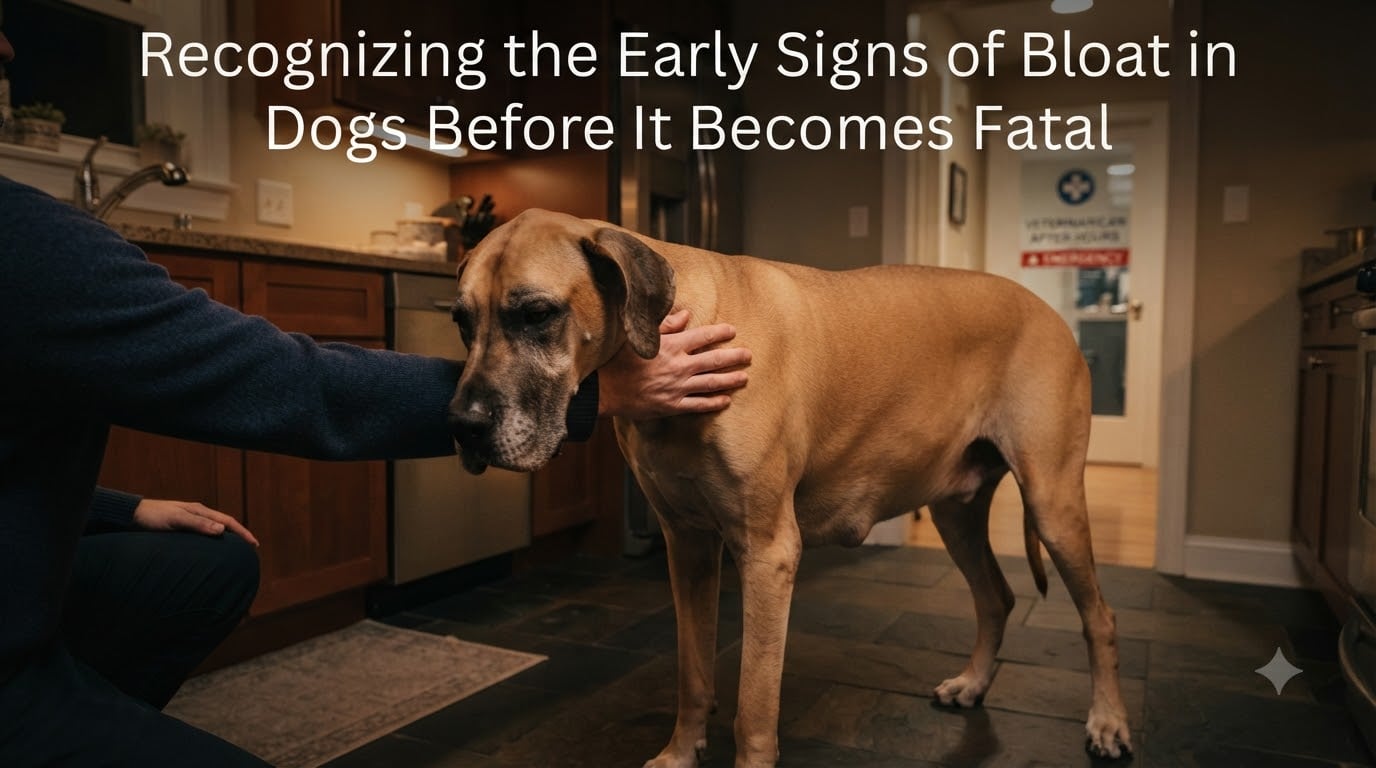
I remember the night my neighbor’s Great Dane started pacing after dinner. Within two hours, he was gone. That’s the brutal truth about bloat, also called gastric dilatation-volvulus (GDV) in dogs. It can kill a healthy, adult dog in a matter of hours, and the early signs of bloat in dogs are so subtle that most owners miss them until it’s too late.
I’ve spent weeks researching veterinary emergency sources, talking to emergency veterinarians, and reading case studies from the American Animal Hospital Association (AAHA) and BluePearl Specialty Hospitals. This guide is what I wish my neighbor had read that night. You’ll learn the exact timeline, the symptoms most owners miss, the breeds at highest risk, and the steps you need to take the moment you suspect bloat.
Bloat is the second leading killer of dogs after cancer. Approximately 30,000 to 60,000 dogs in the United States develop GDV each year, and mortality rates climb past 30 percent even with treatment. Knowing the early signs of bloat in dogs before it becomes fatal is the single most important thing you can do as a dog owner today.
Table of Contents
What Is Bloat in Dogs and Why Does It Become Fatal So Fast?
Bloat, technically called gastric dilatation-volvulus (GDV), is a two-stage medical emergency. First, the dog’s stomach fills with gas, fluid, or food and expands, this is the “dilatation” stage. Then, in roughly half of cases, the bloated stomach twists on itself, the “volvulus” stage, sealing off both ends and trapping everything inside.
When the stomach twists, the spleen rotates with it. Blood vessels that feed the stomach and spleen get compressed, cutting off circulation. The stomach tissue begins to die. Blood flow to the rest of the body collapses into shock. Without emergency surgery within hours, the dog dies from organ failure, internal bleeding, or cardiac arrhythmia.
Veterinary sources differentiate between “simple bloat” and GDV. Simple bloat is just gas accumulation without stomach twisting. It’s uncomfortable, but it usually resolves on its own or with veterinary care. GDV is the fatal version. The confusing part: you cannot tell the difference at home. A dog with simple bloat can flare into GDV within minutes. Every suspected bloat case is treated as a potential GDV emergency.
The Mechanism of Death in GDV
The stomach swells, twists, and begins to compress the large veins that return blood to the heart. Cardiac output drops. Blood pressure falls. The stomach wall starts to necrose, or die from lack of oxygen. Toxins from the dying tissue flood the bloodstream. The heart develops dangerous arrhythmias. From the first sign to cardiac arrest can take as little as one to four hours, which is why every minute matters.
The Early Signs of Bloat in Dogs Most Owners Miss
The very first symptoms of bloat are behavioral. Most owners don’t recognize them because they look like a dog that just ate something funky. Here’s what to watch for, especially in the first 30 to 60 minutes after a meal.
1. Restlessness and Pacing
The earliest, most consistent early sign of bloat in dogs is unusual restlessness. The dog can’t seem to settle. They get up, lie down, get up again. They pace in circles. They stand with their front legs wide apart and their head lowered. They pace outside and then come back inside. They look at you with a worried expression.
I spoke with one German Shepherd owner who lost her dog to GDV. She told me the first sign she noticed was that her dog kept getting up from his bed and walking in tight circles. She thought he had to go outside. By the time he started dry heaving, his stomach was already twisting. That restlessness was the warning she didn’t know to read.
2. A Swollen or Distended Abdomen
As the stomach fills with gas, the belly visibly swells. It may look tight, balloon-like, or feel hard when you press gently on the sides just behind the ribs. In deep-chested breeds, the swelling often shows up high in the abdomen near the ribcage rather than low and round.
Important warning: not every dog with GDV has a visibly swollen belly, especially in the early stages. If you’re waiting for “the swollen stomach” before acting, you may be waiting too long. Roughly 20 percent of dogs with GDV show minimal or no visible distension early on.
3. Unproductive Retching and Dry Heaving
This is one of the most distinctive signs. The dog goes through the motions of vomiting, extending their neck, hunching their shoulders, retching hard, but nothing comes up. Sometimes a small amount of white foam appears. The dog retches every few minutes because the stomach is blocked and can’t release its contents.
If your dog tries to vomit three or more times in a row and nothing comes out, treat it as a bloat emergency. Don’t wait to see if it improves.
4. Excessive Drooling
GDV causes nausea and intense abdominal pain. The dog produces thick, ropey saliva that drips from the mouth. Combined with panting and lip-licking, drooling is one of the early warning signs most owners miss because they assume the dog is just hot or anxious.
5. Sudden Discomfort When You Touch the Belly
A dog with bloat often pulls away, whines, or even snaps when you press on the front of their abdomen. Some dogs stand with their back arched and belly tucked, almost like a horse. This hunched posture, sometimes called “praying position,” is the dog’s attempt to relieve pressure on the painful stomach.
6. Panting and Rapid Breathing
Even at rest, in a cool room, the dog pants rapidly. Their respiratory rate climbs above 40 breaths per minute. This is the body’s response to shock and pain. If your dog is panting heavily without exercise or heat, especially paired with any other sign on this list, head to the emergency vet.
Quick Symptom Checklist
If you see two or more of these signs in a deep-chested dog, especially after a meal or exercise, you have a medical emergency:
Restlessness, pacing, or inability to settle
Swollen, hard, or distended abdomen
Unproductive retching or dry heaving (white foam)
Excessive drooling or thick saliva
Pain when belly is touched
Hunched posture or “praying position”
Heavy panting at rest
Looking at the flank or abdomen repeatedly
Advanced Symptoms: The Final Stages of Bloat in Dogs
Without intervention, the early signs progress into advanced and visibly critical stages. By this point, your dog is in shock and may need surgery within minutes to survive.
Pale or White Gums
Normal dog gums are pink and slick. With GDV, blood pressure drops and circulation collapses to the core. The gums turn pale, gray, or white. Press a finger on the gum and release; the color should refill in under two seconds. If it takes longer, the dog is in shock.
Rapid Heart Rate and Weak Pulse
The heart races above 100 to 120 beats per minute trying to compensate for falling blood pressure. The pulse becomes weak and thready. You can feel it best on the inner thigh where the femoral artery runs.
Collapse and Weakness
The dog becomes unable to stand. They may lie on their side, breathing heavily, with their gums pale. Some dogs lose consciousness. This is the final stage. Mortality at this point is high even with emergency surgery.
Difficulty Breathing
The massively enlarged stomach pushes up against the diaphragm, preventing the lungs from expanding fully. The dog breathes shallowly and rapidly. You may see the ribs heaving with each breath.
Death
Death comes from a combination of shock, organ failure, and fatal cardiac arrhythmia. The heart, starved of oxygen and flooded with toxins from the dying stomach, stops. Without surgery, this can happen within four to six hours of the first symptom.
How Long Can a Dog Have Bloat Before It Becomes Fatal?
The most common question I hear from dog owners is, “How long do I have?” The honest answer: not long. Once the stomach twists, you have a window measured in hours, not days.
The Hour-by-Hour Timeline
0 to 30 minutes: Subtle signs begin. Restlessness, drooling, and lip-licking. The stomach is filling with gas but may not be visibly swollen yet.
30 to 60 minutes: The stomach distends visibly. The dog starts dry heaving. Pain becomes obvious. Panting increases.
1 to 2 hours: The stomach may twist at any point. The dog becomes visibly distressed. Gums may start to pale. Heart rate climbs.
2 to 4 hours: Shock sets in. The dog becomes weak, may collapse. Gums are pale or white. Internal damage is severe.
4 to 6 hours: Without surgery, the dog dies from shock, organ failure, or cardiac arrhythmia. Even with surgery, mortality rises sharply past the 4-hour mark.
Survival Rate Statistics
Veterinary studies report overall survival rates for GDV between 60 and 80 percent when treated with surgery. The single biggest factor is time. Dogs that reach surgery within two hours of symptom onset have survival rates above 90 percent. Dogs treated after six hours see survival rates drop below 50 percent.
One study published in the Journal of the American Veterinary Medical Association found that every hour of delay reduced survival odds by roughly 8 to 10 percent. That is why the early signs of bloat in dogs before it becomes fatal are so important to memorize.
Which Dogs Are at Highest Risk for Bloat
Any dog can develop bloat, but certain breeds and characteristics dramatically increase the risk. Knowing whether your dog is in a high-risk group determines how aggressively you should watch for symptoms.
Deep-Chested Breeds
The shape of the chest is the single biggest risk factor. Dogs with tall, narrow, deep chests have more room for the stomach to move and twist. The breeds at highest risk include:
Great Danes (highest risk of any breed, lifetime risk around 40 percent)
German Shepherds
Standard Poodles
Doberman Pinschers
Saint Bernards
Weimaraners
Boxers
Irish Setters
Gordon Setters
Basset Hounds
Akitas
Bloodhounds
Age and Size
Middle-aged and senior dogs (over 7 years) are at the highest risk. However, large-breed puppies can develop GDV as young as 2 years old. The risk rises with body weight. Dogs over 99 pounds have roughly three times the risk of dogs under 22 pounds.
Eating Habits
Several feeding patterns increase the risk of bloat. Eating one large meal per day, eating rapidly, eating from a raised bowl, and eating dry food with fat or oil listed in the first four ingredients all raise the odds. Drinking large amounts of water immediately after eating also increases risk.
Activity and Stress
Vigorous exercise right after a meal is a known trigger. So is stress. Dogs that are anxious, fearful, or aggressive have higher rates of GDV. Dogs that eat in a tense, competitive environment may gulp food and air together, raising the risk.
Family History
GDV has a genetic component. Dogs with a first-degree relative (parent or sibling) who had bloat are at significantly higher risk. Owners of high-risk breeds should consider preventive gastropexy surgery, which I cover below.
Is It Bloat or Something Else
One of the most common owner mistakes is assuming their dog is fine because the visible symptoms don’t match what they read online. Here are the conditions that get confused with bloat, and how to tell the difference.
Simple Gas vs. GDV
Simple gas causes a swollen belly but no dry heaving, no severe pain, and no shock. The dog is uncomfortable but still eats and drinks. If your dog has a swollen belly but is otherwise acting normal, it could be simple gas, but you still need a vet visit. Bloat can flip from simple to fatal in minutes.
Upset Stomach vs. Bloat
A dog with an upset stomach vomits, often multiple times, and produces actual stomach contents. A dog with GDV dry heaves and produces nothing or just white foam. Vomiting food is a different problem from unproductive retching. If your dog is vomiting food, they probably don’t have bloat, but if they are trying to vomit and can’t, they may.
When “Acting Normal” Is Misleading
Forum threads are full of stories from owners who say, “My dog looked bloated but was acting normal, so I waited.” Within hours, those dogs were in shock. Bloat can be subtle in the early stages. By the time the dog stops acting normal, the condition is already critical. When in doubt, go to the vet. A false alarm is far better than a dead dog.
How to Prevent Bloat in Dogs
You cannot eliminate the risk of bloat, but you can lower it substantially. For high-risk breeds, prevention is as important as recognition.
Preventive Gastropexy Surgery
A gastropexy is a surgical procedure where the stomach is tacked to the inside of the abdominal wall. It prevents the stomach from twisting even if it fills with gas. For high-risk breeds, especially Great Danes, German Shepherds, and Standard Poodles, many veterinarians recommend prophylactic gastropexy at the time of spay or neuter.
A prophylactic gastropexy reduces the risk of GDV by over 90 percent in high-risk breeds. The surgery adds roughly 15 to 20 minutes to a spay or neuter procedure and requires minimal additional recovery time. For owners of at-risk breeds, it is one of the most valuable investments you can make.
Feeding Habits
Divide daily food into two or three smaller meals rather than one large meal. Use a slow-feeder bowl if your dog eats fast. Avoid raised food bowls, despite their popularity. Recent research shows raised bowls may actually increase GDV risk in large breeds. Soak dry food in water before serving if your dog tends to gulp.
Avoid foods with fat listed in the first four ingredients. Wet food or a mix of wet and dry food may reduce risk in some dogs. Keep fresh water available at all times but limit large amounts right after meals.
Activity Restrictions
Do not allow vigorous exercise, running, jumping, or rough play for at least one hour after eating. Walks are fine. Fetch, agility, and roughhousing are not. The same applies to drinking large amounts of water quickly after a meal.
Stress Reduction
Especially for anxious or fearful dogs, reduce mealtime stress. Feed in a quiet location. If you have multiple dogs, feed them separately to prevent food guarding and rapid eating. Avoid stressful events like boarding, grooming, or long car rides during or right after meals.
Know Your Dog’s Baseline
One of the most powerful prevention tools is simply knowing your dog. Observe their normal behavior after meals. Notice how they breathe, how they settle, how their belly looks before and after eating. The owner who notices subtle changes is the owner who catches bloat early.
What to Do Immediately If You Suspect Bloat in Your Dog
If you see two or more of the symptoms listed above, treat it as an emergency. Do not wait. Do not call your regular vet first. Do not post on Facebook asking for advice. Go.
Step 1: Call the Nearest Emergency Veterinary Hospital
While you are getting into the car, call ahead. This gives the emergency team time to prepare. Tell them you suspect GDV and approximately when the symptoms started. Most emergency hospitals have a 24-hour hotline.
Step 2: Transport Safely
Keep the dog as calm and still as possible during transport. If you have a helper, have them sit in the back seat with the dog. Avoid lifting the dog by the abdomen. If the dog can walk, let them walk gently to the car. Don’t feed them water or anything else.
Step 3: Do Not Attempt Home Remedies
I have read forum posts where owners tried to “burp” their dog, gave them gas relief medication, or massaged the abdomen. None of these work for GDV. The stomach is mechanically twisted. Only surgery can fix it. Time spent on home remedies is time the dog doesn’t have.
Step 4: Prepare for Emergency Surgery
GDV surgery is expensive, with costs typically ranging from $3,000 to $7,000 depending on your region and the complexity of the case. Be prepared to authorize surgery quickly. Some clinics require a deposit before starting. If finances are a concern, ask about credit options like CareCredit or Scratchpay at the time of intake.
Step 5: After Diagnosis and Surgery
If the diagnosis is confirmed, the dog will be stabilized with IV fluids, pain medication, and antibiotics before surgery. The surgeon will untwist the stomach, remove any dead tissue, and perform a gastropexy to prevent recurrence. Recovery time is typically 10 to 14 days, with dietary restrictions for several weeks.
Frequently Asked Questions
How long can a dog have bloat before it becomes fatal?
Once symptoms of bloat appear, a dog can die within 4 to 6 hours without surgery. The stomach may twist within the first 1 to 2 hours, after which survival rates drop sharply. Every hour of delay reduces survival odds by 8 to 10 percent. Dogs treated within 2 hours of symptom onset have survival rates above 90 percent.
What are the final stages of bloat in dogs?
The final stages of bloat include pale or white gums, rapid heartbeat above 120 bpm, weak pulse, collapse, difficulty breathing, and loss of consciousness. At this point, the dog is in severe shock with internal organ damage. Without immediate surgery, death follows from cardiac arrhythmia, organ failure, or massive internal bleeding.
What are the odds of a dog surviving bloat?
Overall survival rates for GDV with surgery range from 60 to 80 percent. Dogs treated within 2 hours of symptom onset have survival rates above 90 percent. Dogs treated after 6 hours see survival rates drop below 50 percent. Age, organ damage at the time of surgery, and speed of treatment all affect the outcome.
How soon do signs of bloat appear in dogs?
The first signs of bloat usually appear within 30 to 60 minutes after a meal or triggering event. Early symptoms include restlessness, drooling, and lip-licking. Visible abdominal swelling and unproductive retching typically develop within 1 to 2 hours. From the first symptom to stomach twisting can take as little as 1 to 4 hours.
Can a dog survive bloat without surgery?
No. Once the stomach twists (volvulus), only emergency surgery can save the dog. Simple gas without twisting may resolve on its own, but you cannot tell the difference at home. Any suspected bloat case must be evaluated by a veterinarian immediately, and most will require surgery to prevent fatal GDV.
Final Thoughts on Protecting Your Dog from Bloat
Recognizing the early signs of bloat in dogs before it becomes fatal comes down to three things. Know the symptoms, know your dog’s risk level, and know where the nearest emergency vet is located. Print the symptom checklist above and put it on your fridge. Talk to your veterinarian about whether a prophylactic gastropexy makes sense for your breed. Mark the nearest 24-hour emergency veterinary hospital in your phone right now.
If you ever see your dog pacing after dinner, dry heaving, or showing a swollen belly, do not wait. Drive to the emergency vet. The decision you make in the next five minutes could save your dog’s life.