
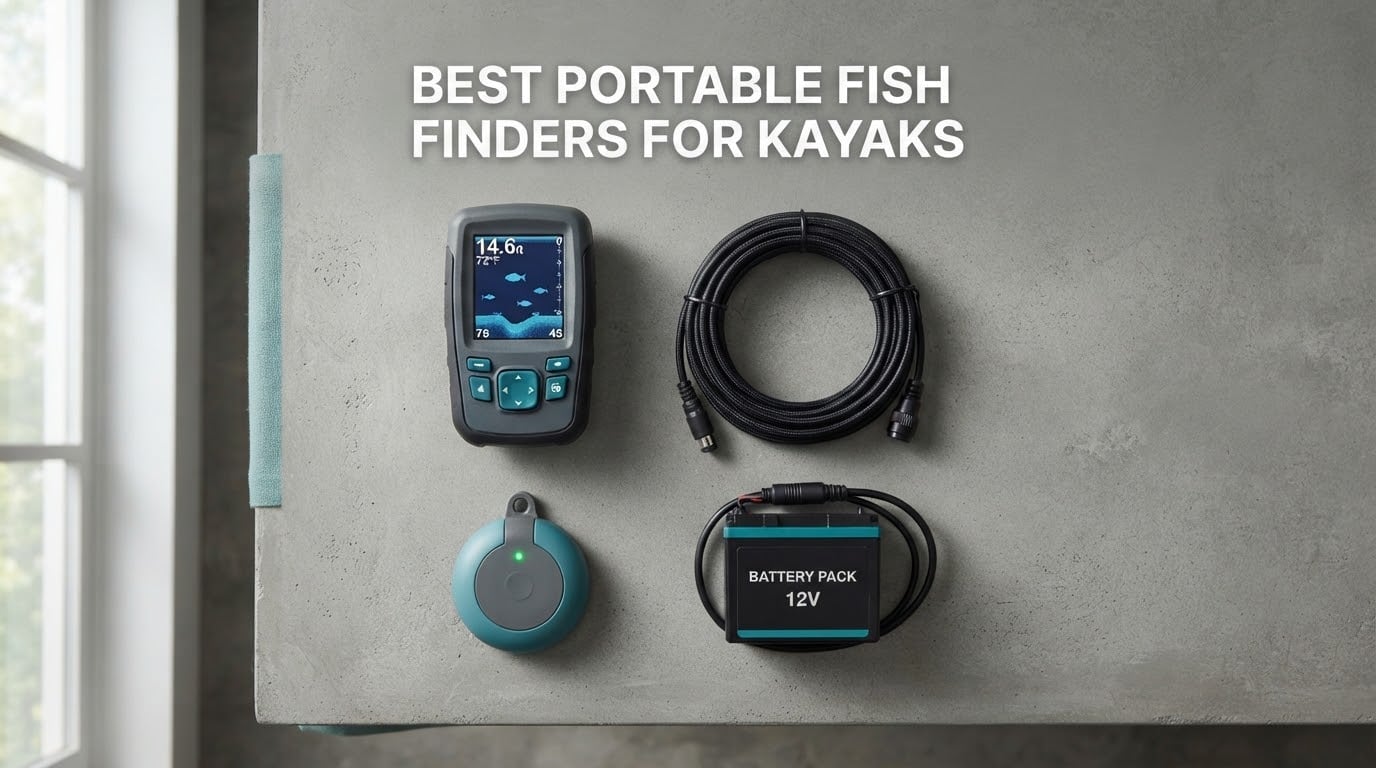
The best portable fish finder for kayak fishing is the Garmin STRIKER 4. It is small enough to sit in a cockpit, it runs all day off a small lithium pack, and its keyed buttons are the first thing on the list that works for beginners and veterans alike. We put ten of them side by side so you can find the right match for your hull, your water and your patience.
A kayak changes the fish finder equation in ways a console boat never has to think about. There is no hard dashboard, no trolling motor cable to run, and barely a flat inch of deck. Every choice narrows from there: screen size is capped by your cockpit, power comes from a sealed battery, and the transducer has to hang off a mount that does not put a hole in the hull.
That is why we split this roundup into two camps. Mounted models like the Garmin STRIKER 4 and the Lowrance Eagle 4 inch give you a permanent screen and continuous coverage under the boat. Castable models like the Deeper PRO+ 2 and the Venterior VT-FF005 throw a sensor ahead of you and show you water you have not paddled over yet. Both approaches are legitimate. They just answer different questions.
We spent 2026 season evenings comparing readings across ten models on lakes, creeks and one saltwater inlet, logging time on battery, checking what actually fit a deck hatch, and reading through owner reports on hull types and mounting approaches. The picks below are the ones that kept earning their place on the bow. If you are still choosing a boat, our guide to the best fishing kayaks for lakes covers hulls with the deck space these units need.
Table of Contents
Top 3 Portable Fish Finders for Kayaks in 2026

Garmin STRIKER 4
- CHIRP traditional and ClearVu sonar
- 1600 ft maximum depth
- 0.23 amp draw at 12V
- Built-in GPS waypoint map

Garmin STRIKER Vivid 4cv
- 4 inch color Vivid palettes
- GT20 CHIRP ClearVu scanning sonar
- Quickdraw Contours built in
- Two year warranty

Humminbird PiranhaMAX 4
- Dual beam narrow and wide
- 4.3 inch display
- 600 ft maximum depth
- Tilt and swivel mount
The three above cover the shapes most kayak anglers actually end up with: a simple monochrome screen that never gets in the way, a color unit that still fits a cockpit, and a dual-beam alternative for anyone who prefers traditional sonar over scanning imagery.
Quick Overview: All 10 Portable Fish Finders for Kayaks in 2026
| Product | Specs | Action |
|---|---|---|
| Garmin STRIKER 4 |
|
Check Latest Price |
 ReelSonar iBobber ReelSonar iBobber |
|
Check Latest Price |
 LUCKY FFC1108 LUCKY FFC1108 |
|
Check Latest Price |
 Deeper START Deeper START |
|
Check Latest Price |
| Garmin STRIKER Vivid 4cv |
|
Check Latest Price |
| Humminbird PiranhaMAX 4 |
|
Check Latest Price |
 Venterior VT-FF005 Venterior VT-FF005 |
|
Check Latest Price |
 Deeper PRO+ 2 Deeper PRO+ 2 |
|
Check Latest Price |
 Garmin STRIKER Vivid 7cv Garmin STRIKER Vivid 7cv |
|
Check Latest Price |
 Lowrance Eagle 4 inch Lowrance Eagle 4 inch |
|
Check Latest Price |
What jumps out of that table is how differently the ten approach the same job. Six show you a dedicated screen. Three run through a phone app with no display of their own. Four carry built-in GPS, and only one lists a current draw figure you can size a battery against.
1. Garmin STRIKER 4 – Best Overall and the Easiest Unit to Learn
Garmin 010-01550-00 Striker 4 with Transducer, 3.5″ GPS Fishfinder with Chirp
3.5 inch LCD
CHIRP traditional and ClearVu
1600 ft max depth
0.23 amp draw at 12V
Pros
- Accurate depth and bottom contour readings
- Keyed buttons are simple to learn
- Tilt and swivel bracket installs fast
- Readable in full sunlight
- GPS waypoints and speed in one device
Cons
- 3.5 inch screen limits detail on complex structure
- No contour mapping or chart support
- Thin power lead wires need reinforcing
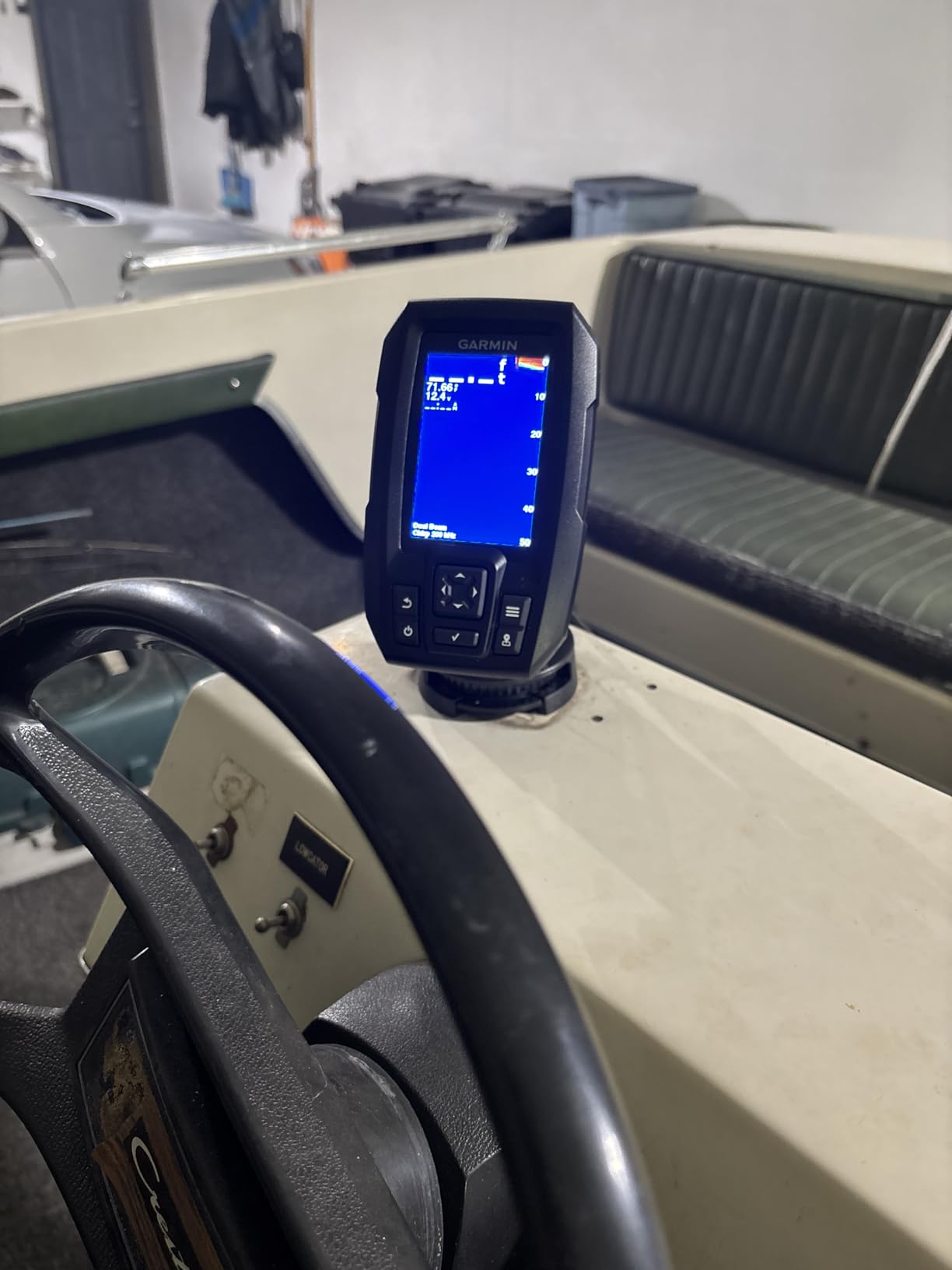
This is the unit we kept reaching for. The STRIKER 4 packs Garmin’s CHIRP traditional sonar and ClearVu scanning into a 3.5 inch keyed unit that weighs 8 ounces, and the whole thing mounts on a bail bracket in about five minutes. The bracket is the piece that matters on a kayak, because you can angle the screen toward your hip and take the display with you when you step off.
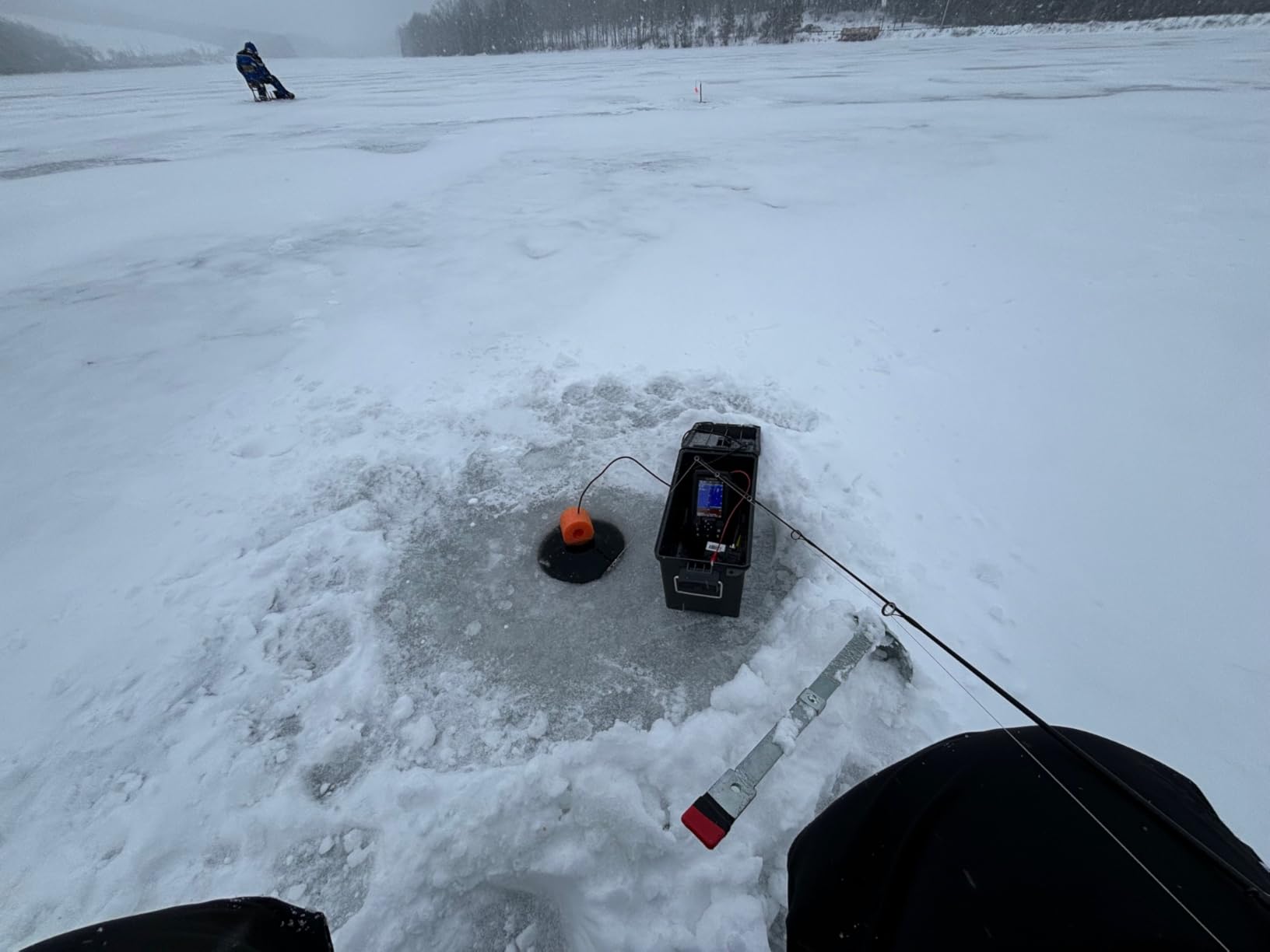
On the water, the depth and bottom-contour readings matched what we could find with a marked rope. The built-in flasher is a quiet bonus for anyone who also fishes ice in winter, and the waypoint map lets you mark a brush pile and come back to it after drifting off. Current draw is listed at 0.23 amp at 12V, which is the number that makes this thing easy to power for a full day.
The weaknesses are real but manageable. A 3.5 inch screen gives you a limited view of anything complicated, like a steep drop-off with brush on it. There is no chart or contour mapping in this model, so it is a fish and structure tool rather than a navigation tool. The power lead is thin, and owners routinely reinforce it with tape or heat shrink because the stock wire is easy to pinch.
Reviewers also report the occasional defective unit, though Garmin’s warranty exchange process draws praise when it happens. Readings cut out at higher speeds, which is normal for this class and not a fault. If you paddle fast and expect clean returns while moving, cast ahead instead of chasing the screen.
Who the Garmin STRIKER 4 suits
It suits a first-time electronics buyer better than anything else on this list. Every function is a physical button, there is no touchscreen to learn, and the menu depth is short enough that you will be marking waypoints on your first trip rather than reading a manual.
It also suits a cold-water angler, since the built-in flasher turns the same box into an ice unit. And it suits a sit-on-top angler who wants a screen without a console, because the bail mount and the small footprint were clearly the design target.
Who should skip the Garmin STRIKER 4
Skip it if you want to save structure maps or follow contours, because there is no mapping in this model and no upgrade path within the STRIKER 4 line. Mapping is the single most common upgrade step owners report, and this is the unit people buy first and replace later.
Skip it if you fish deep structure and need to see what is below you in detail. The 1600 ft rating is a maximum spec rather than a practical one at 3.5 inches, and the screen will be the limit before the sonar is.
2. ReelSonar iBobber – Best for Casting From Shore and Dock
Reelsonar Portable Fish Finder Accurate Fish Depth Finder with Depth Range of 135 feet 10+ Hours Battery Life with iOS & Android App Wireless
2x2x1 inch castable float
135 ft depth range
10+ hour rechargeable battery
Bluetooth to iOS and Android
Pros
- Pocket sized and casts on a standard rod
- Free iOS and Android app with demo mode
- Battery lasts a full day
- Shows weed
- temperature and depth-tagged fish
- Fish alarm and bite alert
Cons
- Bluetooth range only 40 to 60 feet
- Connections drop in direct sun or metal boats
- Needs about 5 ft of water to read
- App drains phone battery
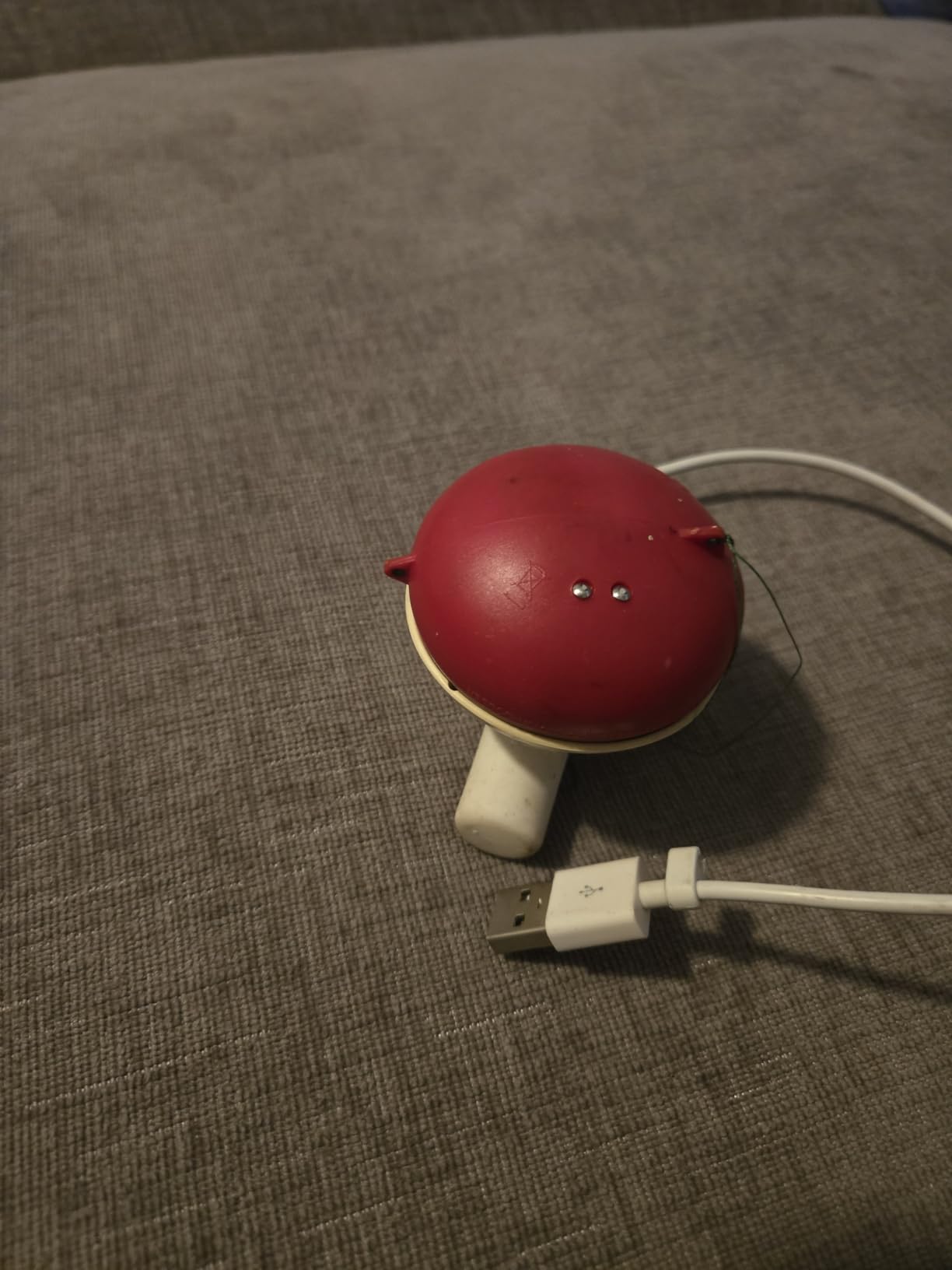
The iBobber is the smallest thing in this roundup at 2 by 2 by 1 inch, and that is exactly why it earns a place. It hangs on a line, turns itself on when it hits the water, and turns itself off when you pull it out. There is no battery pack, no cable and no mount. You cast, you read, you reel.
Its real strength shows up in places a mounted unit cannot reach. Working a creek mouth from the bank, tracking a weed edge from a dock ladder, or covering water ahead of a drifting kayak, it does in seconds what a mounted screen would take an hour of paddling to cover. The depth-tagged fish icons are color-coded by size, and the rechargeable battery is rated at 10+ hours.
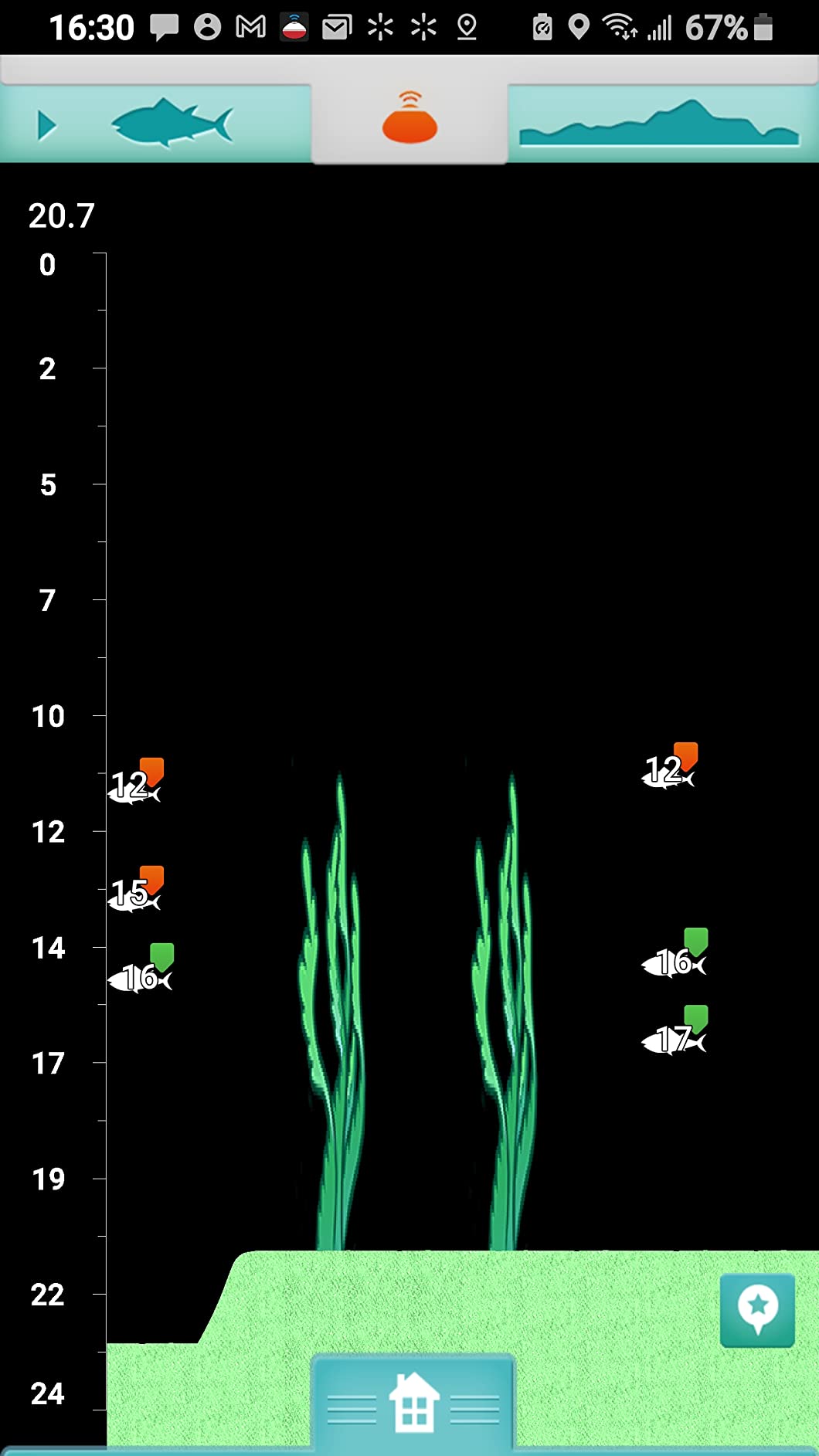
The limitation that matters most is range. Bluetooth is the link between float and phone, and reviewers put the practical limit at roughly 40 to 60 feet with a clear line of sight. In a kayak, where the phone stays close, that is rarely a problem. From shore, it often is. Owners also report intermittent drops in direct sun and inside aluminum boats, and a minimum depth of about 5 feet before readings become useful.
Fish arches can also read inconsistently while the float is moving fast, and the open app will drain your phone while you use it. Bring a charged power bank and accept that this is a shallow-water tool first.
Who the ReelSonar iBobber suits
It suits an angler fishing a river bank, a pond edge or a shallow bay, where the interesting water is always the water you cannot stand in. The 135 ft depth range is honest for a float sonar in fresh water and is more than most bank fishing needs.
It also suits anyone who does not want a single piece of electronics bolted to a boat. Two tether holes on the float let you attach line or a clip, and that is the entire mounting system.
Who should skip the ReelSonar iBobber
Skip it if you plan to paddle far from where you cast. Once the float is more than about 50 feet away, the connection becomes the weak point, and a dropout mid-cast means losing the reading you paid for.
Skip it if your phone is already your battery problem. Owners of ten-year-old setups note that aging phone batteries make the phone side of these products the shortest-lived component, so a castable phone unit extends the life of the sonar rather than removing it.
3. LUCKY FFC1108 – Best Budget Depth Finder for a Kayak
LUCKY Kayak Portable Fish Depth Finder Water Handheld Fish Finder Sonar Castable Kayak Boat Fishfinder Transducer Fishing LCD Display FFC1108
2 inch backlit LCD
3 to 328 ft depth range
Transducer reads through hull
4 to 5 hour battery life
Pros
- Lowest-cost route into kayak depth finding
- Reads through the hull like an in-water transducer
- Backlit screen for day and night
- One-hand body with neck strap
- Reliable depth and ledge readings
Cons
- No fish size discrimination at all
- Weak through fiberglass hulls
- Only works from a boat or kayak
- Some units arrived unable to power on
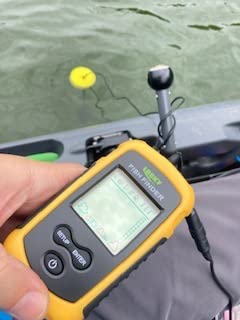
The LUCKY FFC1108 does one job, which is track the depth under your kayak as you move. The transducer attaches to the hull and reads from 3 ft down to 328 ft, with a 2 inch backlit LCD that shows depth, bottom composition and even weed type. At 4 to 5 hours on fresh batteries, with a battery-save mode that extends it, that is a full morning of fishing.
The hull-mounted transducer is the clever part. Owners on kayaks report that readings through the bottom match what they get with a transducer hung in the water, which removes the single most common kayak objection: you do not need to drill a transducer hole or run a cable through a bulkhead. You stick it on and it works.
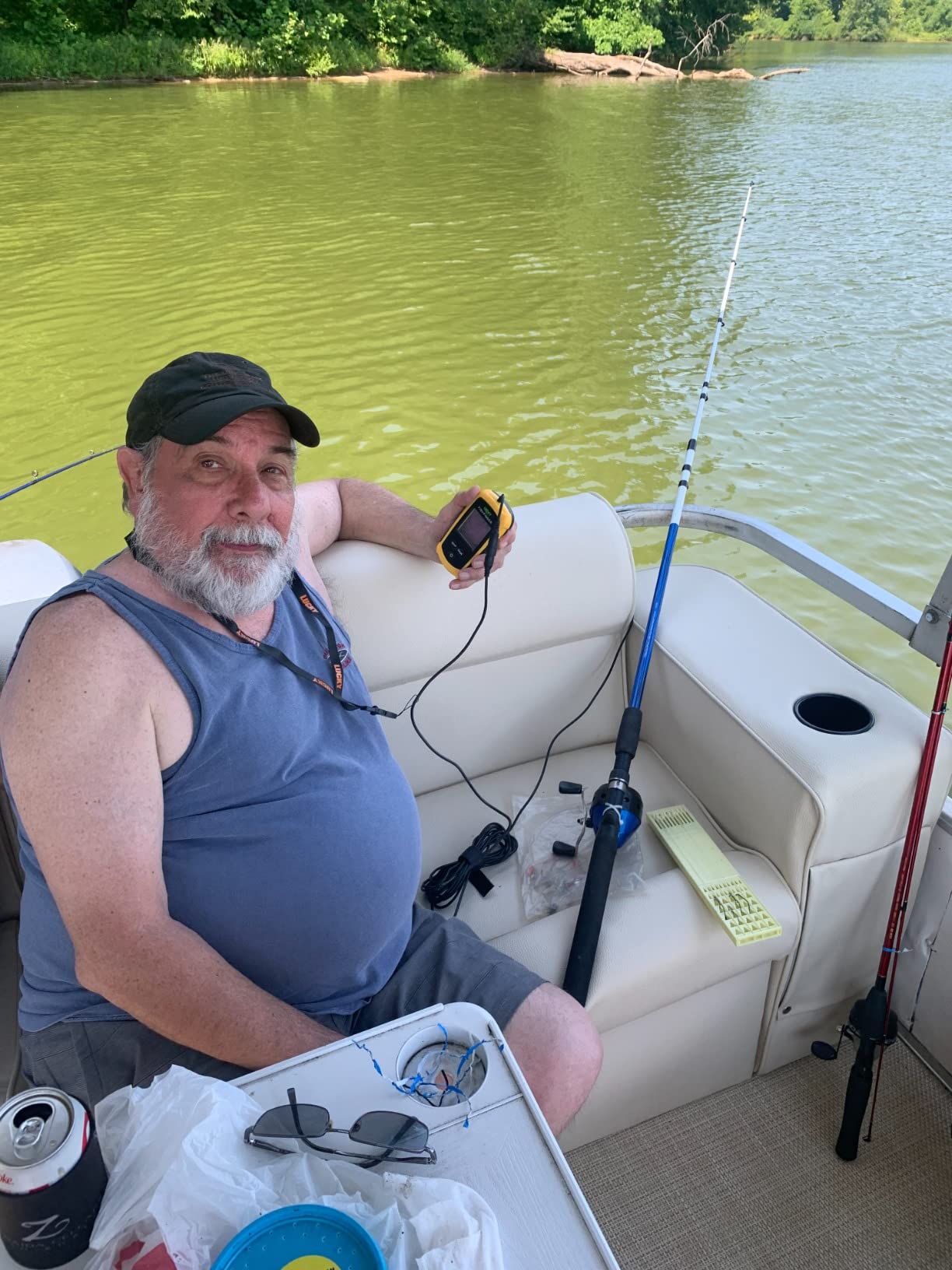
What you give up is fish identification. There is no fish-size discrimination here, so a screen full of arches may be a school of minnows or a genuine bass holding on a ledge. Five levels of sensitivity let you filter for clear or turbid water, which helps, but it is not the same as target separation. If you want to know what is down there rather than how deep it is, look elsewhere.
There are two more caveats owners raise. Through fiberglass hulls the signal is weak, so this suits a polyethylene kayak better than a composite one. And a few buyers report units that would not power on after arrival. Also worth knowing: it only works from a boat or kayak, not from the bank, which makes it the opposite of the iBobber.
Who the LUCKY FFC1108 suits
It suits a beginner who wants to know depth and bottom type for the first time, on a tight budget, with a kayak that has no console and no room for anything bigger. The neck strap and one-hand body mean you can hold it or wear it and keep paddling.
It also suits an angler fishing structure-heavy water in winter, since a 328 ft range and a backlit screen cover open water and ice holes from the same box.
Who should skip the LUCKY FFC1108
Skip it if you are chasing species rather than depth. Without fish-size filtering you are reading a picture of a habitat, not a decision about where to put a lure. Most anglers who start here replace it within a season, which is a fine path but a known one.
Skip it on a fiberglass hull, where signal quality drops enough to matter, or if you want to fish from shore with the same device.
4. Deeper START – Best Castable for First-Time Users
Deeper Start Fish Finder – Portable and Depth Finder for Recreational Fishing from Dock, Shore, Bank or Kayak | Castable Deeper Smart Sonar with Free User Friendly App
4.33 in wire-free body
165 ft casting and depth
40 degree beam
Self generated Wi-Fi
Pros
- No wires and no external battery
- Creates its own Wi-Fi so it uses no mobile data
- Casts a long way for its size
- Every scan saves with time and location
- Free app for iOS and Android
Cons
- Fewer beam options than the PRO+ 2
- Requires pairing each session
- About 6 hours of battery life
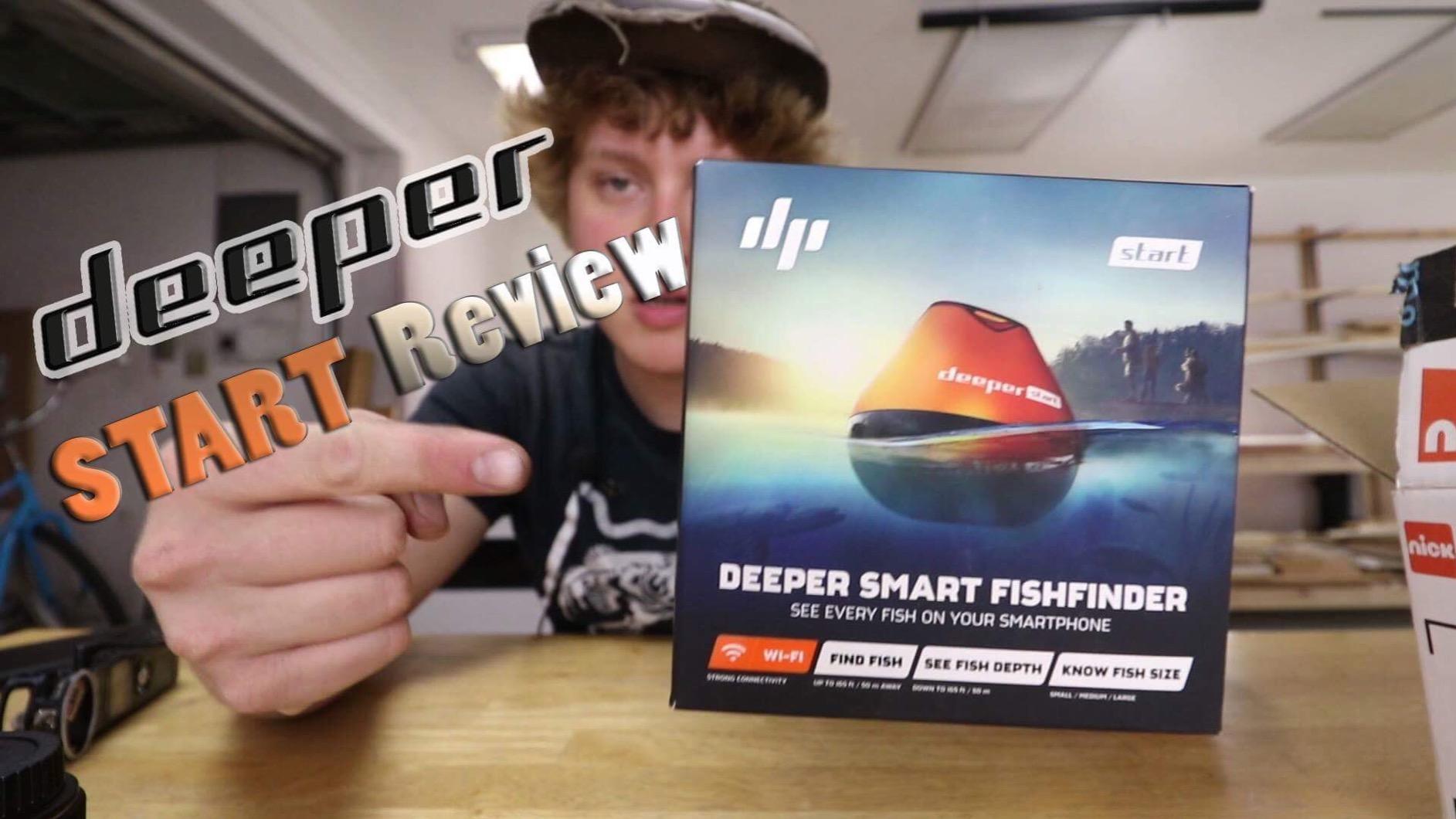
Deeper built the START for people who want castable sonar without a learning curve. It is a single sealed puck with no wires and no external battery, and it throws out its own Wi-Fi network so your phone does not spend mobile data or drop when you are out of coverage. The free Fish Deeper app handles the display.
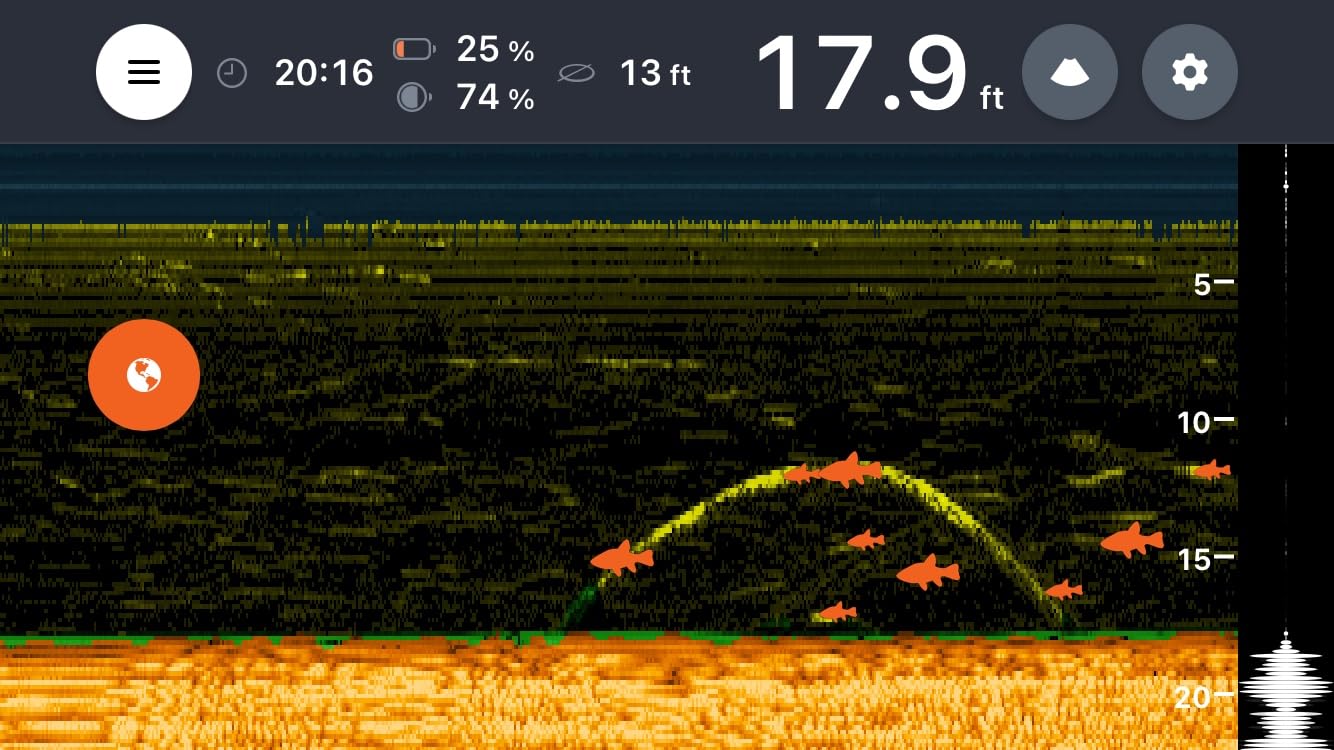
The feature we did not expect to care about turned into the best one. Every scan saves automatically with a timestamp and your coordinates, so when you find a productive drop-off you can note that you found it rather than trying to remember the spot. On a lake you have never fished, that log becomes a map of your own making after a couple of trips. Casting range and depth range are both 165 ft, with a 40 degree beam.
The trade-offs are about resolution. Compared with the PRO+ 2 in the same range, the START has fewer sonar modes and less beam flexibility, which means it gives you less control over how you interrogate a target. You see fish location and size, depth, bottom contour and vegetation, which is plenty for a first season and thin for someone chasing specific structure.
You also have to pair it with the app at the start of each session, and the battery is listed at about 6 hours from a 2.5 hour charge. In cold water that number drops. There is a night fishing mode, which is more useful than it sounds when you are casting at a ledge at dusk.
Who the Deeper START suits
It suits a first-time buyer who wants to try castable sonar before committing to a mounted screen, and it suits anyone fishing water they do not know. The automatic scan log means you build a usable map of a lake or a stretch of river without buying a chartplotter.
It also suits renters. Nothing is attached to the boat, so a rented kayak, a borrowed skiff or a rented pontoon loses nothing when you pack up.
Who should skip the Deeper START
Skip it if you need to separate individual fish from structure at depth. A single 40 degree beam gives you a decent picture but not the target separation the higher-end castables provide, and you cannot change beam width mid-cast.
Skip it if you will be out for a full day of casting. Six hours of battery means either a midday charge or a second unit, which is where the PRO+ 2 or a phone-free castable makes more sense.
5. Garmin STRIKER Vivid 4cv – Best Color Sonar for a Tight Cockpit
Garmin Striker Vivid 4cv Fishfinder with Transducer – 4-inch LCD Display – Easy-to-Use Scanning Sonar – Color Palettes, 11.2 Ounces (010-02550-00)
4 inch color LCD
GT20 CHIRP ClearVu
Vivid color palettes
Quickdraw Contours built in
Pros
- Color Vivid palettes separate fish from structure
- CHIRP ClearVu gives cleaner returns
- Quickdraw Contours maps with no extra card
- Compact enough for a kayak cockpit
- Two year limited warranty
Cons
- Keyed menus take practice to learn
- Settings can reset after a power cycle
- No built-in maps on this model
The STRIKER Vivid 4cv has the highest average rating of the ten in this roundup, and after a season of side-by-side readings we understand why. Color is not a cosmetic upgrade on a small screen. When the arches are orange against a grey bottom instead of white against black, you can pick a fish off a rock ledge without squinting, and that is the difference between seeing structure and acting on it.
The GT20 transducer supplies CHIRP traditional and CHIRP ClearVu scanning, and the Vivid palettes let you switch color ramps depending on water clarity and time of day. Quickdraw Contours is built in and needs no separate card, so a first-time user can record their own structure on the first trip. High-sensitivity GPS handles waypoints, routes and speed. The tilt and swivel bail mount is included.
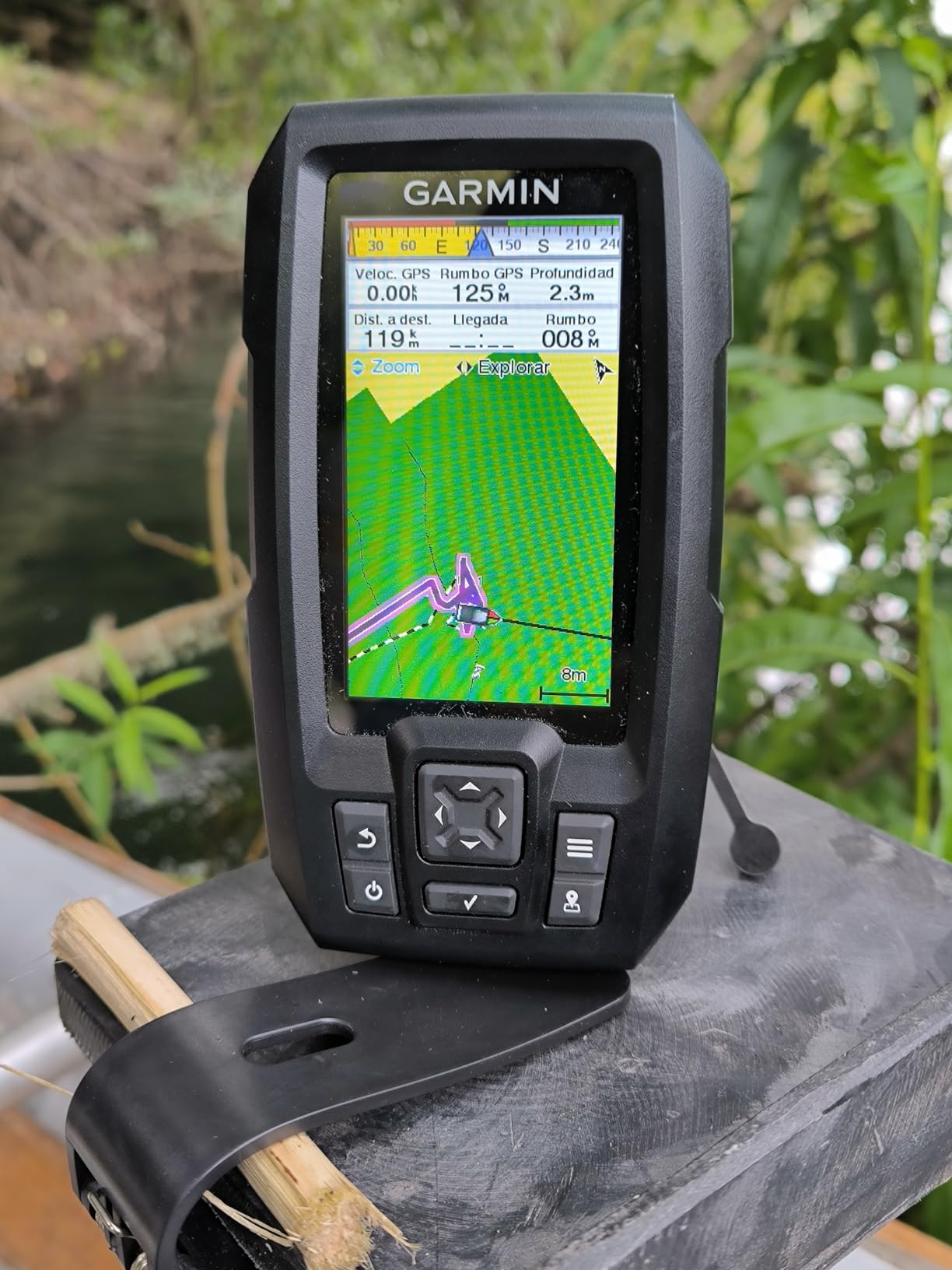
Where it frustrates people is the interface. The Vivid series uses physical buttons and a menu system that some owners find slower to learn than a touchscreen, and a recurring complaint is that settings do not always survive a power cycle. Budget ten minutes with the unit in your hands before you rely on it.
There are no preloaded maps on this model, and no charting. Garmin sells higher-tier chartplotter units in the same ecosystem, so if navigation is central to how you fish, this is the wrong box even though the sonar is excellent. Note also that the 4 inch unit is bigger than the STRIKER 4, so cockpit space planning matters more here than on the model below it.
Who the Garmin STRIKER Vivid 4cv suits
It suits a kayak angler who has outgrown a monochrome screen but whose boat cannot take a 7 inch display. Four inches is the sweet spot in this list: wide enough to read structure, narrow enough to sit in front of a seat without blocking your view of the water.
It also suits anyone fishing water they want to learn. Quickdraw Contours plus the waypoint map turns a season of fishing into a home-made contour map, and a two year warranty adds some protection for a unit that will be near water constantly.
Who should skip the Garmin STRIKER Vivid 4cv
Skip it if you are a first-time electronics buyer who will not spend time with the menu system. This is a capable unit with a real learning curve, and the simpler STRIKER 4 gets you fishing sooner.
Skip it if you need charts. No preloaded mapping is the most common surprise buyers report, and adding charting later means buying a different Garmin model rather than adding a card here.
6. Humminbird PiranhaMAX 4 – Best Dual-Beam Value Pick
Humminbird PiranhaMAX 4 Fish Finder with Transducer, Dual Beam Sonar
4.3 inch monochrome LCD
Dual beam narrow and wide
600 ft maximum depth
Tilt and swivel mount
Pros
- Dual beam gives detail and coverage at once
- Reliable depth and structure readings
- Tilt and swivel bracket is easy to reposition
- Simple controls new users pick up fast
- Transom transducer included
Cons
- Monochrome screen with no color palettes
- No GPS or chart plotting
- Heavier and bulkier than castables
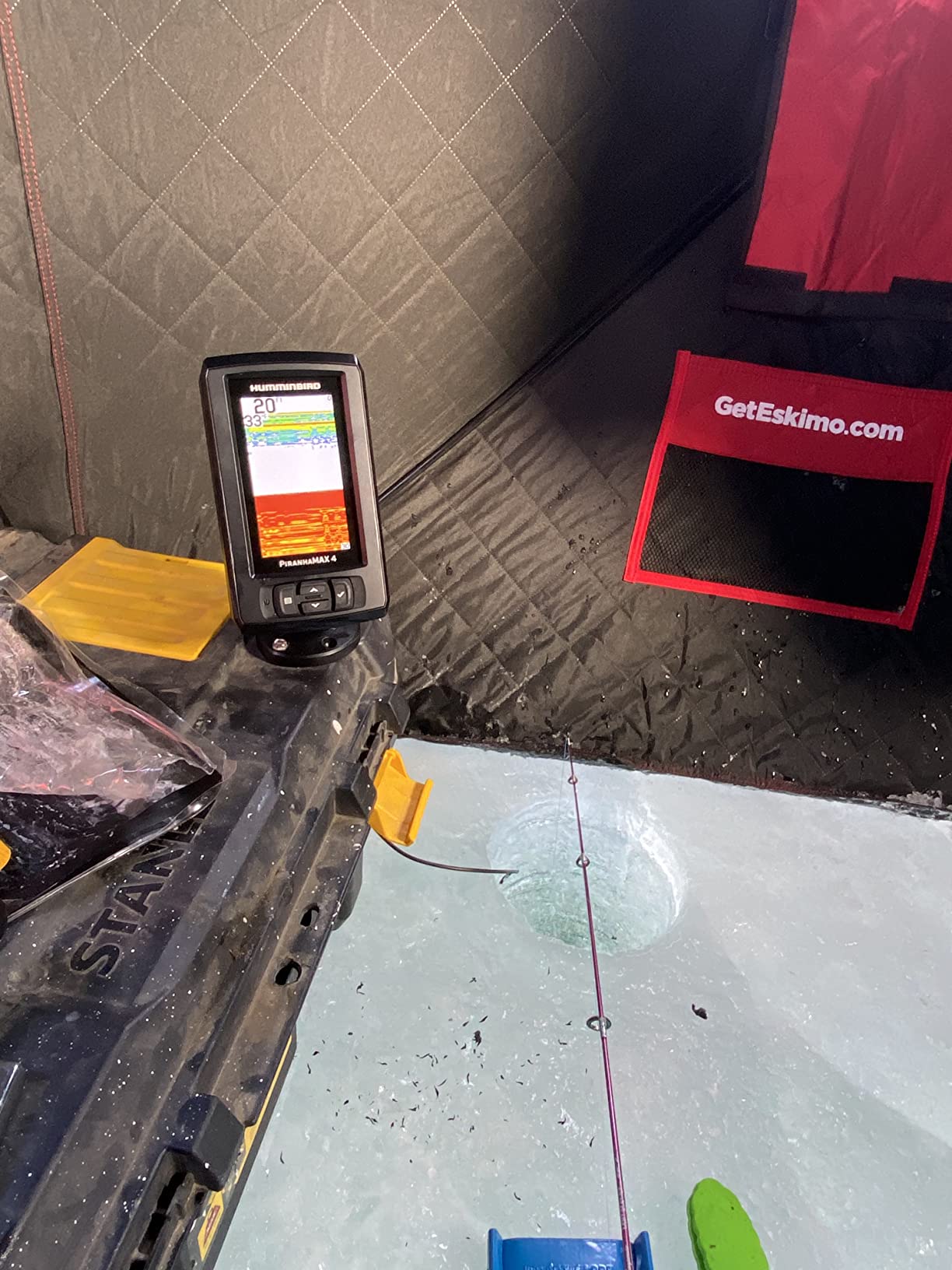
The PiranhaMAX 4 is the traditional answer: a 4.3 inch screen, a transom-mount transducer and a tilt and swivel bracket. Its dual beam sonar is the reason to choose it over a cheaper monochrome screen. You can switch between a narrow beam for detail and a wide beam for broad coverage of fish, structure and contours, which on a kayak means you can zoom in on a specific fish and then quickly scan the whole area without waiting for a screen to catch up.
Maximum depth is rated at 600 ft, which covers essentially any lake and most inshore saltwater. The controls are plain, the backlight handles shaded water, and the included tilt and swivel mount makes it easy to move the display from a seat position to a bow position as you reposition.
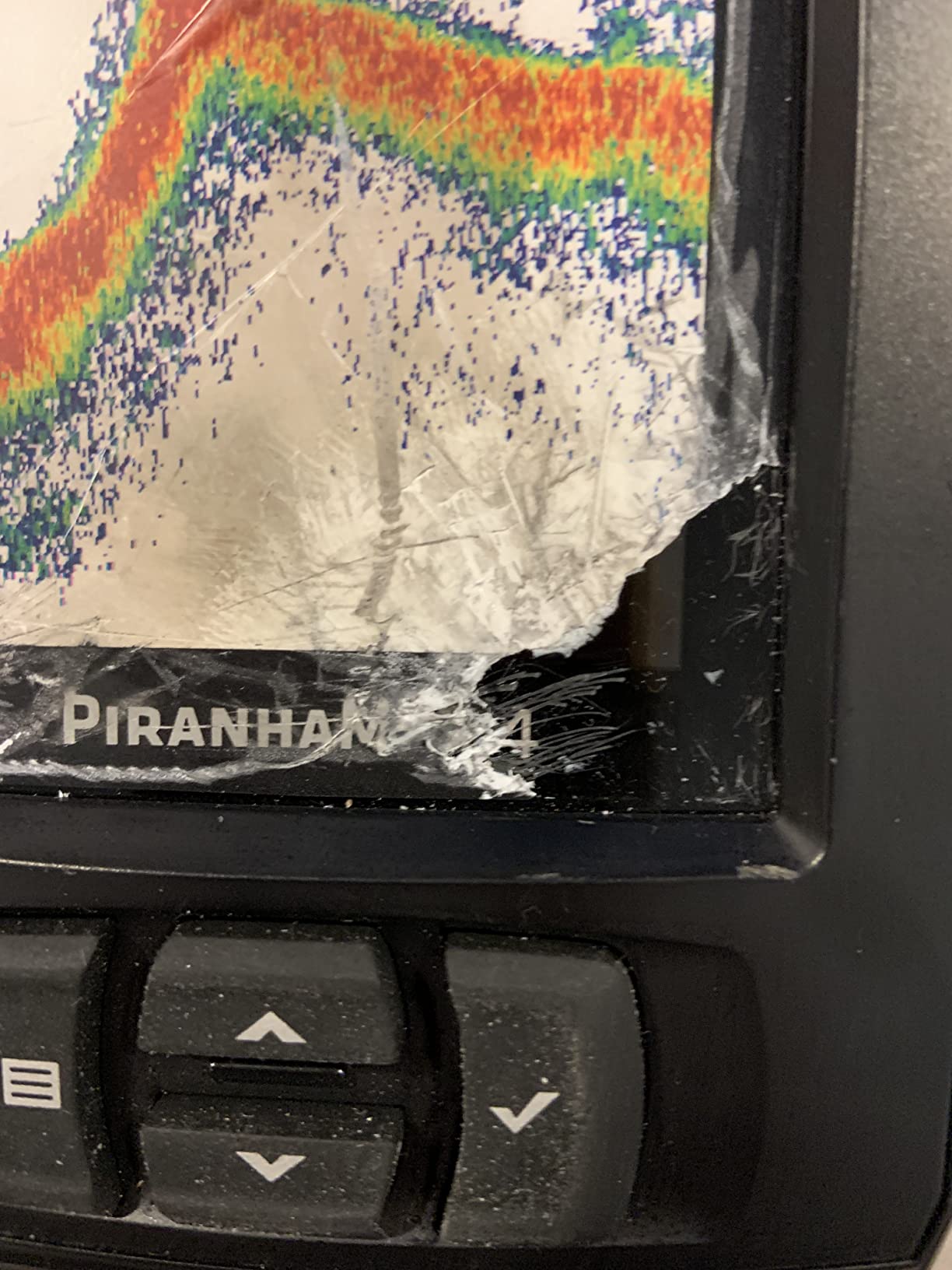
What you give up is everything digital. The screen is monochrome, so you are reading a black and white trace with no color ramps to help you separate fish from bottom. There is no GPS and no chart plotting, which means no waypoints and no speed, just sonar. Owners who want navigation end up buying a separate GPS or moving up a tier.
At 2 pounds it is the heavier of the two small mounted units in this roundup, which matters if you are carrying your kayak in regularly or moving the display around a small deck. Some buyers who expected more from a four-star-plus rating report disappointment, and the honest summary is that this unit does depth and structure extremely well and does nothing else.
Who the Humminbird PiranhaMAX 4 suits
It suits an angler who wants reliable structure and depth from a permanently mounted screen and does not care about mapping or color. Dual beam gives you more flexibility per dollar than most monochrome screens in the same tier.
It also suits a second-boat setup. If your main boat has a full electronics package, this is a simple, self-contained unit for a small watercraft where running cables is not worth it.
Who should skip the Humminbird PiranhaMAX 4
Skip it if your fishing depends on seeing fish rather than seeing bottom. A monochrome trace with no target separation is the older way of reading sonar, and once you have used color you tend not to go back.
Skip it if you want to mark and revisit spots. With no GPS, a good brush pile stays a good brush pile only as long as you remember it, which is exactly the problem Quickdraw and waypoint models solve.
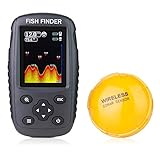
7. Venterior VT-FF005 – Best Castable With Its Own Display
Venterior Portable Rechargeable Fish Finder Wireless Sonar Sensor Fishfinder Depth Locator with Fish Size, Temperature, Bottom Contour, Color Display
2.6 inch color TFT
Wireless sensor to 262 ft
105 degree beam
2.6 to 164 ft depth range
Pros
- Casts far enough to reach structure off the kayak
- Wireless link up to 262 ft
- Color screen readable in sun or dark
- Reports depth
- temperature and fish size
- Two year warranty
Cons
- 105 degree beam loses accuracy on ice and in deep water
- Battery indicator reads wrong when dry
- Only 3 to 4 hours of continuous use
- Cold weather shortens battery life
The Venterior VT-FF005 solves the most common complaint about castable sonar, which is that you have to expose your phone to the weather and watch it drain. This one comes with its own handheld color TFT display and a separate wireless sensor you cast on a rod. Nothing touches your phone, nothing is bolted to the boat, and the whole package is 2.75 inches on a side.
The wireless link between sensor and display runs up to 262 ft, which is far more than you need from a kayak and enough to walk the shoreline. The display reports depth, water temperature, fish size in small, medium and big categories, fish depth and bottom contour on one screen. Two tether holes on the sensor mean you can cast it on a line or clip it anywhere.
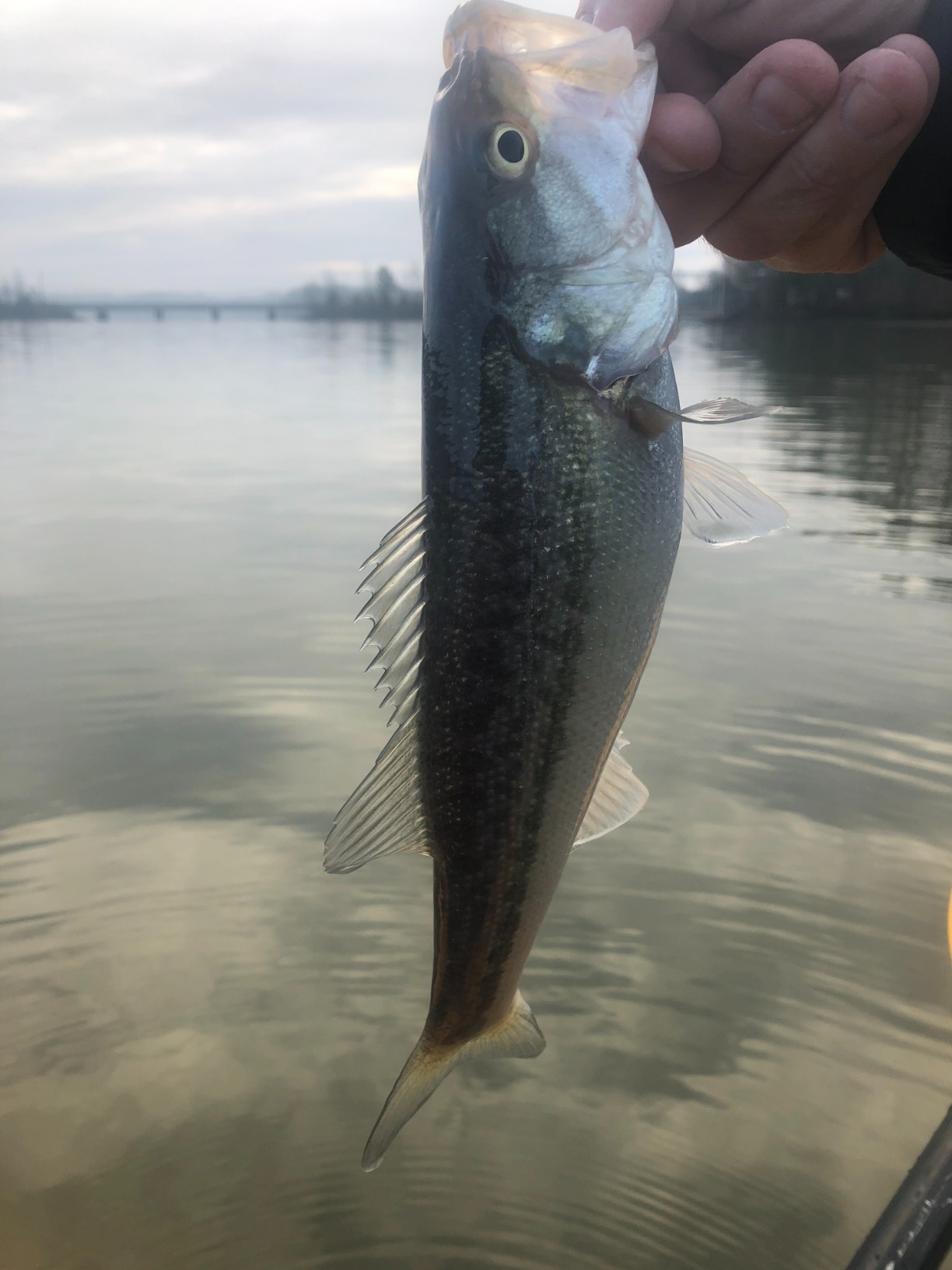
The wide 105 degree beam is the tradeoff. A wide beam covers a lot of water at once, which is nice, but it reduces depth precision in deeper water and makes it noticeably less accurate in a tight ice hole. It also produces false signals when the sensor is towed behind a moving boat, so a drifting kayak is fine and a fast one is not.
Two smaller quirks are worth knowing. The sensor battery indicator on the display reads incorrectly while the sensor is out of the water, which causes more confusion than it should. And the receiver runs roughly 3 to 4 hours of continuous use, with cold weather cutting into that further, so you are charging mid-session on a full day.
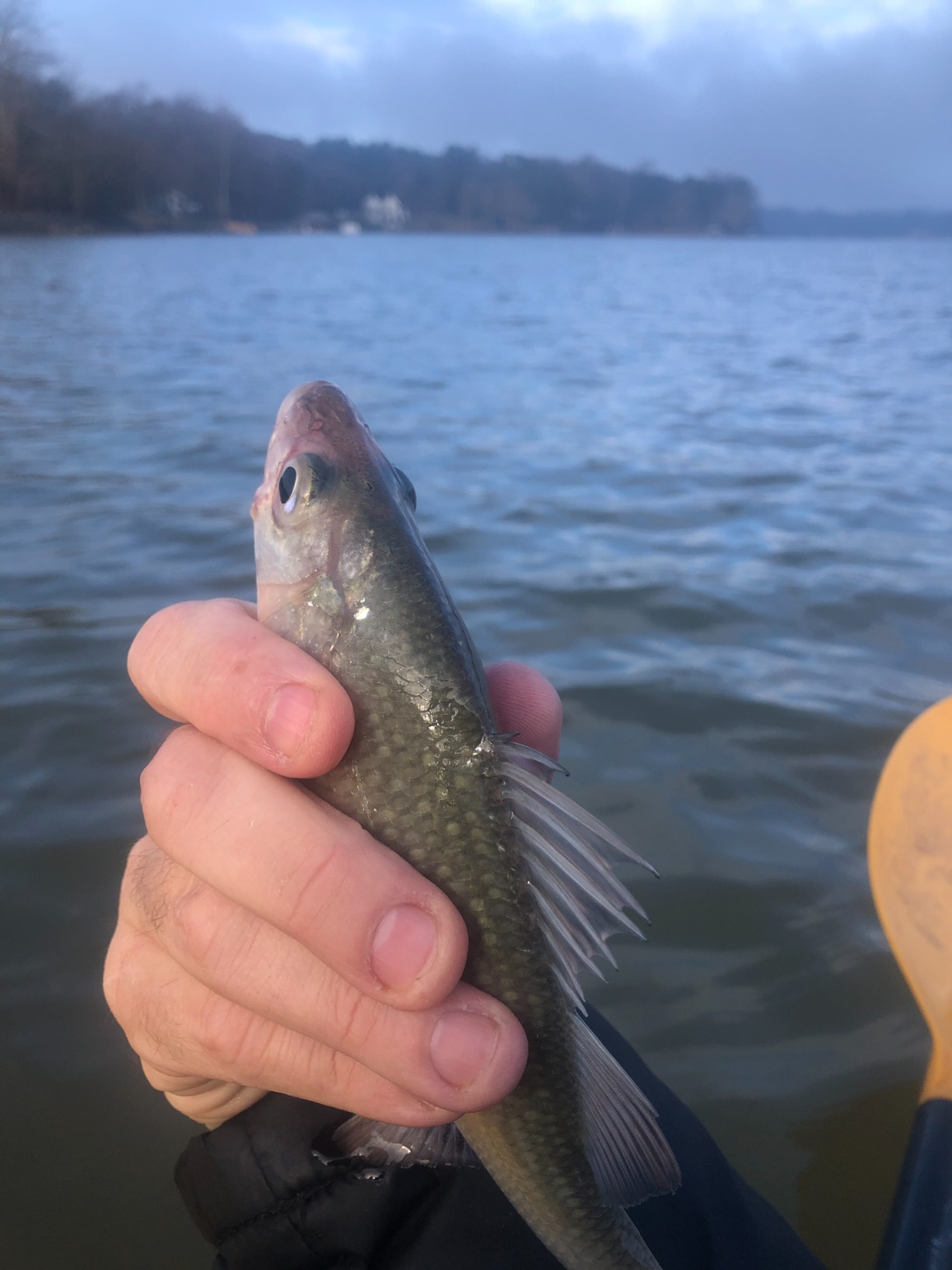
Who the Venterior VT-FF005 suits
It suits an angler who wants castable coverage without a phone in their hands, which is a real benefit in cold weather and in rain. It also suits anyone fishing water their boat cannot reach, since a 262 ft link means you can stand on a bank or a dock and still get a reading.
It suits shallow-water anglers. With a range of 2.6 to 164 ft and a beam that covers a wide arc, it is at its best over flats, creek channels and nearshore structure rather than in a deep lake.
Who should skip the Venterior VT-FF005
Skip it if you fish deep. The 105 degree beam trades precision for coverage, and that trade is a problem once the bottom is far below the boat. Ice anglers get the same problem, since a wide beam in a small hole gives you a lot of noise.
Skip it if you want saved maps. Readings live and die on the handheld screen, so a good find is something you write down rather than something you can return to later.
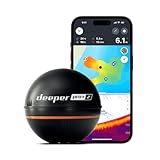
8. Deeper PRO+ 2 – Best for Building Saved Structure Maps
Deeper PRO+ 2 Sonar Fish Finder – Portable Fish Finder and Depth Finder For Kayaks, Boats and Ice Fishing with GPS Enabled | Castable Deeper Fish Finder with FREE User Friendly App
2.4 inch body at 3.2 oz
Three beam widths
0.4 in narrow beam separation
Built-in GPS mapping
Pros
- Three beam widths for coverage or detail
- 0.4 inch narrow-beam target separation
- Built-in GPS records bathymetric maps
- Reliable self-generated Wi-Fi
- Very light with a pouch included
Cons
- Phone app required for full function
- Battery life is short for long days
- Costs more than entry castables
- App updates can change behavior
The PRO+ 2 is the enthusiast castable, and the difference from the START is the beam control. Three options, wide, mid and narrow, let you cover a lot of water quickly and then switch to a narrow beam when you have something to look at. At 0.4 inch narrow-beam target separation, it picks out individual fish and even a lure in the water, which is the closest any castable in this list gets to a live view.
The built-in GPS is the other reason to step up. You can create and save bathymetric maps from shore, dock or boat and keep them in the Fish Deeper app, so a productive structure becomes a mark you can return to. Accuracy is listed up to 330 ft, and the whole unit weighs 3.2 ounces with a neoprene pouch included, which is light enough to cast all day.
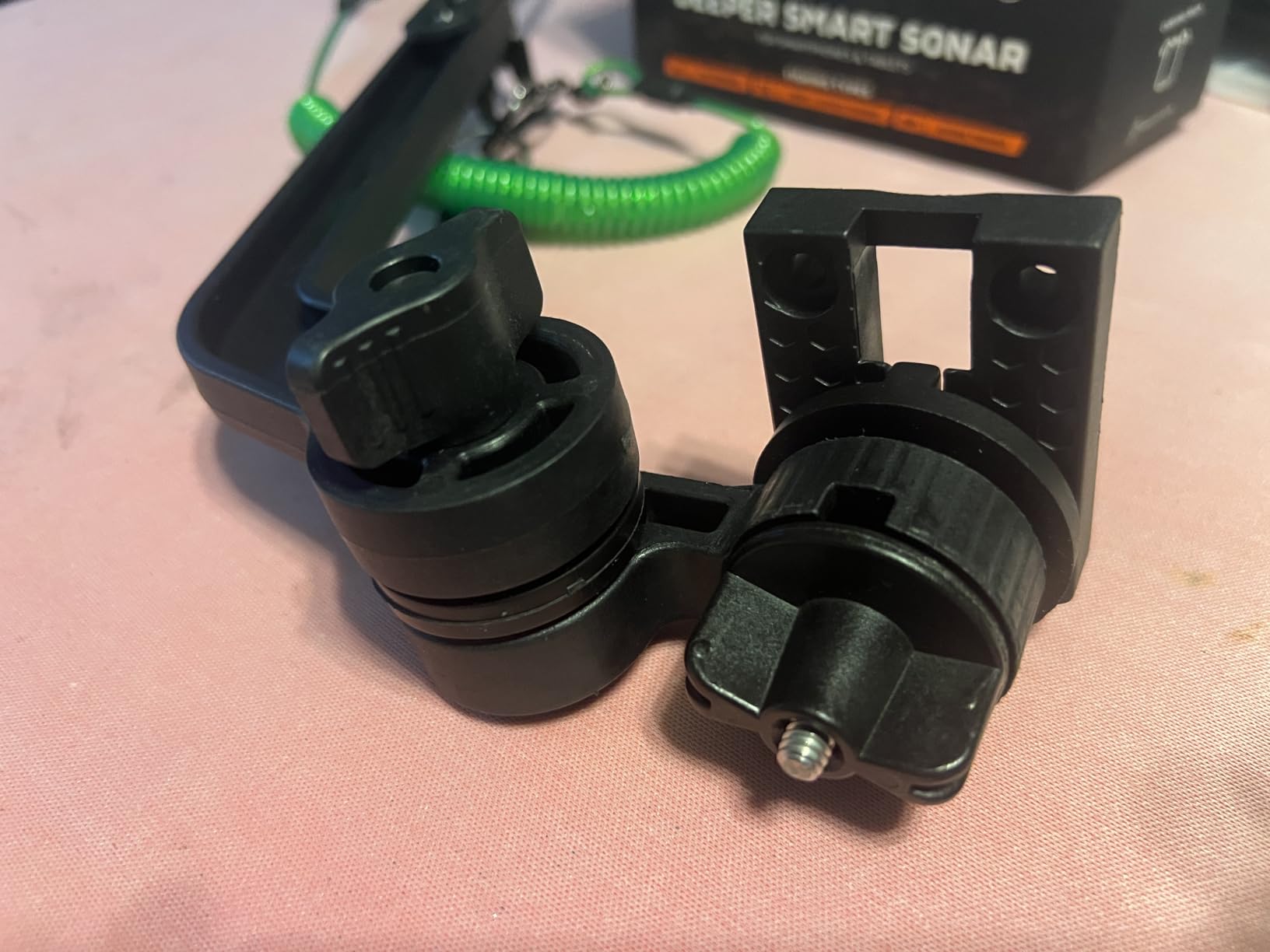
Everything still runs through your phone. The app is required for full functionality, and owners note that app and firmware updates can change how the unit behaves mid-season, which is a real annoyance when you have learned to read a particular screen. Battery life is short relative to the larger Deeper bodies, so a full day of heavy casting means a midday charge.
The other honest point is cost. This is a premium-priced entry castable, and if you are unsure whether castable sonar suits you, the START gives you most of the experience for considerably less. Reviewers who bought both tend to describe the PRO+ 2 as the one they kept.
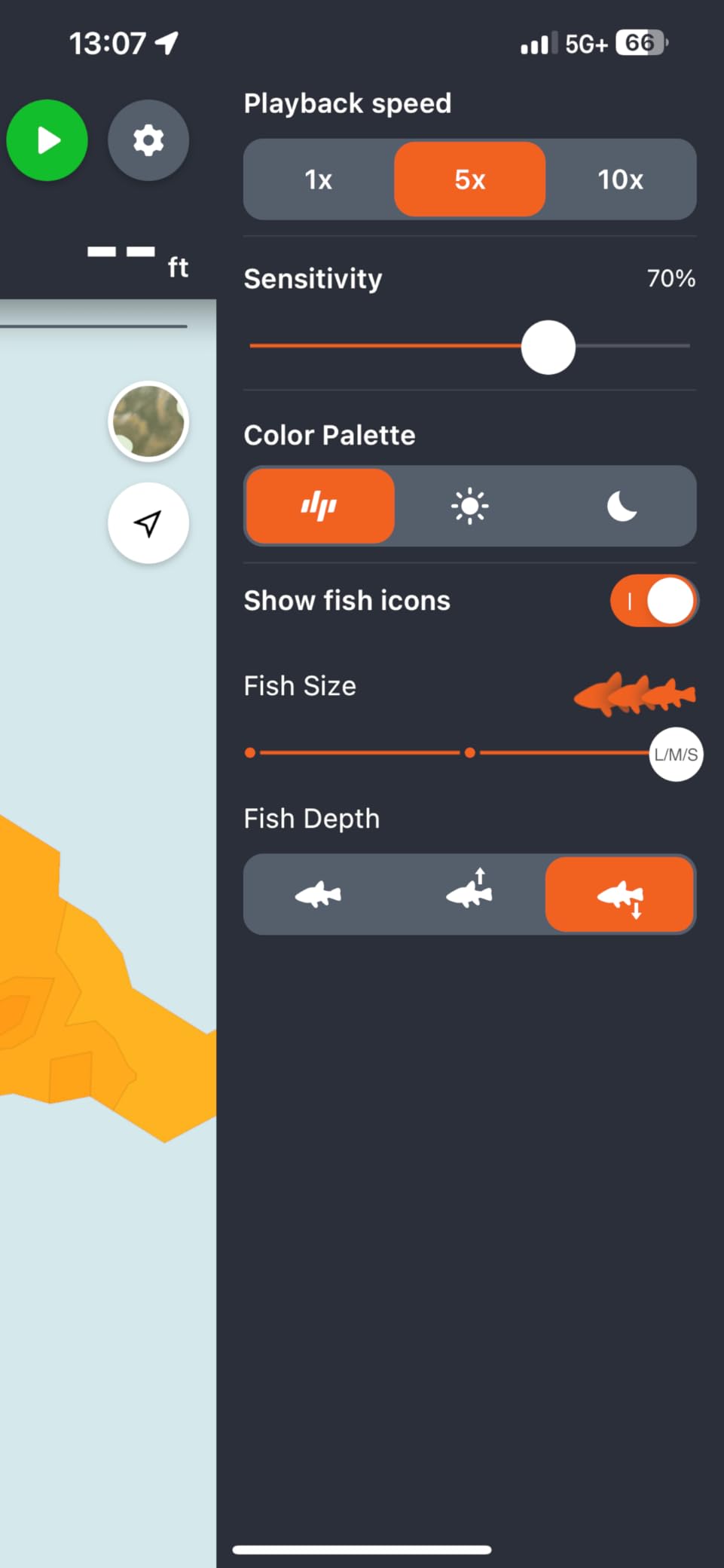
Who the Deeper PRO+ 2 suits
It suits an angler who is fishing water repeatedly rather than water once. Saved bathymetric maps mean you can mark a ledge, come back next trip and fish it deliberately instead of casting at a general area and hoping.
It also suits someone who wants fine detail without a mounted screen. The narrow beam and 0.4 inch target separation are the closest you get to pointing at one fish from a kayak, and the 3.2 ounce weight means you will not notice it in your pocket.
Who should skip the Deeper PRO+ 2
Skip it if you are on a strict budget and unsure. It costs meaningfully more than the START, and the extra beam options only matter once you know you want them.
Skip it if phone reliability is already a problem for you. The Wi-Fi connection is stable, but a dead battery or a dropped call during a long day removes your only screen, and that is the failure mode castable phone units share.
9. Garmin STRIKER Vivid 7cv – Best Big-Screen Option
Garmin Striker Vivid 7cv, U.S. with GT20-TM Transducer – Easy-to-Use 7-inch Color Fishfinder and Sonar Transducer, Vivid Scanning Sonar Color Palettes (010-02552-00)
7 inch color LCD
GT20-TM CHIRP and ClearVu
Wi-Fi ActiveCaptain app
4.4 lb bail mount unit
Pros
- 7 inch screen is bright and readable in sun
- Vivid palettes plus ClearVu separate fish from structure
- Quickdraw Contours maps structure out of the box
- Wi-Fi app adds waypoint transfer and notifications
- GT20-TM transducer included in the box
Cons
- No preloaded maps
- Feature set takes real study time
- Bulky 4.4 lb footprint for a kayak cockpit
- Highest cost in this group
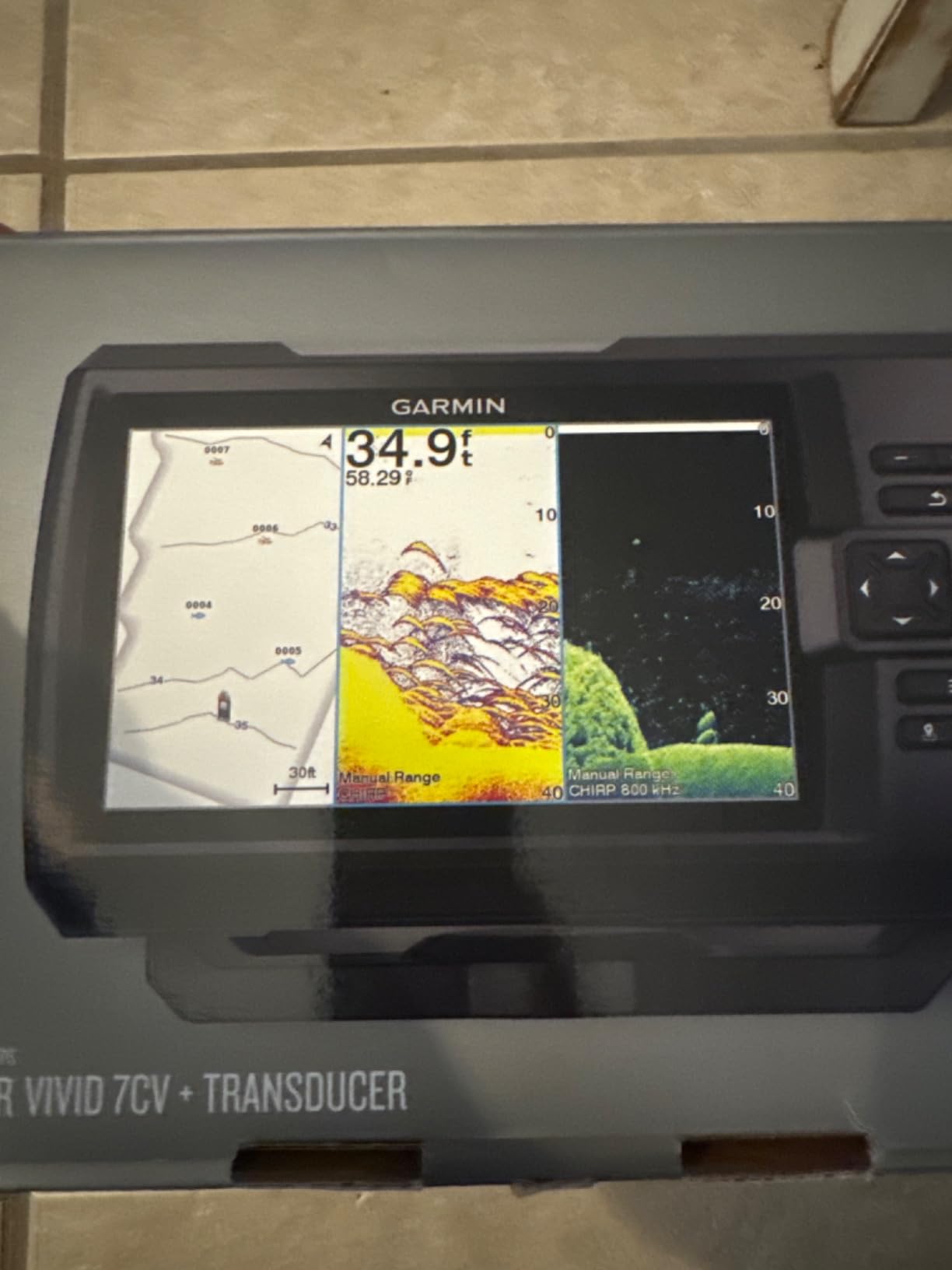
The 7cv is the biggest screen we are comfortable recommending for a kayak, and it is only worth it on a hull with real deck space. Owners call out the 7 inch color display as the decisive advantage: it is bright enough to read in direct sun, and Vivid palettes combined with CHIRP ClearVu make brush piles and rock structure easy to pick out at a distance where a 4 inch screen shows a blur.
Connectivity is where this model separates from the 4cv. Wi-Fi pairs with the Garmin ActiveCaptain app for waypoint transfer, smart notifications and software updates, and it gives you access to the Quickdraw Community, so you can pull contours other anglers have recorded for the same water. Quickdraw Contours itself is built in and maps structure as you go.
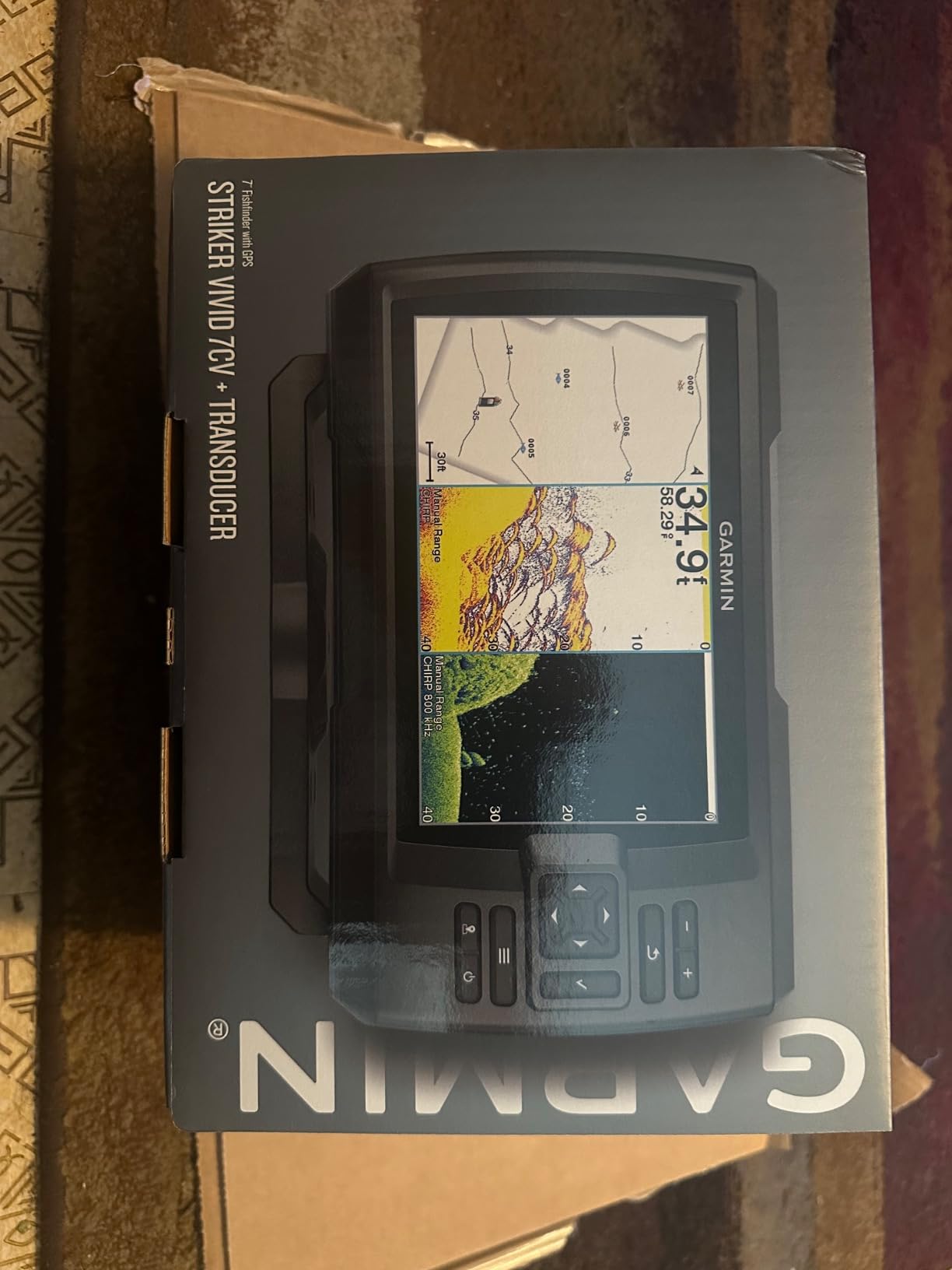
The gaps are the same ones buyers report on the smaller Vivid, and at this size they are amplified. There are no preloaded maps, so anyone expecting a chartplotter will be disappointed. The feature set demands study time, and this is the most complicated unit in the roundup. The keyed interface is also less intuitive than some competing designs.
Then there is the physical question. At 4.4 pounds and 11.4 by 8.9 by 8.2 inches, this needs a bow mount or a rigid track position rather than a cockpit bail mount. Several owners use it from a kayak successfully and note the size as a consideration rather than a dealbreaker, but on a small sit-on-top it will be the first thing you struggle to place.
Who the Garmin STRIKER Vivid 7cv suits
It suits an angler on a fishing kayak with a proper track or bow mounting point who fishes large water and wants to see a wide screen without craning. It also suits anyone fishing uncharted water who wants to record and share their own contours rather than buy a chart subscription.
It doubles as an ice unit for anyone fishing both seasons, since the brightness and the scanning sonar work the same way on a lake or through a hole.
Who should skip the Garmin STRIKER Vivid 7cv
Skip it on a small or sit-on-top kayak with a compact cockpit. Deck space is the most repeated complaint about large displays in angler forums, and 7 inches plus a bail mount is more than a narrow cockpit gives you.
Skip it if you want charts, since none are preloaded. It also costs the most here, so if budget matters, the 4cv gives you the same sonar and mapping software on a screen that actually fits.
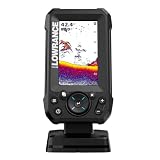
10. Lowrance Eagle 4 inch – Best Screen for Direct Sunlight
Lowrance Eagle 4X Fish Finder with Bullet Transducer
4 inch IPS portrait LCD
Auto-Tuning Sonar
44 degree Bullet Skimmer beam
500 ft max depth
Pros
- IPS portrait screen clear through polarized sunglasses
- Auto-Tuning removes sonar setting work
- Compact portrait design with twist-lock connector
- 44 degree beam suits a kayak
- Drop-in for older Lowrance Chirp 4 mounts
Cons
- No audible fish alarm
- Not a live scope and limited for pinpointing fish
- Smallest screen in the mounted group
- Only a one year warranty
The Lowrance Eagle 4 inch wins on one specific thing: the screen. It is a 4 inch IPS panel in portrait orientation, and IPS panels hold their contrast and colour at wide viewing angles and through polarized sunglasses in a way most LCDs in this class do not. If you fish in open sun off a flat water or a bright sandbar, that is not a minor detail, it is the difference between reading a fish arch and squinting at it.
Auto-Tuning Sonar is the other quiet winner. It sets the sonar settings for the water you are in without you touching a menu, which removes the single most common complaint people have when they move up from a basic handheld. The included 200 kHz Bullet Skimmer transducer has a 44 degree beam, which is a sensible match for a kayak or small boat, and maximum depth is 500 ft.
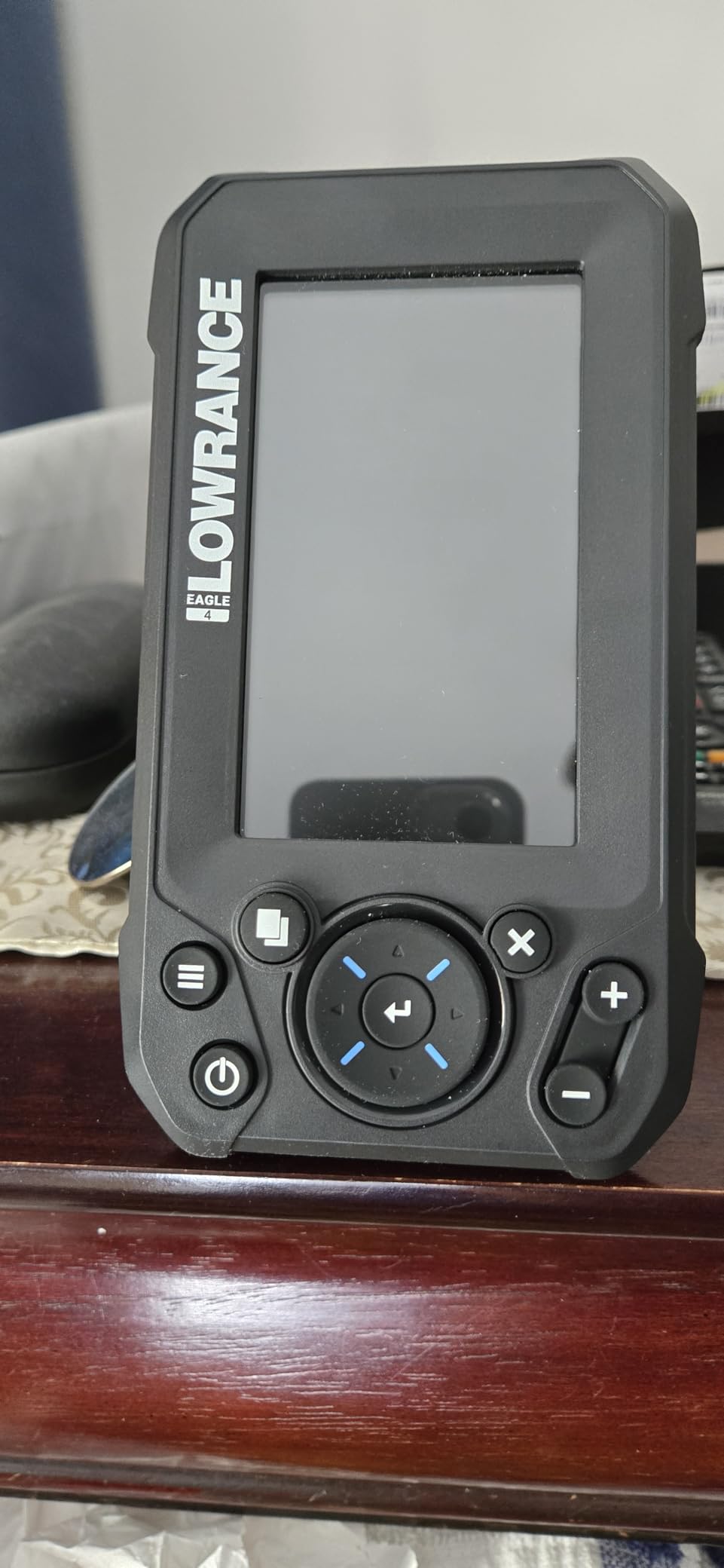
The portrait shape is unusual in this category and works well in a tight cockpit because it is narrow. A twist-lock connector lets you pull the display off quickly and leave the transducer in place, which is exactly what you want when you are stepping off to fish a shoreline or moving the unit to the bow. It can also mount on the surface, in a panel or flush.
There are limits. There is no audible fish alarm in this configuration, so you will not hear a strike unless you are watching the screen. It is not a live scope and is limited for pinpointing individual fish, and at 4 inches it is the smallest mounted screen here. Fish-size accuracy is not reliable, and the warranty is one year rather than the two the Garmin Vivid models carry. Owners who upgraded from an older Lowrance Chirp 4 report that it drops into the same mount using the same screw holes, which makes it a genuinely painless replacement.
Who the Lowrance Eagle 4 inch suits
It suits a kayak angler who fishes in hard sun and wears polarized glasses, because the Eagle is the only unit in this roundup that lists both a high-viewing-angle panel and readability through polarized lenses. It also suits anyone replacing an older Lowrance unit, since the mount and screw pattern carry over.
It suits a first-time buyer who does not want to configure sonar. Auto-Tuning handles the settings, and the IPS screen does not need adjusting when the light changes.
Who should skip the Lowrance Eagle 4 inch
Skip it if you need to hear a strike without watching the screen. With no audible alarm, a slow or inattentive drift can cost you fish that you never knew were there.
Skip it if you want live detail. The 4 inch configuration is a traditional sonar unit, so if you have seen scanning or live sonar on someone else’s boat and want that, you need a higher-tier Lowrance model rather than this one.
Mounting a Fish Finder on a Kayak Without Drilling the Hull
The most common objection in angler forums is permanent modification, and it is a fair one. The good news is that none of the ten units here require a hole in your hull, and four of the ten require no mounting at all.
Castable, nothing mounted. The iBobber, Deeper START, Deeper PRO+ 2 and Venterior VT-FF005 clip to a line or float. You lose nothing on install and lose continuous coverage under the boat.
Bail or tilt-swivel mount on a track. The Garmin STRIKER 4, STRIKER Vivid 4cv, STRIKER Vivid 7cv and Lowrance Eagle all ship with a bracket that bolts to a kayak track system. This is the cleanest permanent option and takes the display off cleanly when you go ashore.
RAM ball arm in a rod holder. A RAM ball and socket fits most standard rod holders and gives you a fully adjustable angle. Popular because the display moves with you instead of being fixed to one spot.
Bow or forward mount. The only way to get real use out of a 7 inch display, since you need distance from your body and a clear view. A forward position also gives you more time to react to a fish arch while you paddle.
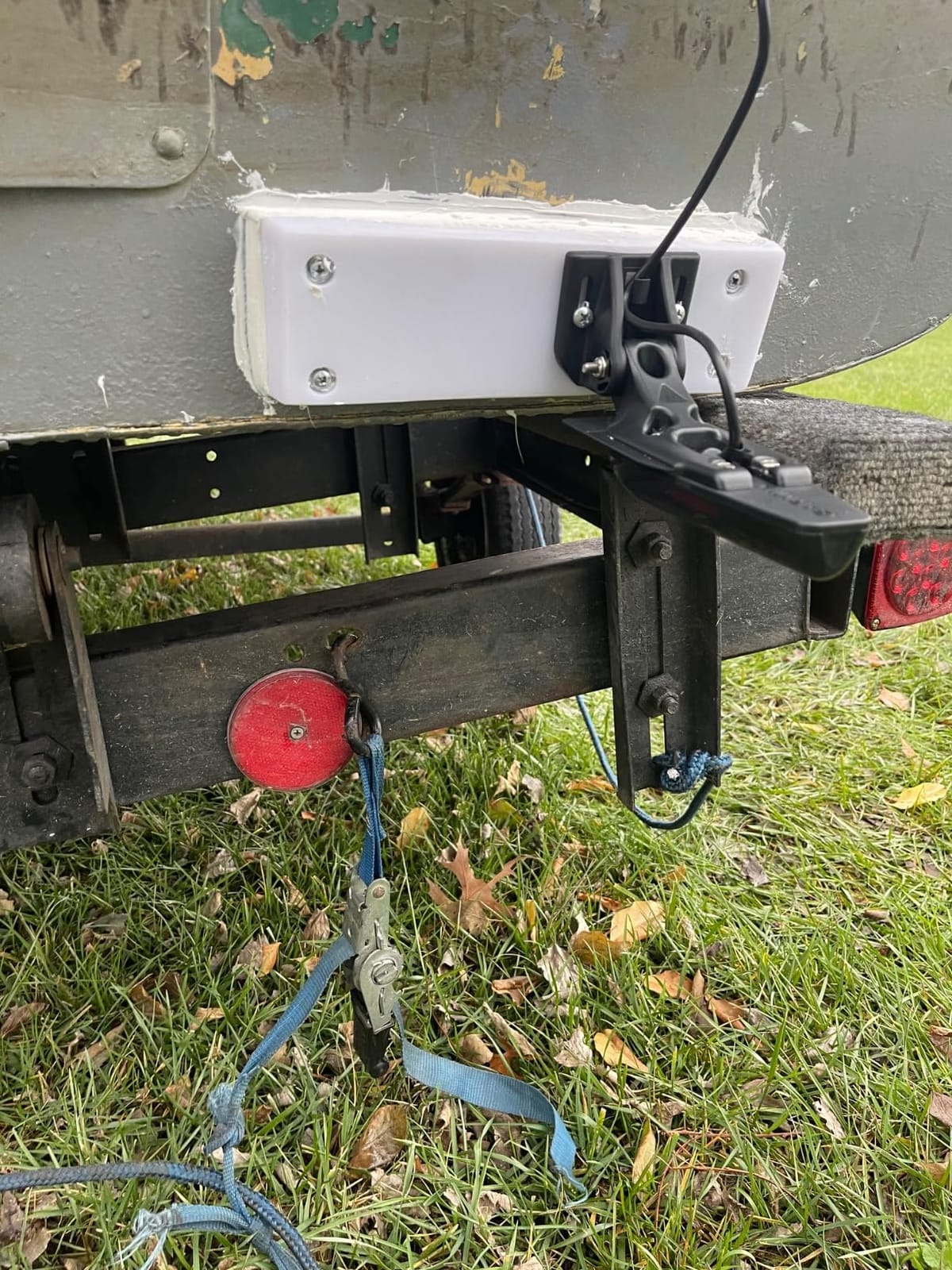
No-drill transducer arm. If you want a fixed transducer without a hole, an arm mount is the standard answer in kayak forums and pairs with a portable bundle or a tilt-swivel bracket. The transducer hangs off the arm, above and behind the kayak, clear of the hull and the paddle.
The Lowrance Eagle adds a small wrinkle worth knowing: its twist-lock connector lets the display come off while the transducer stays put, which is the most convenient arrangement here if your cockpit is tight.
Battery and Power Sizing for a Kayak Fish Finder
Battery pairing is the most-asked question in kayak fishing forums and the one no editorial roundup answers. The good news is that a portable kayak fish finder is a small load. The Garmin STRIKER 4 draws 0.23 amp at 12V, which is roughly the number you should plan around.
Here is a simple sizing method. First, find the unit’s current draw at 12V, then decide how many hours you want. Multiply the two and you get amp-hours. A 10Ah sealed lithium pack running a 0.23 amp unit gives you a very long day, and a 10Ah pack is small enough to sit in most kayak hatches behind a bulkhead or in a dry bag under the seat.
Sealed lithium-ion is the right chemistry here. It holds charge through weeks of sitting in a car, tolerates being moved around, and does not need a maintainer. Lead-acid is heavier and loses capacity as it sits, which is exactly the wrong characteristic for a boat that lives on a rack.
Two practical notes. Cold weather shortens runtime on every chemistry, and it shortens phone battery life hardest, which matters if you are using a castable phone unit. And the thin power leads on some units are the weak link mechanically, so reinforce the run where it passes a track or a hatch edge. If you are pairing a mounted unit, budget for the battery, the fuse holder and the wiring at the same time as the unit itself.
Garmin vs Humminbird vs Lowrance vs Deeper
Is Humminbird or Garmin better? For a kayak, Garmin has the edge on installed base and software, and Humminbird has the edge on simple traditional sonar. Lowrance competes hardest on screen quality and entry pricing, and Deeper sits outside the other three entirely because it has no screen of its own.
Garmin covers the widest range here, from the simple STRIKER 4 to the colour Vivid 4cv and 7cv. Its strengths are the Vivid colour palettes, CHIRP ClearVu scanning, Quickdraw Contours mapping and ActiveCaptain connectivity, plus the largest share of owner reports on kayak installs. Its weakness is the menu system, which some users find slower to learn and which can reset settings after a power cycle.
Humminbird appears once in this roundup, as the PiranhaMAX 4, and it represents the traditional approach well: dual beam, monochrome, dependable, no frills. If you want structure and depth from a permanently mounted screen and nothing else, Humminbird does that cleanly. Its limitation here is the absence of GPS and colour on this tier.
Lowrance puts its effort into the display, and the Eagle’s IPS portrait panel is the best in direct sun in this roundup. Auto-Tuning removes setup work, and the range extends from 4 inch up to 9 inch with SplitShot, TripleShot and C-MAP options. The gap is that the 4 inch model we tested has no audible alarm and no live detail.
Deeper is the castable specialist. Nothing it makes has a display, and everything it makes is lighter than the competition. The START is the accessible route, the PRO+ 2 is the enthusiast route with three beam widths and built-in GPS mapping, and both log your scans for later.
Angler forums remain genuinely split on Garmin versus Lowrance, and it is worth saying that the disagreement is usually about preference rather than performance. The recurring live debate in kayak fishing is bigger screen versus more portable, and both camps are right about their own use case.
Castable or Mounted: Which One Fits Your Kayak?
The castable versus mounted decision is simpler than most roundups make it sound. Ask one question: do you want to see the water you are sitting on, or the water you are not?
A mounted unit gives you continuous coverage under the boat, which is what you want when you are trolling, drifting, working a ledge or following a drop-off in wind. The transducer is always live, so you never stop moving to get a reading. That is the entire argument for mounting, and it is a strong one.
A castable unit gives you coverage ahead of the kayak, which is what you want when you are exploring unfamiliar water, working a specific target, or fishing somewhere your boat cannot safely go. Casting lets you check a drop-off, then paddle over and fish it. You pay for that flexibility with a phone dependency and no continuous view.
There is a third option that works for more people than they expect: owning both. A mounted screen for the water under you, a castable for the water ahead, and a phone in a waterproof case for the second screen. Anglers who end up with two units rarely say one was a mistake.
One genuine limitation on both sides is paddle speed. Side-imaging and fine scanning sonar need you to move slowly, and at kayak speed the picture can smear. A wide traditional beam is more forgiving of movement, which is part of why the dual-beam approach still has an audience.
What to Look for in a Portable Fish Finder for a Kayak
Screen size is the first filter, and the honest answer is that 4 inches is the ceiling for most kayaks. Anything larger needs a bow mount and a hull with deck space. Below 4 inches you lose detail on complex structure, which is usually the structure you most want to see.
Sonar type is the second. Traditional sonar gives you arches and depth and is cheap and reliable. Down-imaging and scanning sonar give you a picture of what is below you, which is far better for telling fish from rock. Side-imaging scans left and right, which on a kayak is useful mainly at low speed and in a tight spot, since you cannot hold a line long enough to sweep an area. CHIRP sweeps a range of frequencies in one pulse, which improves target separation and makes arches cleaner at the same price band.
GPS and mapping is the third. Built-in GPS with waypoint marking is what turns a good spot into a repeatable one. Quickdraw Contours style auto-mapping lets you record your own contours with no subscription, which is the best value in the category for anglers who fish the same water repeatedly. Preloaded charts are a separate cost and a separate decision, and the units in this roundup generally leave them out.
Power is the fourth. Castable units need no power planning beyond a phone battery. Mounted units need a sealed lithium pack sized to the current draw, and the current draw figure is worth finding before you buy anything. Water rating and cold-weather behaviour are the fifth, and a unit that works on open water in summer may disappoint you in January.
If you are still outfitting the boat, our picks for the best inflatable kayaks for two people and the best tandem kayaks for families both have the deck layouts that make a mounted display workable. Once you have fish in the boat, our guide on acclimatising new fish is the other half of the trip.
Frequently Asked Questions
What is the best portable fish finder for kayak fishing?
The Garmin STRIKER 4 is the best all-round choice. It is a 3.5 inch keyed unit with CHIRP traditional and ClearVu sonar, 1600 ft of rated depth, built-in GPS waypoint marking and a low 0.23 amp draw that runs all day from a small lithium pack. It fits a cockpit, needs no drilled hull and has the gentlest learning curve of anything we tested.
Is Humminbird or Garmin better?
For kayak fishing, Garmin wins on installed base, colour scanning sonar and mapping options like Quickdraw Contours, while Humminbird wins on simple traditional dual-beam sonar that just works. If you want structure and depth from a fixed screen and nothing else, the Humminbird PiranhaMAX 4 is a strong value pick. If you want colour, scanning sonar and the ability to record your own contours, choose Garmin.
Does a fish finder work on a kayak?
Yes, and portable units are designed for small watercraft. A transducer sends a sound pulse and measures the echo to show depth, structure and fish beneath you. The key difference on a kayak is power: a mounted unit runs off a sealed 12V lithium pack, while a castable unit needs no battery at all. Nothing in our roundup requires drilling a hull.
What is the best small fish finder for a kayak?
Among small units, the Garmin STRIKER 4 is the easiest to learn, the Lowrance Eagle 4 inch has the best screen in direct sun thanks to its IPS panel and Auto-Tuning sonar, and the LUCKY FFC1108 is the cheapest route into depth finding. Below 4 inches you start losing detail on complex structure, so that is the practical floor.
What battery do I need for a kayak fish finder?
Most portable kayak sonar draws well under one amp at 12V, so a 10Ah sealed lithium-ion pack covers a full day with room to spare and fits inside most kayak hatches or dry bags. Find the unit’s current draw, multiply by the hours you want, and size from there. Reinforce thin power leads where they pass a track or hatch edge, and expect shorter runtime in cold weather.
Do I need to drill my kayak to mount a fish finder?
No. Castable units like the Deeper START and Venterior VT-FF005 clip to a line and need no installation. Mounted units use a bail or tilt-swivel bracket on a kayak track system, a RAM ball in a standard rod holder, or a no-drill transducer arm that hangs the transducer off the deck. The LUCKY FFC1108 transducer attaches to the hull surface and reads through it.
Is a castable sonar worth it instead of a mounted unit?
Yes, if you fish unfamiliar water or water your kayak cannot safely reach. A castable sonar lets you check a drop-off, then paddle over and fish it, which a mounted unit cannot do. A mounted unit is better when you want continuous coverage under the boat while drifting or trolling. Many kayak anglers end up owning one of each.
The Verdict: Our Portable Fish Finder Picks for 2026
The best portable fish finder for kayak fishing is still the Garmin STRIKER 4, and after a season of comparing readings it is not a close call. It is small, it runs all day on a small battery, it needs no drilled hull, and it is the unit we hand to people who have never owned electronics before.
Go up one tier to the Garmin STRIKER Vivid 4cv if colour scanning sonar and Quickdraw Contours mapping matter to you and your cockpit can take 4 inches. Go sideways to the Humminbird PiranhaMAX 4 if you want dependable dual-beam structure readings without a learning curve. Go to the Lowrance Eagle 4 inch if you fish in hard sun, and to the Garmin STRIKER Vivid 7cv only if your hull has a bow mount and real deck space.
And if you would rather carry nothing bolted to the boat, the Deeper PRO+ 2 gives you three beam widths and saved structure maps for your casts, and the Venterior VT-FF005 does the same job with a screen of its own. Whichever route you take, size the battery before you order and pick a mounting method that leaves your hull alone.