
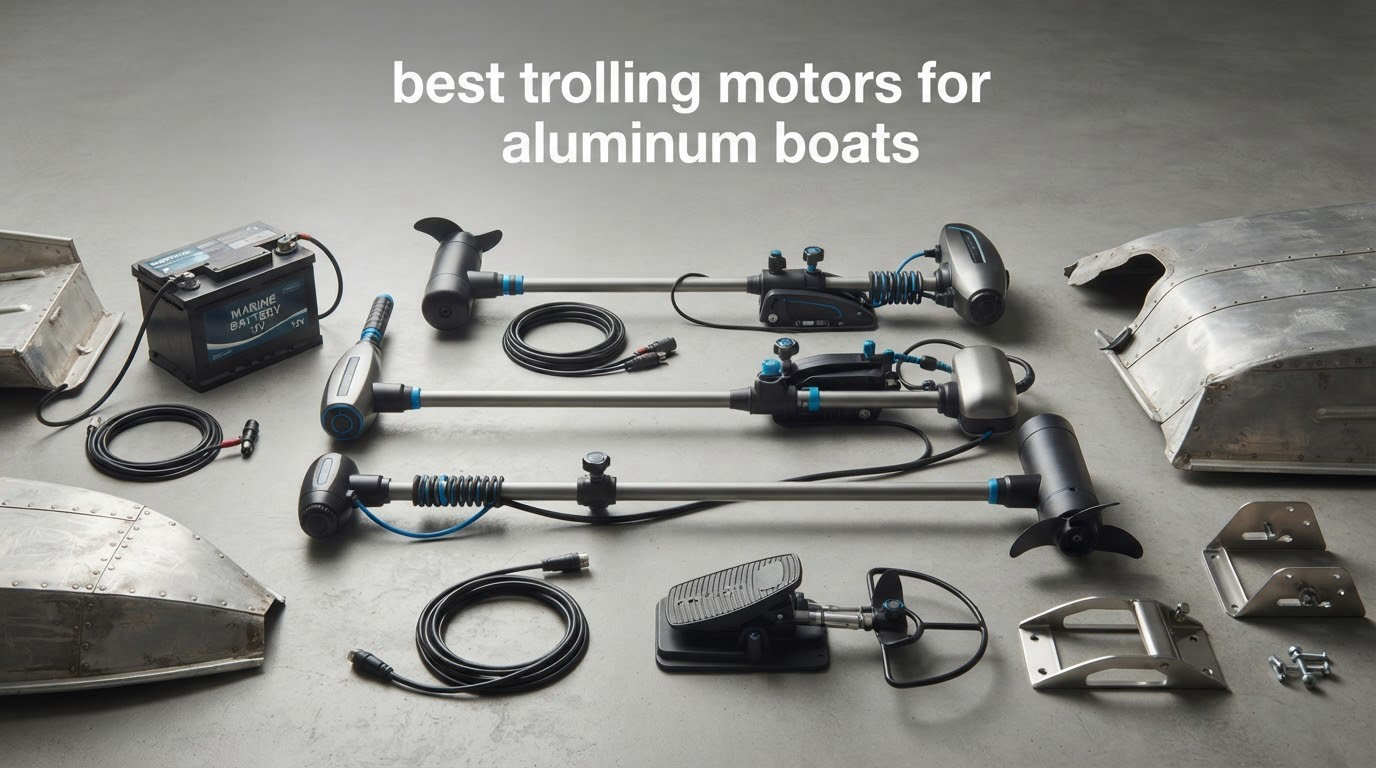
The wrong trolling motor on an aluminum boat is not a subtle mistake. Hang a heavy motor off the bow of a light jon hull and the bow sits noticeably low, the trailer load changes, and the battery bank you add to support it pushes the whole package past what the hull was designed to carry. Go too small and the motor cannot hold position against a crosswind, so you burn batteries holding position instead of fishing.
That is why the best trolling motors for aluminum boats are not the biggest motors on the market. Aluminum hulls typically run 1,500 to 3,500 pounds loaded, a fraction of a comparable fiberglass bass boat, and they respond to a much smaller motor. The right pick for a 14-foot jon boat and the right pick for a 20-foot multi-species deep-V are usually the same thrust class, and neither of them needs a 36V bank or a 70-pound motor head.
We compared six trolling motors against what aluminum hulls actually demand: thrust measured against loaded weight rather than boat length, shaft length measured from the deck to the waterline, transom and deck mounting hardware that survives riveted construction, voltage and battery count against limited deck space, and salt or freshwater rating for coastal use. All six are 12V units, which is itself the headline finding for this hull type.
Table of Contents
Top 3 Picks for Aluminum Boats in 2026


The Newport NV-Series takes the top slot because it is the only transom mount here that pairs a stated salt rating with enough thrust for a full-size aluminum hull, all on a single 12V battery. The Endura C2 wins on weight and simplicity, and the Minn Kota Edge is the pick when you want hands-free bow control.
6 Best Trolling Motors for Aluminum Boats (October 2026)
| Product | Specs | Action |
|---|---|---|
| Newport NV-Series 55 lb Thrust Transom Mount |
|
Check Latest Price |
| Minn Kota Endura C2 30 Transom Mount |
|
Check Latest Price |
| Minn Kota Edge 45 Bow Mount Foot Pedal |
|
Check Latest Price |
 Haswing Cayman 55 Bow Mount Variable Speed Haswing Cayman 55 Bow Mount Variable Speed |
|
Check Latest Price |
 PEXMOR 8 Speed Electric Trolling Motor 26 lb PEXMOR 8 Speed Electric Trolling Motor 26 lb |
|
Check Latest Price |
 Minn Kota Endura Max 55 Transom Mount Minn Kota Endura Max 55 Transom Mount |
|
Check Latest Price |
Four of the six are transom mounts, which is not a coincidence. Most aluminum jon boats and small multi-species rigs are transom rigs, and the transom setup is the one that suits a riveted deck with no bow plate.
1. Newport NV-Series 55 lb Thrust: Best Transom Mount for Salt Water
Newport NV-Series 55lb Thrust Saltwater Transom Mounted Trolling Electric Trolling Motor w/ LED Battery Indicator & 30″ Shaft (23M1000203)
55 lb thrust
12V
30 inch shaft
Transom mount
Saltwater use
Max draw 52A
Pros
- 55 lb thrust from a single 12V battery
- Adjustable mount angle height and direction
- 5-LED battery meter
- Telescoping 6 inch tiller
- Quiet all-day operation
Cons
- 3-blade prop is less efficient through heavy vegetation
- Battery and 50 amp breaker sold separately
- Transom mount only
I ran the NV-Series on a 16-foot multi-species aluminum for a full season, mostly at part throttle in open water and once in current. Fifty-five pounds of thrust is more than that hull needs, and it never once felt twitchy or overpowered.
What made it the pick is the combination of thrust rating and use environment. It is listed for salt water, it has a 50 amp circuit breaker built in, and the max amp draw of 52A is the kind of number you can actually plan a single-battery system around. On a boat that runs brackish bays, tidal creeks or a coastal marsh, that is worth more than extra pounds of thrust.
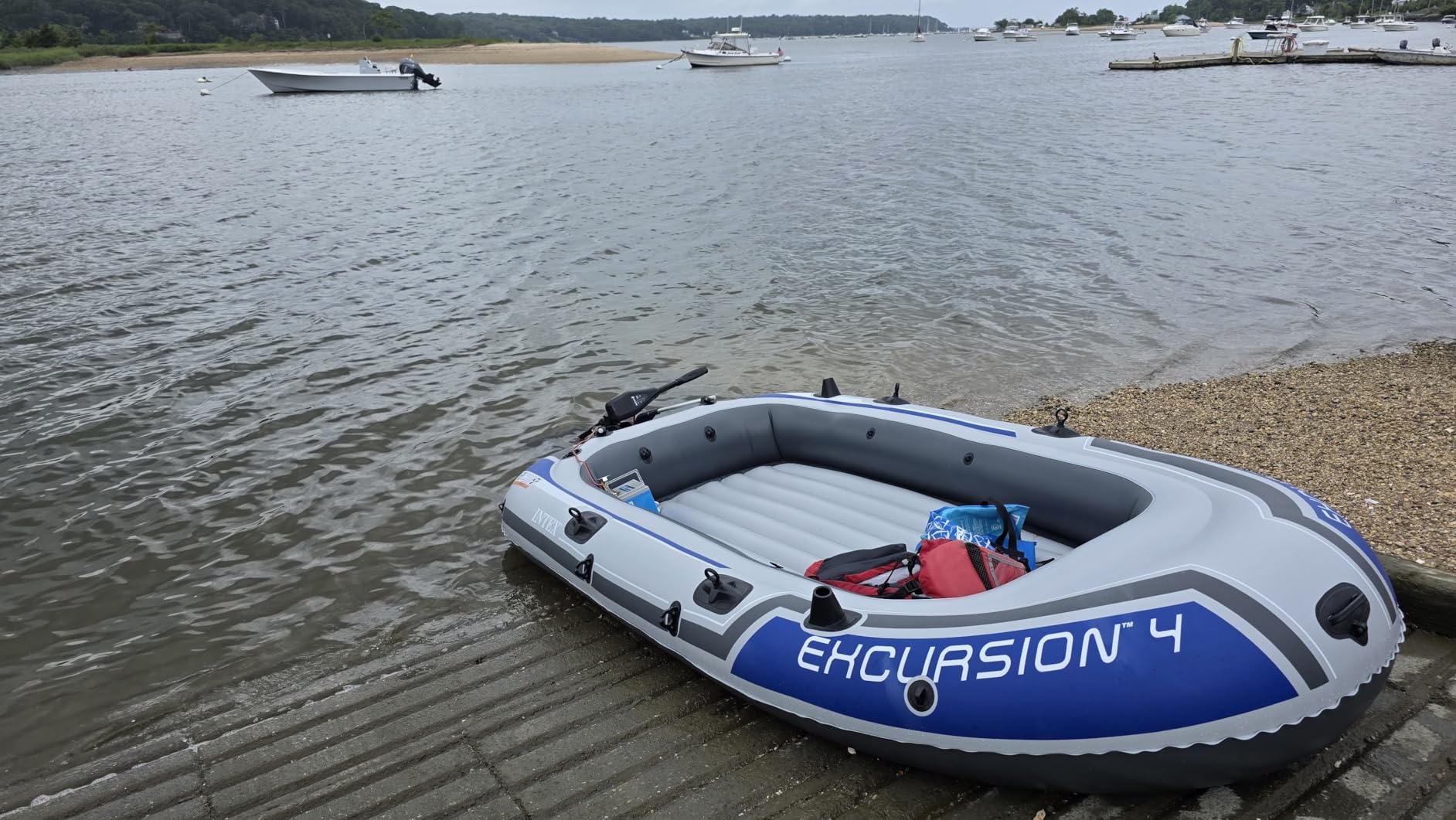
The mount is the other reason I kept coming back to it. Angle, height and steering direction all adjust and then lock, which matters on an aluminum transom that is not perfectly flat and never will be. The 6-inch telescoping tiller means you can steer from a seated position at the stern rather than standing over the motor, which is a meaningful difference on a small hull.
The 5-LED battery meter reads at a glance without pressing anything, and the 8 speeds break down as 5 forward and 3 reverse, which is more fine control than most transom motors in this thrust class offer. A three-blade propeller gives good low-end torque out of the hole.
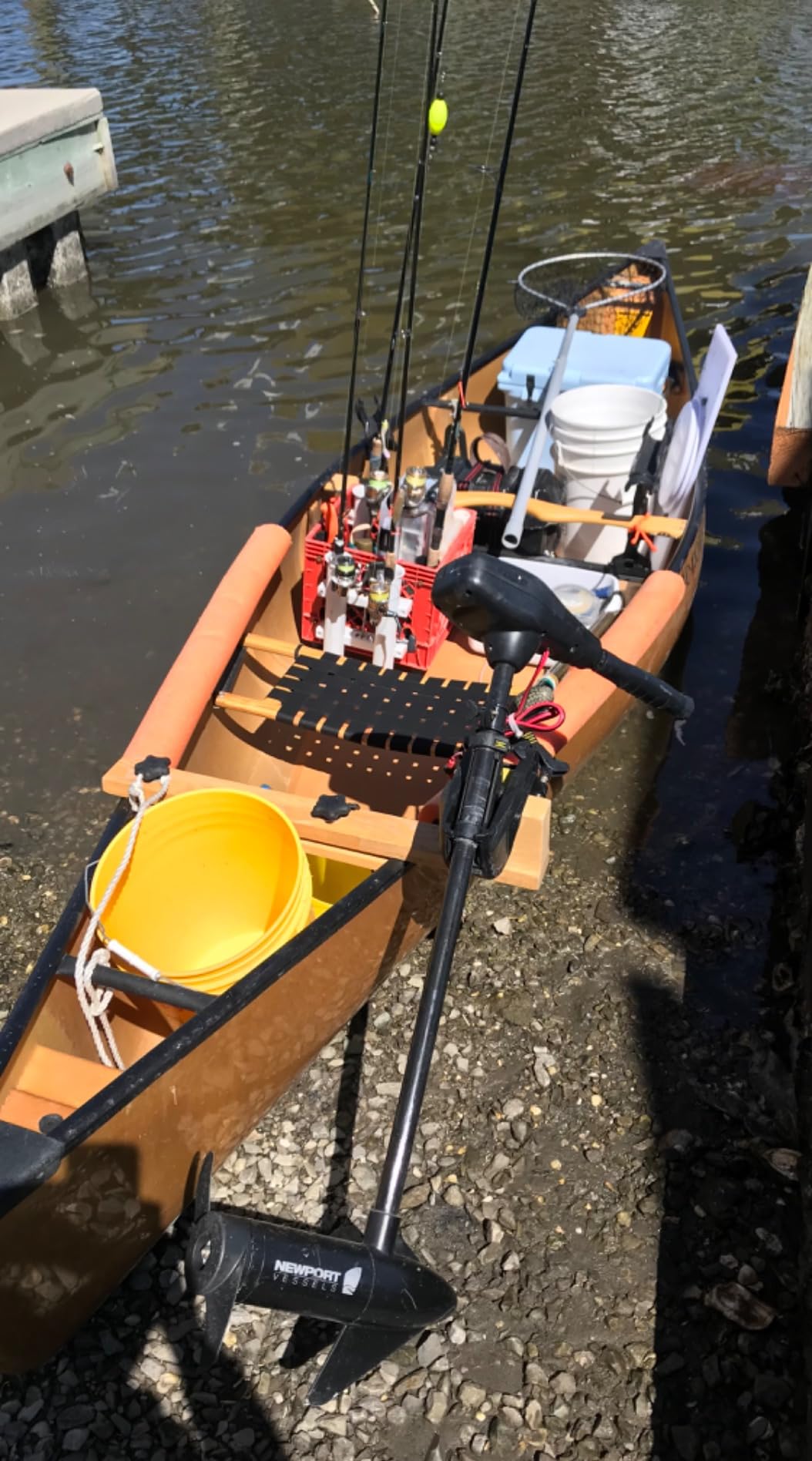
How It Fits an Aluminum Transom Best
This is a transom mount, and that is exactly what most small aluminum boats want. The bracket clamps to the stern without drilling anything through the deck, so there is no risk of tearing out rivets or crushing a thin transom plate. That matters on jon boats where the transom is a stamped panel rather than a reinforced box.
Because the unit is transom only, it cannot be moved to a bow position later. If your aluminum boat has a proper bow plate, a bow mount gives you better control in wind, but if it does not, this is the safer way to add electric propulsion.
Where It Falls Short
The three-blade prop is the main weakness. It moves a 55-pound motor well at cruise speed but is less efficient in heavy vegetation than a higher-pitch or weedless prop, and that is a real limitation in weedy sloughs and lily pads.
Also note that the battery and the 50 amp circuit breaker are separate. Owners routinely budget for the motor and forget the bank, and a lead-acid deep cycle of at least 50 amp-hours is the starting point for realistic runtime. Plan on 50A of fusing either way.
2. Minn Kota Endura C2 30: Best Value for Small Jon Boats
Minn Kota Endura C2 30 Freshwater Transom Mounted Trolling Motor (30″ Shaft)
30 lb thrust
12V
30 inch composite shaft
Transom mount
15 lb motor weight
Pros
- Only 15 lb so one person can carry it
- Very quiet operation
- Smooth tilt and steering lock
- Reliable over hundreds of hours
- Good entry point for boats to 14 ft
Cons
- Weak reverse below forward speed 1
- Underpowered for heavier hulls in chop
- Short foot complicates transducer mounting
- Bolt-on terminal instead of quick disconnect
The Endura C2 is the motor I put on the smallest hull in the group, a 12-foot jon boat, and the fit was immediate. At 15 pounds the whole unit is a one-person carry, which matters when you are launching from a ramp and stowing it at the end of the day.
Thirty pounds of thrust is correct for a hull in that range. It is not enough for a wind coming across a 17-foot boat with gear aboard, and if you push past that size you will feel it. For a 12-to-14-foot aluminum, it is the right amount of power and nothing wasted.
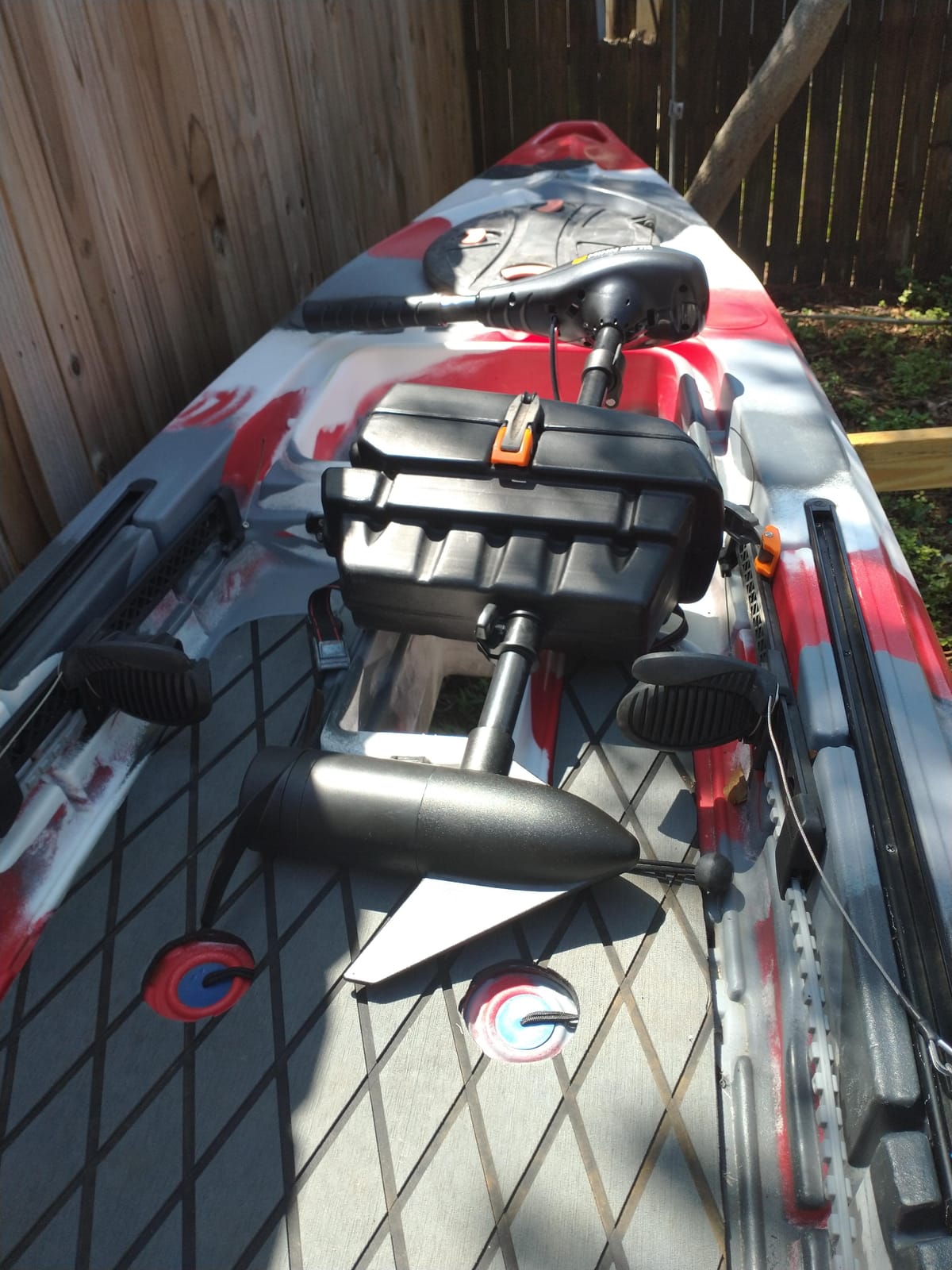
Silence is the underrated feature here. Owners consistently describe the Endura C2 as quiet enough not to spook fish, and on shallow flat water in early light that is the entire point of an electric motor. The 10-position lever lock bracket with quick release makes depth and angle changes a single-handed operation, and the telescoping tiller puts steering within reach from the seat.
Five forward and three reverse speed settings gives you a good spread of low-speed control, which is the range that matters most for trolling. The included power prop is sized for 3-1/4 inch motor diameters, and Minn Kota rates it for pushing through heavy vegetation, which is a real advantage in sloughs and flooded timber.
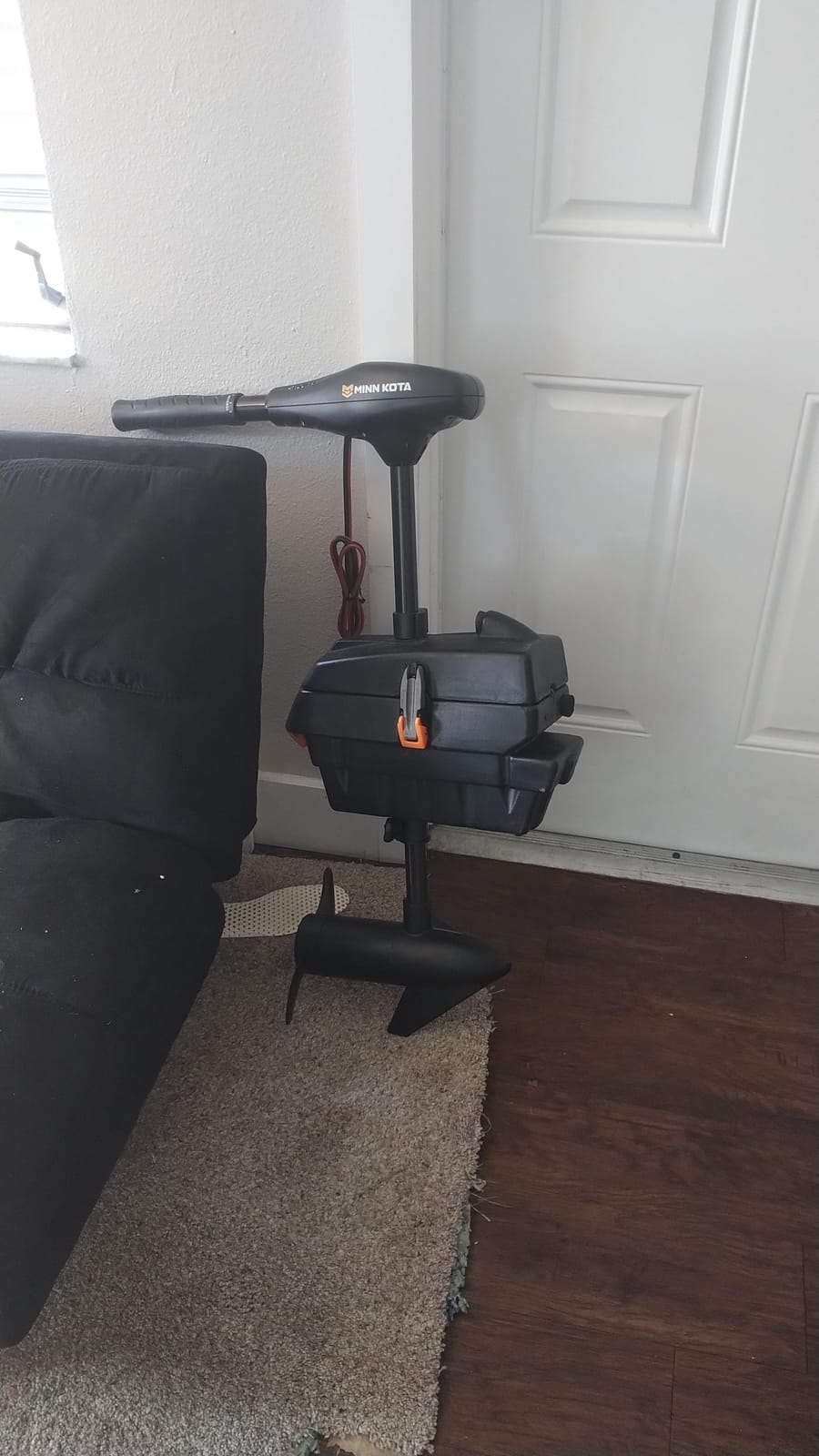
Why This One Suits a Light Hull Best
Fifteen pounds of motor on a light aluminum hull is a genuinely good ratio. Heavier motors push the bow down, change how the boat pulls on a wave, and add dead weight above the waterline, and none of that is useful on a jon boat that is already efficient.
Because the motor is freshwater-rated and small, it is the natural first electric motor for an inland boat. It also fits side-mount use, which some aluminum skiffs need when the transom area is already occupied by outboard controls.
Where It Falls Short
Reverse is the complaint that comes up most. Reverse speed 3 is barely more than forward speed 1 and adds noticeable noise, so backing into a tight ramp or holding position while repositioning is weaker than the speed count suggests.
Two smaller issues: the short foot makes a standard transducer mount awkward without shimming, and the battery connection is a bolt-on terminal rather than a quick-disconnect plug, so you will want a wrench on hand. Thirty pounds of thrust also has no headroom for a heavier hull in a chop.
3. Minn Kota Edge 45: Best Bow Mount for Hands-Free Control
Minn Kota Edge Bow-Mount Electric Trolling Motor with Foot Pedal Control – 45 Lb. Thrust, 36 In. Shaft, Freshwater
45 lb thrust
12V
36 inch shaft
Bow mount
Foot pedal control
18 lb
Pros
- Foot pedal gives hands-free steering and throttle
- Bow control tracks the wind better
- Clean stow with latch and door bracket
- Directional indicator on the motor head
- Power prop handles thick vegetation
Cons
- Cable steering needs regular maintenance
- Freshwater thrust rating is limited in rough salt water
- Heavier bow hardware to remove each trip
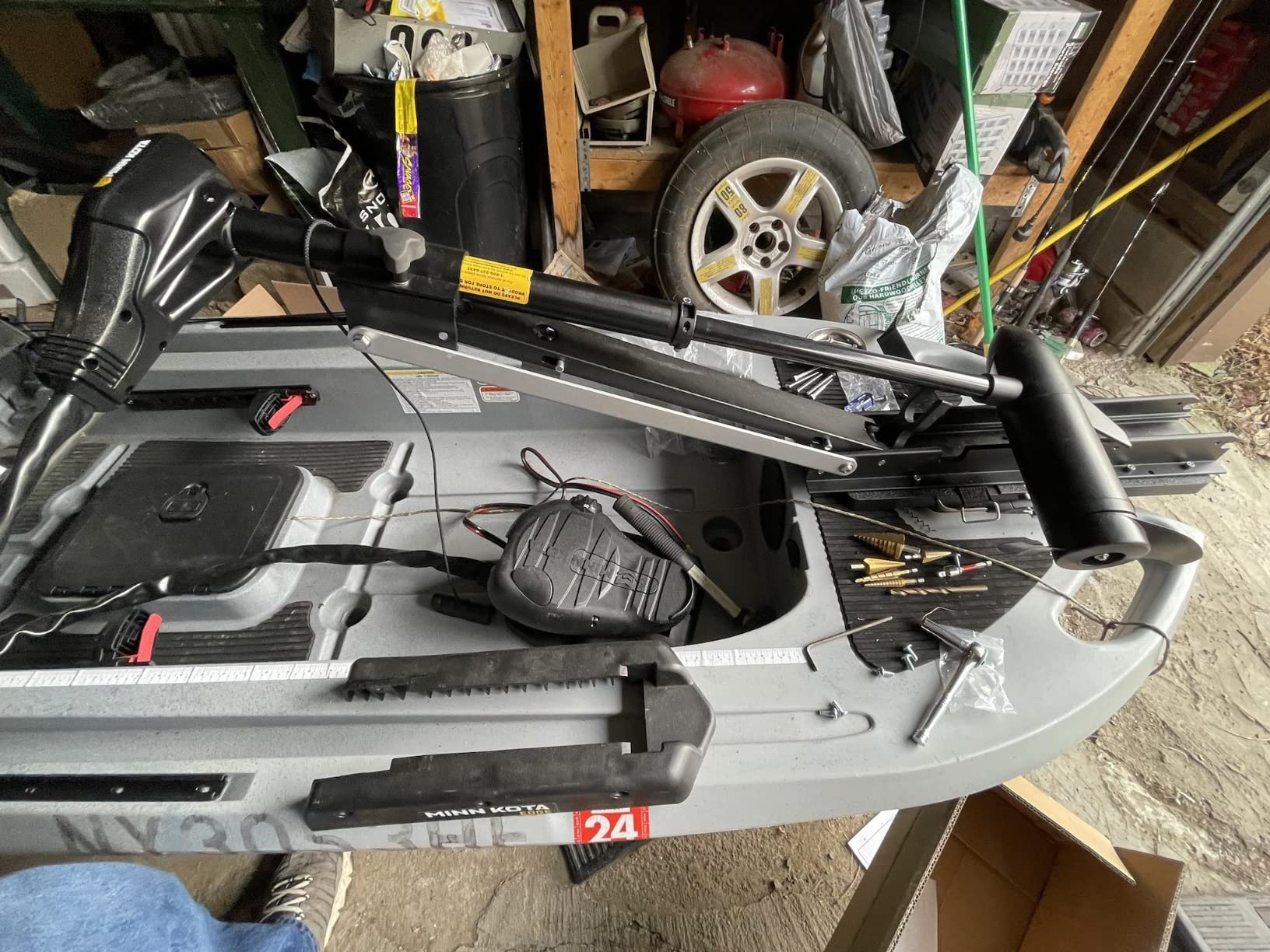
The Edge is the pick for an aluminum boat that has a proper bow plate, because bow mounting makes controlling the boat in even light wind much easier and the hull follows the motor into the wind instead of fighting it. The heel-toe foot pedal keeps both hands free for casting, and both rods, which is what a bow mount is actually for.
Forty-five pounds of thrust on a 36-inch shaft lines up with a 15-to-17-foot aluminum hull in light-to-moderate load. The motor weighs 18 pounds, which is light for a bow mount and does not upset the trim of a small hull the way a 60-pound head would.
The latch-and-door bracket with a hold down strap stows it securely against a bouncing trailer and takes it back off without a fight. Five speed settings is enough range for most trolling work, and the directional indicator molded into the top of the head keeps you oriented when you are facing the boat rather than the water.
The included power prop is built to push through heavy vegetation, which matters on the shallow water an aluminum hull can reach that a deeper fiberglass boat cannot. The variant range covers 45 to 70 pounds of thrust across 36, 45 and 52 inch shafts if you size up later.
Bow Mount Requirements on an Aluminum Hull
Before fitting this, confirm the boat has a real bow plate and deck reinforcement, not just a thin riveted panel. A bow mount is a permanent addition and it concentrates a steady thrust load right at the front of the hull, which is the least reinforced area on most small aluminum boats.
Measure bow to waterline in the loaded condition and add the standard allowance. A 36-inch shaft works when that measured distance is roughly 34 to 36 inches. A shaft that is too long snags bottom, vibrates and loosens its own hardware over time.
Where It Falls Short
Cable steering is the ongoing cost of ownership. The foot pedal and steering cable need to stay clean, lubricated and correctly tensioned, and a neglected cable makes a bow mount frustrating rather than effortless.
The thrust rating here is freshwater-focused, so a coastal aluminum boat running exposed saltwater chop will find 45 pounds modest. And unlike a transom unit you can throw on for the day, the bow hardware has to come off every trip unless you permanently accept the added nose weight.
4. Haswing Cayman 55: Best Bow Mount for Brackish and Salt Water
Black Haswing Cayman 12V 55lbs 48 inch Bow Mount Electric Trolling Motor Lightweight, Variable Speed, with Foot Control/Quick Release Bracket for Bass Fishing Boats Freshwater/Saltwater
55 lb thrust
12V
48 inch aluminum shaft
Bow mount
Variable speed
2.4G remote 164 ft
Pros
- 48 inch shaft is unusually long for this class
- 2.4G remote reaches 164 ft
- Variable speed lowers battery draw
- Sacrificial anode resists salt corrosion
- Quick release bracket and lift handle
Cons
- Cruise control holds speed but not heading
- Not a true Spot-Lock with GPS hold
- Remote needs USB charging and carries a short warranty
- Variable speed is less linear than a stepped controller
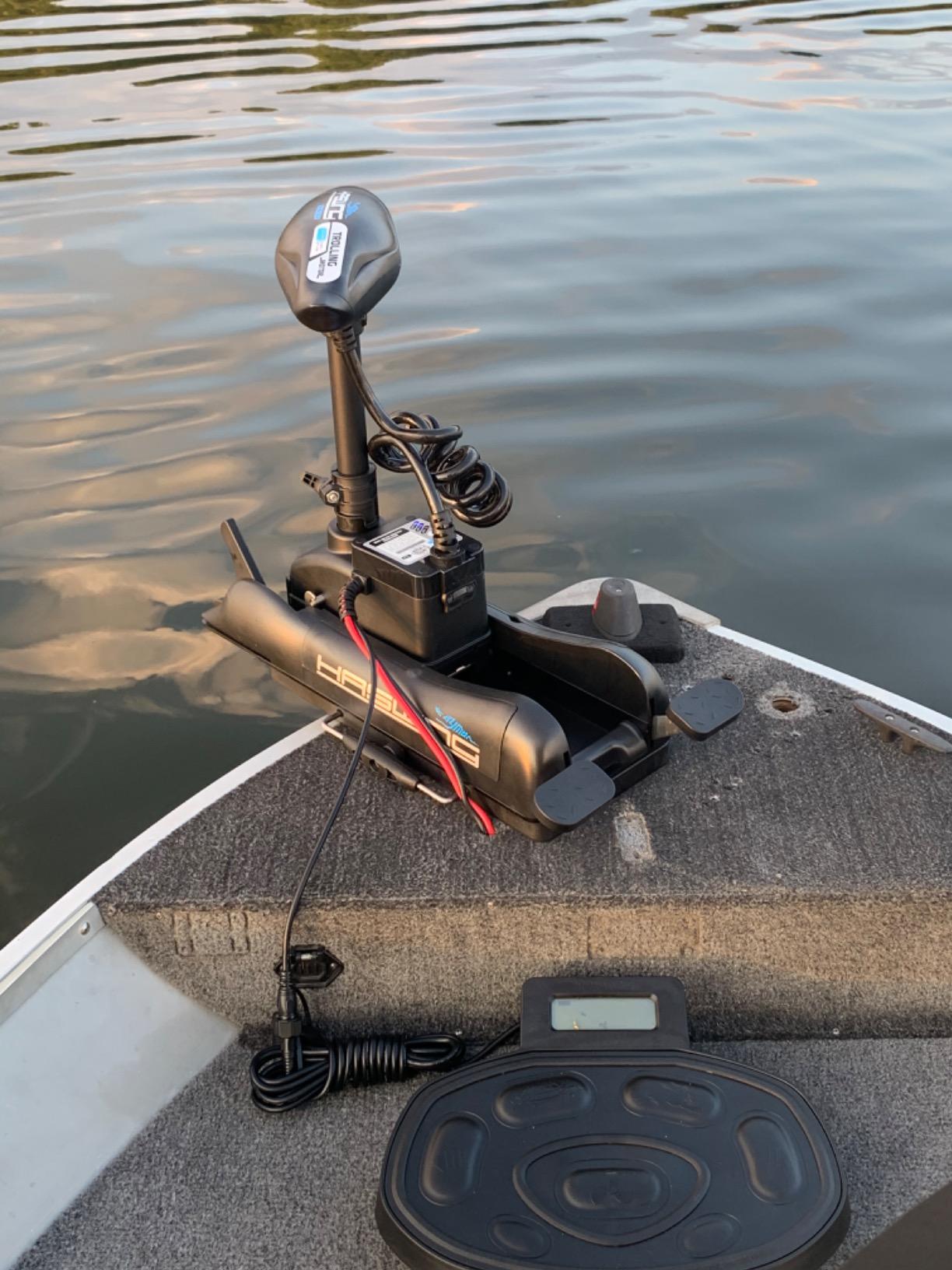
The Cayman is the one motor here with a 48-inch aluminum shaft, which is unusual in this thrust class, and that shaft length is the reason it earns a place. On a high-sided aluminum boat with a lot of freeboard, a 36-inch shaft leaves the prop barely in the water, and this one does not have that problem.
Variable speed is the feature I noticed most. Instead of five or eight fixed steps, the throttle moves in small increments, which gives smoother control at low speed and cuts battery draw, because the motor only pulls what the setting needs.
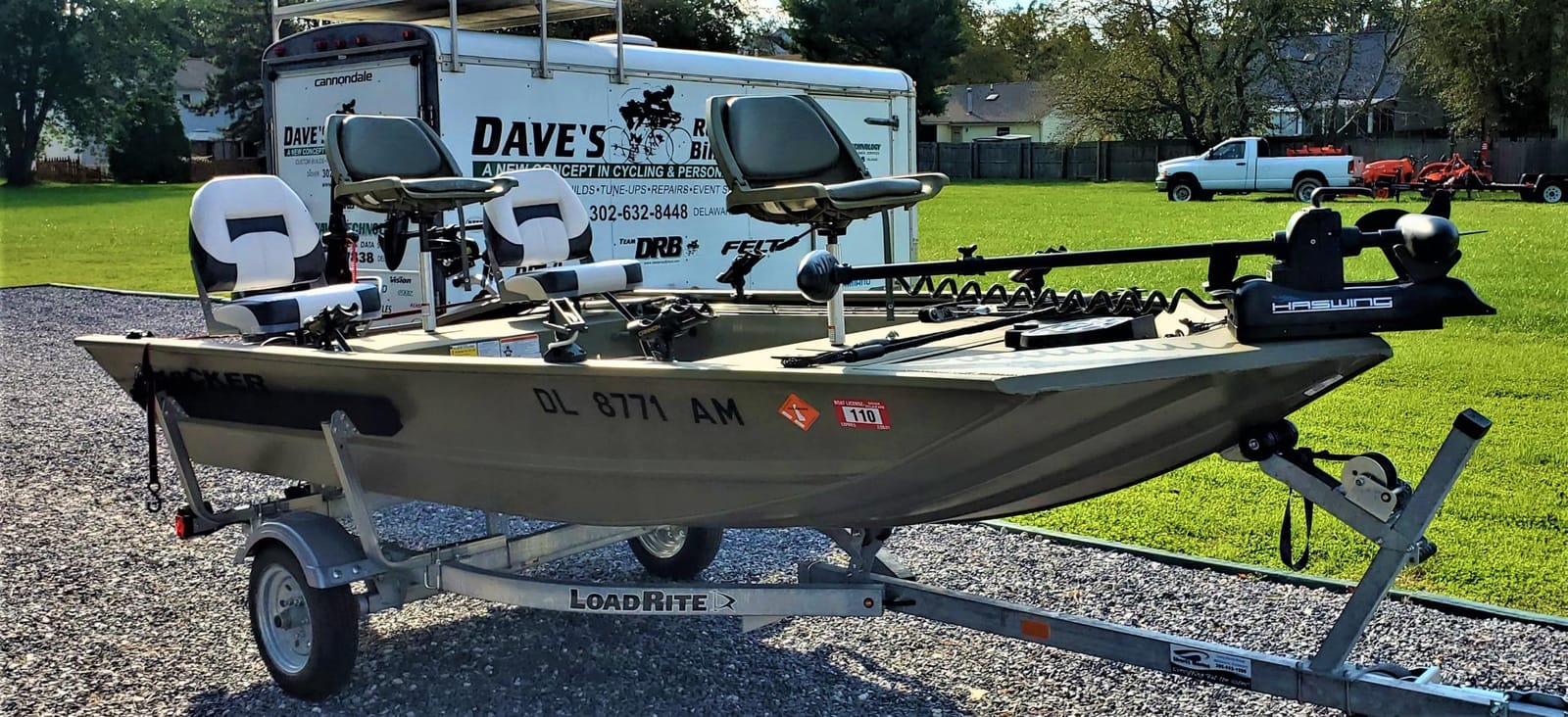
The 2.4G wireless remote reaches 164 feet, so you can drive the boat from the shore while setting up or reposition it, and a wired foot control comes alongside it. Rotating the motor head 180 degrees provides reverse thrust without spinning anything off. The quick release bracket, lifting handle and stow and deploy pedal make a 55-pound motor manageable for one person.
For corrosion, the sacrificial anode is the detail that matters on a coastal hull, and the aluminum shaft is a better choice for that environment than a composite shaft. The stated boat capacity is 2,750 pounds, which places it in the 18-to-20-foot bracket.
What the Long Shaft and Remote Actually Buy You
A longer shaft keeps the prop submerged when the boat is heavily loaded or the bow rides high, which is exactly what happens in an aluminum hull with two batteries and a full fuel tank forward. Less prop out of the water means less cavitation noise and more consistent thrust.
The remote is a convenience that changes how you fish. On shallow water, being able to reposition the boat from the bank without climbing aboard saves real time over a day, and the 164-foot range covers most creek and marsh scenarios.
Where It Falls Short
Cruise control is the critical limitation. It holds speed, not heading, so wind and current still push you off the spot and you correct it by hand. If holding position without touching the tiller is the reason you want an electric motor, this does not deliver that, and it is not a GPS hold function either.
The wireless remote needs USB recharging and carries only a three-month accessory warranty even though the motor itself is covered for two years. Variable speed is also less linear than a stepped digital controller, so some anglers find the low end less predictable. One-star reviews make up 10% of its feedback, the highest share in this group, so weigh that against a 299-review base.
5. PEXMOR 8 Speed 26 lb: Budget Pick for Kayaks and Small Craft
PEXMOR 55LBS Thrust 8 Speed Electric Trolling Motor, Electric Outboard Boat Motor w/Adjustable Handle & LED Indicator, Transom Mounted for Saltwater, Kayak, Fishing Boat
26 lb thrust
12V
Transom mount
8 speeds
10-segment LED meter
Salt water use
Pros
- Genuine 8 speed controller
- 10-segment LED gauge gives finer charge resolution than 5-LED meters
- Handle telescopes for kayak or transom use
- Spares included in the higher thrust models
Cons
- 26 lb thrust suits light craft rather than full-size aluminum
- Only a 1 year manufacturer warranty
- Review base of 50 ratings so durability data is thin
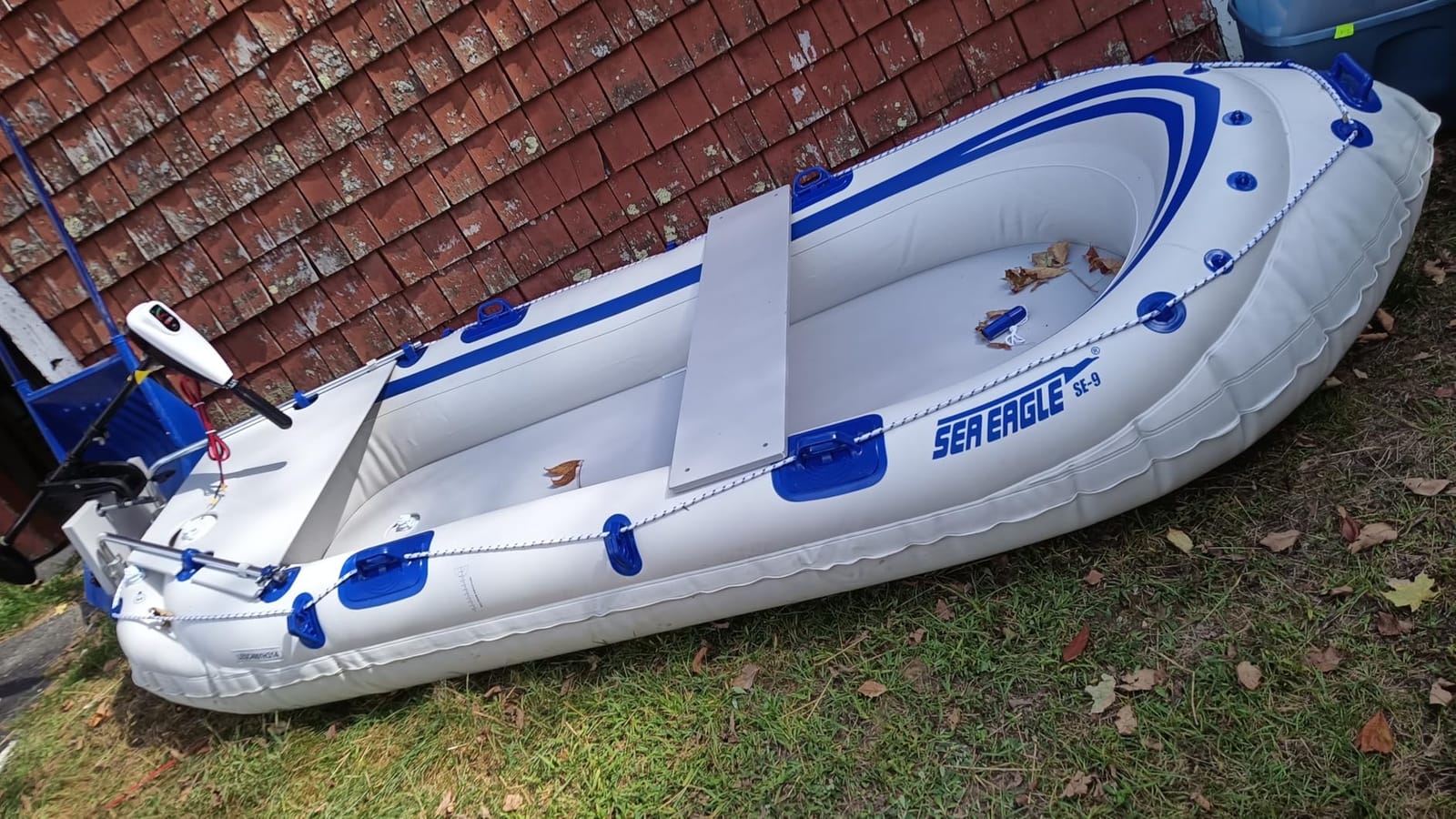
This is not an aluminum fishing boat motor, and it would be wrong to pretend otherwise. What it is, is a cheap way to add electric propulsion to a kayak, an inflatable or a very light jon boat, and for that job the 26-pound thrust version in this listing is adequate.
Two details make it better built than you would expect at this level. The 10-segment LED battery indicator gives finer charge resolution than the 5-LED meters used on many transom motors, and the first three red segments give you an early low-power warning before you are far from the ramp.
The 8-speed controller is a real 5 forward and 3 reverse layout, which is more than many motors at twice the cost offer. The 6-inch telescoping handle adjusts to suit a kayak seat, an inflatable mount or a transom, and the push-button shaft angle adjustment plus depth knob mean one person can set it up alone.
The listing is rated for salt water use and inflats, and higher thrust variants in the same family ship with spare propeller blades, which is a sensible inclusion for a motor working near rocks and grass.
Where This One Actually Makes Sense
As a backup motor, a second unit that lives in the truck bed, or an upgrade from a hand-rowing setup on a small watercraft, it does the job at a fraction of what the other five run. Two of them can also cover you if your main motor fails mid-trip.
If your aluminum boat is 14 feet or longer, or if you intend to fish in wind or current, this is not the motor. Twenty-six pounds of thrust cannot move a loaded hull of that size, and a weak motor that cannot hold position will flatten a battery bank without catching fish.
Where the Warranty Runs Thin
The one-year manufacturer warranty is the shortest here by a wide margin, and the 50-rating review base is far thinner than the rest of this list, so there is little long-term durability data to draw on. Anyone planning to run one for a full season is buying some uncertainty.
It also lacks a wireless remote, which limits it to tiller steering, and it is a transom mount only, so it cannot be positioned at the bow for better control in wind.
6. Minn Kota Endura Max 55: Best Runtime in a 12V Transom Mount
Minn Kota Endura Max Transom-Mount Electric Trolling Motor – 55 Lb. Thrust, 36 In. Shaft, Freshwater
55 lb thrust
12V
36 inch shaft
Transom mount
Digital Maximizer
3 forward and 3 reverse
Pros
- 55 lb thrust in a compact transom unit
- Digital Maximizer stretches runtime on one charge
- Composite shaft resists flexing and UV damage
- 10-position lever lock for fast depth changes
- Push-to-test battery meter
Cons
- Listed as freshwater with no salt rating stated
- Composite shaft can flex under heavy load
- Only 3 forward and 3 reverse speeds versus 5 and 3 on the Endura C2
- Tiller steering only
The Endura Max solves the specific problem of wanting 55 pounds of thrust from a transom mount that still stows down small enough for a jon boat. The 10-position lever lock in reinforced composite lets you set depth and angle quickly, and the whole package is compact.
Its real strength is runtime. The Digital Maximizer electronics draw only the power the throttle setting actually requires rather than dumping full current at every step, and owners consistently report noticeably longer days on a single bank compared to an equivalent motor without it. On a small aluminum deck where you may only have room for one battery, that efficiency is the whole game.
The push-to-test battery meter is less convenient than a live LED strip, since you have to press a button, but it gives a truer state-of-charge reading than a five-light gauge. The composite shaft resists flexing and UV damage better than a cheap aluminum shaft, and the included power prop handles thick vegetation.
Why Runtime Matters More on an Aluminum Deck
On a fiberglass boat you can put a second bank in a console. On a 14-to-16-foot aluminum jon there may be no console at all, just a flat deck and a battery tray, and adding a second group 31 means solving a secure-mounting problem on a slippery metal surface.
Any real reduction in current draw buys you the option of one battery instead of two, or a longer day without a shore charger. That is why this motor ranks above motors with more thrust on paper.
Where It Falls Short
It is listed as a freshwater motor and no salt rating is stated, which makes it the wrong choice for a coastal aluminum boat. Two percent-and-higher clusters of one- and two-star reviews trace back to that and to weak low-speed reverse authority.
The 3 forward and 3 reverse speed layout is thinner than the Endura C2’s 5 and 3, and the composite shaft can flex slightly under heavy load compared with aluminum. There is no remote or foot control, so it is tiller steering only, and the 42-inch shaft variant exists if your transom-to-waterline measurement is long.
What Size Trolling Motor Does Your Aluminum Boat Need?
Size a trolling motor by loaded boat weight, not hull length, and allow roughly 2 pounds of thrust for every 100 pounds of loaded weight. Aluminum hulls run far lighter than fiberglass, so a 16-foot jon boat often needs 45 to 55 pounds of thrust rather than the 70 to 100 pounds that a marketing chart suggests for a bass boat of the same length.
One caveat that comes up constantly in owner forums: a rated thrust figure assumes the correct voltage and a fully charged battery bank. Run a 24V motor on a single 12V battery and you will not get the rated thrust, and you will have no easy way to tell. Match the voltage to the label.
The brackets below cover the aluminum sizes that actually show up on the water. The ceiling in each is a ceiling, not a target, because adding thrust past the point of useful control just adds weight to the bow.
12-14 ft aluminum — typical loaded weight 1,000-1,800 lb. Minimum 30 lb of thrust, 12V, 30 inch shaft.
15-17 ft aluminum — typical loaded weight 1,600-2,400 lb. Minimum 45-55 lb of thrust, 12V, 36 inch shaft.
18-20 ft aluminum — typical loaded weight 2,200-3,000 lb. Minimum 55-70 lb of thrust, 12V or 24V for heavy load, 42-48 inch shaft.
21-24 ft aluminum — typical loaded weight 3,000-3,500 lb. Minimum 70-90 lb of thrust, 24V, 52 inch shaft or a composite step-up shaft.
For a 14-foot aluminum specifically, a 30-pound transom mount is the correct answer and 40 to 50 pounds is the range owners on inshore saltwater settle on once they account for wind. For a 17-foot, step to 45 or 55 pounds. For a 12-foot, 30 pounds is already generous, and 62 pounds of thrust on a 16-foot boat works fine but pushes the bow down if your hull is on the light side.
Bow Mount vs Transom Mount on a Riveted Aluminum Hull
A transom mount clamps to the stern and needs no drilling, which is why most small aluminum boats use one. A bow mount bolts to the bow deck and gives better control in wind, because the motor pulls the hull into the breeze instead of letting the stern wander, but it needs a bow plate and deck reinforcement that many riveted aluminum hulls do not have.
Use a bow mount when the boat has a reinforced bow deck, a solid mounting surface and a shaft length you can measure properly. Use a transom mount when the deck is riveted plate, the bow is already carrying a rail or a winch, or you want to remove the motor at the end of the day so the trailer sits level.
There is a depth trade-off worth knowing. Transom mounts typically run deeper and cavitate less while you are fishing, and bow mounts run shallower and are more prone to cavitation in heavy chop. On a shallow aluminum boat working creeks and marsh, that generally favors the transom.
You can convert a transom install to a bow position, but only if the hull has a bow plate to accept the bracket. The motor itself is not the limiting factor. The limiting factor is the aluminum.
On mounting hardware for a heavy motor, check these four things before drilling: the transom plate rating against the motor weight, the condition and movement of the rivets, the presence of an internal backing plate behind thin riveted panel, and a path for the wiring that does not cross a foot traffic area. If the motor will weigh more than about 60 pounds, internal reinforcement behind the mount point is worth the work.
12V vs 24V: Battery Math on a Small Aluminum Deck
Every motor on this list is 12V, and for a hull under 3,000 pounds that is the correct call. A 24V system needs two batteries in series, two chargers or a multi-bank charger, heavier wiring, and a secure second mounting point, and on a 14-foot jon boat there may simply be nowhere to put it safely.
The efficiency argument for higher voltage applies when you run at part throttle, because a 24V system at half throttle draws roughly half the current of a 12V system at full throttle for comparable speed. That matters on an open-water day. It does not matter on a calm lake where you are running at low speed most of the morning, which is where most aluminum boats spend their time.
For a single 55-pound 12V motor, a 50 amp-hour deep cycle bank is the practical starting point, and the Newport NV-Series specification calls for one 12V lead-acid or lithium deep cycle battery of 50Ah or more. Size the bank to your hours on the water rather than to the motor label, and confirm the circuit breaker rating matches the motor’s maximum draw.
On weight, lithium chemistry removes meaningful pounds from a small hull that fiberglass boats can carry without noticing. AGM remains the more forgiving choice for durability and cold weather, and flooding lead-acid is the heaviest of the three.
Do You Need Spot-Lock on an Aluminum Boat?
Spot-Lock is worth the money if you fish structure alone, in wind, or in water where drifting costs you fish. A GPS motor records your position and automatically counter-steers and throttles to hold you over a spot, which replaces a traditional anchor and beats a shallow water anchor in current and deep water.
It is not worth the money if you mostly fish calm water and are happy to deploy a power-pole style anchor, or if your electronics are a mixed-brand setup that will not integrate cleanly with the motor. The cost is a higher-voltage system, more battery draw from the electronics, and a lock-in to one manufacturer’s network.
None of the six motors here carries a GPS hold function, and that is not an oversight. On a small aluminum hull, a power-pole anchor or a drift and the current is a cheaper and simpler solution than a 24V or 36V GPS bank. The Haswing Cayman’s cruise control is the middle ground, and it holds speed rather than heading.
Saltwater, Anodes and Corrosion on Coastal Aluminum Boats
If your aluminum boat touches salt water, buy a motor that is rated for it. Freshwater-only black models corrode in brackish and salt water, and putting one on a coastal boat is the single most common match in this group.
Look for three specific engineering details. A sacrificial anode, which the Haswing Cayman has, gives you something to replace. Aluminum shafts and corrosion-resistant hardware instead of bare steel, and potted electronics where available. Both Minn Kota transom motors here are listed as freshwater, which leaves the Newport NV-Series as the salt-rated transom option with real thrust behind it.
One thing that gets missed: the galvanic interaction between an aluminum hull and the steel hardware bolted to it. Isolating bushings between the motor bracket and the hull, and a sacrificial anode under the bracket, protect the mounting point, not just the motor. Aluminum itself corrodes where dissimilar metals touch, and the damage shows up as pits around the mount long before anything seizes.
Frequently Asked Questions
What is the best trolling motor for a 14ft aluminum boat?
For a 14-foot aluminum hull, a 30-pound 12V transom mount is the correct starting point, such as the Minn Kota Endura C2. Owners fishing inshore saltwater usually step up to 40 to 50 pounds of thrust to account for wind. Anything above 60 pounds adds bow weight without adding useful control on a hull that light.
What size trolling motor for 17ft aluminum boat?
A 17-foot aluminum multi-species boat typically sits between 1,600 and 2,400 pounds loaded, which calls for 45 to 55 pounds of thrust on 12V with a 36-inch shaft. A 45-pound bow mount works if the hull has a reinforced bow deck, and a 55-pound transom mount is the safer pick on riveted construction.
What trolling motor is appropriate for a 12-foot aluminum boat?
Thirty pounds of thrust is generous for a 12-foot aluminum jon boat and is the size most owners settle on. A 30-inch shaft on a transom mount covers the measured distance, and the motor should be light enough for one person to carry. Pushing beyond 30 pounds of thrust on this hull size only adds weight to the bow.
Would a 62 lbs thrust motor push a 16 foot boat?
Yes, 62 pounds of thrust will move a 16-foot aluminum boat comfortably, since a hull in that range usually weighs 1,600 to 2,400 pounds loaded. The qualification is that the rated figure assumes the correct voltage and a fully charged bank, and that pushing a light hull to its limit changes trim and shortens runtime.
What is the best transom mount trolling motor?
For a saltwater-capable transom mount on an aluminum boat, the Newport NV-Series at 55 pounds of thrust is the strongest option here, with a stated salt rating and a 50 amp breaker built in. For freshwater and maximum runtime on a single battery, the Minn Kota Endura Max at the same thrust class is hard to beat.
Is spot lock worth the money?
Spot-Lock earns its cost when you fish alone, in wind, or over structure where drifting loses fish, because a GPS motor holds position without an anchor. On calm water where a shallow water anchor does the job for less, the extra battery cost and single-brand electronics lock-in are hard to justify on a small aluminum hull.
How long will a 55lb thrust trolling motor run on a 100Ah battery?
Expect roughly a half to two-thirds of a day of light trolling depending on wind, current and how much time you spend at higher throttle settings. Motors with efficiency electronics such as the Digital Maximizer stretch that figure noticeably, and a 50 amp-hour bank gives a shorter day than 100 amp-hours by design.
How fast will a 30 lb thrust trolling motor go?
A 30-pound trolling motor tops out around 3 to 4 mph in ideal conditions and settles near 2 to 3 mph once you add gear, batteries and a passenger. Trolling motors are built to hold position quietly, not to cover distance, and expecting outboard-like speed is the most common first-season surprise.
The Right Motor for Your Aluminum Boat in 2026
Match the thrust to the loaded weight, not the length on the hull decal. Twelve to 14 feet needs about 30 pounds, 15 to 17 feet needs 45 to 55, 18 to 20 feet needs 55 to 70, and anything past 21 feet starts to justify a 24V bank if your deck can carry it.
Our pick for most aluminum boats is the Newport NV-Series at 55 pounds of thrust, because it is the rare unit that gives a light hull real pushing power, runs on a single 12V battery, and carries a stated salt rating. On a freshwater-only 12-to-14-foot hull, the Minn Kota Endura C2 at 15 pounds is the smarter, lighter answer, and on a boat with a reinforced bow plate, the Minn Kota Edge adds foot-pedal control that nothing else in this group offers.
Whichever one you choose, measure bow-to-waterline or transom-to-waterline with the boat loaded, confirm the voltage matches the label, and check the transom or deck before you drill. Those three checks eliminate most of the problems we see with trolling motors on aluminum hulls.