
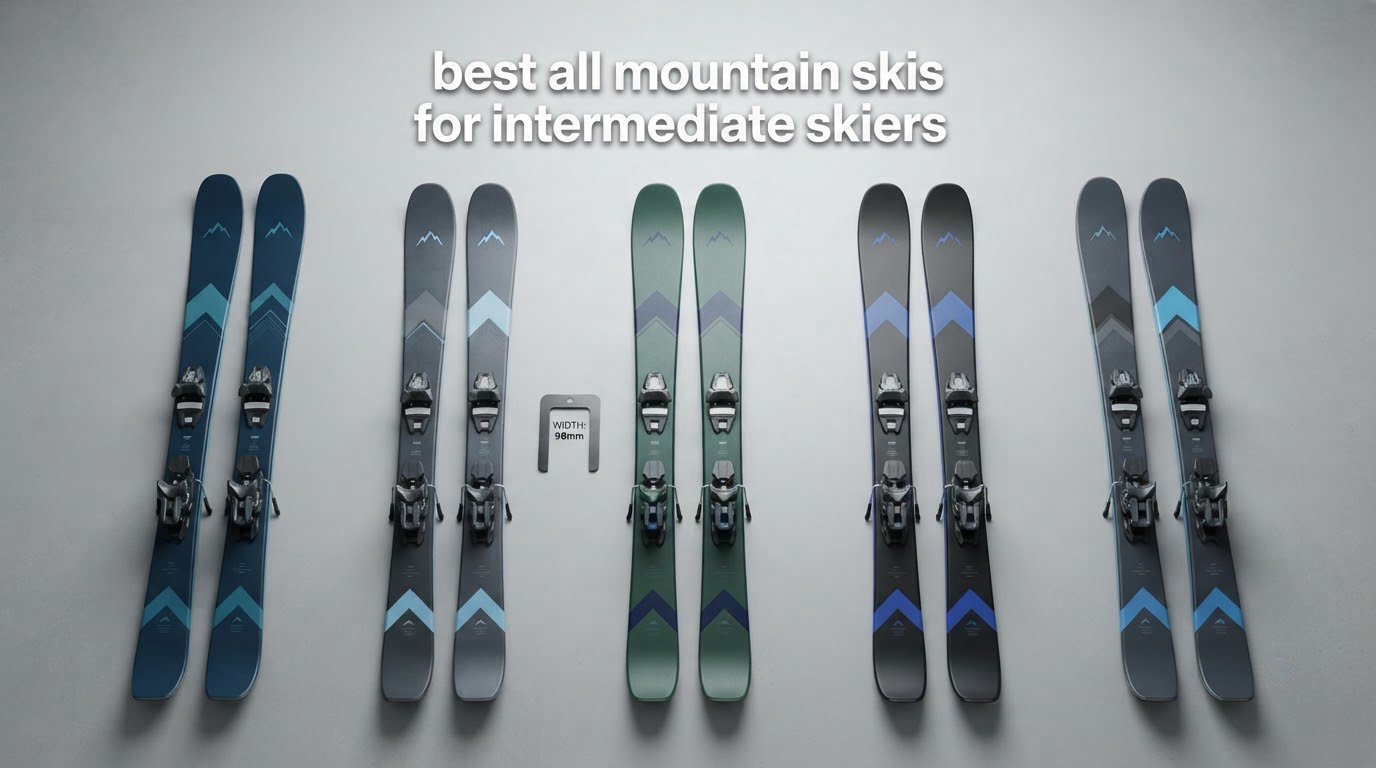
The best all mountain skis for intermediate skiers are the ones that forgive a late weight transfer without going dead when you clean up your turns. That balance is harder to buy than it sounds, because an intermediate skier is the one group whose terrain demands outrun their technique.
You can link turns on green runs and control speed through variable snow, which puts you well past the rental-lease stage. At the same time you are still learning how to pressure a ski properly, and a ski that is too stiff or too long will punish every unfinished habit. Get the width, flex, and length matched to the terrain you actually visit and the ski feels like an extension of your boot instead of a test of character.
Over a dozen skis and hundreds of listings were reviewed for this roundup, and every pick below includes an explicit disqualifier, because a ski that is wrong for you is worse than no ski at all. If you are still working out the numbers, start with the mountain bike buying guide, which covers the same spec-versus-budget logic from a different angle.
Table of Contents
Top 3 All-Mountain Skis for Intermediate Skiers in 2026
Three of the twelve skis in this roundup have enough owner feedback to give a real read on the ride, so those get the spotlight. The other nine are judged on published geometry and construction, which we flag clearly in each section.

12 Best All Mountain Skis for Intermediate Skiers (October 2026)
Every ski below is a genuine all-mountain platform. Some sit at the narrow end of the range for East Coast hardpack, others sit in the middle where a quiver of one makes sense.
| Product | Specs | Action |
|---|---|---|
| Rossignol Sender Soul Pro Xpress |
|
Check Latest Price |
 Rossignol Sprayer Pro Xpress Rossignol Sprayer Pro Xpress |
|
Check Latest Price |
 Nordica Enforcer 89 Nordica Enforcer 89 |
|
Check Latest Price |
 Atomic Bent 85 Atomic Bent 85 |
|
Check Latest Price |
 Atomic Maverick 86 C Atomic Maverick 86 C |
|
Check Latest Price |
 Head Kore 88 Ti Head Kore 88 Ti |
|
Check Latest Price |
 Volkl Mantra 84 Volkl Mantra 84 |
|
Check Latest Price |
 Volkl Blaze 86 Volkl Blaze 86 |
|
Check Latest Price |
 Fischer Curv GT 76 Fischer Curv GT 76 |
|
Check Latest Price |
 Elan Ripstick 88 Elan Ripstick 88 |
|
Check Latest Price |
 Blizzard Anomaly 88 Blizzard Anomaly 88 |
|
Check Latest Price |
 Volkl Secret 84 Volkl Secret 84 |
|
Check Latest Price |
What Intermediate Actually Means for Your Ski Choice
Intermediate is not a single ability level. It is a band roughly ten times as wide as the beginner category, and the skis that suit the bottom of it feel sluggish at the top and vice versa. Before you look at any spec sheet, place yourself honestly inside the band.
An early intermediate can link turns but still falls apart the moment the pitch steepens or the surface goes variable. Length is the biggest lever here, because a ski that overhangs your stance by too much simply will not pivot. Waist width matters too, since a wider shovel feels slower to load and harder to steer through a short radius turn.
A confident intermediate holds an edge on a steep groomer, adapts to chopped-up snow without panic, and starts choosing terrain deliberately. That skier can move up a few flex points and add a few centimeters of length without the ski punishing the transition. Most of the frustration I see in the reviews on these skis comes from early intermediates buying for the confident end of the band.
A rough calibration: if you can ski a green run top to bottom and stop on command but avoid blues, you are early intermediate. If you ski blues comfortably and moguls are your favorite run rather than your nemesis, you are confident intermediate. Buyers in the first group should weight flexibility, width below 90 mm, and shorter lengths; the second group can go wider and longer with confidence.
1. Rossignol Sender Soul Pro Xpress: The Best All-Mountain Ski for a First Real Purchase
Rossignol Sender Soul Pro Xpress – Alpine Snow Skis for Men – Downhill Skis
Poplar wood core
Glass-fiber layup
Cap sidewalls
150-160 cm
Pros
- Light and workable in most conditions
- Solid camber edge grip for carving
- Durable 3D topsheet
- Bindings included in the box
Cons
- Arrived with surface damage from loose packaging
- Sizing skews young rather than adult
- Listed as an advanced-level ski
The Sender Soul Pro Xpress is the pick I keep coming back to for anyone stepping up from a rental or a short-term beginner ski. It is the only ski in this roundup with a meaningful body of owner reviews, and at 4.5 stars across 12 reviews it also holds the highest review volume here. That combination of light weight and conventional camber is exactly what an early intermediate needs to build confidence.
Construction is straightforward and well proven: cap sidewalls with an edge-to-edge topsheet for chip resistance, a PEFC-certified poplar core, and a fiberglass layup that supplies flex and torsional resistance. Owners describe good edge grip and carving response coming from that camber-and-sidecut combination, and they repeatedly call out how light the skis feel across almost any condition.
Two things jumped out at me in the review data. First, the 3D topsheet earns its name, with owners noting it shrugs off scratches. Second, there is a consistent complaint about packaging, with several buyers reporting scratches and knicks on arrival, so inspect the skis the moment the box opens.
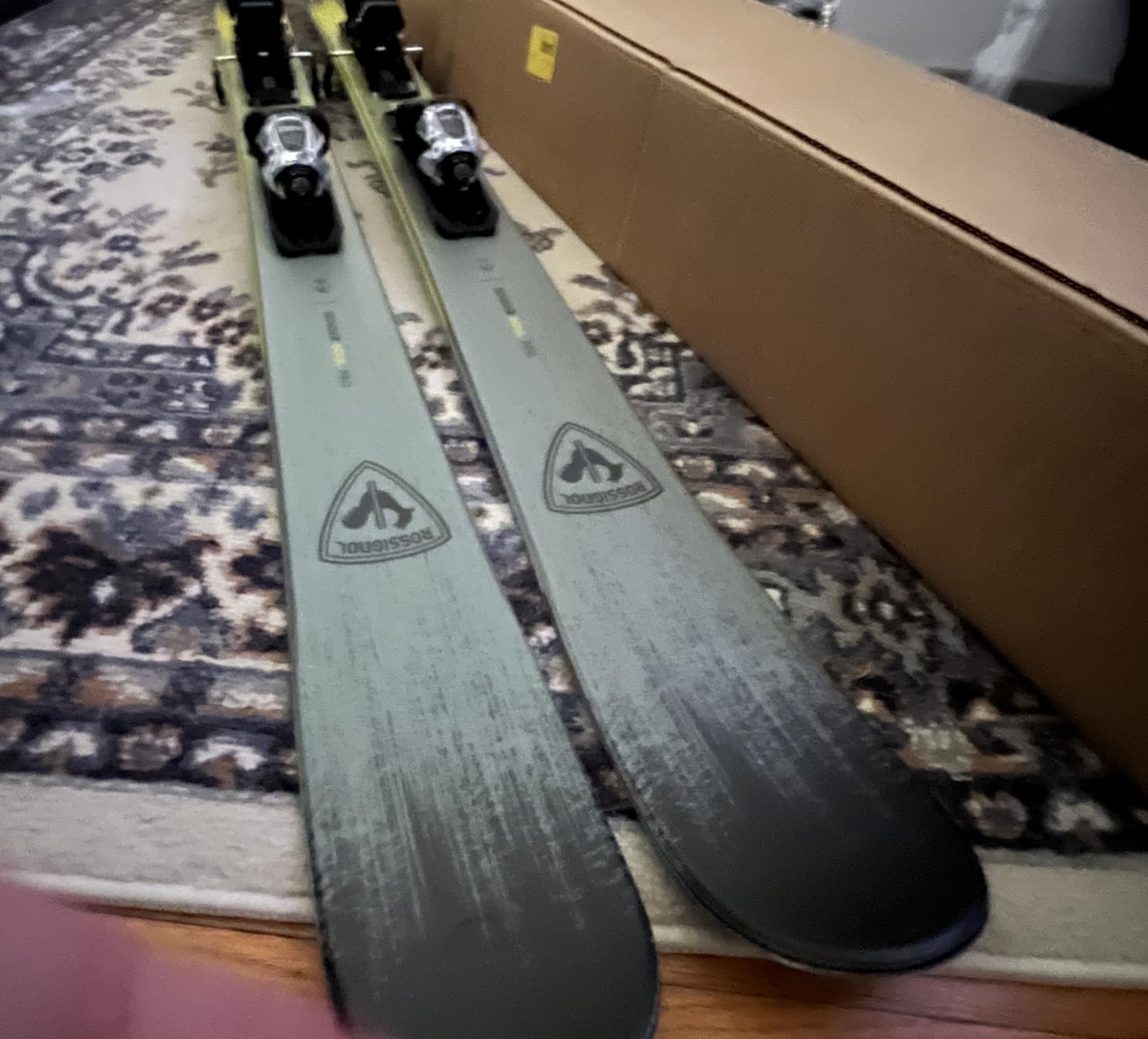
The binding situation is the quiet advantage here. This package includes a Look Xpress binding, so the total cost of getting on snow is one line item instead of a ski plus a binding system plus a mounting fee. For a first real purchase that changes the math more than any spec on the sheet.
Sizing is the real caution. Available variants run 130, 140, 150, and 160 cm, and owners specifically flagged that the fit skews toward younger and teen riders rather than full adults. Measure your boot-shell length in centimetres and check it against the size chart before you commit.
Who It Suits Best
An early intermediate on East Coast or Midwest terrain who wants a light, forgiving ski with bindings already in the box. It is also a strong option for a skier who plans to keep one ski for a few seasons rather than chase a quiver.
Who Should Skip It
Skip this one if you are a heavy adult skier who needs a stiffer platform, or if you are already an advanced skier chasing off-piste performance. The listing calls it an advanced-level ski, but the light cap-sidewall build is really a progression shape, and you would outgrow it within a season or two.
2. Rossignol Sprayer Pro Xpress: A Twin-Tip Ski That Bridges Groomers and Park
Rossignol Sprayer Pro Xpress – All Mountain Downhill Skis with bindings for Men and Women
Poplar core
Fiberglass construction
Twin-tip carving shape
178 cm only
Pros
- Twin-tip shape eases the move into the park
- Balanced flex suits all-day skiing
- Bindings included in the package
Cons
- Only one length offered
- Aimed at kid and teen age range
- Very few owner reviews to judge durability
The Sprayer Pro Xpress is built around a modern carving shape aimed directly at beginner-to-intermediate skiers, which makes it a natural companion to the Sender Soul if you want a twin tip. Owners who reviewed it rated it five stars and cited easy turn initiation and a forgiving, confidence-building feel.
The spec sheet is conventional in the best way: traditional camber, extended sidecut for edge grip and carving, and a poplar wood core for dampness and flex balance. Cap construction keeps weight down, and the listed weight of 14.5 pounds confirms it sits in the lightweight band where this segment belongs.
What makes it interesting for an intermediate is the twin-tip design. Owners specifically called out that the shape makes progression from groomers to the park easy, which matters if your terrain park ambitions are ahead of your piste technique.
Be aware of the limitations. There is a single 178 cm length in the variant list, the age range is listed as kid and teen, and only two verified reviews exist. That is a thin base of evidence, so treat this as a spec-led pick rather than an owner-verified one.
Where It Shines
This suits an intermediate who wants a single ski that can carve groomers in the morning and hit park features in the afternoon without swapping setups. The included bindings keep the package simple for a first season on real equipment.
Where It Falls Short
The single-length offering is the deal-breaker for most adult buyers. If 178 cm does not match your height and ability, or if the kid-and-teen sizing does not align with an adult frame, keep looking rather than forcing the fit.
3. Nordica Enforcer 89: Best for East Coast Intermediate Skiing
Nordica Enforcer 89 Men’s All Mountain Skis (Black/Grey/Blue, 179cm)
Metal sandwich build
Pulse Core elastomer
Unlocked tail
167-185 cm
Pros
- Metal sandwich delivers power with a damped ride
- Elastomer core smooths out vibrations
- Unlocked tail adds control at varied speeds
- Lightweight tip construction aids maneuverability
Cons
- Bindings sold separately
- 89 mm waist is less nimble in tight trees
- Only one owner review available
The Enforcer 89 is the pick for an intermediate who has moved past soft days and now deals with firm, refrozen East Coast snow. A full wood core sandwiched between two sheets of metal gives it the dampness and edge grip that hardpack demands, which is why it slots into the same conversation as the metal-layup skis experienced skiers ask for.
The Energy 2 Ti Pulse Core adds an elastomer layer that damps vibration while keeping the ride lively, and True Tip Tech cuts tip weight by extending the wood core forward for better maneuverability. The tail is unlocked with refined rocker, which improves control when you are varying speed rather than holding one steady edge angle.
Rocker geometry is marked on the base itself, which tells you the ski is designed for varied terrain rather than a single piste. With seven listed variants from 167 cm to 185 cm, sizing is unusually flexible for this price band.
The catch is that only one verified review exists. The five-star rating reflects a strong spec sheet rather than broad owner consensus, so judge this ski on the construction details and on what your home mountain actually delivers.
Why It Earns Its Place
The combination of metal sandwich construction and elastomer damping is the rare pairing that gives an intermediate both edge hold and a quiet ride over chopped-up hardpack. If your skiing involves ice patches and refrozen bumps, that damping is worth more to you than extra float.
Why You Might Pass
If your days are bump runs and tight glades rather than firm pistes, an 89 mm waist will feel slower to steer than something in the mid-80s. The ski also comes bare, so budget for a binding and a mount.
4. Atomic Bent 85: The Most Playful All-Mountain Ski in the Roundup
Atomic Bent 85 Men’s Downhill Alpine Skis (Multi, 150cm)
85 mm waist
Dura Cap sidewall
Poplar Light Woodcore
Densolite foam core
150-175 cm
Pros
- Nimble 85 mm waist built for carving laps
- Reinforced edges hold up to park rails
- Light core dampens vibration
- Many lengths and model years offered
Cons
- Bindings sold separately
- Dura Cap build is light but less stable at speed
- Very few owner reviews
The Bent 85 has a narrow, carve-first waist, and that is exactly why it is fun. An 85 mm waist with a Resist Edge Park reinforced edge gives an intermediate a ski that turns on a coin and survives contact with rail features, which is the combination most skiers in this band are actually searching for.
Construction is a poplar Light Woodcore paired with a Densolite foam core. The wood handles shock absorption and the foam adds agility plus vibration damping, which is a sensible split for a ski that has to work on piste and in the park in the same day.
The Dura Cap Sidewall runs from base to topsheet for edge grip and impact resistance. Note what that is and is not: a cap sidewall is lighter and more impact-tolerant than a full sandwich, but it gives up some of the high-speed damping you would get from metal layers.
With seven listed variants spanning model years and lengths from 150 cm to 175 cm, this is one of the easiest skis in the roundup to size. The single five-star review is too small a sample to read anything into, so the spec sheet is doing all the work here.
Best Fit for an Intermediate
An intermediate who skis mostly groomers, likes short radius turns, and wants a ski light enough to throw around in bumps. The reinforced edge means you can progress into small park features without buying a second pair of skis immediately.
Where It Falls Down
If you want a ski that stays composed on long, steep groomers, a cap sidewall without metal is the wrong platform. A metal sandwich construction such as the Volkl Mantra 84 or the Blizzard Anomaly 88 is the better fit.
5. Atomic Maverick 86 C: Best All-Condition Balance for Intermediates
Atomic Maverick 86 C Men’s Downhill Alpine Skis (Sage/Black, 179cm)
86 mm all-mountain waist
HRZN 3D reinforcement
Carbon Backbone
Poplar Light Woodcore
153-179 cm
Pros
- Carbon Backbone holds weight down without losing stability
- HRZN 3D adds float in deeper snow
- Balanced 86 mm platform for mixed conditions
- Wide range of lengths
Cons
- Bindings sold separately
- No owner ratings yet
- Carbon reinforcement tends to firm up the flex
The Maverick 86 C is the most evenly rounded geometry in the roundup, and the manufacturer’s own summary calls it balanced all-mountain confidence with intuitive handling for any conditions. An 86 mm waist sits close to the middle of the all-mountain range, which makes it the safest choice for a skier who has not yet decided which part of the mountain they like best.
The interesting engineering is the HRZN 3D Maverick/Maven reinforcement with wood through the shovel, which adds stability and deep-snow float without pushing the waist any wider. Underneath it runs a full-length Carbon Backbone insert, a stabilizing strip that keeps the weight down.
Seven variants run from 153 cm to 179 cm, and the ski carries a 2 Year Limited Manufacture Warranty. That is the broadest length range in the roundup, which makes it forgiving to size.
There are no customer ratings or reviews for this listing, so this assessment rests entirely on the published construction. Know that carbon reinforcement firms up the flex compared with an all-wood build, which matters if you are at the early-intermediate end of the band.
Why It Fits a Progressing Skier
The 86 mm platform handles groomers, a few inches of fresh snow, and tree runs without forcing you to compromise on one of them. It is a sensible one-ski quiver for a skier who wants to stop thinking about equipment and start picking lines.
Why You Might Pass
If you are an early intermediate still building turning confidence, the carbon-backed flex may feel more demanding than the all-wood alternatives. And with zero owner feedback, this is a spec-led choice, so demo it if your local shop offers that.
6. Head Kore 88 Ti: Best for Ice, Hardpack, and Long Groomers
Head Kore 88 Ti All-Mountain Alpine Skis (Black/Green, 170cm)
Freeride sandwich cap
Karuba-beech core
Graphene reinforcement
156-184 cm
Pros
- Tip-tail rocker improves float and forgiveness
- Sandwich cap with titanal and wood feels lively
- Karuba-beech core keeps weight down
- Four lengths offered
Cons
- Bindings sold separately
- No customer ratings yet
- Rocker can feel vague on perfect pistes
The Kore 88 Ti is a freeride sandwich cap build with a Hybrid Top Surface, Graphene reinforcement, and a Karuba-beech wood core, finished on a structured sintered base. It is listed as an intermediate-level ski, and the 55 percent camber under the bindings gives it more of an on-piste identity than a pure freeride shape would.
Tip-tail rocker handles variable snow and deep-snow float well, which is the part of the design that serves an intermediate directly. When snow is chopped up or soft, the rocker keeps the tips from diving and makes turn initiation easier.
The catch is that tip-tail rocker plus camber underfoot is a specific balance, and it is not the balance a skier who grew up on full-camber piste skis expects. Owners of similar shapes often describe the early-season feel as vague until they adapt to the softer, more surfy turn shape.
Four lengths from 156 cm to 184 cm cover a wide ability range, and there are no customer reviews for this listing, so the construction details are the whole evaluation.
Best for Firm Terrain and Variable Days
If you ski a coast with hard snow and occasional deep dumps, the rocker-plus-camber combo handles both without a swap. Graphene reinforcement and a sintered base also give it a durable, fast-gliding package for regular use.
Why Kore 88 Ti Is Not for Everyone
Skip it if you want razor-sharp edge-to-edge response on perfectly groomed pistes and prefer maximum pop. Also skip it if you are an early intermediate who needs immediate edge engagement, since rocker asks for a different timing.
7. Volkl Mantra 84: Best for Carving Groomers With a Short Radius
Volkl 84 Mantra Skis 2026
129/84/110 mm
Multi-radius sidecut
Titanal frame with carbon
Multilayer woodcore
163-184 cm
Pros
- Narrow 84 mm waist carves tightly
- Multi-radius tuning in every length
- Rocker with camber underfoot for versatility
- Titanal frame with carbon damps chatter
Cons
- Bindings sold separately
- Listed as an advanced-level ski
- No customer reviews yet
The Mantra 84 sits at the carve-first end of this roundup, and its 129/84/110 mm dimensions tell the whole story: this is a carving ski that happens to have tip and tail rocker for the days when the piste is not a piste. The manufacturer’s highlight calls it sporty carving precision with freeride versatility, and the shape backs that up.
What makes the geometry interesting is the multi-radius sidecut, tuned separately for every length. At 170 cm the three radii are 26.3 m, 14.7 m, and 23.3 m, which means the ski has a tight upper section for short turns and a wider base section for long arcs. That is a genuinely different feel from a single-radius design.
Construction is a two-layer tailored Titanal frame with carbon over a multilayer woodcore. Titanal is the reason this ski will feel planted and quiet at speed, and it is the metal-in-the-core construction experienced skiers ask for when they want dampness.
Profile is tip and tail rocker with camber underfoot, which gives edge grip on groomers and forgiveness in softer snow. Four lengths run from 163 cm to 184 cm, and there are no customer reviews for this model year yet.
Where It Excels
A confident intermediate who carves for a living on groomers and wants an 84 mm waist for maximum edge-to-edge speed. The multi-radius geometry also makes it forgiving in a short turn, because the tight upper section does not fight your crossover.
Why It Might Not Fit
The listing marks this as an advanced-level ski, and an 84 mm waist is unforgiving if you spend time in powder or deep variable snow. Early intermediates should step up in width rather than down.
8. Volkl Blaze 86: Best Lightweight Ski for Bumps and Tight Trees
2025 Volkl Blaze 86 Skis
86 mm all-mountain waist
Milled multilayer woodcore
Hybrid resort-touring platform
173 and 180 cm
Pros
- Milled core keeps weight down for tight spaces
- Quickness in bumps and tight trees
- Platform marketed to intermediate skiers
- Runs true to size
Cons
- Only two lengths offered
- Bindings sold separately
- No customer reviews available
The Blaze 86 is built explicitly for an intermediate who spends the day on small terrain, and its milled construction is the reason. A multilayer woodcore is milled along the bottom to strip weight without losing the pop that makes a bump ski work.
The marketing positions it as a hybrid resort and touring platform, which means it is designed to open up off-piste when the conditions justify it while still behaving on the piste. That is a useful double duty for a skier who wants one pair of skis.
Construction is polyurethane with a lightweight core-milled layup, and the sizing guidance is true to size per the manufacturer. Available variants are 173 and 180 cm, and the ski carries a 1 Year warranty, the shortest warranty in this group.
There are no customer reviews for the 2025 Blaze 86, so the evaluation rests on the editorial and manufacturer description of a lightweight, quick-on-feet platform.
Ideal for Moguls and Forest Trails
If your days are bump runs, glades, and short tree lines, a lightweight core is the single most valuable trait a ski can have. It reduces the effort needed to initiate a turn, which is exactly what tight spaces demand.
Limits to Know
Two lengths is a narrow window, so check that your height falls between them. The ski is bare, and if you plan to use a touring setup you will need compatible bindings and a wider stance than a resort-only ski.
9. Fischer Curv GT 76: Most Versatile for Groomer Days
FISCHER Men’s The Curv GT 76 Snow Sports Versatile Maneuverable Responsive Alpine All Mountain Skis with RSW 10 GW Powerrail Brake 85 [G] Bindings Included, 166 cm
E-Triple Radius sidecut
76 mm waist
Poplar core with Diagofiber
Titanal reinforcement
159-173 cm
Pros
- RSW 10 GW bindings included
- Titanal reinforcement for edge grip and rebound
- Poplar core reduces fatigue
- Sintered base for wax retention
Cons
- Listed weight figure looks inconsistent
- 76 mm waist is narrow for variable snow
- No customer reviews yet
The Curv GT 76 is the value pick in the roundup, largely because the package arrives complete. RSW 10 GW Powerrail Brake 85 bindings are included, so the cost of getting on snow is a single purchase rather than three.
The E-Triple Radius sidecut is the feature to understand here. Three separate radii across the running length mean the ski has a very tight section that makes it easy to steer through short turns while a longer section keeps it stable when you straighten out. That geometry is how the manufacturer describes its agility in transitions.
Construction adds titanal reinforcement for edge grip and rebound, a poplar woodcore for power transfer at low weight, and Diagofiber for torsional stability. The base is sintered, which holds wax better than an extrud base and matters if you care about consistent glide.
Two cautions. The listed weight of 15 kg appears inconsistent with a single pair of skis, so verify that figure with the retailer before you rely on it. And a 76 mm waist is genuinely narrow, which makes this a groomer tool rather than a quiver of one.
Best Value for Groomer-Centric Intermediates
If your skiing is hardpack and crisp mornings on a local hill, a 76 mm waist carves beautifully and included bindings keep your budget intact. The triple-radius sidecut also makes it forgiving while you are still building turn shape.
Why It Falls Out of Contention
Variable terrain will punish the narrow waist. If your mountain has deep snow and long runouts, you are wasting money on a platform built for the wrong job, and the listing weight discrepancy is worth raising before you buy.
10. Elan Ripstick 88: Premium Pick for a Complete Package
2026 Elan Ripstick 88 Skis with Bindings – 175 cm
130/90/108 mm
Amphibio rocker-camber profile
Tubelite core with carbon
Attack 14 GW bindings
168-182 cm
Pros
- Matched Tyrolia Attack 14 GW bindings
- 90 mm waist handles confident frontside carving
- Carbon tubes keep weight low
- Full-release toe with antifriction slider
Cons
- Listed as an advanced-level ski
- Brand detail page reads as generic
- No customer reviews yet
The Ripstick 88 package is the most complete setup in the roundup because it comes complete with the Tyrolia Attack 14 GW binding system, factory-matched. For a buyer who wants a single purchase that works on-piste and can handle touring bindings later, that removes an entire step from the process.
The dimensions are 130/90/108 mm and the profile is Amphibio rocker-camber. Amphibio means the rockered section is limited to the tip, so you keep camber underfoot for frontside edge hold while the tip still floats in softer snow. That is the best compromise for an intermediate who wants both.
The core is Elan Tubelite wood with full-length carbon tubes, listed at 1600 g. The binding specification is the highest DIN range here at 3.5 to 14 with a 17 mm stand height and an FR Pro3 full-release toe plus AFS anti-friction slider.
Two things temper the recommendation. The listing is rated as an advanced-level ski, and 14 DIN bindings are demanding for a true beginner. The detail page is also branded generically rather than clearly as Elan, so confirm with the retailer that you are receiving the ski you researched.
Who Should Buy This
A confident intermediate who wants a wide-ish, complete package with a proven binding system and does not want to shop for a separate mount. The 90 mm waist is a sensible middle of the all-mountain range.
Who Should Look Elsewhere
An early intermediate should start softer and narrower than a 14 DIN advanced-rated platform. And if brand consistency matters to you for warranty service, the generic listing detail is a real question to ask before checkout.
11. Blizzard Anomaly 88: Best for Advancing Past Intermediate
Blizzard Anomaly 88 Men’s All-Mountain Skis, Blue/Gold, 176cm
127.5/88/109.5 mm sidecut
6 mm camber with early rise
2Ti plus FluxForm
Trueblend woodcore
164-188 cm
Pros
- 88 mm waist balances hardpack and off-piste
- Early rise tip and tail ease turn initiation
- Titanal adds stability and dampening at speed
- Flat construction accepts any binding
Cons
- Bindings sold separately
- Most expensive ski in this group
- No customer reviews yet
The Anomaly 88 is the one to buy if you expect to outgrow an intermediate ski in a year or two. The sidecut is 127.5/88/109.5 mm, which gives you a full 109.5 mm tail to work with when the snow goes deep, while the 88 mm waist keeps edge-to-edge speed respectable on hardpack.
Construction is 2Ti plus FluxForm with a Trueblend all-mountain layup over a Trueblend woodcore. That is a metal-heavy build, and metal is what delivers the dampness and high-speed stability that make a ski feel composed rather than nervous at velocity.
The profile is an all-mountain early rise tip and tail with 6 mm of camber underfoot. Early rise means the rocker starts lower on the tip than a full tip rocker, which preserves more of the camber platform and therefore more edge bite in firm conditions.
Construction is flat and interface-free, so it accepts any binding you choose. Nine listed variants run from 164 cm to 188 cm, giving you a wide fit window. There are no customer reviews, so this is a spec-led pick.
Built for Progression
The 88 mm waist with a wide tail means you can ski firm pistes on Saturday and tracked-out powder on Sunday without changing equipment. The metal build also grows with you as your speed and aggression increase.
Why You Might Skip It
This is the most expensive ski in the roundup and bindings are extra, so the total package cost is the highest on the list. It is also an advanced-rated platform, which makes it a poor choice for an early intermediate.
12. Volkl Secret 84: Best for Women Intermediates Building Technique
2025 Volkl Secret 84 Women’s Skis
84 mm waist
Fiberglass frame
Multilayer woodcore
Tailored carbon tips
154 cm
Pros
- Built for intermediates rounding out technique
- Lightweight fiberglass frame feels lively
- Woodcore and carbon from the premium Mantra line
- Accessible performance band
Cons
- Only offered in a single 154 cm length
- Bindings not included
- No customer reviews available
The Secret 84 is positioned explicitly for intermediate and advanced women skiers who are rounding out their technique, and the design choices back that up. A fiberglass frame replaces the Titanal used on the wider Mantra models, which reduces weight and adds a poppy, energetic feel.
Underneath it is a multilayer woodcore shared with the wider Mantra models, plus Tailored Carbon Tips, so you get premium core and tip construction from the brand’s higher range without paying for the metal layers an advanced-rated ski would carry.
Construction is polyurethane, sized true to size per the manufacturer guidance, with a 1 Year warranty. The accessible performance band is the point: this is a ski you grow into rather than one you quickly outgrow.
The hard limitation is sizing. The Secret 84 is listed in a single 154 cm length, which will fit some skiers and none of the rest. There are also no customer reviews for the 2025 model, so treat the manufacturer positioning as the basis for the evaluation.
One more practical note before you commit. The ski arrives bare, so add a binding system and a mounting fee to your budget, and a first service tune on top of that. Our rule is to total the full package as one number before comparing any two options.
Best for Lighter Riders and Technique Work
A lighter intermediate, or a skier working on pressuring a ski through a turn rather than just surviving it, benefits from a lively flex with no metal damping. The shared Mantra woodcore keeps it stable enough for firm piste days.
When It Is the Wrong Choice
If your height is outside the 154 cm window, this is a non-starter, and you should look at the Mantra 84 or the Kore 88 Ti instead. You will also need to add a binding and a mounting fee to the total.
How to Choose an All-Mountain Ski
Spec sheets only help if you know which number answers which question. These five steps, in order, will get you to the right ski faster than any brand marketing will. For the wider mechanics of it, our buying guide fundamentals cover the same rule we use here: match the build spec to the conditions, not to the marketing. The same discipline shows up in our complete kit roundup, where the entry-level pick and the premium pick are separated on fit and specification rather than on brand.
Choose Your Waist Width by Terrain
Waist width is the narrowest point of the ski under your boot, measured in millimetres, and it controls the trade-off between float and edge-to-edge speed. Narrower waists feel fast and carve cleanly on hardpack. Wider waists float in deep snow but bog down when the surface turns firm or heavy.
As a working rule, treat 75 to 90 mm as the groomer and East Coast band, 88 to 100 mm as the heart of the all-mountain range, and 90 to 105 mm as the Rockies and West band. Most intermediate skiers should land in the middle third of that range.
Pick a Length You Can Actually Turn
Ski length is measured in centimetres and should be checked against your height, weight, and ability together. The over-lengthed intermediate is the most common complaint on every ski forum we looked at, and the fix is usually a shorter ski rather than a softer one.
A good rule is that the ski should not extend so far past your shoulders that it fights your balance in a short turn. Going down a length in the same model often feels better immediately, and nobody considers a shorter ski a lesser ski when the turn shape is right.
Understand Camber, Rocker, and What Happens in Between
Camber arches the midsection of the ski and presses the edges down, giving strong edge grip and a pop when you load the tail. Rocker upturns the tips and tail for float and forgiveness at the cost of some piste precision. A mixed rocker-camber profile, sometimes called hybrid camber, gives you both at the cost of a slightly less precise edge bite.
Most intermediates are happier with camber underfoot and rockered tips than with full tip and tail rocker, which can feel vague until you adapt.
Read Turn Radius and Sidecut Correctly
Turn radius is the radius of the arc the sidecut would trace, and shorter radii carve tighter turns. Under 16 m is carving territory. The 16 to 20 m range is all-around. Anything past 20 m is a wide sweeping platform designed for bigger terrain.
Multi-radius sidecut, used on the Volkl Mantra 84 and the Fischer Curv GT 76, layers different radii through one ski so it can do both a tight short turn and a long arc. That is a genuinely useful trait for an intermediate who does not yet know which turn shape they prefer.
Judge Flex, Forgiveness, and Construction
Flex is how stiff a ski resists bending. Softer skis are more forgiving of your mistakes but stall your progress once you are carving properly. A metal sandwich construction adds dampness and stability at speed, while all-wood and fiberglass builds feel livelier and lighter. A carbon insert does both jobs at once, adding stability while holding weight down.
Boots and bindings matter as much as the ski itself, and a badly fitted boot will make a good ski feel terrible. Boot-fitting advice in the forums reduces to one point: get the shell fitted first, then buy the ski that suits it. Our maintenance routine guide applies the same ordering to upkeep: diagnose the variable you can change before you swap the equipment.
Budget for the full package. A bare ski means a binding system plus a mounting fee before you can ski, and a first-time tune on top of that. Four picks in this roundup include bindings, which is a genuine saving on total cost of ownership rather than a marketing line.
Frequently Asked Questions
Which skis are best for intermediate skiers?
The best all-mountain skis for intermediate skiers balance forgiveness with enough stability to grow into. For an early intermediate, prioritize an all-wood or fiberglass build, a waist width between 85 and 94 mm, and a length you can pivot easily. For a confident intermediate, move toward metal sandwich construction, widths in the high 80s to mid 90s, and a slightly longer ski. Demo before buying, since fit and flex matter more to an individual skier than any spec ranking.
What is the best ski width for an intermediate skier?
Most intermediate skiers do best in an 85 to 94 mm waist. Narrower skis carve quickly on hardpack but feel slow in variable snow, while wider skis float but resist an edge-to-edge change of direction. Skiers on the East Coast and in the Midwest usually stay below 95 mm, since wider waists lose responsiveness on ice. Skiers in the Rockies or the West can push toward the mid 90s for deeper snow.
Is 88 a good ski width?
Yes, an 88 mm waist is one of the safest choices in the all-mountain range for an intermediate. It is wide enough to enjoy soft snow and tracked-out powder, and narrow enough to carve hardpack and hold an edge on ice without feeling sluggish. Several skis in this roundup sit at that width, including the Head Kore 88 Ti and the Blizzard Anomaly 88.
What is the best ski length for an intermediate skier?
Length should be chosen from your height, weight, and ability together rather than height alone. The common mistake is skiing a ski that overhangs your stance, which makes short turns and tight trees harder than they should be. If your ski feels hard to steer in a confined space, dropping one length in the same model is usually a better fix than buying a softer ski.
What is the most playful all-mountain ski?
Among these picks, the Atomic Bent 85 is the most playful because its 85 mm waist, Dura Cap sidewall, and reinforced edges let it turn quickly and handle park features. It is light on its feet and easy to pivot, which is what makes a ski fun. Its light cap-sidewall build is the trade-off, since it is less composed at high speed than a metal-sandwich ski.
Do boots and bindings matter as much as the ski?
Boots matter more than most buyers expect. A poorly fitted boot can make an excellent ski feel dead or unpredictable, so get the shell fitted before you finalize a ski purchase. Bindings matter mainly for DIN range and compatibility with your boot size, and they also drive the extra mounting cost when you buy skis online. Budget for the ski, the binding, and the mounting fee as one number.
The Bottom Line on All-Mountain Skis for Intermediate Skiers in 2026
After reading every spec sheet and owner review in this roundup, the Rossignol Sender Soul Pro Xpress remains the best all mountain ski for intermediate skiers who are buying their first real ski. It is light, forgiving, and it arrives with bindings, which keeps the total package cost down at exactly the point where most buyers underestimate their budget.
If your terrain is firm and fast, the Nordica Enforcer 89 gives you the metal sandwich damping that hardpack demands. If your days are bumps and trees, the Volkl Blaze 86 and the Atomic Bent 85 keep you light on your feet. Demo before you buy, get the boot shell fitted first, and pick the width that matches the snow you actually ski rather than the snow you wish you skied.