
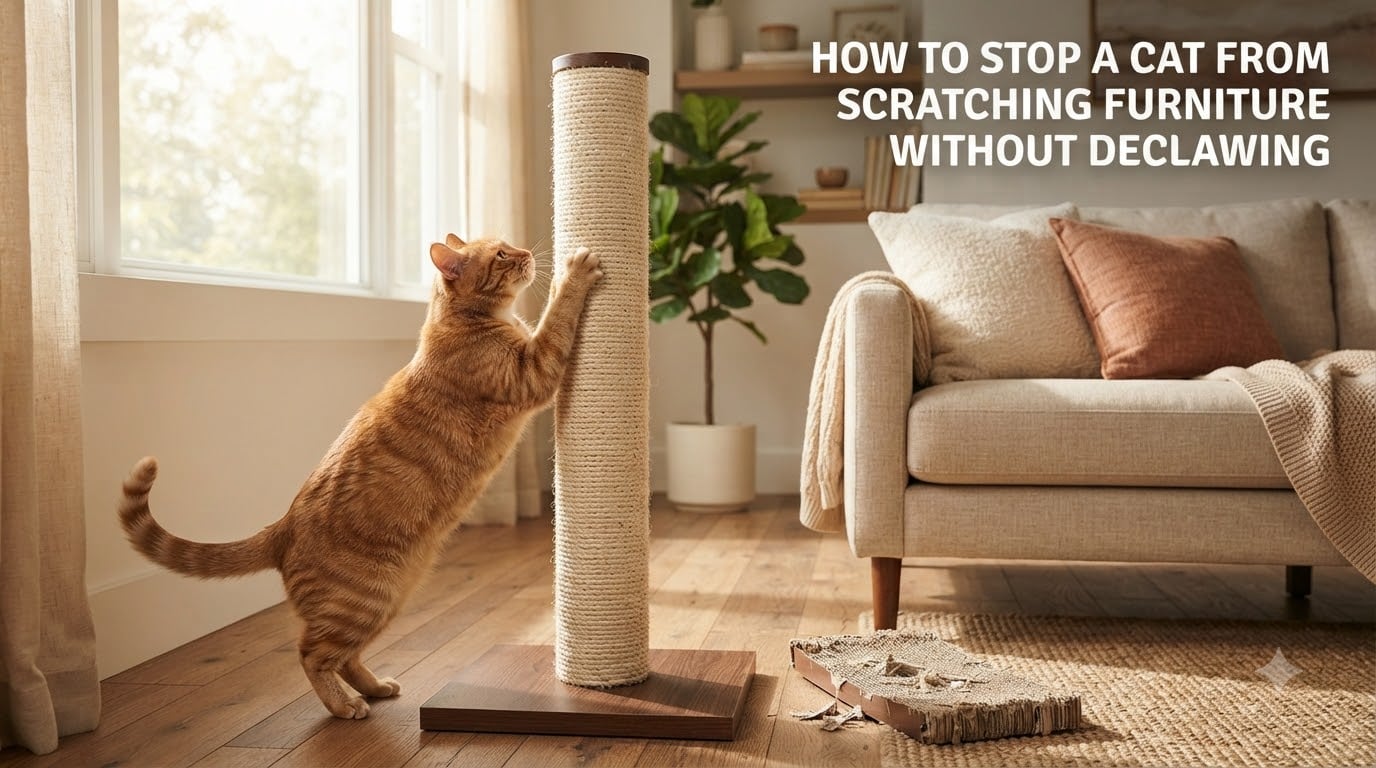
The best way to stop a cat from scratching furniture without declawing is to provide attractive scratching alternatives, place them in strategic locations, use gentle deterrents on the furniture, trim your cat’s nails regularly, and reward the right behavior. Our team has spent years testing these methods with foster cats, and this guide walks you through each step with real results you can replicate at home.
If you’ve ever watched a brand-new couch develop claw marks within hours of arriving, you already know how stressful this habit can be. The good news: scratching is completely normal cat behavior, and you don’t need surgery to redirect it. We’ll show you exactly how I trained my own cats using a combination of yes techniques (giving better options) and no techniques (making furniture less appealing).
By the end of this guide, you’ll have a complete plan covering scratching post selection, placement strategies, DIY builds, nail trimming, deterrents, anxiety management, and when to call a professional. Let’s start with the why, because understanding the behavior makes the training much easier.
Table of Contents
Why Do Cats Scratch Furniture in the First Place?
Cats scratch furniture for four main reasons, and none of them are about being spiteful. Once I understood this, training got ten times easier.
Territory marking. Cats have scent glands in their paw pads. Every scratch leaves both a visible mark and a chemical message that says “I live here.” This is how they establish a sense of ownership in their environment, especially in multi-cat households.
Claw maintenance. Scratching removes the dead outer sheath of the claw, keeping nails sharp and healthy. Think of it as a natural manicure your cat performs on your couch arm.
Stretching and exercise. When cats scratch, they stretch their shoulders, back, and legs. It’s a full-body workout, and the vertical stretch on furniture feels especially satisfying to them.
Stress relief and emotional regulation. Scratching releases endorphins. Cats scratch more when anxious, excited, or marking transitions like moving to a new home. I noticed my foster cat, Mochi, scratched twice as much during her first week with us.
Knowing these triggers helps you respond with empathy instead of frustration. You’re not fighting a bad cat. You’re channeling a healthy instinct.
Why You Should Never Declaw a Cat
Declawing (onychectomy) is not a nail trim. It’s an amputation of the last bone of each toe. The ASPCA and every major veterinary association oppose routine declawing because of the physical and behavioral damage it causes.
Physical harm. Declawed cats often experience chronic pain, nerve damage, lameness, and arthritis later in life. Many develop litter box aversion because the litter hurts their sensitive paws, which leads to inappropriate elimination around your home.
Behavioral side effects. Without claws, cats feel defenseless and often become more aggressive, biting harder because biting is their last resort. They may also start scratching furniture even more out of stress.
Ethical concerns. More than 20 countries have banned declawing entirely, including the UK, Australia, Brazil, and most of the EU. Declawing is illegal in many U.S. cities too, including Los Angeles, San Francisco, Denver, and New York State.
If your vet offers declawing as a quick fix, find a new vet. There are humane alternatives that work better, and we’ll cover every one of them.
The Yes Technique – Provide Better Scratching Alternatives
The Yes Technique means giving your cat something more appealing to scratch than your couch. After fostering 30+ cats through the years, I’ve learned that most scratching problems come down to two issues: the wrong post material or the wrong location.
Choose the Right Scratching Post Material
Cats have texture preferences, and matching them is the fastest path to success.
Sisal rope. This is the gold standard. The rough, fibrous texture lets cats really dig in and shed claw sheaths. Most cats I’ve fostered prefer vertical sisal posts within 48 hours. Sisal also lasts years without falling apart.
Cardboard. Cardboard scratchers (the flat corrugated kind) are a huge favorite. Many cats prefer them because the texture mimics the weave of upholstered furniture. They’re cheap, replaceable, and cats love to shred them.
Carpet. A post wrapped in carpet works, but skip carpet if your cat already scratches carpet, you’ll accidentally reinforce the habit. Sisal is the safer default.
Wood (unfinished). Some cats love raw wood. Jackson Galaxy often recommends redwood or cedar planks mounted on walls for cats that reject everything else.
Match Vertical or Horizontal Preferences
Watch where your cat scratches now. Are they going after the couch arm (vertical) or the carpet by the door (horizontal)?
Vertical scratchers should be at least 28-32 inches tall so your cat can stretch fully. Wobbly posts get ignored. If your cat tips it over once, they’ll never use it again.
Horizontal scratchers (cardboard pads, lying logs) work for cats that prefer the floor. Place them where the unwanted scratching happens.
Strategic Placement Makes or Breaks the Plan
Here’s where most owners fail. They put the scratching post in a corner of the living room where the cat never goes. Then they wonder why the post collects dust.
Place posts next to the problem area. If your cat scratches the couch arm, put a post directly in front of it. As one Reddit user shared, “If he goes for both arms of the couch, then that’s where you will want your posts at the start.”
Place posts near sleeping areas and entry points. Cats stretch and scratch when they wake up. They also scratch near doors to mark territory. A post by the bedroom doorway or front entrance hits both instincts.
Use multiple posts in a multi-cat home. The general rule is one post per cat, plus one extra, placed in different rooms. This prevents resource guarding.
DIY Scratching Post (Budget-Friendly, Under $15)
Commercial posts can run $50 to $150, but a DIY version often works better. In my experience, homemade posts beat store-bought ones because you can match the exact material your cat prefers.
Materials: A 4×4 post (cedar or pine, about 30 inches), sisal rope (50 feet of 1/4 inch), a wide base (12×12 inch plywood), wood screws, and catnip.
Steps:
Cut the post to 30 inches.
Center and screw the post onto the plywood base. Make sure it’s sturdy enough to handle a full-grown cat leaning on it.
Wrap sisal rope tightly from base to top, gluing every few inches with non-toxic glue.
Rub catnip into the rope to attract your cat.
One Reddit user built exactly this setup and reported their cat ignored every store-bought post they had tried. DIY worked because the rope was fresh and tight, and the base didn’t wobble.
The No Technique – Gentle Deterrents That Actually Work
The No Technique makes your furniture unappealing without harming your cat. The key word here is “gentle.” Anything that scares or punishes your cat will backfire.
Double-Sided Tape (Sticky Paws)
Cats hate sticky paws. Apply double-sided tape (Sticky Paws is the popular brand, but generic packing tape works in a pinch) to the corners of your couch, chair arms, or wherever your cat scratches. They take one touch, dislike the feeling, and walk away.
This only works if you also provide a better option nearby. Tape alone won’t teach your cat where to scratch, only where not to.
Aluminum Foil
Yes, aluminum foil stops many cats from scratching. The crinkly sound and unfamiliar texture turn most cats off immediately. Lay foil strips across the arms of your couch or any other targeted area. Replace as needed since foil tears.
One caveat: some cats are completely unbothered by foil. Test it on a small area first before covering your entire couch.
Covers and Slipcovers
A loose throw blanket or washable slipcover over your couch protects the upholstery while you retrain your cat. This is honestly the cheapest and fastest way to save a new couch.
Scent Deterrents
Cats strongly dislike citrus, eucalyptus, menthol, and certain herbal smells. You can make a homemade spray with one part lemon or orange essential oil to three parts water. Lightly mist the furniture (test for staining first).
What cats hate most to stop scratching furniture:
Citrus (orange, lemon, grapefruit)
Eucalyptus
Menthol or peppermint
Rosemary
Citronella
Avoid using vinegar directly on wood, it can damage the finish. Stick to water-diluted citrus sprays on fabric only.
Feliway Pheromone Sprays
Feliway Classic mimics the facial pheromone cats use to mark safe territory. When sprayed on a scratching post, it signals “this is yours.” When used near furniture, it can reduce the urge to mark. Feliway isn’t a magic bullet, but it pairs well with the other techniques here.
How to Trim Your Cat’s Nails Safely
Regular nail trims reduce the damage from any scratching that does happen. Clipped nails are duller and do less harm to fabric and wood. Our team trims foster cats every 2 weeks as a standard practice.
Step-by-Step Nail Trimming Guide
Step 1: Get the right clippers. Use small, sharp cat nail clippers (guillotine or scissor style). Human clippers crush the nail and cause pain.
Step 2: Find the quick. The quick is the pink blood vessel inside the nail. Cut only the clear tip, never the pink part. On light-colored nails, it’s easy to see. On dark nails, trim small slivers at a time.
Step 3: Hold gently but securely. Wrap your cat in a towel burrito if they’re squirmy. Press the top of their paw to extend the claw.
Step 4: Clip at a 45-degree angle. Cut just the sharp tip, about 2 millimeters. Less is more.
Step 5: Reward immediately. Give a treat after each paw, or even each nail. Positive reinforcement makes the next session easier.
If you accidentally cut the quick and your cat starts bleeding, apply styptic powder or cornstarch to stop it. Don’t panic, it looks worse than it is.
How Often Should I Trim My Cat’s Nails?
Every 2-3 weeks is ideal for indoor cats. Some cats need weekly trims, others can go a month. You’ll know it’s time when their claws start snagging on fabric again.
Start nail trims when your cat is a kitten if possible. Older cats can learn to tolerate it too, but it takes more patience. A great training window is right after a meal when your cat is sleepy and content.
Nail Caps and Other Long-Term Solutions
Soft Paws (also called Soft Claws) are vinyl caps that glue over your cat’s claws. They blunt the claws so scratching doesn’t cause damage, while still letting your cat perform the natural behavior.
Application takes about 10 minutes and the caps last 4-6 weeks before falling off with natural nail growth. Most cats adjust quickly and don’t seem bothered.
Nail caps aren’t a replacement for training. They pair best with a solid Yes/No plan. They’re also a good option for cats that simply can’t be retrained, like senior cats or those with long-established habits.
If you go this route, order from a reputable brand and follow the included adhesive instructions carefully. Cheap caps can pop off and become a choking hazard if your cat pulls at them.
Reduce Stress and Anxiety to Curb Destructive Scratching
Sometimes excessive scratching is a cry for help. Cats under stress scratch more, and the scratching itself becomes a self-soothing loop.
Identify stressors. New pets, new baby, construction noise, rearranging furniture, or even a new cat visible through the window can all trigger anxiety scratching. Try to minimize sudden changes.
Add vertical territory. Cat trees, shelves, and window perches give cats a sense of safety. A cat that feels secure in its territory scratches less out of stress.
Use a Feliway diffuser. Plug-in pheromone diffusers reduce generalized anxiety in many cats over 2-4 weeks. They’re especially helpful in multi-cat homes.
Play more. Daily interactive play (wand toys, laser pointers, fetch) burns off energy and reduces anxiety-driven scratching. Two 15-minute sessions daily is a solid target.
Multi-cat strategy. If one cat bullies another, the bullied cat may scratch heavily near doorways to feel safe. Separating resources (food bowls, litter boxes, scratchers) and adding hiding spots helps a lot.
When to Call a Cat Behavior Specialist?
Most cats respond to the methods in this guide within 2-8 weeks. If you’ve tried multiple approaches consistently and your cat is still destroying furniture, it’s time to bring in a certified behaviorist.
A veterinary behaviorist (DACVB) or certified applied animal behaviorist can identify triggers you may have missed, like underlying medical pain or separation anxiety. They can also tailor a training plan to your specific cat.
Ask your vet for a referral, or check the International Association of Animal Behavior Consultants directory.
Frequently Asked Questions
What is the best thing to stop cats from scratching furniture?
The single most effective tool is a tall, sturdy sisal scratching post placed right next to the furniture your cat targets. Pair it with double-sided tape on the couch and positive reinforcement when your cat uses the post, and most cats switch over within 2-4 weeks.
What smell do cats hate to stop scratching furniture?
Cats strongly dislike citrus (orange, lemon, grapefruit), eucalyptus, menthol, peppermint, rosemary, and citronella. A homemade spray of one part citrus essential oil to three parts water works well on fabric. Always test for staining first and never apply essential oils directly to your cat.
Does aluminum foil stop cats from scratching?
Yes, aluminum foil stops many cats from scratching because they dislike both the crinkly sound and the unfamiliar texture under their paws. Lay foil strips across targeted furniture areas. Note that some cats are completely unbothered by foil, so test on a small area first.
Do cats ever outgrow scratching furniture?
Cats never fully outgrow scratching because it’s a hardwired instinct tied to territory marking and claw health. However, scratching often decreases with age, especially in cats that have established good scratching post habits. Adult cats typically scratch less than kittens once they’ve settled into a routine.
How to stop a cat from scratching furniture permanently?
Permanent change comes from combining three strategies: attractive scratching alternatives placed in the right spots, gentle deterrents on furniture, and consistent positive reinforcement when your cat uses the post. Expect 4-8 weeks of consistent effort before the new habit sticks for adult cats.
How often should I trim my cat’s nails?
Trim your cat’s nails every 2-3 weeks for indoor cats. You’ll know it’s time when claws start snagging on fabric again. Senior cats and kittens may need weekly trims. Always use sharp cat nail clippers and cut only the clear tip, avoiding the pink quick inside the nail.
Final Thoughts on Keeping Your Cat From Scratching Furniture
Learning how to stop a cat from scratching furniture without declawing comes down to one core idea: redirect, don’t punish. Cats scratch because they’re built to scratch, and your job is to make the right surfaces more appealing than your couch.
Start by giving your cat at least one tall sisal post, placing it directly in front of the problem area. Layer in gentle deterrents like double-sided tape or aluminum foil. Trim your cat’s nails every 2-3 weeks, and reward every successful trip to the post with a treat or affection. Be patient. Most cats need 4-8 weeks to form a new habit, and adult cats sometimes take a few months to fully transition.
Skip the declawing. It’s harmful, unethical, and banned in many places. With the right combination of yes techniques, no techniques, and consistency, your cat will learn where to scratch, and your furniture will thank you.