
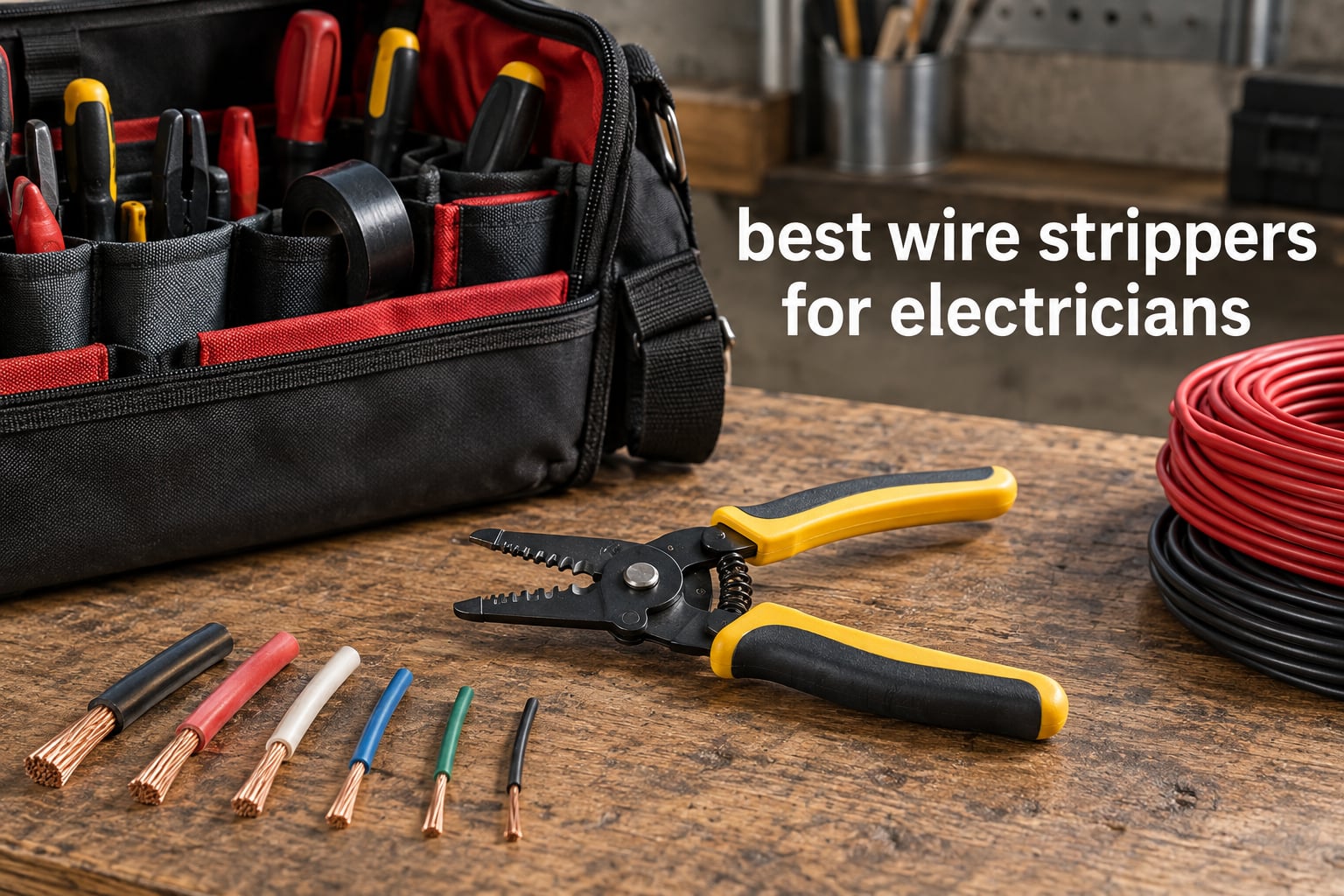
A wire stripper is a hand tool with precision-cut, gauge-sized notches that bite through insulation in a clean ring without cutting into the copper or aluminium conductor underneath, leaving a connection-ready end every time. A nicked, crushed or over-stripped conductor causes loose connections, overheating and failed inspections, so the stripper is one of the few tools that genuinely decides whether a job passes.
We spent six weeks with 12 of the best wire strippers for electricians, running them through 8 AWG stranded feeder, 10-14 AWG branch circuit, 18-22 AWG control and 24-26 AWG signal wire. We checked for nicks, flattened strands, inconsistent strip length and how fast each tool dulled. Nothing here recommends a category. Every pick names a model.
Before the reviews, the four stripper types worth knowing:
Gauged (manual) strippers with fixed AWG notches, where you pick the hole and pull.
Self-adjusting strippers that sense wire diameter and set the depth for you.
Rotary or dial strippers for data, coax and control cabling where a dial sets the depth.
Cable and jacket strippers for removing outer sheaths and armour, not the conductor insulation.
Our best overall is the Klein Tools 11063W Katapult stripper. It covers the widest range of any tool we tested, from 8 AWG solid down to 22 AWG stranded, and it pulled a full inch of insulation per squeeze without touching a strand. If your work is a mix of feeder, branch circuit and control wiring, that is the one to buy first.
One note on adjacent tools. Electricians rarely strip wire in isolation; they pull it, cut it and cut screws in the same motion, which is why so many picks below combine stripping with crimpers, bolt cutters and screw shears. Related reading on our site covers wire crate covers tested for anyone who has asked us about wire storage before.
Table of Contents
Top 3 Picks for Electricians (October 2026)

Klein 11063W Katapult
- 8-20 AWG solid
- 10-22 AWG stranded
- Compound action one-squeeze stripping
- 1 inch of insulation per pull

IRWIN Vise-Grip 2078309
- Strips and cuts 10-22 AWG
- Induction hardened edge
- Crimper and bolt cutter
The three above cover the widest range of work without duplicating each other. The Klein Katapult is the do-everything pick, the IRWIN is the cheapest way to get four functions in one pouch tool, and the NEIKO is the smallest, lightest service tool that still feels forged rather than stamped.
Best Wire Strippers for Electricians in 2026
| Product | Specs | Action |
|---|---|---|
| Klein Tools 11063W Katapult Stripper |
|
Check Latest Price |
| IRWIN Vise-Grip 2078309 Multi-Tool |
|
Check Latest Price |
 Klein Tools 11055EP Precision Stripper Klein Tools 11055EP Precision Stripper |
|
Check Latest Price |
 Klein Tools 11061 Self-Adjusting Stripper Klein Tools 11061 Self-Adjusting Stripper |
|
Check Latest Price |
 KNIPEX Ergostrip 16 95 01 SB KNIPEX Ergostrip 16 95 01 SB |
|
Check Latest Price |
 KNIPEX 13 72 8 Forged Stripper KNIPEX 13 72 8 Forged Stripper |
|
Check Latest Price |
 KNIPEX 12 62 180 Automatic Stripper KNIPEX 12 62 180 Automatic Stripper |
|
Check Latest Price |
 Milwaukee 48-22-3079 Six-in-One Pliers Milwaukee 48-22-3079 Six-in-One Pliers |
|
Check Latest Price |
 NEIKO 02037A Compact Stripper NEIKO 02037A Compact Stripper |
|
Check Latest Price |
 Channellock 957 Spring Stripper Channellock 957 Spring Stripper |
|
Check Latest Price |
 IDEAL 45-120 T-Stripper IDEAL 45-120 T-Stripper |
|
Check Latest Price |
 IDEAL Stripmaster 45-097 IDEAL Stripmaster 45-097 |
|
Check Latest Price |
1. Klein Tools 11063W Katapult Stripper – Best Overall
Klein Tools 11063W 7-Inch Heavy-Duty Automatic Wire Cutter/Stripper
8-20 AWG solid, 10-22 AWG stranded
1 inch insulation per pull
12 oz cast alloy
Pros
- Compound action grips and strips in one squeeze
- Precision machined holes leave the conductor untouched
- Cuts and strips in the same tool
- Dual-material ergonomic grips
Cons
- Smallest strip size is 20 AWG solid
- Stripping dies are not replaceable
- Bulky for users with smaller hands
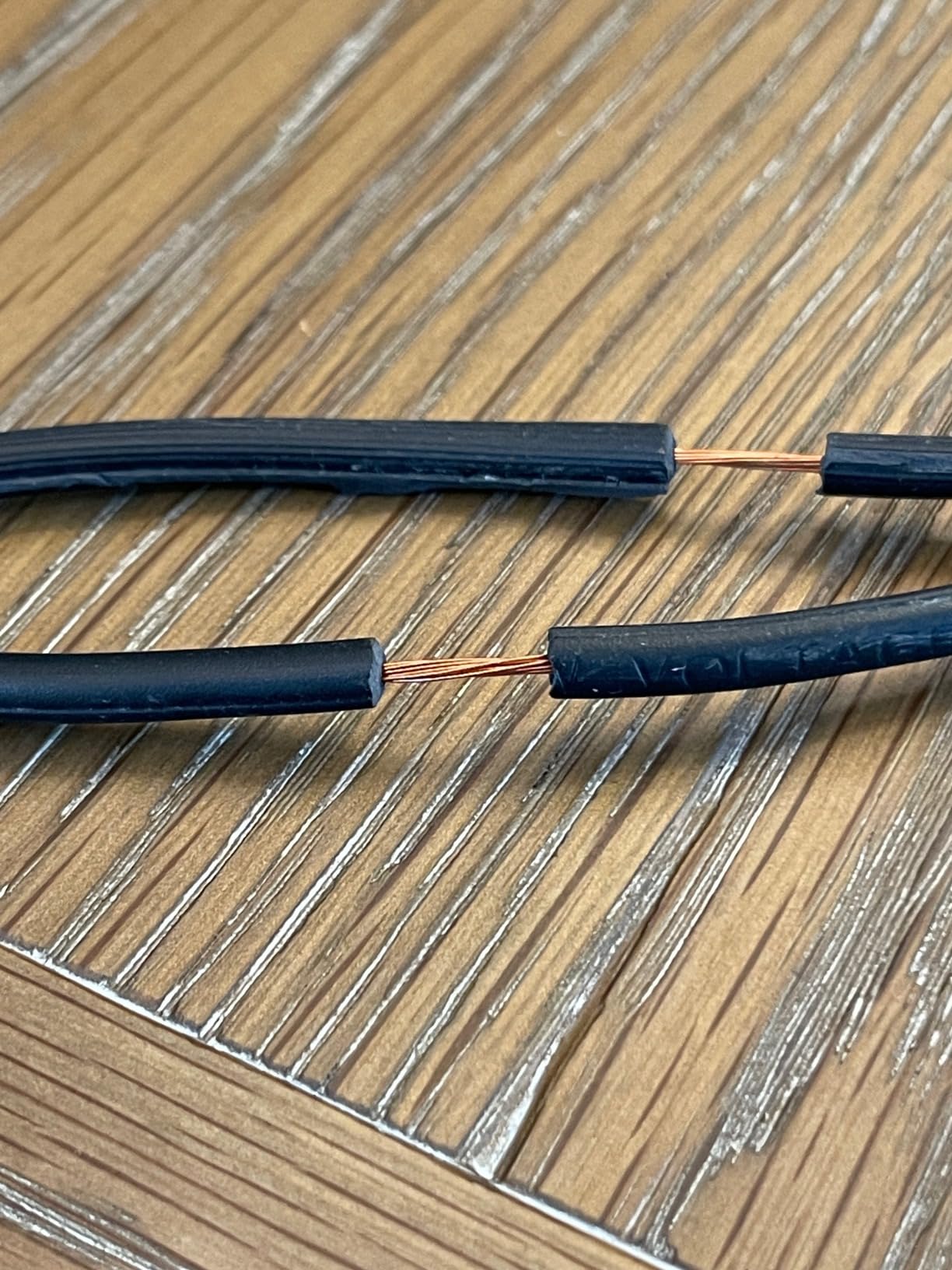
The Katapult is the only stripper in this roundup that removed a full inch of insulation in a single pull without a second adjustment. That range matters more than it sounds on a service call, because it means you are not re-gripping and re-pulling a long run of THHN to land it in a deep box.
What sold me was the compound action. One squeeze clamps the cable and completes the strip, and the tension-loaded wire grip holds the cable without crushing it. On 10 AWG stranded, which is where most self-adjusting tools struggle, the conductor came out round and every strand intact.
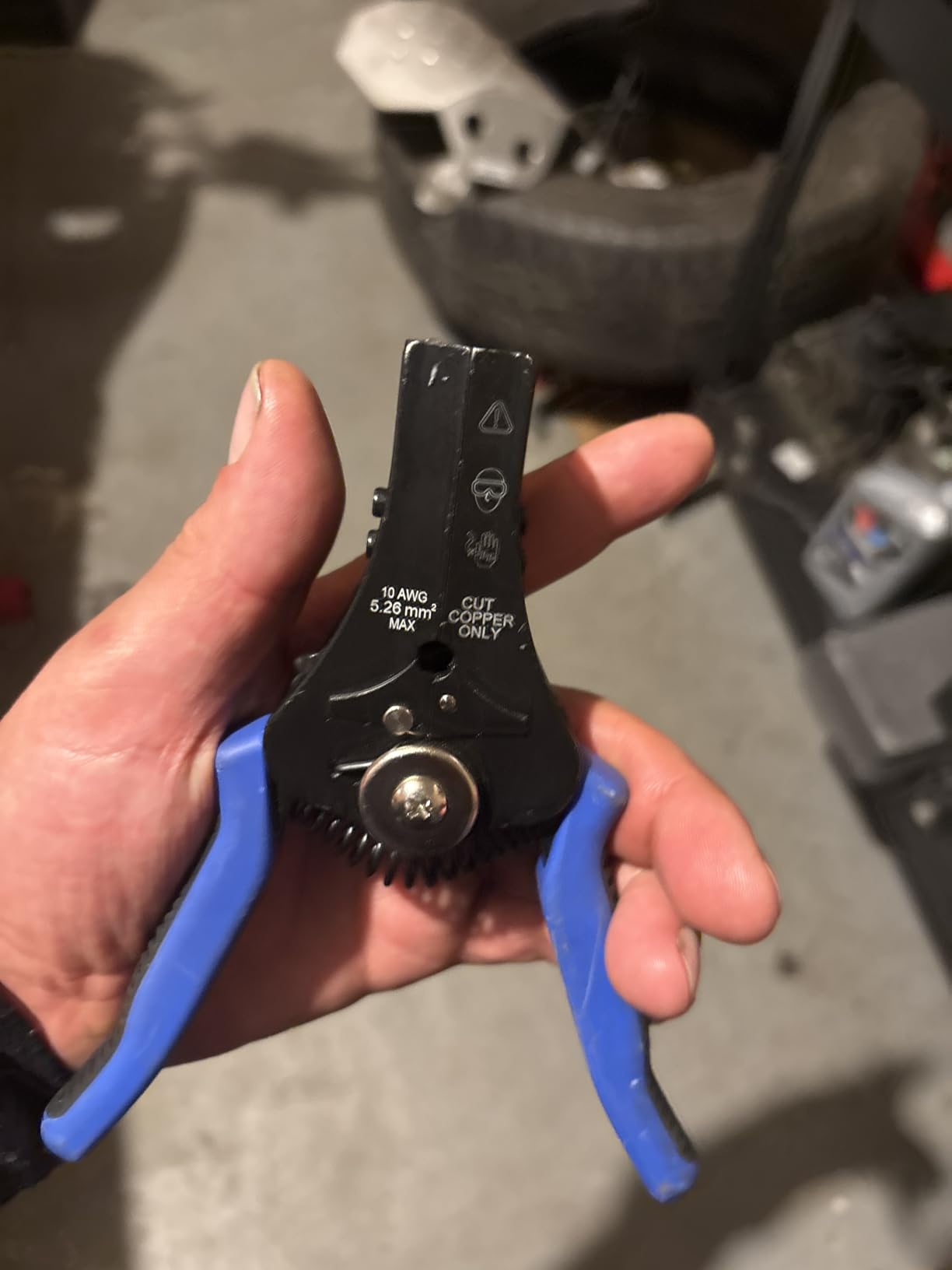
The spec sheet claims 8-20 AWG solid and 10-22 AWG stranded, and that matched what we saw on the bench. The precision machined stripping holes are cut deep enough to shear thick insulation in one pass but stop short of the copper. Cast alloy chassis with a heavy-duty Ecoat finish means it shrugs off the pocket lint and truck-bed grit that eats painted steel.
Two limitations are worth stating plainly. This model tops out at 20 AWG solid, so 22 and 24 AWG electronics wire is outside its range entirely, and the stripping dies are not user-replaceable, which matters if you nick a hole in the field. Reviewers also flag the body as fairly bulky for smaller hands, and at 12 ounces it is not a light tool for all-day carry.
When the Katapult earns its place in the bag
It suits anyone who mixes service work: feeders, 12/2 and 14/2 residential cable, HVAC thermostat runs and control wiring in the same week. The integrated cutter means one less tool on the belt, and the double-material grips stayed comfortable through a full day of repetitive stripping.
It is the wrong choice if you terminate a lot of Cat6 or 24 AWG control wire, or if you want a tool you can service yourself when a hole goes oval. For pure data work, the KNIPEX Ergostrip later in this list handles coax and twisted pair in one pass.
Where it falls short against a forged tool
Cast alloy is not forged steel, and the 11063W does not carry a replaceable die set, so its long-term edge retention depends on the quality of your pockets rather than the tool. A minority of owners report the stripping holes drifting slightly out of calibration and ovalizing a gauge after heavy use, which shows up as a strip that looks clean from a metre away but fails a pull test.
Compare it to the KNIPEX 13 72 8, which is forged and cuts NM-B, BX and MC cable as well as wire. If your day is heavy feeder and sheath work rather than a mixed service roster, that is the more capable tool, at a higher cost.
2. IRWIN Vise-Grip 2078309 Multi-Tool Stripper – Best Value
IRWIN Vise-Grip Wire Stripper, 8 Inch, Cuts 10-22 AWG, Plier Style Nose, ProTouch for Comfort, Blue (2078309)
Strips and cuts 10-22 AWG
Induction hardened edge
Crimper and bolt cutter
Pros
- Induction hardened edge holds its sharpness
- Four functions in one 8 inch tool
- Plier-style nose pulls and loops wire
- ProTouch grip for long sessions
Cons
- Grip sleeves can feel slick once worn
- Narrow nose is weak for heavy wire
With more than 21,000 ratings behind it, the 2078309 is the most proven stripper in this guide and the one I would hand an apprentice who is building a first tool bag. It strips and cuts 10-22 AWG and does three more jobs besides.
The induction hardened cutting edge is the reason it lasts. Reviewers consistently describe the blades as staying sharp through years of daily work, and our own copper cutting stayed clean and square rather than crushing the end flat. The ProTouch rubber grip is comfortable enough for long sessions once you get used to it.
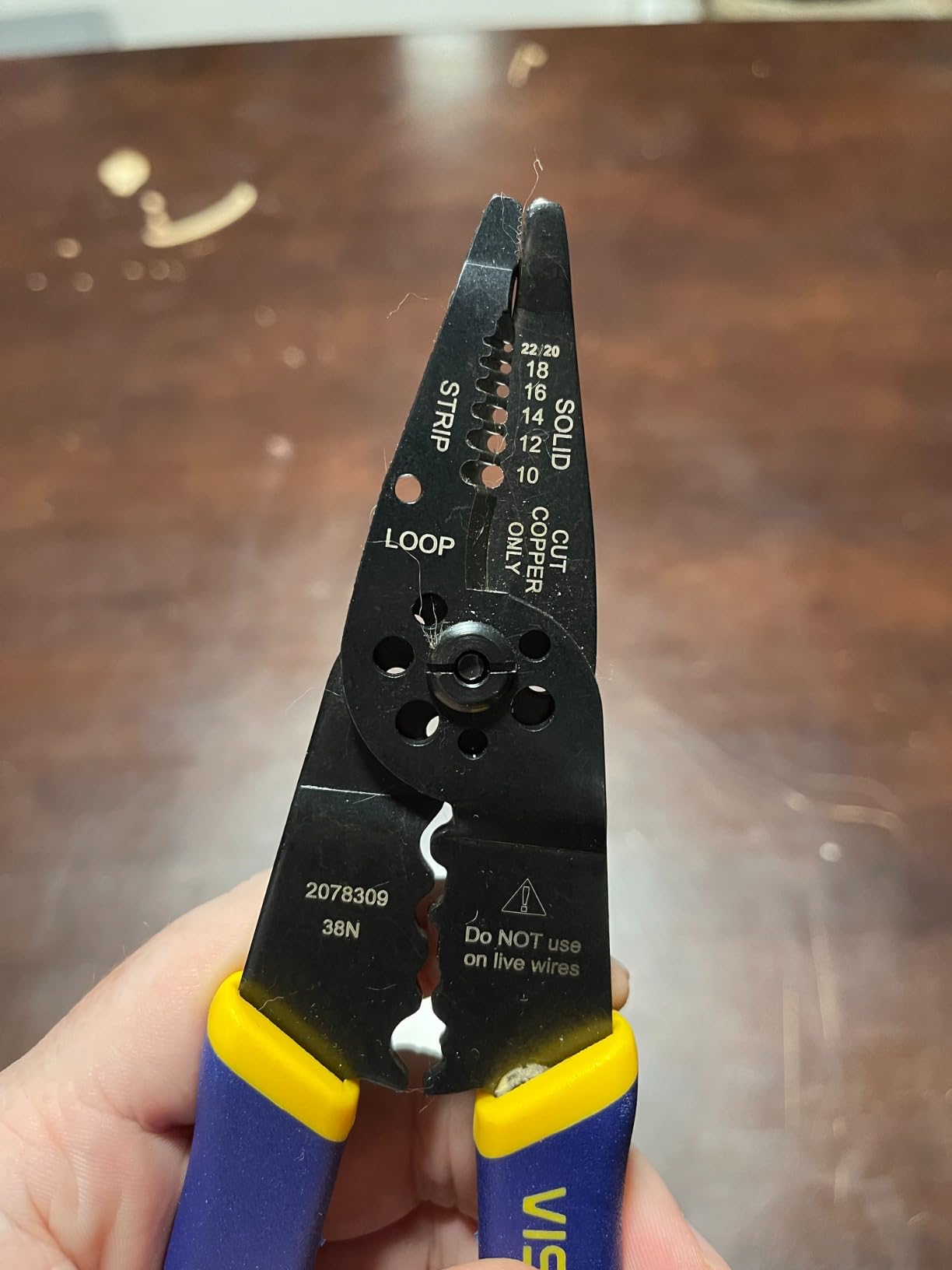
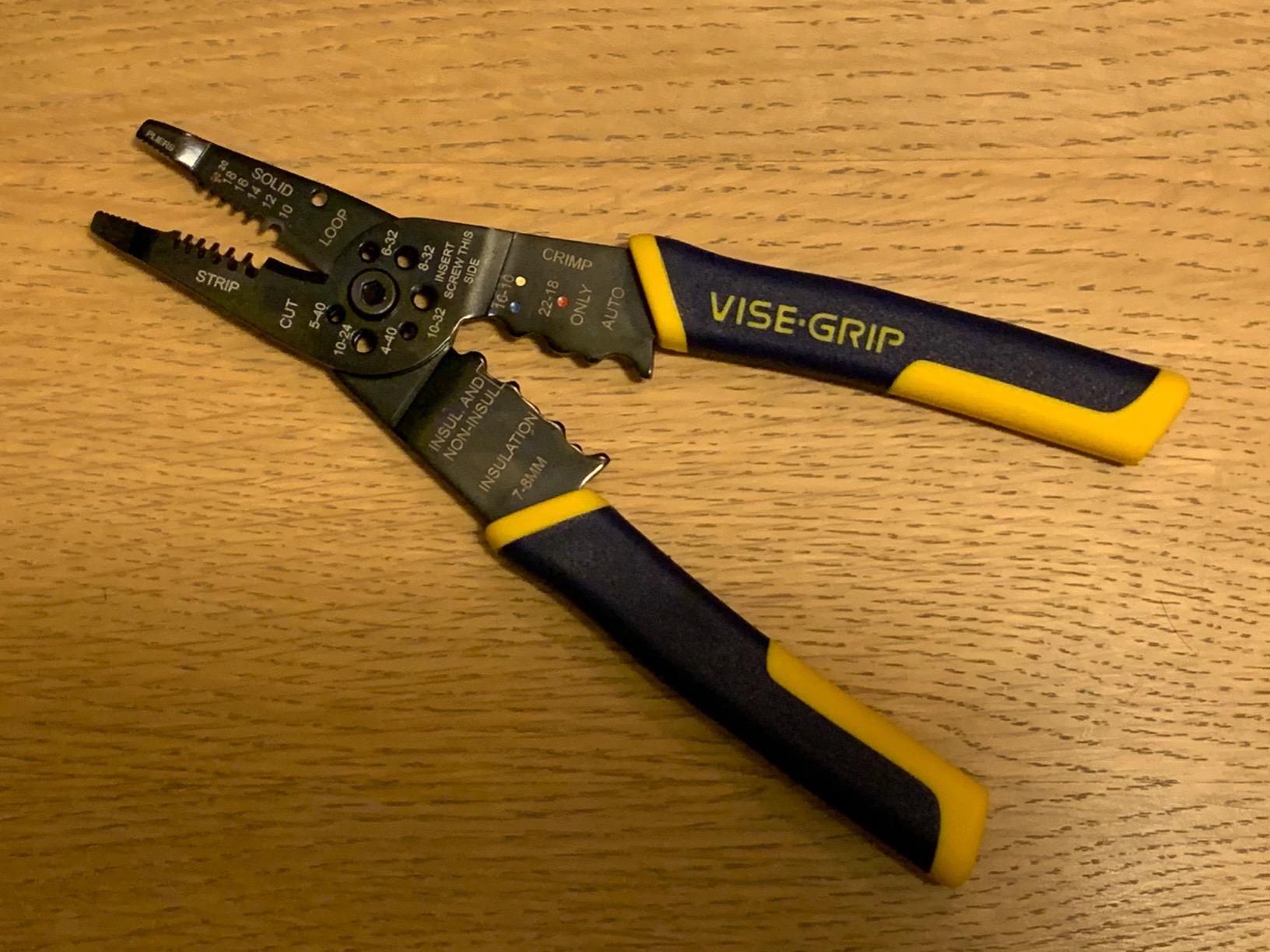
What makes it a multi-tool rather than a stripper is the second jaw. It crimps both insulated and non-insulated terminals, cuts bolts to size and leaves a clean lead thread, and the plier-style nose lets you pull a loop of wire and shape it around a terminal screw without switching tools. At just over 3 ounces it is one of the lightest tools here.
The honest criticisms are minor. Grip sleeves can feel slick or wear smooth over time, and the narrow nose is not built for gripping or pulling heavy feeder conductor, so you still want a lineman’s for that job. Neither issue touches the stripping function, which is where most of the value sits.
Best fit for a starter bag
This is the tool to buy first if you strip wire but do not yet know your own gauge habits. The crimper alone replaces a separate crimping tool for most residential and light commercial terminals, and the 10-22 AWG range covers essentially all branch and control circuit work.
It is also a good second opinion tool to keep in the truck. When a customer calls about a failed termination, having a stripper that works on the same wire range as your primary tool makes diagnosis quick.
When to step up instead
If you regularly run 8 AWG and larger feeder, this range stops short and you need something wider. It also has no screw shears and no shears-type cutter, so a 6-32 or 8-32 screw goes in the bin, not the jaws.
For heavy work the Klein 11063W reaches down to 8 AWG solid, and the KNIPEX 13 72 8 adds forged steel and cable cutting. The IRWIN is the value answer, not the capability answer.
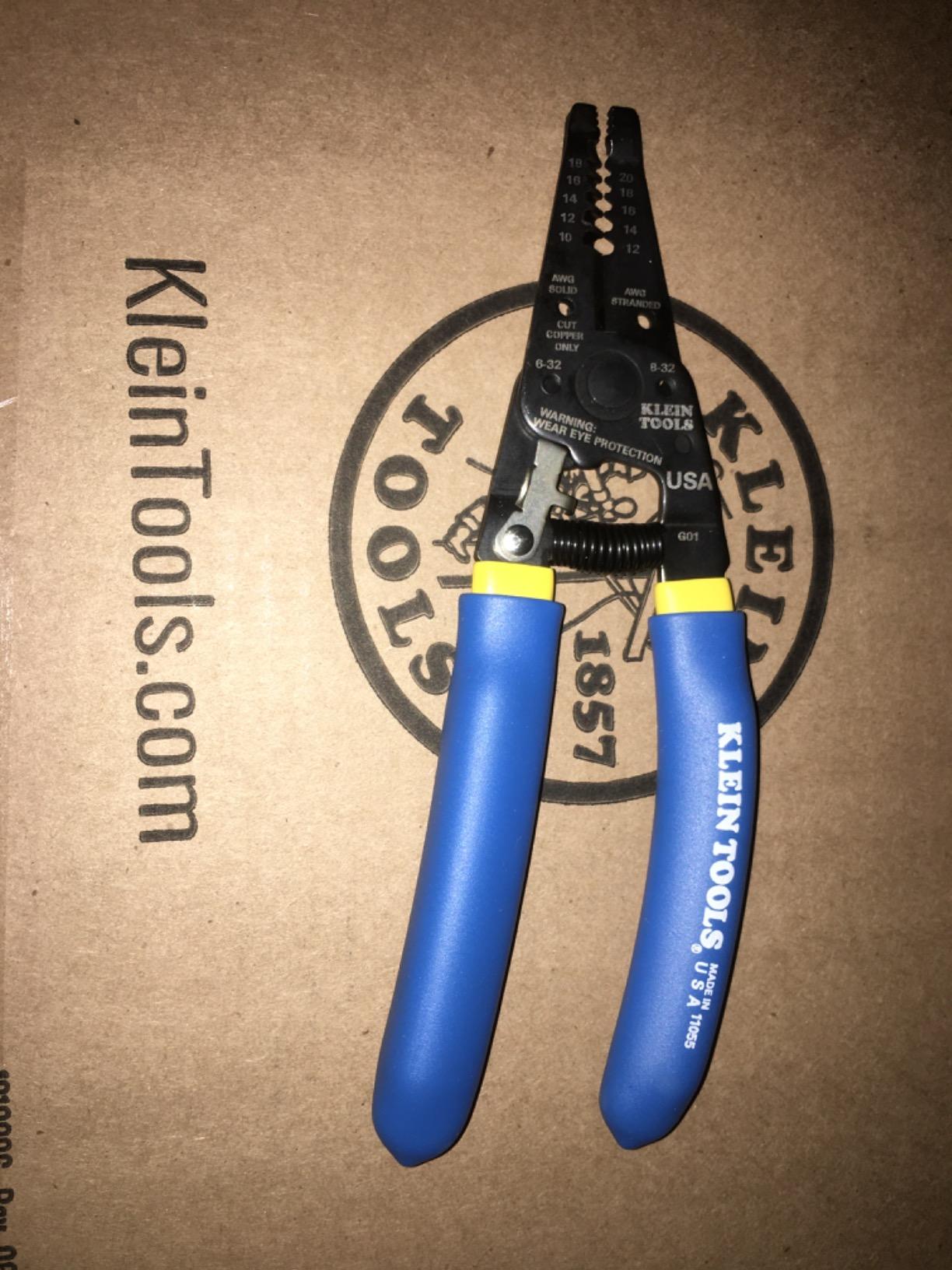
3. Klein Tools 11055EP Precision Stripper – Best for Branch Circuit Wiring
Klein Tools 11055EP Wire Cutter and Stripper, Made in USA, Stranded and Solid Wire Cutter, Cuts Copper
10-18 AWG solid, 12-20 AWG stranded
Shears 6-32 and 8-32 screws
Precision ground stripping holes
Pros
- Precision ground holes strip without nicking
- Cuts strips loops and shears screws
- Serrated nose bends and pulls wire
- Made in USA with shear-type blades
Cons
- Will not handle wire heavier than 10 AWG solid
- Double-dipped grips can be slippery with gloves
The 11055EP is the tool I reach for when I am roughing in a house. It covers 10-18 AWG solid and 12-20 AWG stranded, which is essentially every conductor in a residential branch circuit, and the precision ground holes gave the cleanest strips in the whole test on that range.
It is a genuinely multi-purpose plier. It cuts, strips, loops, bends and shears 6-32 and 8-32 screws from either end, and the serrated nose is strong enough to shape wire into a hook for a terminal screw. Shear-type cutting blades leave a clean cut rather than a crushed stub, which matters when the offcut has to be flush against a box.
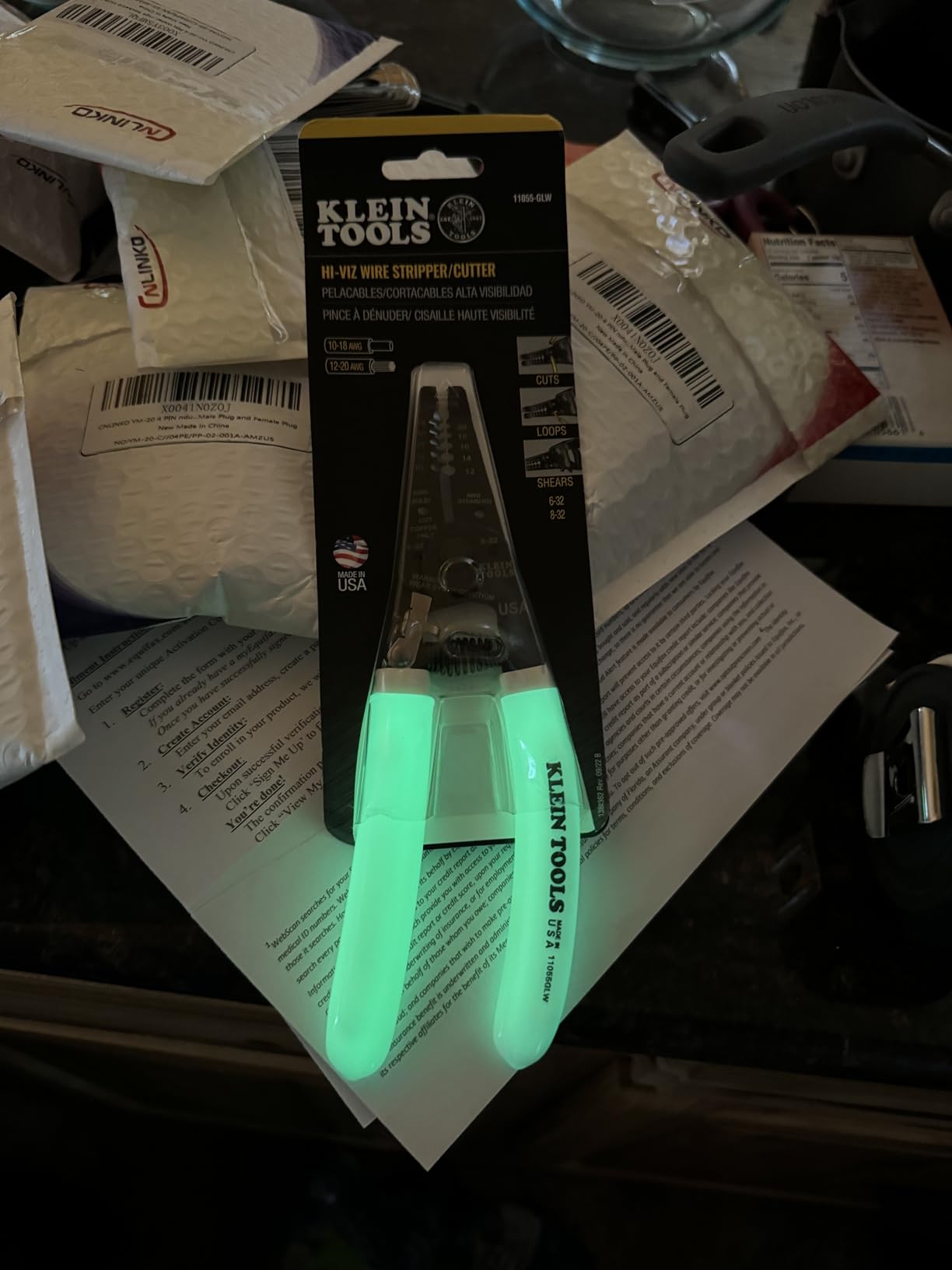
At 5.4 ounces with double-dipped curved handles, it is comfortable for a full day of rough-in work, and it is made in the USA, which shows in the tolerance of the stripping holes. Owners report it as the classic Klein workhorse, with the vast majority of ratings at five stars.
The ceiling is the honest limitation. It will not handle wire larger than 10 AWG solid or 12 AWG stranded, so it is not a feeder tool under any circumstance. Reviewers also note the grips can be slick when you are wearing gloves, which is a real problem on cold-weather rough-ins.
Why rough-in crews keep buying it
One tool doing four jobs means fewer handovers at the box, and the screw shears remove the need to swap to a driver for every device. The looping holes are sized for standard terminal screws, so forming a pigtail is a squeeze rather than a wrap.
Because the precision ground holes hold calibration well, it is also a good second stripper to verify a suspect tool. If both produce the same clean ring, the wire was not the problem.
Where it is the wrong pick
It has no self-adjusting mechanism, so every strip depends on choosing the right notch. On unmarked or older cable, that means guesswork, and reviewers of gauged tools generally warn that nicks come from wrong-notch selection rather than from bad blades.
For unmarked wire or mixed insulation thickness, the Klein 11061 self-adjusting model is the safer default. For 8 AWG feeder, neither is the answer.
4. Klein Tools 11061 Self-Adjusting Stripper – Best for Romex and HVAC
Klein Tools 11061 8-Inch Self-Adjusting Wire Stripper/Cutter
10-20 AWG solid, 12-22 AWG stranded
Strips 12/2 and 14/2 Romex
Adjustable strip stop
Pros
- Handles fine stranded through heavy Romex
- Adjustable stopper and thumb wheel for repeat strips
- Integrated cutter in the handle
- Grooved grips reduce hand fatigue
Cons
- Self-adjusting action needs a break-in period
- Heavier than plier-style strippers
- Romex stripping takes practice
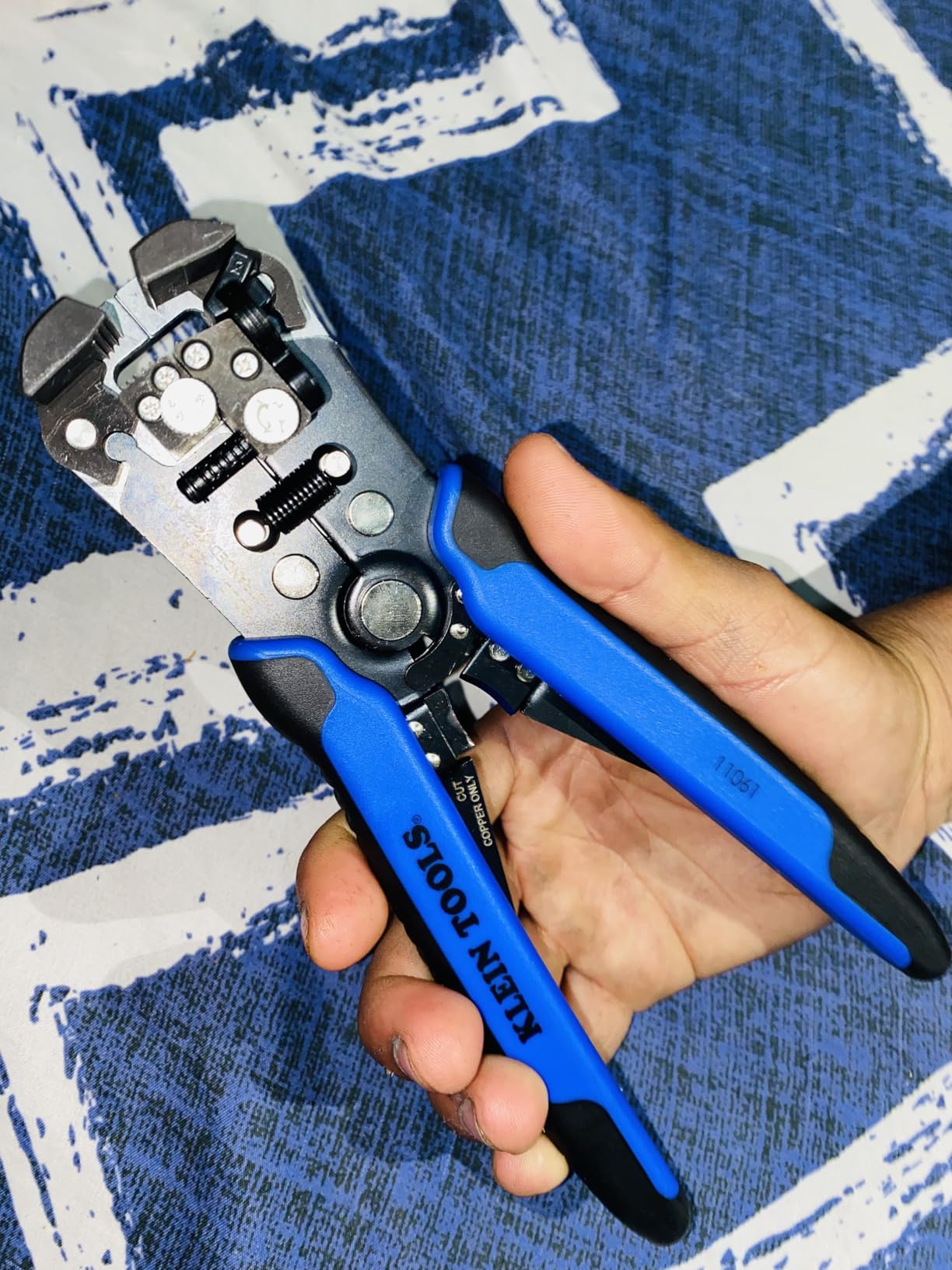
The 11061 is the most versatile tool in this list for residential work, because it does not only strip conductor. It handles 12/2 and 14/2 Romex and other type NM sheathed cable, which no other pick here does at this weight.
The self-adjusting mechanism reads the wire diameter and stops at the right depth, so you do not have to pick a notch. The adjustable stopper sets strip length, and the tensioning thumb wheel lets you dial in the feel for smaller gauge wire, which is the trick that stops a self-adjusting tool from eating fine stranded.
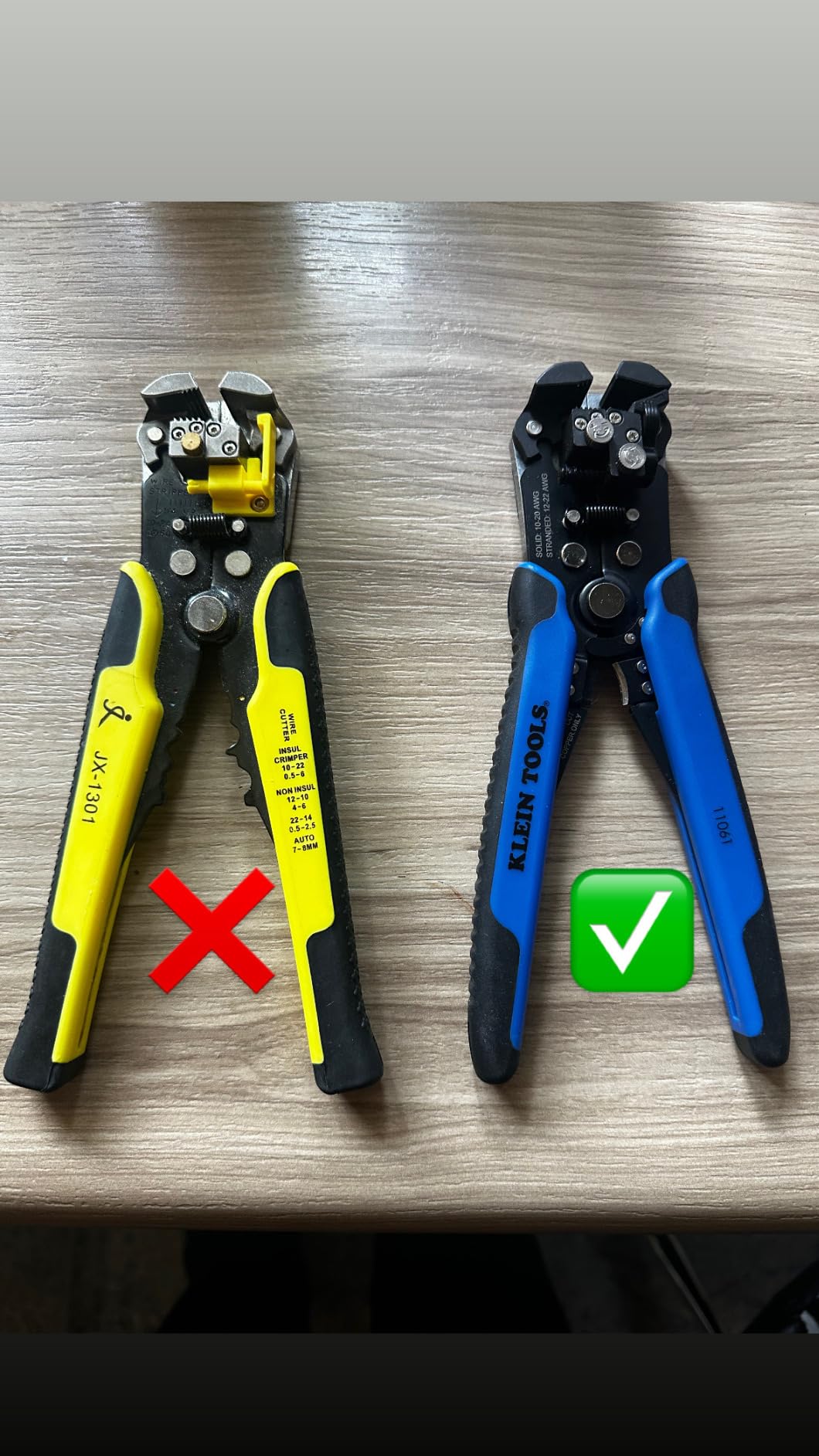
Buyers rate it slightly below the other Klein models here for honest reasons. It weighs over 12 ounces, making it the heaviest stripper in the group, and the self-adjusting action needs a short break-in before it stops grabbing. Ratings reflect a tool that asks for a few hours of practice and then rewards you.
The integrated wire cutter in the handle is a genuine convenience on a ladder. Grooved dual-material grips reduce fatigue on long HVAC and service runs, and it is specifically suited to thermostat wire applications where fine stranded is the norm.
When a self-adjusting stripper wins
It wins on unmarked or legacy cable, on mixed insulation thicknesses, and on any job where you are switching gauge constantly. Mechanical automation users run tools like this on THHN for exactly that reason: throughput beats precision when the wire is known.
For a residential service truck it is the most useful single tool on this list, because Romex handling is built in rather than bolted on. That single feature covers a job most strippers cannot touch.
When a gauged stripper wins instead
On a known gauge with known insulation, a fixed notch is faster and gives a more consistent result, because there is nothing to sense. If you want a guaranteed clean edge on every conductor for inspection purposes, the 11055EP precision holes beat an adjusting mechanism.
The weight is the other factor. At over 12 ounces this is not a light belt tool for a full day of overhead work, and Romex stripping takes practice to avoid pulling stray strands out of the jacket.
5. KNIPEX Ergostrip 16 95 01 SB – Best for Data and Coax
KNIPEX Ergostrip Universal Stripping Tool for Right-Handers, 135 mm, Round Cable, Coax Cables, Data Cables, Wire Stripper, 16 95 01 SB
0.2 to 4 mm2 notches
Strips data and coax cable
VDE rated pistol grip
Pros
- Clean sheath removal without damaging conductors
- Pistol grip works at several angles
- Notches from 0.2 to 4 mm2 in one tool
- Conical ends reach into tight enclosures
Cons
- Made for right-handed use only
- Complements rather than replaces a plier stripper
- Bulkier than a simple stripper
The Ergostrip is the tool for a low-voltage or data technician rather than a power electrician, and it fills a gap none of the other picks cover. It strips round and damp-proof installation cable, twisted pair, and coax without touching the conductors inside.
Buyers consistently report clean, repeatable sheath removal with no damaged inner conductors, which is the entire point on a Cat6 or coax run where a nicked pair means a failed test. It handles NYM cable from 3 x 1.5 mm2 up to 5 x 2.5 mm2, and the integrated notches cover 0.2, 0.3, 0.8, 1.5, 2.5 and 4 mm2 cross-sections.
The pistol grip is the reason it feels different in the hand. It works from several angles, which matters when you are stripping inside a wall box or a control cabinet, and the conical slimmed-down tool ends reach spots a plier-style stripper physically cannot enter. It is also VDE rated for commercial and industrial work.
Location ridges make it simple to insert a single wire for stripping without hunting for the right notch, which is a small detail that saves time on repetitive terminations. The soft plastic pistol grip stays comfortable through long patching sessions.
Where it belongs in a mixed toolkit
Treat it as a complement, not a replacement. It does not fully replace a plier-style stripper for small individual conductors, and for 24 and 26 AWG control wire the IDEAL Stripmaster later in this guide is the better dedicated tool.
For anyone who moves between power and low voltage, the ergonomic pistol grip and the conical ends are genuinely useful in confined enclosures where a conventional stripper is the wrong shape for the space.
What to know before you buy
It is made for right-handed use only, which is a genuine limitation for a minority of users and worth confirming before ordering. It is also heavier and bulkier than a simple stripper for occasional use.
If your work is copper power wire rather than data or cable, you will be using a fraction of what this tool does, and a Klein or Knipex plier stripper will serve you better.
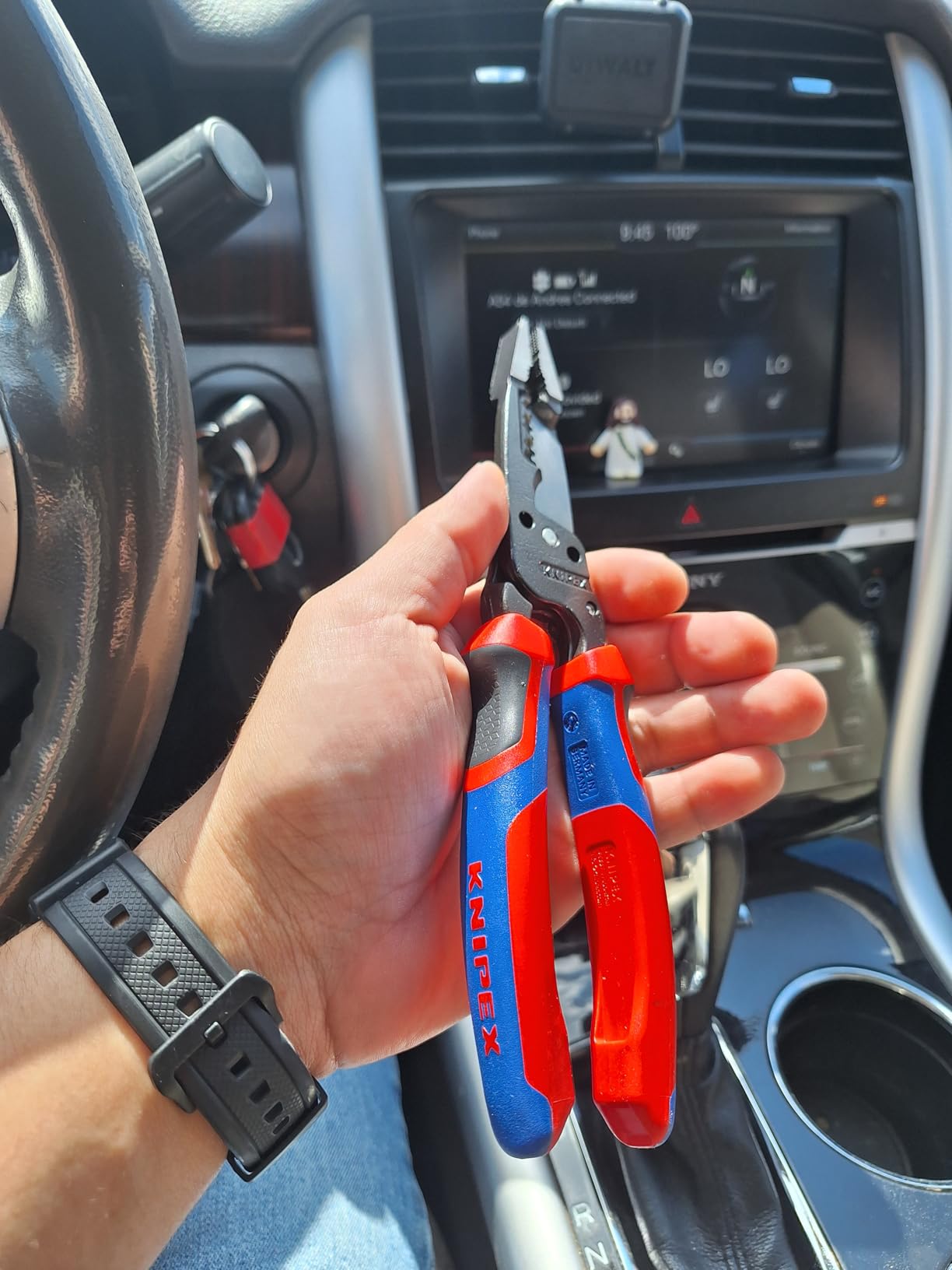
6. KNIPEX 13 72 8 Forged Stripper – Best for Forged Durability
KNIPEX Tools 13 72 8 Forged Wire Stripper, 8-Inch
10-20 AWG solid and stranded
Forged stainless steel frame
Cuts cable, NM-B, BX and MC
Pros
- Precision ground holes strip without nicking
- Forged frame stays sharp for years
- Shear blades cut 50 percent more capacity
- Screw cutter works from front or back
Cons
- Very thick or stiff wire may need two hands
- Screw cutter falls short of a full flush cut
The 13 72 8 is the premium benchmark and the tool the Knipex argument ultimately comes down to. It is forged rather than cast, it is the only pick here that cuts cable, NM-B, BX and MC as well as wire, and owners describe it as the only stripper that does not cut strands off stranded conductor.
The shear cutting blades are rated at 50 percent higher cutting capacity than the competition and cut with 25 percent less hand power, which is why it starts stiff 10 AWG when other tools stall. The 6-32 and 8-32 screw cutter works from the front or the back without threading the screw, and locating ridges make the stripping holes easy to find by feel.
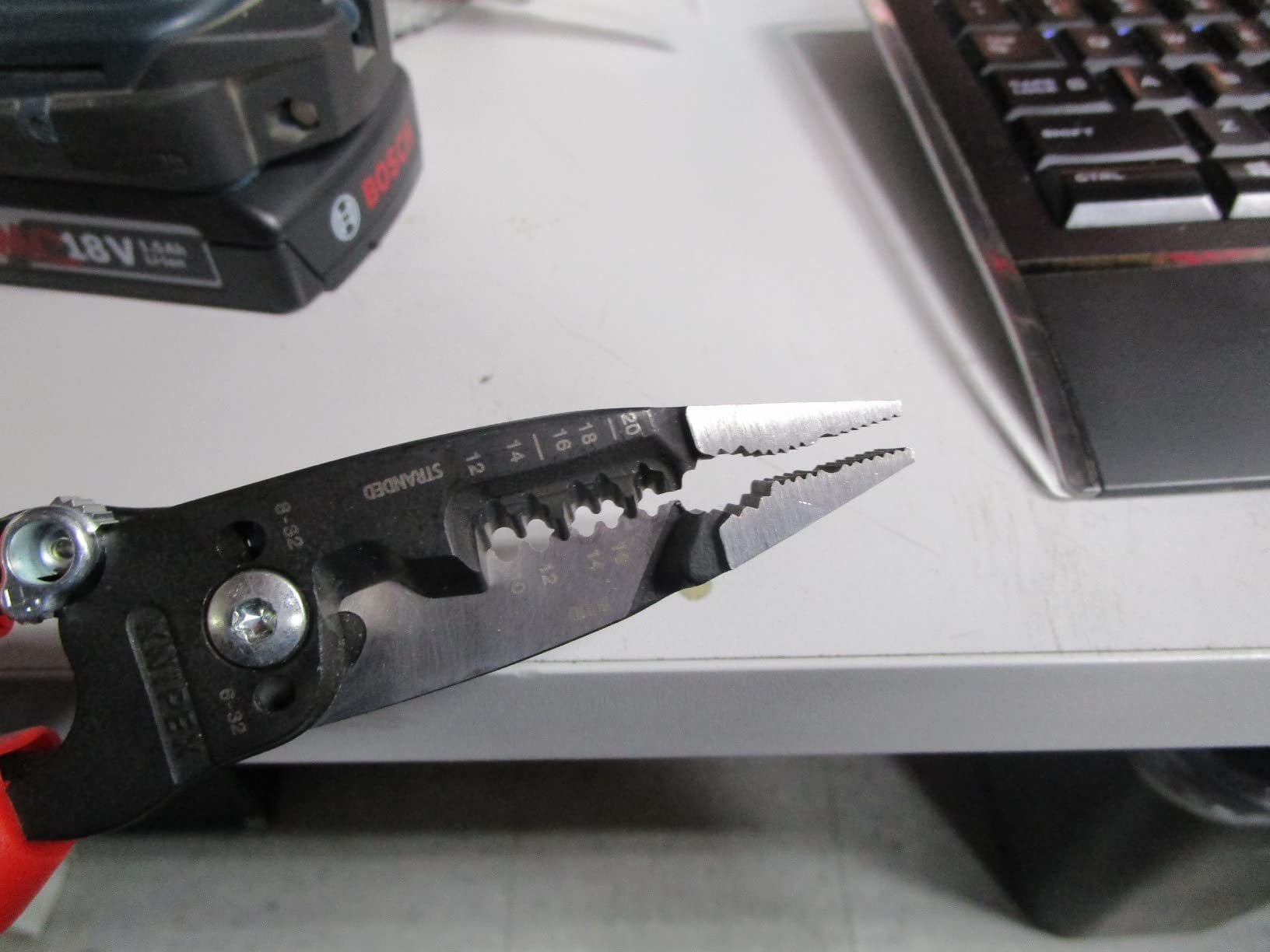
At 9.76 ounces with a multi-component comfort grip, the balance is better than the cast alloy tools it is usually compared against. The forged frame is the reason reviewers report years of service without edge degradation, and the 8-inch length fits a standard pouch without shifting.
Honest limitations exist. Very thick or stiff wire can need two hands to start the cut, the screw cutter does not shear short enough for recessed positions, and a minority of owners report the solid-wire holes tearing insulation on 10-12 AWG or splaying twisted strands on an uncrosshatched nose tip.
Who should pay for the forged frame
It makes sense if you are on heavy feeder work, cutting MC or BX cable, or replacing a tool every few years and would rather not. The blade quality difference is real and it shows in the finished strip rather than only in the tool bag.
For heavy service work it is the most capable hand stripper in this guide. Nothing else here matches its combination of stripping range, cutting capacity and cable capability.
When the extra cost is not justified
If you strip mostly 14-18 AWG branch circuit and light control wire, a Klein 11055EP or a Klein 11061 produces an equally clean result at a fraction of the outlay. The forged advantage only compounds if you use the heavy end of the range often.
Forum consensus is that Knipex is not the cheapest option but is very well designed and long lasting, and that verdict holds up here. Buy it once if you will keep it for a career.
7. KNIPEX 12 62 180 Automatic Stripper – Best for Repeatable Panel Work
KNIPEX Automatic Wire Stripper 10-24 AWG, 7.25
Self-adjusting 10-24 AWG
Adjustable strip-length stop
Integrated handle cutter
Pros
- Self-adjusting action with minimal conductor damage
- One-squeeze cycle speeds repetitive work
- Stop gives repeatable strip lengths
- Lightweight and comfortable for long sessions
Cons
- Cannot strip 10 AWG THHN
- Mostly plastic body feels soft under load
- Minimum practical strip length around 5 mm
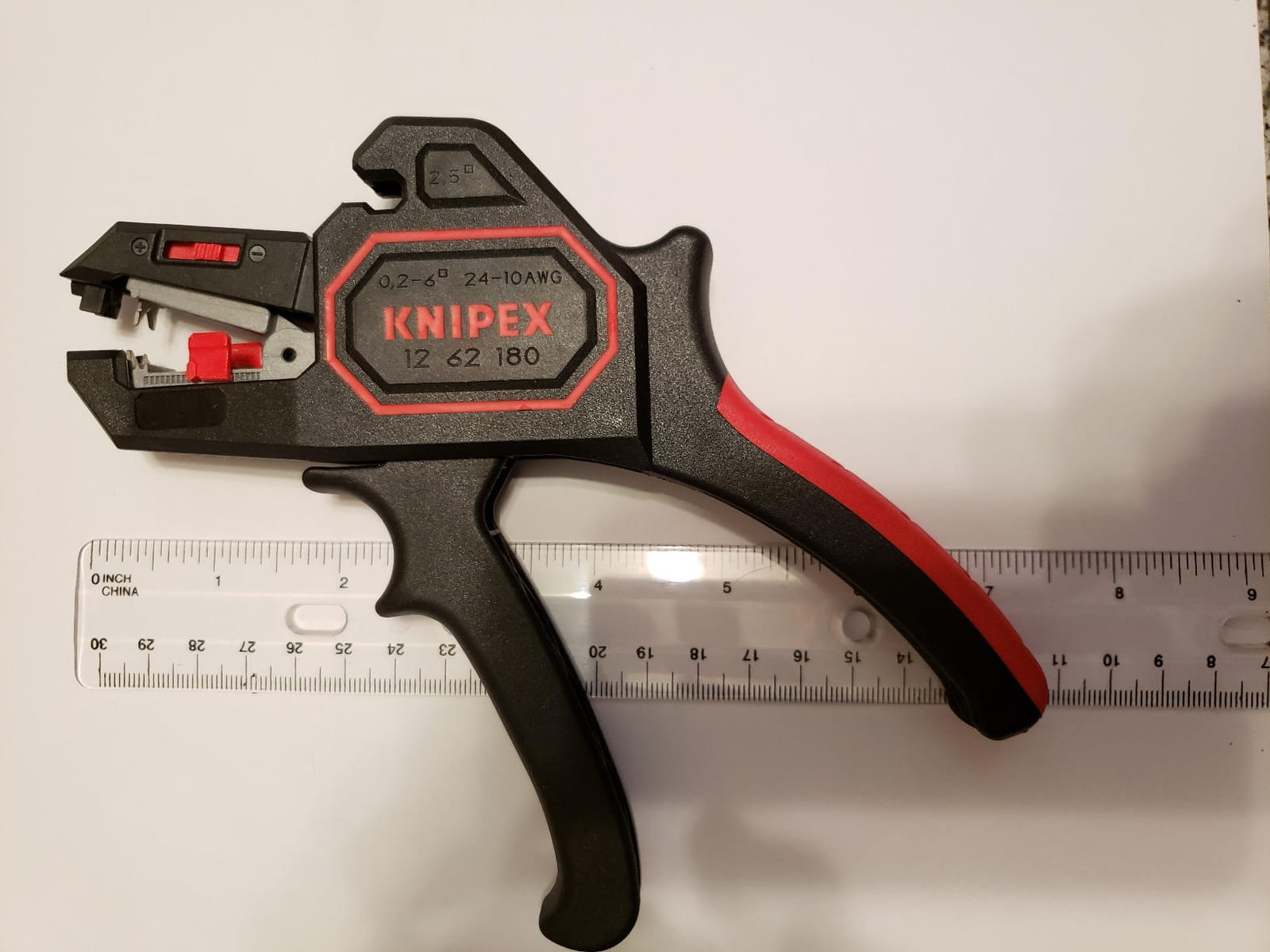
The 12 62 180 is the self-adjusting specialist. It covers 10-24 AWG, which is the widest range in this guide once you include fine control wire, and the spring-loaded one-squeeze cycle is the fastest way we found to terminate a whole panel.
The adjustable tension lets you set the tool for harder or softer insulation rather than fighting it, and the strip-length stop gives you the same exposure on every conductor. Reviewers love it on 18-22 AWG, which is where most panel and terminal work actually sits.
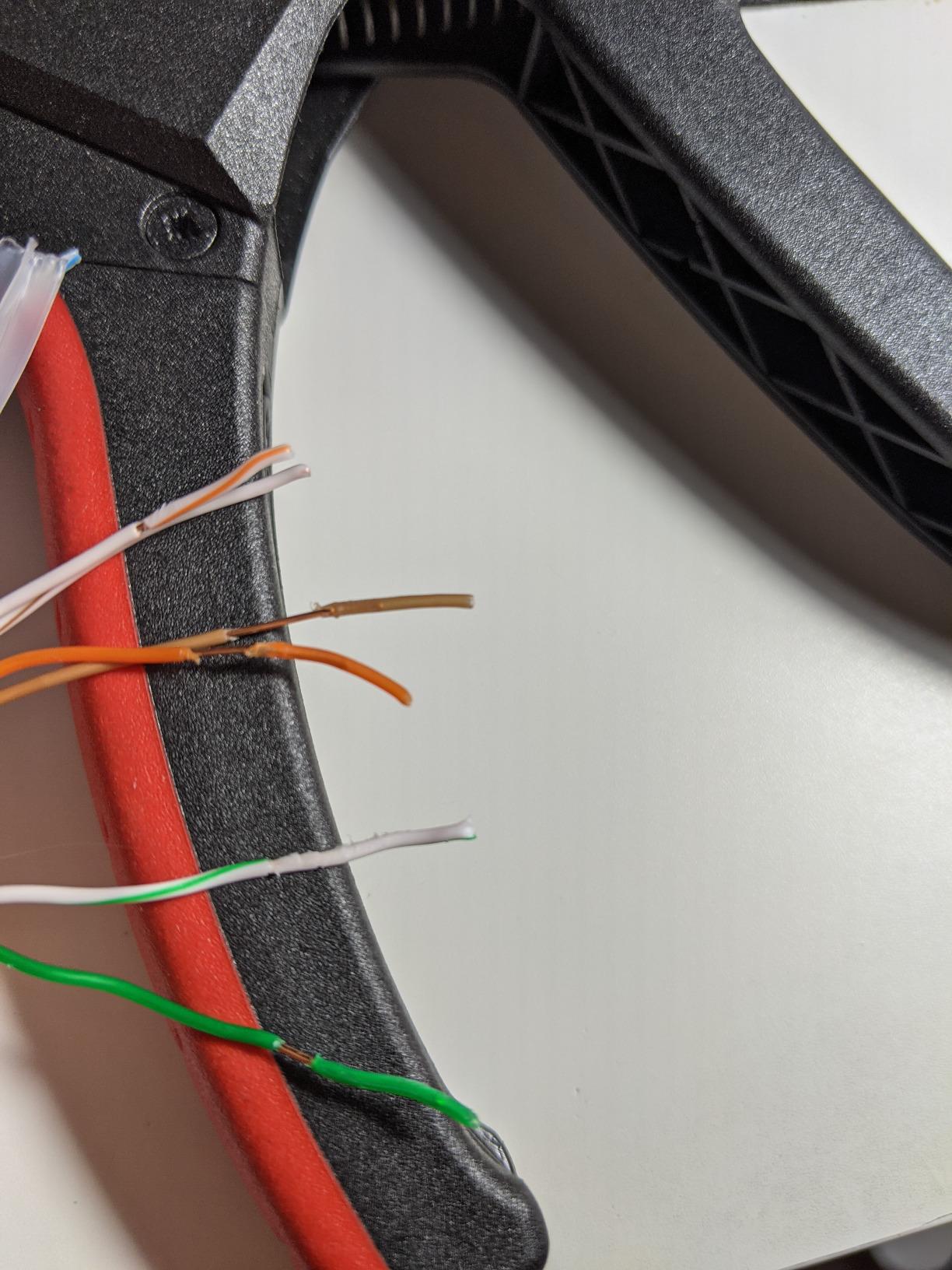
At 5.6 ounces with an ergonomic pistol-grip form, it is comfortable for long sessions, and the integrated cutter in the handle removes the tool switch entirely. Knipex lifetime warranty service is singled out as a genuine strength by owners of this model.
The 4.5 rating reflects a real split, and you should know both halves. A notable group criticise the largely plastic construction as feeling soft under load, and the tool cannot strip 10 AWG THHN because the blades ride over the jacket instead of cutting. The minimum practical strip length is around 5 mm.
Where the automatic action pays off
Panel and control cabinet assembly, where you terminate dozens of identical conductors and need identical results. Once the tension and length are dialled in, the repeatability is the best in this roundup and it does not require you to think about gauge selection.
It is also the fastest option for 24 AWG signal wire in the guide, which is otherwise the hardest part of the range to strip cleanly.
Where a forged tool is the safer buy
If your work includes stiff THHN at the heavy end, this is the wrong tool, because it simply will not engage that jacket. A 4.5 rating with a plastic frame also ages differently from a forged one, and heavy-gauge users tend to regret it sooner.
Dialing in the tension and length settings takes practice, so give it a week of use before judging it. Once set, most owners stop noticing that it is automatic at all.
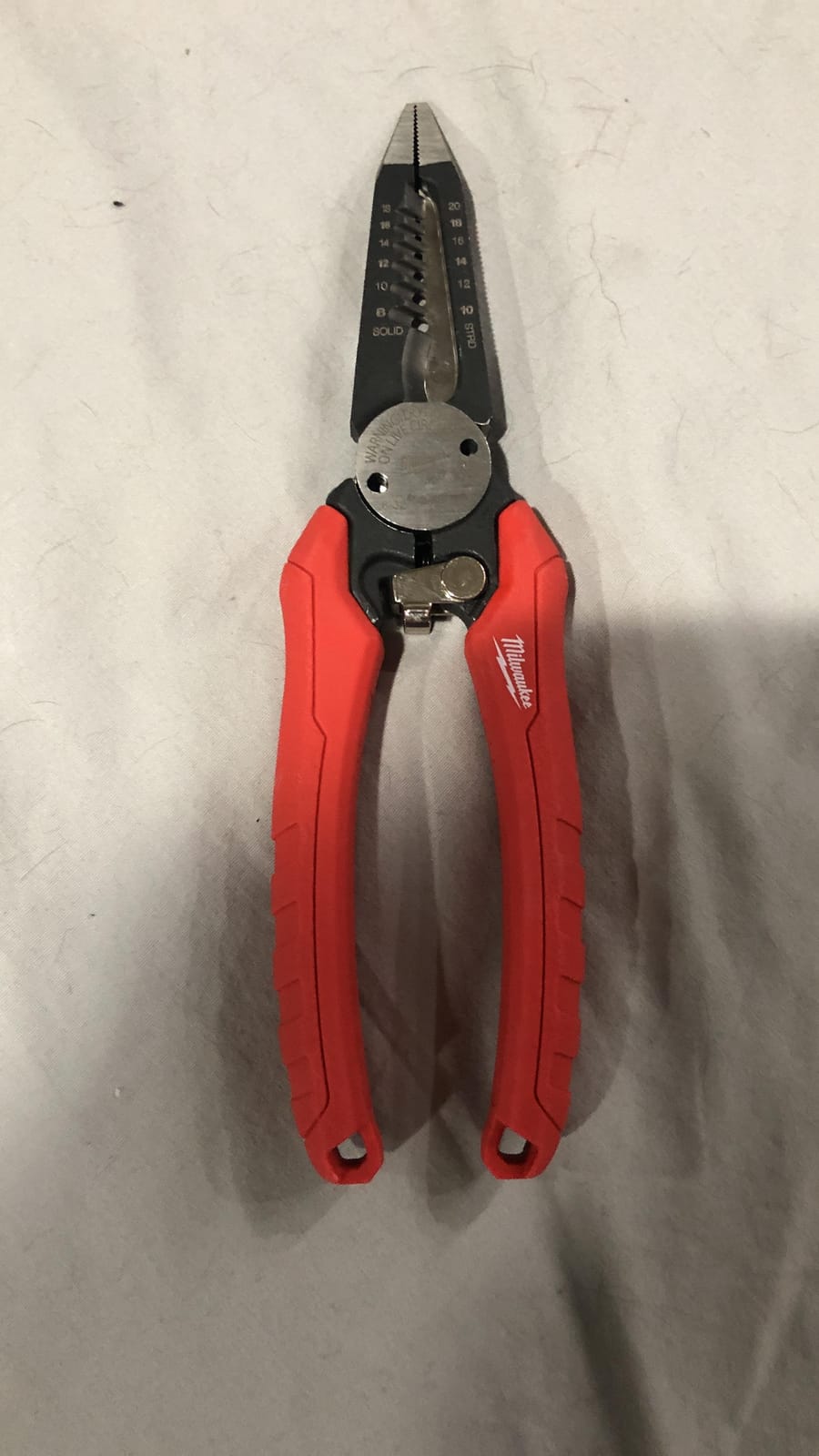
8. Milwaukee 48-22-3079 Six-in-One Stripping Pliers – Best for Multi-Function Utility
Milwaukee 48-22-3079 6-In-One Combination Wire Stripping & Reaming Pliers For Electricians
8-18 AWG solid, 10-20 AWG stranded
Reams 1/2 to 1 inch pipe
Cuts 6 and 8 bolts
Pros
- Six functions free up belt space
- Stripping holes tighten after break-in
- Curved blade cuts above its gauge template
- One-handed spring lock stays shut in a pouch
Cons
- Gauge markings are small in the field
- Stripping holes grab new wire before wear-in
The Milwaukee is the belt-space answer. It strips 8-18 AWG solid and 10-20 AWG stranded, forms loops for 8-32 and 6-32 grounding screws, reams conduit from half an inch to an inch, cuts and threads 6 and 8 bolts, and cuts wire.
What separates it from a generic multi-tool is the curved cutting blade. It handles wire larger than the stamped gauge suggests, so the 8 AWG hole is genuinely useful rather than decorative, and there is no play in the joints, which is why it stays sharp on copper over time.
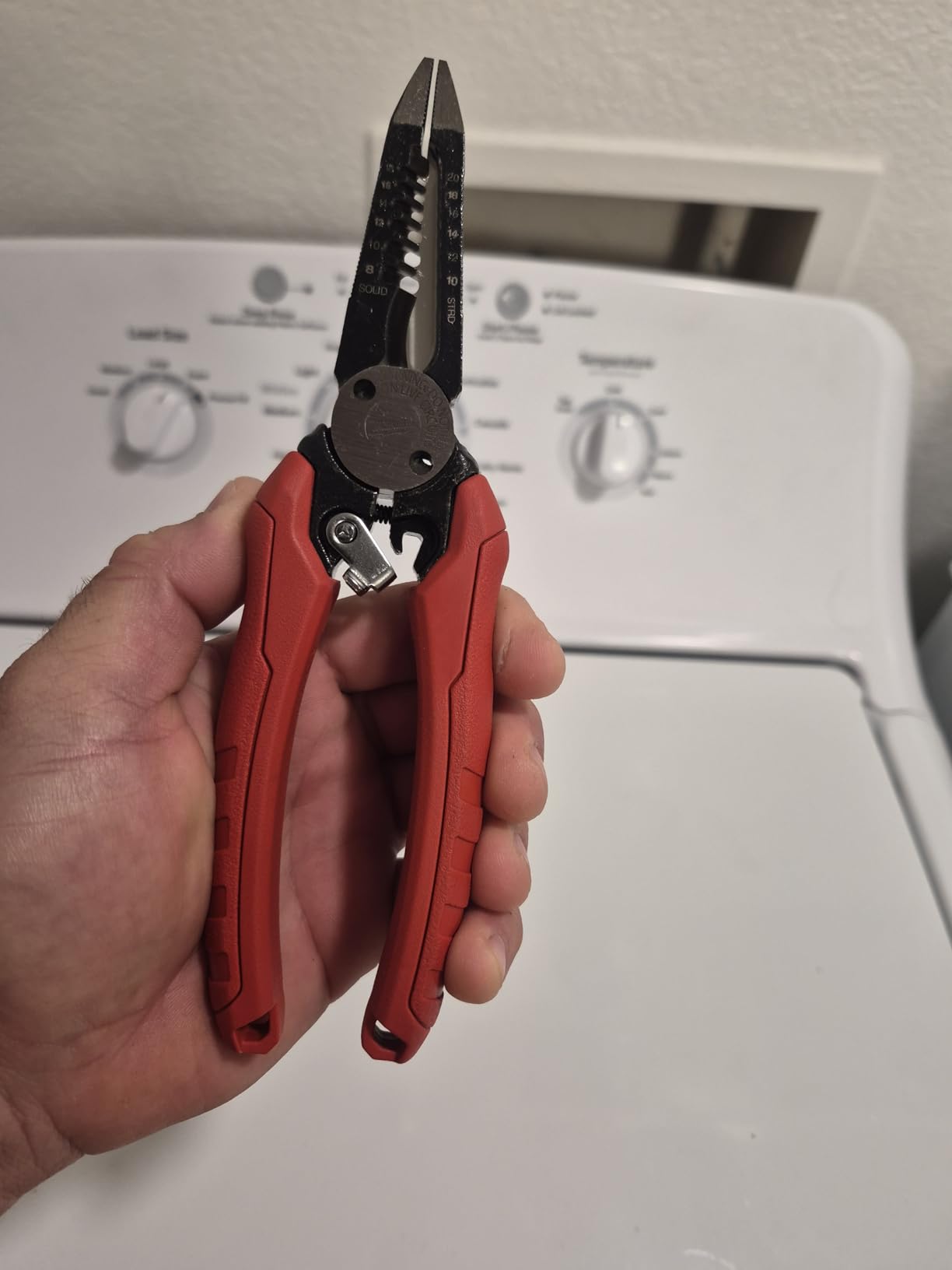
The one-handed spring lock opens easily with one gloved hand and stays shut in a pouch, which is a small courtesy that matters on a ladder. Rust-resistant finish extends tool life, and the reaming head smoothing pipe edges is a function you will use on every conduit job.
The recurring criticism is legibility. Gauge markings are small and hard to read in the field, particularly on a dark jacket at night, and the stripping holes grab the wire when the tool is new and need a short wear-in before they sit right.
Best for conduit and panel work
The reaming head is the reason to own this one. Smoothing the cut end of EMT or IMC before the coupling goes on is a task most electricians do with a file, a second tool and more time than the job needs, and this does it in the same grip as the strip.
Combined with the bolt cutter and the loop-making holes, it covers three of the four most common secondary operations on a service call.
Where to look elsewhere
It has no 1000V insulation rating, so it is a tool for de-energised work and general construction rather than a certified live-side tool. The small gauge markings are the practical annoyance, and a stripper with laser-etched numbers like the Channellock 957 solves that better.
At 290 grams it is not a lightweight belt tool either, so pair it with something lighter for fine control work rather than expecting it to do everything.
9. NEIKO 02037A Compact Stripper – Most Versatile
NEIKO 02037A Compact Wire Stripper | 4-in-1 Multi Purpose Electricians Pliers | Wire Crimper, Cutter and Gripper | 12-20 AWG Wire Service Tool | Crimps Insulated & Non-Insulated | Electrical Stripping
Strips 12-20 AWG
Crimps insulated and bare terminals
Compact 7 inch forged body
Pros
- Four functions in a compact 7 inch body
- Forged alloy steel with heat-treated teeth
- Works a clean strip from 12-20 AWG
- Light enough for a belt or a pocket
Cons
- 20 AWG ceiling limits heavier conductors
- Crimping cavity suits small terminals
The NEIKO 02037A is the pick if you need a service tool that fits in a pocket and does not feel like a stamped reject. Four functions, forged alloy steel, CNC machined heat-treated blades, and a body that fits a pouch in a way most plier strippers do not.
It handles 12, 14, 16, 18 and 20 AWG, which covers the majority of control and branch work an HVAC or low-voltage technician sees. The crimping cavity works on both insulated and bare terminals, and the gripping nose pulls, holds, twists and bends wire ends.
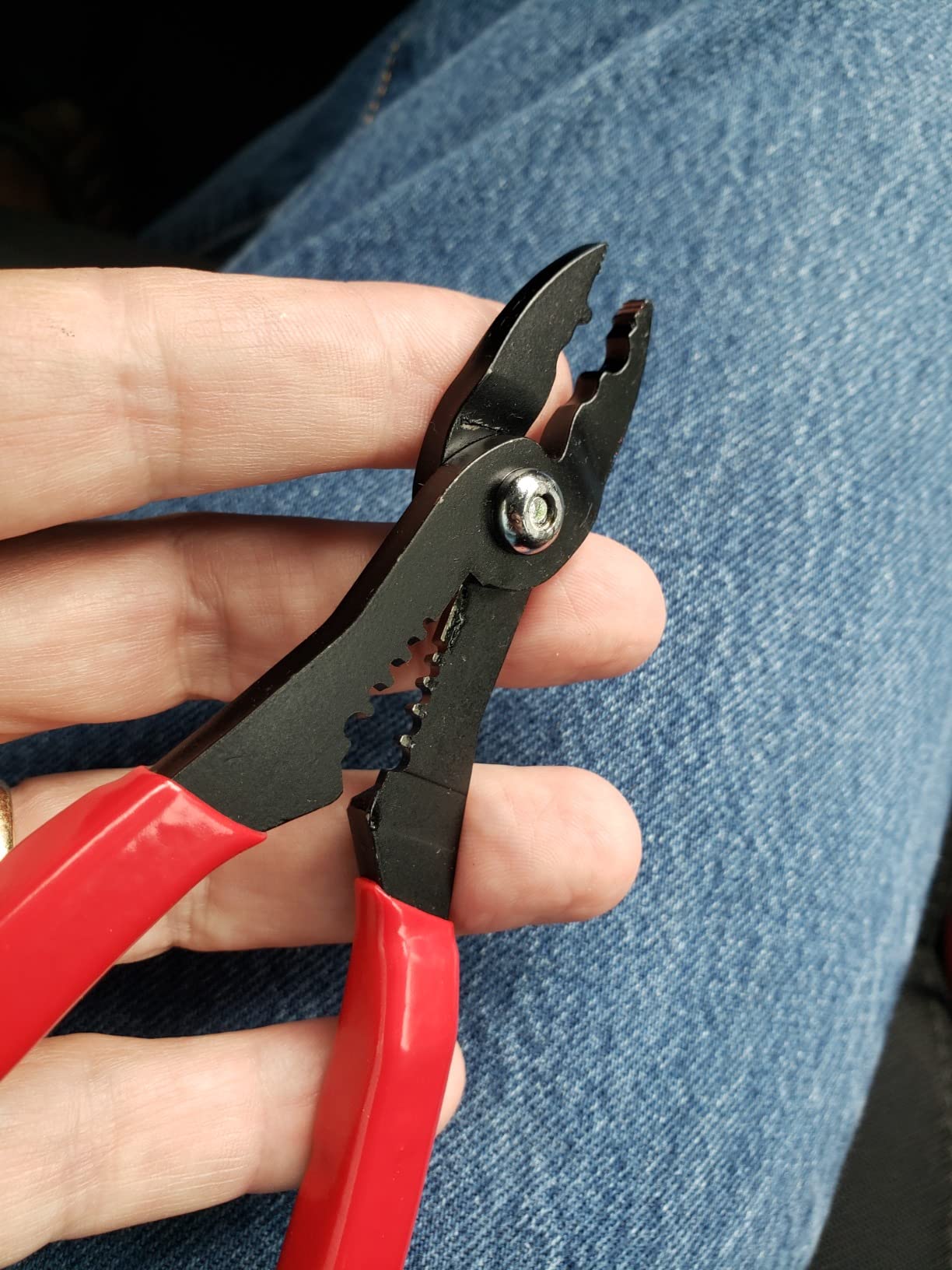
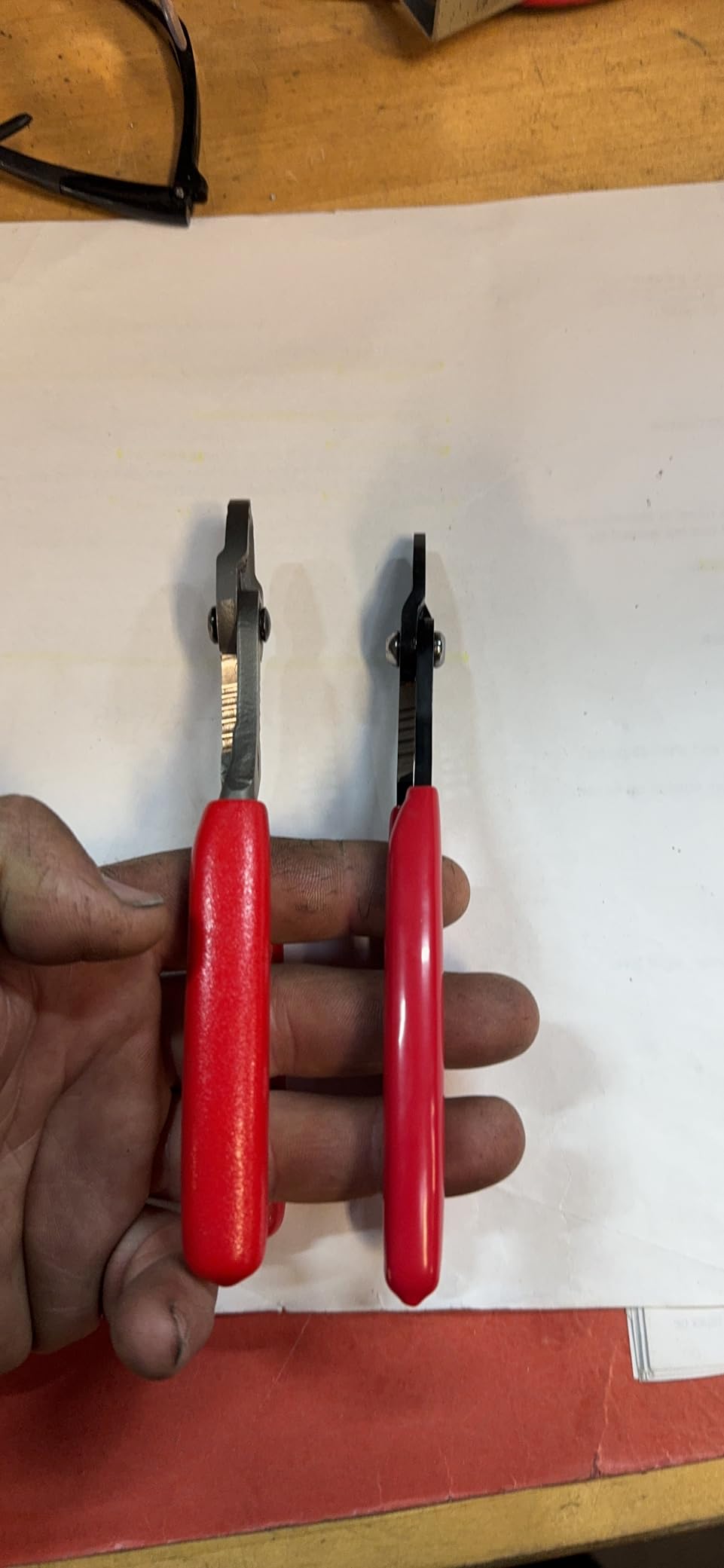
Buyers consistently remark that the forged construction is heavier duty than the price suggests, and that the heat-treated teeth hold up to daily carry. The 4.6 rating sits a notch below the premium tools because of what it leaves out, not because of what it does.
The limits are honest ones. It will not touch anything heavier than 20 AWG solid, and the crimping cavity is small, so it is not the right tool for large lugs or heavy terminals. The protective finish can also show wear after a lot of service.
Why it makes sense as a second tool
It is small enough to live in a chest pocket or a laptop bag, which means it is there when you are on a call and did not plan to do electrical work. At 7 inches and very light, you will actually carry it, which is the whole value case.
For apprentices building a first bag it is a strong companion piece to a heavier stripper, giving you crimp and cut capability without a second bulky tool.
When to spend a little more
If the wire in front of you is 10 AWG or heavier, this tool simply is not in the conversation, and you will be doing the job with a different pair in your hand. The same applies to large-terminal crimping.
Stepping up to the IRWIN 2078309 gives you a wider range and a bolt cutter for a similar outlay, and the Klein 11055EP gives you precision ground holes and screw shears. Choose this one for portability, not capability.
10. Channellock 957 Spring Stripper – Best for Lightweight Carry
Channellock Wire Stripping Tool 957 – Ergonomic Handle, Channel Lock Wire Stripper – 7-Inch w/Spring
Strips 10-20 AWG
Precision ground cutter
Laser etched gauge markings
Pros
- Precision ground edge for smooth consistent cuts
- Laser etched gauges stay readable
- Lean plier nose pulls and loops wire
- Light 7 inch spring body
Cons
- No crimper or screw cutter
- 10-20 AWG only with no larger capacity
The Channellock 957 is a single-purpose stripper done properly. It handles 10-20 AWG with a precision ground cutter, and at 2.4 ounces with a spring it is the second lightest tool in this guide after the NEIKO.
The laser-etched gauge markings are a genuinely thoughtful detail. They stay legible after months in a pouch, unlike stamped or painted numbers that wear off, and that is exactly when you need to read them. The lean plier nose makes pulling and looping wire straightforward.
It is made in the USA from alloy steel and carries a limited lifetime warranty, and the spring-loaded design means it is open and ready the moment your hand arrives. Users report smooth, consistent cuts across the range.
The trade-off owners accept is that it does one job. There is no crimper, no screw cutter and no bolt cutter, and it stops at 20 AWG. If you want a single-function tool that stays in the truck as a backup, that is a virtue. If you want one tool to carry, it is thin.
Best as a backup or a loaner
Every crew keeps one tool that is not the main tool, and this earns that slot. It is cheap relative to its build quality, it is made in the USA, and it is the tool you hand a customer or a helper who needs to strip four wires correctly right now.
Its weight also makes it the one to reach for on overhead work where a 12 ounce stripper becomes tiring by the end of a ceiling.
Why it is not the primary recommendation
Reviewers of the 957 note the small review base means long-term durability feedback is limited, and there is nothing to replace if a hole goes oval. A multi-function tool gives you a fallback function when the primary one is compromised.
Compare it with the Klein 11055EP for the same 10-20 AWG band: the Klein adds screw shears, looping holes and USA manufacture for a similar class of money, and is the stronger everyday buy.
11. IDEAL 45-120 T-Stripper – Best for Looping and Forming
IDEAL Wire Strippers, Electrical T-Stripper, Pro Electrical Tool
10-20 AWG precision holes
Knife-type ground blades
Spring-loaded straight handles
Pros
- Precision ground blades strip cleanly
- Spring handles open with one hand
- Narrow nose works in tight spots
- High-visibility grips easy to find in a bag
Cons
- T-notches can score some insulation
- Straight handles give less leverage
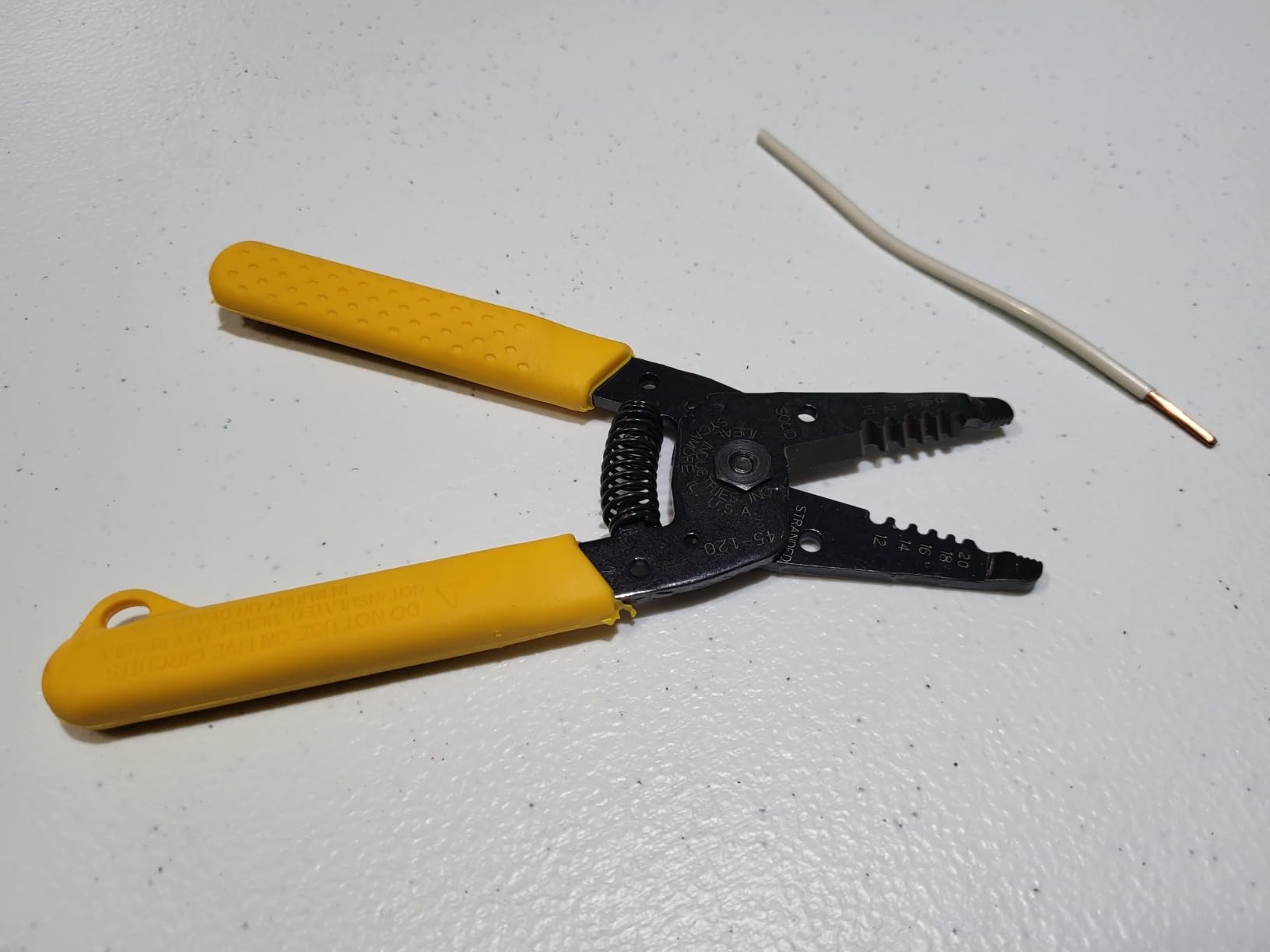
IDEAL’s 45-120 is the traditional T-stripper pattern, and if your work involves forming wire around terminal screws, the looping holes and narrow nose are the reason to pick it over a generic stripper. It covers 0.75 mm2 to 6 mm2, which is 10-20 AWG.
The precision-ground knife-type blades strip accurately, and the markings are easy to read, which matters on a straight-handle tool where the nose sits further from your eye. Spring-loaded straight handles open easily one-handed, and the narrow plier nose is genuinely useful for twisting and holding wires in awkward positions.
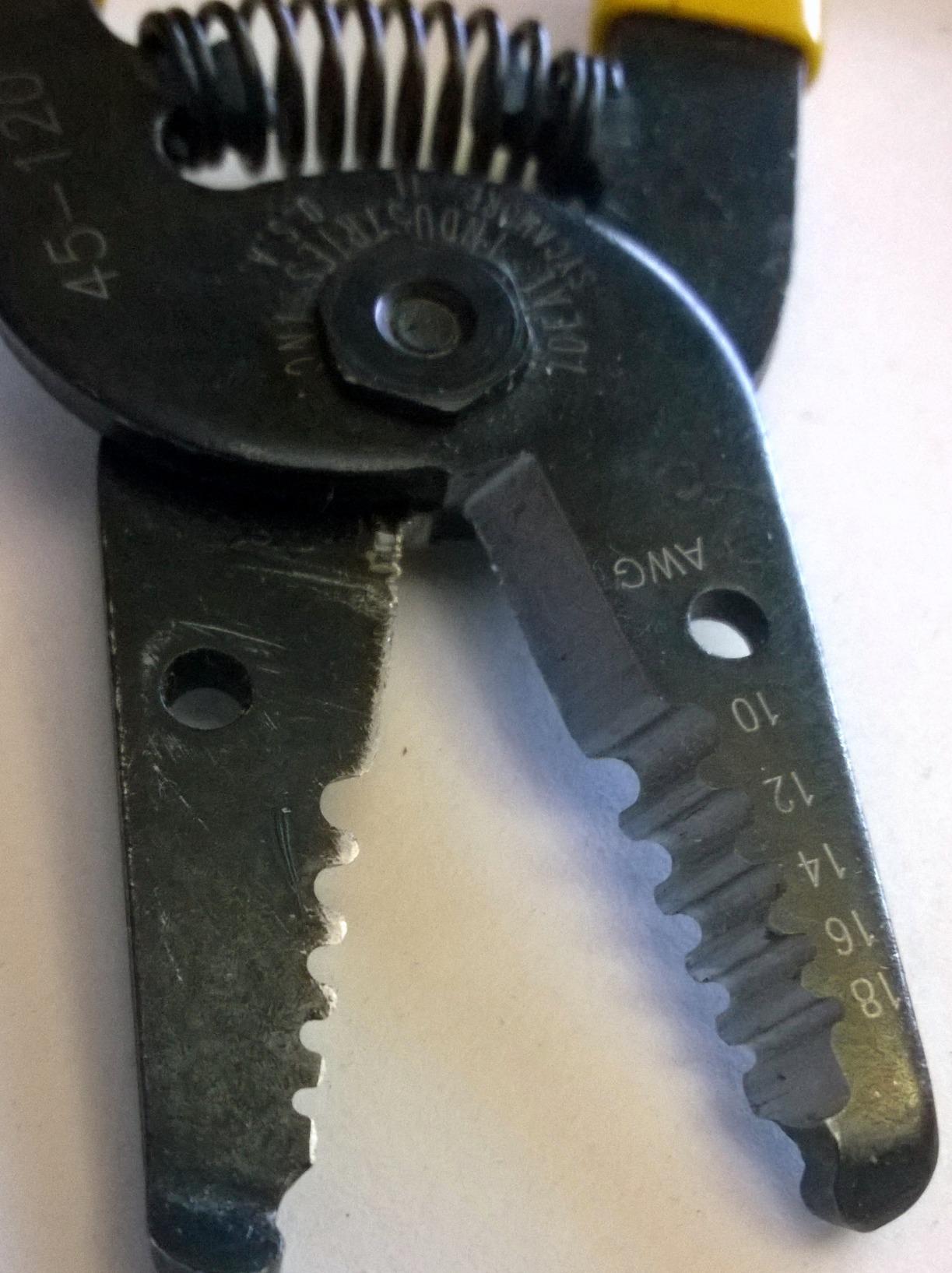
At 4 ounces with high-visibility non-slip grips, it is easy to find in a full tool bag and light enough for all-day use. The steel construction with a black-oxide finish resists corrosion, and it is designed and made in the USA.
The main reservation is the T-stripper notch design itself. Those notches can leave a scored mark on some insulation types, which does not affect the conductor but can look careless on a visible run. Straight handles also offer less leverage than angled or pistol-grip models when you are pulling a long strip.
Best for forming and terminal work
The looping holes are properly sized for forming a wire loop around a standard terminal screw, and the narrow nose holds the conductor while you wrap. Technicians who like this pattern use it for control panel terminations where the finish on the loop matters.
It is a natural companion to the IDEAL Stripmaster below, since the two cover opposite ends of the useful range.
When to choose a different pattern
If insulation appearance matters to you, a rotary or self-adjusting strip removes a clean ring rather than a T-slot, and the Klein 11055EP is the better all-round partner to a T-stripper. For fine wire you should look at the Stripmaster instead of stretching this range.
Reviewers also point out that the straight-handle design gives less leverage, so for stiff or thick insulation an angled model with more mechanical advantage is easier on the hand.
12. IDEAL Stripmaster 45-097 – Best for Fine Gauge Control Wire
IDEAL Electrical Stripmaster Manual Wire Strippers, #16 to #26 AWG
16-26 AWG one-step stripping
Die-cast zinc frame
Replaceable cutters and guides
Pros
- Clean repeatable strips on fine wire
- Owners report 20-plus years of service
- One-step design speeds repetitive work
- Replaceable cutters extend tool life
Cons
- Bulky frame may not fit in tight or confined work areas
- Cannot strip very short wire lengths (under about 2 inches)
- Spring-loaded handles can pinch fingers if attention lapses
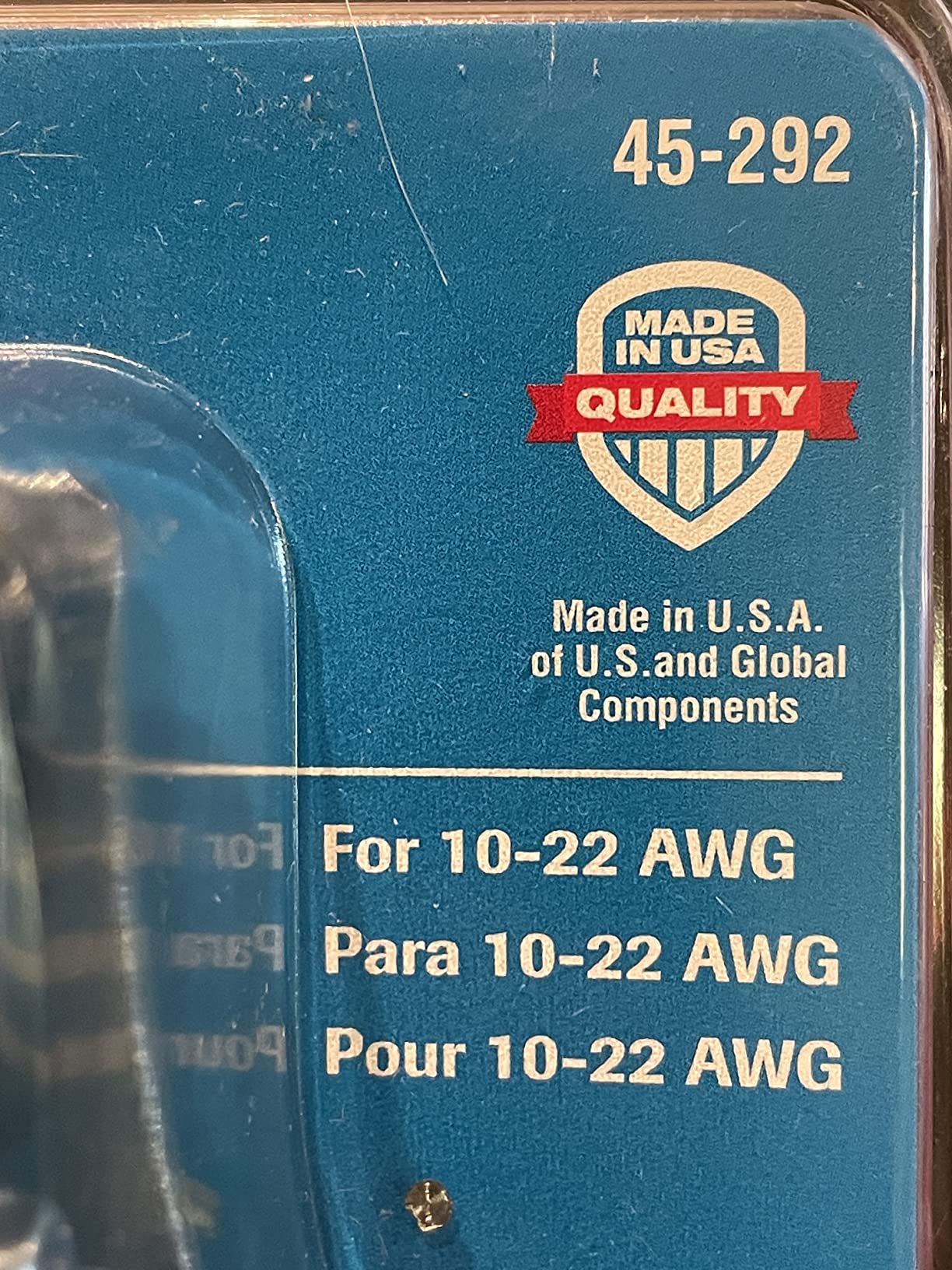
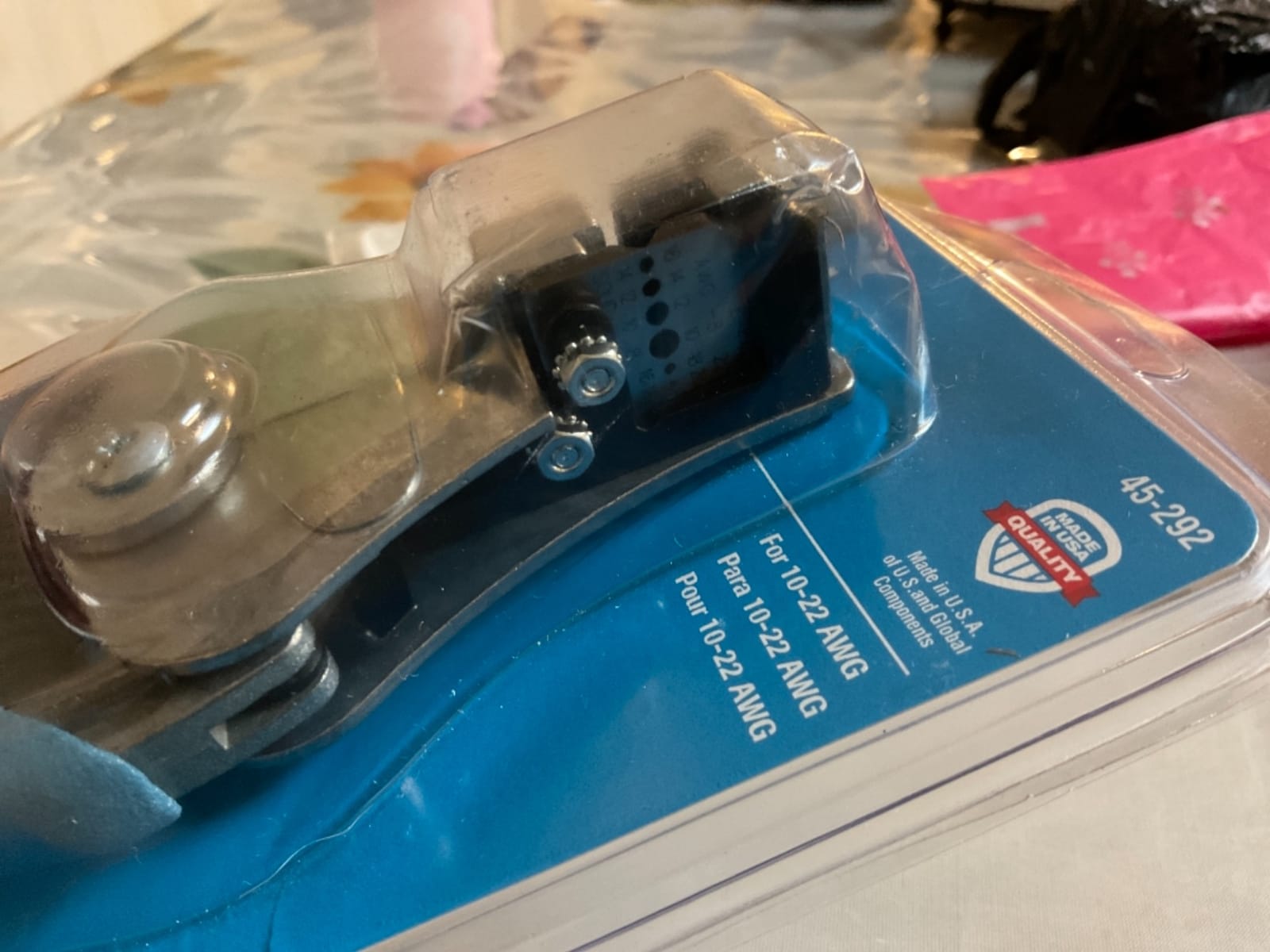
The Stripmaster covers 16-26 AWG, a range almost nothing else in this guide reaches at this quality. If you terminate control wiring, PLC panels, harness work or fine signal cable, this is the dedicated tool rather than a compromise.
The one-step stripping mechanism is the point. Precision-ground knife-type blades and high-leverage spring action do the work in one motion, and the die-cast zinc frame is the reason owners report 20-plus years of service or repeat purchases of the same model. Several reviewers describe it as equal to far more expensive aerospace strippers.
Professional electricians, aircraft mechanics and harness builders use it heavily on THHN, GXL and TXL insulation. The replaceable cutters and wire guides extend tool life well past the point where a fixed-blade tool would be retired, and a short auto-lock on release prevents the tool from crushing freshly stripped ends.
The physical drawbacks are real but functional rather than quality problems. The bulky frame is awkward in confined work areas, it cannot strip wire leads under about 2 inches, and the spring-loaded handles can pinch fingers if attention lapses.
Where the fine-gauge specialist earns its cost
At fine gauges, a stripper is judged almost entirely on whether it damages the conductor, and this one is praised for clean, consistent strips on small-gauge wire. Replaceable blades mean the tool stays useful instead of becoming a liability after a few months of fine work.
For a panel builder or harness shop, the one-step action and the spring leverage reduce hand fatigue across a long shift in a way a light plier-style tool does not.
When to choose something lighter
Some users find the 12 ounce die-cast body heavy, especially at the end of a day, and a few report inconsistent performance at the extreme 26 AWG end of the range. It is also not available in AWG sizing for all international markets, so check availability before committing.
If your work is 12 AWG and heavier, this tool is out of its depth entirely, and the Klein 11055EP or 11061 is the right purchase instead.
Knipex vs Klein vs Milwaukee vs Channellock: The Brand Verdict
Knipex is the premium and forged end of the market. The 13 72 8 is a forged stainless frame with shear blades rated well above the competition, and owners consistently describe it as very well designed and long lasting. It is not the lowest cost option, and the price is the most common objection, but the tools deliver what the money pays for.
Klein is the volume brand and the reason most electricians have a working stripper at all. The 11055EP and 11063W cover branch circuit and mixed service work, are widely available, and are made in the USA. Forum discussion regularly recommends Klein Kurve strippers for commercial electricians who value slim design.
Milwaukee competes on multi-function utility rather than strip quality. The 48-22-3079 adds reaming, bolt cutting and loop making to a solid 8-18 AWG stripper, and its curved blade out-cuts the gauge stamped on it. Reviewers praise Milwaukee self-adjusting strippers for being gentle on wire and rarely over-cutting.
Channellock is the value and heritage option, with USA alloy steel construction, laser-etched gauges and a limited lifetime warranty on straightforward single-purpose tools.
Our verdict: for a service truck doing mixed work, Klein. For heavy feeder, MC cable and buying once, Knipex. For conduit and panel utility in one tool, Milwaukee. For a lightweight backup, Channellock. The brand debate is real, but it is usually a debate about job type dressed up as a debate about quality.
How to Choose a Wire Stripper: A Buying Guide
Start with the wire, not the brand. Write down the gauges you actually terminate and whether they are solid or stranded, because that single question eliminates most of the list above. A tool that tops out at 20 AWG is useless on a feeder, and no amount of blade quality compensates for that.
Next, decide between gauged and self-adjusting. Gauged strippers with precision ground holes give the most consistent result on known wire with known insulation, and they are faster. Self-adjusting strippers win on unmarked or legacy cable, mixed insulation thickness, and high-volume work where you are switching gauge constantly. The common complaint about self-adjusting tools is over-stripping fine stranded wire, which the tensioning thumb wheel on the Klein 11061 directly addresses.
Then check the secondary functions against your actual work. If you form wire loops for terminal screws, look for looping holes. If you cut 6-32 and 8-32 screws, look for screw shears. If you crimp terminals, check that the crimping cavity matches the terminal size you use. If you ream conduit, that is the Milwaukee’s argument for a place on the belt.
Finally, think about insulation rating. None of the picks in this guide are 1000V rated hand tools for live-side work; the KNIPEX Ergostrip carries a VDE specification, which is the only insulated rating in the group. For commercial and industrial live work, use a genuinely insulated tool and treat everything else as a de-energised-work tool.
Matching the tool to the wire size
8-10 AWG feeder: the Klein 11063W, the KNIPEX 13 72 8 or the Milwaukee 48-22-3079. This is where 10 AWG stranded either gets crushed or refused by lesser tools.
12-14 AWG: most tools here cover this band, and the Klein 11055EP or 11061 give the cleanest rings.
14-18 AWG branch circuit: the widest band of the range, where a precision gauged stripper such as the Klein 11055EP is the standard answer.
18-22 AWG control and signal: the Klein 11061, the KNIPEX 12 62 180 and the NEIKO 02037A all handle this cleanly.
22-26 AWG: the KNIPEX 12 62 180 and the IDEAL Stripmaster are the two picks that reach it properly.
Data, coax and sheathed cable: the KNIPEX Ergostrip for cable and data, and the Klein 11061 for 12/2 and 14/2 Romex.
Two failure modes to avoid. First, a nick usually means the wrong notch rather than a bad blade, so choose a self-adjusting tool when the wire is unmarked. Second, using stripper cutters on steel or hardened screws destroys the cutting edge permanently, and most people only learn that after the damage is done. Keep your cutters for copper.
How to Strip Wire Without Damaging the Conductor
Confirm the circuit is dead. Test and prove your tester on a known live source before you touch anything, then lock off and tag. Stripping is one of the few tasks where a distracted moment is genuinely dangerous.
Match the notch to the gauge and strand type. Check the conductor size against the stripping range, not against the insulation diameter. Stranded wire needs the stranded range, and forcing it into a solid notch crushes the strands.
Set the strip length first. On self-adjusting tools, set the stop before you start. Most of the tool-switching and rework in panel work comes from changing strip length wire by wire.
Position the conductor and close smoothly. Seat the wire fully in the notch, then close the handles in one steady squeeze rather than a hesitant bite. A partial close on a gauged tool is the most common cause of a torn insulation ring.
Pull and inspect the conductor. Pull in line with the wire, not at an angle, and check the exposed length and the surface. Look for a flat spot, a missing strand or a score. A clean strip is bright, round and slightly stepped at the edge where the blades met.
Inspect every conductor before it goes into a box. A nicked or over-stripped termination is the kind of defect that passes a fast job and fails an inspection months later, and it is far cheaper to catch it now.
Frequently Asked Questions
Which is better, Knipex or Klein?
It depends on the job, not the brand. Klein is the better value for mixed residential and branch circuit work because the 11055EP and 11063W are accurate, widely available and cheaper. Knipex is better for heavy feeder, MC and BX cable work and for buying once, because the forged 13 72 8 frame and shear blades outlast stamped alternatives and cut with far less hand force.
Is Knipex better than Milwaukee or Channellock?
Not across the board. Knipex leads on stripping quality and forged durability, while Milwaukee wins on multi-function utility with reaming, bolt cutting and loop making in one plier. Channellock wins on lightweight single-purpose tools with laser-etched gauges and USA construction. For stripping alone, Knipex leads; for conduit and panel work in one tool, Milwaukee is hard to beat.
Is Knipex worth the price?
If you strip wire every day and especially if you work with heavier gauge or sheathed cable, yes. The forged frame and higher-capacity shear blades are the reason the cost premium exists, and owners commonly report years of service. If you mostly terminate 14-18 AWG branch circuit, a Klein precision stripper produces an equally clean result for a fraction of the outlay.
What is the best way to strip electrical wire?
Match the notch to the gauge and strand type, seat the conductor fully, then close the handles in one steady squeeze and pull in line with the wire. On self-adjusting tools, set the strip-length stop before you start. Always inspect the conductor for a nick, a flat spot or a missing strand before terminating it.
What is the best tool for stripping twin and earth wire?
A self-adjusting stripper handles twin and earth well because it reads the conductor rather than a fixed notch, and the Klein 11061 is specifically built to strip 12/2 and 14/2 Romex along with 10-20 AWG solid and 12-22 AWG stranded wire. For repeated rough-in on known gauges, the Klein 11055EP gives the most consistent result.
Which wire cutters are best for electricians?
It depends on the range. The Klein 11055EP is the strongest all-round branch circuit cutter with screw shears, the KNIPEX 13 72 8 has the highest cutting capacity and cuts cable as well as wire, and the IRWIN 2078309 is the best value multi-tool with a crimper and bolt cutter. Use stripper cutters on copper only, since steel or hardened screws will destroy the edge permanently.
Are self-adjusting wire strippers better than gauged manual ones?
Self-adjusting strippers are better on unmarked or legacy cable, mixed insulation thickness and high-volume panel work. Gauged strippers with precision ground holes are better on known wire with known insulation, because there is nothing to sense and the result is faster and more consistent. The usual complaint about self-adjusting tools is over-stripping fine stranded wire.
What is the best automatic wire stripping machine for scrap copper?
For scrap copper recycling the answer changes completely, because volume and speed matter more than conductor quality. Powered and drill-mounted strippers handle continuous scrap far faster than any hand tool in this guide and are worth the investment only if you process a regular volume. For termination work, a precision hand stripper is faster and far safer for the conductor.
Final Verdict: The Best Wire Strippers for Electricians in 2026
After six weeks and several hundred strips, the Klein Tools 11063W Katapult is the best wire stripper for electricians overall, because it covers the widest range of real job wire and pulled a full inch of insulation cleanly in one squeeze. The IRWIN Vise-Grip 2078309 is the best value pick and the best first tool for an apprentice bag, and the KNIPEX 13 72 8 is what to buy when you plan to keep one stripper for a career.
Match the tool to the gauge you actually terminate, keep the cutters off steel, and inspect every conductor before it goes into the box. That habit matters more than any brand on the handle.