
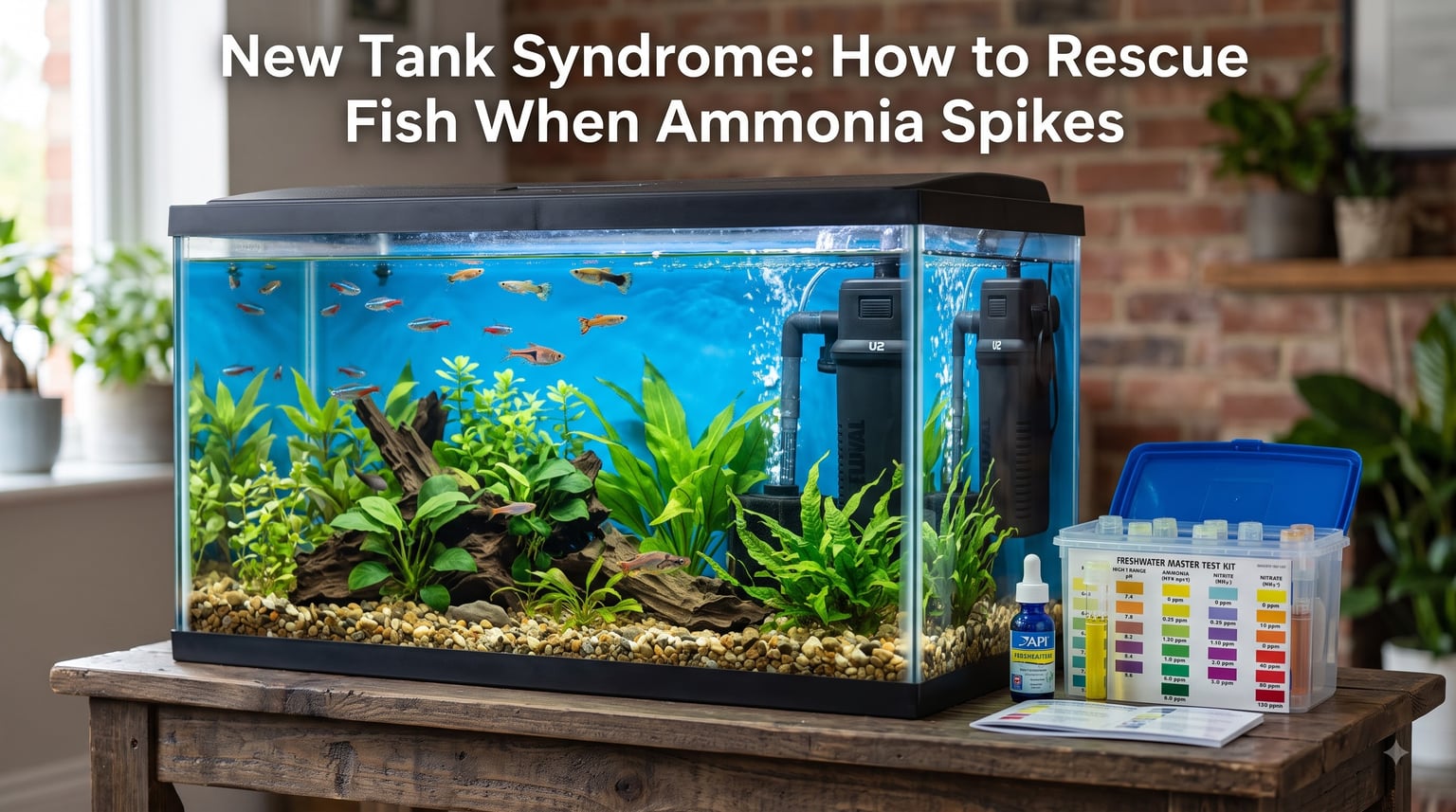
You set up a beautiful new aquarium, added your fish, and everything looked great for a day or two. Now your fish are gasping at the surface, hiding behind decorations, or worse. You are watching them struggle and wondering what went wrong.
This is New Tank Syndrome, and it happens to almost every new fish keeper. The good news is that fish can survive if you act fast. In this guide, I will walk you through exactly what New Tank Syndrome is, how to recognize it, the emergency steps to rescue your fish right now, and how to prevent it from ever happening again.
Whether you are in the middle of an ammonia crisis or trying to avoid one, you will find clear, step-by-step instructions here. I have pulled together the best practices from fish keepers who have been through this, veterinary guidance, and the science behind what is actually happening in your tank water.
Table of Contents
What Is New Tank Syndrome?
New Tank Syndrome is ammonia and nitrite poisoning in an aquarium that does not yet have enough beneficial bacteria to process fish waste. It occurs most often in tanks that are less than six weeks old, which is why it hits new setups so hard.
Here is the simple version of what goes wrong. Fish constantly produce ammonia through their waste, uneaten food, and even through their gills when they breathe. In a mature tank, colonies of nitrifying bacteria live in the filter media and on surfaces throughout the tank. These bacteria convert ammonia into nitrite, then convert nitrite into nitrate, which is far less toxic.
In a brand new tank, those bacterial colonies barely exist. There has not been enough time for them to grow. So the ammonia your fish produce has nowhere to go. It builds up in the water, and within 24 to 72 hours of adding fish, ammonia levels can spike to lethal concentrations. A nitrite spike usually follows a week or two later as the first batch of bacteria starts processing ammonia but the second batch has not caught up.
The entire cycling process typically takes four to six weeks. During that window, your tank is in a dangerous transition phase where water can look crystal clear and perfectly clean while being completely toxic. This is one of the most confusing aspects for new keepers, because clear water does not mean safe water.
Why Ammonia and Nitrite Kill Fish?
Understanding the toxicity mechanism helps you appreciate why fast action matters. Ammonia and nitrite damage fish in two completely different ways, and both can be fatal within hours.
Ammonia essentially burns fish. It damages the gill tissue, causing the delicate membranes to swell and secrete excess mucus. When gills are burned, fish cannot extract oxygen from the water efficiently. This is why ammonia-poisoned fish gasp at the surface, where oxygen concentration is highest. The damage to gill tissue is often permanent, and fish that survive high ammonia exposure may have lasting respiratory problems.
Nitrite works differently. It enters the bloodstream through the gills and binds to hemoglobin, the molecule that carries oxygen. When nitrite locks onto hemoglobin, it turns the blood brown, a condition called brown blood disease. The blood can no longer transport oxygen effectively, so the fish slowly suffocates even in well-oxygenated water. You may notice gills appearing brownish rather than bright red.
Both ammonia and nitrite are invisible. You cannot see them, smell them, or detect them without a test kit. This is why testing is non-negotiable during the first six weeks of a new tank.
Signs of New Tank Syndrome in Your Fish
Fish give you warning signs before they die, but you need to know what to watch for. Here is a checklist of symptoms that point to ammonia or nitrite poisoning.
Gasping at the surface: Fish hang near the top of the water, gulping air. This is the number one sign that something is wrong with water quality.
Rapid gill movement: Gills move fast and may look red, inflamed, or brownish. This indicates the fish is struggling to breathe.
Lethargy and hiding: Fish that were active suddenly sit at the bottom, hide behind decorations, or stop responding to food.
Red streaks or blotches: Blood vessels become visible on the body and fins, a sign of hemorrhaging from ammonia damage.
Clamped fins: Fins are held tight against the body rather than spread out, a general stress indicator.
Loss of appetite: Fish refuse food or spit it back out.
Red or irritated gills: Look closely at the gills. Inflamed, dark red, or brown gills signal poisoning.
If you see any two of these symptoms together in a tank less than six weeks old, assume New Tank Syndrome and test your water immediately. Do not wait.
Emergency Rescue: How to Save Fish When Ammonia Spikes
If your fish are showing symptoms right now, follow these steps in order. Every minute counts when ammonia levels are high.
Step 1: Test the water immediately. Use a liquid test kit to check ammonia, nitrite, and nitrate levels. If ammonia reads above 0.25 ppm or nitrite reads above 0.5 ppm, you are in an active crisis. Write down the numbers so you can track changes.
Step 2: Do a 50 percent water change right now. Use a dechlorinator that also neutralizes ammonia, such as Seachem Prime or a similar water conditioner. Match the new water temperature to the tank within a degree or two to avoid temperature shock. Pour the new water in slowly.
Step 3: Add an ammonia detoxifier. If you are not using a conditioner that binds ammonia, dose one now. Products like Prime temporarily convert ammonia into a non-toxic form that bacteria can still process. This buys you 24 to 48 hours. Remember, this is a bandage, not a fix.
Step 4: Increase oxygen levels. Add an air stone, lower the water level slightly so the filter return creates more surface agitation, or point a filter output toward the surface. Ammonia and nitrite both reduce oxygen delivery in fish, so boosting dissolved oxygen directly helps them survive.
Step 5: Stop feeding for 24 to 48 hours. Uneaten food decomposes into more ammonia. Fish can go days without food safely. When you resume feeding, offer tiny amounts once a day and remove anything uneaten after two minutes.
Step 6: Repeat water changes daily. Test every morning. If ammonia is above 0.25 ppm or nitrite above 0.5 ppm, do another 30 to 50 percent water change with conditioned water. This daily routine may need to continue for two to four weeks until the bacteria colony catches up.
Step 7: Add bottled bacteria. Products containing live nitrifying bacteria can accelerate the cycling process. Quality varies between brands, so look for products stored refrigerated and check expiration dates. Add directly to the filter media where bacteria need to colonize.
Step 8: Consider moving fish if levels are extreme. If ammonia reads above 4.0 ppm despite water changes and you have a cycled tank available, moving fish temporarily may be the safest option. If you have no second tank, focus on frequent water changes and detoxifiers.
Do not tear down the tank and start over. A partially cycled tank is better than a completely uncycled one, because some bacteria have already begun colonizing your filter. Starting over just resets the clock.
How to Test Your Water the Right Way?
Testing is the single most important thing you can do during the first six weeks. You are flying blind without accurate numbers.
Use a liquid test kit, not test strips. Forum fish keepers overwhelmingly recommend liquid kits like the API Freshwater Master Test Kit because strips are notoriously inaccurate. Liquid kits measure ammonia, nitrite, nitrate, and pH with far more precision.
Test daily during a fish-in cycle. You are looking for three things: ammonia dropping toward zero, nitrite rising then falling, and nitrate appearing. When you see ammonia and nitrite both reading zero with some nitrate present, your tank is cycled.
Rinse test tubes between uses with tank water, not tap water. Tap water contains chlorine that can affect results. Hold tubes against a white background to read colors accurately, and test at the same time each day for consistency.
If pH drops significantly during cycling, your water may lack buffering capacity. Carbonate hardness, or KH, keeps pH stable. Low KH can cause dangerous pH swings that compound the stress on your fish.
Fish-in Cycling vs Fishless Cycling
Fishless cycling means building the bacterial colony before any fish enter the tank. You add a pure ammonia source, test daily, and wait for the bacteria to establish. This takes the same four to six weeks but puts zero fish at risk. This is the method every experienced fish keeper recommends.
Fish-in cycling is what happens when fish are already in the tank before it is cycled. It is stressful and requires daily testing, frequent water changes, and constant vigilance. Fish survive it, but they may carry lasting organ or gill damage from ammonia exposure.
The core difference is risk. Fishless cycling is controlled and predictable. Fish-in cycling is reactive, expensive in dechlorinator and test supplies, and carries real risk of fish death. If you have not bought fish yet, cycle first. If fish are already in the tank, you are committed to a fish-in cycle and need to manage it carefully.
One shortcut that genuinely works is seeded media. If you have a friend with a healthy, cycled tank or a local fish store willing to share filter media, adding established media to your filter can cut cycling time from weeks to days. The bacteria you need are already living in that sponge or ceramic media.
How to Prevent New Tank Syndrome?
Prevention comes down to one principle: never add fish to a tank that has not been cycled. Here is how to cycle a tank properly before fish arrive.
Set up the tank with filter, heater, and substrate fully in place. Add dechlorinated water and let it run for 24 hours to stabilize temperature and flow. Then add a pure ammonia source, either bottled ammonia designed for cycling or a small amount of fish food that will decompose.
Add bottled bacteria to jumpstart the process. Test daily. You are looking for the ammonia to spike, then drop as the first bacteria colony grows. Then nitrite will spike and eventually drop as the second colony establishes. When both read zero and nitrate is climbing, the tank is cycled.
Stock slowly. Even a cycled tank can crash if you add too many fish at once. Add a few small fish first, wait a week, test to confirm stability, then add more gradually. The bacterial colony scales with the bioload, so sudden increases in fish waste can outpace what your bacteria can handle.
Avoid overfeeding. Excess food decomposes into ammonia and is one of the fastest ways to overwhelm a developing filter. Feed only what fish consume in two minutes, once or twice daily.
Recovery Timeline: What to Expect After an Ammonia Spike
Fish recovery depends on how high the ammonia or nitrite got and how long the exposure lasted. Here are realistic expectations based on what fish keepers report.
If you caught the spike early with mild readings, fish usually recover fully within a few days of clean water. Their behavior normalizes, appetite returns, and gill inflammation subsides. Continue testing daily for at least a week after symptoms disappear.
If ammonia was high for several hours or days, expect recovery to take one to two weeks. Fish may remain lethargic and off their food. Some will develop secondary infections because ammonia-damaged gills and skin are vulnerable to bacteria. Watch for fungal growth or fin rot and treat promptly.
Fish exposed to severe ammonia may never fully recover. Permanent gill scarring reduces their ability to extract oxygen, making them more sensitive to future water quality issues. These fish need consistently excellent water for the rest of their lives.
For the tank itself, cycling typically completes four to six weeks from setup regardless of when the spike occurred. The bacterial colonies need that time to grow to a size that can handle the bioload of your fish. Once cycled, ammonia and nitrite should always read zero.
What to Do If Your Fish Died
If you lost fish, first know that this happens to nearly every fish keeper at some point. Fish stores routinely tell new owners a tank is ready after 24 or 48 hours, which is simply not true. You were set up to fail before you even brought fish home.
Remove the deceased fish immediately to prevent an ammonia spike from decomposition. Test the water to understand what happened. If ammonia or nitrite is high, do a large water change before considering any new additions.
Do not add new fish right away. Use this time to finish cycling the tank properly. Run a fishless cycle with bottled ammonia, or add bottled bacteria and continue daily testing. Once the tank reads zero ammonia and zero nitrite consistently for a full week, it is safe to stock again, slowly.
Clean the tank but do not sterilize it. A gentle wipe of glass and a gravel vacuum are enough. You want to preserve whatever bacteria have started growing. Sterilizing restarts the clock entirely.
Frequently Asked Questions
Can fish recover from an ammonia spike?
Yes, fish can recover from an ammonia spike if you catch it early and act fast. Mild exposure usually clears up in a few days with clean water. Severe or prolonged exposure can cause permanent gill damage, so fish that survive may need consistently excellent water quality for the rest of their lives.
How do I fix an ammonia spike in my fish tank?
Do a 50 percent water change immediately using water treated with a dechlorinator that also binds ammonia. Stop feeding for 24 hours, add an air stone for extra oxygen, and dose bottled bacteria into the filter. Test daily and repeat water changes whenever ammonia reads above 0.25 ppm until the tank finishes cycling.
Can fish survive New Tank Syndrome?
Fish can survive New Tank Syndrome with prompt intervention. The key is daily water testing, frequent partial water changes, ammonia detoxifiers, and patience while the bacterial colony establishes over four to six weeks. Without intervention, ammonia can kill fish within 24 to 72 hours.
How long does an ammonia spike last in an aquarium?
An ammonia spike typically lasts one to two weeks in a new tank before the first bacteria colony grows large enough to process it. A nitrite spike follows and lasts another one to two weeks. The full cycle usually completes within four to six weeks. Daily water changes keep levels safe during this period.
Why are my new fish dying?
New fish dying is almost always caused by New Tank Syndrome. An uncycled tank lacks the beneficial bacteria needed to process ammonia from fish waste. Ammonia builds up to toxic levels within 24 to 72 hours, burning gills and suffocating fish. Test your water for ammonia and nitrite immediately.
How do I cycle a tank without fish?
Set up the tank with filter and heater running, then add a pure ammonia source to about 2 to 3 ppm. Add bottled bacteria to jumpstart colonization. Test daily. Once ammonia and nitrite both read zero with nitrate present, usually after four to six weeks, the tank is cycled and ready for fish.
Conclusion
New Tank Syndrome is the most common reason new fish keepers lose their fish, and it is entirely preventable. The core problem is simple: a new aquarium does not have enough beneficial bacteria to process the ammonia fish produce. Without those bacteria, ammonia and nitrite build up to lethal levels fast.
If you are in the middle of an ammonia crisis, follow the emergency rescue steps: test, change water, detoxify, oxygenate, and repeat daily. If you have not added fish yet, cycle your tank first using the fishless method. Four to six weeks of patience saves fish lives and saves you from the stress of daily crisis management.
Remember that clear water does not mean safe water. A good liquid test kit is your most important tool during the first six weeks of any new tank. Once your tank reads zero ammonia and zero nitrite consistently, you have a stable biological filter that will keep your fish healthy for years. Learning how to rescue fish when ammonia spikes is a skill every aquarist needs, but the better skill is never needing to use it.