
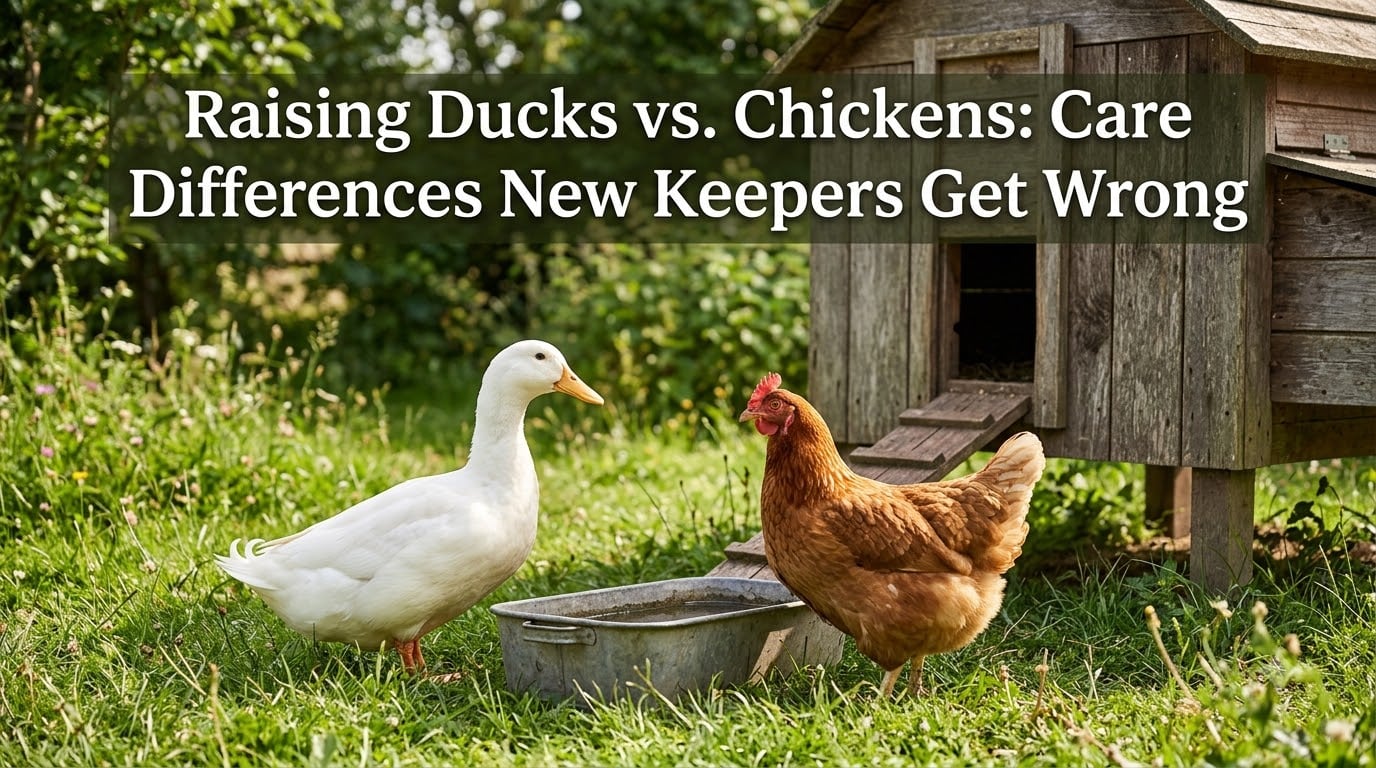
When I got my first batch of ducklings, I assumed they were basically chickens with webbed feet. Within three weeks, two of them had weak legs and one had tipped over a five-gallon water bucket into the bedding. That is the moment I learned why raising ducks vs chickens is not a casual comparison.
Ducks and chickens share a coop, a feed scoop, and a category at the farm store, but they have fundamentally different biology. New keepers who treat them as interchangeable end up with sick ducklings, soaked coops, muddy runs, and an egg yield far below what they expected. This guide walks through the seven care differences that catch beginners off guard, plus the five mistakes I see repeated on backyard poultry forums every spring.
Whether you are starting a fresh flock or thinking about adding the other species to an existing setup, here is what I have learned after keeping both for seven years.
Table of Contents
Water Requirements: Why Ducks Need Substantially More Water Than Chickens
The single biggest difference in duck vs chicken water needs is volume. A laying hen drinks roughly 200 to 500 ml of water per day. A duck of similar weight drinks one to two liters, and that is just for drinking. Ducks also need water deep enough to submerge their heads and clear their nostrils. Without it, mucus and feed dust clog their sinuses, and you end up at the vet.
This is the part that surprises new keepers most. A chicken can thrive with a basic nipple waterer. A duck will treat a shallow dish like a bathtub, soak the bedding, splash the feed, and then need the water refilled four times a day.
Drinking water needs in practice
For a small flock of four ducks, plan on at least eight liters of clean drinking water daily. In summer, double that. Ducks drink more when it is hot, and they also use water to thermoregulate by dipping their bills and splashing it over their backs.
Swimming water for nasal hygiene
Ducks do not need a full pond, but they do need a container deep enough to dunk their entire head. I use a concrete mixing tray, 90 cm across and 25 cm deep. It costs $15 and takes me two minutes to dump and refill. Without swimming or bathing water, ducks develop eye infections and respiratory issues that look exactly like a chicken cold but are actually hygiene-related.
Winter water management
Here is where duck keepers earn their stripes. Ducks cannot drink ice. You either swap water twice a day, use a heated dog bowl, or run a low-wattage stock tank deicer in a rubber trough. Chickens will peck at snow and slush. Ducks will walk away dehydrated and stop laying within a week.
Nutrition Differences: The Niacin Mistake That Costs Duckling Lives
The most dangerous mistake in raising ducklings is feeding them standard chick starter. Chick starter is formulated for the niacin requirements of a chick, which is roughly 25 to 30 mg per kg of feed. Ducklings need 55 to 70 mg per kg. If you do not supplement, they develop perosis (slipped tendon) and bowed legs, often between two and four weeks of age.
I have personally watched a duckling go from running around happily on day 14 to sitting on its hocks on day 18 because I forgot to add brewer’s yeast. By day 22 it could barely walk. Recovery with extra niacin took three weeks. That is the cost of skipping one ingredient.
Why ducklings need niacin?
Ducks grow faster than chicks. Their leg bones elongate rapidly, and niacin is essential for cartilage and bone development. Chick starter has just enough niacin for slower-growing chickens. For ducklings, it is functionally deficient.
Feed selection: chick starter vs duckling starter
Waterfowl starter crumbles exist, and they are the safest choice. If you can only find chick starter, supplement it with brewer’s yeast at a ratio of roughly one part yeast to four parts feed. The pellet-size brewer’s yeast sold at farm supply stores works well. Avoid nutritional yeast for humans, which is heat-treated and may be inactive.
Common feed mixing mistakes
Ducks and chickens should not share the same feed bowl. Layer feed is too high in calcium for drakes and roosters, which can cause kidney damage. Ducklings need more niacin than chicks. If you keep both, plan separate feeding stations and separate age groups. I cover this more in the integration section below.
Housing Differences: Ventilation, Space, and Bedding for Each Species
The classic backyard chicken coop is a small wooden box on stilts with a roosting bar and a nest box. That works for three to four hens. For ducks, you need something closer to a garden shed with a concrete floor.
Ducks do not roost, they sleep on the ground. Their poop is roughly 75% water, compared to about 50% for chickens. So bedding that works for chickens (pine shavings, straw) turns into a soggy mat under ducks within 48 hours.
Ventilation: moisture matters more than cold
Chickens tolerate drafts but hate moisture on their combs and wattles (frostbite risk). Ducks release so much moisture through respiration and droppings that a closed duck coop will go damp within hours. I learned this when I retrofitted a chicken tractor for ducks and woke up to 90% humidity and visible condensation on the walls.
Rule of thumb: ducks need at least twice the ventilation square footage of chickens for the same flock size. Open eaves, hardware cloth windows, and a roof vent are not optional. They are the design.
Space per bird when confined
Chicken guides say 0.4 square meters per bird in the coop and one square meter in the run. Ducks need at least 50% more in both areas. Confined ducks without enough space become aggressive, feather-pecking, and start laying fewer eggs. We have seen six ducks in an 8-square-meter run do fine, but the same number in a 4-square-meter space started pulling feathers within a week.
Bedding that handles wet vs dry
For chickens, pine shavings work great. For ducks, try the deep litter method with straw over pine shavings, or use large flake pine pellets sold for horse stalls. The pellets absorb moisture without turning into mud. Replace wet spots daily rather than doing a weekly full clean. A duck coop without spot-cleaning smells within three days, not three weeks.
Egg Production: Quantity, Size, and Baking Properties Compared
For eggs alone, ducks are surprisingly competitive with chickens. A high-production chicken breed (Leghorn, ISA Brown) will lay 280 to 320 eggs per year. A Khaki Campbell duck will lay 280 to 320 as well. Most other duck breeds produce less (Welsh Harlequin around 240, Pekin around 180), but the eggs are larger.
Where duck eggs really shine is winter. Most chicken breeds slow or stop laying when daylight drops below 12 hours. Ducks, especially Campbell and Runner varieties, keep laying through cold months at 60 to 70% of their summer rate.
Annual egg count by species
If raw count matters, chickens win on average. If winter eggs matter, ducks win. Homesteaders who want a year-round supply often run both.
Duck egg size and richness
A duck egg is roughly 30 to 50% larger than a chicken egg of the same breed. The yolk-to-white ratio is higher, the yolk is deeper orange (more carotenoids from foraging), and the albumen is thicker. Nutritionally, duck eggs have more fat, more vitamin D, more B12, and almost twice the choline per gram.
Why duck eggs bake better
Higher fat content and thicker whites make duck eggs the choice for pastry chefs. Cakes rise taller, custards set firmer, and brioche gets richer. The trade-off is that you cannot substitute duck eggs one-for-one in recipes. Use one duck egg for every two chicken eggs, and reduce other liquid by a tablespoon.
Mess and Cleanup: How Ducks Turn a Coop Into a Mudroom
Here is the pain point that sends many first-year duck keepers back to chickens. Ducks are messy. Not slightly messy. They are soup-messy. They mix water, mud, and droppings into a slurry that gets everywhere.
A clean chicken run with five hens stays tidy for a week. The same setup with five ducks needs raking and topping up with fresh bedding every two to three days.
Water and poop combined mess
Ducks drink, then immediately poop in the water. They bathe in their drinking water if it is deep enough. They scoop feed with water and spill it everywhere. They love mud. Their droppings are wet and smell stronger than chicken droppings. This is real life with ducks.
Run design to manage mud
The fix is design, not discipline. Put down a gravel or river-stone base under the water station, slope the run slightly for drainage, and add a covered rain shelter over the food area. Ducks will still find ways to be messy, but you can keep the mess contained to a washable zone instead of your entire yard.
Daily vs weekly cleaning load
Plan on 10 minutes of duck-coop spot-cleaning per day and a full bedding swap once a week. Chickens need about half that. If your time is tight, chickens are the lower-maintenance choice. If you can build the right infrastructure, ducks are not actually that much harder.
Health Considerations: Disease Resistance and Common Ailments
Compared to chickens, ducks are noticeably hardier. They are less prone to respiratory infections, recover faster from minor illnesses, and tolerate parasites better. Their higher body temperature and waterproofing give them a stronger immune baseline.
That said, ducks have their own vulnerabilities. They are susceptible to angel wing (a wing deformity from too much protein), botulism from stagnant water, and bumblefoot from rough surfaces.
Why ducks are hardier overall?
Ducks have a higher core body temperature (around 41.5C versus 41C for chickens), better resistance to coccidiosis, and a thick layer of waterproofing that protects against skin infections. They also handle wet weather better, which matters in rainy climates where chickens would suffer respiratory stress.
Respiratory disease comparison
Chickens carry Mycoplasma gallisepticum and Infectious Bronchitis Virus at much higher rates than ducks. Ducks can carry these diseases without showing symptoms, which means introducing a duck to an existing chicken flock can introduce a disease the chickens have never been exposed to. Always quarantine new birds for 30 days.
Parasite and predator risks
Both species attract the same predators (raccoons, foxes, hawks, dogs), but ducks are more vulnerable on land because they cannot fly. A secure run is mandatory. Ducks also attract more attention from rats because of their wet droppings and feed waste. Rat-proof your feed storage or expect rodent pressure to climb.
Common Mistakes New Keepers Make With Ducks and Chickens
After reading through seven years of backyard poultry forums and watching our own flock mistakes, these are the five errors that come up over and over. If you avoid these, you will outpace 80% of first-year keepers.
Mistake 1: Treating ducks like wet chickens
This is the foundational mistake. Ducks are not chickens. Their water, bedding, feed, and space needs are different. If you set up your duck area based on a chicken coop, every single component will be wrong. Build for ducks from the start or skip ducks for now.
Mistake 2: Skipping niacin supplementation
I covered this earlier, but it bears repeating because it is the most preventable cause of duckling death. If you cannot find waterfowl starter, supplement chick starter with brewer’s yeast. The cost is cents per duckling. The alternative is a deformed bird you cannot fix later.
Mistake 3: Sharing feed between species
Ducks need higher niacin. Laying ducks need lower calcium than laying chickens. Roosters and drakes should not eat layer feed at all. If you mix species in one coop with one feeder, you will end up with sick birds of one kind or the other. Separate feeding stations are not optional.
Mistake 4: Underestimating water volume needs
One nipple waterer will not cut it for ducks. They need an open dish or trough because they clean their bills by dunking and scooping. They need enough water depth to submerge their eyes and nostrils. And they need fresh water twice a day minimum. Plan ahead or your ducks will suffer and you will feel guilty.
Mistake 5: Confinement without swimming access
Ducks that never get to bathe become stressed, dirty, and start losing feathers. If you cannot commit to daily water access (a kiddie pool, a stock tank, a cattle trough), reconsider ducks. A dry chicken run is fine for chickens and cruel for ducks.
Can You Raise Ducks and Chickens Together? Integration Realities
Yes, but with caveats. Many homesteaders successfully run mixed flocks. The integration requires planning and ongoing management. Just tossing ducklings into a chicken coop usually ends with bullying, feed conflicts, and wet bedding everywhere.
Feed competition problems
Chickens eat faster than ducks. They will dominate a shared feeder. Ducks eat by slurping and need wet feed or water at the feeder, which chickens cannot tolerate. The solution is two separate feeding stations, ideally in different parts of the run.
Space and water access conflicts
Chickens and ducks have different space needs. Chickens roost up high. Ducks sleep on the floor. If you force them to share a coop, the ducks will end up sleeping under the roost in the dirtiest spot. The chickens will track droppings onto the ducks. Separate night housing works much better.
Drake and rooster interactions
Drakes can be aggressive during breeding season and have been known to drown chickens by mating with them in water. If you keep both, monitor interactions in spring and remove the drake if he targets hens. Most mixed flocks work fine with one drake and several roosters, or no drakes at all.
Climate and Cold Hardiness: Which Bird Handles Winter Better?
Ducks handle cold and wet weather better than chickens. Their down layer and waterproofing make them comfortable in light rain and snow. Chickens with large combs suffer frostbite in sub-zero temperatures.
The flip side is that ducks need ice-free water, which is harder to provide in winter. Chickens can peck at snow and slush. Ducks will not. If you live where winter means -10C, plan for a heated water source for ducks.
Winter laying differences
Most chicken breeds stop or drastically slow laying when daylight drops below 12 hours. Ducks, especially Khaki Campbell and Indian Runner, keep laying through winter at a reduced rate. For year-round eggs, ducks win clearly.
Temperament and Handling: Friendliness, Noise, and Manageability
Chickens are more independent. They tolerate handling but do not seek it out. Ducks are more interactive. Many duck breeds (Pekin, Rouen, Swedish) actively enjoy being around their keeper and will follow you around the yard.
Ducks are also louder. Female ducks (hens) have a loud quack that carries. Roosters have a crow but ducks have volume throughout the day. If you have close neighbors, chickens are quieter.
Best breeds for beginners
For chickens: Buff Orpington, Plymouth Rock, ISA Brown. Friendly, hardy, good layers.
For ducks: Khaki Campbell (eggs), Pekin (meat and personality), Welsh Harlequin (balanced). All are calm, productive, and easy to find.
Cost Comparison: First-Year Expenses and Feed Budget Differences
Day-old chicks cost $3 to $5 each. Day-old ducklings cost $5 to $8 each. Starter feed is roughly the same price, but ducks eat more of it per bird because they grow faster.
For a small starter flock of four birds, expect first-year costs of around $300 to $450 for chickens and $400 to $600 for ducks, including coop, feeder, waterer, feed, bedding, and basic vet supplies. The difference comes from the more expensive water setup and higher feed consumption for ducks.
Egg revenue does not usually cover feed costs at small scale, but ducks offer slightly more egg value per bird when you factor in winter production and larger egg size.
Frequently Asked Questions
Are ducks harder to care for than chickens?
Ducks are not harder, but they are different. They require more water (both drinking and swimming), wetter bedding management, niacin supplementation as ducklings, and more space per bird. Chickens are simpler to set up and maintain but offer less winter egg production.
Why do people raise chickens instead of ducks?
People raise chickens instead of ducks because chickens need less water, create less mess, eat less feed, are quieter, and are easier to find locally. Chickens also fit smaller yards and require less daily maintenance for suburban keepers.
What is dirtier, chickens or ducks?
Ducks are noticeably dirtier than chickens. Their droppings are 75% water versus 50% for chickens, they splash water everywhere, and they mix mud into the run area. A duck coop needs daily spot-cleaning while a chicken coop can go several days between cleanings.
Do ducks carry more diseases than chickens?
Ducks are actually hardier than chickens overall and carry fewer symptomatic diseases. However, ducks can be asymptomatic carriers of Mycoplasma gallisepticum and avian influenza, which can infect chicken flocks. Always quarantine new birds for 30 days before mixing species.
Choosing Between Ducks and Chickens: A Final Decision Framework
After seven years of raising ducks vs chickens in the same backyard, my honest summary is this: chickens are easier to start, ducks are more rewarding once you understand them. If you have limited time, a small yard, and close neighbors, choose chickens. If you have space, a water setup, and want winter eggs plus richer baking, choose ducks.
Many homesteaders end up with both, separated by species and managed in parallel. That is a valid third option. Start with what fits your life this season, then add the other species next year once you have learned the basics.
The most important thing is to set up for the species you actually have, not the species you wish you had. Ducks need duck setups. Chickens need chicken setups. Build the right one from day one, and your flock will thrive.