
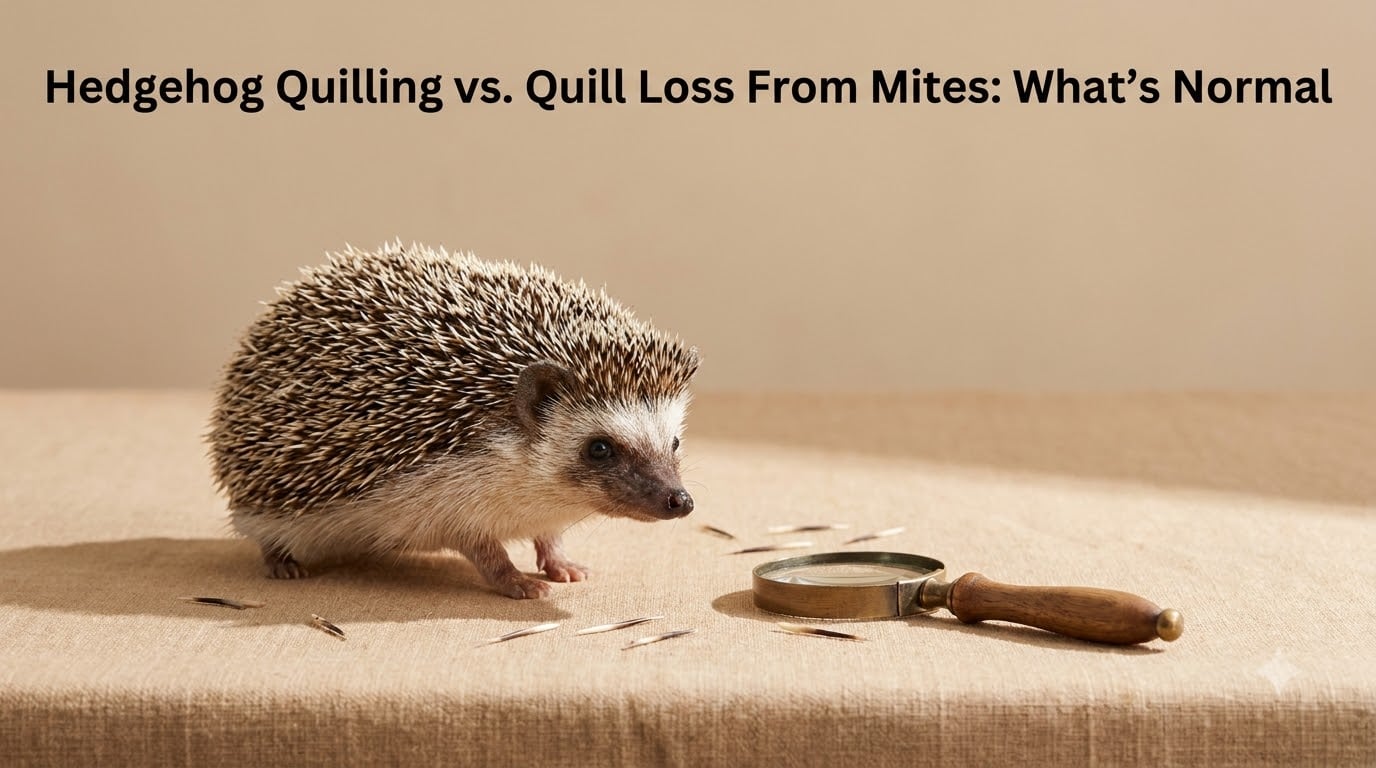
When I brought my first baby hedgehog home, I panicked at the sight of quills scattered across his fleece liner. Was this normal quilling or something worse? The truth is, hedgehog quilling vs mites is one of the most common worries new owners face, and even experienced keepers second-guess themselves. Some quill loss is completely natural. Other times, it’s your hedgehog waving a red flag that says “vet visit, now.”
This guide walks you through what I learned from caring for hedgehogs, talking to exotic vets, and reading countless threads on hedgehog forums. By the end, you’ll know exactly how to tell normal hedgehog quilling apart from quill loss caused by mites, fungal infections, or other skin problems.
Table of Contents
What Is Quilling in Hedgehogs?
Quilling is the natural process where hedgehogs shed their soft baby quills and replace them with thicker, harder adult quills. Think of it like a human baby losing teeth — it’s a developmental milestone, not a health problem.
During quilling, old quills loosen and fall out while new ones push through the skin to take their place. Your hedgehog’s quill count stays roughly the same; you’re simply seeing the trade-off between old and new. The process can be itchy and uncomfortable, which is why many hedgehogs become grumpy during these phases.
Hedgehog Quilling Age Timeline: When to Expect It
One of the easiest ways to figure out whether your hedgehog is quilling or has mites is to ask: how old is my hedgehog? Quilling follows a predictable pattern, and if your pet falls outside these windows, quilling is less likely.
Baby Quilling (6 to 8 Weeks)
Baby hedgehogs are born with a thin coat of soft, flexible quills. Around 6 to 8 weeks of age, they begin losing these baby quills and growing in their first set of juvenile quills. This is usually the most dramatic quilling phase and the one new owners notice first.
Juvenile Quilling (4 Months)
The second round happens around 3 to 4 months of age, when the juvenile quills are replaced with a denser adult coat. You’ll see another burst of quill loss, though it tends to be milder than the baby phase.
Yearly Quilling (9 to 12 Months)
Some hedgehogs experience a smaller third quilling between 9 and 12 months as their coat fully matures. After this, occasional quill loss is normal throughout life, similar to how humans shed hair daily.
Signs of Normal Quilling in Hedgehogs
Normal hedgehog quilling has a recognizable pattern. Here’s what to look for when you want to confirm this is natural development rather than a problem.
- Quills fall out with their little follicle bulb intact — the white tip is visible on the lost quill.
- New quills are already growing in to replace the lost ones, giving the coat a slightly “spiky” or uneven look.
- Quill loss is spread fairly evenly across the back, not concentrated in patches.
- Some dry skin or mild flaking is present, but no sores, scabs, or redness.
- Behavior changes: your hedgehog may be grumpier, hiss more, or huff when handled.
- Quill loss matches your hedgehog’s age timeline (around 6 to 8 weeks, 4 months, or 9 to 12 months).
I keep a simple log on my phone noting when I find stray quills. If I see 5 to 10 a day during one of those windows, I know we’re in a normal quilling phase.
Signs of Mite Infestation in Hedgehogs
Mites are tiny external parasites that burrow into the skin and cause severe itching, crustiness, and patchy quill loss. Unlike quilling, mite damage usually has visible warning signs that don’t match your hedgehog’s age.
- Crusty or flaky skin, especially around the ears, eyes, and lower back.
- Visible bald patches where quills have fallen out and no new quills are growing.
- Excessive scratching — your hedgehog scratches much more than during normal quilling.
- Quills with broken or chewed tips rather than clean, bulb-tipped shed quills.
- Quill loss outside the expected quilling age windows.
- Lethargy, weight loss, or loss of appetite along with the skin symptoms.
- White, dandruff-like flakes that move slightly (these can be mites themselves).
If you notice any combination of these signs, schedule a vet visit. Mites are highly treatable when caught early, but they can cause serious skin infections if ignored.
Hedgehog Quilling vs Mites: Side-by-Side Comparison
This is the comparison I wish I’d had when I was learning. Use it as a quick reference whenever you’re unsure.
- Age of hedgehog: Quilling happens at 6 to 8 weeks, 4 months, or 9 to 12 months. Mites can strike at any age.
- Quill appearance: Quilling sheds whole quills with white bulb tips. Mite loss often leaves broken quills or no quills at all.
- Pattern: Quilling is evenly spread. Mite loss creates bald patches with no regrowth.
- Skin condition: Quilling may have mild dry skin. Mites cause crusting, redness, and sores.
- Behavior: Quilling makes hedgehogs grumpy but not miserable. Mites cause frantic scratching and distress.
- Treatment needed: Quilling needs only comfort care. Mites require a vet-prescribed antiparasitic treatment.
How Many Quills Should a Hedgehog Lose per Day?
This is one of the most-asked questions on hedgehog forums, and the honest answer is “it depends.” A healthy adult hedgehog might lose 1 to 2 quills a day with no cause for concern. During active quilling phases, that number climbs to 5 to 10 quills daily, sometimes more.
The real warning sign isn’t the exact number — it’s whether new quills are growing back in to replace them. If you see bald spots that aren’t filling in after a few weeks, the loss isn’t from natural quilling. In that case, mites, fungal infections, or stress-related overgrooming become more likely suspects.
Comfort Care for a Quilling Hedgehog
Quilling isn’t dangerous, but it can be uncomfortable. Over the years, I’ve settled on a few routines that seem to help my hedgehogs through each phase.
- Offer a shallow, lukewarm oatmeal bath once a week to soothe dry, itchy skin.
- Add a tiny dab of plain, unscented coconut oil to dry areas if your vet approves.
- Handle your hedgehog gently and expect some huffy behavior — don’t take it personally.
- Provide fleece liners instead of loose bedding during heavy quilling to avoid irritation.
- Keep the room warm (around 72 to 78F) and humidity stable to support healthy skin.
If your hedgehog is too tender for handling, simply sit near the cage and talk softly. They’ll still recognize your presence, and the break from being poked and prodded helps them rest.
Environmental Factors That Affect Quill Loss
Quilling isn’t the only reason hedgehogs drop quills. Low humidity can dry out skin and cause flaking, which owners sometimes mistake for mites. Loose bedding like pine or cedar shavings can also irritate sensitive skin and trigger quill loss.
Keep humidity between 40% and 60% if you can. Use unscented, dust-free bedding — paper-based pellets or fleece are safest. I’ve found that switching a hedgehog’s bedding alone sometimes clears up mystery flaking within a week or two.
Can Humans Get Mites From Hedgehogs?
Yes, in some cases. The most common hedgehog mite, Caparinia tripilis, is generally species-specific and doesn’t thrive on humans. However, hedgehogs can occasionally carry sarcoptic mange mites (Sarcoptes scabiei) that can cause temporary itchy rashes in people.
If your hedgehog is diagnosed with mites, wash your hands thoroughly after handling and avoid close skin-to-skin contact until treatment is complete. Most vets will treat the hedgehog with a prescription ivermectin or selamectin product, which clears the infestation in two to three weeks.
When to See a Veterinarian for Quill Loss
Trust your instincts. If something feels off, get it checked. That said, here are clear signs that warrant a vet visit rather than a wait-and-see approach.
- Bald patches that aren’t filling in with new quills after two weeks.
- Crusty, bleeding, or oozing skin anywhere on the body.
- Quill loss outside the expected age windows for quilling.
- Excessive scratching that interrupts sleep or eating.
- Lethargy, weight loss, or changes in appetite alongside skin symptoms.
Find an exotic or small-animal vet experienced with hedgehogs before you actually need one. Having that contact saved me a lot of stress when my hedgehog had a sudden mite flare-up one weekend.
Frequently Asked Questions About Hedgehog Quilling and Mites
Is it normal for hedgehogs to lose quills?
Yes, hedgehogs lose quills regularly throughout their lives. Normal quill loss ranges from 1 to 2 quills per day for adults to 5 to 10 quills per day during active quilling phases at around 6 to 8 weeks, 4 months, and 9 to 12 months of age.
How do I tell if my hedgehog is quilling or has mites?
Quilling usually matches your hedgehog’s age timeline, causes even quill loss across the back, and shows clean white bulb tips on shed quills. Mites cause patchy bald spots, crusty skin, excessive scratching, broken quill tips, and often occur outside quilling age windows.
How can I tell if my hedgehog has mites?
Look for crusty skin around the ears and lower back, bald patches with no regrowth, broken quill tips, constant scratching, and small white flakes that move. A vet can confirm mites with a skin scraping and prescribe antiparasitic treatment.
Is quilling painful for hedgehogs?
Quilling is uncomfortable and itchy but not typically painful. Your hedgehog may be grumpier, hiss more, and resist handling during quilling phases. Comfort care like oatmeal baths and gentle handling helps ease the discomfort.
Can humans get mites from hedgehogs?
Most hedgehog mites are species-specific and don’t transfer to humans. However, hedgehogs can occasionally carry sarcoptic mange mites that cause temporary itchy rashes in people. Wash hands after handling and avoid skin contact until treatment is complete.
How many quills does a hedgehog lose a day?
Healthy adult hedgehogs typically lose 1 to 2 quills per day. During active quilling phases at 6 to 8 weeks, 4 months, and 9 to 12 months, daily loss can rise to 5 to 10 quills or more. The key indicator of a problem is bald patches with no new quill regrowth.
What age do hedgehogs quill?
Hedgehogs quill three main times: baby quilling at 6 to 8 weeks, juvenile quilling at 3 to 4 months, and a final round at 9 to 12 months. Outside these windows, significant quill loss is more likely to indicate mites or another skin condition.
Final Thoughts on Hedgehog Quilling vs Mites
Understanding hedgehog quilling vs mites comes down to three things: age, pattern, and skin condition. Quilling is normal, predictable, and evenly spread. Mites are patchy, irritating, and come with visible skin damage. When in doubt, your exotic vet is your best resource — and they would much rather see a worried owner than a hedgehog with a treatable problem that’s been left too long.
Your hedgehog is counting on you to notice the difference. Now you know how.