
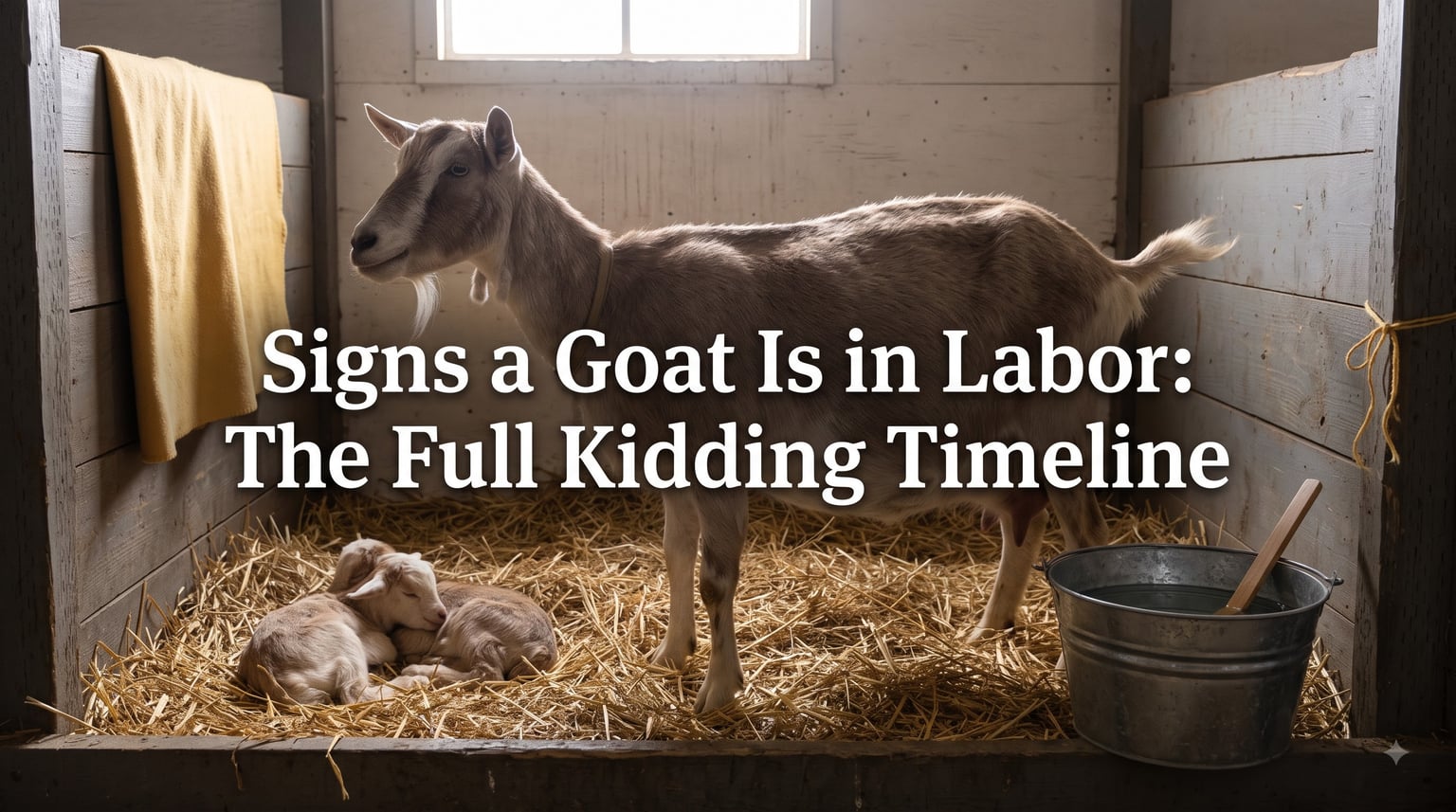
Watching a pregnant doe pace, paw, and stare at the wall for 12 hours straight is enough to make any goat keeper nervous. I have sat through more kidding sessions than I can count, and I still get butterflies every time a doe starts showing early signs. The signs a goat is in labor can stretch over two days, or they can arrive in a rush within an hour, so knowing the full kidding timeline is what separates calm preparation from panicked guesswork.
This guide walks through every stage of goat labor, from the first subtle behavioral shifts to the moment the placenta drops. I will cover what to watch for 24 to 48 hours before kidding, how to check tail ligaments correctly, how to tell normal delivery from a problem, and what to do in the first hour after birth. Whether this is your first freshener or your fiftieth kidding, the goal is the same: read your doe, trust the timeline, and know exactly when to step in.
One quick note before we start. Goats are individuals. Some does follow the textbook perfectly, and others break every rule. Use this timeline as a framework, not a guarantee, and always have your veterinarian’s number close by during kidding season.
Table of Contents
Goat Gestation: How Long Are Goats Pregnant?
Goat gestation runs about 140 to 150 days, with most does landing around 145 to 147 days. The exact length depends on breed, number of kids, nutrition, and individual variation. Larger breeds like Boers and Saanens often land near the higher end, while smaller breeds like Nigerian Dwarfs can kid closer to 145 days.
Counting forward from the breeding date is your best baseline for predicting kidding. If you bred on October 15, expect kids somewhere between March 4 and March 14, with the sweet spot around March 9. Mark a two-week window on your calendar, then start watching closely around day 138.
Breed differences matter. A first-time Nigerian Dwarf freshener may kid at day 143, while a mature Nubian might hold on until day 150. Twins and triplets tend to arrive a day or two earlier than single kids. Track each doe’s history, because most does repeat their pattern year after year.
Early Signs a Goat Is in Labor (24 to 48 Hours Before Kidding)
The early signs of goat labor show up well before active pushing begins. Most does start changing one to two days ahead, giving you a window to move her to a kidding stall and get supplies ready. Here are the most reliable signs, ranked roughly by how soon they appear.
Udder filling (“bagging up”): The udder begins to swell and firm up as colostrum moves in. Experienced does may bag up two to four weeks ahead, but a noticeable tight, shiny udder in the final 24 hours is a strong signal. First-time fresheners often bag up only days before, sometimes hours.
The udder “pop”: Right before kidding, the udder can suddenly look noticeably larger and almost glossy. This “pop” is a hallmark sign and a great indicator that kidding is hours, not days, away.
Vulva swelling and relaxation: The vulva becomes longer, swollen, and softer as connective tissue loosens. You may also see a clear or whitish mucous discharge. Many experienced keepers consider vulva relaxation a more reliable sign than ligament checks.
Hollowing out and sunken sides: The kids shift down and back into the pelvic canal. The doe’s spine and hip bones suddenly look more prominent, and her sides look pinched. Once the kids “drop,” kidding is usually close.
Nesting and pawing: The doe paws at bedding, circles her stall, or tries to build a nest. She may repeatedly stand and lie down.
Separation from the herd: Many does pull away from the group, find a quiet corner, and resist moving. This is one of the most consistent behavioral signs.
Pregnancy trance: Some does get a glazed, distant look and seem mentally checked out. They may stand still for long stretches or grind their teeth softly. This “trance” is an early hormonal shift, not distress.
Loss of appetite: A doe that suddenly skips grain or picks at hay in the final day is telling you something. Refusing food completely is a stronger sign than just eating slowly.
How to Check Tail Ligaments for Kidding Readiness?
The two tail ligaments run alongside the spine, just above where the tail meets the rump. They feel like pencils or guitar strings when the doe is not close to labor. As kidding approaches, these ligaments soften and may feel like they disappear entirely.
To check, place your thumb on the doe’s spine near the tail head and your fingers on the ligaments running down at roughly a 45-degree angle. Press gently. When the ligaments feel soft, spongy, or gone, kidding is usually within 24 hours. Some keepers describe the area as feeling “buttery” or completely pliable.
Here is the honest truth that experienced goat owners on forums will tell you: ligaments are not perfectly reliable. Some does never fully lose them. Some lose them three days before kidding. Some lose them and still hold on for another 48 hours.
Use ligaments as one signal in a stack of signals, not as a countdown clock. Combine them with udder changes, vulva relaxation, behavior, and the overall picture. If you rely on ligaments alone, you will be wrong at least a third of the time.
Signs a Goat Is in Labor: The Three Stages of Kidding
Once early labor signs ramp up, the doe moves into active stages. Goat labor officially has three stages: preparation, delivery, and afterbirth. Each stage has its own timeline and set of physical cues.
Stage 1: Early Labor (Preparation Phase)
Stage 1 is the longest and most variable part of goat labor. It can last anywhere from 2 to 12 hours, and in first-time fresheners it sometimes stretches longer. This is when the cervix dilates and the body sets up for delivery.
Signs of stage 1 include restlessness, frequent standing and lying down, pawing, looking back at the belly, soft vocalizations, and increasing discharge. Contractions begin but are usually mild at first, then build in intensity. The doe may stretch, arch her back, or press her head against a wall.
First-time does tend to spend more time in stage 1 because the tissues are stretching for the first time. Experienced does often breeze through stage 1 in just a couple of hours. Keep the stall quiet, dim the lights if you can, and resist the urge to fuss. Stress slows labor.
Stage 2: Active Labor and Delivery
Stage 2 is when real pushing starts and the kids are born. This stage is much shorter, typically lasting 30 minutes to 2 hours total. A normal delivery moves fast once it gets going.
The first thing you will usually see is the water bag, a translucent bubble filled with amber fluid. It may bulge from the vulva before rupturing. After the water breaks, the amniotic sac often appears next.
Within a few minutes of active pushing, you should see two front hooves, pads facing down, followed by a nose tucked between the legs. This is the normal “diving” presentation and the most common position. Once the head is out, the rest of the kid usually follows quickly.
Multiple kids arrive one at a time. Between kids, the doe often rests, cleans the first baby, or gets up and repositions. Allow 30 minutes to an hour between kids before worrying, as long as the doe is comfortable and not straining without progress.
Signs of a problem in stage 2 include straining hard for 30 minutes with no progress, only one hoof showing, a tail or nose first, or foul-smelling discharge. These are dystocia warning signs, and intervention or a vet call is needed.
Stage 3: Placenta Delivery and Afterbirth
Stage 3 is the passing of the placenta, also called the afterbirth. In goats, the placenta typically drops within 2 to 6 hours after the last kid is born. Sometimes it comes right away, sometimes it takes a few hours.
Do not pull on the placenta. Yanking can tear tissue and cause bleeding or infection. Let it detach naturally. If it has not passed within 12 hours, contact your veterinarian, as a retained placenta is a serious problem.
Once the placenta is out, check that it looks complete. A healthy placenta is dark red and looks like a cluster of sacs. Count the cotyledons (the bumps) if you want, but more importantly, make sure no large pieces remain inside. A foul smell or fever in the doe suggests infection.
Normal vs Abnormal Delivery Positions
Most kids arrive in the diving position: two front feet first, pads down, with the nose following between the knees. This is what you want to see. Any other presentation can slow labor or require help.
Normal front delivery: Two front hooves, pads facing down, nose appears. This is straightforward and usually needs no intervention.
Backward or breech: The kid comes tail and hind legs first. Hind legs first can sometimes deliver on their own, but a true breech (tail only, legs folded forward) almost always needs help. You may need to reach in, find the hind legs, and guide them back.
Head back: Front legs are out but the head is bent back alongside the body. The kid cannot deliver this way. You will need to push the kid slightly back in, find the head, and bring it forward between the legs.
One leg back: One hoof shows but the other is folded back. Push the kid back gently, find the missing leg, and bring it up alongside the first.
Rules for assisting: Trim your nails, scrub your hands and arms, use lubricant, and be gentle. If you cannot reposition the kid within 10 minutes of careful effort, or if the doe is exhausted and making no progress, call the vet. Forcing a delivery injures the doe and the kids.
The line between “helping” and “making it worse” is thin. If you are new, have an experienced mentor on speed dial, or better yet, in the stall with you.
First-Time Kidding Doe vs Experienced Doe: What Changes
First-time fresheners behave differently than does that have kidded before. Knowing the difference keeps you from panicking when your first-timer takes longer than expected.
First-time does often have a longer stage 1 labor because the cervix and birth canal are stretching for the first time. Expect 8 to 12 hours of restlessness, sometimes more. They may also bag up later, sometimes only hours before kidding, which throws off your timeline.
Experienced does usually show classic signs earlier and progress faster. They know what is happening, and their bodies are already stretched. An experienced doe can move from early labor to delivery in just a couple of hours.
First-timers may also be more anxious and vocal. Give them extra quiet and minimal handling. Stress stalls labor, and a stalled first labor is when complications creep in. Stay close but stay back.
One more difference: first fresheners may only have one or two kids, while mature does often have twins or triplets. Single kids tend to be larger and can be harder to deliver, so do not assume fewer kids means an easier kidding.
When to Call the Vet: Dystocia Warning Signs
Dystocia is the medical term for a difficult birth. Knowing when to step in and when to call for help is the skill that saves does and kids. Here are the thresholds experienced keepers use.
Call the vet or intervene if any of these happen: the doe strains hard and continuously for 30 minutes with no kid appearing; only one hoof shows; you see a tail or nose first with no legs; the doe gives up pushing and lies down exhausted; or there is foul-smelling, dark, or bloody discharge.
Also watch for a doe that started active labor and then stopped. If pushing ceases for more than 30 minutes and no progress has been made, something may be wrong. A kid could be stuck, malpositioned, or dead, and the doe’s body has shut down the process.
The 30-minute rule is a useful guide. If 30 minutes pass with hard straining and no delivery, or 30 minutes of no progress between kids, it is time to investigate. Reach in gently to feel for hooves and a nose. If you cannot sort it out quickly, call for help.
Keep emergency supplies on hand: lubricant, clean towels, iodine for navels, a nasal aspirator for kids, and your vet’s after-hours number. Kidding at 2 a.m. is not the time to be searching for supplies.
Postpartum Care: The First Hour After Kidding
The first hour after kidding sets up the health of both the doe and the kids. Have a checklist ready before the doe goes into labor so you are not improvising in the moment.
For the kids: Clear mucus from the nose and mouth with a towel or aspirator. Rub them dry briskly to stimulate breathing and warmth. Dip the navel in 7 percent iodine to prevent infection. Make sure each kid nurses colostrum within the first 1 to 2 hours, because colostrum delivers antibodies that protect against disease in the first weeks of life.
For the doe: Offer warm water with molasses and a pinch of salt to replace energy and fluids. Many keepers add electrolytes. Provide fresh hay and a small amount of grain. Keep the stall clean and bedded, and check that the doe is bonding with and letting her kids nurse.
Colostrum matters more than anything: Kids need about 10 percent of their body weight in colostrum within the first 12 hours, ideally within the first 2 hours. After 24 hours, the gut closes and can no longer absorb antibodies. If the doe rejects a kid or has no milk, use frozen goat colostrum or a commercial replacer, not a substitute formula.
Watch the doe for signs of milk fever (calcium deficiency), which can hit within 72 hours of kidding. Symptoms include weakness, cold ears, muscle tremors, and inability to stand. Milk fever is an emergency. Have calcium gluconate on hand if you have a history of it in your herd.
How Do You Know If a Goat Is Done Kidding?
Telling whether a doe has delivered her last kid is one of the most common questions from new goat owners. She may have one kid, or she may have three, so you need a reliable way to know labor is finished.
The simplest check is palpation. Once the doe seems to be wrapping up, gently feel her right side (the rumen is on the left, the uterus on the right). If you feel no firm lumps or movement, she is likely done. If you still feel a kid, she is not finished.
Behavioral cues also help. A doe that is truly done kidding will get up, eat hay, drink water, and focus on cleaning her kids. She stops straining and looks relaxed. If she is still pushing, pawing, or looking back at her sides, there may be another kid coming.
When in doubt, wait 30 to 60 minutes and check again. A retained kid is a serious problem, so it is better to verify than to assume. If palpation is unclear and the doe seems uncomfortable, a vet ultrasound or exam can confirm.
Frequently Asked Questions
How can I tell how close my goat is to giving birth?
The most reliable signs that kidding is within 24 hours include a tight shiny udder that suddenly pops, a relaxed and swollen vulva with mucous discharge, hollowed-out and sunken sides as kids drop into the pelvis, separation from the herd, nesting and pawing behavior, loss of appetite, and softening or disappearance of the tail ligaments. Stacking multiple signs gives you the most accurate prediction.
How do you know if a goat is done kidding?
Palpate the doe’s right side (where the uterus sits) to feel for any remaining firm lumps or movement. A doe that is finished will stop straining, get up, eat hay, drink water, and focus on cleaning her kids. If she keeps pushing or looking back at her sides, there may be another kid. When in doubt, wait 30 to 60 minutes and recheck.
How long can the first stage of labor last in goats?
Stage 1 of goat labor, the preparation phase, typically lasts 2 to 12 hours. Experienced does may move through it in 2 to 4 hours, while first-time fresheners often take 8 to 12 hours because the cervix and birth canal are stretching for the first time. Some does show early labor signs for over 24 hours before active pushing begins.
What does active labor look like in a goat?
Active labor in a goat involves strong abdominal contractions and visible straining. You will usually see a translucent water bag emerge from the vulva first, followed by the amniotic sac. Within minutes of hard pushing, two front hooves with pads facing down appear, then a nose tucked between the legs. The kid is delivered headfirst in a diving position. Stage 2 typically lasts 30 minutes to 2 hours total.
When do goats give birth (what time of year)?
Goats are seasonal breeders and most often kid in spring, typically February through April in the Northern Hemisphere. Does bred in fall (September through November) kid 145 to 150 days later. Some breeds, like Nigerian Dwarfs, can breed year-round, but most dairy and meat breeds stick to a spring kidding cycle.
Can a goat show labor signs for 24 hours before kidding?
Yes. Some does, especially first-time fresheners, show early labor signs like restlessness, pawing, discharge, and ligament softening for 24 hours or more before active pushing starts. As long as the doe is comfortable, eating and drinking, and not straining hard without progress, this extended early phase is normal. If she strains for 30 minutes with no delivery, call the vet.
How many kids do goats usually have?
Most goats have twins or triplets. First-time fresheners often have one or two kids, while mature does commonly have two or three. Some highly productive breeds and lines can have quadruplets or more. Litter size depends on breed, age, nutrition, and genetics. An ultrasound around day 60 of gestation can tell you how many kids to expect.
Conclusion
Recognizing the signs a goat is in labor is less about memorizing a checklist and more about learning to read your doe. The full kidding timeline starts 24 to 48 hours before birth with udder filling, vulva relaxation, hollowed sides, nesting, and herd separation. From there, the three stages of labor move from preparation through delivery to placenta passing, and your job is to watch, support, and step in only when needed.
The framework is simple. Count forward from your breeding date to land a two-week kidding window. Stack early signs rather than relying on any single one, especially ligament checks, which are notoriously unreliable. Use the 30-minute rule for intervention: 30 minutes of hard straining with no progress, or 30 minutes of stalled labor between kids, means it is time to investigate or call the vet.
First-time fresheners take longer and follow fewer rules, so give them extra grace and extra quiet. Make sure every kid gets colostrum within the first two hours, dip every navel in iodine, and offer the doe warm molasses water to recover. Palpate to confirm she is done kidding before you walk away.
My best advice after years of kidding seasons: prepare your stall and supplies by day 135, set up a camera if you can, and keep your vet’s number on the barn wall. Most kiddings go smoothly when you stay calm and let the doe work. The more you watch, the better you get at reading the signs, and the easier every kidding season becomes.
Now go check your does, mark those kidding dates, and trust the timeline. You have got this.