
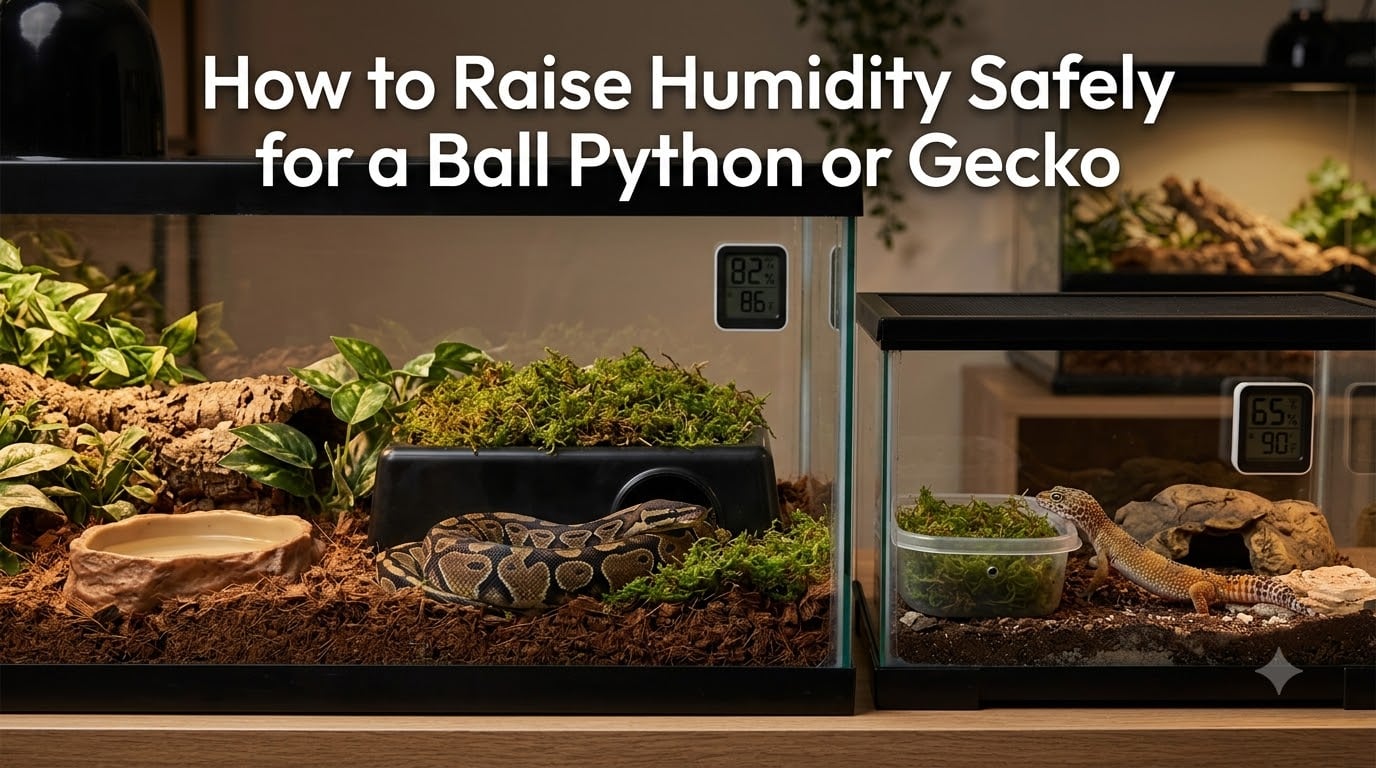
If you keep a ball python or a leopard gecko, you’ve probably watched your hygrometer tank from 70% to 30% overnight and wondered what went wrong. I have. Twice. The first time was with a glass tank and a screen lid in a dry winter apartment. The second time was when I switched species and assumed geckos wanted the same jungle-level moisture as my snake.
Here’s the truth most beginner guides skip: ball pythons and geckos need completely different humidity levels. They share some of the same tools (substrate, humid hides, larger water bowls), but they don’t share a target number. Get that single fact wrong, and you’ll be troubleshooting shedding problems and respiratory infections for months.
In this guide, I’ll walk you through how to raise humidity safely for a ball python or gecko, using methods I’ve tested on both species over the last few years. You’ll get specific ranges, a side-by-side comparison, a DIY humid hide build, and the seasonal adjustments most guides leave out. By the end, you’ll know exactly what your setup needs and why.
Table of Contents
What Humidity Do Ball Pythons and Geckos Actually Need?
Ball pythons need 60 to 80% ambient humidity, with a boost to 80 to 85% during shedding. Leopard geckos need 30 to 40% ambient humidity, but they still benefit from a localized humid hide at 70 to 80% inside the enclosure. That single number difference is the source of most beginner confusion, because the same enclosure, the same substrate, and the same water bowl will behave very differently for each species.
Ball pythons come from West and Central Africa, where they spend daylight hours in termite mounds and burrows that hold high moisture. Their bodies are built to handle and even require that moisture. Drop them below 50% for long stretches, and shedding becomes patchy, breathing becomes labored, and feeding response drops.
Leopard geckos evolved in the arid rocky grasslands of Afghanistan, Pakistan, and northern India. They get moisture from dew, occasional rain, and the bodies of their prey. Their skin tolerates dry air, but they still need a humid microclimate to shed cleanly. That’s where a humid hide comes in. It gives them a choice. They choose when they need moisture.
Why the Ranges Differ
The difference is habitat, not pet-store convenience. Wild ball pythons live in burrows that hold 80%+ humidity for most of the year. Wild leopard geckos live in dry rocky areas where ambient humidity rarely climbs above 40%. Your enclosure should mimic what each animal evolved to expect, not what the cheapest setup on the shelf allows.
Ball Python vs Leopard Gecko: Quick Humidity Comparison
This table gives you the at-a-glance numbers. Use it as a quick reference when you’re adjusting your setup or troubleshooting a problem.
| Factor | Ball Python | Leopard Gecko |
|---|---|---|
| Ambient humidity | 60 to 80% | 30 to 40% |
| Humidity during shed | 80 to 85% | 70 to 80% (inside humid hide) |
| Best substrate | Coconut fiber or cypress mulch | Reptile-safe sand mix or tile with a humid hide |
| Water bowl placement | Warm side, large enough to soak in | Cool side, shallow |
| Humid hide required | Optional but helpful | Essential |
| Screen top cover | Cover 75 to 90% | Keep mostly open for ventilation |
| Misting needed | Yes, light daily or as needed | Rarely; rely on humid hide |
The takeaway: a ball python’s whole enclosure should feel like a rainforest floor. A leopard gecko’s enclosure should feel like a dry desert with one damp cave. Same tools, different goals.
Why Screen Top Enclosures Kill Your Humidity Levels
If your humidity drops 20 to 30% overnight, the screen top is almost always the reason. Mesh lids are designed for ventilation, and ventilation moves moisture out of the enclosure as fast as you put it in. In a heated home during winter, this problem compounds because the surrounding air is already dry, and warm air carries moisture away faster than cool air.
Ball pythons suffer the most here because they need higher humidity in the first place. A ball python in a glass tank with a fully open screen top can sit at 35% ambient humidity within hours of misting, even with perfect substrate.
Leopard geckos are less affected because they don’t need high ambient humidity anyway, but keepers often make the mistake of treating their setup like a snake setup and covering the screen. That traps stale air and creates respiratory problems for the gecko. Different species, different lid strategy.
How to Fix the Screen Top Problem
For ball pythons, cover 75 to 90% of the screen top with aluminum foil, HVAC tape, or a custom-cut acrylic sheet. Leave a small uncovered section on the cool side for airflow. This single change can raise your sustained humidity by 20 to 30% without any misting.
For leopard geckos, leave the screen mostly uncovered. If you live in an extremely dry climate and humidity drops below 25%, cover only 25 to 30% of the lid, just enough to prevent bottoming out.
If you’re buying a new enclosure, consider PVC. PVC enclosures hold humidity dramatically better than glass. Most experienced keepers on Reddit’s r/ballpython report a switch to PVC cuts their humidity struggles in half.
Choose the Right Substrate to Hold Moisture
Substrate is your single most powerful humidity tool. Aspen, sand, and paper towels hold almost no moisture. Coconut fiber, cypress mulch, and sphagnum moss can hold several times their weight in water and release it slowly through evaporation. That slow release is what keeps humidity stable between mistings.
Best Substrates for Ball Pythons
Coconut fiber (also called coco husk or eco earth) is the gold standard. It holds moisture without molding when managed well, and ball pythons seem to enjoy burrowing in it. Aim for a depth of 3 to 4 inches so your snake can burrow and so the lower layers stay moist while the top layer dries slightly.
Cypress mulch is the second-best option. It holds moisture, resists mold, and adds a mild natural scent. Mix it 50/50 with coconut fiber for an even better moisture profile. Avoid cedar and pine mulches at all costs. They release aromatic oils that damage reptile respiratory systems.
Sphagnum moss is not a base substrate but a humidity booster. Lay clumps of moist sphagnum moss under the substrate or in a humid hide. It releases moisture slowly over days and is easy to rehydrate when it dries out.
Best Substrates for Leopard Geckos
Leopard geckos do well on a 70/30 mix of organic topsoil and play sand, or on slate tile. The sand mix is cheap and holds some moisture in the lower layers. Tile is the easiest to clean and doesn’t hold much moisture at all, which is fine because leopard geckos get their humidity from the humid hide rather than the substrate.
What you avoid matters as much as what you use. Avoid pure calcium sand, walnut shell, and any loose particle substrate that can cause impaction if ingested. Avoid aspen for leopard geckos because it dries out too quickly and offers no benefit over safer options.
Substrate Depth Guidance
For ball pythons, 3 to 4 inches of substrate gives you a moisture gradient. The bottom stays wet, the middle is damp, the top is barely moist. Pour water into the corners rather than spraying the surface. This bottom-watering technique keeps the top dry enough to prevent scale rot while keeping humidity high.
For leopard geckos, 2 to 3 inches of substrate is plenty. You don’t need bottom-watering because the ambient humidity target is low. Focus your moisture efforts on the humid hide instead.
Water Bowl Placement and Sizing That Actually Works
The water bowl is the most underrated humidity tool in reptile keeping. A large water bowl on the warm side of a ball python enclosure acts as a constant, passive humidifier. The warm air above the water absorbs moisture and circulates it through the enclosure. This is why ball python keepers are told to size up their water bowl, not down.
For an adult ball python, the water bowl should be large enough for the snake to soak its entire body if it chooses. Many keepers use cat litter pans or large ceramic dog bowls. Refill with fresh water every 2 to 3 days, and clean the bowl weekly to prevent bacterial buildup.
For leopard geckos, the water bowl should be shallow. They will lick water droplets but rarely soak. A small dish on the cool side works fine. The water bowl does very little for ambient humidity in a leopard gecko enclosure, which is exactly what you want. Their target humidity is low.
If your ball python is soaking in the water bowl constantly, that is a humidity signal. The snake is telling you the ambient air is too dry. Increase substrate moisture, cover more of the screen top, and add a humid hide. The soaking should decrease within a week.
How to Build a DIY Humid Hide (Step by Step)?
A humid hide is a small enclosed space filled with moist substrate or moss that gives your reptile a place to retreat when it needs extra moisture. Both ball pythons and leopard geckos benefit from one. For leopard geckos, it’s essential. For ball pythons, it acts as a shedding aid and stress-relief spot.
You can buy commercial humid hides, but a DIY version works just as well and costs almost nothing. Here is the build I use for both species.
Step 1: Choose the Container
Pick a plastic container with a lid that is large enough for your reptile to fit inside with a little room to turn around. For leopard geckos, a small tupperware or a commercial hide works. For ball pythons, a larger container or a dedicated reptile hide from a pet store works better. The opening needs to be smooth, with no sharp plastic edges.
Step 2: Cut an Entry Hole
Cut a hole in the side or the lid using a utility knife or a heated cutting tool. The hole should be just large enough for your reptile to enter easily. For leopard geckos, a 1.5 to 2 inch round hole is plenty. For ball pythons, a 3 to 4 inch hole works for juveniles, and a 5 to 6 inch hole works for adults.
Sand the edges smooth with sandpaper or a rotary tool. Loose plastic shavings can irritate skin and eyes.
Step 3: Add Moist Substrate
Pack the bottom of the hide with damp sphagnum moss. Soak the moss in water, then squeeze out the excess so it is damp but not dripping. You want the moss to feel like a wrung-out sponge. Add a 1 to 2 inch layer for leopard geckos and a 2 to 4 inch layer for ball pythons.
You can also use a 50/50 mix of coconut fiber and sphagnum moss. The mix holds slightly more water and lasts longer between rehydrations.
Step 4: Place and Maintain the Hide
Place the humid hide on the warm side of the enclosure for leopard geckos. They need warmth to use it effectively during shedding. For ball pythons, place it in the middle of the temperature gradient or on the warm side, depending on your snake’s preference.
Check the moisture level every 2 to 3 days. When the moss feels dry to the touch, rehydrate it. Replace the moss entirely every 4 to 6 weeks to prevent mold and bacterial growth.
Seasonal Humidity Adjustments Most Keepers Miss
Here’s a content gap I noticed when researching this topic: almost no guide talks about seasonal adjustments. Yet seasonal changes are the single biggest reason humidity becomes harder to manage. Your enclosure doesn’t care what the calendar says, but the air in your home does.
Winter: Indoor Air Gets Dry
Forced-air heating drops indoor humidity to 15 to 25% in many regions. That’s desert-dry air. Your enclosure is fighting an uphill battle. During winter, you’ll likely need to:
Cover 90 to 100% of the screen top
Bottom-water the substrate weekly
Add extra sphagnum moss throughout the enclosure
Mist more frequently
Run a room humidifier near the enclosure if ambient household humidity drops below 20%
For leopard geckos in winter, you may need to check their humid hide more often because the surrounding dry air pulls moisture out faster. The hide itself should be fine, but rehydrate the moss every 3 to 4 days instead of every 5 to 7.
Summer: Humidity Spikes Become the Problem
In humid summer climates, ambient humidity can climb to 70%+ even in air-conditioned homes. For ball pythons, this is usually fine. For leopard geckos, it can cause respiratory issues if the enclosure stays too damp.
If you live in a humid region, make sure your leopard gecko’s enclosure has good ventilation. Open up more of the screen top. Remove excess moss from the cool side. Watch for signs of respiratory infection like wheezing or mucus around the mouth.
Regional and Climate Considerations
If you live in the desert Southwest US, the Gulf Coast, or the Pacific Northwest, your local climate creates different challenges. Desert keepers struggle with chronically low humidity year-round. Gulf Coast keepers struggle with chronically high humidity. Pacific Northwest keepers get a mix. Tailor your approach to your region. There is no one-size-fits-all answer.
How to Monitor Humidity the Right Way
A bad hygrometer reading is worse than no reading at all. It gives you false confidence that your humidity is fine when it isn’t. Most experienced keepers recommend digital hygrometers with probe attachments, calibrated annually.
Analog dial hygrometers are cheap and inaccurate. They can be off by 10 to 20% in either direction, which is the entire range you care about. If you bought an analog hygrometer with your starter kit, replace it.
Place the probe in the middle of the enclosure, not directly above the water bowl. You want to measure the ambient humidity your reptile actually experiences, not the microclimate right above the water. For leopard geckos, place a second probe inside the humid hide so you can verify it stays in the 70 to 80% range.
Log your readings daily for the first month. A simple notebook works. After a month, you’ll see patterns: when humidity drops, when it spikes, what your routine actually produces. This data beats any advice you’ll find in a guide.
Signs of Low Humidity and What to Do About Them
Reptiles tolerate suboptimal humidity for a while, then show symptoms. Knowing the early signs saves you a vet bill.
Retained Shed
The classic symptom. Eye caps, tail tips, and toes are the most common spots for stuck shed. If your snake or gecko has patchy shed that doesn’t come off in one piece, your humidity is too low during the shed cycle. Increase humidity for the next cycle and provide a humid hide that’s always available.
Never pull stuck shed off manually unless you know what you’re doing. Especially with eye caps. Soaking the reptile in shallow lukewarm water for 10 to 15 minutes softens the shed, and gentle rubbing with a damp cloth usually removes it.
Respiratory Infection Signs
Watch for open-mouth breathing, wheezing, mucus around the mouth or nostrils, and unusual lethargy. These symptoms mean a vet visit is overdue. Respiratory infections in reptiles are often triggered by humidity that is chronically too low (or, paradoxically, too high combined with poor ventilation). Don’t wait. RI can kill a ball python within weeks.
Dehydration Symptoms
Wrinkled skin, sunken eyes, and stuck shed all over the body indicate dehydration. Increase ambient humidity, soak your reptile in shallow lukewarm water, and check that the water bowl is fresh and accessible. Severe dehydration requires a reptile veterinarian.
Quick Fixes When Humidity Drops Tonight
Sometimes you don’t have time for the long-term fixes. Here’s an emergency checklist for when your humidity has tanked and you need to act now.
Cover 75 to 90% of the screen top with aluminum foil immediately.
Pour lukewarm water into the substrate corners, not on the surface.
Add a handful of damp sphagnum moss to the warm side.
Move the water bowl directly under the heat source.
Lightly mist the enclosure walls and decor, not the animal.
What NOT to do: don’t soak your reptile to “fix humidity.” That’s a medical treatment, not a humidity fix. Don’t seal the enclosure completely. Stagnant air breeds bacteria and respiratory problems. And don’t run a household humidifier directly into the enclosure. That floods the substrate and causes scale rot within days.
Frequently Asked Questions
How do I raise humidity for a ball python fast?
Cover 75 to 90% of the screen top with aluminum foil, pour lukewarm water into the substrate corners, add damp sphagnum moss to the warm side, and move the water bowl under the heat source. These four changes together can raise ambient humidity by 20 to 30% within a few hours. For long-term stability, switch to a 3 to 4 inch layer of coconut fiber substrate and add a humid hide.
Is 40% humidity too low for a ball python?
Yes. 40% ambient humidity is below the safe range for ball pythons and will cause retained shed, dehydration, and stress over time. The target range is 60 to 80%, with 80 to 85% during shedding. If your enclosure sits at 40%, your screen top is too open, your substrate is too dry, or both. Fix those first before adding misting routines.
What humidity do leopard geckos need?
Leopard geckos need 30 to 40% ambient humidity in their enclosure, with a humid hide that stays at 70 to 80% for shedding. The ambient humidity should not climb above 50% for long periods, as that creates respiratory risks. The humid hide gives your gecko a place to choose higher humidity when shedding without raising the whole enclosure’s humidity.
Is misting a good way to keep humidity up?
Misting helps in the short term but is not reliable as a primary humidity strategy. The humidity spike from misting usually fades within 2 to 4 hours in a screen-top enclosure. For sustained humidity, focus on substrate choice, screen top coverage, water bowl size, and a humid hide. Reserve misting for situations where you need a quick boost.
Can low humidity kill a ball python?
Yes. Chronically low humidity causes retained shed, dehydration, and respiratory infections. Severe respiratory infections can be fatal within weeks if untreated. Eye cap retention can lead to infections that cause permanent eye damage. Maintaining 60 to 80% humidity is a core part of ball python husbandry, not an optional upgrade.
Final Thoughts
Raising humidity safely for a ball python or gecko comes down to understanding the species-specific range, then building a setup that holds that range without daily effort. For ball pythons, that means 60 to 80% ambient humidity backed by coconut fiber substrate, a covered screen top, a large water bowl on the warm side, and a humid hide. For leopard geckos, it means 30 to 40% ambient humidity with a localized humid hide that does the heavy lifting.
Start by checking your hygrometer, then walk through the screen top, substrate, water bowl, and humid hide in that order. Most humidity problems fix themselves once those four variables are dialed in. Seasonal adjustments come next, because your enclosure will need different support in winter than in summer. If you stick with this framework, your reptile will shed cleanly, breathe easily, and thrive for years.