
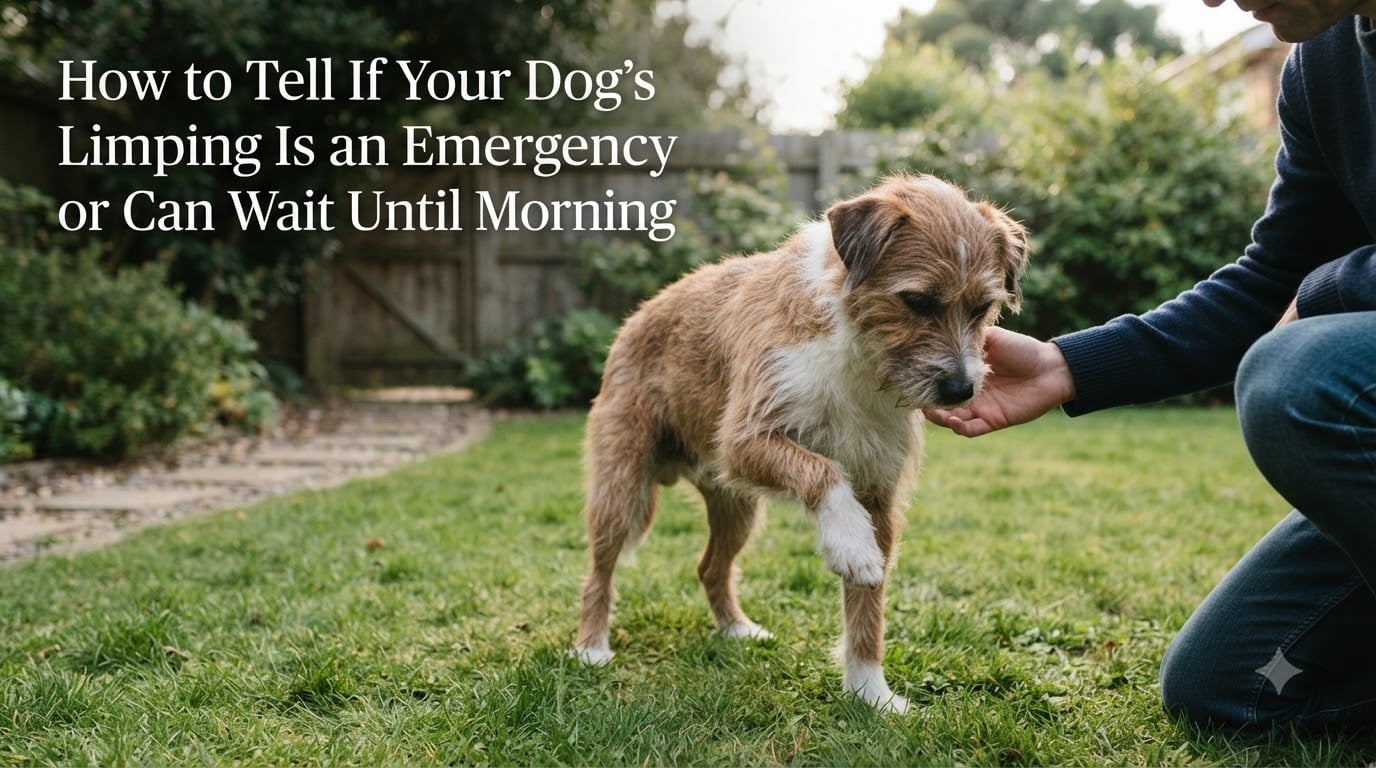
Most cases of dog limping are not emergencies and can safely wait until morning — but a few specific signs mean you need to head to the emergency vet right now. Limping is fairly common in dogs, and minor strains, sore paws, or a little too much playtime can cause a temporary limp that resolves with rest. The problems that cannot wait include a dangling or visibly deformed leg, a limb that feels hot and swollen, sudden non-weight-bearing lameness with vocalization, or any limping paired with lethargy, fever, or refusal to eat.
What trips up most dog owners is the gray area in between. Your dog is holding a leg up, but eating normally. Or your dog is toe-touching but not crying. I have been there at 11 PM on a Sunday, staring at my limping dog and wondering whether the ER visit is worth the $500+ bill. This guide gives you a clear framework to make that call with confidence.
Here is what we will cover: a 60-second emergency check, a full checklist of signs that need the ER tonight, signs that can wait until morning, how to examine the leg yourself, common causes by your dog’s age, what medications to never give, and exactly what to do while you wait.
Table of Contents
The 60-Second Quick Check: Is This an Emergency?
When your dog starts limping and panic sets in, run through this five-question check. If you answer “yes” to any of these, call the emergency vet now.
1. Is the leg dangling, bent at an unnatural angle, or visibly deformed? This points to a fracture or dislocation and needs immediate care.
2. Is your dog completely refusing to put any weight on the leg AND showing other distress signs (whining, trembling, panting heavily, hiding)? Non-weight-bearing alone is not always an emergency, but combined with distress, it usually is.
3. Is there a wound with bleeding, or bone visible through the skin? Open fractures are true emergencies — infection sets in fast.
4. Is the limping paired with systemic symptoms — lethargy, fever, vomiting, refusal to eat, or collapse? Limping plus these signs can indicate infection, tick-borne disease, or a serious systemic problem.
5. Did the limping start after a major trauma? A fall, a car accident, or getting hit means you go to the ER regardless of how the leg looks. Internal injuries may not be obvious.
If you answered “no” to all five, you are likely in the safe-to-monitor zone. Your dog probably can wait until morning — but keep reading to confirm and learn how to assess the leg properly.
Signs That Mean Go to the Emergency Vet Right Now
These are the red flags that should send you to the emergency vet or urgent care clinic without waiting. Each one signals a problem that can worsen significantly overnight or cause permanent damage if delayed.
Sudden non-weight-bearing lameness with vocalization. If your dog screams, yelps, or cries when trying to use the leg and will not put any weight on it, something is acutely painful. This could be a fracture, a severe ligament tear, or a joint luxation. The pain alone warrants immediate relief.
Visible deformity or unnatural angle of the limb. A leg that bends where it should not bend is almost certainly fractured or dislocated. Do not try to splint it yourself — improper splinting causes more damage. Stabilize your dog and go.
Swelling that is hot to the touch. Run your hand along both legs and compare. If one feels noticeably warmer, significantly larger, or both, you may be dealing with an infection, a severe inflammatory response, or in some cases a tumor. Hot, painful swelling needs same-day attention.
An open wound with bone visible. This is an open (compound) fracture. The risk of deep infection is extremely high. Cover the area gently with a clean cloth and head to the ER immediately.
Limping plus lethargy, fever, or refusal to eat. When limping comes with systemic signs, the cause may not be orthopedic at all. Tick-borne diseases like Lyme, serious bacterial infections, or immune-mediated conditions can cause joint pain and lameness alongside fever and depression.
Sudden inability to walk at all or dragging the limb. If your dog is dragging a leg or cannot support any weight on the back legs, this could indicate a spinal issue, severe neurological problem, or bilateral injury. These situations deteriorate fast.
Puppies under 12 months with sudden limping. Growing dogs have open growth plates — soft areas at the ends of bones that are vulnerable to injury. A growth plate fracture can permanently affect bone development. Puppies get a lower threshold for “emergency.”
Profuse bleeding from the paw or leg. Apply firm pressure with a clean cloth. If bleeding does not stop within 5 to 10 minutes of continuous pressure, or if the wound is deep, go to the ER.
Signs That Can Safely Wait Until Morning
Many limps are caused by minor soft tissue strains, sore muscles, small paw irritations, or a mild sprain from too much activity. If your dog shows these signs, monitoring at home overnight is reasonable and safe.
Your dog is toe-touching or partial weight-bearing. A dog that still puts some weight on the leg — even if it looks like they are gingerly placing it — is generally in a lower-risk category than one holding the leg up entirely.
Your dog is eating, drinking, and acting normally otherwise. If your dog still wants dinner, greets you at the door, and seems bright and alert, the limping is unlikely to be a systemic emergency. This is one of the most reassuring signs.
The limp is mild and your dog is still willing to walk. A slight hitch in the gait that does not slow your dog down much is typical of a minor strain or muscle soreness. Rest and observation are appropriate here.
No swelling, heat, or deformity when you feel the leg. If both legs feel the same temperature and size, and there are no obvious lumps, bumps, or tender spots, the problem may be muscular or a low-grade strain.
The limp started after vigorous exercise or rough play. Post-activity limping is extremely common and usually reflects soft tissue soreness. Most of these resolve with 24 to 48 hours of rest.
Your dog is not vocalizing pain. Dogs that are limping but not crying, whimpering, or flinching when touched are typically not in severe pain. Keep in mind that dogs do hide pain — so this alone is not enough. But combined with the other signs above, it supports a wait-and-monitor approach.
You can see and address the cause. If you find a small thorn, a minor cut on the paw pad, or a broken toenail and the limping is mild, you may be able to manage this at home or with a regular vet visit the next day.
The Gray Zone: Needs a Vet Soon, But Not Tonight
This is the category that confuses owners the most, and it is the one most guides gloss over. The gray zone covers limps that are not emergencies but should not wait a full week for a routine appointment either. These situations call for a same-day or next-day vet visit.
Non-weight-bearing but otherwise comfortable. If your dog is holding a leg up completely but is eating, alert, and not in obvious distress, this is not an ER trip — but it is not a “wait three days” situation either. Book a same-day appointment. A cruciate ligament tear, for example, fits this profile. It is painful and needs treatment, but it is not life-threatening overnight.
Mild swelling without heat. Some puffiness around a joint can indicate a soft tissue injury or early arthritis flare. If the area is not hot or extremely tender, you can probably wait for a regular appointment within 24 to 48 hours.
Limping that has not improved after 48 hours of strict rest. If you have rested your dog for two full days and the limp is the same or worse, it is time to see the vet. Most minor strains show some improvement within 48 hours. No improvement means something more is going on.
Intermittent limping that comes and goes. A limp that appears after rest and improves with movement, or one that shifts from leg to leg, can indicate joint disease, panosteitis in young dogs, or an immune condition. Schedule a non-emergency appointment but do not ignore it.
Limping in a senior dog that is gradually worsening. Gradual-onset limping in older dogs often signals osteoarthritis progression, but it can also be the first sign of a bone tumor. A vet visit within a few days is the right call — not the ER, but not “wait and see” for weeks either.
The general rule for the gray zone: call your regular vet’s office when they open, describe the symptoms, and ask for a same-day or next-day appointment. Most clinics reserve slots for urgent but non-emergency cases.
How to Examine Your Dog’s Leg at Home
A careful home exam helps you decide whether to wait or go. Here is the step-by-step process our team recommends, adapted from veterinary assessment techniques. Keep your dog calm, move slowly, and have treats on hand to reward cooperation.
Step 1: Observe from a distance. Watch your dog walk on a flat, non-slip surface. Notice which leg is affected, whether the dog is bearing any weight, and how the gait looks. Compare the walk to how your dog normally moves. Note whether the limp is constant or intermittent.
Step 2: Check the paw thoroughly. This is where many problems hide. Spread each toe apart and look between them. Check the paw pads for cuts, cracks, blisters, or embedded objects like foxtails, thorns, or glass. Inspect the toenails for cracks or tears. Look for redness, swelling, or discharge between the toes. Paw issues are one of the most common — and most treatable — causes of limping.
Step 3: Gently feel up the leg. Start at the paw and work upward. Use light pressure and move slowly. Feel for heat, swelling, lumps, or areas where your dog flinches. Compare the affected leg to the normal leg at the same time — this side-by-side comparison is the most useful thing you can do. Any significant difference in size, temperature, or tenderness is worth noting.
Step 4: Assess pain response. Press gently on the joints — wrist, elbow, shoulder for front legs; ankle, knee, hip for back legs. Watch for flinching, pulling away, tensing, or vocalizing. Dogs often tense their muscles before they cry out, so watch for subtle body language too. Note which joint, if any, triggers a reaction.
Step 5: Check range of motion. Gently move each joint through its natural range. Do not force anything. If your dog resists a particular movement or a joint will not bend normally, that information is valuable for the vet.
What to look for at each joint:
Paw/toes: foreign objects, cracked pads, torn nails, interdigital cysts
Wrist (carpus): sprains, hyperextension injuries
Elbow: elbow dysplasia (common in large breeds), soft tissue swelling
Shoulder: muscle strains, osteochondrosis (young dogs)
Knee (stifle): cruciate ligament tears, luxating patella
Hip: hip dysplasia, arthritis
Write down what you find. If you do end up calling the vet or going in, a specific description — “hot swelling on the left knee, flinches when I press it, not bearing weight” — is far more useful than “he is limping.”
Common Causes of Limping by Age Group
The most likely cause of your dog’s limping depends heavily on age and breed. Knowing what is common for your dog’s stage of life helps you assess urgency.
Puppies (under 12 months). Growing dogs have open growth plates that are softer and more vulnerable than mature bone. Sudden limping in a puppy should always be taken seriously because growth plate injuries can cause permanent limb deformity. Common puppy causes include growth plate fractures, panosteitis (a self-limiting bone inflammation that causes shifting leg lameness, often in large breeds), hypertrophic osteodystrophy (painful bone disease in fast-growing large breed puppies), and osteochondrosis dissecans (a cartilage defect in the shoulder or elbow). Puppies also get into everything — paw foreign bodies and minor sprains from rough play are common.
Adult dogs (1 to 7 years, depending on breed). The most frequent cause of acute limping in adult dogs is a soft tissue injury — muscle strains, sprains, and paw problems. In medium to large breeds, cruciate ligament tears (CCL rupture) are extremely common, especially in active dogs. Signs include sudden hindlimb lameness, partial or non-weight-bearing, and sometimes a “toe touch” gait. Other adult causes include luxating patella (kneecap slipping, common in small breeds), elbow dysplasia, fragmented coronoid process, paw pad injuries, broken nails, foreign bodies like foxtails, insect stings, and toenail injuries.
Senior dogs (7+ years, varies by breed). The leading cause of limping in senior dogs is osteoarthritis. Arthritis limping often looks worse in the morning or after rest and improves as the dog warms up — this is a key diagnostic clue. Senior dogs are also at higher risk for osteosarcoma (bone cancer), which presents as progressive, painful limping with swelling around the affected bone, usually in a single leg. Osteosarcoma is aggressive and needs prompt diagnosis, so any senior dog with unexplained, worsening limping and swelling needs a vet visit soon — not in two weeks.
Breed patterns to know: Large and giant breeds (Labradors, German Shepherds, Rottweilers, Great Danes) are prone to cruciate tears, hip dysplasia, elbow dysplasia, and osteosarcoma. Small breeds (Yorkies, Pomeranians, Chihuahuas) more commonly have luxating patellas. Deep-chested, active breeds can develop panosteitis as young dogs. Knowing your breed’s tendencies helps you anticipate what might be happening.
NEVER Give Your Dog These Pain Medications
This section exists because well-meaning owners cause serious harm every year by reaching for human painkillers. Do not give your dog ibuprofen (Advil, Motrin), naproxen (Aleve), or acetaminophen (Tylenol). These medications are toxic to dogs and can cause kidney failure, stomach ulcers, liver damage, and death — sometimes from a single dose.
Ibuprofen is one of the most common causes of poisoning in dogs. Even one pill can cause stomach ulceration and kidney damage in small dogs.
Naproxen is extremely potent and has a very long half-life in dogs, meaning it builds up and causes prolonged toxicity even at small doses.
Aspirin is sometimes mentioned as “safe” for dogs in older sources. Current veterinary guidance is to avoid giving aspirin without direct instruction from your vet. It can cause gastrointestinal bleeding and interferes with the medications your vet will want to prescribe.
Instead of self-medicating, call your vet or an emergency helpline. If the pain seems severe enough that you are reaching for the medicine cabinet, that itself is a sign your dog needs professional care. Your vet can prescribe dog-safe anti-inflammatics like carprofen, meloxicam, or grapiprant, along with pain medications appropriate for the specific injury.
Home Care While You Wait for the Vet
If you have decided your dog can wait until morning or you are in the 48-hour monitoring window, here is how to care for the leg at home safely.
Strict rest is the single most important thing you can do. This means no running, no jumping, no stairs, no off-leash time, and no rough play. Take your dog out on a short leash only for bathroom breaks. Confine to a small room or crate if needed. Rest is not optional — continued activity turns a minor strain into a major injury.
Apply cold therapy for the first 48 hours. Wrap an ice pack or a bag of frozen peas in a thin towel and apply it to the affected area for 10 to 15 minutes, two to three times daily. This reduces swelling and inflammation. Never put ice directly on the skin. After 48 hours, you can switch to warm compresses if the area is no longer swollen.
Keep the leg clean and protected. If there is a minor wound or paw irritation, keep it clean with mild soap and water. Do not apply hydrogen peroxide — it damages healthy tissue. A clean sock or dog bootie can protect a sore paw during short walks.
Provide a comfortable resting surface. An orthopedic dog bed or thick cushioned surface reduces pressure on sore joints, especially for older dogs with arthritis.
What to avoid: Do not force your dog to walk to “test” the leg. Do not massage the area if there is swelling or heat — this can worsen inflammation. Do not wrap or splint the leg unless a vet has shown you how. Improper wrapping cuts off circulation. Do not let your dog lick a wound excessively — use an Elizabethan collar if needed.
Monitor and document. Take a short video of your dog walking each day. This lets you track whether the limp is improving, staying the same, or getting worse. If you end up at the vet, these videos are invaluable for showing the progression.
If the limp has not improved after 48 hours of strict rest, or if it worsens at any point, call your vet. Continuing to wait past 48 hours with no change is not productive and delays diagnosis.
Frequently Asked Questions
How many days should I wait if my dog is limping?
For a mild limp with no emergency signs, monitor at home with strict rest for 48 hours. If the limp has not improved or has worsened after two full days of rest, call your vet for an appointment. Do not wait longer than 48 hours without improvement — most minor strains show some progress within that window. If new symptoms appear at any point (swelling, non-weight-bearing, lethargy), move up your timeline.
How to know if dog limping is serious?
Dog limping is serious and needs immediate or same-day veterinary care if your dog is completely non-weight-bearing, the leg is deformed or at an unnatural angle, the affected area is hot and swollen, there is an open wound or visible bone, or the limping comes with lethargy, fever, or refusal to eat. A limp that does not improve after 48 hours of rest also needs a vet visit.
Why is my dog limping worse in the morning?
Limping that is worse in the morning or after rest and improves as your dog moves around is a classic sign of osteoarthritis. Joints stiffen during rest, and it takes a few minutes of movement for them to warm up. This pattern is common in senior dogs and large breeds. If your dog shows this pattern, schedule a vet visit to discuss arthritis management — it is not an emergency, but it should not be ignored.
Will a dog’s limp heal on its own?
Some mild limps heal on their own with strict rest, particularly soft tissue strains and sore muscles from overexertion. However, many causes of limping — including cruciate ligament tears, fractures, paw foreign bodies, and arthritis — need veterinary treatment to heal properly. Waiting indefinitely for a limp to self-resolve can lead to chronic pain, worsening injury, or permanent damage. If a limp has not improved after 48 hours of rest, see your vet.
The Bottom Line
Figuring out whether your dog’s limping is an emergency or can wait until morning comes down to a handful of clear signs. If the leg is deformed, hot and swollen, or has an open wound, go to the ER. If the limping comes with lethargy, fever, or collapse, go to the ER. If a puppy is suddenly non-weight-bearing, treat it as urgent.
For everything else — mild limps, toe-touching, post-play soreness, a happy dog that is still eating — strict rest and overnight monitoring are safe. Run through the five-step home exam. Give it 48 hours. If there is no improvement, call your vet in the morning. And no matter what you do, never reach for human painkillers.
Trust your gut. If something feels wrong beyond the limp itself, the ER visit is always worth the peace of mind. You know your dog better than anyone, and no veterinarian will fault you for being cautious.