
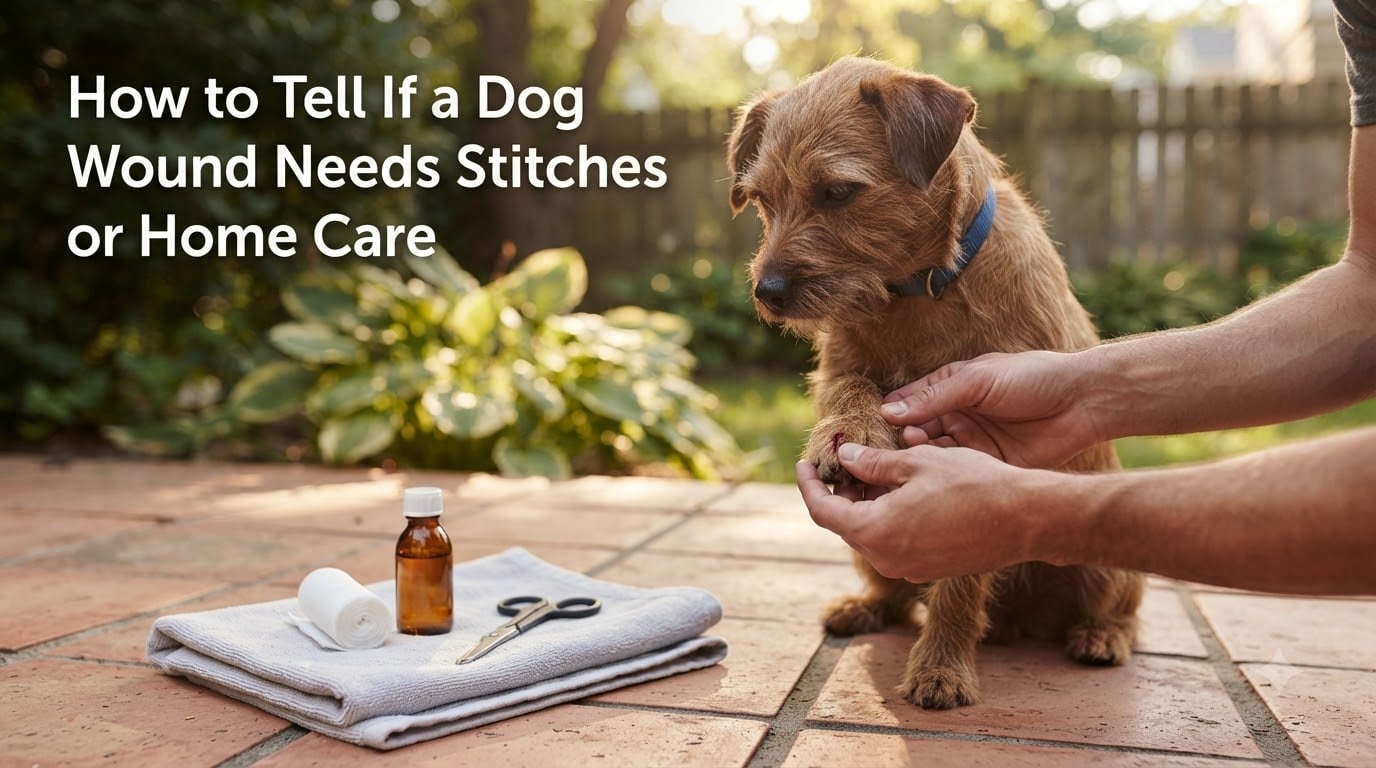
When your dog comes in from the yard with blood on its fur, your first thought is usually panic. I have been there, holding a terrier wrapped in a towel at 9 PM, trying to figure out if this was an emergency or something I could handle at home. Knowing how to tell if a dog wound needs stitches or home care can save you both money and stress.
In this guide, I will walk you through the exact measurements vets use to decide, the warning signs that mean go now, and what to do if cost is a concern. You will get a clear decision framework, step-by-step assessment, and home care steps that actually work.
Table of Contents
How to Tell If a Dog Wound Needs Stitches?
A dog wound needs stitches when it is too deep, too long, or too open to heal correctly on its own. Vets use specific thresholds to make this call, and you can apply the same logic at home before you load your dog into the car.
Here are the signs that tell you a dog wound needs stitches rather than home care:
Depth over 1/4 inch (about 6 mm). If you can see layers beneath the top skin, the wound is too deep for surface healing.
Length over 1/2 inch to 1 inch. Longer cuts pull apart as your dog moves and rarely stay closed without sutures.
Gaping or open edges. If the skin edges will not lie flat together, the wound needs help closing.
Visible fat, muscle, or bone. Yellowish fat, red muscle, or white bone means the wound goes through all skin layers.
Bleeding that does not stop after 10 minutes of direct pressure. Ongoing blood loss signals a vessel that may need ligation.
Location over a joint. Wounds on legs, paws, or near joints reopen with every step.
Bite wounds of any size. Bites introduce bacteria deep into tissue and almost always need cleaning, drainage, and often closure.
Heavy contamination. Wounds with gravel, hair, or dirt ground in need debridement before they can heal safely.
Wound older than 6 to 12 hours. After this window, bacteria multiply and closure becomes risky. If it is already past that, you still need vet care, but possibly with different treatment.
Your dog is in obvious pain or limping. Pain out of proportion to the visible injury can mean deeper tissue damage.
If two or more of these match what you see, do not wait. Call your vet or an emergency clinic.
Types of Dog Wounds and What They Mean
Not every wound behaves the same way. Knowing the type helps you judge severity and pick the right response.
Lacerations and Cuts
A laceration is a clean or jagged cut through the skin. Sharp objects, glass, or fencing cause most lacerations. A short, shallow laceration under 1/4 inch deep may heal with cleaning and bandaging. A long or deep laceration almost always needs stitches because the skin edges cannot hold themselves together.
Puncture Wounds
A puncture wound looks small on the surface but can be deep. Teeth, thorns, nails, and sticks are common causes. Puncture wounds are tricky because they trap bacteria inside. Most vets will not stitch a puncture closed because sealing in bacteria causes abscesses. Instead, the wound gets flushed, sometimes drained, and left open to heal from the inside out.
Abrasions and Scrapes
Abrasions scrape off the top layer of skin. They bleed a little but usually heal well at home with cleaning and protection. Watch for dirt embedded in the surface, which can cause infection if not flushed out.
Bite Wounds
Bite wounds combine puncture and crushing damage. Even small bites can mean deep tissue damage and bacterial contamination from the other animal’s mouth. Any bite wound should be seen by a vet, ideally within a few hours. Closing a bite wound is sometimes done after thorough cleaning, but it is never a home care situation.
Hot Spots and Burns
Hot spots are moist, inflamed patches dogs create by licking or chewing. Burns come from heat, chemicals, or friction. Both are usually treated at home with cleaning, topical care, and an e-collar to stop further chewing, but severe burns need professional wound care.
When to Seek Emergency Vet Care?
Some situations cannot wait until morning. If any of these are true, head to an emergency clinic now.
Bleeding that soaks through gauze within 10 to 15 minutes
Pale gums, weakness, or rapid breathing (signs of shock)
Wound exposing bone, tendon, or large muscle areas
Bite from an unknown or wild animal (rabies risk)
Wound near the eye, throat, or major blood vessel
Your dog is unconscious, vomiting, or acting disoriented after the injury
The wound is on a puppy under 6 months, since small bodies lose heat and fluid fast
Trust your gut. If something feels wrong, an emergency vet would rather see a wound that turns out to be minor than hear about one that got worse overnight.
Step-by-Step Wound Assessment Guide
Use this process the moment you discover the wound. Stay calm, move slowly, and keep your voice steady so your dog stays calm too.
Step 1: Secure your dog first. Even the sweetest dog may snap when in pain. Muzzle if needed, or have a helper hold the head gently. A slip lead around the neck works in a pinch.
Step 2: Stop the bleeding. Apply firm, direct pressure with a clean cloth or gauze. Do not peek for at least 5 minutes. If blood soaks through, add more layers on top rather than removing the soaked ones.
Step 3: Estimate the depth. Look at the wound edges. Can you see pink flesh, yellow fat, or red muscle? Anything deeper than the surface layer of skin means a vet visit.
Step 4: Check the length and width. Compare to a coin or your finger. A cut longer than your thumbnail or wider than a pencil eraser likely needs sutures.
Step 5: See if the edges gap. Gently bring the skin edges together. If they fall back open, the wound needs stitches to stay closed during healing.
Step 6: Look for foreign material. Gravel, hair, grass, or wood splinters need professional removal, especially from deep wounds.
Step 7: Note the location. Wounds on the face, paws, legs, or near the tail base get contaminated easily and reopen with movement. These almost always need professional closure.
Step 8: Time-stamp the injury. Try to figure out when it happened. Stitches work best within 6 to 12 hours. Past 24 hours, vets usually prefer to let the wound heal by second intention rather than risk sealing in bacteria.
Step 9: Watch your dog’s behavior. Lethargy, loss of appetite, or unusual hiding after a wound can signal pain or shock.
Step 10: Decide and act. If any red flags came up in steps 2 through 9, call your vet or an emergency clinic right now.
How to Care for a Dog Wound at Home?
For shallow, clean wounds that do not meet the stitch criteria, home care works. Here is what to do and what to keep on hand.
Basic First Aid Supplies
Clean gauze pads and non-stick dressing
Self-adhering bandage wrap (Vetrap or similar)
Diluted chlorhexidine (0.05%) or povidone-iodine solution
Saline for flushing
Elizabethan collar (e-collar) to stop licking
Styptic powder for minor nail bleeding
A muzzle in case pain triggers a bite
Cleaning the Wound
Flush the area with saline or lukewarm water to remove loose debris. Avoid hydrogen peroxide on open wounds since it damages healing tissue. Dilute chlorhexidine to a light tea color and use it once to disinfect, then rinse with saline.
Pat dry with clean gauze. Do not use cotton balls since fibers stick to the wound.
Bandaging the Wound
Is it better to keep a dog’s wound covered or uncovered? For most shallow wounds, light bandaging keeps dirt out and prevents licking. Leave deeper puncture wounds uncovered so drainage can escape, but limit your dog’s access with an e-collar.
To bandage: place a non-stick pad over the wound, wrap with gauze to hold it in place, then add a self-adhering layer. Leave the toes visible so you can check for swelling. Change the bandage daily or whenever it gets wet or dirty.
Stopping Your Dog from Licking
Licking is the most common reason a wound fails to heal. Licking introduces bacteria and reopens closed tissue. Use an e-collar or a surgical recovery suit. Bitter sprays help in some cases, but most dogs ignore them after the first lick.
The Time Window for Getting Stitches
If your dog needs stitches, time matters. Wounds heal fastest and safest when closed within 6 to 12 hours of injury. After 12 hours, bacterial counts climb sharply. After 24 hours, most vets will not close a contaminated wound because the risk of infection trapped under the sutures is too high.
That said, an old wound is not a reason to skip the vet. Your vet may still need to clean, debride, and treat it. They might just close it differently or leave it open to heal by secondary intention.
If you are unsure of the time, go in anyway. Vets make the call on closure, not you.
What to Do If You Cannot Afford Vet Care?
This is the question nobody likes to talk about, but it is real. If your dog needs stitches and money is tight, you have options.
Low-cost vaccine and spay/neuter clinics often treat minor wounds at reduced rates. Search low-cost veterinary care plus your city.
Humane societies and animal shelters sometimes run veterinary clinics with sliding scale fees.
Veterinary teaching hospitals offer care at lower cost because students perform procedures under supervision.
CareCredit and similar financing let you pay over 6 to 24 months. Many vet offices accept it.
Pet insurance covers emergencies if you already have a plan. If you do not yet, this injury is not the time to sign up, since pre-existing conditions are excluded.
Ask your vet about a payment plan. Many clinics work with regular clients on a structured payment plan.
Scratchpay and similar services offer short-term loans for vet bills with quick approval.
Never let cost be the reason you skip care for a deep, gaping, or bleeding wound. The infection that follows is far more expensive to treat than the original stitches.
Frequently Asked Questions
Will a dog’s wound heal without stitches?
Yes, a small and shallow wound will often heal without stitches within 7 to 14 days as long as it is kept clean. However, deep wounds over 1/4 inch, gaping wounds, or wounds longer than 1 inch heal better and faster with stitches. Leaving a deep wound to close on its own increases the risk of infection and scarring.
Is it better to keep a dog’s wound covered or uncovered?
Light bandaging works best for most shallow wounds because it keeps dirt and bacteria out while stopping your dog from licking. Leave puncture wounds uncovered or only lightly covered so drainage can escape. Always use an Elizabethan collar to prevent chewing at the bandage.
What to do if my dog needs stitches but I can’t afford it?
Call your regular vet and ask about a payment plan, then search for low-cost veterinary clinics, humane societies, or veterinary teaching hospitals in your area. CareCredit and Scratchpay offer short-term financing for vet bills. Never delay care for a deep, bleeding, or bite wound because the resulting infection is much more expensive than the original treatment.
How can I close my dog’s wound without stitches?
For minor wounds, you can use veterinary skin glue or wound closure strips after cleaning the area. These work best on small, clean cuts under 1/4 inch deep. Never try to close a deep, contaminated, or bite wound at home. Leave it covered lightly and see a vet as soon as possible.
Conclusion
Knowing how to tell if a dog wound needs stitches or home care comes down to three numbers: depth over 1/4 inch, length over 1 inch, and a time window of 6 to 12 hours. If any of these thresholds are crossed, get to a vet. If not, clean, bandage, and watch for infection over the next 7 to 10 days.
Keep a basic first aid kit ready, learn to recognize the red flags, and have a low-cost clinic number saved in your phone. With this knowledge, the next time your dog comes in bleeding, you will know exactly what to do.