
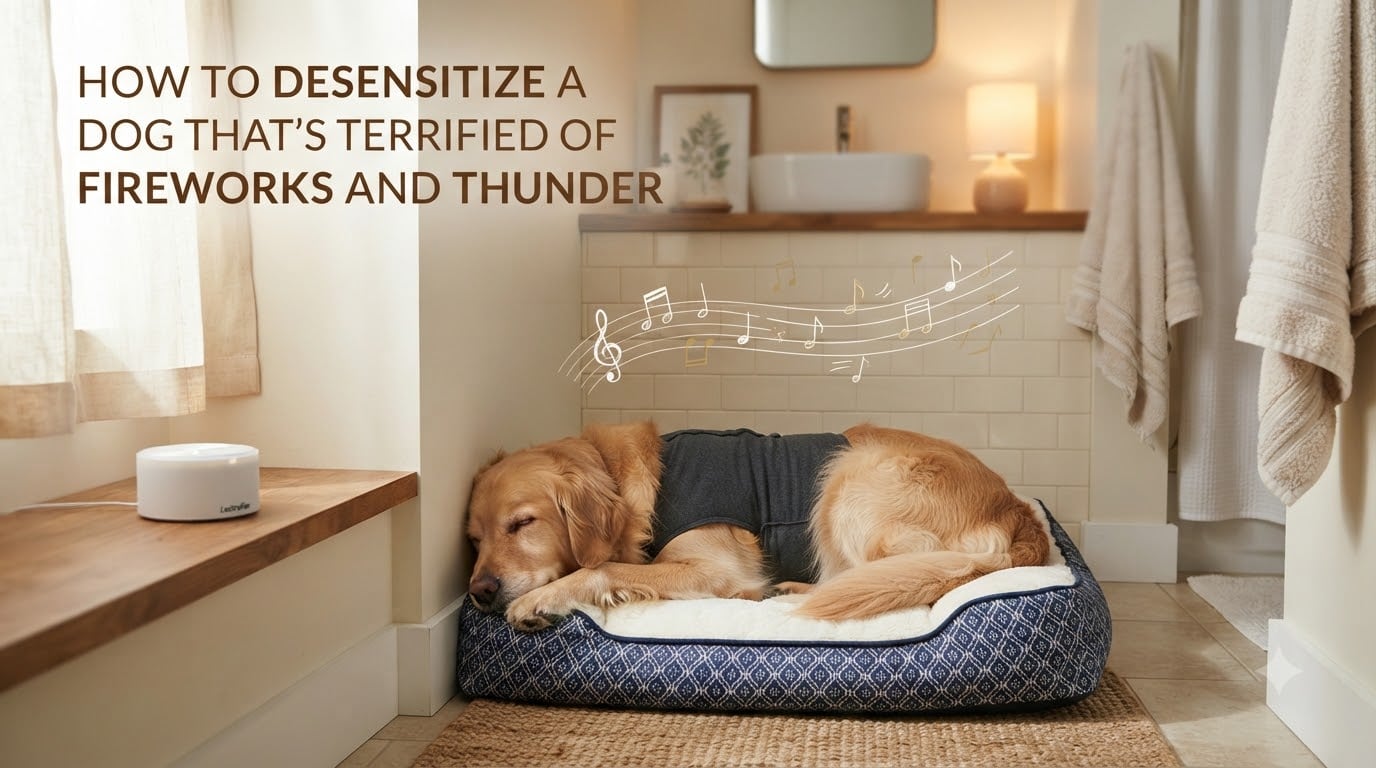
Learning how to desensitize a dog to fireworks and thunder can transform your pet’s life from one of terror to calm confidence. I have worked with dozens of anxious dogs over the years, and the relief on both dog and owner faces after successful training is something I never get tired of seeing.
This guide covers everything you need to know, from understanding why your dog reacts this way to running actual training sessions. You will learn the science behind desensitization, the exact protocol to follow week by week, and the tools that speed up progress. Whether you have a puppy showing early signs or a senior dog with years of fear, this approach works when applied consistently.
Let me walk you through what I have learned from working with veterinarians, certified behaviorists, and thousands of dog owners. By the end, you will have a clear action plan tailored to your situation.
Table of Contents
Why Dogs Develop Fear of Fireworks and Thunder?
Dogs experience loud noises at a much higher intensity than humans do. Their hearing range extends to roughly 60,000 Hz compared to our 20,000 Hz, which means a thunderclap that bothers you can feel genuinely painful to your dog.
Several factors contribute to noise phobia:
Genetic predisposition: Border Collies, Australian Shepherds, and German Shepherds show higher rates of noise anxiety, though any breed can develop it.
Barometric pressure sensitivity: Many dogs begin hiding or pacing before a storm is even audible. Researchers believe they detect pressure drops through their inner ear or paw pads.
Static electricity buildup: During thunderstorms, dogs may receive small static shocks through their fur, making them associate the air with danger.
Single traumatic event: One severe fireworks experience during a sensitive developmental window can create lifelong fear associations.
Lack of early exposure: Puppies not exposed to varied sounds between 3 and 16 weeks often develop noise phobias as adults.
The critical thing to understand is that fear of fireworks and thunder is not bad behavior or disobedience. It is a genuine panic response driven by a nervous system that perceives a real threat. Punishing your dog for being scared will only make the fear worse and damage your bond.
Signs of Noise Anxiety in Dogs
Recognizing the severity of your dog’s fear helps you choose the right intervention level. I always tell owners to watch for the full spectrum of behaviors, not just the obvious ones.
Mild anxiety signs:
Pinned-back ears and tucked tail
Lip licking and yawning when not tired
Panting despite cool temperatures
Restlessness and inability to settle
Moderate anxiety signs:
Visible trembling
Hiding in bathrooms, closets, or under furniture
Clingy behavior, becoming a “velcro dog”
Refusing food, treats, or play
Severe anxiety signs:
Destructive behavior (chewing doors, scratching walls)
Escape attempts, including breaking through windows
Self-injury from panicked movement
Loss of bladder or bowel control
Refusing to go outside for days after an event
If your dog shows severe signs, please skip ahead to the section on professional help. Severe noise phobia requires structured intervention beyond basic desensitization.
Understanding Noise Phobia vs Normal Fear Response
There is an important clinical distinction between fear and phobia. Normal fear is a proportionate response to a genuine threat, like a loud bang that startles your dog but passes quickly.
Noise phobia is different. It is characterized by an exaggerated, persistent fear response that significantly impacts your dog’s quality of life. A phobic dog may refuse to eat for days, stop going outside, or destroy property trying to escape. The fear often generalizes, so a dog scared of thunder may become anxious during any loud noise, including construction, vacuum cleaners, or car backfires.
The defining test is this: does the fear persist beyond the triggering event? If your dog shows stress symptoms hours or days after fireworks end, you are dealing with phobia, not just fear. This distinction matters because phobias almost always require professional treatment alongside desensitization work.
How to Desensitize a Dog to Fireworks and Thunder: Step-by-Step Guide
Systematic desensitization is the gold-standard treatment for noise phobia. The process gradually exposes your dog to scary sounds at controlled levels while pairing them with positive experiences. I have seen this approach transform terrified dogs into dogs who barely notice thunderstorms.
Here is the exact protocol I recommend, broken into five phases.
Phase 1: Preparation and Baseline Assessment
Before you start training, gather your supplies and establish where your dog currently stands on the fear spectrum.
Download high-quality sound recordings: Look for thunder and fireworks audio that includes a range of intensities, from distant rumbles to sharp cracks. Free recordings are available on YouTube, but I recommend paid options like “Through a Dog’s Ear” for cleaner audio.
Choose your training space: Pick a quiet room where your dog already feels comfortable, with a mat or bed they can claim as their spot.
Identify high-value treats: Find something your dog finds irresistible but only gets during training. Small pieces of cheese, freeze-dried liver, or peanut butter usually work better than kibble.
Test the baseline volume: Play the recording at the lowest volume and watch your dog’s body language. The correct starting volume is one where your dog notices the sound but shows no stress signs. If your dog reacts at any volume, start with the sound off and just use the routine.
Phase 2: Sound Pairing at Low Volume
This phase typically takes 2 to 4 weeks. The goal is to teach your dog that the sound predicts good things.
Play the recording at your determined baseline volume.
The moment the sound starts, give your dog a treat.
Continue giving treats at random intervals while the sound plays.
Keep sessions short, just 5 to 10 minutes.
End the session before your dog shows any stress.
Repeat two to three times daily.
The key principle here is timing. You want your dog to associate the sound with the treat, not the treat after the sound stops. If you struggle to get the timing right, a clicker can help mark the exact moment the sound plays.
Phase 3: Gradual Volume Increase
Once your dog shows excitement or relaxation when hearing the recording at low volume (usually a sign of anticipation), you can slowly increase the volume. The rule is to raise volume by no more than 5 to 10 percent per session.
If your dog shows any stress at a new level, drop back to the previous volume for several more sessions. This is not a setback. It is how the process works. Rushing this phase is the most common mistake I see owners make.
Phase 4: Adding Realism and Duration
After reaching medium volume without stress, layer in additional elements to make the training more realistic:
Visual cues: Flash a flashlight or play a video of fireworks on mute to simulate flashes.
Longer sessions: Extend sessions to 20 to 30 minutes, mimicking a real storm duration.
Unpredictability: Vary when sounds occur, rather than playing them on a steady schedule.
Different locations: Practice in various rooms so your dog generalizes the calm response.
Phase 5: Real-World Application
The final test happens when you encounter actual fireworks or thunder. By this point, your dog should show noticeably less reaction. Keep high-value treats handy during the first few real events and continue the positive association.
Expect some regression. Real sounds carry unpredictability that recordings cannot fully replicate. Most dogs still show mild stress during genuine events initially, but the recovery time shortens dramatically.
Counterconditioning: Changing Your Dog’s Emotional Response
Counterconditioning works alongside desensitization to rewire your dog’s emotional reaction to scary sounds. While desensitization reduces the intensity of the trigger, counterconditioning replaces the fear response with a positive one.
The most effective counterconditioning technique uses what trainers call “open bar, closed bar.” During training sessions, you make every good thing happen while the sound is playing. Food appears, toys come out, and affection flows. When the sound stops, the good things stop too. Over time, your dog learns that the sound means the fun begins.
For practical application, try this:
Start a game of tug or fetch as soon as the recording plays.
Pull out a special toy your dog only sees during these sessions.
Practice relaxed body language yourself, since dogs read human emotions.
Use a happy, upbeat tone when speaking.
You can also teach a “settle” command that becomes a default behavior during storms. Reward your dog for lying calmly on their mat, and gradually build duration while the sound plays at increasing volumes.
A common mistake is trying to comfort a fearful dog with soothing words. While it feels intuitive, this can actually reinforce the fear by signaling that something is genuinely wrong. Be present, be calm, but act as though nothing unusual is happening.
Creating a Safe Space for Storms and Fireworks
Even with desensitization training in progress, every dog needs a reliable safe space during real events. The goal is to reduce the intensity of the experience and give your dog a predictable retreat.
Choose the right room: An interior bathroom, closet, or basement works best because these spaces have no windows and are surrounded by additional walls. The smaller and more enclosed, the better, as it muffles sound and provides a den-like feeling.
Sound masking:
Run a white noise machine or fan to drown out sharp peaks.
Play calming music, specifically classical or reggae, which research shows lowers canine heart rates.
Close windows and doors to reduce external noise.
Consider heavy curtains or acoustic panels if you live in a fireworks-prone area.
Pressure wraps: Products like the Thundershirt apply gentle, constant pressure around your dog’s torso, similar to swaddling a baby. About 60% of dogs show reduced anxiety when wearing one, though results vary. Introduce the wrap during calm times first so your dog associates it with comfort, not fear.
Comfort items: Place your dog’s bed, favorite toys, and a worn t-shirt with your scent in the safe space. Familiar smells provide significant emotional security during stressful events.
Pheromone diffusers: Adaptil and similar products mimic the calming pheromones mother dogs release. Mount a diffuser near the safe space at least two weeks before a known event for best results.
Distraction Techniques and Calming Aids
Beyond the safe space, several techniques can redirect your dog’s attention and lower overall anxiety during events.
Pre-event exercise: Tire your dog out before fireworks or storms. A long walk or vigorous play session releases endorphins and creates a natural calming effect that lasts several hours. Time this so your dog is winding down when the event starts.
Food puzzles and lick mats: Long-lasting treats like peanut butter-filled Kongs, frozen broth blocks, or toppled treat puzzles keep dogs focused on a rewarding activity. The repetitive licking motion is itself calming and releases endorphins.
Calming supplements: Several over-the-counter options may help mildly anxious dogs:
Zylkene (milk protein)
Solliquin (l-theanine)
Composure (calming chews)
Anxitane (l-theanine)
These work best when started several weeks before known events. They are not sedatives and will not stop severe phobia, but they can take the edge off for mild cases. Always consult your vet before starting any supplement.
What NOT to do: Do not scold your dog for being scared, leave them alone during fireworks, force them to “face their fear,” or skip the pre-event preparation. These approaches consistently backfire and worsen anxiety long-term.
Realistic Timeline and What to Expect
One of the most common questions I hear is “how long until this works?” The honest answer is that it depends, but here is what most research and clinical experience shows.
For dogs with mild to moderate noise anxiety, you should see noticeable improvement within 8 to 12 weeks of consistent daily training. Severe phobias typically require 6 to 12 months of dedicated work, and some dogs need ongoing maintenance sessions even after recovery.
Factors that speed up progress:
Younger age (puppies learn faster)
Consistent daily training sessions
Owner patience and emotional control
Starting before the next storm season
Working with a qualified trainer initially
Factors that slow progress:
Advanced age
Multiple phobias (e.g., thunder plus separation anxiety)
Irregular training schedule
Inconsistent household responses
Underlying medical conditions causing pain
Plateaus are normal. If progress stalls, take a week off from training, then return with fresh games and higher-value treats. Many dogs then break through the plateau quickly. If you see no improvement after three months of consistent effort, consult a professional.
When to Consult a Veterinarian or Behaviorist?
Some cases of noise phobia require professional intervention. I strongly recommend seeking help if your dog shows any of the following:
Self-injury during storms or fireworks
Escape attempts resulting in damaged property or broken teeth
Refusal to eat, drink, or go outside for more than 24 hours after an event
Aggression when approached during fearful states
No improvement after three months of consistent training
Veterinary options: Your vet can prescribe short-term anti-anxiety medications for known events. Common options include trazodone, alprazolam, or dexmedetomidine gel (Sileo), which can be applied to the gums. These medications work best when combined with behavior training, not as a replacement.
For severe cases, your vet may recommend daily medications like fluoxetine or clomipramine, which reduce overall anxiety levels and make training more effective.
Board-certified veterinary behaviorists: These are veterinarians with additional specialized training in animal behavior. They can diagnose complex cases, design comprehensive treatment plans, and prescribe medications. You can find one through the American College of Veterinary Behaviorists or your local vet school.
Certified applied animal behaviorists and force-free trainers: For training-only support, look for professionals certified by the International Association of Animal Behavior Consultants or the Certification Council for Professional Dog Trainers. Avoid trainers who use punishment, shock collars, or “flooding” techniques, which cause significant psychological harm.
Frequently Asked Questions About Dog Noise Anxiety
Why is my dog so afraid of thunder and fireworks?
Dogs hear higher frequencies and louder volumes than humans, so fireworks and thunder feel physically overwhelming. Their sensitive hearing ranges up to 60,000 Hz, and they may also detect barometric pressure changes and static electricity before a storm. Genetic predisposition, lack of early socialization, and single traumatic events can all contribute to noise phobia.
How long does it take to desensitize a dog to fireworks?
Most dogs show noticeable improvement within 8 to 12 weeks of consistent daily training. Mildly affected dogs may respond faster, while severe phobias typically require 6 to 12 months of dedicated work. Starting training before storm season and maintaining daily sessions gives the best results.
Can you desensitize an older dog to fireworks?
Yes, older dogs can absolutely learn through desensitization, though they may progress more slowly than younger dogs. Senior dogs sometimes respond even better because they often have stronger bonds with their owners and more established training foundations. The key is patience and consistency regardless of age.
What can I give my dog for fireworks anxiety?
For mild anxiety, try calming supplements like Zylkene, Solliquin, or Composure started several weeks before events. Pheromone diffusers like Adaptil and pressure wraps also help many dogs. For severe anxiety, consult your veterinarian about prescription medications like trazodone, Sileo, or fluoxetine, which are specifically designed for canine noise phobia.
Is Benadryl safe for dogs during fireworks?
Benadryl (diphenhydramine) is generally safe for dogs in proper doses, but it is not the best choice for fireworks anxiety. It causes drowsiness without addressing the underlying fear, and some dogs become paradoxically more anxious. For significant noise phobia, ask your vet about medications specifically designed for acute anxiety like Sileo or trazodone.
Should I comfort my dog during fireworks or ignore them?
Stay calm and present during fireworks rather than ignoring or over-comforting your dog. Acting as if nothing unusual is happening models appropriate behavior, while excessive coddling can reinforce that something is genuinely wrong. Offer quiet companionship, engage them in a distracting activity, and let them retreat to their safe space if they choose.
Helping Your Dog Live Free from Noise Fear
Learning how to desensitize a dog to fireworks and thunder requires patience, but the process is straightforward when you understand the science. The path forward combines gradual sound exposure, positive association building, and a reliable safe space for unavoidable events.
Start your desensitization training today, ideally during a calm period months before the next storm season. The dogs who recover fastest are the ones whose owners commit to daily sessions and resist the urge to rush through the phases. If your dog has severe phobia or you are not seeing progress after three months of consistent effort, do not hesitate to reach out to a veterinarian or certified behaviorist for additional support.
Your dog is counting on you to be their calm, confident leader during scary moments. With the right approach, you can give them the gift of feeling safe during the loudest nights of the year.