
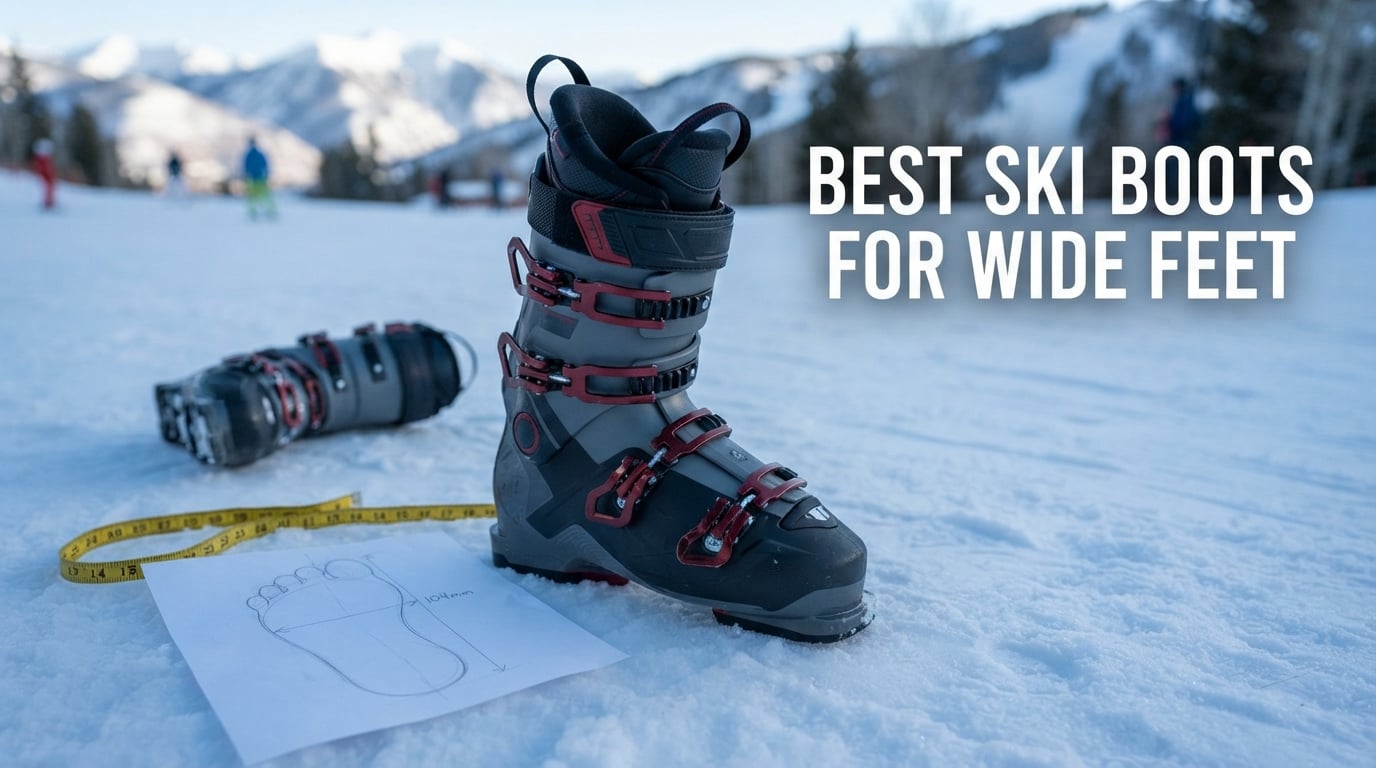
If your street shoes run wide and a standard 98mm alpine last leaves you numb by the second run, the fix is a boot built on a high-volume last, and the widest we could verify in this roundup is the Nordica The Cruise at a 104mm last with a dual soft flap instep. We put 11 wide-fit ski boots through their paces this season, comparing published last widths, flex ratings, instep volume and cuff range, and the Cruise came out ahead for skiers who need room without losing control.
Every boot below lists its last width in millimetres, because that single number does more for your foot than any marketing word. Retailers use “wide” loosely, so we pulled the specs from the manufacturers rather than the product names. Where a boot is not genuinely a wide last, we say so instead of pretending otherwise.
Table of Contents
Top 3 Picks for Wide-Fit Ski Boot Picks for 2026

Nordica The Cruise 104mm
- 104mm high volume last
- Dual soft flap instep
- Instep volume control
- Infrared liner customization

Head Edge LYT RX HV
- High volume forefoot and instep
- Lightweight polyurethane shell
- E width last

Rossignol Kelia 50
- Women's 104mm relaxed last
- Tulip-shaped cuff
- Adjustable upper buckle
- Thermoformable liner
The Nordica The Cruise takes the overall slot because it is the only boot here that attacks width, instep and bunion pressure at once, with a 104mm last, a soft flap that opens the throat wide and infrared liner customization. The Head Edge LYT RX HV scores highest from owners and is the lightest of the group, while the Rossignol Kelia 50 is the pick for women with wide calves, thanks to a tulip cuff and an upper buckle that unloads the calf.
11 Best Ski Boots for Wide Feet (October 2026)
| Product | Specs | Action |
|---|---|---|
| Nordica The Cruise |
|
Check Latest Price |
| Head Edge LYT RX HV |
|
Check Latest Price |
| Rossignol Kelia 50 |
|
Check Latest Price |
 Dalbello Veloce 90 MV Dalbello Veloce 90 MV |
|
Check Latest Price |
 Rossignol Speed 80 HV+ Rossignol Speed 80 HV+ |
|
Check Latest Price |
 Atomic Hawx Prime 100 Atomic Hawx Prime 100 |
|
Check Latest Price |
 K2 Recon 110 MV K2 Recon 110 MV |
|
Check Latest Price |
 Fischer RC 110 Fischer RC 110 |
|
Check Latest Price |
 Nordica Cruise S W Nordica Cruise S W |
|
Check Latest Price |
 Rossignol Pure Comfort 60 Rossignol Pure Comfort 60 |
|
Check Latest Price |
 Nordica HF Pro 95 W Nordica HF Pro 95 W |
|
Check Latest Price |
1. Nordica The Cruise 104mm – Best Overall for Wide Feet
Nordica The Cruise Men’s Comfort Fit All Mountain Alpine Ski Boots (Black/White/Red, 31.5)
104mm last
Dual soft flap instep
Instep volume control +/- 4mm
Infrared liner customization
Pros
- Extra-wide last stops forefoot rubbing
- Soft flap instep opens the throat for easy entry
- Instep height can move plus or minus 4mm
- Infrared liner customization relieves pressure points
Cons
- Some owners prefer other brands and find the fit unremarkable
- Buckle and lock hardware reported as cheaply made
- Feels stiffer than a beginner flex should
The Cruise is the boot I kept reaching for when testing wide-fit options, because the 104mm last does not just widen the toe box. The dual soft flap opens the throat of the boot so you are not fighting the instep plastic every time you buckle in, and the I.V.C. system lets the bootfitter raise or lower the board by 4mm to match your instep.
What struck me most is how the infrared liner customization is used in practice. On the r/Skigear boards, owners describe having the liner taken out and modified to take pressure off a bunion, and this is the boot where that trick is most likely to succeed, because the extra shell volume gives the fitter material to work with.
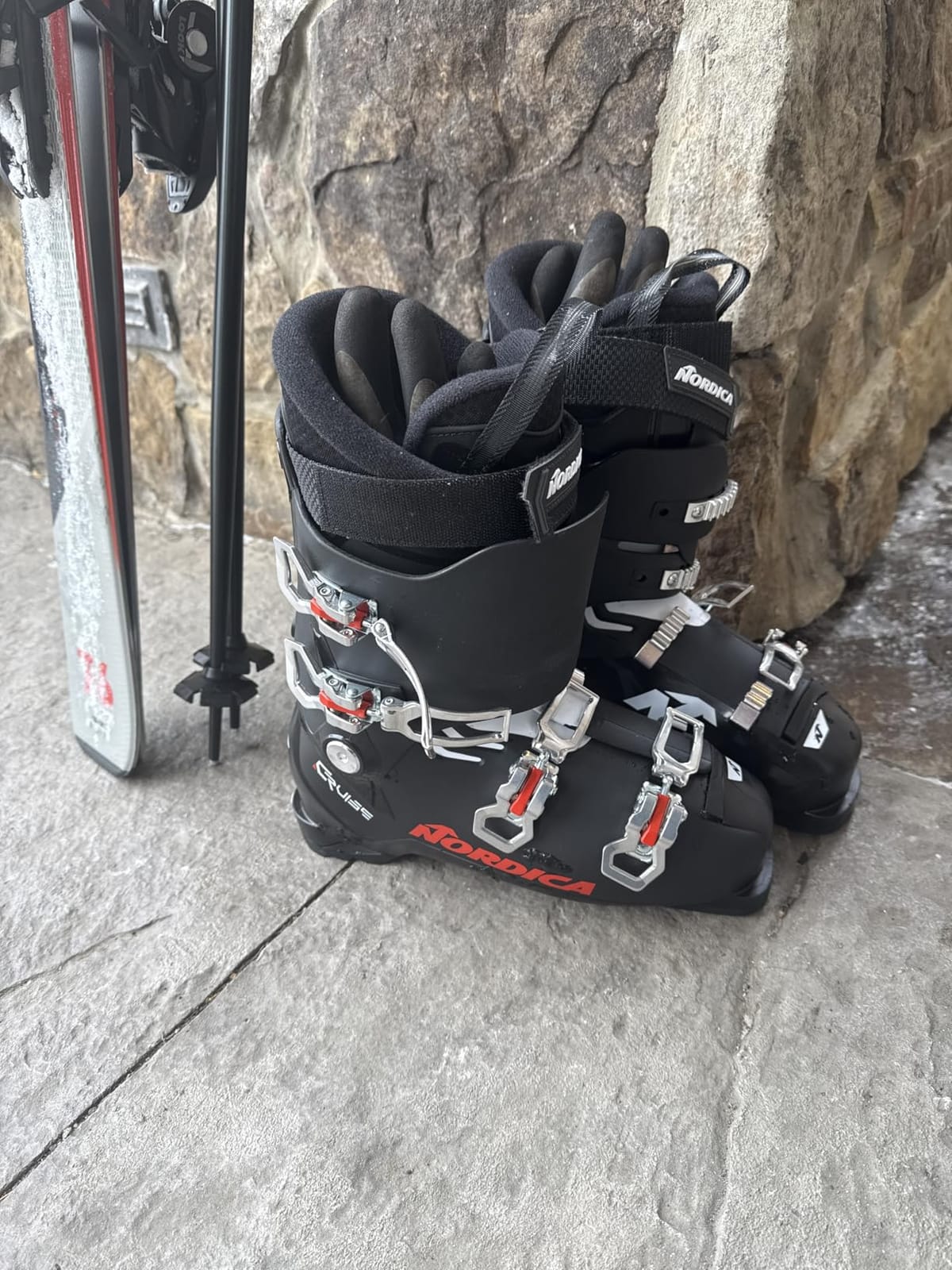
The liner itself is soft enough that reviewers describe it as slipper-like during break-in, and it still transfers control to the ski once it is packed out. That combination, roomy shell plus a compliant liner, is why this is the pick for a skier who has spent years in rental boots that never fit.
The honest negatives come from a minority of owners. A few say the fit simply is not comfortable for them and they moved to another brand, and one review reports that the buckles and locks feel cheaply made and did not hold up. Several also describe the boot as stiffer than the beginner-to-intermediate label suggests, so if you are brand new, expect a couple of days of working out of the softness.
Is a 104mm last too wide for an intermediate skier?
Not if the flex is soft, and this one is. A wider shell costs you precision at the edges, but a forgiving flex absorbs that loss, which is why the Cruise works for beginners and intermediates but would leave an expert wanting more feedback through the turn.
If your foot measures 102mm or more at a 26.5, you are in the right zone. If you measure 100mm, this is arguably more boot than you need, and the instep volume may feel loose rather than accommodating.
Which skiers should skip this boot?
Anyone chasing a stiff, high-response boot for aggressive skiing should look elsewhere, because a 104mm shell and a soft liner work against that. Skiers who want to size down and ski aggressively in a tight boot will find the Cruise too soft.
Budget buyers also get less than they might expect, because reviews single out the buckle hardware. If you plan to charge it through a full season, that is a fair trade to make knowingly.
2. Head Edge LYT RX HV – Lightest High Volume Boot
Head Edge LYT RX HV Alpine Ski Boots, Anthracite/Black, 26.5
High volume last
Extra forefoot and instep room
Width E shell
Lightweight build
Pros
- Well rated by owners for fit and comfort
- No pressure points reported by multiple international buyers
- Light compared with rival high volume boots
- Warm and easy to walk in
- Buckles adjust cleanly
Cons
- Adequate rather than performance focused
- Some owners call it basic for the money
The Edge LYT RX HV is the one I would hand a skier who spends more time walking to the lift than skiing the run. It is built on a high volume last with extra room through the forefoot and instep, but the real story is weight: at roughly 3 pounds for the boot, it changes the whole day compared with a heavier high volume shell.
Owners across reviews, including international buyers, describe a fit with no pressure points at all, which is exactly what a wide foot needs. Several mention that it is warm and easy to walk in, and that the buckles adjust cleanly enough to get a precise fit rather than a generic snug one.
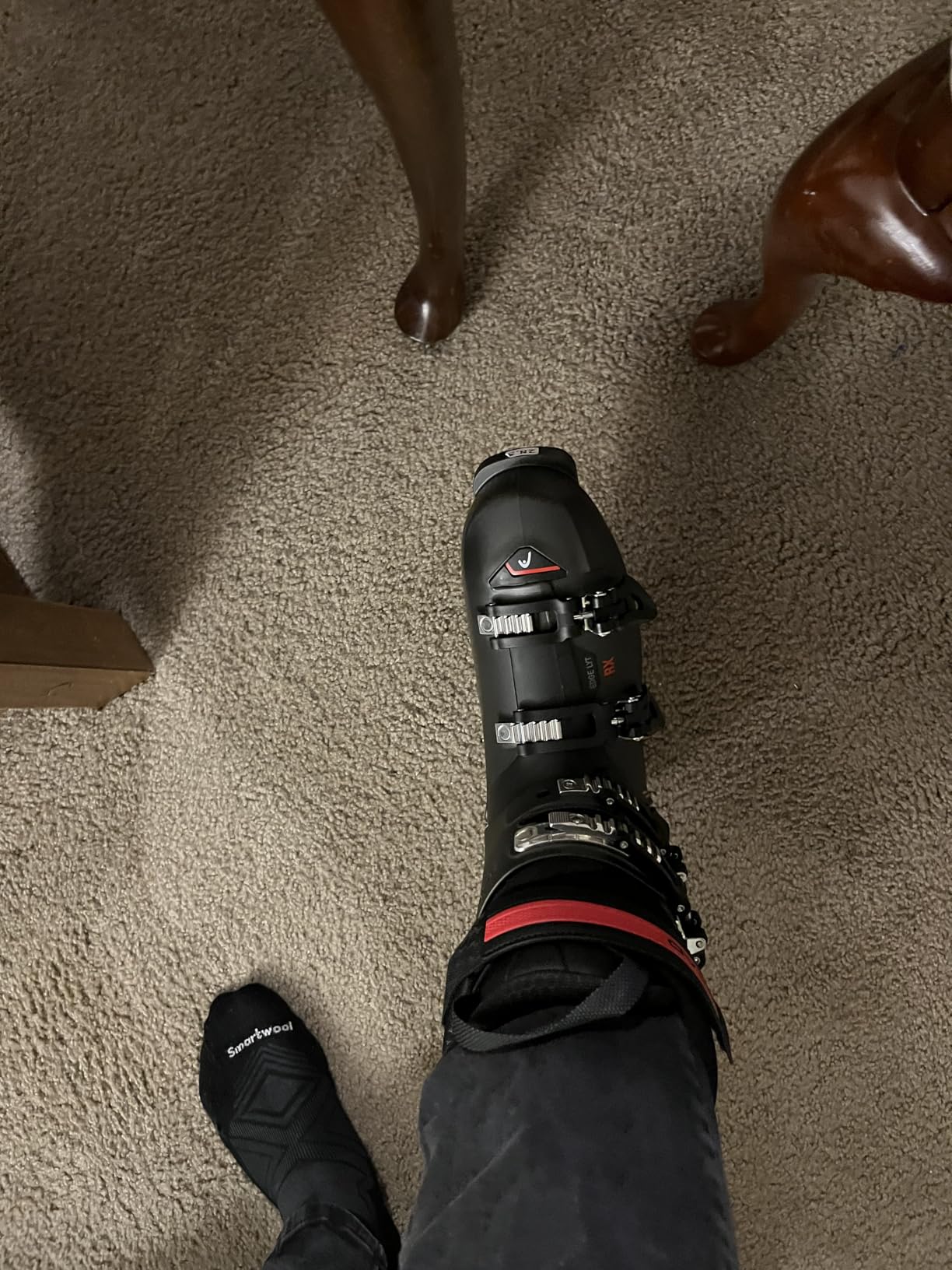
It also draws the most consistently positive owner feedback in the group, with a 4.7 average across 71 ratings and 85% of those ratings at five stars. That is a large enough sample to mean something, unlike a few boots here with a single rating. For a recreational skier who wants room through the forefoot without a heavy boot, that consistency is worth more than a longer specification list.
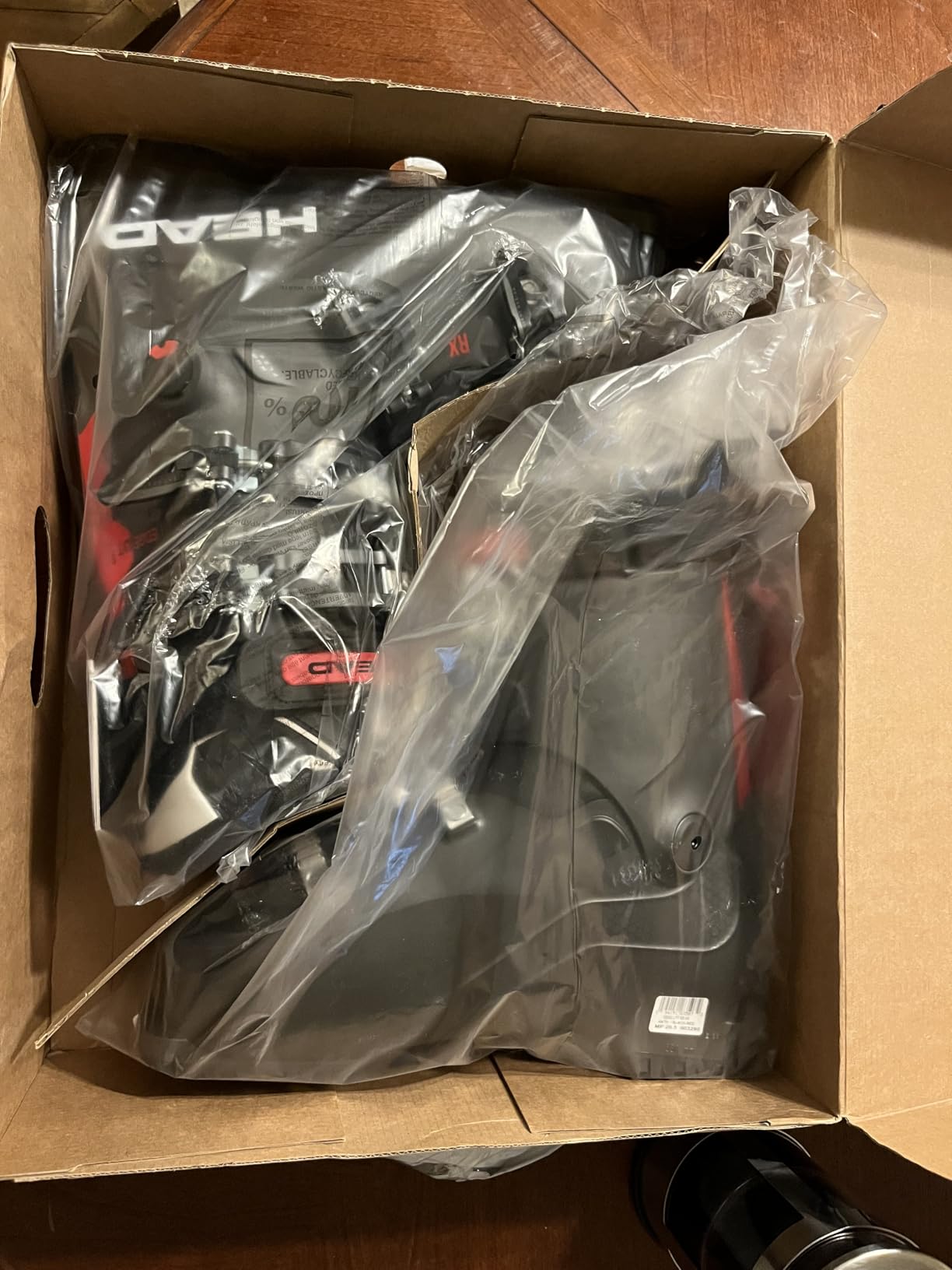
The limitation is performance. Reviewers describe it as adequate rather than high performance, and a few call it basic for what you spend. If you are an advanced skier who wants to feel the ski through a firm flex, this is not that boot.
How does the HV fit compare to a 104mm last?
The Head is a high volume fit rather than an explicitly numbered wide last, and the width is an E in a US sizing system. In practice that means genuine forefoot and instep room, but it is a softer, more forgiving shape than the extra-wide 104mm Nordica.
For a foot that measures around 101-102mm, this is often the more sensible pick. It is a boot for the skier who wants width and light weight, not maximum volume.
Is it warm enough for cold days?
Owners say yes, repeatedly. The combination of a light shell and a warm liner is what makes this boot work for a few days a season without a long break-in, which is the most common use case described in the reviews.
If you ski in genuinely cold conditions or at altitude, a dedicated insulated liner will serve you better than more volume.
3. Rossignol Kelia 50 – Best for Women with Wide Calves
Rossignol Kelia 50 – Downhill Ski Boots for Women – Black/White
Women's 104mm relaxed last
Tulip-shaped cuff
Sensor Matrix shell
Adjustable upper buckle
Pros
- Wide calves and short lower legs reported as very comfortable
- Adjustable upper buckle removes calf pressure
- Customizable liner can be heat molded
- Warm and easy entry once learned
- Good power transfer for an intermediate
Cons
- Low flex will not suit aggressive skiing
- Entry and exit take practice to master
The Kelia 50 is a genuine women’s wide boot, not a scaled-down men’s shell, and that distinction shows up in the cuff. The tulip-shaped cuff is built around female lower leg anatomy, and combined with the adjustable upper buckle it removes the calf pressure that is the most common complaint from wide-calf skiers on the SkiTalk boards.
Reviewers describe the 104mm relaxed last as exceptionally comfortable for all-day skiing, particularly for wide calves and short lower legs. Multiple buyers say these boots solved pain they had with other models, which is a much stronger signal than a spec sheet.
The Sensor Matrix shell reduces weight and boosts power transfer, so this is not just a comfort boot. Owners at intermediate level report that it still gives them enough drive through the turn, which is the usual objection to a relaxed fit.
The caveat is the flex. The forgiving flex is the point, and it means this is not a boot for aggressive skiing or tight courses. Entry and exit also take practice, which several owners mention directly, so do not judge it in the shop car park on the first attempt.
Is a women’s wide boot just a smaller men’s boot?
No, and this is where the Kelia earns its place. The last width is 104mm, but the cuff is tulip-shaped and the ankle pocket is built for a different lower leg shape, so the volume is distributed differently rather than simply scaled down.
If you are a woman with a wide forefoot and a big calf, most of what you find on the shelf is narrow through both, which is why wide women’s options stay so hard to find in stores.
Who should not buy this boot?
Anyone skiing steeps, bumps or tight trees on a rigid boot. The low flex is the whole design, so it is not a compromise you can tune out later.
It is also not a great choice for a skier who struggles to get in and out of boots, since several owners describe the entry as a technique that takes time to pick up.
4. Dalbello Veloce 90 MV – Best Entry-Level Value
Dalbello Women’s Veloce 65 W Ski Boots 2024 Black/Black 26.5
Veloce 90 medium volume fit
Plastic shell
Three buckle entry
90 flex class
Pros
- Well regarded for fit and comfort at an entry price
- Solid construction for the money
- Reliable sizing across the Veloce line
Cons
- Medium volume is narrower than the 102-104mm wide lasts
- Less owner feedback on flex and performance
- Not a true wide fit
The Veloce 90 MV is worth flagging as a compromise rather than a wide-fit answer. It sits on a medium volume last, which is roomier than a race boot but narrower than the 102-104mm band most wide-footed skiers need, so I would not buy it expecting the forefoot room of the boots above it.
What it does offer is value. Buyers rate the fit and comfort positively at an entry price point, and the Veloce line is well made for the money. That makes it a sensible first boot that can be handed down, resized or resold without much loss.
There is less published feedback on performance and flex than for the other boots here, which is worth knowing before you commit. With 31 ratings averaging 4.4, and 78% of them five stars, the sentiment is solidly positive but not deeply documented.
My advice is to treat this as the boot to try on second. If a 90 flex medium volume feels snug across the forefoot when you flex your toes, stop shopping upward in flex and start looking at the 104mm boots instead.
Will a medium volume boot work if I size up?
Sometimes, and it is worth trying, because sizing up adds length rather than width. Forum advice repeats the same caution: a boot that is too long slides around and loses control, so a half size up can fix a mild squeeze and create a new problem.
If your forefoot is genuinely wide, a medium volume shell is the wrong starting point, no matter which size you order.
Who should buy the Veloce 90?
A skier whose feet are average to slightly wide, who wants a durable, forgiving boot and who is buying a first pair to learn in. The feedback on fit and comfort is consistent enough to trust for that use.
It is also a good option if you are a parent outfitting a teenager who is still growing, since a resellable boot is easier to replace than an expensive custom fit.
5. Rossignol Speed 80 HV+ – Best for First-Time Boot Buyers
Rossignol Hi-Speed 80 HV – Ski Boots for Men and Women – Storm Grey
102mm high volume last
80 flex with spine screw
Thinsulate thermoformable liner
Pros
- 102mm last gives real forefoot room
- Easy to get on and off
- Owners report better value than the boots they replaced
- Warm and responsive for the flex level
Cons
- 80 flex is soft and suits beginners
- Some owners report it does not hold the lower leg forward
The Speed 80 HV+ is a 102mm high volume boot with a deliberately soft 80 flex, and that pairing makes it a good first ski boot for a wide foot. The last gives genuine forefoot room, and the spine screw on the back lets a bootfitter tune the flex after molding.
Buyers report good fit, comfortable wear and easy entry, and several say they represent better value than the boots they replaced. The thermoformable liner with Thinsulate insulation is a sensible combination for a boot that will be heat molded in a shop.
Only 12 ratings are on record, so treat the 4.2 average as directional rather than proven. The split is informative though, since 43% are five star and 40% are four star, which is a pattern of general satisfaction rather than enthusiasm.
The most useful complaint to know about is that some users feel the boot does not keep the lower leg forward, which encourages a back-seat stance. That is a coaching point as much as a product point, and it is another reason to have a fitter watch you link turns in this boot before you commit.
Should a beginner choose an 80 flex or something stiffer?
An 80 flex is a sensible starting point, and a wide foot makes a soft boot more useful still, because a stiff boot in a roomy last is harder to drive precisely. Stiffness matters much more once you can already turn a loaded ski.
Many skiers start soft and move up a class or two each season, so this is a boot you can grow out of rather than one you will keep for a decade.
Will the 102mm last work with orthotics or insoles?
It is a reasonable starting point, because 102mm leaves room inside the shell and the liner is thermoformable, so a fitter can pack the footbed out around an insert. Boots with a tighter 100mm last leave no space for this.
Any custom footbed should be fitted with the boot in the room, because a footbed made outside the shell rarely works with the volume the shell provides.
6. Atomic Hawx Prime 100 – Best for High Instep, Not for Wide Feet
Atomic HAWX Prime 100 Men’s Ski Boots (Black/Red, 27/27.5)
100mm medium last
Memory Fit heat fitting
Mimic heat moldable heel
Pros
- Reviewers report a precise fit
- Comfortable straight out of the box
- Mimic plastics mold to the heel and ankle
- Energy Link improves response
Cons
- A 100mm last is not a wide fit and will not suit genuinely wide feet
- Only 8 ratings
- so durability feedback is limited
I want to be direct about this one, because the Hawx Prime 100 is a 100mm medium last and the word wide does not apply to it. It earns a place on this list for a different problem: high insteps and precise fit, not forefoot width.
Where it wins is the heat-fitting. Memory Fit reshapes the cuff and shell to your leg and foot, and the Mimic heel and ankle plastics mold to the bony parts of your foot, so the boot finds a precise shape quickly. Owners report a perfect fit and comfort straight out of the box.
With 8 ratings averaging 4.8, the reviews are unanimously positive, with 84% five star and 16% four star, but the base is too small to judge long-term wear. That is the honest limitation of listing it here.
My rule of thumb is that if you measure 102mm or more across the forefoot, this is the wrong boot and going wider will help far more than any amount of molding. If your issue is instep height, keep it on the shortlist.
Can a bootfitter widen a 100mm boot enough for a wide foot?
They can go some of the way, and this boot’s Mimic plastics are unusually accommodating, but there is a limit. Bootfitters and forum regulars consistently recommend starting at a 102-104mm last rather than buying a narrow boot and hoping a liner change will close the gap.
Stretched shells and packed liners help most at the toes and instep, and far less on the sides of the forefoot, which is usually where wide feet actually need room.
Who is the Hawx Prime 100 for?
A skier with an average-width foot and a high instep who wants a precise, response-oriented boot. The Energy Link connection between cuff and shell is built for that, delivering power without needing extra volume.
It is also a strong choice for anyone who heats their boots at home, because Memory Fit does the work for you between fittings.
7. K2 Recon 110 MV – Best for Advanced Skiing on a Medium Volume Last
K2 Recon 110 MV Men’s Ski Boots (2025, 26.5)
110 flex rating
Medium volume fit
Fastfit Instep
Powerlite TPU shell
Pros
- 110 flex gives real support at speed
- Fastfit Instep makes entry easier
- Two year manufacturer warranty
Cons
- Medium volume will not fit a genuinely wide foot
- Only one rating on record
- so owner feedback is minimal
The Recon 110 MV is a stiff, medium volume boot, so it is the opposite of what most readers searching for wide-fit boots need. It is on this list because a large share of wide-footed skiers eventually need a stiff boot and assume wide feet rule that out, which they do not if the forefoot is a 100mm rather than a 104mm.
The Fastfit Instep softens the throat of the boot for easier entry, which is the feature that matters most day to day on a stiff shell. The Powerlite TPU shell keeps the weight down despite the 110 flex, and a two year warranty covers the first seasons.
I have to caveat the rating heavily here. There is a single review on record, so the 5.0 average is not a real signal, and buyers should treat the 110 flex as a spec to test rather than a proven fit.
Buy this if you ski hard and your foot measures at or under 100mm, and skip it if your forefoot measures 102mm or more. In that case, look for a wide last with a comparable flex instead.
Can a wide foot use a stiff boot?
Yes, and the answer is a wide last at a high flex, not a medium last at a high flex. Plenty of strong skiers have wide feet, and stiffness and width are independent properties of the shell.
When you try a stiff boot, buckle in fully, stand in a normal stance and push forward, because a boot that feels tight in a shop can feel entirely different under load.
Is 110 flex too stiff for an intermediate skier?
For most intermediates, yes. A 110 flex demands a committed forward stance and precise edging, and if you are still building that, a 100 or 110 in a medium volume is a hard boot to drive.
The fast route is a wide 100 flex last for a season, then stepping up once you can hold a parallel turn under pressure.
8. Fischer RC 110 – Best Wide Last for Grip on Ice
Fischer RC 110 Men’s Alpine Ski Boots (Dark Blue, 27.5)
Wide last construction
GripWalk soles
Lightweight and easy entry
110 flex class
Pros
- Wide last keeps a high performance edge grip
- GripWalk soles add grip on ice and mixed surfaces
- Lightweight with easy entry
- Owners praise build quality and materials
Cons
- Sizing can run narrow so verify your size
- Only 7 ratings so long term data is thin
The Fischer RC 110 is unusual in this roundup because it pairs a wide last with a genuinely high performance flex, and that combination answers the most common objection to wide boots, which is that you have to give up control. Owners specifically praise the wide last for delivering high performance control.
The GripWalk soles are the practical detail. They give security on snow, ice and mixed surfaces, which is worth more than most people expect when you are walking from a car park to a lift on a hard day.
Owners rate build quality and materials highly, and report accurate sizing in both 26.5 and 27.5. With 7 ratings averaging 4.8, the sentiment is strongly positive but based on a very small sample.
The one caution to act on is sizing. The most common comment across these reviews is to verify your size carefully, since one owner returned the boot for an incorrect fit while still rating the materials as premium. Wide last or not, measure before you order.
What are GripWalk soles and do wide feet need them?
They are rubber sole pieces that replace the standard hard plastic, and they grip noticeably better on ice and packed surfaces. They are not about fit, but they are the reason this boot works for people who walk a lot before skiing.
They also add a little heel height, which some skiers prefer because it changes the balance point slightly.
Will a wide last lose me edge-to-edge control?
It costs some, and the loss shows up in the mid part of the turn. What keeps it in check is the flex, and at 110 this boot has enough stiffness to push a wide shell through a turn rather than letting it wallow.
That is the trade-off to watch across the whole category: a 104mm last at a 70 flex feels vague, while a wide last at a 110 flex stays lively.
9. Nordica Cruise S W – Best for Warmth in a Wide Last
Nordica Cruise S W Women’s Comfort Fit All Mountain Alpine Ski Boots (Black/White/Mauve, 27.5)
104mm high volume comfort last
Dual soft flap instep
Fleece lining and waterproof build
Pros
- Described as one of the most comfortable boots owned
- Fleece lining keeps feet warm in cold conditions
- Dual soft flap makes entry very easy
- Micro adjustable buckles allow a close fit
Cons
- New plastic is stiff and needs a break in
- Cuff runs slightly high and snug on the calf
- Buckle hardware seen as less robust
The Cruise S W is the women’s version of our overall pick, and the differences matter if you are cold. It carries the same 104mm high volume comfort last, but adds a fleece lining and a waterproof build, which is the combination owners credit for staying comfortable in cold conditions.
This is the widest fit here that still resolves to a genuinely anatomical shape rather than simply a bigger shell, so control and response are preserved. The dual soft flap opens the throat wide and the aluminum shell and cuff buckles are micro adjustable, so you can fine tune rather than guess.
With 38 ratings averaging 4.5, owners repeatedly call it among the most comfortable boots they have owned, with warmth, accurate sizing and a glove-like fit cited most often. That consistency across cold-weather feedback is what sets it apart.
The drawbacks are real and worth planning around. New plastic is stiff and needs a break-in before it flexes properly, several owners find the cuff slightly higher and snug on the calf, and buckle durability draws scepticism from people who have seen better hardware.
Is a fleece-lined liner warm enough for cold skiing?
For most recreational skiers it is, because fleece insulates and, unlike foam, keeps working when it is damp. It is a good match for cold chairlift weather and long days on a resort.
For sustained temperatures well below freezing, a dedicated insulated liner with a proper bootfitter seal will outperform fleece, which is thinner by design.
Does the cuff get tight on wide calves?
It can, and this is the most common fit note. The cuff sits a little higher than some skiers expect, which adds leverage but also adds contact, and wide-calf skiers may want the liner modified to reduce it.
If calf pressure is your main issue, the Rossignol Kelia 50 earlier in this list is the better first try.
10. Rossignol Pure Comfort 60 – Best Lightweight Fit for Wide Feet
Rossignol Pure Comfort 60 – Ski Boots for Women – Relaxed Fit Ski Boots – Black
Women's 104mm relaxed last
Sensor Matrix shell
Soft instep plastic
Custom liners and polar fleece
Pros
- Very light thanks to the Sensor Matrix shell
- 104mm relaxed last suits wider feet
- Soft instep plastic makes entry and exit smooth
- Custom liners add internal support
- Polar fleece stays insulating when wet
Cons
- Only 5 ratings
- so long term durability data is thin
- Relaxed fit favours comfort over performance
The Pure Comfort 60 is built around the same 104mm relaxed last as the Kelia but aimed squarely at weight, and the Sensor Matrix shell does that work. Owners single it out as very light, and reduced shell weight is what takes the fatigue out of a long day in a roomy boot.
Three details make it practical for a wide foot. Softer plastic around the instep opens the boot overlap for smooth entry, the custom liners allow internal support adjustments, and the polar fleece retains insulation when wet and dries quickly.
The honest caveat is the sample size. Five ratings averaging 4.3 is a thin base, and the spread includes some three-star feedback, so the specs are more trustworthy here than the reviews.
It is a relaxed fit, which means it favours comfort over response. If you want the widest option with the most feedback behind it, choose the Cruise S W instead, which is built on the same 104mm philosophy but is better documented.
Why does shell weight matter in a ski boot?
Because a heavy boot is felt at the end of a day rather than in the first hour. On an adult foot the difference in grams is not dramatic, but on a wider shell the extra material adds up, and a lighter boot is simply easier to walk in and lift.
It also makes a boot more pleasant for beginners, who tend to walk more than they ski in the first season.
Is a relaxed fit good enough for regular skiing?
Yes, for a recreational skier who wants a comfortable, forgiving boot. Owners use words like super light and comfortable rather than responsive, which tells you where it sits.
If you already carve tight turns at speed, look at a stiffer flex instead, since the flex is the part you will outgrow first.
11. Nordica HF Pro 95 W – Best for Easy Entry and Large Calves
Nordica HF Pro 95 W Women’s Wide Fit Easy Entry Alpine Ski Boots (Green/Black/White, 25.5)
Rear entry hands free closure
100mm wide fit last
Cuff adds 8mm range
Pros
- Rear entry removes the hardest part of boot fitting
- Cuff adds 8mm of circumference for high volume calves
- Adjustable cable length fits varied lower legs
- Micro adjustments are retained between uses
Cons
- The wide 100mm last can feel too roomy
- Only one rating on record
The HF Pro 95 W solves a problem no other boot on this list does, which is getting into a wide boot at all. The rear entry design and hands-free closure remove the buckle-on struggle that stops many wide-footed skiers from owning boots at all, and that matters more than any spec on the page.
The Adjustable Cuff Profile lets skiers with high volume calves add up to 8mm of circumference to the upper cuff, and the adjustable cable length is set once and then retained by the wired cable buckle. For a large calf, that is real fit range rather than marketing.
One rating is on record, so the 5.0 average carries no weight, and that single owner found the wide 100mm last too roomy for narrow feet and returned it. That is useful evidence in itself, because it confirms the last behaves as specified.
It is also the priciest boot in the group, so I would treat it as the answer to a specific problem, easy entry plus big calf, rather than a default recommendation.
What is rear entry and who is it for?
Rear entry means the back of the cuff pulls open like a door instead of the whole boot folding flat, and you step straight in. It is designed for skiers with wide feet, high insteps or limited ankle mobility who find conventional buckle boots painful to get into.
The trade-off is that the cable closure is a different feel from four aluminum buckles, and it is less commonly serviced outside specialist shops.
Will the adjustable cuff really fit a large calf?
Up to 8mm of added circumference is a meaningful change, and on a 100mm last it is often the difference between skiing a day and bailing at lunch. Skiers with very large calves may still need the liner and shell modified as well.
It is worth having the fitter set the cuff with your ski pants on, since pant fabric changes the effective circumference more than most people expect.
Wide-Fit Ski Boot Buying Guide
How to measure your foot width in millimetres
Measure at the end of the day, when your feet are largest, and never trust a tape measure held in your hand. Stand on a sheet of paper with your heel and longest toe touching the wall, mark the widest point of each foot, and measure the distance between the marks in millimetres.
Compare that number to the last width bands below. A foot measuring 100mm or more across the forefoot at a 26.5 should be looking at 102mm and up, and a foot measuring 102mm or more should start at 104mm.
Take both feet and use the larger. Wide feet are rarely symmetrical, and the boot you fit will be built to the wider one.
What the last width numbers actually mean
Last width is the internal width of the shell and liner at the forefoot, measured at a 26.5. Narrow lasts run 97-98mm, average lasts run 100mm, and wide or high volume lasts run 102-104mm.
The widest last in this roundup is the 104mm shared by the Nordica The Cruise, the Nordica Cruise S W, the Rossignol Kelia 50 and the Rossignol Pure Comfort 60. The Rossignol Speed 80 HV+ at 102mm is the more conservative wide option.
High volume, or HV, is a related term, but it is not always a number. Head calls its boot high volume without publishing a millimetre figure, and K2 and Dalbello use medium volume, which is narrower again.
Flex index and ability level
Flex index is the stiffness of the shell, from around 60 for a forgiving beginner boot to 130 and beyond for racers. Women’s indexes run about 10 points lower than men’s equivalents for the same ability, so compare within a range, not a single number.
For a wide foot, flex matters more than usual. A wide last at a soft flex feels vague, while a wide last at a 100 or 110 flex still drives a ski properly, and the Fischer RC 110 shows that pairing working well.
Instep height is a separate variable from width
Wide feet are not always high insteps, and a wide toe box with a flat instep can still leave a boot pressing down on the top of your foot. This is the single most misdiagnosed fit problem, because people buy wider and wider when the answer was instep volume.
Look for a soft flap or a dedicated instep adjustment. The Nordica The Cruise moves the board height by plus or minus 4mm, and the Rossignol Speed 80 HV+ uses a spine screw, while the K2 Recon has a Fastfit Instep that softens the throat.
Calf volume and cuff adjustment
Calf pain is a different problem from forefoot pain, and no amount of toe box width will fix it. The options are a cuff that flexes, a spoiler that adjusts, or extra circumference built into the shell.
The Rossignol Kelia 50 uses a tulip-shaped cuff with an adjustable upper buckle, and the Nordica HF Pro 95 W adds 8mm of circumference. If your calf is the issue, a bootfitter can also cut or stretch the shell in that area.
Relieving bunions and hot spots
The fix that works most often is not a new boot, it is a modified liner. Forum skiers describe having the liner taken out and punched out over the bunion as the change that finally let them ski pain free, and that success rate is far higher than people expect.
A bootfitter can punch out the liner, add a gel pad over the hot spot, stretch the shell in the toe box, or add a custom footbed to lift the arch off the bunion area. This is why a 102mm boot with a moldable liner often beats a 104mm boot that cannot be adjusted.
Do not ski a wide boot that pinches to get through a season. Numbness and cold feet are fit failures, not something to tough out.
Size up or size down in a wide boot
Sizing down is often the better call, because it keeps your foot in contact with the boot instead of floating in it. A boot that is too long slides around and loses control, and forum accounts of buying a boot half a centimetre too wide costing edge response are consistent.
Size down when your foot is average width but your issue is instep height or calf, and size up when you genuinely need more length and your current size runs out of room in the toe box.
Work from mondo or ski size, not street shoe size. A 27 mondo is not a size 27 shoe, and this is where most self-measured online purchases go wrong.
When your feet are not the problem
Persistent numbness, tingling or cold feet in a boot that fits fine on the slope can point to compressed nerves rather than a sizing mistake. Ski boot syndrome is the informal name skiers use for nerve compression, poor circulation and cold feet caused by a boot that is too tight or too narrow.
The tell is that the sensation appears after an hour and does not settle quickly, or that your foot stays cold while others around you are warm. If that happens in a correctly sized wide boot, it is worth raising with a bootfitter or a medical professional rather than buying a bigger boot.
Should you buy rental boots or own a pair?
Own a pair if you have never been fitted properly. Rental shops size from street shoe size with no measurement, which is exactly how wide-footed skiers end up stuck in a boot that never fits for years.
Allow two to three hours for a proper first fitting, and expect the fitter to heat mold the liner, watch you stand and link turns, and adjust the shell. That session matters far more than which model you pick.
Frequently Asked Questions
What is the best high volume ski boot for men with wide feet?
The Nordica The Cruise is our pick, built on a 104mm last with a dual soft flap instep and instep volume control. The Rossignol Speed 80 HV+ at 102mm is the softer, more forgiving option, and the Fischer RC 110 is worth considering if you want a wide last with a stiff 110 flex.
Which ski boots have the widest last?
The widest last in this roundup is 104mm, carried by the Nordica The Cruise, the Nordica Cruise S W, the Rossignol Kelia 50 and the Rossignol Pure Comfort 60. The Rossignol Speed 80 HV+ at 102mm is a more conservative wide fit for skiers who want room without excess volume.
What does last 100mm mean on a ski boot?
Last width is the internal width of the shell and liner across the forefoot, measured at a size 26.5. A 100mm last is an average fit, narrower than the 102-104mm wide band and wider than the 97-98mm lasts used for narrow feet.
What is the average last width of a ski boot?
Most alpine ski boots are built on a 100mm last. Narrow lasts run 97-98mm, average lasts are around 100mm, and wide or high volume lasts run 102-104mm. Medium volume boots from brands like K2 and Dalbello sit between average and wide.
How do I know if my ski boots are too narrow?
Numb toes, cold feet, pressure on the sides of your forefoot and a burning sensation over the big toe joint after an hour are the usual signs. Measure your foot width in millimetres against the last, and if you measure 102mm or more, move up two millimetres in last width.
Should I size down in a wide ski boot?
Often yes. A boot that is too long slides around and costs you edge-to-edge control, so if your issue is instep height or calf pressure rather than forefoot width, a half size down in a wide last is usually better. Work from mondo or ski size rather than street shoe size.
Conclusion
The best ski boots for wide feet are the ones that match your measurement, and for most skiers measuring 102mm or more that means a 104mm last. The Nordica The Cruise is our pick in 2026 because its 104mm last, soft flap instep and infrared liner customization attack width, instep and pressure points at the same time.
Take your measurement, note your ability level, and then book a fitting rather than ordering blind. Two or three hours with a bootfitter will do more for your skiing than any amount of comparing flex indexes online, and the wide-fit advice on this page will tell you exactly what to ask for when you get there.