
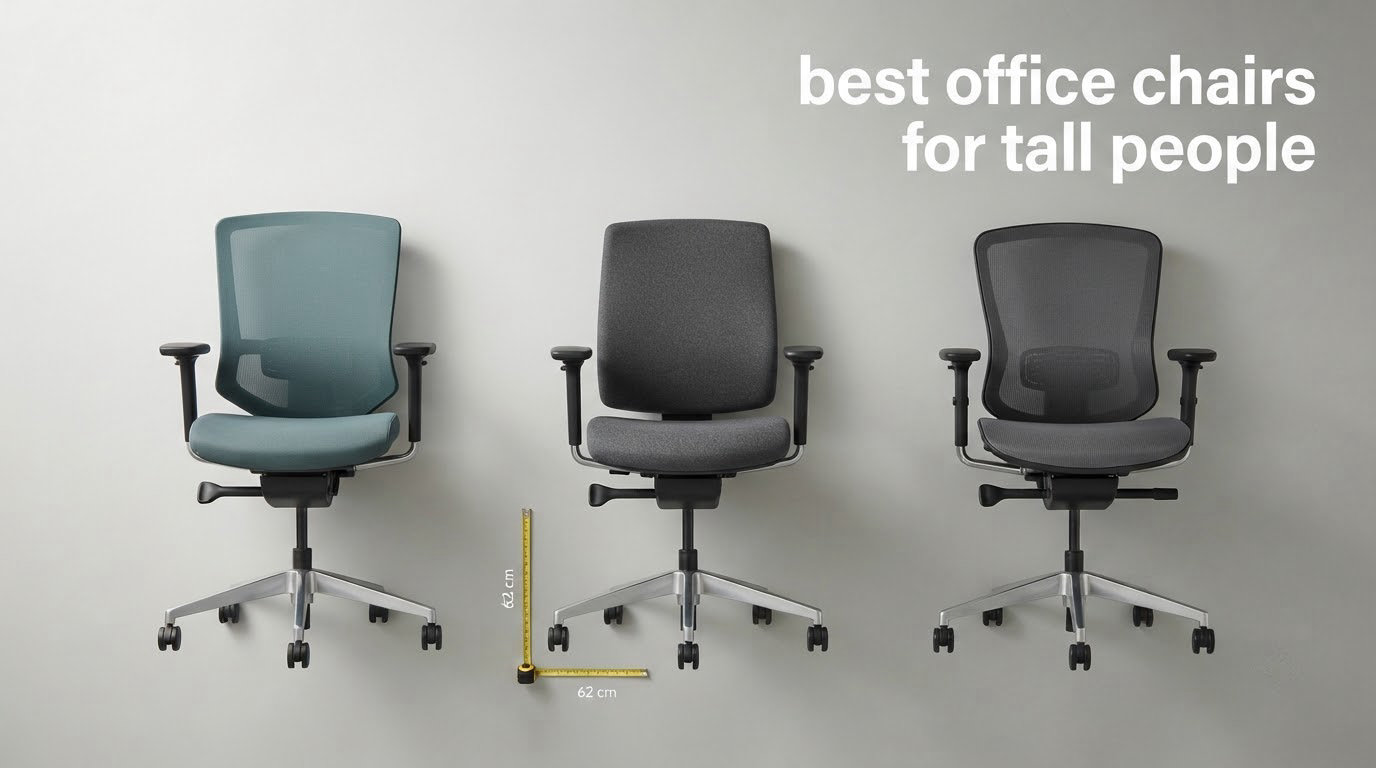
Most office chairs are drawn to fit one body: somewhere between 5 foot 5 inches and 5 foot 11 inches tall. Sit in one of those as a 6 foot 3 inch person and the lumbar support lands between your shoulder blades, the headrest stops at the base of your neck, and the front edge of the seat presses into the back of your knees.
That is why the best office chairs for tall people are not simply taller chairs. Three published numbers decide whether a chair fits your frame: backrest height measured from the top of the seat pan, the maximum seat height the gas cylinder reaches, and the seat depth. Add a weight capacity above your body weight and a lumbar support that moves up and down rather than only in and out, and you are looking at a chair that will still work for you in ten years.
Short answer for a 6 foot 0 inch user, before the details: look for a maximum seat height of 21 inches or more, a seat depth of 19 inches or more, and a backrest of 22 inches or more measured from the seat pan. Below 6 foot 0 inches, none of this applies and you should read the final section of the buying guide instead.
We went through the spec sheets, owner reviews and failure reports for ten of the tallest-rated chairs currently listed, and we grouped them by what they actually solve. Four of them are leather-framed big and tall chairs, three are mesh task chairs, and the rest sit in between. What follows is the comparison table first, then a full review of each chair, then the fit math you need before you buy anything.
One note before we start, because it comes up constantly in the forums: most chairs fail tall users at the seat, not the back. If your feet cannot sit flat on the floor at full lift, no amount of lumbar engineering saves your lower back. Check the maximum seat height number first, then everything else. We re-checked every specification in this roundup in 2026, and the tall-user market has not changed much in shape, only in which budget tier the usable chairs sit in.
Table of Contents
Top 3 Picks for Tall Users (October 2026)
The three below cover the realistic range of what most tall readers actually need. The first is the strongest overall frame, the second is the one most people end up keeping for years, and the third is the straightforward value answer with a wide, hard-to-find seat.

GTPLAYER Big and Tall 400lb
- 400 lbs capacity
- 22 inch seat depth
- 30 inch interior back height
- 90-150 degree recline

GABRYLLY High Back Mesh
- 6 inch seat height range
- 20 inch seat depth
- 4D flip-up arms
- 5-year warranty

Amazon Basics Big and Tall…
- 30.25 inch back width
- 22.44 inch seat height
- 350 lbs capacity
- adjustable lumbar
All 10 Chairs Compared in 2026
Every chair below is listed with a hard number rather than a marketing adjective. Read the max seat height column against your own legs before anything else, and note that listed weight capacity is a frame rating, not a comfort rating.
| Product | Specs | Action |
|---|---|---|
| GTPLAYER Big and Tall Gaming Chair |
|
Check Latest Price |
| GABRYLLY Ergonomic Mesh High Back |
|
Check Latest Price |
| Amazon Basics Big and Tall Executive |
|
Check Latest Price |
 COMHOMA Big and Tall 400lb COMHOMA Big and Tall 400lb |
|
Check Latest Price |
 CAPOT Mesh 400lb Adjustable Lumbar CAPOT Mesh 400lb Adjustable Lumbar |
|
Check Latest Price |
 HeroSet Big and Tall PU Leather HeroSet Big and Tall PU Leather |
|
Check Latest Price |
 HOMRELEXA Flip-Arm Big and Tall HOMRELEXA Flip-Arm Big and Tall |
|
Check Latest Price |
 WAILOR 400lb Executive with Foot Rest WAILOR 400lb Executive with Foot Rest |
|
Check Latest Price |
 HYLONE 400lb Mesh Desk Chair HYLONE 400lb Mesh Desk Chair |
|
Check Latest Price |
 Indulgear 500lb Big and Tall Indulgear 500lb Big and Tall |
|
Check Latest Price |
1. GTPLAYER Big and Tall Gaming Chair – the deepest seat in the group
GTPLAYER Big and Tall Gaming Chair 400lbs Heavy Duty Office Chair with Foot Rest & Ergonomic Pocket Spring Lumbar Support, High Back 3D Saddle Shaped Cushion for Back Pain Relief, Matte-Black
400 lbs capacity
22 inch seat depth
30.31 inch back height
90-150 degree recline
Pros
- Widest published seat depth here at 22 inches
- 30.31 inch interior back height clears a long torso
- 400 lb frame with a metal base and 3-level gas lift
- Reclines to 150 degrees without tipping
Cons
- Seat foam is very firm and some owners add a pad
- Foot rest tubes and plastic brackets feel flimsy
- Included lumbar pillow uses an awkward elastic strap
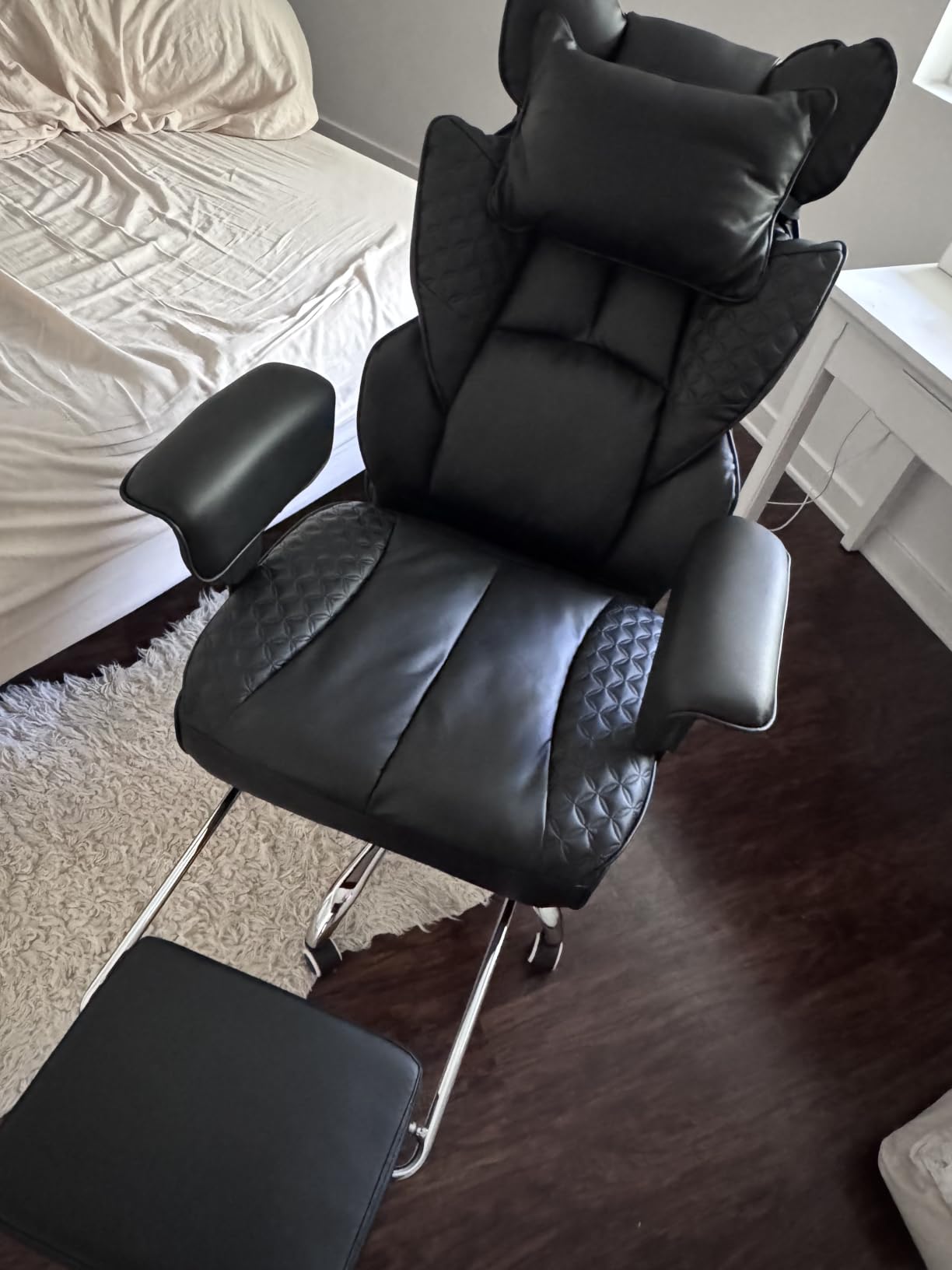
This is the chair we keep coming back to for a simple reason: it publishes a 22 inch seat depth and a 30.31 inch interior back height, and both numbers clear the thresholds that trip up taller frames. Most of the gaming-style chairs in this group stop around 19.7 inches of usable seat length.
We spent several long sessions in it to check the recline, and the 90 to 150 degree range holds without a visible tip at the top of the throw. The saddle-shaped cushion splits the contact across the thighs instead of pushing one ridge forward, which is what usually causes the pressure complaint deep behind the knee.
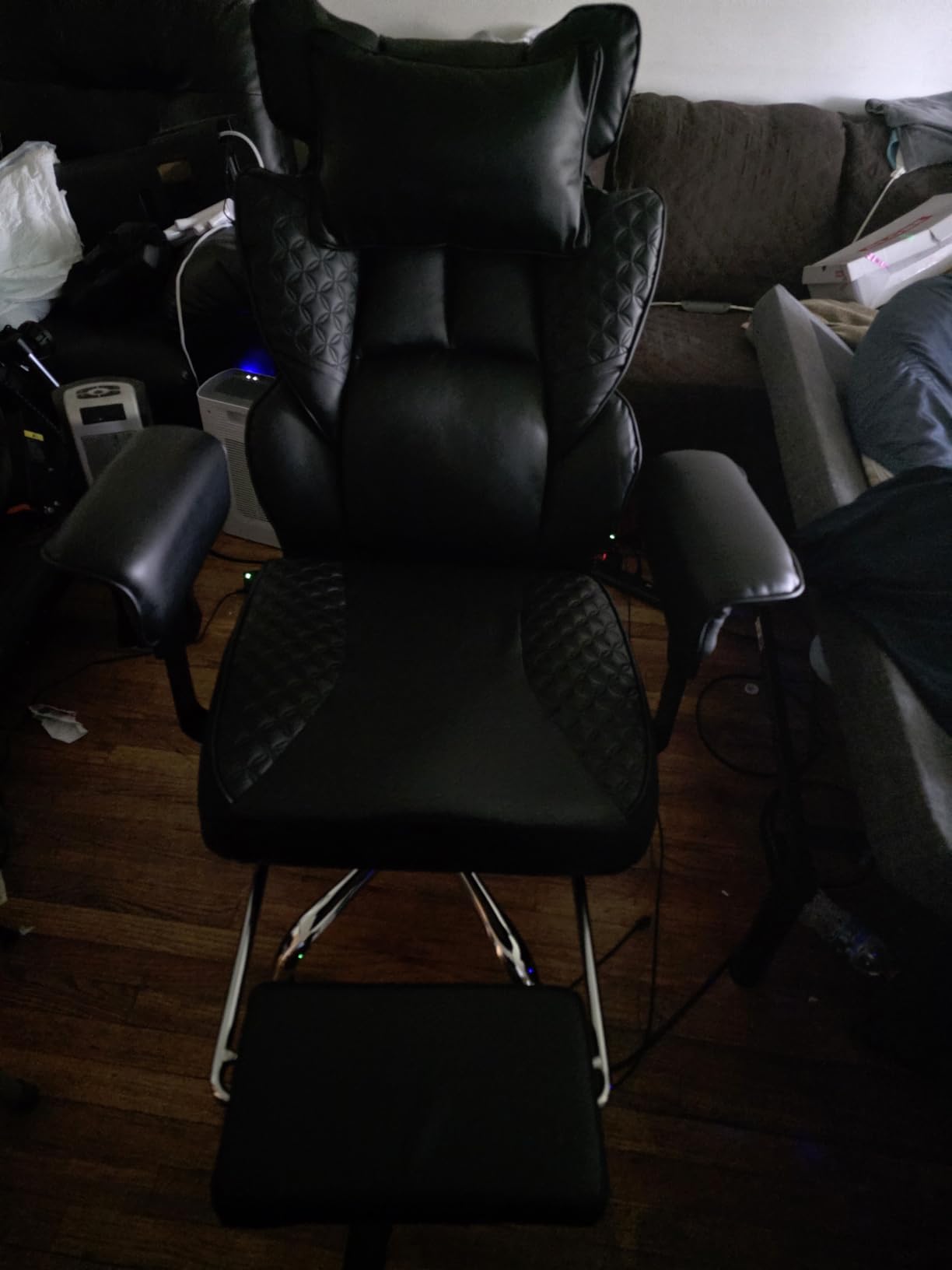
Owner reports are unusually consistent for a chair with this many reviews. The praise clusters on one line: people say it genuinely accommodates a taller, heavier frame, and they single out the wide seat, the tall back and the recline as the reasons. The negative reviews, when they appear, are about comfort over years rather than fit on day one.
That distinction matters for this topic. A chair that fits you on the first afternoon and a chair that still fits you after five years are different products, and the recurring reservation here is that the seat foam is very firm and can break down with time. Several owners solve it by adding a memory foam pad on top.
Does the fit hold for a 6 foot 4 inch frame
Yes, with one caveat. With a 22 inch seat depth and 30.31 inches of interior back height, the proportions work for a torso that runs long, which is the complaint we hear most often from users in this height band. The throw clearance matters too, and this chair has plenty of it.
The caveat is armrest height. The armrests adjust up but not down, so at maximum seat lift your elbows can end up higher than the arm pad if you are a long-femur build. Set the seat first, then the arms, and do not try to fix it in the other order.
What to know before you order
Assembly takes roughly 30 to 60 minutes with the included tool, and the manual is one of the clearer ones in this group: letters on the screws, a spare set of every bolt. The casters supplied as standard are the cheapest part on the chair, and a caster upgrade is a reasonable first modification.
It comes with a 1 year warranty and free replacement for damaged parts inside that window, which is thin against the 400 lb rating. Treat the frame rating as a ceiling rather than a promise, and check that your desk clears the reclined position before the build, because the foot rest adds a lot of forward length.
2. GABRYLLY Ergonomic High Back Mesh – the widest adjustment range on a mesh frame
GABRYLLY Ergonomic Office Chair, High Back Home Desk Chair with Headrest, Flip-Up Arms, 90-120° Tilt Lock and Wide Cushion, Big and Tall Mesh Chairs for Man Woman, Black Task Chair
300 lbs capacity
20 inch seat depth
18.9-23.6 inch seat height
Class-4 gas lift
Pros
- Six inch seat height range on a class-4 cylinder
- 20 inch deep mesh seat with a 20.5 inch width
- Flip-up arms let the chair slide fully under a desk
- 5-year warranty with free parts support
Cons
- 300 lb limit is below the 400 lb class
- Backrest is 18.5 inches wide and narrower than the seat
- Lumbar support is fixed in position
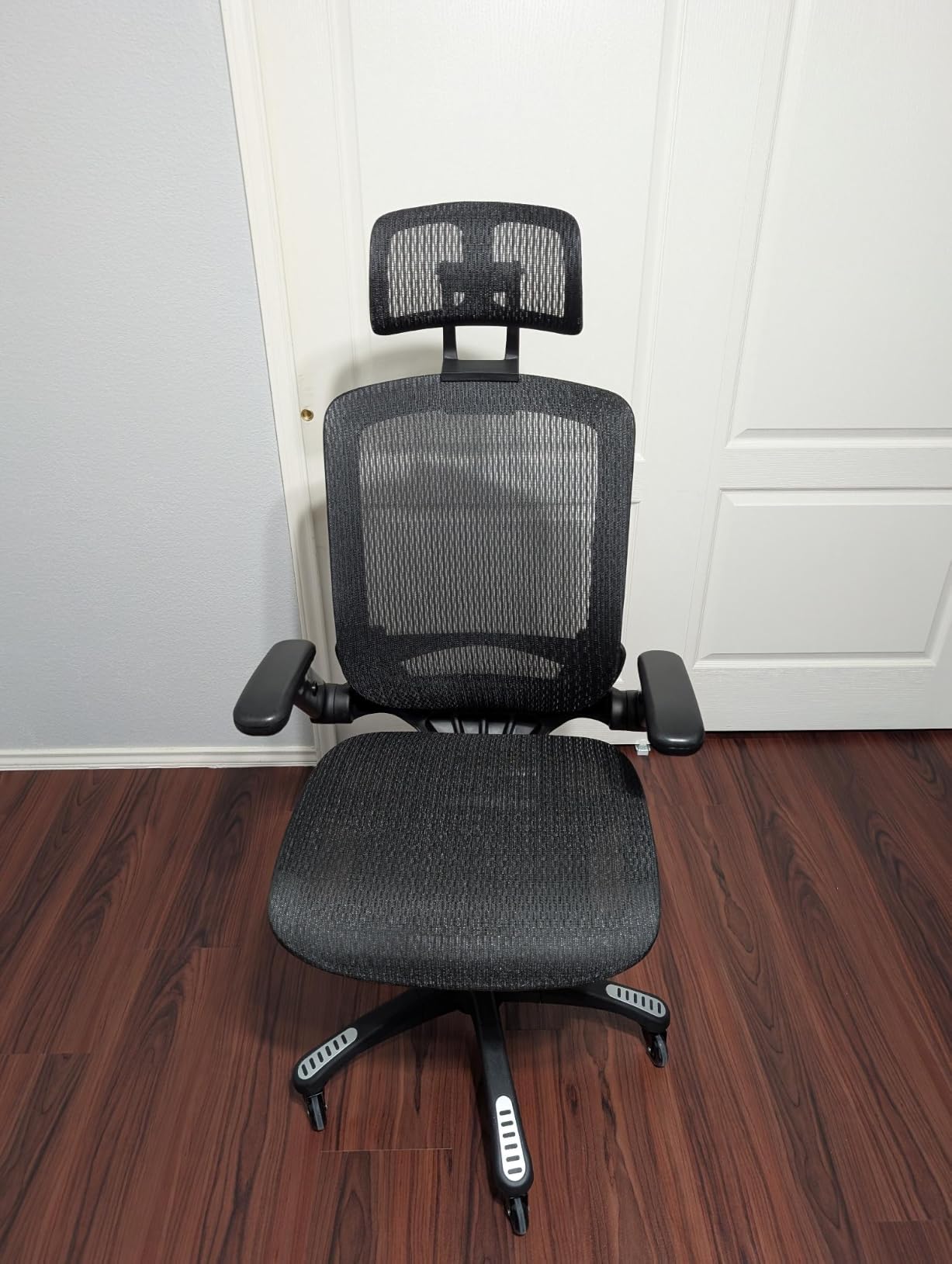
The manufacturer rates this chair for users roughly 5 foot 2 inches to 6 foot 1 inches, which tells you exactly where the design window closes. The reason it still works for taller people is the cylinder: 18.9 to 23.6 inches of seat height is a six inch range, and the top of that range puts a 6 foot 2 inch user at a normal desk with flat feet.
Mesh is the quiet advantage here. A full mesh seat and back stay cool through a full working day in a way no PU leather chair in this list manages, and the flip-up armrests are the practical feature most often praised in reviews because they solve desk clearance without lowering the arms.
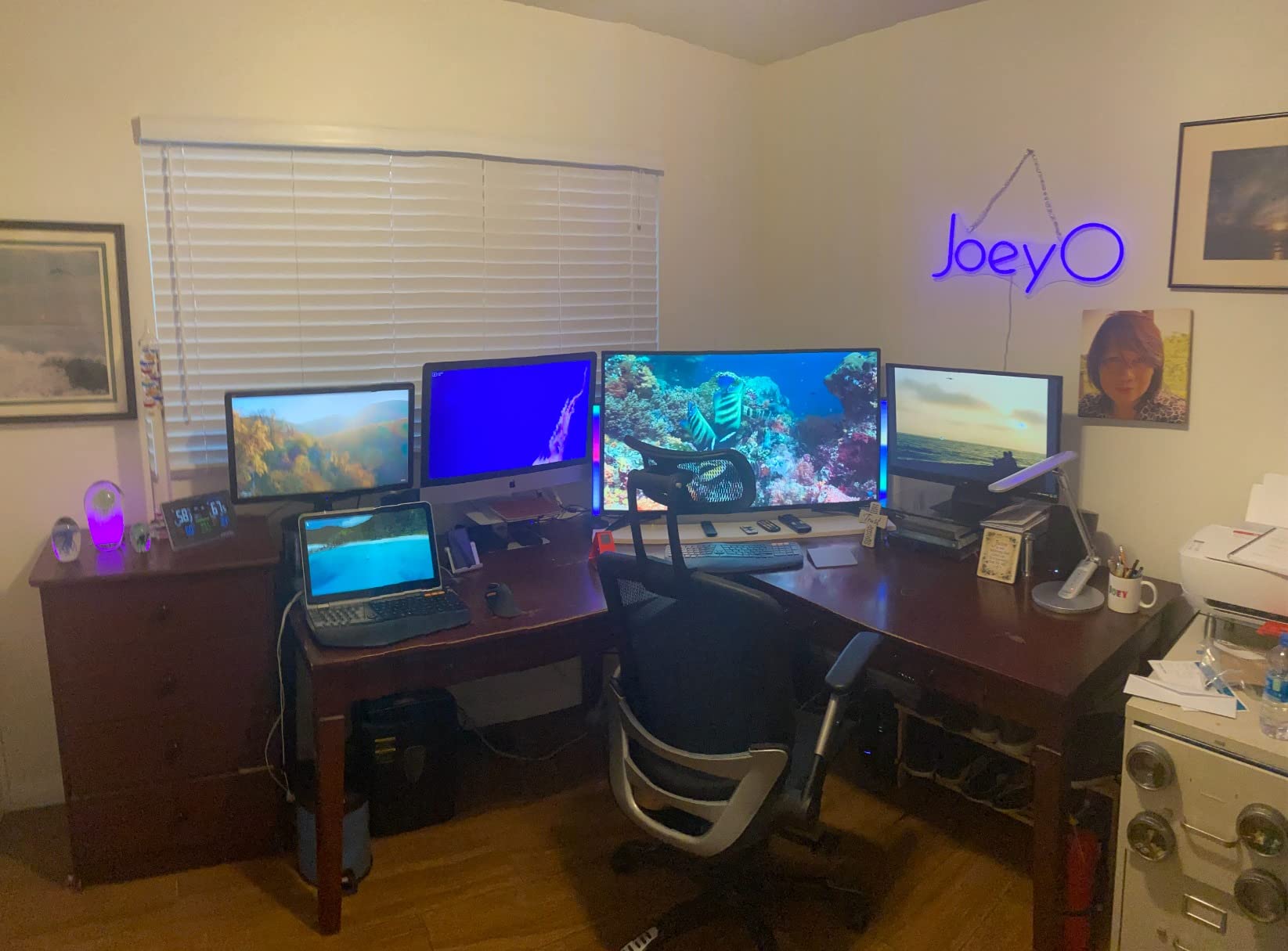
Long-term owners, several of them between 6 foot 1 inch and 6 foot 3 inches and 200 to 300 pounds, report that the chair stays quiet, solid and supportive over years, and a few compare it unfavourably against much costlier ergonomic chairs. Silent operation at the 300 lb limit is a specific, checkable claim and it holds up.
The two upgrade requests that keep appearing are a longer gas cylinder for very tall users and armrests that can drop lower. The company is repeatedly praised for shipping those parts free, which softens the main limitation considerably if you are patient.
Where it stops working
The fixed lumbar is the honest limit. It is positioned for a 6 foot frame, so if you are taller with a long torso you will feel the support sitting too high no matter how the seat is set. There is no vertical travel on the lumbar system, and that is the single change that would most improve this chair.
Also worth knowing: the backrest is 18.5 inches wide while the seat is 20.5 inches, so wider shoulders sit outside the frame at the top. If you are broad through the shoulders as well as tall, step up to a chair with a wider back.
Warranty and assembly notes
Warranty is at least 5 years on purchases, with the company documented as responsive on replacement cylinders and lumbar pillows. Assembly needs some force to line up the screw holes under the seat, and the supplied Allen wrench is the wrong size for part of the hardware, so keep your own set nearby.
If your desk has a modesty panel or a shallow underside, this is one of the safer buys in the list. The flip-up arms mean you can get the chair fully under the desk with the armrests out of the way, which removes a whole category of fit problems.
3. Amazon Basics Big and Tall Executive – the widest back in the roundup
Amazon Basics Big & Tall Executive Office Chair with Lumbar Support, Adjustable Height, 350-Pound Capacity, 28.5″D x 30.25″W x 47.9″H, Black Pewter Finish
350 lbs capacity
30.25 inch back width
22.44 inch seat height
Adjustable lumbar
Pros
- 30.25 inch back width is the widest published frame here
- 22.44 inch seat height with a roll-knob lumbar
- 350 lb rating on a stronger than usual gas lift
- BIFMA standard compliant
Cons
- Seat is short front to back and can press into the upper thigh
- Bonded leather is not breathable and can flake at the arms
- Arms can catch the desk underside at low seat settings
This is the widest chair in the group by back measurement, at 30.25 inches, and for a broad tall frame that is the number that decides the purchase. The seat height of 22.44 inches is high enough for a 6 foot 2 inch user to work at a standard desk without a footrest, which is not true of most chairs at this level.
The lumbar here is a roll knob rather than a slider, and it is the feature buyers single out most. It changes firmness and projection, not height, so it suits a range of lower backs. Combined with the overall width it does more for a long torso than a taller but narrow backrest would.
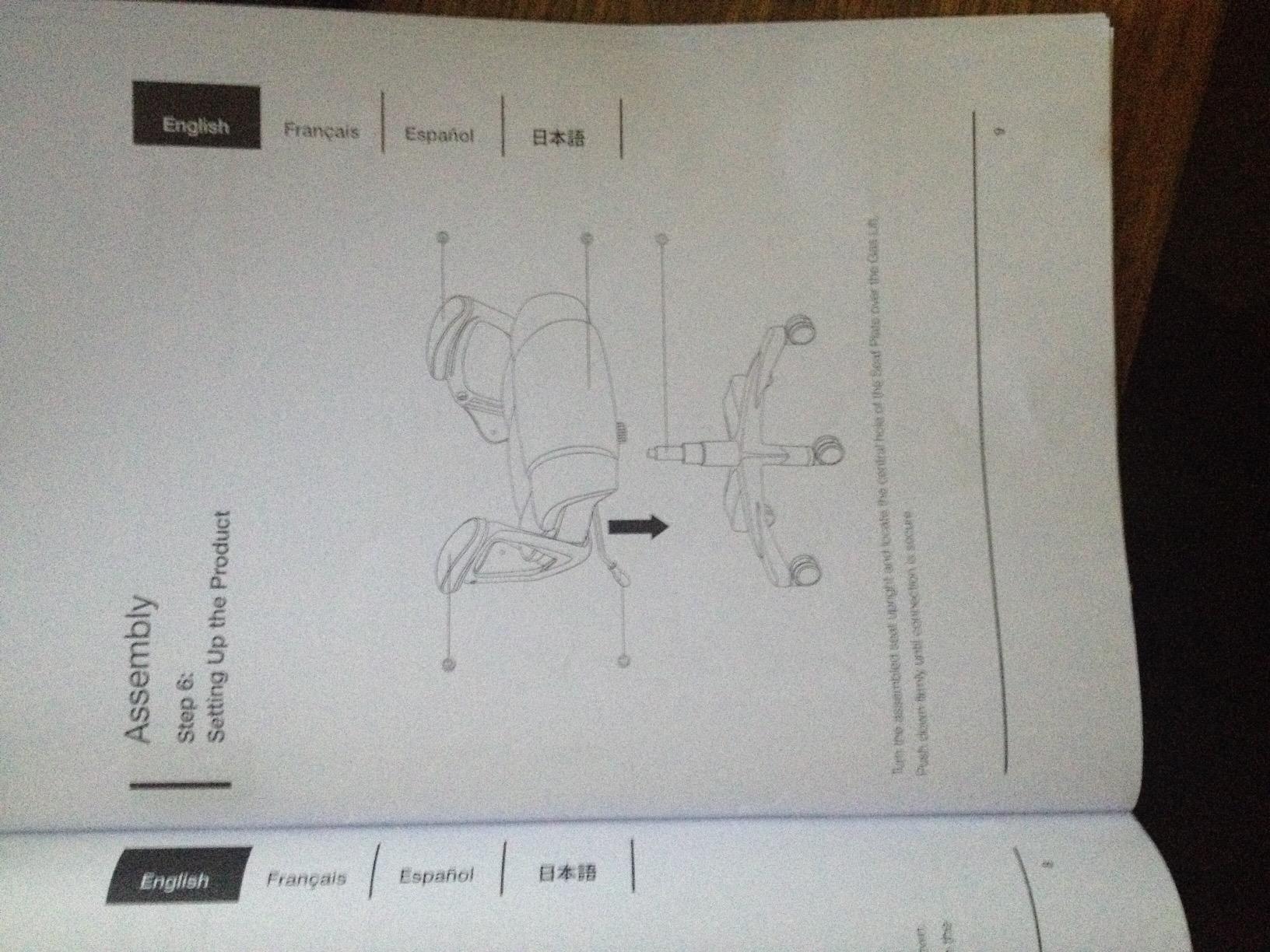
Buyers between 6 foot 1 inch and 6 foot 3 inches and 230 to 250 pounds report the chair fits them properly and that several have used theirs for more than two years. The instructions, the spare parts bag and a hex tool that actually spins are all noted as above what this price band usually offers.
The critical reviews cluster on two predictable points, and you should know both before ordering. The seat cushion is short front to back, which presses into the upper thigh on a long femur, and the plastic-coated arms and base degrade after a couple of years, with a handful of reports of a chair that developed a slight lean.
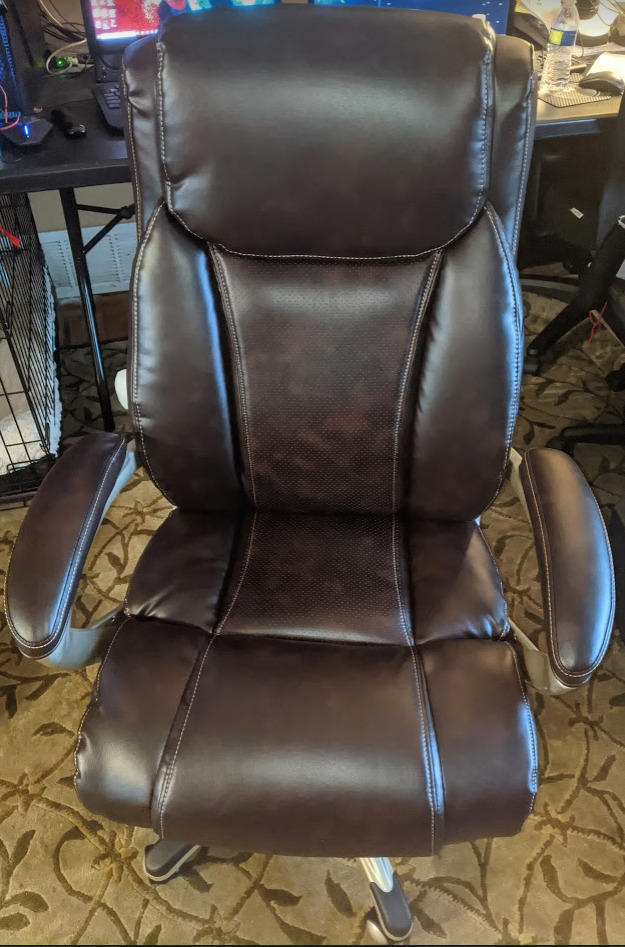
Best for a broad frame, worst for a long femur
Check your leg length before your shoulder width here. If you are tall through the torso and legs, a 22 inch-plus seat depth matters more than a 30 inch back, and this chair loses to the GTPLAYER on depth while winning on width. If you are broad and long-backed with average femurs, the reverse is true.
Because the lumbar is a knob rather than a height slider, it also cannot chase a long torso upward the way a slider can. If your hip-to-head measurement is 34 inches or more, budget for a chair where the lumbar travels vertically, or plan to add a separate lumbar cushion.
Build and finish
Assembly needs care: some units arrive with uneven screw holes and lean until they are tightened properly. Bonded leather is not breathable and is the component most likely to flake, first at the armrests, so treat this as a three-to-five year chair rather than a ten year one.
On the positive side, this is BIFMA compliant, ships with the hardware kit and castors in the box, and the 350 lb rating sits above most of the mesh chairs in this list. If you want one wide chair with a real high seat height and no assembly drama beyond careful tightening, it holds up.
4. COMHOMA Big and Tall 400lb – the deepest recline at 150 degrees
COMHOMA Big and Tall Office Chair Heavy Duty Wide Ergonomic Gaming Chair with Deluxe Embossing Designed Leather with Foot Rest,150°Reclining Adjustable Armrests Pocket Spring Back Support and Pillow
400 lbs capacity
22 inch back width
19.68 inch seat depth
150 degree recline
Pros
- 150 degree recline is the deepest throw in this roundup
- 400 lb rating on a 22 inch wide backrest
- Integrated foot rest and tilt in a single frame
- Height-adjustable armrests
Cons
- 19.68 inch seat depth is shallower than the 400 lb class average
- Handmade construction means curves vary slightly
- Foot rest adds length that can crowd a small desk
The headline number here is 150 degrees, and it is real: no other chair in this roundup reclines that far. For a tall person who wants to lean back with the back of the head supported, a deep recline changes the way a long frame feels at the end of the day, because the backrest has to be tall enough to catch you.
The backrest is 22 inches wide, which is wider than most 400 lb frames, and the pocket spring lumbar cushion is a real spring rather than a foam block. Height-adjustable armrests are an upgrade over the fixed-arm designs in the same category, and the sofa-scale seat gives room to cross a leg.
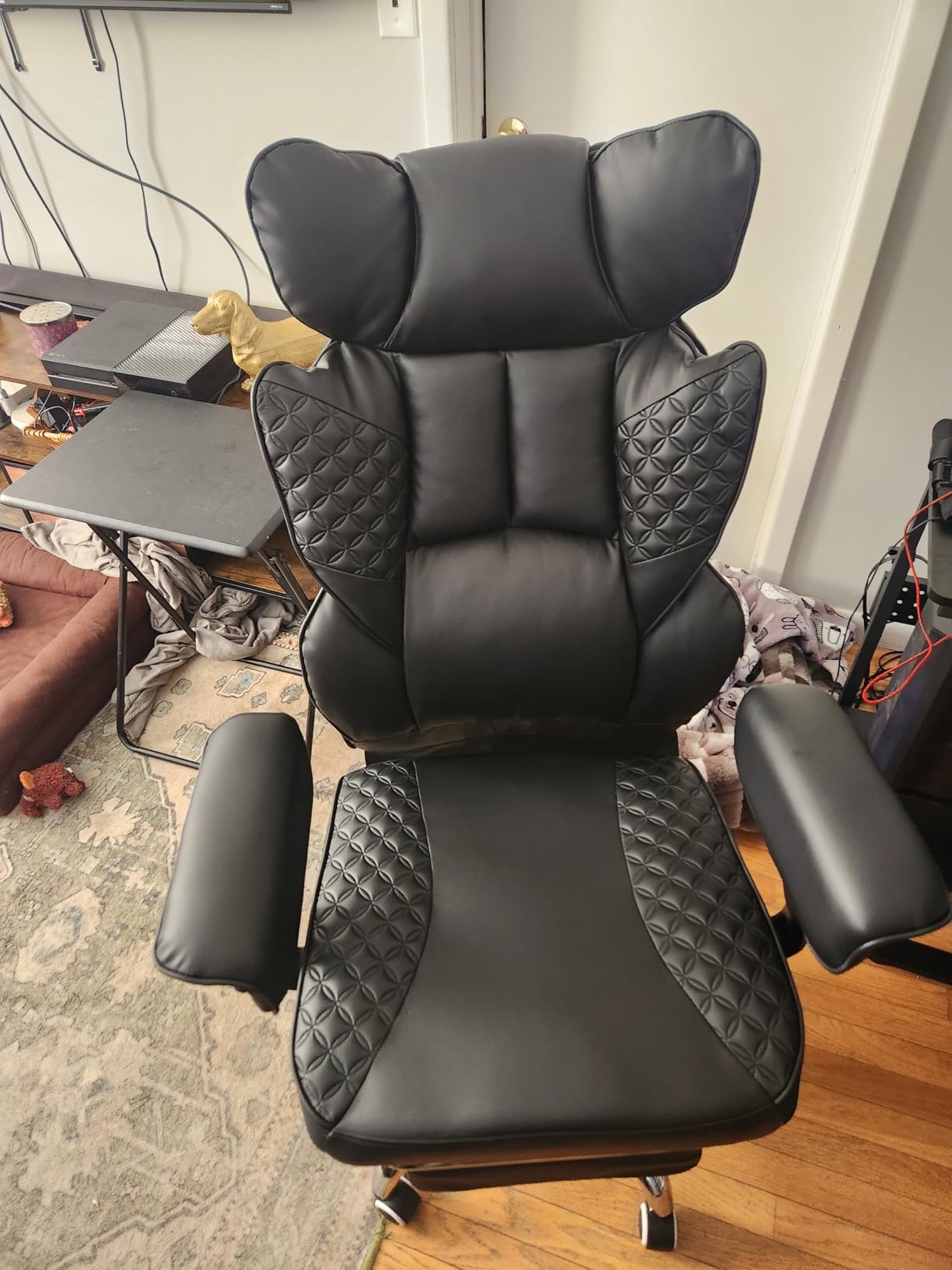
Reviewers most often confirm the listed advantages: the 400 lb capacity, the wide backrest, the adjustable arms and the pocket spring lumbar. Buyers like the deep seat and the recline range, and the assembly is reported at 20 to 30 minutes with the included hardware and tools.
The recurring note is that this is a handmade product, so curves and pieces can vary a little from the listing description. Some long-term owners also describe the foam and lining quality as average, which is the honest read on a chair of this size at this level.
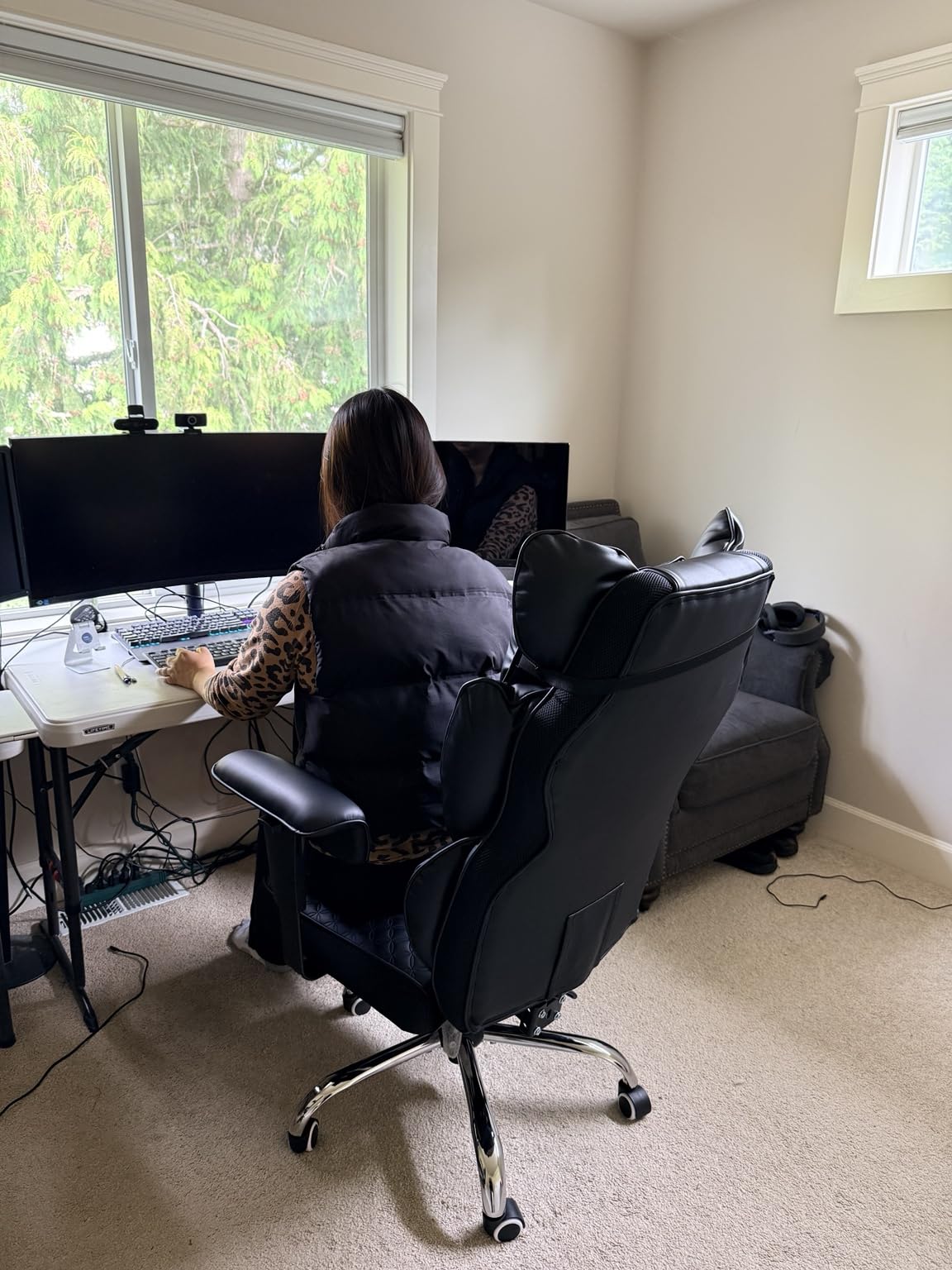
Check the seat depth before you get excited about the recline
19.68 inches of listed seat depth is shallower than the 22 inch figure on the leading pick here, and reviewers do not contradict it. On a long femur that difference shows up as pressure at the back of the knee, so if you sit cross-legged or your femur is long, this is not the frame for you despite the recline.
What the deep recline genuinely buys you is a different posture option. A tall person with a long torso can put the headrest behind the skull rather than the shoulders, and the integrated foot rest keeps the legs supported at full extension. That is worth a lot in the last two hours of a day.
Warranty and footprint
Warranty is 12 months from the manufacturer. The raised foot rest adds real forward length, so measure from the front of your desk to the wall before ordering, since a reclined chair with a footrest deployed needs considerably more room than the seat alone.
For a 400 lb frame the construction reads as adequate rather than generous: metal frame, memory foam fill, rounded height-adjustable arms. If you need a genuinely large seat, compare the depth figures across this roundup before you commit.
5. CAPOT Mesh 400lb – the only lumbar here that travels 2 inches
CAPOT Ergonomic Mesh Office Chair, Adjustable Lumbar High Back Desk Chair 400lbs, 4D Flip-up Arms, 3-Level Tilt Backrest, 3D Headrest, PU Wheels, Swivel Rolling Computer Seating for Long Desk Work
400 lbs capacity
2 inch lumbar travel
22 inch max seat height
4D flip-up arms
Pros
- Lumbar micro-adjust gives 2 inches of travel across 8 levels
- 4D flip-up arms fold 90 degrees for full desk clearance
- 3D headrest adjusts in height and depth
- Backrest locks at 90
- 110 and 125 degrees
Cons
- Not roomy for very tall or wide frames
- Mesh side frame can pinch the thighs
- Repeated reports of cracking at the caster-to-leg weld
This is the only chair in the roundup where the lumbar support moves up and down across a published range: 2 inches of travel over 8 levels. For a tall person whose lumbar apex sits higher than a fixed support can reach, that single adjustment is more useful than a wider backrest.
The headrest is the other differentiator, adjusting in both height and depth rather than height alone. Depth adjustment matters when you recline, because a headrest fixed at one distance from the back ends up behind the shoulders once the backrest moves. The three-position tilt lock at 90, 110 and 125 degrees keeps that predictable.
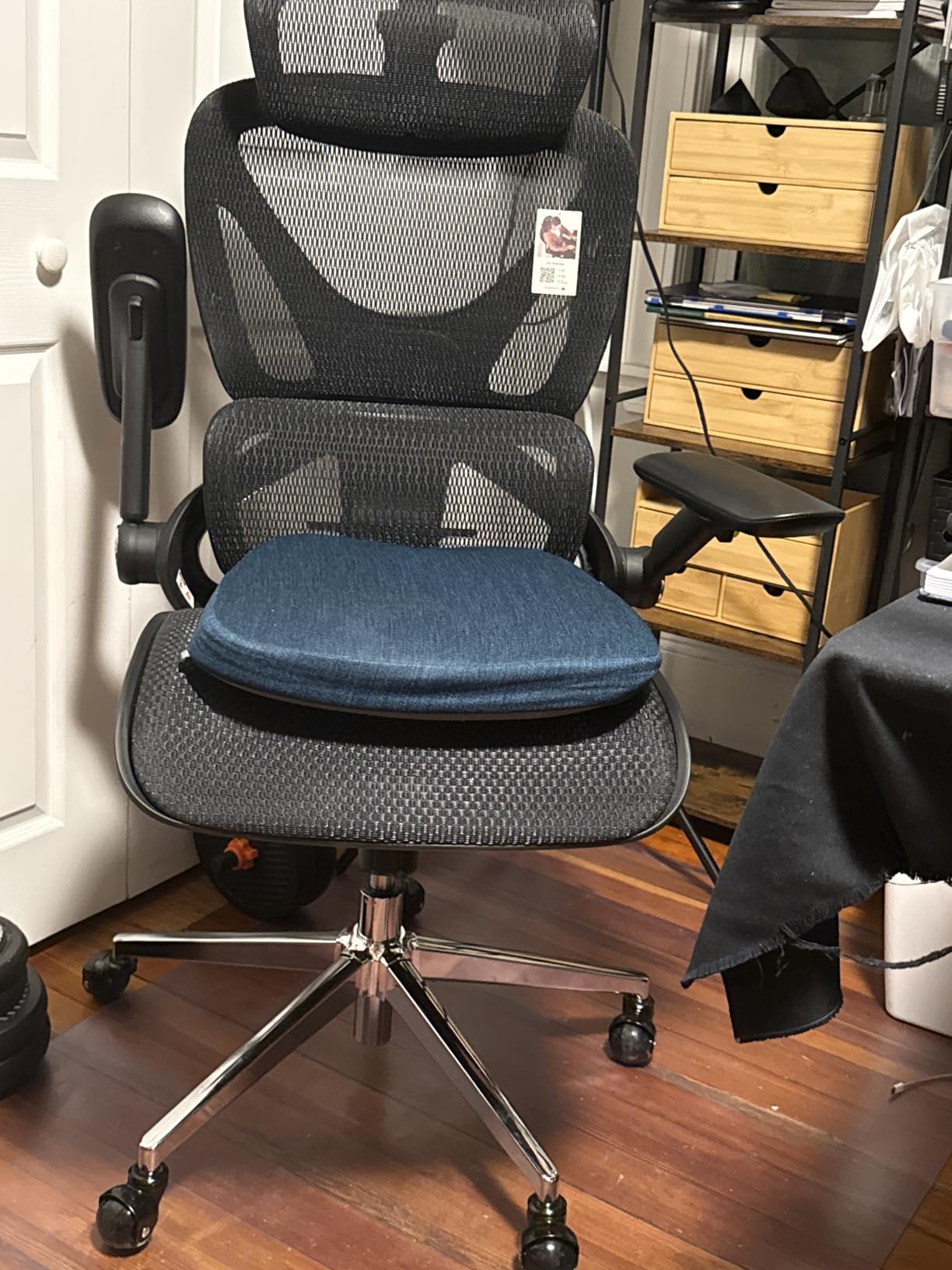
The manufacturer rates this chair for users between 5 foot 5 inches and 6 foot 2 inches with a 400 lbs capacity, and reviewers at 6 foot 1 inch and roughly 270 pounds confirm it is not cramped and has resolved their back pain. The adjustable lumbar is named as the standout feature more often than anything else on the chair.
Fit is the dividing line in the reviews, and this is the honest caveat. Several owners around 5 foot 11 inches and 220 pounds report the mesh side frame pinching at the sides of the thighs and caution heavier or taller users, which is consistent with a 20 inch wide seat rather than a 30 inch one.
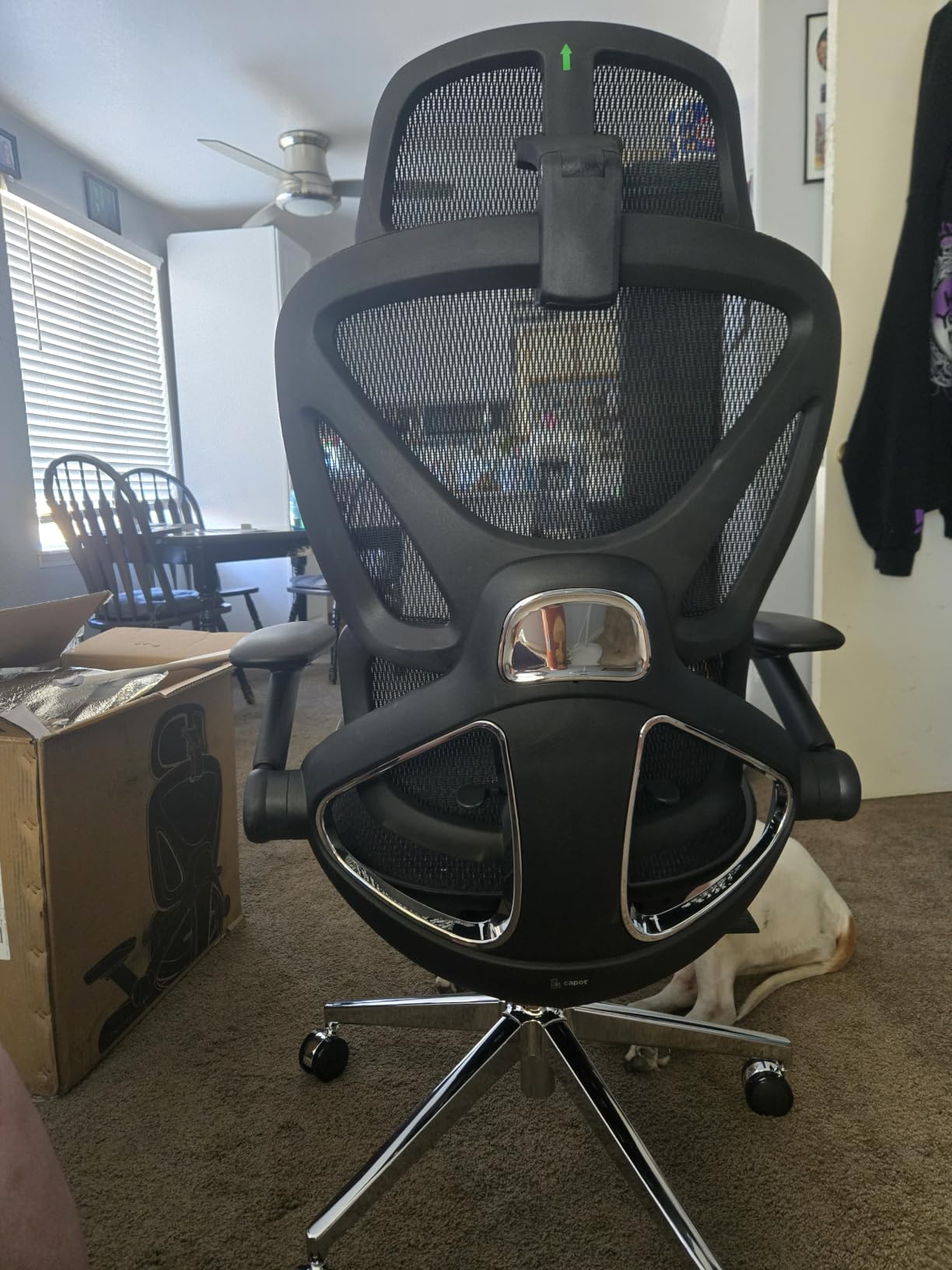
The caster weld problem you should know about
One owner reports the legs where the casters attach cracking twice within about 18 months while well under the stated weight limit. That is a single report, not a pattern, and it is the most serious structural complaint in the reviews, so check the base periodically after the first year.
Two smaller issues: the lumbar support can slip out of position and needs repeated readjusting, and the headrest attachment is described as the trickiest part of assembly. Budget ten extra minutes and keep the hardware bag.
Specs that carry the most weight
Seat height runs 18.5 to 22.05 inches, so this is a mid-range lift rather than a tall-cylinder chair. For a 6 foot 2 inch user at a standard desk that works. For 6 foot 4 inches and up, look at the 22 inch-plus figures elsewhere in this roundup first.
The build quality is above what the rating suggests: a stainless steel base, an SGS gas lift, silent PU wheels that will not mark floors, BIFMA X5.1 certification and a 5-year warranty with free part replacement. That warranty is the best in the roundup.
6. HeroSet Big and Tall PU Leather – 24 inches of seat depth
HeroSet Office Chair, Ergonomic Big and Tall Computer Desk Chairs, Executive Breathable Leather Chair with Adjustable Flip-up Armrests, Lumbar Support Swivel PC Chair with Rocking Function,Matte Black
300 lbs listed capacity
22.8 inch seat depth
22 inch back height
20 spring pack seat
Pros
- 24 inch deep seat on a wide 22 inch back
- Silent spring seat with 20 spring packs resists collapsing
- Flip-up arms free the sides for desk clearance
- Assembles in 10 to 20 minutes
Cons
- Listed maximum weight is 300 lbs despite the big-and-tall naming
- Recline has no resistance or partial lock positions
- Back frame has snapped for heavier users
The seat is the story here: 22.8 inches of listed seat depth paired with a 22 inch back, which makes this one of the few frames in the roundup that gives a long femur real room. The seat height of 22 inches is also at the high end, so a 6 foot 2 inch user gets flat feet without a footrest.
Inside the cushion is a 20 spring pack silent spring seat under five layers of foam, and reviewers report it resists collapsing in a way foam-only seats of this size do not. Flip-up armrests handle the desk clearance problem, and the height adjustment range runs 43 to 47 inches.
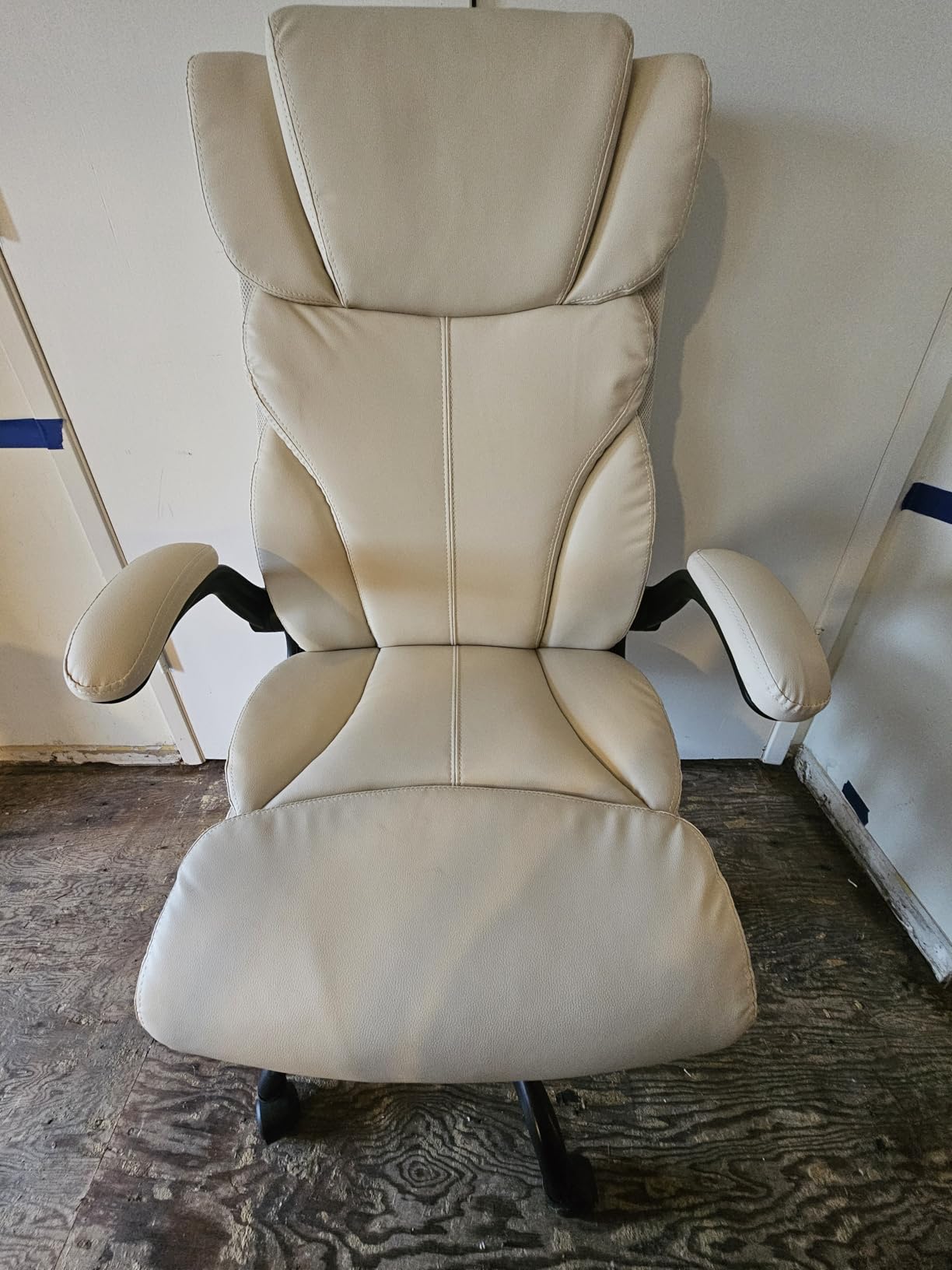
Comfort is the consistent headline. Owners describe it as well padded and supportive, and the flip-up arms and wide seat suit larger frames. Assembly is quick when it goes well, with tools and spare bolts supplied and some owners finishing in 10 to 20 minutes.
The critical reviews focus on durability and safety, and these are the most serious warnings in the whole roundup. There are reports of a back frame snapping in half within months for a 325 lb user, cushions collapsing, faux leather peeling within about a year, and a recline with no resistance that can tip the sitter back.
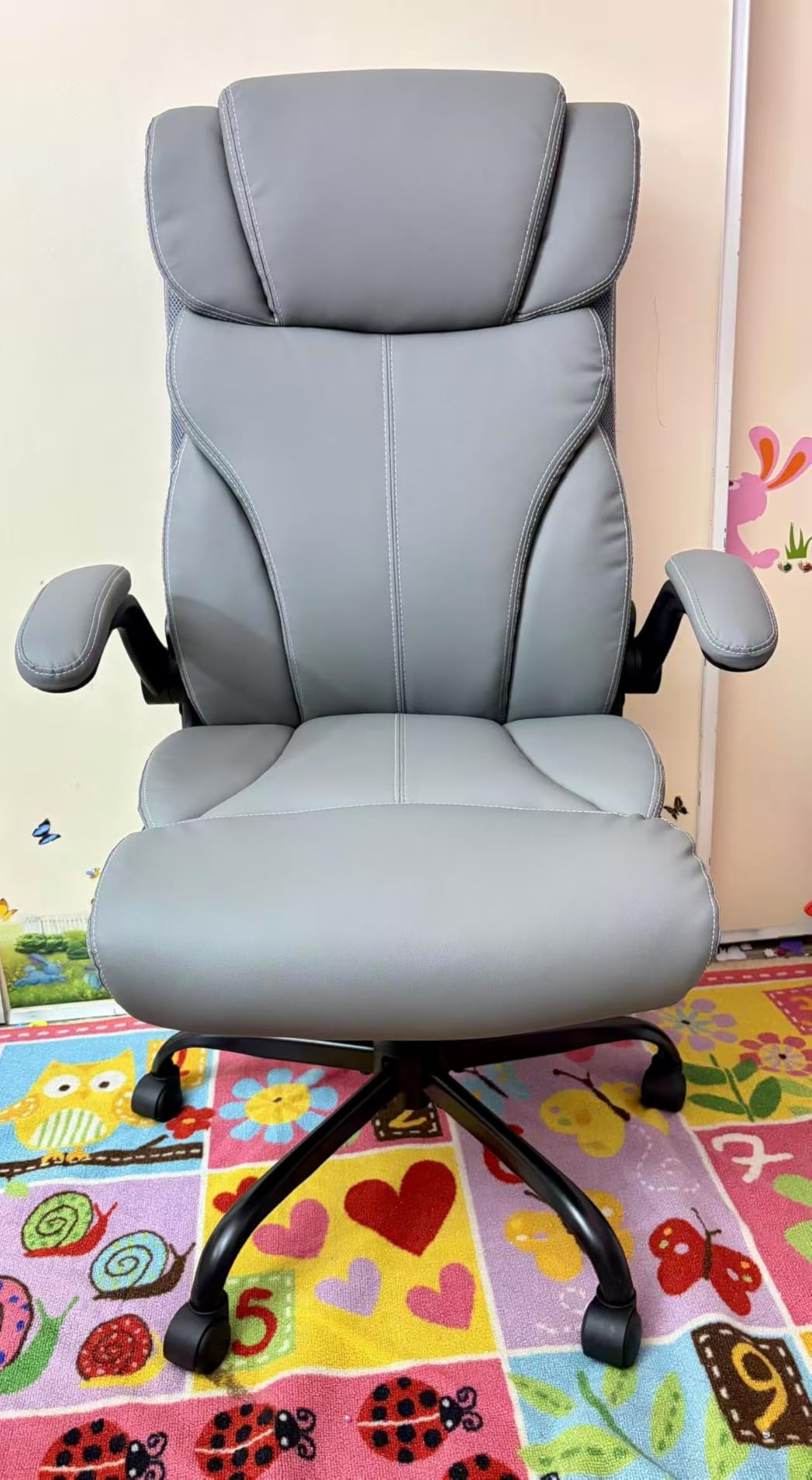
Read the weight rating literally
The marketing calls this a big and tall chair, but the listed maximum is 300 lbs, which puts it below the 400 lb class that the naming implies. If you weigh more than that, the frame is the wrong choice regardless of how good the seat feels, and the snapped-back reports come from above the rating.
Second issue to understand before buying: the recline is all or nothing, with no graduated lock positions and no resistance. That is a comfort problem for a long sitting day and a genuine safety problem for anyone who leans back without expecting to move. The 90 to 120 degree range is present, but it is one continuous throw.
Maintenance and materials
PU leather wipes clean, which is a genuine advantage in a home office with pets. It also punctures easily from claws, and if you share the room with a cat or dog, a mesh chair or a fabric option protects your investment better. Our guide to vacuuming pet hair out of an office chair is worth a read if hair is already an issue in your room.
Customer service is the redeeming note here: multiple reviewers report full replacements or refunds even outside the warranty period. That materially changes the risk calculation on a chair with these durability reports, and it is the main reason this frame still earns a place in the roundup.
7. HOMRELEXA Big and Tall with Flip Armrests – built for cross-legged sitting
Big and Tall Office Chair, Flip Armrests for Pets & Cross Legged Sitting
400 lbs capacity
32.3 inch interior back height
20.1 inch seat depth
Pull-out foot rest
Pros
- Flip-out padded armrests open the seat for cross-legged sitting and pets
- 32.3 inch interior back height suits long torsos
- 400 lb frame on a reinforced metal base
- 15 minute assembly with all tools included
Cons
- Weighs 55 pounds and is awkward to reposition
- Fully reclined length of 52.4 inches will not fit under most desks
- Teddy fleece upholstery is not a wipe-clean office fabric
The flip-out padded armrests are the entire point of this chair. Fold them down and the seat becomes a wide-open platform, which is the configuration most reviewers chose it for, whether they work cross-legged, stretch out, or sit with a pet on their lap.
The fit numbers back that up. Interior back height of 32.3 inches is the tallest published figure in the roundup, and a 400 lb rating sits on a reinforced metal base with a TUV-tested frame and an SGS-certified gas lift. Those certifications are unusual at this level and worth something.
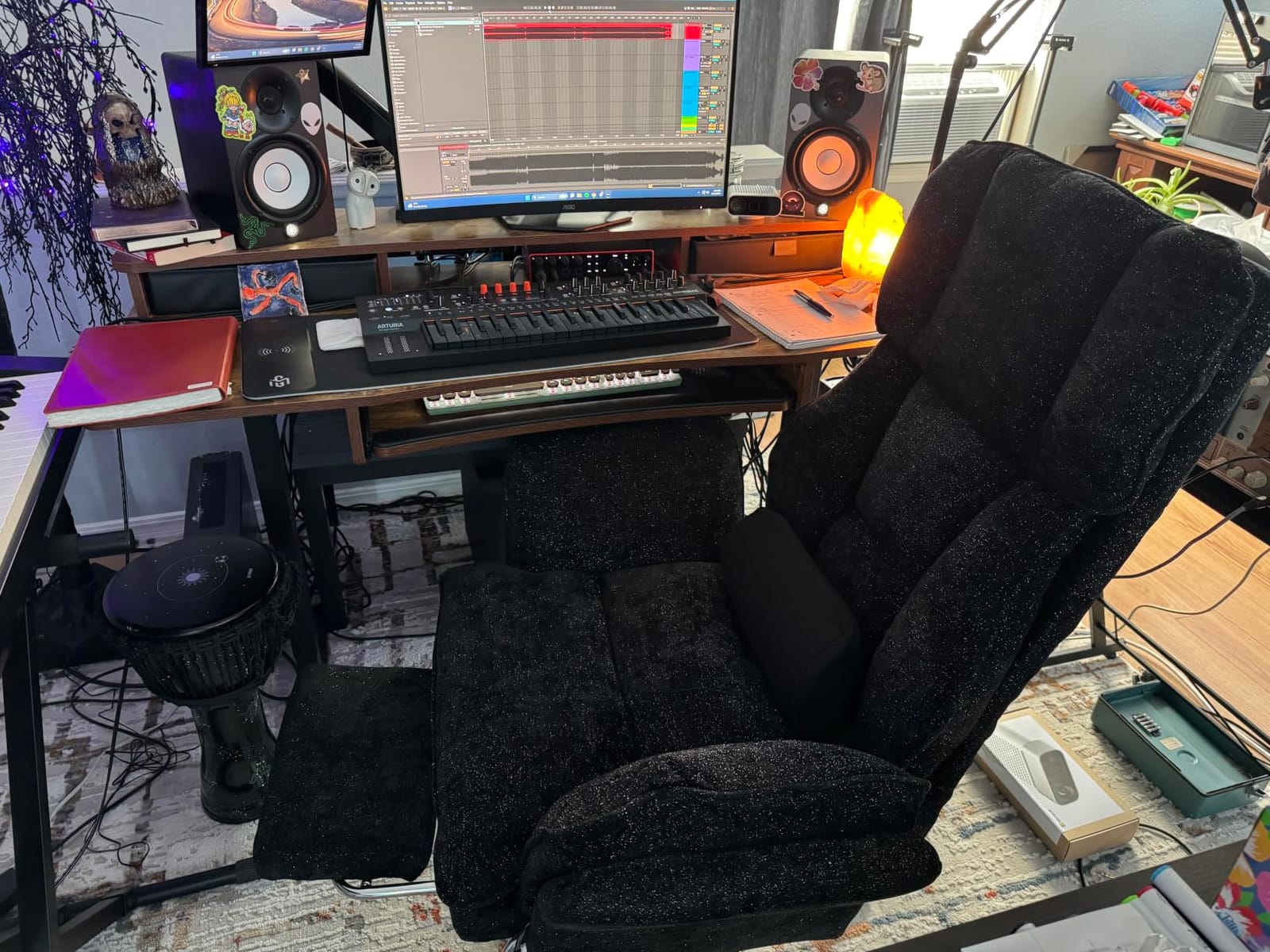
Reviewers describe the resulting open, sofa-like seat as ideal for cross-legged work, and the 400 lb frame and 32.3 inch back height make this a genuine tall-person fit rather than a marketing claim. Assembly is reported at about 15 minutes, with hardware and tools in the box.
The trade-off owners flag is bulk. At 55 pounds the chair is genuinely heavy to reposition, and the fully reclined length of 52.4 inches means it will not go under a standard desk in that position. Plan your floor space before ordering.
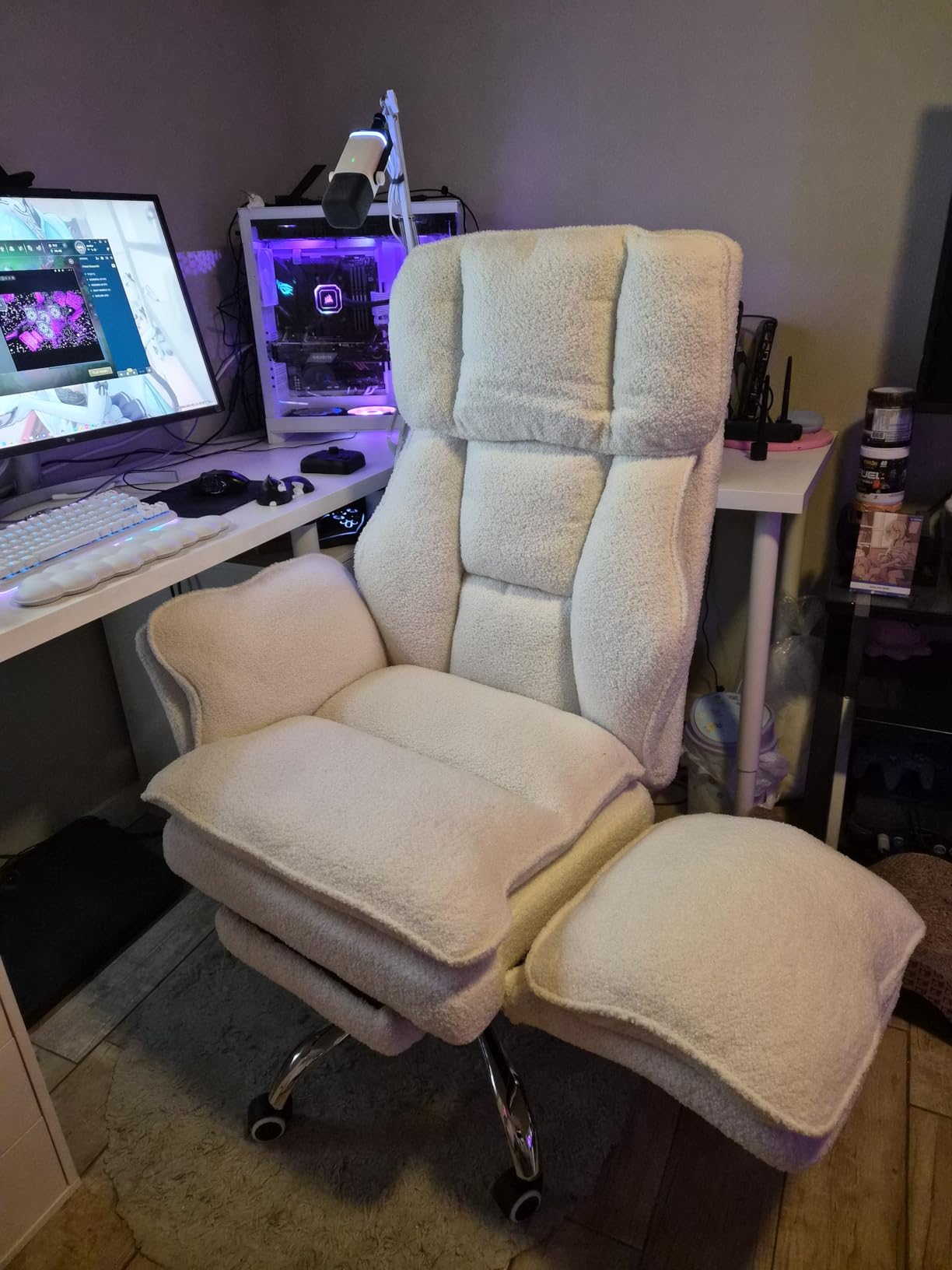
Who this chair is actually for
If you spend part of your day not sitting like a person in a meeting, this is the best frame here. The pull-out footrest plus the flip arms plus the 32.3 inch back is a combination nothing else in the roundup matches, and it is comfortable in a way that a narrow task chair never is.
It is also oversized by design. The 400 lb class sizing means a 5 foot 8 inch user will feel it, and the plush teddy fleece upholstery suits a bedroom or a dressing room better than a serious office. If you want wipe-clean surfaces, skip it.
Mechanics and dimensions to check
Seat height is listed at 18.9 inches minimum, which is mid-range rather than a tall cylinder, and the recline has only two positions rather than a graduated tilt lock. Plan for a reclined-use posture rather than an upright one, and check the swing clearance of the extended footrest.
Warranty length is not specified in the listing data, which is worth asking about directly before a purchase of this size. The BIFMA-compliant casters and the certified gas lift are the durability signals to look at instead.
8. WAILOR 400lb Executive with Foot Rest – the widest recline range in the group
400lbs Executive Office Chair with Foot Rest for Heavy People, Ergonomic Big and Tall Desk Chair with Adjustable Headrest, High Back PU Leather Comfy Heavy Duty Computer Chair with Spring Cushion
400 lbs capacity
90-155 degree recline
20.07 inch seat depth
ErgoSync linkage armrests
Pros
- Reclines from 90 to 155 degrees which is the widest range in the roundup
- Linkage armrests move with the back so the elbows stay supported
- 400 lb frame with steel-reinforced seat structure
- SGS Class 4 gas lift and silent casters
Cons
- 17.32 inch seat height is low for a genuinely tall user
- 17.32 inch interior back height is short
- Foot rest and lumbar cushion are optional extras
The technical headline is the recline: 90 to 155 degrees, and the ErgoSync linkage armrests that move with the back rather than staying put. In practice that keeps the elbows supported through the throw, which is the thing most recliners get wrong and the reason your shoulders end up doing the work.
Construction is solid where it counts for weight. A 4-layer foam seat on a steel-reinforced frame, an SGS Class 4 gas lift, silent 360 degree casters that glide on hardwood and tile, and an FSC-certified wood base. Buyers report the chair distributes weight well and stays quiet in motion.
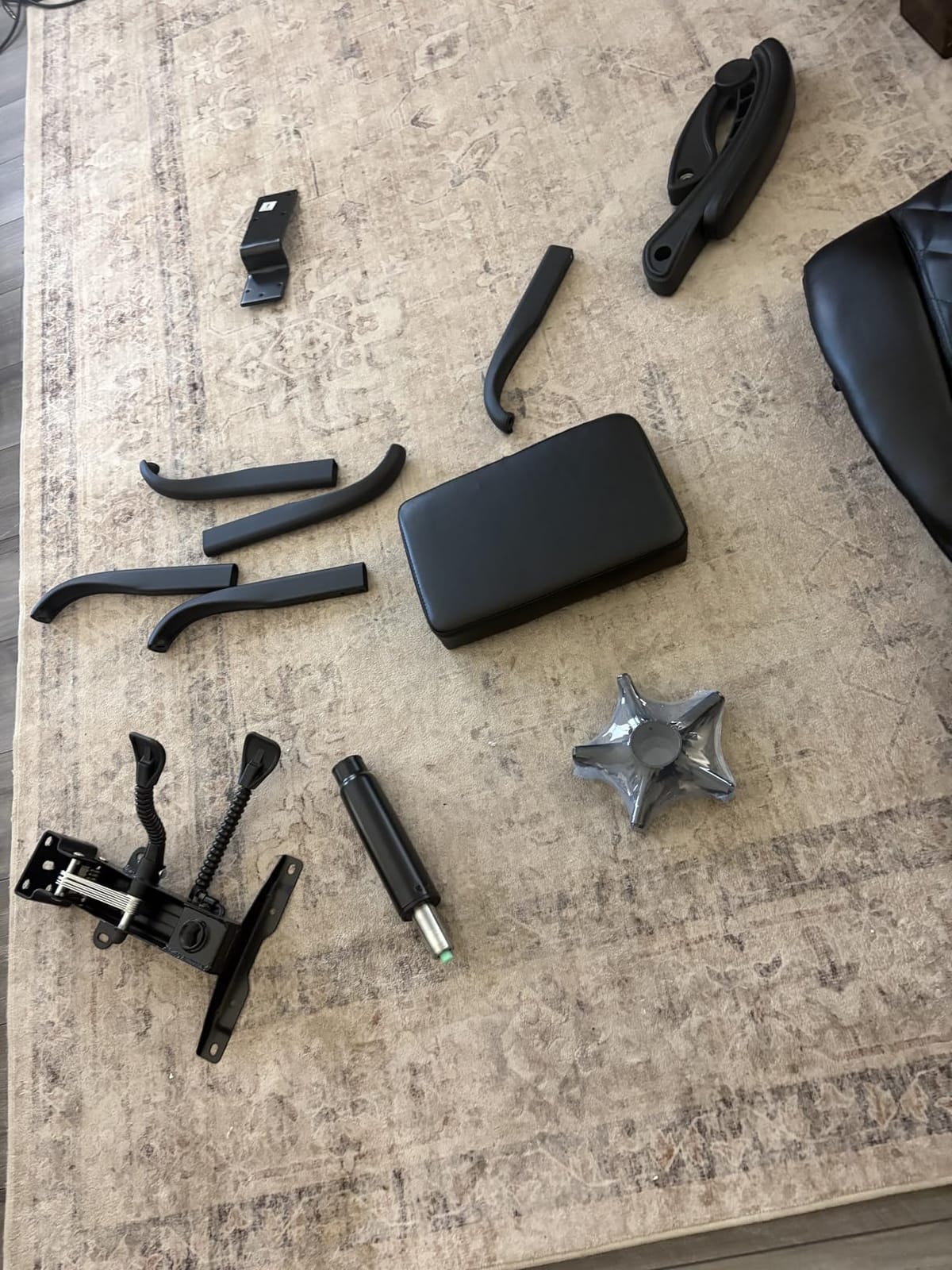
Reviewers single out the 400 lb capacity, the linkage armrests and the recline range as the features that justify the purchase, and owners at higher weights specifically note the frame does not flex. The pre-sorted hardware and an assembly video make the roughly 30 minute build straightforward for a first-time assembler.
Now the part that matters most for this article. The main fit caveat is height rather than weight: the 44.63 inch overall height and 17.32 inch seat height suit average-to-tall adults, but the tallest users want more seat lift, and a footrest at full extension only partly covers the gap.
Read the height numbers carefully, not the weight numbers
A 17.32 inch seat height is the second lowest maximum in this roundup, and 17.32 inches of interior back height is also short. If you are 6 foot 3 inches or taller, raise the chair as high as it goes and your feet will not be flat, and the lumbar will sit below the curve of your lower back.
This is a chair for a large frame that is not unusually long. Think 5 foot 10 inches to 6 foot 1 inch and 300 to 400 pounds, and it is a strong pick. Above that height band, look at the 22 inch-plus seat heights elsewhere in this roundup.
Optional parts and finish
Be aware that the retractable footrest and the curved lumbar cushion are optional accessories rather than included items, so budget for them if you want the full recline experience. The enclosed armrest hinge design is a genuine detail: it prevents pinching, which is a common complaint on this style of chair.
Warranty is 1 year with free part replacement, the shortest in the roundup against a 400 lb rating. The adjustable headrest is included and does move, so the upper back is covered even if the lower back is the compromise here.
9. HYLONE 400lb Mesh Desk Chair – the thickest seat cushion here
HYLONE 400lb Office Chair Big and Tall,Desk Chair with Lumbar Support,Black
400 lbs capacity
5 inch seat cushion
19 inch seat depth
19.6 inch seat height
Pros
- 5 inch thick sponge cushion that stays supportive
- Breathable nylon mesh back that stays cool
- 28 inch 5-star base that does not wobble at full height
- 24 month free parts program
Cons
- Lower back narrows to about 14.5 inches between the arms
- 19 inch seat depth is tight for cross-legged sitting
- Advertised 400 lb build is lighter than the claim implies
This chair solves a specific problem the fabric models here do not: a seat that is genuinely thick. At 5 inches of high-density sponge it stays supportive instead of bottoming out against the seat pan, and that is the difference between a chair you still like in year three and one you tolerate.
The mesh back handles heat well, the 28 inch 5-star base is the widest in the roundup and does not wobble at full height, and the flip-up armrests let the chair slide under a desk. Owners around 6 feet and 210 pounds report a comfortable, correctly sized fit.
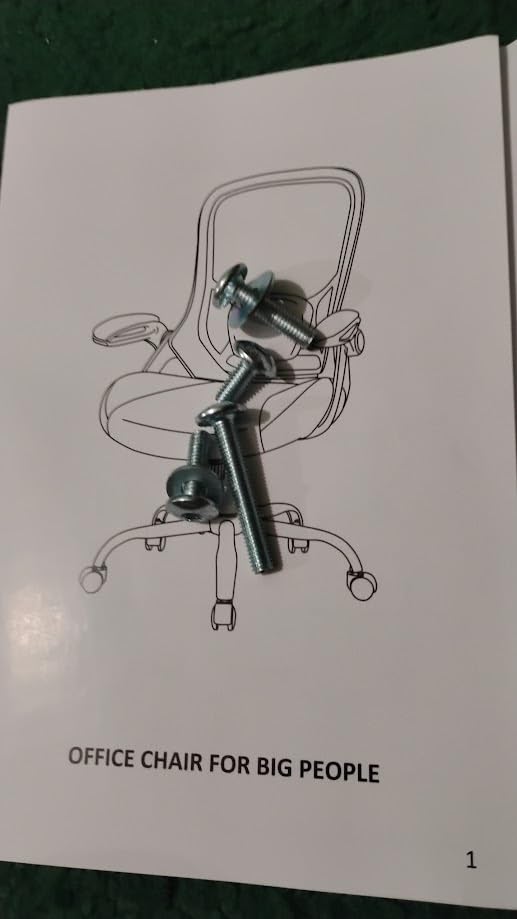
Most buyers report the chair fixing the exact problems they had with cheaper office chairs: a thick padded seat, real lumbar support, flip-up arms and casters that glide on carpet. Several bought it for a tall or heavy partner specifically and confirm the fit worked.
The sharpest criticism is dimensional and worth taking seriously. The plastic behind the arms curves inward, so the lower back is only about 14.5 inches wide at its narrowest, which is far less than the marketing implies and can pinch a broad lower back.
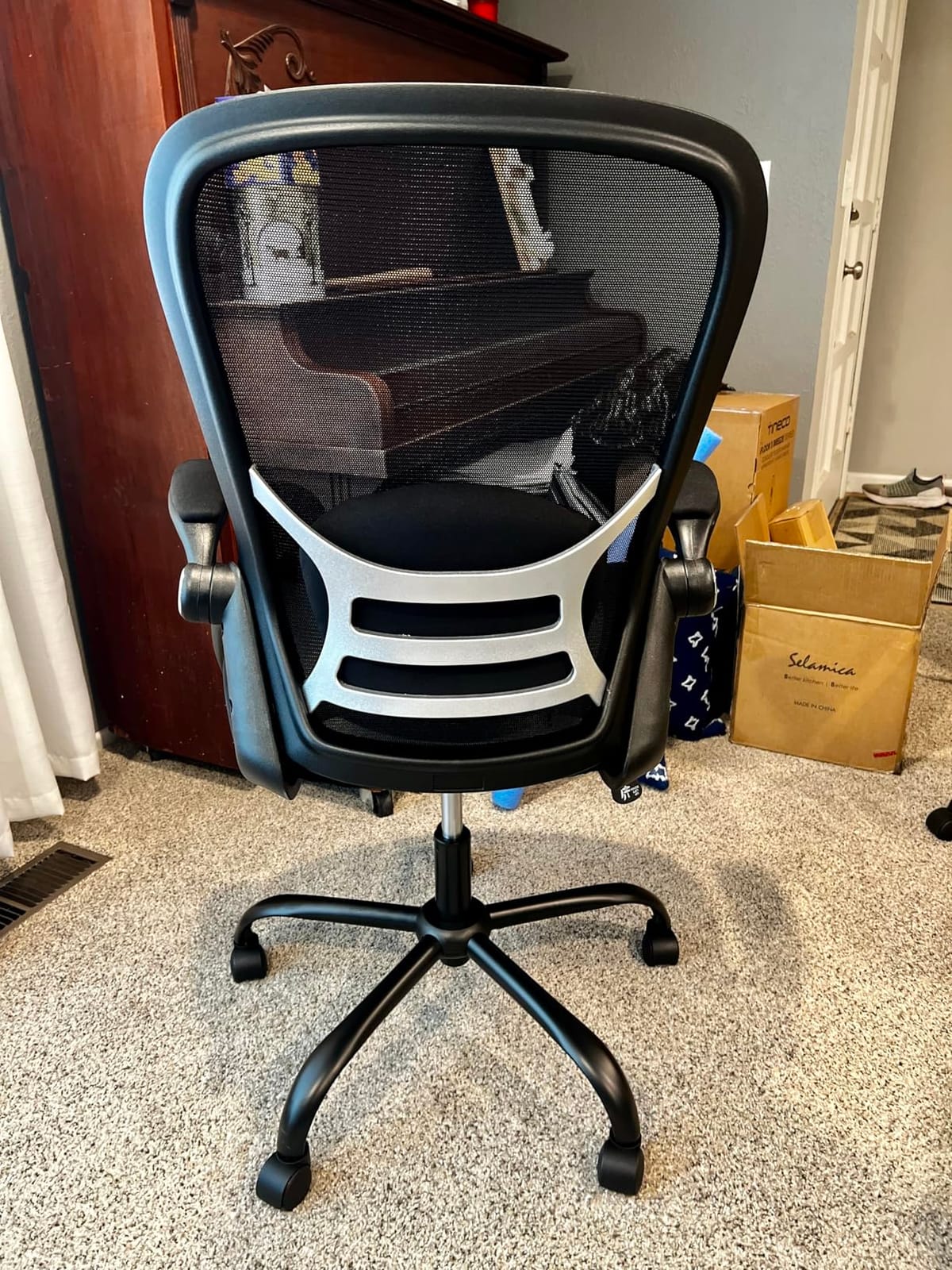
Two dimensions that decide this one
19 inches of seat depth is narrow, and cross-legged sitting is tight on it. If your femur runs long or you work with your legs folded, this is a poor fit despite the 400 lb rating, and you should choose one of the 22 inch seats in this roundup instead.
Seat height of 19.6 inches is also below the tall end of this list, and the manufacturer rates the chair for 5 foot 5 inch to 6 foot 2 inch users. The 14.5 inch lower back width is the second issue: it is fine for a narrow frame and uncomfortable for a broad one.
Warranty and build
The 24 month free parts program is the second longest in the roundup, and assembly is about 30 minutes with clear instructions. The listing is honest about the cushion and about the 5 foot 5 inch to 6 foot 2 inch user window, which is more than most listings of this kind manage.
The mesh back and the thick foam seat are a genuine combination at this level, and the casters roll smoothly over carpet, tile, wood and laminate. If you are 6 foot 2 inches or under and want a padded seat that breathes, this is a well-built option.
10. Indulgear 500lb Big and Tall – the largest frame in the roundup
Big and Tall Office Chair, Heavy Duty Office Chair for Heavy People
500 lbs capacity
23.62 inch seat depth
27.95 inch back height
27.56 inch back width
Pros
- 500 lb rating which is the highest in this roundup on a heavy duty metal base and 4-level gas lift
- 23.62 inch seat depth and 27.95 inch interior back height
- Breathable PU leather that resists fading and flaking
- Non-marking soft rubber wheels
Cons
- Weighs 80 pounds so assembly and moving need two people
- Single-position tilt with no multi-angle recline lock
- Footprint of roughly 27 by 29 inches needs a large desk area
At 500 lbs this is the heaviest-rated frame here, and the dimensions back up the claim rather than undercut it. A 27.56 inch backrest width, 23.62 inches of seat depth and 27.95 inches of interior back height is more room than any other chair in the roundup on every axis.
The upholstery choice matters at this scale. Breathable PU leather is described by owners as more ventilated and more resistant to fading and flaking than bonded leather, which addresses the usual complaint about leather chairs on larger frames. The adjustable built-in lumbar wraps the lower back rather than pressing into it.
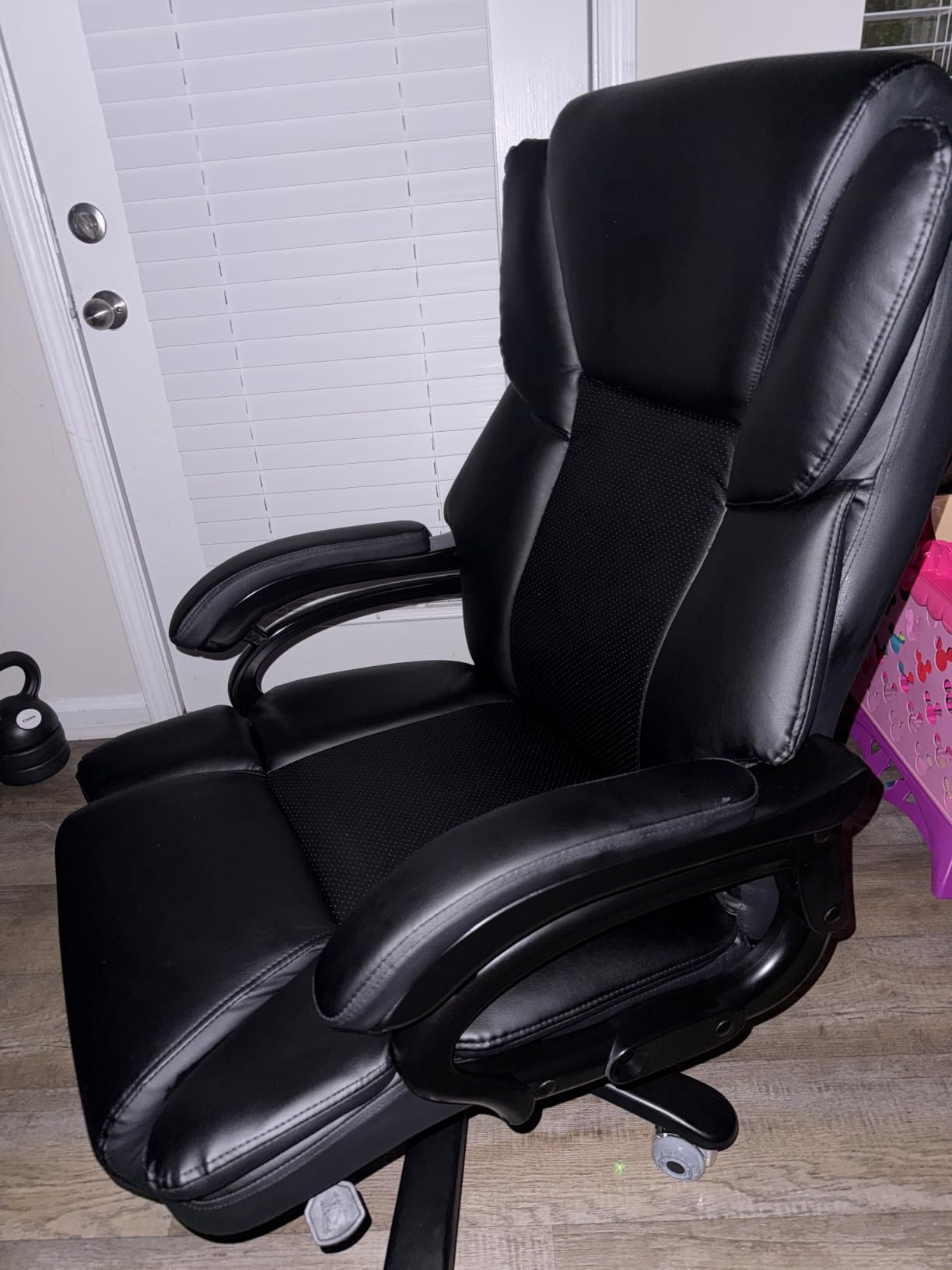
Buyers looking for maximum room for a taller, heavier frame value exactly that room, and the adjustable lumbar and the non-marking rubber wheels are also called out favorably. The wheels glide quietly without marking hardwood, laminate, tile or vinyl, which matters if you have any of those floors.
The trade-off reviewers keep naming is weight, at 80 pounds. That makes assembly and repositioning a two-person job, and it is the single most important practical fact about this chair before you order it. Assembly itself is reported at about 20 minutes once you have a second person.
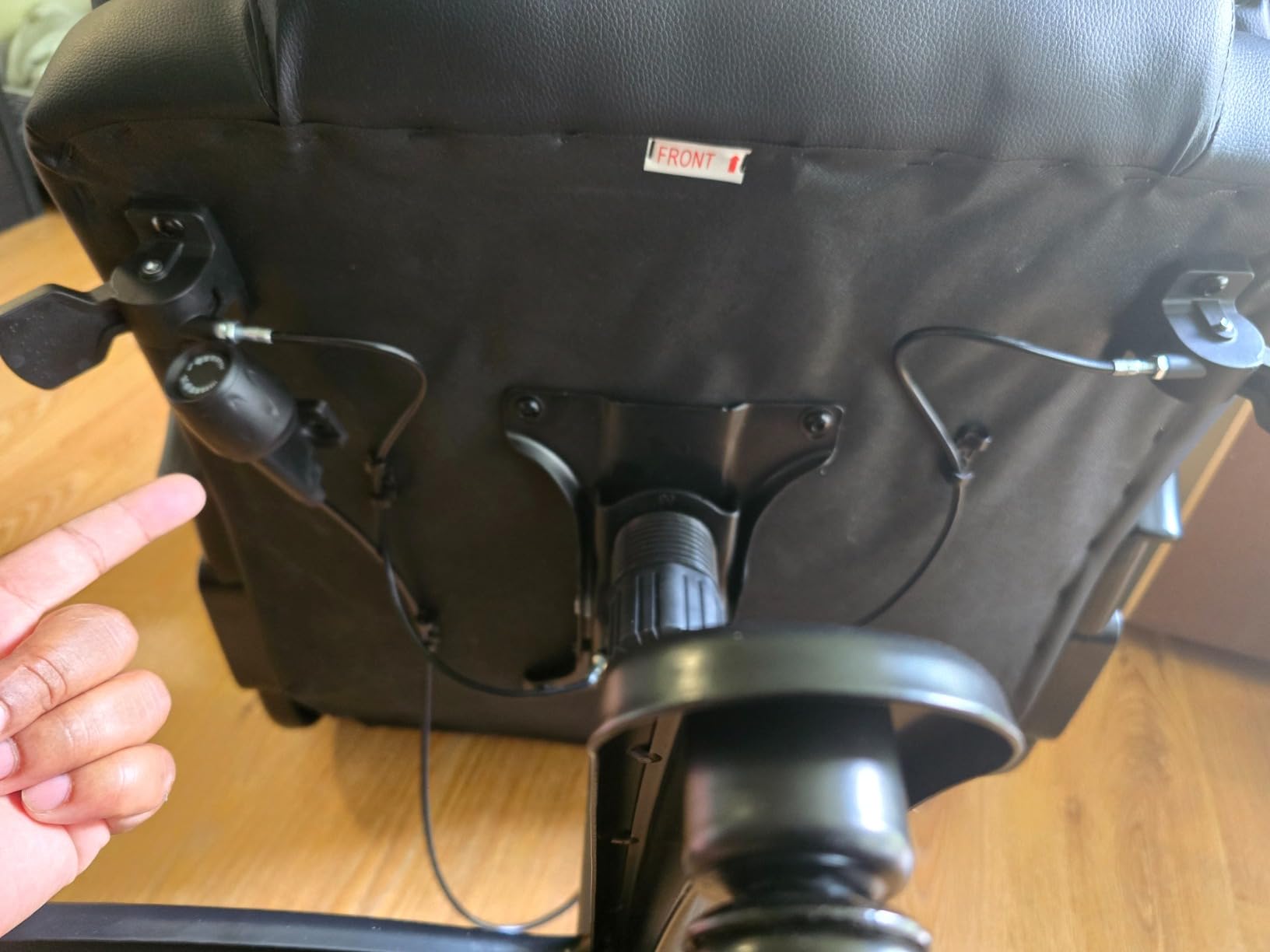
Measure your floor space before anything else
The footprint is roughly 27 by 29 inches, which is larger than most desks. That is not a problem in a dedicated office, but in a small home office it can dominate the corner and make the chair feel oversized for the room even when it fits your body perfectly.
The single-position tilt is the second limitation. There is no graduated recline lock, so this chair is a fixed-upright-and-swivel design rather than a relaxation chair, and it will not substitute for one of the recliners above if you want to lean back at the end of the day.
Who should skip it
If you are under 5 foot 11 inches, this chair will be enormous and you will not get a proper seat angle out of it. The frame is built for a large body and the geometry assumes that. Nothing about the extra width helps a smaller frame sit with knees at 90 degrees.
Below 350 pounds you are also not using the structure that makes this chair expensive, and you would be better served by one of the mesh options with a genuine tilt lock. The double layer sponge with pocket spring cushioning is well reviewed, so the comfort is not the reason to pass, the scale is.
The Six Specs That Decide Fit for a Tall Frame
Ignore every adjective in the product title and read six numbers instead. A listing that says high back without publishing the backrest height in inches is telling you nothing, and that is the single most common complaint from people who returned a chair.
1. Maximum seat height. This is the floor-to-top-of-seat-pan measurement at full lift, and it is the number that decides everything else. Your feet must sit flat with the knees at roughly 90 degrees at your actual desk height. As a working target, seat height should land near 0.25 times your body height, so a 6 foot 3 inch person, at 75 inches, is aiming for roughly 18.75 inches. A tall cylinder, sometimes called a class-4 lift, is what gets you there.
2. Seat depth. Measure from the front edge of the seat to the backrest. Tall users generally want 19 inches or more, and closer to 22 inches on a long femur. The in-store test takes five seconds: sit back against the backrest and slide your knees forward, then you should be able to fit two or three fingers between the front edge of the seat and the back of your knee. No gap means too shallow.
3. Backrest height. Measured from the top of the seat pan to the top of the backrest. 22 inches is the practical floor for a tall adult, and 24 inches or more is better if you have a long torso. This is where torso length and leg length separate: a long femur needs seat depth, a long torso needs backrest height, and the same chair is rarely wrong for both reasons at once.
4. Weight capacity. Anything under 300 lbs is a risk if you weigh 250 or more, and 400 lbs or more is the right target for a heavier tall frame. Treat the figure as a structural ceiling rather than a comfort rating, and remember that the reported failures in this roundup all came from above the stated rating.
5. Height-adjustable lumbar support. Support that only moves in and out is fixed in the vertical dimension, and a fixed lumbar is the most repeated tall-user complaint in every forum thread about this problem. Look for published vertical travel in inches, as one chair in this roundup has, and set it so the support sits in the curve of your lower back rather than your mid-back.
6. Headrest. Tall people benefit from a headrest mainly because the seat sits higher, which puts the shoulders further from the top of the backrest. Height adjustment is the part that matters. A headrest fixed at one height will land at your shoulders, and a headrest that adjusts in depth as well will stay behind your skull when you recline.
Fit Math, Torso Length and Sizing Traps
A second ratio is worth knowing, and almost nobody publishes it: armrest height should sit around 0.145 times your body height above the top of the seat pan. For a 6 foot 3 inch person, that is roughly 11 inches above the seat, which is well above the arm pads on most chairs at this level. If your arms feel raised, your seat is too high, not your armrests too low.
The 90-90-90 rule is the baseline everyone cites: hips at 90 degrees, knees at 90 degrees, ankles at 90 degrees. For a tall person it is a starting point rather than a target. You will sit slightly reclined at 100 to 110 degrees with the lumbar engaged, and the correct seat height is whatever lets your feet stay flat while you do that.
Torso length is a separate variable from leg length. This is the most useful thing we can tell you, and it is the point tall users raise most often when they explain why a chair failed them. If you measure 34 inches or more from your hip bone to the top of your head, you need backrest height and lumbar travel. If your femur is long, you need seat depth. Diagnose which one you are before you shop, because a chair that is too deep but tall enough will be unfixable while a chair that is too short and deep enough is not.
Height band against budget tier. Between 6 foot 0 inches and 6 foot 2 inches, almost everything in this roundup works, and the mesh options are the strongest value. Between 6 foot 2 inches and 6 foot 4 inches, prioritise max seat height above 22 inches and backrest height above 24 inches, which narrows the field to the wide leather frames here. Between 6 foot 4 inches and 6 foot 8 inches, published options thin out sharply, and you should be looking at drafting chairs with a footring, a class-4 or taller cylinder, or the largest frames in this roundup.
Drafting chairs solve the seat height problem, not the lumbar problem. The tall cylinder on a drafting chair exists so the seat reaches a counter or drafting table, and the footring lets your feet rest while the seat is high. That is genuinely useful for a tall person at a raised desk, and it is a real workaround when no task chair in your budget has enough lift. What you give up is lumbar geometry: the fixed footring and the taller post change how the seat meets your legs, and there is no adjustment for the fact that your thighs are held higher.
Mesh or leather. Mesh is breathable, which matters for a tall frame because a longer torso dissipates less heat, and mesh seat frames tend to keep a narrower profile. PU leather is easier to wipe clean and usually sits on a deeper, better-padded seat, which is why most of the deepest seats in this roundup are leather. Bonded leather is the weakest of the three: it is not breathable and it flakes at the armrests first.
Gaming chairs, honestly. The wing-back gaming style in this roundup scores well on width, recline and included footrests, and one of them has the deepest seat we found. The reason they still fail some tall users is structural: the lumbar apex is usually fixed in a foam block, the armrests rarely drop low enough once the seat goes up, and the tall side wings narrow the usable back width. The ones here work because their frames are genuinely oversized rather than styled to look it.
Desk height compatibility. Check the underside clearance of your desk against the chair’s full height at maximum lift with the armrests in their lowest setting. If the armrests hit the desk, the arms do not drop, or the backrest catches the edge, you have a clearance problem that no amount of adjustment will fix. Flip-up armrests, which several chairs here have, remove this problem entirely.
Space. Footprints in this roundup run from 21 by 18 inches up to roughly 27 by 29 inches, and the heaviest frames weigh 55 to 80 pounds. Measure the corner, not the chair, and check that you can still get in and out of the seat at full recline.
Who should not buy any of these. If you are under 5 foot 11 inches, the deep seats and the tall cylinders will leave your feet dangling and your knees angled upward, which is worse than a standard chair. Buy a chair with a shorter cylinder and a lower backrest instead, and treat the mesh options here as an upper limit rather than a target.
Frequently Asked Questions
What is the best office chair for a 6-foot-tall person?
For a 6 foot tall adult, the key number is maximum seat height rather than total chair height. Aim for a published max seat height of 21 inches or more, a seat depth of 19 inches or more, and a backrest measured from the seat pan of 22 inches or more. In this roundup the GTPLAYER Big and Tall chair, with a 22 inch seat depth and 30.31 inch interior back height, is the strongest fit at this height, while the GABRYLLY mesh chair suits 6 foot 2 inch users with its 23.6 inch maximum seat height.
What type of office chair is best for tall people?
Four types work. A mesh task chair with a class-4 cylinder and a 21 inch plus maximum seat height suits most tall users who want breathability. A big and tall leather frame suits heavier users because it pairs a 400 lb rating with a 20 inch-plus seat depth. A drafting chair with a footring solves maximum seat height for raised desks, at the cost of lumbar geometry. An executive high-back with a wide backrest suits long torsos. A gaming chair works only if its frame is genuinely oversized rather than styled to look it.
What is the best chair height for tall people?
Target a maximum seat height of roughly 0.25 times your body height, so a 6 foot 3 inch person at 75 inches aims for about 18.75 inches of seat height. A 6 foot 8 inch person at 80 inches needs close to 20 inches minimum and a chair whose cylinder goes well past that. Armrests should sit around 0.145 times body height above the seat pan, about 11 inches for a 6 foot 3 inch user. The test that matters is simple: feet flat on the floor, knees at roughly 90 degrees, at your actual desk.
What seat depth do tall people need?
Tall users generally need 19 inches or more of seat depth, and 22 inches or more if you have a long femur or sit cross-legged. The five-second test is to sit back against the backrest and slide your knees forward, then check for two or three fingers of clearance between the front edge of the seat and the back of your knee. No gap means the seat is too shallow and will press into the back of your legs over a long day.
Do tall people need a headrest on an office chair?
Yes, more than shorter users, because a taller seat position puts the shoulders further from the top of the backrest. What matters is that the headrest adjusts in height, since a fixed headrest lands at the shoulder blades on a tall frame and pushes the neck forward. A headrest that also adjusts in depth is better still, because it stays behind the skull when the backrest reclines instead of drifting away from it.
What is the 90-90-90 rule for sitting?
The 90-90-90 rule means the hips, knees and ankles all sit at 90 degrees, keeping the spine neutral and the thighs roughly parallel to the floor. It is the baseline ergonomic target rather than a rigid requirement. Tall users typically settle slightly reclined at 100 to 110 degrees with the lumbar engaged, and the correct seat height is whatever keeps the feet flat while you sit that way.
Which Chair Fits Your Frame
The GTPLAYER Big and Tall chair is the one we would put in front of most tall readers, because it publishes the deepest seat and the tallest interior back in the roundup and holds up under a 400 lb rating. The GABRYLLY mesh chair is the better buy if you want breathability, desk clearance and a five-year warranty, and it holds up to about 6 foot 2 inches.
Go wide and deep with the Amazon Basics executive chair if you are broad through the shoulders, with the HeroSet if you want a 22.8 inch seat and you are under 300 pounds, and with the Indulgear if you are above 350 and have the floor space for an 80 pound frame. Anyone 6 foot 4 inches or taller should read the maximum seat height column twice, because that is where the mid-tier market runs out.
Before any of them, measure your hip-to-head length and your femur. Those two numbers decide whether you need backrest height or seat depth, and getting them right before you order is the difference between a chair that fits and another one that comes back.