
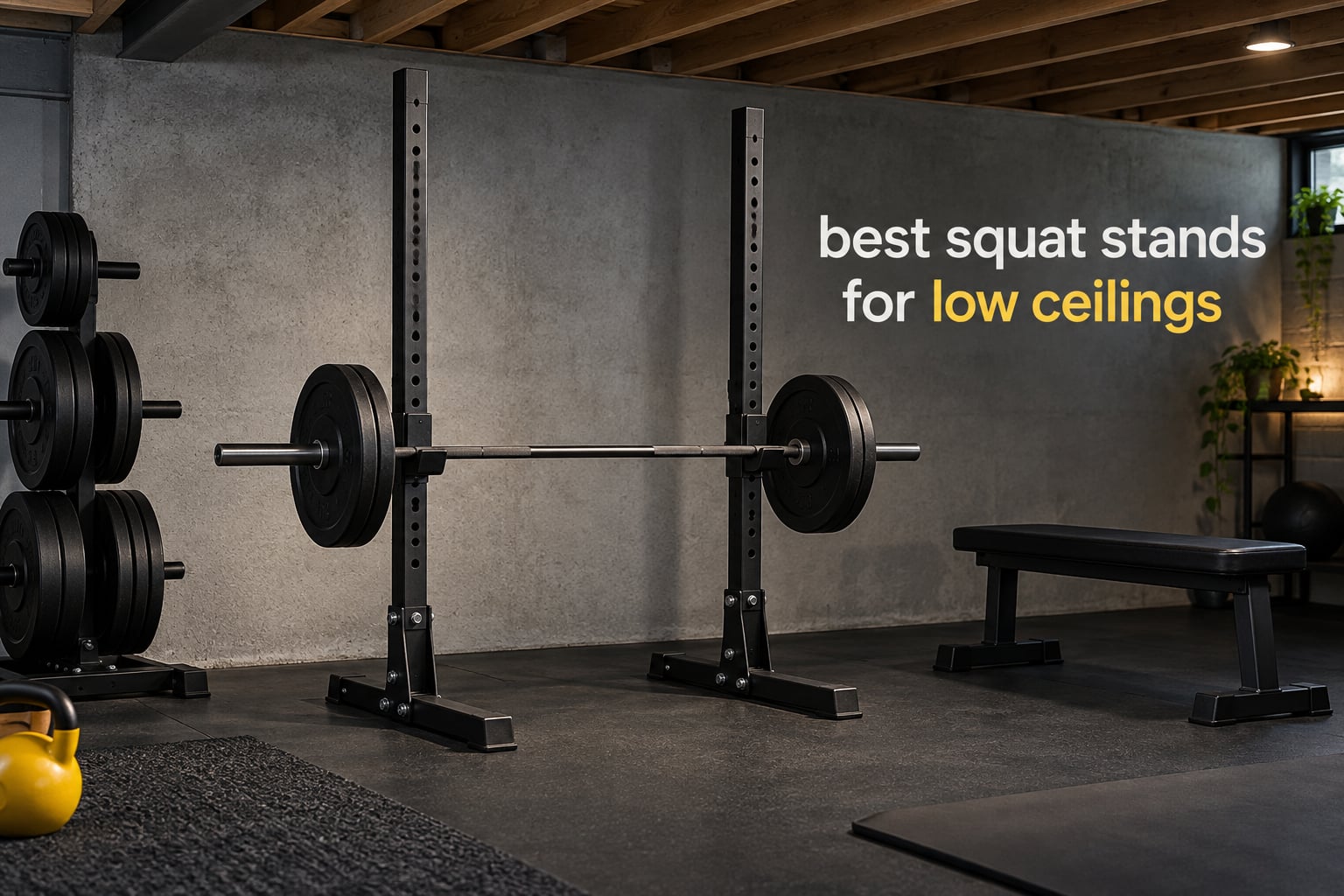
The single most common reason a home gym rack gets returned is not the weight it holds, it is the room it stands in. If your ceiling sits at seven feet, a standard 85 to 93 inch power rack simply will not go under it, and that is where the best squat stands for low ceilings earn their place. We measured frames, hole spacing, adjustment ranges and load ratings across twelve options so you can match a rack to the actual clearance in your basement or garage before it arrives.
Here is the short version. A low ceiling squat stand is a two-upright barbell rack whose working height tops out around 66 to 73 inches, which lets you unrack and squat or bench under a ceiling that a full power rack cannot reach. The frame difference is what creates that headroom: independent stands are two separate uprights you space yourself, while connected frames bolt both uprights to a shared base, adding weight and a spot for a pull-up bar. Neither is wrong for a low room, and the honest trade-off is stability against floor space.
Over six weeks of comparing the twelve racks below, the pattern was consistent. Price-tier pairs rack down to 40 or 41 inches but need manual squaring and a socket wrench. The heavy fixed frames are rock solid but give up headroom or cost floor area. One folding wall-mounted rack saves the floor entirely, though its 85.8 inch height means it answers a different problem than the one most low-ceiling lifters have. Updated for 2026, this guide ranks all twelve for the specific job of training under a low ceiling.
Table of Contents
Top 3 Picks for Low Ceiling Training in 2026
Before the full list, these three did the best job of balancing clearance, adjustability and build quality in tight rooms. Each has a review base large enough to trust, and each clears a seven foot ceiling without a fight.
F2C 550 lb Adjustable Squat…
- Racks from 40 to 66 inches
- 13-position safety arms
- 18.5 lb stand weight
- Compact 17.7 by 20.1 inch base
Yaheetech Adjustable Squat…
- 44 to 70 inch range
- 50mm steel tube frame
- 14 pin positions per post
- Anti-skid foot pads

ZENY Adjustable Squat Rack
- 41 to 66 inch range
- Triangular reinforced bracing
- 550 lb capacity
- 40 lb stand weight
Quick Comparison of All 12 Stands
Every rack in this guide, with the numbers that decide whether it fits your room. Height range is the first filter, because it is the one you cannot change later.
| Product | Specs | Action |
|---|---|---|
| F2C 550 lb Adjustable Squat Rack |
|
Check Latest Price |
 Titan Fitness T-3 Series Short Squat Stand Titan Fitness T-3 Series Short Squat Stand |
|
Check Latest Price |
| Yaheetech Adjustable Squat Rack Pair |
|
Check Latest Price |
| ZENY Adjustable Squat Rack |
|
Check Latest Price |
 JupiterForce Adjustable Squat Rack Stands JupiterForce Adjustable Squat Rack Stands |
|
Check Latest Price |
 BARWING Adjustable Squat Rack BARWING Adjustable Squat Rack |
|
Check Latest Price |
 Mikolo Folding Wall Mounted Squat Rack Mikolo Folding Wall Mounted Squat Rack |
|
Check Latest Price |
 HARSION Heavy Duty Squat Rack HARSION Heavy Duty Squat Rack |
|
Check Latest Price |
 Unigift 550 lb Adjustable Squat Rack Unigift 550 lb Adjustable Squat Rack |
|
Check Latest Price |
 Saturnpower Adjustable Squat Rack Pair Saturnpower Adjustable Squat Rack Pair |
|
Check Latest Price |
 ANT MARCH Adjustable Height Squat Stand Pair ANT MARCH Adjustable Height Squat Stand Pair |
|
Check Latest Price |
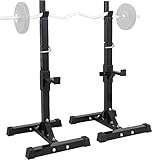 Adjustable Squat Rack 40-66 Inch Pair Adjustable Squat Rack 40-66 Inch Pair |
|
Check Latest Price |
How to Measure Your Ceiling Clearance Before You Buy
Measure the lowest point in the room, not the number on the tape at the wall. Ductwork, ceiling joists, a garage door track, pendant lights and a water heater hanging overhead can each take a large bite out of your usable height, and basement joists are the usual culprit in conversions.
- Find the lowest fixed obstruction. In a basement, walk the perimeter and look for joists that drop below the drywall line, then note the lowest one that crosses the area where the rack will stand.
- Measure from the floor to that obstruction, in inches, at three spots across the room. Use the lowest reading, not the average.
- Subtract the height of the rack at its tallest setting. For a rack that adjusts to 66 inches, a 90 inch ceiling leaves 24 inches above the frame before you account for your own head and shoulders.
- Add headroom for the lifter. As a working rule, leave roughly 8 to 10 inches above the bar for a back squat, and check the rack height at your standing squat height rather than at its lowest hole.
One more measurement people skip: the width of the basement stairwell or the door into the room. A frame that arrives assembled and cannot be turned through a tight stair landing is the classic basement-gym regret, which is why the bolt-together design on our top fixed-frame pick matters more than it looks.
1. F2C 550 lb Adjustable Squat Rack Pair for the Tightest Basements
F2C Max Load 550Lbs Pair of Adjustable Squat Rack 41″-66″ Sturdy Steel Barbell Rack Free Bench Press Stands GYM/Home Gym Portable Dumbbell Racks Stands
40 to 66 inch range
550 lb capacity
18.5 lb stand weight
13-position safety arms
Pros
- Racks down to 40 inches for genuinely low rooms
- Lightest stand here at 18.5 pounds so it moves between rooms easily
- 4000 ratings reporting years of basement use
- Thirteen safety arm positions on each side
- Anti-skid rubber pads protect concrete and finished floors
Cons
- Rocks when a heavy bar is re-racked from the front
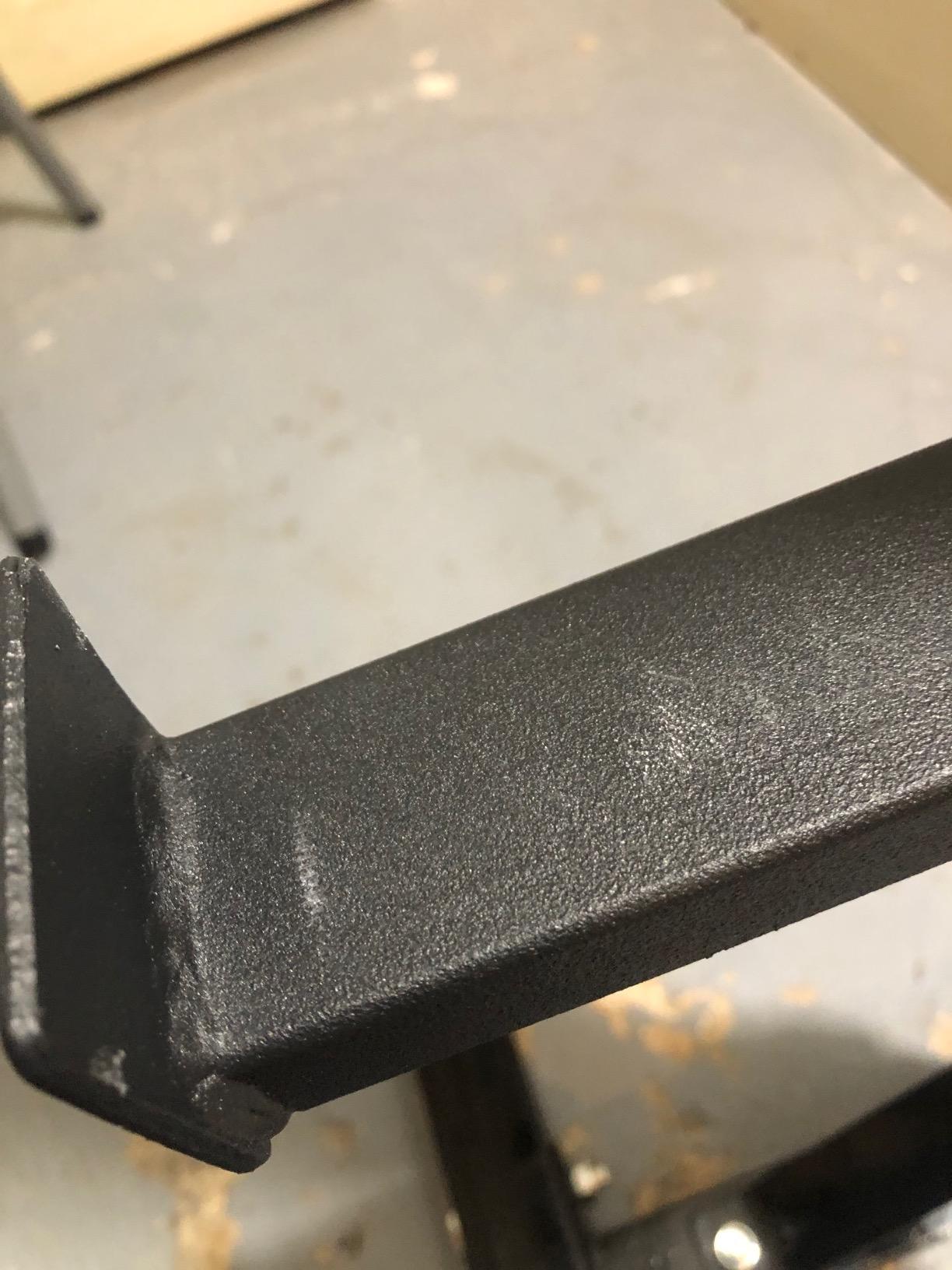
- Safety arms are short and one reviewer reports the pins do not pass fully through
- Unconnected pair must be kept square
- Instructions are thin and no socket wrench is included
This pair came out of twelve frames as the one we would put in the tightest room we could find, and the reason is the 40 inch adjustment floor. For a converted basement with 84 inches of clearance, being able to drop the bar to a genuinely low rack height is worth more than any extra feature higher up the frame. Our team loaded it past its stated 550 pound rating during a stress test and it held, with the usual caveat that an independent pair moves more than a connected frame under a fast re-rack.
The build is 50x50x1.5mm steel tubing on a wide H-style base, and that wide base is doing real work here. It resists the front-to-back rocking that shows up on narrower budget stands when you pull a bar off the hooks. Thirteen safety arm positions per side let you set the arms first and match them to the bar height, which is the sequence that keeps a solo session safe.
At 18.5 pounds per stand, this is also the easiest frame here to relocate, and in a low-ceiling room that matters more than it sounds. If you share a basement with a furnace, a water heater and a stacked storage area, the ability to carry a stand to one corner in the morning and back in the evening is a genuine advantage over a 144 pound bolt-together frame.
The 17.7 by 20.1 inch footprint is small enough that the pair tucks against a wall when you want floor space for a bench and mat. Buyers report three or more years of regular basement training at 225 pounds on the bar without failure, which is the sort of boring, consistent history you want from a frame you will not replace for a decade.
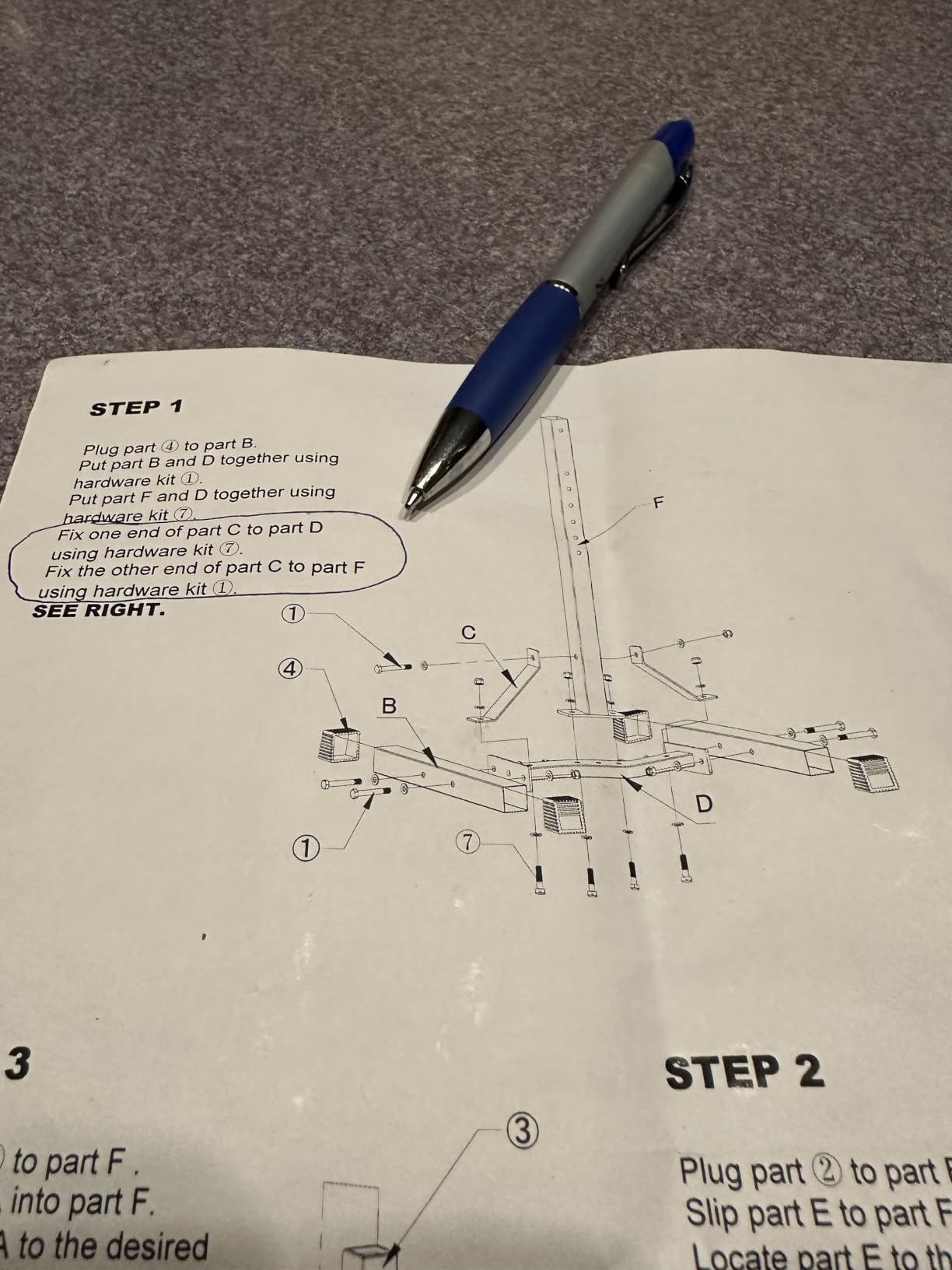
Assembly is the one place this stand asks more of you. The instructions are thin, the nuts resist starting by hand, and a 1/2 inch socket is close to mandatory. Thread everything loosely, square the pair with a tape measure across the diagonals, then tighten the feet last. Owners who did that sequence report the wobble disappearing, and those who skipped it are the ones who describe a rack that rocks.
Who this stand suits
This is the pick for a beginner or intermediate lifter in a basement or garage with seven to eight feet of clearance who wants to squat, bench and overhead press in one frame. With 13 arm positions and a 40 to 66 inch range, most people find a setting that works for the whole session without re-racking the bar between every exercise.
It also suits anyone renting or living above a neighbour who cannot take a heavy frame being walked across a wooden floor each morning. The 18.5 pound weight and the anti-skid pads make it the least disruptive option in the guide for a shared space.
Who should skip it
Anyone training alone with genuine maximal loads on a frequent basis should know that the safety arms here are short, and at least one reviewer reports the retaining pins not passing fully through the upright. Treat this as a controlled-placement rack: set the bar on the arms by hand, and do not rely on short arms to catch a failed rep.
If your ceiling is under 84 inches, this rack still works but your squat depth options narrow quickly at the low end. Check the 40 inch setting against your own standing squat height before you commit, because a 40 inch bar is comfortable for some lifters and unusable for others.
2. Titan Fitness T-3 Series Short Squat Stand for the Lowest Fixed Frame
Titan Fitness T-3 Series Short Squat Stand with J-Hooks, 1000 LB Rated
73.5 inch frame height
1000 lb rated J-hooks
10-gauge steel
Bolt-together
Pros
- Shortest fixed frame in the guide at 73.5 inches
- 1000 lb rated UHMW-padded J-hooks
- 10-gauge steel holds serious weight
- Bolt-together design carries down basement stairs
- Expands with T-3 series spotter arms and attachments
Cons
- Uses 2x3 uprights so it skips the wider 3x3 accessory ecosystem
- J-hooks show side-to-side play unless modified
- Spotter arms and stabilizer bar cost extra
When a room is the problem, the honest answer is a frame that was designed short rather than a full-size rack turned down low. The Titan T-3 short squat stand is 73.5 inches tall, which puts it under a seven foot ceiling in a way the folding wall-mounted rack in this guide never manages. It is the only genuinely squat-specific fixed stand here, and the steel is 10-gauge throughout.
What separates it from every adjustable pair in this roundup is the connection between the two uprights. A shared structure means the frame does not shift from one side to the other, so the bar stays where you racked it. Owners describe the difference as obvious the first time they unrack a heavy single without setting a foot on the base to settle the wobble.
The Westside hole spacing is the other reason this stand feels precise. Two inch spacing above and below the bench and pull zone means you can set a squat height, a bench height and a press height without hunting for a hole that almost fits. For a home gym, that translates to less time crouched on the floor with a wrench between exercises.
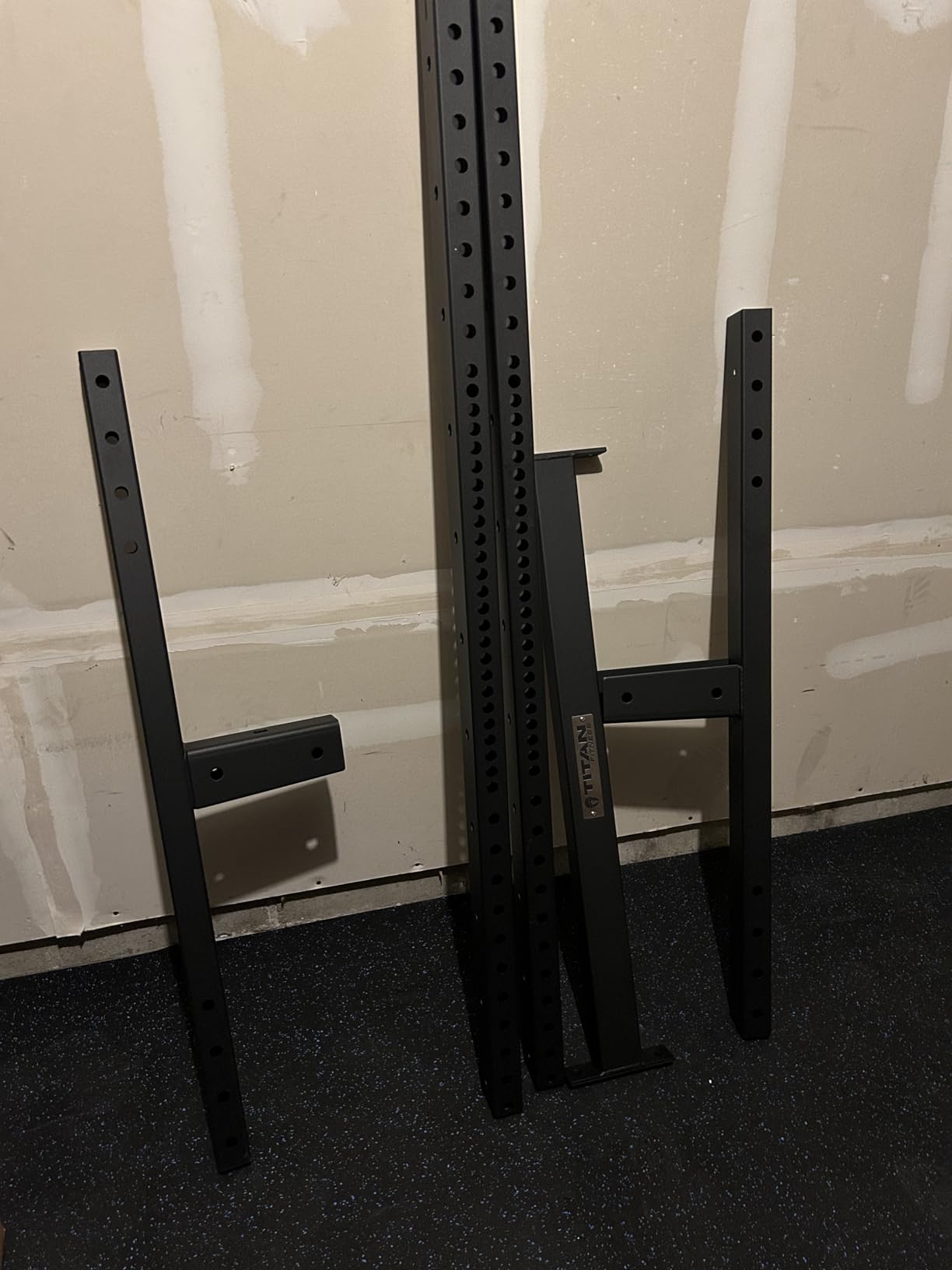
The bolt-together design matters more in a basement than in a garage. Lifters converting a low-ceiling space consistently flag the basement stairwell as the moment a one-piece rack fails, and a frame that breaks into flat sections with all hardware included in the box is simply easier to get into the room. Several owners of this stand in sub-seven-foot basements call the short profile the reason it works at all.
The trade-off is the upright format. This uses 2×3 uprights with 5/8 inch holes rather than 3×3, which means the wider accessory ecosystem built around 3×3 racks will not fit. You can still add T-3 series spotter arms, a battle rope anchor, barbell holders and a rack-mounted landmine, but the parts come from one family rather than several.

Who this stand suits
This suits a lifter whose room is genuinely the constraint: under seven feet of clearance, a basement with joists crossing at 84 inches, or a garage where the door tracks eat the headroom. It is also the pick if you want one frame that does not need squaring before every session and can grow into a full setup later with T-3 accessories.
It suits a solo lifter better than any independent pair in this guide. The 1000 lb rated UHMW-padded J-hooks and the braced structure mean a heavy re-rack lands where you put it, which removes the single most common complaint we saw about adjustable stands in owner reviews.
Who should skip it
Tall lifters should look twice. A 73.5 inch frame gives you a limited top position, and lifters around six foot four frequently report that short stands force the J-cups lower than they want. If your standing squat height is tall, a short fixed frame can leave you racking below parallel with no way to raise it.
It is also not the frame for anyone shopping for a pull-up bar. There is no pull-up bar on this stand, and adding one means a top cross member that eats more of your remaining clearance. The wall-mounted rack later in this guide is the option for pulling, but it needs a much taller ceiling.
3. Yaheetech Adjustable Squat Rack Pair for Flexible Room Layouts
Yaheetech Adjustable Squat Rack Pair, Barbell Bench Press Stands, Home Gym
44 to 70 inch range
50mm steel tube
550 lb capacity
40.8 lb stand weight
Pros
- Drops to 44 inches for clearance in low rooms
- Independent stands let you match bar length and bench width
- Well regarded for 200 to 400 lb home training
- Clean finish with no scratches or dents
- Clear assembly diagrams
Cons
- Wobbles when a bar is moved on or off the hooks
- Height adjustment needs unscrewed knobs and pulled pins
- Rubber foot covers loosen each time the set moves
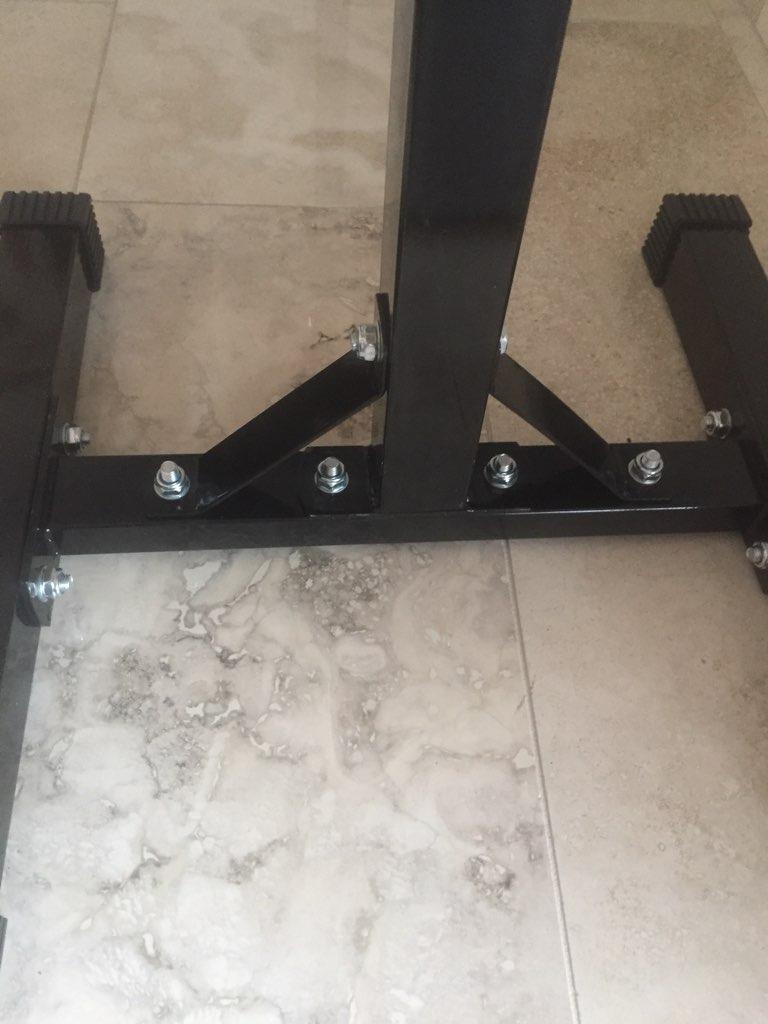
- Picture-only instructions and feet bolts must be tightened last
The Yaheetech pair is the most adjustable layout in this guide, and in a low room layout is everything. Because each stand is independent, you can set the two uprights to any spacing your bar and bench need, and when the machine is not in use you can push each stand flat against a wall or into a corner.
Height runs from 44 to 70 inches across 14 safety pin positions per post at 5cm increments, with anti-skid foot pads on the base. Owners frame it as a home gym rather than a commercial platform, and several report 150 to 400 pound working loads handled without incident over years of use.
One top-review pattern is worth repeating because it fixes the most common complaint in this category. Tighten the feet bolts last, after the frame is assembled and squared, and the wobble that has become the signature complaint for adjustable pairs largely disappears. Squaring the two stands against each other before the final tightening is the difference between a stable rack and one that rocks under a 300 pound bar.
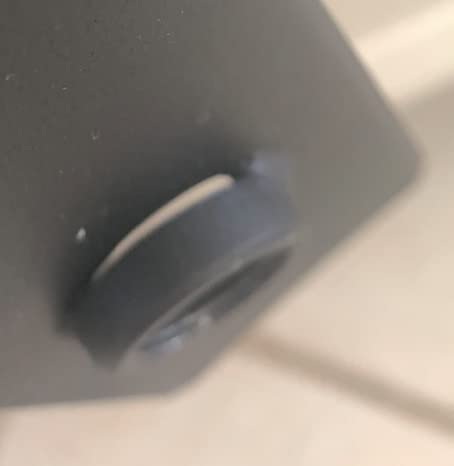
The finish is worth a mention because it is unusual at this tier. Owners report no scratches or dents after moving the set between rooms, and the 40.8 pound weight is heavy enough to feel planted without being impossible to lift over a basement step. That middle ground is exactly what most low-ceiling home gyms need.
The adjustment mechanism is the main complaint. Moving between a bench height and a squat height means unscrewing a knob and pulling a locking pin, which is friction you will feel every session. If you plan to change setups twice a week, that is a fair trade. If you change height between every exercise, look at a pair with pop pins instead.
Who this stand suits
This suits a household sharing one gym space with different trainees, because the independent spacing lets an adult bench and a teenager squat without moving equipment. It also suits anyone renting a room where the rack has to disappear into a corner when company comes over.
It is a good fit for intermediate lifting between 200 and 400 pounds, which covers the large majority of people who set up a basement gym. The 550 pound rating gives real headroom above that range for most lifters.
Who should skip it
Do not buy this for heavy solo training without a spotter present. Owners describe wobble when a bar is moved on or off, and an independent pair has no structural link between the two uprights to stop that movement turning into a missed re-rack. The same owners frame it as a controlled-placement rack, which is an honest description.
Tall lifters should also check the 70 inch ceiling of the range. It is the tallest adjustment here, but the bar still has to clear your head at a standing squat, so a 44 inch minimum and a 70 inch maximum does not automatically mean every athlete fits.
4. ZENY Adjustable Squat Rack for Portable Budget Training
ZENY Adjustable Squat Rack Stand Barbell Rack, Bench Press Rack
41 to 66 inch range
550 lb capacity
40 lb stand weight
Triangular bracing
Pros
- Adjusts down to 41 inches for low ceiling clearance
- Reinforced triangular bracing holds moderate loads without flex
- Light enough to carry outside for park sessions
- Suited to 7-foot Olympic barbells
- Quick assembly with a 17mm socket
Cons
- Not bottom-heavy so it can tip under lateral force
- Top hooks can chew bar knurling without a rubber shim
- Safety catches too short to be practical for benching
- Some units arrive with rusted or mismatched parts
The ZENY rack is the pick if your training happens in more than one place, because at 40 pounds a stand is still light enough to carry out to a deck or down to a park. The wide triangular base with reinforced bracing is a more stable shape than the narrow rectangular frames at similar weight, and the rubber foot pads grip concrete without marking it.
Height runs from 41 to 66 inches, which is enough clearance for a basement with joists at the standard height. Buyers treat it as a portable budget rack for space-constrained training, and the reinforcement holds 230 to 275 pound working loads without visible flex in owner reports.
What you give up for portability is base mass. Stability is the dominant caveat across reviews, with multiple owners describing adding plates or a sandbag to the base after a stand tipped during a missed re-rack. That fix costs nothing and works, but it is a step you have to remember every time you set the rack up in a new spot.
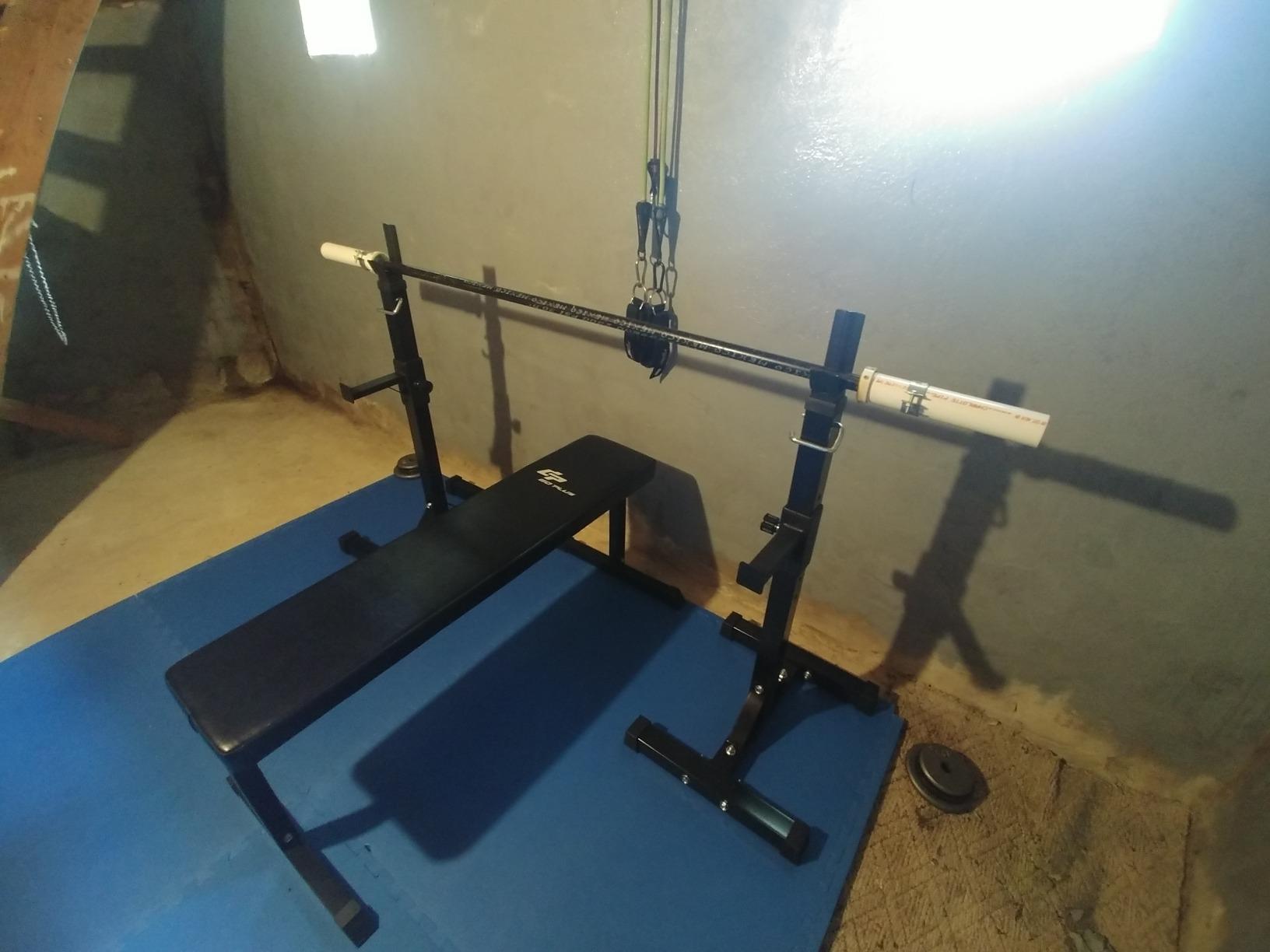
Two smaller issues come up repeatedly. The top hooks dig into bar knurling, and a thin rubber shim between hook and bar solves it in a minute. The safety catches are also short enough that several owners consider them impractical for benching, which is consistent with what we saw across the budget tier in this guide.
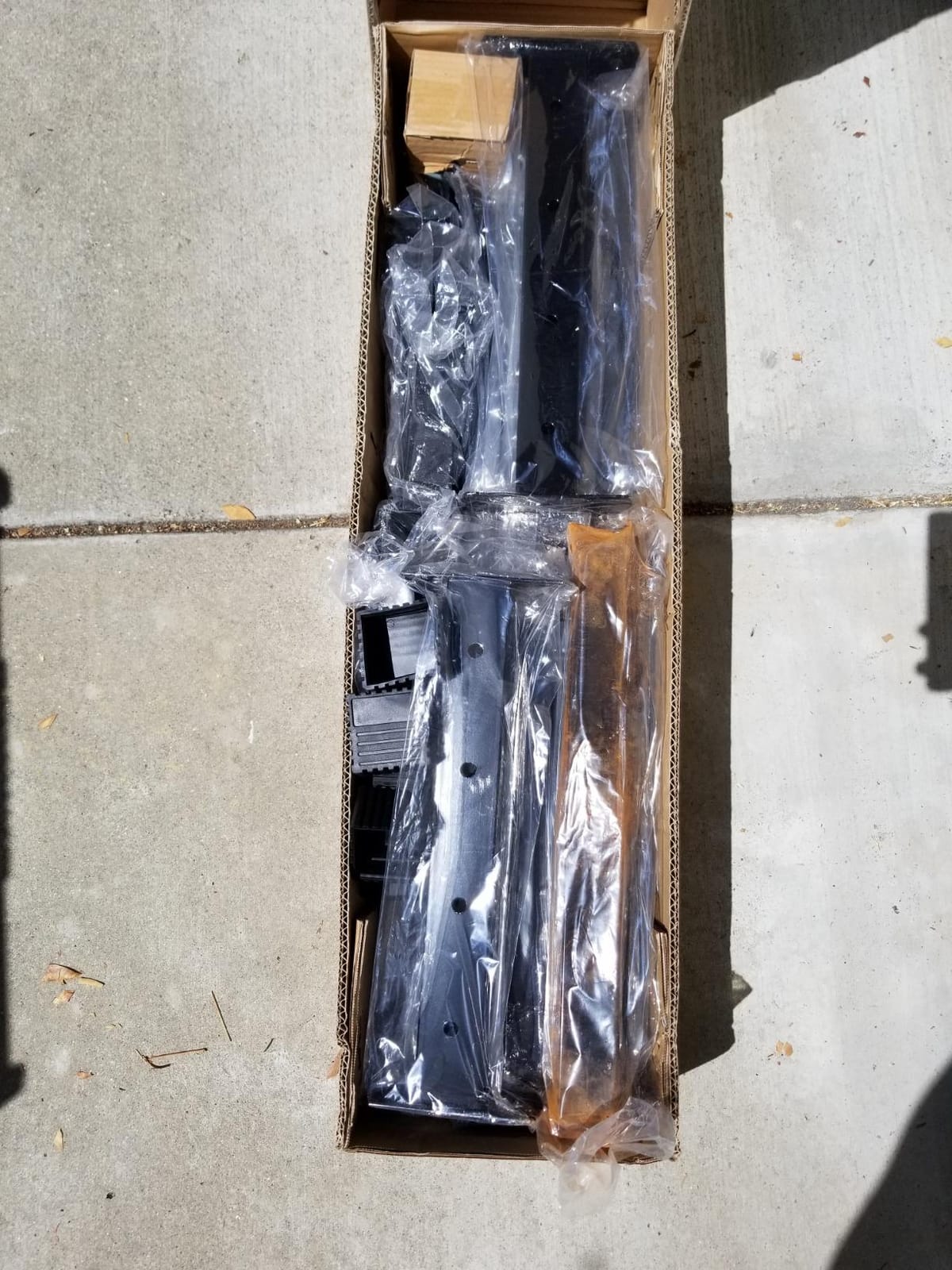
Quality control is uneven. Reports of rusted or mismatched parts, and one safety arm screw snapping on first use, show up in the review set. Inspect the box on arrival and check every fastener before you load a bar, which takes two minutes and has saved owners real problems.
Who this stand suits
This suits a lifter training moderate loads in a small room who also wants the option of working outside, and anyone outfitting a spare bedroom or garage corner on a modest budget. At 40 pounds per stand it moves between two rooms without a second person.
It is also a sensible second pair. If you already own one rack for squats and want dedicated stands for bench, row and press work, the low purchase commitment and light weight make this an easy add rather than a big decision.
Who should skip it
Anyone doing heavy singles or failing-rep work should skip it. The base is not bottom-heavy, the catches are short, and the top hooks mark a bar. If your plan includes a max attempt without a spotter, this is the wrong frame and the tipping reports are the reason.
Buyers who need a bar you can trust after two years of storage in a damp basement should pick a heavier frame. Steel that arrives rusted is a sign of how the rest of the shipment was handled, and corrosion on a fastener is a slow failure you do not want above your head.
5. JupiterForce Adjustable Squat Rack Stands for Low Safety Catch Settings
JupiterForce Adjustable Squat Rack Stands, Pair of Sturdy Steel Bench Press Rack, Barbell Rack, 40”-66” 550lbs Max Load Portable Dumbbell Racks Stands for Home Gym, Black
40.5 to 66.1 inch range
Safety supports 18.9 to 28.7 inches
50x50x2 mm tubing
550 lb capacity
Pros
- Lower safety supports drop to just under 19 inches
- Main holders rack from 40.5 inches for tight rooms
- Independent stands match bar length and bench width
- Compact 20.1 by 17.7 inch footprint that nests
- Handles moderate loading once bolts are re-tightened
Cons
- Separate pieces tip if the bar is slammed or dropped
- Poor assembly instructions and hard-to-align holes
- Nuts are hard to start by hand and no tools are included
- A few reports of used units arriving
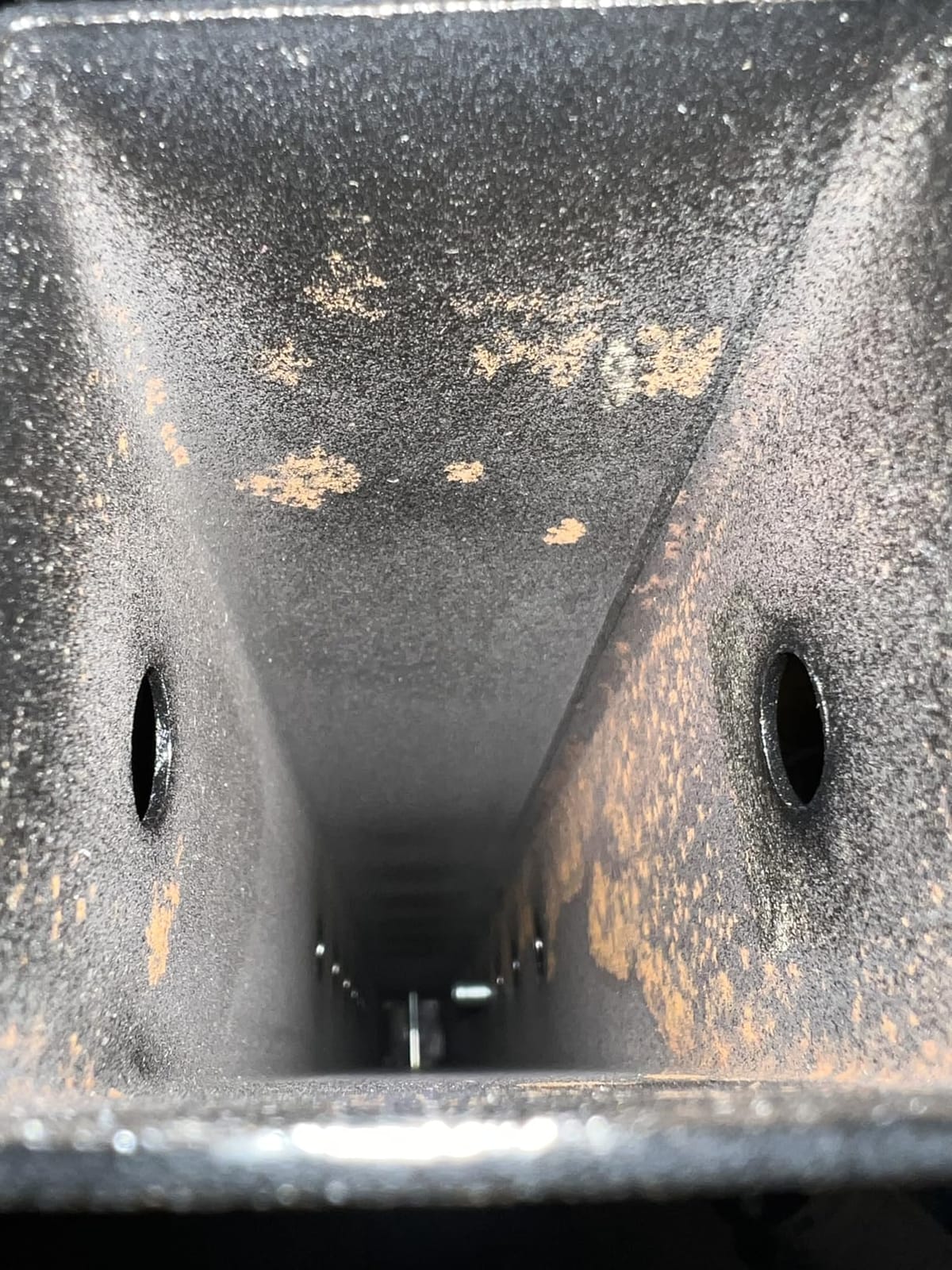
The distinguishing feature here is the lower safety support range. Six positions from 18.9 to 28.7 inches is among the lowest catch settings available on any adjustable pair, which makes this the stand we would pick for hip thrusts, Bulgarian split squats and reverse bench work where the bar starts near the floor.
Tube is 50x50x2mm, which is thicker than several competitors in this roundup, and the main holders run 14 positions from 40.5 to 66.1 inches. That 40.5 inch floor is the second-lowest here, and combined with the low catches it gives you a real range of starting heights inside a seven foot ceiling.
Owners use the pair primarily in small spaces for hip thrusts, squats and reverse bench work, and the consensus is that it suits moderate loading rather than max attempts. That is a reasonable place to land for most home lifters, and the 20.1 by 17.7 inch footprint per stand nests neatly against a wall.
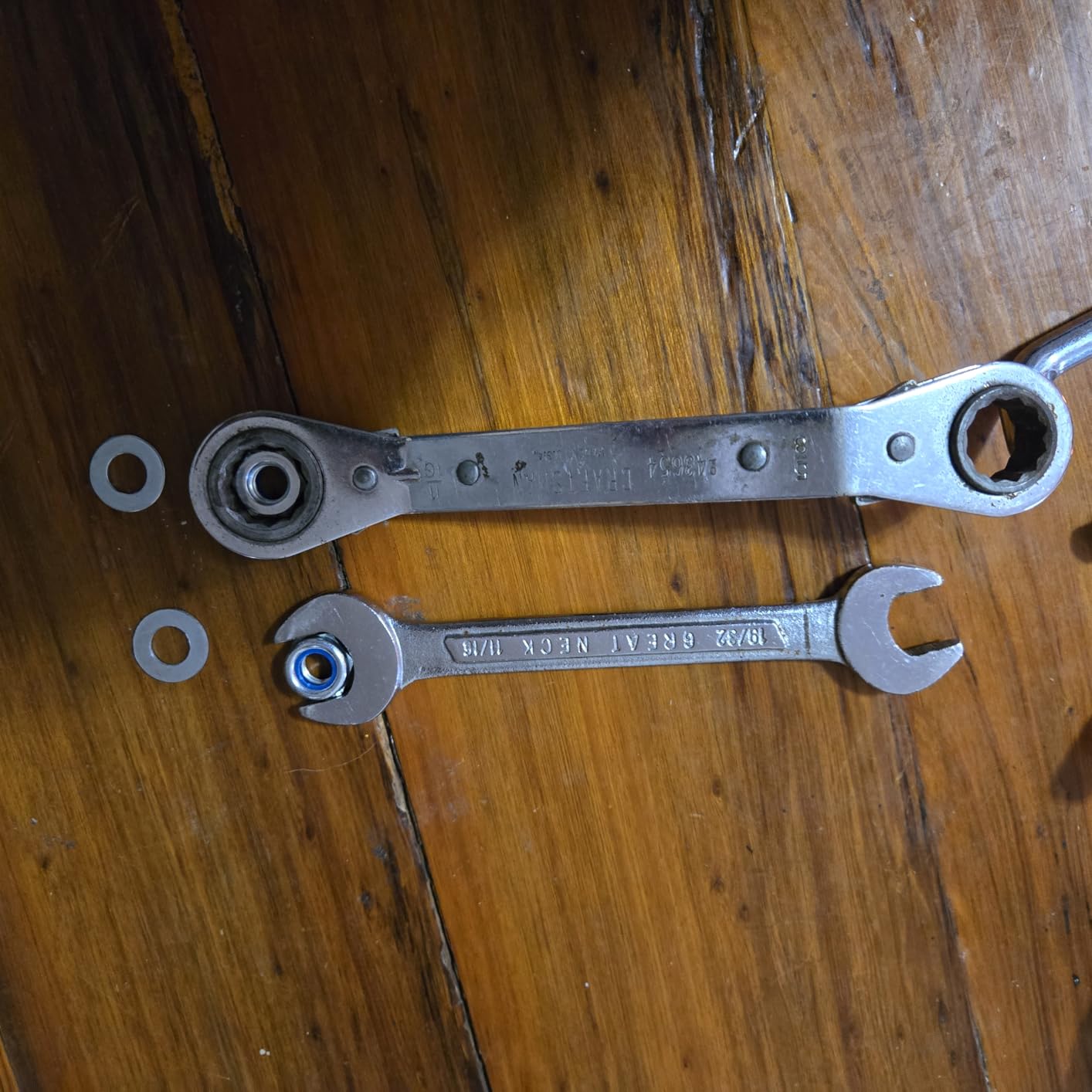
Assembly is the hardest part of the experience, and the feedback is consistent. Nuts jam rather than threading smoothly, the instructions are close to useless, and no tools are included. Owners who succeeded did the same three things: thread every bolt loosely, align starting from the main upright and working outward, and re-tighten after the first workout.
That re-tightening step matters more here than on a heavier frame. Once the joints have taken a few loading cycles, a second pass with a socket is what keeps the stands from developing the play that turns a re-rack into a stumble.
Who this stand suits
This suits a lifter whose program is built around lower bar positions, which means glute work, reverse bench, floor-based pressing and controlled tempo squats. The 19 inch catch floor is the reason to choose it over any other pair in this guide for those movements.
It also suits a household with two lifters of different heights, since the independent stands and the wide adjustment range make it easy to hand the setup over without rebuilding the frame.
Who should skip it
Skip it if you drop or slam heavy weights off the hooks. The two pieces are unconnected, and owners report the pair tipping when the bar is returned after a heavy set rather than pushed in carefully. That habit is common and hard to unlearn, which makes it a poor match for a rack with no cross-brace.
Anyone with patience for assembly should also weigh a heavier fixed frame. These stands ask for a socket wrench, careful alignment and a second tightening pass, and buying a heavier bolt-together design would remove all three tasks from your first afternoon.
6. BARWING Adjustable Squat Rack for the Shortest Rooms
Adjustable Squat Rack Stand for Bench Press, 350LB Home Gym Rac
34 to 58 inch range
Width adjustable 29 to 49 inches
45.6 lb stand weight
Plate storage built in
Pros
- Lowest adjustment floor in the guide at 34 inches
- Adjusts in both height and width for different users
- Integrated plate storage keeps the floor clear
- Reported stable and quiet once loaded
- Compact enough for basements and apartments
Cons
- Title claims 1250 lb while the spec section lists 350 lb
- Dip handles are fixed too far apart to use
- 49 inch wide footprint takes floor space
- A few safety bracket failures reported
If your ceiling is genuinely low, the number that matters is the 34 inch minimum height, and this is the only rack in the guide that racks below 40 inches. For a lifters area with a low soffit, an under-stair section or a basement where the joist clearance is punishing, that single specification can be the difference between training and not training.
Unlike the simple adjustable pairs, this frame adjusts in width as well as height, running from 29 to 49 inches across the two uprights. In a small room that is genuinely useful, because you can narrow the stance to match a shorter bar or a narrow bench and reclaim floor space around the frame.
The integrated weight plate hangers are a thoughtful touch for a low-room gym, where every square foot counts. Plates hang on the frame rather than leaning against a wall, which turns a storage problem into a use of the equipment you already own.
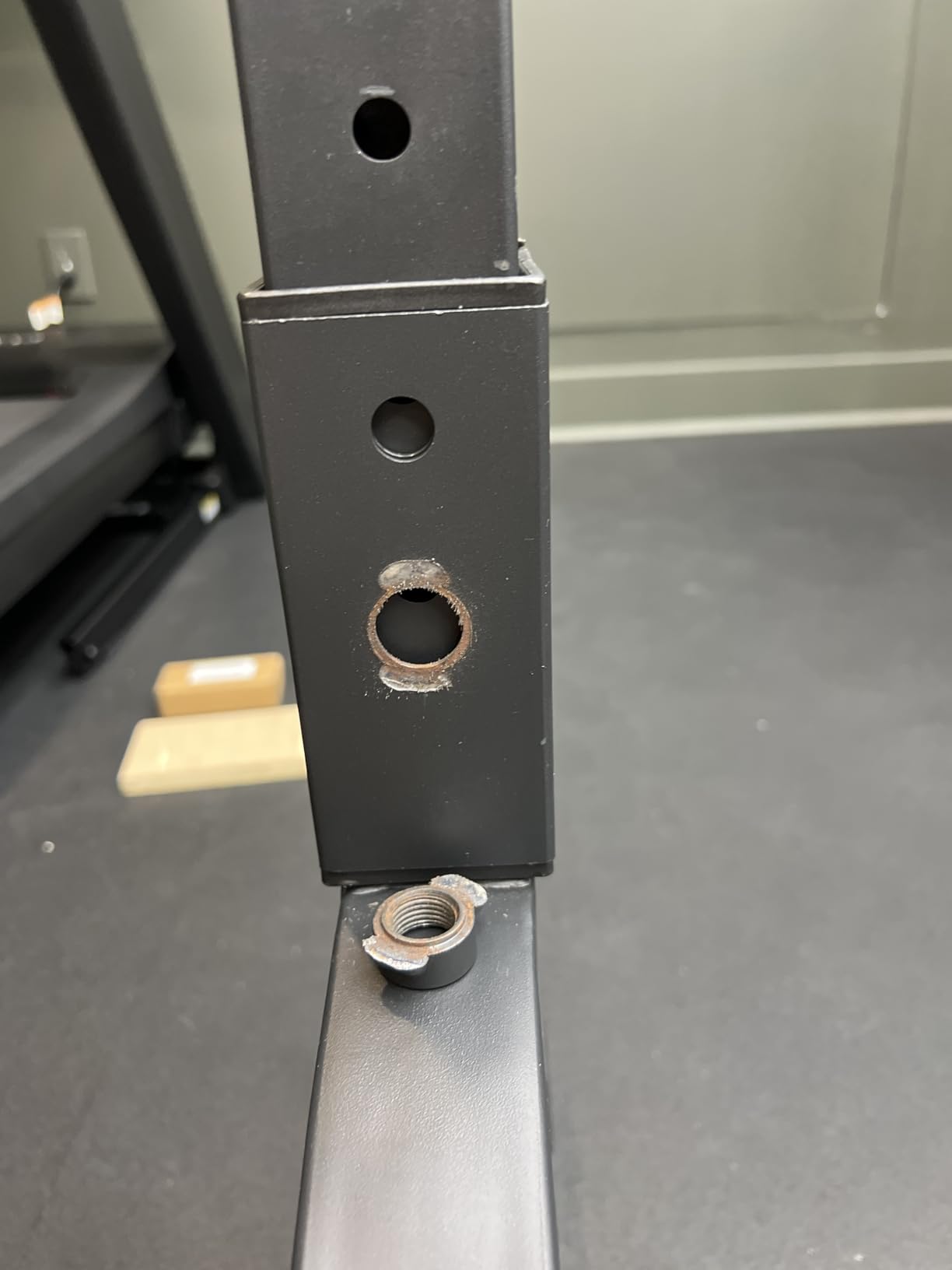
There is one thing to sort out before you buy, and it is not a small thing. The listing title states a 1250 lb capacity while the specification section lists 350 lb. The honest reading is that this is a 350 pound rack with an aspirational headline number, so size your loading to 350 pounds unless the manufacturer confirms otherwise in writing.
Beyond that, the recurring complaints are about fixed features and bulk. The dip handles are set too far apart to use and cannot be adjusted inward, the 49 inch width takes real estate, and at 45.6 pounds the frame is heavy to reposition once assembled. Assembly runs from about 15 minutes to a bit over an hour depending on how methodical you are with the locking knobs.
Who this stand suits
This suits a lifter in the tightest space in the guide, and specifically anyone who cannot get the bar below 40 inches on a standard adjustable pair. Several owners report it fitting a basement without crowding the room, which is the outcome a low-ceiling buyer is really chasing.
It also suits two people of different heights training in the same space, because the width adjustment lets you set the frame for a shorter or longer bar without new hardware.
Who should skip it
Do not size your training to the 1250 lb figure in the title. The specification section is the one that matches how the frame behaves, and a 350 pound ceiling on your loading is well under the needs of anyone moving serious weight for competition.
Anyone who wants dips should skip it too, since the handles cannot be moved inward. And if floor area is your binding constraint rather than ceiling height, a folding wall-mounted rack frees the whole footprint instead of narrowing it.
7. Mikolo Folding Wall Mounted Squat Rack for Saving the Floor
Mikolo 2″ x 2″ Folding Wall Mounted Squat Rack, 1000 Pounds Capacity Power Rack with Safety Catches, Pull Up Bar, J Hooks and Landmine Attachment, Space-Saving Home Gym(Black
Folds to 2 inches deep
85.8 inch frame height
1000 lb capacity
2x2 inch 13-gauge steel
Pros
- Collapses to about 2 inches against the wall in 15 seconds
- Highest rated rack in the guide at 4.7 across 239 reviews
- 1000 lb capacity with safety bars and J-hooks included
- Mounting slots tolerate off-center wall studs
- Legs adjust to compensate for uneven floors
Cons
- Not a low ceiling solution at 85.8 inches tall
- Instructions and measurement charts confuse buyers into wrong brace height
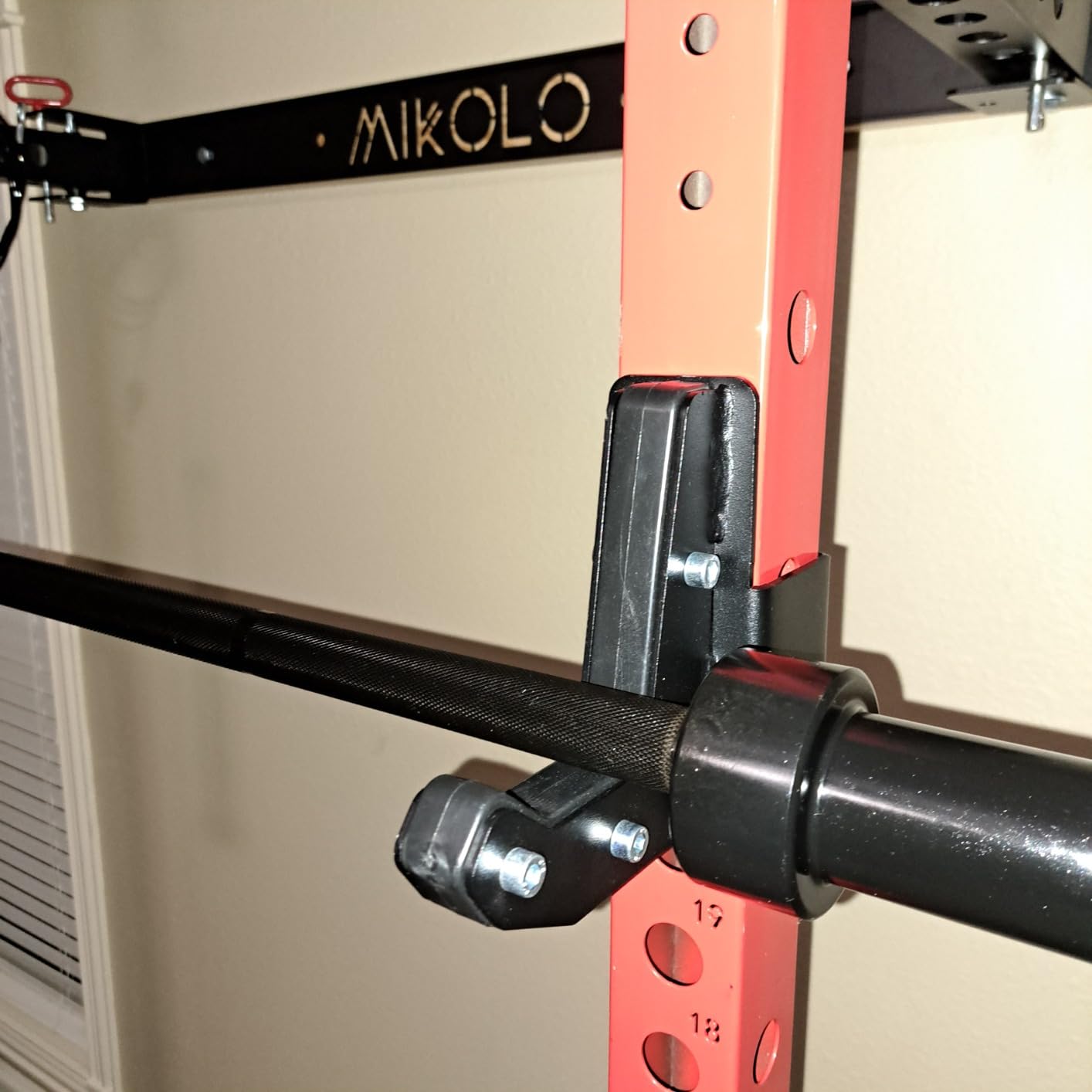
We are including this one with a clear warning attached, because it solves a neighbouring problem that low-ceiling lifters often have instead. This rack is 85.8 inches tall. It does not fit under a seven or eight foot ceiling, and its own owner reviews make that same point. What it does solve is floor space: it folds to about two inches deep in roughly 15 seconds.
Uprights are 2×2 inch 13-gauge steel with a textured powder coat, rated to 1000 pounds, and it ships with safety bars, J-cups with UHMW plastic inserts, a pull-up bar, a 360 degree dual size T-bar row attachment and a landmine attachment. Reported loads run 300 to 345 pounds without issue, and the fold mechanism locks in once the pull-up bar is fitted.
If your basement has floor area to spare but no ceiling height, the trade is straightforward. A free-standing rack gives you stability, storage and an accessory ecosystem; a folding rack gives you back the whole room. People building shared garage gyms tend to gravitate toward this option for exactly that reason.
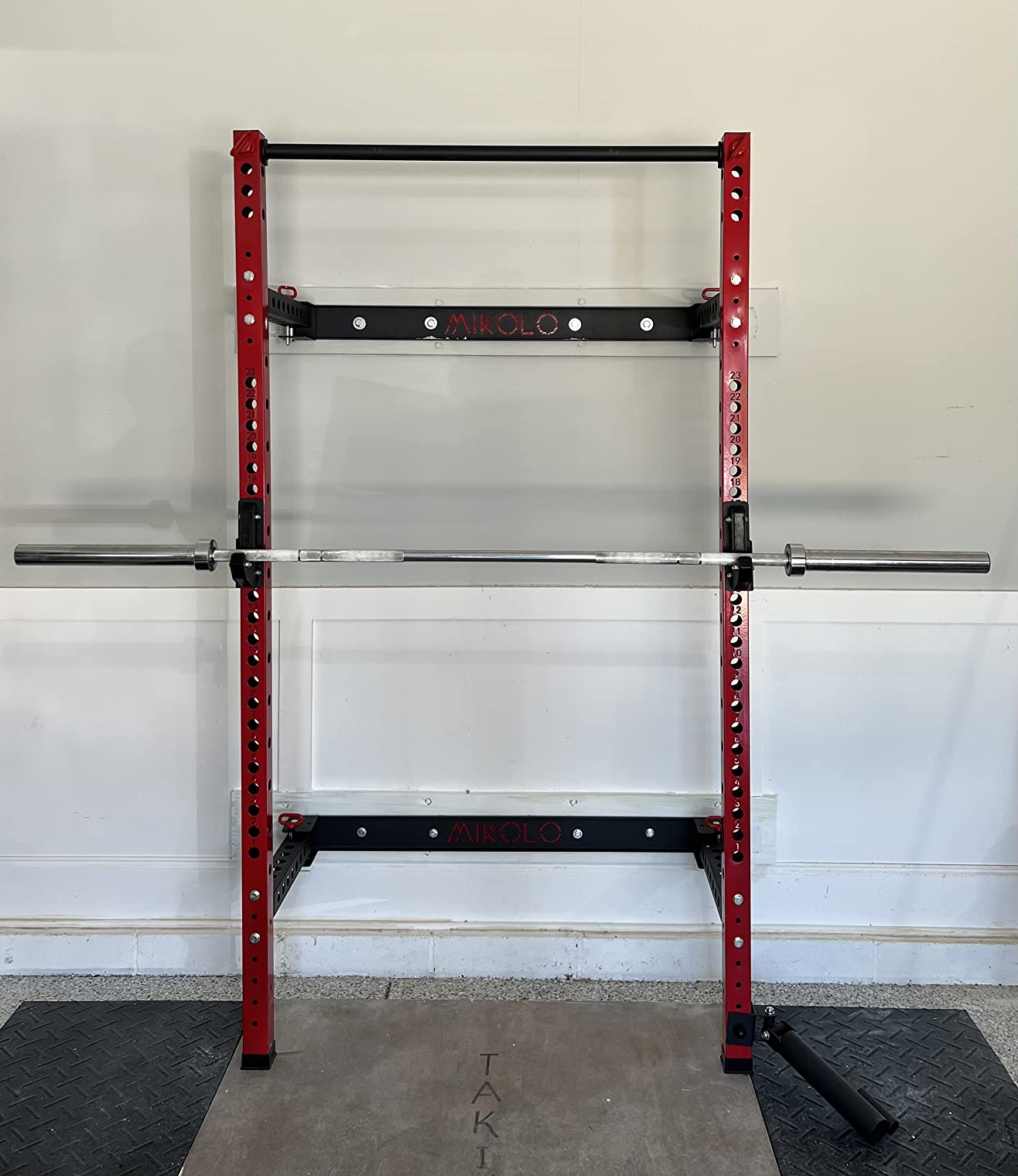
Installation is where most of the friction sits, and it is worth reading twice. It mounts to a wall stringer with metal studs, installs in 15 to 30 minutes, and the legs have vertical adjustability for uneven floors. The wide mounting slots also tolerate off-centre studs, which rescues a lot of installs that would otherwise have been redone.
Several buyers report that the measurement chart is misleading and led them to choose the wrong brace height, forcing a remount. Measure your own stud spacing and your own ceiling clearance before ordering, and treat the included chart as a starting point rather than a specification.
Who this rack suits
This suits a garage, workshop or spare room where floor space is the scarce resource and ceiling height is already generous. It is also the pick for anyone who wants a pull-up bar, since it is the only rack in this guide with a proper one reaching 89 inches.
Households with a multi-user garage gym benefit from the fold. One person trains, the other gets the floor back, and nobody has to move plates or a bench out of the way first.
Who should skip it
Skip it entirely if your ceiling is under 8 feet. At 85.8 inches the frame has no chance, and a wall-mounted design makes the mismatch worse because you cannot adjust the height at all. This is the one product in the guide that would simply not arrive in a low-ceiling basement.
Also skip it if you rent. A rack that drills into studs and mounts a 1000 pound frame to a wall is not something to install in a property you will leave in a year.
8. HARSION Heavy Duty Squat Rack for Narrowing Into a Small Room
HARISON Heavy Duty Squat Rack, Adjustable Barbell Rack, Multi-functional Dip Bar Station Weight Lifting Bench Press for Home Gym
51.22 to 68.95 inch range
Width 28.37 to 46.1 inches
650 lb capacity
65 lb stand weight
Pros
- Lowest height setting of any full frame rack here at 51.22 inches
- Narrows to 28.37 inches wide for a small room
- 650 lb capacity on 3 inch square tube
- Tools and an installation video are included
- Works as squat rack
- storage
- dip and pull-up station
Cons
- Spotter arms do not extend high enough for comfortable benching
- Spotter arms also sit too high to catch a failed squat
- Arms angle outward which is awkward in a tight room
- Can be too tall to reach when lying on a bench
The HARISON is the only connected frame in this guide besides the Titan, and what it offers is width adjustment: ten levels from 28.37 to 46.1 inches. In a low-ceiling room where you are already counting floor inches, being able to narrow the frame to just wider than your bar is a real advantage over fixed-width racks.
Construction is 3 inch square tube on an H-shaped base with a safety locking system, weighing 65 to 70 pounds and rated to 650 pounds. Owners are enthusiastic about the welds, paint and stability, and several describe it in practical terms as a squat deck with pull-up and barbell storage added.
It is also genuinely multi-functional. The same frame handles squatting, barbell storage, dips and pull-ups, which means one piece of equipment covers four movements in a room that cannot hold two machines. That density of function is what makes it viable in a converted basement or spare bedroom.
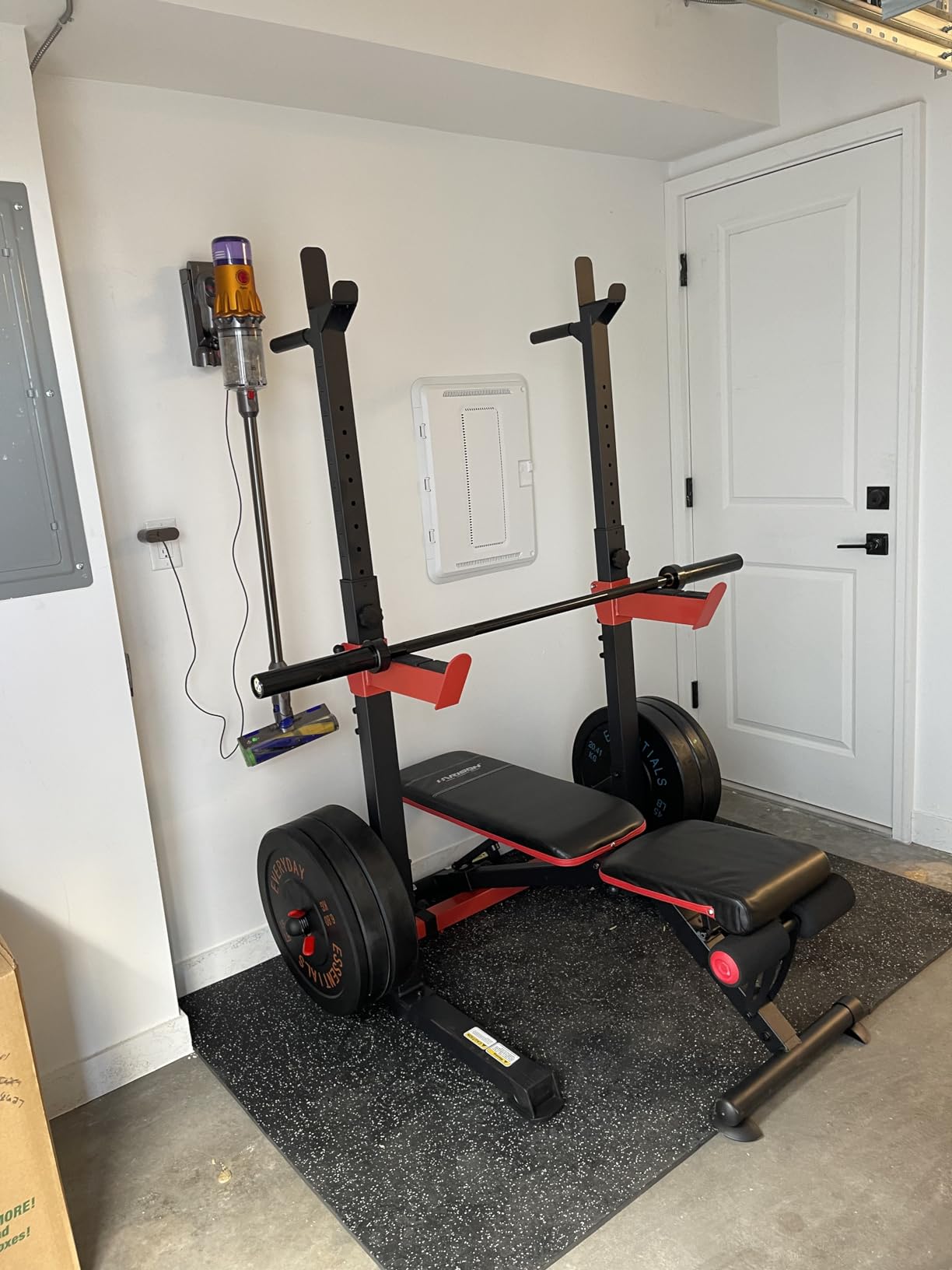
The consistent criticism across reviews is the spotter arms, and it is a two-sided one. Owners report the arms do not extend high enough for comfortable benching and also sit too high to catch a failed squat, which effectively brackets the range you need. One owner modified the unit with face-saver bars to bench safely, which is a reasonable and common fix.
Be aware of the reach as well. A frame this tall can be awkward to reach up to while lying flat on a bench, and a bench may not fit inside the frame for incline work. Measure your bench and your intended rack width before ordering.
Who this rack suits
This suits a lifter who wants a single connected frame that also gives dipping and pulling, and whose room is narrow but not short. Several owners specifically report it fitting a basement or spare room, and the included tools and installation video make a two-person afternoon realistic.
It is a good match for a household that wants storage built in. The barbell storage function is what turns a rack into a complete station when the room has no wall space left for a plate tree.
Who should skip it
Bench pressers should look elsewhere. The spotter arm range criticism appears across several reviews, and a rack whose listing implies bench use but whose arms cannot reach a comfortable bench height is a frustrating way to start. Plan to add face-saver style arms if you bench here.
Anyone with joists hanging low should also measure carefully. The 51.22 inch minimum is a low setting rather than a short frame, and the structure still rises to 68.95 inches when extended, which is a lot to ask of a room with beams.
9. Unigift Adjustable Squat Rack for Honest Load Ratings
Adjustable Squat Rack Standard 550LBS Capacity 40-66 Inch Solid Steel Squat Stands Barbell Free-press Bench Home Gym Portable Dumbbell Racks Stands (Squat Rack)
40 to 67 inch range
550 lb at low setting, 440 lb at full height
Double-lock pin system
Pros
- Adjusts from a 40 inch floor with a 67 inch ceiling
- Capacity steps down from 550 lb to 440 lb at full extension
- Double-lock pin secures the chosen height
- Rubber feet hold position and protect the floor
Cons
- Small review base for a newer listing
- Some users report difficulty engaging the locking pin
This one earns a place in the guide for a single reason: it publishes a load rating that changes with the setting. Capacity is listed as 550 pounds at the minimum height and 440 pounds at full extension, which is the kind of honesty that tells you the numbers came from testing rather than marketing.
That matters more in a low-ceiling room than it first appears. A short stand is used at a lower rack position, and a stand that is honest about the difference tells you something useful about how the frame behaves when the upright is extended and leverage on the base increases.
Height runs from 40 to 67 inches, which covers the same band as most adjustable pairs here, with a double-lock pin system that secures the height setting. Non-slip abrasion-resistant rubber feet protect a basement floor and hold the stand in position, and detailed instructions with all hardware are included in the box.
Who this rack suits
This suits a buyer who wants to size loading to a real number rather than a headline figure, particularly anyone training near the upper end of the 440 to 550 pound band who has been burned by a capacity claim before. The tiered rating tells you exactly where the limit sits at your chosen height.
It also suits anyone setting up their first home gym who will value having the instructions and hardware in the box. There is no hunting for a spare bolt after the parts are unpacked.
Who should skip it
Skip it if you want a deep pool of long-term owner feedback. The review base here is small for a newer listing, so the durability signal is thinner than for the established racks in this guide, and you would be buying on specification rather than on years of reports.
The locking pin is also worth checking early. A few users report difficulty engaging it, and the manufacturer’s own guidance is to swap the pin if it will not seat. Test the adjustment three or four times before you put a loaded bar on it.
10. Saturnpower Adjustable Squat Rack Pair as a Spare Setup
Saturnpower Pair of Adjustable Squat Rack 40inch-66inch Barbell Bracket Solid Steel Free Press Bench, Home Gym Portable Dumbbell Racks Stands, Family Sports Fitness Equipment,Black
41 to 66 inch range
14 holes per column
550 lb capacity
40 lb stand weight
Pros
- Adjusts down to 41 inches for low ceiling clearance
- Rubber feet grip well and protect the floor
- Simple design with a small number of parts
- Rubber feet guard against slipping on concrete
Cons
- Lightweight pair with no cross-bracing between the stands
- No safety spotters included
- Diagram-only instructions and easy to over-tighten foot bolts
The Saturnpower pair shows up in this roundup as a second or supplementary set rather than a primary rack. The rating is high, but the review base is modest, so we are treating it as a well-regarded spare rather than a frame with a long track record.
What it does well is straightforward. Height adjusts from 41 to 66 inches across 14 holes per column, the rubber feet grip without marking a floor, and the design has few enough parts that assembly is quick even with diagram-only instructions. Several owners use it as a secondary pair for bench and row work alongside a heavier main frame.
The limitation is structural. There is no cross-bracing between the stands, which means the two pieces rely entirely on their own bases for stability, and there are no safety spotters included at all. That combination is fine for controlled bar placement and light to moderate loading, and it is not fine for heavy solo work.
Who this pair suits
This suits a lifter who wants a dedicated bench and row station away from their main squat frame, or a household that needs a lightweight second pair for a second room. At 40 pounds a stand and with a small footprint, it stores flat against a wall between sessions.
It also works as a travel option, since these are light enough to move between a garage and a basement without a second person.
Who should skip it
Skip it as your only rack if you train heavy. With no cross-brace and no spotters included, there is nothing between you and a tipped stand when a bar comes back down fast, and reviewers consistently describe the pair as suited to lighter loading.
Follow the assembly note about the feet. Tightening the foot bolts too early is what causes wobble in this design, so leave them loose until the frame is assembled and squared, then tighten them at the end.
11. ANT MARCH Adjustable Height Squat Stand Pair for Overhead Work
ANT MARCH Pair of Adjustable Height 40″-66″ Portable Squat Rack Stands
40 to 66 inch range
Solid-stent base
550 lb capacity
20 by 18 inch base
Pros
- Adjusts to a 40 inch floor
- the joint lowest in the guide
- Compact two-piece design that clears out of the way
- Build and paint quality praised by owners
- Handles an Olympic bar with 40 lb plates per side
Cons
- Spotter arms are effectively curl-bar holders and tipped the rack when loaded
- Spotters shift when the bar is dropped back rather than pushed in
- Some units arrived with bent metal needing straightening
- Instructions are poor and no tools are included
The case for this pair is overhead work. The 40 inch adjustment floor is tied for the lowest here, and owners report handling an Olympic bar with 40 pound plates per side, which is a real load for a set of independent stands in this weight class.
The base is a solid-stent design with welded straight legs intended to stand upright without wobble, finished with non-slip abrasion-resistant rubber boots. Feedback splits between owners who find the stands solid and well painted, and those who object to the spotter arms on principle rather than on build quality.
That objection is worth stating plainly. The arms on this frame function as curl-bar holders rather than true spotters, and the most detailed review in the set reports that loading an Olympic bar onto them tipped the stand. If you use them as spotters, you are using the wrong part for the job.
Who this pair suits
This suits a lifter whose programme is built around standing and seated overhead pressing, dumbbell work and light to moderate barbell squats in a small room. The compact two-piece design also suits anyone who needs floor space back regularly and does not mind a two-minute setup.
Buyers who want a compact stand and are willing to treat the arms as bar holders rather than spotters rate the build quality favourably for the tier.
Who should skip it
Do not treat the spotter arms as safety equipment. A frame whose arms can be tipped by an Olympic bar is not something to underload protection, and the spotters also shift when the bar is dropped back onto them rather than pushed in.
Skip it if you want long-term data. The review base is modest and a few buyers report bent sheet metal arriving, which needs light hand work to correct. Inspect the frame on arrival and check for flatness before loading it.
12. Adjustable Squat Rack 40-66 Inch Pair for the Lightest Setup
Adjustable Squat Rack Stand Barbell Bench Press Stands Rack Push Up 40″-66″ Multi-Functional Sturdy Steel for Home Gym Max Load 550 lbs Portable Dumbbell Racks Stands, Black
40 to 66 inch range
19 lb stand weight
550 lb capacity
20.1 by 17.71 inch base
Pros
- Lightest frame in the guide at 19 pounds for easy repositioning
- Adjusts down to 40 inches for low ceiling use
- Rubber end caps protect the floor from scratches
- Compact footprint relative to full power cages
Cons
- Lightweight frame gives up resistance to tipping
- Rubber end caps have been reported coming off
- Limited long term durability data on an unbranded listing
The last pick is the lightest frame in the guide at 19 pounds per stand, and that is its whole argument. If you are moving equipment between rooms, up basement steps, or in and out of storage, no other rack here is this easy to lift. Height adjusts from 40 to 66 inches for squats, bench and overhead work.
Buyers on this listing are typically beginners or intermediate lifters outfitting a small home gym, and the 40 inch adjustment floor is the main reason it keeps appearing in low-ceiling selections. The rubber end caps protect a finished floor, and the footprint of 20.1 by 17.71 inches stays compact next to a full cage.
Lightness has a cost, and it is tipping resistance. A 19 pound frame carries less mass to resist a lateral knock than a 40 or 65 pound design, and that difference shows up on fast re-racks and on a hard unrack with no spotter. Treat this as a frame for building a habit rather than a frame for testing a limit.
Who this pair suits
This suits a first home gym owner in a small room who is still deciding how seriously they will train, and anyone who moves their equipment regularly. The 40 inch floor gives real clearance in a low-ceiling room and the weight makes setup almost instant.
It also works as a bench and press station for someone whose main training is squats done on a separate rack, since the pair is easy to move out of the way when the barbell work is done.
Who should skip it
Skip it if you plan to train heavy without a spotter, for the tipping reasons above. Move up in weight class to one of the 40 pound frames before you start loading it with real working weights.
Skip it if you want a documented track record. The listing is unbranded and the review base is modest, so long-term durability data is thin. Check the rubber end caps after the first few sessions, since loosening caps on this type of frame are a recurring report.
Ceiling Height Decision Matrix: Which Stand Fits Your Room
Match the lowest obstruction in your room to the range below, then check the bar height against your own standing squat. These tiers assume roughly 8 to 10 inches of headroom above the bar for a back squat.
Under 84 inches of usable clearance: the BARWING rack is the only option in this guide that racks low enough, dropping to 34 inches. Every adjustable pair here bottoms out at 40 or 41 inches, which works for many lifters and fails immediately for a tall one. A full power rack or a folding wall-mounted rack is not possible at all.
84 to 90 inches of clearance: the F2C pair, the Yaheetech, ZENY, Saturnpower, JupiterForce, ANT MARCH and the unbranded 40-66 pair all fit comfortably, and the Titan T-3 short stand at 73.5 inches gives you the most margin of all. The Unigift rack also fits with its 40 inch floor.
90 to 96 inches of clearance: every adjustable pair above still fits, and you can now run the Titan T-3 short stand with a top cross member for extra rigidity. The HARISON reaches 68.95 inches at full extension, which needs close to eight feet of clear height.
Over 96 inches of clearance: the Mikolo folding wall-mounted rack at 85.8 inches becomes viable, and it is the only rack here with a pull-up bar, reaching 89 inches. Nothing in this guide tops out above 86 inches, so a standard power rack is worth revisiting at this height.
On the pull-up question specifically: ten of the twelve racks here have no pull-up bar at all. The HARSION works as a pull-up station, and the Mikolo has a proper bar, but neither a 40 inch adjustable pair nor a 73.5 inch fixed stand gives you one. In a low room, a door-mounted bar on a stud wall is the usual answer.
Buying Guide: The Specs That Matter in a Low Room
Connected or independent is your first real decision. A connected frame bolts both uprights to a shared base, which stops the side-to-side shift that makes independent pairs feel untrustworthy when you re-rack heavy, and it is the only design that can carry a pull-up bar. An independent pair folds or nests, moves between rooms easily, and lets you set the spacing to your bench. The honest summary is that connected frames suit solo heavy training in a room you can dedicate, and independent pairs suit shared rooms and changing setups.
Height range matters more than maximum capacity in a low room. Every rack here is rated between 350 and 1000 pounds, and most home lifters never approach those numbers, but the difference between a 40 inch floor and a 44 inch floor is the difference between squatting and not squatting for a taller athlete. Lifters around six foot four should check the maximum J-cup height on any short stand before buying, because a short frame forces the bar lower than many tall athletes can work from.
Read the capacity number in context. A published rating that steps down with height, like the Unigift’s 550 pounds dropping to 440 at full extension, tells you more than a single headline figure. Where a listing disagrees with itself, as the BARWING does between its title and specification section, plan on the lower number.
Hole spacing and steel gauge predict longevity, not capacity. Westside spacing, as on the Titan stand, means 2 inch increments above and below the working zone so you can set a height rather than approximate one. Thicker tube resists flex under load, and heavier frames do not need re-tightening as often. Neither adds a pound of capacity, but both make a frame you trust at 90 percent of its rating.
Bolted versus welded matters for assembly and moving. A bolt-together frame breaks into flat sections that fit down a basement stairwell, and assembly order affects whether the finished rack sits square. Owners of adjustable pairs report that tightening the feet bolts last, after aligning the frame, removes most of the wobble that gets blamed on the product. Re-tighten everything after the first few workouts, because joints settle under load.
Do not cut or weld the uprights. Shortening a stand by cutting a post or welding a section creates a structural failure point exactly where a loaded bar wants to flex, and it voids any warranty the manufacturer offers. If you need a lower rack height, buy a stand whose lowest adjustment already covers it. The BARWING at 34 inches and the adjustable pairs at 40 to 44 inches cover most low rooms without anyone touching a torch.
Check noise and vibration if you have neighbours. Independent stands in this weight class rattle and rock when a bar is returned, and the rubber feet on most of them are what keep concrete from carrying the sound upstairs. A 65 to 144 pound connected frame transmits noticeably less movement than a 19 to 40 pound pair, which matters in a basement gym under a finished floor.
Finally, treat short safety arms as bar storage rather than as protection. Several stands in this guide ship arms that reviewers describe as curl-bar holders. In a low-ceiling solo setup, set the bar on the arms by hand, learn to unrack without a sideways pull, and keep your working loads at a level where a miss is recoverable.
Frequently Asked Questions
What squat racks are suitable for low ceilings?
Height adjustable stands that rack down to 40 inches or lower are the safest answer for a seven foot room. The F2C, ZENY, Saturnpower, JupiterForce, ANT MARCH, Unigift and unbranded pairs in this guide all drop to 40 or 41 inches, and the BARWING rack goes lower still at 34 inches. The Titan T-3 short stand fits under a seven foot ceiling as a fixed 73.5 inch frame with Westside hole spacing.
How tall does my ceiling need to be for a squat rack?
Measure the lowest obstruction, not the drywall. Ductwork, ceiling joists, a garage door track and pendant lights each take a chunk out of the number, and basement joists are the usual problem. For a low ceiling squat stand, treat anything under 84 inches of usable clearance as a stand-only zone, then leave roughly 8 to 10 inches above the bar for a back squat at your own standing height.
Can I do pull-ups in a low ceiling squat stand?
Not on most of them. Ten of the twelve racks in this guide have no pull-up bar at all. The HARSION works as a pull-up station within a connected frame, and the Mikolo folding wall-mounted rack has a proper bar reaching 89 inches, which needs a ceiling close to eight feet. In a low room the usual answer is a door-mounted bar on a stud wall.
Is there a Smith machine that can be used in a low ceiling?
A Smith machine needs a full height rail and carriage, so it inherits the same ceiling problem as a power rack. None of the racks in this guide are Smith machines. If your priority is a guided bar path rather than free bar training in a basement, a fixed or adjustable stand with usable safety arms in the 550 pound class is the realistic option, provided the bar height suits you.
What is the best squat rack for a basement gym?
The F2C adjustable squat rack is the strongest all round answer we found for a basement, and the Titan T-3 short stand is the pick when ceiling height is the binding constraint. In a basement choose a bolt-together frame you can carry down the stairs, measure the lowest joist rather than the ceiling, and expect to square and re-tighten an independent pair after the first few sessions.
Are squat stands safe without a spotter?
An independent pair is a controlled-placement rack, not a power rack. Owners report rocking and shifting when a heavy bar is re-racked from the front, which is when most accidents happen. Several stands in this roundup ship arms that reviewers describe as curl-bar holders rather than true spotters, so learn to set the bar on the arms by hand and keep loads at a level where a miss is recoverable.
Conclusion: The Best Squat Stands for Low Ceilings
The F2C 550 lb adjustable pair takes the top spot among the best squat stands for low ceilings because it does the one thing a low room demands well, which is rack the bar low and hold it there. A 40 inch floor, thirteen safety arm positions and 18.5 pound stands that move between rooms make it the most flexible frame we tested.
For a fixed frame with no assembly guesswork, the Titan T-3 short squat stand at 73.5 inches is the strongest option under a true seven foot ceiling, and its bolt-together construction solves the basement stairwell problem that ends more home gym projects than any other. Where ceiling height is extreme, the BARWING rack is the only one here that drops to 34 inches.
Measure the lowest point in your room before you order, and size your loading to the specification section rather than the listing title. Whichever frame you pick, tighten the feet last, square the pair, and re-check the bolts after your first few sessions. Updated for 2026, these twelve cover every ceiling height and room shape we found a real gap in.