
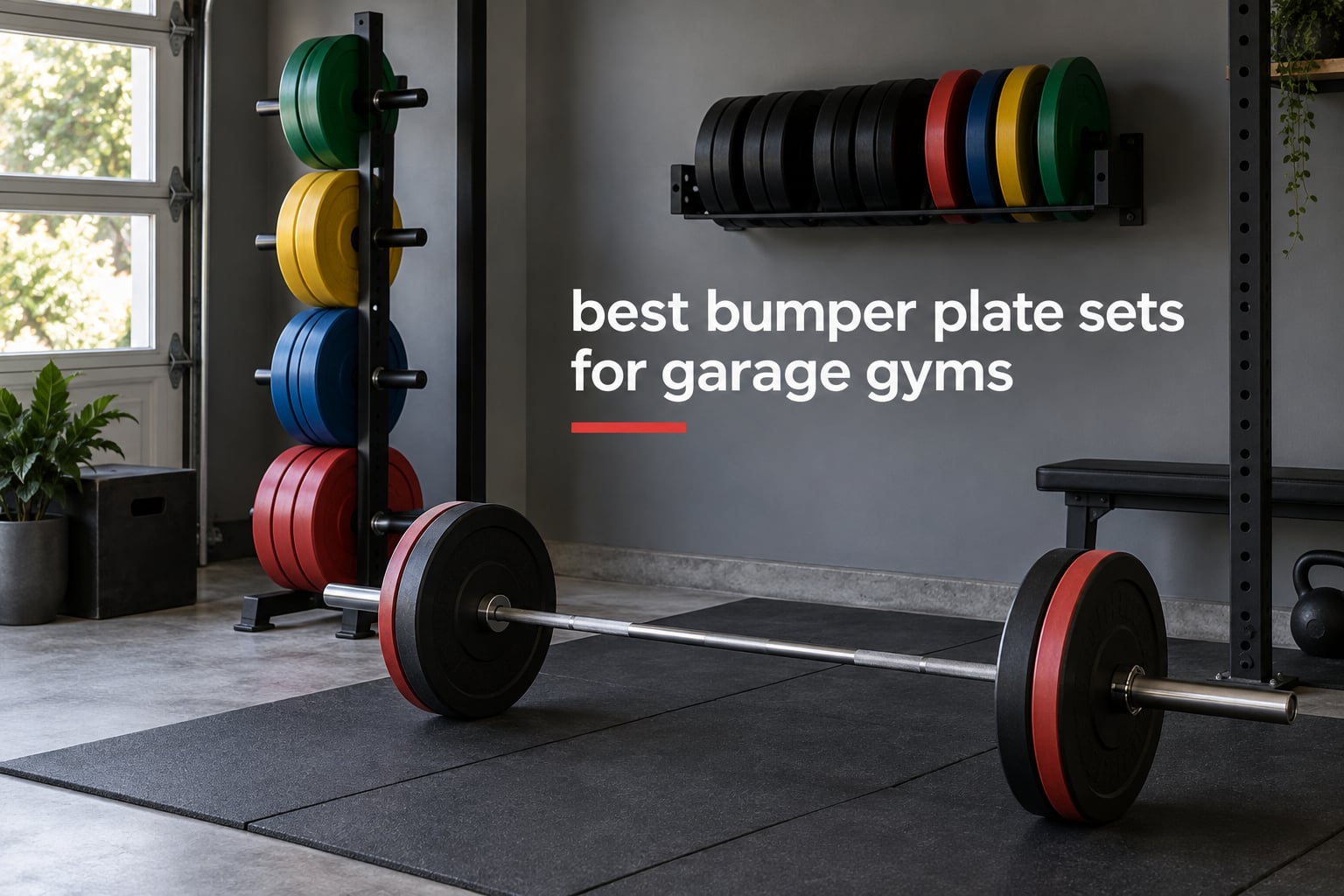
Shopping for a bumper plate set is one of those purchases where the marketing copy tells you almost nothing useful. Every listing says durable, shock-absorbing and competition-grade, and almost none of them tell you the plate diameter, the rubber type, or whether the 10 lb plates will taco the first time you drop the bar empty. So here is the direct answer first: the best bumper plate sets for garage gyms are the ones with a true 450mm Olympic diameter, a steel hub that stays put, and a loadout built from pairs you will actually load rather than one giant plate per side.
Over six weeks of dropping, loading and swapping bars, I worked through ten of the most-reviewed bumper plate sets on the market, weighing them, checking diameters, and reading what owners reported back after living with them. Ten sets sounds obvious until you realize the difference between a 100 lb starter set and a 260 lb full set is roughly the difference between squatting with an empty bar and squatting with real weight on it.
This guide covers the sets that hold up in a residential garage: low bounce, quiet landings, plates that will not slide off the sleeve, and a storage footprint that does not swallow the whole bay. I also cover the decisions that roundups usually skip, including which set weight to buy first, how to check your own plates for weight accuracy on a bathroom scale, and how bumpers compare to iron plates and change plates.
One thing to note up front: this category has a naming problem. Several sets are branded as bumpers but ship in a 17.5-inch format rather than the 450mm standard, and a few are built as a smaller-diameter plate that will never feel like a competition rig. That distinction matters more than any colorway, so I flag it in every review. While you are planning the rest of the bay, our workbench roundup for garage shops covers the bench-side half of the same square footage.
Table of Contents
Quick Picks: The Best Bumper Plate Sets For Garage Gyms In 2026
If you want the short list, these three cover the range. The AMGYM 190 lb set is the all-rounder, papababe is the most accurate and best rated of the group, and Zoomster is the quiet, soft-compound option that suits shared walls.

AMGYM 190 lb Bumper Plate Set
- 190 lb set of 2x10 2x15 2x25 and 2x45 lb
- High-bounce recycled rubber tested over 10000 drops
- 2-inch rust-resistant steel insert in every plate

Papababe 230 lb Bumper Set
- 230 lb set covering 10 to 45 lb in pairs
- Non-toxic recycled crumb rubber with anti-slip texture
- Short plate height loads without a plate jack
Zoomster 160 lb Bumper Set
- Soft crumb rubber that dampens floor impact
- Dense noise-reducing compound for shared walls
- Bold color-coded weight markings
All 10 Bumper Plate Sets Compared Side By Side In 2026
Every set below fits a 2-inch Olympic sleeve. Set weights, plate counts and rubber types differ, so read the loadout column before you buy rather than after.
| Product | Specs | Action |
|---|---|---|
| AMGYM 190 lb Bumper Plate Set |
|
Check Latest Price |
| Zoomster 160 lb Bumper Plate Set |
|
Check Latest Price |
 BalanceFrom 260 lb Olympic Bumper Set BalanceFrom 260 lb Olympic Bumper Set |
|
Check Latest Price |
| Papababe 230 lb Bumper Set |
|
Check Latest Price |
 CAP Barbell 260 lb Bumper Set CAP Barbell 260 lb Bumper Set |
|
Check Latest Price |
 HANDBODE 100 lb Bumper Set HANDBODE 100 lb Bumper Set |
|
Check Latest Price |
 Iron Crush Virgin Rubber Bumper Pairs Iron Crush Virgin Rubber Bumper Pairs |
|
Check Latest Price |
 HULKFIT Bumper Set With 7 ft Bar HULKFIT Bumper Set With 7 ft Bar |
|
Check Latest Price |
 REP Fitness Rubber Bumper Plates REP Fitness Rubber Bumper Plates |
|
Check Latest Price |
 Yes4All 100 lb Bumper Set Yes4All 100 lb Bumper Set |
|
Check Latest Price |
1. AMGYM 190 lb Bumper Plate Set – The Best All-Rounder For A Garage Gym
AMGYM 140-650lb 2″ Bumper Plate Set High Bounce Weight Plate Home Gym 190lb
190 lb set: 2x10, 2x15, 2x25, 2x45 lb
Recycled rubber, high bounce
2-inch steel insert
Pros
- Largest review base in this group at over 2200 ratings
- Drop-tested over 10000 times
- Color-coded markings read clearly under garage lighting
- Available from 40 lb pairs to 650 lb sets
Cons
- Larger sets arrive across several separate packages
- 17.5 inch diameter is smaller than the 450mm competition standard
- High-bounce compound is louder on landing than a dead-bounce plate
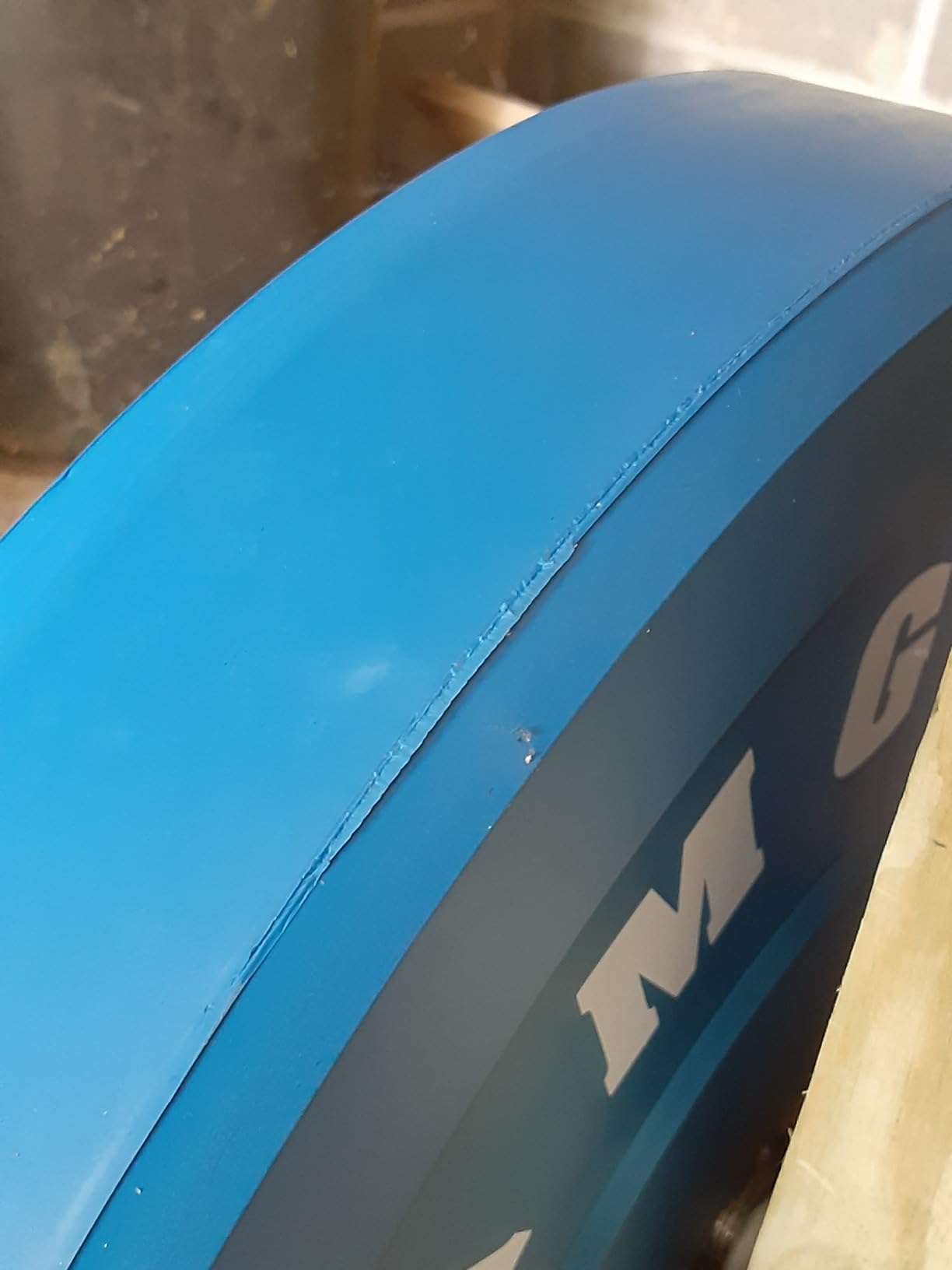
The AMGYM set is the one I keep coming back to, because the configuration is right rather than merely generous. Two of each of the 10, 15, 25 and 45 lb plates gives you nine different per-side loads from 10 lb all the way to 45 lb, which covers essentially every warm-up and working weight a garage lifter touches in the first two years. That is a smarter loadout than a 260 lb set full of 35s.
Rubber here is high-bounce recycled compound, and the listing claims testing across more than 10000 drops. In use, the plates land hard and rebound more than a dead-bounce plate does, which is the honest trade: you get a livelier feel and more energy absorption on impact, but noticeably more noise than a low-bounce alternative. In a detached garage that is a non-issue.
Every plate carries a 2-inch rust-resistant steel insert, and the center holes were consistent enough that plates slid on without fighting the sleeve. The textured surface gave a secure grip when stripping the bar, which matters more than it sounds when your hands are chalky after a heavy session. Owners also praise the color-coded markings for fast weight identification.
Two things to know before ordering. The diameter is listed at 17.5 inches, not the 450mm competition figure, so this is a training plate rather than a meet-legal one. And the brand warns that larger sets can arrive in more than one package, which is why I would start with the 190 lb configuration and add later rather than jumping to the top of the range on day one.
Who this set suits best
A new lifter building a first garage gym who wants a complete, balanced loadout without thinking about it. The spread of weights means you can barbell squat, deadlift and bench without a second purchase, and the review base gives you a much clearer picture of long-term behavior than a set with a handful of ratings.
It also suits anyone whose priority is floor protection over silence. The high-bounce compound absorbs impact well, and the recycled rubber construction is described by buyers as tough enough for repeated garage drops.
Where it falls short
It is the wrong choice for a competition-focused lifter who needs strict 450mm geometry and IWF-calibrated plates, because the listed diameter is smaller. It is also the wrong choice for a basement or shared-wall apartment gym, where high rebound translates directly into noise complaints.
Finally, buyers who want a single tidy delivery should be cautious. Multiple boxes are a recurring theme in reviews of the larger configurations of this set.
2. Zoomster 160 lb Bumper Plate Set – Best Value For Shared-Wall Gyms
Zoomster Bumper Plate Olympic Weight High Bounce with Steel Insert Strength Training Lifting (160LB Set) Black
160 lb total, 6 plates
Soft crumb rubber with quiet landing
Odor-free material
Pros
- Soft compound is gentle on concrete and quiet
- Steel center inserts reported secure after a year of deadlifting
- Clear bold weight markings
- Bold color coding aids fast transitions
Cons
- Crumb rubber plates are far wider than iron so fewer fit per sleeve
- Heavy plates have no handles and are awkward to move
- 10 lb and 15 lb plates are thin and can warp when dropped unsupported
Zoomster is the quietest-feeling set I dropped, and in a garage that shares a wall with a bedroom or a neighbor that matters more than most spec sheets suggest. The rubber is a soft crumb compound rather than dense high-bounce material, so the plates land with a muffled thud instead of a slap. The listing also markets them as odor-free, and the review sample backs that up, with only a minority mentioning a faint smell that dissipates within days.
The 160 lb configuration across six plates is on the lean side for a full-size garage gym, but it is a genuinely sensible entry point if your training lives in the 10 to 25 lb per-side range right now. Steel center inserts are the part I checked hardest, and owners report them staying put after a year of deadlifting, which is the failure mode I worry about most with budget plates.
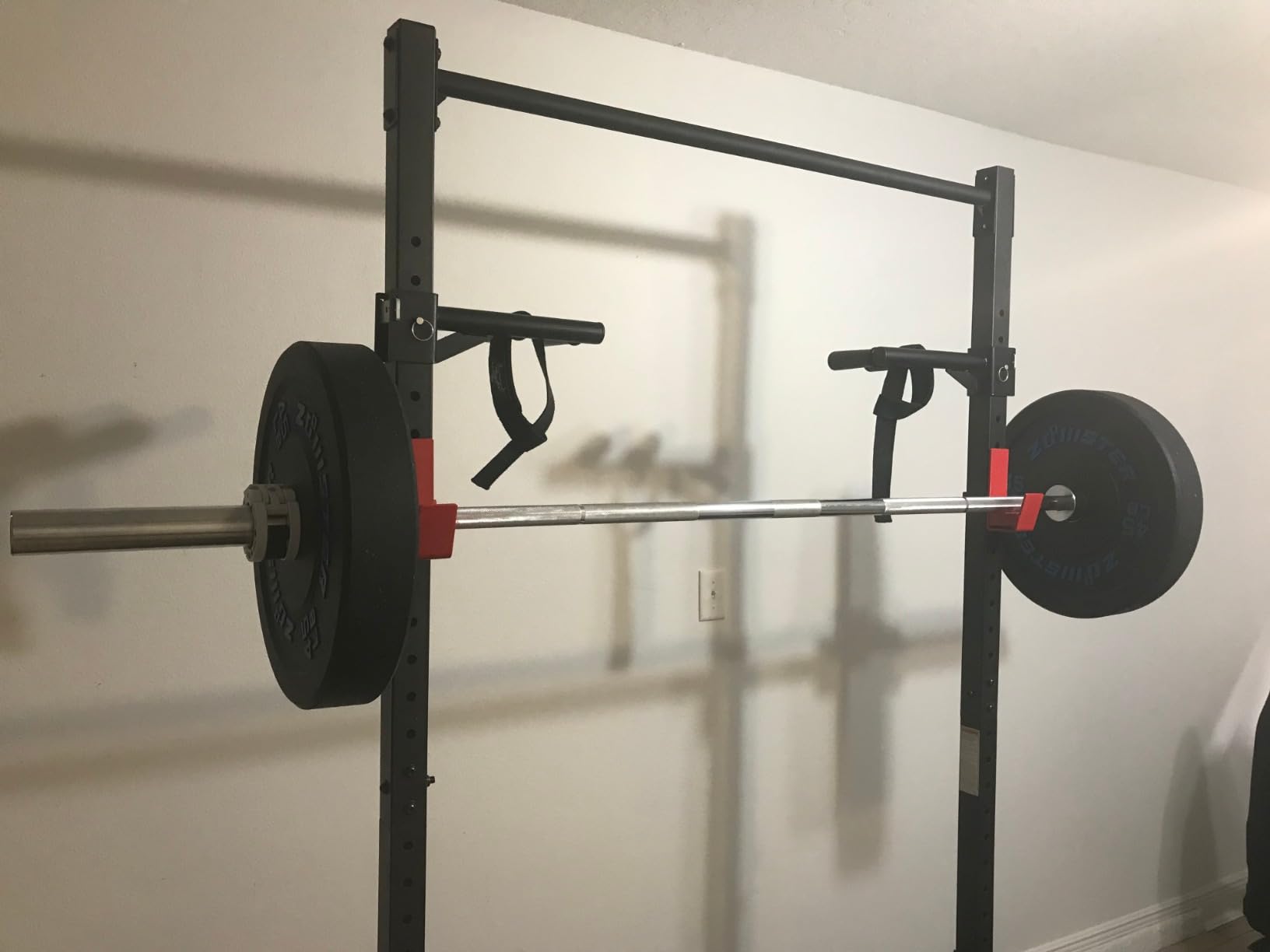
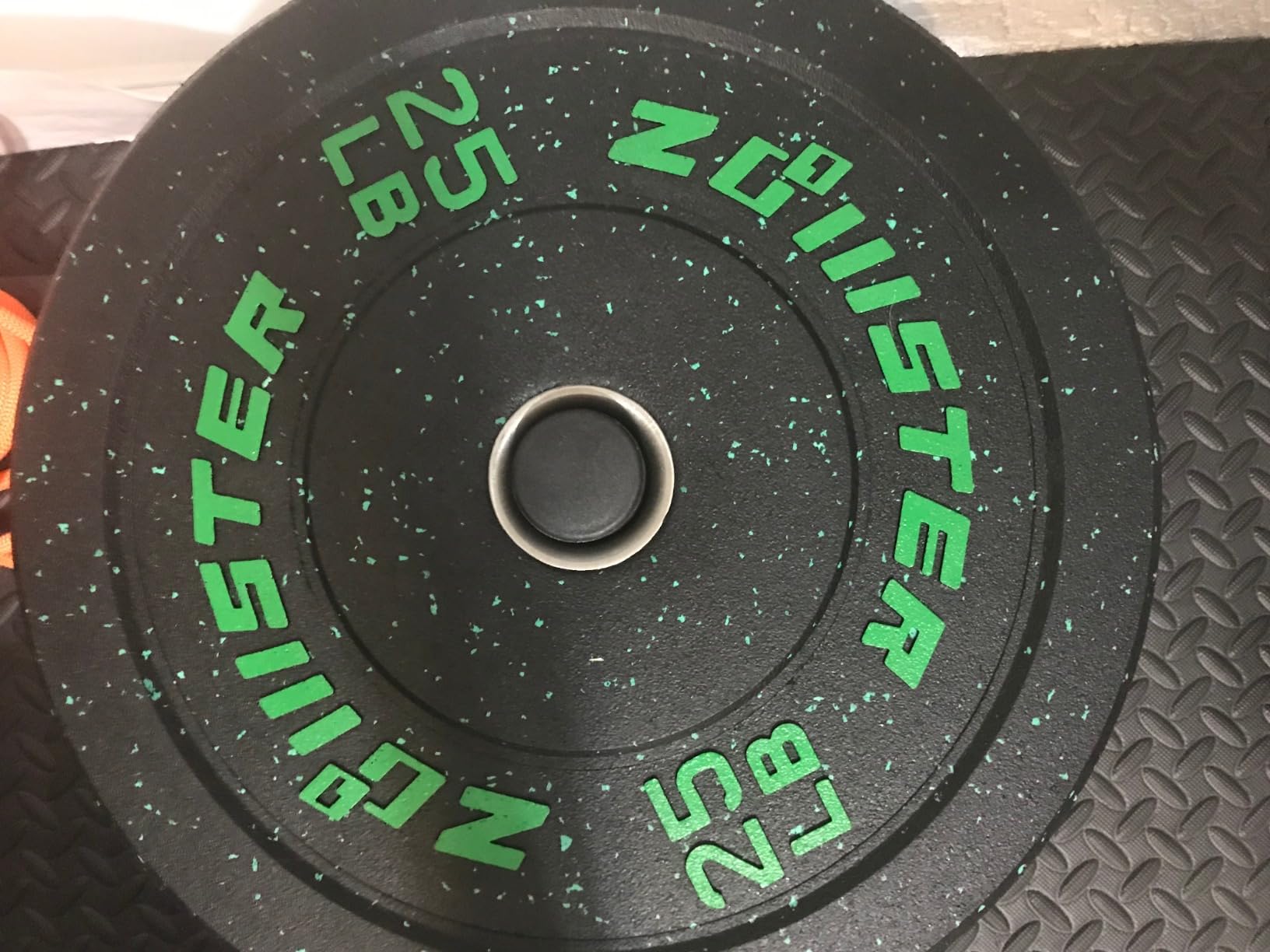
Markings are bold and easy to read, and plates slide onto the bar without a fight. That detail sounds trivial until you are re-racking a bar alone at the end of a long session. Packaging is reported as solid, and the value per pound is the strongest argument for this set among the 10 collected here.
The width issue deserves attention because it is not obvious until the bar is loaded. Crumb rubber plates are substantially wider than iron or urethane plates of the same weight, so a pair of 45s eats a lot of sleeve space. If your bar has a short usable sleeve length, plan your loadouts around fewer plates per side.
Who this set suits best
Anyone training in a space where noise is the binding constraint, including basement gyms, converted spare rooms and shared-wall apartments. The soft compound is the quietest option in this roundup, and the absence of a lingering rubber odor matters in an enclosed room.
It also suits budget-focused buyers who want a genuine full set of quality plates rather than one cheap plate. Buyers consistently frame the cost per pound as the reason they are satisfied.
Where it falls short
Heavy plates without handles are a real ergonomic problem. Loading two 45s onto a bar solo requires a controlled hip hinge, and there is no grip hole to help. If you will be moving plates frequently, budget for a plate dolly or a second set of hands.
The light plates are the weak point. Multiple reviews note that 10 lb and 15 lb plates are thin and can warp if dropped without support, which is the single most common complaint in this category regardless of brand.
3. BalanceFrom 260 lb Set – Best For Lifters Who Read Both Scales
BalanceFrom Olympic Rubber Bumper Weight Plate Set with Steel Hub Inserts – 2-Inch Hole Plates for Strength Training, Powerlifting, and Weightlifting at Home, Garage, or Commercial Gym
260 lb, 10 plates: pairs of 10 to 45 lb
Solid stainless steel 2-inch hub
Weight labels in lb and kg
Pros
- Solid stainless steel hub gives a wobble-free fit on bars and sleds
- Complete incremental set covers every common training jump
- Dual pound and kilogram labeling speeds up loading
- High-density rubber keeps landings quiet
Cons
- Lowest average rating in this group at 4.5
- Includes 35 lb plates that many home lifters never load
- A noticeable share of one-star ratings signals finish or build inconsistency
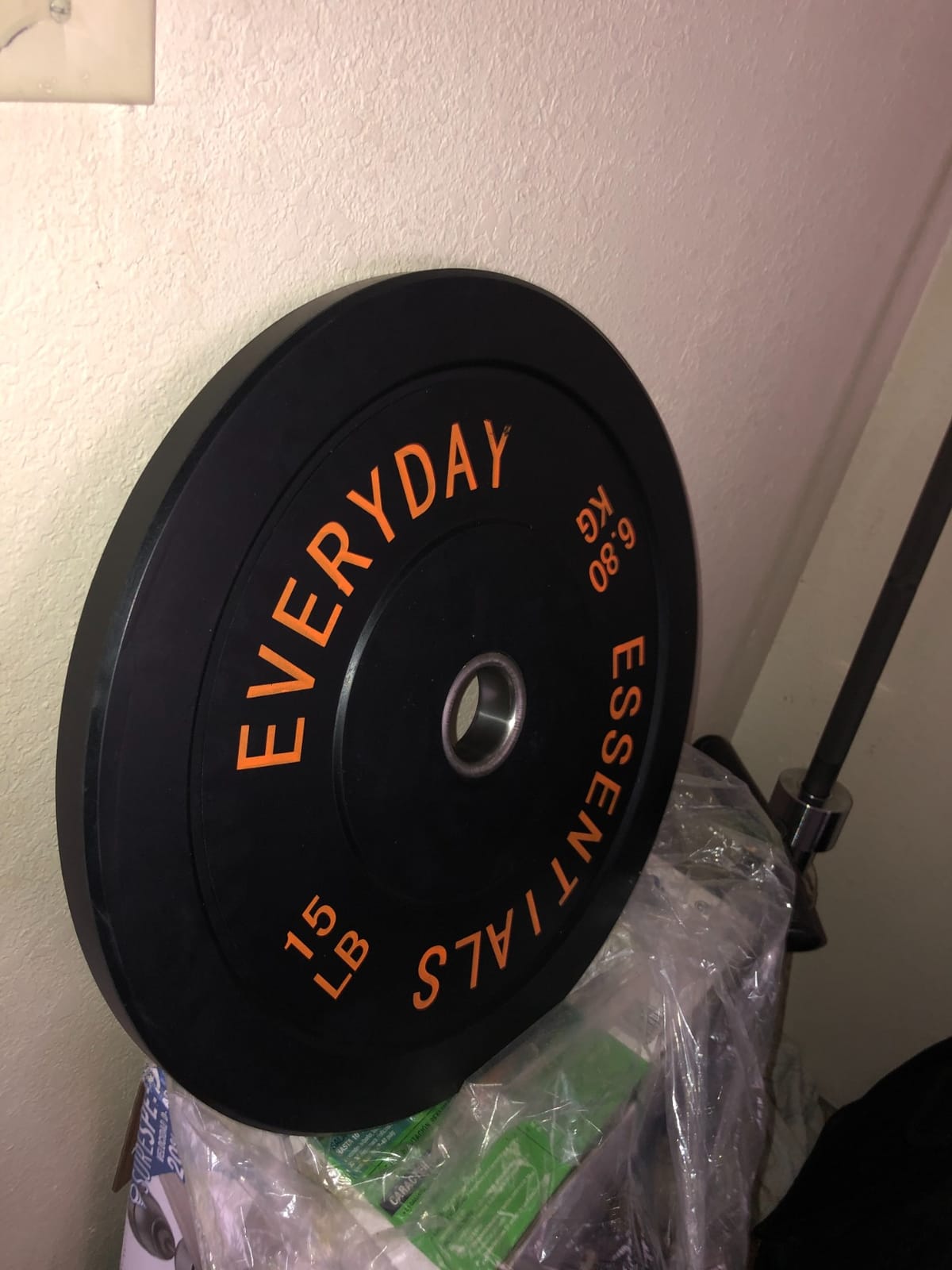
The BalanceFrom set is the only one in this roundup that labels every plate in both pounds and kilograms, and if you have ever tried to load 20 kg plates in a pound-based garage gym, you know how much friction that removes. Ten plates in matched pairs from 10 lb through 45 lb give a complete 260 lb set, which is the most training coverage you get without moving past 45 lb on a side.
Construction is a solid stainless steel 2-inch hub insert, and the plate also fits dumbbell bars and 2-inch sleds, which broadens its use beyond the barbell. The rubber is described as high-density, and in practice the plates land quietly and protect flooring and bar sleeves better than softer crumb compounds.
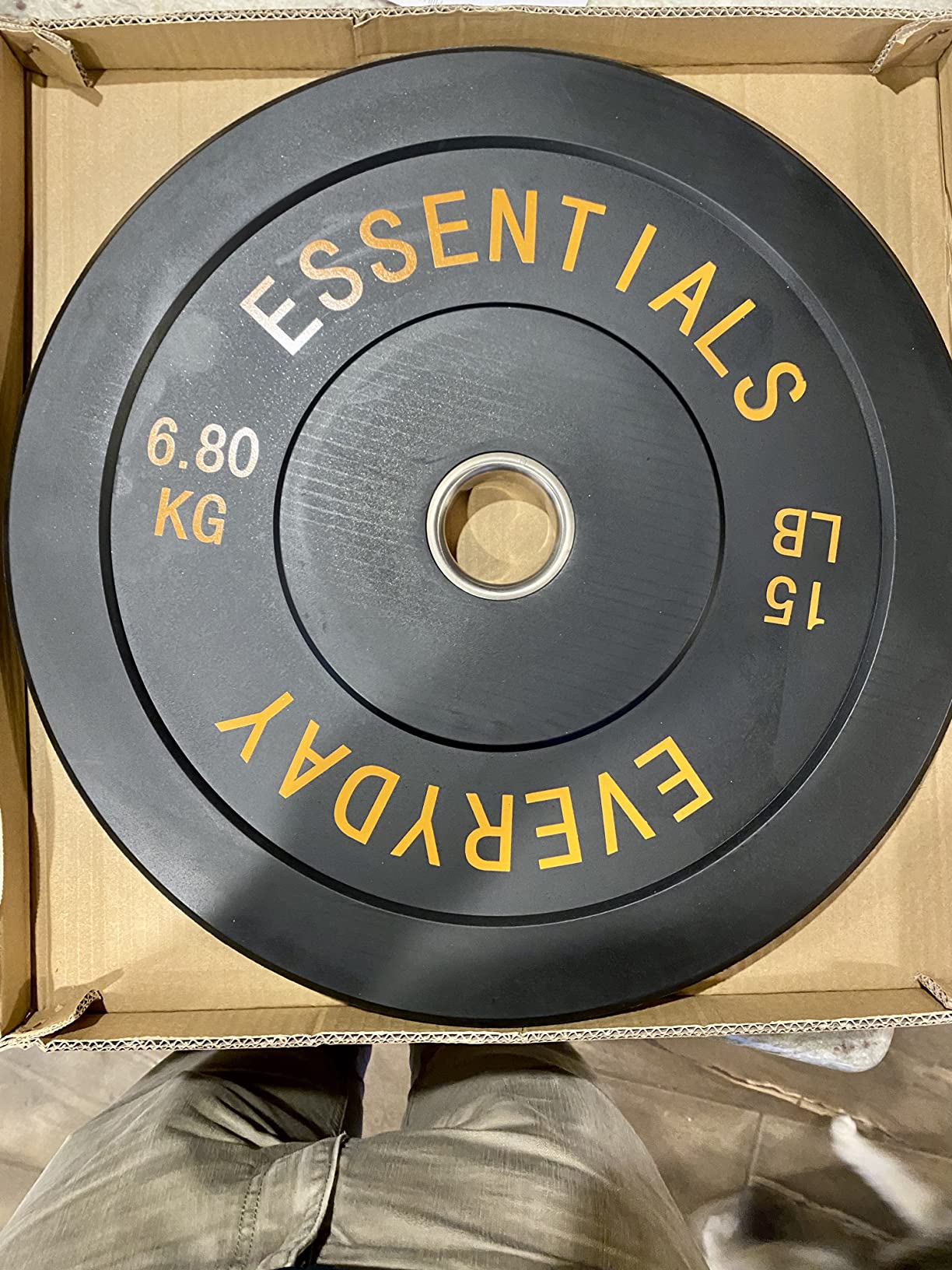
Where I want to set expectations honestly is on the ratings. This is the lowest average score among the ten sets here, at 4.5, with 6% of ratings landing at one star. The high-rating reviews point consistently at hub fit, quiet rubber and clear labeling, while the low ones describe build and finish problems that are not detailed enough in the sample to diagnose precisely.
One design choice worth arguing with: the set includes a pair of 35 lb plates. Forum lifters building a home set frequently note that 35s are among the weights they never end up loading, and a 25 plus a 10 gets you the same jump in most programs. It is not a flaw, but it is a weight better spent elsewhere.
Who this set suits best
Lifters who move between systems. Olympic weightlifting practice, powerlifting and gym-based strength work all live in this set, and the sled and dumbbell-bar compatibility widens it further. The dual-unit labeling is the quiet hero for anyone programming in kilograms at home.
It is also a strong choice if you want maximum weight coverage per purchase. At 260 lb across ten plates, this is the most plate-efficient configuration in the group for a standard bar.
Where it falls short
The 4.5 average is the clearest signal in the data. You are accepting a wider spread of outcomes than with the top-rated sets, which means a higher chance of a finish complaint. Inspect every plate on arrival rather than assuming the set is uniform.
Rubber plates also consume more sleeve space than iron plates of the same weight, so loading two 45s plus a 25 can be tight depending on your bar. Check your usable sleeve length before committing to a full 260 lb set.
4. Papababe 230 lb Set – Top Rated For Accuracy And Low Profile
High-Bounce Bumper Plates, 230lb set Olympic Weight Plates Home Gym Garage
230 lb: 2x10, 2x15, 2x20, 2x25, 2x45 lb
Recycled crumb rubber, anti-slip
Same diameter across all weights
Pros
- Best average rating in the group at 4.8 across 733 reviews
- Short plate height loads without needing a plate jack
- Weights measure accurate to within about 0.2 lb
- Color-coated finish wears well under near-daily use
Cons
- 10 lb plates are thin and flexible
- some sets arrive across multiple boxes
- Heavier set configurations cost more per pound than smaller ones
Papababe has the strongest rating profile of any set here, at 4.8, and owners describe the reason with unusual consistency: the plates are accurate and they are not thick. The 230 lb loadout includes a pair of 20 lb plates, which almost no other set in this roundup offers, and that fills a genuine gap between 15 and 25 in most progressive programs.
The low profile is the practical headline. Short plate height means a 45 lb plate per side does not raise the bar as far, so you are not scraping plates to set up for a squat or deadlift. If you have a low ceiling or a shallow squat setup, that geometry buys you room you would otherwise spend on a platform adjustment.
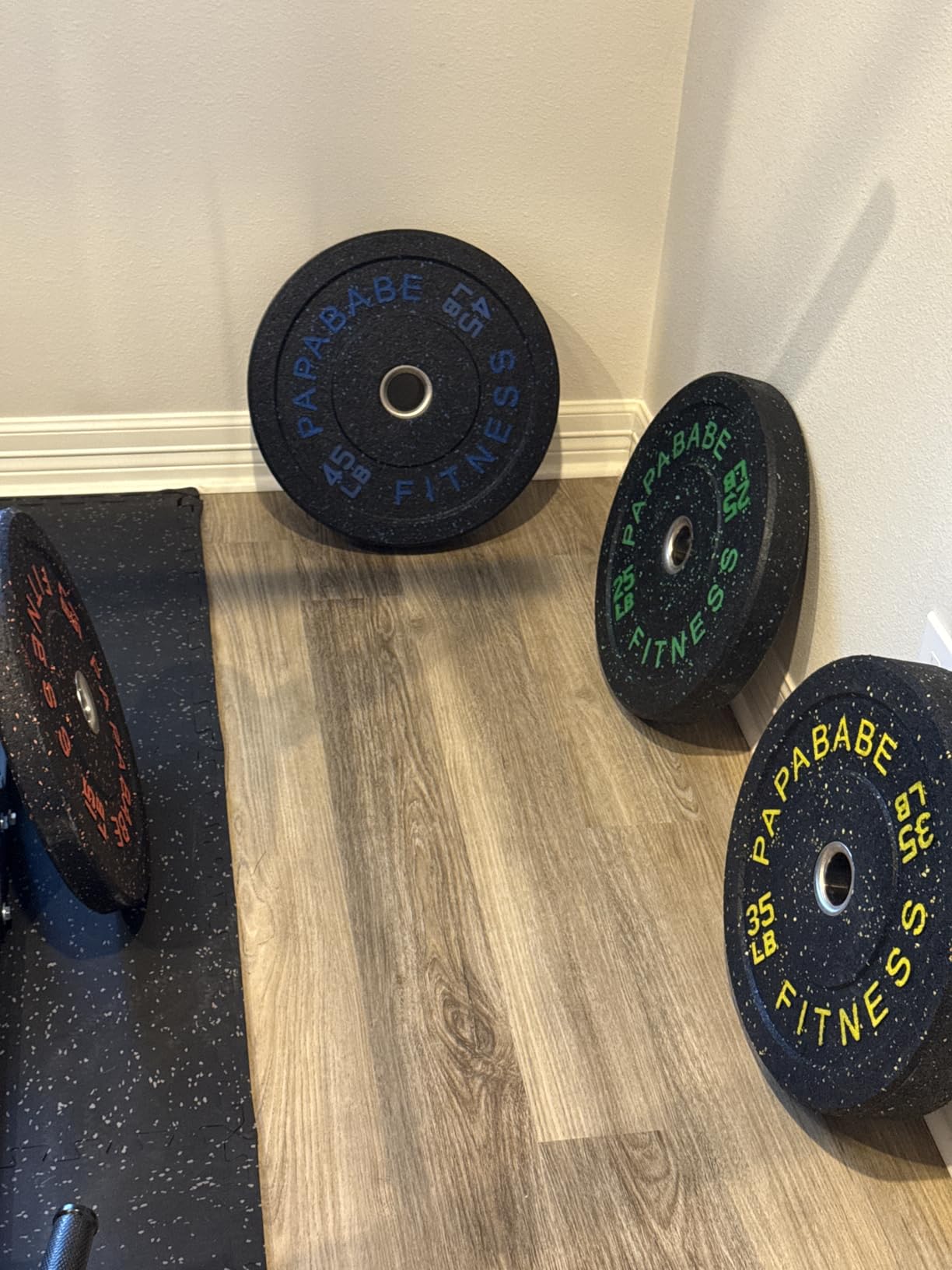
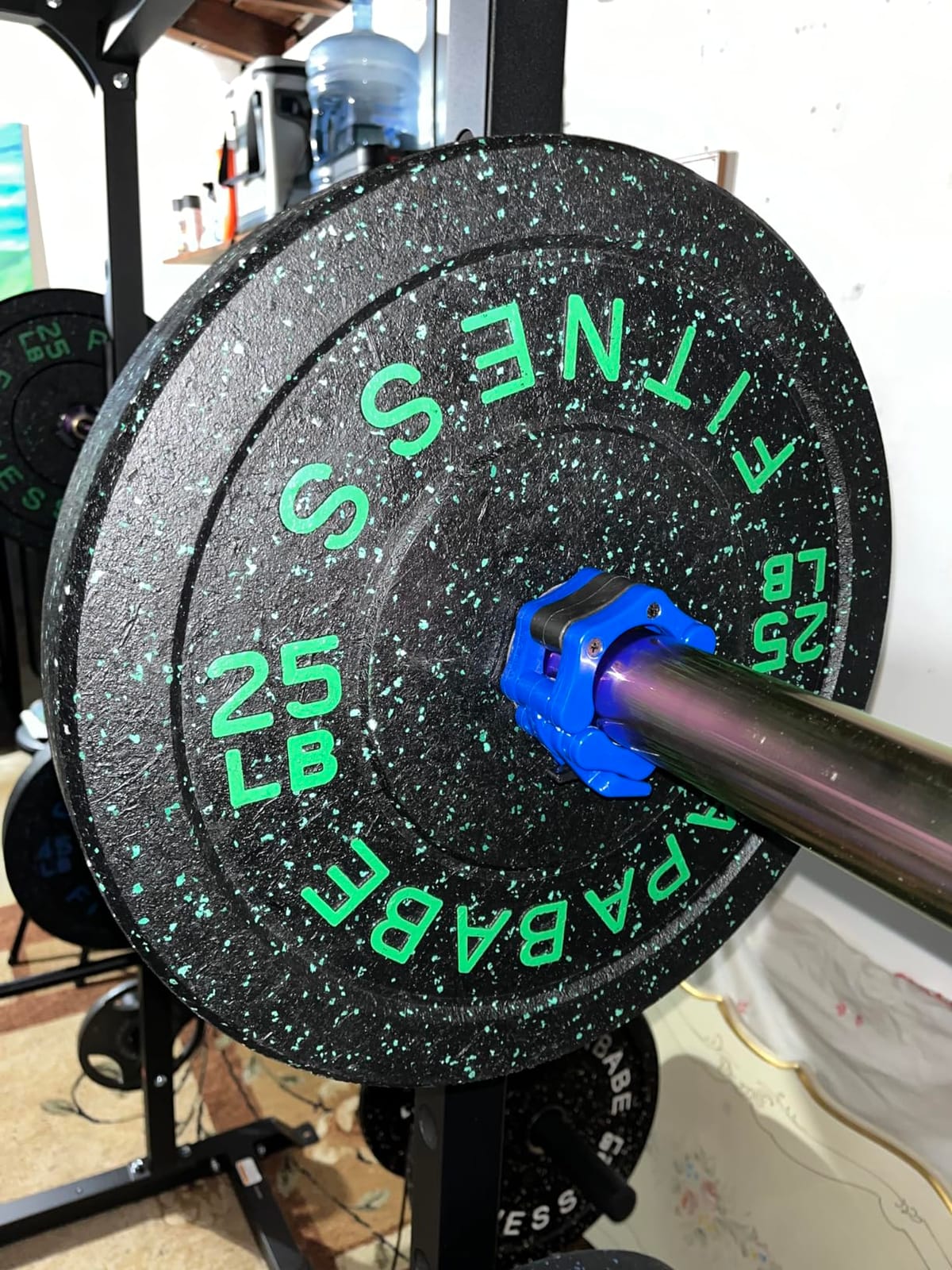
Weight accuracy is where this set separates itself. Buyers report measuring plates to within roughly 0.2 lb of the labeled weight, which is the kind of check I would otherwise expect only from a specialty retailer. Rubber is recycled crumb material described as non-toxic and eco-friendly, and the textured, grainy surface grips well when you are stripping the bar.
Owners also note the rubber smell is mild and fades within about a week, and several describe standardizing their home gym around this set specifically. The finish is color-coated and holds up under near-daily use rather than scuffing quickly.
Who this set suits best
Lifters who care about measurement accuracy, and anyone whose program depends on small jumps. If you are adding 5 lb to a working weight and want to know the plates are actually that, this is the set to buy. The 20 lb plates also make it a natural fit for a 5-10-15-20-25 incremental scheme.
Low-ceiling garages benefit most from the short profile. If your bar setup is already tight, thinner plates are the cheapest ceiling fix available.
Where it falls short
The 10 lb plates are thin and flexible, which makes them the weakest link and the plates most likely to taco. Reviewers also mention a light oil coating on arrival that wipes off, and the multi-box delivery pattern that recurs across this category.
Economics also flatten out as sets get larger. The cost per pound does not scale linearly, so the 230 lb configuration is a better value position than a much heavier set from the same brand would be.
5. CAP Barbell 260 lb Set – The Dependable Budget Starter
CAP 260lb Economy Olympic Bumper Plate Weight Set
260 lb: pairs of 10, 15, 25, 35 and 45 lb
Steel floating hub
Medium-bounce rubber blend
Pros
- Ranked number one in Strength Training Plates for strong category demand
- Slides onto bars smoothly with consistent center holes
- Well balanced on the bar
- Color-coded markers read clearly
Cons
- Ships with a heavy oil coating and a strong rubber smell that needs airing out
- Plates are slippery on the bar so use collars
- 10 lb and 15 lb plates are about an inch thick and feel flimsy solo
- Weights may vary slightly from labeled values
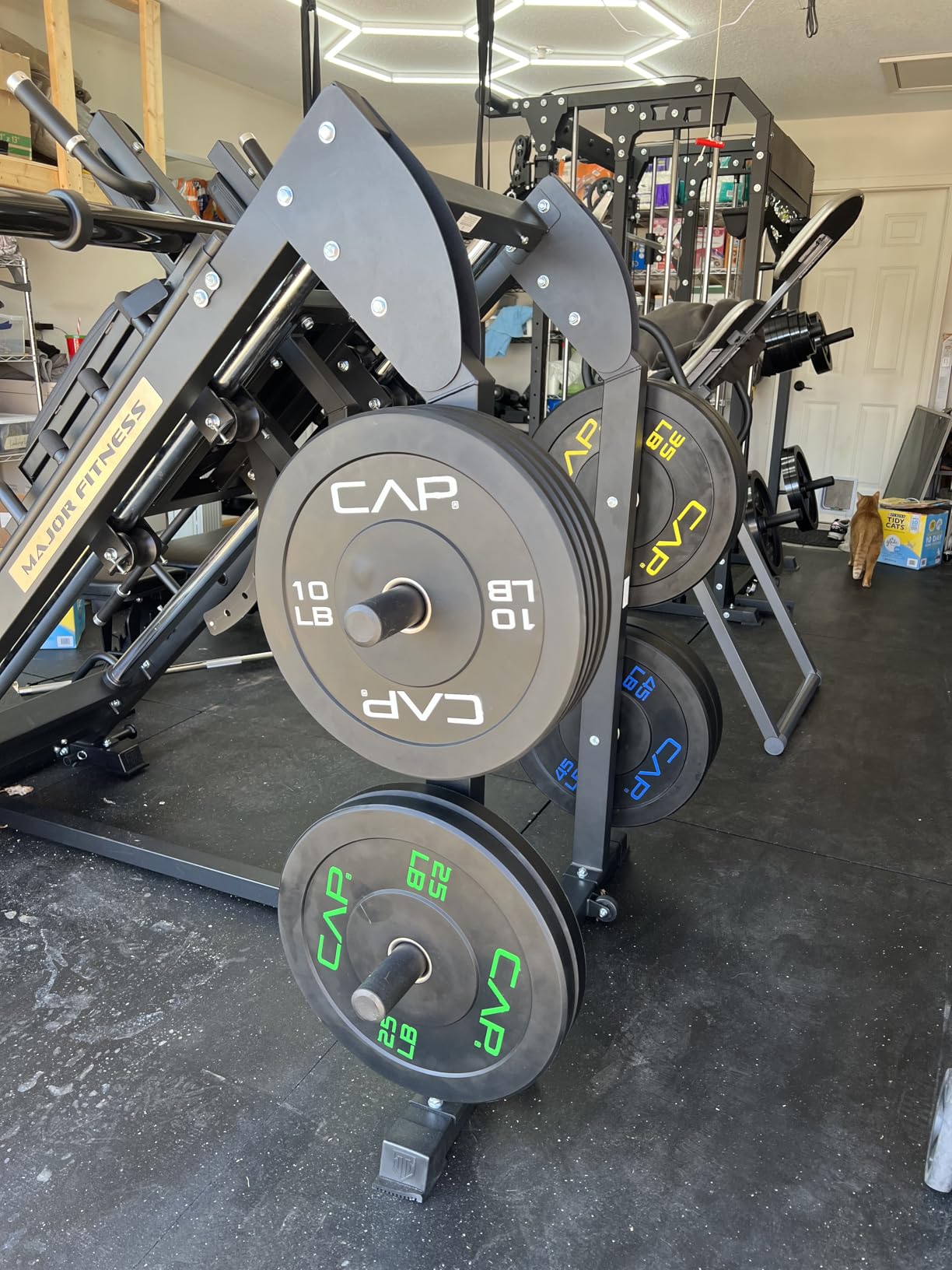
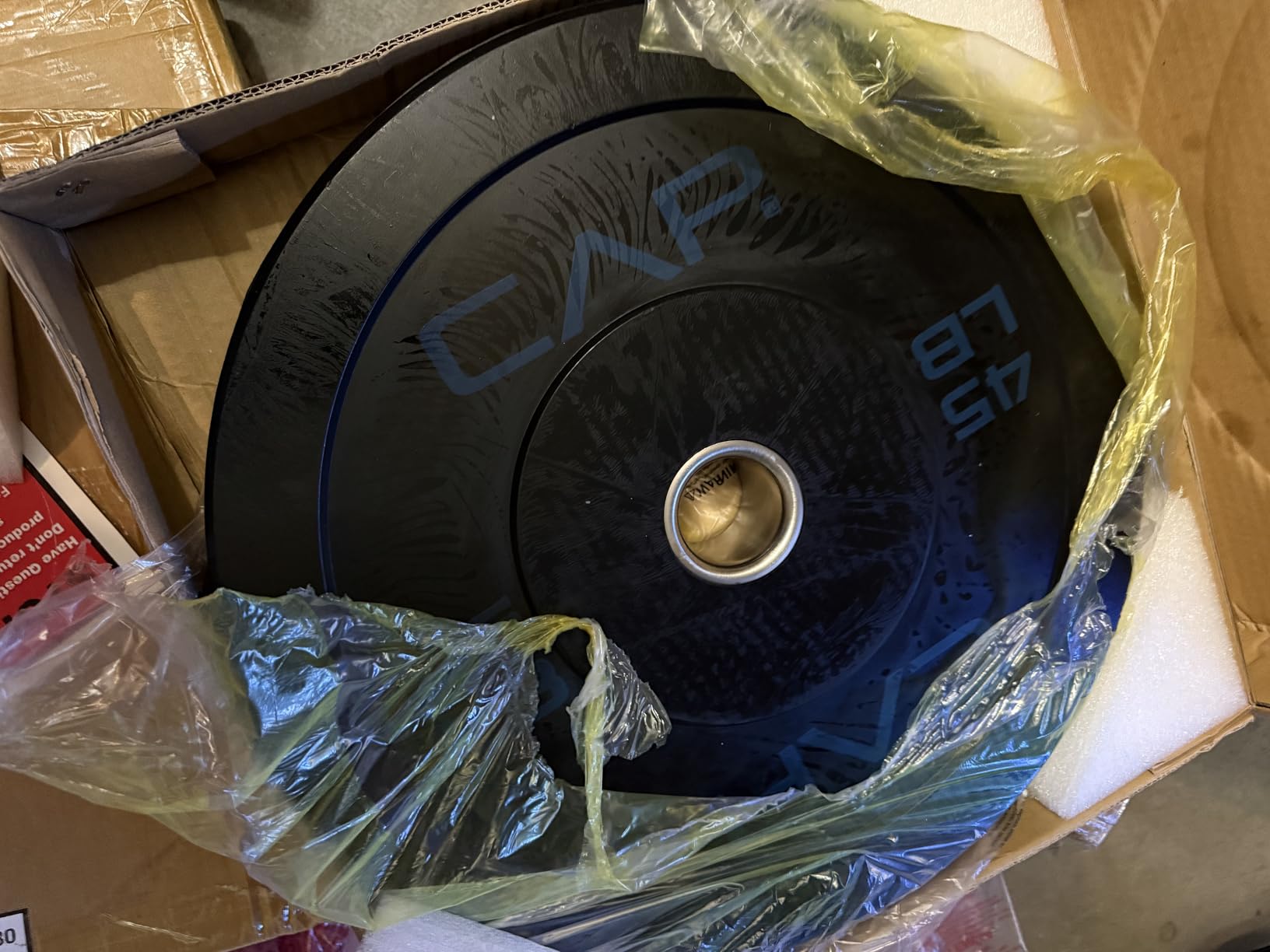
CAP Barbell is the name most people in a garage gym already recognize, and the 260 lb configuration is a complete matched set of five pairs. The steel floating hub is a sensible design choice because it lets the plate center move slightly, which reduces the binding you feel with a rigid insert when the sleeve is not perfectly aligned.
Buyers consistently report smooth loading with consistent center holes and plates that sit well balanced on the bar, which is the confidence factor that matters in a back squat. The rubber is a medium-bounce blend, positioned between the soft crumb sets and the livelier high-bounce options, and it is described as absorbing impact while reducing noise during controlled drops.
Two practical warnings, both repeated across nearly every review. The plates arrive coated in a heavy oil or grease with a strong rubber smell, and the fix that owners use is soap, water and a few days of airing out in the garage. Until you do that, expect to handle something slippery. Related to that, several reviewers advise using bar collars because of the slick surface once loaded.
The light plates are the other weak point. At roughly an inch thick, the 10 lb and 15 lb plates are described as flimsy when used solo, and weights are budget-grade with some variation from labeled values. Set it against the 4.5 rating with an 8% three-star share, which is the widest spread in the group.
Who this set suits best
First-time garage gym owners who want a complete, recognizable set from an established brand and would rather not research ten options. The 260 lb configuration is heavy enough that most beginners will not outgrow it within a year, and the breadth of options from 100 lb to 370 lb means you can add matching plates later instead of replacing the set.
It also suits anyone who will use a plate tree, since the finish looks professional and the color markers make inventory at a glance easy.
Where it falls short
The factory oil coating and rubber odor are a real unboxing experience problem, and the plates stay slippery on the sleeve until you wash them. That is a fifteen-minute job done once, but it is a job.
Weight accuracy is the second concern. If your program depends on precise loading, verify plates on a scale before you trust them. And those thin light plates are exactly the ones you will drop alone while changing weights, so expect to handle them gently.
6. HANDBODE 100 lb Set – A Compact Starter Loadout
HANDBODE 2-Inch High-Bounce Bumper Plate, Olympic Weight Plates 100 lb Set
100 lb set: 2x10, 2x15, 2x25 lb
100% recycled vulcanized rubber
50mm reinforced steel ring hole
Pros
- The most compact full set here
- ideal for a small garage
- Weights reported accurate to within about 0.2 lb
- Color-coded flecks make weight selection straightforward
- Some buyers report no rubber smell at all
Cons
- 10 lb plate is thin and flimsy
- Center ring does not appear to be held by adhesive
- Lighter plates are very wide for their weight which looks misleading
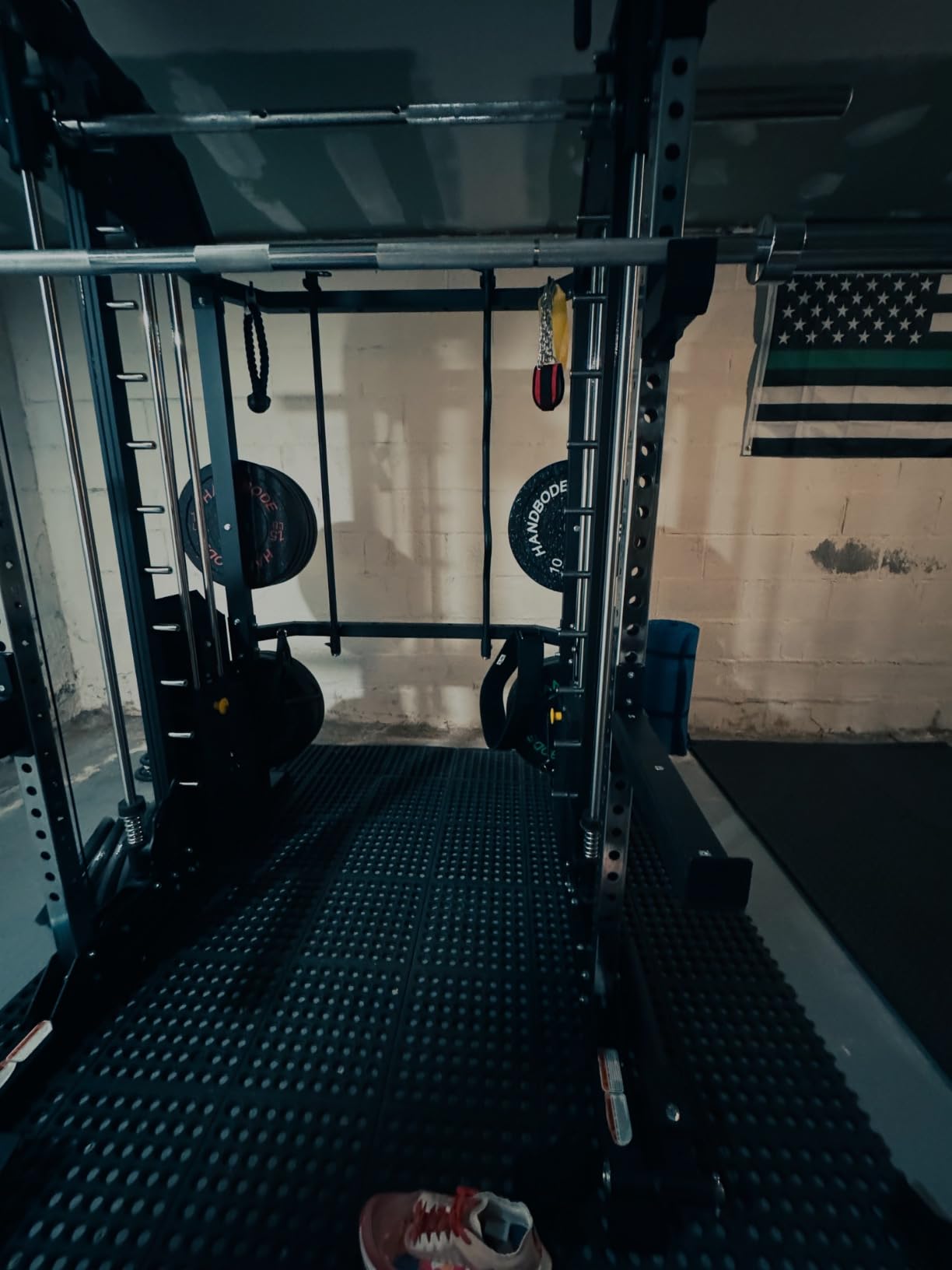
The HANDBODE set exists to solve a problem most roundups ignore: not every garage can hold a full 260 lb set, and not every lifter needs one. Six plates across three weights total 100 lb, and that footprint is small enough to live on a corner plate tree without taking over the bay.
Construction is 100% recycled vulcanized rubber with a reinforced 50mm steel ring hole sized for standard 2-inch sleeves. The uniform diameter claim matters more than it sounds: because every plate shares one diameter and only thickness changes, the bar stays balanced, which is a small sign of disciplined manufacturing.
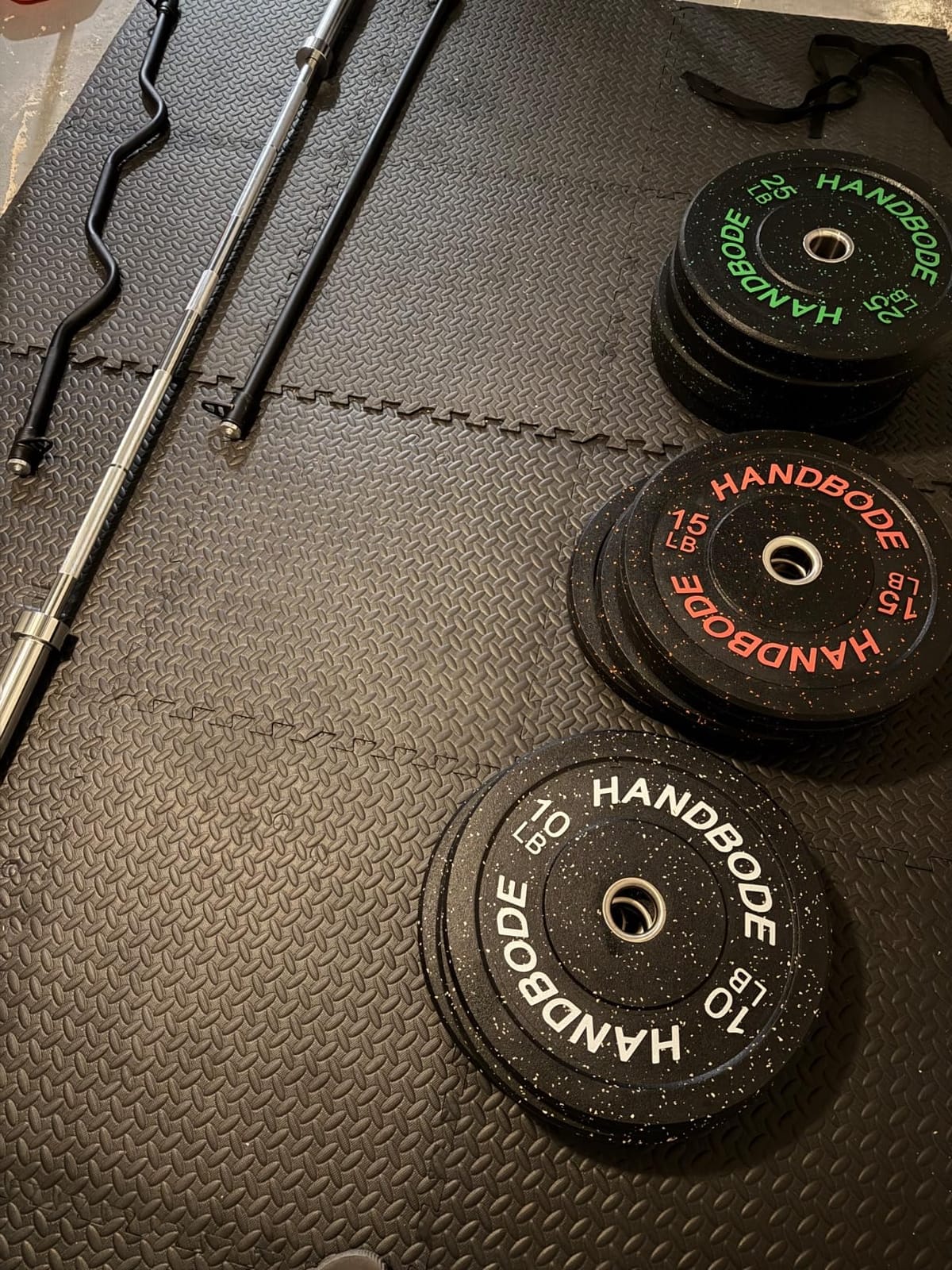
Buyers rate the plates as attractive and sturdy, with weight accuracy to within roughly 0.2 lb and a 4.7 average across 522 reviews. Color-coded flecks make it fast to pick the right plate, and some owners report no rubber smell at all, which is not typical for crumb rubber at this level.
The concern I would flag is the hub. Several reviewers note that the center ring does not appear to be held by adhesive, which raises a reasonable question about long-term insert security once the plates start taking real drop abuse. That is not an immediate failure, but it is the detail I would watch over the first year of use.
Who this set suits best
Beginners working in the 10 to 25 lb per-side range, and anyone in a genuinely small garage where a 260 lb set would dominate the available floor space. It is also a sensible first step for a lifter who wants to confirm that they like rubber plates before committing to a full set.
If you plan to add weight within a year, this is a low-commitment way in. The construction and color coding are consistent enough that a later matching purchase is straightforward.
Where it falls short
Six plates is not much in the way of loading options. Without 45s you cannot squat heavy, and the missing 35s limit the jump sizes available to you. Treat this as a start, not a destination.
The thin 10 lb plate and the adhesive question on the steel ring are the two real limitations. And the light plates being wider than you would expect for their weight is a visual reminder that crumb rubber does not scale thickness neatly with mass.
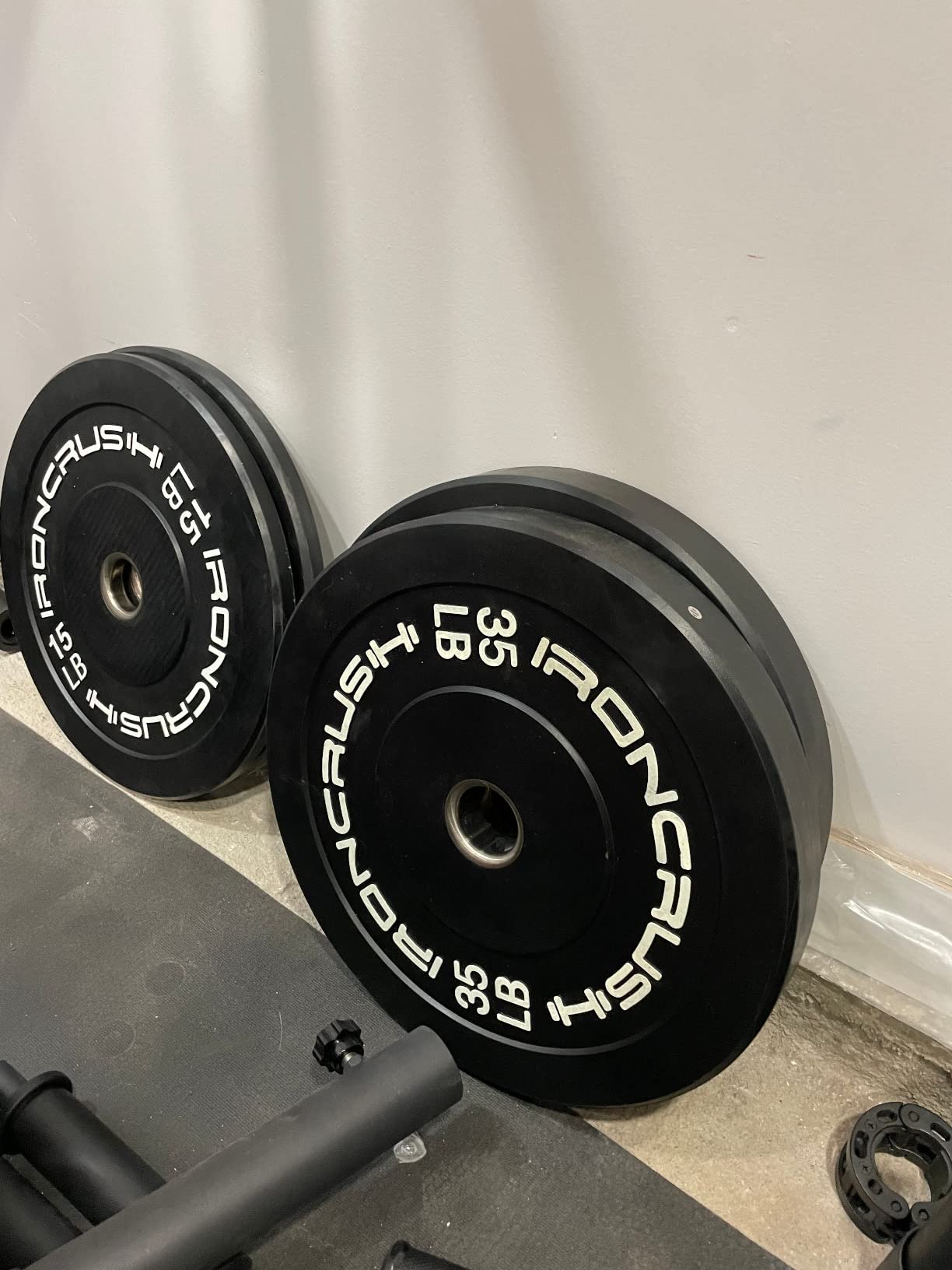
7. Iron Crush Virgin Rubber Pairs – Best For Dead Bounce And IWF Sizing
Iron Crush Olympic Bumper Plates Set – Virgin Rubber Weights for Strength Training – Stainless Steel Inserts, Fits 2″ Barbells – Low, Dead Bounce for Safety – 10lb to 45lb – Sold in Pairs
Sold in pairs, 10 to 45 lb
Virgin rubber, low dead bounce
450mm diameter per IWF regulations
Pros
- Only set here listed at the IWF-standard 450mm diameter
- Virgin rubber is tougher and more shock absorbent than ordinary rubber
- Low dead bounce suits confined home gym spaces
- 10 lb plate is 1.05 inches thick
- thicker than most competitors
Cons
- Sold only in pairs so a full set needs multiple listings
- Lowest bestseller rank in this group
- Dead bounce feels noticeably less lively on Olympic lifts
Iron Crush is the only set in this roundup listed at 450mm, the IWF standard diameter, and if you are training Olympic lifts the difference is not academic. A 17.5-inch plate sits lower in the bottom position and changes how a clean or a snatch feels at the catch. The low, dead bounce also means the bar settles instead of rebounding into your hands.
Virgin rubber is the other differentiator. It is described as tougher than regular rubber, more shock absorbent and less odorous, and the 4.7 rating with only 1% one-star ratings is the tightest quality distribution in the group. Reviewers respond to the durability claim rather than questioning it.
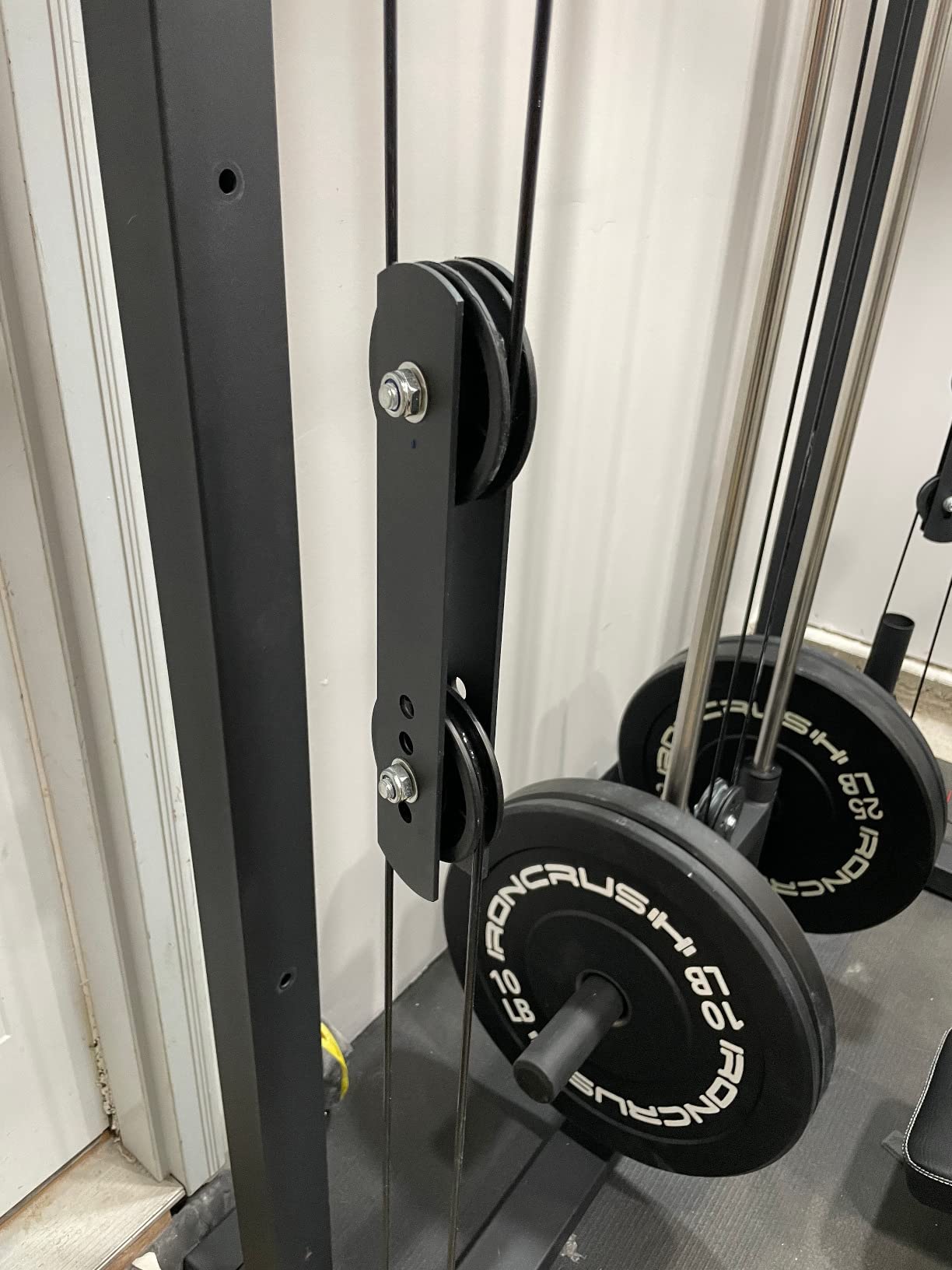
Premium stainless steel inserts reinforce the hub, which is the standard defense against the insert working loose in the rubber over time. IWF-consistent geometry across the range is a genuine advantage for anyone who might later upgrade to a competition bar.
The unusual feature is the 10 lb plate thickness at 1.05 inches, thicker than most budget alternatives. Since tacoing on light plates is a near-universal complaint, a thicker 10 lb is a small, meaningful upgrade. The catch is format: plates are sold in pairs, so building a full set means placing several separate orders and tracking which weights you already have.
Who this set suits best
Olympic lifters and anyone whose garage has a low ceiling or tight clearances, since dead bounce keeps the bar from rebounding into equipment or walls. The 450mm diameter makes these the most competition-adjacent plates in the roundup.
They also suit anyone who has previously been disappointed by crumb rubber smell and softness. Virgin rubber addresses both, and the low one-star share suggests build consistency that is harder to find elsewhere.
Where it falls short
Pair-only purchasing is the practical drawback. Assembling a usable set takes multiple listings, and managing that across a first build is genuinely more work than opening one box.
Dead bounce is not universally preferable. Lifters doing explosive work may find the bar less lively on the rebound, and anyone who wants plate hop or bounce as part of their training will find these too flat. This is also the set with the weakest bestseller rank here, so expect less community troubleshooting if something goes wrong.
8. HULKFIT Bumper Set With 7 ft Bar – The Complete Starting Kit
HULKFIT 2-Inch Olympic Rubber Weight Plates Sets, Bumper Plates Set with 7ft Bar, 180LB Set, Colored
Bumper plate set bundled with a 7 ft Olympic bar
100% virgin, high-density rubber
Machined solid steel 2-inch insert
Pros
- Bar included
- so it is a genuinely complete starting kit
- Low-bounce compound limits dangerous rebound
- Precision-machined steel ring stays firmly in place
- Quiet and vibration-free
- suited to garages and shared spaces
Cons
- Bundled sets cost more than buying plates alone
- 4.6 rating trails the best-rated sets in this roundup
- Bundles range from 100 lb to 390 lb so plate count varies by option
The HULKFIT bundles are the only products in this roundup that include an Olympic bar, and for a garage gym starting from nothing that changes the arithmetic entirely. Instead of sourcing a bar, plates and a rack separately, you are buying the two pieces that must match on sleeve diameter and length in one package.
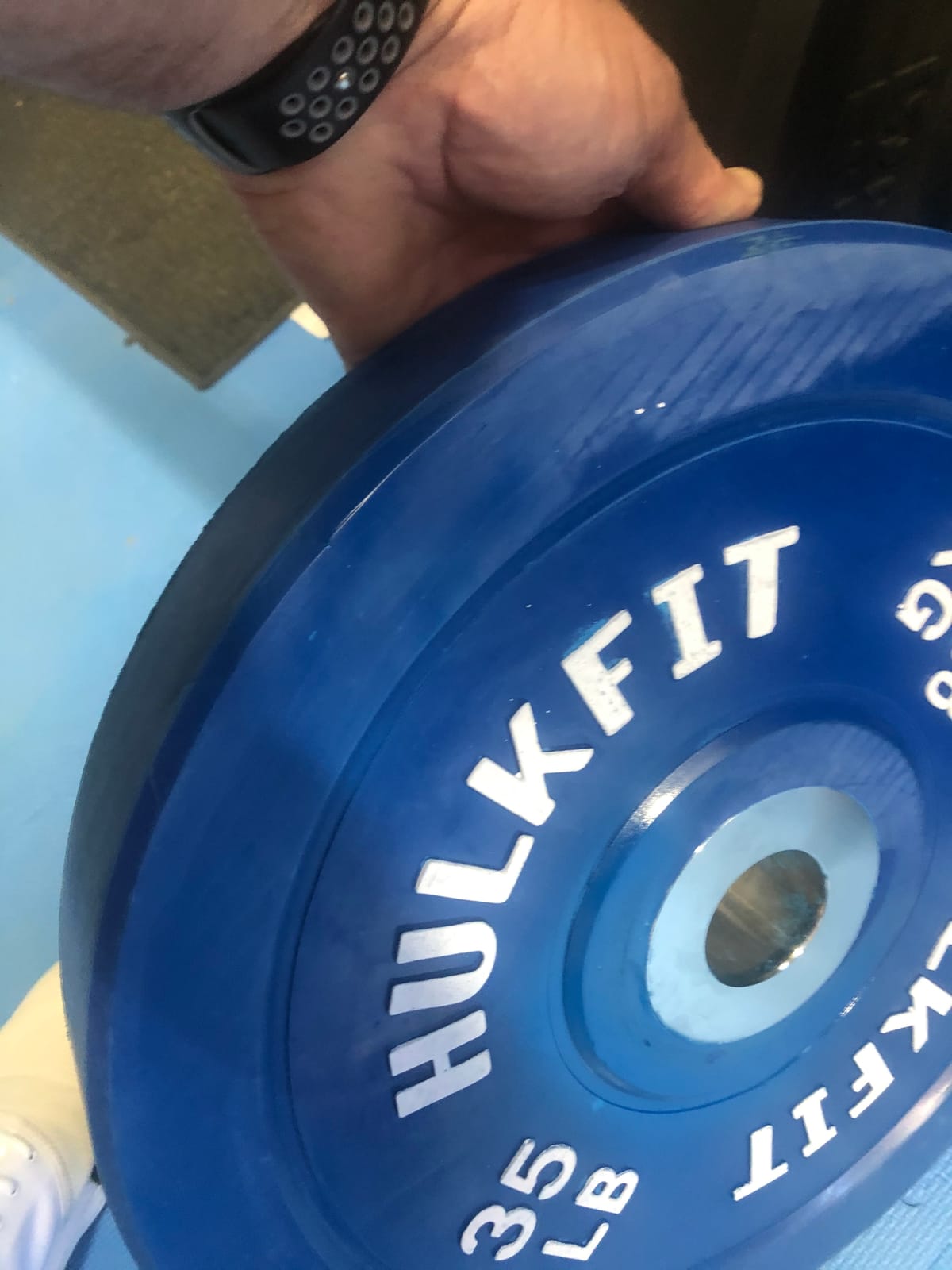
The rubber is 100% virgin, high-density material, and the low-bounce formulation is doing real work here. Reviewers highlight reduced dangerous rebound and floor damage, and describe the plates as quiet and vibration-free, which is a meaningful claim in a room attached to living space.
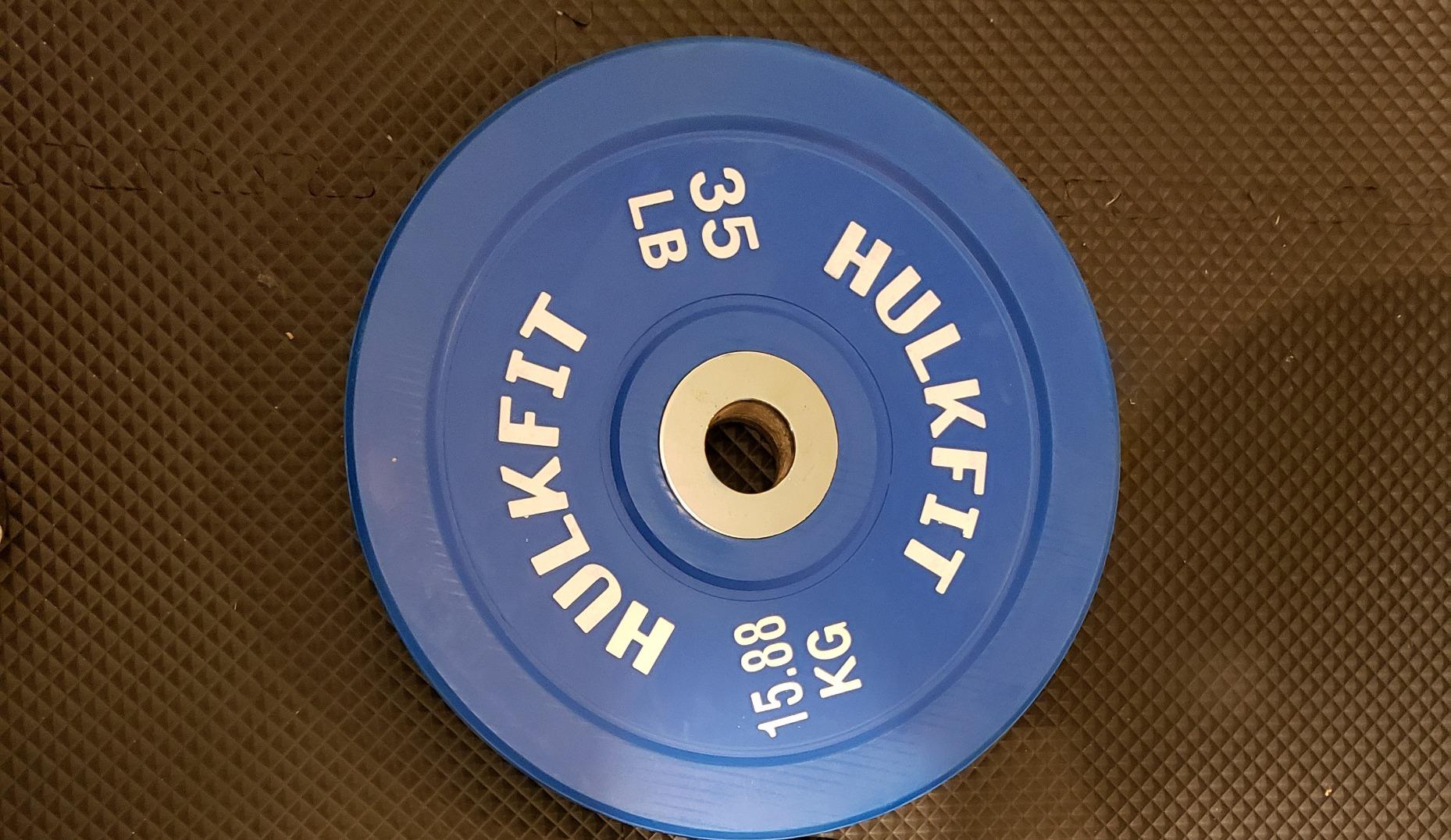
The insert is the part I would inspect on arrival. A precision-machined 2-inch solid steel ring is described as staying firmly in place for a wobble-free fit, and the plates are engineered to resist bending under repeated high-altitude drops rather than tacoing, which would be a meaningful upgrade over the thin light plates in the budget sets here.
The trade is straightforward arithmetic. Bundles span 100 lb to 390 lb, and paying for a bar inside the bundle is rarely cheaper than sourcing components yourself. It buys convenience and matched geometry, not a discount.
Who this set suits best
Anyone starting a garage gym from a completely empty floor who wants a bar and plates in a single purchase. It removes the most common beginner mistake, which is buying a bar whose sleeve length leaves no room for bumper plates.
It also suits lifters in apartments or attached rooms where vibration and noise transmit through structure. The quiet, low-bounce formulation is the reason to choose it over a livelier set.
Where it falls short
If you already own a barbell, skip the bundle. The included bar adds cost without adding anything you can use, and buying plates alone gives you more flexibility on total weight.
The 4.6 average is mid-pack for this group, and the plate count varies depending on which bundle configuration you pick, so confirm the actual loadout rather than assuming a standard 10-plate set. Durable light plates also cost more to produce, and the review base is smaller here than for the top sets.
9. REP Fitness Bumper Plates – The Cleanest Molded Rubber
REP Fitness Rubber Bumper Plates, 45 LB Set, Olympic Standard Weights, Shock Absorbing Low Bounce Design, For Home Gyms, Fitness Centers, Strength Workouts, Barbell Use
Pairs from 5 lb up to 370 lb sets
Low-bounce shock-absorbing rubber
Precision-machined solid steel center ring
Pros
- Clean molding with no flash or release-agent residue
- Internal reinforcements stop inserts twisting out of the rubber
- Integrated grip holes make plates easy to move and carry
- Plates do not buckle or fold under bar weight
- Minimal odor for a basement gym
Cons
- Rubber plates take more sleeve space than iron plates
- Raised lettering needs a soft brush to clean
- Inner steel ring can rub grooved sleeves and shed metal dust
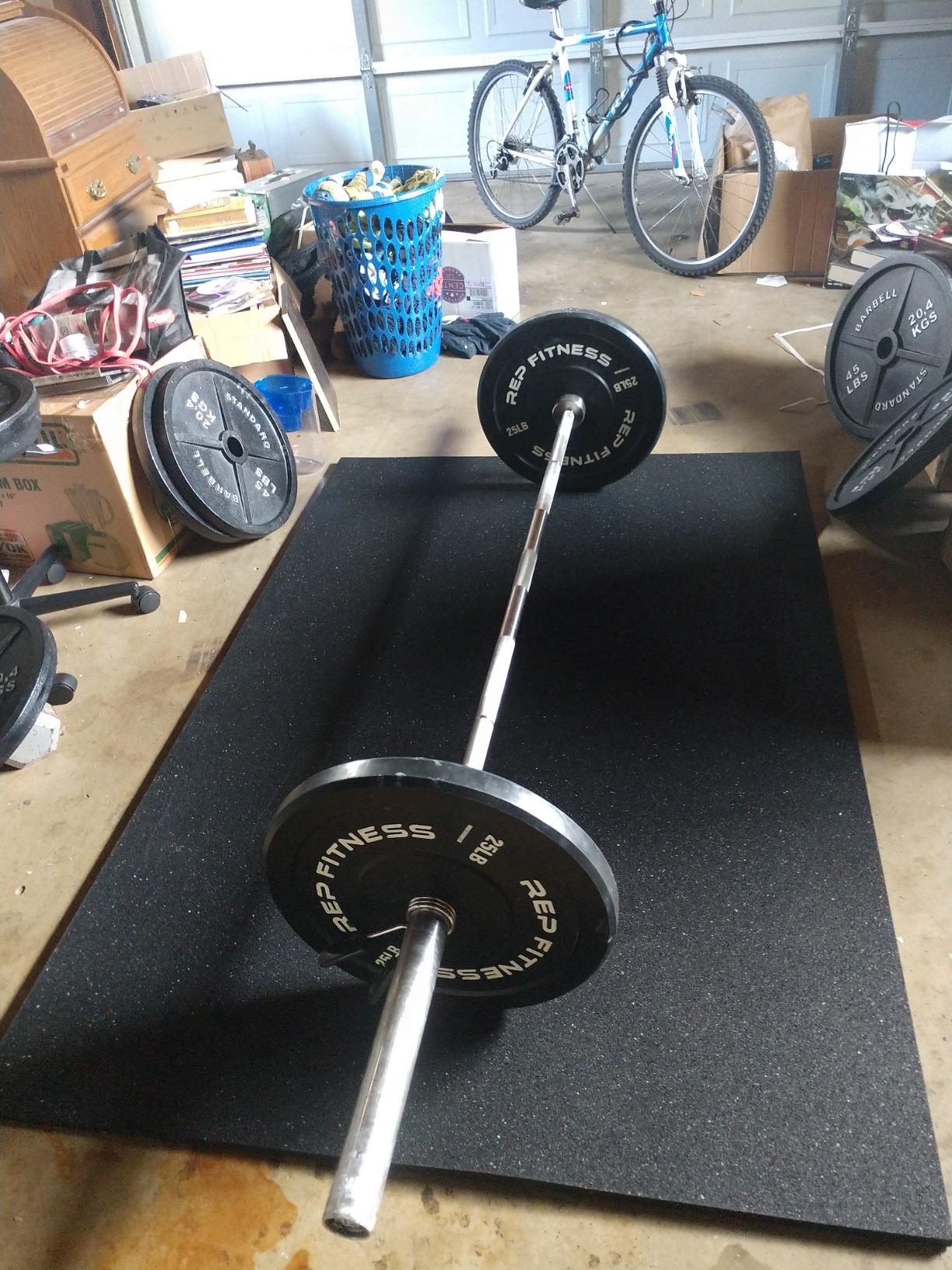
REP Fitness gets the most detailed reviews in this group, and the praise is specific enough to be useful rather than generic. Owners inspect the molding and find no flash, no residue, no molding defects. That sounds fussy until you have handled a set with a rough parting line that chafes your forearm on every rep.
The internal reinforcements are the more important engineering detail. Rather than bonding a steel ring into rubber and hoping it holds, REP adds internal structure that resists the insert twisting out under repeated drop abuse. Reviewers confirm plates do not buckle or fold under bar weight, which is the failure that ends a plate’s life.
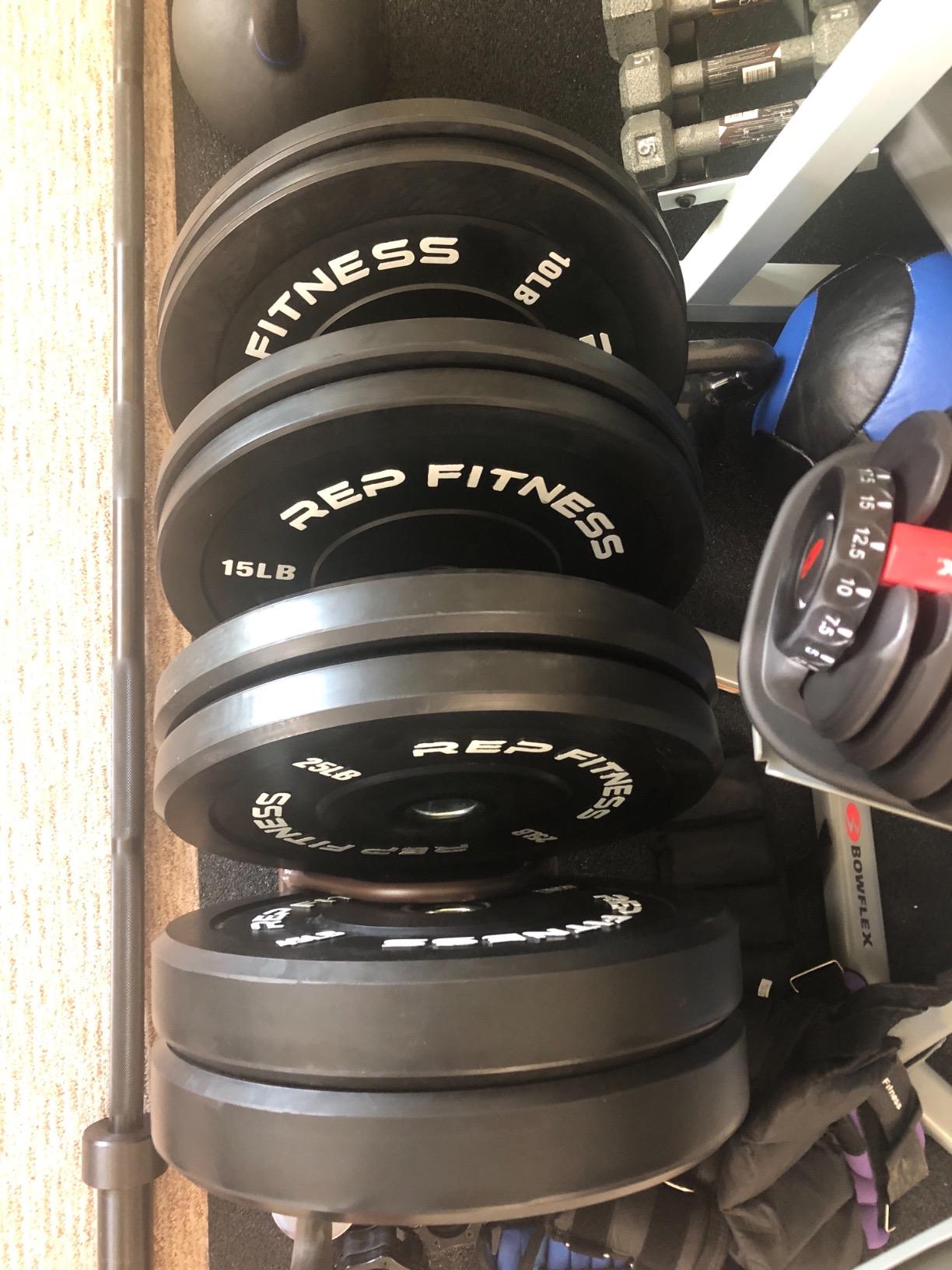
Grip holes are built into the plates themselves, which solves the handling problem that flattens most rubber sets. The holes make loading faster and let the plates double as a carry or twist implement, a genuinely useful feature when you are alone in a garage with a heavy bar.
Options run from 5 lb pairs all the way to 370 lb sets, and the low-bounce compound is described as shock-absorbing with minimal odor, which matters in a basement. Customer service is also reported as responsive when a shipment is delayed.
Who this set suits best
Lifters who train alone in a garage and care about build quality over price. The grip holes alone justify this set for solo training, and the reinforced inserts target the durability question that most rubber plate reviews raise.
It also suits anyone sensitive to rubber smell, and anyone who wants to build gradually, since 5 lb pairs let you load smaller jumps than any other option in this roundup.
Where it falls short
The standard rubber-plate trade-off applies: they consume considerably more sleeve space than iron plates, so plan your loadouts around fewer plates per side. The raised lettering also needs a soft brush to clean, which is a minor chore in a dusty garage.
The one long-term concern in reviews is the inner steel ring rubbing against grooved bar sleeves and shedding metal dust. On a knurled power bar the effect is minimal, but on a finely grooved competition sleeve it is worth pairing with a sleeve protector.
10. Yes4All 100 lb Set – Best Compact Set With A Clean Finish
Yes4All 2-Inch Bumper Plate, Olympic Rubber Weight Plate with Steel Insert for Weightlifting & Strength Training (100LB Plate Set)
100 lb: 2x10, 2x15, 2x25 lb
Crumb rubber with moderate bounce
Color-coated finish, minimal odor
Pros
- Minimal bounce and odor from high-grade rubber
- Moderate rebound protects flooring and the barbell sleeve
- Correct weight with few visible imperfections
- Attractive color coating that looks clean on the bar
Cons
- Smallest review base in this group at 251 ratings
- Light oil coating makes plates slippery for the first few days
- Only three weights in the set limits loading options
The Yes4All set is the smallest configuration here at 100 lb across six plates, and it earns its place by doing the basic things well. Crumb rubber with moderate bounce sits in the middle of the range, protecting the floor and the bar sleeve without the softness that makes some sets feel vague under load.
Finish quality comes up repeatedly in reviews. Owners report correct weight, an attractive color coating and few visible imperfections, and the 86% five-star share is among the strongest in the group despite a small sample.
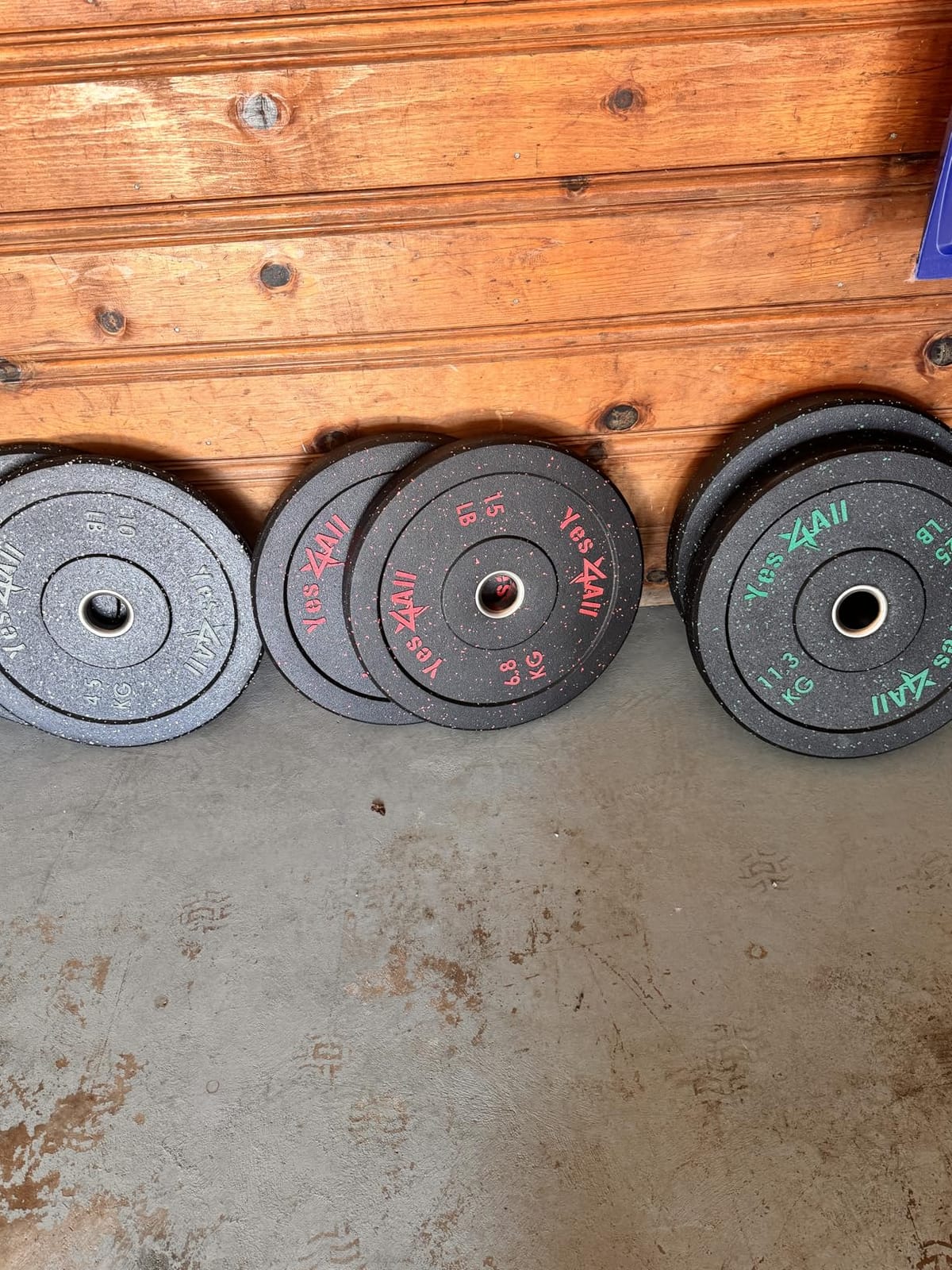
Odor is minimal, which puts it closer to REP than to most crumb rubber sets. The 2-inch center hole fits all Olympic barbells and the plates suit squats, deadlifts, cleans and bench, so there is no awkward gap in what the set can be used for.
One minor issue appears repeatedly: a light oil coating on arrival makes the plates slippery to grip for the first few days before it wears off. It resolves itself, and unlike heavier oil coatings it does not demand a full wash-down before use.
Who this set suits best
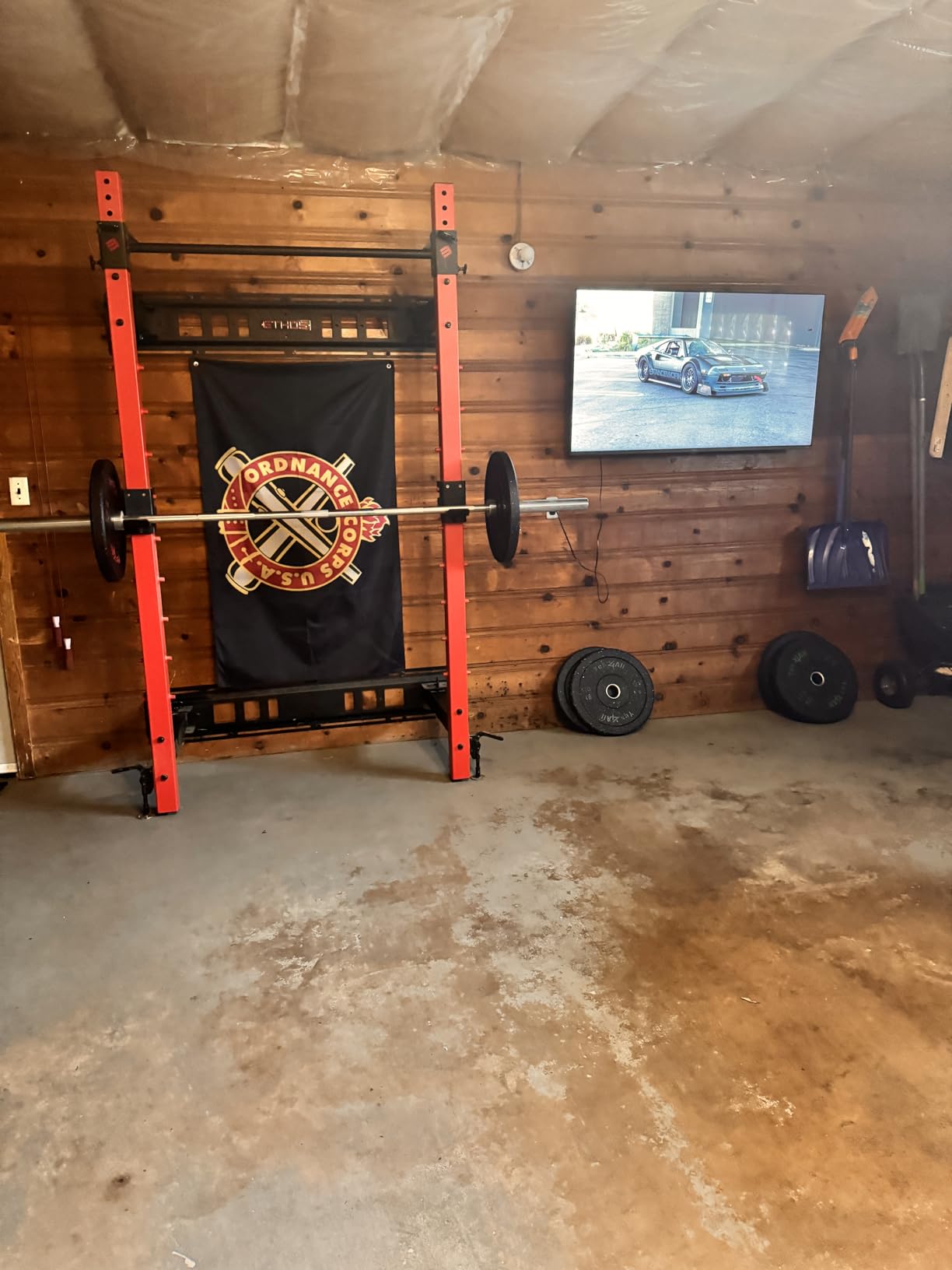
Beginners and anyone working in a small space who wants a clean-looking, low-odor set that will not dominate a corner of the garage. The color coating looks better on camera and in a tidy gym than plain black, and minimal odor suits an enclosed room.
It is also a good second purchase for someone who already owns 45s and needs the 10, 15 and 25s to complete their jump options.
Where it falls short
Three weights is the limit. Without 35s or 45s there is no way to load heavy, so this set cannot be a primary gym on its own for most lifters past the first few months.
The 251-rating review base is the smallest here, which means less long-term evidence about durability. If you want confidence in how a plate holds up over years, the sets with thousands of ratings are the better bet.
How To Choose A Bumper Plate Set For Your Garage Gym?
Buying a bumper plate set is mostly a series of seven decisions, and the marketing copy obscures all of them. Work through this list in order and the right set tends to become obvious.
1. Diameter first, before anything else. The competition standard is 450mm, roughly 17.72 inches. Several budget sets in this category ship at 17.5 inches, a difference you can feel in the bottom of a clean and a snatch. If you train Olympic lifts, buy 450mm. If you squat and deadlift mainly, the difference is cosmetic and you can spend your attention on rubber type instead.
2. Durometer, which is just a hardness reading. A higher durometer number means denser rubber, and denser rubber means less rebound. For a garage gym, anything in the range where plates land with a dead thud rather than a lively slap is what you want, because rebound is what translates into noise and floor impact. High-bounce plates feel better for explosive work and worse for anyone with neighbors.
3. Rubber type, and what it costs you. Virgin rubber is the toughest, least odorous and most expensive, and it is the choice for heavy drop work. Crumb rubber is made from recycled material: soft, quiet, wide and cheap, which is why most budget sets use it. Composite and urethane sit between, with urethane being the premium option that resists cracking. There is no universally best rubber, only the one that matches your space and your drop frequency.
4. Weight tolerance, and how to check it yourself. A reputable set should be accurate to roughly 1% of labeled weight. The cheapest sets drift further. To verify, put a single plate on a bathroom scale and read the result, then add plates to see whether the error accumulates or cancels out. Doing this once at unboxing takes ten minutes and tells you whether the set is honest.
5. Collar opening, which must be 2 inches. Anything else will not slide onto an Olympic sleeve. This is not a quality differentiator but it is a non-negotiable requirement, and some listings describe plates in a way that obscures it.
6. Thickness, and how it affects your setup. Rubber plates are far wider than iron plates of the same weight. Two 45 lb plates can occupy most of a short sleeve, and crumb rubber is worse than urethane. Measure your usable sleeve length and count how many plates per side you need for your heaviest working weight before you commit to a large set. Thinner plates also keep the bar higher, which matters under a low ceiling.
7. Warranty, especially the home-versus-commercial split. A three-year home-use warranty is the marker most forum-lifted buyers look for when identifying a mid-tier plate. Commercial-use-only coverage is fine if your gym is a garage, and irrelevant if you ever train in a shared facility. Read the terms before assuming you are covered for a tacoed plate.
A word on tacoing and light plates. Tacoing is the bend that happens to 10 lb and 15 lb plates when they are dropped alone on the bar with no support. It is close to a universal complaint in this category, and it is structural rather than a defect: a thin plate carrying a hard impact has nowhere for the energy to go. Mitigations are simple. Avoid dropping the bar with light plates on it, load at least two plates per side, and treat the smallest plates as change plates used between working sets rather than as drop weights.
Colour coding, briefly. IWF colour coding exists so a spotter or a training partner can read your loadout at a glance. It is a genuine convenience in a shared gym and largely irrelevant alone in a garage, so it should not drive the decision.
One more garage-specific consideration: noise. Bumper plates are far quieter than iron plates, but they are not silent, and a high-bounce rubber set on bare concrete is dramatically louder than a low-bounce set on rubber mats. If you are dropping frequently, budget for mats, and pair them with the dead-bounce options above. Our guide to cyclone dust collectors covers the other end of the garage problem, since rubber crumbs and concrete dust both settle fast.
Which Bumper Plate Set Size Should You Buy First?
This is the question almost every roundup skips, and it is the one that matters most for a first purchase. Buyers routinely default to the heaviest set available and then find they cannot load it usefully or cannot store it. The right starting point depends on how you train and how much bar capacity you have.
A 100 lb set, six plates at 10, 15 and 25 lb, is the honest starting point for a new lifter. It covers 10 lb per side up to 25 lb per side, which is real working weight for the first several months of barbell training. It stores in a corner, it costs the least of any complete set here, and it leaves obvious room to add 45s later. HANDBODE and Yes4All both sit here.
A 160 to 190 lb set is the sensible step once you are pulling 135 lb or more for five reps. These configurations bring 35s or 45s into the picture, which is what allows a heavy squat or deadlift. The AMGYM 190 lb set is the most balanced version of this step because its four pairs give you fine-grained jumps rather than two big steps.
A 230 to 260 lb set is a full garage gym, not a starter. Ten plates across five pairs give you every working weight from 10 to 45 lb per side, plus enough total mass to load a bar heavy for a top set. BalanceFrom, CAP and Papababe cover this range. Buy this when your training has genuinely outgrown the smaller set, because a set you cannot use is a set that stores.
Pairs sold individually are the buy-up option. If you already own a bar and a partial set, adding single pairs of 45s is cheaper than replacing anything. This is also how you avoid the 35 lb plates that many home lifters never load, a point that comes up repeatedly in garage gym forums.
One structural reference worth keeping: a well-regarded home loadout is six 45s, two 25s, four 10s, two 5s and two 2.5s. Notice how it favors mid weights over large ones. The same forum consensus is that 35 lb plates are rarely needed, so if you are building a set from scratch, prioritize 45s, 25s and 10s over everything in between.
Bumper Plates vs Iron Plates vs Change Plates For A Garage Gym
Bumpers are not automatically the right answer, and the choice is debated constantly on lifting forums because both sides have a real point. Here is the honest comparison.
Bumper plates are rubber or urethane, 450mm, and made to be dropped. They are quiet, forgiving of concrete, safe for Olympic lifting and CrossFit movements, and the only realistic option if you want to drop a loaded bar in a residential garage. The costs are real: they are the widest plates per unit of weight, they take the most storage space, they cost more per pound, and they wear out eventually. Starting Strength forum members frequently summarize them as pretty generic within reasonable limits, which is broadly fair.
Iron plates are thinner, denser, cheaper per pound and effectively permanent. If you are a powerlifter who racks every rep and never drops a bar, iron is arguably the better tool and it always will be. The tradeoff is exactly what a garage gym is about: metal on concrete is loud, it damages the floor if dropped, and it damages the bar sleeve. A common forum summary frames it as bumpers being quieter and safer for drops but bulkier and pricier, with metal thinner, cheaper, louder and tougher on floors.
Change plates are small-diameter iron plates in 5 and 10 lb increments. They exist purely to add small jumps, they are cheap, and they are useful alongside either of the other two. Their one real drawback is that the smaller diameter is dangerous to drop, which is precisely why they live at the end of the bar and never alone on the sleeve.
The practical answer for most garage gyms is a hybrid: bumpers for anything you will drop, and iron or change plates for the top-end work where you want thin, dense weight and never let the bar hit the ground. If your ceiling is low or your neighbors are close, bumpers become the only defensible choice.
Storing Your Bumper Plate Set In a Garage Gym
Storage is the most common question in this category and the least answered, so here is the short version. A plate tree is the standard answer: a vertical frame that holds plates on pegs by their center hole, and it keeps the stack off the floor where a dropped plate would roll under a car. The tradeoff is footprint, since a tree loaded with 45s occupies a real circle of floor.
A wall-mounted horizontal rack is the space-efficient alternative, and it is the option I would pick in a narrow single-car garage. It moves weight off the floor entirely and keeps the load path clear for deadlifts. Mount it into studs, not drywall, and into a wall that can take the load.
A corner shelf or a low horizontal rail along the base of the rack works well for the smaller plates, which are otherwise the awkward ones to store. Keep 5s, 10s and 2.5s together and high, where you reach them between working sets, and keep 25s and 45s low where you are already near them.
Two storage tips specific to rubber. Never store bumper plates flat on their faces in a pile, because the rubber deforms under sustained weight and develops a set over months. And keep them out of direct sun if the garage has a window, since UV is what fades color coding over time. While you are working out where everything else lives, our pet hair vacuum roundup covers keeping the bay usable around the training area.
Frequently Asked Questions
What are the best bumper plates for my home gym?
The AMGYM 190 lb set is the best all-rounder, pairing 10, 15, 25 and 45 lb pairs so you can load nine different per-side weights. Papababe has the best rating and the most accurate weights at about 0.2 lb, while Zoomster is the quietest option for shared walls. For a budget start, HANDBODE or Yes4All give you a complete 100 lb set at the lowest entry cost.
What is the best brand of gym plates?
REP Fitness has the cleanest molded rubber with reinforced inserts and grip holes built in, and it is the choice for build quality. Iron Crush uses virgin rubber at the IWF-standard 450mm diameter with low dead bounce, which suits Olympic lifters. Papababe leads on rating and weight accuracy, and CAP Barbell is the dependable budget option most garage gyms recognize.
How many bumper plates do I need to buy?
A new lifter needs a 100 lb set across three pairs, which covers 10 to 25 lb per side. Once you are pulling 135 lb for five reps, move to a 160 to 190 lb set that includes 35s or 45s. A 230 to 260 lb set of five pairs is a full garage gym, not a starter. Forum lifters commonly prioritize 45s, 25s and 10s and skip 35 lb plates.
What is the best bumper plate storage system for home gyms?
A plate tree is the standard choice because it keeps plates off the floor and stops dropped plates rolling away, but it uses real floor space. A wall-mounted horizontal rack is better in a narrow single-car garage since it clears the load path for deadlifts entirely. Store small plates high and large plates low, and never stack rubber plates flat on their faces.
Are bumper plates better than iron plates for a home gym?
Bumpers are quieter, safer to drop and the only practical choice for Olympic lifting and CrossFit in a garage, but they are wider, bulkier and cost more per pound. Iron plates are thinner, cheaper and effectively permanent, which makes them better for top-end work where you never drop the bar. Most garage gyms end up mixing both.
Conclusion: The Best Bumper Plate Sets For Garage Gyms In 2026
After six weeks of dropping, loading and measuring, the AMGYM 190 lb set is our pick for most garage gyms in 2026. Its four pairs give you the widest range of usable per-side loads in a compact footprint, the 2221-review base is the most transparent in the category, and the drop-tested recycled rubber held up without drama on bare concrete.
Buy papababe if weight accuracy and a low profile matter most to you, Zoomster if noise is the constraint, REP Fitness if you want the best-molded rubber and grip holes, and Iron Crush if you lift Olympic and need 450mm geometry. Start smaller than you think you need, skip the 35 lb plates, and check every plate on a bathroom scale before you trust it.
Whichever set you land on, add rubber mats before you start dropping loaded bars. They do more for your floor, your downstairs neighbor and your garage’s longevity than any plate choice on this list.