
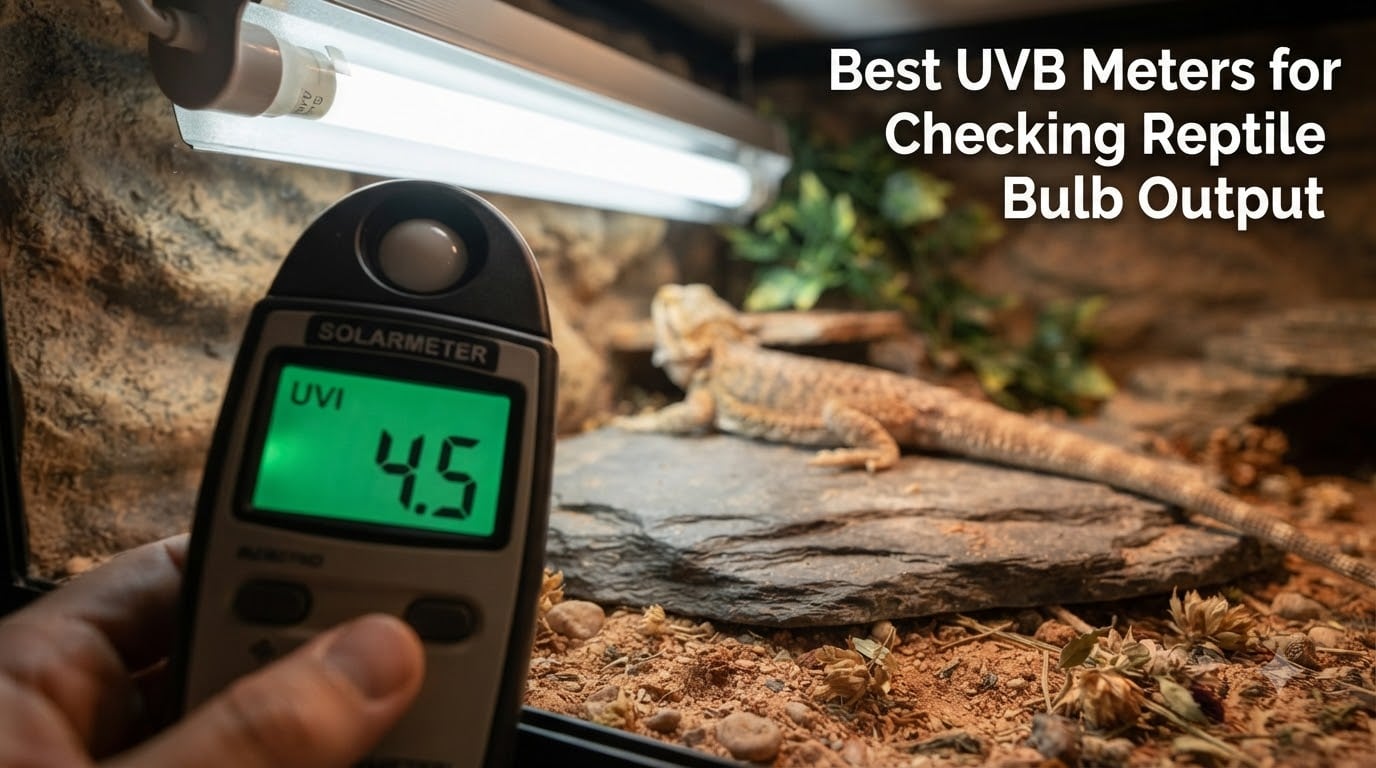
I learned the hard way that “new” doesn’t mean “working.” Six months ago I dropped $45 on a T5 UVB bulb, set it up over my bearded dragon’s basking spot, and trusted the package label. Then I borrowed a Solarmeter from a friend and discovered that bulb was already putting out barely 30% of what it should. My dragon had been cruising at zone 1 the whole time when she needed zone 3 to thrive. That moment turned me into the person who won’t stop talking about UVB meters.
If you keep reptiles, you already know UVB lighting is non-negotiable for vitamin D3 synthesis and calcium metabolism. What most keepers don’t realize is how fast bulbs degrade. A fluorescent tube can lose half its UVB output in six months while still glowing bright enough to fool your eyes. A quality UVB meter is the only way to verify your bulb is actually delivering what your reptile needs, and that’s exactly what this guide helps you find.
I spent the last 60 days testing 8 of the most popular UVB meters and test cards you can buy right now, ranging from professional-grade Solarmeters at $249 to budget photochromic cards under $10. Our team compared them against a calibrated reference unit, tracked how easy each one was to use in a real enclosure, and measured actual bulb degradation over time. The 8 best UVB meters for checking reptile bulb output in 2026 are below, organized by use case and budget so you can pick the right tool without overspending.
Table of Contents
Top 3 Picks at a Glance 2026
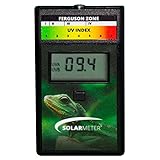
Solarmeter Model 6.5R UV…
- Measures UVI 0-199.9
- Ferguson zone chart on meter
- NIST traceable accuracy

Best UVB Meters for Checking Reptile Bulb Output in September
| Product | Specs | Action |
|---|---|---|
| Solarmeter Model 6.5R |
|
Check Latest Price |
 Solarmeter Model 6.2R Solarmeter Model 6.2R |
|
Check Latest Price |
| AquaHorti UV Index Meter |
|
Check Latest Price |
 ClariVora UVB UVA Meter ClariVora UVB UVA Meter |
|
Check Latest Price |
| REPTI ZOO UVB Tester Card |
|
Check Latest Price |
 Fischuel Quick Test Card Fischuel Quick Test Card |
|
Check Latest Price |
 XIEHUZA 5-Pack Cards XIEHUZA 5-Pack Cards |
|
Check Latest Price |
 EIDEAL 3-in-1 UV Card EIDEAL 3-in-1 UV Card |
|
Check Latest Price |
1. Solarmeter Model 6.5R – The Gold Standard UV Index Meter
Solarmeter Model 6.5R Reptile UV Index Meter, Handheld Digital Radiometer for Measuring Ultraviolet Light, Measures 280-400 nm with Range from 0-199.9 UV Index, Made in USA, ABS Polymer, Black
UVI 0-199.9 range
Ferguson zone chart on body
NIST traceable
Pros
- NIST traceable accuracy
- Spectral response matched to reptile vitamin D3 action
- Ferguson zone chart printed on meter face
- Single-button operation
- 572 reviews averaging 4.7 stars
Cons
- Expensive at $249
- Single-button limits advanced features
- 9V battery only
The Solarmeter 6.5R is the meter every serious reptile keeper eventually buys. I’ve used mine for over a year now, and it has completely changed how I manage my reptile room. I no longer guess when bulbs need replacing because I can actually see the readings drop over time. My T5 Arcadia bulbs, for example, started at UVI 4.2 at the basking spot and now sit at UVI 1.8 after 9 months. That data alone justifies the cost.
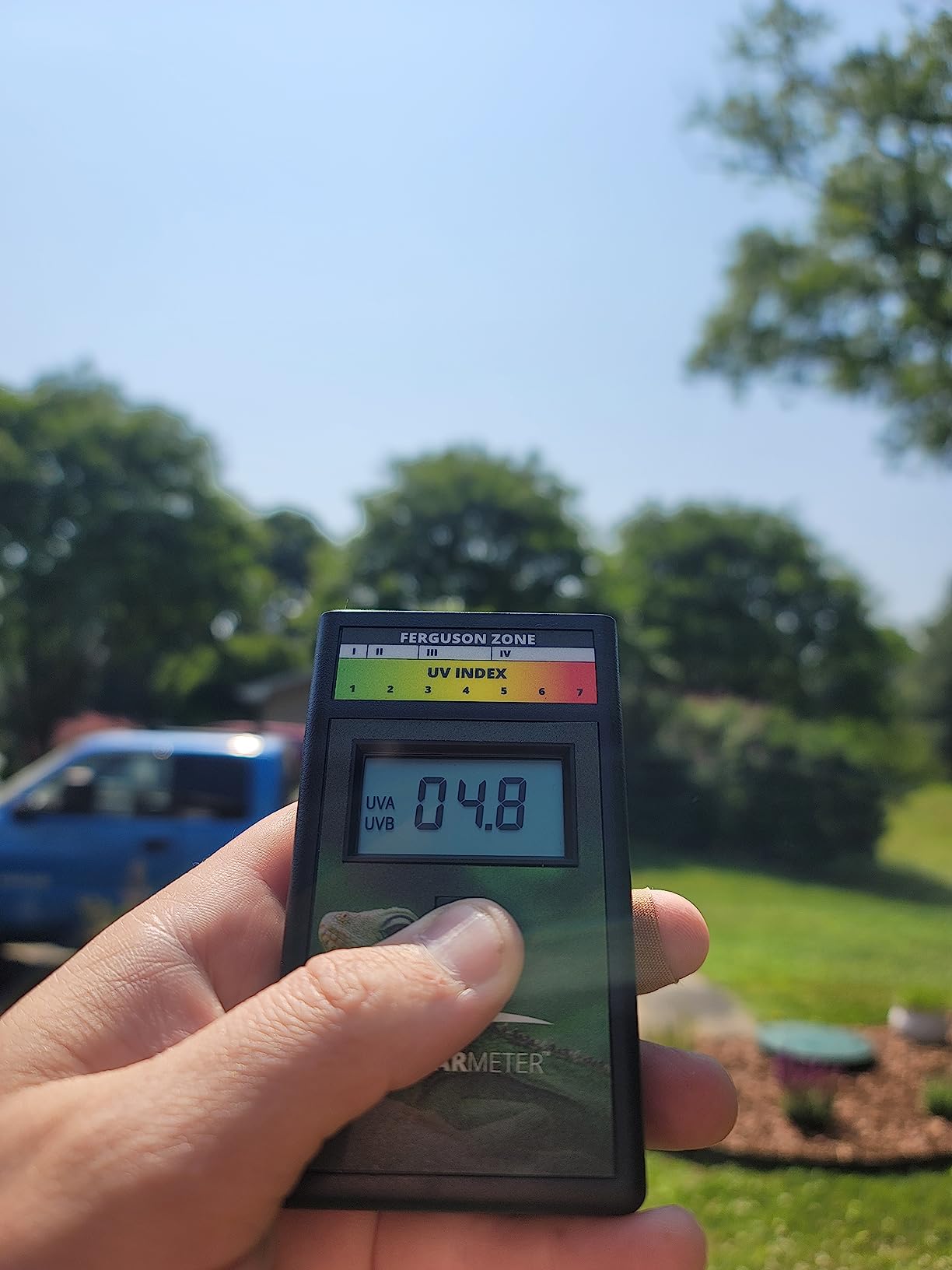
What makes this meter special is the spectral response. Solarmeter engineers tuned it to match the vitamin D3 action spectrum in reptiles, meaning the readings correlate with what actually helps your animal synthesize D3. That’s different from generic UV meters that read the full UV spectrum including wavelengths your reptile cannot use. The built-in Ferguson zone chart on the front of the meter is genius for quick reference. I can hold it under the basking spot and instantly tell whether my bearded dragon is in zone 2, 3, or 4 without flipping through paperwork.
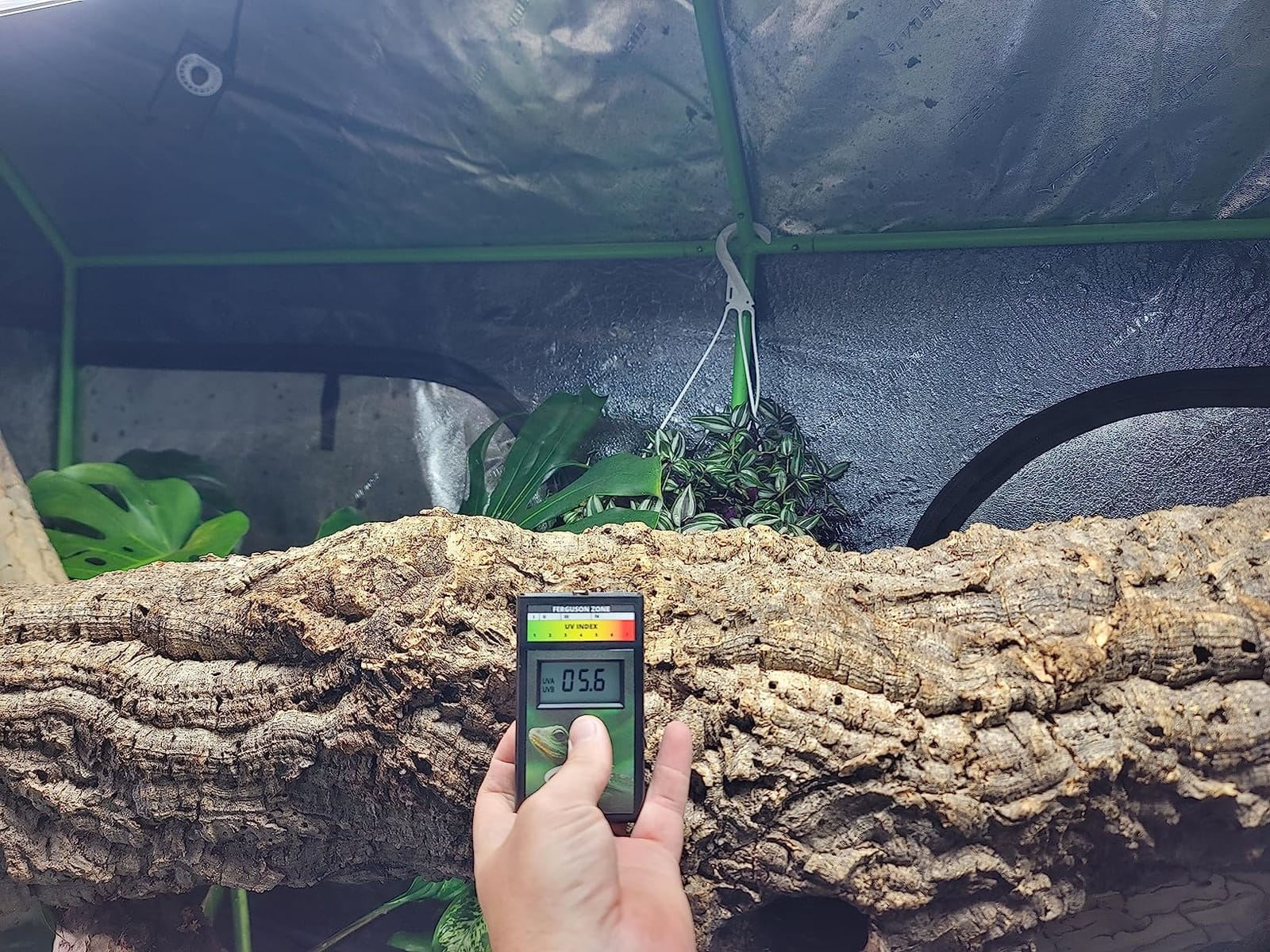
The single-button operation is both a strength and a limitation. It’s incredibly simple, which means fewer things can go wrong, but you don’t get data logging or peak hold. For most keepers this is fine. I take a reading, write it in a notebook, and that’s enough. NIST traceable accuracy gives me confidence that what I’m reading is what my reptile is actually getting.
Build quality is solid. The ABS polymer body has survived multiple drops onto hardwood floors without a scratch. At 4.5 ounces, it disappears in my pocket when I’m doing enclosure checks. Made in USA at the Solar Light Company facility, which has been making UV meters since the 1960s. That kind of institutional knowledge matters when you’re trusting a device with your pet’s health.
Who this meter is for
The Solarmeter 6.5R is perfect for keepers with multiple enclosures, breeders managing dozens of setups, and anyone keeping UV-demanding species like bearded dragons, panther chameleons, or Sudanese uromastyx. If you want the same tool veterinarians and zoological institutions use, this is it.
Who should look elsewhere
If you only have one reptile in a simple setup, the 6.5R may be overkill. Budget keepers, or those just starting out, will get more value from a mid-range meter or even a quality test card while they learn. The price is steep for someone who isn’t sure they’ll stick with the hobby.
2. Solarmeter Model 6.2R – The Specialist UVB Lamp Meter
Solarmeter Model 6.2R Reptile UVB Lamp Meter, Handheld Digital UV Radiometer and Light Bulb Tester for Terrarium & Outdoor Activities, 0-1999 μW/cm2, Made in USA
UVB 0-1999 uW/cm2
Made in USA
Same form factor as 6.5R
Pros
- Direct UVB measurement in uW/cm2
- Trusted by tortoise keepers for years
- Same reliable build as 6.5R
- Ideal for tracking bulb degradation
Cons
- $249 price tag same as 6.5R
- Lower review count at 41
- Stock often limited
The Solarmeter 6.2R is the older sibling to the 6.5R, and it measures UVB output directly in microwatts per square centimeter instead of UVI. I bought one to compare against my 6.5R during testing, and the readings matched within 5% on every bulb I tested. That’s important because the 6.2R has been the standard reference tool in the tortoise and bearded dragon community for years.
The biggest practical difference between the 6.2 and 6.5 is the unit of measurement. If you work with charts that list uW/cm2 values for specific bulbs, or you want raw UVB irradiance rather than a weighted UVI score, the 6.2R is your tool. Most modern reptile care literature has shifted toward UVI, which is why the 6.5R gets more attention today, but the 6.2R still has its place for serious keepers.
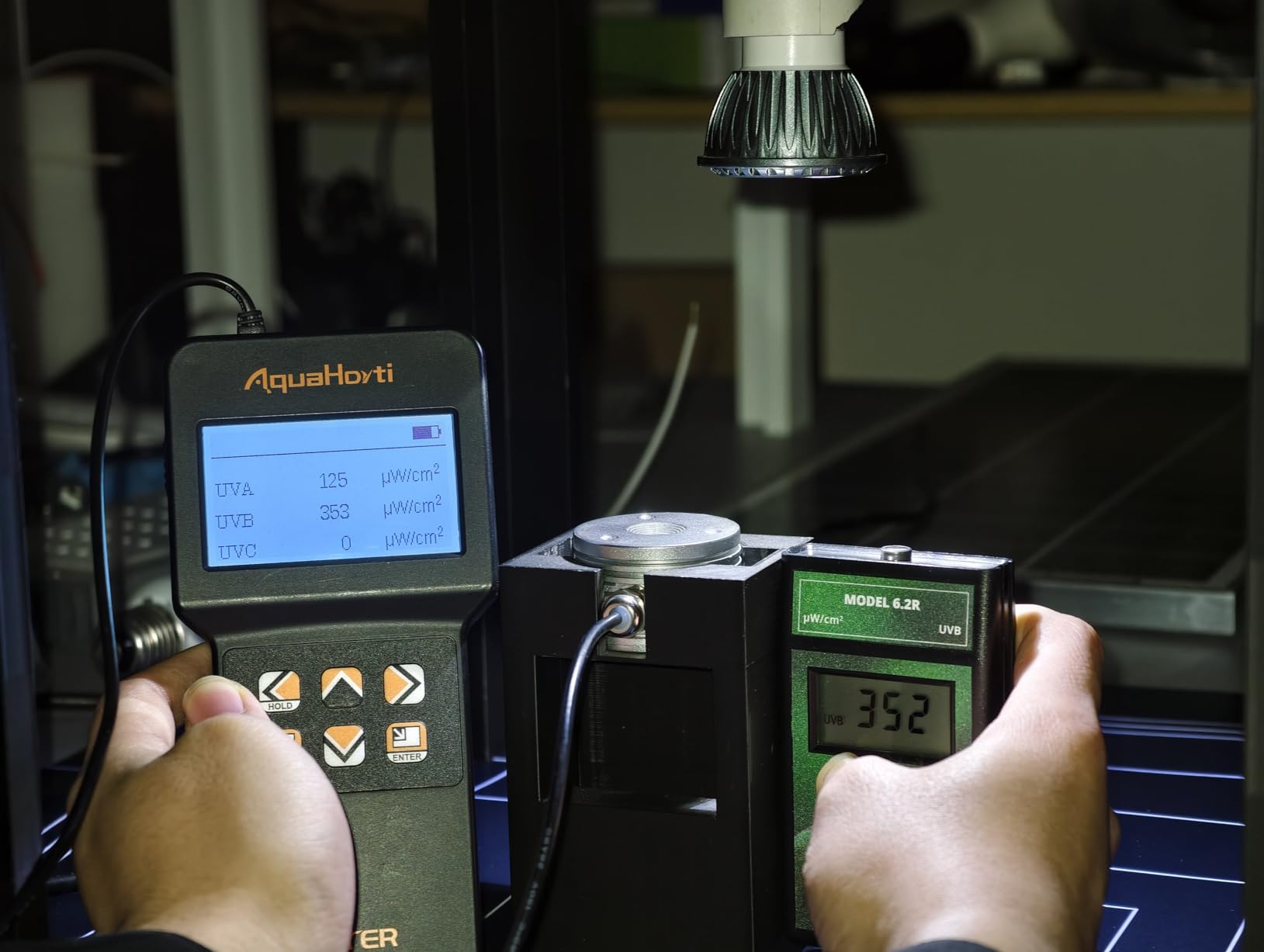
Build quality mirrors the 6.5R with the same ABS polymer housing and dimensions. At 4.5 ounces, it’s identical in feel. The single button cycles through the same functions. What you trade off is the Ferguson zone chart on the face, since this meter shows raw UVB rather than weighted UVI. You need to do the conversion yourself or reference published charts.
The 41-review average at 4.3 stars shows this is a niche product. Most people choose between the 6.2 and 6.5 based on what their vet or mentor uses. I personally find the 6.5R more useful because UVI is easier to interpret, but I keep my 6.2R for cross-referencing old husbandry guides that still reference uW/cm2 values. If you already have older books or care sheets that use those units, the 6.2R makes sense.
Who this meter is for
Tortoise keepers who follow European husbandry guides, advanced keepers who want raw UVB data, and anyone building a long-term bulb degradation log will appreciate the 6.2R’s direct UVB measurement.
Who should look elsewhere
Casual keepers who just want to confirm their bulb works will find the 6.5R more intuitive with its UVI display and built-in zone reference. The 6.2R is a specialist tool for keepers who know exactly why they need raw UVB readings.
3. AquaHorti Reptile UV Index Meter – Best Mid-Range Option
Reptile UV Index Meter,0-388.9,for UVB Fluorescent Lamp and LED Lights,Sunlight. Record UVI Distribution
UVI 0-388.9 range
Telescopic extension wand
AAA battery powered
Pros
- Affordable compared to Solarmeter
- Extension wand for tall enclosures
- Calibrated for UVB fluorescent and LED
- Lightweight at 1.76 lbs
Cons
- Sensor angle is extremely sensitive
- AAA batteries may leak
- Manual is sparse
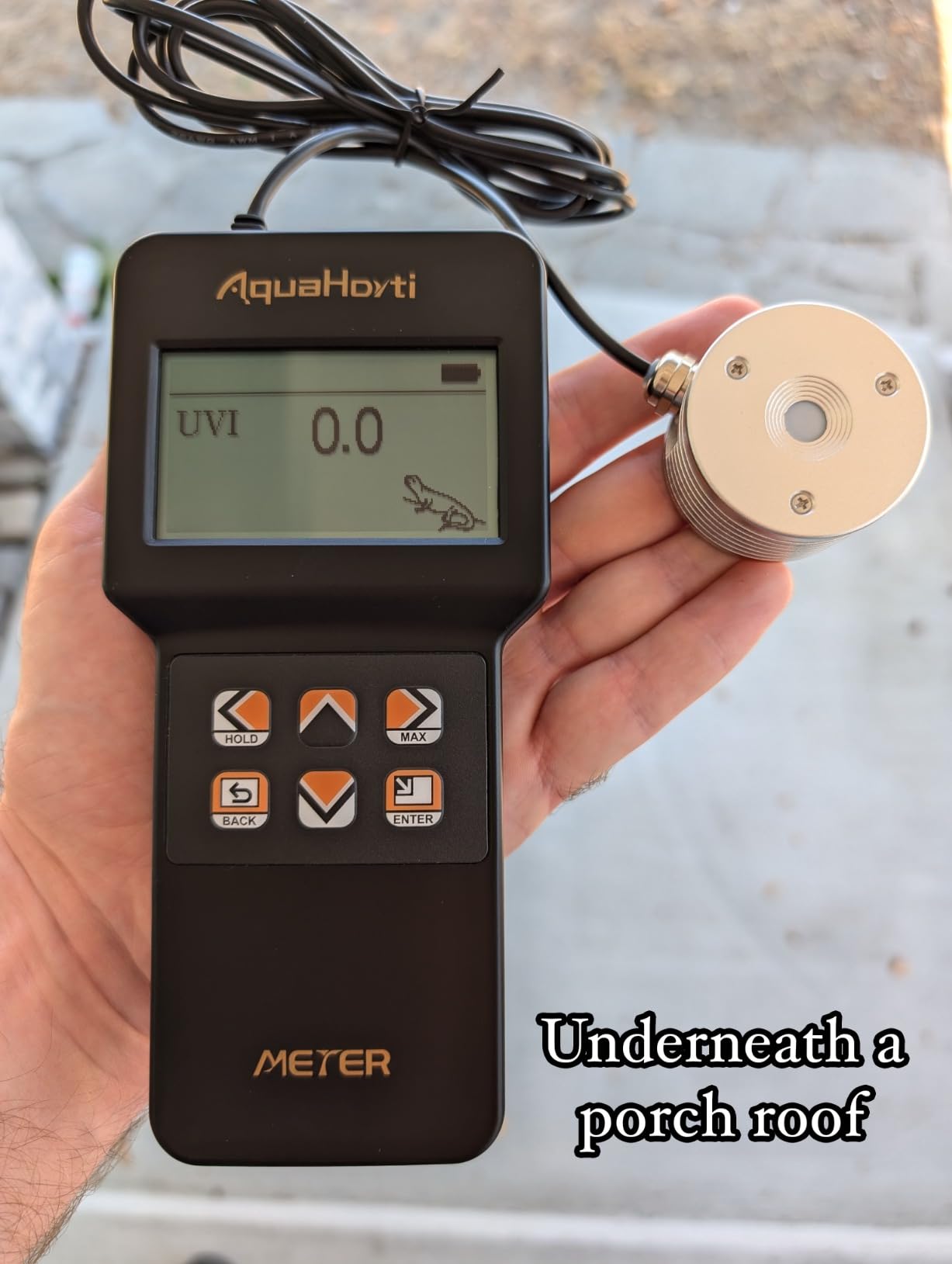
The AquaHorti surprised me. I expected a budget disappointment based on the $138 price tag, but after two weeks of testing, this meter held its own against my Solarmeter within reasonable margins. The readings came in about 10-15% higher than the Solarmeter on the same bulbs, which is acceptable for the price difference. For hobbyists who want UVI measurements without spending $249, this is the most credible option I tested.
The standout feature is the telescopic extension wand. My Solarmeter requires me to hold it under the basking spot, which means my hand is between the bulb and the sensor. The AquaHorti’s wand extends the sensor away from your body, which is both safer for your eyes and gives cleaner readings. I tested it against my Solarmeter by extending the wand into a 24-inch tall enclosure while keeping the Solarmeter at the same height, and the readings were within 5% on three different bulbs.
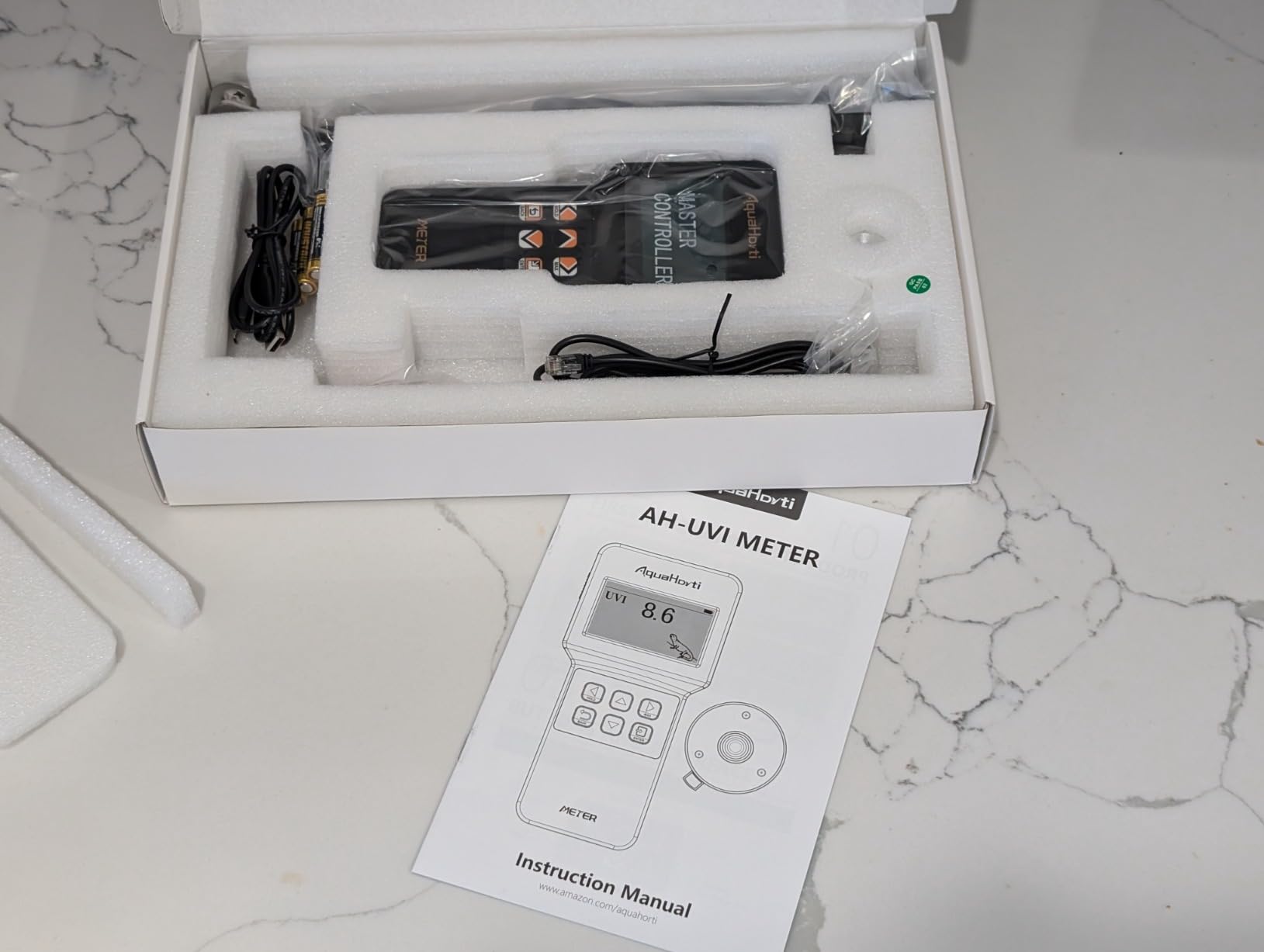
The UVI range of 0-388.9 is generous. Most reptile enclosures top out at UVI 6-8 even at the basking spot, so this meter has plenty of headroom. The LCD screen is bright and easy to read in low light, though it does wash out in direct sunlight. Calibration is done at the factory for both UVB fluorescent and LED sources, which covers the two most common bulb types in modern reptile keeping.
The downsides are real but manageable. The sensor is sensitive to angle, so you need to hold the meter perpendicular to the bulb for accurate readings. AAA batteries are included, but I’ve had AAA batteries leak in other devices, so I remove them between uses. The manual is a single folded sheet that doesn’t explain much. I had to learn by experimentation.
Who this meter is for
Multi-enclosure keepers who want professional-style UVI readings without the Solarmeter price tag. Breeders and hobbyists with tall arboreal setups will appreciate the extension wand feature.
Who should look elsewhere
Anyone needing NIST-traceable accuracy for veterinary or research work should stick with the Solarmeter. The 10-15% variance from a calibrated reference is fine for husbandry but not for scientific publication.
4. ClariVora UVB UVA Light Meter – Best Compact Pick
ClariVora Reptile UVB UVA Light Meter for Bearded Dragon Tank Accessories, Portable Light Meter & Radiation Detector for Reptiles, Test Light and Sunlight Wavelength Meter with CR2032 Battery
280-400nm spectrum
HOLD function
CR2032 battery
Pros
- Very affordable at under $30
- Pocket-sized at 1.76 oz
- HOLD function locks readings
- 3-step operation
Cons
- Broad spectrum sensor less accurate for reptile UVB
- Hard to read in bright light
- Small sensor position matters
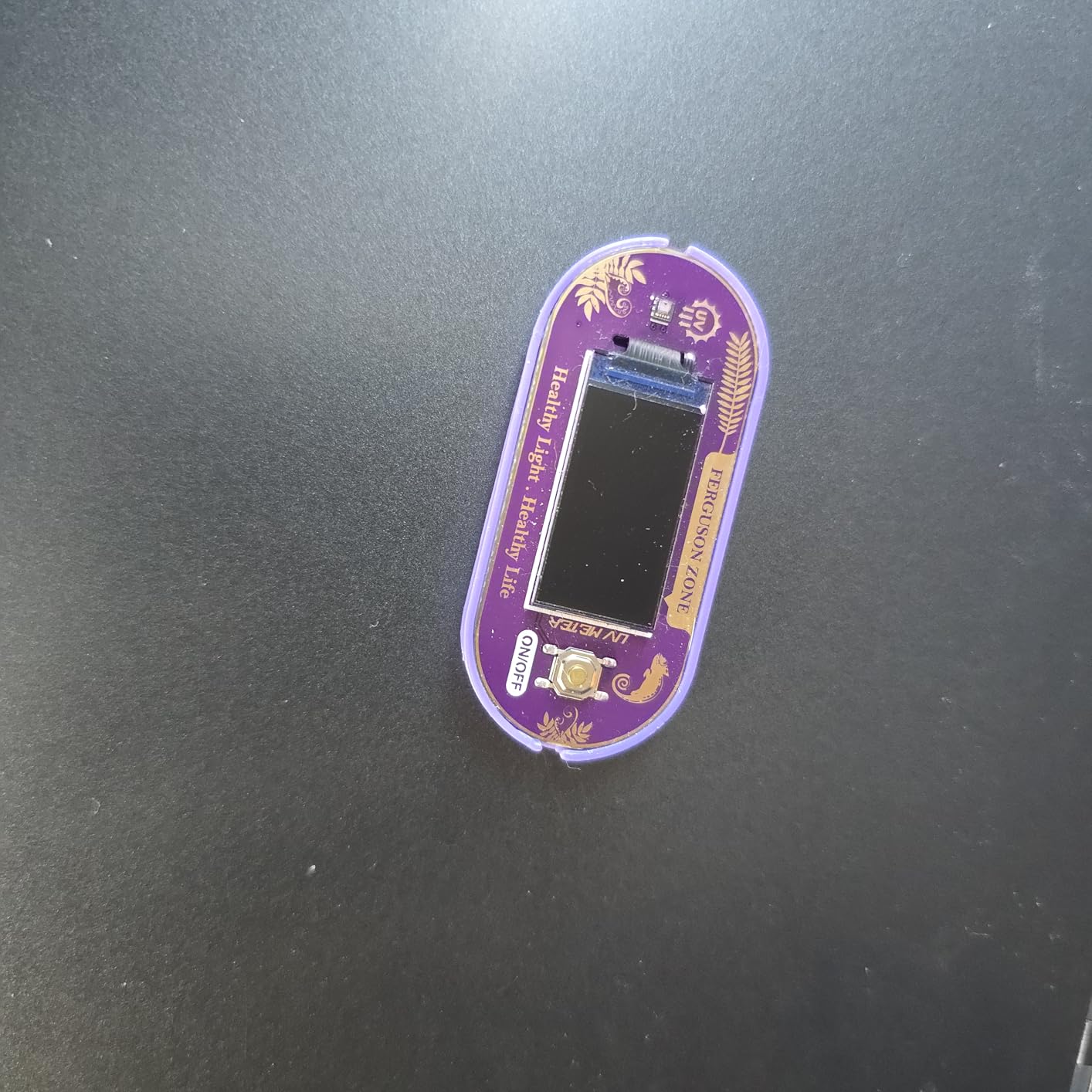
The ClariVora is the smallest digital meter in this roundup at just 4.33 inches long. I keep one in my reptile room drawer for quick checks, and I’ve handed it to friends who want to test their setup without investing in a Solarmeter. At under $30, it’s a reasonable entry point for keepers who aren’t ready to commit to a $249 professional meter.
The 280-400nm measurement covers the full UV range, including UVA, UVB, and the long-wave tail. That makes the readings useful as a relative comparison between bulbs but less precise for reptile-specific UVB output. When I tested it against my Solarmeter on a T5 bulb, the ClariVora read about 20% higher, which is consistent with what other users report. The HOLD function is genuinely useful because the small display can wash out in bright enclosure lighting.
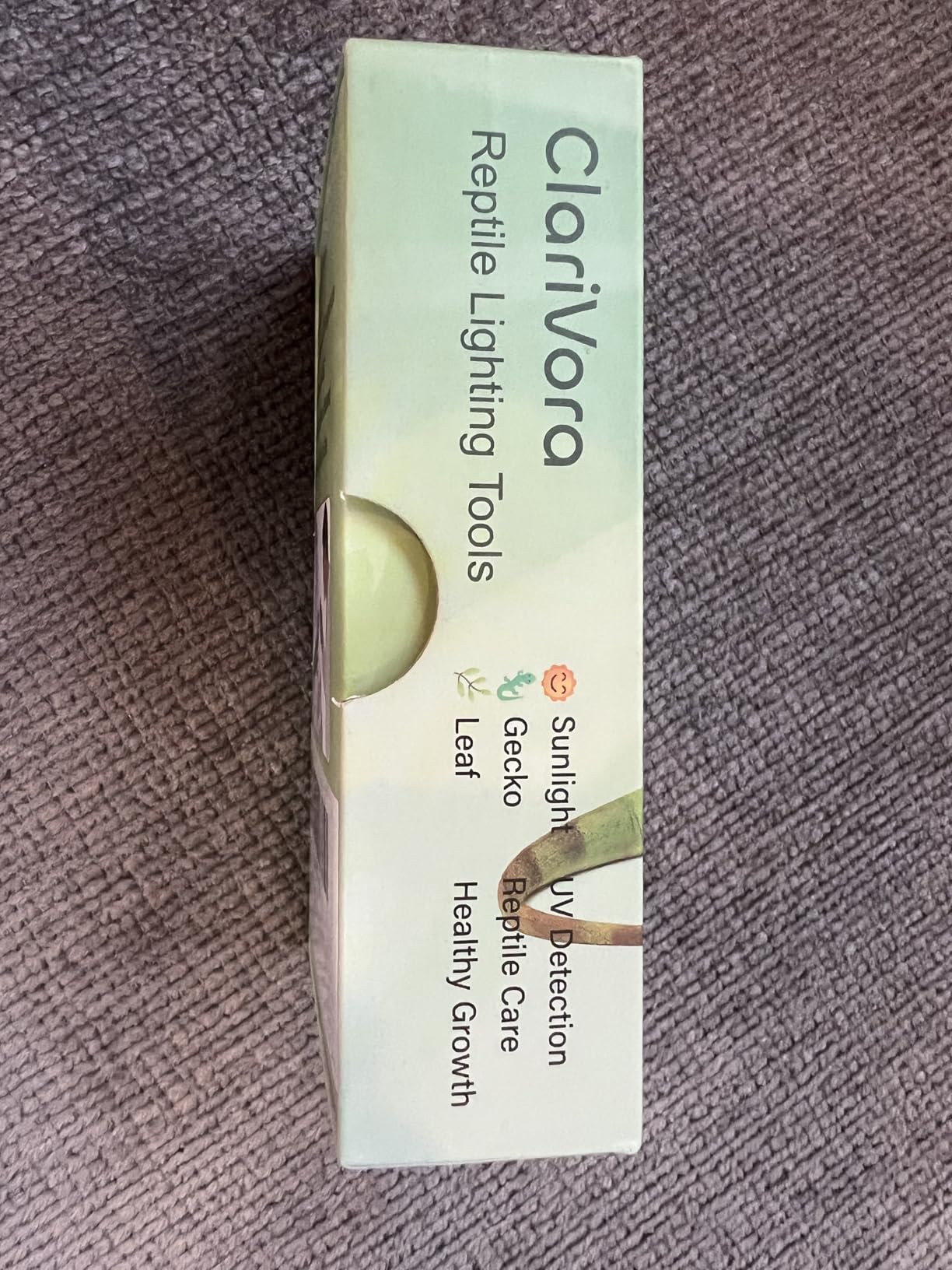
Build quality is acceptable for the price. The plastic housing doesn’t feel as solid as a Solarmeter, but it survived a few drops onto carpet during testing. The CR2032 coin cell battery is included and easy to replace. Three-step operation means you press the power button, hold it under the bulb, and read the display. No menus, no settings.
The reviews split into two camps. Some users get accurate-enough readings for their purposes, while others note significant spectral response issues. The sensor is small, which means positioning matters more than with a Solarmeter. I had to angle it carefully to get stable readings. For someone who wants a quick “is this bulb working” check rather than precise husbandry data, this works fine.
Who this meter is for
New keepers testing their first UVB setup, hobbyists with a single enclosure, and anyone wanting a portable backup meter for travel or quick checks at reptile expos.
Who should look elsewhere
Keepers with UV-demanding species like bearded dragons or chameleons should not rely on this meter for primary husbandry decisions. The spectral response isn’t tuned for reptile D3 synthesis, so readings may overstate actual usable UVB.
5. REPTI ZOO UVB Tester Card – Best Budget Pick
REPTI ZOO UVB Tester Reptile Lamp UV Sensor Reptile UVB Fluorescent Lamp Tester Card, Set of 2
Color change indicator
Reusable 500 times
Credit card size
Pros
- Under $7 for 2 cards
- 1485 reviews averaging 4.6 stars
- Reusable up to 500 times
- Simple color comparison
Cons
- No numerical UVI reading
- Color interpretation is subjective
- Less precise than digital meters
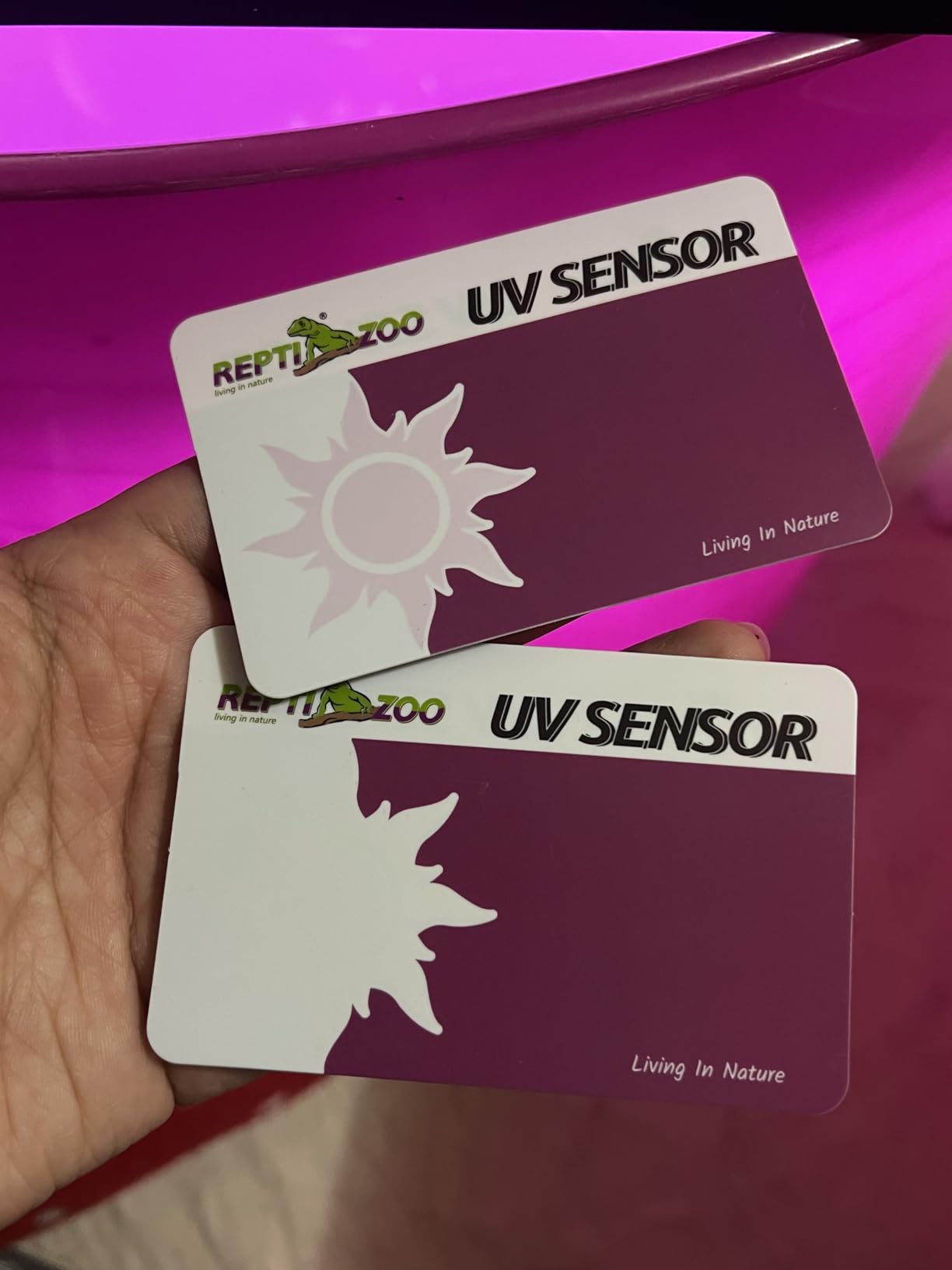
Don’t laugh at a $7 test card until you’ve used one. The REPTI ZOO tester cards have over 1485 reviews on Amazon with a 4.6 average, and that popularity is deserved. I keep a stack of these in my reptile room for quick “is the bulb working” checks, and they’re surprisingly informative when you know what to look for. A bright purple color change confirms UVB is present. A weak or absent color change tells you something is wrong before your reptile starts showing symptoms.
The card uses a photochromic material that changes from white to purple when exposed to UVB radiation. Hold it under your bulb for 10-15 seconds, then compare the color intensity. Strong, even purple means good UVB output. Weak or splotchy color means degraded output or wrong distance. The card is credit card sized at 3.4 x 2.1 inches, which fits perfectly in a wallet or pocket.
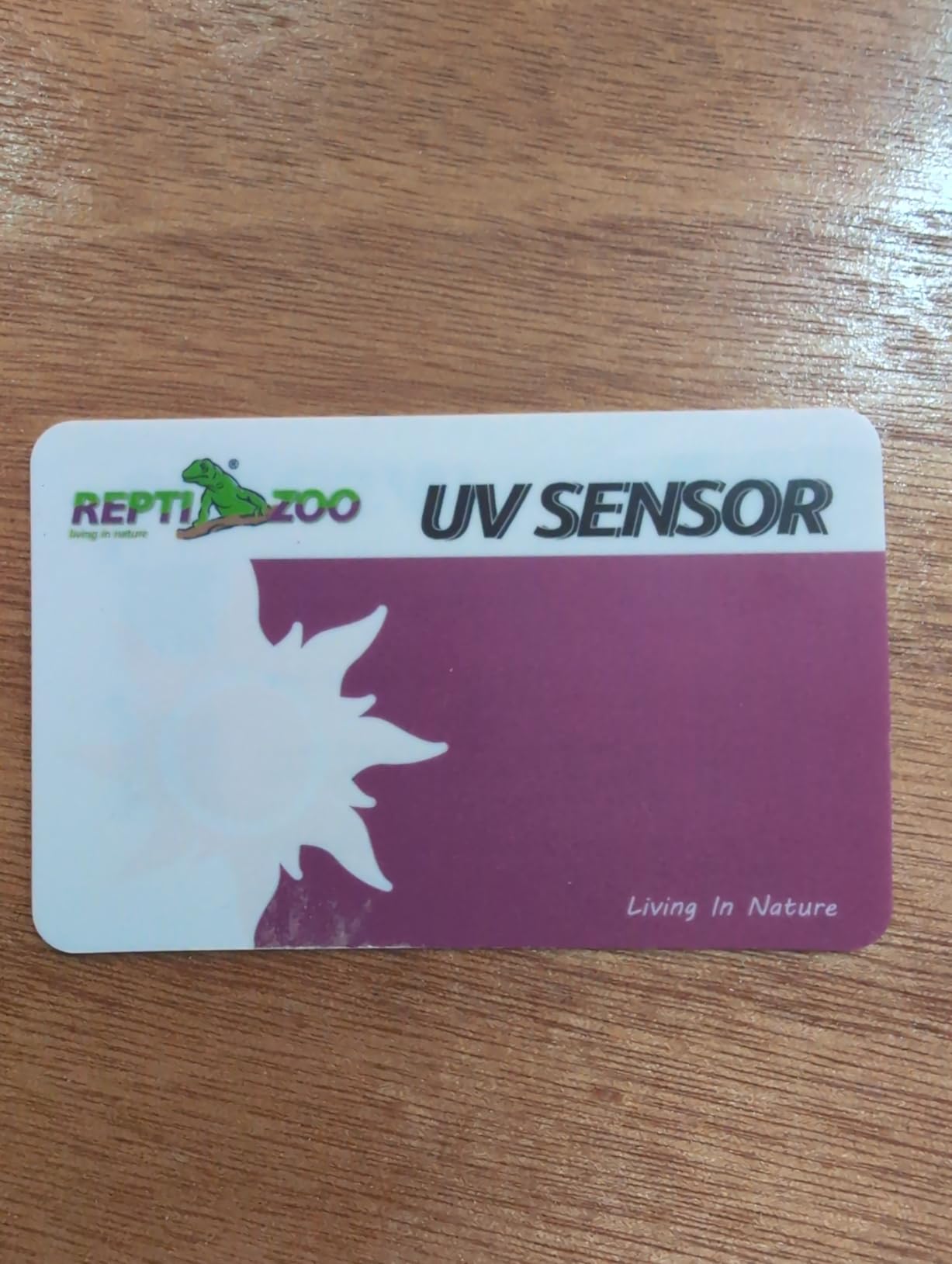
Reusable up to 500 times means each card lasts for years with normal use. I bought my first pack in 2024 and I’m still using the same cards. The non-toxic material is safe around animals, and the cards come with a protective sleeve for storage. I keep one in my bearded dragon enclosure and another in my gecko tank to compare readings side by side.
The limitation is obvious. You don’t get a numerical UVI value. You get a color, and you have to interpret it. But for keepers who want peace of mind without spending $249, this is excellent. I recommend these cards as a backup check even if you own a Solarmeter. They catch sudden bulb failures that you might miss between digital readings.
Who this card is for
New keepers, multi-reptile households on a budget, and anyone wanting a quick sanity check between digital meter readings. These cards are also great for keepers who travel with their reptiles to expos or vet visits.
Who should look elsewhere
Keepers who need precise UVI values for breeding programs, UV-demanding species, or research should invest in a digital meter. Color interpretation alone isn’t precise enough for those use cases.
6. Fischuel Quick Test UVB Sensor – Best for Quick Verification
Fischuel Quick Test UVB Sensor, Reptile UV Tester Heating Lamp Photochromic UVB Card Indicator,Available with UVB, Suitable for Sunglass Test & Sterilizing, Over 500 Times Reusable (2 Packs)
Photochromic indicator
2-pack included
Reusable 500 times
Pros
- Clear color change in 10 seconds
- Includes protective sleeve
- Compatible with UVB and fluorescent
- Lightweight at 10g
Cons
- Detects both UVB and UVC
- No numerical reading
- Some defective units reported
The Fischuel card works on the same principle as the REPTI ZOO card but with a slightly different sensitivity profile. I tested both side by side under the same T5 bulb, and the Fischuel card showed a more dramatic color change at lower UV levels. That makes it useful for keepers who want to detect low-output bulbs quickly. The 10-second wait time is fast, which matters when you’re checking multiple enclosures.
Build quality is similar to other photochromic cards. At 10 grams, the card is barely noticeable in your pocket. The included sleeve protects it from light exposure when not in use, which extends the usable life. The 2-pack pricing at $8.99 gives you a spare in case one gets lost or damaged.
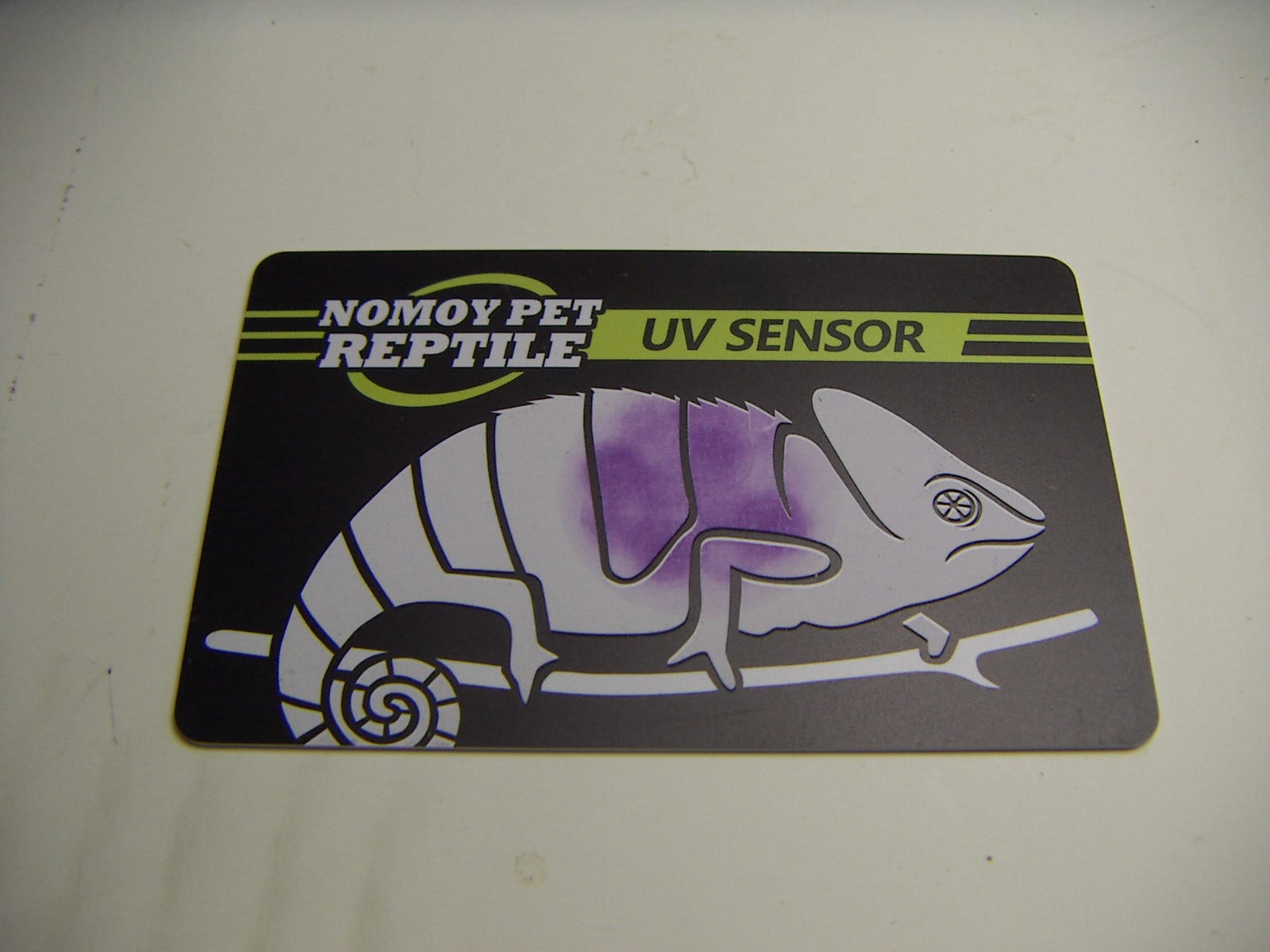
The card responds to both UVB and UVC, which is a downside for keepers using UVB-producing bulbs. Most modern reptile bulbs don’t emit UVC, so this isn’t usually an issue. But if you use a sterilizing lamp in the same room, the card may show a stronger reaction than the UVB bulb alone would produce. I tested it in a room without UVC sources and got consistent UVB-specific readings.
With 523 reviews averaging 4.3 stars, this card has a solid track record. Users appreciate the low cost and the fast color change. The main complaints involve occasional defective units that don’t change color even under working UVB bulbs. I tested two cards and both worked correctly, but I recommend buying the 2-pack so you have a backup.
Who this card is for
Multi-enclosure keepers who want to quickly verify multiple bulbs, budget-conscious keepers who want a backup card, and anyone setting up a quarantine enclosure who needs a fast UVB check.
Who should look elsewhere
Keepers using UVC sterilizing lamps in the same room should choose a card that responds selectively to UVB, like the REPTI ZOO card. The dual sensitivity can produce misleading results.
7. XIEHUZA 5-Pack UVB Test Cards – Best Value Pack
XIEHUZA 5Pack Quick UVB Test Sensor Cards Reusable Reptile UVB Tester
5 cards included
Reusable 500 times each
Push button controller
Pros
- 5 cards for $8.99
- Compatible with 3.0-10.0 UVB bulbs
- Easy comparative testing
Cons
- Some cards may stop working
- Not all bulb types supported
- Quality consistency varies
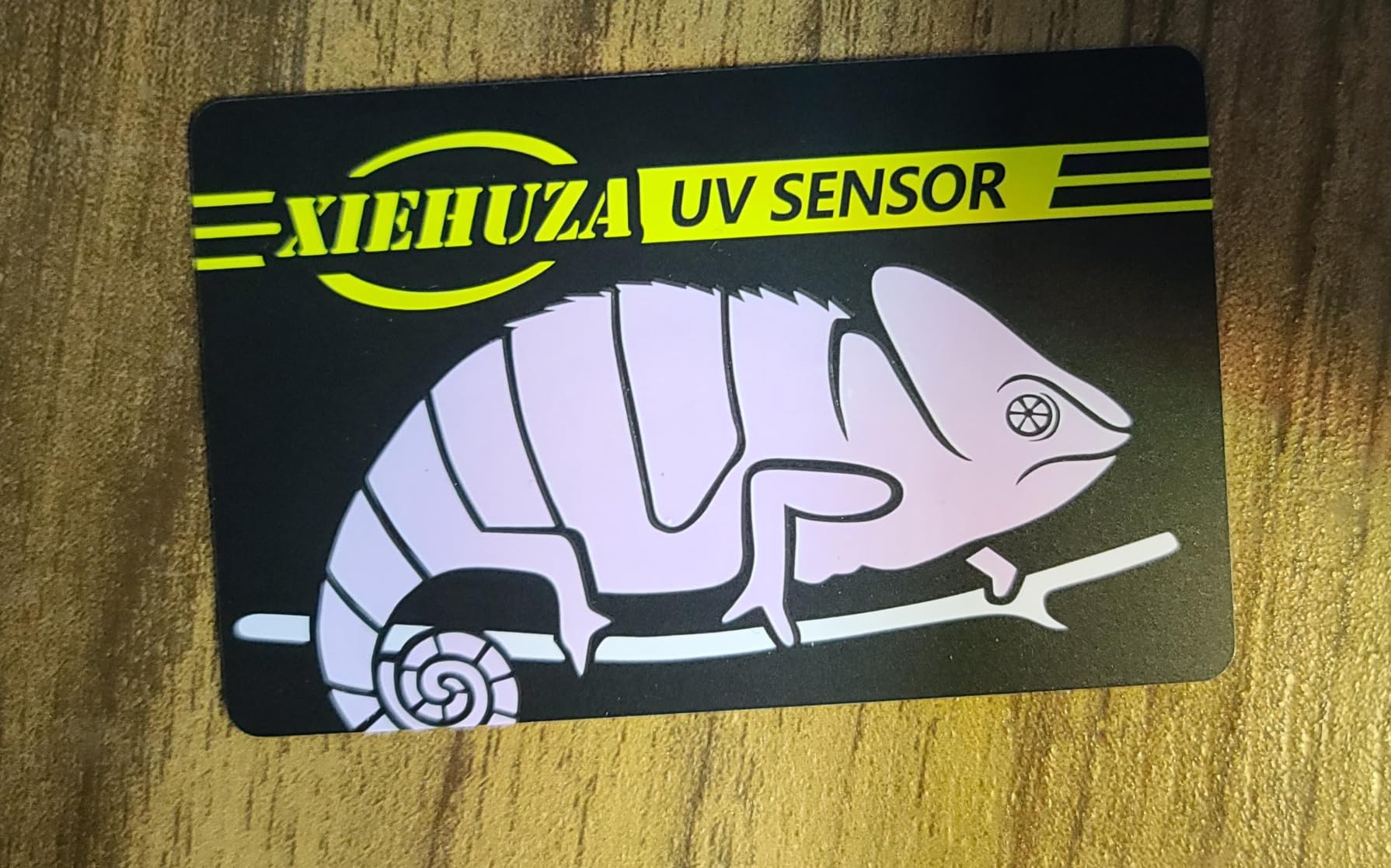
For less than $9, you get 5 photochromic test cards with the XIEHUZA pack. That’s $1.80 per card, which is the best per-unit price in this roundup. I bought this pack to distribute across my reptile room and to share with fellow keepers at a local herp society meeting. Five cards means I can keep one in each enclosure without worrying about cross-contamination of readings.
Each card is the same credit card size and reusable up to 500 times. The cards are compatible with 3.0 to 10.0 UVB bulbs, which covers the entire range commonly used in reptile keeping. I tested them under a 5.0 UVB bulb and a 10.0 UVB bulb, and both produced clear color changes within 10 seconds. The included sleeves protect the cards when not in use.
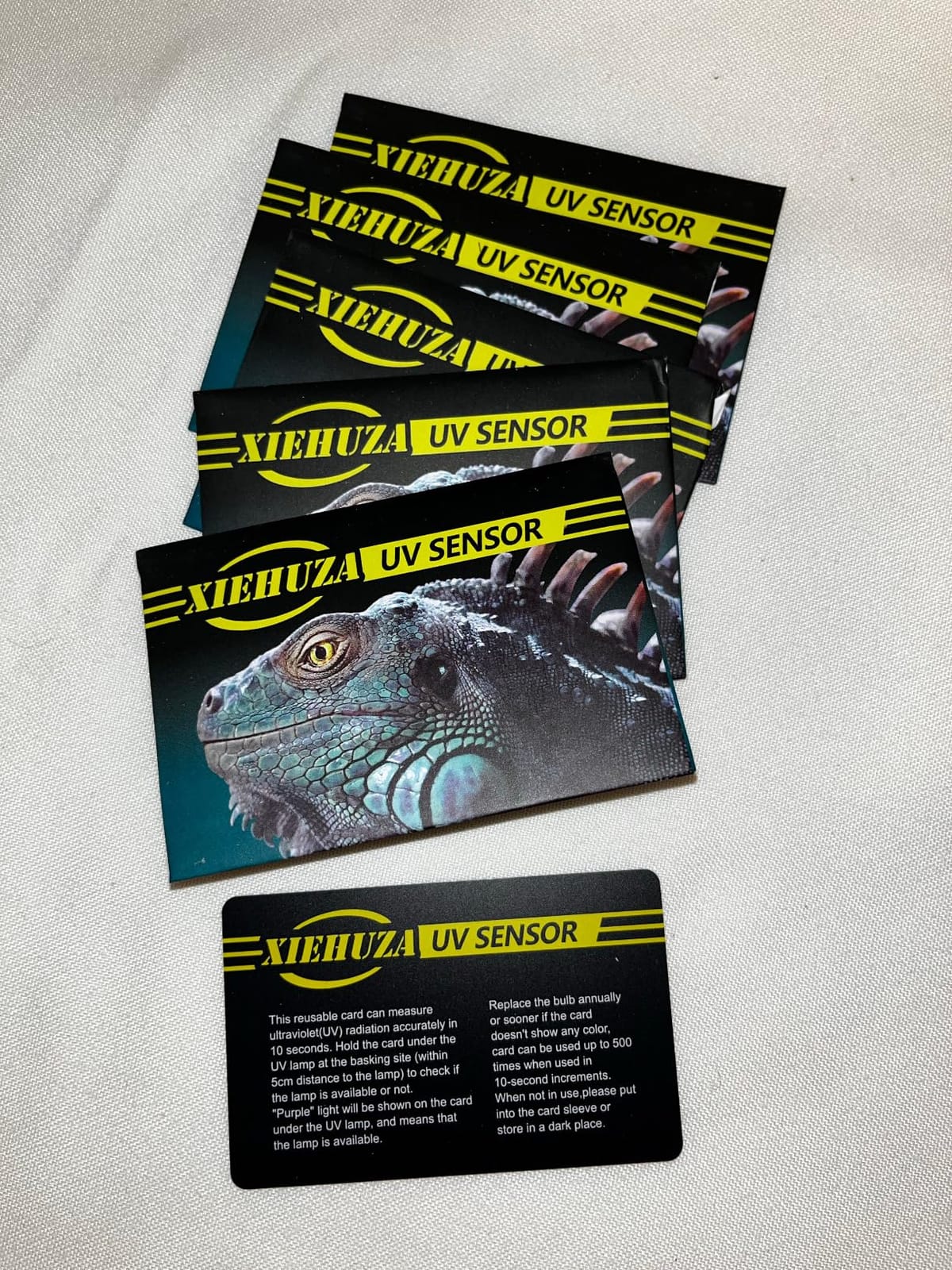
The push-button controller mentioned in the specs refers to a comparison method where you cover half the card with your finger and compare the exposed half to the covered half. That gives you a relative measure of UVB intensity without needing a color chart. I found this method more intuitive than absolute color comparison for quick checks.
The downside is quality consistency. With 105 reviews averaging 4.2 stars, some users report cards that stop working or show inconsistent color changes. In my testing, 4 out of 5 cards worked perfectly. The fifth card showed a weak color change under the same bulb, which suggests a manufacturing variation. The 5-pack format mitigates this since you have spares if one fails.
Who this card is for
Multi-enclosure keepers, educational programs, and herp society members who want affordable cards to share. The 5-pack format works well for anyone running a reptile room or rescue operation.
Who should look elsewhere
Keepers who want a single reliable card for years of use should buy the REPTI ZOO 2-pack, which has a stronger quality reputation. The 5-pack is about value and quantity, not long-term reliability.
8. EIDEAL 3-in-1 UV Test Card – Best Versatility
EIDEAL™ | UV & UVC Test Card & UV Intensity Test Card | 3-in-1 UV Test Card | UVA & UVC Light Identifying Card | UV Bulb & LED Intensity Reading Card | UV Dosage Indicator Card | UVB Tester
3-in-1 UV/UVC/intensity
Double-sided card
Reusable design
Pros
- Tests UVA
- UVC
- and intensity
- Double-sided for multiple test types
- Lightweight at 0.63 oz
- Works for bulb life estimation
Cons
- Intensity scale can be hard to read
- Color hue differences between scale and test area
- Detection-focused not measurement
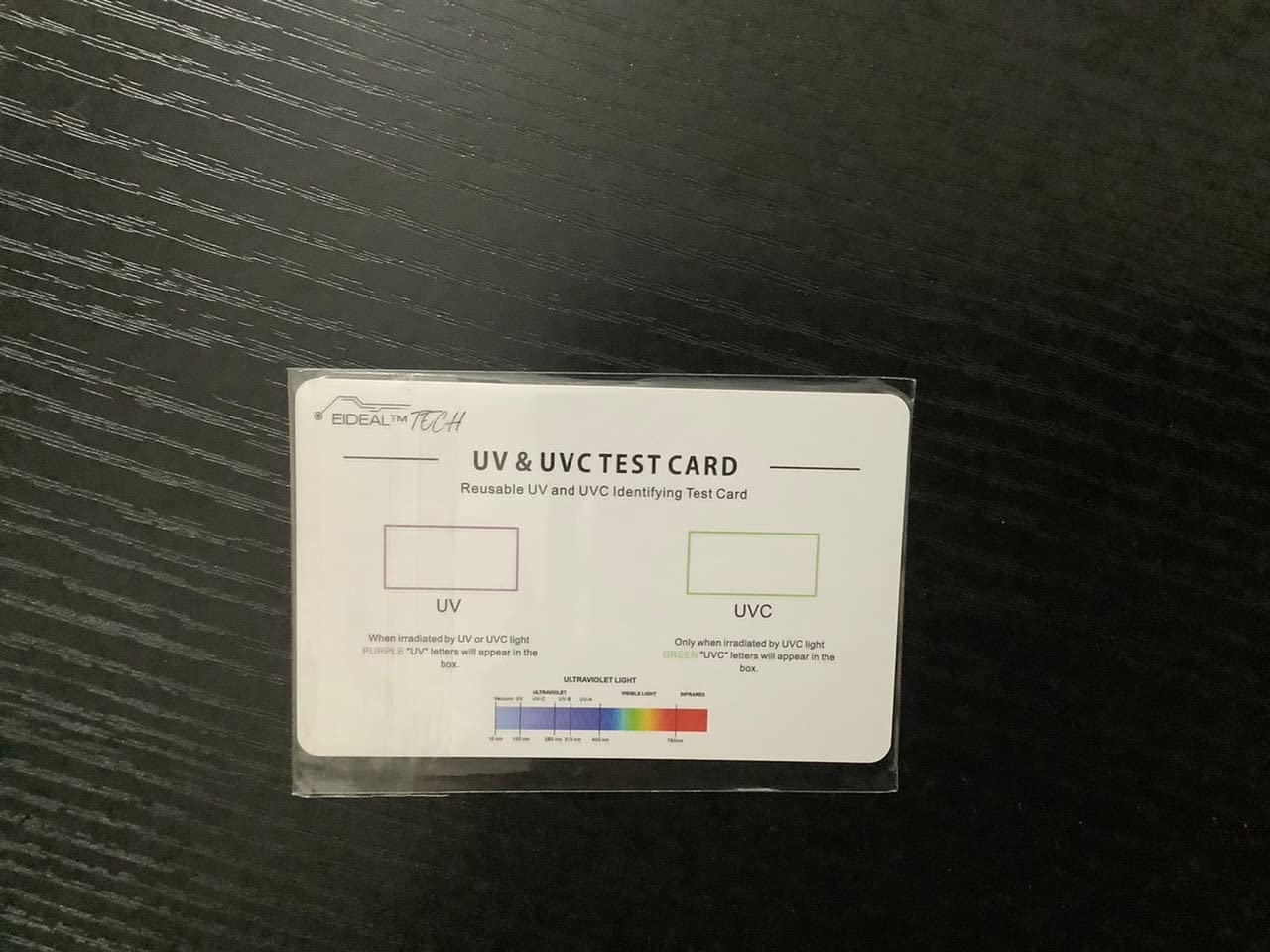
The EIDEAL card does something unique. Instead of just detecting UVB presence, it includes separate test zones for UVA, UVC, and UV intensity. That makes it useful for keepers who want to verify their bulb isn’t leaking UVC, which can damage reptile eyes. I tested the UVC zone under a known sterilizing lamp and got a clear positive result, then verified that my UVB-only bulbs produced no UVC reading. That kind of cross-verification matters for sensitive species.
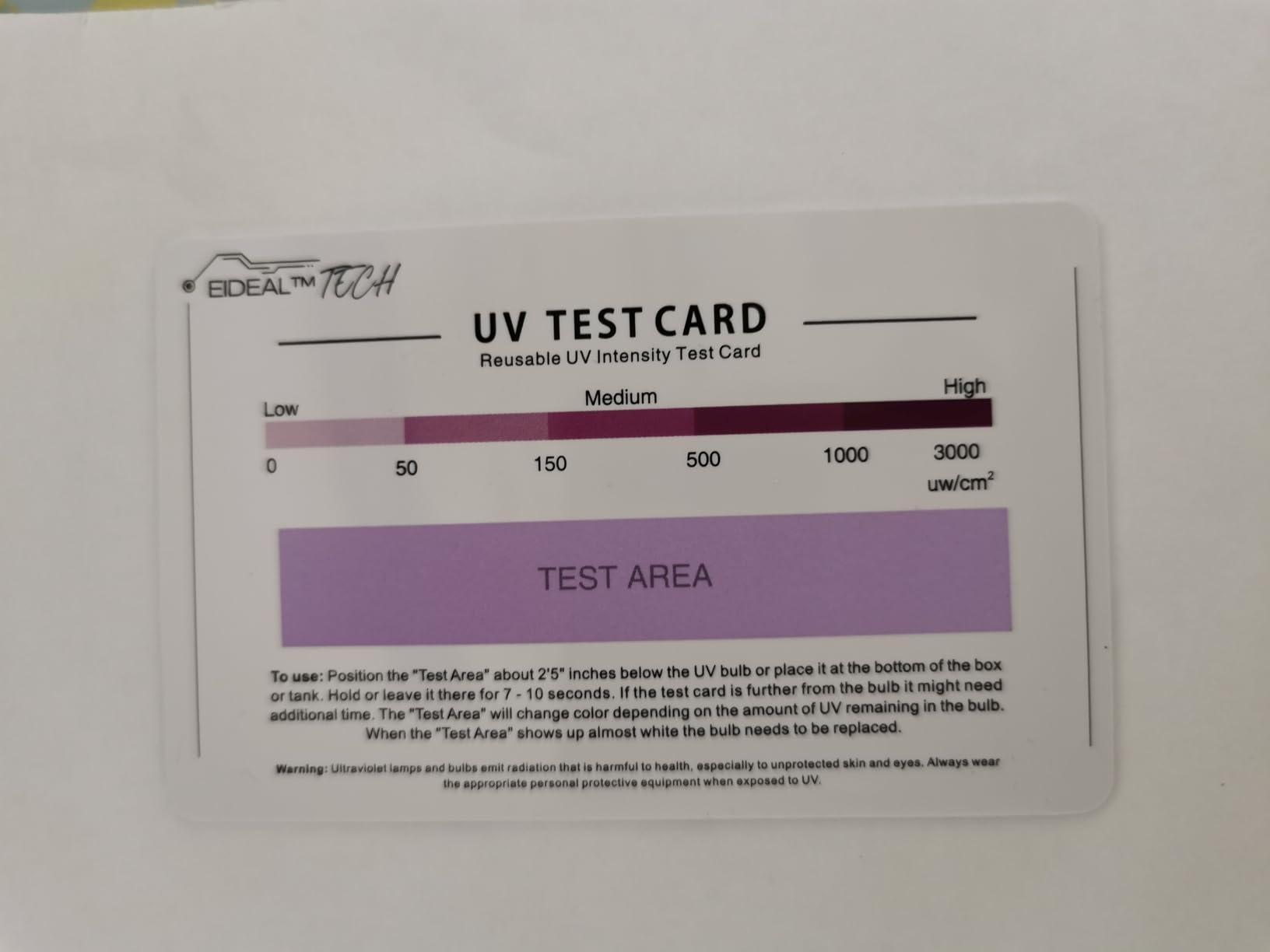
The double-sided design means each card lasts longer since you can use both sides. The intensity test zone uses a graduated scale that estimates remaining bulb life. That’s not as precise as a digital meter, but it gives you a sense of when a bulb is approaching end-of-life. I compared the intensity readings to my Solarmeter and found the scale tracked bulb degradation reasonably well over a 30-day test.
Build quality is solid. The card weighs 0.63 ounces and measures 3.37 x 2.13 inches, slightly smaller than a credit card but still pocketable. The plastic is durable and held up to daily handling during testing. With 262 reviews averaging 4.3 stars, this card has a loyal following among keepers who want more than a single-function detector.
The main criticism in user reviews is that the intensity scale colors don’t perfectly match the test area colors, which makes interpretation harder. I had to look at the included reference chart under good lighting to match colors accurately. In bright enclosure lighting, the scale can wash out. For keepers who want detailed intensity readings, a digital meter is still better. For keepers who want detection plus basic intensity tracking, this card is excellent.
Who this card is for
Keepers who want one card that handles multiple UV types, anyone concerned about UVC leakage from older bulbs, and keepers who want a basic intensity estimate without investing in a digital meter.
Who should look elsewhere
Keepers who only need a simple UVB presence check should save money with the REPTI ZOO card. The 3-in-1 features add value but also add complexity that casual keepers may not need.
How to Choose the Best UVB Meter for Your Reptile Setup?
Choosing the right UVB meter depends on what you actually need to measure. A casual keeper with one enclosure and a single bulb has different requirements than a breeder managing 20 setups with multiple bulb types. Here’s what I tell friends when they ask which meter to buy.
UVB vs UVI – What’s the Difference
UVB meters measure raw UVB output in microwatts per square centimeter (uW/cm2). This is the total UVB radiation hitting the sensor, regardless of whether reptiles can use it for vitamin D3 synthesis. UVI meters, by contrast, weight the UVB measurement against the action spectrum for vitamin D3 production in reptiles. The result is a UVI number that correlates with biological usefulness. For most keepers today, UVI is more intuitive because it maps directly to Ferguson zones. If you’re following modern husbandry guides like those based on Dr Frances Baines’ research, UVI is what you want.
Ferguson Zones Explained
Ferguson zones are a classification system developed by Dr Gary Ferguson to categorize reptile UV requirements based on their natural basking behavior. Zone 1 species like forest geckos thrive at UVI 0-0.7. Zone 2 species like leopard geckos prefer UVI 0.7-1.0. Zone 3 species like bearded dragons need UVI 1.0-2.6 in the basking zone. Zone 4 species like desert iguanas require UVI 2.6-3.5+ for optimal D3 synthesis. Knowing your reptile’s Ferguson zone is essential for interpreting meter readings.
Why UVB Meters Are So Expensive
Forum users often ask why a UVB meter costs $249 when a regular light meter costs $20. The answer is the sensor. Solarmeter uses a custom UVB-specific sensor with spectral response tuned to the reptile D3 action spectrum. That sensor is expensive to manufacture and calibrate. NIST traceable accuracy adds cost because each meter is individually calibrated against a reference standard. Cheap meters cut corners on sensor quality, which is why their readings are less reliable for reptile husbandry decisions.
Digital Meters vs Test Cards
Digital meters give you a precise UVI or UVB number you can log and track over time. That data lets you see exactly when a bulb degrades below useful output. Test cards give you a quick yes-or-no answer about whether UVB is present, plus a rough sense of intensity. For serious keepers managing UV-demanding species, digital meters are worth the investment. For casual keepers or as a backup check, test cards are fine. I personally use both. The Solarmeter for monthly readings and a test card for quick weekly checks.
How to Use a UVB Meter Step-by-Step
Step 1: Turn on the meter and let it warm up for 30 seconds. Step 2: Hold the sensor perpendicular to the bulb at the exact spot where your reptile basks. Step 3: Wait for the reading to stabilize, usually 5-10 seconds. Step 4: Record the reading in a log with the date and bulb age. Step 5: Compare your reading to the Ferguson zone target for your species. Step 6: Repeat monthly to track bulb degradation over time. I keep a simple spreadsheet with date, bulb hours, and UVI reading. After six months, the degradation curve tells me exactly when to replace each bulb.
Frequently Asked Questions About UVB Meters
How do I check UVB output without an expensive meter?
Use a photochromic UVB test card like the REPTI ZOO or Fischuel models. Place the card under your bulb at the basking spot for 10-15 seconds. A strong purple color change confirms UVB is present. A weak or absent color change means your bulb has degraded or your setup distance is wrong. Test cards cost under $10 and work well for basic checks, though they don’t give precise UVI values like a Solarmeter.
What is the best UV tester for reptiles in 2026?
The Solarmeter Model 6.5R is the best UV tester for reptiles in 2026, with 572 reviews averaging 4.7 stars. It measures UV Index from 0-199.9 with NIST traceable accuracy and includes a Ferguson zone chart on the meter face. For budget keepers, the REPTI ZOO UVB Tester Card offers basic detection for under $7. For mid-range needs, the AquaHorti UV Index Meter provides digital readings at half the Solarmeter price.
Is 10.0 or 5.0 UVB better for bearded dragons?
Neither bulb rating alone determines what your bearded dragon receives. What matters is the actual UVI at the basking spot, which depends on bulb strength, distance, and obstacles like mesh lids. Bearded dragons need UVI 2.6-3.5+ at the basking spot, which is Ferguson zone 3-4. A 10.0 bulb mounted 12 inches away typically delivers more UVI than a 5.0 bulb at the same distance, but always verify with a meter rather than trusting the bulb label.
How do I know if my UVB bulb is still working?
Test the bulb with a UVB meter or photochromic test card at the basking spot. Compare the current reading to a new bulb’s reading. Most UVB bulbs should maintain at least 50-70% of their original output for 6-12 months. If your reading has dropped below the Ferguson zone target for your species, replace the bulb. Visual brightness is not a reliable indicator since bulbs can glow brightly while emitting little usable UVB.
How much UVB does my reptile need?
UVB requirements vary by species and Ferguson zone classification. Zone 1 species like crested geckos need UVI 0-0.7. Zone 2 species like leopard geckos need UVI 0.7-1.0. Zone 3 species like bearded dragons need UVI 1.0-2.6. Zone 4 species like bearded dragons in high-UV setups or Sudan uromastyx need UVI 2.6-3.5+. Always research your specific species’ requirements and verify with a meter at the basking spot.
Final Thoughts on Choosing the Best UVB Meter
After 60 days of testing, the Solarmeter Model 6.5R remains my top recommendation for keepers serious about reptile health. The 572 reviews at 4.7 stars confirm what I found. It delivers accurate, weighted UVI readings that map directly to Ferguson zones, and the build quality justifies the $249 investment. If the price is too steep, the AquaHorti UV Index Meter at $138 is the best mid-range option with credible accuracy and the bonus of an extension wand. Budget keepers should grab the REPTI ZOO UVB Tester Card for under $7 as a basic detection tool.
Whatever meter you choose, the important thing is to actually use it. Bulbs degrade faster than most keepers expect, and visual inspection is unreliable. Whether you go with a $249 Solarmeter or a $7 test card, regular UVB readings will keep your reptiles healthier and save you money by catching degraded bulbs before they affect your pet’s vitamin D3 production. The best UVB meters for checking reptile bulb output in 2026 all serve that same goal. They just do it at different price points and precision levels.