
When my neighbor’s Lab started gagging on a tennis ball two summers ago, she froze for almost a full minute. That is a long time when an animal cannot breathe. By the time she remembered what to do, the dog had already dislodged it on his own, but the panic on her face has stuck with me ever since.
This guide exists so you don’t freeze. I will walk you through exactly how to do the Heimlich maneuver on a choking pet, from the first signs of trouble through the moment you hand your dog or cat to the emergency vet. We will cover dogs of every size, cats, what to avoid, when to call for help, and how to prevent the next scare.
Table of Contents
How to Recognize Choking in Dogs and Cats?
A pet can be choking and still be breathing. Yes, you read that right. A partial obstruction often lets some air squeak past the object, which is why so many owners miss the early warning signs.
Here are the signs that mean your pet is choking right now:
Pawing at the mouth or face frantically
Gagging, retching, or making high-pitched wheezing sounds
Gums turning blue, gray, or white (a sign of oxygen loss)
Panicked eyes, drooling, or sudden collapse
Refusal to eat even a favorite treat
Choking vs. coughing: A coughing dog usually produces sound and can clear its throat within a few seconds. A choking dog gets quieter, not louder, and the distress ramps up. If your pet sounds like a goose honking, it is probably kennel cough. If your pet is silent and pawing at its face, it is probably choking.
Trust your gut. If something feels wrong, treat it like choking until proven otherwise. The next two minutes matter more than being right.
Before You Act: Stay Calm and Stay Safe
Your pet can sense your panic. A choking dog is already terrified and oxygen-deprived, and a frantic owner makes everything worse. Take one breath, then move.
What NOT to do:
Do not shove your finger blindly down the throat. You can push the object deeper or get bitten.
Do not hold your pet upside down unless it is small enough to safely suspend (under 15 pounds).
Do not waste time on long phone calls. Call the emergency vet on speakerphone while you work.
Do not perform thrusts on a pet that is still breathing well. Aggressive thrusts on a partially obstructed airway can cause internal injury.
When to skip the Heimlich entirely: If your pet is unconscious, go straight to CPR (covered below). If the object is visible and easy to grab with two fingers, just pull it. Heimlich maneuvers are for objects you cannot see or cannot safely reach.
How to Do the Heimlich Maneuver on a Choking Pet: Step by Step
These six steps work for both dogs and cats. I will walk through the position details for each size in the next section.
Stay calm and check the mouth. Open your pet’s mouth gently and look for a visible object. If you can see it and grasp it with two fingers, sweep it out. Use a side-to-side sweeping motion, never a poke straight down the throat.
Perform 5 abdominal thrusts. Make a fist and place it just below the rib cage. Thrust inward and upward five times in quick succession. The pressure compresses the diaphragm and forces air out of the lungs to push the object upward.
Give 5 sharp back blows. Using the heel of your hand, strike firmly between the shoulder blades. Back blows and abdominal thrusts are alternated in modern first aid for a reason – they use different pressure points.
Recheck the mouth. After the first round of thrusts and blows, look again. If the object is now visible, sweep it out with your fingers.
Repeat if needed. Continue the cycle of 5 thrusts and 5 back blows until the object comes loose or your pet loses consciousness. Most cases resolve within two or three cycles.
Head to the emergency vet immediately after. Even if your pet seems fine, internal bruising or a torn esophagus can kill hours later. Always follow up.
Important warning: Abdominal thrusts can break ribs or damage the spleen, especially in small dogs, cats, and puppies. This is acceptable trade-off in a life-or-death emergency, but you must get veterinary imaging afterward.
Heimlich Maneuver for Large vs Small Dogs
Body size changes everything about this technique. Here is how to position yourself based on your dog’s weight.
Large Dogs (over 50 pounds)
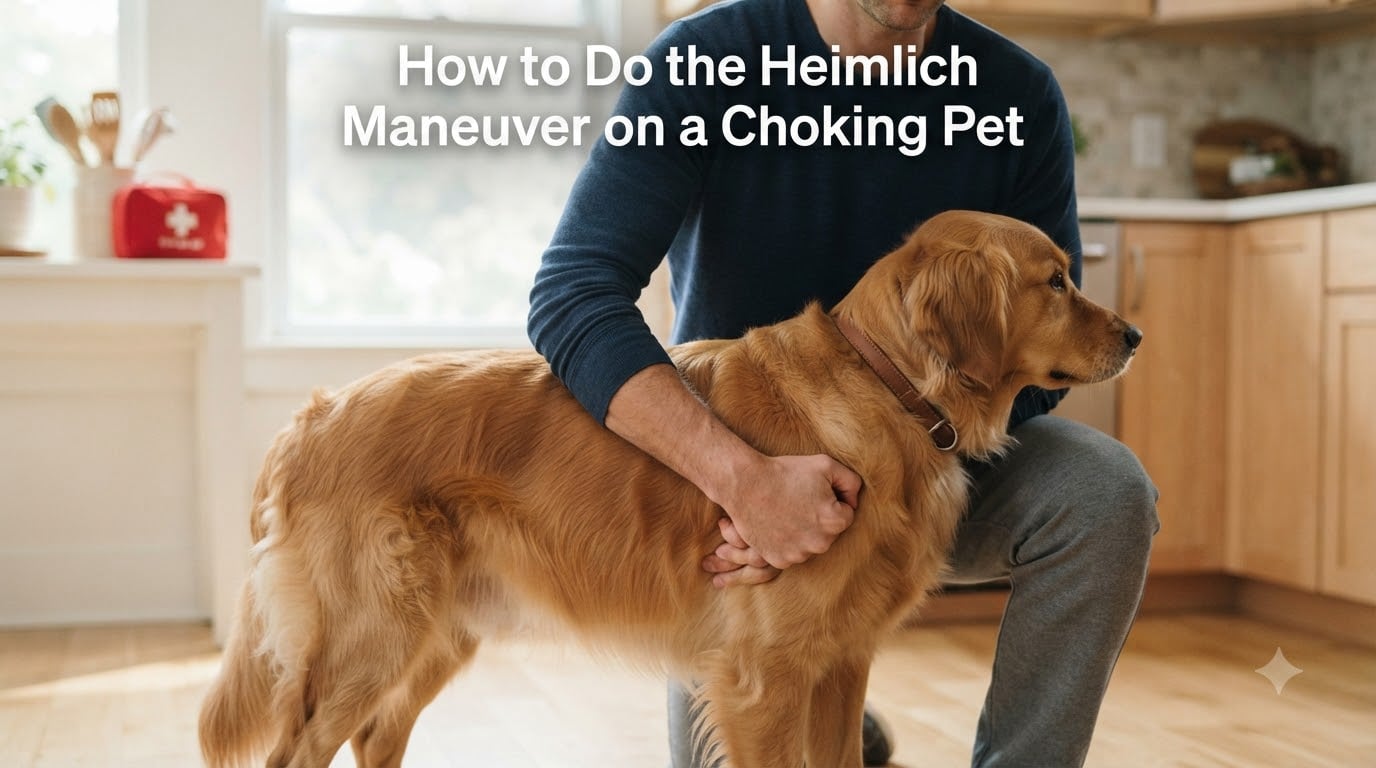
For a large dog, you work from behind or beside the standing dog. Wrap both arms around the dog’s torso just behind the last rib. Make a fist with one hand, cover it with the other, and thrust sharply inward and upward five times.
If your large dog has collapsed, lay it on its side. Place one hand on the back for support and the other fist just below the rib cage. Thrust upward toward the spine five times.
Small Dogs (under 30 pounds)
For a small dog, the easiest method is the hip-suspension hold. Lift your dog by its back thighs, holding it upside down with its head pointing toward the floor. Gravity plus five firm thrusts to the abdomen just below the rib cage usually clears the obstruction fast.
If the dog is too heavy to lift but under 30 pounds, hold it against your chest with its back against your stomach. Place a fist just below the rib cage and thrust upward, similar to the human Heimlich.
Cats and Puppies
Cats and small puppies are treated almost identically. Hold the animal upside down by its hips with one hand supporting the chest. Use the heel of your other hand to deliver five quick thrusts just below the rib cage. Be gentle – feline rib cages and puppy bones are fragile.
Cats rarely choke on toys because they tend to play cautiously, but string, thread, dental floss, and small bones are common culprits. If your cat is pawing at its mouth and drooling heavily, check for linear objects first before attempting thrusts.
If Breathing Stops: Transitioning to Pet CPR
Once the object is clear, your pet may still not be breathing. That is when you switch to CPR. The transition must be fast – brain damage begins around four minutes without oxygen.
Check responsiveness
Tap your pet and call its name. If there is no response, check for a heartbeat by placing your hand on the left side of the chest just behind the elbow.
Chest compressions
For dogs over 30 pounds, compress the chest about one-third of its width at a rate of 100 to 120 compressions per minute. For cats and small dogs, wrap one hand around the chest just behind the elbows and squeeze with your thumb on one side and fingers on the other.
Rescue breaths
Close your pet’s mouth, extend the neck slightly, and breathe into the nose. You should see the chest rise. Give two breaths after every 30 compressions.
Continue until your pet breathes on its own, you reach the emergency vet, or you are physically unable to continue.
After the Object Is Removed: What Comes Next
Do not relax just because your pet is breathing again. The throat may be scraped, the trachea bruised, or a rib cracked from the thrusts. All of these can turn fatal hours later if untreated.
Always see a vet within the hour, even if your pet looks normal. Internal damage from abdominal thrusts is not visible from the outside. X-rays or ultrasound may be needed to rule out a ruptured spleen or lacerated liver.
Watch for warning signs in the next 24 hours:
Vomiting or refusing food
Lethargy or hiding
Bloody saliva or nose discharge
Labored breathing that gets worse
How to Prevent Choking in Pets
Most choking incidents are preventable. A few minutes of smart toy and treat selection saves an emergency room visit later.
Toy size rule
A safe toy cannot fit entirely inside your pet’s mouth. If your dog can close its jaws fully around a ball or toy, the toy is too small. Tennis balls are notorious for this on medium and large dogs.
Food and treats
Cut large kibble into smaller pieces for small breeds. Avoid cooked bones, which splinter. Rawhide chews should be sized so the dog cannot swallow a piece whole. Antlers and bully sticks can also break into sharp fragments.
Supervise chewing sessions
Most choking happens when pets are alone with a chew. Stay in the room during high-risk chew sessions, especially with new toys or aggressive chewers.
Common household hazards
Keep these away from curious pets: hair ties, rubber bands, small plastic toys, broken balloon pieces, corn cobs, peach pits, and dental floss. Cats are especially drawn to string, tinsel, and yarn – all of which can cause linear obstructions deeper in the digestive tract.
Practice on a stuffed animal
Veterinary trainers recommend rehearsing the Heimlich position on a stuffed dog once a quarter. Muscle memory is the difference between freezing and acting when seconds matter. The Red Cross Pet First Aid app includes a video refresher you can review in under five minutes.
Frequently Asked Questions
Can a dog be choking but still breathing?
Yes. A partial airway obstruction often allows some air past the object, so a choking dog may still produce wheezing, gagging, or faint breathing sounds. Watch for pawing at the mouth, blue or white gums, and escalating panic – these mean you should act even if your pet is not silent.
What do you do if your dog has something stuck in its throat but is not choking?
If your dog is alert, breathing normally, and drooling excessively, the object is likely stuck but not fully blocking the airway. Stay calm, look inside the mouth with a flashlight, and only attempt removal if you can see and safely grasp the object with two fingers. Do not force anything deeper. Call your vet for guidance even if removal is successful.
Is the Heimlich maneuver the same for dogs as for humans?
The principle is identical – abdominal thrusts that push air from the lungs to dislodge the object – but the position differs. Humans stand and receive thrusts from behind. Large dogs also stand, but small dogs and cats are best lifted upside down by the hips so gravity assists. The number of thrusts is the same: five sharp compressions.
How do you do the Heimlich maneuver for choking?
Check the mouth first and sweep out any visible object with two fingers. If that fails, place a fist just below the rib cage and give five quick inward and upward thrusts. Follow with five sharp back blows between the shoulder blades. Repeat the cycle until the object dislodges or your pet loses consciousness, then transition to CPR if needed.
When should I take my choking dog to the emergency vet?
Take your dog to the emergency vet immediately after any choking incident, even a successfully resolved one. Internal injuries from the object or the thrusts are not visible from the outside. Go straight to the vet without trying the Heimlich if your pet is unconscious, has blue gums, or shows no improvement after two cycles of thrusts and back blows.
Will my dog be okay after choking?
Most dogs recover fully after a choking incident if the object is removed quickly and they receive veterinary follow-up. The biggest risks are delayed: bruised trachea, cracked ribs, or internal bleeding from the thrusts can surface hours later. With prompt care, the survival rate is high. Without intervention, choking is fatal within minutes.
Final Thoughts on Pet Choking Emergencies
Knowing how to do the Heimlich maneuver on a choking pet is a skill you hope you never use. It takes about ten minutes to read this guide and ten more to practice the positions on a stuffed animal. That twenty minutes is the difference between a pet that lives and a tragedy you replay for years.
The core technique is simple: check the mouth, perform five abdominal thrusts, deliver five back blows, repeat. The hard part is staying calm enough to do it. Take a pet first aid course if you can. Download the Red Cross app tonight. Keep your vet’s emergency number on your fridge, not just in your phone.
Choking kills in minutes. You have more time than you think if you act. Save this guide, share it with anyone who watches your pets, and breathe easier knowing you are ready.