
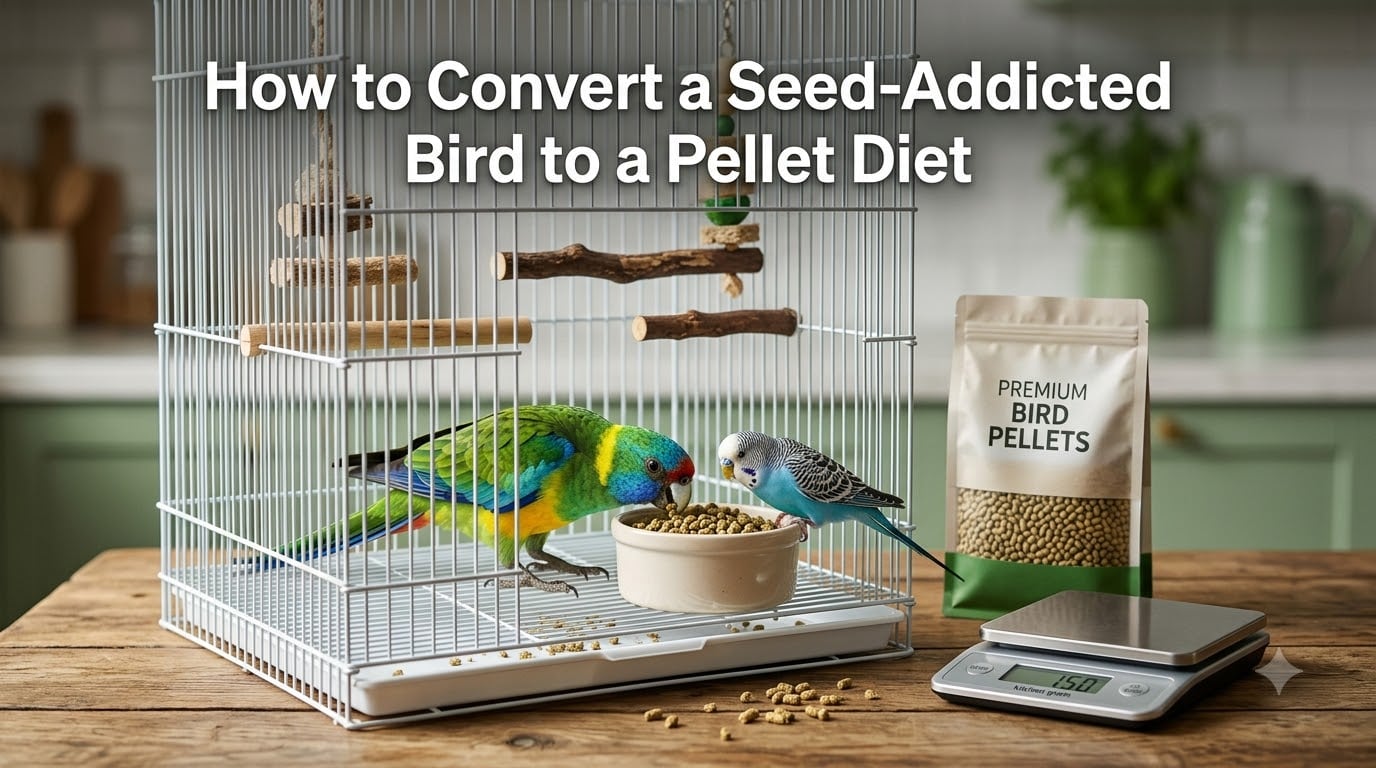
If your bird picks through their bowl, shells every seed, and ignores everything else, you are not alone. Most pet birds arrive home already hooked on seed-only diets, and breaking that habit is one of the hardest things an owner can do. But learning how to convert a seed-addicted bird to a pellet diet can add years to your bird’s life and dramatically improve their energy, feather quality, and immune system.
I have helped convert dozens of stubborn eaters over the years, from cockatiels that refused pellets for years to budgies that would not touch anything green. The process takes patience, the right method, and a gram scale. There is no overnight fix, but the results are worth every frustrating week.
This guide walks through why seeds alone are dangerous, how birds think about food, and three proven conversion methods you can start today. I will also cover weight monitoring, dropping checks, and what to do when your bird flat-out refuses to eat.
Table of Contents
Why a Seed-Only Diet Is Dangerous?
Seed-only diets are the number one cause of preventable illness in companion birds. Seeds are high in fat and missing dozens of the vitamins, minerals, and amino acids your bird needs to stay healthy. Over time, those nutritional gaps turn into serious medical problems.
The most common condition I see in seed-only birds is fatty liver disease. Sunflower seeds, safflower seeds, and peanuts are loaded with fat. A bird eating nothing but these will develop a enlarged, inflamed liver that can shorten their lifespan by years. Other issues include vitamin A deficiency, calcium deficiency, and weakened immune function.
Birds on seed-only diets also tend to be overweight or underweight depending on the species. Cockatiels and budgies often become obese, while larger parrots may fail to absorb enough nutrients. Either way, the body is not getting what it needs to maintain healthy feathers, strong bones, and a functioning immune system.
A balanced pellet diet solves these problems because every pellet contains the same complete nutrition. Your bird cannot pick out the “good stuff” and leave the rest. They get consistent, balanced nutrition in every bite, which is why avian veterinarians recommend pellets as the base of a bird’s diet.
Why Birds Resist New Foods
Birds are not being stubborn when they ignore pellets. They genuinely do not recognize pellets as food. In the wild, a bird learns what is safe to eat by watching their parents and flock mates. A pellet looks, smells, and feels like nothing they have ever seen, so their survival instinct tells them to avoid it.
This instinct is called food neophobia, and it is especially strong in parrots, cockatiels, and budgies. A bird’s brain is wired to be suspicious of anything unfamiliar because eating the wrong thing in the wild could be fatal. That instinct does not disappear just because your bird lives in a cozy cage with unlimited food.
Birds also have far fewer taste buds than humans. While we have around 10,000, a parrot might have only 300 to 400. They rely heavily on texture, color, and shape to decide if something is worth eating. The hard, uniform texture of an extruded pellet feels completely foreign compared to the satisfying crunch of cracking a seed shell.
Understanding this psychology is the key to success. You are not fighting stubbornness. You are working against a deep survival instinct, which is why patience and gradual exposure matter more than persistence.
What Is a Balanced Pellet Diet?
A balanced pellet diet is one where formulated pellets make up roughly 70 to 80 percent of your bird’s daily intake, with fresh vegetables, a small amount of fruit, and occasional seeds or nuts making up the rest. The pellet is the nutritional foundation, and everything else adds variety and mental enrichment.
There are two main types of pellets. Extruded pellets are baked and formed into uniform shapes, which makes them nutritionally consistent but texturally boring. Chop-based pellets and formulated products like Lafeber’s Nutriberries or Avicakes combine ingredients into more natural shapes that some birds accept faster because they resemble food more closely.
The brands I see recommended most often by avian veterinarians are Harrison’s Bird Food, Mazuri, Roudybush, and Lafeber’s. Harrison’s is widely considered the gold standard for veterinary nutrition. Roudybush is a solid mid-range option that many birds accept quickly. Mazuri is popular with breeders and larger facilities. Lafeber’s Nutriberries are a great transition tool because they look and feel more like food to a skeptical bird.
Pick one brand and stick with it during the conversion process. Switching pellet types mid-conversion will only confuse your bird and reset their acceptance clock.
Before You Begin: Essential Preparation
Preparation is what separates a successful conversion from a stressful one. Before you change a single thing in your bird’s bowl, take care of these steps.
First, schedule a checkup with an avian veterinarian. Your bird needs a clean bill of health before any diet change, and your vet should record a baseline weight. This is also your chance to ask about specific pellet recommendations for your bird’s species and size.
Second, buy a gram scale. This is non-negotiable. A kitchen scale that measures in one-gram increments lets you track your bird’s weight daily during conversion. A bird can lose dangerous amounts of weight before showing any visible signs, and a gram scale catches that drop before it becomes a crisis.
Third, weigh your bird every morning before they eat. Record the number somewhere you can reference easily. This baseline tells you exactly how much weight loss is acceptable during the transition. As a general rule, your bird should never lose more than 10 percent of their starting body weight during conversion.
Fourth, choose your pellet and buy enough to last through the full conversion process. Have fresh vegetables ready for supplementation. Set up a journal or spreadsheet to track daily weight, food offered, and food consumed. The more data you collect, the easier it is to spot problems early.
How to Convert a Seed-Addicted Bird to a Pellet Diet: Step-by-Step Methods?
There is no single right way to convert a seed-addicted bird to a pellet diet. Different birds respond to different approaches, so I recommend understanding all three methods and choosing the one that fits your bird’s personality and your schedule.
Method 1: Gradual Substitution
This is the safest and most commonly recommended method, especially for first-time converters. The idea is simple: slowly increase the percentage of pellets while decreasing the percentage of seeds over several weeks.
Start by mixing 90 percent seeds with 10 percent pellets in your bird’s regular food dish. Use the same dish your bird is used to so the change feels minimal. Keep this ratio for four to seven days, depending on how your bird responds.
Each week, shift the ratio by roughly 10 percent. Week two is 80 percent seeds and 20 percent pellets. Week three is 70/30. Continue this pattern until you reach 100 percent pellets. For most birds, this process takes four to eight weeks. Stubborn birds may need three months or more.
Watch your bird’s weight and droppings closely throughout. If weight drops more than 10 percent, slow the ratio change and give your bird more time at the current level. Patience is more important than speed.
Method 2: Controlled Conversion (The Instinct Method)
This method works well for healthy adult birds and is faster than gradual substitution, but it requires more careful monitoring. The principle is that a hungry bird is more willing to try new foods, but you never let your bird go hungry.
Place two separate dishes in the cage: one with pellets and one with seeds. Offer the pellet dish first thing in the morning when your bird is hungriest. Leave it for one to two hours, then add the seed dish for the rest of the day.
Over the course of one to two weeks, gradually extend the pellet-only window and shorten the seed window. Eventually, seeds become a small evening portion rather than the main meal. This method works because birds are naturally most willing to explore new foods in the morning.
Weigh your bird daily. If they are not touching the pellets at all during the morning window, the instinct method may not be right for them, and you should switch to gradual substitution. Never extend the pellet-only period if your bird is losing weight rapidly.
Method 3: Softening and Soaking
Some birds reject pellets purely because of texture. Softening the pellets can bridge that gap by making them feel more like the soft foods birds naturally enjoy. This method is especially effective for budgies and small parrots.
Try soaking pellets in a small amount of unsweetened apple juice or warm water for five to ten minutes before serving. The pellets absorb the liquid and become softer, and the slight sweetness from apple juice can make them more appealing. Drain excess liquid before serving so the pellets do not become mushy or spoil quickly.
Another variation is grinding pellets into a fine powder using a clean coffee grinder. Mix the powder with your bird’s favorite soft food, like mashed sweet potato, applesauce, or cooked squash. Gradually reduce the soft food and increase the pellet powder over several weeks until your bird is eating mostly pellets.
One real-world success story I love comes from a budgie owner who ground pellets into powder, mixed them with seeds so the powder coated the seed shells, and let their bird get used to the pellet taste every time they cracked a seed. Within six weeks, the budgie was eating whole pellets on its own.
Monitoring Your Bird’s Health During Conversion
Weight monitoring is the single most important safety measure during diet conversion. Weigh your bird every morning before feeding, using a gram scale accurate to one gram. Record each weight in a log so you can spot trends over time.
A weight loss of up to 10 percent is generally acceptable during conversion. If your bird started at 90 grams, anything above 81 grams is safe. If the number drops below that threshold, pause the conversion, increase the seed ratio temporarily, and consult your avian vet if the trend continues.
Droppings are your second window into your bird’s health. Healthy droppings have three parts: a dark green or brown solid portion (feces), a white or cream portion (urates), and a clear liquid portion (urine). During conversion, watch for changes in volume, color, and consistency.
If droppings become very small, dark, and dry, your bird may not be eating enough. If they become loose, discolored, or foul-smelling, stop the conversion and contact your vet. Droppings should return to normal within a day or two of adjusting the food ratio.
Other signs of inadequate eating include fluffed feathers, lethargy, sitting at the bottom of the cage, and reduced vocalization. If you notice any of these, your bird may be hungry or ill. Always take these signs seriously and consult a veterinarian.
Tips for Stubborn Birds
Some birds need extra encouragement to accept pellets. These techniques come from experienced bird owners and avian professionals, and they can make a real difference when standard methods stall.
The family meal technique works because birds are social eaters. Eat your own meals near your bird’s cage, and offer pellets from your hand or a separate dish while you eat. Birds are more likely to try a food they see their flock (you) enjoying. Make a show of enjoying the food yourself, even if you are just pretending.
For budgies specifically, try placing a small mirror behind or beside the food dish. Budgies are highly social and may be more willing to eat when they think another bird is eating nearby. This trick has helped many budgie owners break through a conversion plateau.
Hand-feeding individual pellets builds positive associations. Hold a pellet between your fingers and offer it gently. Even if your bird just tastes it and drops it, that counts as progress. Repeat daily until your bird starts accepting pellets willingly from your hand.
If your bird is extremely attached to a particular seed mix, try placing pellets in the same location where the seed dish normally sits. Familiar location plus unfamiliar food sometimes tips the balance. Birds are creatures of habit, and using their routine to your advantage can speed up acceptance.
The 3-3-3 Rule for Birds
The 3-3-3 rule is a guideline for helping a bird adjust to a new home, and it connects directly to diet conversion because stress affects eating habits. The rule breaks the adjustment period into three phases: 3 days, 3 weeks, and 3 months.
In the first 3 days, your bird is in survival mode. They may not eat much, may be loud or withdrawn, and are unlikely to accept new foods. This is not the time to start a diet conversion. Let your bird settle first.
Over the next 3 weeks, your bird starts learning the routine of their new home. They begin to trust their environment, recognize feeding schedules, and may become curious about new things. This is when you can begin introducing pellets alongside their regular food.
By the 3-month mark, your bird is fully settled and comfortable. They have established trust, understand the household routine, and are emotionally ready for bigger changes like a full diet conversion. Starting a conversion during this window tends to go more smoothly because your bird feels secure enough to take risks with new foods.
Common Mistakes to Avoid
The biggest mistake is going cold turkey. Removing all seeds at once and offering only pellets can cause your bird to stop eating entirely, leading to rapid weight loss and potentially fatal health consequences. Always use a gradual method.
Another common mistake is not weighing your bird. Without daily weight checks, you have no way to know if your bird is actually eating enough. Visual checks are unreliable because birds hide weight loss under their feathers.
Rushing the process is equally dangerous. If you move too fast through the seed-to-pellet ratio, your bird may reject the pellets entirely and you will have to start over. Slow and steady wins this race, even if it takes months.
Finally, ignoring droppings is a mistake I see too often. Droppings tell you in real time whether your bird is digesting food properly. Make dropping checks part of your daily routine throughout the entire conversion process.
Frequently Asked Questions
How to switch a bird from seed to pellets?
The best way to switch a bird from seed to pellets is the gradual substitution method. Start with a mix of 90 percent seeds and 10 percent pellets, then increase the pellet ratio by about 10 percent each week while monitoring your bird’s weight daily with a gram scale. The full process typically takes four to eight weeks, though stubborn birds may need several months.
Are pellets better than seeds for birds?
Yes, pellets are better than seeds for birds because they provide complete, balanced nutrition in every bite. Seed-only diets are high in fat and deficient in essential vitamins, minerals, and amino acids, which leads to fatty liver disease, vitamin A deficiency, calcium deficiency, and shortened lifespans. Pellets are formulated to prevent these deficiencies and are recommended by avian veterinarians as the base of a healthy bird diet.
How do I wean my bird into eating pellets?
Wean your bird onto pellets by gradually mixing pellets into their regular seed dish, starting with a small ratio of about 10 percent pellets. Increase the pellet percentage slowly each week while tracking your bird’s weight and droppings. You can also try softening pellets in apple juice, grinding them into powder, or using the family meal technique where you eat alongside your bird to model the behavior.
What is the 3 3 3 rule for birds?
The 3-3-3 rule for birds breaks a new bird’s adjustment period into three phases. The first 3 days are survival mode where the bird is stressed and unlikely to try new foods. Over the next 3 weeks, the bird starts settling in and learning the routine. By 3 months, the bird is fully comfortable and emotionally ready for bigger changes like diet conversion. Waiting until the 3-month mark makes diet transitions smoother.
Conclusion
Learning how to convert a seed-addicted bird to a pellet diet is one of the most important things you can do for your bird’s long-term health. The process takes patience, a gram scale, daily weight checks, and a willingness to slow down when your bird needs more time. Start with a baseline vet visit, choose a quality pellet brand, and commit to gradual conversion over weeks or months rather than days.
Your bird may resist at first, but persistence pays off. Every small step toward a balanced pellet diet adds up to a healthier, longer-lived companion. Begin with the method that fits your bird, track your progress, and remember that going slow is always better than going fast.