
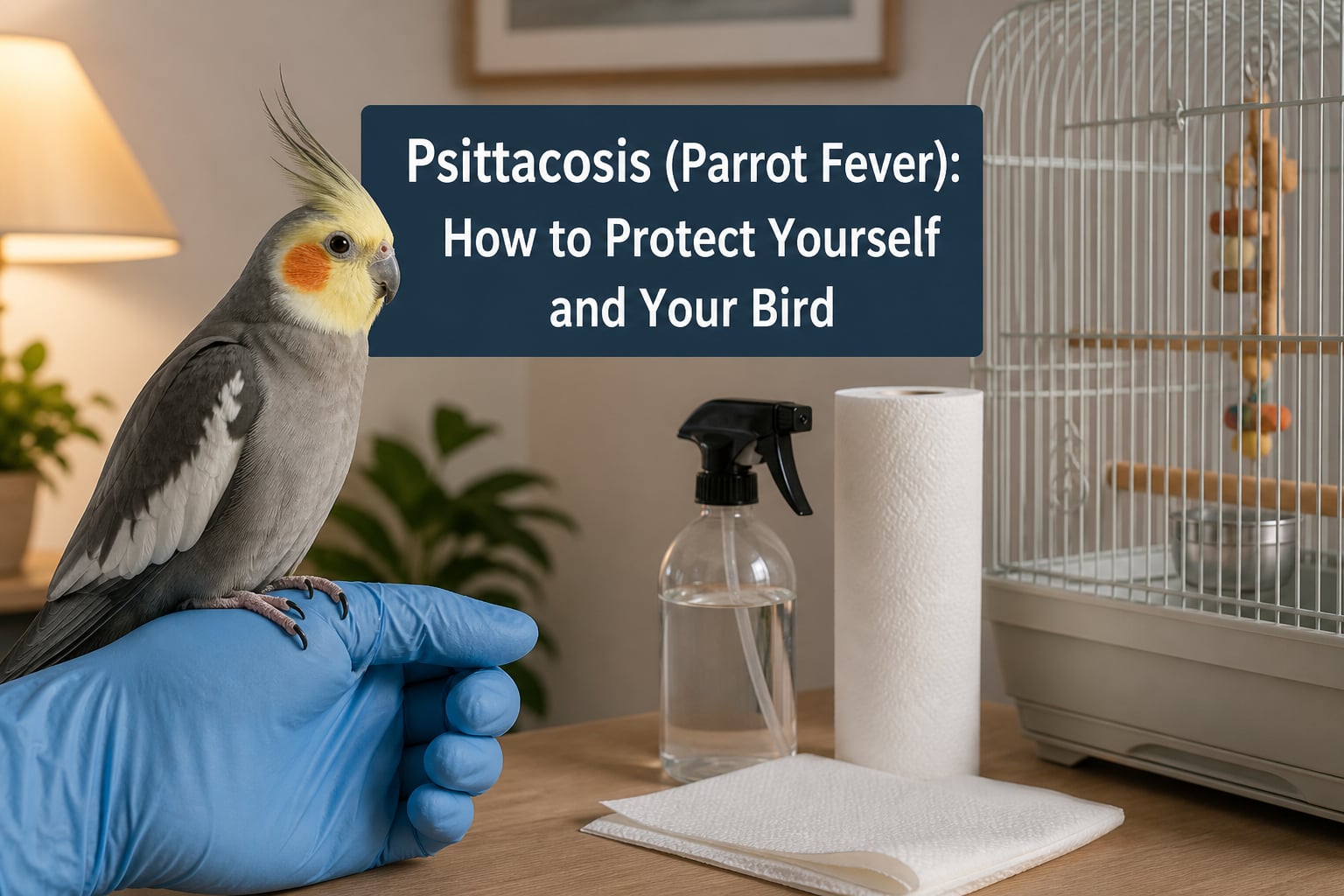
Psittacosis (also called parrot fever or ornithosis) is a bacterial infection caused by Chlamydia psittaci that moves between birds and people. I have spent years around parrots, cockatiels, and rescue finches, and I have seen how quickly a quiet bird can turn into a wheezing one when this pathogen enters a home.
The good news: psittacosis is rare. In the United States, fewer than 50 confirmed human cases are reported each year, and the illness responds well to common antibiotics when it is caught early. The bad news: because the early symptoms look exactly like a cold or the flu, both bird owners and doctors sometimes miss the diagnosis until it has already progressed.
This guide covers everything our team has learned from working with avian vets, public health resources (CDC, NCBI StatPearls), and real bird owners on forums like Reddit’s r/cockatiel and r/parrots. You will get the definition, the symptoms on both sides of the cage, the transmission routes, and a step-by-step protection plan you can apply tonight.
Table of Contents
What Is Psittacosis and What Causes Parrot Fever?
Psittacosis is a zoonotic respiratory infection caused by the bacterium Chlamydia psittaci, an obligate intracellular organism that survives inside bird cells and spills into droppings, urine, and respiratory secretions. The disease has been recognized since the late 1800s, when it was linked to parrots and other psittacine birds, hence the name.
You may see the same illness called several names in different sources:
Psittacosis – the formal medical term, used most often in human medicine.
Parrot fever – the common name among bird owners.
Ornithosis – an older name still used in European literature.
Avian chlamydiosis – the veterinary term when the infection stays in birds.
The incubation period in humans typically runs 5 to 14 days after exposure, though the CDC notes it can stretch as long as 4 weeks in rare cases. During that window, an infected person feels fine while the bacteria quietly multiply.
Our team reviewed the NCBI StatPearls entry and the CDC’s About Psittacosis page side by side. Both describe Chlamydia psittaci as a Gram-negative bacterium that infects more than 460 bird species worldwide. Parrots, cockatiels, parakeets, and pigeons are the most common carriers in pet and urban settings, while turkeys and ducks drive most occupational exposures on poultry farms.
In 2026, the disease still matters. A 2024 European outbreak tied to wild and captive birds infected dozens of people across five countries and killed at least five, reminding public health agencies that psittacosis never truly disappears, it just goes quiet between flare-ups.
Psittacosis Symptoms in Humans
Human psittacosis almost always begins with flu-like symptoms that range from mild to severe. The CDC lists the most common presentations as fever, chills, headache, muscle aches, and a dry, non-productive cough. Most patients notice symptoms 5 to 14 days after handling an infected bird or cleaning a contaminated cage.
Here is what the early phase usually looks like:
Sudden fever, often 38.5 to 40 °C (101.4 to 104 °F).
Chills and drenching sweats, especially at night.
A persistent dry cough that does not bring up mucus.
Headache that throbs behind the eyes or across the forehead.
Muscle aches, particularly in the lower back and thighs.
Fatigue that feels heavier than a normal cold.
When the infection spreads deeper into the lungs, it can cause atypical pneumonia. Doctors may hear crackles on auscultation even when a chest x-ray looks only mildly abnormal. This pattern is one reason psittacosis is sometimes misdiagnosed as ordinary community-acquired pneumonia.
Less common but more serious complications include:
Endocarditis – infection of the heart valves, which can damage them permanently.
Hepatitis – liver inflammation marked by yellowing of the skin or eyes.
Encephalitis – brain inflammation that can cause confusion or seizures.
Reactive arthritis – joint pain that lingers after the infection clears.
You should see a doctor quickly if you develop fever plus cough within two weeks of bird exposure, especially if you own parrots, work in a pet store, or recently brought home a new bird. Be sure to mention the bird contact explicitly; many clinicians will not think to test for psittacosis unless you raise it.
Signs of Psittacosis in Birds You Should Never Ignore
Bird symptoms can be subtle, and prey animals instinctively hide illness until they can no longer compensate. By the time a sick parrot looks obviously unwell, the infection has often been active for days. Our team asked avian veterinarians which signs they consider red flags, and the same five kept coming up.
Five warning signs your bird may have psittacosis:
Breathing changes. Wheezing, tail bobbing with each breath, open-mouth breathing, or holding the beak open for long stretches while at rest.
Eye or nose discharge. Clear, yellow, or green fluid around the nostrils or eyes, sometimes with crusting that sticks the eyelids together.
Lethargy and fluffed feathers. A bird that sits low on the perch with feathers puffed out for hours, even in a warm room, is conserving energy to fight infection.
Changes in droppings. Watery, green, or yellow droppings, or droppings with more urine than usual. Some birds stop eating and produce only scant, dark feces.
Weight loss and appetite drop. Visible keel bone, eaten seeds left in the bowl, or a bird that ignores favorite treats.
One cockatiel owner on Reddit described how her new bird started “wheezing like a tiny accordion” within a week of purchase. That bird required two shots per day for seven days plus oral antibiotics before it stabilized. Her story is a useful reminder that early veterinary care is the single biggest factor in survival.
Psittacosis can also show up as sudden death, particularly in young parrots, finches, and pigeons whose immune systems are weaker. If multiple birds in an aviary die over a short window without an obvious cause, ask your vet to test for Chlamydia psittaci even if the surviving birds look fine.
A quick note on testing: avian vets usually confirm psittacosis with a PCR test on a cloacal or choanal swab, sometimes paired with blood serology. Treatment most often involves 30 to 45 days of doxycycline, given by injection for the first week and then orally, with strict isolation during the course.
How Parrot Fever Spreads Between Birds and People?
Humans catch psittacosis by inhaling aerosolized particles of dried bird droppings, urine, or respiratory secretions. The bacteria become airborne when droppings dry out, when birds flap their wings, or when owners sweep, vacuum, or dust a cage without precautions. Direct beak-to-mouth contact (kissing a bird, sharing food) and handling of sick birds without gloves also transmit the infection.
The most common transmission pathways are:
Inhaled dust – the single biggest route. Dry droppings and feather dust carry the bacteria deep into the lungs.
Direct contact – touching a sick bird and then touching your mouth, nose, or eyes.
Bird-to-bird – shared feeders, water bowls, and perch space in pet stores, aviaries, and shelters.
Human-to-human – extremely rare but documented, usually in hospital settings where a patient has severe pneumonia.
People at highest exposure include bird owners, pet store employees, veterinarians and vet techs, aviary workers, poultry farmers, and taxidermists. Lab workers handling Chlamydia psittaci cultures are also at risk and use biosafety cabinets for that reason.
Carrier birds complicate the picture. An infected bird can shed bacteria for weeks before showing any symptoms, and some birds shed intermittently for months after they appear to recover. This is why quarantine matters even when a new bird looks healthy.
One detail that surprises new owners: psittacosis does not require you to own a parrot. Wild pigeons, seagulls, and ducks also carry the bacterium. People who clean balconies, rooftops, or barns contaminated with wild bird droppings can develop psittacosis without ever touching a pet.
How to Protect Yourself and Your Bird from Psittacosis?
Most cases of psittacosis are preventable with a handful of consistent habits. The CDC’s prevention page boils the advice down to handwashing, safe handling, and wet cleaning, and our team has turned each of those into a concrete checklist you can use today.
Wash your hands every time you handle birds or cages. Use running water and soap for at least 20 seconds. Wash again after you finish cleaning feeders, water bowls, or aviary surfaces. If soap is not available, an alcohol-based hand sanitizer works as a temporary backup, but washing is better because it also removes dust and debris.
Wear personal protective equipment when cleaning. Disposable gloves, an N95 or KN95 mask, and ideally safety glasses. I keep a small kit next to the bird food so I never have an excuse to skip the gear. Long sleeves and a washable apron add another layer when you clean out a dirty cage.
Use the wet cleaning method, never dry sweeping. Dry sweeping or vacuuming aerosolizes the exact particles you are trying to avoid. Instead:
Spray droppings and soiled surfaces with a disinfectant or a mild bleach solution before wiping.
Use paper towels or disposable cloths for heavy messes, then discard them in a sealed bag.
Scrub cages and perches with hot, soapy water, then rinse and dry them in the sun when possible.
Disinfectants effective against Chlamydia psittaci include 1:32 diluted bleach, quaternary ammonium compounds, and 70 percent alcohol.
Quarantine any new or sick bird for at least 30 to 45 days. Keep new arrivals in a separate room with their own air space if possible. Watch for the warning signs listed above and schedule a vet check before introducing the bird to your existing flock. If a bird is diagnosed with psittacosis, isolate it for the full treatment course plus a follow-up negative test.
Take new birds to an avian vet within the first week. A pre-purchase or post-adoption exam catches problems that pet store staff may not notice. Bring any health records the seller or shelter provides, and ask specifically about psittacosis testing if the bird came from a multi-bird environment.
Avoid risky contact behaviors. Do not kiss your bird on the beak, share food from your mouth, or let birds perch on your face or shoulders while you eat. Wash any bite or scratch immediately with soap and water, and watch the wound for signs of infection.
Keep your own immune health in mind. Pregnant women, people over 65, and anyone with a chronic lung condition or who is immunocompromised should be especially careful. If you fall into one of those groups, ask another household member to handle the heavy cleaning, or invest in a high-quality respirator.
If you are worried your bird may have been exposed, the most important first step is to call an avian vet rather than waiting to see if symptoms appear. Time matters because antibiotics work better the earlier they start.
Treatment and Recovery for Parrot Fever
Psittacosis is highly treatable in both humans and birds when it is diagnosed correctly. The first-line antibiotic for almost everyone is doxycycline, typically a 10 to 14 day course for adults and a longer 30 to 45 day course for birds. Severe cases may need intravenous antibiotics and a short hospital stay.
For humans:
Doxycycline 100 mg taken twice daily for at least 10 to 14 days is the standard adult regimen.
Most people feel noticeably better within 48 to 72 hours of starting the antibiotic.
A dry cough can linger for several weeks even after the bacteria are gone.
Relapse is uncommon but possible if the course is cut short, so finish every dose.
For birds:
Doxycycline is given by injection for the first 7 days, then orally for the remainder of a 30 to 45 day course.
Tetracycline-medicated water or feed is sometimes used for flocks, but individual dosing is more reliable.
Recovered birds can still shed bacteria briefly, so a follow-up PCR test is recommended before they rejoin other birds.
The overall prognosis is excellent. With prompt antibiotics, mortality in humans is below 1 percent in treated cases, and most pet birds recover fully when their owners follow the full course. Untreated psittacosis is more dangerous; older case series reported mortality rates of 10 to 20 percent before antibiotics became routine, which is why any suspected exposure deserves a call to your doctor or vet.
Frequently Asked Questions About Psittacosis and Parrot Fever
How is parrot fever transmitted?
Humans catch parrot fever by breathing in dust from dried bird droppings, urine, or respiratory secretions. Direct contact with an infected bird, especially kissing or sharing food, can also transmit the bacteria.
Can parrot fever be prevented?
Yes. Wash your hands after handling birds or cages, wear gloves and a mask during cleaning, and use the wet cleaning method instead of dry sweeping. Quarantine new birds for at least 30 days and have them tested by an avian vet.
Should I quarantine a bird with psittacosis?
Yes. Isolate any bird diagnosed with psittacosis for the entire antibiotic course plus a follow-up negative PCR test. Keep the bird in a separate room with its own air space, food bowls, and cleaning supplies.
Can psittacosis spread from human to human?
Human-to-human transmission is extremely rare but has been documented, usually in hospital settings where a patient has severe psittacosis pneumonia. Casual household contact does not normally spread the infection.
Is psittacosis deadly to humans?
Treated psittacosis is rarely fatal, with mortality under 1 percent. Untreated cases can be more serious, especially in older adults, pregnant women, and people with weakened immune systems. Prompt antibiotics make a huge difference.
What does parrot fever look like in birds?
Look for wheezing, tail bobbing, open-mouth breathing, eye or nose discharge, fluffed feathers, lethargy, appetite loss, and watery or green droppings. Sudden death without obvious cause can also be the first sign, especially in young birds.
How long does it take to recover from psittacosis?
Most humans feel better within 2 to 3 days of starting doxycycline and recover fully in 10 to 14 days. Birds need 30 to 45 days of antibiotics plus a follow-up test before they are considered clear.
Key Takeaways for Bird Owners and At-Risk People
Psittacosis (parrot fever) is rare but real, and it is one of the few bird-related diseases where a few small habits make a huge difference. Our team distilled everything in this guide into three rules I now follow in my own flock.
First, wash your hands and wear a mask whenever you clean. The wet cleaning method removes the dust that dry sweeping sends straight into your lungs. Second, quarantine every new bird for at least 30 days and have an avian vet check it before you introduce it to your existing birds. Third, do not ignore flu-like symptoms that follow bird contact. Mention the exposure to your doctor right away and ask specifically about psittacosis testing.
With those habits in place, you can enjoy your birds with confidence rather than worry. The CDC, NCBI StatPearls, and avian veterinarians all agree: psittacosis is preventable, recognizable, and very treatable when it is caught early. Your job is to give yourself that early window.