
If you have noticed your chickens scratching more than usual, dropping feathers, or laying fewer eggs, you might be dealing with a parasite problem. Mites and lice are the two most common external parasites that infest backyard flocks, and a single female mite can multiply to over 500,000 mites in just nine weeks. The good news is that both are treatable once you know what to look for.
Learning how to recognize and treat mites and lice in a chicken coop can save your flock from anemia, reduced egg production, and in severe cases, death. I have dealt with these parasites in my own flock, and the key is catching the infestation early and treating both the birds and the coop at the same time.
Quick answer: Inspect your chickens’ vent area and feather shafts weekly for crawling insects or white egg clusters. Treat all birds with a poultry-safe insecticide like spinosad (Elector PSP) or permethrin dust, clean and treat the coop, then repeat the entire treatment in 7 to 10 days to kill newly hatched parasites.
Table of Contents
Signs Your Chickens Have Mites or Lice
The earlier you spot the signs of infestation, the easier treatment becomes. Most backyard flock owners miss the early warning signs because the symptoms build gradually.
Here is what to watch for in your flock:
Dirty-looking vent feathers — This is often the first visible sign, especially with northern fowl mites that cluster around the vent.
Pale comb and wattles — Blood-feeding mites cause anemia, which drains the color from your birds’ combs.
Drop in egg production — Stressed, anemic hens lay fewer eggs or stop laying entirely.
Excessive preening and scratching — Birds infected with lice spend noticeably more time picking at their feathers.
Feather damage and bald patches — Particularly under the wings and around the vent.
Blood spots on eggs — Red roost mites hiding in nesting boxes leave telltale red or brown specks.
Listlessness and weight loss — Heavily infested birds become lethargic and lose condition quickly.
Scabs near the vent or on comb — Feeding sites become irritated and scab over time.
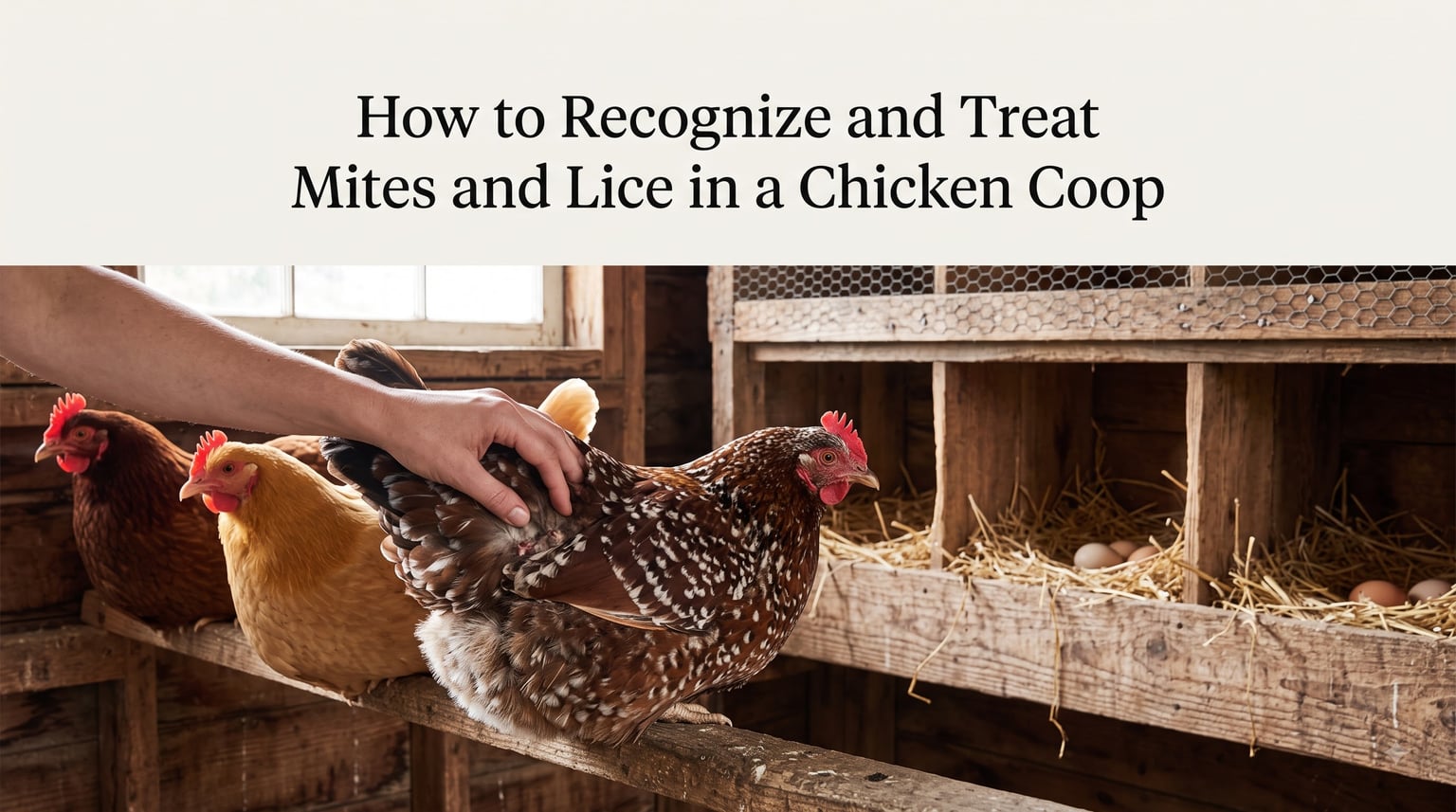
I check my flock every week by catching each bird and parting the feathers around the vent. Hold the bird under one arm, lift the tail feathers, and look closely at the skin. Northern fowl mites appear as tiny red or black moving specks. Lice look like fast-moving, yellowish insects about the size of a sesame seed, and you may see clusters of white eggs glued to the feather shafts.
Roosters often show infestation first because they dust bathe less frequently than hens. If you keep a rooster, make him your canary. When I notice my rooster looking ruffled, I immediately inspect the entire flock.
How to Recognize and Treat Mites and Lice in a Chicken Coop: Common Mite Types
Not all mites behave the same way, and identifying which type you are dealing with changes your treatment approach. The three mites below account for nearly all backyard flock infestations.
Northern Fowl Mite
The northern fowl mite lives its entire life cycle on the bird. These mites are dark red or black, about the size of a pinhead, and congregate around the vent and tail area. A heavy infestation makes the feathers around the vent look crusty and dark from mite droppings and dried blood.
Northern fowl mites reproduce rapidly, with a life cycle of just 5 to 7 days. Each female lays thousands of eggs in the feather shafts near the vent. Because they never leave the bird, you must treat the birds directly to eliminate them.
Red Roost Mite (Chicken Mite)
Red roost mites are the sneakiest parasites in the coop. They hide in cracks, crevices, and roosts during the day and crawl onto sleeping chickens at night to feed on blood. During the day, they appear gray or white. After feeding, they turn bright red.
This nocturnal behavior makes red roost mites hard to detect. Check roosts, nesting boxes, and coop cracks at night with a flashlight. Dirty eggs in nesting boxes are often the first clue, since mites leave behind blood spots and droppings.
Red roost mites can survive off the host for months, so treating the coop is just as important as treating the birds. A single female can lay up to 100,000 eggs in her lifetime.
Scaly Leg Mite
Scaly leg mites burrow under the scales on your chickens’ legs and feet. They cause the scales to lift, thicken, and crust over, giving the legs a rough, deformed appearance. Left untreated, scaly leg mites cause permanent deformity and lameness.
These mites spread through direct contact and shared roosts. Because they live under the skin, standard sprays and dusts do not reach them. Scaly leg mites require a completely different treatment approach, which I cover in detail below.
Poultry Lice vs Mites: How to Tell the Difference
Many chicken keepers confuse lice and mites, but they are completely different parasites. Knowing which one you have determines your treatment plan.
Lice are six-legged insects that live on the bird permanently. They are yellowish or tan, about 2 to 3 millimeters long, and move quickly through the feathers. Lice feed on feather debris and skin, not blood. You will see clusters of white eggs (nits) glued to the base of feather shafts, especially under the wings and around the vent.
Mites belong to the arachnid family and have eight legs. Most mite species feed on blood. Some live on the bird continuously (northern fowl mite), while others only visit at night (red roost mite). Mites appear as tiny red, black, or gray specks depending on species and whether they have fed recently.
The treatment difference matters. Because lice live entirely on the bird, you treat the birds directly and repeat in 7 to 10 days. With red roost mites, you must treat both the birds and every surface in the coop, since the mites spend daylight hours hiding in the structure.
If you see fast-moving yellowish insects with visible white egg clusters on feather shafts, you are dealing with lice. If you see tiny red or black specks crawling on skin, especially at night, you are looking at mites.
Step-by-Step Treatment Process
Treating mites and lice requires a systematic approach. Skip a step and the parasites come roaring back within two weeks. I learned this the hard way after my first infestation.
Step 1: Treat the Birds at Night
Treat your chickens after dark when they are calm and roosting. Birds are easier to handle at night, and this is also when red roost mites are actively feeding on the birds. Pick up each bird and apply your chosen treatment, paying special attention to the vent area, under the wings, and the back of the neck.
For sprays like Elector PSP (spinosad), dilute according to the label and spray each bird thoroughly, parting feathers to wet the skin. For permethrin dust, sprinkle directly onto the skin around the vent, under wings, and along the back, then work it into the feathers.
Step 2: Treat Every Bird
You must treat the entire flock, not just the birds showing obvious symptoms. Parasites spread through contact and shared roosting space. Missing even one bird creates a reservoir that reinfects the rest of the flock within days.
Step 3: Clean and Treat the Coop
Remove all bedding, nesting material, and droppings. Dispose of it away from the coop or burn it. Scrub roosts, walls, nesting boxes, and floors with a poultry-safe disinfectant. Then apply your insecticide spray to every crack, crevice, and joint in the coop structure, where red roost mites hide during the day.
Replace nesting material with fresh bedding. Consider adding herbs like mint or lavender to nesting boxes, which some keepers report help deter parasites, though they are not a substitute for chemical treatment during an active infestation.
Step 4: Treat Dust Bathing Areas
Chickens naturally dust bathe to control parasites. Help them out by adding food-grade diatomaceous earth or poultry dust to their dust bathing spots. This provides ongoing low-level parasite suppression between treatments.
Step 5: Mark Your Calendar and Repeat in 7 to 10 Days
This is the step most backyard keepers skip, and it is the reason reinfection is so common. The first treatment kills adult mites and lice but does not kill the eggs. New parasites hatch within a week, restarting the cycle.
Treat the entire flock and coop again 7 to 10 days after the first treatment to kill the newly hatched generation before they reproduce. Some poultry veterinarians recommend a third treatment for severe infestations.
Step 6: Monitor and Inspect Weekly
After treatment, inspect vent areas and roosts weekly for two months. Catching a resurgence early means you only need one treatment round instead of fighting a full-blown infestation again.
Scaly Leg Mite Treatment: The Oil Method
Scaly leg mites require a completely different treatment because they burrow under the leg scales. Sprays and dusts cannot reach them. The most effective home treatment suffocates them with oil.
Dip each affected bird’s legs in mineral oil, vegetable oil, or petroleum jelly. Coat the legs thoroughly, working the oil under the lifted scales. Repeat every 7 to 10 days for three to four weeks until the scales flatten and heal. Old, damaged scales will shed and regrow normally over several months.
For severe cases, some keepers combine the oil method with ivermectin applied to the skin. Consult a poultry veterinarian before using ivermectin, as it is off-label for poultry in many regions and requires an egg withdrawal period.
Always treat the entire flock, even if only one bird shows symptoms. Scaly leg mites spread through shared roosts, and asymptomatic birds may carry low-level infections.
The Diatomaceous Earth Debate: What Actually Works
Diatomaceous earth (DE) is the most controversial topic in backyard chicken keeping. Some swear by it. Others, including The Chicken Chick, strongly warn against using it on birds. The truth is somewhere in the middle.
Food-grade diatomaceous earth is a fine powder made from fossilized diatoms. The microscopic sharp edges damage the exoskeletons of insects, causing them to dehydrate. There is no question it can kill mites and lice in laboratory conditions.
However, DE has real limitations. It only works when perfectly dry, which is nearly impossible in a humid coop or on a chicken’s skin. It does not kill eggs, so you still need repeat applications. And it creates fine dust that can irritate chicken and human respiratory systems with prolonged exposure.
Based on forum experience from hundreds of backyard keepers, DE works reasonably well as a preventative measure in dust bathing areas. It does not work well for treating an active, established infestation. For active infestations, spinosad or permethrin products are far more reliable.
If you use DE, apply it only to dust bathing spots and coop bedding, never directly on birds. Wear a mask to avoid inhaling the fine dust, and choose food-grade DE only, never pool-grade.
Natural and Pesticide-Free Alternatives
Some chicken keepers prefer to avoid chemical insecticides entirely. While natural methods require more persistence, they can be effective for mild to moderate infestations.
Heat treatment is one pesticide-free approach that works well for coop-level red roost mites. Using a propane torch, carefully pass the flame over roosts, cracks, and crevices where mites hide. The heat kills mites and eggs on contact. Take extreme care around bedding and wood to avoid fire. Some keepers use a heat gun as a safer alternative.
Mechanical removal involves scrubbing every surface of the coop with hot soapy water and a stiff brush. This physically removes mites and eggs from hiding spots. Combined with frequent bedding changes, mechanical control disrupts the mite life cycle without chemicals.
Enhanced dust baths with a mix of sand, wood ash, and food-grade DE give chickens a powerful natural tool. Birds coat their feathers in the mixture, which helps smother and deter external parasites between chemical treatments.
Can Chicken Mites Live on Humans?
This is one of the most common questions in chicken-keeping forums, and the answer is reassuring but with a caveat. Chicken mites cannot complete their life cycle on humans, and they cannot reproduce on human skin.
However, red roost mites and northern fowl mites will bite humans when their preferred hosts are unavailable. During severe infestations, mites may crawl onto your arms while you handle birds or clean the coop. The bites cause itchy red bumps that can last several days.
If you experience biting, wash affected skin with soap and warm water, change your clothes, and launder them in hot water. The real solution is treating the coop and flock to eliminate the source. Once the chicken mite population is under control, the human bites stop.
Poultry lice do not bite humans. They are species-specific and cannot survive on people.
Prevention: Keeping Your Coop Mite-Free
Prevention is dramatically easier than treatment. After fighting my first infestation, I built a prevention routine that has kept my flock parasite-free for over two years.
Quarantine all new birds. Keep new chickens separate for at least 30 days. Inspect and treat them for parasites before introducing them to your existing flock. New birds are the number one way parasites enter a clean coop.
Inspect weekly. Pick up a few birds each week and check vent areas and feather shafts. Catching an infestation in its first week means a single treatment round solves the problem.
Keep the coop clean and dry. Remove droppings weekly, change bedding regularly, and ensure good ventilation. Mites and lice thrive in damp, dirty environments with deep litter accumulation.
Limit wild bird access. Wild birds, especially sparrows and starlings, carry mites and lice. Screen vents and openings to keep them out of the coop area.
Maintain dust bathing areas. Provide covered dust bathing spots with clean sand and a sprinkle of poultry dust or DE. Chickens’ natural dust bathing behavior is their first line of defense against parasites.
Treat preventatively in warm months. Mite and lice populations explode in spring and summer. Some keepers apply a preventative treatment in early spring and again in midsummer to stay ahead of seasonal population booms.
Clean the coop between flocks. If you replace your flock, strip the coop completely, disinfect all surfaces, and treat with insecticide before introducing new birds. This breaks the cycle of persistent red roost mites that can survive months without a host.
Frequently Asked Questions
How do I tell if my chicken has mites or lice?
Check the vent area and under the wings for crawling insects or white egg clusters on feather shafts. Look for dirty vent feathers, a pale comb, decreased egg production, and excessive scratching. Northern fowl mites appear as tiny red or black specks on the skin. Lice look like fast-moving yellowish insects with visible white eggs glued to feather shafts.
What does a mite in a chicken coop look like?
Chicken mites are about the size of a pinhead. Northern fowl mites are dark red or black and cluster around the vent. Red roost mites appear gray or white when unfed and bright red after a blood meal. They hide in coop cracks and roosts during the day and feed on chickens at night. Scaly leg mites are invisible to the naked eye but cause leg scales to lift and crust over.
How long does it take to get rid of mites in a chicken coop?
A complete treatment cycle takes 14 to 20 days. The first treatment kills adult mites and lice. A second treatment applied 7 to 10 days later kills the newly hatched generation from eggs that survived the first round. Severe infestations may require a third treatment. Red roost mites that have colonized the coop structure can take a month or more to fully eliminate.
Will diatomaceous earth kill mites and lice on chickens?
Diatomaceous earth can kill mites and lice in dry conditions by damaging their exoskeletons, but it does not kill eggs and is unreliable for active infestations. It works better as a preventative in dust bathing areas than as a treatment on birds. For active infestations, poultry-safe insecticides like spinosad (Elector PSP) or permethrin are far more effective. DE also creates fine dust that can irritate respiratory systems.
Can chicken mites live on humans?
Chicken mites cannot reproduce or complete their life cycle on humans. However, red roost mites and northern fowl mites will bite humans during severe infestations, causing itchy red bumps. The bites are temporary and stop once you treat the flock and coop. Poultry lice do not bite humans at all.
What is the best treatment for scaly leg mites?
Coat the affected bird’s legs in mineral oil, vegetable oil, or petroleum jelly to suffocate the burrowing mites. Repeat every 7 to 10 days for three to four weeks until scales flatten and heal. For severe cases, consult a poultry veterinarian about ivermectin. Always treat the entire flock, since scaly leg mites spread through shared roosts.
Conclusion
Knowing how to recognize and treat mites and lice in a chicken coop comes down to three core principles: inspect weekly, treat the entire flock and coop at the same time, and always repeat the treatment in 7 to 10 days to catch the newly hatched generation.
The difference between a minor nuisance and a flock-threatening infestation is speed. Catch parasites early with weekly vent checks, act immediately with a proven treatment, and stay disciplined with prevention through quarantine, coop hygiene, and maintained dust bathing areas.
Keep a poultry-safe treatment on hand before you need it. When you spot the first signs, you want to act that night, not wait for a delivery. Your flock will thank you with healthy feathers, bright combs, and a steady supply of eggs.