
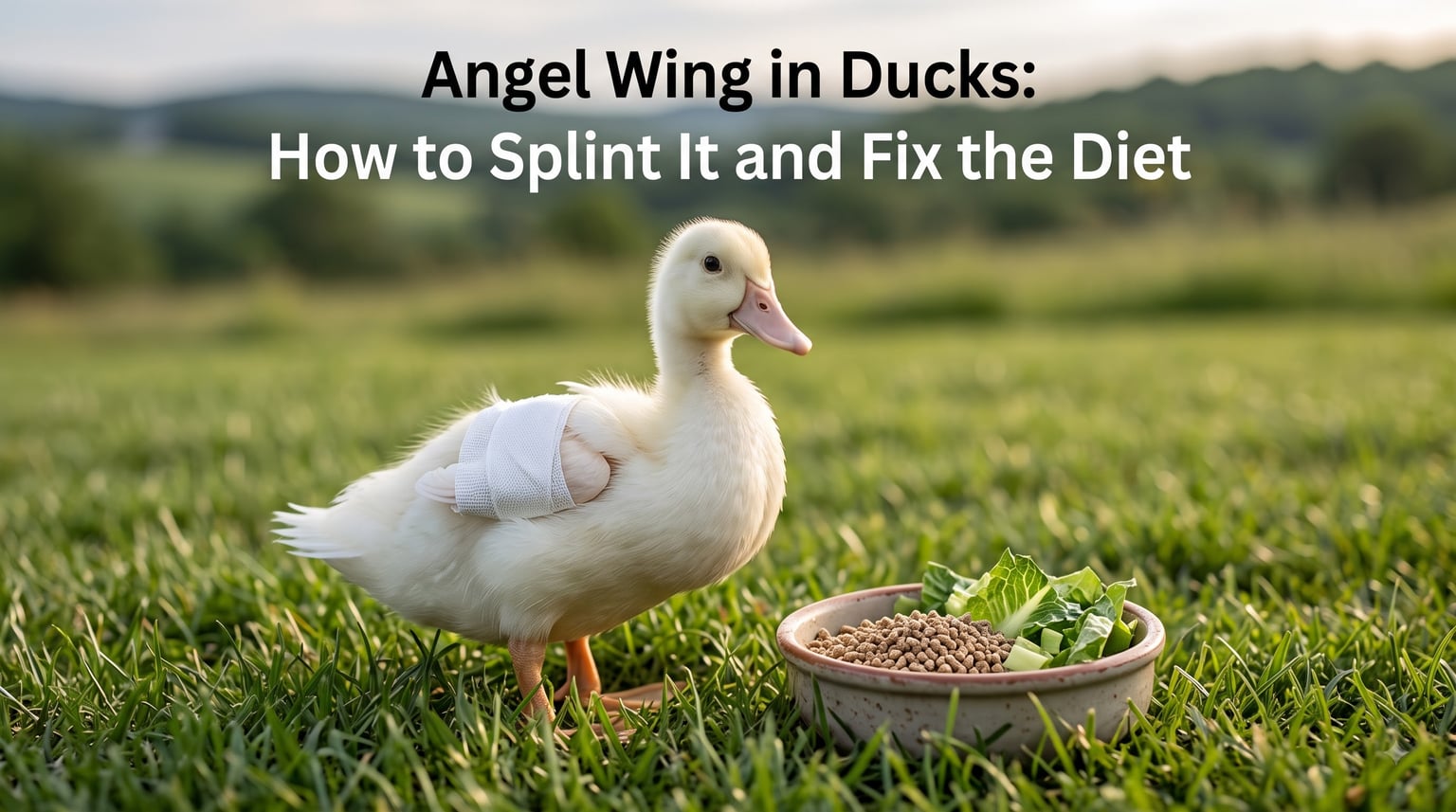
If you’ve noticed your duckling’s wing sticking out at an odd angle, you may be looking at angel wing. I want to walk you through everything I’ve learned about this common waterfowl wing deformity, including how to spot it early, splint it correctly, and adjust your duck’s diet so the wing grows back into place.
Angel wing in ducks is a treatable condition, but timing is everything. Most ducklings show signs between 2 and 12 weeks of age. If you catch it before that window closes, a simple wrap combined with smarter feeding can correct the wing and save your duck from a lifetime of an awkward wing position. I’ll show you exactly how to do both.
Table of Contents
What Is Angel Wing in Ducks?
Angel wing is a wing deformity where the last joint of the wing (the carpal joint) twists outward, causing the primary flight feathers to stick out sideways instead of lying flat against the body. Vets call this a valgus deformity because the wing rotates away from the duck’s side at an unnatural angle.
The good news: angel wing is a cosmetic condition, not a painful one. Your duck won’t wince or limp from it. The practical downside is that ducks with permanent angel wing can’t fly well, which puts them at higher risk from predators and prevents them from roosting safely at night.
Early Signs of Angel Wing in Ducklings
Catching angel wing early is the single biggest factor in successful treatment. Here’s what I look for during our weekly checks:
Wing tip sticking out perpendicular to the body when the duck is resting
Primary flight feathers visibly splayed instead of tucked neatly
One wing drooping lower than the other
Visible rotation at the carpal joint (the bend looks “wrong”)
The left wing is more commonly affected, though both wings can show symptoms. Wing position can look similar to a normal wing stretch, so I check the angle when the duckling is relaxed and standing still. Stretching is temporary; angel wing stays the same no matter how the duck moves.
What Causes Angel Wing in Ducks
Angel wing happens when feathers grow faster than the ligaments and muscles around the carpal joint can support. The heaviest flight feathers push the wing tip outward, and once it rotates past a certain angle, gravity keeps pulling it the wrong way.
The main trigger is diet. Specifically, feeding ducklings high-protein starter feeds for too long creates exactly the rapid growth that causes this wing deformity. Here are the protein guidelines I follow:
0 to 2 weeks: 18-20% protein (starter feed only is fine for this short window)
3 to 12 weeks: 16% protein or less (switch to grower feed)
Avoid bread, kitchen scraps, and excessive treats during the growth window
Mineral deficiencies also play a role. Vitamin E and manganese help ligaments develop properly, so feed lacking these nutrients makes angel wing more likely even on a reasonable protein level. Free-range foraging and greens help cover that gap naturally.
Angel Wing Severity: Mild, Moderate, and Severe
Before you wrap anything, you need to grade the severity. I use the same three-grade scale veterinarians use, and it determines whether wrapping will work or whether the wing has already set permanently.
Mild (Grade 1): Wing tip sticks out slightly, feathers visible at an angle but mostly aligned. Best response to wrapping.
Moderate (Grade 2): Wing tip clearly rotated 45 degrees or more outward. Wrapping still works but takes longer.
Severe (Grade 3): Wing tip points almost straight out from the body. Wrapping rarely corrects it; treatment focuses on comfort and acceptance.
If your duckling is past 12 weeks old, the bones and ligaments have hardened. Wrapping a Grade 1 or 2 wing early (around 3-8 weeks) gives the best results. After 12 weeks, the wing is usually set even if it still looks only mild.
How to Splint Angel Wing in Ducks: Step-by-Step Wing Wrapping
Splinting angel wing in ducks means wrapping the affected wing against the body so the carpal joint sits in its correct position. Materials are simple: self-adhering vet wrap (1 inch wide for ducklings), masking tape, and optionally a thin piece of pipe insulation for the tube method. Here’s how I do the two most reliable methods.
Figure-Eight Wrap (Best for Mild to Moderate Cases)
Hold the duck firmly but gently, supporting the body and tucking the head under your arm to keep it calm.
Fold the affected wing against the duck’s body in the correct position (feathers lying flat, wing tip pointing back toward the tail).
Start the vet wrap around the duck’s chest just behind the wing, going under the opposite wing.
Bring the wrap up and over the folded wing, then loop it back down and around in a figure-eight pattern that holds the wing tight to the body.
Make 3 to 4 passes, keeping tension even but not too tight (you should fit one finger between the wrap and the duck’s chest).
Secure the end with a small piece of masking tape so the duck can’t pull it off.
Tube Method (Best for Ducklings Who Wiggle Out of Wraps)
From forum discussions, many duck keepers report ducklings pulling off figure-eight wraps within hours. The tube method holds better:
Cut a 2 to 3 inch piece of foam pipe insulation (the kind used on copper pipes) and slit it lengthwise.
Fold the affected wing into correct position and slide the foam tube over the wing tip, covering the flight feathers completely.
Wrap a single band of vet wrap around the middle of the tube to keep it secure.
The rigid foam makes it much harder for the duckling to dislodge, while still allowing normal walking and swimming.
Wrapping Tips From Real Duck Keepers
Wrap in the early morning when ducklings are calm and sleepy, not after a feeding frenzy.
Leave the wrap on for 2 to 5 days, then remove and reassess. Most mild cases correct after one round.
Moderate cases may need 2 to 3 rounds over 2 to 3 weeks.
Never leave a wrap so tight it restricts breathing or cuts off circulation to the wing.
Diet Modifications to Fix and Prevent Angel Wing
Wrapping fixes the position, but diet fixes the cause. The protein level in your duckling’s feed is the single biggest lever you can pull. Here’s the exact plan I follow:
Switch from chick starter (18-20% protein) to a duck grower feed with 14-16% protein by 3 weeks of age.
Supplement with chopped greens: lettuce, kale, duckweed, peas, and grass clippings.
Offer alfalfa pellets as a daily supplement; they add fiber and minerals without spiking protein.
Allow at least 4 to 6 hours of outdoor foraging daily so the ducklings fill up on greens and insects.
Remove bread, crackers, and scratch grains from the diet during the growth window.
This diet change should start the same day you begin wrapping. The combination of correct wing position plus slower growth gives the carpal joint ligaments time to catch up with feather development.
How Long Does It Take to Fix an Angel Wing?
For mild cases caught early (between 3 and 6 weeks of age), one round of wrapping combined with dietary changes usually corrects the wing within 5 to 7 days. Moderate cases typically take 2 to 3 weeks of repeated wrapping cycles. Severe cases in older ducklings rarely correct fully, but the wing can still be stabilized to prevent worsening.
The critical cutoff is 12 weeks of age. After that, the wing bones have hardened into whatever position they’re in. This is why weekly monitoring during weeks 2 through 10 is so important.
Preventing Angel Wing in Future Ducklings
Once you’ve treated angel wing, preventing it in future ducklings is much easier. Prevention comes down to three habits:
Feed management: Start grower feed by week 3, never give bread, and keep protein steady around 16%.
Exercise: Provide plenty of room to walk, swim, and forage. Confined ducklings grow faster than their muscles can keep up.
Weekly checks: Take a photo of each duckling’s wings the same day every week so you can compare and spot changes early.
If you hatch or buy new ducklings, follow this plan from day one and you’ll likely never see angel wing show up in your flock again.
Frequently Asked Questions
Can angel wings on ducks be fixed?
Yes, angel wing in ducks can be fixed if caught early (before 12 weeks of age). The treatment combines wrapping the affected wing against the body in the correct position and switching to a lower-protein feed (16% or less). Most mild cases correct within 5 to 7 days, while moderate cases take 2 to 3 weeks of repeated wrapping.
Can you reverse angel wing in ducks?
Angel wing can be reversed in growing ducklings using wing wrapping combined with dietary changes that slow rapid growth. Once a duck is older than 12 weeks and the bones have hardened, the wing position becomes permanent and cannot be fully reversed, though the bird can still live a normal, healthy life.
Can an angel wing correct itself?
No, angel wing does not correct itself once the carpal joint has rotated past a mild angle. The weight of the growing flight feathers keeps pulling the wing outward. Active treatment (wrapping plus dietary changes) is required, and the window for correction closes around 12 weeks of age.
How long does it take to fix an angel wing?
Mild angel wing caught early typically corrects within 5 to 7 days of consistent wrapping and dietary changes. Moderate cases usually require 2 to 3 weeks of repeated wrapping cycles. After 12 weeks of age, full correction is unlikely regardless of treatment duration.
What causes angel wing syndrome in ducks?
Angel wing in ducks is caused by rapid growth that outpaces the development of ligaments and muscles around the carpal joint. The main triggers are high-protein feeds (above 18% protein for too long), excessive treats like bread, and vitamin E or manganese deficiencies. The heavy flight feathers push the wing tip outward before the supporting structures are strong enough to hold it in place.
What are the early signs of angel wing in ducklings?
The early signs of angel wing in ducklings include the wing tip sticking out perpendicular to the body while at rest, primary flight feathers splayed instead of tucked, visible rotation at the carpal joint, and one wing drooping lower than the other. Check ducklings weekly between 2 and 10 weeks of age, since early detection dramatically improves treatment success.
Does angel wing hurt ducks?
No, angel wing does not hurt ducks. It is a cosmetic condition in which the carpal joint rotates outward, causing the flight feathers to stick out sideways. Ducks with angel wing do not experience pain from the deformity itself, though they should still be protected from predators because the affected wing cannot support proper flight.
Final Thoughts on Treating Angel Wing in Ducks
Angel wing in ducks is one of the most treatable conditions in young waterfowl, as long as you catch it before 12 weeks. The combination of correct wing wrapping, lower-protein feed, and free access to greens and exercise corrects mild to moderate cases reliably. Even ducks with permanent angel wing live full, happy lives, so don’t panic if you find it late.
Start by checking your flock’s wings this week, switch any ducklings over 3 weeks old to grower feed, and keep vet wrap on hand in case you need it. Doing these three things puts you ahead of most duck keepers and gives every duckling the best shot at growing into a healthy adult.
1 thought on “Angel Wing in Ducks: How to Splint It (September 2026)”